Skip to content

Edexcel GCSE Chemistry questions by topic

Every question from every Edexcel GCSE Chemistry paper, 2018–2025, part by part. Filter by topic, paper or year, open the mark scheme under any question, and download a set as a PDF.

Find questions1,880
Topics Pick as many as you like. Open one to choose its sub-topics.

By area

Exam
All years
Calculations

1,880 questions

  1. Q1(a)(i)

    June 2025 · Paper 1 Higher

    1 mark
    The whole paper ↗
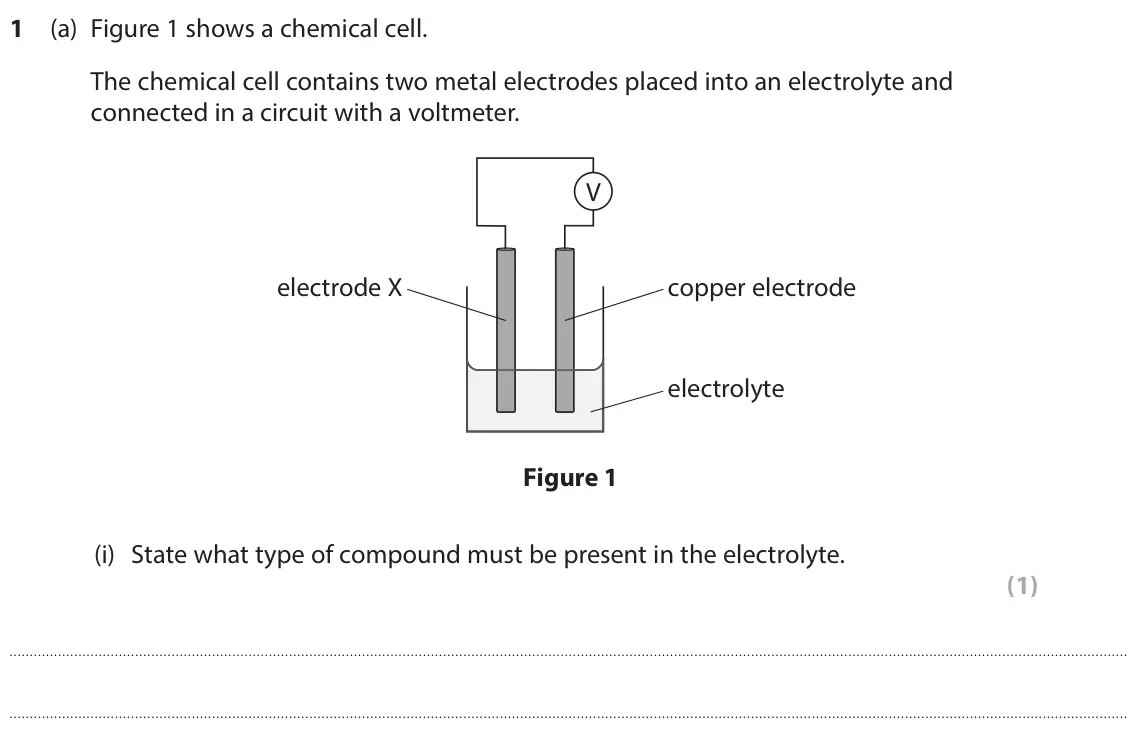
    June 2025 Paper 1 Higher, question 1(a)(i): State what type of compound must be present in the electrolyte. (1)
  2. Q1(a)(ii)

    June 2025 · Paper 1 Higher

    1 mark
    The whole paper ↗
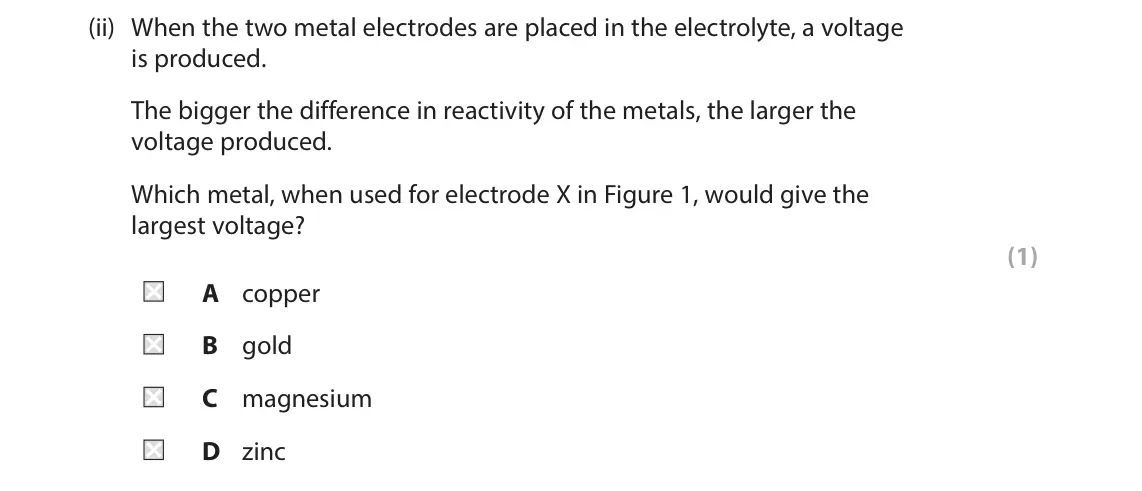
    June 2025 Paper 1 Higher, question 1(a)(ii): When the two metal electrodes are placed in the electrolyte, a voltage is produced. The bigger the difference in reactivity of the metals, the larger the voltag
  3. Q1(a)(iii)

    June 2025 · Paper 1 Higher

    1 mark
    The whole paper ↗
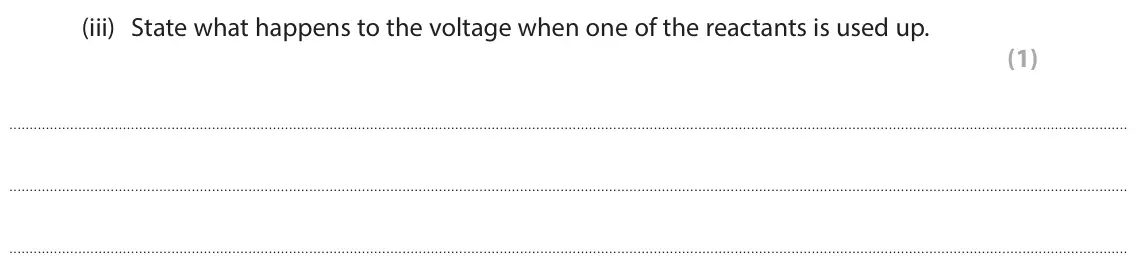
    June 2025 Paper 1 Higher, question 1(a)(iii): State what happens to the voltage when one of the reactants is used up. (1)
  4. Q1(b)(i)

    June 2025 · Paper 1 Higher

    2 marks
    The whole paper ↗
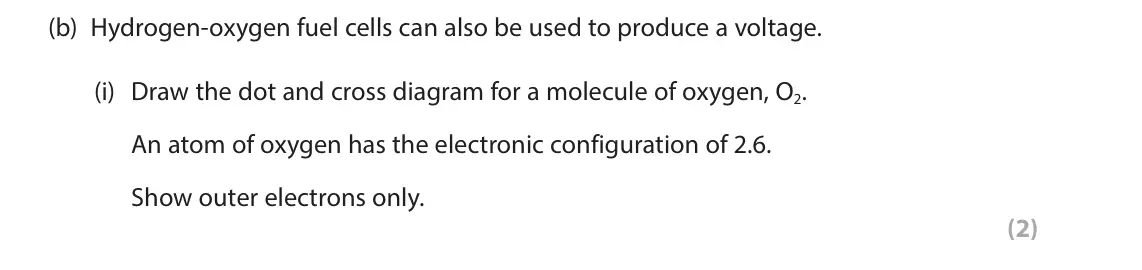
    June 2025 Paper 1 Higher, question 1(b)(i): Draw the dot and cross diagram for a molecule of oxygen, O2. An atom of oxygen has the electronic configuration of 2.6. Show outer electrons only. (2)
  5. Q1(b)(ii)

    June 2025 · Paper 1 Higher

    1 mark
    The whole paper ↗
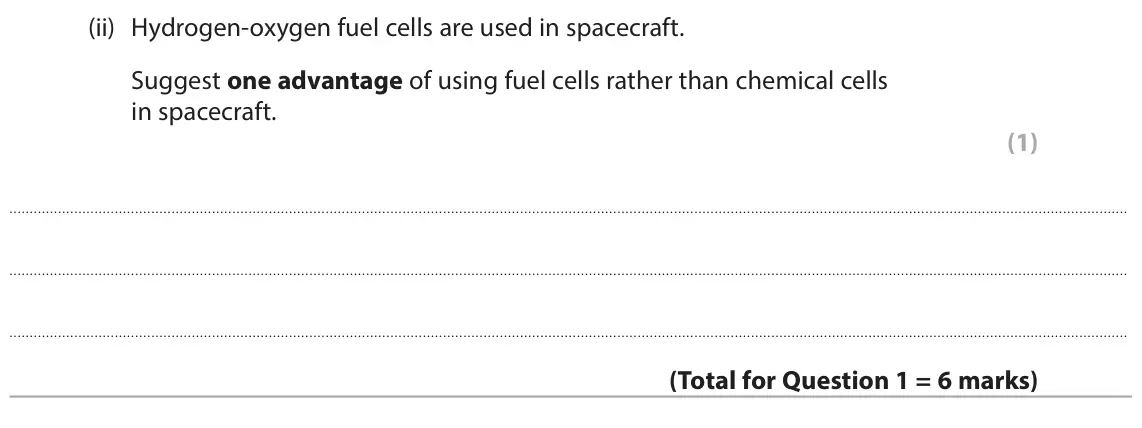
    June 2025 Paper 1 Higher, question 1(b)(ii): Hydrogen‑oxygen fuel cells are used in spacecraft. Suggest one advantage of using fuel cells rather than chemical cells in spacecraft. (1)
  6. Q2(a)(i)

    June 2025 · Paper 1 Higher

    3 marks
    The whole paper ↗
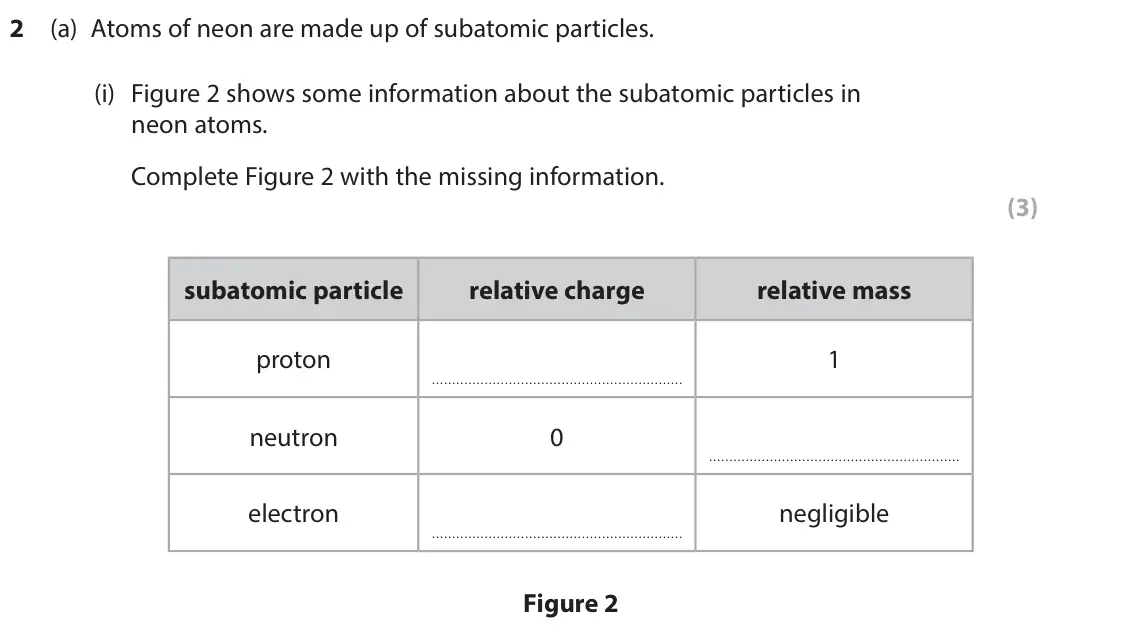
    June 2025 Paper 1 Higher, question 2(a)(i): Figure 2 shows some information about the subatomic particles in neon atoms. Complete Figure 2 with the missing information. (3) subatomic particle relative cha
  7. Q2(a)(ii)

    June 2025 · Paper 1 Higher

    2 marks
    The whole paper ↗
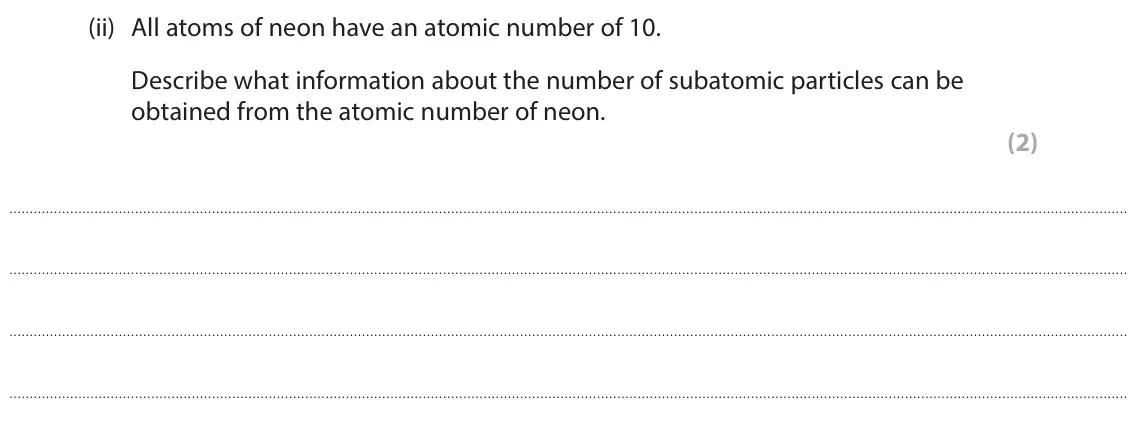
    June 2025 Paper 1 Higher, question 2(a)(ii): All atoms of neon have an atomic number of 10. Describe what information about the number of subatomic particles can be obtained from the atomic number of neon.
  8. Q2(a)(iii)

    June 2025 · Paper 1 Higher

    2 marks
    The whole paper ↗
    June 2025 Paper 1 Higher, question 2(a)(iii): Explain why atoms of neon are electrically neutral. (2)
  9. Q2(b)

    June 2025 · Paper 1 Higher

    2 marks
    The whole paper ↗
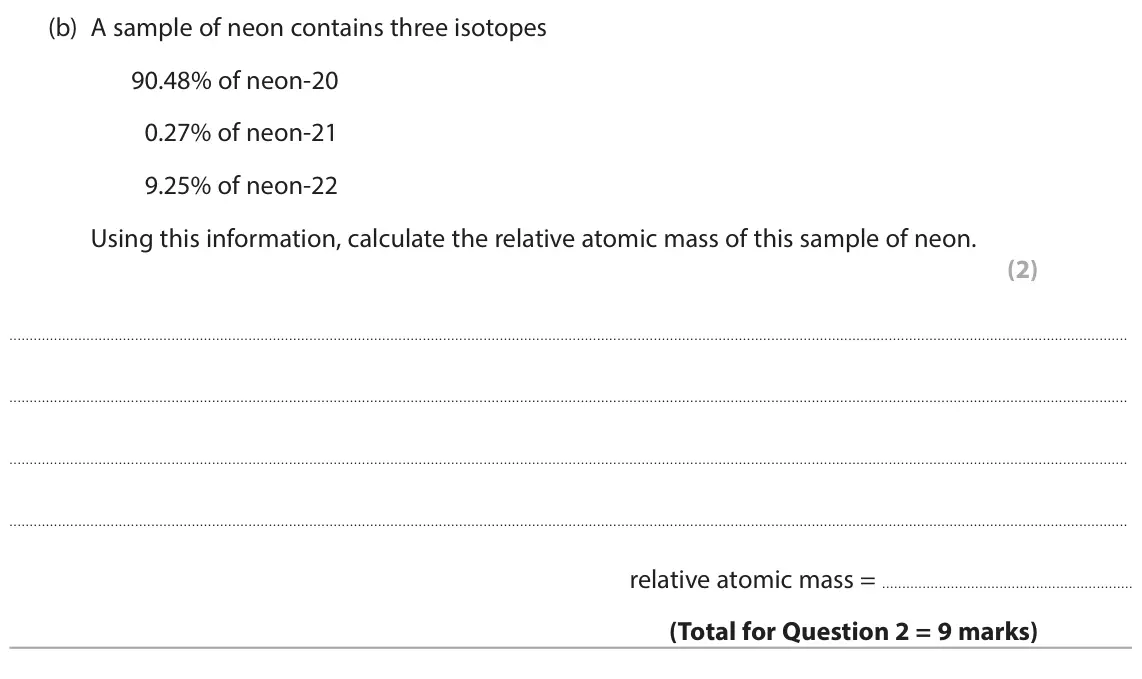
    June 2025 Paper 1 Higher, question 2(b): A sample of neon contains three isotopes 90.48% of neon-20 0.27% of neon-21 9.25% of neon-22 Using this information, calculate the relative atomic mass of this
  10. Q3(a)(i)

    June 2025 · Paper 1 Higher

    2 marks
    The whole paper ↗
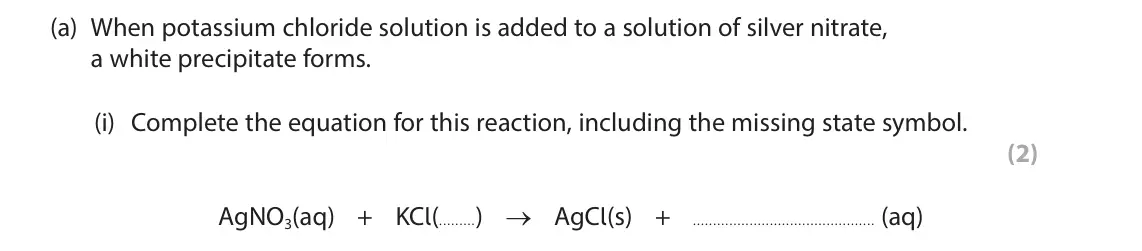
    June 2025 Paper 1 Higher, question 3(a)(i): Complete the equation for this reaction, including the missing state symbol. (2) AgNO3(aq) + KCl( ) → AgCl(s) + (aq)
  11. Q3(a)(ii)

    June 2025 · Paper 1 Higher

    1 mark
    The whole paper ↗
    June 2025 Paper 1 Higher, question 3(a)(ii): Give the name of the white precipitate that forms. (1)
  12. Q3(a)(iii)

    June 2025 · Paper 1 Higher

    3 marks
    The whole paper ↗
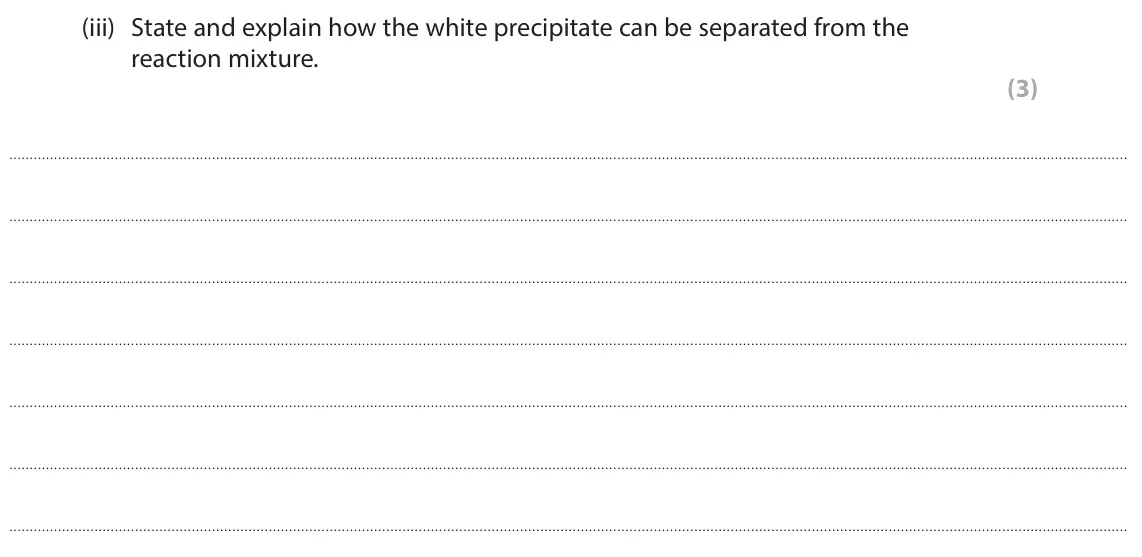
    June 2025 Paper 1 Higher, question 3(a)(iii): State and explain how the white precipitate can be separated from the reaction mixture. (3)
  13. Q3(b)

    June 2025 · Paper 1 Higher

    3 marks
    The whole paper ↗
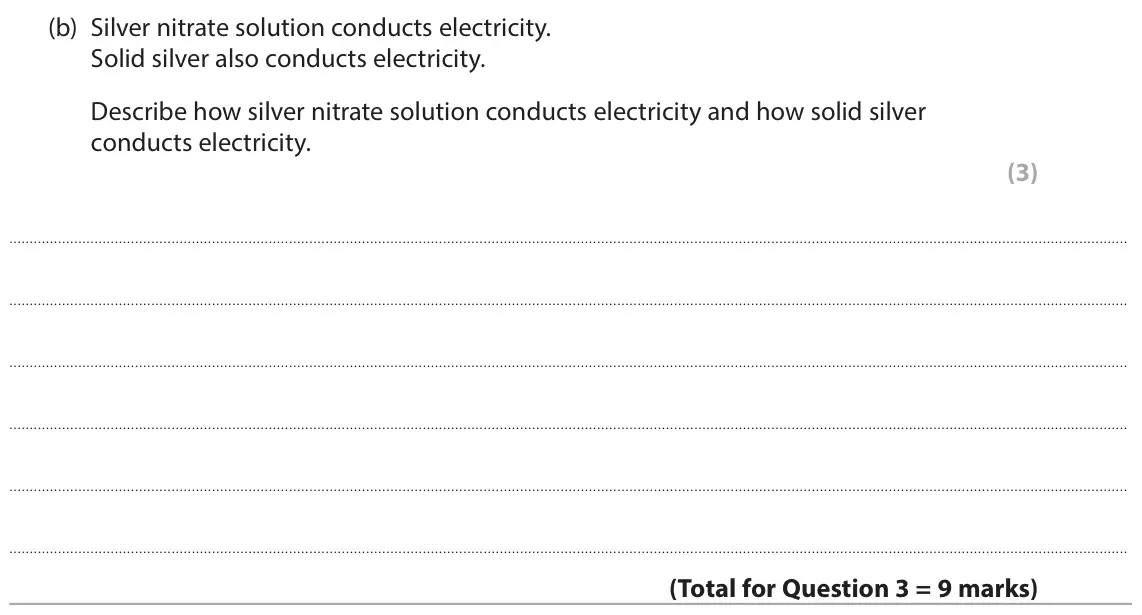
    June 2025 Paper 1 Higher, question 3(b): Silver nitrate solution conducts electricity. Solid silver also conducts electricity. Describe how silver nitrate solution conducts electricity and how solid si
  14. Q4(a)(i)

    June 2025 · Paper 1 Higher

    1 mark
    The whole paper ↗
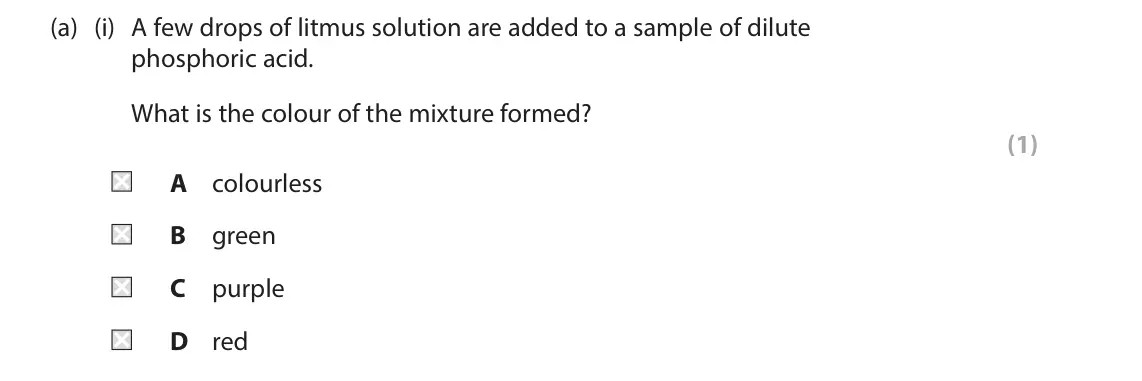
    June 2025 Paper 1 Higher, question 4(a)(i): A few drops of litmus solution are added to a sample of dilute phosphoric acid. What is the colour of the mixture formed? (1) A colourless B green C purple D re
  15. Q4(a)(ii)

    June 2025 · Paper 1 Higher

    1 mark
    The whole paper ↗
    June 2025 Paper 1 Higher, question 4(a)(ii): State why litmus cannot be used to measure pH. (1)
  16. Q4(b)

    June 2025 · Paper 1 Higher

    2 marks
    The whole paper ↗
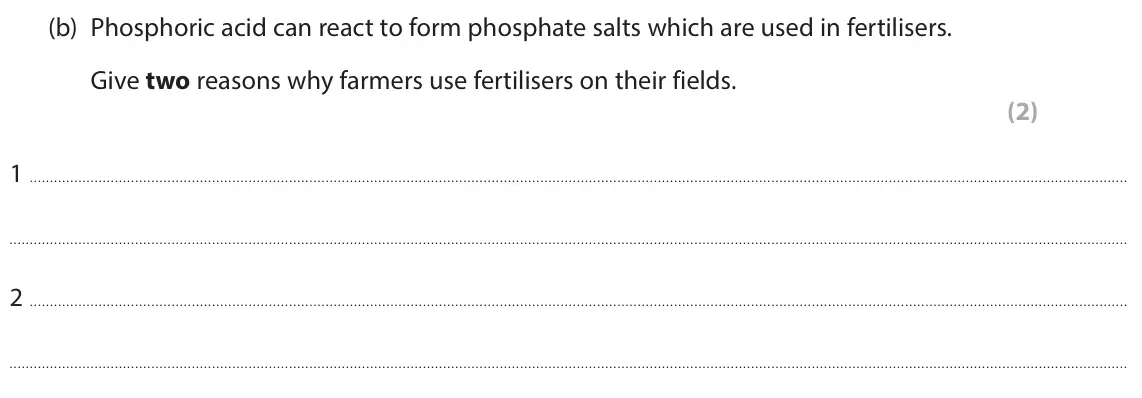
    June 2025 Paper 1 Higher, question 4(b): Phosphoric acid can react to form phosphate salts which are used in fertilisers. Give two reasons why farmers use fertilisers on their fields. (2) 1 2
  17. Q4(c)(i)

    June 2025 · Paper 1 Higher

    2 marks
    The whole paper ↗
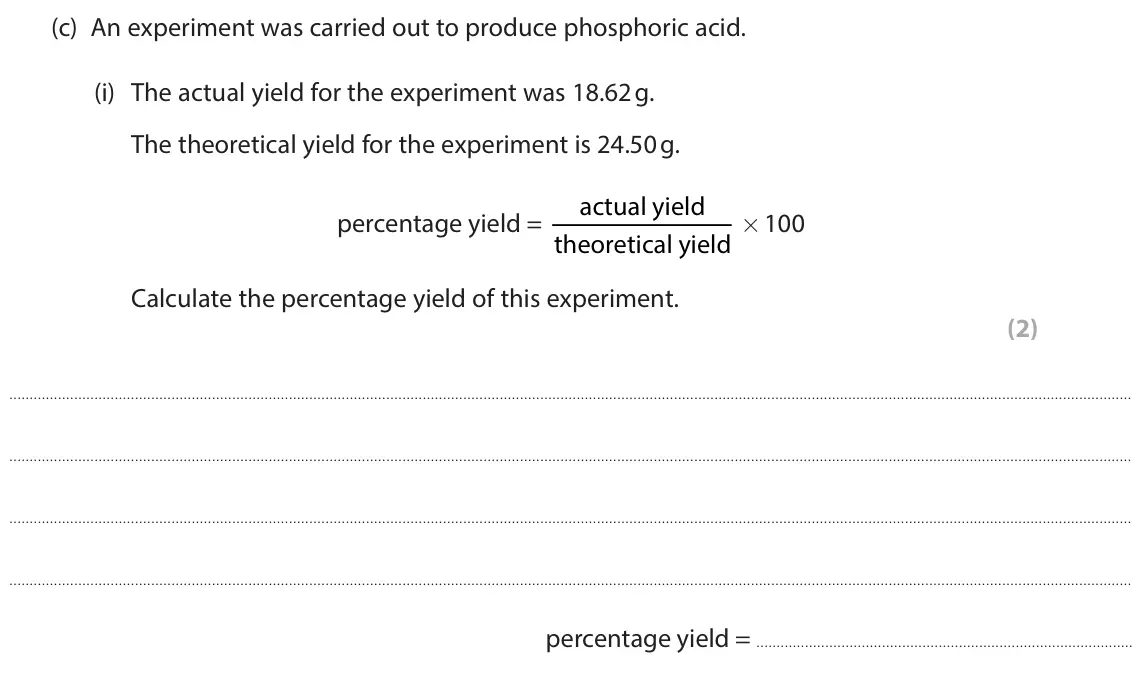
    June 2025 Paper 1 Higher, question 4(c)(i): The actual yield for the experiment was 18.62 g. The theoretical yield for the experiment is 24.50 g. actual yield percentage yield = theoretical yield × 100 Ca
  18. Q4(c)(ii)

    June 2025 · Paper 1 Higher

    3 marks
    The whole paper ↗
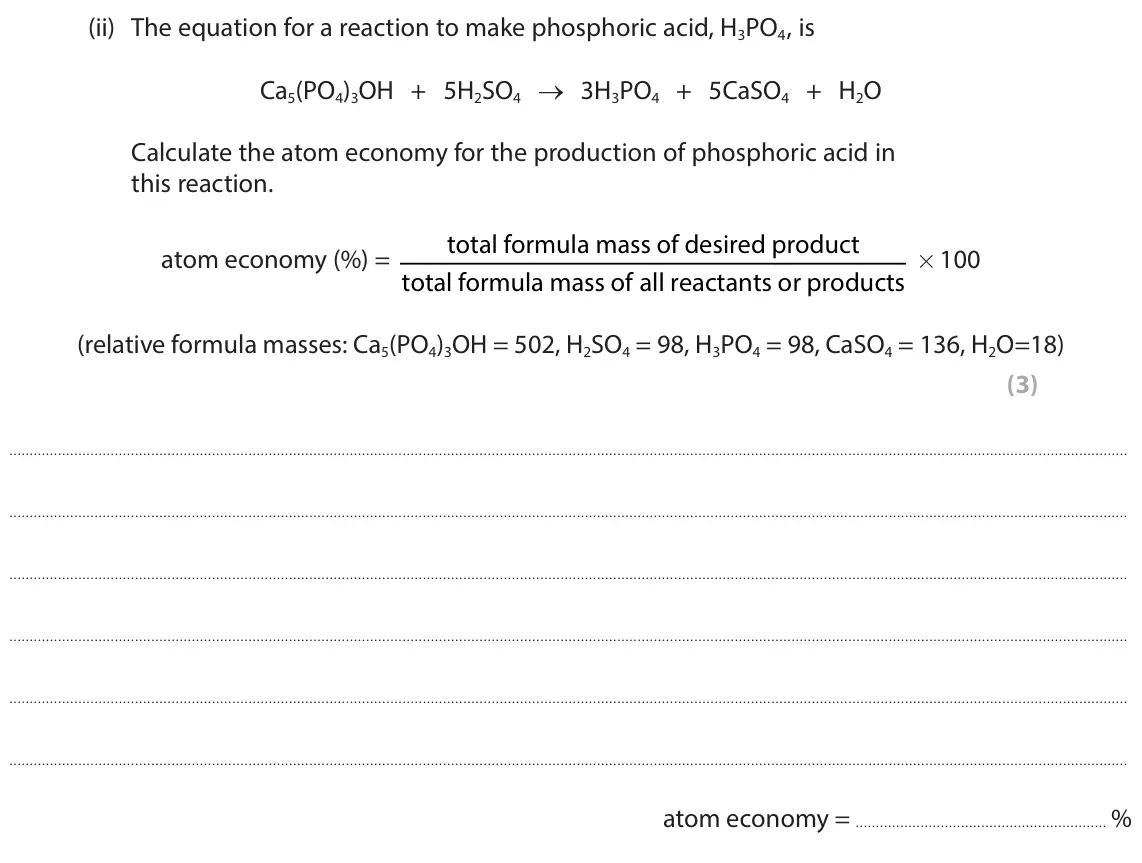
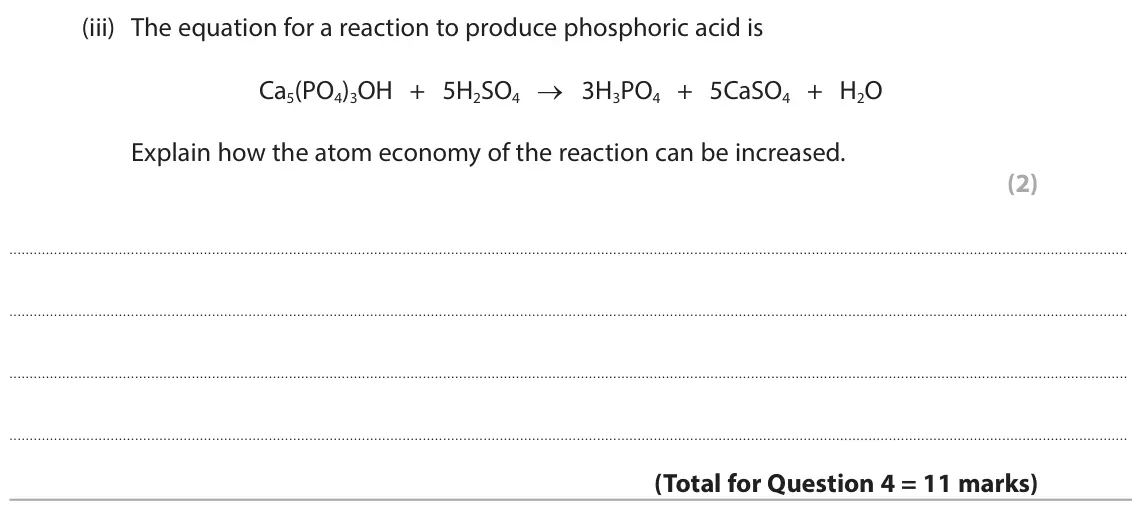
    June 2025 Paper 1 Higher, question 4(c)(ii): The equation for a reaction to make phosphoric acid, H3PO4, is Ca5(PO4)3OH + 5H2SO4 → 3H3PO4 + 5CaSO4 + H2O Calculate the atom economy for the production of pho
  19. Q4(c)(iii)

    June 2025 · Paper 1 Higher

    2 marks
    The whole paper ↗
    June 2025 Paper 1 Higher, question 4(c)(iii): The equation for a reaction to produce phosphoric acid is Ca5(PO4)3OH + 5H2SO4 → 3H3PO4 + 5CaSO4 + H2O Explain how the atom economy of the reaction can be incre
  20. Q5(a)

    June 2025 · Paper 1 Higher

    2 marks
    The whole paper ↗
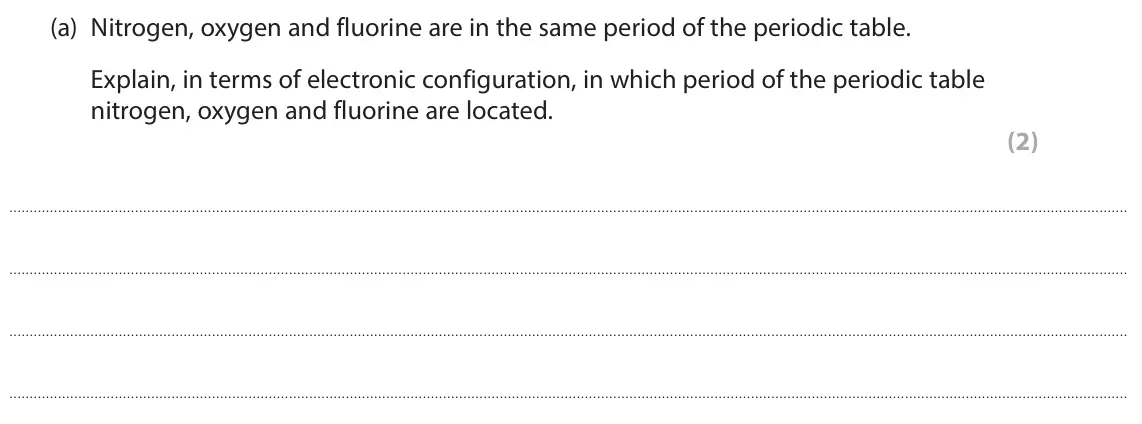
    June 2025 Paper 1 Higher, question 5(a): Nitrogen, oxygen and fluorine are in the same period of the periodic table. Explain, in terms of electronic configuration, in which period of the periodic table

Questions, mark schemes and examiner’s reports are © Pearson Edexcel, from their published past papers. Plumi isn’t affiliated with any exam board. Want whole papers? Every Edexcel GCSE Chemistry paper.

Rather write your answers by hand on iPad? Plumi marks them against the same mark schemes.