 plumi
Atomic structure and isotopes: Edexcel GCSE Chemistry questions
Every Edexcel GCSE Chemistry exam question on Atomic structure and isotopes (specification points 1.1–1.12), 2018–2025, with its mark scheme and examiner’s report.
Find questions1,880
Exam
All years
Calculations
Q2(a)(i)
The whole paper ↗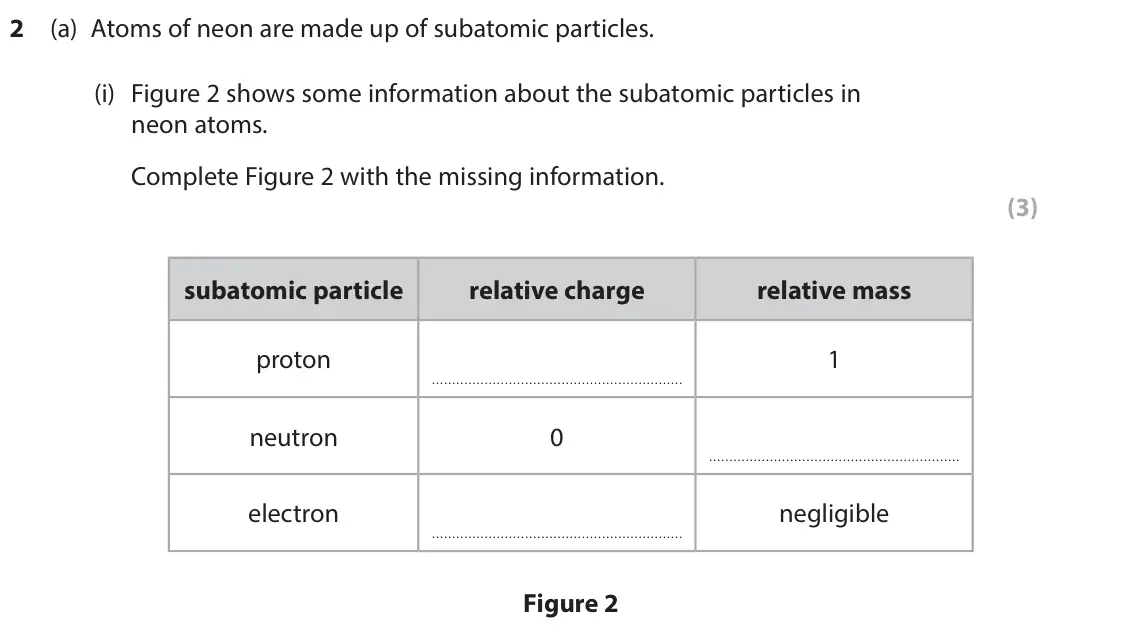
Q2(a)(ii)
The whole paper ↗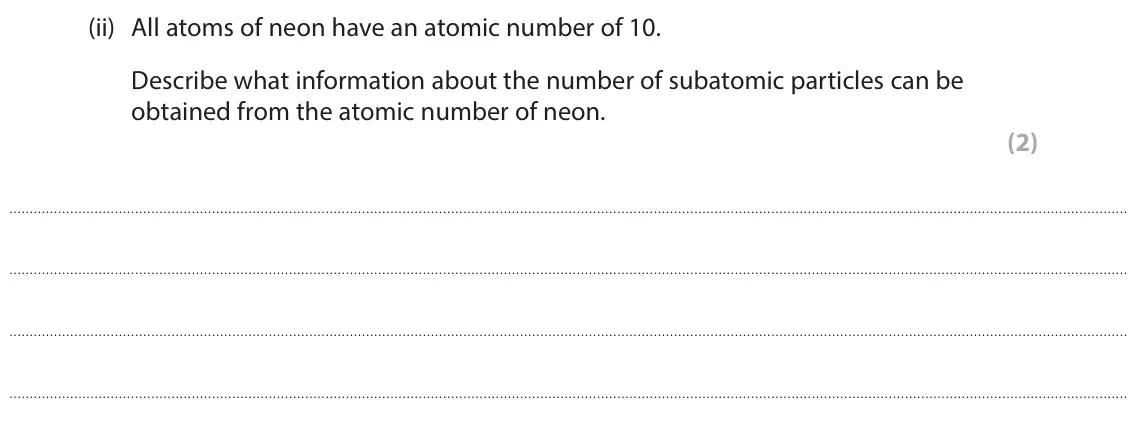
Q2(a)(iii)
The whole paper ↗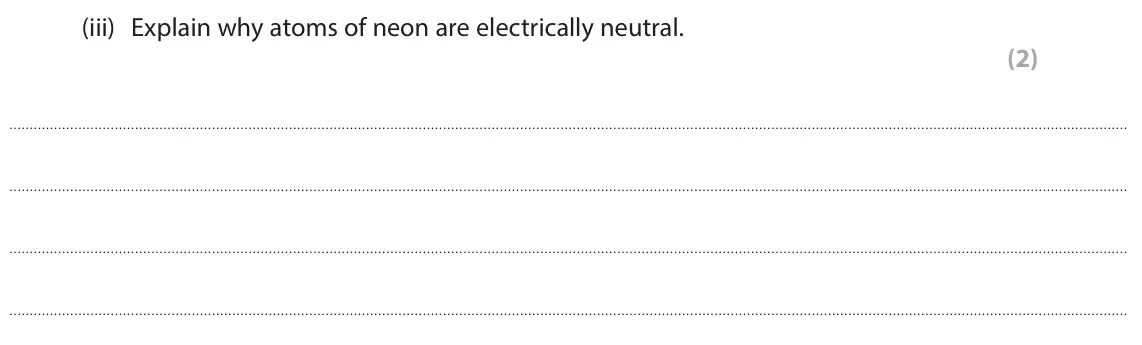
Q2(b)
The whole paper ↗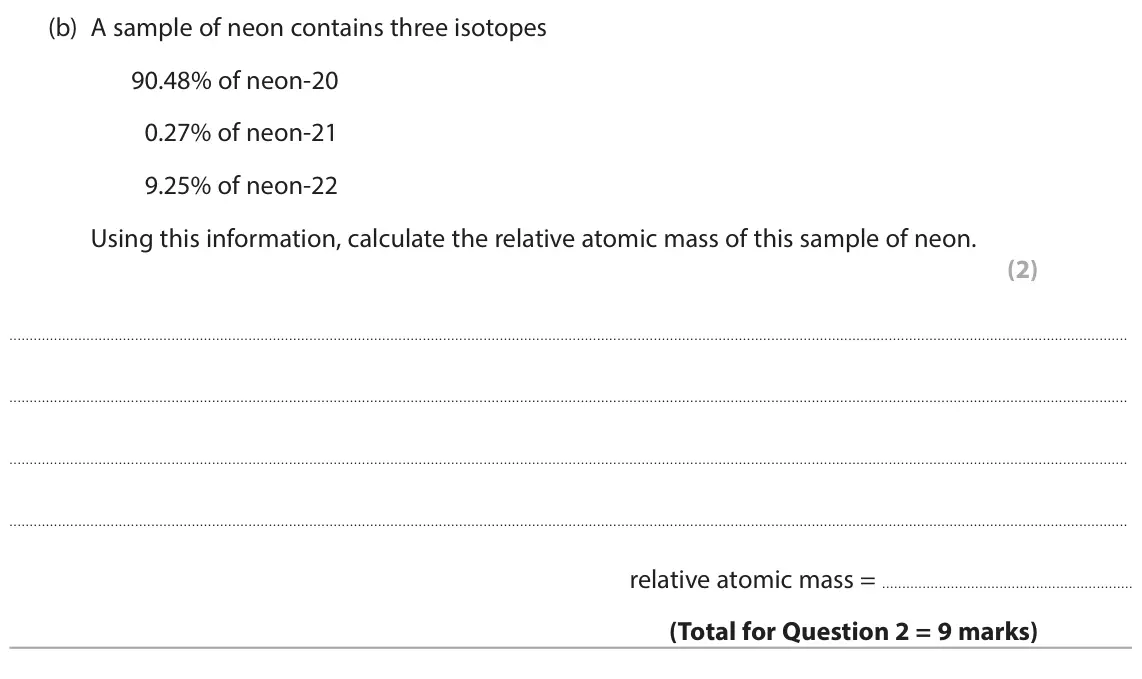
Q8(a)(i)
The whole paper ↗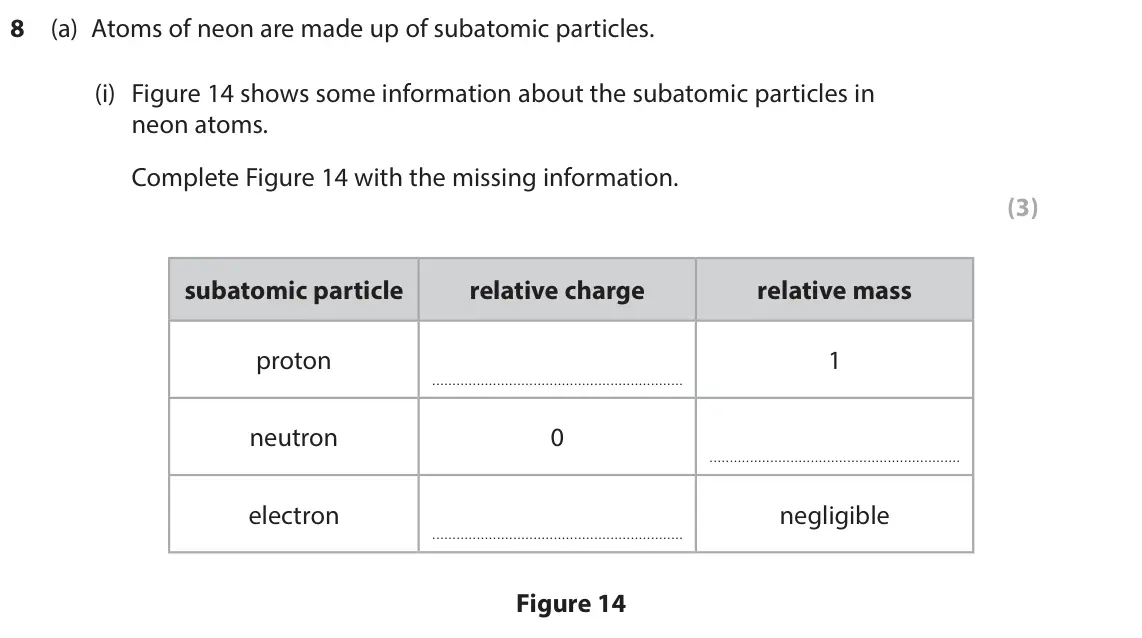
Q8(a)(ii)
The whole paper ↗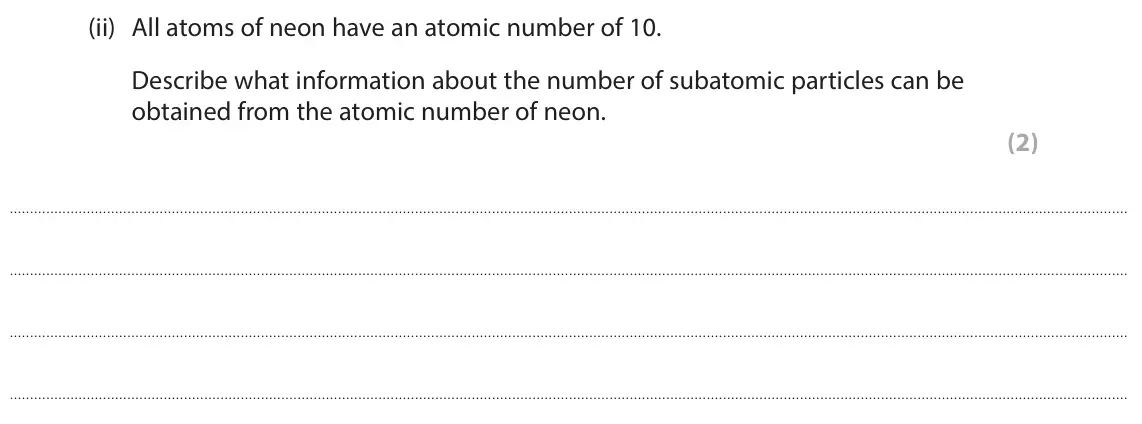
Q8(a)(iii)
The whole paper ↗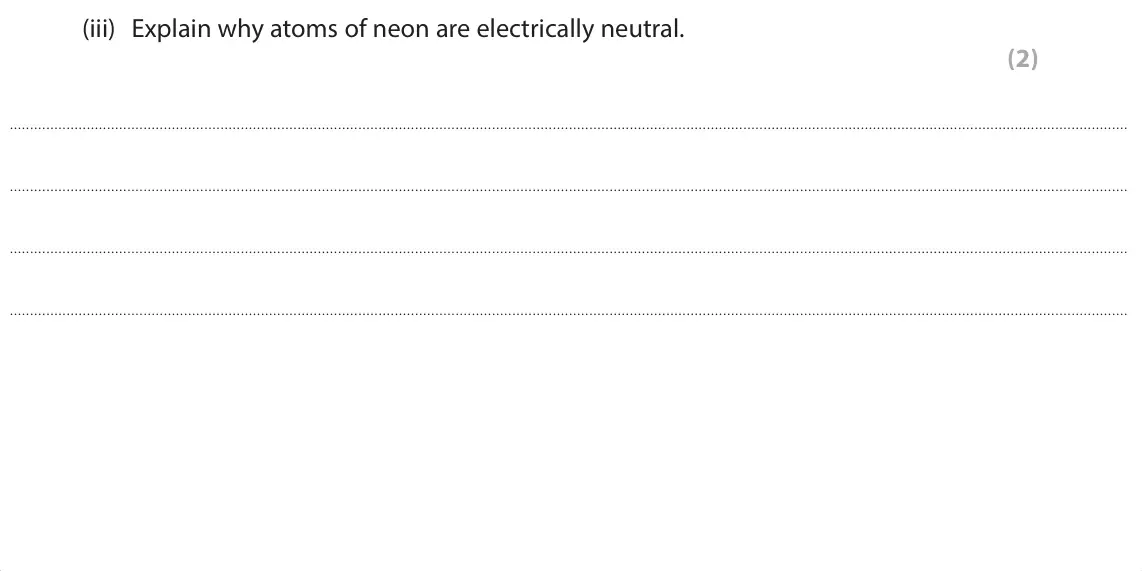
Q8(b)
The whole paper ↗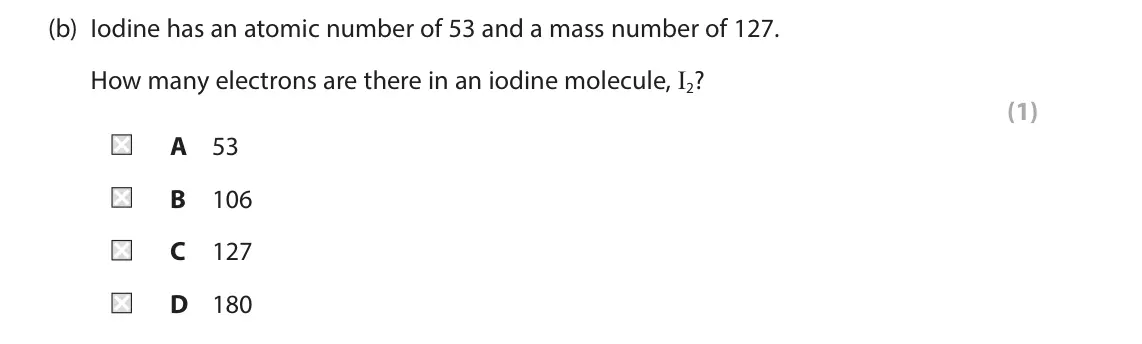
Q5(a)
The whole paper ↗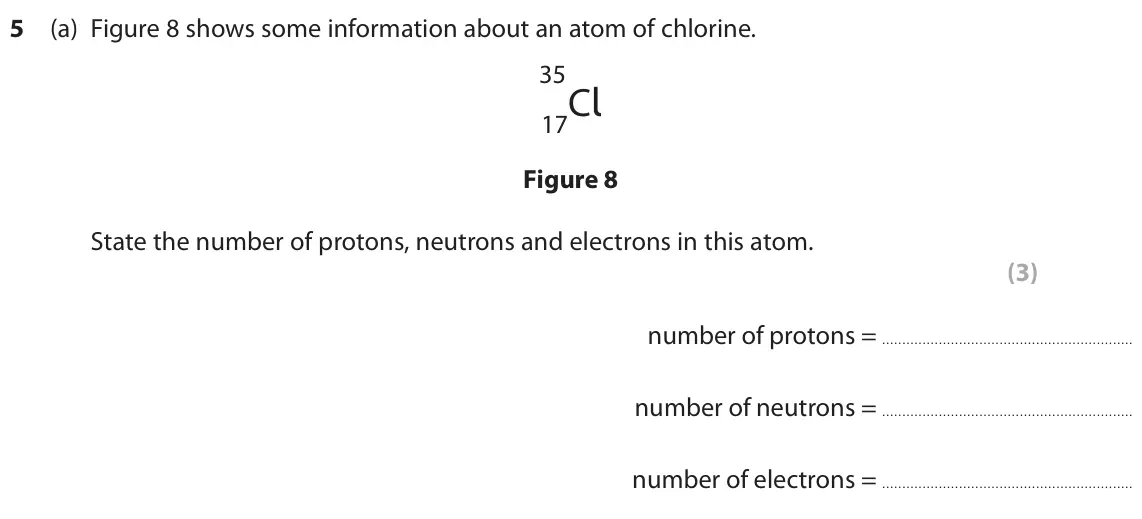
Q1(a)
The whole paper ↗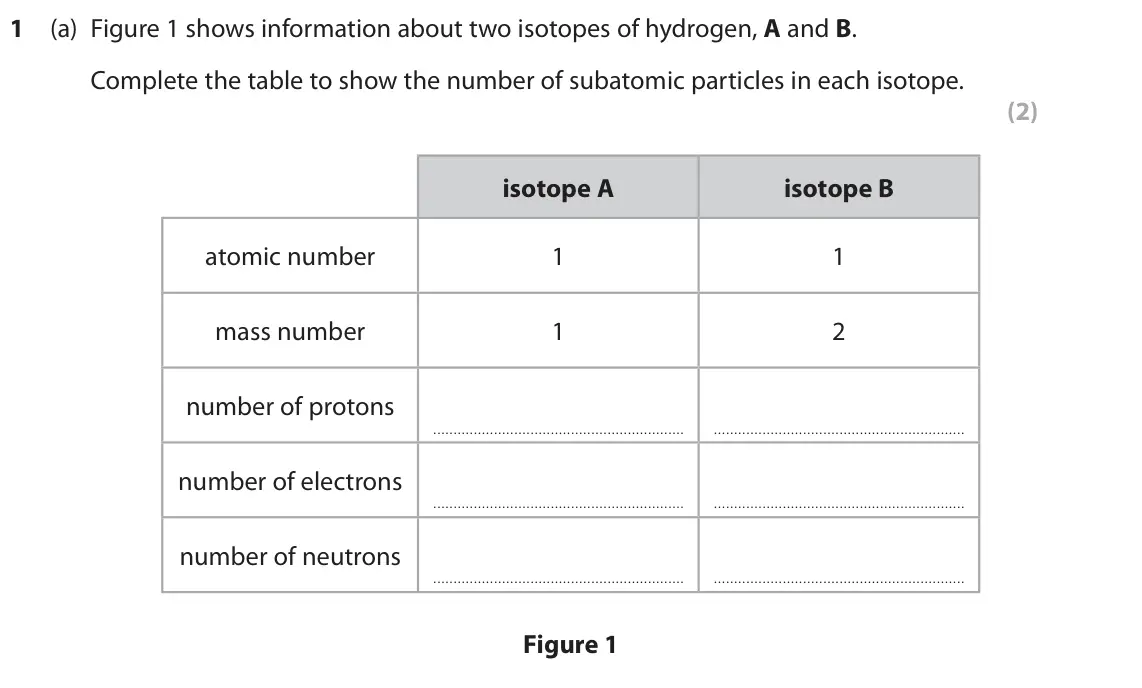
Q6(b)(i)
The whole paper ↗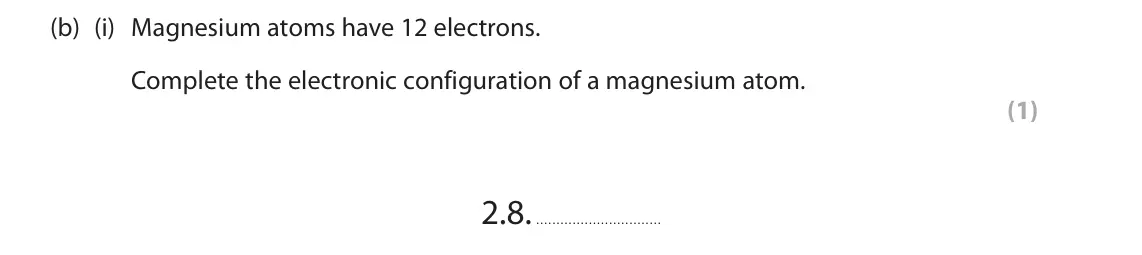
Q3(d)(i)
The whole paper ↗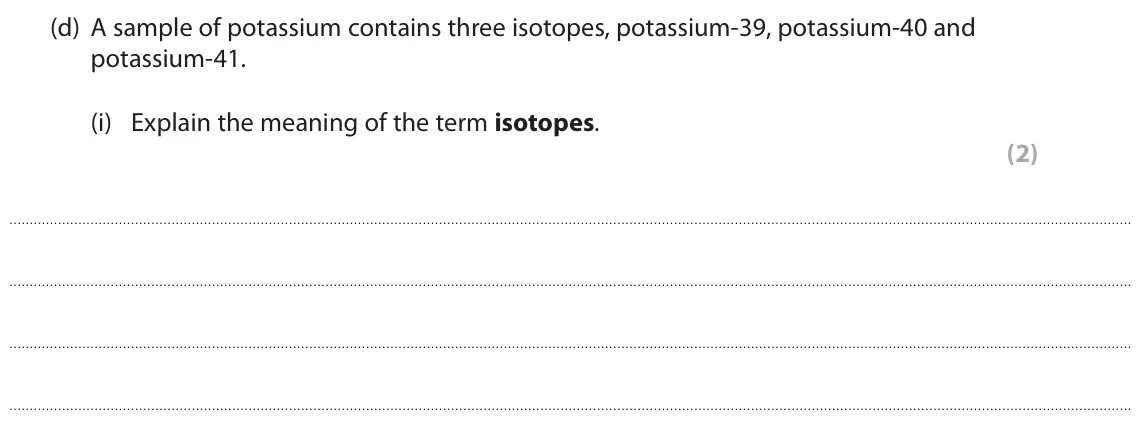
Q3(d)(ii)
The whole paper ↗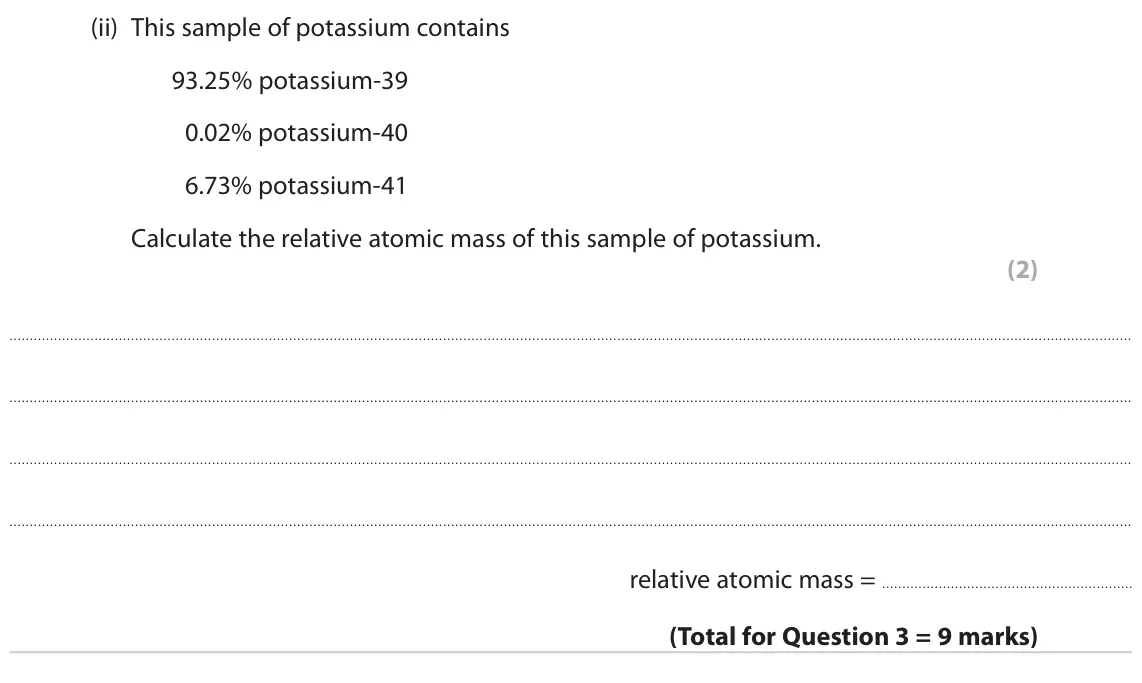
Q1(d)
The whole paper ↗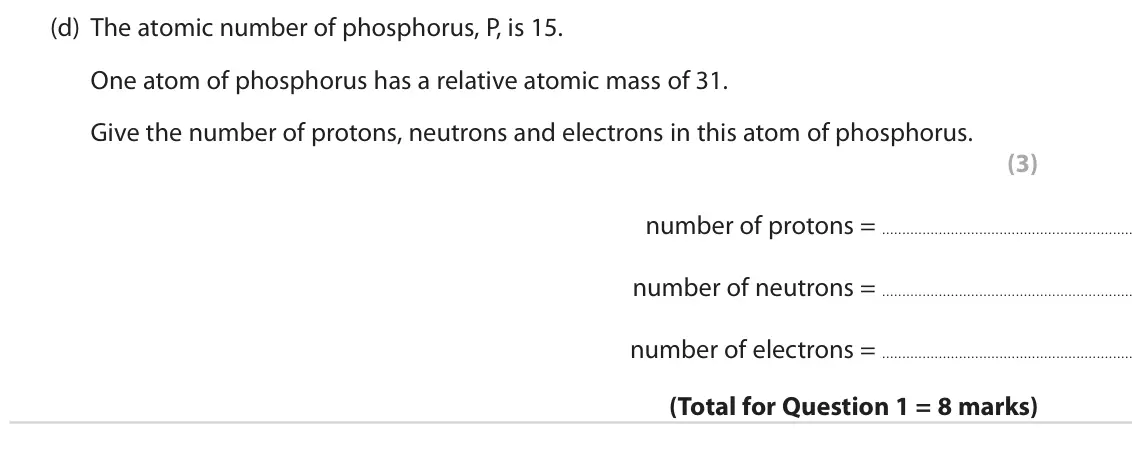
Q9(d)
The whole paper ↗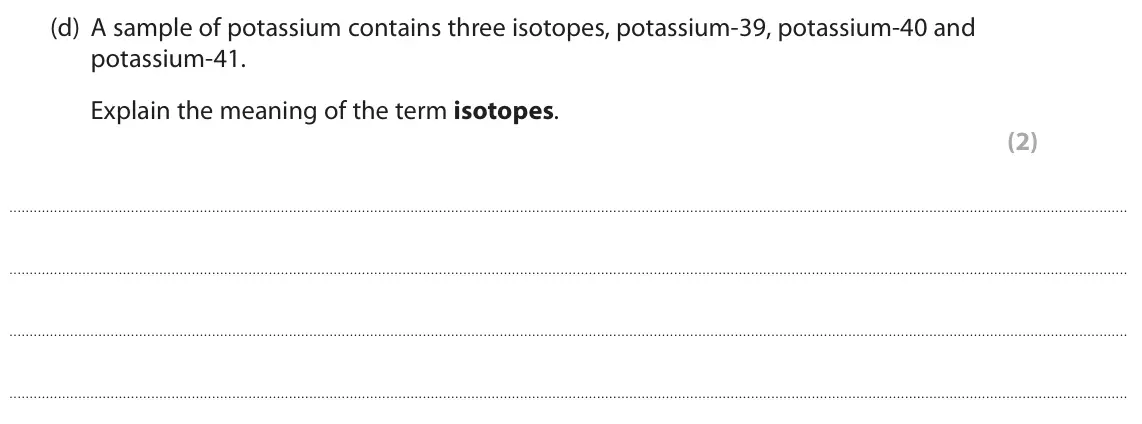
Q5(a)
The whole paper ↗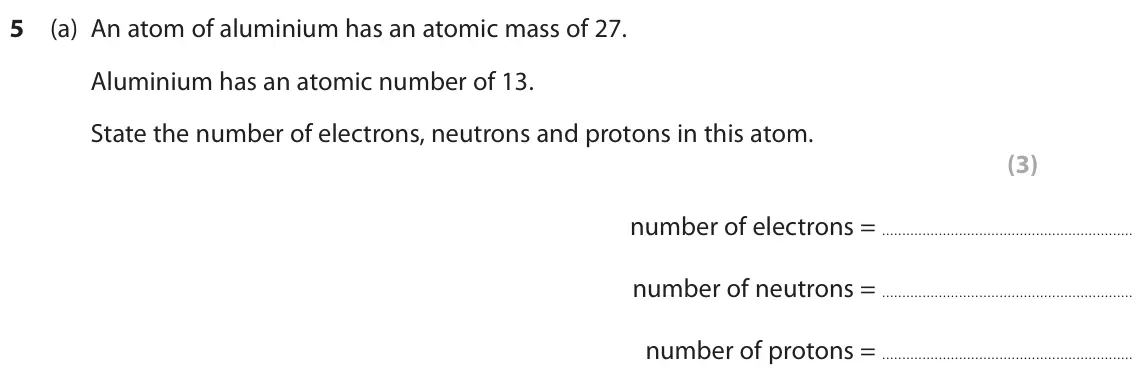
Q2(a)(ii)
The whole paper ↗
Q2(a)
The whole paper ↗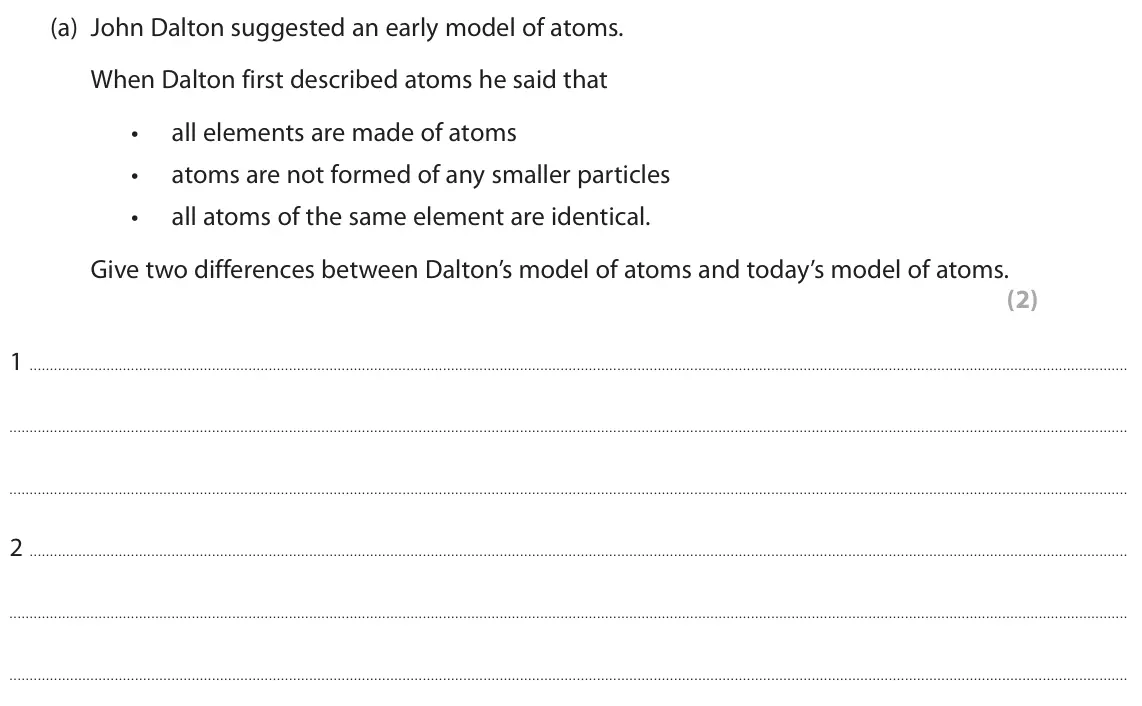
Q9(a)
The whole paper ↗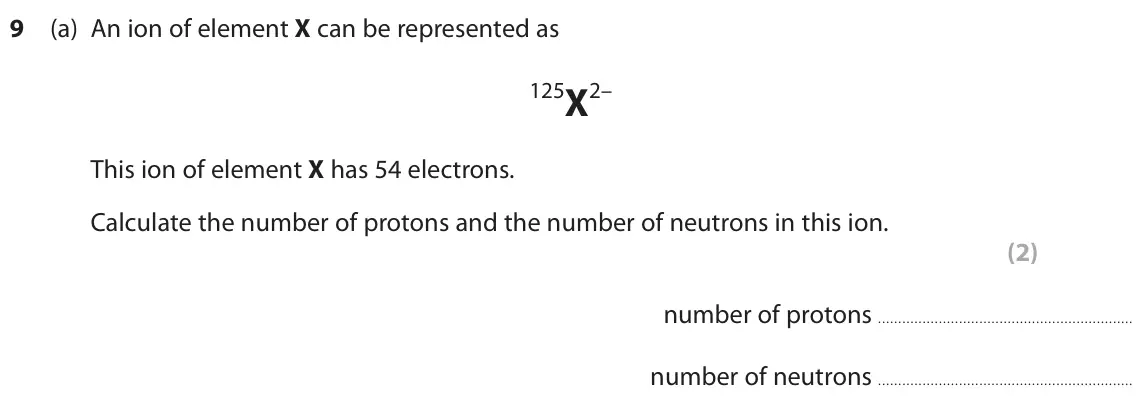
Q9(b)(i)
The whole paper ↗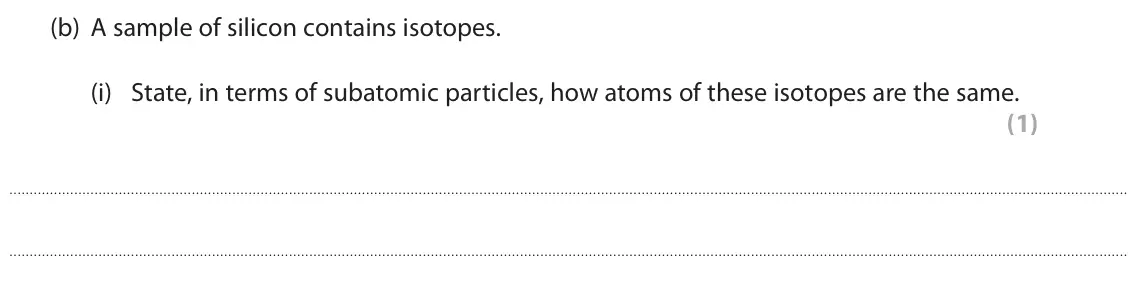
All 50 questions on Atomic structure and isotopes, as a list
- June 2025, Paper 1 Higher, Q2(a)(i) (3 marks): Figure 2 shows some information about the subatomic particles in neon atoms. Complete Figure 2 with the missing information. (3) subatomic particle relative cha
- June 2025, Paper 1 Higher, Q2(a)(ii) (2 marks): All atoms of neon have an atomic number of 10. Describe what information about the number of subatomic particles can be obtained from the atomic number of neon.
- June 2025, Paper 1 Higher, Q2(a)(iii) (2 marks): Explain why atoms of neon are electrically neutral. (2)
- June 2025, Paper 1 Higher, Q2(b) (2 marks): A sample of neon contains three isotopes 90.48% of neon-20 0.27% of neon-21 9.25% of neon-22 Using this information, calculate the relative atomic mass of this
- June 2025, Paper 1 Foundation, Q8(a)(i) (3 marks): Figure 14 shows some information about the subatomic particles in neon atoms. Complete Figure 14 with the missing information. (3) subatomic particle relative c
- June 2025, Paper 1 Foundation, Q8(a)(ii) (2 marks): All atoms of neon have an atomic number of 10. Describe what information about the number of subatomic particles can be obtained from the atomic number of neon.
- June 2025, Paper 1 Foundation, Q8(a)(iii) (2 marks): Explain why atoms of neon are electrically neutral. (2)
- June 2025, Paper 2 Higher, Q8(b) (1 mark): Iodine has an atomic number of 53 and a mass number of 127. How many electrons are there in an iodine molecule, I2? (1) A 53 B 106 C 127 D 180
- June 2024, Paper 1 Foundation, Q5(a) (3 marks): Figure 8 shows some information about an atom of chlorine. 35 17Cl Figure 8 State the number of protons, neutrons and electrons in this atom. (3) number of prot
- June 2023, Paper 1 Higher, Q1(a) (2 marks): Figure 1 shows information about two isotopes of hydrogen, A and B. Complete the table to show the number of subatomic particles in each isotope. (2) isotope A
- June 2023, Paper 1 Foundation, Q6(b)(i) (1 mark): Magnesium atoms have 12 electrons. Complete the electronic configuration of a magnesium atom. (1) 2.8.
- June 2023, Paper 2 Higher, Q3(d)(i) (2 marks): Explain the meaning of the term isotopes. (2)
- June 2023, Paper 2 Higher, Q3(d)(ii) (2 marks): This sample of potassium contains 93.25% potassium-39 0.02% potassium-40 6.73% potassium-41 Calculate the relative atomic mass of this sample of potassium. (2)
- June 2023, Paper 2 Foundation, Q1(d) (3 marks): The atomic number of phosphorus, P, is 15. One atom of phosphorus has a relative atomic mass of 31. Give the number of protons, neutrons and electrons in this a
- June 2023, Paper 2 Foundation, Q9(d) (2 marks): A sample of potassium contains three isotopes, potassium-39, potassium-40 and potassium-41. Explain the meaning of the term isotopes. (2)
- June 2022, Paper 1 Foundation, Q5(a) (3 marks): An atom of aluminium has an atomic mass of 27. Aluminium has an atomic number of 13. State the number of electrons, neutrons and protons in this atom. (3) numbe
- June 2022, Paper 2 Foundation, Q2(a)(ii) (1 mark): Give the atomic number of lithium. (1)
- November 2021, Paper 1 Higher, Q2(a) (2 marks): John Dalton suggested an early model of atoms. When Dalton first described atoms he said that • all elements are made of atoms • atoms are not formed of any sma
- November 2021, Paper 1 Higher, Q9(a) (2 marks): An ion of element X can be represented as 125X2– This ion of element X has 54 electrons. Calculate the number of protons and the number of neutrons in this ion.
- November 2021, Paper 1 Higher, Q9(b)(i) (1 mark): State, in terms of subatomic particles, how atoms of these isotopes are the same. (1)
- November 2021, Paper 1 Higher, Q9(b)(ii) (2 marks): This sample of silicon contains three isotopes. 92% of the atoms are silicon-28 5% of the atoms are silicon-29 3% of the atoms are silicon-30 Calculate the rela
- November 2021, Paper 1 Foundation, Q8(a) (2 marks): John Dalton suggested an early model of atoms. When Dalton first described atoms he said that • all elements are made of atoms • atoms are not formed of any sma
- November 2020, Paper 1 Higher, Q6(a) (3 marks): Figure 6 shows the percentage abundance of each isotope in a sample of titanium. 100 percentage abundance 90 80 70 60 50 40 30 20 10 0 Ti-46 Ti-47 Ti-48 Ti-49 T
- November 2020, Paper 1 Higher, Q8(a)(i) (1 mark): Which row of the table shows the number of protons and number of neutrons in this atom of calcium? (1) number of protons number of neutrons A 20 20 B 40 20 C 20
- November 2020, Paper 1 Foundation, Q2(a)(i) (1 mark): What is the electronic configuration of this atom? (1) A 10.7 B 17 C 2.8.7 D 7.8.2
- November 2020, Paper 1 Foundation, Q2(b)(i) (2 marks): Explain, using the information in Figure 3 and Figure 4, why atoms of chlorine have no overall charge. (2)
- November 2020, Paper 1 Foundation, Q2(b)(ii) (1 mark): Atoms of chlorine-37 have a mass number of 37. Calculate the number of neutrons in atoms of chlorine-37. (1) number of neutrons =
- November 2020, Paper 1 Foundation, Q2(b)(iii) (2 marks): There are two isotopes of chlorine, chlorine-35 and chlorine-37. Explain the meaning of the term isotopes. (2)
- November 2020, Paper 2 Higher, Q2(a)(i) (1 mark): Give the electronic configuration of this potassium atom. (1)
- November 2020, Paper 2 Higher, Q2(a)(ii) (1 mark): This potassium atom forms the ion K+. Which row shows the number of protons and the number of neutrons in this potassium ion, K+? (1) number of protons number o
- November 2020, Paper 2 Foundation, Q8(a)(i) (1 mark): Give the electronic configuration of this potassium atom. (1)
- November 2020, Paper 2 Foundation, Q8(a)(ii) (1 mark): This potassium atom forms the ion K+. Which row shows the number of protons and the number of neutrons in this potassium ion, K+? (1) number of protons number o
- June 2019, Paper 1 Higher, Q2(b)(i) (2 marks): Explain, in terms of subatomic particles, what is meant by the term isotopes. (2)
- June 2019, Paper 1 Higher, Q2(b)(ii) (1 mark): All atoms of element E in this sample contain (1) A 5 protons B 5 neutrons C 6 protons D 6 neutrons
- June 2019, Paper 1 Higher, Q2(c) (1 mark): Element X has an atomic number of 18. State the electronic configuration of an atom of element X. (1)
- June 2019, Paper 1 Foundation, Q8(b)(i) (2 marks): Explain, in terms of subatomic particles, what is meant by the term isotopes. (2)
- June 2019, Paper 1 Foundation, Q8(b)(ii) (1 mark): All atoms of element E in this sample contain (1) A 5 protons X B 5 neutrons • C 6 protons D 6 neutrons
- June 2019, Paper 1 Foundation, Q8(c) (1 mark): Element X has an atomic number of 18. State the electronic configuration of an atom of element X. (1)
- June 2019, Paper 2 Higher, Q6(c) (4 marks): Lithium has two naturally occurring isotopes, lithium‑6 and lithium‑7. A sample of lithium contains 7.59 % of lithium‑6 92.41% of lithium‑7. Calculate the relat
- June 2019, Paper 2 Foundation, Q1(c) (2 marks): An atom of an element has an atomic number and a mass number. Draw one straight line from each of these to the numbers of subatomic particles it shows to be pre
- June 2018, Paper 1 Foundation, Q3(a)(i) (2 marks): Draw one line to link each particle to its correct relative charge. (2) particle relative charge +1 electron neutron 0 proton –1
- June 2018, Paper 1 Foundation, Q3(a)(ii) (1 mark): Which of the following is the relative mass of a proton? (1) A 0 1 B 1837 C 1 D –1
- June 2018, Paper 1 Foundation, Q3(c) (3 marks): Figure 4 shows the atomic number and mass number of two isotopes of argon. isotope atomic number mass number argon-38 18 38 argon-40 18 40 Figure 4 Describe the
- June 2018, Paper 2 Higher, Q2(a)(i) (1 mark): State the mass number of this chlorine atom. (1)
- June 2018, Paper 2 Higher, Q2(a)(ii) (1 mark): Give the electronic configuration of this chlorine atom. (1)
- June 2018, Paper 2 Foundation, Q8(a)(i) (1 mark): State the mass number of this chlorine atom. (1)
- June 2018, Paper 2 Foundation, Q8(a)(ii) (1 mark): Give the electronic configuration of this chlorine atom. (1)
- Specimen, Paper 2 Foundation, Q2(a)(iii) (1 mark): State the number of electron shells in an atom of potassium, K. (1)
- Specimen, Paper 2 Foundation, Q7(a) (1 mark): The atomic number of lithium is 3. The mass number of a lithium atom is 7. Which row of the table shows the number of protons, neutrons and electrons in an atom
- Specimen, Paper 2 Foundation, Q7(c) (2 marks): Magnesium has atomic number 12. Magnesium exists as magnesium-24, magnesium-25 and magnesium-26 atoms. Explain, in terms of protons and neutrons, why these atom
Questions, mark schemes and examiner’s reports are © Pearson Edexcel, from their published past papers. Plumi isn’t affiliated with any exam board. Want whole papers? Every Edexcel GCSE Chemistry paper.
Rather write your answers by hand on iPad? Plumi marks them against the same mark schemes.