 plumi
Water treatment: Edexcel GCSE Chemistry questions
Every Edexcel GCSE Chemistry exam question on Water treatment (specification points 2.12), 2018–2025, with its mark scheme and examiner’s report.
Find questions1,880
Exam
All years
Calculations
Q3(a)
The whole paper ↗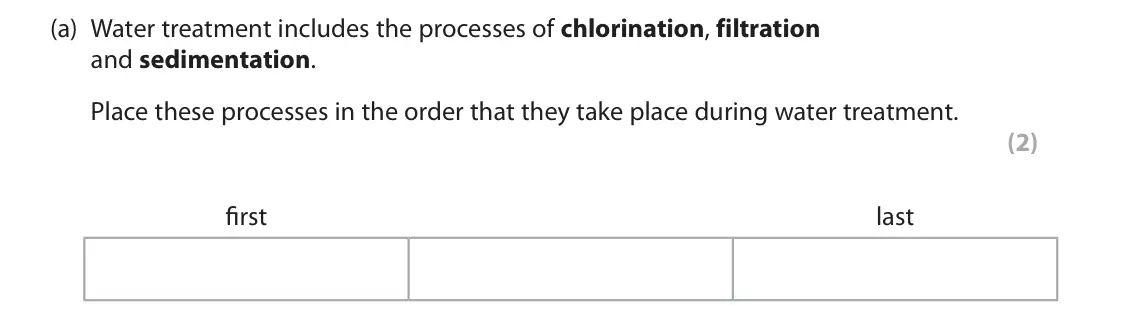
Q3(b)(ii)
The whole paper ↗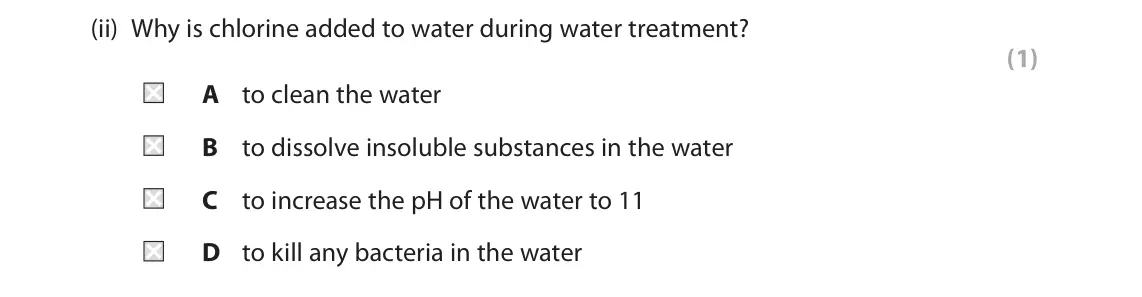
Q3(b)(iii)
The whole paper ↗
Q3(c)(i)
The whole paper ↗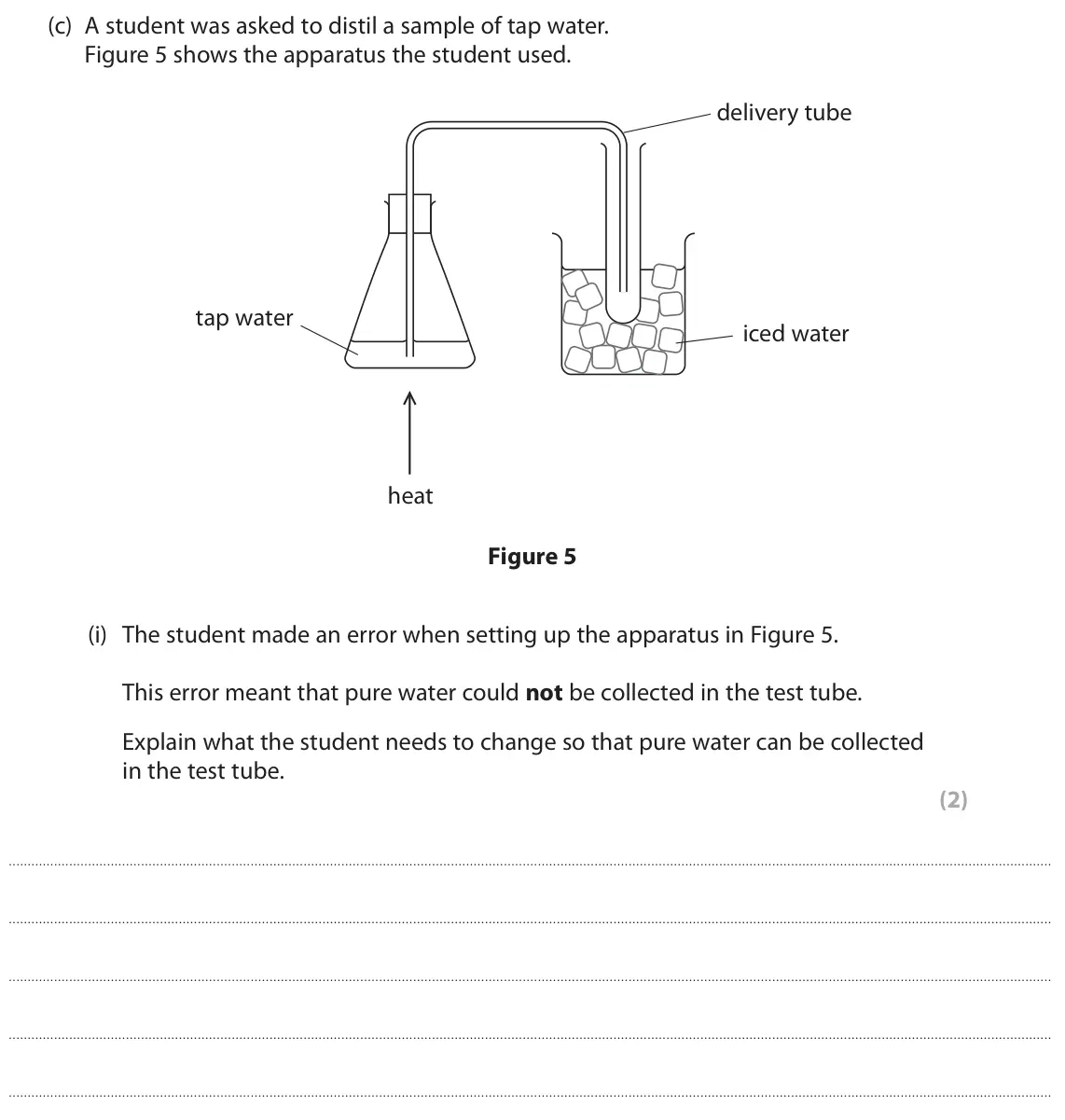
Q3(c)(ii)
The whole paper ↗
Q3(a)(i)
The whole paper ↗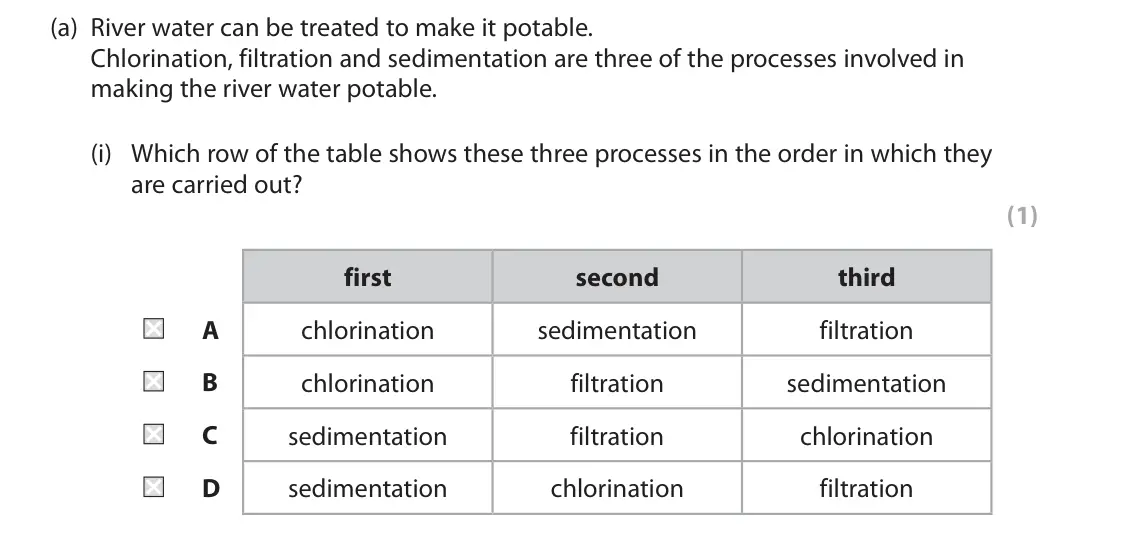
Q3(a)(ii)
The whole paper ↗
Q3(a)(iii)
The whole paper ↗
Q3(a)(iv)
The whole paper ↗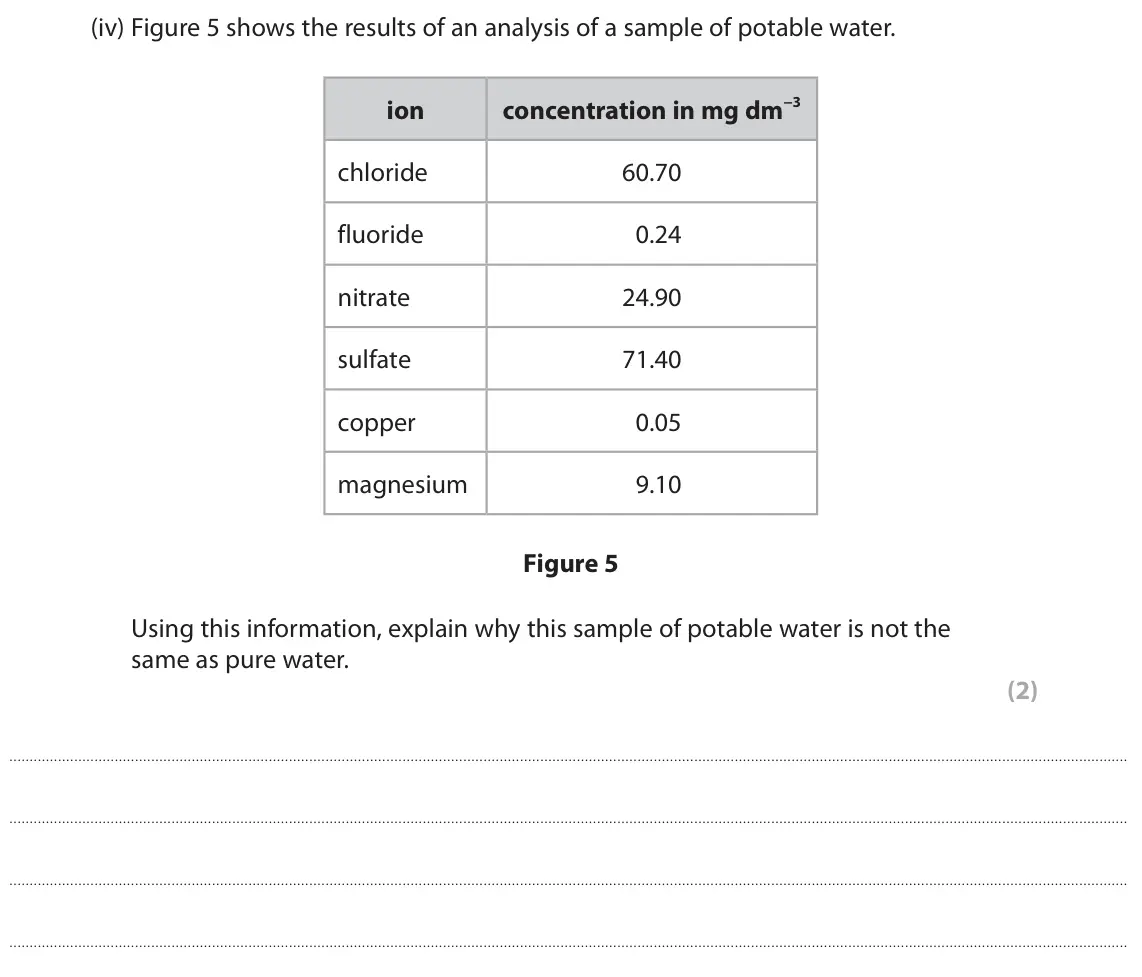
Q3(b)(i)
The whole paper ↗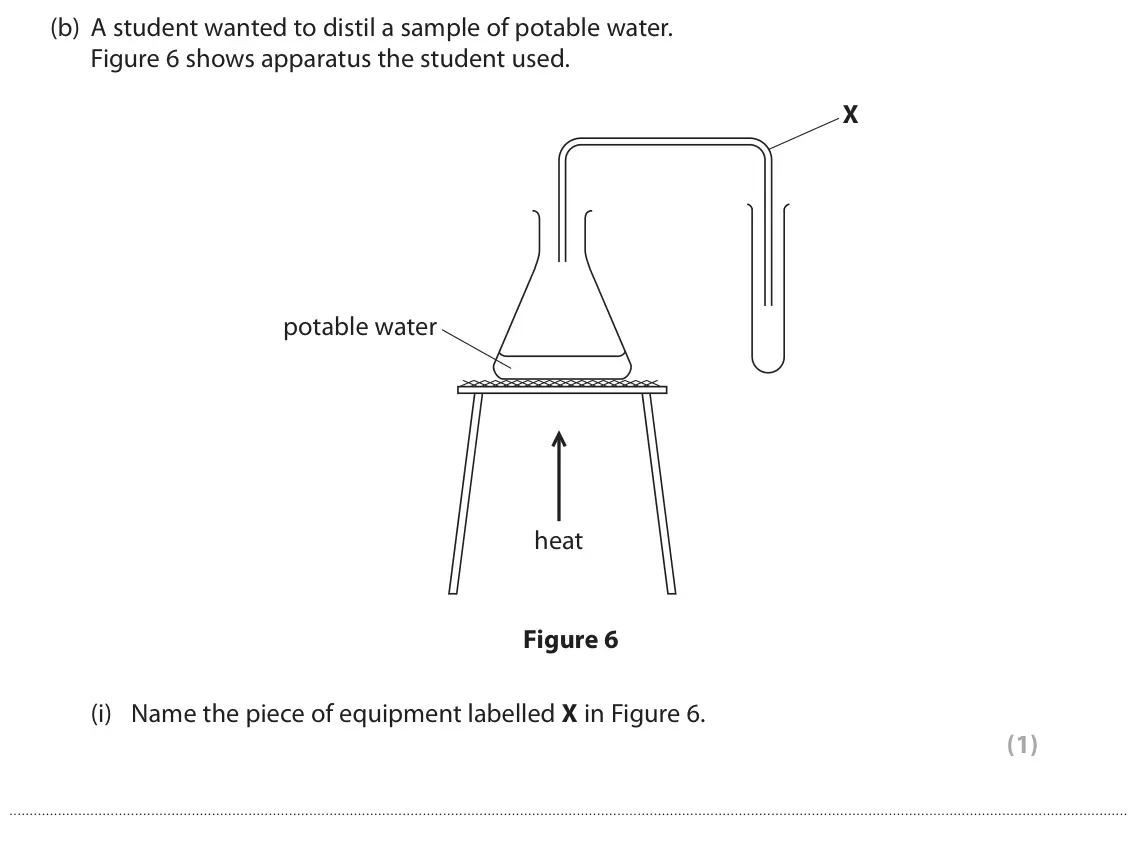
Q3(b)(ii)
The whole paper ↗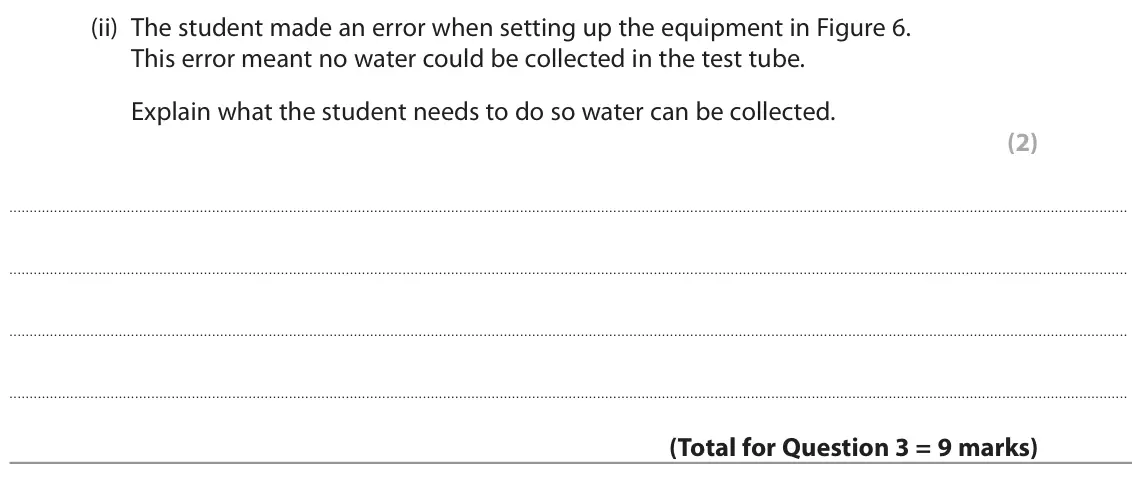
Q3(a)
The whole paper ↗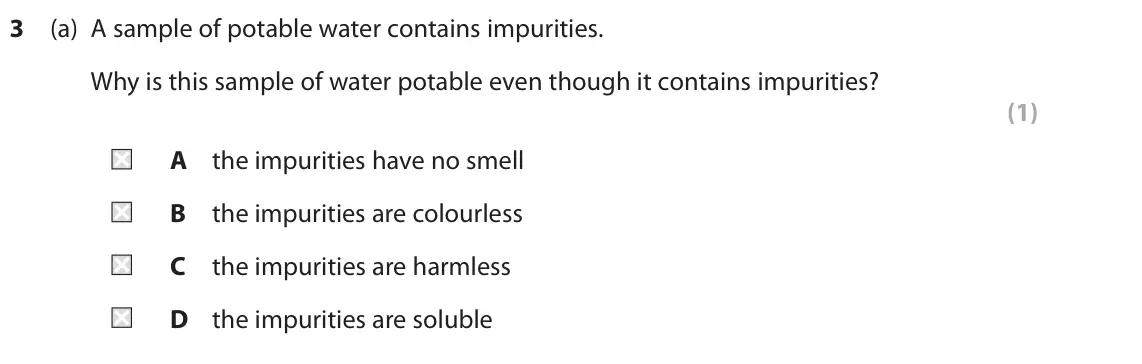
Q3(b)(i)
The whole paper ↗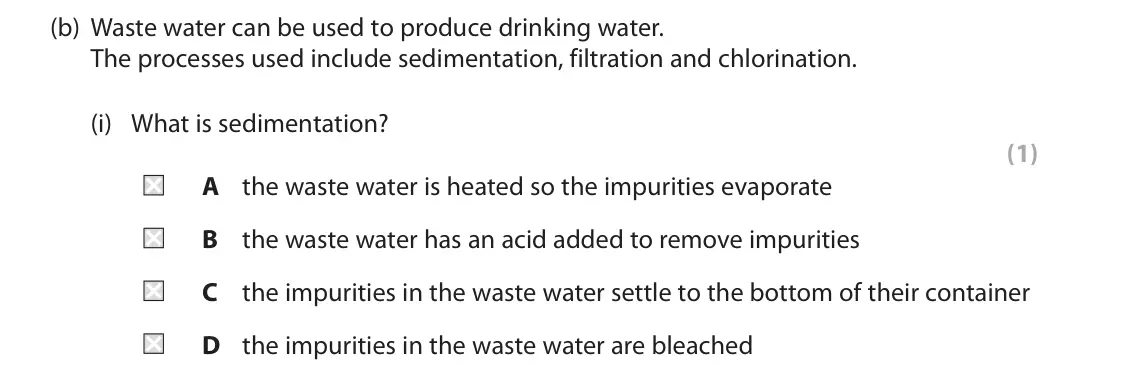
Q3(b)(ii)
The whole paper ↗
Q3(b)(iii)
The whole paper ↗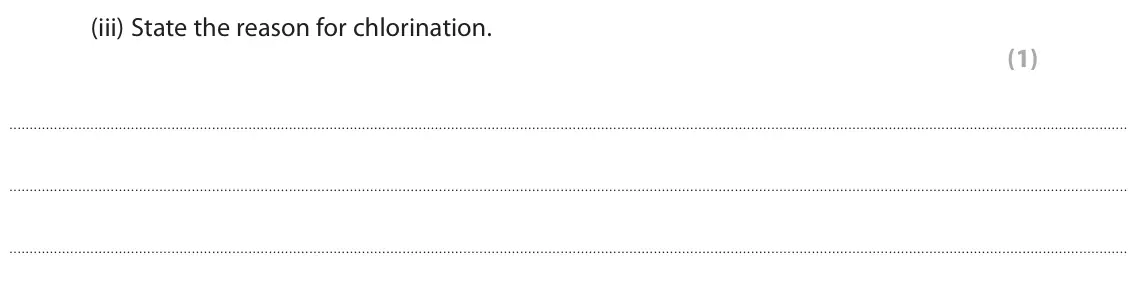
Q3(c)
The whole paper ↗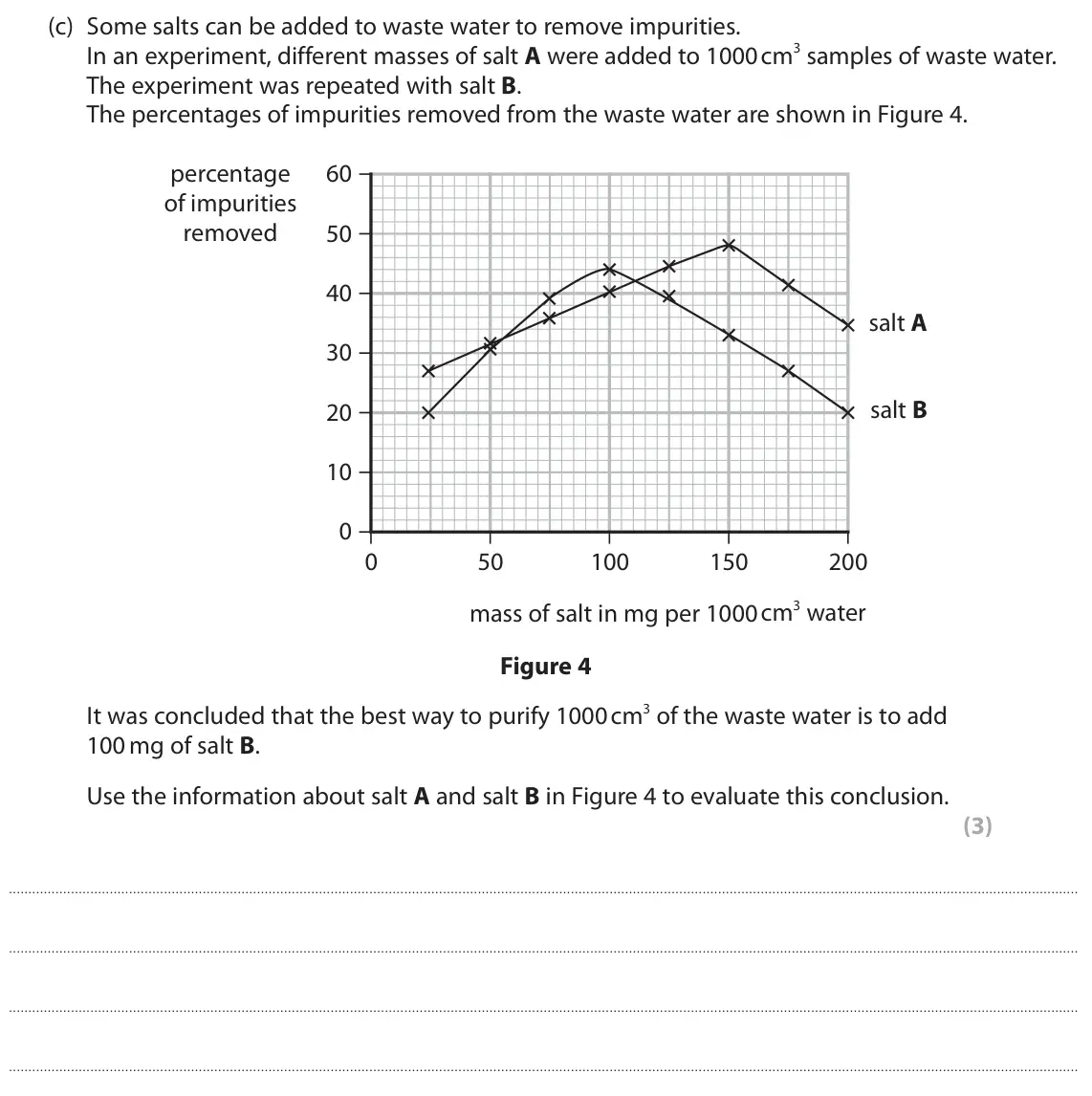
Q3(d)
The whole paper ↗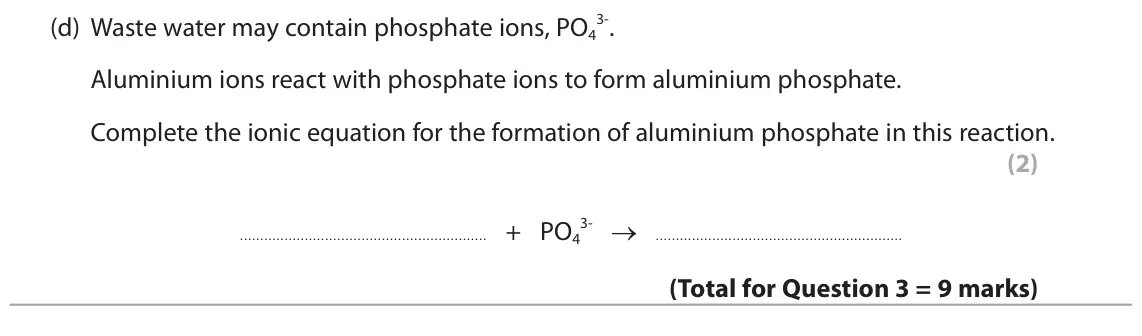
Q9(a)
The whole paper ↗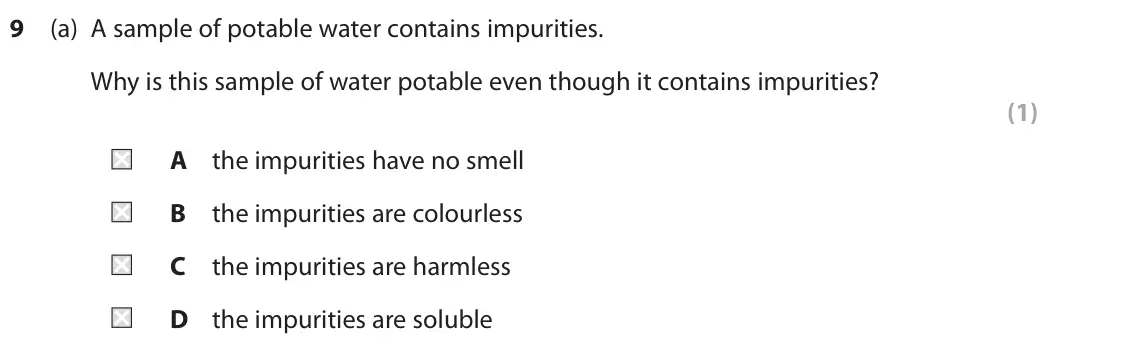
Q9(b)(i)
The whole paper ↗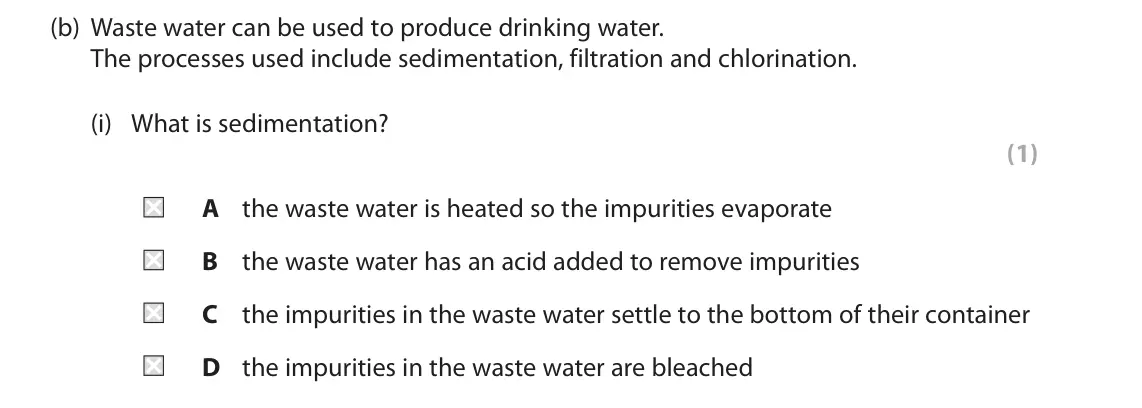
Q9(b)(ii)
The whole paper ↗
All 23 questions on Water treatment, as a list
- June 2024, Paper 1 Foundation, Q3(a) (2 marks): Water treatment includes the processes of chlorination, filtration and sedimentation. Place these processes in the order that they take place during water treat
- June 2024, Paper 1 Foundation, Q3(b)(ii) (1 mark): Why is chlorine added to water during water treatment? (1) A to clean the water B to dissolve insoluble substances in the water C to increase the pH of the wate
- June 2024, Paper 1 Foundation, Q3(b)(iii) (1 mark): State why tap water is not suitable for use in chemical analysis. (1)
- June 2024, Paper 1 Foundation, Q3(c)(i) (2 marks): The student made an error when setting up the apparatus in Figure 5. This error meant that pure water could not be collected in the test tube. Explain what the
- June 2024, Paper 1 Foundation, Q3(c)(ii) (1 mark): State what the student should use to heat the water. (1)
- June 2022, Paper 1 Foundation, Q3(a)(i) (1 mark): Which row of the table shows these three processes in the order in which they are carried out? (1) first second third A chlorination sedimentation filtration B
- June 2022, Paper 1 Foundation, Q3(a)(ii) (1 mark): State the reason why chlorine is added during the water treatment. (1)
- June 2022, Paper 1 Foundation, Q3(a)(iii) (2 marks): Describe how sedimentation is carried out. (2)
- June 2022, Paper 1 Foundation, Q3(a)(iv) (2 marks): Figure 5 shows the results of an analysis of a sample of potable water. ion concentration in mg dm−3 chloride 60.70 fluoride 0.24 nitrate 24.90 sulfate 71.40 co
- June 2022, Paper 1 Foundation, Q3(b)(i) (1 mark): Name the piece of equipment labelled X in Figure 6. (1)
- June 2022, Paper 1 Foundation, Q3(b)(ii) (2 marks): The student made an error when setting up the equipment in Figure 6. This error meant no water could be collected in the test tube. Explain what the student nee
- November 2021, Paper 1 Higher, Q3(a) (1 mark): A sample of potable water contains impurities. Why is this sample of water potable even though it contains impurities? (1) A the impurities have no smell B the
- November 2021, Paper 1 Higher, Q3(b)(i) (1 mark): What is sedimentation? (1) A the waste water is heated so the impurities evaporate B the waste water has an acid added to remove impurities C the impurities in
- November 2021, Paper 1 Higher, Q3(b)(ii) (1 mark): State why the waste water is filtered. (1)
- November 2021, Paper 1 Higher, Q3(b)(iii) (1 mark): State the reason for chlorination. (1)
- November 2021, Paper 1 Higher, Q3(c) (3 marks): Some salts can be added to waste water to remove impurities. In an experiment, different masses of salt A were added to 1000cm3 samples of waste water. The expe
- November 2021, Paper 1 Higher, Q3(d) (2 marks): Waste water may contain phosphate ions, PO4 Aluminium ions react with phosphate ions to form aluminium phosphate. Complete the ionic equation for the formation
- November 2021, Paper 1 Foundation, Q9(a) (1 mark): A sample of potable water contains impurities. Why is this sample of water potable even though it contains impurities? (1) A the impurities have no smell B the
- November 2021, Paper 1 Foundation, Q9(b)(i) (1 mark): What is sedimentation? (1) A the waste water is heated so the impurities evaporate B the waste water has an acid added to remove impurities C the impurities in
- November 2021, Paper 1 Foundation, Q9(b)(ii) (1 mark): State why the waste water is filtered. (1)
- November 2021, Paper 1 Foundation, Q9(b)(iii) (1 mark): State the reason for chlorination. (1)
- November 2021, Paper 1 Foundation, Q9(c) (3 marks): Some salts can be added to waste water to remove impurities. In an experiment, different masses of salt A were added to 1000cm3 samples of waste water. The expe
- November 2021, Paper 1 Foundation, Q9(d) (6 marks): A sample of water was contaminated with a dissolved solid. Devise a plan to separate pure water from this mixture, including a test to show that the water obtai
Questions, mark schemes and examiner’s reports are © Pearson Edexcel, from their published past papers. Plumi isn’t affiliated with any exam board. Want whole papers? Every Edexcel GCSE Chemistry paper.
Rather write your answers by hand on iPad? Plumi marks them against the same mark schemes.