 plumi
Reactivity and extracting metals: Edexcel GCSE Chemistry questions
Every Edexcel GCSE Chemistry exam question on Reactivity and extracting metals (specification points 4.1–4.9), 2018–2025, with its mark scheme and examiner’s report.
Find questions1,880
Exam
All years
Calculations
Q6(b)
The whole paper ↗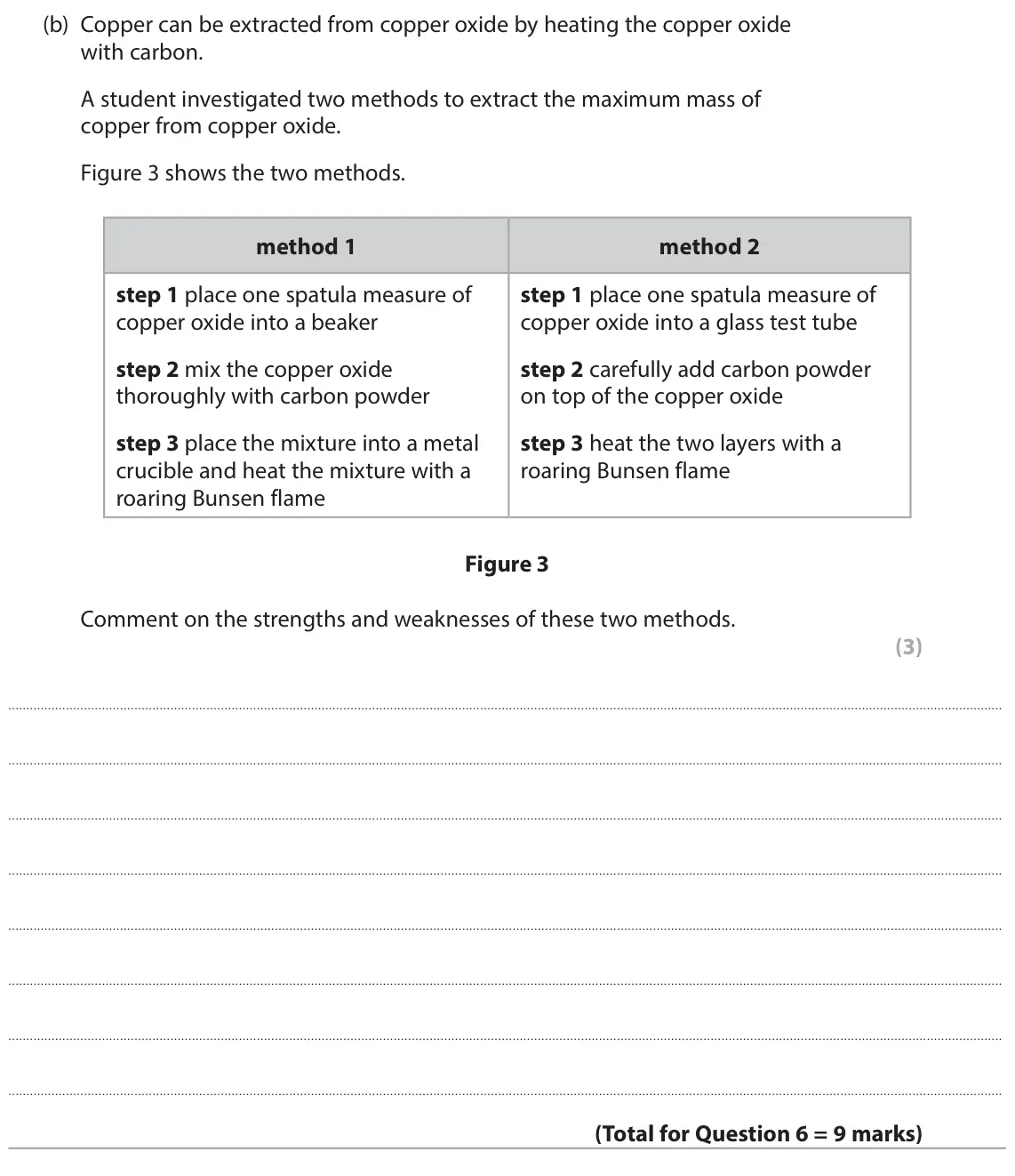
Q4(b)(i)
The whole paper ↗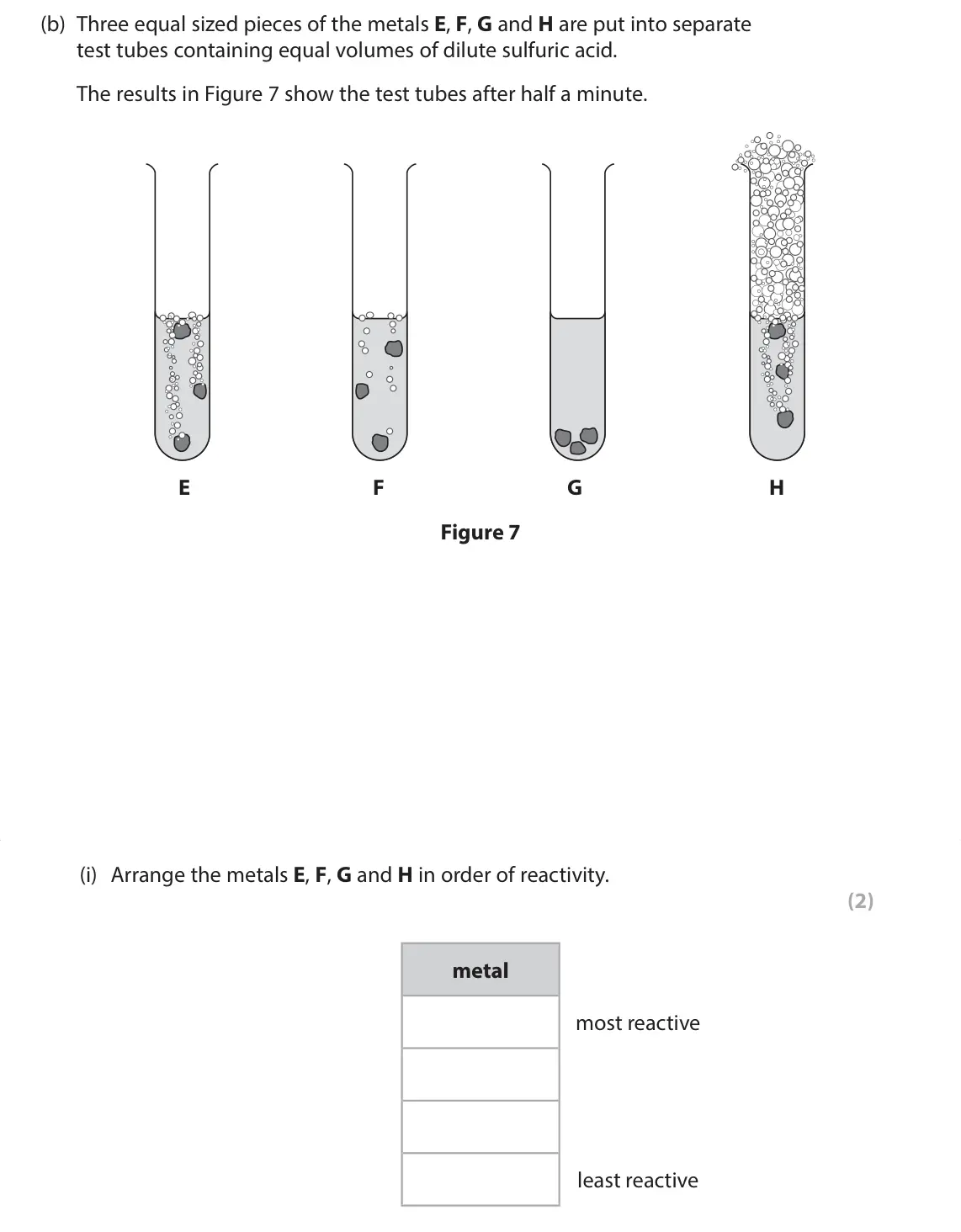
Q6(a)(i)
The whole paper ↗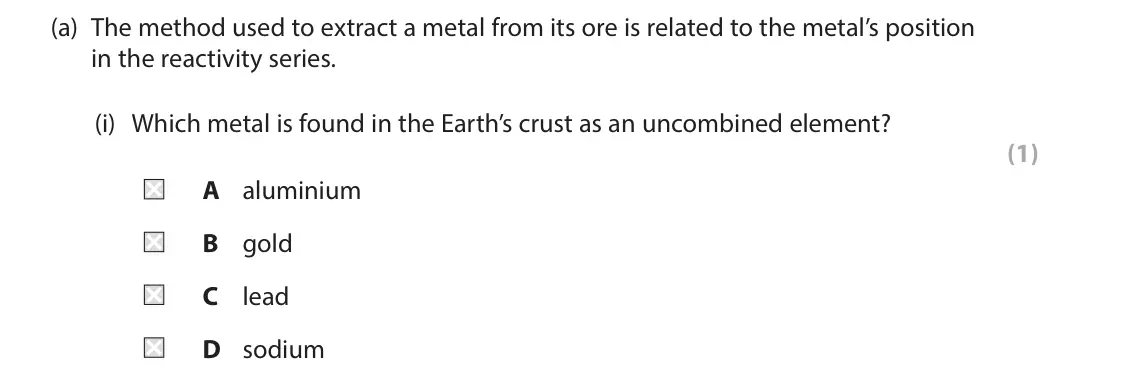
Q6(a)(ii)
The whole paper ↗
Q6(c)(i)
The whole paper ↗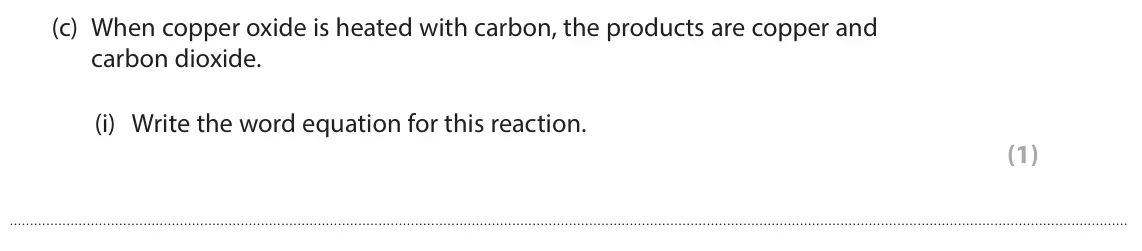
Q6(c)(ii)
The whole paper ↗
Q6(c)(iv)
The whole paper ↗
Q5(b)(i)
The whole paper ↗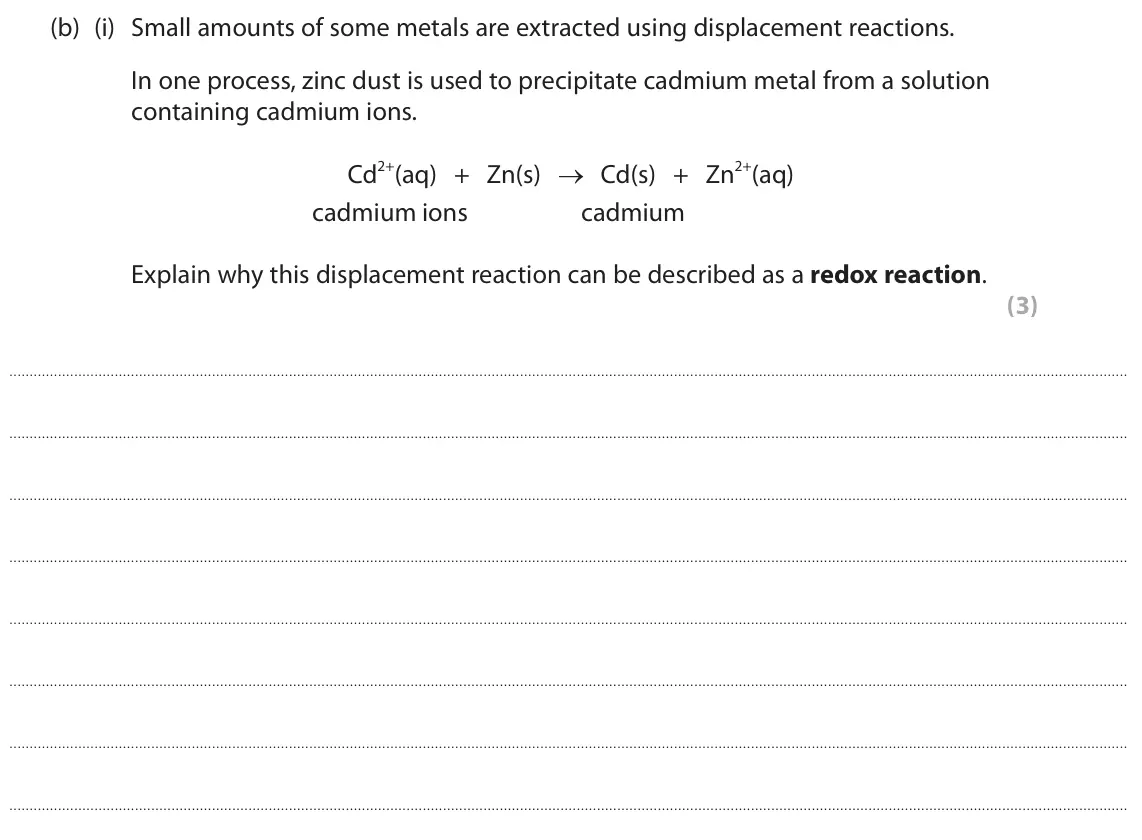
Q5(d)
The whole paper ↗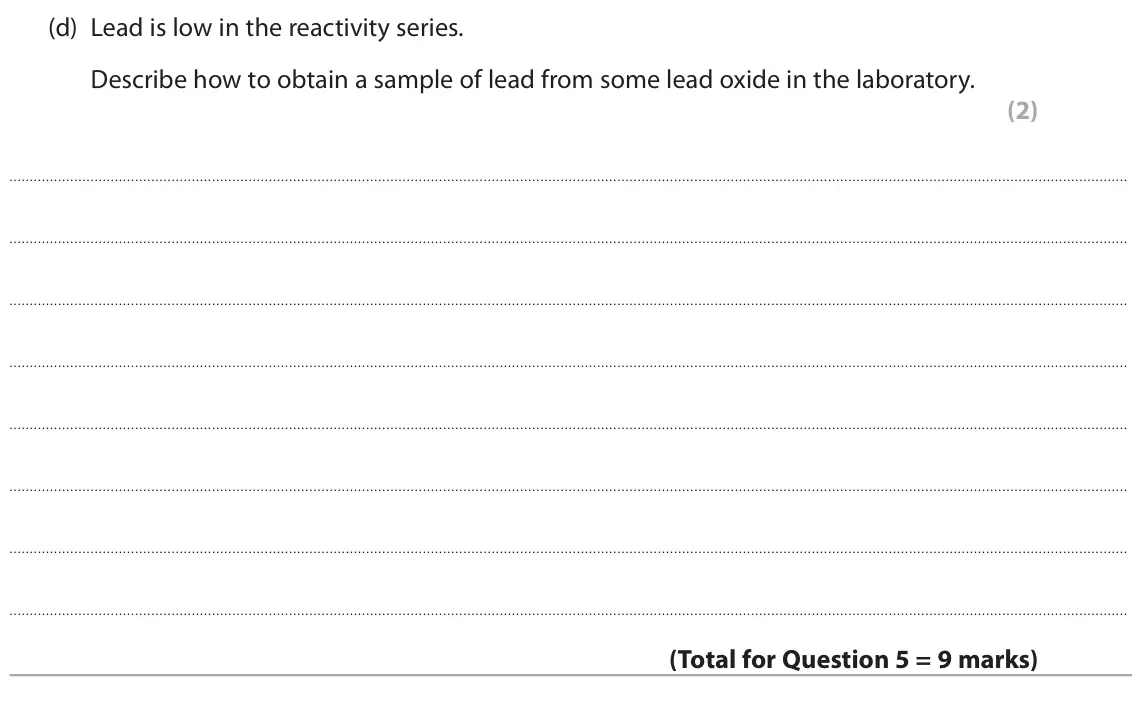
Q9(a)(i)
The whole paper ↗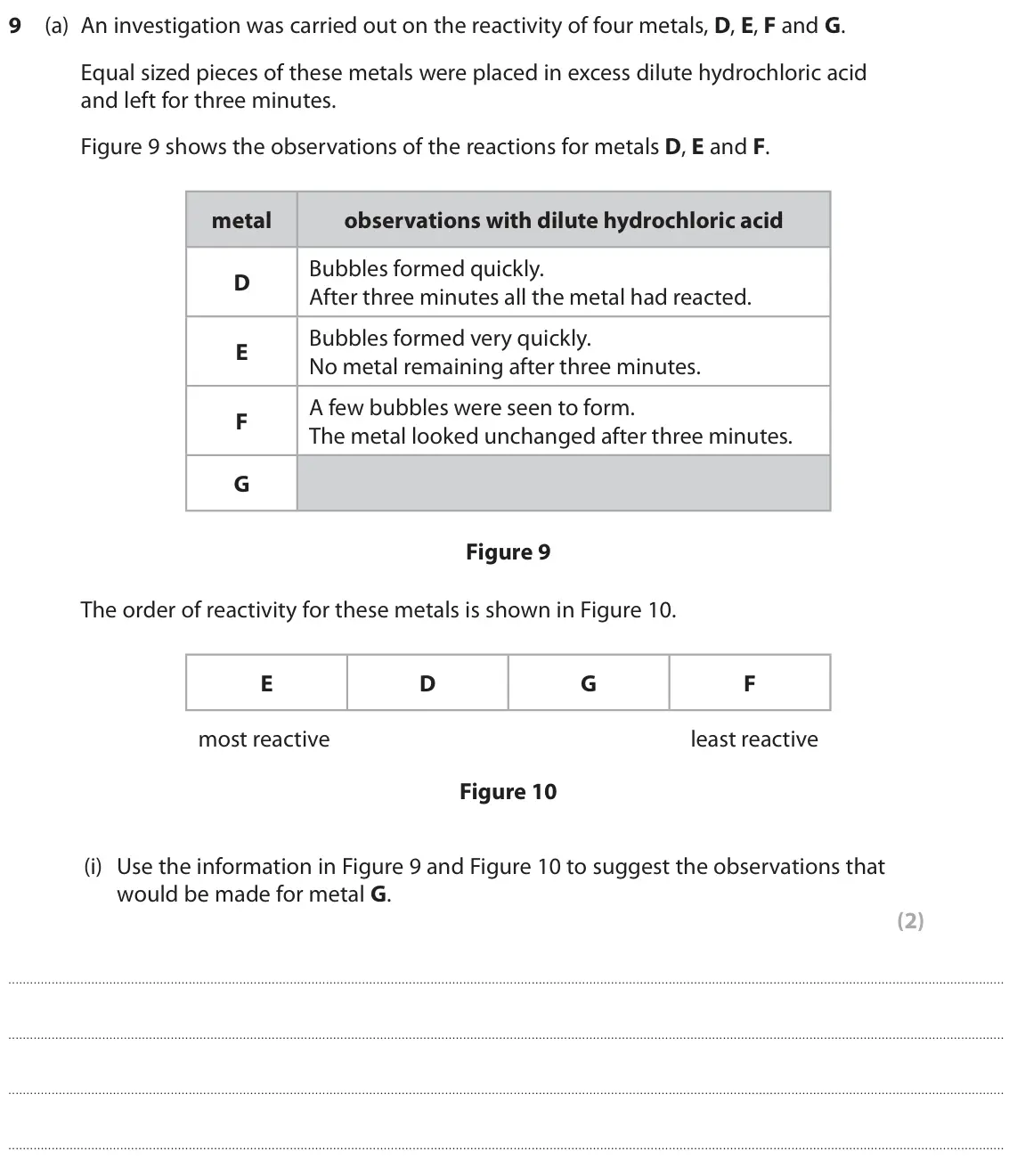
Q3(a)
The whole paper ↗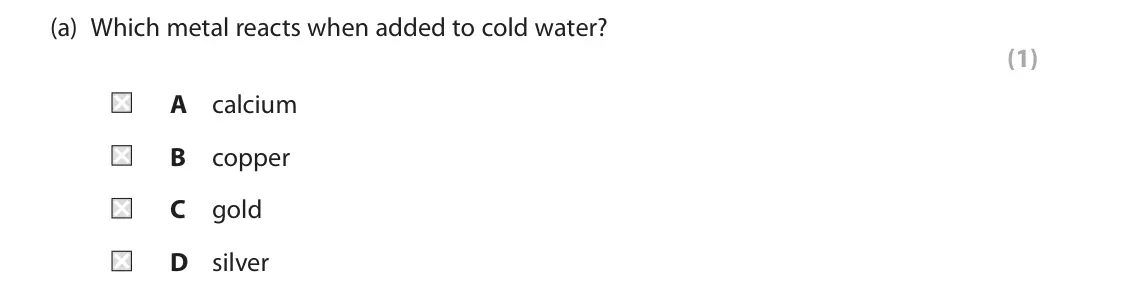
Q3(b)(i)
The whole paper ↗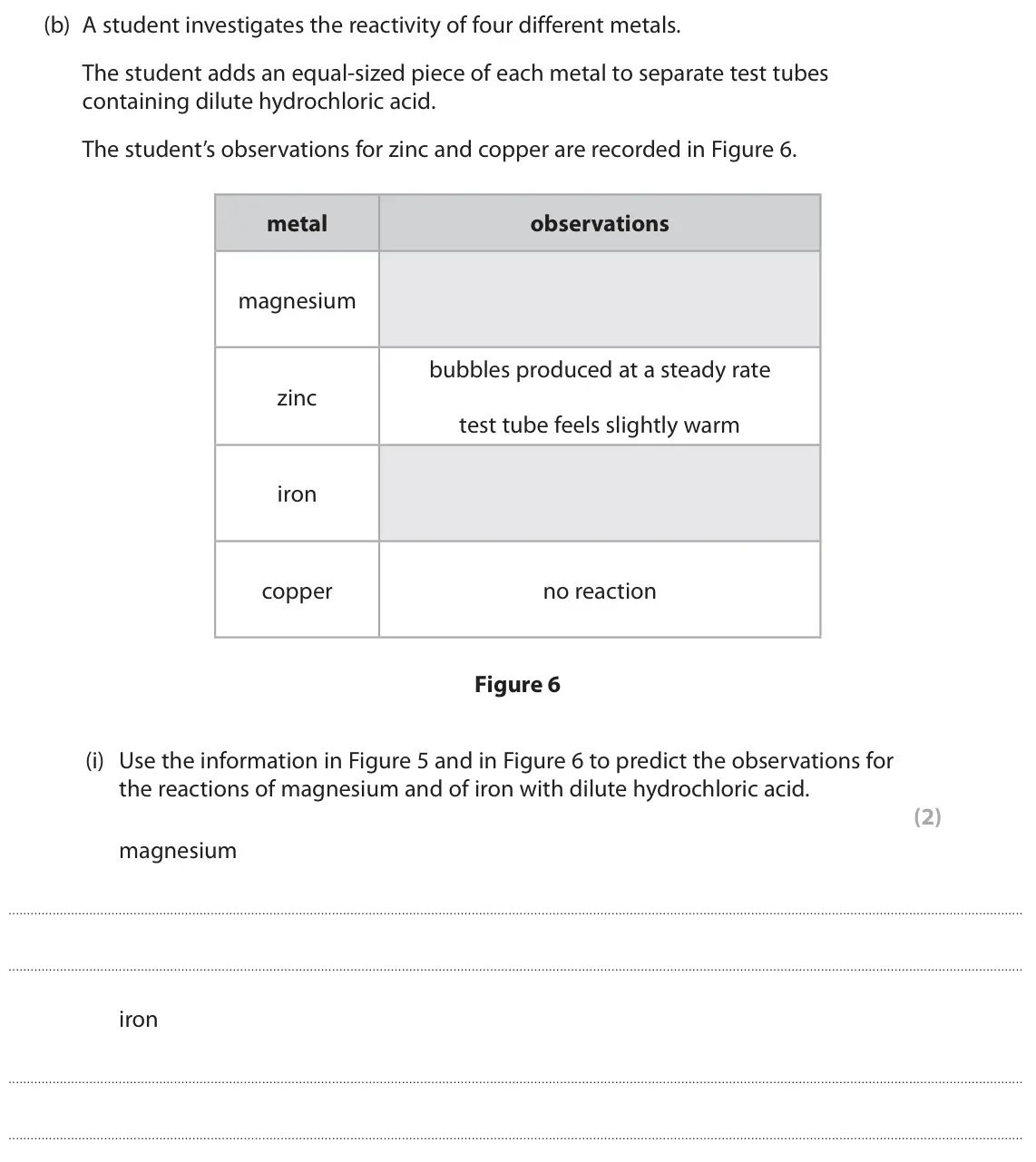
Q8(e)
The whole paper ↗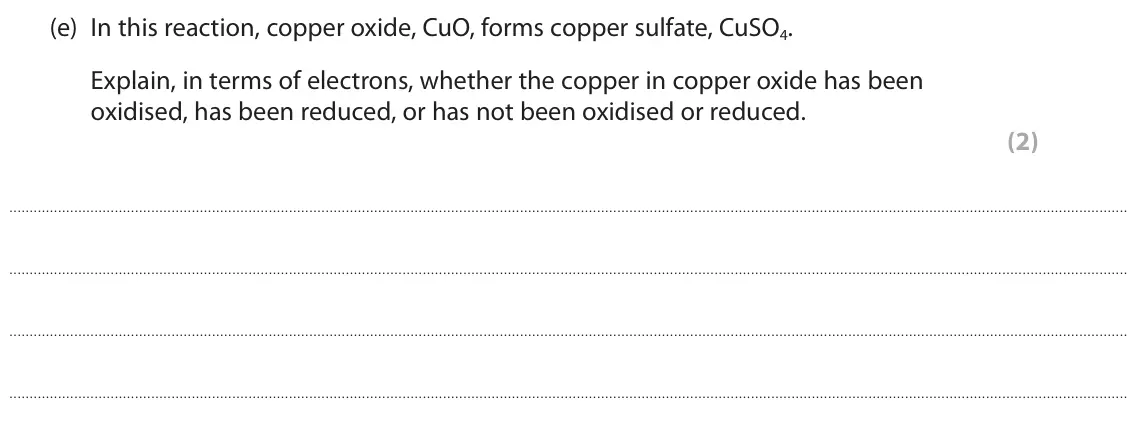
Q9(a)
The whole paper ↗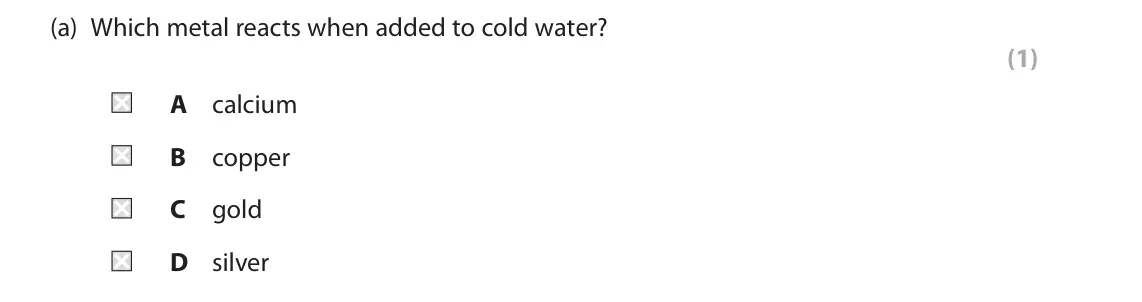
Q9(b)(i)
The whole paper ↗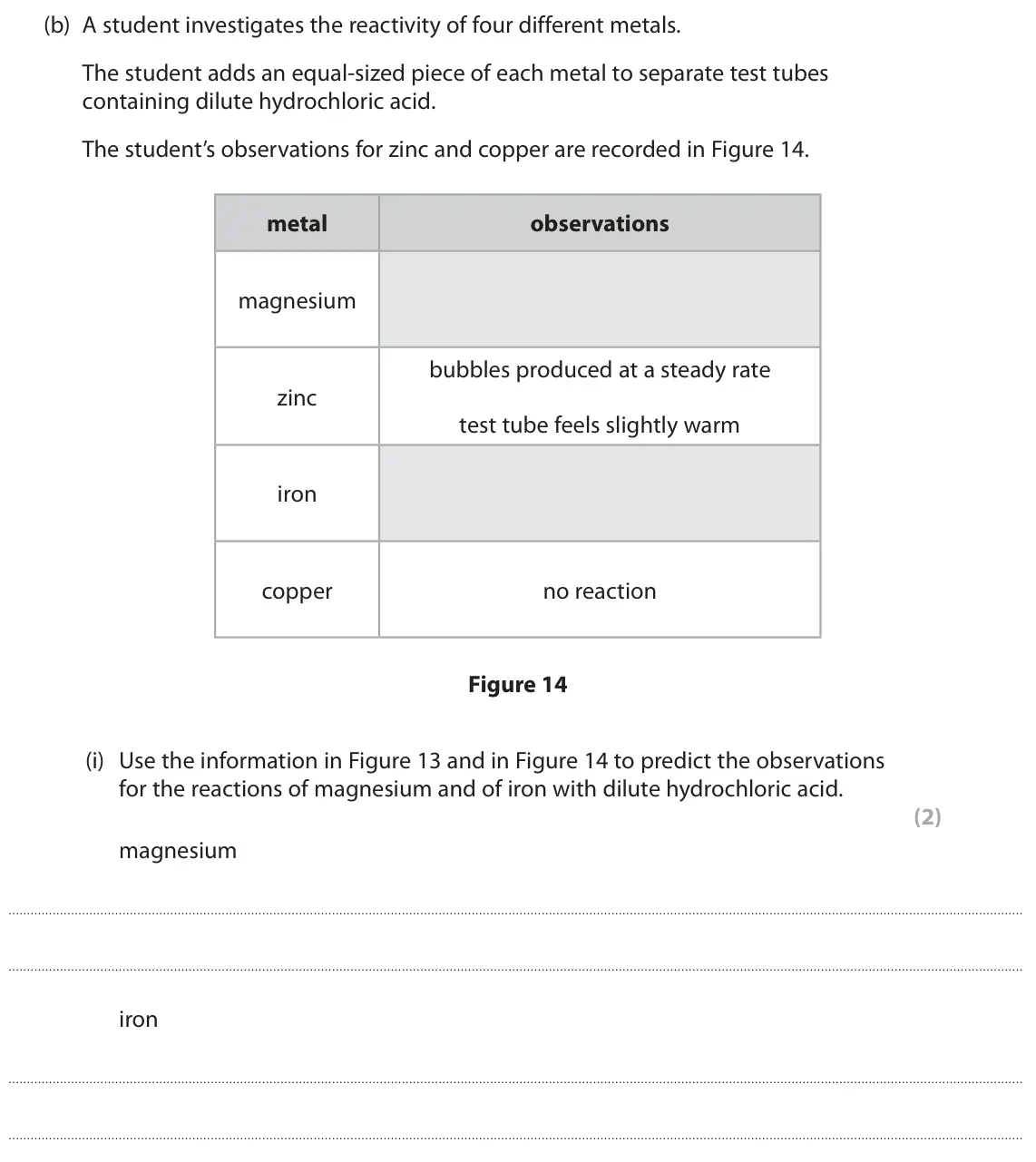
Q9(c)
The whole paper ↗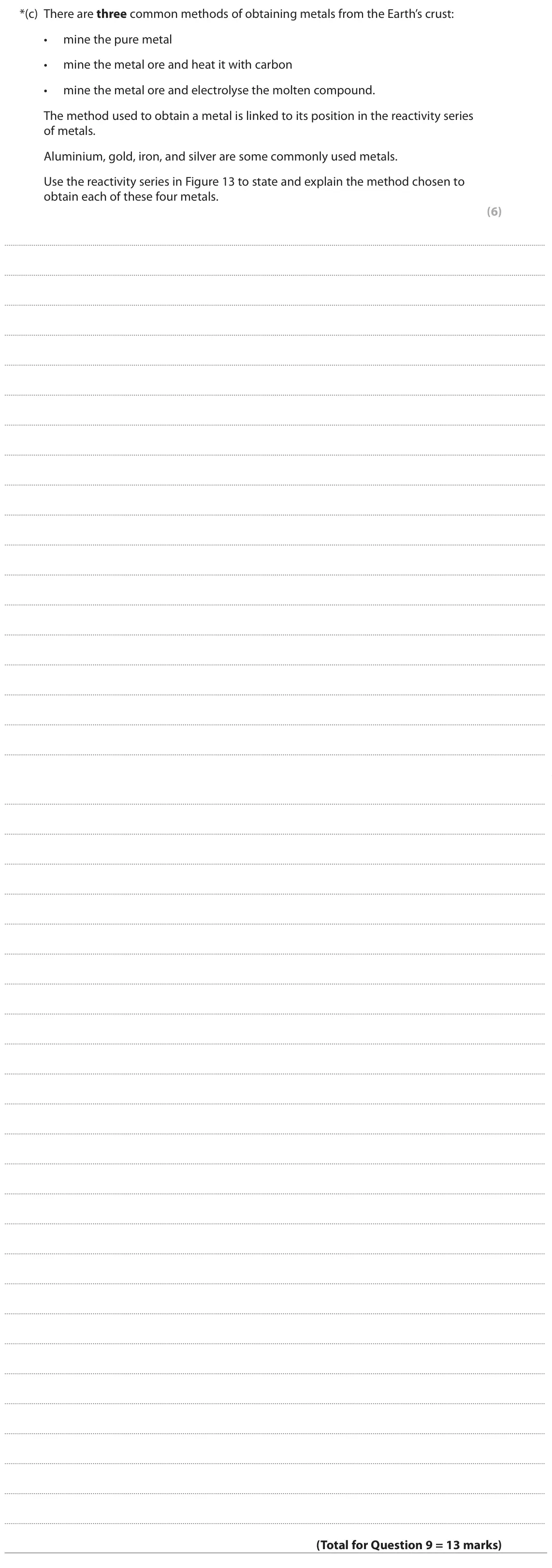
Q6(a)
The whole paper ↗
Q6(b)(i)
The whole paper ↗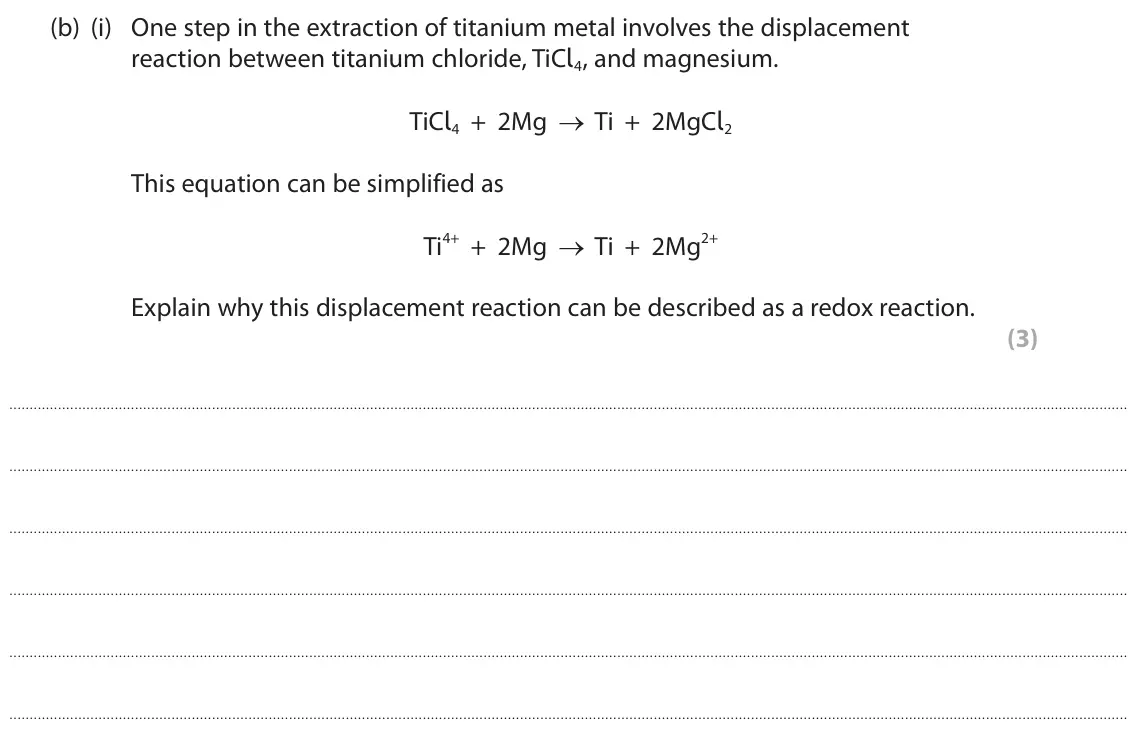
Q6(d)
The whole paper ↗
Q9(a)(i)
The whole paper ↗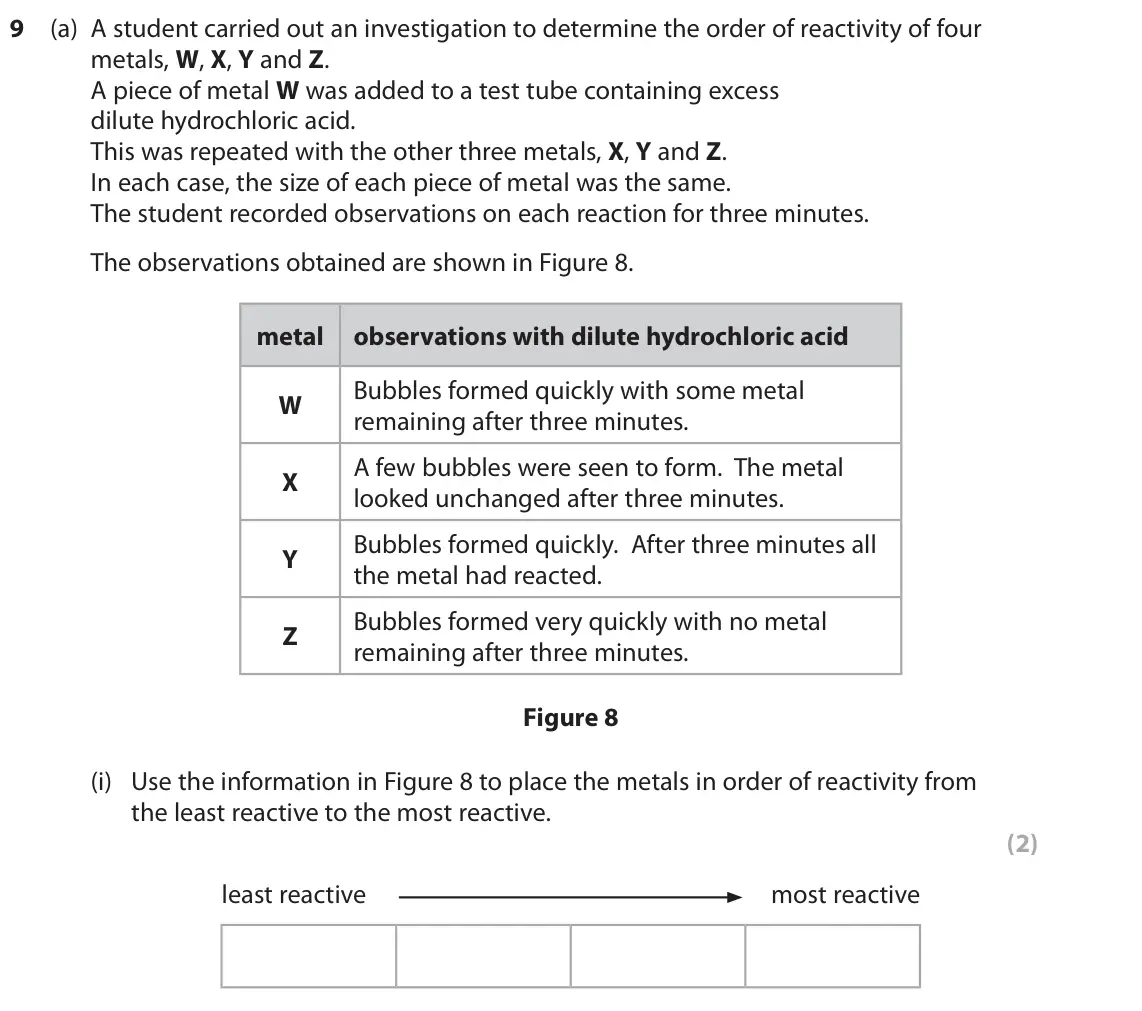
All 71 questions on Reactivity and extracting metals, as a list
- June 2025, Paper 1 Higher, Q6(b) (3 marks): Copper can be extracted from copper oxide by heating the copper oxide with carbon. A student investigated two methods to extract the maximum mass of copper from
- June 2025, Paper 1 Foundation, Q4(b)(i) (2 marks): Arrange the metals E, F, G and H in order of reactivity. (2) metal most reactive least reactive
- June 2025, Paper 1 Foundation, Q6(a)(i) (1 mark): Which metal is found in the Earth’s crust as an uncombined element? (1) A aluminium B gold C lead D sodium
- June 2025, Paper 1 Foundation, Q6(a)(ii) (1 mark): Name one metal in Figure 11 that is normally extracted by electrolysis. (1)
- June 2025, Paper 1 Foundation, Q6(c)(i) (1 mark): Write the word equation for this reaction. (1)
- June 2025, Paper 1 Foundation, Q6(c)(ii) (1 mark): In this reaction, copper oxide loses oxygen. State the type of reaction when copper oxide loses oxygen. (1)
- June 2025, Paper 1 Foundation, Q6(c)(iv) (1 mark): State why this reaction with copper oxide uses excess carbon. (1)
- June 2024, Paper 1 Higher, Q5(b)(i) (3 marks): Small amounts of some metals are extracted using displacement reactions. In one process, zinc dust is used to precipitate cadmium metal from a solution containi
- June 2024, Paper 1 Higher, Q5(d) (2 marks): Lead is low in the reactivity series. Describe how to obtain a sample of lead from some lead oxide in the laboratory. (2)
- June 2024, Paper 1 Higher, Q9(a)(i) (2 marks): Use the information in Figure 9 and Figure 10 to suggest the observations that would be made for metal G. (2)
- June 2023, Paper 1 Higher, Q3(a) (1 mark): Which metal reacts when added to cold water? (1) A calcium B copper C gold D silver
- June 2023, Paper 1 Higher, Q3(b)(i) (2 marks): Use the information in Figure 5 and in Figure 6 to predict the observations for the reactions of magnesium and of iron with dilute hydrochloric acid. (2) magnes
- June 2023, Paper 1 Higher, Q8(e) (2 marks): In this reaction, copper oxide, CuO, forms copper sulfate, CuSO4. Explain, in terms of electrons, whether the copper in copper oxide has been oxidised, has been
- June 2023, Paper 1 Foundation, Q9(a) (1 mark): Which metal reacts when added to cold water? (1) A calcium B copper C gold D silver
- June 2023, Paper 1 Foundation, Q9(b)(i) (2 marks): Use the information in Figure 13 and in Figure 14 to predict the observations for the reactions of magnesium and of iron with dilute hydrochloric acid. (2) magn
- June 2023, Paper 1 Foundation, Q9(c) (6 marks): There are three common methods of obtaining metals from the Earth’s crust: • mine the pure metal • mine the metal ore and heat it with carbon • mine the metal o
- June 2022, Paper 1 Higher, Q6(a) (2 marks): Aluminium is extracted from its ore by electrolysis. Explain why this method is used to extract aluminium from its ore. (2)
- June 2022, Paper 1 Higher, Q6(b)(i) (3 marks): One step in the extraction of titanium metal involves the displacement reaction between titanium chloride, TiCl4, and magnesium. TiCl4 + 2Mg → Ti + 2MgCl2 This
- June 2022, Paper 1 Higher, Q6(d) (2 marks): Copper is low down in the reactivity series and can be obtained from copper oxide. Devise a simple method to obtain a sample of copper from copper oxide in the
- June 2022, Paper 1 Higher, Q9(a)(i) (2 marks): Use the information in Figure 8 to place the metals in order of reactivity from the least reactive to the most reactive. (2) least reactive most reactive
- June 2022, Paper 1 Higher, Q9(a)(ii) (2 marks): The experiment was repeated using an excess of dilute sulfuric acid in place of the dilute hydrochloric acid. metal + sulfuric acid → metal sulfate + hydrogen W
- November 2021, Paper 1 Higher, Q7(a) (3 marks): The order of reactivity of copper, magnesium and zinc can be determined by the displacement reactions between these metals and solutions of their salts. You are
- November 2021, Paper 1 Higher, Q7(b) (2 marks): Metals can be extracted from ores found in the Earth’s crust. Explain why aluminium cannot be extracted from its ore by heating with carbon but can be extracted
- November 2021, Paper 1 Foundation, Q4(a)(i) (1 mark): Write the word equation for this reaction. (1) + →
- November 2021, Paper 1 Foundation, Q4(a)(ii) (1 mark): What type of reaction occurs when chromium reacts with oxygen? (1) A condensation B evaporation C neutralisation D oxidation
- November 2021, Paper 1 Foundation, Q4(b)(i) (1 mark): Place the metals in order of reactivity from most to least reactive. (1) most reactive least reactive
- November 2021, Paper 1 Foundation, Q4(c)(i) (1 mark): State why iron can be extracted by heating iron oxide with carbon. (1)
- November 2021, Paper 1 Foundation, Q4(c)(ii) (1 mark): State why electrolysis is not used to extract iron. (1)
- November 2020, Paper 1 Higher, Q8(b)(i) (1 mark): One similarity in the reactions is that hydrogen gas is produced. State one other similarity in the products of the reactions of calcium and potassium with wate
- November 2020, Paper 1 Higher, Q8(b)(ii) (1 mark): Potassium is higher in the reactivity series than calcium and reacts more vigorously with water than calcium reacts with water. State why potassium is higher in
- November 2020, Paper 1 Foundation, Q1(b)(ii) (1 mark): The hazard symbol shown in Figure 1 is used on containers of sodium. Figure 1 What is the meaning of this hazard symbol? (1) A corrosive B flammable C oxidising
- November 2020, Paper 1 Foundation, Q6(a) (1 mark): Which of these metals is found as the uncombined element in the Earth’s crust? (1) A aluminium B gold C potassium D zinc
- November 2020, Paper 1 Foundation, Q6(c) (1 mark): An ore of iron is mostly iron oxide, Fe2O3. Iron can be extracted from this iron oxide by heating it with carbon. Balance this equation for the reaction that ta
- November 2020, Paper 1 Foundation, Q6(d) (2 marks): Most copper ores are described as low grade. This means that the percentage of copper in the ore is very small. 5000 kg of one copper ore was found to contain 4
- November 2020, Paper 1 Foundation, Q6(e) (2 marks): In one stage of the extraction of lead from its ore, lead oxide is heated strongly with carbon. The equation for the reaction is 2PbO + C → 2Pb + CO2 Explain, u
- June 2019, Paper 1 Higher, Q5(b)(i) (2 marks): In the first stage of extracting nickel from nickel sulfide, the nickel sulfide, NiS, is heated in air to form nickel oxide, NiO, and sulfur dioxide. Write the
- June 2019, Paper 1 Higher, Q5(b)(ii) (1 mark): In the final stage of the extraction process, a nickel compound is electrolysed to produce pure nickel. An advantage of producing a metal by electrolysis is tha
- June 2019, Paper 1 Higher, Q8(a) (2 marks): Describe what you would see when an excess of zinc is added to copper sulfate solution and the mixture left until the reaction is complete. (2)
- June 2019, Paper 1 Higher, Q8(b) (4 marks): This reaction is described as a redox reaction. Explain, in terms of electrons, which particles have been oxidised and which particles have been reduced in this
- June 2019, Paper 1 Foundation, Q3(b) (2 marks): Copper is a transition metal. Magnesium reacts with copper sulfate solution to form copper and a solution of magnesium sulfate. Magnesium sulfate solution is co
- June 2019, Paper 1 Foundation, Q5(a)(i) (1 mark): The same mass of metal was used in each experiment. Which piece of apparatus should be used to find the mass of metal used? (1) A a balance a pipette a stopwatc
- June 2019, Paper 1 Foundation, Q5(a)(ii) (2 marks): State two variables, apart from the mass of the metals, that should be controlled in this investigation. (2) 1... 2
- June 2019, Paper 1 Foundation, Q5(a)(iii) (1 mark): Magnesium produces the most vigorous effervescence. Copper does not produce any effervescence. Give the reason why copper does not produce any effervescence. (1
- June 2019, Paper 1 Foundation, Q6(a) (1 mark): Which of these metals is usually found uncombined in the Earth's crust? (1) A calcium B gold C iron X D magnesium
- June 2019, Paper 1 Foundation, Q6(b)(i) (2 marks): Write the word equation for this reaction. (2)
- June 2019, Paper 1 Foundation, Q6(b)(ii) (1 mark): In this reaction zinc oxide loses oxygen. State the type of reaction taking place when an oxide loses oxygen. (1)
- June 2018, Paper 1 Higher, Q3(a)(i) (1 mark): In this reaction (1) A carbon is reduced B iron oxide is neutralised C iron oxide is reduced D iron is oxidised
- June 2018, Paper 1 Higher, Q3(b) (2 marks): Aluminium cannot be extracted by heating its oxide with carbon. Aluminium has to be extracted from its oxide by electrolysis. Explain why. (2)
- June 2018, Paper 1 Higher, Q3(c) (1 mark): Predict the method that will have to be used to extract calcium from its ore. (1)
- June 2018, Paper 1 Higher, Q9(a)(i) (2 marks): The student recorded the observations until each metal had reacted with the acid for two minutes. The observations are shown in Figure 9. metal observations bub
- June 2018, Paper 1 Higher, Q9(a)(ii) (2 marks): Complete the diagram below to show how the student could add to the apparatus to measure the volume of gas produced in the two minutes. (2)
- June 2018, Paper 1 Foundation, Q9(a)(i) (1 mark): In this reaction (1) A carbon is reduced B iron oxide is neutralised C iron oxide is reduced D iron is oxidised
- June 2018, Paper 1 Foundation, Q9(b) (2 marks): Aluminium cannot be extracted by heating its oxide with carbon. Aluminium has to be extracted from its oxide by electrolysis. Explain why. (2)
- June 2018, Paper 1 Foundation, Q9(c) (1 mark): Predict the method that will have to be used to extract calcium from its ore. (1)
- Specimen, Paper 1 Higher, Q3(a)(i) (1 mark): Which gas is given off? A carbon dioxide B chlorine C hydrogen D oxygen (1)
- Specimen, Paper 1 Higher, Q3(b) (2 marks): In the experiment, the student used the same amount of each metal in a finely powdered form. State two factors, concerning the hydrochloric acid, which should a
- Specimen, Paper 1 Higher, Q3(c)(i) (1 mark): Give the name of the method used to extract aluminium. (1)
- Specimen, Paper 1 Higher, Q3(c)(ii) (2 marks): Explain why aluminium is extracted by a different method rather than heating the ore with carbon. (2)
- Specimen, Paper 1 Higher, Q3(d) (2 marks): The extraction of iron involves the reduction of iron oxide, Fe2O3, by carbon monoxide, CO. During this reaction, the iron oxide is reduced to iron, Fe, and the
- Specimen, Paper 1 Foundation, Q3(a) (1 mark): Which of the following metals is found uncombined in the Earth’s crust? (1) A aluminium B gold C sodium D zinc
- Specimen, Paper 1 Foundation, Q3(b)(i) (2 marks): Complete the word equation for the reaction. (2) iron oxide + carbon → +
- Specimen, Paper 1 Foundation, Q3(b)(ii) (1 mark): What happens to the iron oxide during this reaction? (1) A the iron oxide burns B the iron oxide is neutralised C the iron oxide is oxidised D the iron oxide is
- Specimen, Paper 1 Foundation, Q3(d) (1 mark): Zinc can be extracted from its ore by electrolysis or by heating the ore with carbon. Give a reason for the method that is used. (1)
- Specimen, Paper 2 Higher, Q2(a) (2 marks): Calcium reacts with water to form calcium hydroxide, Ca(OH)2, and hydrogen, H2. Ca(s) + 2H2O(l) → Ca(OH)2(s) + H2(g) Describe what would be seen when a piece of
- Specimen, Paper 2 Higher, Q2(b) (2 marks): Magnesium reacts very slowly with cold water but it reacts faster with steam, H2O, and forms magnesium oxide, MgO, and hydrogen. Write the balanced equation for
- Specimen, Paper 2 Higher, Q2(c) (2 marks): The electronic configurations of magnesium and calcium are magnesium 2.8.2 calcium 2.8.8.2 When magnesium and calcium react with water they form positive ions.
- Specimen, Paper 2 Foundation, Q4(b)(iii) (2 marks): Figure 5 shows the results obtained by the student. metal added to temperature rise iron(II) sulfate solution / °C magnesium 6.0 copper 0.0 zinc 2.8 Figure 5 Ex
- Specimen, Paper 2 Foundation, Q4(b)(iv) (2 marks): Explain how the student could improve the method to make a fairer comparison of the temperature change produced by the different metals. (2)
- Specimen, Paper 2 Foundation, Q7(d) (2 marks): Magnesium and calcium are in group 2 of the periodic table. They are less reactive than the metals in group 1. Calcium reacts with water to form calcium hydroxi
- Specimen, Paper 2 Foundation, Q7(e) (2 marks): Magnesium reacts very slowly with cold water but it reacts faster with steam, H2O, to form magnesium oxide, MgO, and hydrogen. Write the balanced equation for t
- Specimen, Paper 2 Foundation, Q7(f) (2 marks): The electronic configurations of magnesium and calcium are magnesium 2.8.2 calcium 2.8.8.2 When magnesium and calcium react with water they form positive ions.
Questions, mark schemes and examiner’s reports are © Pearson Edexcel, from their published past papers. Plumi isn’t affiliated with any exam board. Want whole papers? Every Edexcel GCSE Chemistry paper.
Rather write your answers by hand on iPad? Plumi marks them against the same mark schemes.