 plumi
Molar gas volume: Edexcel GCSE Chemistry questions
Every Edexcel GCSE Chemistry exam question on Molar gas volume (specification points 5.16–5.18), 2018–2025, with its mark scheme and examiner’s report.
Find questions1,880
Exam
All years
Calculations
Q10(b)
The whole paper ↗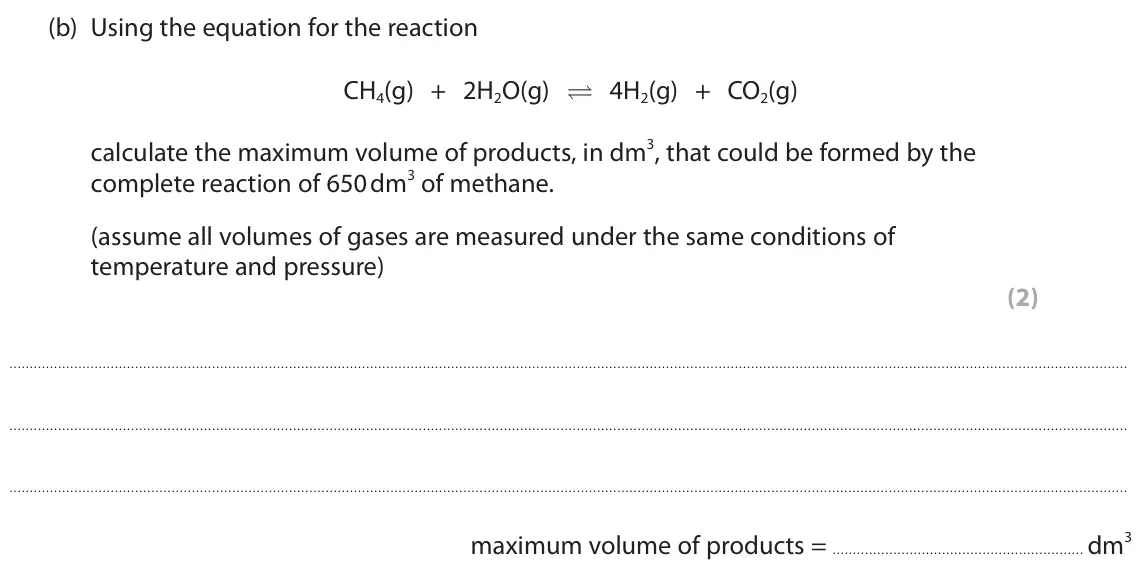
Q10(c)
The whole paper ↗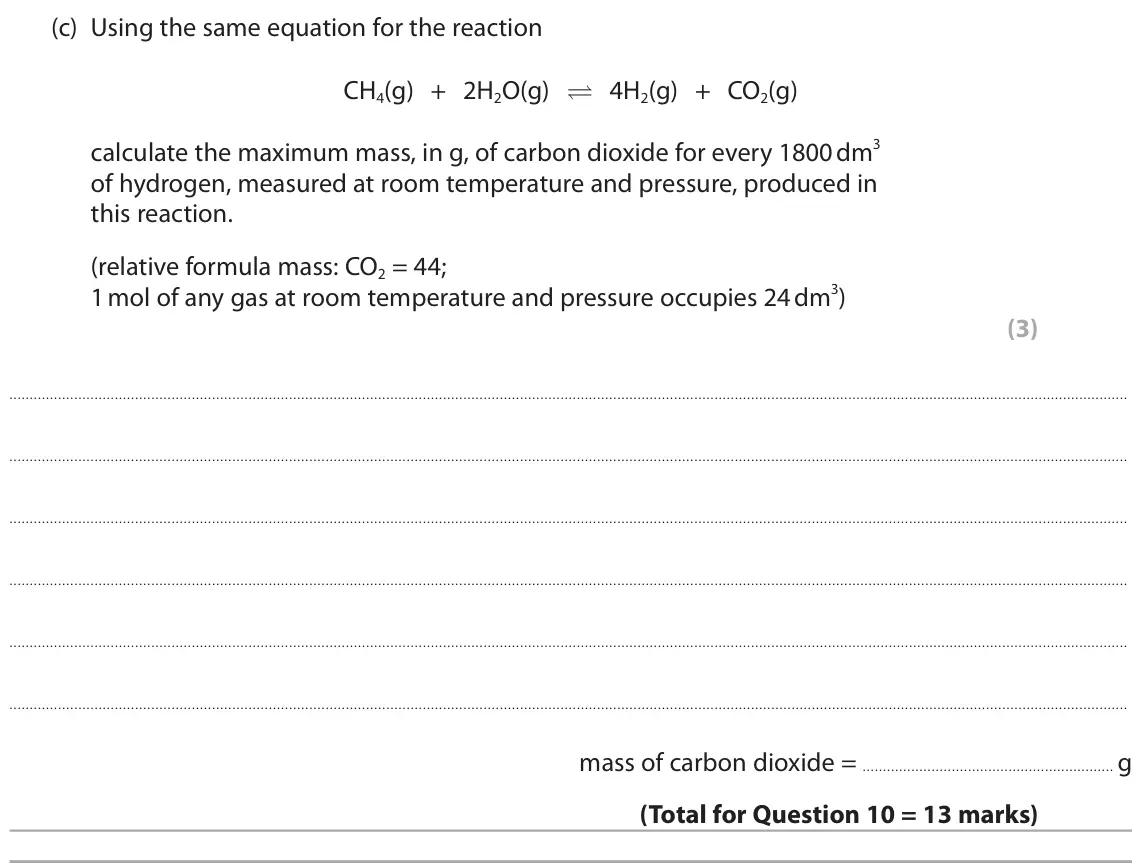
Q10(a)(ii)
The whole paper ↗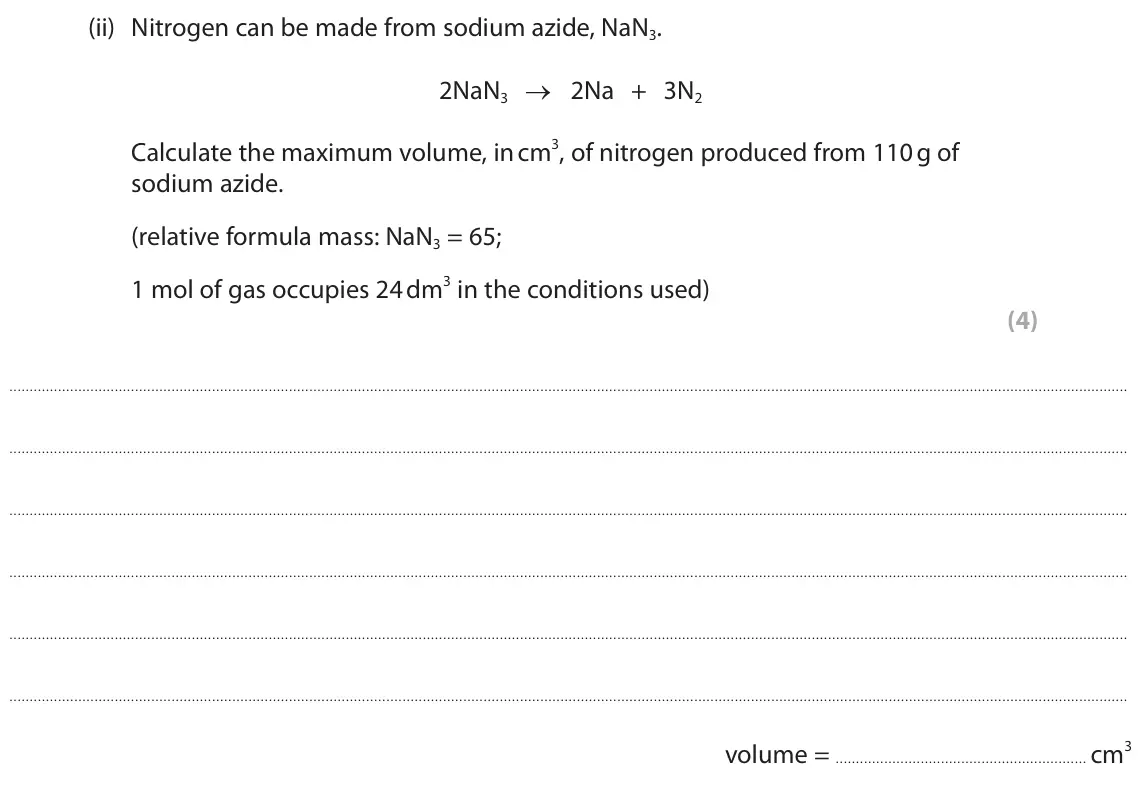
Q10(b)
The whole paper ↗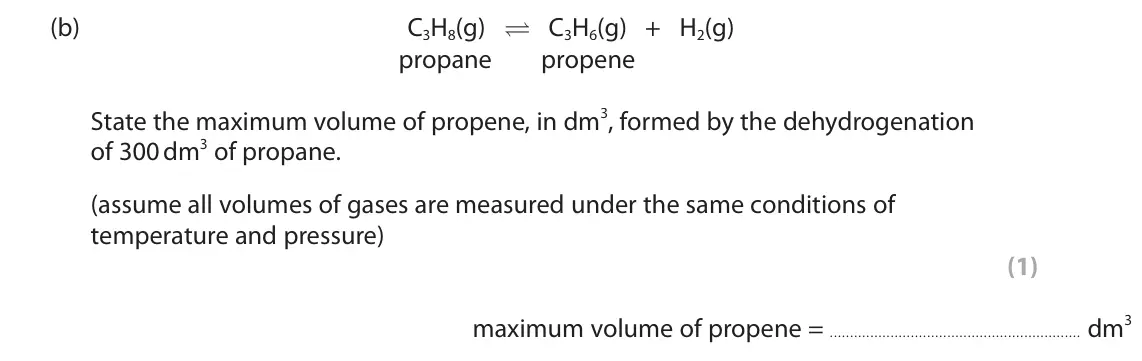
Q10(c)
The whole paper ↗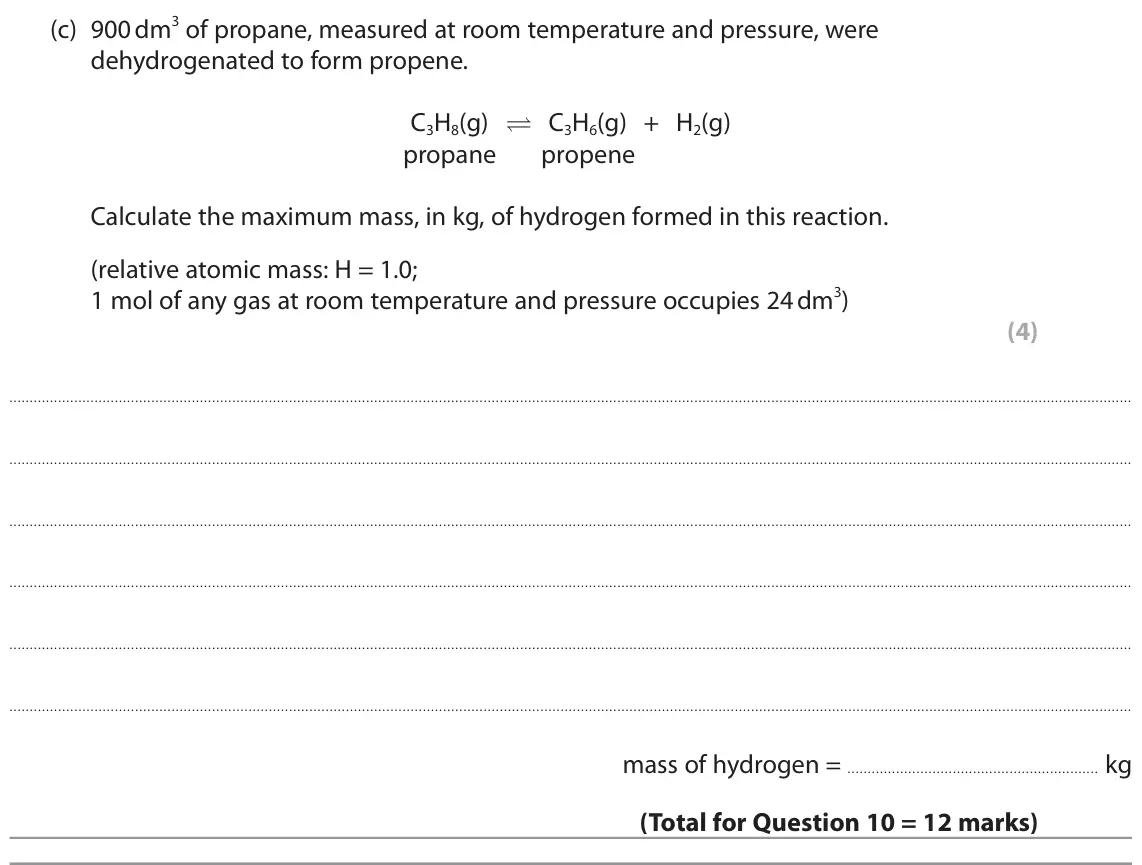
Q8(c)
The whole paper ↗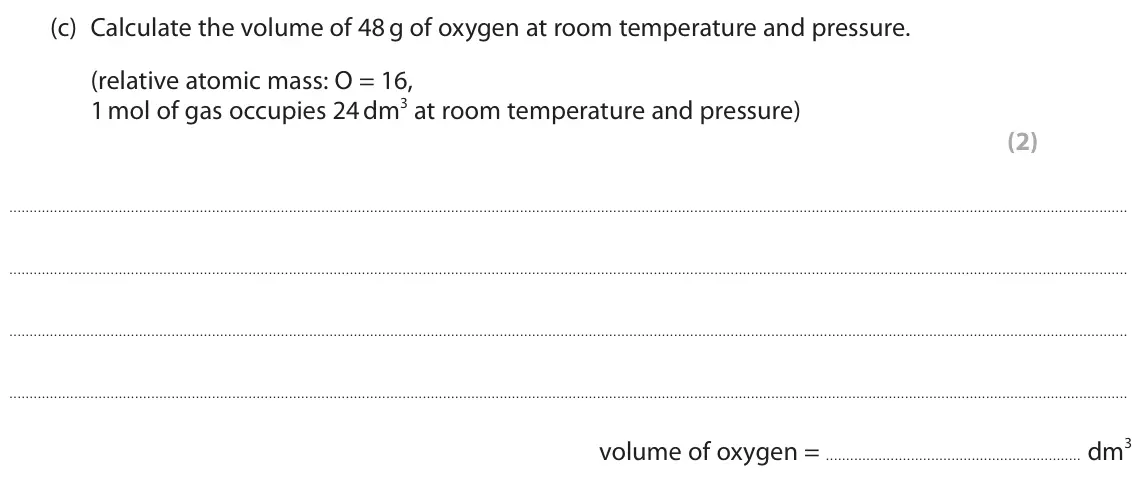
Q7(a)(ii)
The whole paper ↗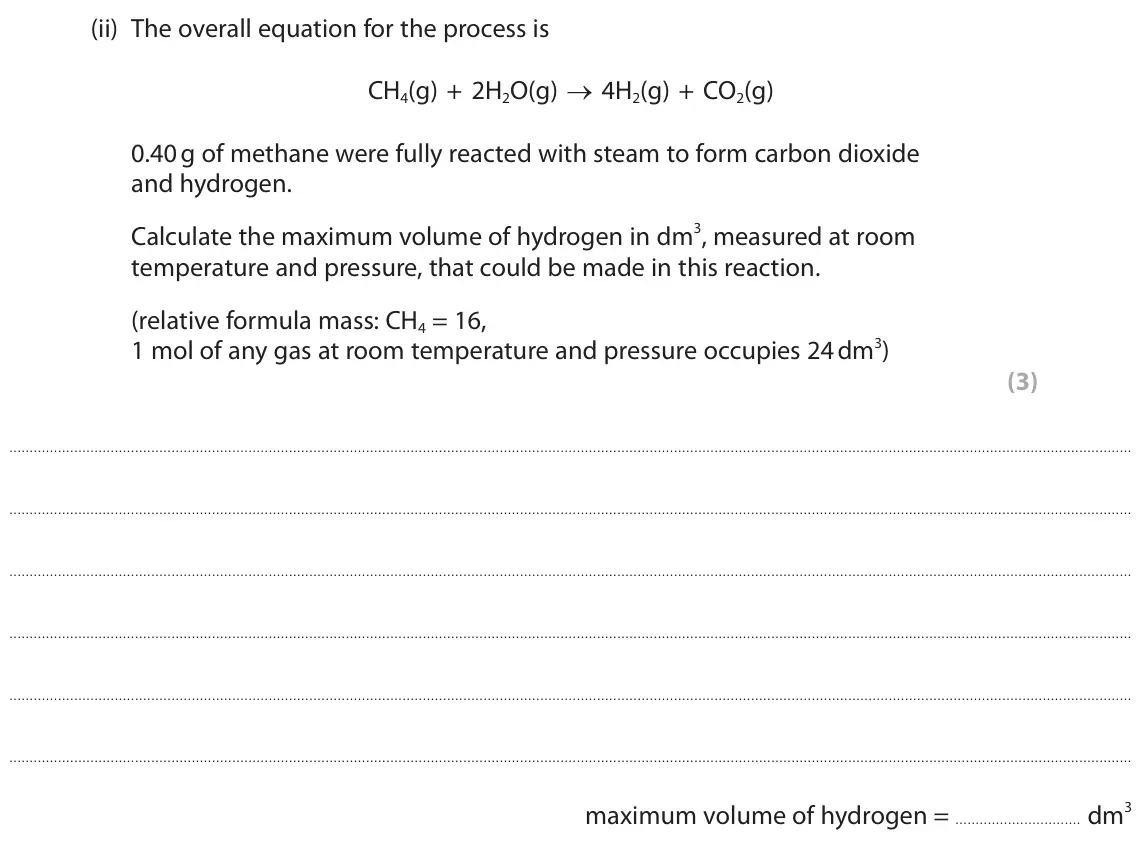
Q10(b)
The whole paper ↗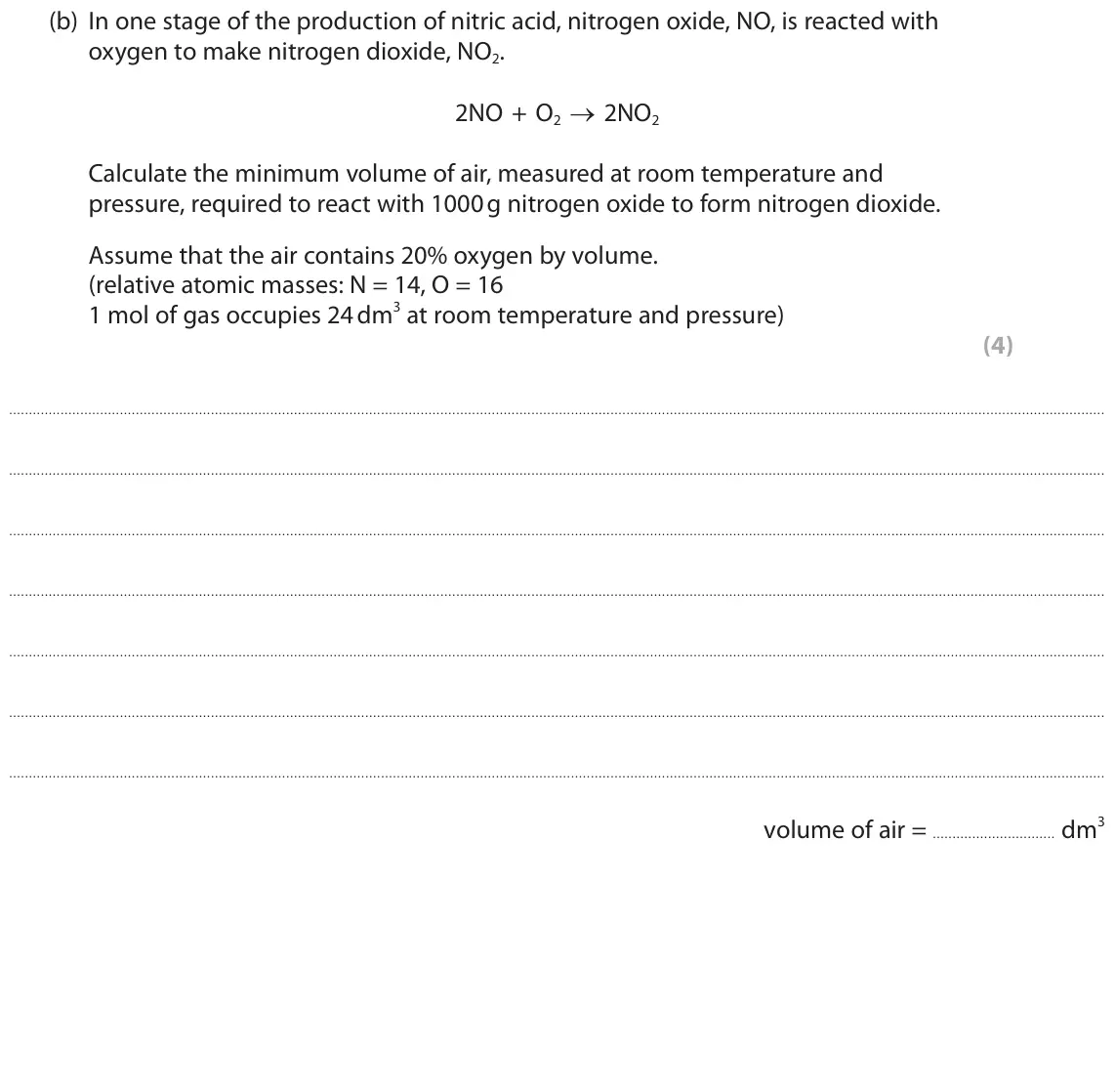
Q7(a)
The whole paper ↗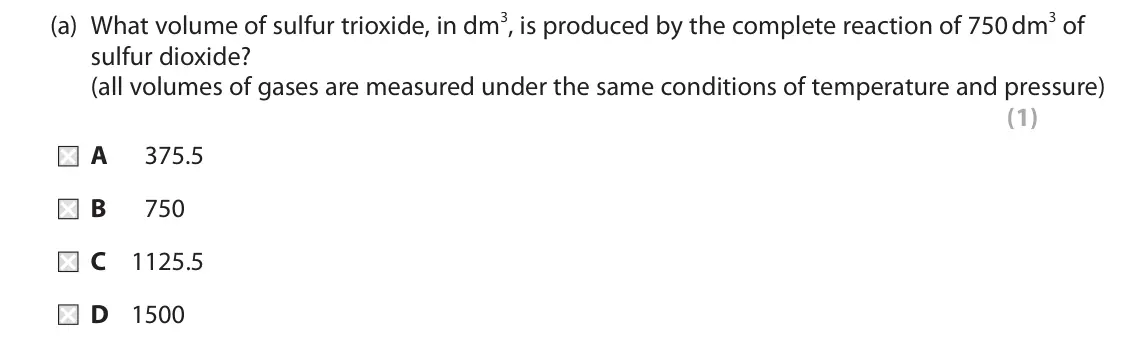
Q7(b)
The whole paper ↗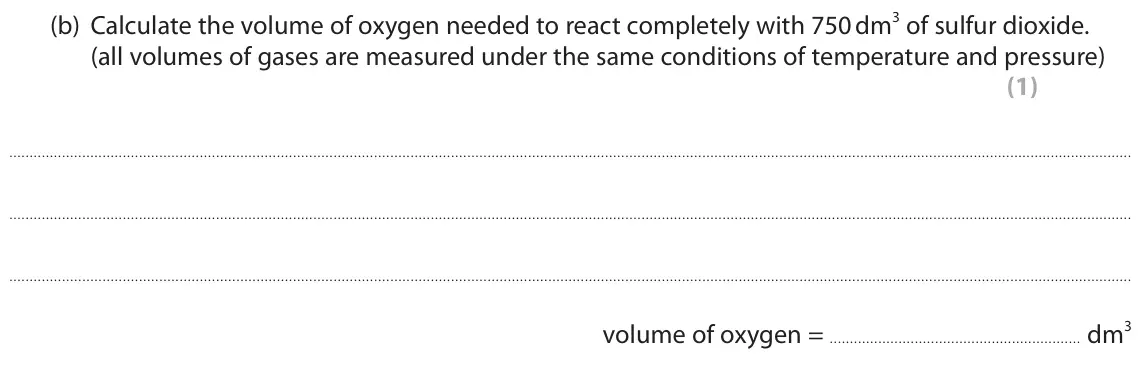
Q7(c)
The whole paper ↗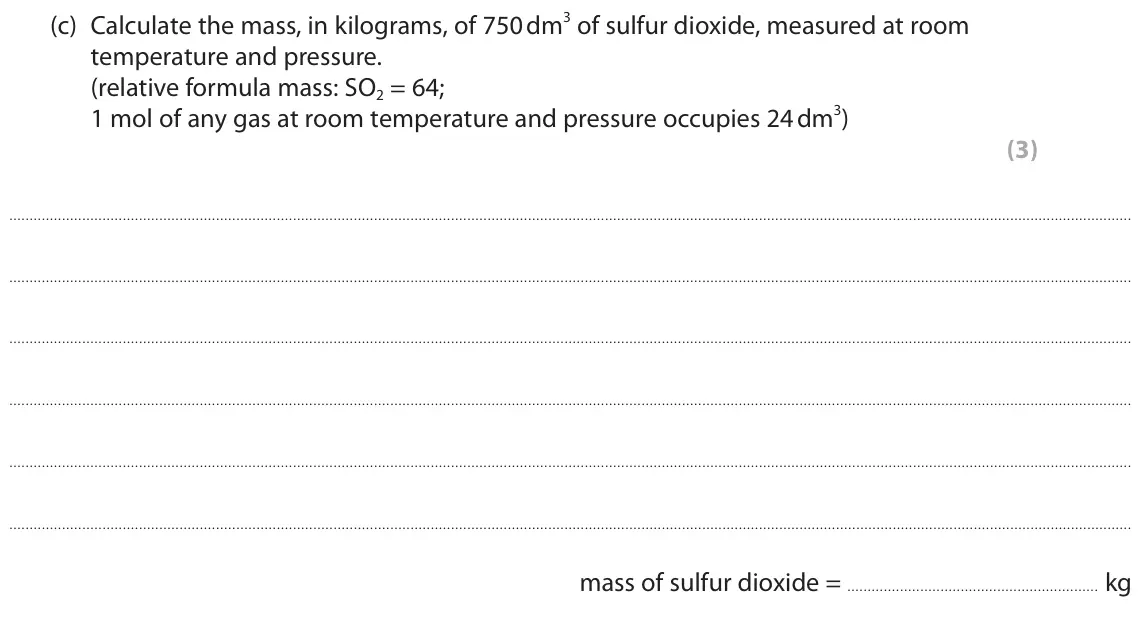
Q7(a)(ii)
The whole paper ↗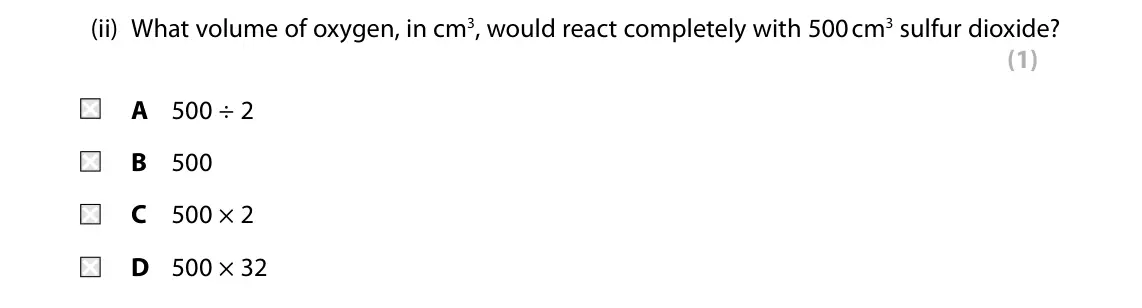
Q10(a)
The whole paper ↗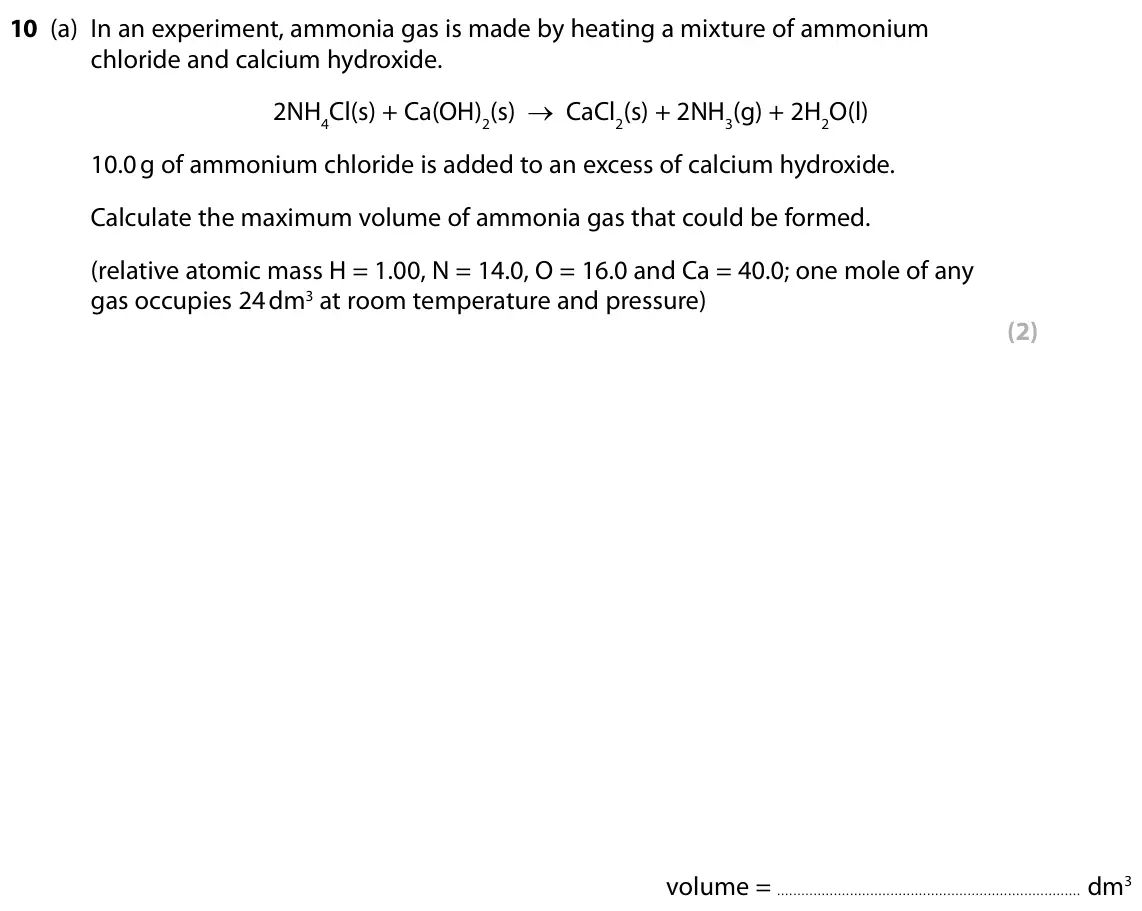
All 13 questions on Molar gas volume, as a list
- June 2024, Paper 1 Higher, Q10(b) (2 marks): Using the equation for the reaction CH4(g) + 2H2O(g) 4H2(g) + CO2(g) calculate the maximum volume of products, in dm3, that could be formed by the complete re
- June 2024, Paper 1 Higher, Q10(c) (3 marks): Using the same equation for the reaction CH4(g) + 2H2O(g) 4H2(g) + CO2(g) calculate the maximum mass, in g, of carbon dioxide for every 1800 dm3 of hydrogen,
- June 2023, Paper 1 Higher, Q10(a)(ii) (4 marks): Nitrogen can be made from sodium azide, NaN3. 2NaN3 → 2Na + 3N2 Calculate the maximum volume, in cm3, of nitrogen produced from 110 g of sodium azide. (relative
- June 2022, Paper 1 Higher, Q10(b) (1 mark): C3H8(g) C3H6(g) + H2(g) propane propene State the maximum volume of propene, in dm3, formed by the dehydrogenation of 300 dm3 of propane. (assume all volumes
- June 2022, Paper 1 Higher, Q10(c) (4 marks): 900 dm3 of propane, measured at room temperature and pressure, were dehydrogenated to form propene. C3H8(g) C3H6(g) + H2(g) propane propene Calculate the maxi
- November 2021, Paper 1 Higher, Q8(c) (2 marks): Calculate the volume of 48 g of oxygen at room temperature and pressure. (relative atomic mass: O = 16, 1 mol of gas occupies 24 dm3 at room temperature and pre
- November 2020, Paper 1 Higher, Q7(a)(ii) (3 marks): The overall equation for the process is CH4(g) + 2H2O(g) → 4H2(g) + CO2(g) 0.40 g of methane were fully reacted with steam to form carbon dioxide and hydrogen.
- June 2019, Paper 1 Higher, Q10(b) (4 marks): In one stage of the production of nitric acid, nitrogen oxide, NO, is reacted with oxygen to make nitrogen dioxide, NO2. 2NO + O2 o 2NO2 Calculate the minimum v
- June 2018, Paper 1 Higher, Q7(a) (1 mark): What volume of sulfur trioxide, in dm3, is produced by the complete reaction of 750 dm3 of sulfur dioxide? (all volumes of gases are measured under the same con
- June 2018, Paper 1 Higher, Q7(b) (1 mark): Calculate the volume of oxygen needed to react completely with 750 dm3 of sulfur dioxide. (all volumes of gases are measured under the same conditions of temper
- June 2018, Paper 1 Higher, Q7(c) (3 marks): Calculate the mass, in kilograms, of 750 dm3 of sulfur dioxide, measured at room temperature and pressure. (relative formula mass: SO2 = 64; 1 mol of any gas at
- Specimen, Paper 1 Higher, Q7(a)(ii) (1 mark): What volume of oxygen, in cm3, would react completely with 500 cm3 sulfur dioxide? (1) A 500 ÷ 2 B 500 C 500 × 2 D 500 × 32
- Specimen, Paper 1 Higher, Q10(a) (2 marks): In an experiment, ammonia gas is made by heating a mixture of ammonium chloride and calcium hydroxide. 2NH4Cl(s) + Ca(OH)2(s) → CaCl2(s) + 2NH3(g) + 2H2O(l) 10.
Questions, mark schemes and examiner’s reports are © Pearson Edexcel, from their published past papers. Plumi isn’t affiliated with any exam board. Want whole papers? Every Edexcel GCSE Chemistry paper.
Rather write your answers by hand on iPad? Plumi marks them against the same mark schemes.