 plumi
Polymers: Edexcel GCSE Chemistry questions
Every Edexcel GCSE Chemistry exam question on Polymers (specification points 9.17–9.25), 2018–2025, with its mark scheme and examiner’s report.
Find questions1,880
Exam
All years
Calculations
Q4(a)(ii)
The whole paper ↗
Q10(b)
The whole paper ↗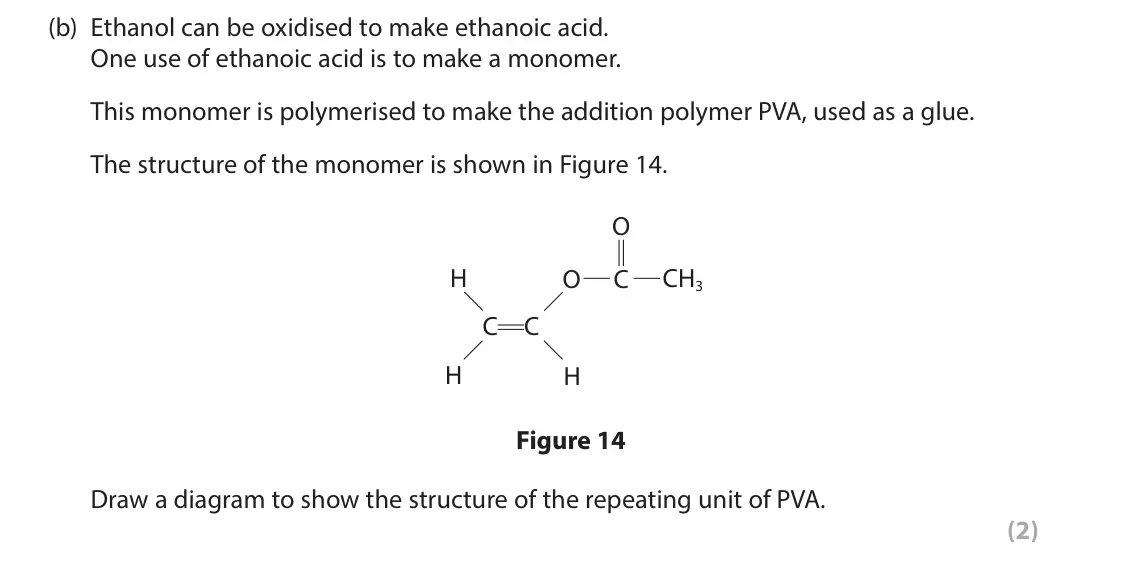
Q10(a)(ii)
The whole paper ↗
Q10(b)(i)
The whole paper ↗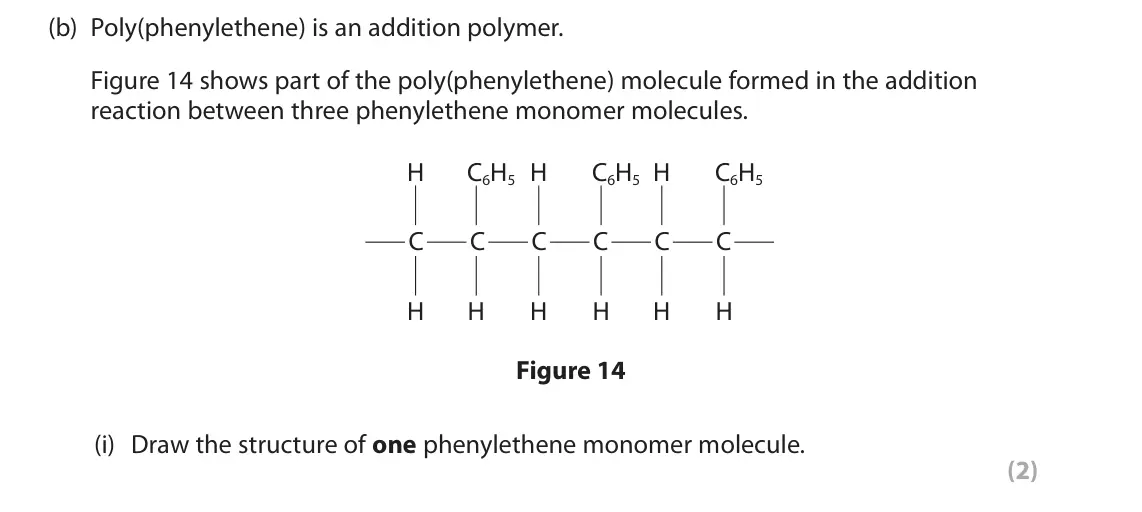
Q10(c)
The whole paper ↗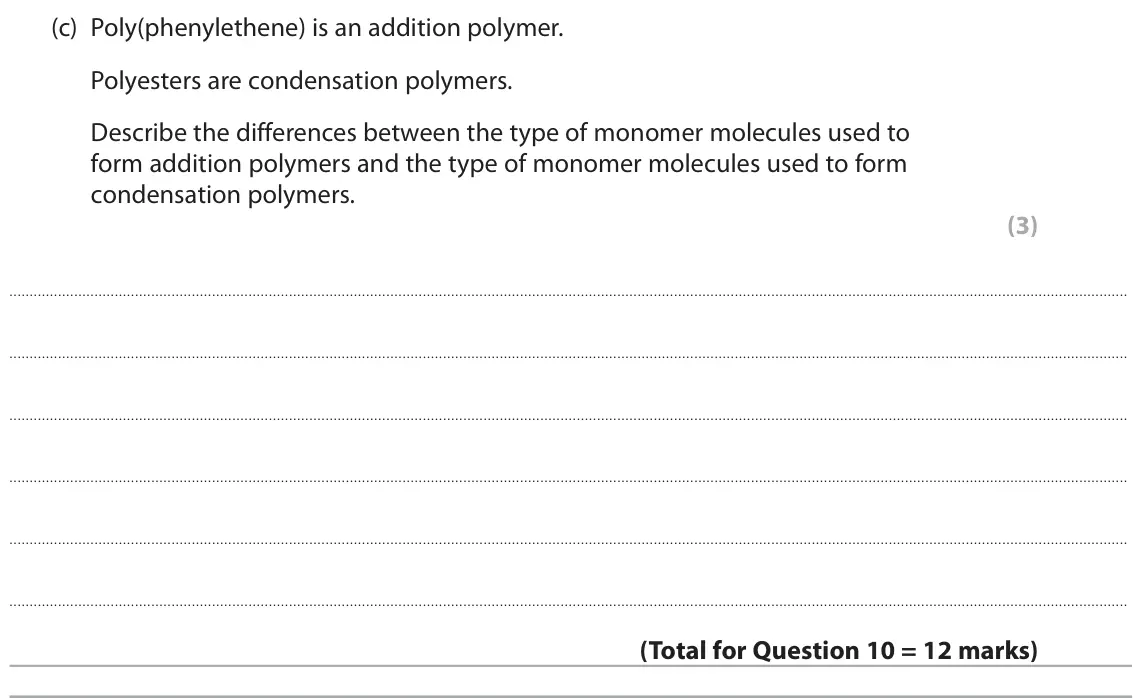
Q7(a)(iii)
The whole paper ↗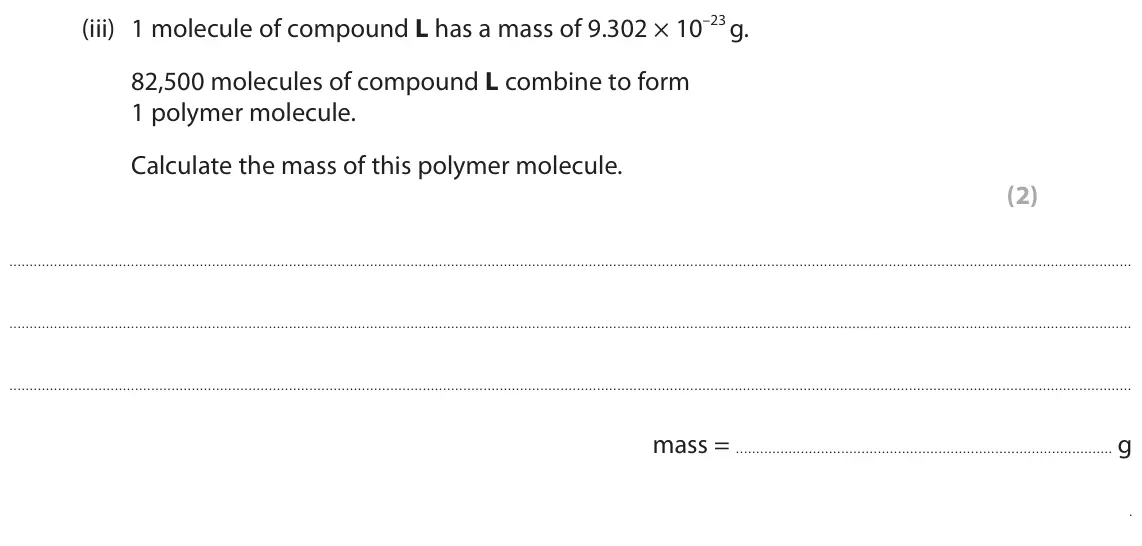
Q7(b)
The whole paper ↗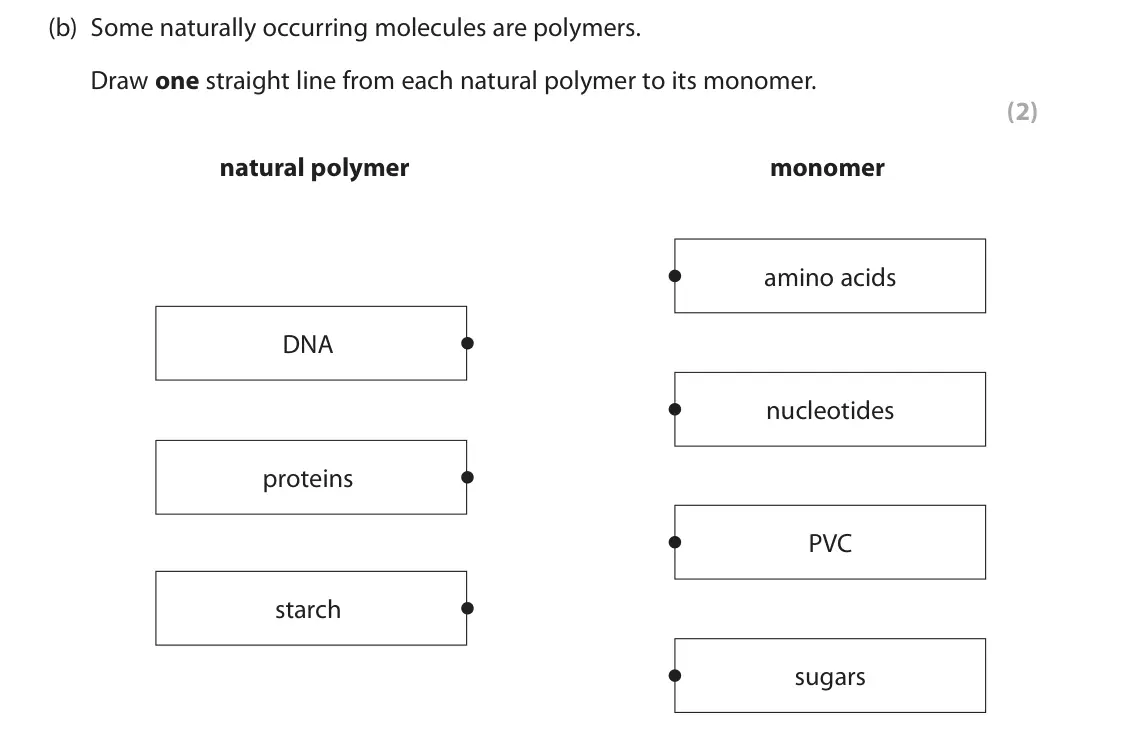
Q4(c)(i)
The whole paper ↗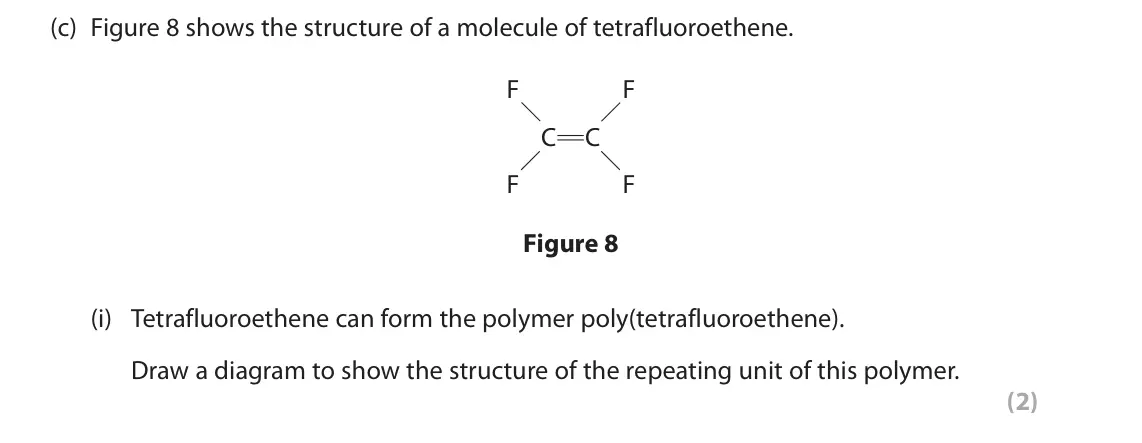
Q4(c)(ii)
The whole paper ↗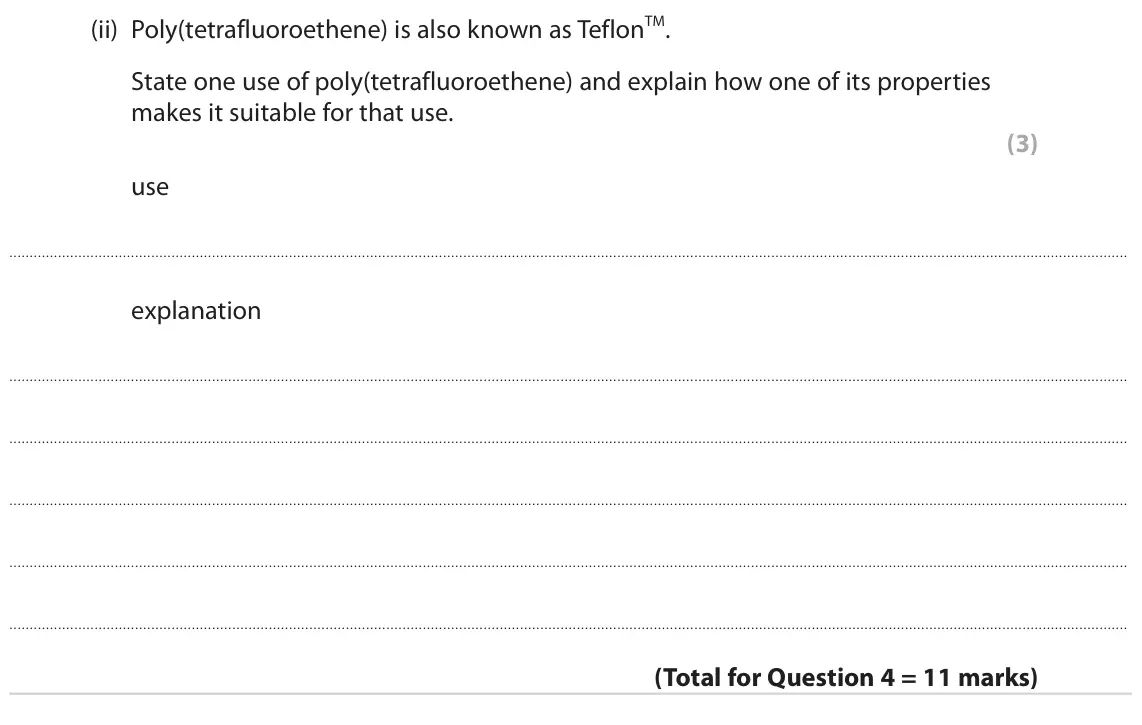
Q10(c)(i)
The whole paper ↗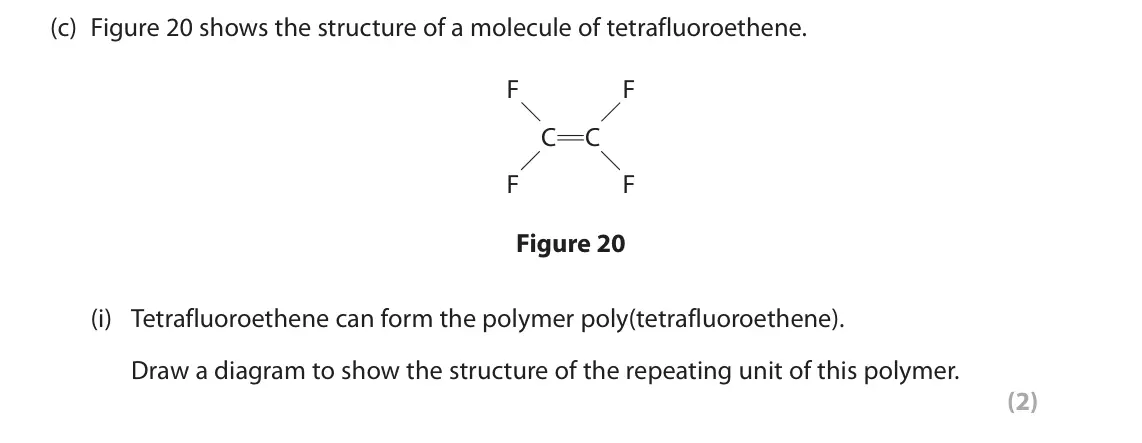
Q10(c)(ii)
The whole paper ↗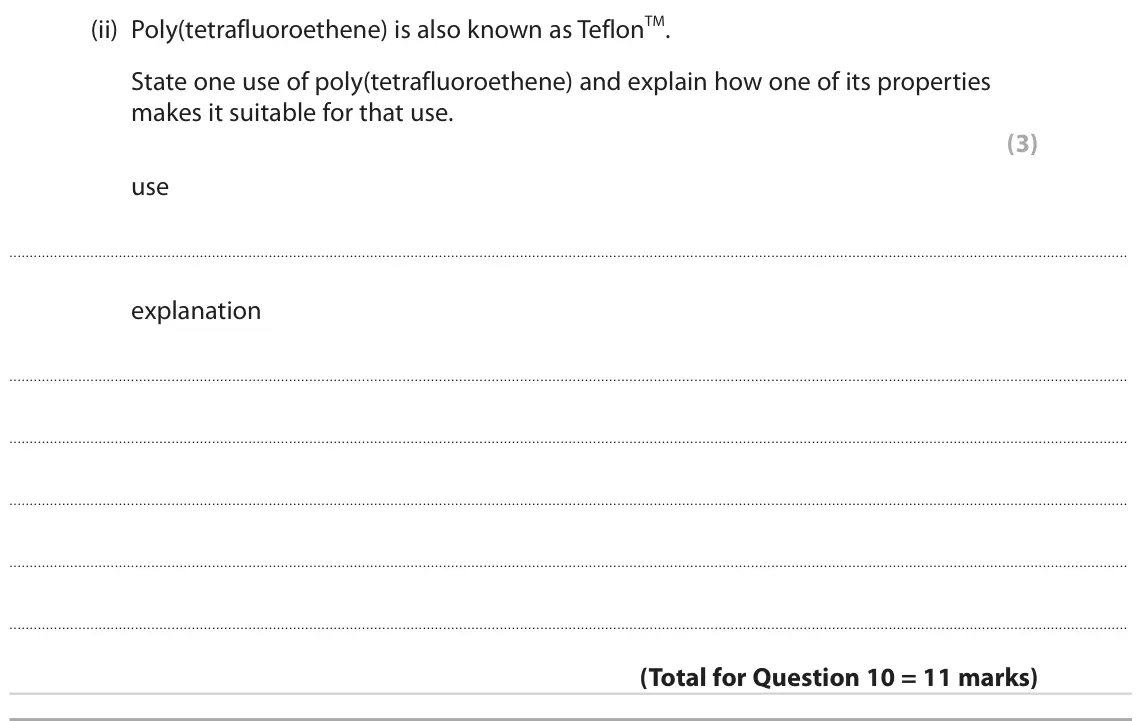
Q10(a)(iii)
The whole paper ↗
Q7(c)(i)
The whole paper ↗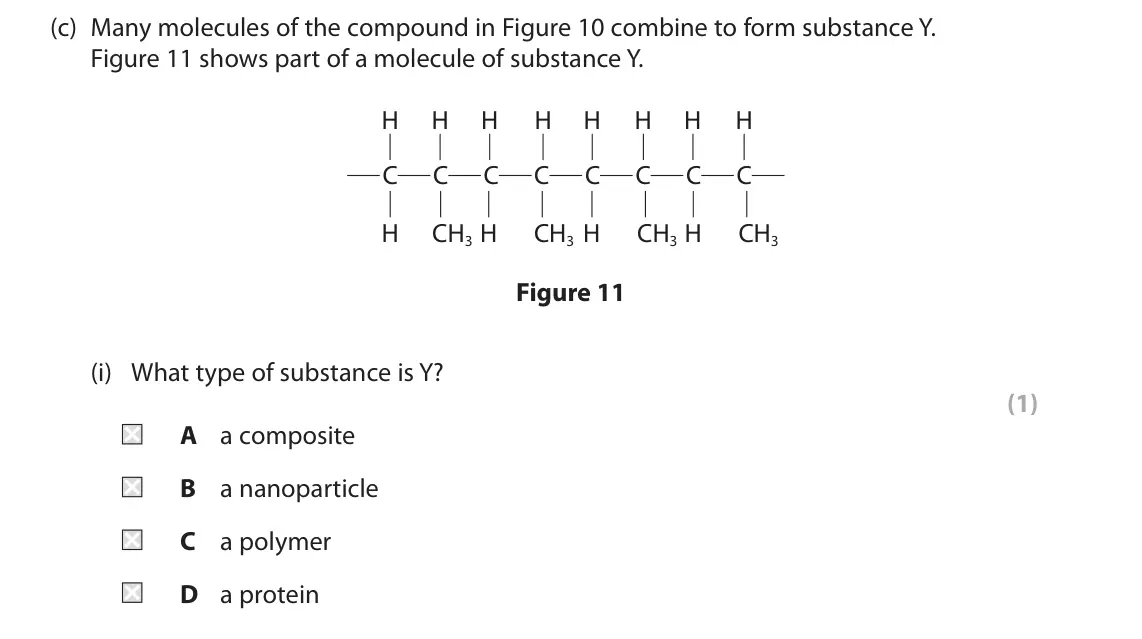
Q7(c)(ii)
The whole paper ↗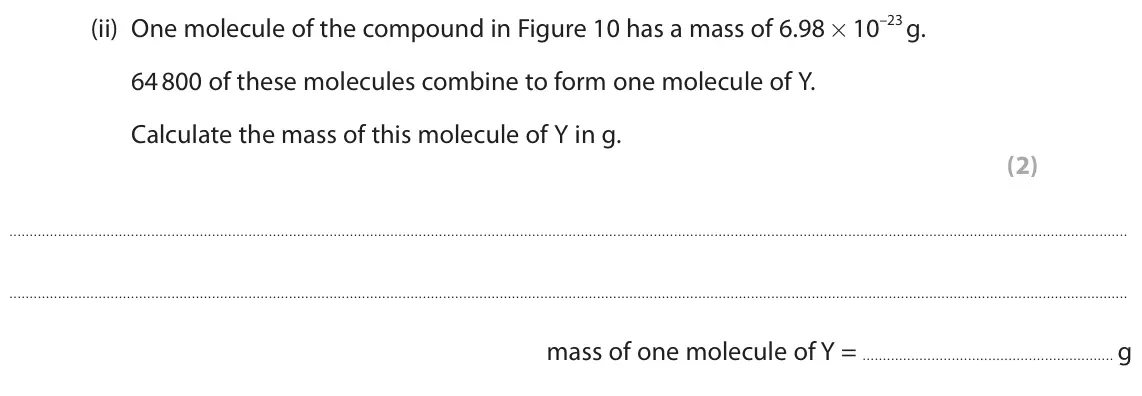
Q4(a)(i)
The whole paper ↗
Q4(a)(ii)
The whole paper ↗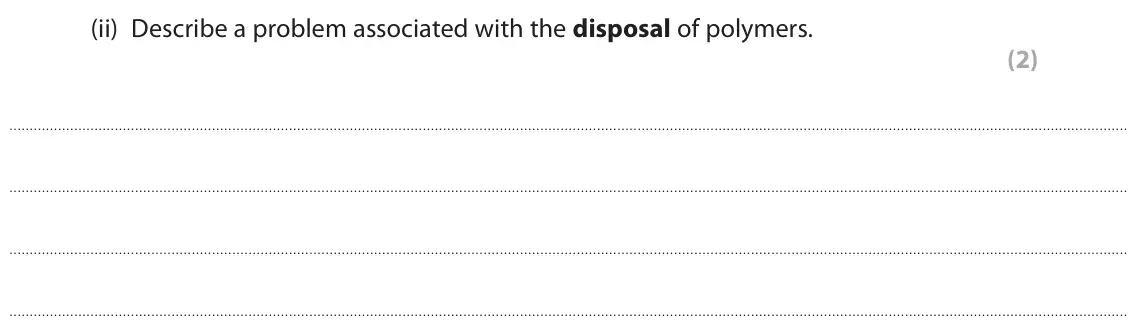
Q4(b)(ii)
The whole paper ↗
Q4(b)(iii)
The whole paper ↗
Q10(a)(i)
The whole paper ↗
Q10(a)(ii)
The whole paper ↗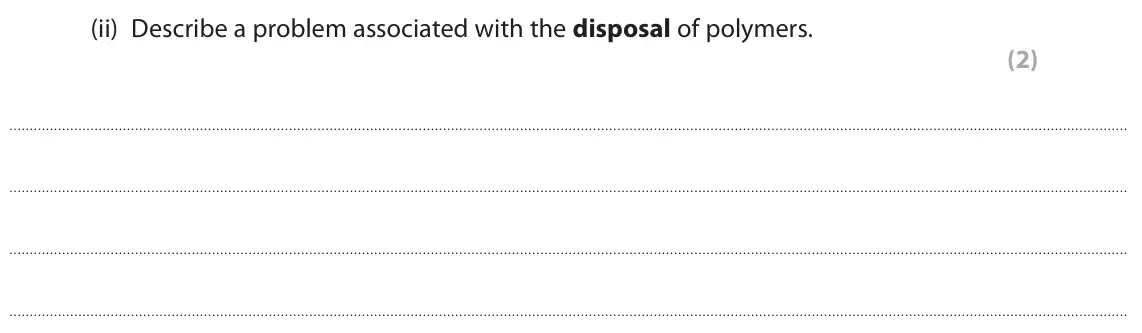
All 46 questions on Polymers, as a list
- June 2025, Paper 2 Higher, Q4(a)(ii) (2 marks): Describe how monomer molecules combine to make polymers. (2)
- June 2025, Paper 2 Higher, Q10(b) (2 marks): Ethanol can be oxidised to make ethanoic acid. One use of ethanoic acid is to make a monomer. This monomer is polymerised to make the addition polymer PVA, used
- June 2025, Paper 2 Foundation, Q10(a)(ii) (2 marks): Describe how monomer molecules combine to make polymers. (2)
- June 2024, Paper 2 Higher, Q10(b)(i) (2 marks): Draw the structure of one phenylethene monomer molecule. (2)
- June 2024, Paper 2 Higher, Q10(c) (3 marks): Poly(phenylethene) is an addition polymer. Polyesters are condensation polymers. Describe the differences between the type of monomer molecules used to form add
- June 2024, Paper 2 Foundation, Q7(a)(iii) (2 marks): 1 molecule of compound L has a mass of 9.302 × 10⁻²³ g. 82,500 molecules of compound L combine to form 1 polymer molecule. Calculate the mass of this polymer mo
- June 2024, Paper 2 Foundation, Q7(b) (2 marks): Some naturally occurring molecules are polymers. Draw one straight line from each natural polymer to its monomer. (2) natural polymer monomer amino acids DNA nu
- June 2023, Paper 2 Higher, Q4(c)(i) (2 marks): Tetrafluoroethene can form the polymer poly(tetrafluoroethene). Draw a diagram to show the structure of the repeating unit of this polymer. (2)
- June 2023, Paper 2 Higher, Q4(c)(ii) (3 marks): Poly(tetrafluoroethene) is also known as TeflonTM. State one use of poly(tetrafluoroethene) and explain how one of its properties makes it suitable for that use
- June 2023, Paper 2 Foundation, Q10(c)(i) (2 marks): Tetrafluoroethene can form the polymer poly(tetrafluoroethene). Draw a diagram to show the structure of the repeating unit of this polymer. (2)
- June 2023, Paper 2 Foundation, Q10(c)(ii) (3 marks): Poly(tetrafluoroethene) is also known as TeflonTM. State one use of poly(tetrafluoroethene) and explain how one of its properties makes it suitable for that use
- June 2022, Paper 2 Higher, Q10(a)(iii) (2 marks): Draw the repeating unit of the addition polymer formed when hydrocarbon Z undergoes polymerisation. (2)
- June 2022, Paper 2 Foundation, Q7(c)(i) (1 mark): What type of substance is Y? (1) A a composite B a nanoparticle C a polymer D a protein
- June 2022, Paper 2 Foundation, Q7(c)(ii) (2 marks): One molecule of the compound in Figure 10 has a mass of 6.98 × 10⁻²³ g. 64 800 of these molecules combine to form one molecule of Y. Calculate the mass of this
- November 2021, Paper 2 Higher, Q4(a)(i) (1 mark): State a problem with recycling polymers. (1)
- November 2021, Paper 2 Higher, Q4(a)(ii) (2 marks): Describe a problem associated with the disposal of polymers. (2)
- November 2021, Paper 2 Higher, Q4(b)(ii) (3 marks): Draw a section of a poly(chloroethene) molecule containing three repeating units, showing all bonds. (3)
- November 2021, Paper 2 Higher, Q4(b)(iii) (1 mark): What type of polymer is poly(chloroethene)? (1)
- November 2021, Paper 2 Foundation, Q10(a)(i) (1 mark): State a problem with recycling polymers. (1)
- November 2021, Paper 2 Foundation, Q10(a)(ii) (2 marks): Describe a problem associated with the disposal of polymers. (2)
- November 2021, Paper 2 Foundation, Q10(b)(i) (1 mark): On Figure 20, draw a circle around the functional group in this molecule. (1)
- November 2021, Paper 2 Foundation, Q10(b)(ii) (3 marks): Draw a section of a poly(chloroethene) molecule containing three repeating units, showing all bonds. (3)
- November 2021, Paper 2 Foundation, Q10(b)(iii) (1 mark): What type of polymer is poly(chloroethene)? (1)
- November 2021, Paper 2 Foundation, Q10(b)(iv) (3 marks): Calculate the relative formula mass of a poly(chloroethene) molecule made from 2850 chloroethene molecules, C2H3Cl. (relative atomic masses: H = 1.00, C = 12.0,
- November 2020, Paper 2 Higher, Q4(a)(i) (2 marks): Describe how dichloroethene monomers form a polymer. (2)
- November 2020, Paper 2 Higher, Q4(a)(ii) (1 mark): Which of these represents the structure of the polymer formed from the monomer in Figure 2? (1) H Cl A C C Cl H n Cl H B C C Cl H n Cl H C C C
- November 2020, Paper 2 Higher, Q4(c) (2 marks): Poly(dichloroethene) was used to wrap food to keep it fresh. Explain one property that a plastic food wrapping must have. (2)
- November 2020, Paper 2 Higher, Q5(a)(ii) (2 marks): When monomer A and monomer B react together they polymerise to form a polymer and one other product. Name the type of polymerisation that takes place and name t
- November 2020, Paper 2 Higher, Q5(a)(iii) (1 mark): A naturally occurring polymer is made by combining monomers called nucleotides. Give the name of this natural polymer. (1)
- November 2020, Paper 2 Foundation, Q7(d) (6 marks): Polymers have many uses. However, the disposal of polymers after use can be a problem. The uses of polymers are related to their properties. Some uses of three
- November 2020, Paper 2 Foundation, Q10(a)(i) (2 marks): Describe how dichloroethene monomers form a polymer. (2)
- November 2020, Paper 2 Foundation, Q10(a)(ii) (1 mark): Which of these represents the structure of the polymer formed from the monomer in Figure 16? (1) H Cl A C C Cl H n Cl H B C C Cl H n Cl H C C C
- November 2020, Paper 2 Foundation, Q10(c) (2 marks): Poly(dichloroethene) was used to wrap food to keep it fresh. Explain one property that a plastic food wrapping must have. (2)
- June 2019, Paper 2 Foundation, Q3(a) (3 marks): Figure 5 shows the names and structures of some polymers and the monomers used to make them. Complete the table using the information given. (3) structure of st
- June 2019, Paper 2 Foundation, Q3(b) (2 marks): Plastics are polymers. State two problems caused by the disposal of polymers. (2) 1 2
- June 2019, Paper 2 Foundation, Q3(c) (1 mark): A molecule of propene has the structure shown in Figure 6. H CH3 C C H H Figure 6 Which of the following shows the structure of part of a poly(propene) molecule
- June 2019, Paper 2 Foundation, Q3(d) (2 marks): Calculate the relative formula mass of the poly(propene) molecule made from joining together 24 600 molecules of propene, C3H6. (relative formula mass: C3H6 = 4
- June 2018, Paper 2 Higher, Q5(b) (2 marks): Poly(propene) is an example of a polymer. The structure of a poly(propene) molecule is shown in Figure 5. H CH3 ⎡ ⎢ C C ⎣ H H n Figure 5 This polymer is made fr
- June 2018, Paper 2 Higher, Q5(d) (1 mark): Some polymers are polyesters. What type of reaction takes place when polyesters are formed? (1) A addition B condensation C neutralisation D precipitation
- June 2018, Paper 2 Higher, Q5(e)(i) (2 marks): This polymer is made from two different monomers. Draw a molecule of each monomer showing all covalent bonds. (2)
- June 2018, Paper 2 Higher, Q5(e)(ii) (1 mark): Give the name or formula of the small molecule formed when the monomer molecules react to form an ester link. (1)
- June 2018, Paper 2 Foundation, Q7(c)(i) (2 marks): The structure of a molecule of a polymer is shown in Figure 12. F H C C F H n Figure 12 Complete the structure of a molecule of the monomer used to make this po
- June 2018, Paper 2 Foundation, Q7(c)(ii) (6 marks): Poly(ethene) has many uses in everyday life. Large amounts of poly(ethene) are manufactured from ethene produced by cracking fractions obtained from crude oil.
- Specimen, Paper 2 Higher, Q9(b) (6 marks): Polymers are addition or condensation polymers. Polymers can be formed by using the monomers shown in Figure 12. monomer structure H Cl chloroethene C C H H H H
- Specimen, Paper 2 Foundation, Q9(g) (1 mark): Alkenes are used to make polymers. Figure 15 shows the repeating unit of a polymer. H H C C H Cl n Figure 15 Draw the structure of a molecule of the monom
- Specimen, Paper 2 Foundation, Q9(h) (1 mark): Bottles can be made of polymers, such as poly(ethene), and of glass. Give one advantage of a bottle made of a polymer rather than a bottle made of glass. (1)
Questions, mark schemes and examiner’s reports are © Pearson Edexcel, from their published past papers. Plumi isn’t affiliated with any exam board. Want whole papers? Every Edexcel GCSE Chemistry paper.
Rather write your answers by hand on iPad? Plumi marks them against the same mark schemes.