 plumi
Conservation of mass and moles: Edexcel GCSE Chemistry questions
Every Edexcel GCSE Chemistry exam question on Conservation of mass and moles (specification points 1.47–1.53), 2018–2025, with its mark scheme and examiner’s report.
Find questions1,880
Exam
All years
Calculations
Q5(c)
The whole paper ↗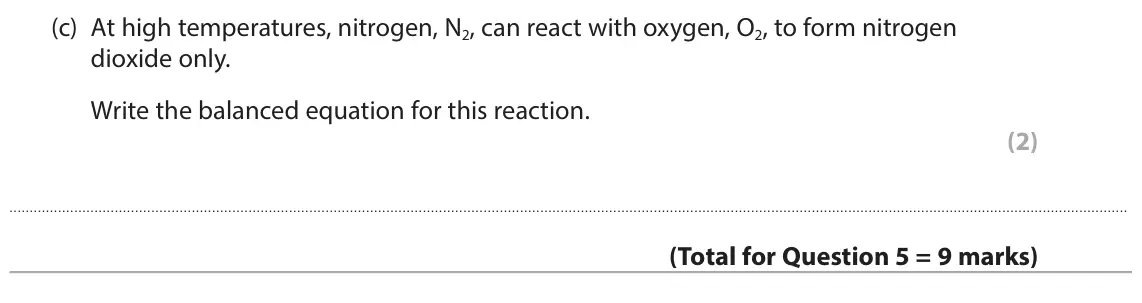
Q6(a)(iii)
The whole paper ↗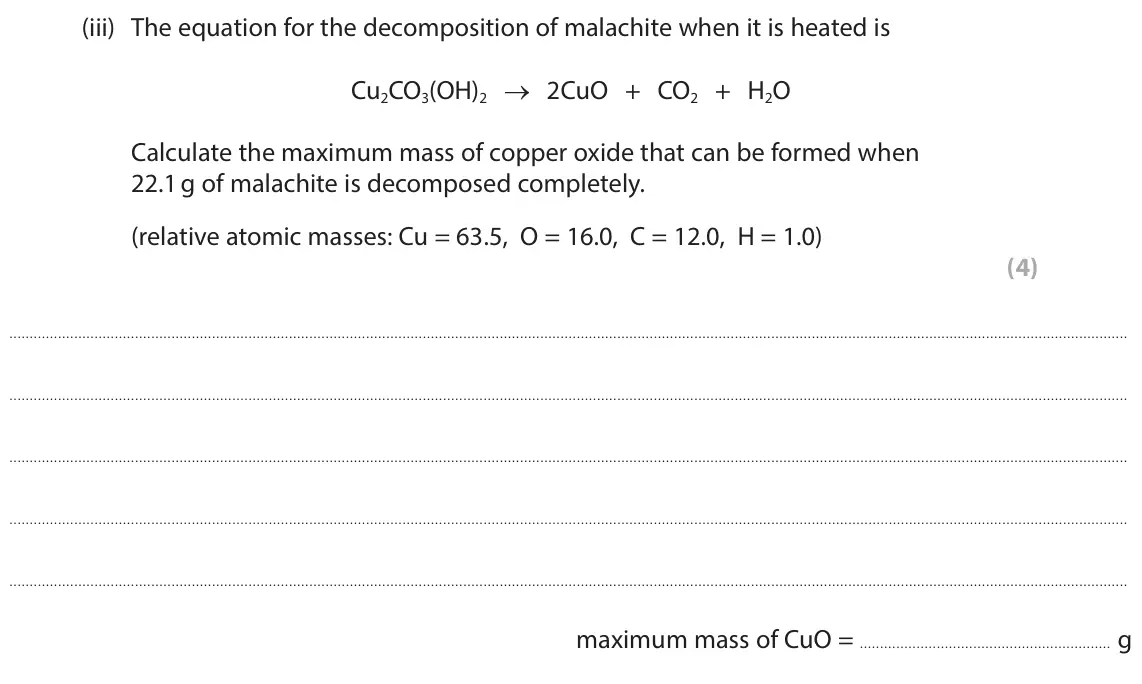
Q8(b)(ii)
The whole paper ↗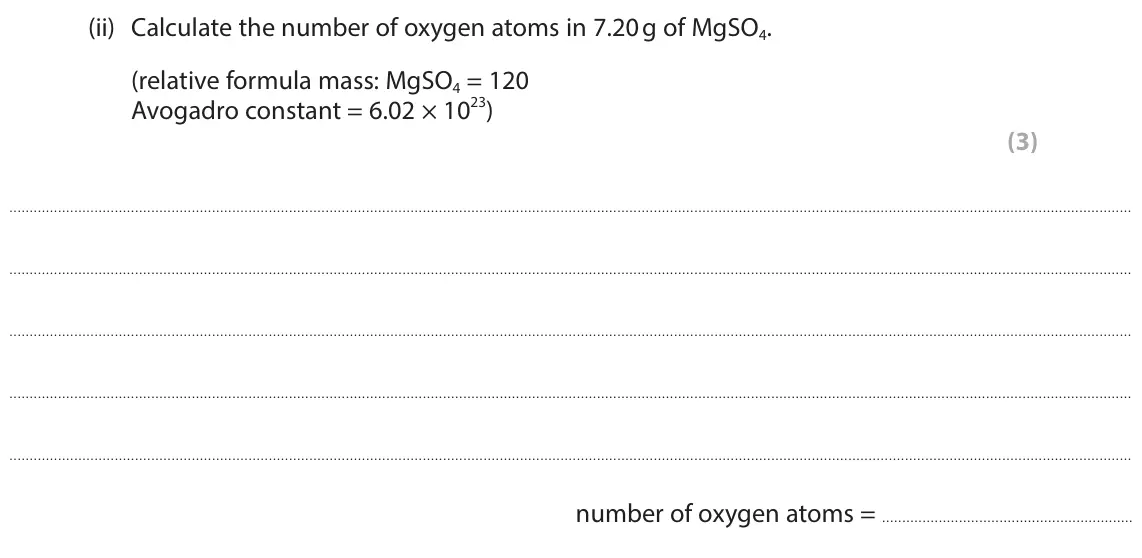
Q1(d)(i)
The whole paper ↗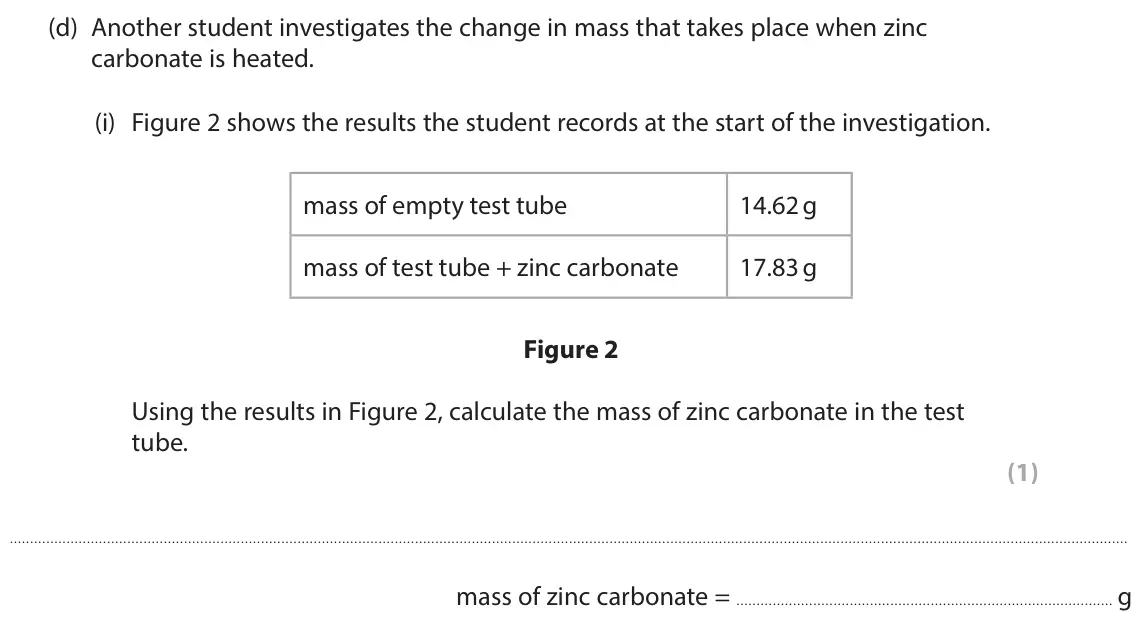
Q1(d)(ii)
The whole paper ↗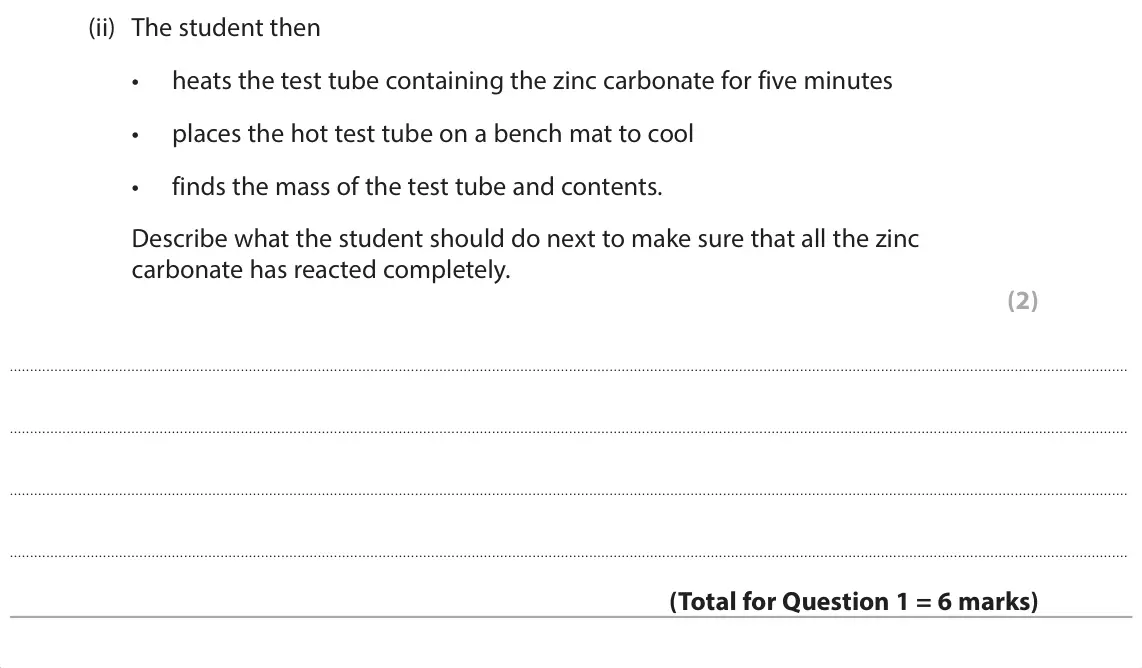
Q4(c)(ii)
The whole paper ↗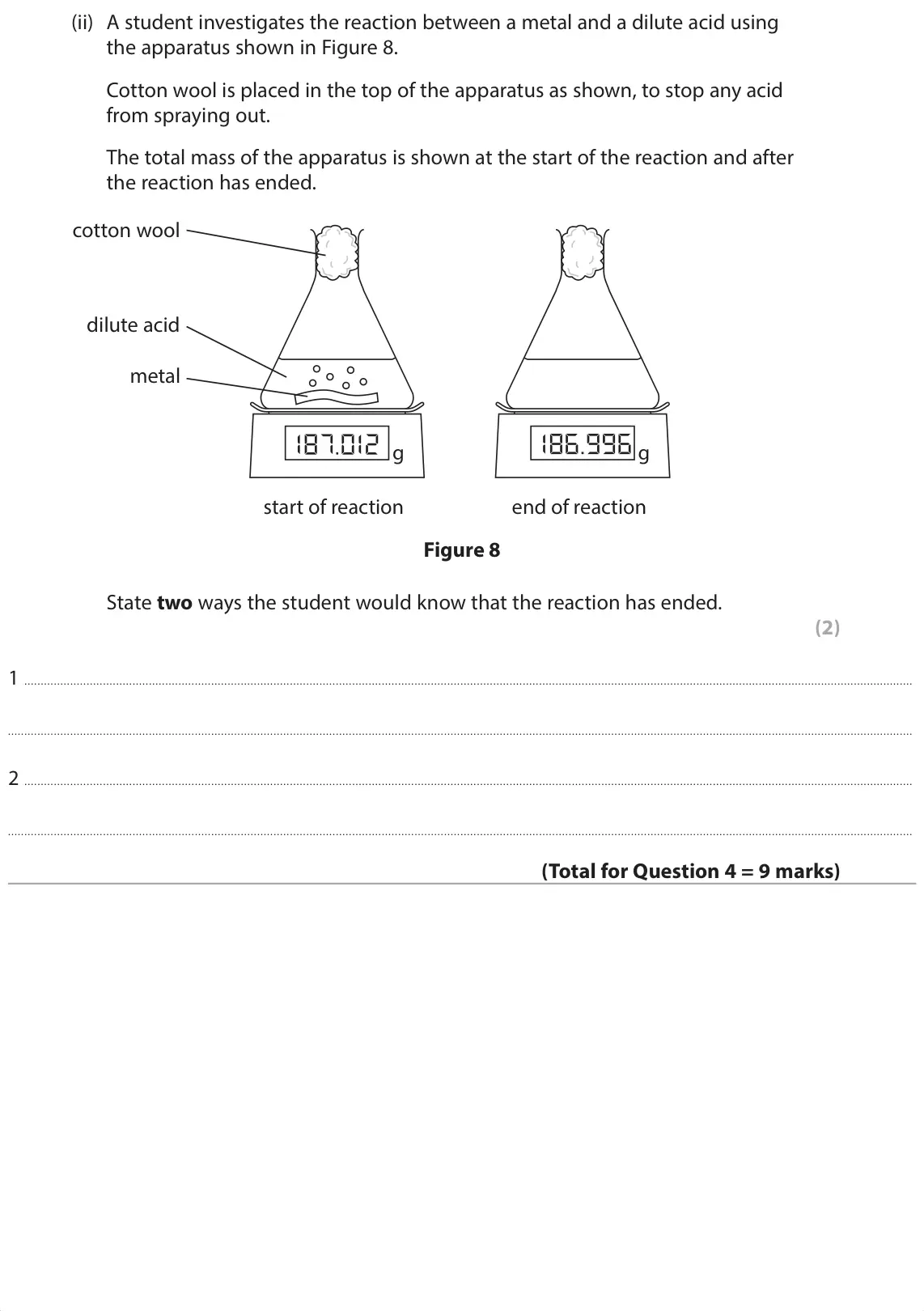
Q6(c)(iii)
The whole paper ↗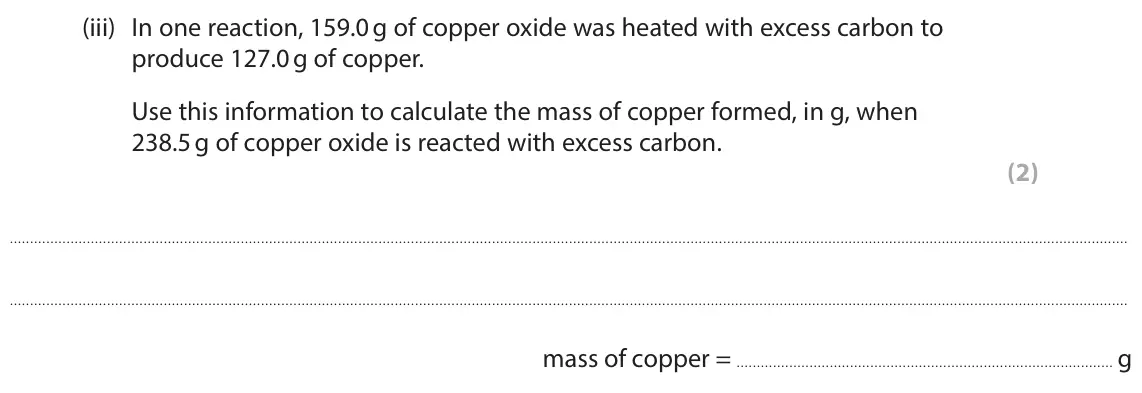
Q6(d)
The whole paper ↗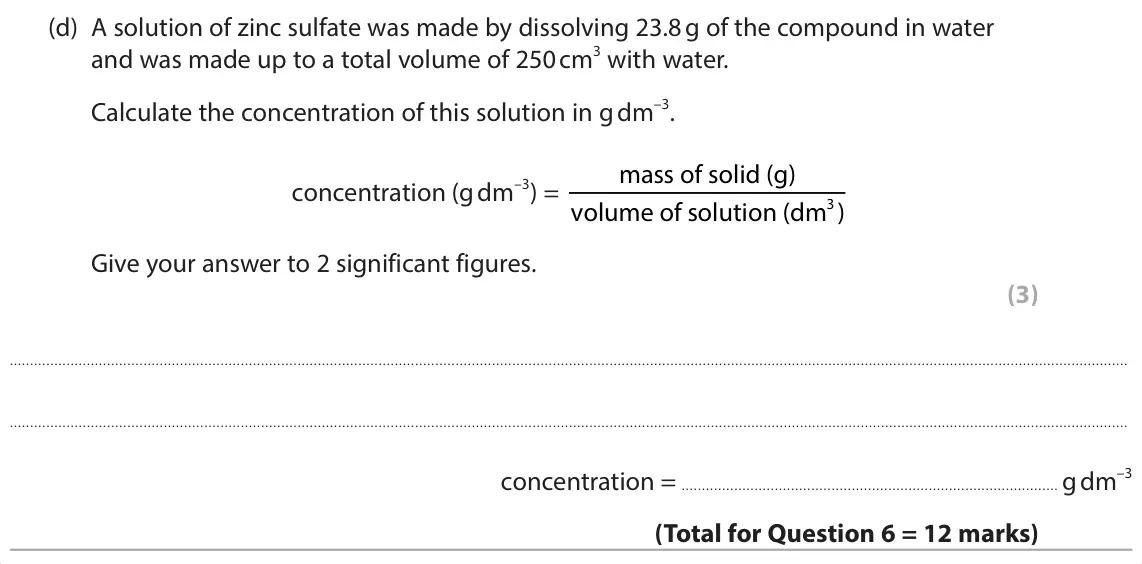
Q2(c)
The whole paper ↗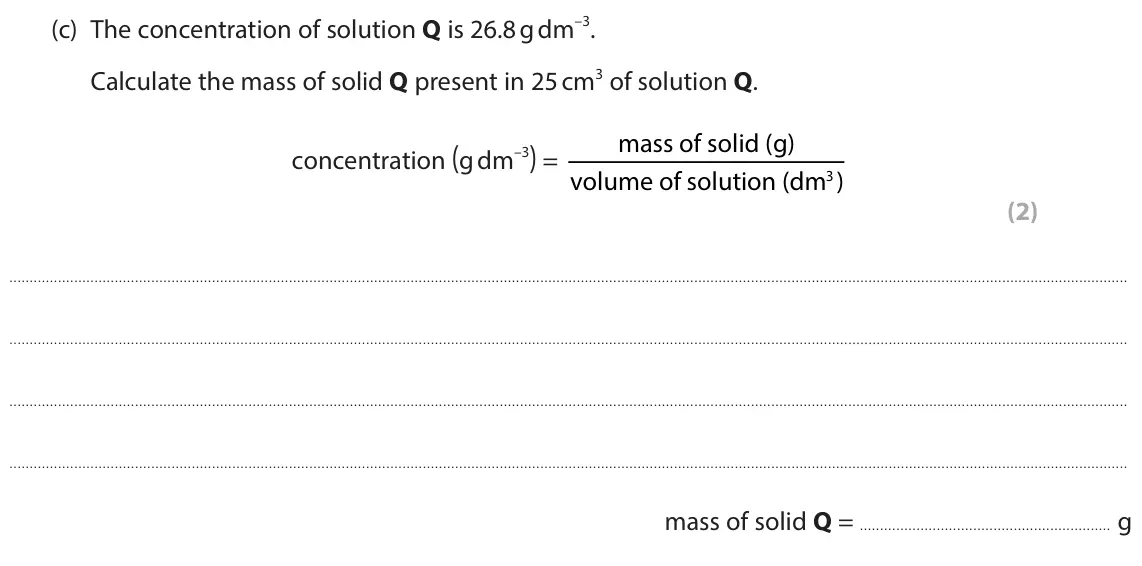
Q4(c)(ii)
The whole paper ↗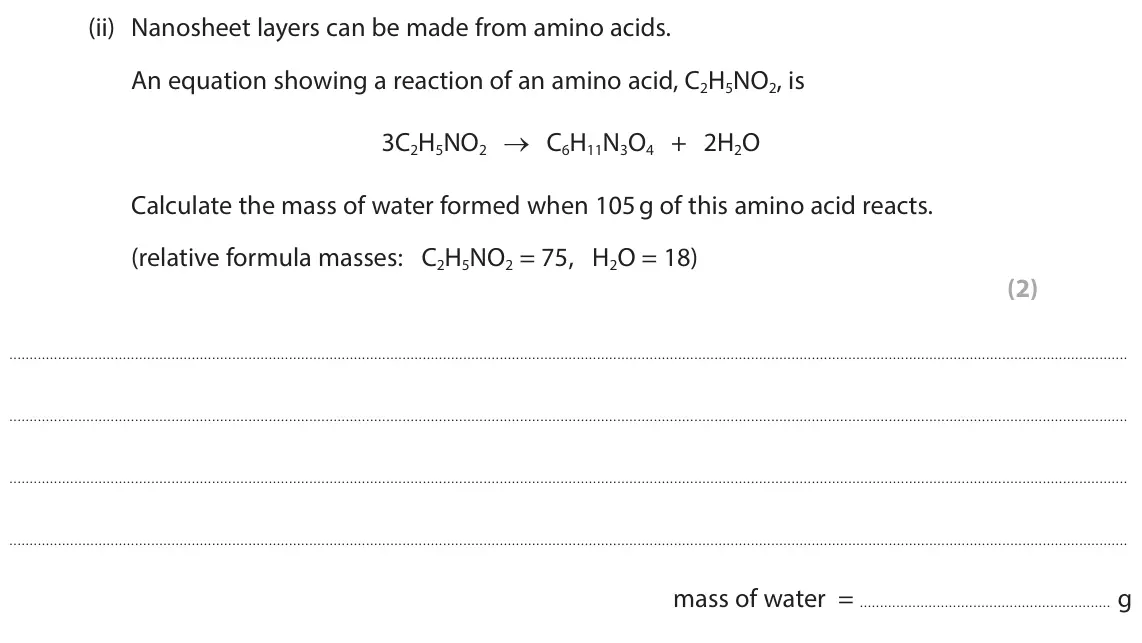
Q5(c)
The whole paper ↗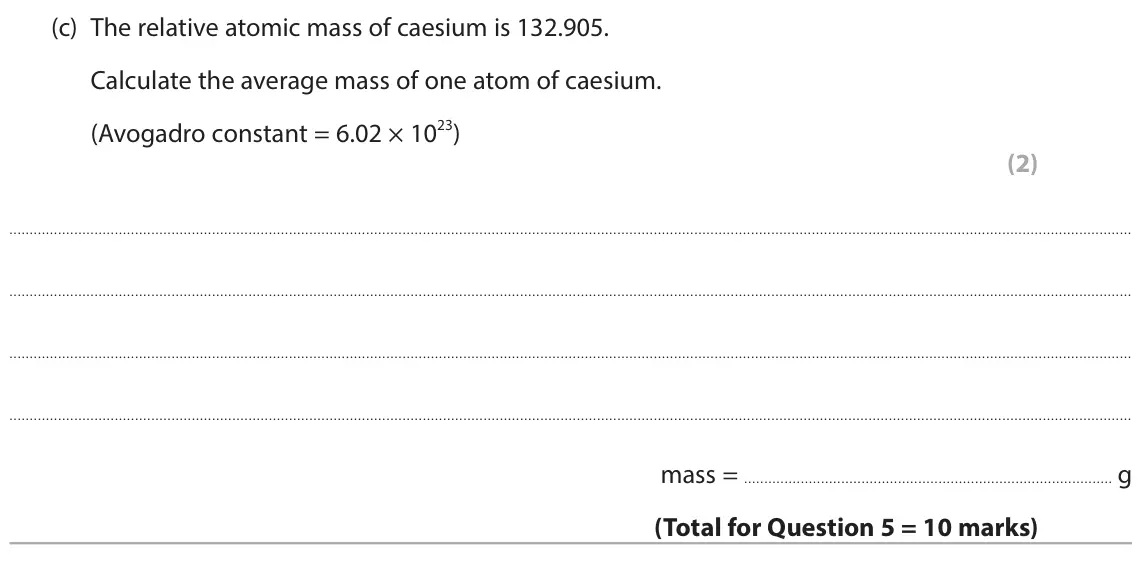
Q7(a)(ii)
The whole paper ↗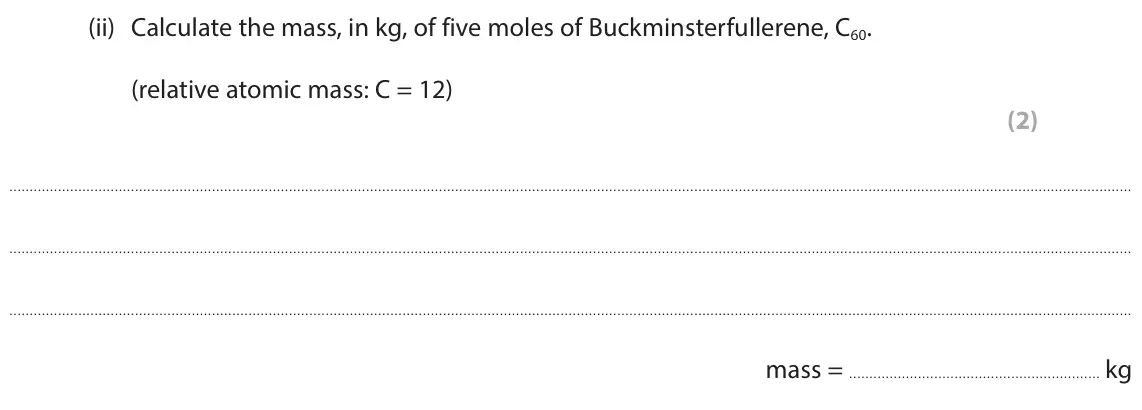
Q9(b)(ii)
The whole paper ↗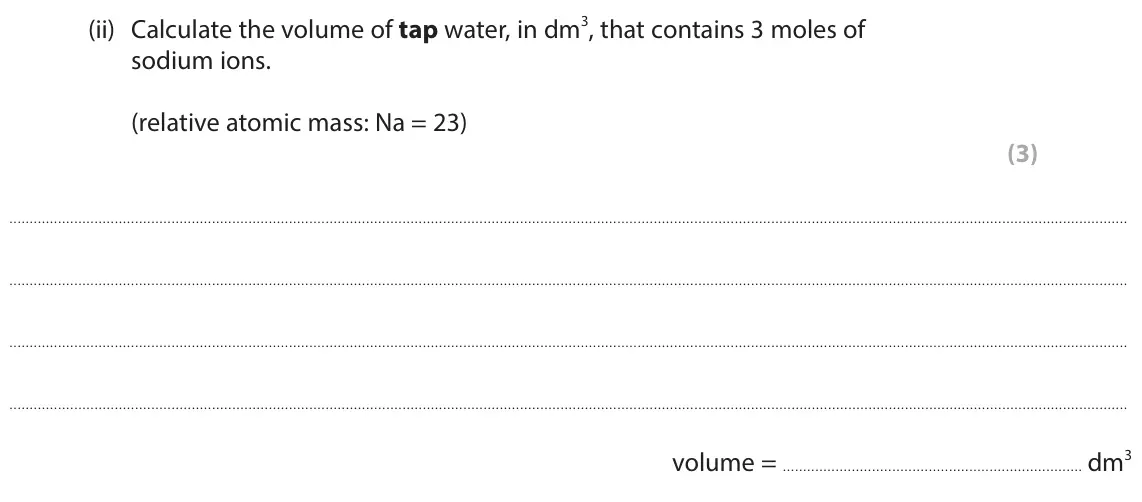
Q4(c)(ii)
The whole paper ↗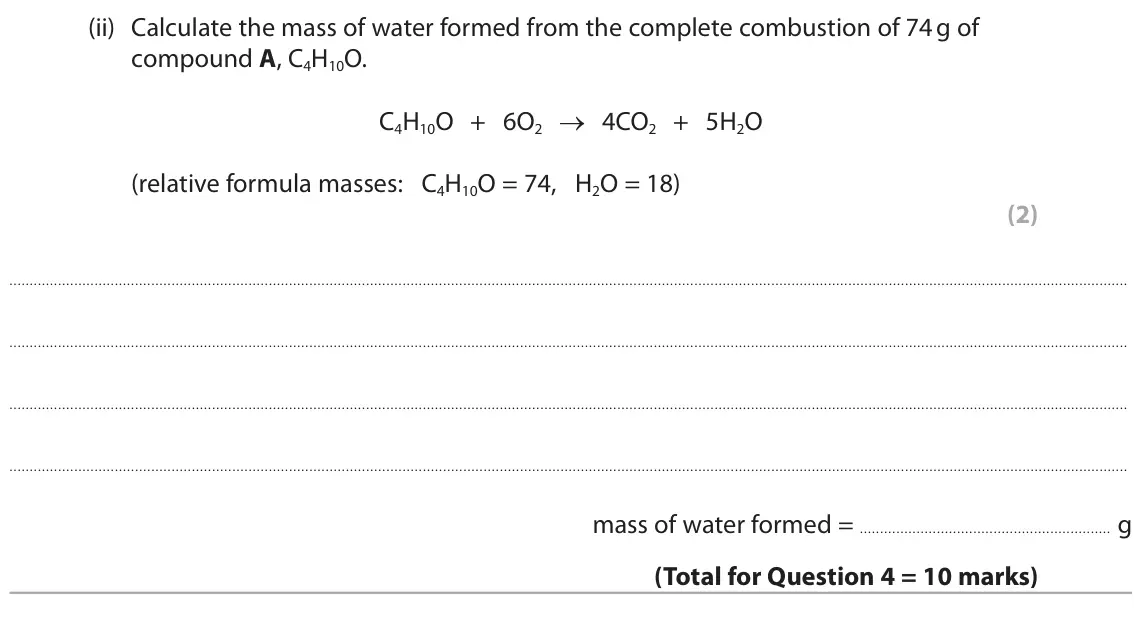
Q8(c)
The whole paper ↗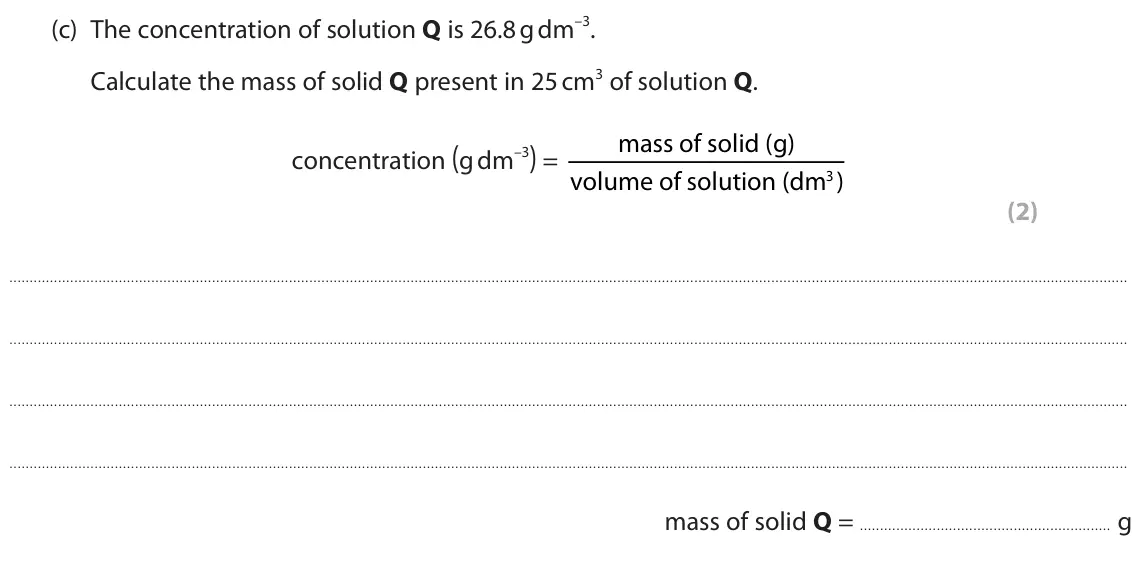
Q10(c)(ii)
The whole paper ↗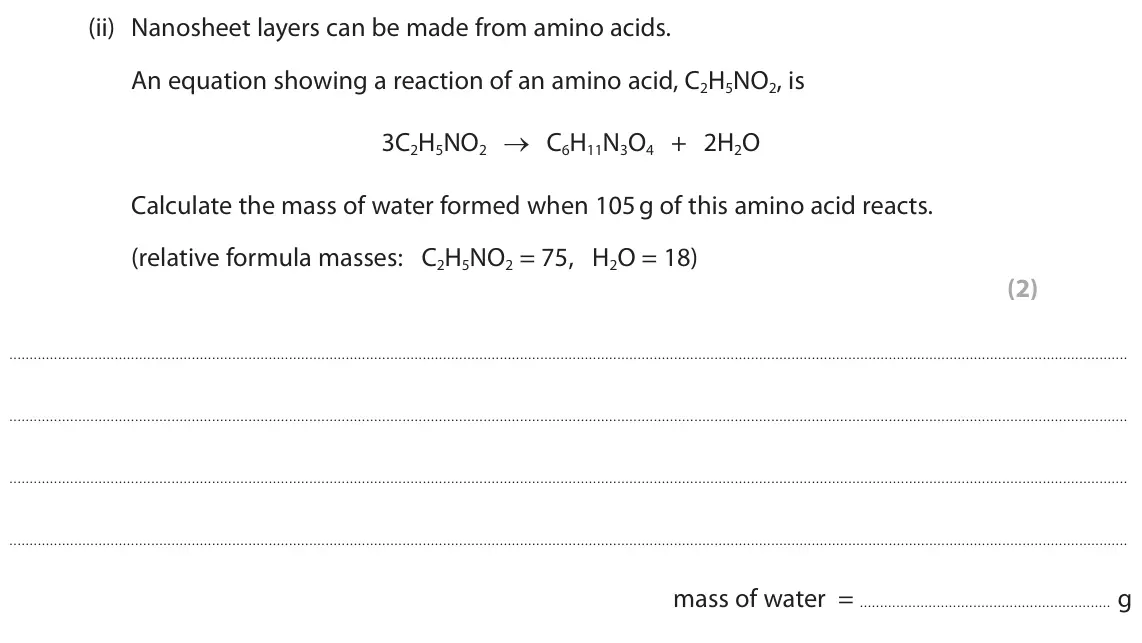
Q9(b)
The whole paper ↗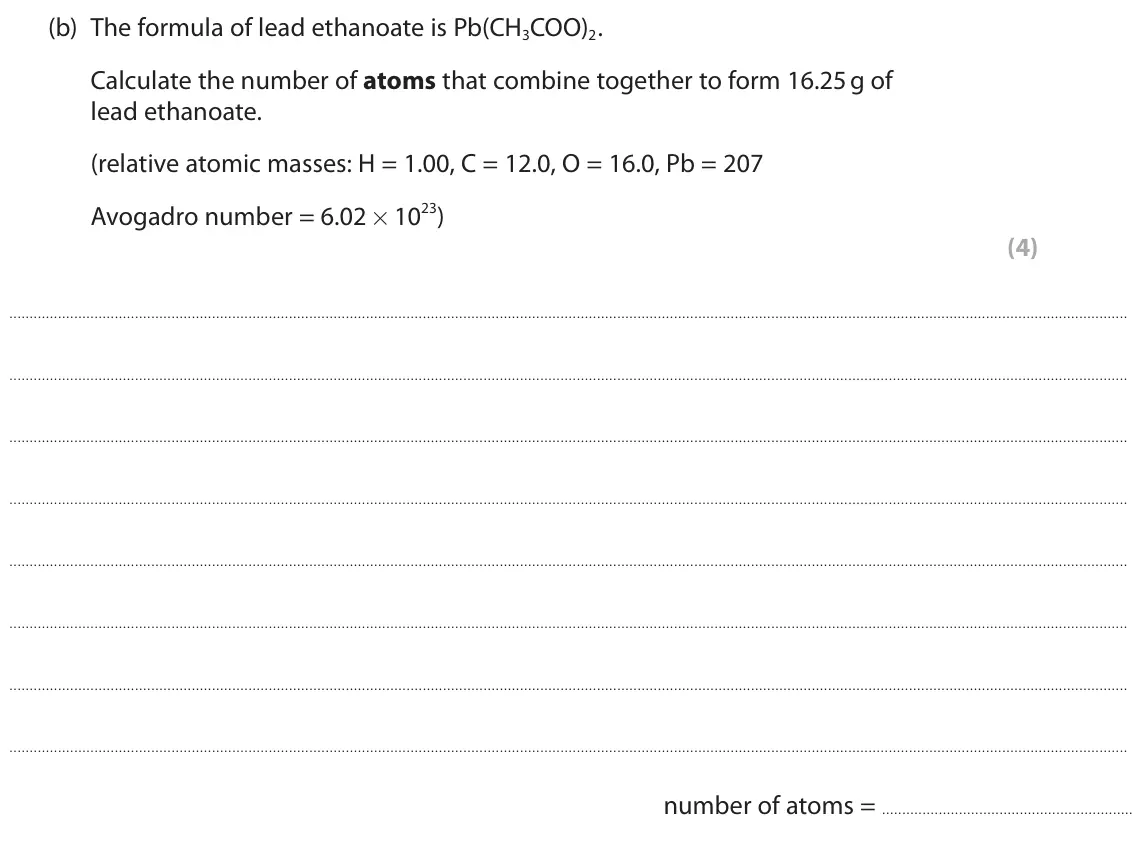
Q9(c)
The whole paper ↗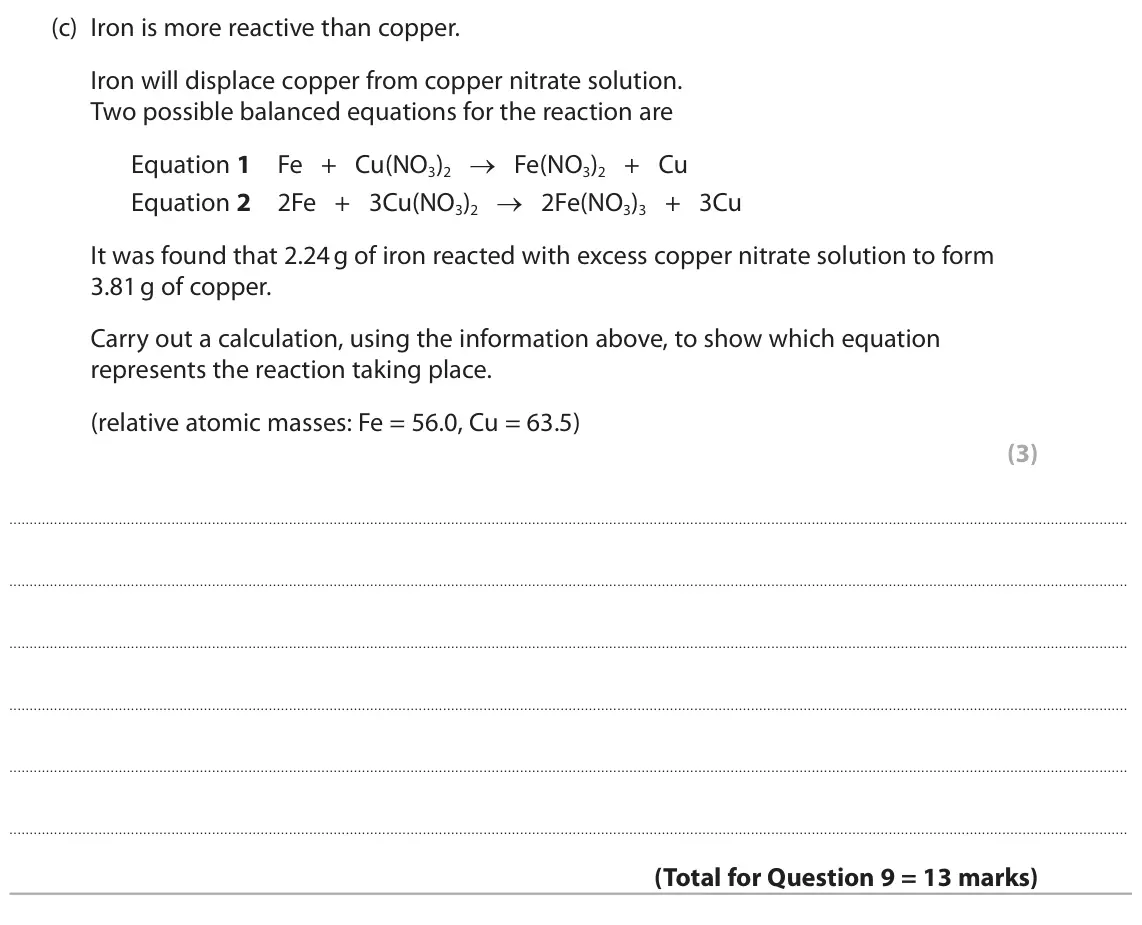
Q6(a)
The whole paper ↗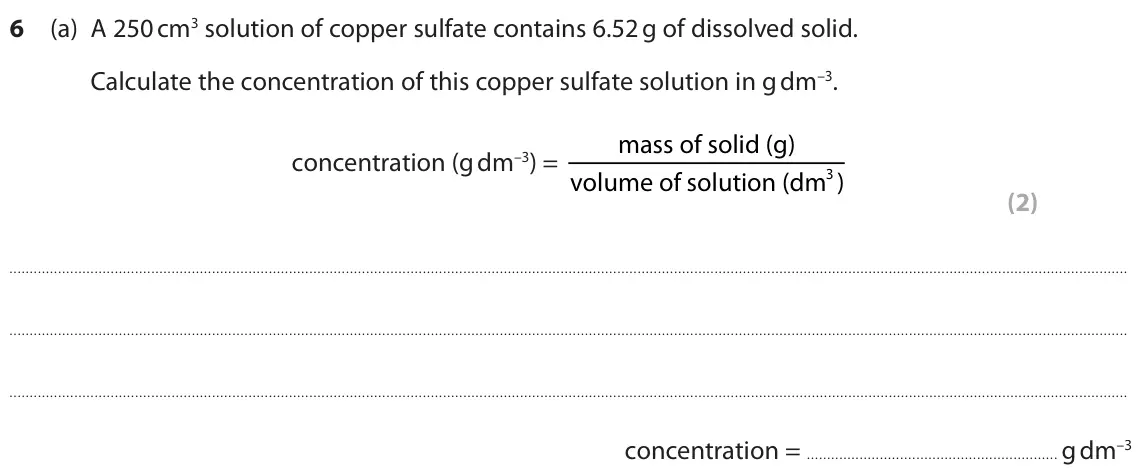
Q3(b)
The whole paper ↗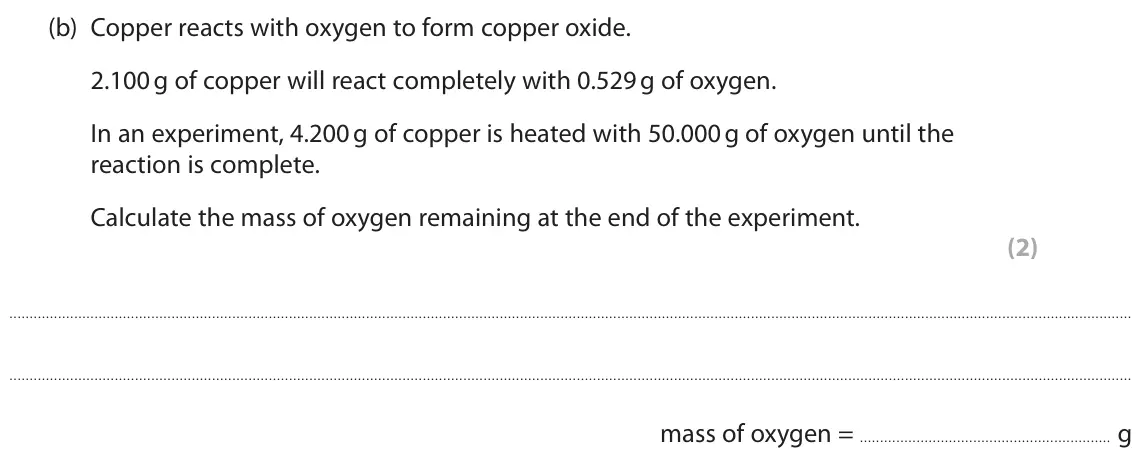
All 94 questions on Conservation of mass and moles, as a list
- June 2025, Paper 1 Higher, Q5(c) (2 marks): At high temperatures, nitrogen, N2, can react with oxygen, O2, to form nitrogen dioxide only. Write the balanced equation for this reaction. (2)
- June 2025, Paper 1 Higher, Q6(a)(iii) (4 marks): The equation for the decomposition of malachite when it is heated is Cu2CO3(OH)2 → 2CuO + CO2 + H2O Calculate the maximum mass of copper oxide that can be forme
- June 2025, Paper 1 Higher, Q8(b)(ii) (3 marks): Calculate the number of oxygen atoms in 7.20 g of MgSO4. (relative formula mass: MgSO4 = 120 Avogadro constant = 6.02 × 10²³) (3) number of oxygen atoms =
- June 2025, Paper 1 Foundation, Q1(d)(i) (1 mark): Figure 2 shows the results the student records at the start of the investigation. mass of empty test tube 14.62 g mass of test tube + zinc carbonate 17.83 g Fig
- June 2025, Paper 1 Foundation, Q1(d)(ii) (2 marks): The student then • heats the test tube containing the zinc carbonate for five minutes • places the hot test tube on a bench mat to cool • finds the mass of the
- June 2025, Paper 1 Foundation, Q4(c)(ii) (2 marks): A student investigates the reaction between a metal and a dilute acid using the apparatus shown in Figure 8. Cotton wool is placed in the top of the apparatus a
- June 2025, Paper 1 Foundation, Q6(c)(iii) (2 marks): In one reaction, 159.0 g of copper oxide was heated with excess carbon to produce 127.0 g of copper. Use this information to calculate the mass of copper formed
- June 2025, Paper 1 Foundation, Q6(d) (3 marks): A solution of zinc sulfate was made by dissolving 23.8 g of the compound in water and was made up to a total volume of 250 cm3 with water. Calculate the concent
- June 2025, Paper 2 Higher, Q2(c) (2 marks): The concentration of solution Q is 26.8 g dm–3. Calculate the mass of solid Q present in 25 cm3 of solution Q. mass of solid (g) concentration (g dm–3) = volume
- June 2025, Paper 2 Higher, Q4(c)(ii) (2 marks): Nanosheet layers can be made from amino acids. An equation showing a reaction of an amino acid, C2H5NO2, is 3C2H5NO2 → C6H11N3O4 + 2H2O Calculate the mass of wa
- June 2025, Paper 2 Higher, Q5(c) (2 marks): The relative atomic mass of caesium is 132.905. Calculate the average mass of one atom of caesium. (Avogadro constant = 6.02 × 10²³) (2) mass = g
- June 2025, Paper 2 Higher, Q7(a)(ii) (2 marks): Calculate the mass, in kg, of five moles of Buckminsterfullerene, C60. (relative atomic mass: C = 12) (2) mass = kg
- June 2025, Paper 2 Higher, Q9(b)(ii) (3 marks): Calculate the volume of tap water, in dm3, that contains 3 moles of sodium ions. (relative atomic mass: Na = 23) (3) volume = dm3
- June 2025, Paper 2 Foundation, Q4(c)(ii) (2 marks): Calculate the mass of water formed from the complete combustion of 74 g of compound A, C4H10O. C4H10O + 6O2 → 4CO2 + 5H2O (relative formula masses: C4H10O = 74,
- June 2025, Paper 2 Foundation, Q8(c) (2 marks): The concentration of solution Q is 26.8 g dm–3. Calculate the mass of solid Q present in 25 cm3 of solution Q. mass of solid (g) concentration (g dm–3) = volume
- June 2025, Paper 2 Foundation, Q10(c)(ii) (2 marks): Nanosheet layers can be made from amino acids. An equation showing a reaction of an amino acid, C2H5NO2, is 3C2H5NO2 → C6H11N3O4 + 2H2O Calculate the mass of wa
- June 2024, Paper 1 Higher, Q9(b) (4 marks): The formula of lead ethanoate is Pb(CH3COO)2. Calculate the number of atoms that combine together to form 16.25 g of lead ethanoate. (relative atomic masses: H
- June 2024, Paper 1 Higher, Q9(c) (3 marks): Iron is more reactive than copper. Iron will displace copper from copper nitrate solution. Two possible balanced equations for the reaction are Equation 1 Fe +
- June 2024, Paper 1 Foundation, Q6(a) (2 marks): A 250 cm3 solution of copper sulfate contains 6.52 g of dissolved solid. Calculate the concentration of this copper sulfate solution in g dm–3. mass of solid (g
- June 2024, Paper 2 Higher, Q3(b) (2 marks): Copper reacts with oxygen to form copper oxide. 2.100 g of copper will react completely with 0.529 g of oxygen. In an experiment, 4.200 g of copper is heated wi
- June 2024, Paper 2 Higher, Q6(b)(ii) (4 marks): A hydrocarbon, CxHy , is burned in excess oxygen, forming 26.4 g of carbon dioxide and 5.4 g of water. The relative formula mass of CxHy is 78. Calculate the mo
- June 2024, Paper 2 Higher, Q10(a)(ii) (2 marks): It is found that 1.6 g of ethanol is used to raise the temperature of water by 40 °C. Calculate the number of moles of ethanol used. Give your answer to two sig
- June 2024, Paper 2 Foundation, Q9(b) (2 marks): Copper reacts with oxygen to form copper oxide. 2.100 g of copper will react completely with 0.529 g of oxygen. In an experiment, 4.200 g of copper is heated wi
- June 2023, Paper 1 Higher, Q4(c)(i) (2 marks): Calculate the maximum mass of sulfuric acid that could be produced from 400 tonnes of sulfur trioxide, SO3. (relative formula masses: SO3 = 80, H2SO4 = 98) (2)
- June 2023, Paper 1 Higher, Q6(c) (3 marks): In another experiment, 74 mg of copper is formed. Calculate the number of copper atoms in 74 mg of copper. (relative atomic mass Cu = 63.5; Avogadro constant =
- June 2023, Paper 1 Higher, Q8(f) (1 mark): In another experiment, a copper sulfate solution with a concentration of 39.875 g dm–3 is used. Calculate the mass of copper sulfate dissolved in 0.300 dm3 of t
- June 2023, Paper 1 Foundation, Q10(c)(i) (2 marks): Calculate the maximum mass of sulfuric acid that could be produced from 400 tonnes of sulfur trioxide, SO3. (relative formula masses: SO3 = 80, H2SO4 = 98) (2)
- June 2023, Paper 2 Higher, Q10(c)(i) (3 marks): A student was asked to test a sample of aluminium sulfate for sulfate ions. The student needed 25 cm3 of barium chloride solution of concentration 83 g dm–3 for
- June 2023, Paper 2 Foundation, Q5(b) (2 marks): The student dissolved 45 g of glucose in water to make 150 cm3 of glucose solution. Calculate the concentration of this solution in g dm–3. (2) concentration of
- June 2023, Paper 2 Foundation, Q5(e) (2 marks): The complete fermentation of 180 g of glucose produces 92 g of ethanol. Calculate the maximum mass of ethanol, in g, produced from the complete fermentation of
- June 2022, Paper 1 Higher, Q9(b) (4 marks): The formula of aluminium sulfate is Al2(SO4)3. Calculate the total number of atoms that combine to form 5.13 g of aluminium sulfate. (relative atomic masses: O
- June 2022, Paper 1 Higher, Q9(c) (3 marks): Iron is more reactive than lead. Iron reacts with lead nitrate solution to form solid lead. Two possible balanced equations for the reaction are Equation 1 Fe +
- June 2022, Paper 1 Foundation, Q6(a) (2 marks): 3.14 g of solid copper sulfate was dissolved in water and made up to 250 cm3 of solution. mass of solid (g) concentration (g dm−3) = 3 volume of solution (dm )
- June 2022, Paper 1 Foundation, Q6(b)(ii) (1 mark): Complete the balanced equation for the reaction by adding a number in front of NaOH. (1) NaOH + CuSO4 → Cu(OH)2 + Na2SO4
- June 2022, Paper 2 Higher, Q3(c) (2 marks): When calcium carbonate is heated it decomposes. CaCO3(s) → CaO(s) + CO2(g) When 5.000 g of calcium carbonate is heated, the mass of solid remaining is 2.800 g.
- June 2022, Paper 2 Higher, Q3(e) (2 marks): Oxygen gas has the formula O2. Calculate the number of oxygen atoms in 3.50 mol of oxygen gas. (Avogadro constant = 6.02 × 10²³) (2) number of oxygen atoms =
- June 2022, Paper 2 Higher, Q7(b) (2 marks): Magnesium reacts with oxygen from the air to form magnesium oxide. A student carries out an investigation to determine the mass of magnesium oxide formed when a
- June 2022, Paper 2 Foundation, Q3(c)(ii) (2 marks): 10.0 g of the solution of the compound of potassium are tested. 1.0 g of dilute nitric acid is added. 4 drops of silver nitrate solution are added, each with a
- June 2022, Paper 2 Foundation, Q9(c) (2 marks): When calcium carbonate is heated it decomposes. CaCO3(s) → CaO(s) + CO2(g) When 5.000 g of calcium carbonate is heated, the mass of solid remaining is 2.800 g.
- November 2021, Paper 1 Higher, Q1(a) (3 marks): A student investigated the decomposition of a sample of zinc carbonate. The student used the following method. step 1 the mass of an empty crucible was determin
- November 2021, Paper 1 Higher, Q1(c) (2 marks): Another student carried out the experiment using a similar method. The student used a blue, roaring Bunsen burner flame and placed a lid on the crucible. State
- November 2021, Paper 1 Higher, Q6(d) (4 marks): Hydrated copper sulfate has the formula CuSO4.5H2O. The formula tells us that each mole of copper sulfate contains 5 moles of water. A sample of CuSO4.5H2O was
- November 2021, Paper 1 Higher, Q7(d)(i) (2 marks): Calculate the number of moles in 45 000 grams of titanium chloride. (relative atomic masses: Cl = 35.5, Ti = 48.0) (2) number of moles titanium chloride =
- November 2021, Paper 1 Higher, Q7(d)(ii) (1 mark): Show that the 500 moles of magnesium added is an excess. (1)
- November 2021, Paper 1 Foundation, Q2(b)(iii) (2 marks): Calculate the mass of calcium ions in 250 cm3 of this drinking water. (2) mass = mg
- November 2021, Paper 1 Foundation, Q7(d) (6 marks): Some gold alloys contain copper. Copper reacts with oxygen when heated. copper + oxygen → copper oxide A teacher calculates that 1.20g of copper reacts complete
- November 2021, Paper 2 Higher, Q2(a) (2 marks): The concentration of a solution can be calculated using the equation mass of solid concentration of solution = volume of solution A student dissolved 9.25g of a
- November 2021, Paper 2 Higher, Q10(b) (2 marks): The balanced equation for the production of ethanol from the carbohydrate sucrose is C12H22O11 + H2O → 4C2H5OH + 4CO2 sucrose Calculate the minimum mass of sucr
- November 2021, Paper 2 Higher, Q10(c) (2 marks): Calculate the total number of atoms in 10.0 g of sucrose, C12H22O11. (relative formula mass: C12H22O11 = 342; Avogadro constant = 6.02 × 10²³) (2) number of ato
- November 2021, Paper 2 Foundation, Q8(a) (2 marks): The concentration of a solution can be calculated using the equation mass of solid concentration of solution = volume of solution A student dissolved 9.25g of a
- November 2020, Paper 1 Higher, Q1(c) (2 marks): A gold ring contains 3.94 g of gold. Calculate the number of gold atoms in the ring. (relative atomic mass: Au = 197, Avogadro constant = 6.02 × 10²³) Show your
- November 2020, Paper 1 Higher, Q2(b) (3 marks): The sodium sulfate solution was made by dissolving 28.4 g of sodium sulfate in water to make 250 cm3 of solution. Calculate the concentration of this solution i
- November 2020, Paper 1 Foundation, Q8(b) (3 marks): The sodium sulfate solution was made by dissolving 28.4 g of sodium sulfate in water to make 250 cm3 of solution. Calculate the concentration of this solution i
- November 2020, Paper 2 Higher, Q6(a)(iii) (1 mark): You are provided with some dilute hydrochloric acid which has a concentration of 50 g dm–3. For this experiment, dilute hydrochloric acid with a concentration o
- November 2020, Paper 2 Higher, Q8(a)(iii) (4 marks): 8.5 g of rubidium are reacted completely with water. The reaction makes a solution of rubidium hydroxide. The volume of this solution is 2.5 dm3. Calculate the
- November 2020, Paper 2 Higher, Q8(b) (3 marks): An example of an endothermic reaction is the reaction between rubidium hydroxide and ammonium carbonate, (NH4)2CO3. This reaction forms rubidium carbonate, Rb2C
- November 2020, Paper 2 Higher, Q10(b) (3 marks): The equation for the fermentation of a carbohydrate is C6H12O6 → 2C2H5OH + 2CO2 Calculate the maximum mass of carbon dioxide that could be produced if 135 g of
- November 2020, Paper 2 Foundation, Q3(a)(ii) (1 mark): The student recorded the total mass of the reactants and the total mass of the products. The results are shown in Figure 4. reactants products total mass in g 2
- November 2020, Paper 2 Foundation, Q6(d)(ii) (2 marks): Dodecane is a large hydrocarbon molecule. When one molecule of dodecane is cracked the products are one molecule of octane and one molecule of butene. dodecane
- November 2020, Paper 2 Foundation, Q10(d) (3 marks): An industrial process uses 500 tonnes of dichloroethene. In the process only 96.5% of the dichloroethene molecules react. Calculate the mass of dichloroethene t
- June 2019, Paper 1 Higher, Q4(a) (1 mark): 8.000 g of CaCO3 was heated strongly for about 10 minutes. 6.213 g of solid remained. Calculate the mass of carbon dioxide gas given off. (1) mass of carbon dio
- June 2019, Paper 1 Higher, Q4(c)(i) (2 marks): Explain the trend shown by the data in Figure 3. (2)
- June 2019, Paper 1 Higher, Q4(c)(ii) (1 mark): It is impossible to be sure from this data that the reaction is complete. State why. (1)
- June 2019, Paper 1 Higher, Q6(c) (2 marks): Calculate the number of atoms combined in one mole of copper iodide, CuI2. (Avogadro constant = 6.02 × 10²³) (2) number of atoms =
- June 2019, Paper 1 Higher, Q8(c) (3 marks): The copper sulfate solution used has a concentration of 15.95 g dm−3. Calculate the number of moles of copper sulfate, CuSO4, in 50.00 cm3 of this solution. (re
- June 2019, Paper 1 Higher, Q8(d) (2 marks): In another experiment, 0.043 mol of copper sulfate, CuSO4, is used. Calculate, to one decimal place, the minimum mass of zinc that must be added to react with a
- June 2019, Paper 1 Foundation, Q10(a) (1 mark): 8.000g of CaCO, was heated strongly for about 10 minutes. 6.213 g of solid remained. Calculate the mass of carbon dioxide gas given off. (1) mass of carbon diox
- June 2019, Paper 1 Foundation, Q10(c)(ii) (1 mark): It is impossible to be sure from this data that the reaction is complete. State why. (1)
- June 2019, Paper 2 Higher, Q3(b) (3 marks): Magnesium burns in excess oxygen to form magnesium oxide. The balanced equation for this reaction is 2Mg + O2 → 2MgO Starting with 1.35g of magnesium, calculate
- June 2019, Paper 2 Higher, Q5(c) (3 marks): Calculate the number of molecules in 0.11 g of carbon dioxide. Give your answer to two significant figures. (relative formula mass : CO2 = 44 Avogadro constant
- June 2019, Paper 2 Foundation, Q4(e) (3 marks): The concentration of a calcium chloride solution is 12 g dm–3. Calculate the volume of this solution, in cm3, that contains 9.0 g of calcium chloride. You must
- June 2019, Paper 2 Foundation, Q6(b) (2 marks): Explain why there is a loss in mass of the flask and contents. (2)
- June 2019, Paper 2 Foundation, Q9(b) (3 marks): Magnesium burns in excess oxygen to form magnesium oxide. The balanced equation for this reaction is 2Mg + O2 → 2MgO Starting with 1.35g of magnesium, calculate
- June 2018, Paper 1 Higher, Q2(b) (2 marks): A nickel sulfate solution is made by dissolving 23.5 g of nickel sulfate to make 250 cm3 of solution. Calculate the concentration of the solution in g dm−3. (2)
- June 2018, Paper 1 Higher, Q3(a)(ii) (3 marks): The formula of the iron oxide is Fe2O3. Calculate the maximum mass of iron that can be obtained from 240 tonnes of iron oxide, Fe2O3. (relative atomic masses: O
- June 2018, Paper 1 Higher, Q9(b) (2 marks): When iron reacts with copper sulfate solution, solid copper is formed. Two possible equations for this reaction are A CuSO4 + Fe o Cu + FeSO4 B 3CuSO4 + 2Fe o 3
- June 2018, Paper 1 Higher, Q9(e) (3 marks): Calculate the mass, in g, of a hydrogen atom, using the data below. (relative atomic mass: H = 1.00; Avogadro constant = 6.02 × 10²³) (3) mass of hydrogen atom
- June 2018, Paper 1 Foundation, Q4(c)(i) (2 marks): Balance the equation for this reaction by putting numbers in the spaces provided. (2) C4H8 + 6O2 o CO2 + H2O
- June 2018, Paper 1 Foundation, Q5(d)(i) (1 mark): A beaker of barium chloride solution and a beaker of dilute sulfuric acid were placed on a balance, as shown in Figure 6. dilute sulfuric acid barium chloride s
- June 2018, Paper 1 Foundation, Q8(d) (2 marks): A nickel sulfate solution is made by dissolving 23.5 g of nickel sulfate to make 250 cm3 of solution. Calculate the concentration of the solution in g dm–3. (2)
- June 2018, Paper 1 Foundation, Q9(a)(ii) (3 marks): The formula of the iron oxide is Fe2O3. Calculate the maximum mass of iron that can be obtained from 240 tonnes of iron oxide, Fe2O3. (relative atomic masses: O
- June 2018, Paper 2 Higher, Q9(b)(i) (1 mark): In another experiment, 0.1 moles of hydrochloric acid, HCl, were reacted with 0.1 g of magnesium ribbon. Calculate the number of moles of magnesium, Mg, in the
- June 2018, Paper 2 Higher, Q9(b)(ii) (1 mark): In a further experiment, 0.5 mol of hydrochloric acid, HCl, were mixed with 0.5 mol of magnesium, Mg. Use the equation to show that, in this experiment, the mag
- Specimen, Paper 1 Higher, Q8(b)(ii) (2 marks): The thermal decomposition of copper carbonate forms copper oxide and carbon dioxide. CuCO3(s) → CuO(s) + CO2(g) 15.0 g of pure copper carbonate is decomposed co
- Specimen, Paper 1 Higher, Q8(c) (3 marks): Magnesium reacts with water in the form of steam as shown in the equation. Mg + 2H2O → Mg(OH)2 + H2 2.4 g of magnesium reacts with sufficient steam for a comple
- Specimen, Paper 1 Higher, Q9(c) (2 marks): 50 cm3 of potassium hydroxide solution of concentration 40 g dm–3 is needed for an experiment. Calculate the mass of potassium hydroxide that must be dissolved
- Specimen, Paper 1 Foundation, Q3(c) (1 mark): Copper ore contains copper carbonate, CuCO3. In the first stage of the extraction process, the copper carbonate is decomposed by heating to form copper oxide, C
- Specimen, Paper 1 Foundation, Q4(d) (2 marks): In a different electrolysis, molten sodium fluoride is decomposed. 2NaF → 2Na + F2 (relative atomic masses: F = 19, Na = 23) (relative formula mass NaF = 42) Ca
- Specimen, Paper 1 Foundation, Q6(b) (1 mark): Balance the equation for the reaction of magnesium with oxygen to form magnesium oxide. (1) Mg + O2 → MgO
- Specimen, Paper 1 Foundation, Q8(b) (2 marks): The sodium hydroxide solution is made by dissolving 4.3 g of sodium hydroxide in water and making the solution up to 250 cm3 with water. Calculate the concentra
- Specimen, Paper 2 Higher, Q4(c)(i) (3 marks): Calculate the maximum mass of butanol, C4H9OH, that can be produced when 1.4 kg of butene, C4H8, reacts with excess steam. (relative atomic masses: H = 1, C = 1
- Specimen, Paper 2 Higher, Q8(c)(i) (4 marks): In an experiment, 5.60 g of iron reacted exactly with 24.0 g of bromine, Br2. [relative atomic masses: Fe = 56.0, Br = 80.0] Determine, using this information,
- Specimen, Paper 2 Foundation, Q4(b)(v) (2 marks): The iron(II) sulfate solution contained 6.2 g of iron(II) sulfate in 50 cm3 of solution. Calculate the concentration of the iron(II) sulfate solution in g dm–3.
- Specimen, Paper 2 Foundation, Q9(e)(i) (3 marks): Calculate the maximum mass of butanol, C4H9OH, that can be produced when 1.4 kg of butene, C4H8, reacts with excess steam. (relative atomic masses: H = 1, C = 1
Questions, mark schemes and examiner’s reports are © Pearson Edexcel, from their published past papers. Plumi isn’t affiliated with any exam board. Want whole papers? Every Edexcel GCSE Chemistry paper.
Rather write your answers by hand on iPad? Plumi marks them against the same mark schemes.