 plumi
Alkanes and alkenes: Edexcel GCSE Chemistry questions
Every Edexcel GCSE Chemistry exam question on Alkanes and alkenes (specification points 9.10–9.16), 2018–2025, with its mark scheme and examiner’s report.
Find questions1,880
Exam
All years
Calculations
Q1(c)
The whole paper ↗
Q7(b)
The whole paper ↗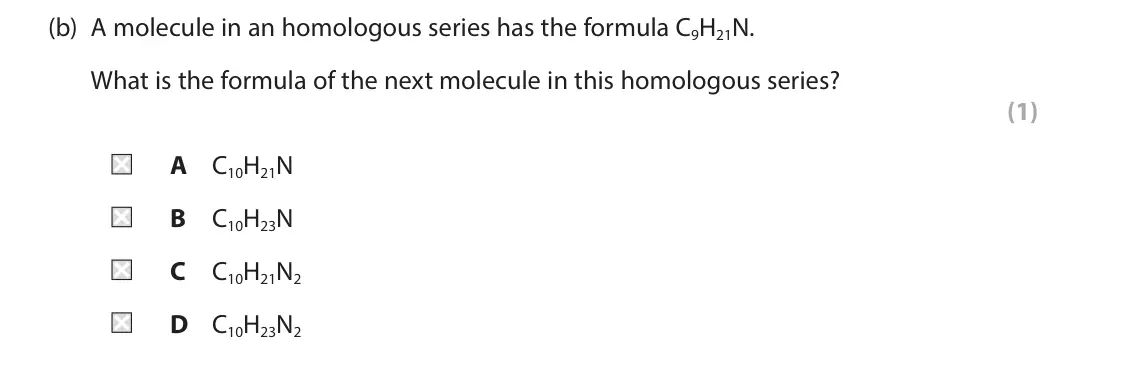
Q4(a)(i)
The whole paper ↗
Q4(b)(i)
The whole paper ↗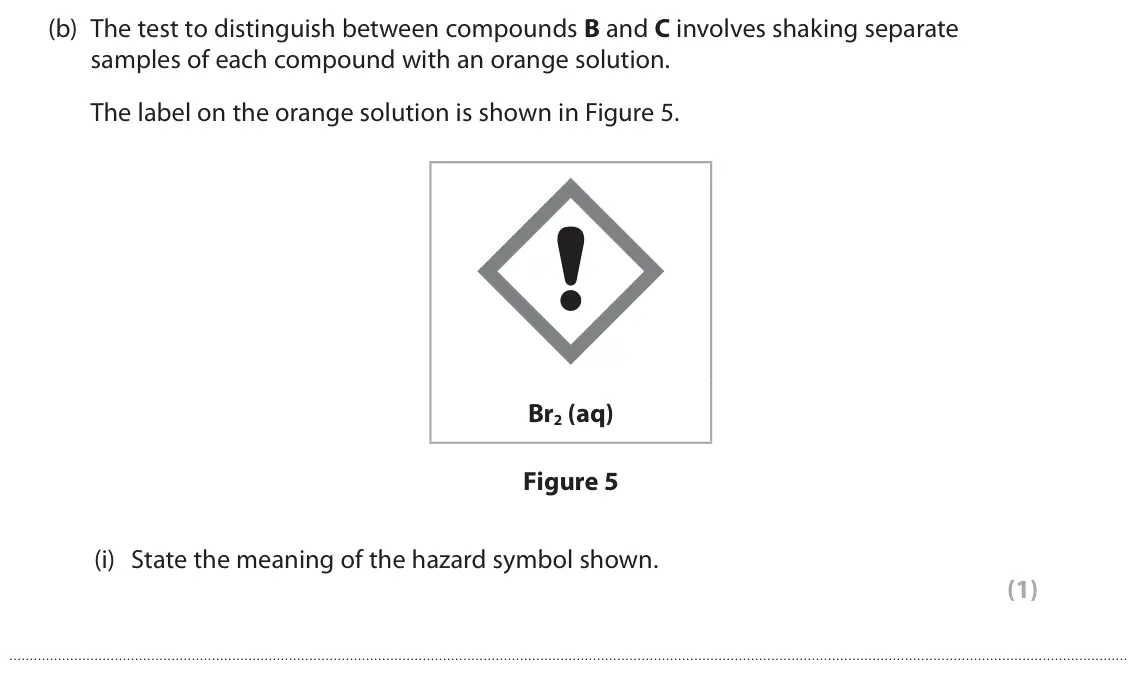
Q4(b)(ii)
The whole paper ↗
Q4(b)(iii)
The whole paper ↗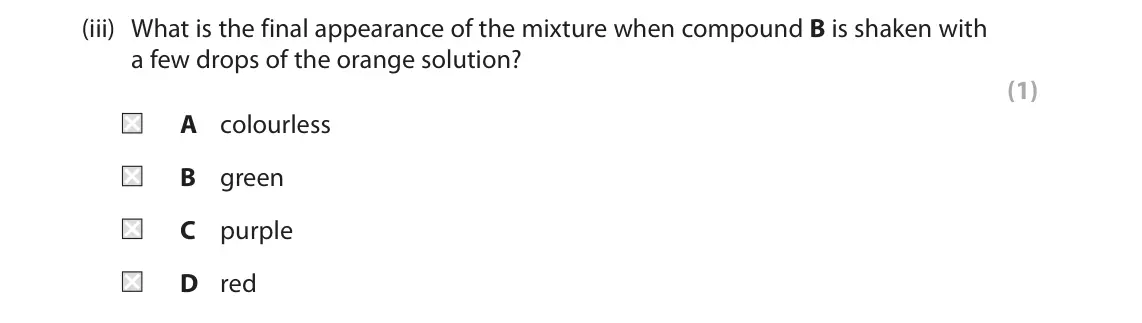
Q9(a)(i)
The whole paper ↗
Q5(a)(i)
The whole paper ↗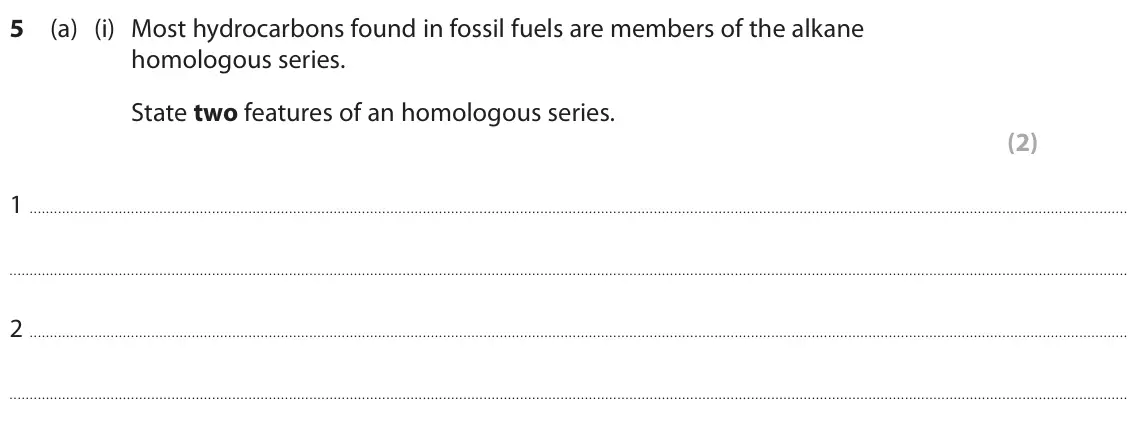
Q5(a)(ii)
The whole paper ↗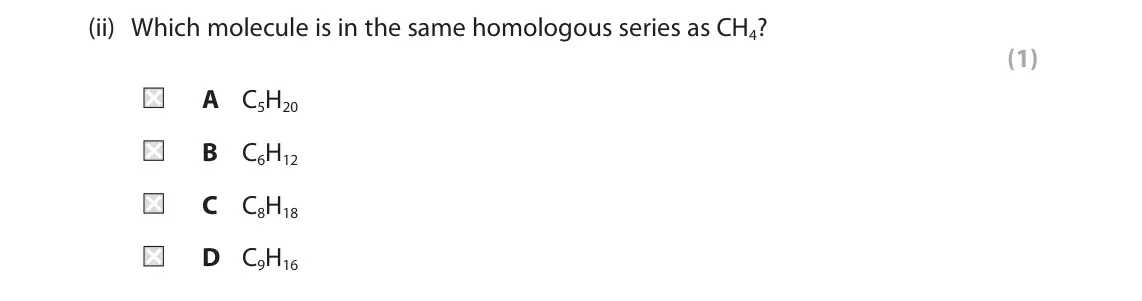
Q10(b)(ii)
The whole paper ↗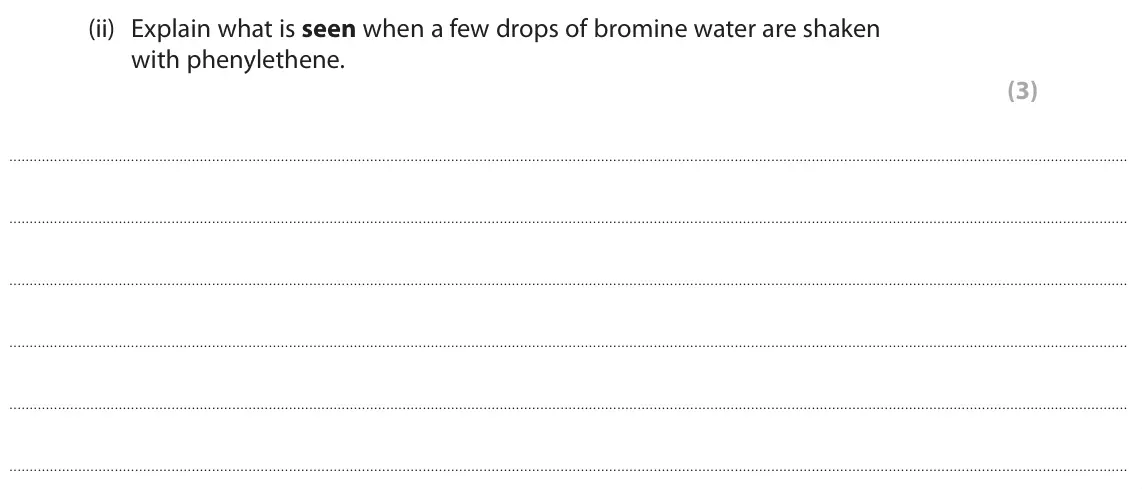
Q5(a)(iv)
The whole paper ↗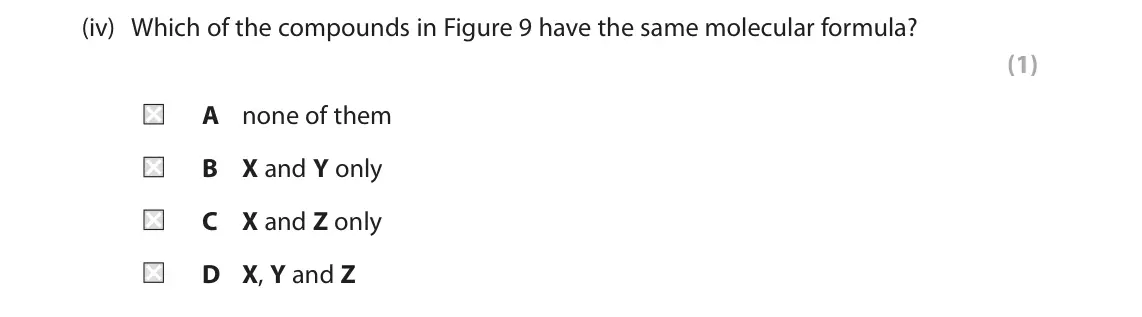
Q7(a)(ii)
The whole paper ↗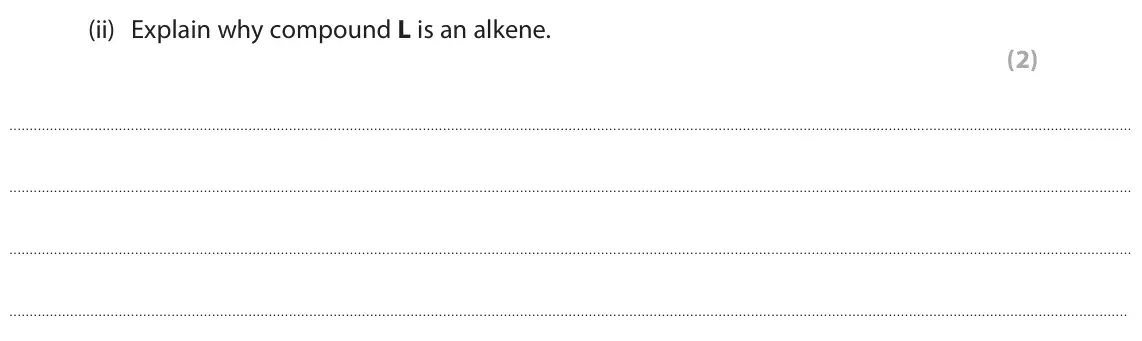
Q7(c)
The whole paper ↗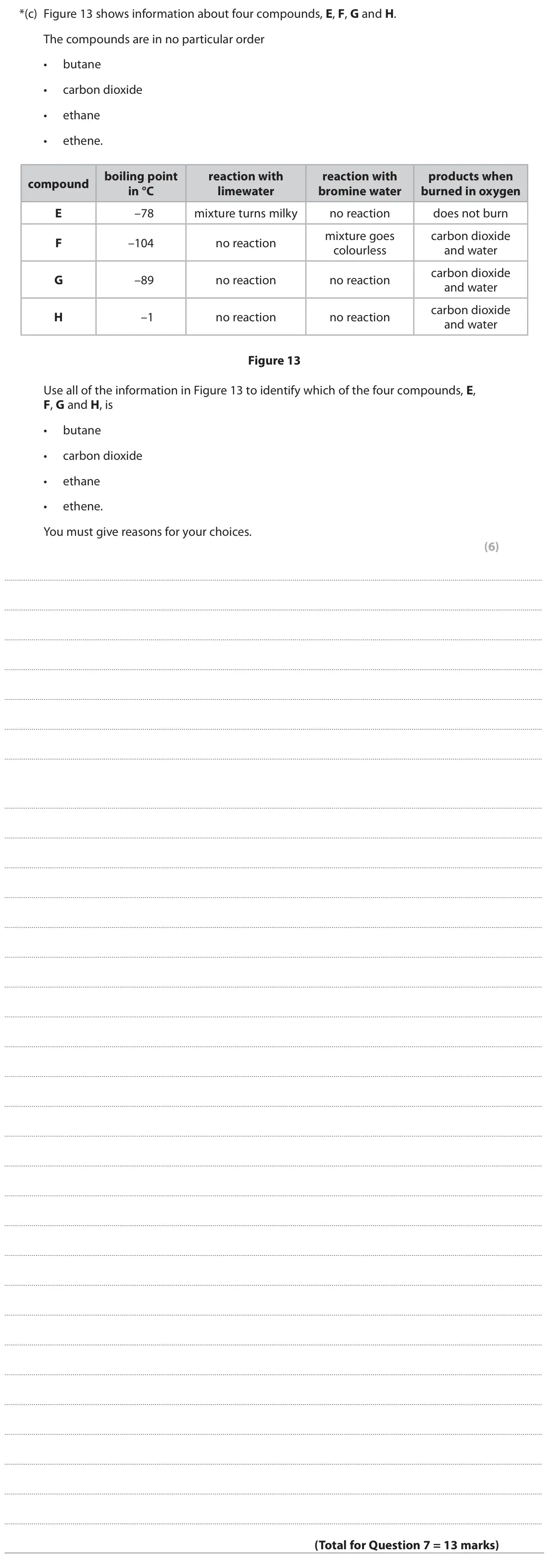
Q7(a)(i)
The whole paper ↗
Q7(a)(ii)
The whole paper ↗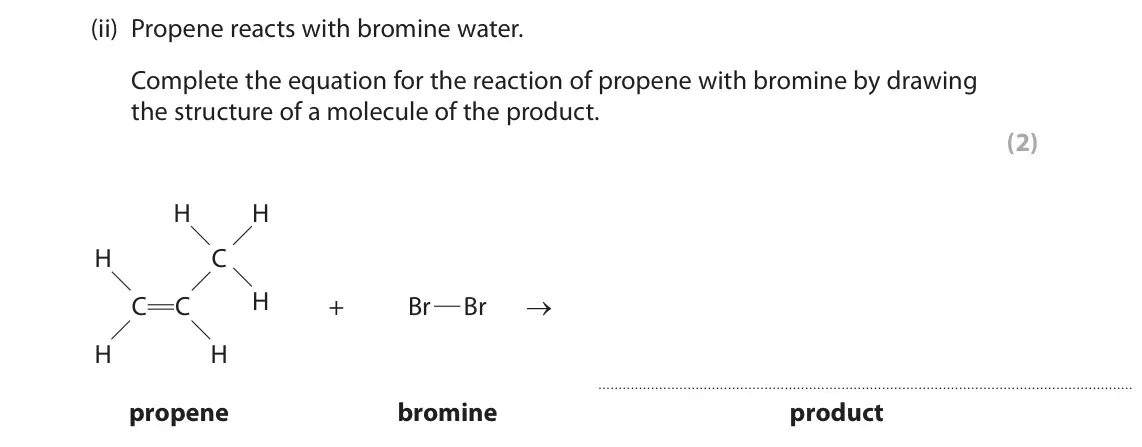
Q7(b)(i)
The whole paper ↗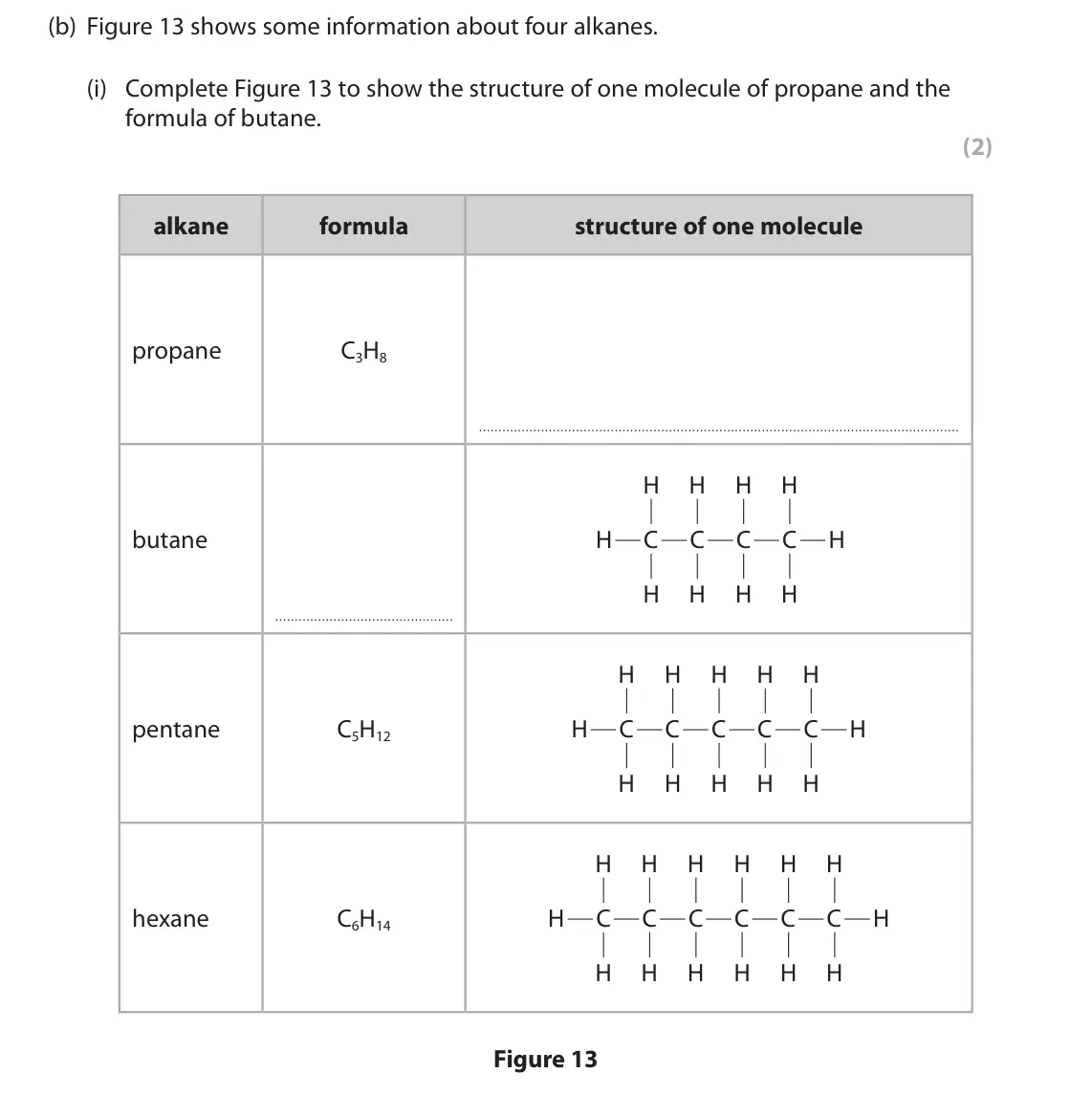
Q5(b)(ii)
The whole paper ↗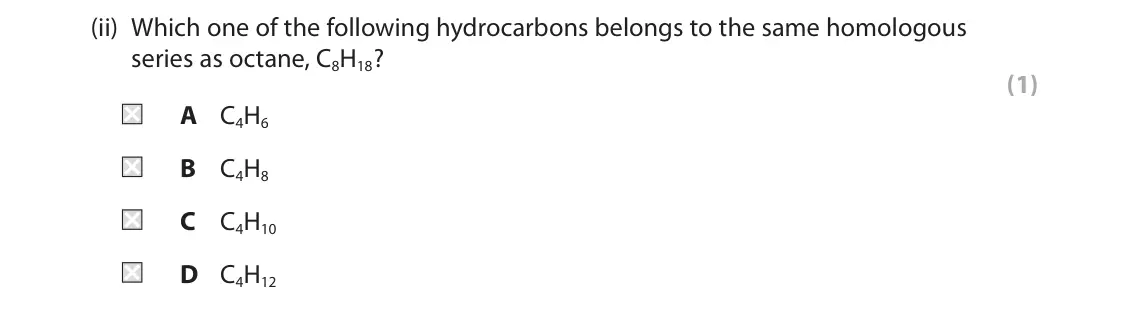
Q10(a)(i)
The whole paper ↗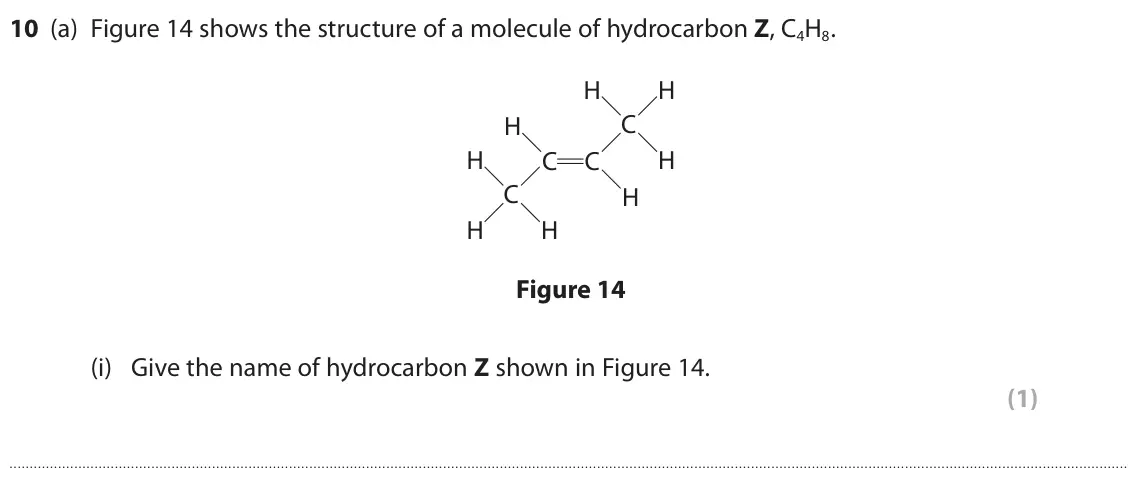
Q10(a)(ii)
The whole paper ↗
Q7(a)
The whole paper ↗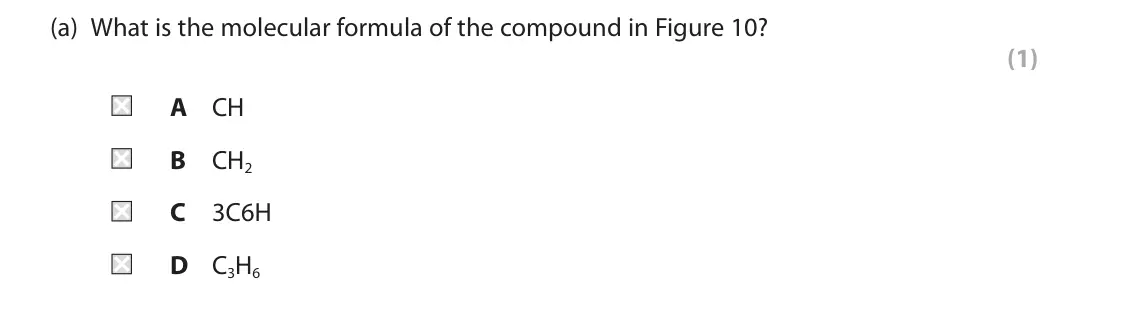
All 47 questions on Alkanes and alkenes, as a list
- June 2025, Paper 2 Higher, Q1(c) (2 marks): Yellow bananas emit ethene gas, C2H4 . Draw one molecule of ethene, showing all covalent bonds. (2)
- June 2025, Paper 2 Higher, Q7(b) (1 mark): A molecule in an homologous series has the formula C9H21N. What is the formula of the next molecule in this homologous series? (1) A C10H21N B C10H23N C C10H21N
- June 2025, Paper 2 Foundation, Q4(a)(i) (2 marks): Explain which compound, A, B or C, is an alkene. (2)
- June 2025, Paper 2 Foundation, Q4(b)(i) (1 mark): State the meaning of the hazard symbol shown. (1)
- June 2025, Paper 2 Foundation, Q4(b)(ii) (1 mark): Name the orange solution used to distinguish between compounds B and C. (1)
- June 2025, Paper 2 Foundation, Q4(b)(iii) (1 mark): What is the final appearance of the mixture when compound B is shaken with a few drops of the orange solution? (1) A colourless B green C purple D red
- June 2025, Paper 2 Foundation, Q9(a)(i) (1 mark): The majority of hydrocarbons in crude oil belong to one homologous series. Give the name of this series. (1)
- June 2024, Paper 2 Higher, Q5(a)(i) (2 marks): Most hydrocarbons found in fossil fuels are members of the alkane homologous series. State two features of an homologous series. (2) 1 2
- June 2024, Paper 2 Higher, Q5(a)(ii) (1 mark): Which molecule is in the same homologous series as CH4? (1) A C5H20 B C6H12 C C8H18 D C9H16
- June 2024, Paper 2 Higher, Q10(b)(ii) (3 marks): Explain what is seen when a few drops of bromine water are shaken with phenylethene. (3)
- June 2024, Paper 2 Foundation, Q5(a)(iv) (1 mark): Which of the compounds in Figure 9 have the same molecular formula? (1) A none of them B X and Y only C X and Z only D X, Y and Z
- June 2024, Paper 2 Foundation, Q7(a)(ii) (2 marks): Explain why compound L is an alkene. (2)
- June 2024, Paper 2 Foundation, Q7(c) (6 marks): Figure 13 shows information about four compounds, E, F, G and H. The compounds are in no particular order • butane • carbon dioxide • ethane • ethene. boiling p
- June 2023, Paper 2 Higher, Q7(a)(i) (1 mark): Each molecule in Figure 12 contains a different functional group. Circle the alkene functional group in propene. (1)
- June 2023, Paper 2 Higher, Q7(a)(ii) (2 marks): Propene reacts with bromine water. Complete the equation for the reaction of propene with bromine by drawing the structure of a molecule of the product. (2) H H
- June 2023, Paper 2 Foundation, Q7(b)(i) (2 marks): Complete Figure 13 to show the structure of one molecule of propane and the formula of butane. (2) alkane formula structure of one molecule propane C3H8 H H H H
- June 2022, Paper 2 Higher, Q5(b)(ii) (1 mark): Which one of the following hydrocarbons belongs to the same homologous series as octane, C8H18? (1) A C4H6 B C4H8 C C4H10 D C4H12
- June 2022, Paper 2 Higher, Q10(a)(i) (1 mark): Give the name of hydrocarbon Z shown in Figure 14. (1)
- June 2022, Paper 2 Higher, Q10(a)(ii) (2 marks): Complete the balanced equation for the reaction of hydrocarbon Z, C4H8, with bromine. (2) C4H8 + →
- June 2022, Paper 2 Foundation, Q7(a) (1 mark): What is the molecular formula of the compound in Figure 10? (1) A CH B CH2 C 3C6H D C3H6
- June 2022, Paper 2 Foundation, Q7(b) (3 marks): The compound in Figure 10 is an unsaturated hydrocarbon. State why the compound is described as an unsaturated hydrocarbon. (3) unsaturated . hydrocarbon .
- November 2021, Paper 2 Higher, Q4(b)(i) (1 mark): On Figure 5, draw a circle around the functional group in this molecule. (1)
- November 2021, Paper 2 Higher, Q10(a)(ii) (3 marks): Compound Y can also be formed in the following reaction C3H8 C3H6 → + H2 compound X compound Y Explain how bromine water can be used to distinguish between comp
- November 2021, Paper 2 Foundation, Q9(b) (1 mark): Diesel oil contains alkanes. These alkanes are part of an homologous series. Which statement about compounds in this homologous series is true? (1) A they have
- November 2020, Paper 2 Higher, Q4(a)(iii) (1 mark): Separate samples of dichloroethene and poly(dichloroethene) are shaken with a few drops of bromine water. What would be seen? (1) A both mixtures remain orange
- November 2020, Paper 2 Higher, Q4(b) (2 marks): Dichloroethene is produced from ethene and chlorine. In the overall reaction, ethene reacts with chlorine and forms dichloroethene and hydrogen chloride. Comple
- November 2020, Paper 2 Foundation, Q10(a)(iii) (1 mark): Separate samples of dichloroethene and poly(dichloroethene) are shaken with a few drops of bromine water. What would be seen? (1) A both mixtures remain orange
- November 2020, Paper 2 Foundation, Q10(b) (2 marks): Dichloroethene is produced from ethene and chlorine. In the overall reaction, ethene reacts with chlorine and forms dichloroethene and hydrogen chloride. Comple
- June 2019, Paper 2 Higher, Q2(c)(i) (2 marks): Explain, using these formulae, why butane and pentane are neighbouring members of the same homologous series. (2)
- June 2019, Paper 2 Higher, Q7(a) (2 marks): Explain why ethene is an unsaturated hydrocarbon. (2)
- June 2019, Paper 2 Higher, Q7(b) (3 marks): A sample of ethene is burned completely in oxygen. Write the balanced equation for this reaction. (3)
- June 2019, Paper 2 Higher, Q7(c) (3 marks): Ethene can be polymerised to form poly(ethene). Describe what you would see when a sample of ethene and a sample of poly(ethene) are shaken with separate, small
- June 2019, Paper 2 Foundation, Q5(c) (2 marks): Substance X is an unsaturated hydrocarbon. The structure of a molecule of substance X is shown in Figure 10. H H H H H C C C C H C C H H H H H C H H H Figure 10
- June 2019, Paper 2 Foundation, Q5(d) (2 marks): Two liquid hydrocarbons, A and B, were tested with bromine water. One hydrocarbon was known to be an alkane. The other hydrocarbon was known to be an alkene. Ea
- June 2019, Paper 2 Foundation, Q8(c)(i) (2 marks): Explain, using these formulae, why butane and pentane are neighbouring members of the same homologous series. (2)
- June 2018, Paper 2 Higher, Q6(b)(i) (1 mark): Which of the following is the general formula of an alkane? (1) A CnH2n B CnH2n +1 C CnH2n −1 D CnH2n +2
- June 2018, Paper 2 Higher, Q10(b) (6 marks): A student is provided with unlabelled samples of three liquids. The three liquids are known to be hexane, C6H14, a liquid alkane hexene, C6H12, a liquid alkene
- June 2018, Paper 2 Foundation, Q4(b)(i) (3 marks): A small volume of bromine water is added to each of the substances A, B and C and the mixtures shaken. Explain why A and B decolourise bromine water but C does
- June 2018, Paper 2 Foundation, Q4(b)(ii) (2 marks): Ethane, C2H6, is a hydrocarbon. Draw a molecule of ethane showing all covalent bonds. (2)
- Specimen, Paper 2 Higher, Q4(b) (2 marks): Figure 5 shows some information about the alkenes, ethene and propene. Complete the table. The structure of propene must show all covalent bonds. (2) name of al
- Specimen, Paper 2 Higher, Q4(c)(ii) (1 mark): What type of reaction takes place between butene and steam? (1) A addition B dehydration C neutralisation D substitution
- Specimen, Paper 2 Higher, Q4(d) (2 marks): A sample of each of three hydrocarbons, X, Y and Z, was shaken with bromine water. Bromine water is orange coloured. The results are: X orange mixture becomes c
- Specimen, Paper 2 Foundation, Q9(b) (1 mark): The graph in Figure 13 shows the boiling points of some alkanes plotted against the number of carbon atoms in one molecule of each alkane. 100 boiling point / °
- Specimen, Paper 2 Foundation, Q9(c) (2 marks): Figure 14 shows some information about the alkenes, ethene and propene. Complete the table. The structure of propene must show all covalent bonds. (2) name of a
- Specimen, Paper 2 Foundation, Q9(d) (1 mark): Alkenes burn completely to produce carbon dioxide and water. Balance the equation for the complete combustion of butene gas, C4H8. (1) C4H8 + O2 → CO2 + H2O
- Specimen, Paper 2 Foundation, Q9(e)(ii) (1 mark): What type of reaction takes place between butene and steam? (1) A addition B dehydration C neutralisation D substitution
- Specimen, Paper 2 Foundation, Q9(f) (2 marks): A sample of each of three hydrocarbons, X, Y and Z, was shaken with bromine water. Bromine water is orange coloured. The results are: X orange mixture becomes c
Questions, mark schemes and examiner’s reports are © Pearson Edexcel, from their published past papers. Plumi isn’t affiliated with any exam board. Want whole papers? Every Edexcel GCSE Chemistry paper.
Rather write your answers by hand on iPad? Plumi marks them against the same mark schemes.