 plumi
Rates of reaction: Edexcel GCSE Chemistry questions
Every Edexcel GCSE Chemistry exam question on Rates of reaction (specification points 7.1–7.8), 2018–2025, with its mark scheme and examiner’s report.
Find questions1,880
Exam
All years
Calculations
Q2(a)
The whole paper ↗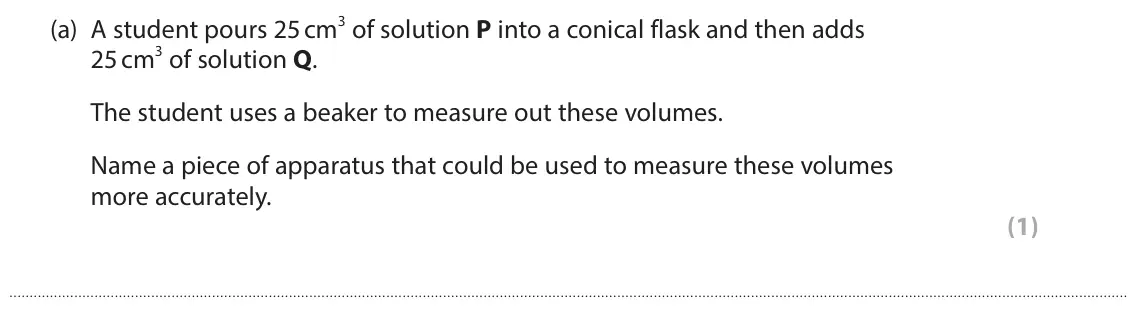
Q2(b)(i)
The whole paper ↗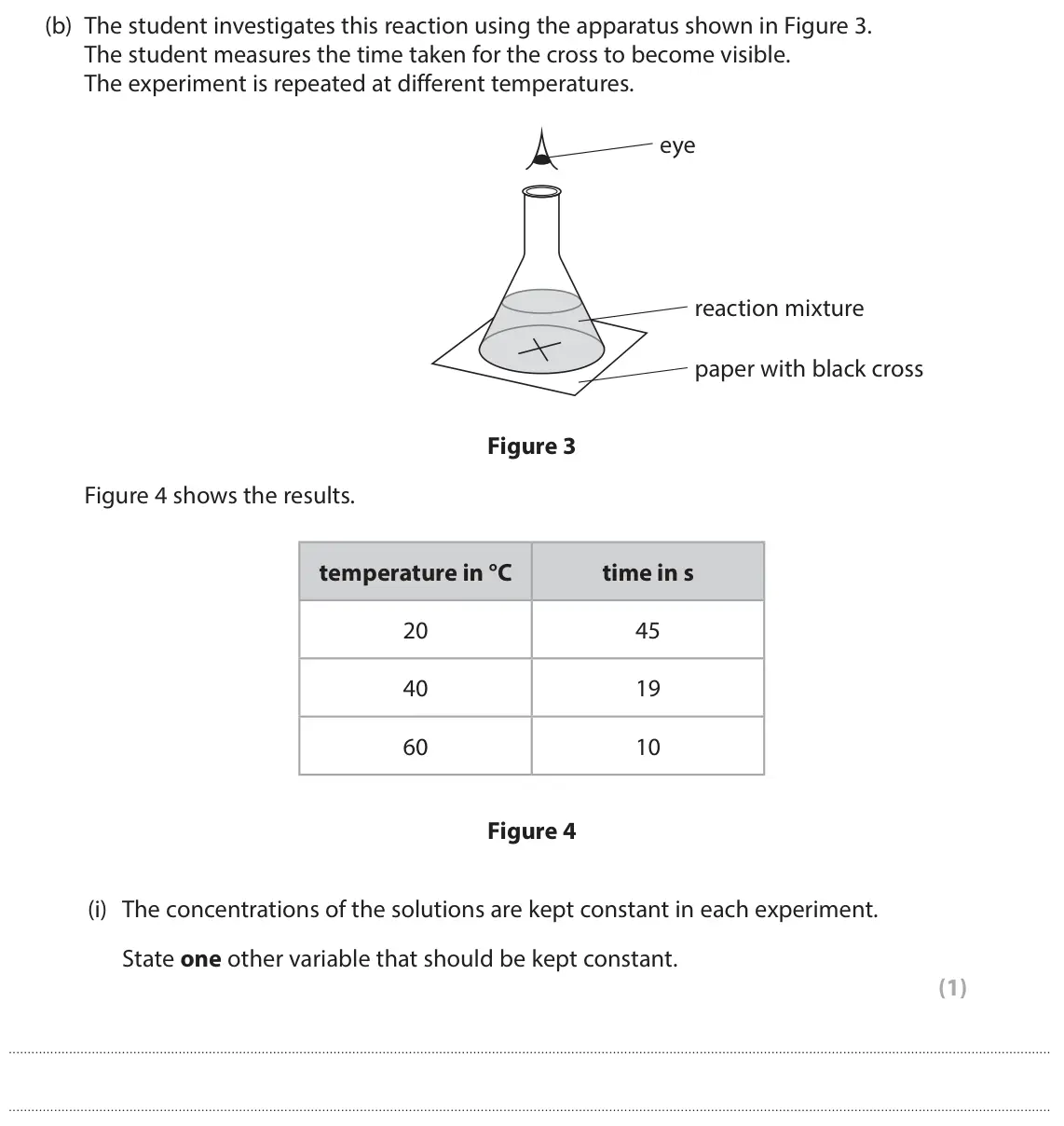
Q2(b)(ii)
The whole paper ↗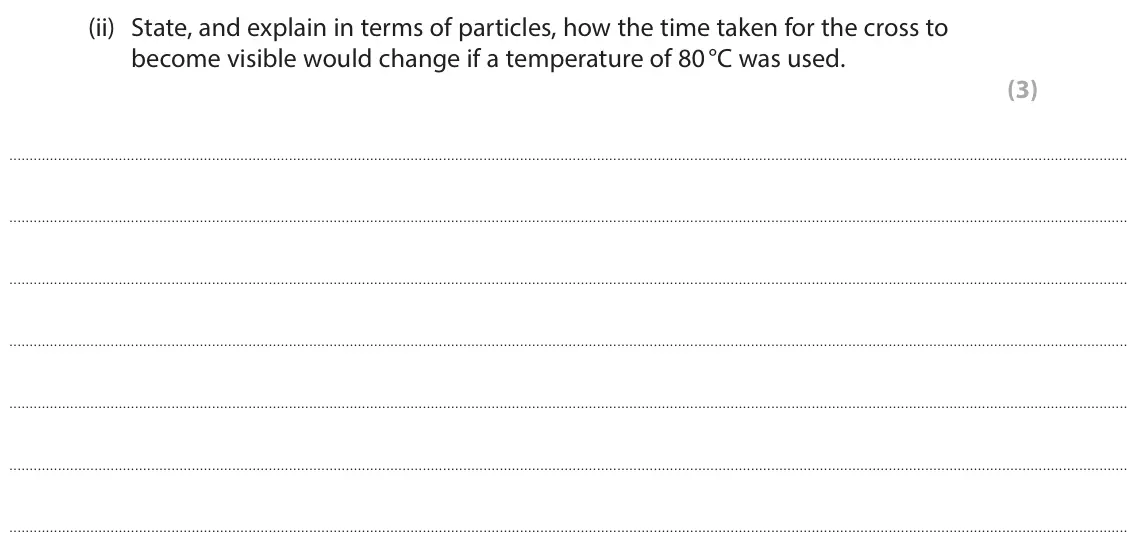
Q2(d)
The whole paper ↗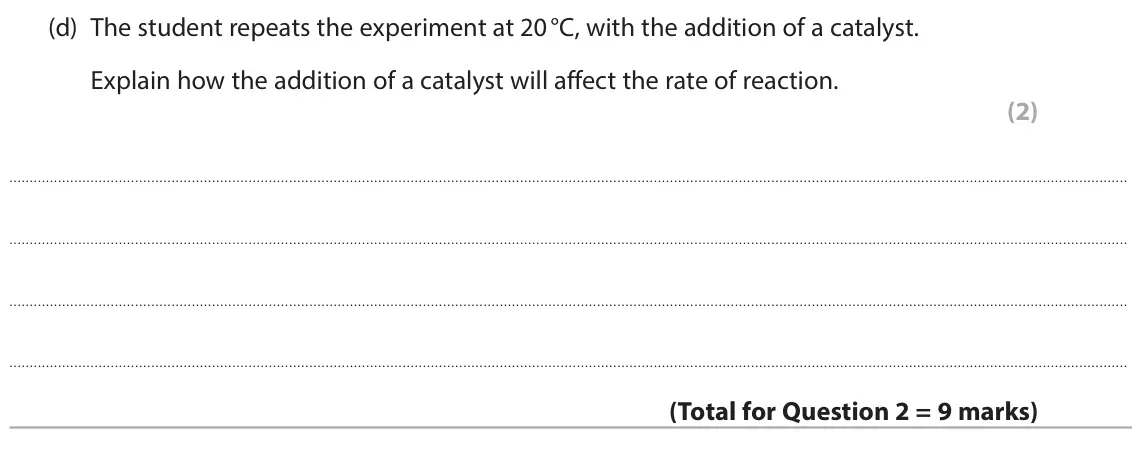
Q8(a)
The whole paper ↗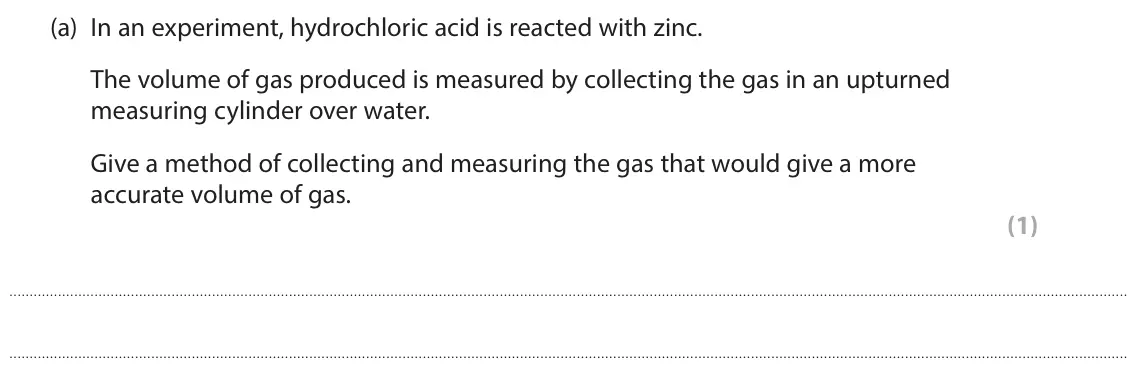
Q8(a)
The whole paper ↗
Q8(b)(i)
The whole paper ↗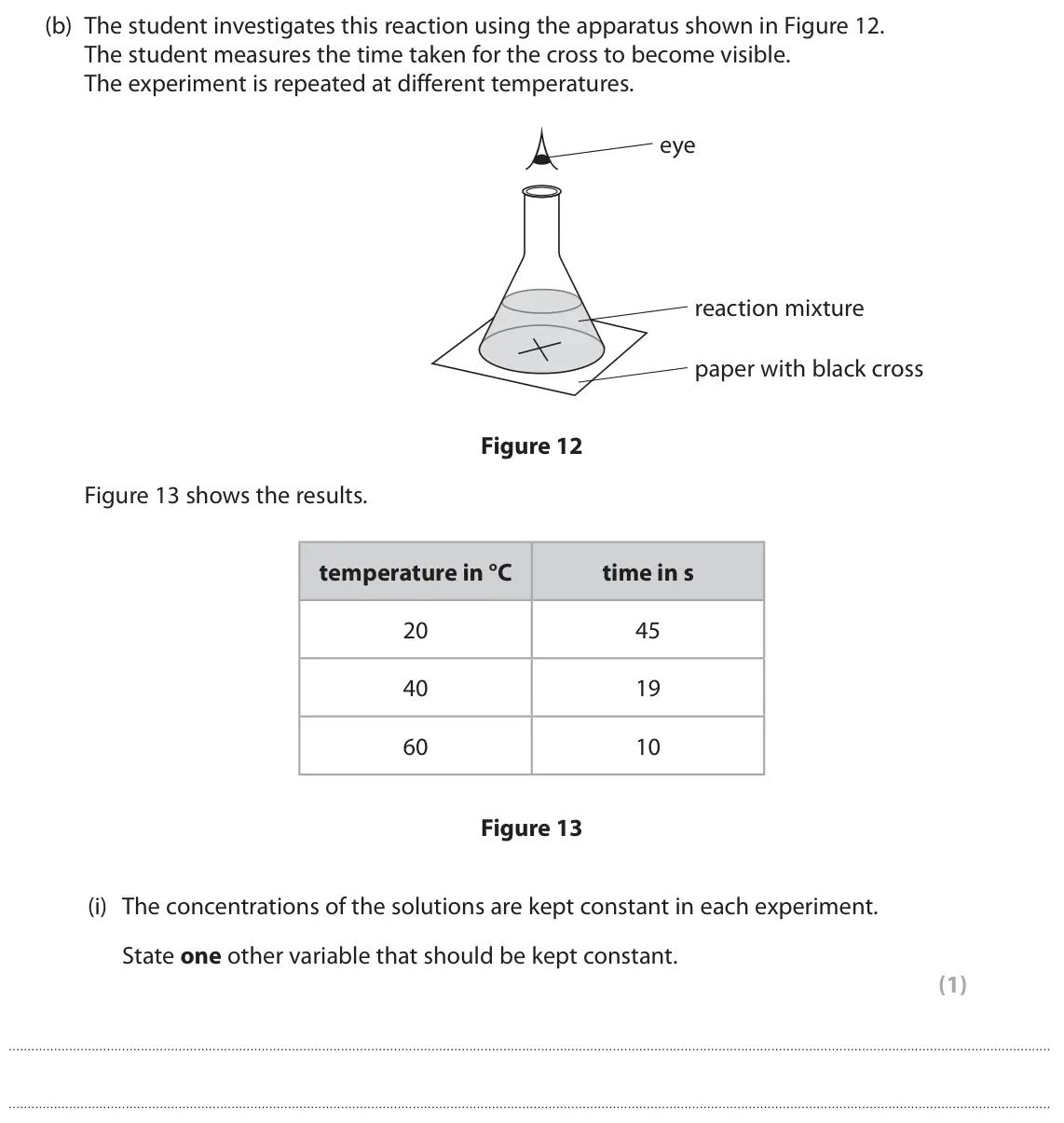
Q8(b)(ii)
The whole paper ↗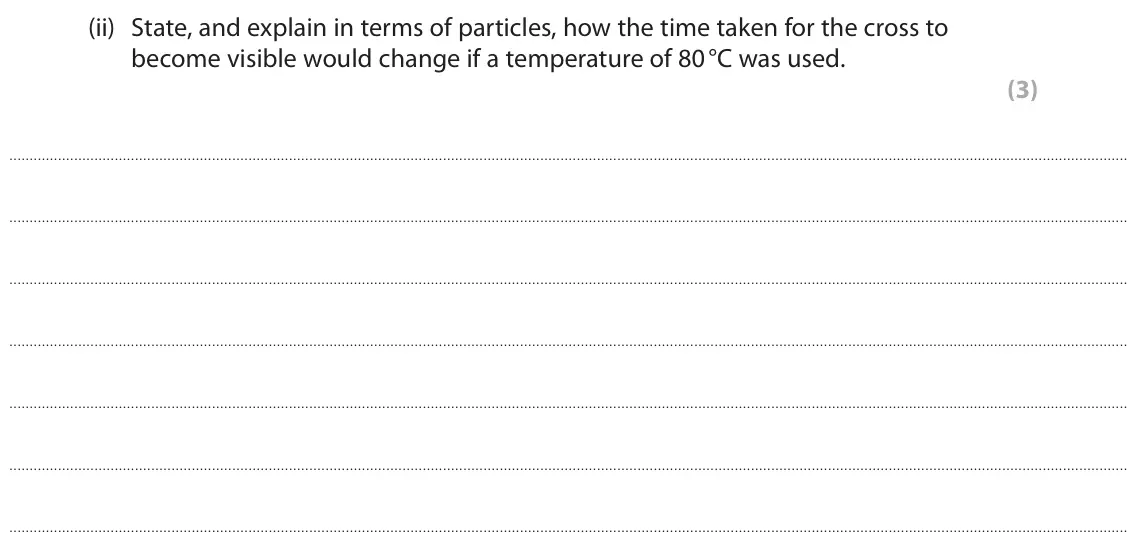
Q8(d)
The whole paper ↗
Q8(e)(i)
The whole paper ↗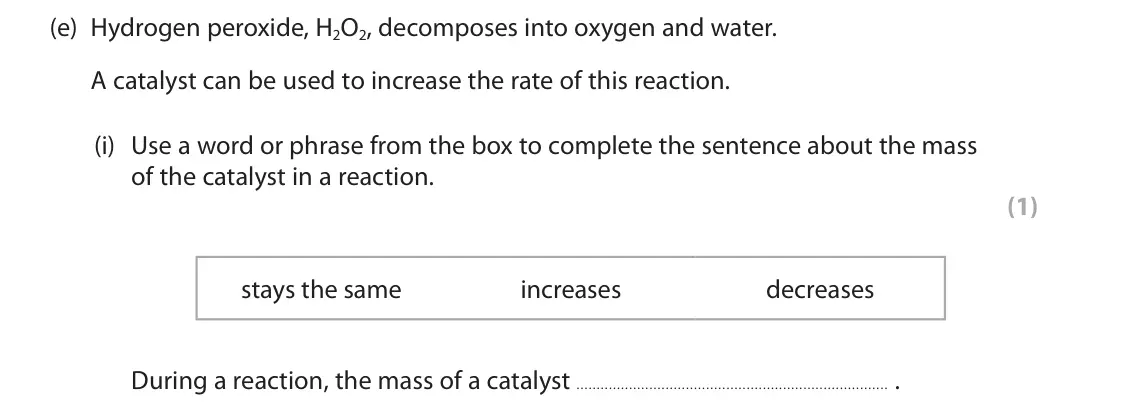
Q8(e)(ii)
The whole paper ↗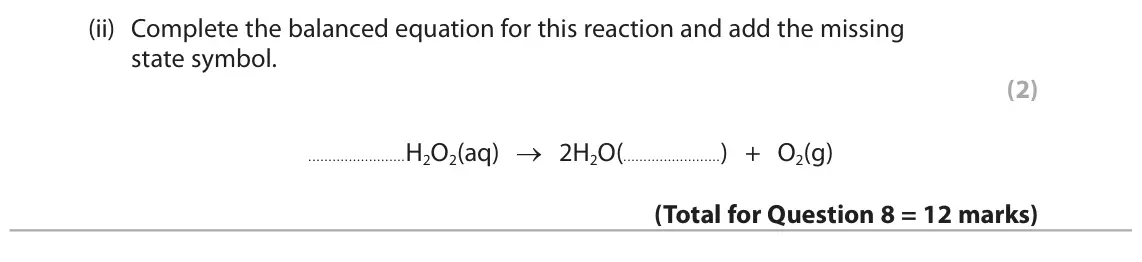
Q2(a)
The whole paper ↗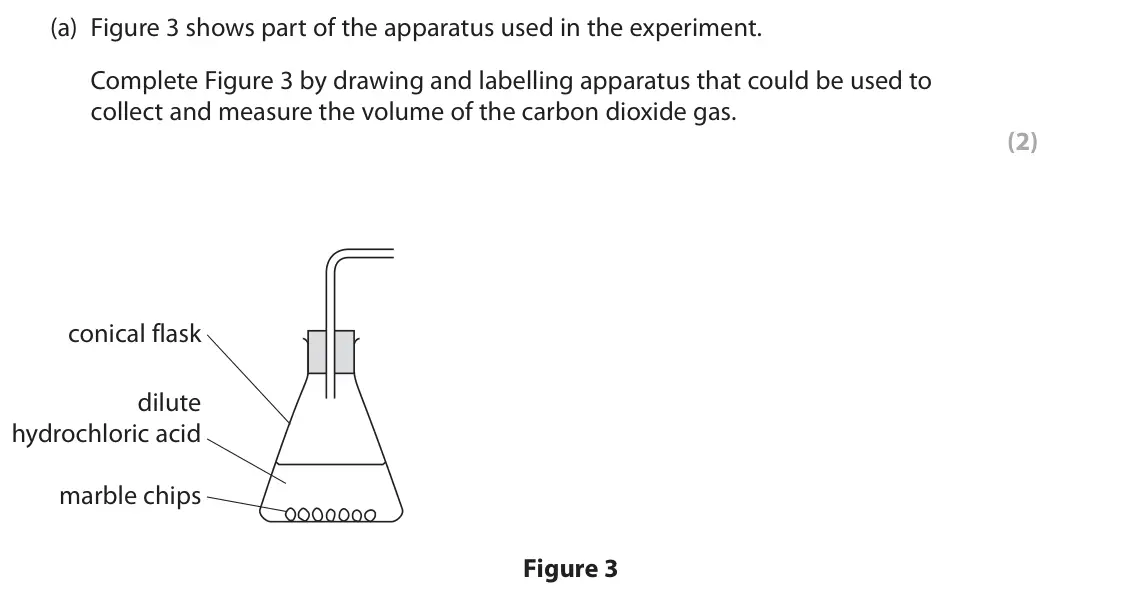
Q2(b)(i)
The whole paper ↗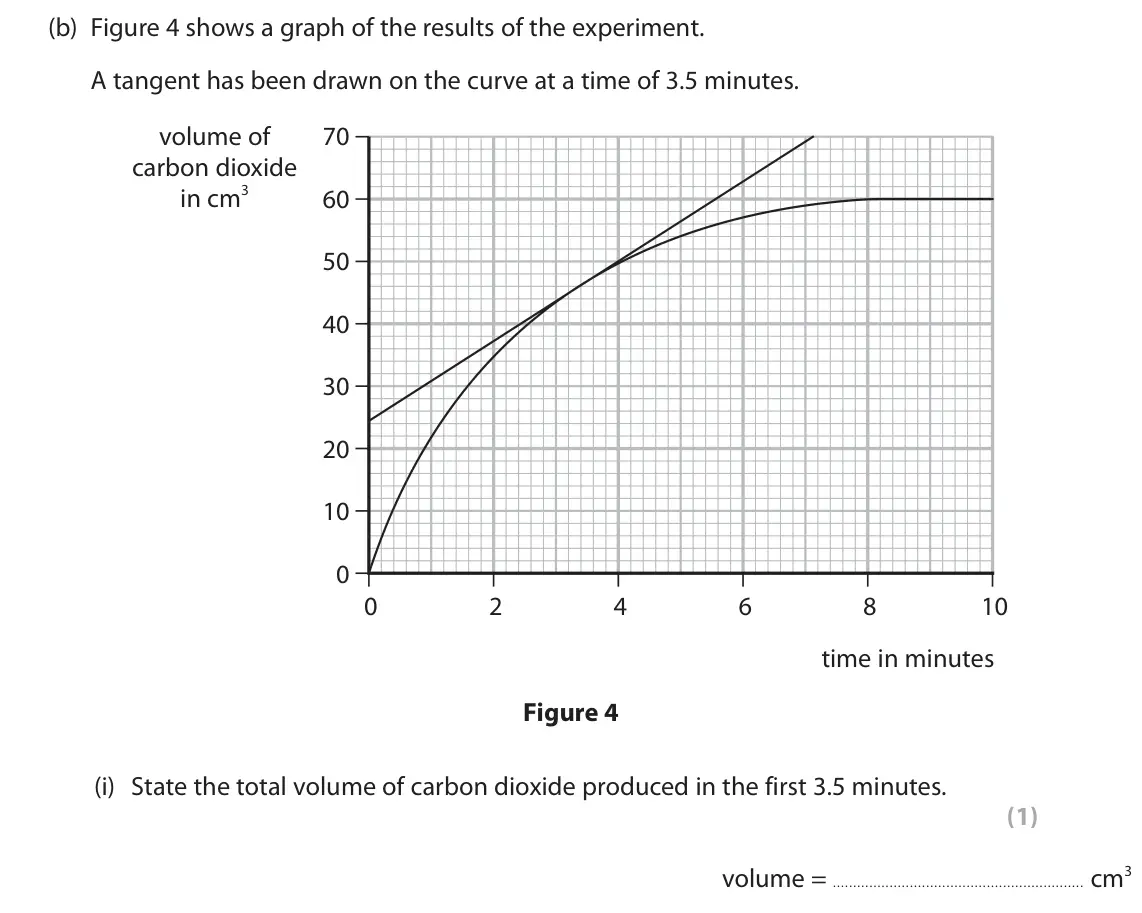
Q2(b)(ii)
The whole paper ↗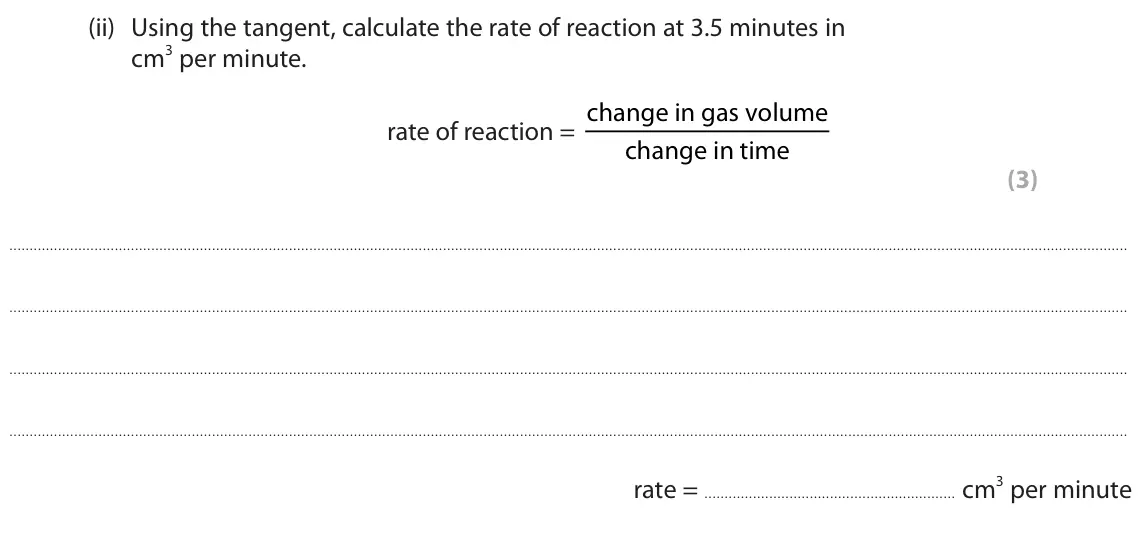
Q2(c)
The whole paper ↗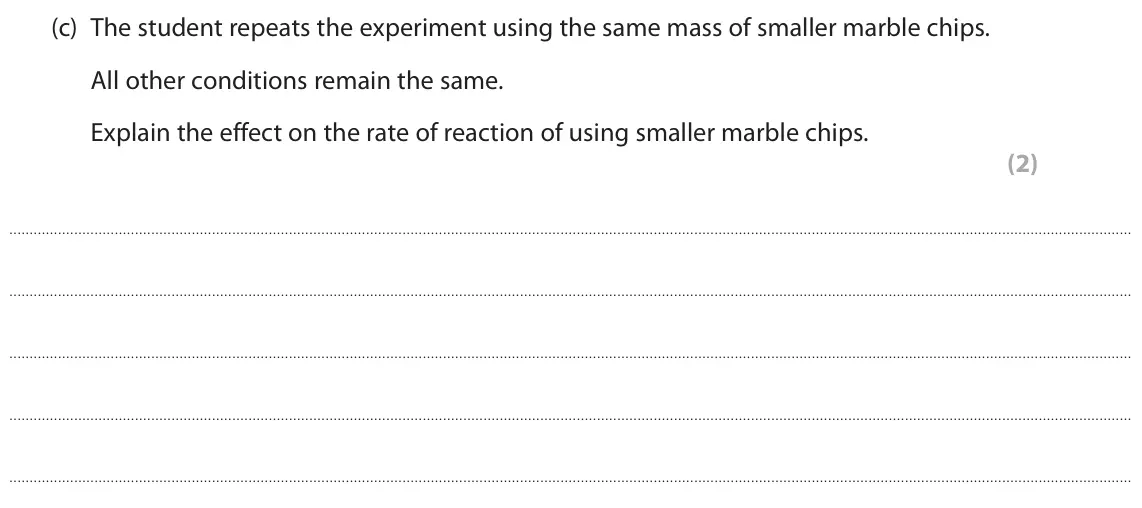
Q2(d)
The whole paper ↗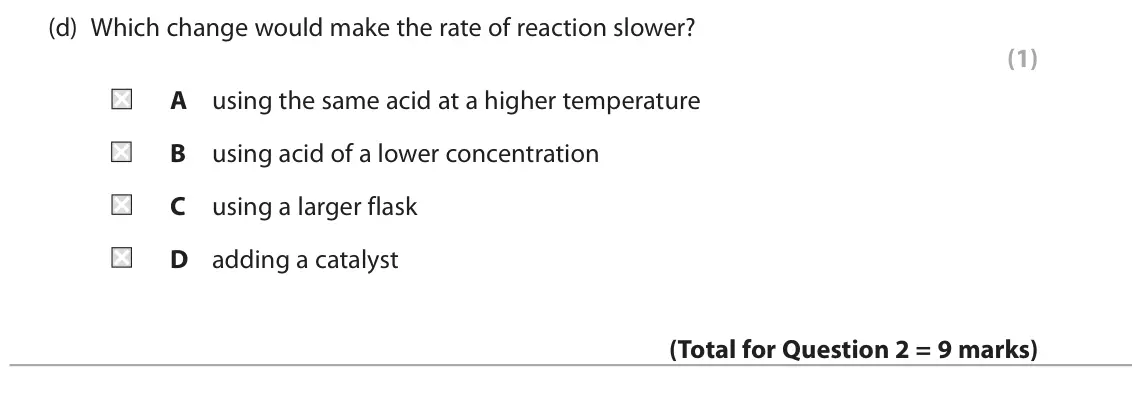
Q8(a)
The whole paper ↗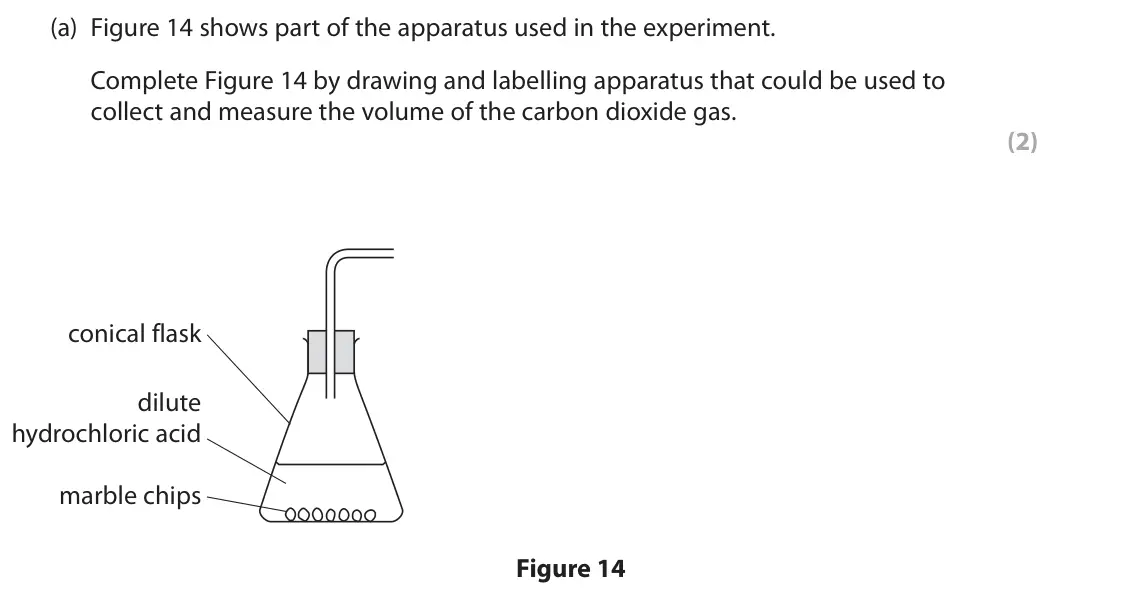
Q8(b)(ii)
The whole paper ↗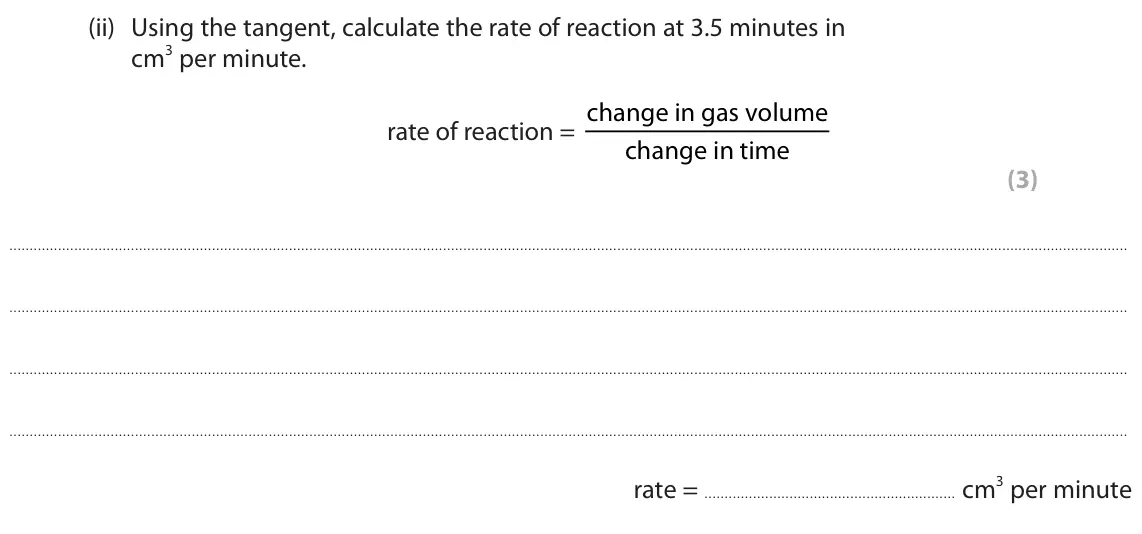
Q8(c)
The whole paper ↗
All 101 questions on Rates of reaction, as a list
- June 2025, Paper 2 Higher, Q2(a) (1 mark): A student pours 25 cm3 of solution P into a conical flask and then adds 25 cm3 of solution Q. The student uses a beaker to measure out these volumes. Name a pie
- June 2025, Paper 2 Higher, Q2(b)(i) (1 mark): The concentrations of the solutions are kept constant in each experiment. State one other variable that should be kept constant. (1)
- June 2025, Paper 2 Higher, Q2(b)(ii) (3 marks): State, and explain in terms of particles, how the time taken for the cross to become visible would change if a temperature of 80 °C was used. (3)
- June 2025, Paper 2 Higher, Q2(d) (2 marks): The student repeats the experiment at 20 °C, with the addition of a catalyst. Explain how the addition of a catalyst will affect the rate of reaction. (2)
- June 2025, Paper 2 Higher, Q8(a) (1 mark): In an experiment, hydrochloric acid is reacted with zinc. The volume of gas produced is measured by collecting the gas in an upturned measuring cylinder over wa
- June 2025, Paper 2 Foundation, Q8(a) (1 mark): A student pours 25 cm3 of solution P into a conical flask and then adds 25 cm3 of solution Q. The student uses a beaker to measure out these volumes. Name a pie
- June 2025, Paper 2 Foundation, Q8(b)(i) (1 mark): The concentrations of the solutions are kept constant in each experiment. State one other variable that should be kept constant. (1)
- June 2025, Paper 2 Foundation, Q8(b)(ii) (3 marks): State, and explain in terms of particles, how the time taken for the cross to become visible would change if a temperature of 80 °C was used. (3)
- June 2025, Paper 2 Foundation, Q8(d) (2 marks): The student repeats the experiment at 20 °C, with the addition of a catalyst. Explain how the addition of a catalyst will affect the rate of reaction. (2)
- June 2025, Paper 2 Foundation, Q8(e)(i) (1 mark): Use a word or phrase from the box to complete the sentence about the mass of the catalyst in a reaction. (1) stays the same increases decreases During a reactio
- June 2025, Paper 2 Foundation, Q8(e)(ii) (2 marks): Complete the balanced equation for this reaction and add the missing state symbol. (2) H2O2(aq) → 2H2O( ) + O2(g)
- June 2024, Paper 2 Higher, Q2(a) (2 marks): Figure 3 shows part of the apparatus used in the experiment. Complete Figure 3 by drawing and labelling apparatus that could be used to collect and measure the
- June 2024, Paper 2 Higher, Q2(b)(i) (1 mark): State the total volume of carbon dioxide produced in the first 3.5 minutes. (1) volume = cm3
- June 2024, Paper 2 Higher, Q2(b)(ii) (3 marks): Using the tangent, calculate the rate of reaction at 3.5 minutes in cm3 per minute. rate of reaction = change in gas volume change in time (3) rate = cm3 per mi
- June 2024, Paper 2 Higher, Q2(c) (2 marks): The student repeats the experiment using the same mass of smaller marble chips. All other conditions remain the same. Explain the effect on the rate of reaction
- June 2024, Paper 2 Higher, Q2(d) (1 mark): Which change would make the rate of reaction slower? (1) A using the same acid at a higher temperature B using acid of a lower concentration C using a larger fl
- June 2024, Paper 2 Foundation, Q8(a) (2 marks): Figure 14 shows part of the apparatus used in the experiment. Complete Figure 14 by drawing and labelling apparatus that could be used to collect and measure th
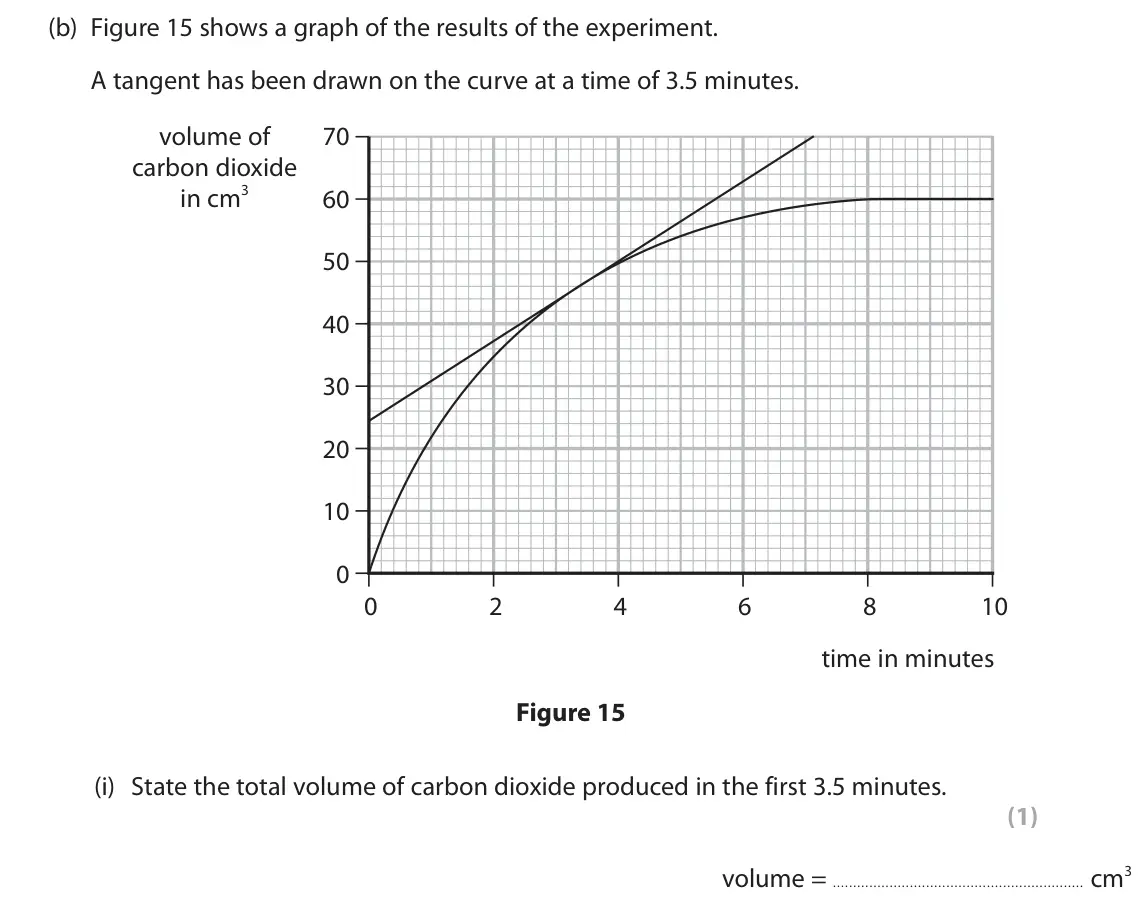
- June 2024, Paper 2 Foundation, Q8(b)(i) (1 mark): State the total volume of carbon dioxide produced in the first 3.5 minutes. (1) volume = cm3
- June 2024, Paper 2 Foundation, Q8(b)(ii) (3 marks): Using the tangent, calculate the rate of reaction at 3.5 minutes in cm3 per minute. rate of reaction = change in gas volume change in time (3) rate = cm3 per mi
- June 2024, Paper 2 Foundation, Q8(c) (2 marks): The student repeats the experiment using the same mass of smaller marble chips. All other conditions remain the same. Explain the effect on the rate of reaction
- June 2024, Paper 2 Foundation, Q8(d) (1 mark): Which change would make the rate of reaction slower? (1) A using the same acid at a higher temperature B using acid of a lower concentration C using a larger fl
- June 2024, Paper 2 Foundation, Q8(e) (1 mark): In this experiment the volume of carbon dioxide gas produced is measured. Give a different way that the amount of carbon dioxide produced can be measured. (1)
- June 2024, Paper 2 Foundation, Q8(f) (1 mark): In this experiment there is an excess of dilute hydrochloric acid. State what you would see in the conical flask at the end of the experiment. (1)
- June 2023, Paper 2 Higher, Q2(a) (3 marks): On the grid, plot the results shown in Figure 4. Draw a curve of best fit. (3) 100 volume of gas in cm3 90 80 70 60 50 40 30 20 10 0 0 1 2 3 4 5 6 time in minut
- June 2023, Paper 2 Higher, Q2(b)(i) (1 mark): Calculate the rate of reaction for the time interval 2 to 3 minutes. (1) rate of reaction = cm3 min–1
- June 2023, Paper 2 Higher, Q2(b)(ii) (3 marks): State and explain what happens to the rate of reaction as the acid reacts with the marble chips in this experiment. (3)
- June 2023, Paper 2 Higher, Q2(c) (2 marks): The student repeated the experiment using the same volume of acid and the same mass of marble chips but used smaller marble chips. All other conditions remained
- June 2023, Paper 2 Foundation, Q8(a) (3 marks): On the grid, plot the results shown in Figure 16. Draw a curve of best fit. (3) 100 volume of gas in cm3 90 80 70 60 50 40 30 20 10 0 0 1 2 3 4 5 6 time in minu
- June 2023, Paper 2 Foundation, Q8(b)(i) (1 mark): Calculate the rate of reaction for the time interval 2 to 3 minutes. (1) rate of reaction = cm3 min–1
- June 2023, Paper 2 Foundation, Q8(b)(ii) (3 marks): State and explain what happens to the rate of reaction as the acid reacts with the marble chips in this experiment. (3)
- June 2023, Paper 2 Foundation, Q8(c) (2 marks): The student repeated the experiment using the same volume of acid and the same mass of marble chips but used smaller marble chips. All other conditions remained
- June 2023, Paper 2 Foundation, Q8(d) (1 mark): Which of the following changes would make the reaction faster? (1) A use a larger boiling tube B use a larger volume of the dilute acid C use a more concentrate
- June 2023, Paper 2 Foundation, Q8(e) (1 mark): State what could be used to measure time in the investigation. (1)
- June 2022, Paper 2 Higher, Q2(a)(i) (2 marks): Name a piece of apparatus that would be better to measure the volume of gas produced, instead of the 250 cm3 measuring cylinder. Give a reason for your answer.
- June 2022, Paper 2 Higher, Q2(a)(ii) (3 marks): Calculate the mean rate of production of hydrogen over the first 90 seconds, in cm3 per second. (3) rate = cm3 per second
- June 2022, Paper 2 Higher, Q2(a)(iii) (1 mark): The student measured the volume of gas for 10 minutes. State why the measurements could have been stopped at 9 minutes. (1)
- June 2022, Paper 2 Higher, Q2(b)(i) (2 marks): Explain why the rate of reaction increases when the concentration of acid is increased. (2)
- June 2022, Paper 2 Higher, Q2(b)(ii) (1 mark): Another student suggests four other ways of increasing the rate of this reaction. Which one is correct? (1) A use the same acid but at a lower temperature B use
- June 2022, Paper 2 Higher, Q9(b) (6 marks): The reaction profile for an uncatalysed exothermic reaction is shown in Figure 13. energy reactants products progress of reaction Figure 13 Using some examples
- June 2022, Paper 2 Foundation, Q6(c) (2 marks): Alkenes react with halogens. When iron chloride is added to the reaction mixture, the reaction is much faster but the products are the same. Use words from the
- June 2022, Paper 2 Foundation, Q8(a)(i) (2 marks): Name a piece of apparatus that would be better to measure the volume of gas produced, instead of the 250 cm3 measuring cylinder. Give a reason for your answer.
- June 2022, Paper 2 Foundation, Q8(a)(ii) (3 marks): Calculate the mean rate of production of hydrogen over the first 90 seconds, in cm3 per second. (3) rate = cm3 per second
- June 2022, Paper 2 Foundation, Q8(a)(iii) (1 mark): The student measured the volume of gas for 10 minutes. State why the measurements could have been stopped at 9 minutes. (1)
- June 2022, Paper 2 Foundation, Q8(b)(i) (2 marks): Explain why the rate of reaction increases when the concentration of acid is increased. (2)
- June 2022, Paper 2 Foundation, Q8(b)(ii) (1 mark): Another student suggests four other ways of increasing the rate of this reaction. Which one is correct? (1) A use the same acid but at a lower temperature B use
- June 2022, Paper 2 Foundation, Q8(c) (2 marks): The apparatus in Figure 13 can be used to measure the rate of the reaction between marble chips and hydrochloric acid. The student needs different sized marble
- November 2021, Paper 2 Higher, Q6(b) (2 marks): Some pieces of calcium carbonate were added to dilute hydrochloric acid in a conical flask and the volume of carbon dioxide produced was measured. Complete the
- November 2021, Paper 2 Higher, Q6(c)(i) (1 mark): State what could be used to keep the temperature of the conical flask and its contents at a temperature of 45 °C throughout the reaction. (1)
- November 2021, Paper 2 Higher, Q6(c)(ii) (2 marks): Figure 8 shows a graph of volume of gas collected in this investigation. volume of 100 gas in cm3 90 80 70 60 50 40 30 20 10 0 0 50 100 150 200 250 300 time in
- November 2021, Paper 2 Higher, Q6(c)(iii) (1 mark): The temperature of the acid was kept at 45 °C. State one other variable that needs to be controlled during this investigation. (1)
- November 2021, Paper 2 Higher, Q6(c)(iv) (3 marks): Explain, in terms of particles, how decreasing the temperature affects the rate of this reaction. (3)
- November 2021, Paper 2 Foundation, Q2(a) (2 marks): The student kept the volume of sulfuric acid the same when they repeated the method at 50 °C. State two other variables that should be kept the same. (2) 1 2
- November 2021, Paper 2 Foundation, Q2(b) (1 mark): Which piece of equipment can be used to find the volume of 25 cm3 of sulfuric acid? (1) A balance B measuring cylinder C ruler D thermometer
- November 2021, Paper 2 Foundation, Q2(c) (1 mark): State how the student will know that the reaction has finished. (1)
- November 2021, Paper 2 Foundation, Q2(d) (1 mark): The reaction at 50 °C was faster than the reaction at 30 °C. Give one reason, in terms of particles, why the reaction at 50 °C was faster than the reaction at 3
- November 2021, Paper 2 Foundation, Q2(e) (2 marks): At 50 °C, 15.0 cm3 of gas was produced during the first 60 seconds of the reaction. Calculate the average rate of reaction, in cm3 s–1, for the first 60 seconds
- November 2021, Paper 2 Foundation, Q6(a)(i) (1 mark): Write the word equation for hydrogen peroxide solution decomposing. (1) →
- November 2021, Paper 2 Foundation, Q6(a)(ii) (2 marks): In this reaction hydrogen peroxide is a solution, water is a liquid and oxygen is a gas. Draw one straight line from each substance to its correct state symbol.
- November 2021, Paper 2 Foundation, Q6(b) (2 marks): Describe the test to show the gas produced is oxygen. (2)
- November 2021, Paper 2 Foundation, Q6(d)(i) (1 mark): Complete the missing label on the axis of the graph. (1)
- November 2021, Paper 2 Foundation, Q6(d)(ii) (2 marks): Describe what the graph shows about the difference in decomposition of hydrogen peroxide with and without liver. (2)
- November 2021, Paper 2 Foundation, Q6(d)(iii) (2 marks): Describe how the apparatus in Figure 12 could be modified to find the volume of gas produced when the liver is added to the hydrogen peroxide. (2)
- November 2020, Paper 2 Higher, Q3(a) (1 mark): The investigation was carried out with different sized calcium carbonate pieces. The mass of calcium carbonate and all other conditions were kept the same. The
- November 2020, Paper 2 Higher, Q3(b) (3 marks): The calcium carbonate powder produced 90 cm3 of carbon dioxide in five minutes. Calculate the average rate of reaction in cm3 s–1. (3) average rate of reaction
- November 2020, Paper 2 Higher, Q3(c) (3 marks): The experiments were repeated at a higher temperature. The rate of reaction for each experiment increased. Explain, in terms of particles, why the rate of react
- November 2020, Paper 2 Higher, Q6(a)(i) (2 marks): When dilute hydrochloric acid is mixed with sodium thiosulfate solution, the mixture turns cloudy. Explain why the mixture turns cloudy. (2)
- November 2020, Paper 2 Higher, Q6(a)(ii) (3 marks): In an investigation, different concentrations of hydrochloric acid are reacted with sodium thiosulfate solution. The mixture goes cloudy at different rates. Des
- November 2020, Paper 2 Foundation, Q9(a)(i) (1 mark): The investigation was carried out with different sized calcium carbonate pieces. The mass of calcium carbonate and all other conditions were kept the same. The
- November 2020, Paper 2 Foundation, Q9(a)(ii) (3 marks): The calcium carbonate powder produced 90 cm3 of carbon dioxide in five minutes. Calculate the average rate of reaction in cm3 s–1. (3) average rate of reaction
- November 2020, Paper 2 Foundation, Q9(a)(iii) (3 marks): The experiments were repeated at a higher temperature. The rate of reaction for each experiment increased. Explain, in terms of particles, why the rate of react
- November 2020, Paper 2 Foundation, Q9(b) (6 marks): Zinc metal reacts with dilute hydrochloric acid to produce hydrogen gas. zinc + hydrochloric acid → zinc chloride + hydrogen A student investigated the effect o
- June 2019, Paper 1 Foundation, Q10(c)(i) (2 marks): Explain the trend shown by the data in Figure 11. (2)
- June 2019, Paper 2 Higher, Q8(a) (2 marks): A student wanted to measure the amount of gas produced in two minutes. The student suggested that this could be done by counting the number of bubbles formed. H
- June 2019, Paper 2 Higher, Q8(c) (6 marks): An investigation was carried out into the rate of reaction of calcium carbonate with dilute hydrochloric acid. 5.0g of small lumps of calcium carbonate were rea
- June 2019, Paper 2 Foundation, Q6(a) (1 mark): Name the apparatus that could be used to measure out 100 cm3 of dilute hydrochloric acid. (1)
- June 2019, Paper 2 Foundation, Q6(c) (3 marks): The graph shows that the rate of reaction slows as the reaction takes place. Explain, in terms of particles, why the rate of reaction between magnesium ribbon a
- June 2019, Paper 2 Foundation, Q6(d) (1 mark): The experiment was repeated using the acid at a higher temperature. All other conditions were kept the same. State the effect of the higher temperature on the m
- June 2019, Paper 2 Foundation, Q6(e) (2 marks): The original experiment was repeated using the same mass of magnesium powder instead of the magnesium ribbon. All other conditions were kept the same. Sketch, o
- June 2019, Paper 2 Foundation, Q6(f)(i) (1 mark): State the effect of a catalyst on a reaction. (1)
- June 2019, Paper 2 Foundation, Q6(f)(ii) (3 marks): Devise a simple experiment to find out what happens to the mass of a solid catalyst during a reaction. (3)
- June 2018, Paper 2 Higher, Q9(a)(i) (1 mark): State a change that can be made to the apparatus in Figure 11 to measure the volumes of gas more accurately. (1)
- June 2018, Paper 2 Higher, Q9(a)(ii) (2 marks): A tangent has been drawn to the line on the graph in Figure 12. Calculate the rate of reaction at this point. (2) rate of reaction = cm3 s−1
- June 2018, Paper 2 Higher, Q9(a)(iii) (1 mark): On the graph in Figure 12, draw the line you would expect to obtain if the magnesium ribbon in this experiment was replaced with an equal mass of powdered magne
- June 2018, Paper 2 Higher, Q9(c) (6 marks): Two substances, A and B, each form a colourless solution. If the solutions are mixed in a beaker, A and B react to form a coloured product. The rate of the reac
- June 2018, Paper 2 Foundation, Q3(a) (1 mark): State the name of the piece of apparatus labelled Z in Figure 5. (1)
- June 2018, Paper 2 Foundation, Q3(b) (1 mark): At the end of the reaction the bung is removed from the conical flask. A glowing splint is put into the gas in the flask. State what you would see. (1)
- June 2018, Paper 2 Foundation, Q3(c)(i) (1 mark): The experiment is repeated under identical conditions but with the catalyst added. (1) In the experiment with the catalyst added A the rate of reaction is the s
- June 2018, Paper 2 Foundation, Q3(c)(ii) (1 mark): At the end of the experiment with the catalyst added, the mass of the catalyst remaining is found. The method used to find the mass of the catalyst remaining is
- June 2018, Paper 2 Foundation, Q3(c)(iii) (1 mark): A given mass of catalyst is more effective if it has a large surface area. State how you could increase the surface area of some lumps of solid catalyst. (1)
- June 2018, Paper 2 Foundation, Q3(d) (2 marks): The experiment is repeated three times once using a more dilute solution of hydrogen peroxide once using a lower temperature once using a larger flask In each c
- June 2018, Paper 2 Foundation, Q3(e) (2 marks): Complete the balanced equation for the reaction and fill in the two missing state symbols. (2) H2O2(aq) o 2H2O( ) + O2( )
- Specimen, Paper 2 Higher, Q7(b)(i) (1 mark): State how the graph shows that line B gives the results for the larger marble chips. (1)
- Specimen, Paper 2 Higher, Q7(b)(ii) (2 marks): A tangent has been drawn on line A. Calculate the rate of reaction at this point. (2) rate of reaction = cm3 s−1
- Specimen, Paper 2 Higher, Q7(c) (2 marks): During any reaction, reactants are used up and the rate of reaction decreases. Explain, in terms of particles, why the rate of reaction decreases. (2)
- Specimen, Paper 2 Higher, Q7(d) (1 mark): The decomposition of hydrogen peroxide is catalysed by adding a small amount of manganese(IV) oxide. Which of these graphs shows the mass of the catalyst as the
- Specimen, Paper 2 Higher, Q7(e) (3 marks): Two gases, X and Y, react to give a gaseous product Z. The reaction is carried out under two different sets of conditions in experiments 1 and 2 as shown in Fig
- Specimen, Paper 2 Foundation, Q5(a) (1 mark): Give the name of a piece of equipment that can be used to measure 25 cm3 of dilute hydrochloric acid accurately. (1)
- Specimen, Paper 2 Foundation, Q5(b) (3 marks): Draw a graph of the volume of hydrogen gas produced against time using the grid. (3)
- Specimen, Paper 2 Foundation, Q5(c) (1 mark): The average rate of reaction in the first 20 seconds in cm3 of hydrogen produced per second is (1) A 2.1 B 8.4 C 21 D 84
- Specimen, Paper 2 Foundation, Q5(d) (2 marks): The student repeated the experiment keeping all conditions the same but using the same mass of powdered zinc instead of granulated zinc. On the grid above sketc
- Specimen, Paper 2 Foundation, Q5(e) (3 marks): Sodium thiosulfate solution, Na2S2O3, reacts with dilute hydrochloric acid as shown in the equation. Na2S2O3(aq) + 2HCl(aq) → 2NaCl(s) + H2O(l) + S(s) + SO2(g)
Questions, mark schemes and examiner’s reports are © Pearson Edexcel, from their published past papers. Plumi isn’t affiliated with any exam board. Want whole papers? Every Edexcel GCSE Chemistry paper.
Rather write your answers by hand on iPad? Plumi marks them against the same mark schemes.