 plumi
Energy changes in reactions: Edexcel GCSE Chemistry questions
Every Edexcel GCSE Chemistry exam question on Energy changes in reactions (specification points 7.9–7.16), 2018–2025, with its mark scheme and examiner’s report.
Find questions1,880
Exam
All years
Calculations
Q6(c)
The whole paper ↗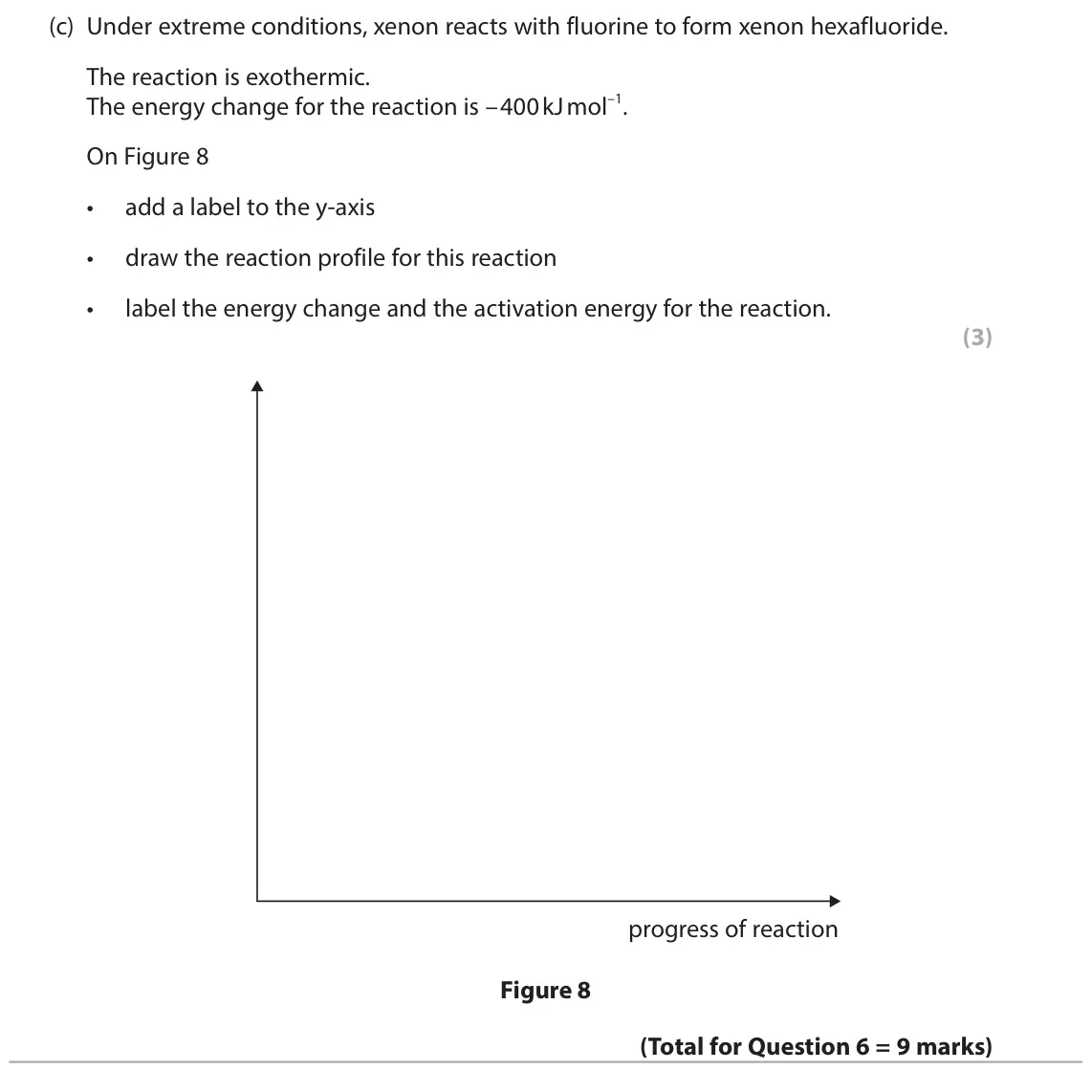
Q8(e)
The whole paper ↗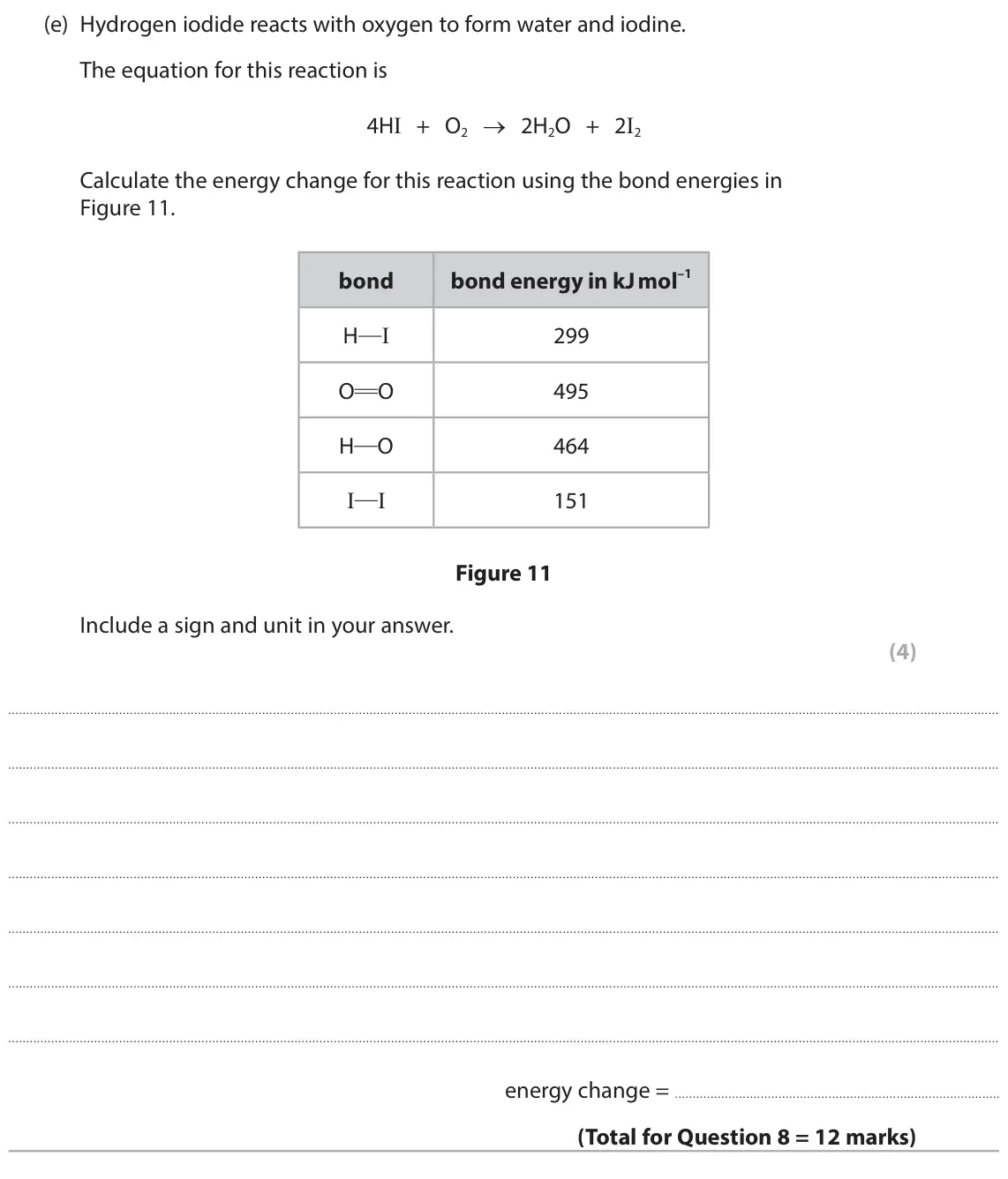
Q3(a)
The whole paper ↗
Q3(b)(i)
The whole paper ↗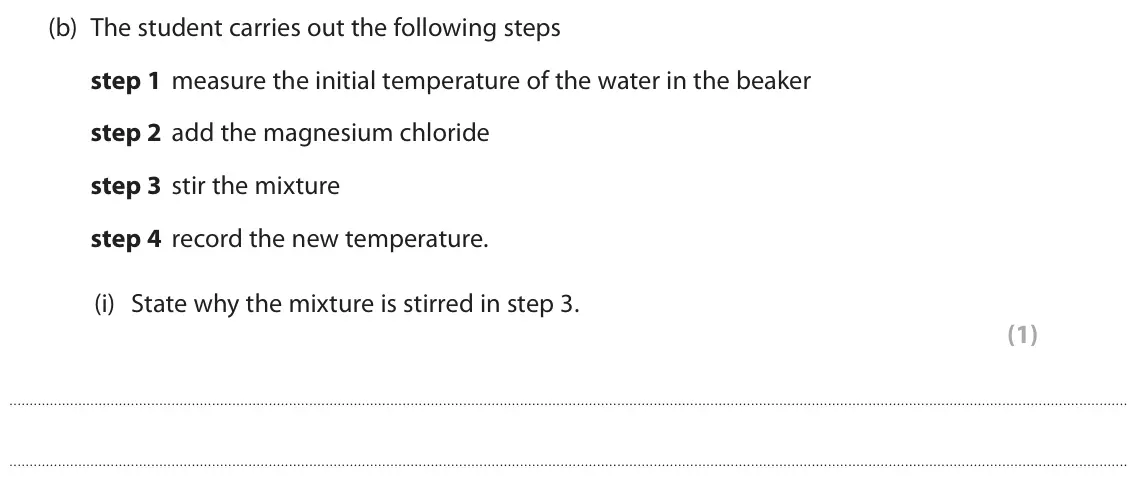
Q3(b)(ii)
The whole paper ↗
Q3(b)(iii)
The whole paper ↗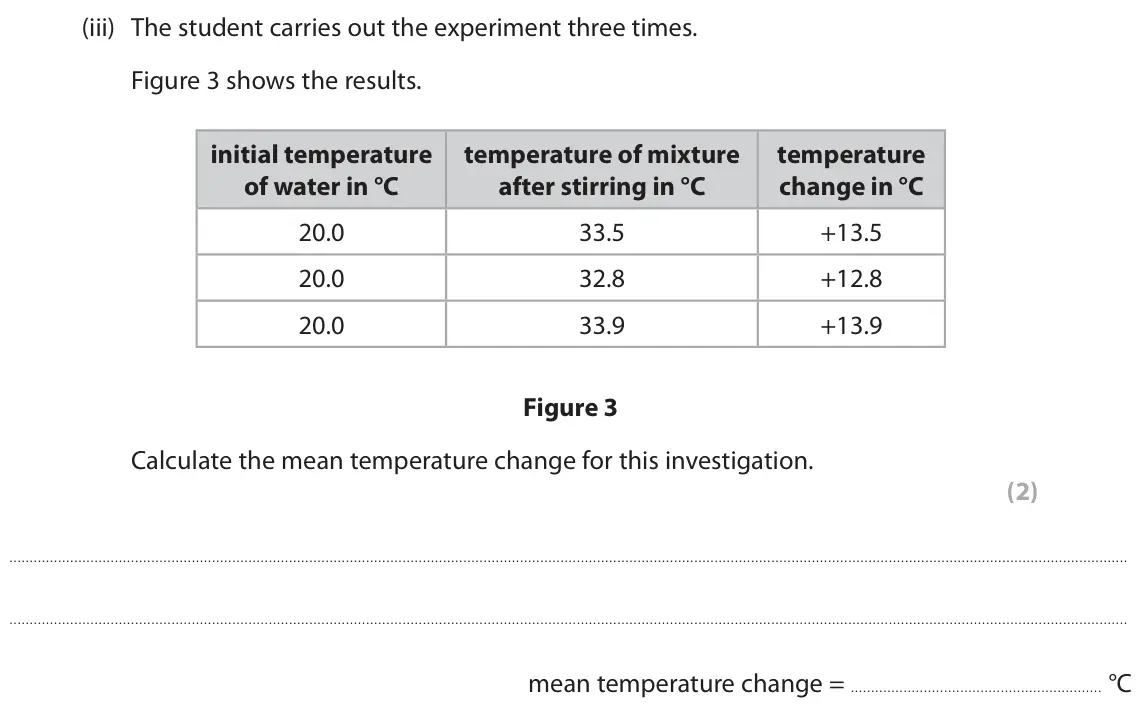
Q3(b)(iv)
The whole paper ↗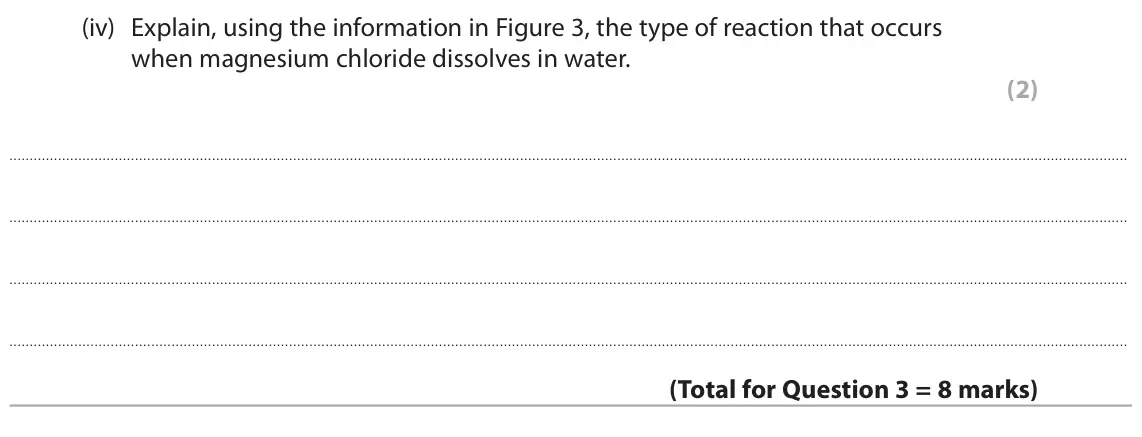
Q7(b)(ii)
The whole paper ↗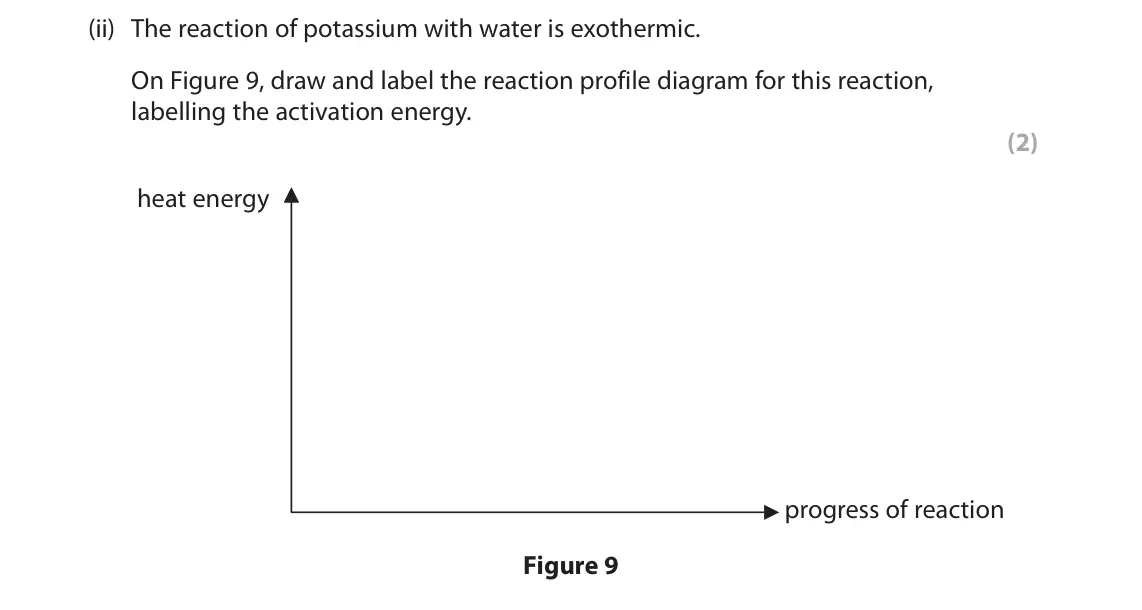
Q7(c)
The whole paper ↗
Q7(d)
The whole paper ↗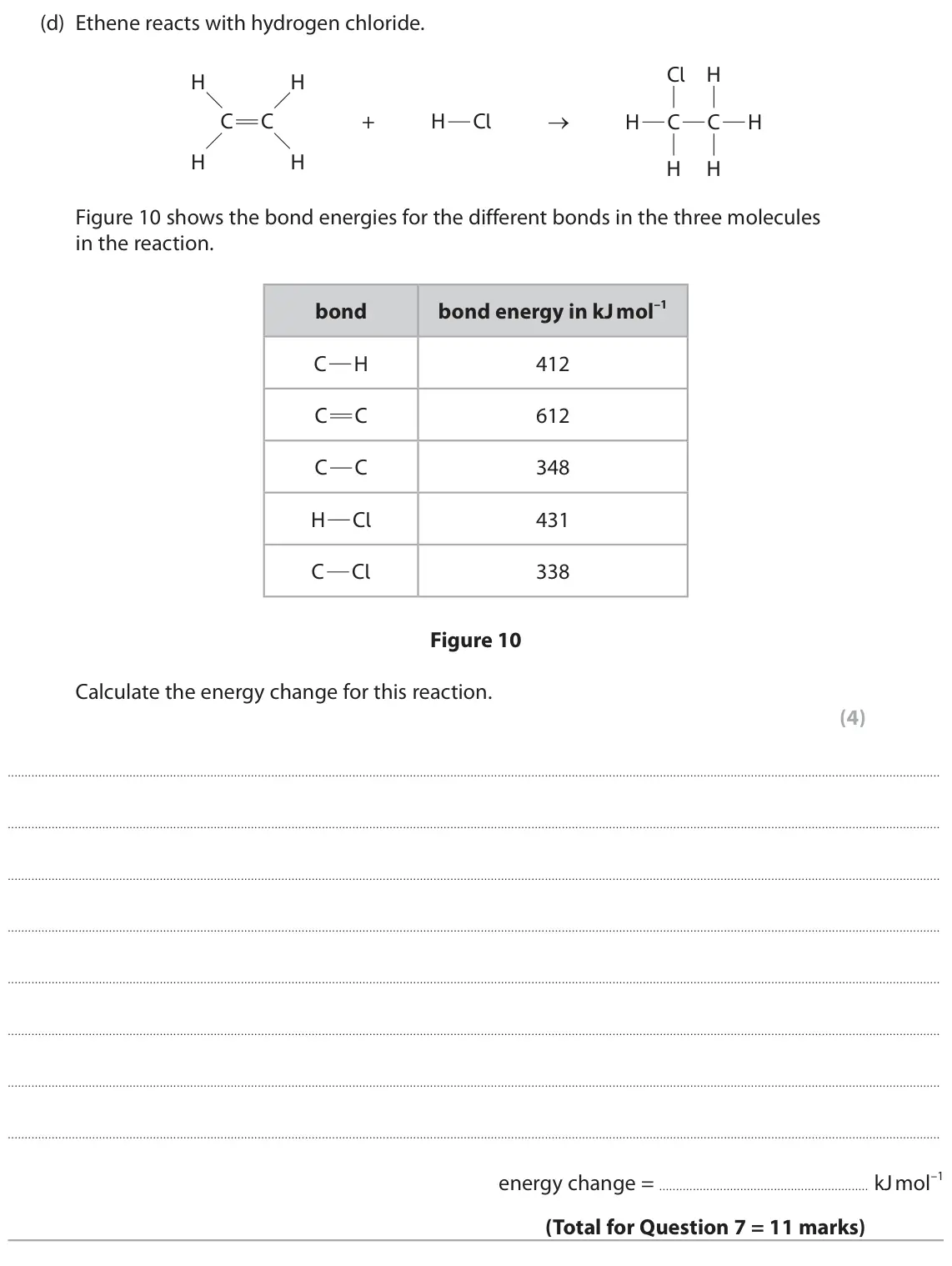
Q4(a)
The whole paper ↗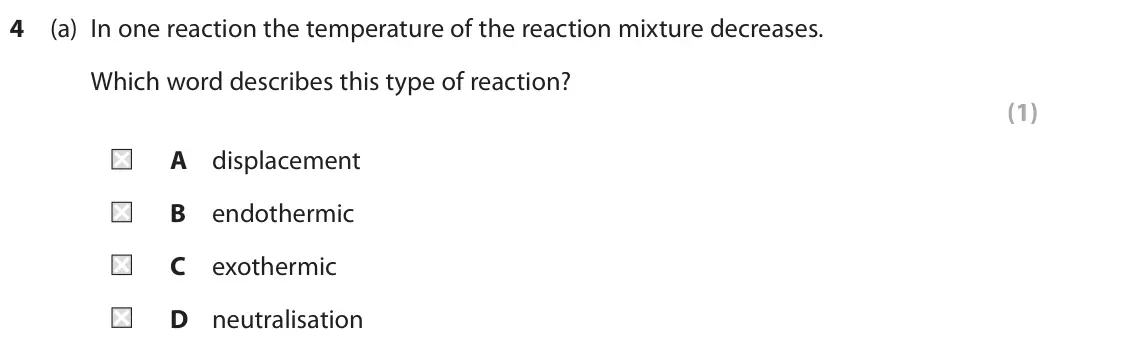
Q4(b)(i)
The whole paper ↗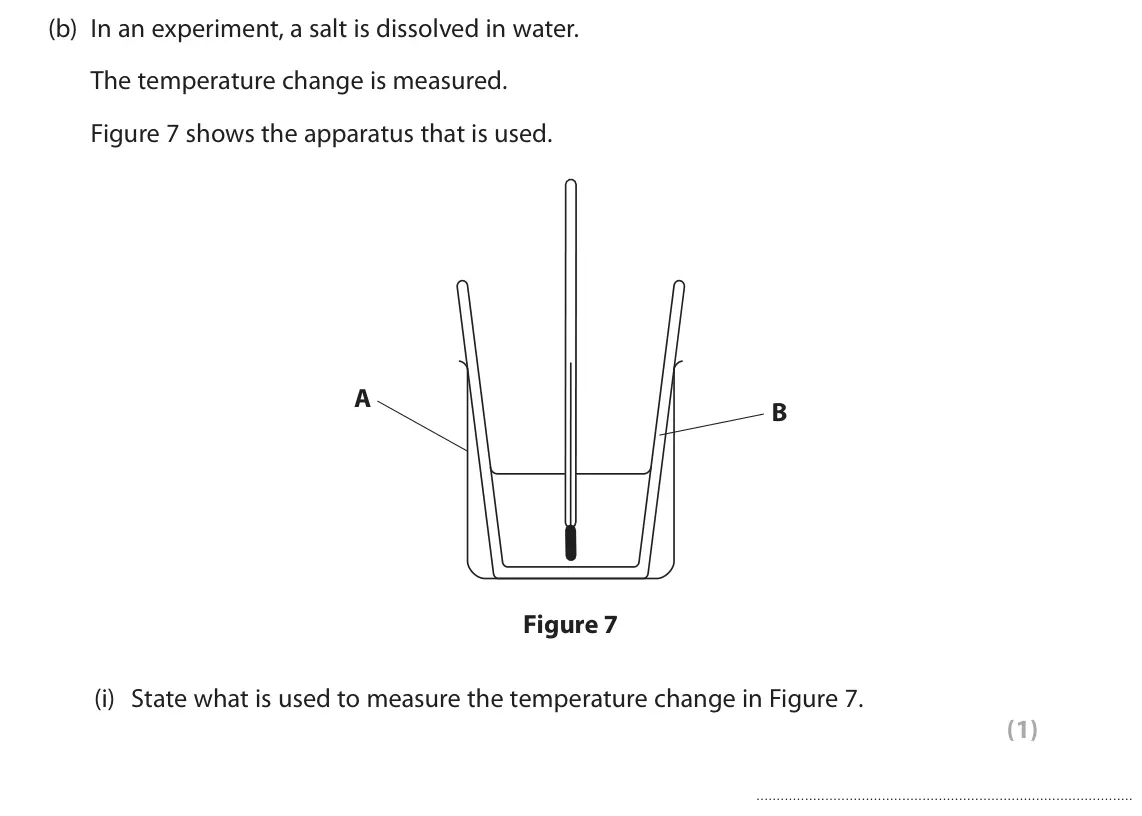
Q4(b)(ii)
The whole paper ↗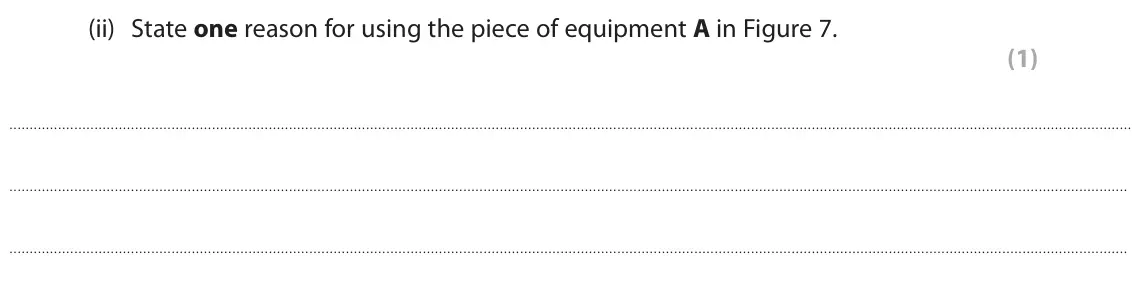
Q4(b)(iii)
The whole paper ↗
Q4(b)(iv)
The whole paper ↗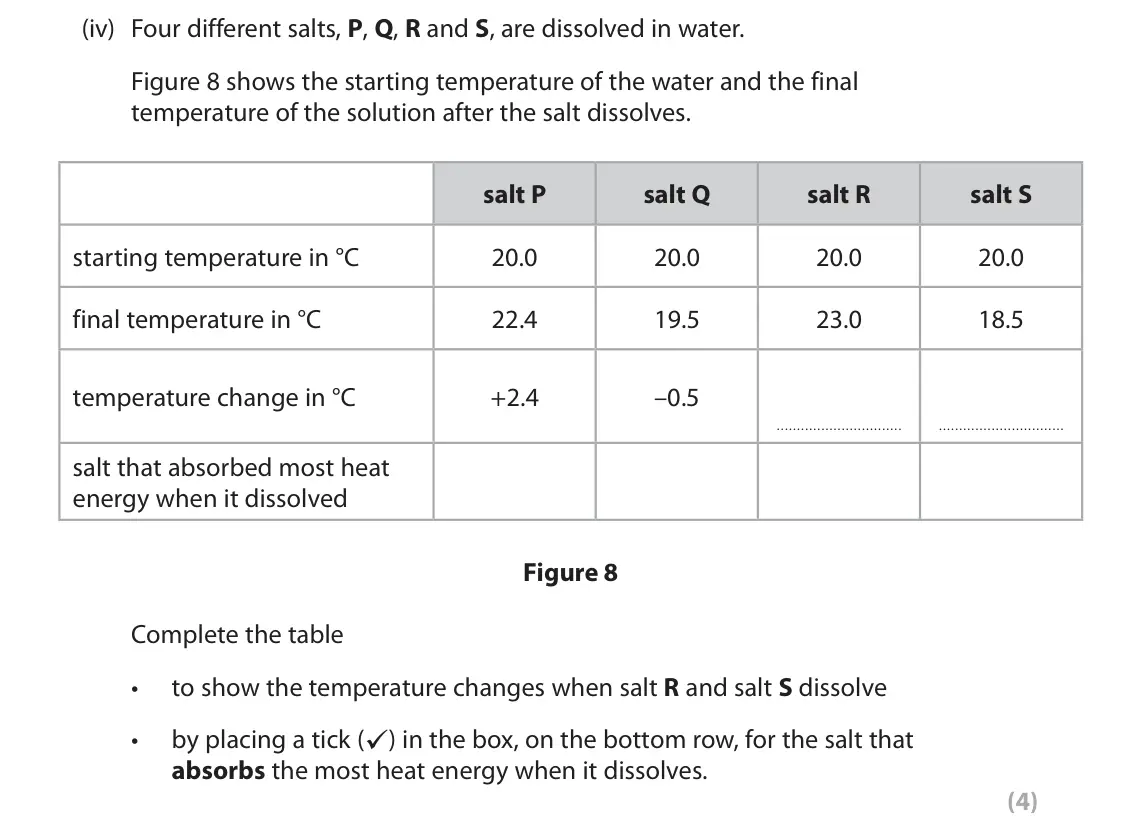
Q8(b)(i)
The whole paper ↗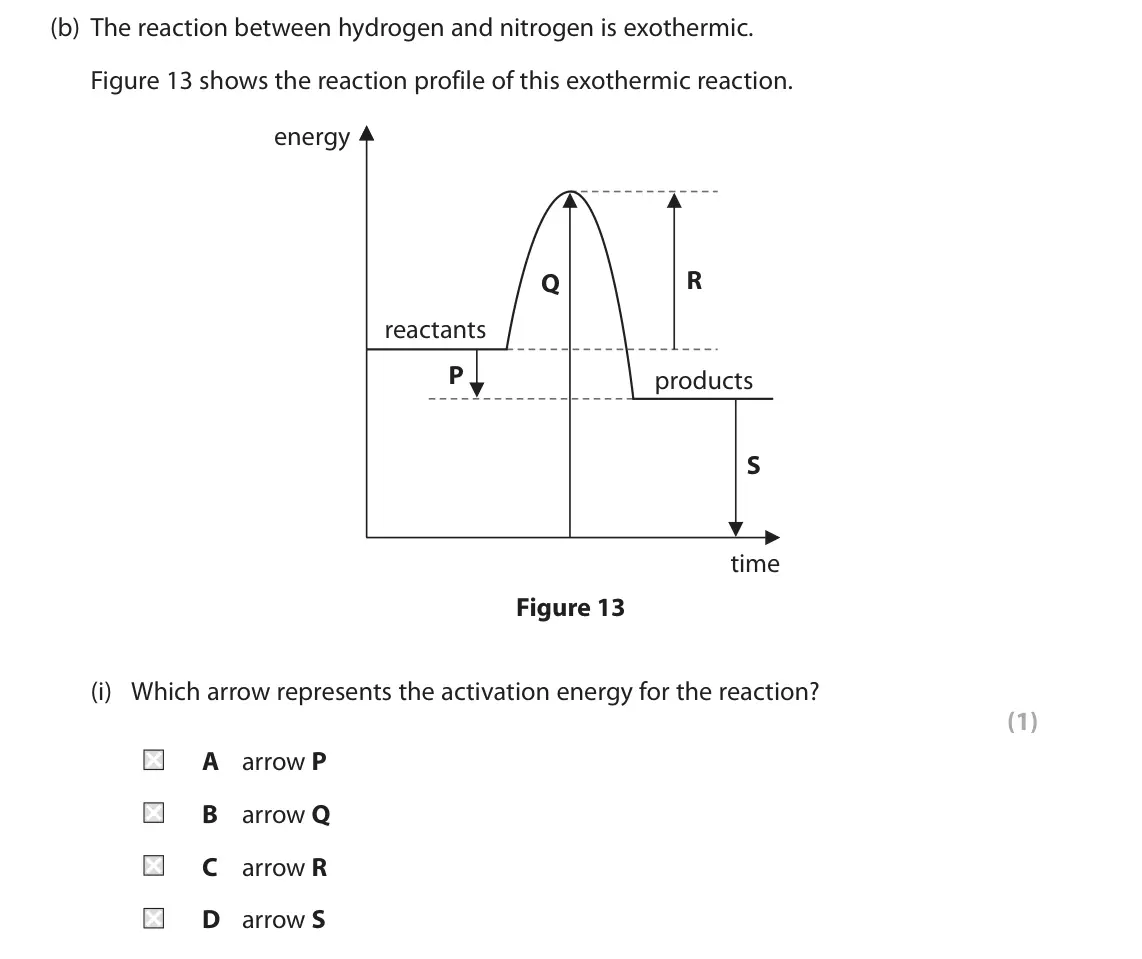
Q8(b)(ii)
The whole paper ↗
Q8(b)(iii)
The whole paper ↗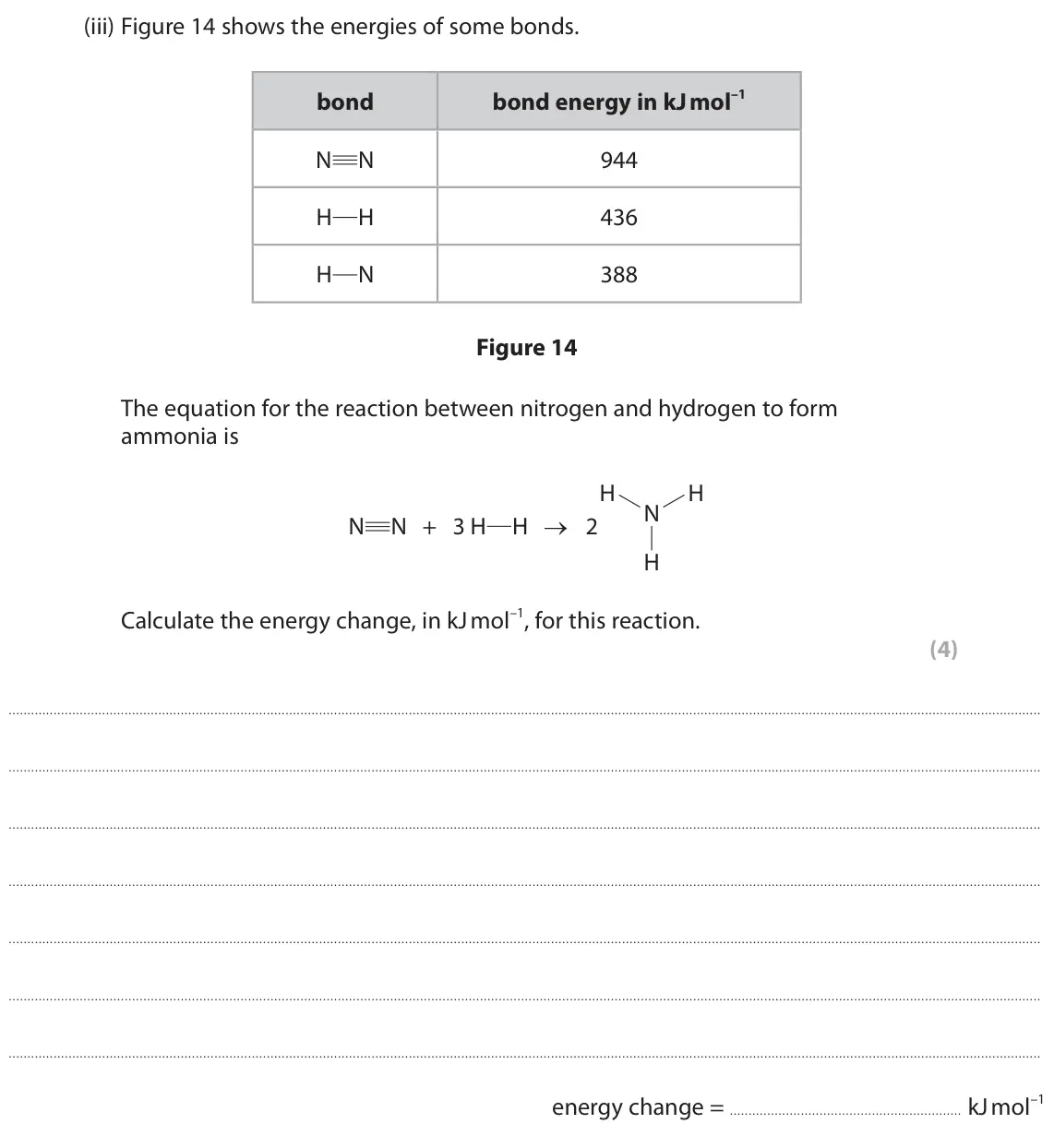
Q2(a)
The whole paper ↗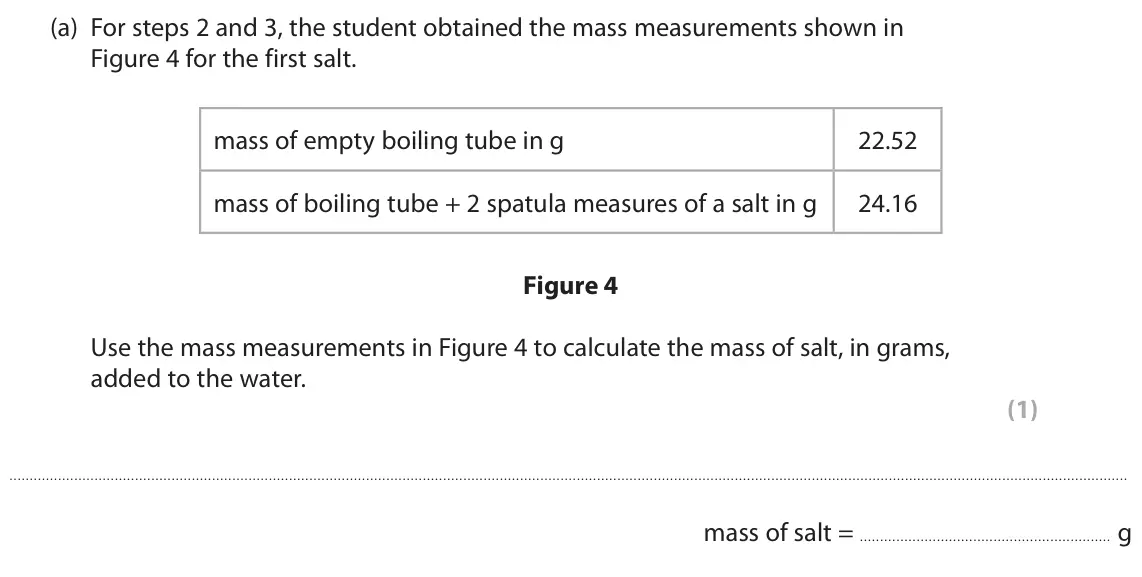
Q2(b)(i)
The whole paper ↗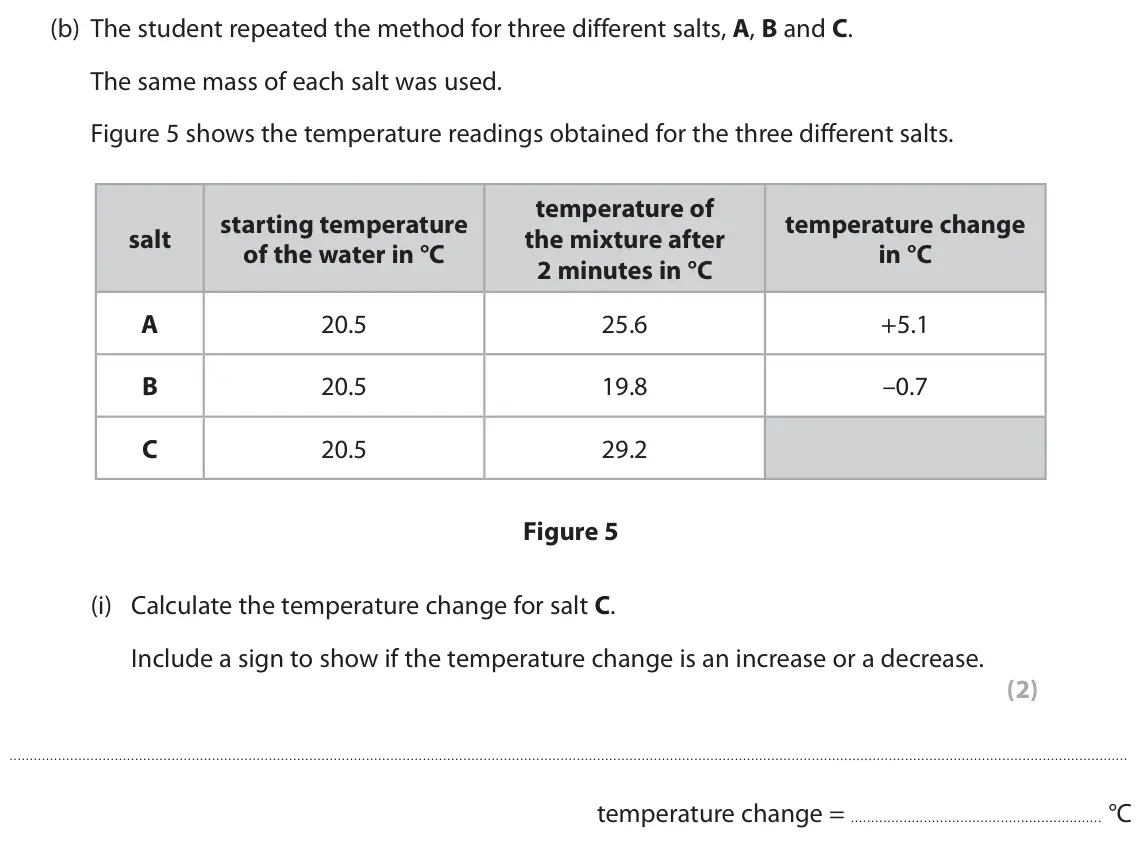
All 61 questions on Energy changes in reactions, as a list
- June 2025, Paper 2 Higher, Q6(c) (3 marks): Under extreme conditions, xenon reacts with fluorine to form xenon hexafluoride. The reaction is exothermic. The energy change for the reaction is –400 kJ mol–1
- June 2025, Paper 2 Higher, Q8(e) (4 marks): Hydrogen iodide reacts with oxygen to form water and iodine. The equation for this reaction is 4HI + O2 → 2H2O + 2I2 Calculate the energy change for this reacti
- June 2025, Paper 2 Foundation, Q3(a) (1 mark): Name the piece of apparatus labelled X in Figure 2. (1)
- June 2025, Paper 2 Foundation, Q3(b)(i) (1 mark): State why the mixture is stirred in step 3. (1)
- June 2025, Paper 2 Foundation, Q3(b)(ii) (2 marks): State two ways the apparatus could be changed to reduce the heat energy lost during the investigation. (2) 1 2
- June 2025, Paper 2 Foundation, Q3(b)(iii) (2 marks): The student carries out the experiment three times. Figure 3 shows the results. initial temperature temperature of mixture temperature of water in °C after stir
- June 2025, Paper 2 Foundation, Q3(b)(iv) (2 marks): Explain, using the information in Figure 3, the type of reaction that occurs when magnesium chloride dissolves in water. (2)
- June 2024, Paper 2 Higher, Q7(b)(ii) (2 marks): The reaction of potassium with water is exothermic. On Figure 9, draw and label the reaction profile diagram for this reaction, labelling the activation energy.
- June 2024, Paper 2 Higher, Q7(c) (3 marks): Some reactions are endothermic. Explain, in terms of bond breaking and bond forming, why some reactions are endothermic. (3)
- June 2024, Paper 2 Higher, Q7(d) (4 marks): Ethene reacts with hydrogen chloride. Cl H H H Cl → H C C + H C C H H H H H Figure 10 shows the bond energies for the different bonds in the three molecules in
- June 2024, Paper 2 Foundation, Q4(a) (1 mark): In one reaction the temperature of the reaction mixture decreases. Which word describes this type of reaction? (1) A displacement B endothermic C exothermic D n
- June 2024, Paper 2 Foundation, Q4(b)(i) (1 mark): State what is used to measure the temperature change in Figure 7. (1)
- June 2024, Paper 2 Foundation, Q4(b)(ii) (1 mark): State one reason for using the piece of equipment A in Figure 7. (1)
- June 2024, Paper 2 Foundation, Q4(b)(iii) (1 mark): A student suggests putting a lid on piece of equipment B. State why this would help to give a more accurate value for the temperature change. (1)
- June 2024, Paper 2 Foundation, Q4(b)(iv) (4 marks): Four different salts, P, Q, R and S, are dissolved in water. Figure 8 shows the starting temperature of the water and the final temperature of the solution afte
- June 2023, Paper 2 Higher, Q8(b)(i) (1 mark): Which arrow represents the activation energy for the reaction? (1) A arrow P B arrow Q C arrow R D arrow S
- June 2023, Paper 2 Higher, Q8(b)(ii) (2 marks): Describe what the reaction profile shows about the energy involved in bond breaking and bond making in this reaction. (2)
- June 2023, Paper 2 Higher, Q8(b)(iii) (4 marks): Figure 14 shows the energies of some bonds. bond bond energy in kJ mol–1 N N 944 H H 436 H N 388 Figure 14 The equation for the reaction between nitrogen and hy
- June 2023, Paper 2 Foundation, Q2(a) (1 mark): For steps 2 and 3, the student obtained the mass measurements shown in Figure 4 for the first salt. mass of empty boiling tube in g 22.52 mass of boiling tube +
- June 2023, Paper 2 Foundation, Q2(b)(i) (2 marks): Calculate the temperature change for salt C. Include a sign to show if the temperature change is an increase or a decrease. (2) temperature change = °C
- June 2023, Paper 2 Foundation, Q2(b)(ii) (2 marks): Explain which salt produces the biggest exothermic change. (2)
- June 2023, Paper 2 Foundation, Q2(c) (2 marks): Explain why a polystyrene cup is a better container to use for this investigation than a glass beaker. (2)
- June 2022, Paper 2 Higher, Q9(a)(i) (1 mark): Which row is correct about the energy changes for these processes? (1) energy change breaking a bond making a bond A energy is released energy is released B ene
- June 2022, Paper 2 Higher, Q9(a)(ii) (4 marks): Hydrogen reacts with fluorine. H2 + F2 → 2HF Figure 12 shows the bond energies for the bonds in the three molecules in the equation. bond bond energy in kJ mol–
- June 2022, Paper 2 Higher, Q9(b) (6 marks): The reaction profile for an uncatalysed exothermic reaction is shown in Figure 13. energy reactants products progress of reaction Figure 13 Using some examples
- June 2022, Paper 2 Foundation, Q4(a) (1 mark): What does an exothermic reaction always give out? (1) A heat energy B light C a gas D sound
- June 2022, Paper 2 Foundation, Q4(b)(i) (1 mark): Give the letter of the piece of apparatus, A, B, C or D, in Figure 6 that is used to measure the temperature. (1)
- June 2022, Paper 2 Foundation, Q4(b)(ii) (1 mark): Give the name of the piece of apparatus B shown in Figure 6. (1)
- June 2022, Paper 2 Foundation, Q4(b)(iii) (1 mark): The piece of apparatus labelled C is made from polystyrene. State why polystyrene is a better material than glass for this piece of apparatus. (1)
- June 2022, Paper 2 Foundation, Q4(b)(iv) (3 marks): The results of the experiment are given in Figure 7. temperature of liquid at start in °C 18.6 temperature of products at end in °C 16.1 Figure 7 Calculate the
- November 2021, Paper 2 Higher, Q2(b)(i) (2 marks): Explain how Figure 2 shows that dissolving ammonium chloride in water is an endothermic process. (2)
- November 2021, Paper 2 Higher, Q2(b)(ii) (2 marks): Complete the reaction profile in Figure 2 and label the activation energy. (2)
- November 2021, Paper 2 Higher, Q9(c) (4 marks): Figure 11 shows the reaction of propene, C3H6, with water. H H H H O H O C=C + H H C C C H H H H C H H H H H Figure 11 Figure 12 shows some bond energies. bond
- November 2021, Paper 2 Foundation, Q8(b)(i) (2 marks): Explain how Figure 17 shows that dissolving ammonium chloride in water is an endothermic process. (2)
- November 2021, Paper 2 Foundation, Q8(b)(ii) (2 marks): Complete the reaction profile in Figure 17 and label the activation energy. (2)
- November 2020, Paper 2 Higher, Q9(b) (4 marks): The energies of some bonds are shown in Figure 8. bond bond energy in kJ mol–1 C H 435 O O 496 C O 805 H O 463 Figure 8 Methane burns in oxygen to form carbon d
- November 2020, Paper 2 Foundation, Q3(b)(i) (1 mark): Name a piece of apparatus that should be used to measure the 100 cm3 of water in step 1. (1)
- November 2020, Paper 2 Foundation, Q3(b)(ii) (1 mark): The student cannot work out the temperature decrease using the method described. State what the student must do before step 2 to be able to work out the tempera
- November 2020, Paper 2 Foundation, Q3(b)(iii) (1 mark): State why a polystyrene cup is used in this experiment. (1)
- November 2020, Paper 2 Foundation, Q3(b)(iv) (2 marks): Figure 6 shows the reaction profile for this reaction. Use the words from the box to complete the labels on Figure 6. activation energy products reactants (2) h
- June 2019, Paper 2 Higher, Q8(b) (3 marks): The reaction between calcium carbonate and dilute hydrochloric acid is exothermic. Explain, in terms of bond breaking and bond making, why some reactions are ex
- June 2019, Paper 2 Foundation, Q4(a) (1 mark): Give the name of the apparatus that could be used to measure 1.00 g of calcium chloride. (1)
- June 2019, Paper 2 Foundation, Q4(b) (2 marks): The student’s results were temperature of water at start = 21 °C temperature of mixture after stirring = 32 °C Explain, using these results, the type of heat en
- June 2019, Paper 2 Foundation, Q4(c)(i) (1 mark): Which hazard symbol would be expected to be seen on a container of calcium chloride? (1) A B C D
- June 2019, Paper 2 Foundation, Q4(c)(ii) (1 mark): Give a safety precaution that the student should take during the experiment. (1)
- June 2019, Paper 2 Foundation, Q4(d) (1 mark): State one way in which the apparatus could be changed to reduce the amount of heat energy lost during the experiment. (1)
- June 2018, Paper 2 Higher, Q6(d)(ii) (3 marks): In a cracking reaction, reactants are heated to form products. This reaction is endothermic. On the axes provided, draw the reaction profile of this reaction. L
- June 2018, Paper 2 Higher, Q10(a) (4 marks): Hydrogen reacts with oxygen to form steam. 2H2(g) + O2(g) o 2H2O(g) Bond energies are shown in Figure 14. bond energy in kJ mol−1 bond H H 435 O O 500 O H 460 F
- June 2018, Paper 2 Foundation, Q1(a) (2 marks): The steps needed to carry out this experiment are P, Q, R, S and T. They are shown below. They are not in the correct order. P pour the 50 cm3 water into the po
- June 2018, Paper 2 Foundation, Q1(b) (1 mark): The dissolving of this solid in water is an exothermic change. The experiment is repeated a number of times. Compared with the initial temperature of the water,
- June 2018, Paper 2 Foundation, Q1(c) (1 mark): State how step R could be changed to measure the volume of water more accurately. (1)
- June 2018, Paper 2 Foundation, Q1(d)(i) (2 marks): Explain why the pack goes cold. (2)
- June 2018, Paper 2 Foundation, Q1(d)(ii) (1 mark): Give the reason why the pack can be used only once. (1)
- Specimen, Paper 2 Higher, Q10(b) (4 marks): When sodium hydroxide solution is neutralised with an acid there is a temperature change. A student is given dilute hydrochloric acid and dilute ethanoic acid o
- Specimen, Paper 2 Higher, Q10(c) (3 marks): Hydrogen reacts with chlorine to form hydrogen chloride. H2(g) + Cl2(g) → 2HCl(g) The reaction is exothermic. Draw and label the reaction profile diagram for th
- Specimen, Paper 2 Higher, Q10(d) (4 marks): The energies of some bonds are shown in Figure 13. energy of bond bond / kJmol–1 H–H 436 Cl–Cl 243 H–Cl 432 Figure 13 Hydrogen reacts with chlorine to form hydr
- Specimen, Paper 2 Foundation, Q4(a) (1 mark): When solid ammonium chloride is shaken with water, a colourless solution forms and the temperature changes from 20°C to 16°C. Give the name of the type of heat
- Specimen, Paper 2 Foundation, Q4(b)(i) (1 mark): State a suitable container for the iron(II) sulfate solution in this experiment. (1)
- Specimen, Paper 2 Foundation, Q4(b)(ii) (1 mark): State what the student should do to the mixtures during the experiment. (1)
- Specimen, Paper 2 Foundation, Q4(b)(iii) (2 marks): Figure 5 shows the results obtained by the student. metal added to temperature rise iron(II) sulfate solution / °C magnesium 6.0 copper 0.0 zinc 2.8 Figure 5 Ex
- Specimen, Paper 2 Foundation, Q4(b)(iv) (2 marks): Explain how the student could improve the method to make a fairer comparison of the temperature change produced by the different metals. (2)
Questions, mark schemes and examiner’s reports are © Pearson Edexcel, from their published past papers. Plumi isn’t affiliated with any exam board. Want whole papers? Every Edexcel GCSE Chemistry paper.
Rather write your answers by hand on iPad? Plumi marks them against the same mark schemes.