 plumi
Covalent bonding: Edexcel GCSE Chemistry questions
Every Edexcel GCSE Chemistry exam question on Covalent bonding (specification points 1.28–1.32), 2018–2025, with its mark scheme and examiner’s report.
Find questions1,880
Exam
All years
Calculations
Q1(b)(i)
The whole paper ↗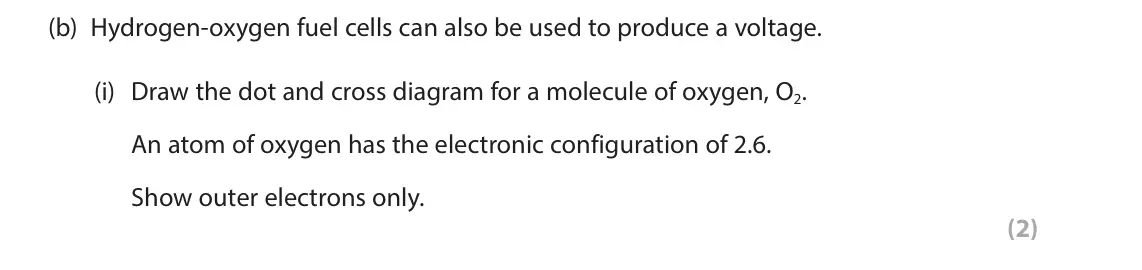
Q1(b)(ii)
The whole paper ↗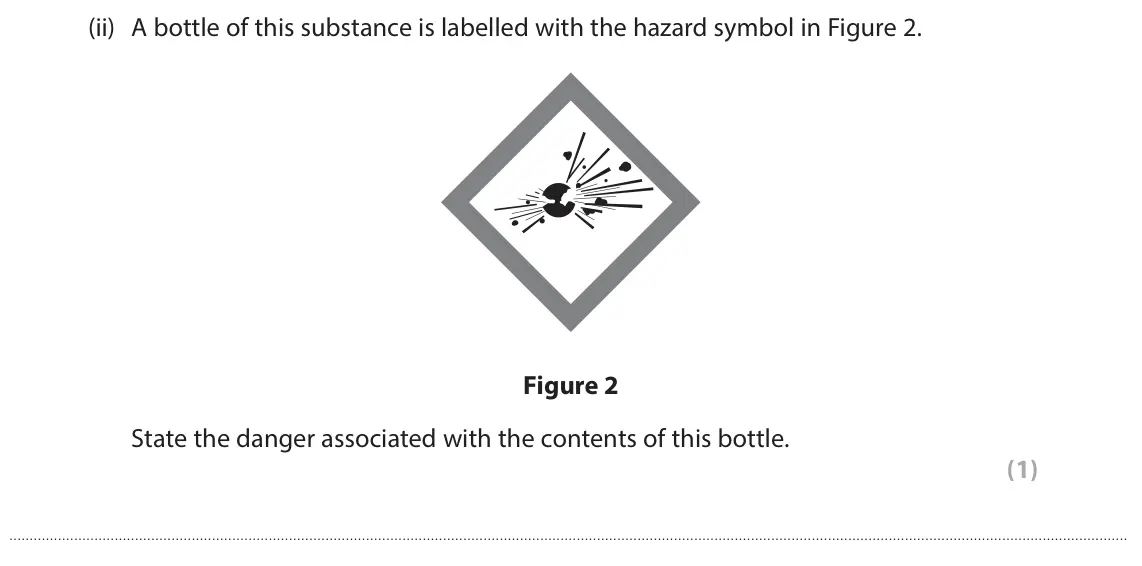
Q3(b)
The whole paper ↗
Q9(b)
The whole paper ↗
Q1(c)
The whole paper ↗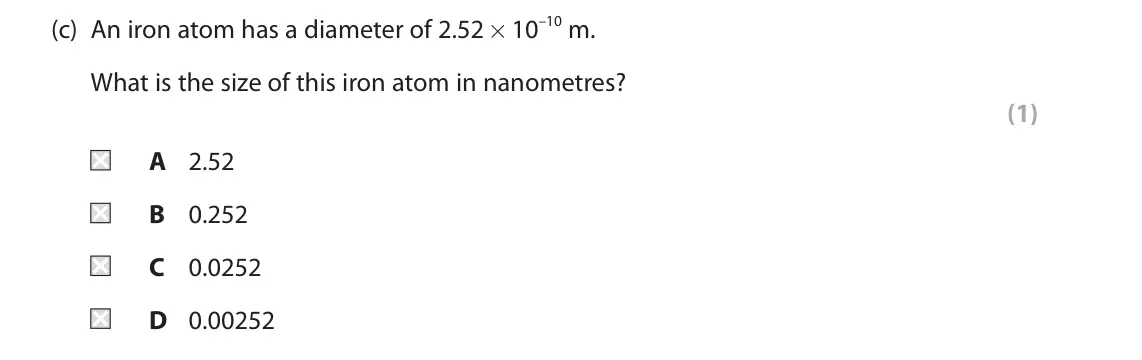
Q8(a)(i)
The whole paper ↗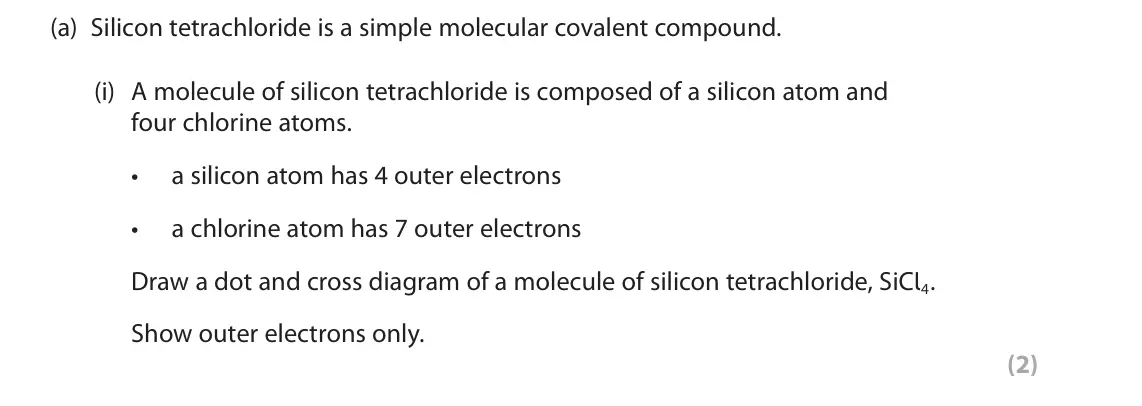
Q2(a)(ii)
The whole paper ↗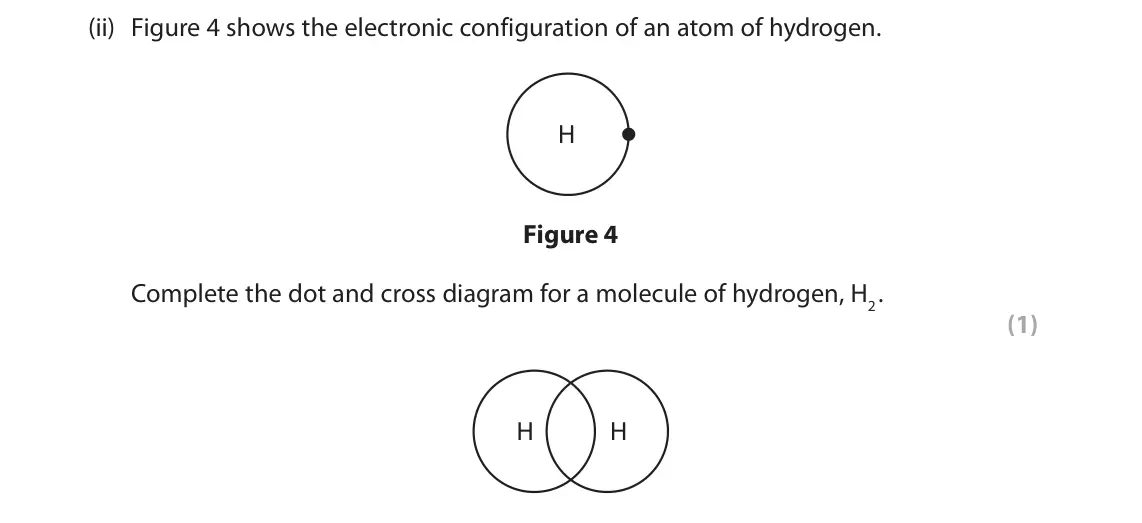
Q7(a)(i)
The whole paper ↗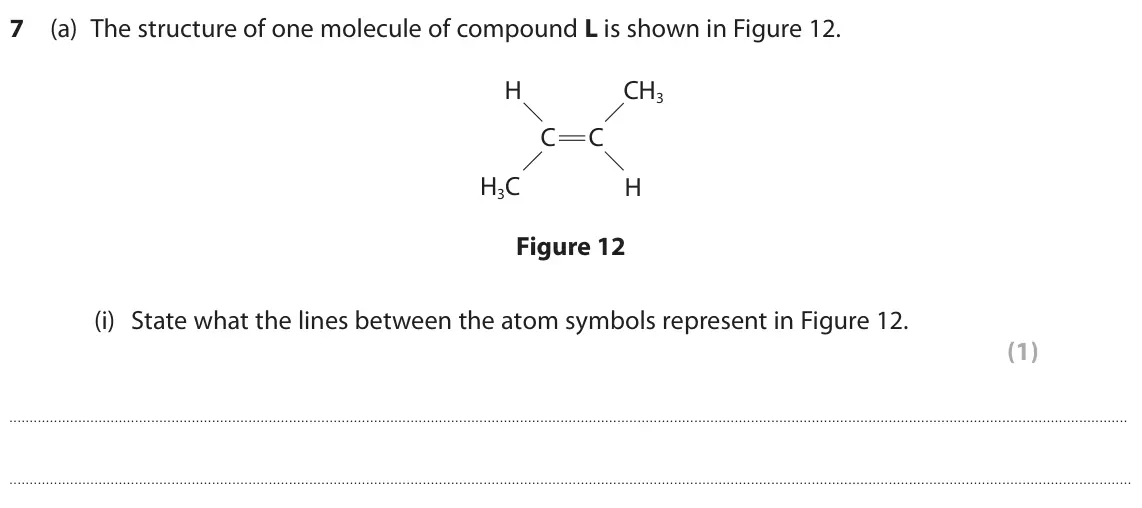
Q6(d)
The whole paper ↗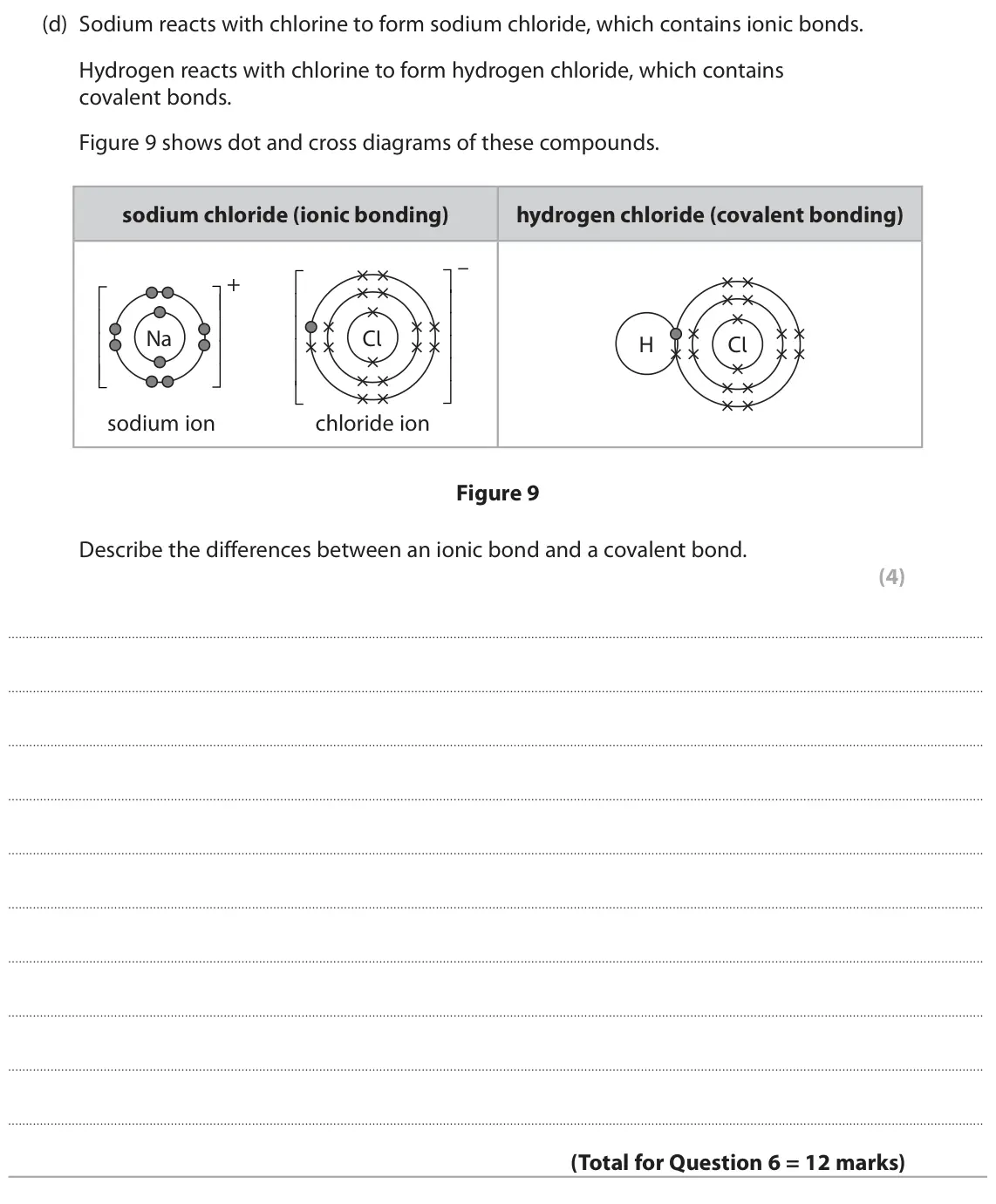
Q5(b)
The whole paper ↗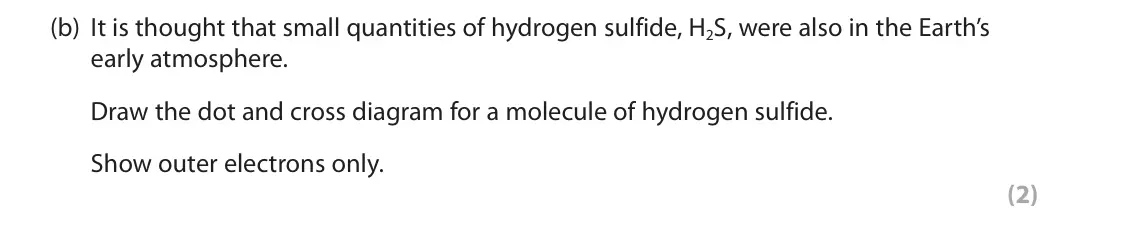
Q1(a)
The whole paper ↗
Q1(b)
The whole paper ↗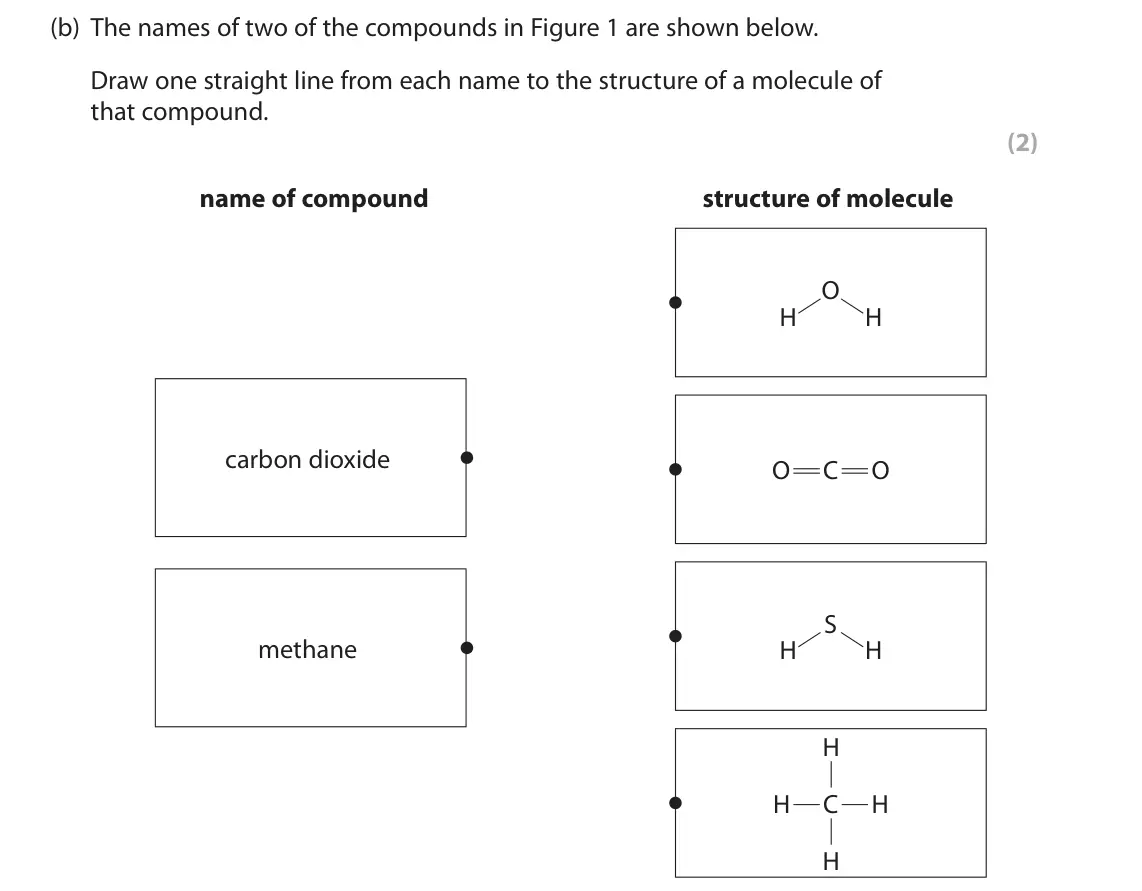
Q1(c)
The whole paper ↗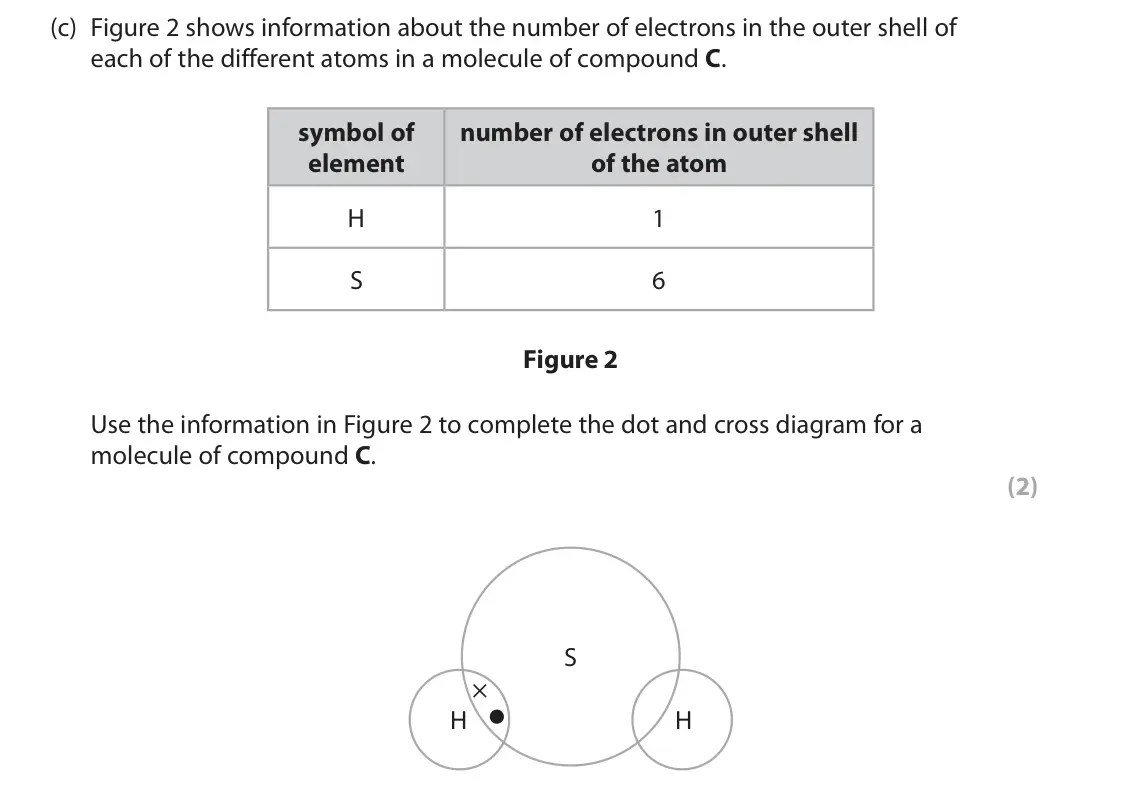
Q6(b)(ii)
The whole paper ↗
Q1(c)
The whole paper ↗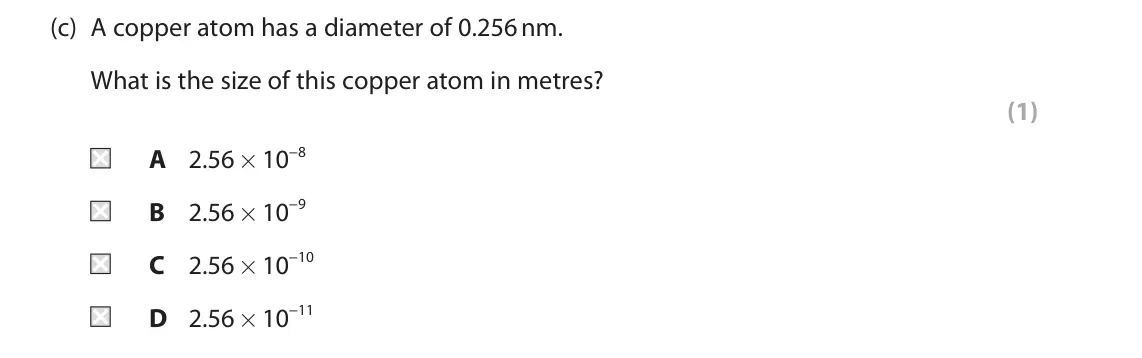
Q8(d)
The whole paper ↗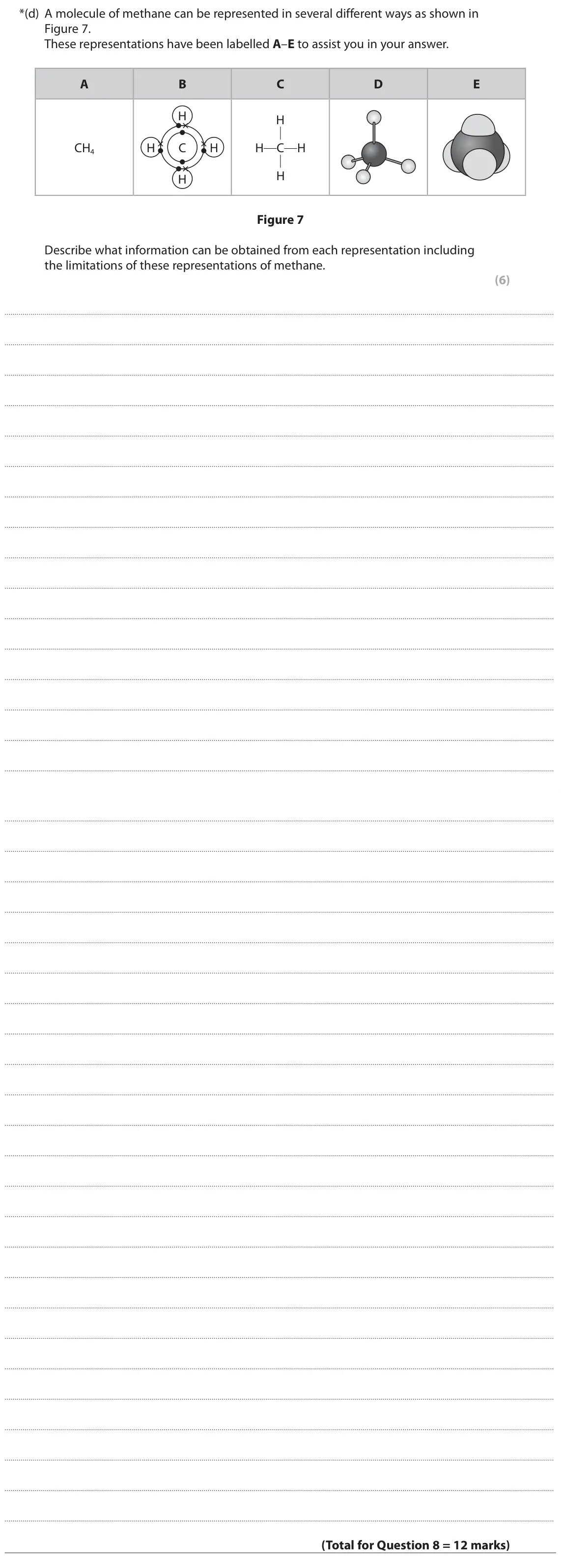
Q1(b)(iii)
The whole paper ↗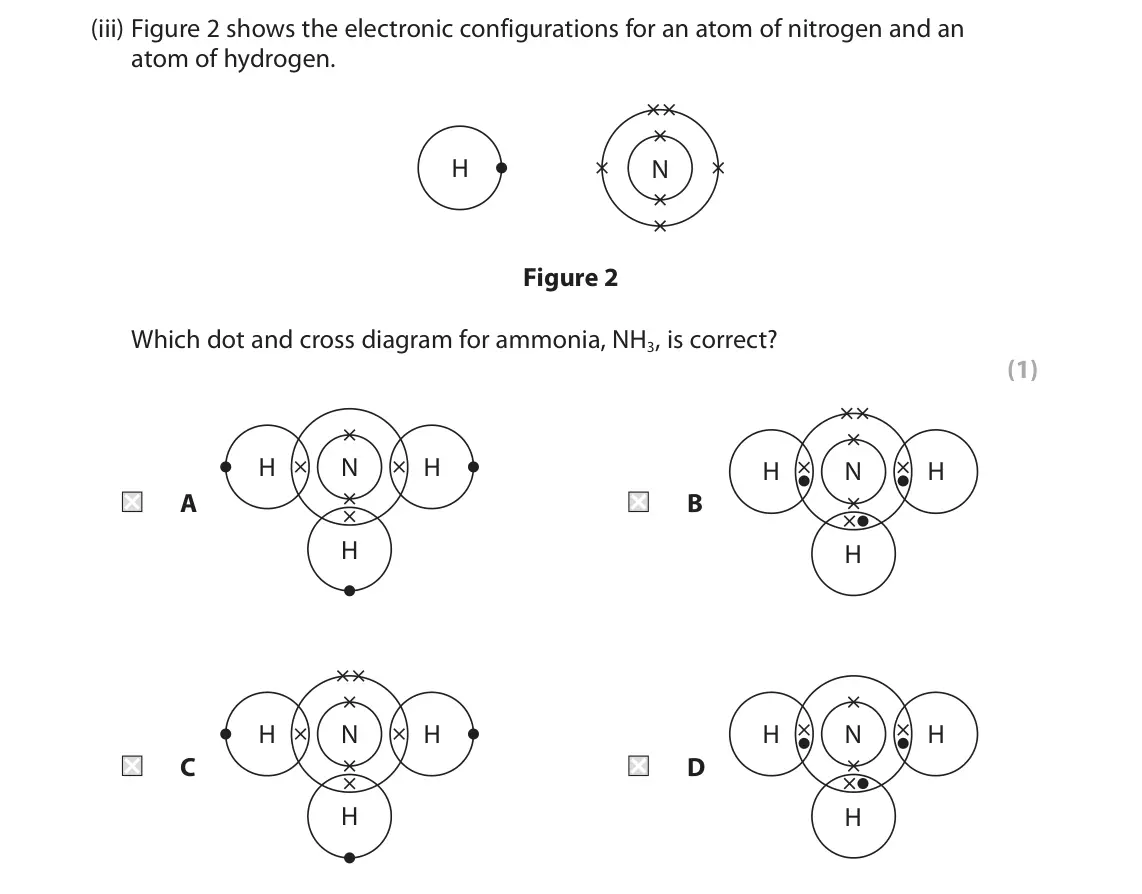
Q6(c)
The whole paper ↗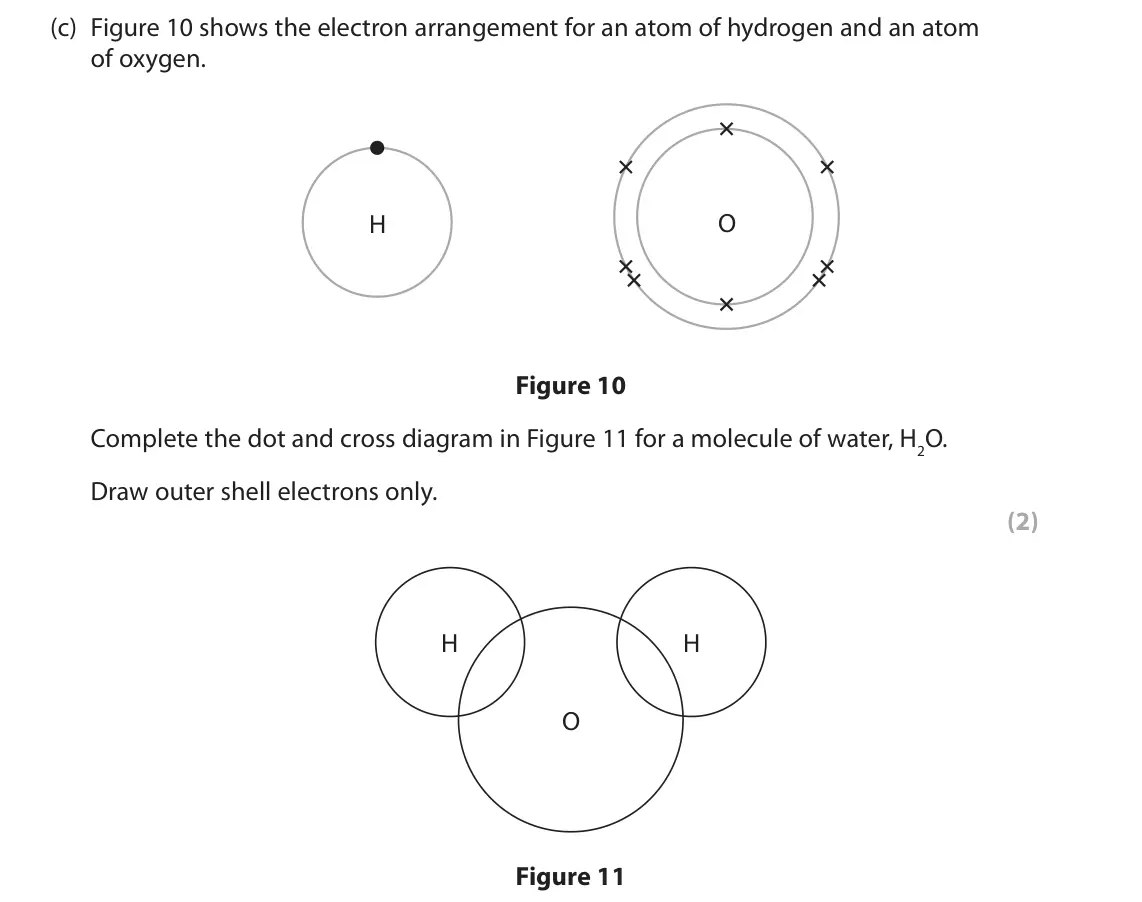
Q3(c)
The whole paper ↗
Q1(b)(iii)
The whole paper ↗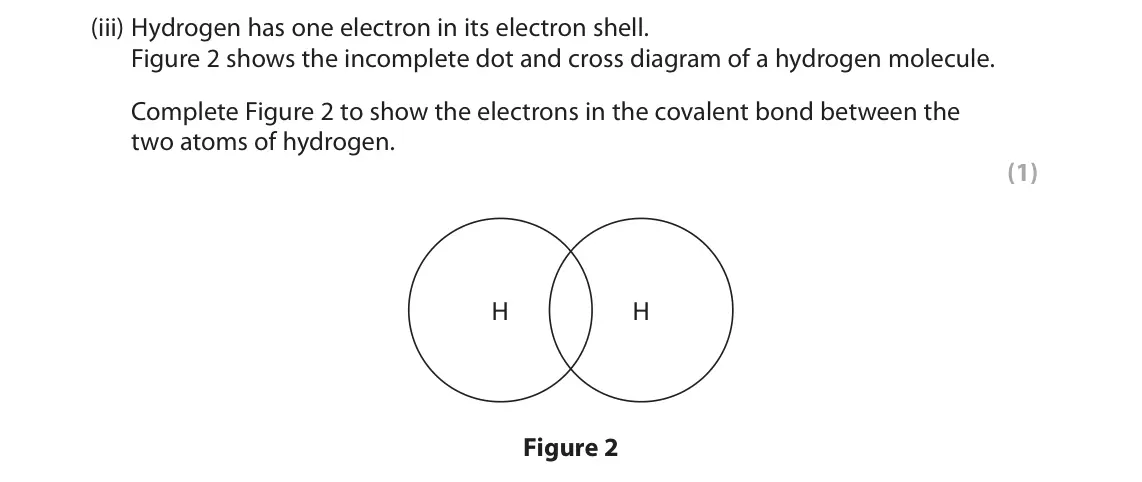
All 32 questions on Covalent bonding, as a list
- June 2025, Paper 1 Higher, Q1(b)(i) (2 marks): Draw the dot and cross diagram for a molecule of oxygen, O2. An atom of oxygen has the electronic configuration of 2.6. Show outer electrons only. (2)
- June 2025, Paper 2 Higher, Q1(b)(ii) (1 mark): A bottle of this substance is labelled with the hazard symbol in Figure 2. Figure 2 State the danger associated with the contents of this bottle. (1)
- June 2025, Paper 2 Higher, Q3(b) (2 marks): When hydrocarbons undergo combustion, water is produced. Draw a dot and cross diagram of a molecule of water. (2)
- June 2025, Paper 2 Foundation, Q9(b) (2 marks): When hydrocarbons undergo combustion, water is produced. Draw a dot and cross diagram of a molecule of water. (2)
- June 2024, Paper 1 Higher, Q1(c) (1 mark): An iron atom has a diameter of 2.52 × 10⁻¹⁰ m. What is the size of this iron atom in nanometres? (1) A 2.52 B 0.252 C 0.0252 D 0.00252
- June 2024, Paper 1 Higher, Q8(a)(i) (2 marks): A molecule of silicon tetrachloride is composed of a silicon atom and four chlorine atoms. • a silicon atom has 4 outer electrons • a chlorine atom has 7 outer
- June 2024, Paper 1 Foundation, Q2(a)(ii) (1 mark): Figure 4 shows the electronic configuration of an atom of hydrogen. H Figure 4 Complete the dot and cross diagram for a molecule of hydrogen, H2. (1) H H
- June 2024, Paper 2 Foundation, Q7(a)(i) (1 mark): State what the lines between the atom symbols represent in Figure 12. (1)
- June 2023, Paper 1 Foundation, Q6(d) (4 marks): Sodium reacts with chlorine to form sodium chloride, which contains ionic bonds. Hydrogen reacts with chlorine to form hydrogen chloride, which contains covalen
- June 2023, Paper 2 Higher, Q5(b) (2 marks): It is thought that small quantities of hydrogen sulfide, H2S, were also in the Earth’s early atmosphere. Draw the dot and cross diagram for a molecule of hydrog
- June 2023, Paper 2 Foundation, Q1(a) (1 mark): The formula of a molecule of compound A is H2O. Give the formula of a molecule of compound D. (1)
- June 2023, Paper 2 Foundation, Q1(b) (2 marks): The names of two of the compounds in Figure 1 are shown below. Draw one straight line from each name to the structure of a molecule of that compound. (2) name o
- June 2023, Paper 2 Foundation, Q1(c) (2 marks): Figure 2 shows information about the number of electrons in the outer shell of each of the different atoms in a molecule of compound C. symbol of number of elec
- June 2023, Paper 2 Foundation, Q6(b)(ii) (2 marks): Chlorine, Cl2 , is made of simple molecules. Describe what is meant by the term molecule. (2)
- June 2022, Paper 1 Higher, Q1(c) (1 mark): A copper atom has a diameter of 0.256 nm. What is the size of this copper atom in metres? (1) A 2.56 × 10⁻⁸ B 2.56 × 10⁻⁹ C 2.56 × 10⁻¹⁰ D 2.56 × 10⁻¹¹
- June 2022, Paper 1 Higher, Q8(d) (6 marks): A molecule of methane can be represented in several different ways as shown in Figure 7. These representations have been labelled A–E to assist you in your answ
- June 2022, Paper 1 Foundation, Q1(b)(iii) (1 mark): Figure 2 shows the electronic configurations for an atom of nitrogen and an atom of hydrogen. H N Figure 2 Which dot and cross diagram for ammonia, NH3, is corr
- November 2021, Paper 2 Foundation, Q6(c) (2 marks): Figure 10 shows the electron arrangement for an atom of hydrogen and an atom of oxygen. H O Figure 10 Complete the dot and cross diagram in Figure 11 for a mole
- November 2020, Paper 1 Higher, Q3(c) (2 marks): The electronic configuration of carbon is 2.4 The electronic configuration of oxygen is 2.6 Draw a dot and cross diagram for a molecule of carbon dioxide. Show
- November 2020, Paper 1 Foundation, Q1(b)(iii) (1 mark): Hydrogen has one electron in its electron shell. Figure 2 shows the incomplete dot and cross diagram of a hydrogen molecule. Complete Figure 2 to show the elect
- November 2020, Paper 1 Foundation, Q3(b) (1 mark): The formula of ammonia is NH3. State what the formula of ammonia shows about the number of nitrogen atoms and the number of hydrogen atoms combined in a molecul
- November 2020, Paper 2 Foundation, Q5(b)(iii) (1 mark): A chlorine atom has seven electrons in its outer shell. A hydrogen atom has one electron in its outer shell. Complete the dot and cross diagram of a molecule of
- November 2020, Paper 2 Foundation, Q5(b)(iv) (1 mark): Name the type of bonding in a molecule of hydrogen chloride. (1)
- June 2019, Paper 1 Foundation, Q8(e) (2 marks): An oxygen atom has six electrons in its outer shell. A hydrogen atom has one electron in its outer shell. Complete the dot and cross diagram of a molecule of wa
- June 2019, Paper 2 Foundation, Q5(b)(i) (1 mark): Figure 9 shows the incomplete dot and cross diagram for a molecule of ethene. H H X X X C C X H H Figure 9 Complete Figure 9 to show the electrons of the C C do
- June 2018, Paper 1 Higher, Q8(b) (2 marks): Oxygen, O2, is also a simple molecular, covalent substance. Draw a dot and cross diagram for the molecule of oxygen. (2)
- June 2018, Paper 1 Foundation, Q1(a)(i) (1 mark): What do the dots and crosses represent in the diagram? (1) A electrons B neutrons C protons D nuclei
- June 2018, Paper 1 Foundation, Q1(a)(ii) (1 mark): Give the formula for the molecule of ammonia. (1)
- June 2018, Paper 2 Higher, Q2(c)(i) (2 marks): Describe what is meant by a covalent bond. (2)
- June 2018, Paper 2 Foundation, Q6(a) (1 mark): State the formula of a molecule of substance B. (1)
- June 2018, Paper 2 Foundation, Q8(c)(i) (2 marks): Describe what is meant by a covalent bond. (2)
- Specimen, Paper 2 Foundation, Q2(d) (2 marks): Hydrogen reacts with chlorine to form hydrogen chloride. H–H + Cl–Cl → 2H–Cl The symbol – is used to show a covalent bond. The electronic configuration of hydro
Questions, mark schemes and examiner’s reports are © Pearson Edexcel, from their published past papers. Plumi isn’t affiliated with any exam board. Want whole papers? Every Edexcel GCSE Chemistry paper.
Rather write your answers by hand on iPad? Plumi marks them against the same mark schemes.