 plumi
Yield and atom economy: Edexcel GCSE Chemistry questions
Every Edexcel GCSE Chemistry exam question on Yield and atom economy (specification points 5.11–5.15), 2018–2025, with its mark scheme and examiner’s report.
Find questions1,880
Exam
All years
Calculations
Q4(c)(i)
The whole paper ↗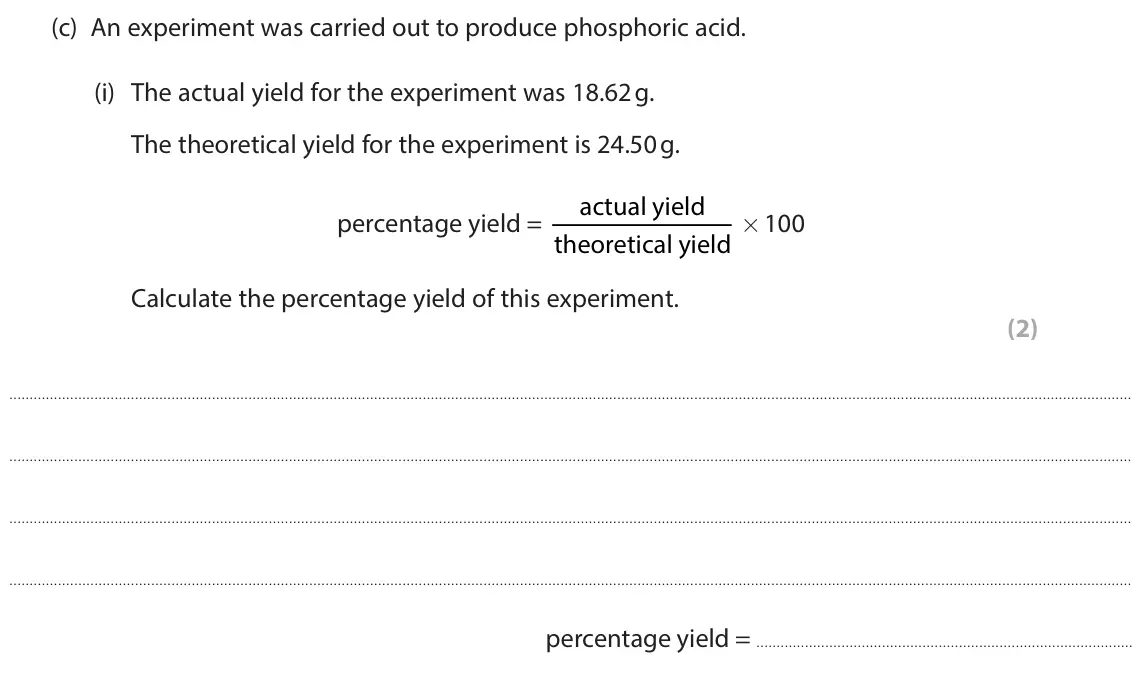
Q4(c)(ii)
The whole paper ↗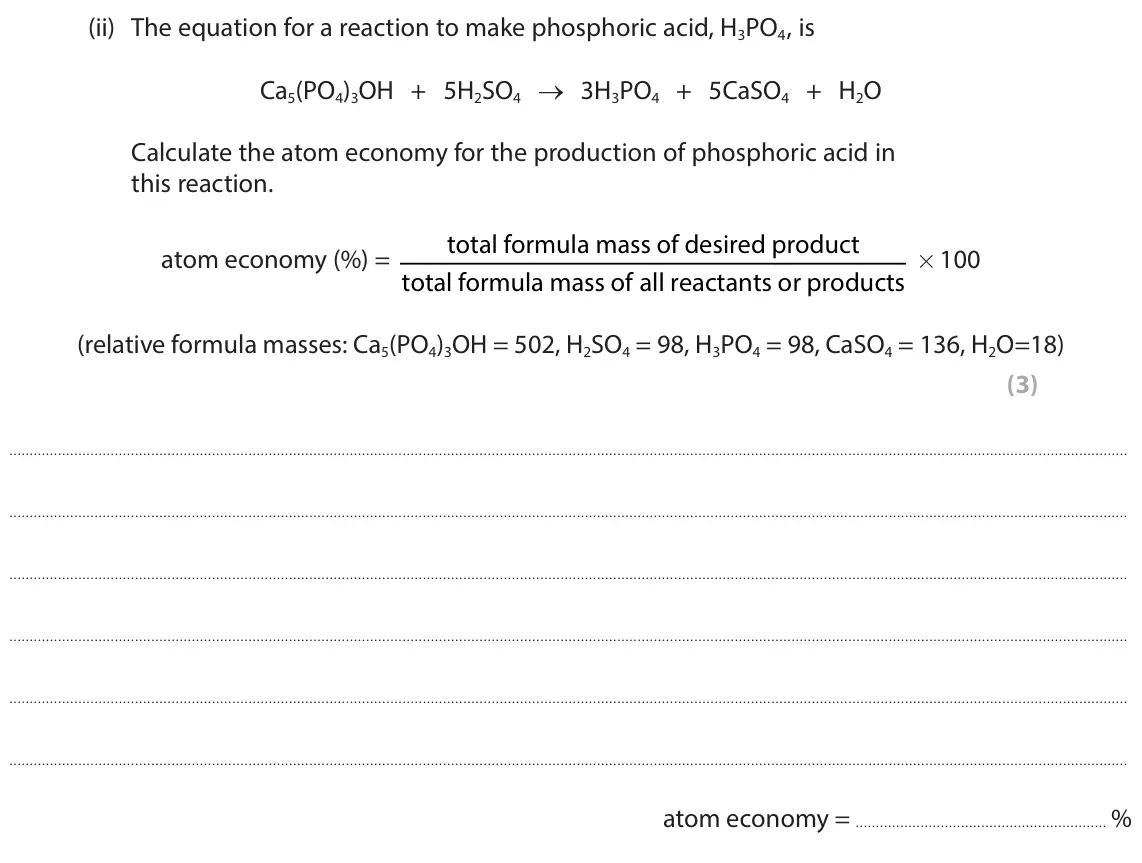
Q4(c)(iii)
The whole paper ↗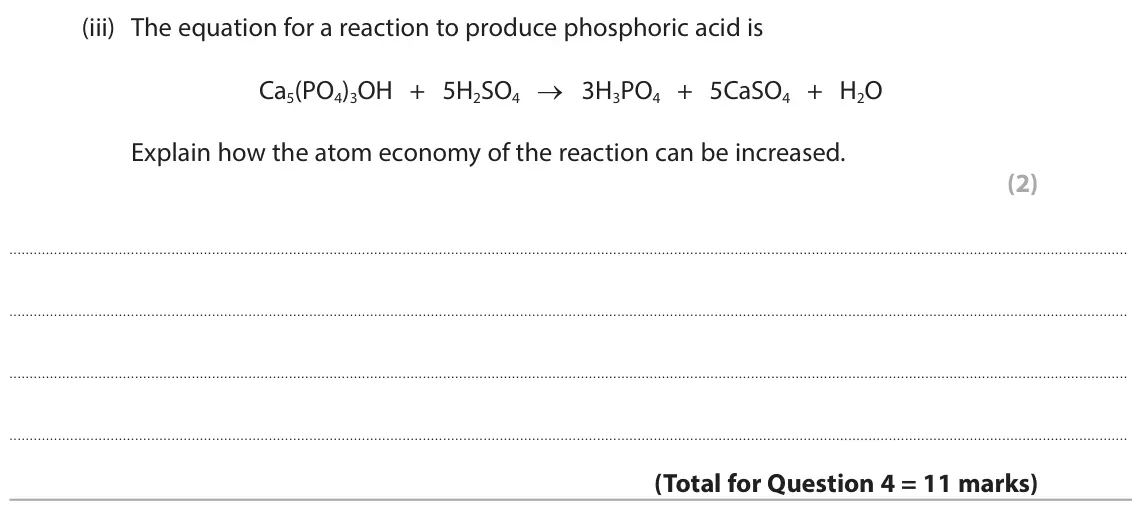
Q10(c)(i)
The whole paper ↗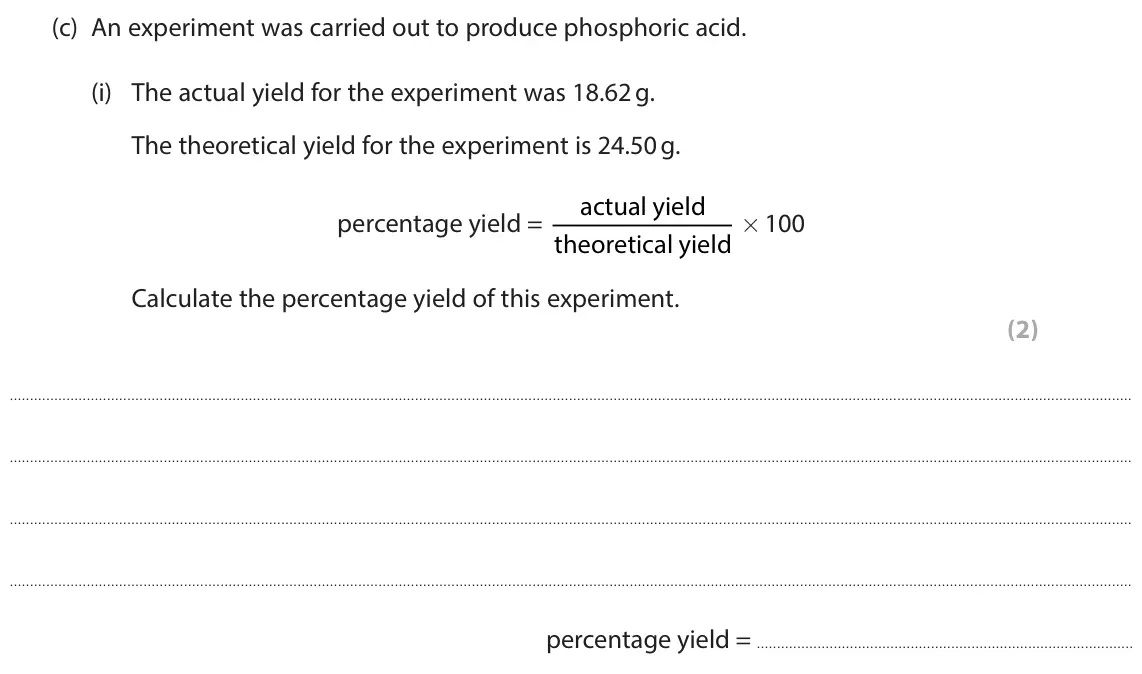
Q10(c)(ii)
The whole paper ↗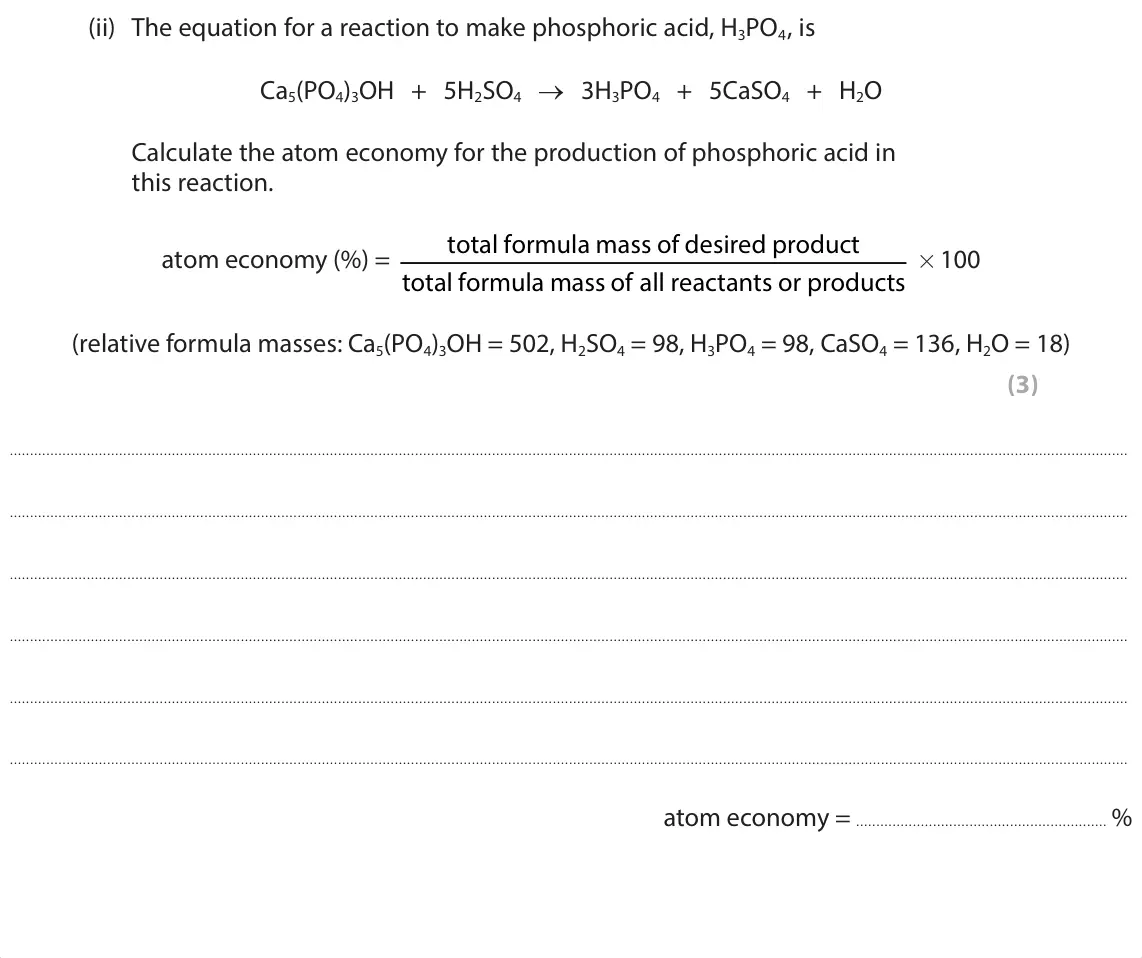
Q10(c)(iii)
The whole paper ↗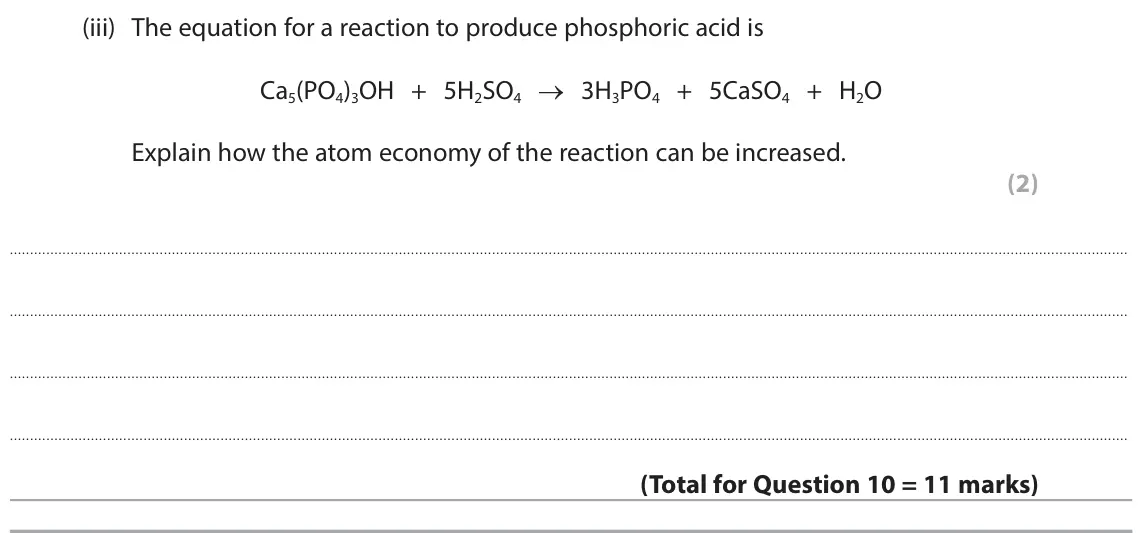
Q4(a)(i)
The whole paper ↗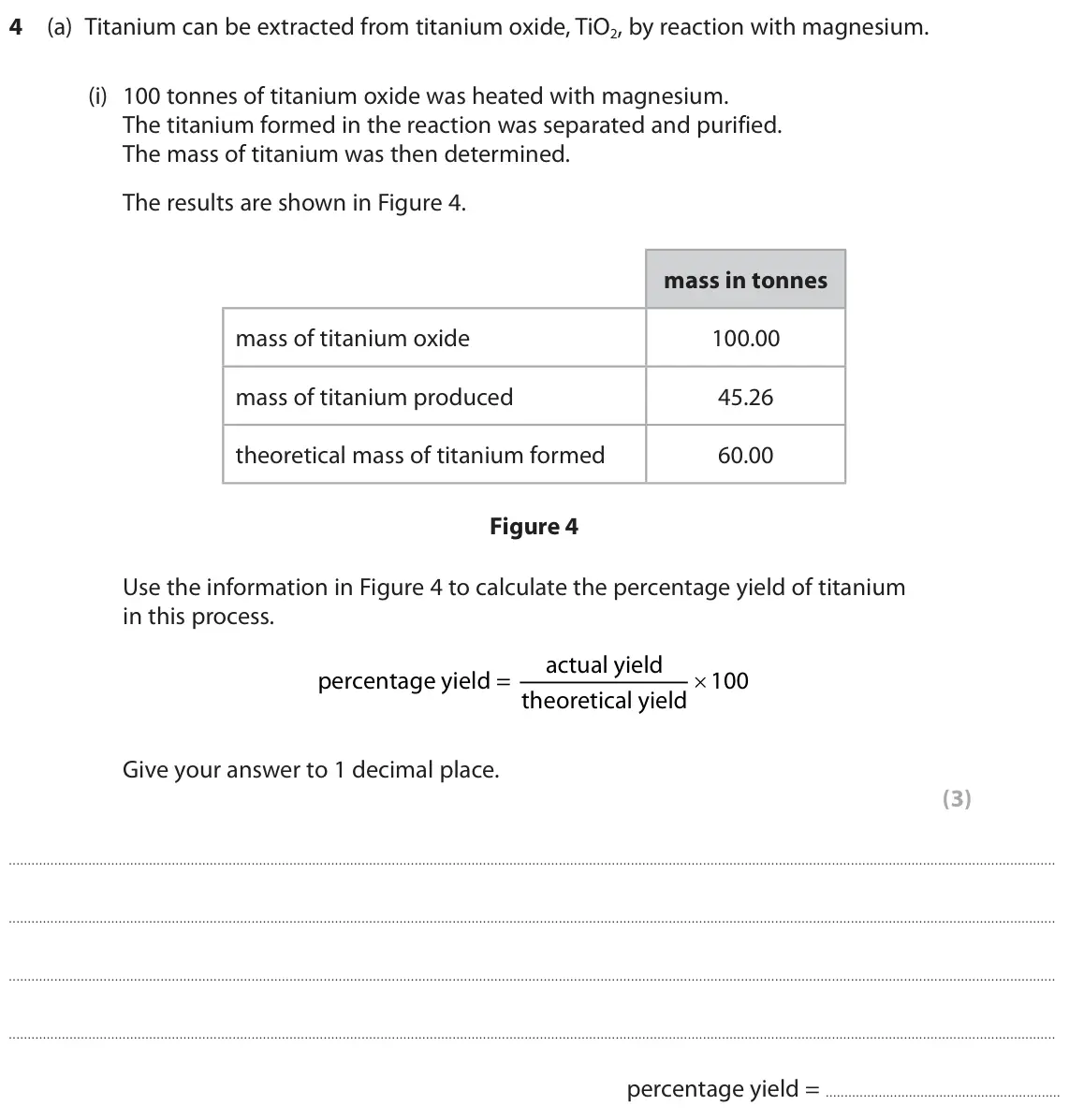
Q4(a)(ii)
The whole paper ↗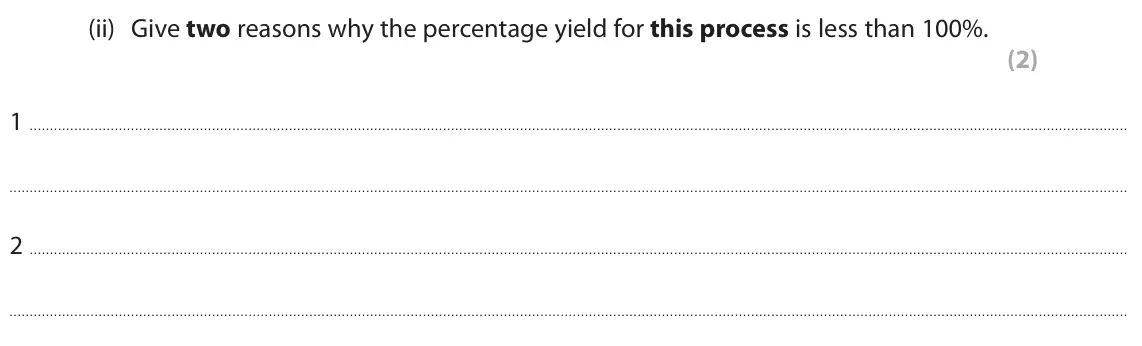
Q4(a)(iii)
The whole paper ↗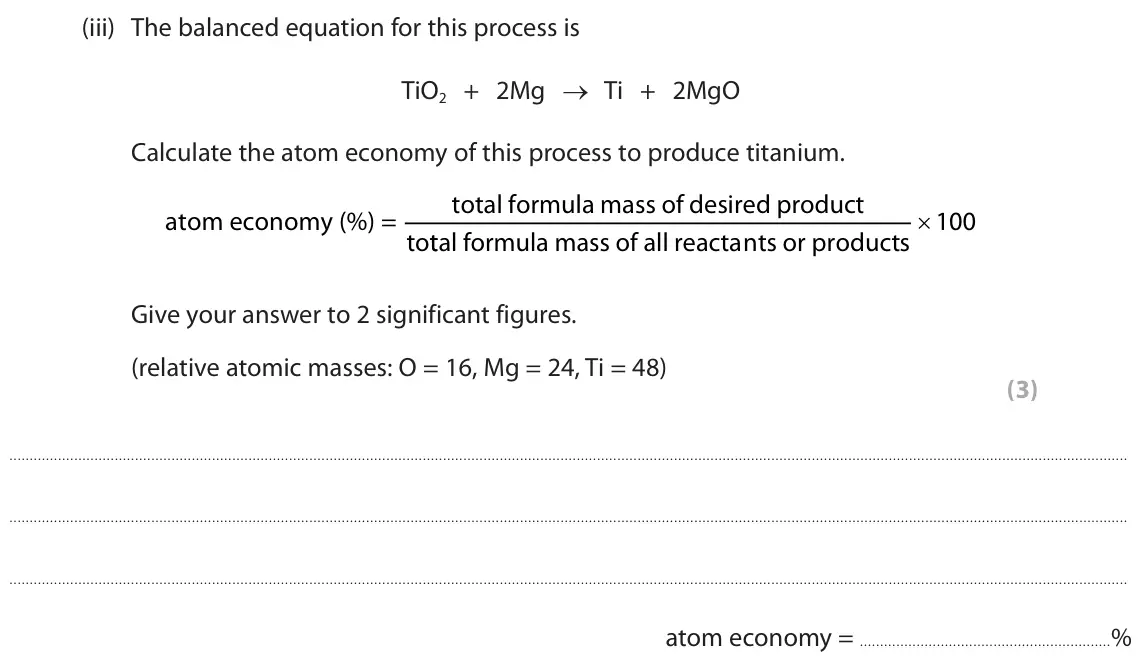
Q4(b)(i)
The whole paper ↗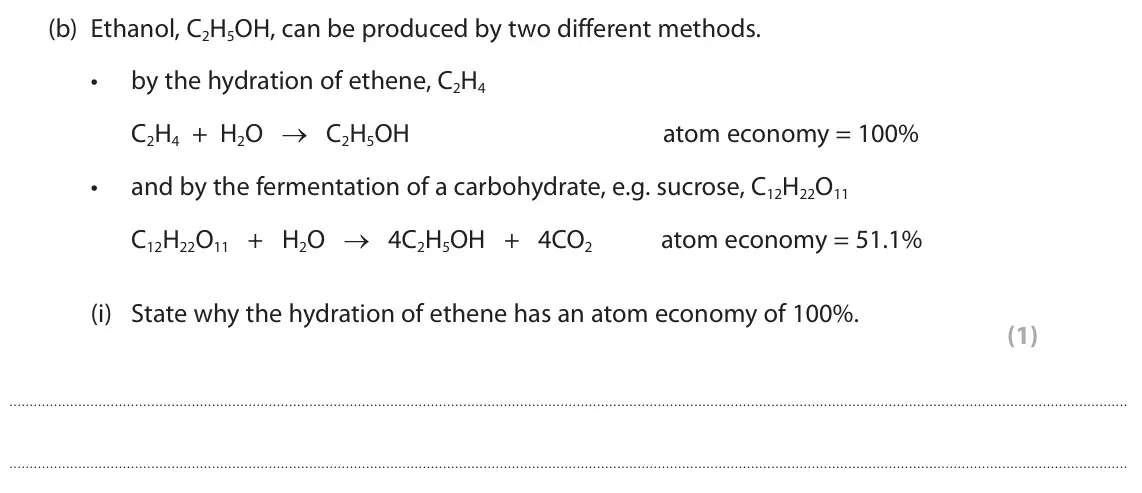
Q4(b)(ii)
The whole paper ↗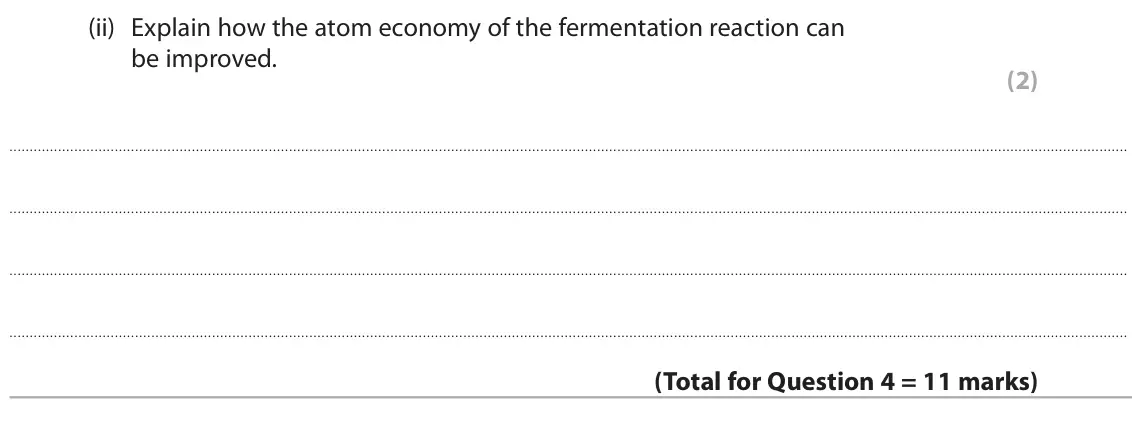
Q10(a)(i)
The whole paper ↗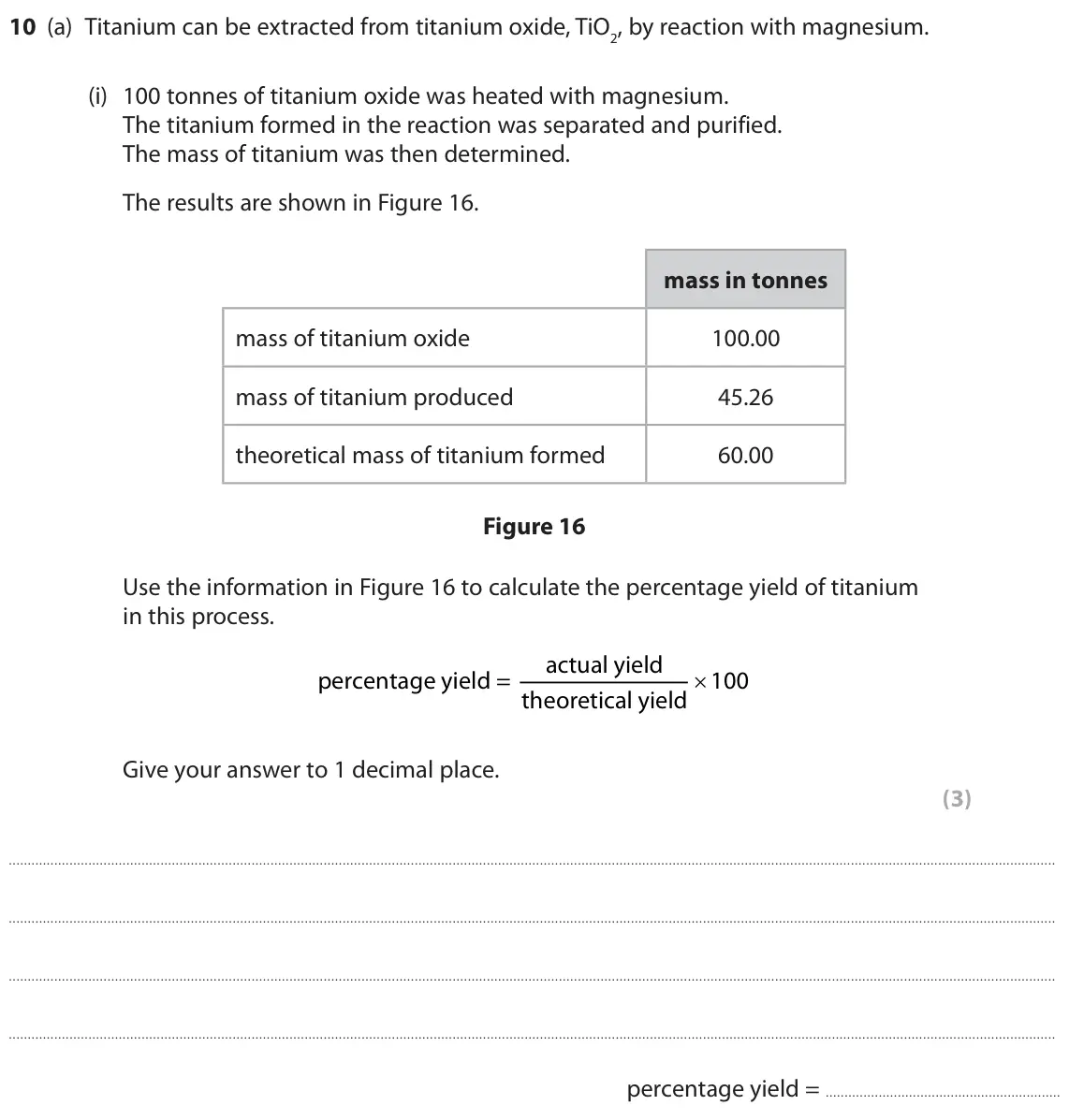
Q10(a)(ii)
The whole paper ↗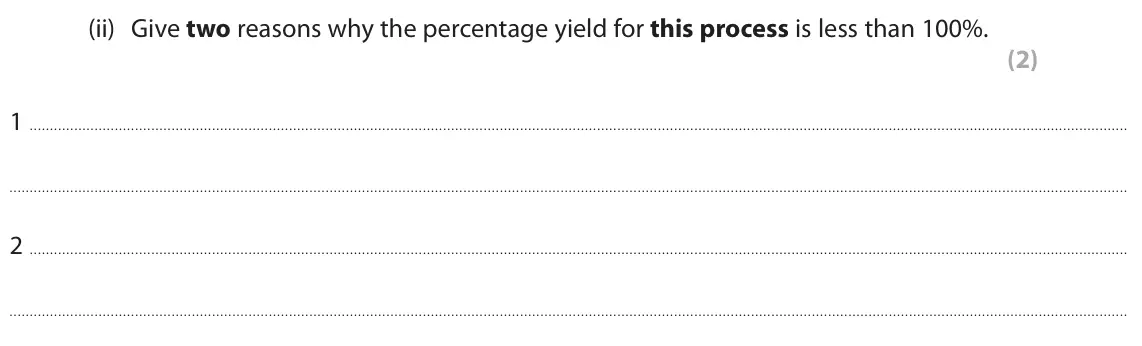
Q10(a)(iii)
The whole paper ↗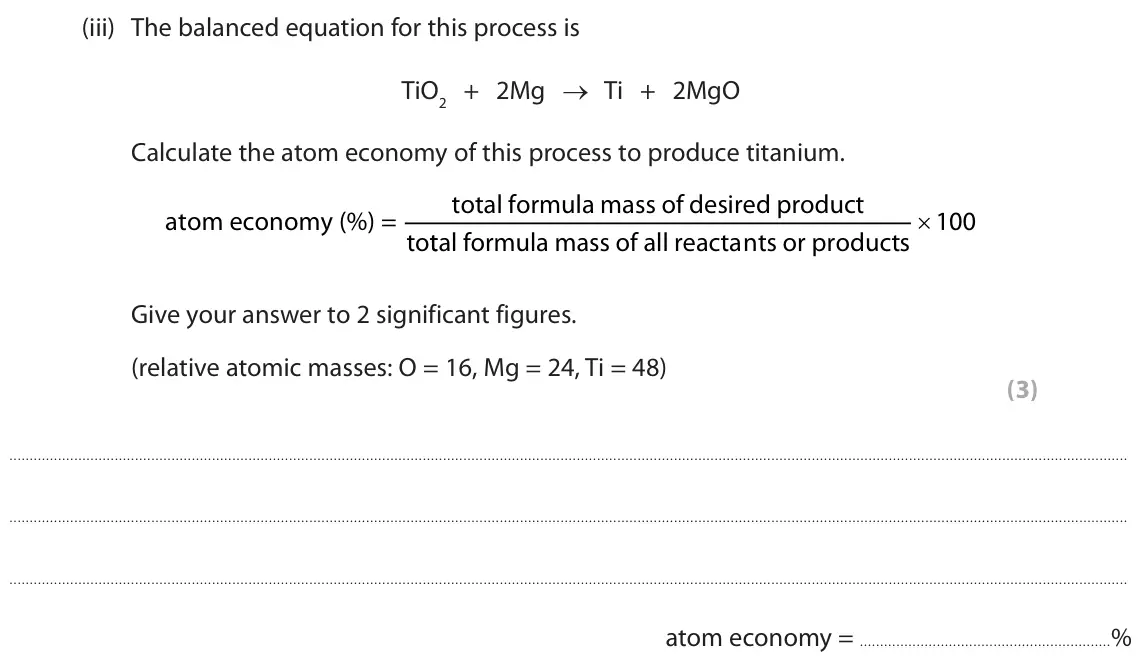
Q10(b)(i)
The whole paper ↗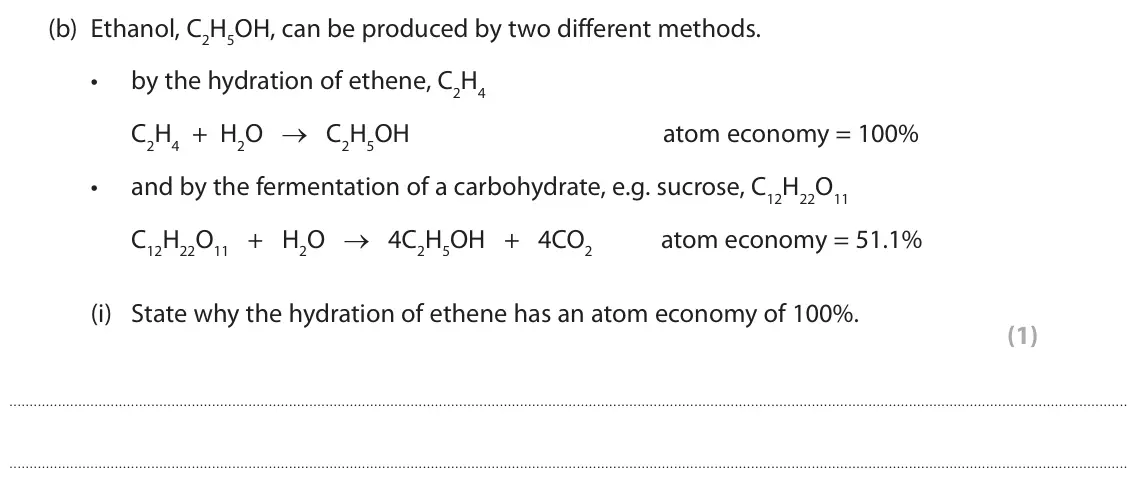
Q10(b)(ii)
The whole paper ↗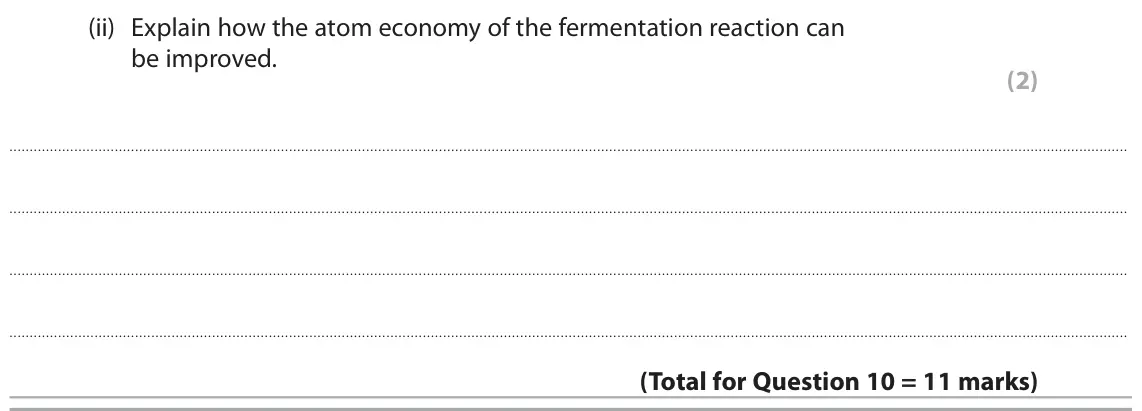
Q4(a)
The whole paper ↗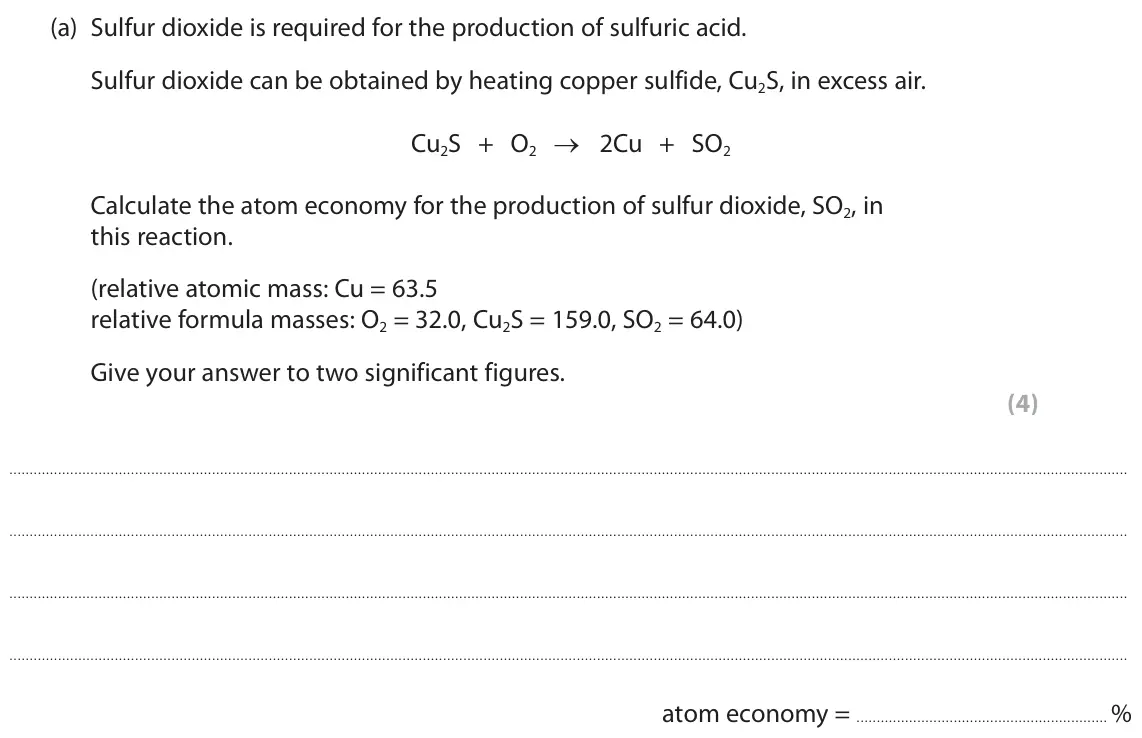
Q4(c)(ii)
The whole paper ↗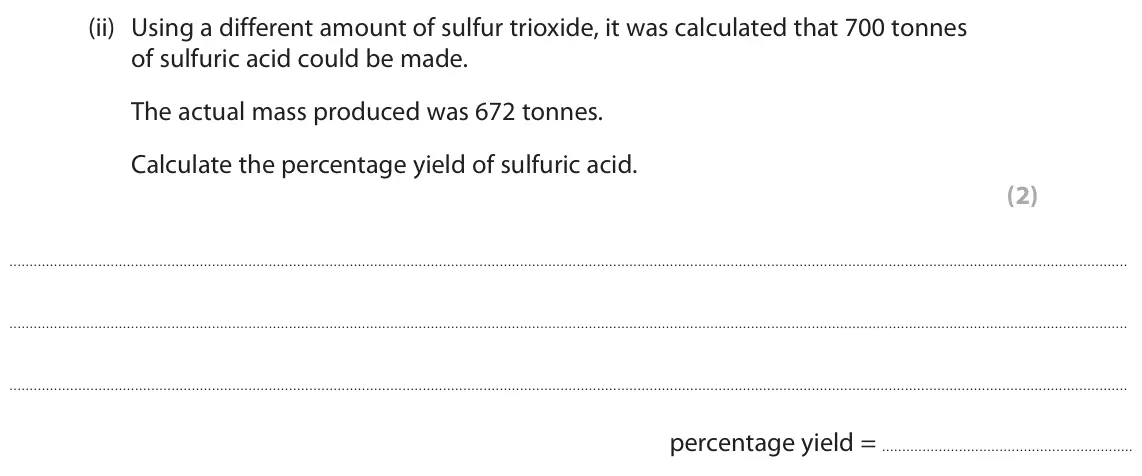
Q4(c)(iii)
The whole paper ↗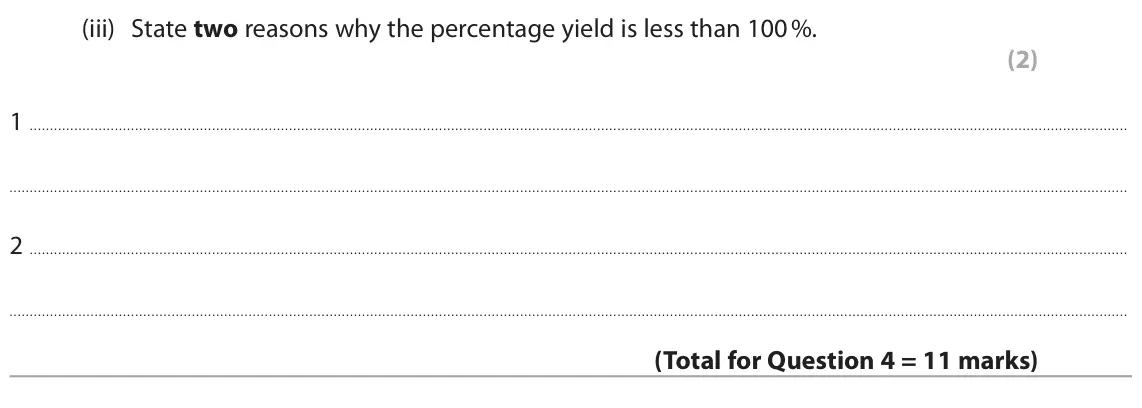
Q10(a)
The whole paper ↗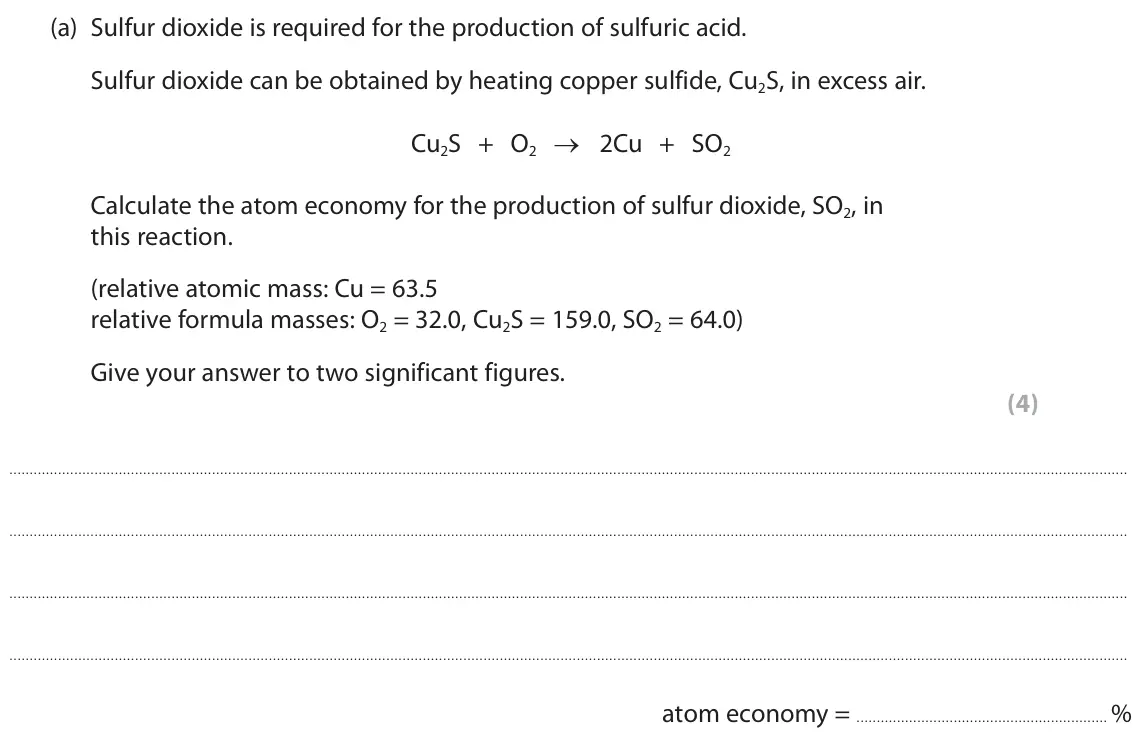
All 56 questions on Yield and atom economy, as a list
- June 2025, Paper 1 Higher, Q4(c)(i) (2 marks): The actual yield for the experiment was 18.62 g. The theoretical yield for the experiment is 24.50 g. actual yield percentage yield = theoretical yield × 100 Ca
- June 2025, Paper 1 Higher, Q4(c)(ii) (3 marks): The equation for a reaction to make phosphoric acid, H3PO4, is Ca5(PO4)3OH + 5H2SO4 → 3H3PO4 + 5CaSO4 + H2O Calculate the atom economy for the production of pho
- June 2025, Paper 1 Higher, Q4(c)(iii) (2 marks): The equation for a reaction to produce phosphoric acid is Ca5(PO4)3OH + 5H2SO4 → 3H3PO4 + 5CaSO4 + H2O Explain how the atom economy of the reaction can be incre
- June 2025, Paper 1 Foundation, Q10(c)(i) (2 marks): The actual yield for the experiment was 18.62 g. The theoretical yield for the experiment is 24.50 g. actual yield percentage yield = theoretical yield × 100 Ca
- June 2025, Paper 1 Foundation, Q10(c)(ii) (3 marks): The equation for a reaction to make phosphoric acid, H3PO4, is Ca5(PO4)3OH + 5H2SO4 → 3H3PO4 + 5CaSO4 + H2O Calculate the atom economy for the production of pho
- June 2025, Paper 1 Foundation, Q10(c)(iii) (2 marks): The equation for a reaction to produce phosphoric acid is Ca5(PO4)3OH + 5H2SO4 → 3H3PO4 + 5CaSO4 + H2O Explain how the atom economy of the reaction can be incre
- June 2024, Paper 1 Higher, Q4(a)(i) (3 marks): 100 tonnes of titanium oxide was heated with magnesium. The titanium formed in the reaction was separated and purified. The mass of titanium was then determined
- June 2024, Paper 1 Higher, Q4(a)(ii) (2 marks): Give two reasons why the percentage yield for this process is less than 100%. (2) 1 2
- June 2024, Paper 1 Higher, Q4(a)(iii) (3 marks): The balanced equation for this process is TiO2 + 2Mg → Ti + 2MgO Calculate the atom economy of this process to produce titanium. total formula mass of desired p
- June 2024, Paper 1 Higher, Q4(b)(i) (1 mark): State why the hydration of ethene has an atom economy of 100%. (1)
- June 2024, Paper 1 Higher, Q4(b)(ii) (2 marks): Explain how the atom economy of the fermentation reaction can be improved. (2)
- June 2024, Paper 1 Foundation, Q10(a)(i) (3 marks): 100 tonnes of titanium oxide was heated with magnesium. The titanium formed in the reaction was separated and purified. The mass of titanium was then determined
- June 2024, Paper 1 Foundation, Q10(a)(ii) (2 marks): Give two reasons why the percentage yield for this process is less than 100%. (2) 1 2
- June 2024, Paper 1 Foundation, Q10(a)(iii) (3 marks): The balanced equation for this process is TiO2 + 2Mg → Ti + 2MgO Calculate the atom economy of this process to produce titanium. total formula mass of desired p
- June 2024, Paper 1 Foundation, Q10(b)(i) (1 mark): State why the hydration of ethene has an atom economy of 100%. (1)
- June 2024, Paper 1 Foundation, Q10(b)(ii) (2 marks): Explain how the atom economy of the fermentation reaction can be improved. (2)
- June 2023, Paper 1 Higher, Q4(a) (4 marks): Sulfur dioxide is required for the production of sulfuric acid. Sulfur dioxide can be obtained by heating copper sulfide, Cu2S, in excess air. Cu2S + O2 → 2Cu +
- June 2023, Paper 1 Higher, Q4(c)(ii) (2 marks): Using a different amount of sulfur trioxide, it was calculated that 700 tonnes of sulfuric acid could be made. The actual mass produced was 672 tonnes. Calculat
- June 2023, Paper 1 Higher, Q4(c)(iii) (2 marks): State two reasons why the percentage yield is less than 100 %. (2) 1 2
- June 2023, Paper 1 Foundation, Q10(a) (4 marks): Sulfur dioxide is required for the production of sulfuric acid. Sulfur dioxide can be obtained by heating copper sulfide, Cu2S, in excess air. Cu2S + O2 → 2Cu +
- June 2023, Paper 1 Foundation, Q10(c)(ii) (2 marks): Using a different amount of sulfur trioxide, it was calculated that 700 tonnes of sulfuric acid could be made. The actual mass produced was 672 tonnes. Calculat
- June 2023, Paper 1 Foundation, Q10(c)(iii) (2 marks): State two reasons why the percentage yield is less than 100 %. (2) 1 2
- June 2022, Paper 1 Higher, Q4(a)(i) (2 marks): State the meanings of the terms actual yield and theoretical yield. (2) actual yield theoretical yield
- June 2022, Paper 1 Higher, Q4(a)(ii) (2 marks): Use the information in Figure 3 to calculate the percentage yield of ethanol in this experiment. (2) percentage yield =
- June 2022, Paper 1 Higher, Q4(a)(iii) (2 marks): State two reasons why the actual yield of a reaction is usually less than the theoretical yield. (2) 1 2
- June 2022, Paper 1 Higher, Q4(b)(i) (3 marks): Calculate the atom economy of this reaction to produce ethanol. Give your answer to two significant figures. (relative formula masses: C12H22O11 = 342, H2O = 18
- June 2022, Paper 1 Higher, Q4(b)(ii) (2 marks): Explain the effect on the atom economy of this reaction if the carbon dioxide produced was used to make fizzy drinks. (2)
- June 2022, Paper 1 Foundation, Q10(a)(i) (2 marks): State the meanings of the terms actual yield and theoretical yield. (2) actual yield theoretical yield
- June 2022, Paper 1 Foundation, Q10(a)(ii) (2 marks): Use the information in Figure 16 to calculate the percentage yield of ethanol in this experiment. (2) percentage yield =
- June 2022, Paper 1 Foundation, Q10(a)(iii) (2 marks): State two reasons why the actual yield of a reaction is usually less than the theoretical yield. (2) 1 2
- June 2022, Paper 1 Foundation, Q10(b)(i) (3 marks): Calculate the atom economy of this reaction to produce ethanol. Give your answer to two significant figures. (relative formula masses: C12H22O11 = 342, H2O = 18
- June 2022, Paper 1 Foundation, Q10(b)(ii) (2 marks): Explain the effect on the atom economy of this reaction if the carbon dioxide produced was used to make fizzy drinks. (2)
- November 2021, Paper 1 Higher, Q1(b) (2 marks): The theoretical maximum yield of zinc oxide was 1.86 g. The actual yield was 1.63 g. Calculate the percentage yield of zinc oxide. (2) percentage yield =
- November 2020, Paper 1 Higher, Q4(b)(ii) (2 marks): After evaporation, the mass of the potassium chloride was determined. The theoretical yield of the experiment was 0.70 g. The actual yield was 0.84 g. This gave
- November 2020, Paper 1 Higher, Q4(b)(iii) (1 mark): Suggest a reason why the actual yield was greater than the theoretical yield. (1)
- November 2020, Paper 1 Higher, Q4(b)(iv) (4 marks): The equation for the reaction between potassium hydroxide solution and dilute hydrochloric acid is KOH + HCl → KCl + H2O Calculate the atom economy for the prod
- November 2020, Paper 1 Foundation, Q10(b)(ii) (2 marks): After evaporation, the mass of the potassium chloride was determined. The theoretical yield of the experiment was 0.70 g. The actual yield was 0.84 g. This gave
- November 2020, Paper 1 Foundation, Q10(b)(iii) (1 mark): Suggest a reason why the actual yield was greater than the theoretical yield. (1)
- November 2020, Paper 1 Foundation, Q10(b)(iv) (4 marks): The equation for the reaction between potassium hydroxide solution and dilute hydrochloric acid is KOH + HCl → KCl + H2O Calculate the atom economy for the prod
- November 2020, Paper 2 Higher, Q4(d) (3 marks): An industrial process uses 500 tonnes of dichloroethene. In the process only 96.5% of the dichloroethene molecules react. Calculate the mass of dichloroethene t
- June 2019, Paper 1 Higher, Q4(b)(i) (2 marks): The theoretical yield of calcium oxide in this experiment is 5.600 g. Calculate the percentage yield of calcium oxide. (2) percentage yield =
- June 2019, Paper 1 Higher, Q4(b)(ii) (1 mark): The mass of solid left in the crucible is less than the theoretical mass of calcium oxide that should be obtained. A possible reason for this is that (1) A some
- June 2019, Paper 1 Higher, Q4(d)(ii) (2 marks): Calculate the atom economy for the formation of calcium oxide in this reaction. CaCO3 o CaO + CO2 You must show your working. (relative atomic masses: C = 12, O
- June 2019, Paper 1 Foundation, Q10(b)(i) (2 marks): The theoretical yield of calcium oxide in this experiment is 5.600 g. Calculate the percentage yield of calcium oxide. (2) percentage yield =
- June 2019, Paper 1 Foundation, Q10(b)(ii) (1 mark): The mass of solid left in the crucible is less than the theoretical mass of calcium oxide that should be obtained. A possible reason for this is that (1) some s
- June 2019, Paper 1 Foundation, Q10(d)(ii) (2 marks): Calculate the atom economy for the formation of calcium oxide in this reaction. CaCO3 → CaO + COz You must show your working. (relative atomic masses: C = 12, O
- June 2018, Paper 1 Higher, Q4(a)(ii) (1 mark): The atom economy for the reaction in (i) is 100%. State how the equation shows that the atom economy is 100%. (1)
- June 2018, Paper 1 Higher, Q4(b) (4 marks): Lead can be obtained by heating its oxide with carbon. The balanced equation for the reaction is 2PbO + C o 2Pb + CO2 Calculate the atom economy for the product
- June 2018, Paper 1 Higher, Q4(c)(i) (2 marks): In an experiment to produce lead, 7.67 g of lead are obtained. The theoretical yield of lead for the experiment is 11.80 g. Calculate the percentage yield of le
- June 2018, Paper 1 Higher, Q4(c)(ii) (2 marks): In most reactions, the percentage yield of any product is less than 100%. Give two reasons why the percentage yield is less than 100%. (2) reason 1 reason 2
- June 2018, Paper 1 Foundation, Q10(a)(ii) (1 mark): The atom economy for the reaction in (i) is 100%. State how the equation shows that the atom economy is 100%. (1)
- June 2018, Paper 1 Foundation, Q10(b) (4 marks): Lead can be obtained by heating its oxide with carbon. The balanced equation for the reaction is 2PbO + C o 2Pb + CO2 Calculate the atom economy for the product
- June 2018, Paper 1 Foundation, Q10(c)(i) (2 marks): In an experiment to produce lead, 7.67 g of lead are obtained. The theoretical yield of lead for the experiment is 11.80 g. Calculate the percentage yield of le
- June 2018, Paper 1 Foundation, Q10(c)(ii) (2 marks): In most reactions, the percentage yield of any product is less than 100%. Give two reasons why the percentage yield is less than 100%. (2) reason 1 reason 2
- Specimen, Paper 1 Higher, Q4(b) (3 marks): Lead nitrate solution mixed with sodium sulfate solution forms lead sulfate as a precipitate. Pb(NO3)2 + Na2SO4 → PbSO4 + 2NaNO3 The theoretical yield of lead s
- Specimen, Paper 1 Foundation, Q10(b) (3 marks): Lead nitrate solution mixed with sodium sulfate solution forms lead sulfate as a precipitate. Pb(NO3)2 + Na2SO4 → PbSO4 + 2NaNO3 In an experiment, the theoretic
Questions, mark schemes and examiner’s reports are © Pearson Edexcel, from their published past papers. Plumi isn’t affiliated with any exam board. Want whole papers? Every Edexcel GCSE Chemistry paper.
Rather write your answers by hand on iPad? Plumi marks them against the same mark schemes.