Skip to content

WJEC A‑Level Chemistry questions by topic

Every question from every WJEC A-Level Chemistry paper, 2016–2025, part by part. Filter by topic, paper or year, open the mark scheme under any question, and download a set as a PDF.

Find questions1,204
Topics Pick as many as you like. Open one to choose its sub-topics.

Year 1 · AS

Year 2 · A‑Level only

Calculations

1,204 questions

  1. Q1

    Summer 2025 · Unit 3

    1 mark
    The whole paper ↗
    Summer 2025 Unit 3, question 1: Complete the Arrhenius equation below. [1] k =
  2. Q2

    Summer 2025 · Unit 3

    1 mark
    The whole paper ↗
    Summer 2025 Unit 3, question 2: Give a reason why SiCl4 reacts vigorously with water whilst CCl4 does not. [1]
  3. Q3(a)

    Summer 2025 · Unit 3

    1 mark
    The whole paper ↗
    Summer 2025 Unit 3, question 3(a): State what is meant by the term heterogeneous in this context. [1]
  4. Q3(b)

    Summer 2025 · Unit 3

    1 mark
    The whole paper ↗
    Summer 2025 Unit 3, question 3(b): Give an example of a heterogeneous catalyst and the reaction it catalyses. [1]
  5. Q4

    Summer 2025 · Unit 3

    1 mark
    The whole paper ↗
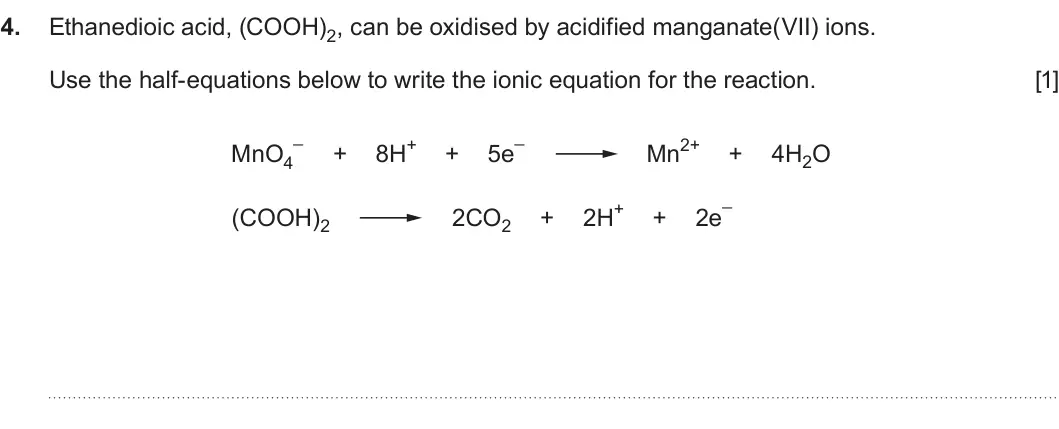
    Summer 2025 Unit 3, question 4: Ethanedioic acid, (COOH)2, can be oxidised by acidified manganate(VII) ions. Use the half-equations below to write the ionic equation for the reaction. [1] _ _
  6. Q5

    Summer 2025 · Unit 3

    2 marks
    The whole paper ↗
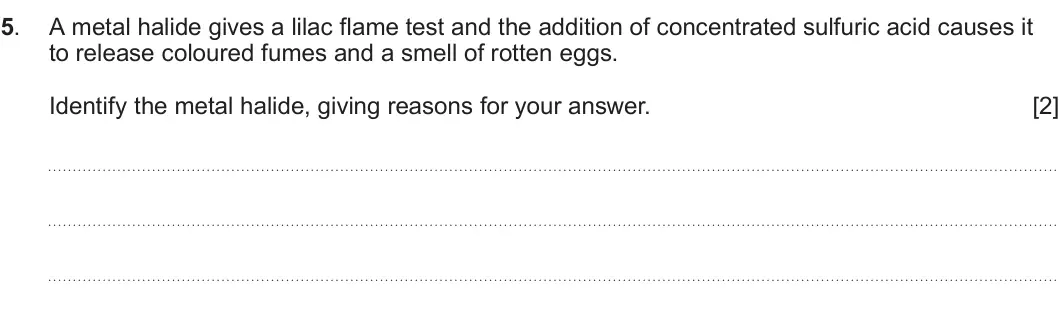
    Summer 2025 Unit 3, question 5: A metal halide gives a lilac flame test and the addition of concentrated sulfuric acid causes it to release coloured fumes and a smell of rotten eggs. Identify
  7. Q6(a)

    Summer 2025 · Unit 3

    1 mark
    The whole paper ↗
    Summer 2025 Unit 3, question 6(a): Give the observation(s) expected when aqueous sodium hydroxide is added gradually to aqueous chromium(III) chloride until the sodium hydroxide is in excess. [1]
  8. Q6(b)(i)

    Summer 2025 · Unit 3

    1 mark
    The whole paper ↗
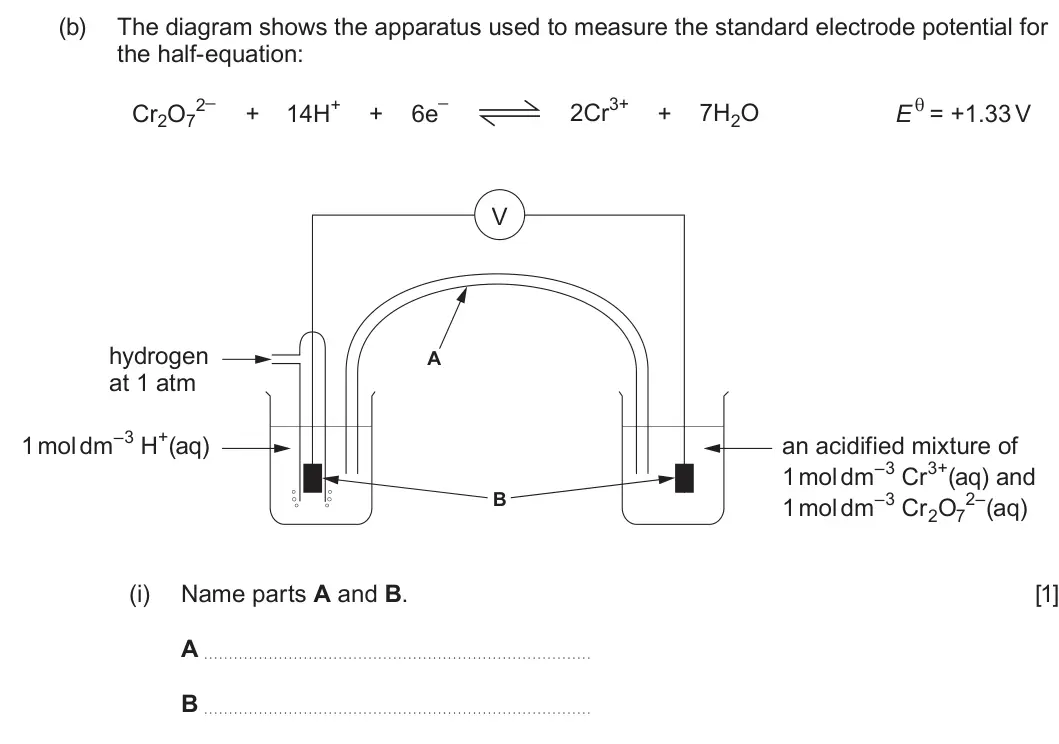
    Summer 2025 Unit 3, question 6(b)(i): Name parts A and B. [1] A B
  9. Q6(b)(ii)

    Summer 2025 · Unit 3

    1 mark
    The whole paper ↗
    Summer 2025 Unit 3, question 6(b)(ii): Label the diagram to show the direction of flow of electrons in the wire. [1]
  10. Q7(a)(i)

    Summer 2025 · Unit 3

    1 mark
    The whole paper ↗
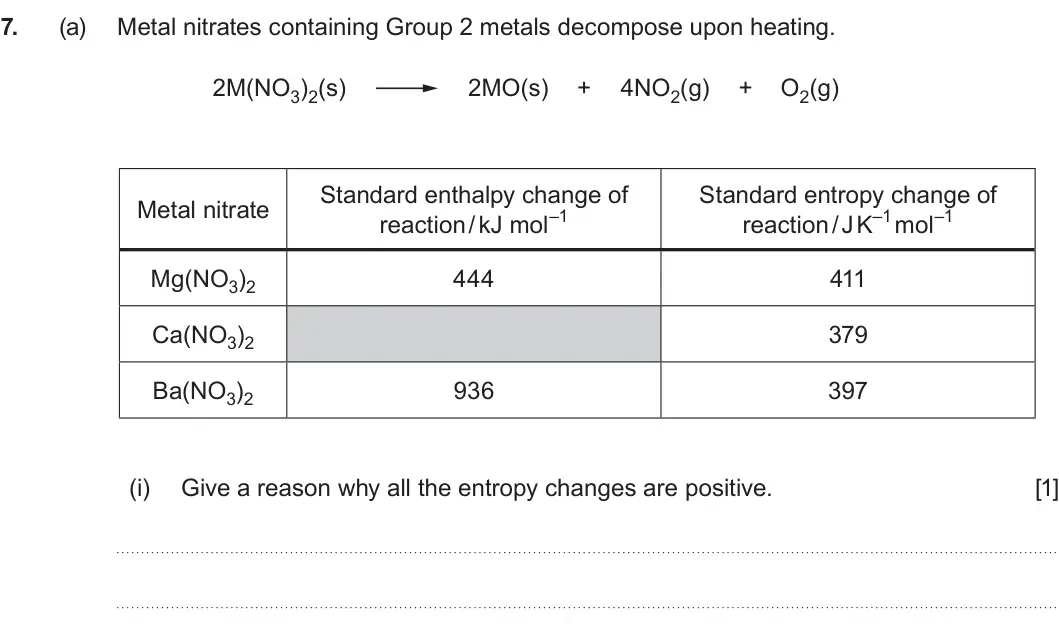
    Summer 2025 Unit 3, question 7(a)(i): Give a reason why all the entropy changes are positive. [1]
  11. Q7(a)(ii)

    Summer 2025 · Unit 3

    3 marks
    The whole paper ↗
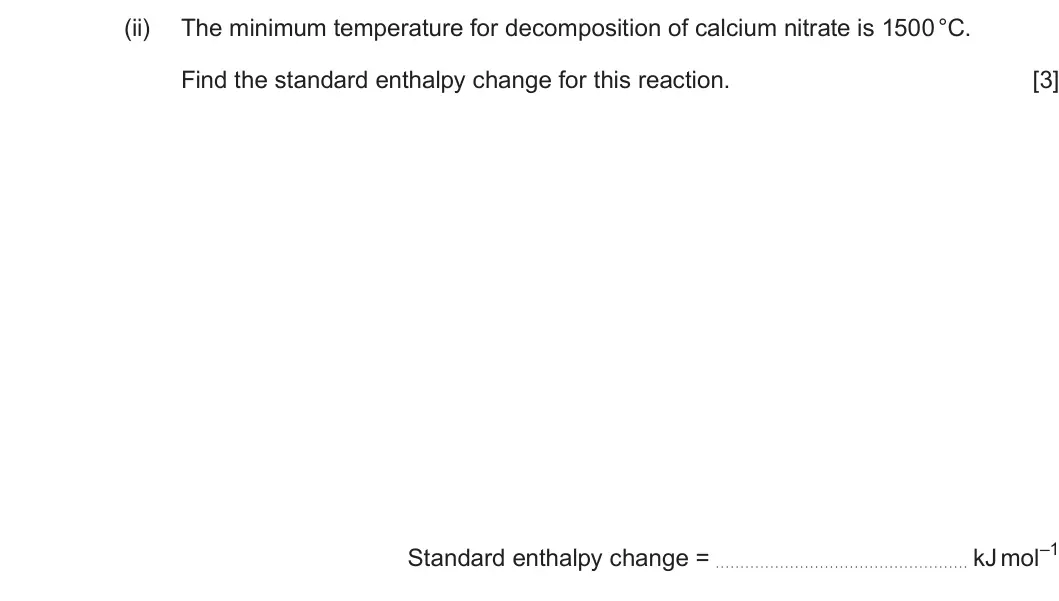
    Summer 2025 Unit 3, question 7(a)(ii): The minimum temperature for decomposition of calcium nitrate is 1500 °C. Find the standard enthalpy change for this reaction. [3] kJ mol–1 Standard enthalpy cha
  12. Q7(a)(iii)

    Summer 2025 · Unit 3

    4 marks
    The whole paper ↗
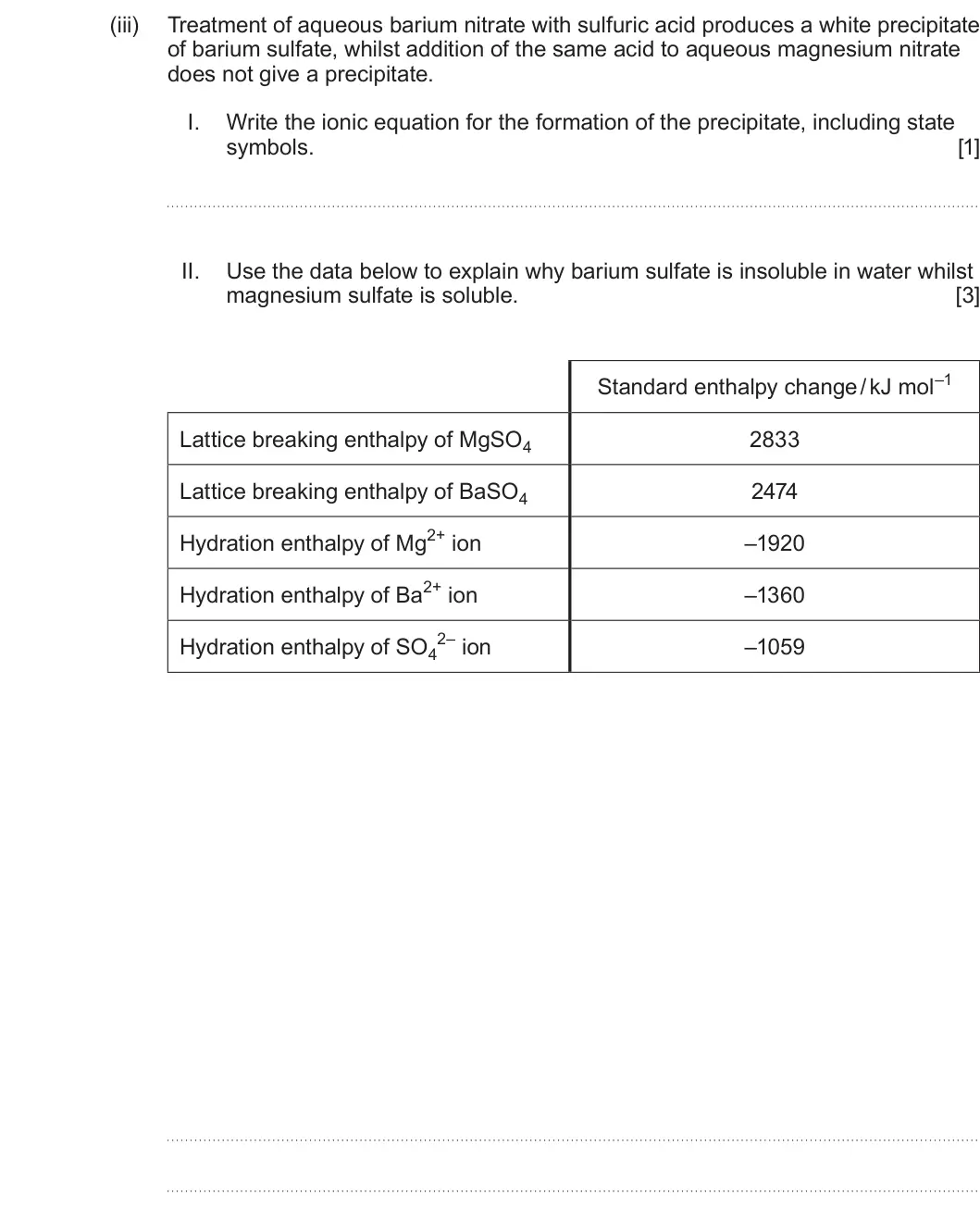
    Summer 2025 Unit 3, question 7(a)(iii): Treatment of aqueous barium nitrate with sulfuric acid produces a white precipitate of barium sulfate, whilst addition of the same acid to aqueous magnesium nit
  13. Q7(b)

    Summer 2025 · Unit 3

    2 marks
    The whole paper ↗
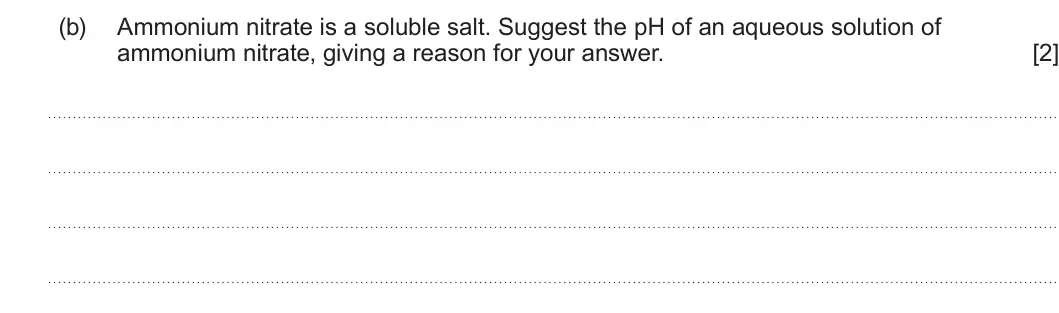
    Summer 2025 Unit 3, question 7(b): Ammonium nitrate is a soluble salt. Suggest the pH of an aqueous solution of ammonium nitrate, giving a reason for your answer. [2]
  14. Q7(c)

    Summer 2025 · Unit 3

    2 marks
    The whole paper ↗
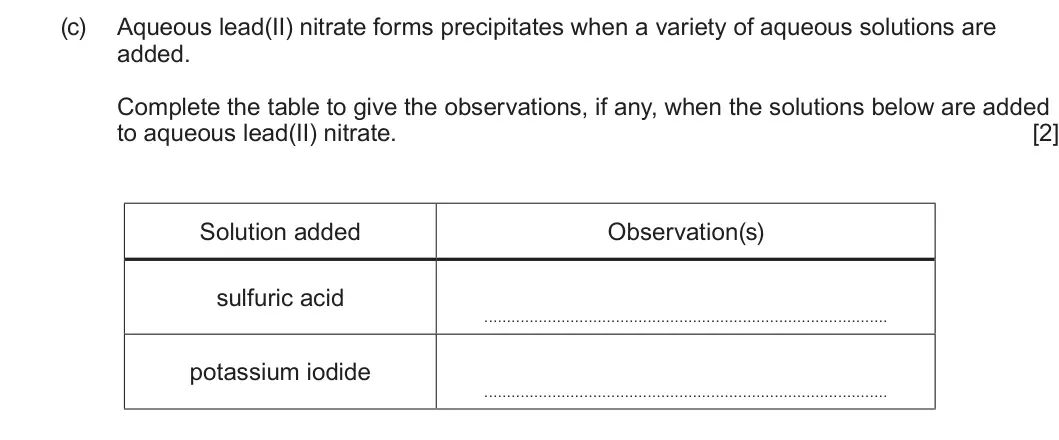
    Summer 2025 Unit 3, question 7(c): Aqueous lead(II) nitrate forms precipitates when a variety of aqueous solutions are added. Complete the table to give the observations, if any, when the solutio
  15. Q7(d)

    Summer 2025 · Unit 3

    4 marks
    The whole paper ↗
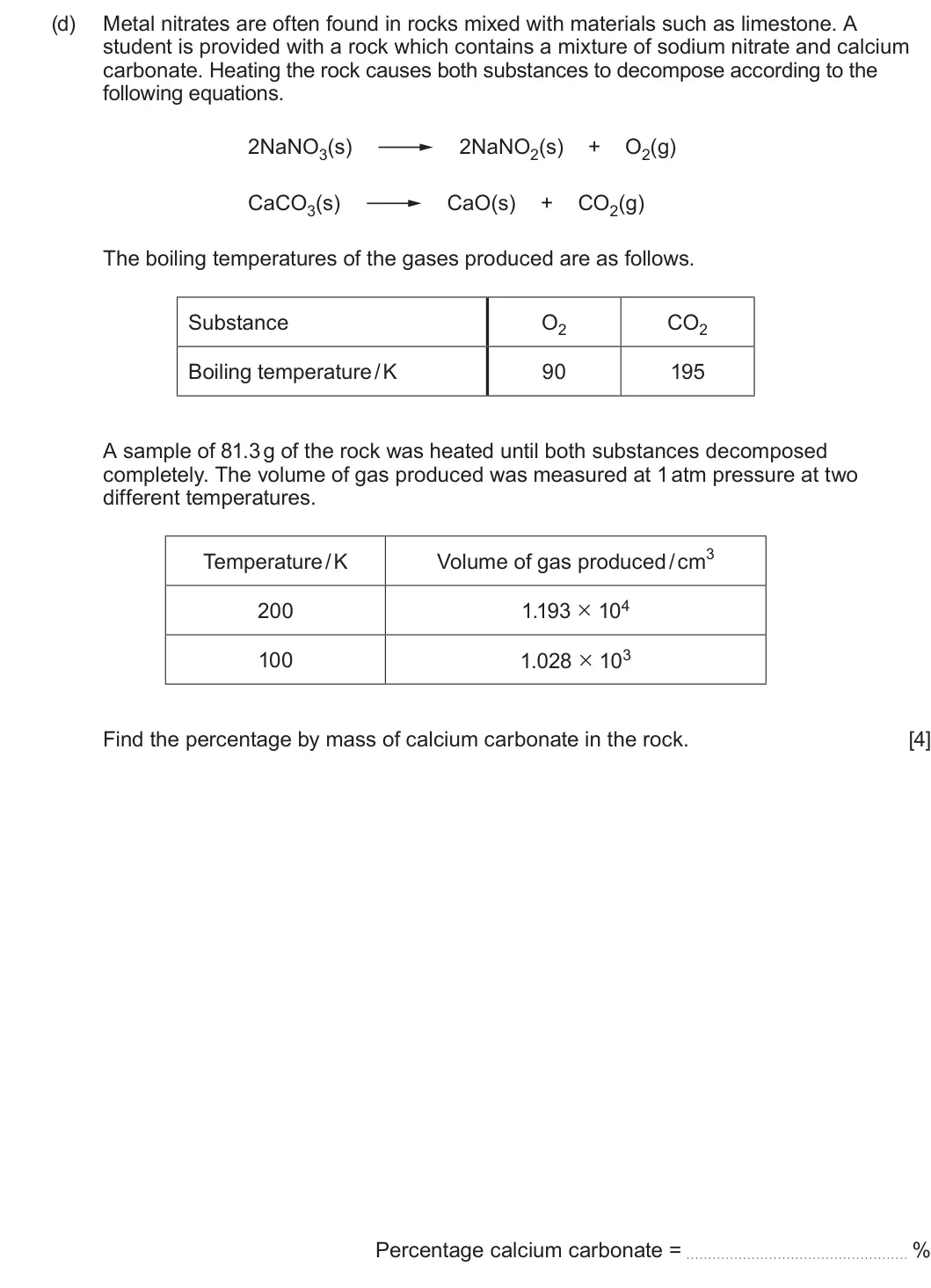
    Summer 2025 Unit 3, question 7(d): Metal nitrates are often found in rocks mixed with materials such as limestone. A student is provided with a rock which contains a mixture of sodium nitrate and
  16. Q8(a)(i)

    Summer 2025 · Unit 3

    1 mark
    The whole paper ↗
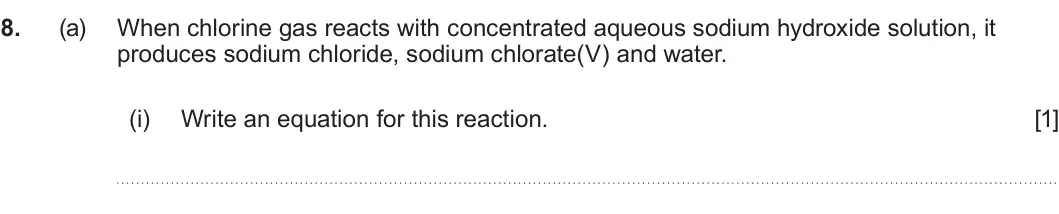
    Summer 2025 Unit 3, question 8(a)(i): Write an equation for this reaction. [1]
  17. Q8(a)(ii)

    Summer 2025 · Unit 3

    2 marks
    The whole paper ↗
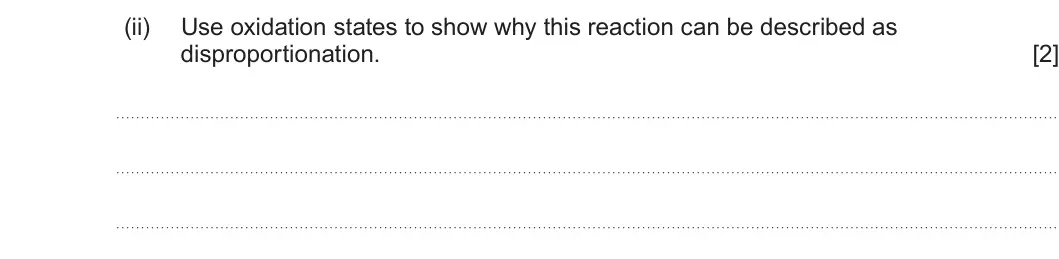
    Summer 2025 Unit 3, question 8(a)(ii): Use oxidation states to show why this reaction can be described as disproportionation. [2]
  18. Q8(b)(i)

    Summer 2025 · Unit 3

    1 mark
    The whole paper ↗
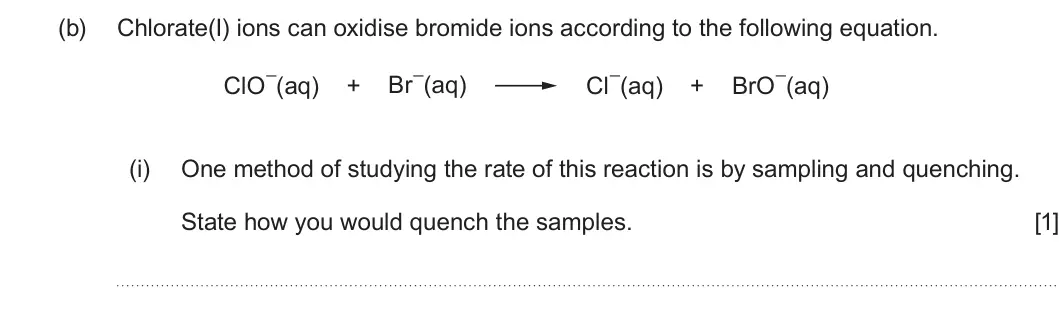
    Summer 2025 Unit 3, question 8(b)(i): One method of studying the rate of this reaction is by sampling and quenching. State how you would quench the samples. [1]
  19. Q8(b)(ii)

    Summer 2025 · Unit 3

    1 mark
    The whole paper ↗
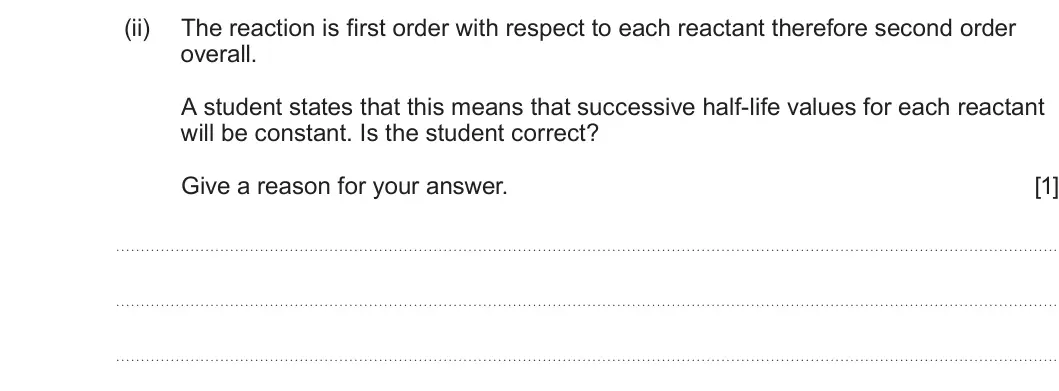
    Summer 2025 Unit 3, question 8(b)(ii): The reaction is first order with respect to each reactant therefore second order overall. A student states that this means that successive half-life values for
  20. Q8(b)(iii)

    Summer 2025 · Unit 3

    8 marks
    The whole paper ↗
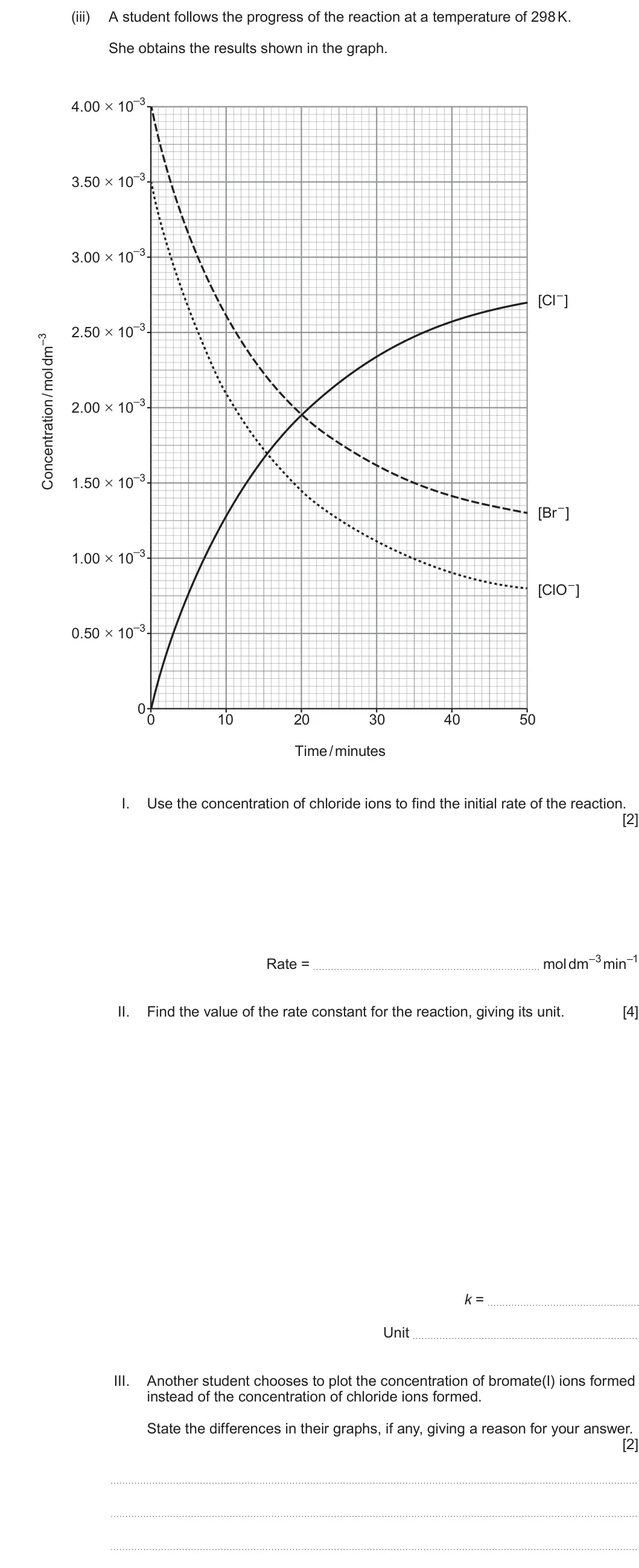
    Summer 2025 Unit 3, question 8(b)(iii): A student follows the progress of the reaction at a temperature of 298 K. She obtains the results shown in the graph. _3 4.00 × 10 _3 3.50 × 10 _3 3.00 × 10 [Cl

Questions, mark schemes and examiner’s reports are © WJEC CBAC Ltd, from their published past papers. Plumi isn’t affiliated with any exam board. Want whole papers? Every WJEC A-Level Chemistry paper.

Rather write your answers by hand on iPad? Plumi marks them against the same mark schemes.