 plumi
Basic ideas about atoms: WJEC A‑Level Chemistry questions
Every WJEC A-Level Chemistry exam question on 1.2 Basic ideas about atoms, 2016–2025, with its mark scheme and examiner’s report.
Find questions1,204
Calculations
Q9(b)(i)
The whole paper ↗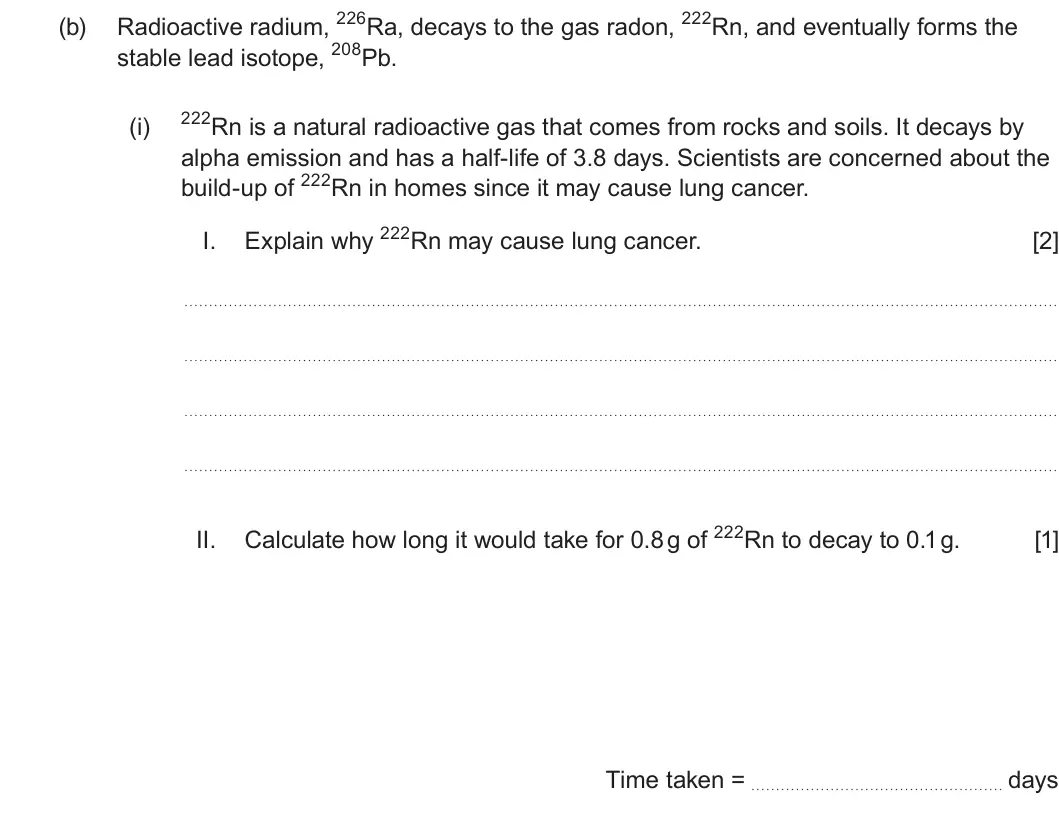
Q9(b)(ii)
The whole paper ↗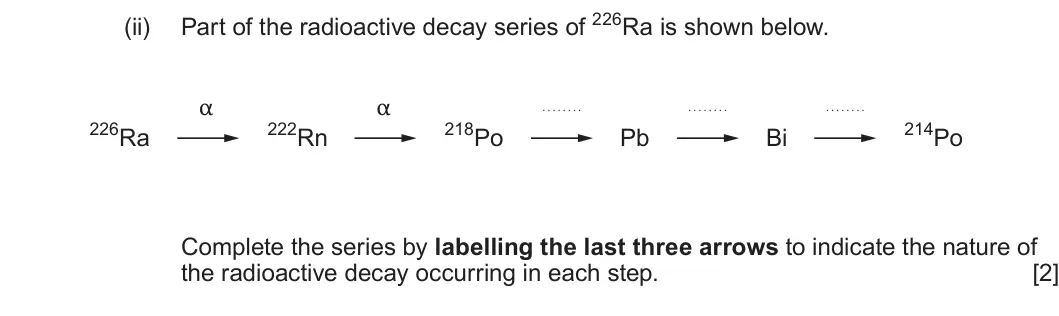
Q6(a)
The whole paper ↗
Q6(b)
The whole paper ↗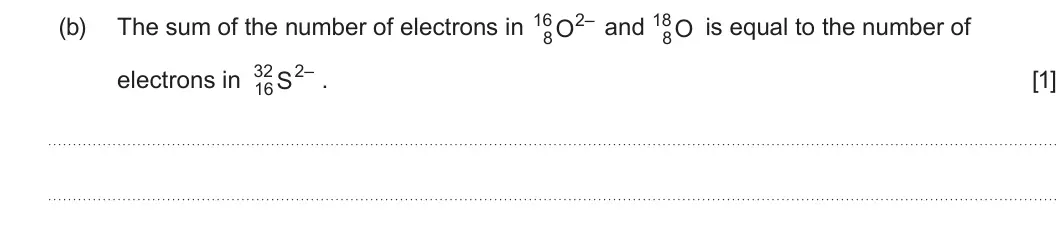
Q10(a)(i)
The whole paper ↗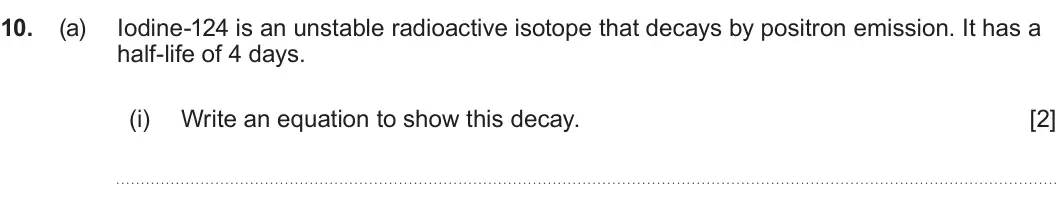
Q10(a)(ii)
The whole paper ↗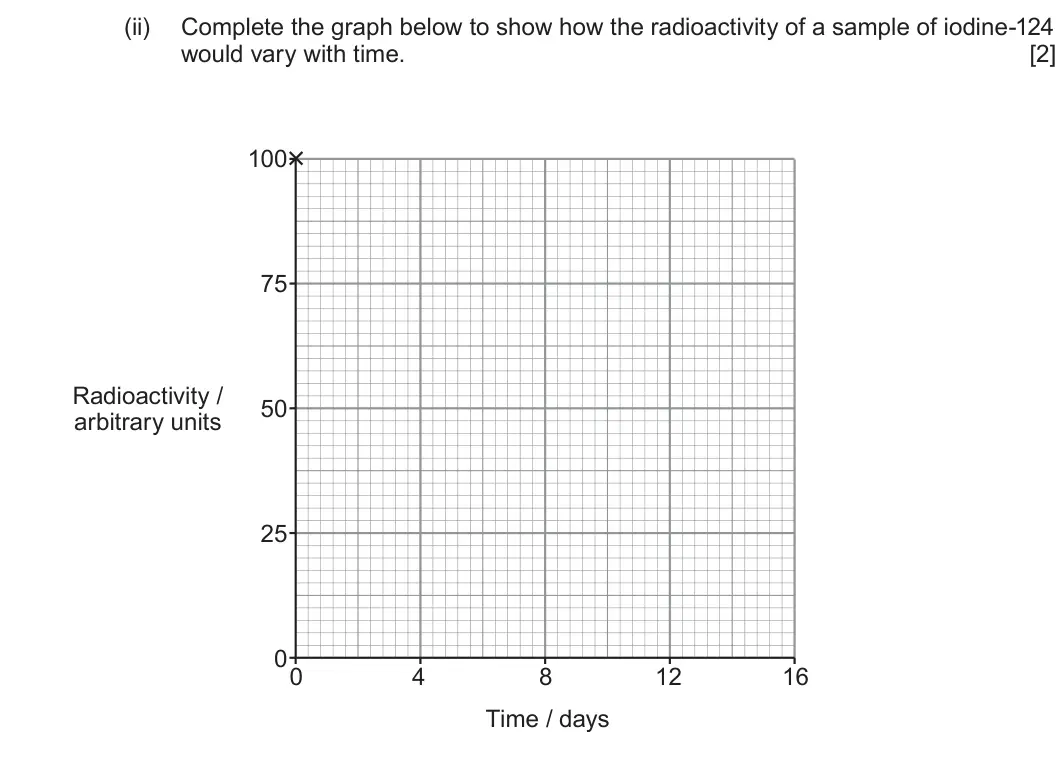
Q11(b)(ii)
The whole paper ↗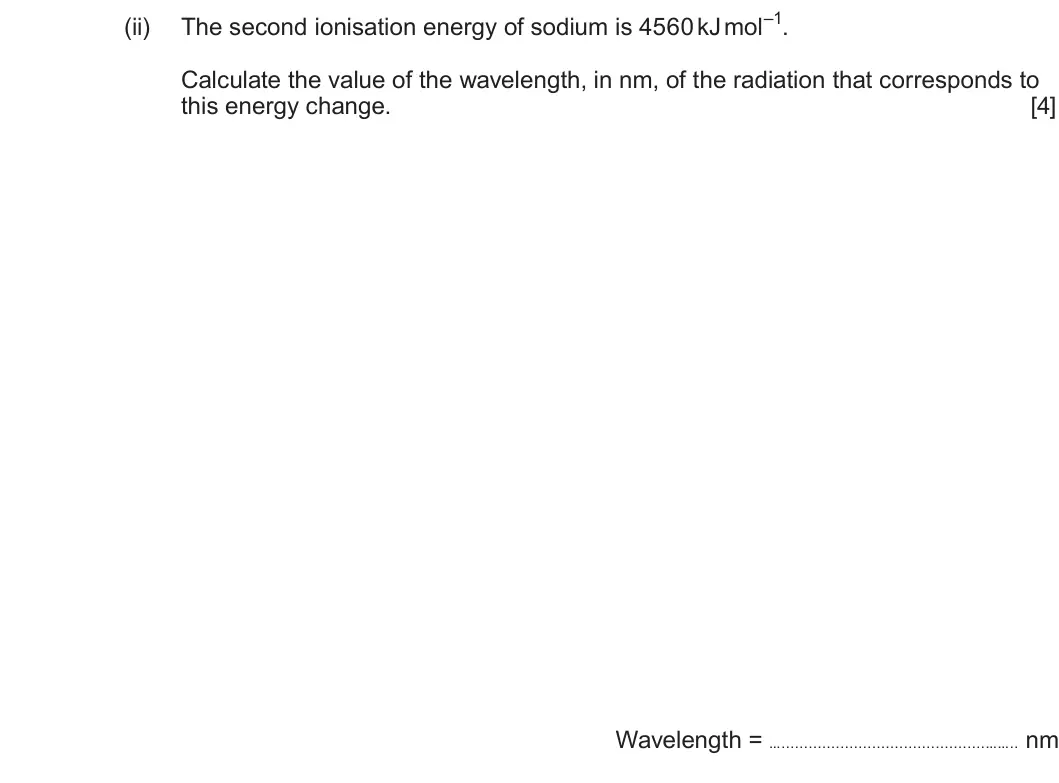
Q4(a)
The whole paper ↗
Q4(b)
The whole paper ↗
Q8(d)(i)
The whole paper ↗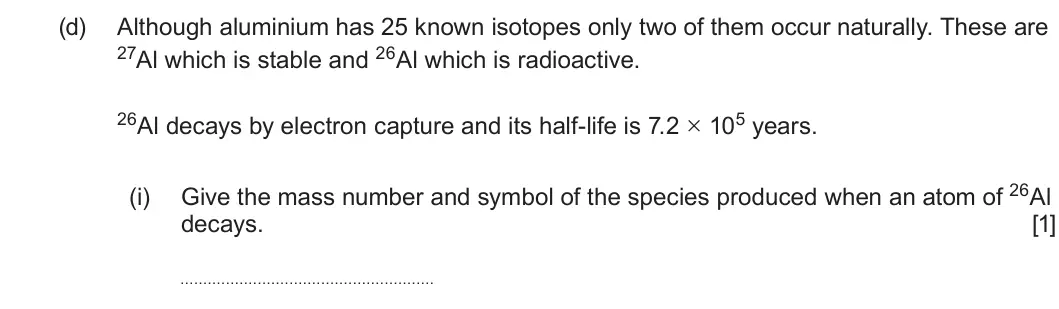
Q8(d)(ii)
The whole paper ↗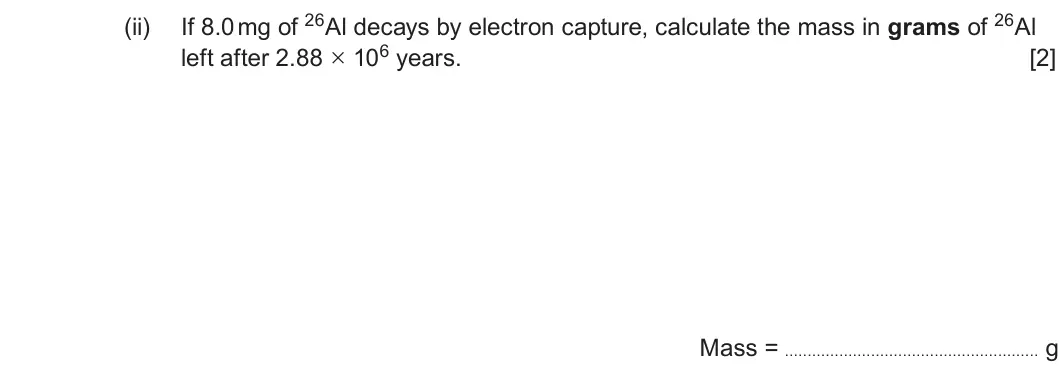
Q6(a)
The whole paper ↗
Q6(b)
The whole paper ↗
Q9(a)(i)
The whole paper ↗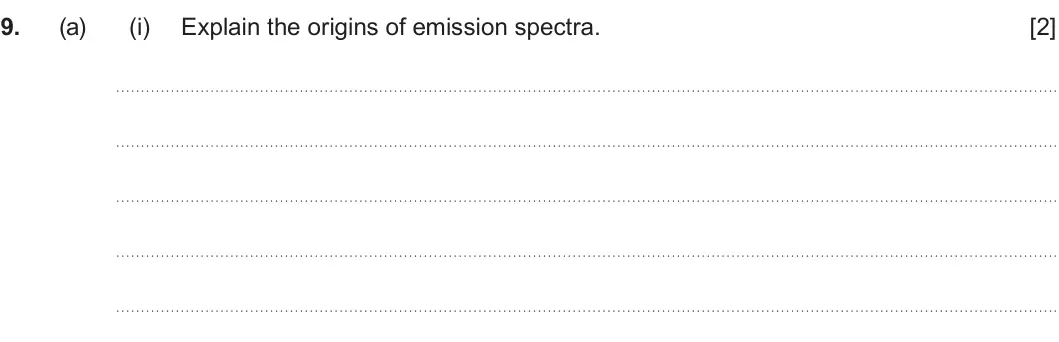
Q9(a)(ii)
The whole paper ↗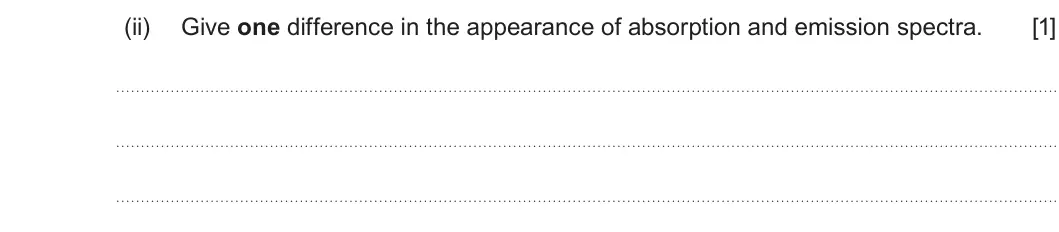
Q9(b)
The whole paper ↗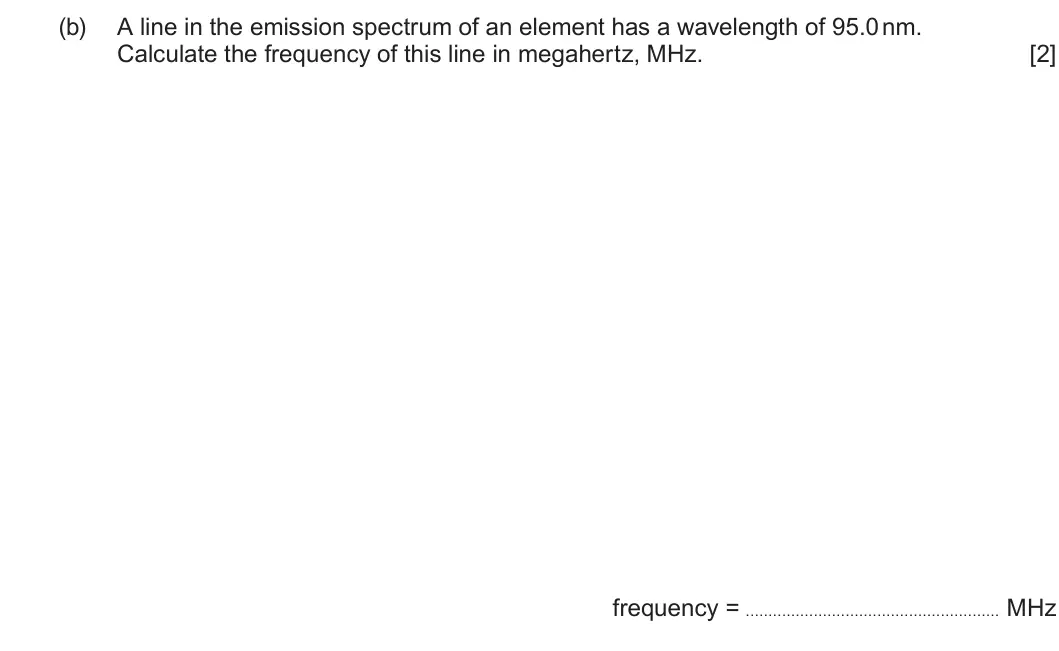
Q9(c)(i)
The whole paper ↗
Q9(c)(ii)
The whole paper ↗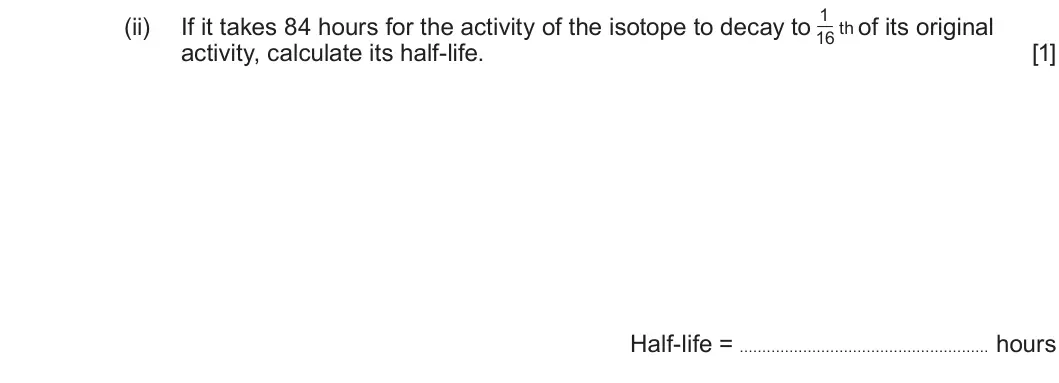
Q10(a)
The whole paper ↗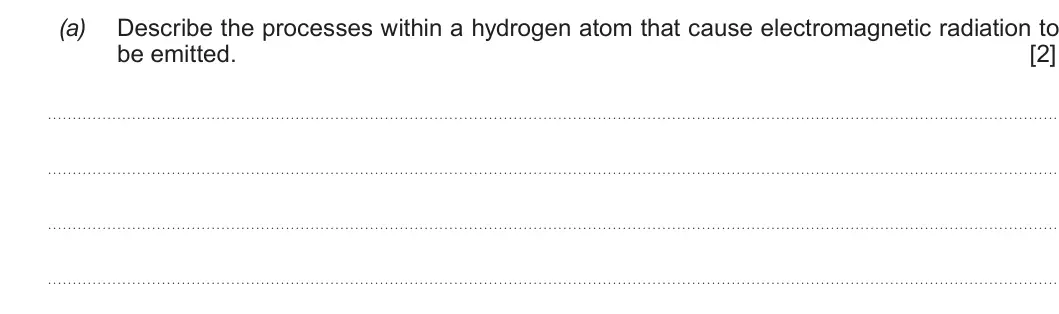
All 35 questions on Basic ideas about atoms, as a list
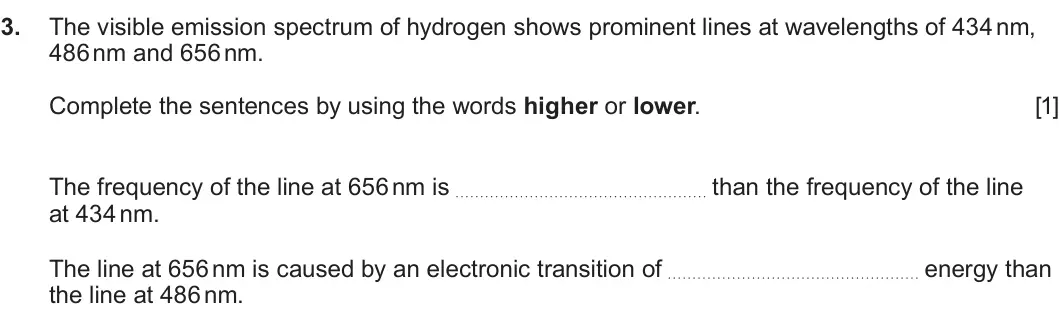
- Summer 2025, AS Unit 1, Q3 (1 mark): The visible emission spectrum of hydrogen shows prominent lines at wavelengths of 434 nm, 486 nm and 656 nm. Complete the sentences by using the words higher or
- Summer 2025, AS Unit 1, Q9(b)(i) (3 marks): alpha emission and has a half-life of 3.8 days. Scientists are concerned about the build-up of 222Rn in homes since it may cause lung cancer. Explain why 222Rn
- Summer 2025, AS Unit 1, Q9(b)(ii) (2 marks): α α 226Ra 222Rn 218Po 214Po Pb Bi Complete the series by labelling the last three arrows to indicate the nature of the radioactive decay occurring in each step.
- Summer 2024, AS Unit 1, Q6(a) (1 mark): has twice the number of neutrons that there are in . [1] S O 16 8
- Summer 2024, AS Unit 1, Q6(b) (1 mark): The sum of the number of electrons in and is equal to the number of O O 8 8 32 2– electrons in . [1] S 16
- Summer 2024, AS Unit 1, Q10(a)(i) (2 marks): Write an equation to show this decay. [2]
- Summer 2024, AS Unit 1, Q10(a)(ii) (2 marks): Complete the graph below to show how the radioactivity of a sample of iodine-124 would vary with time. [2] 100 75 Radioactivity / 50 arbitrary units 25 0 0 4 8
- Summer 2024, AS Unit 1, Q11(b)(ii) (4 marks): Calculate the value of the wavelength, in nm, of the radiation that corresponds to this energy change. [4] Wavelength = … …….. nm
- Summer 2023, AS Unit 1, Q4(a) (1 mark): On the diagram, draw an arrow to represent the transition corresponding to the ionisation of the atom. Label this arrow A. [1]
- Summer 2023, AS Unit 1, Q4(b) (1 mark): On the diagram, draw an arrow to represent the transition corresponding to the first line in the visible region in the atomic spectrum. Label this arrow B. [1]
- Summer 2023, AS Unit 1, Q8(d)(i) (1 mark): decays. [1]
- Summer 2023, AS Unit 1, Q8(d)(ii) (2 marks): left after 2.88 × 10⁶ years. [2] Mass = g
- Summer 2022, AS Unit 1, Q6(a) (1 mark): Give the mass number and symbol of the element formed as a product of the radioactive decay of uranium-235. [1]
- Summer 2022, AS Unit 1, Q6(b) (1 mark): fraction left =
- Summer 2022, AS Unit 1, Q9(a)(i) (2 marks): Explain the origins of emission spectra. [2]
- Summer 2022, AS Unit 1, Q9(a)(ii) (1 mark): Give one difference in the appearance of absorption and emission spectra. [1]
- Summer 2022, AS Unit 1, Q9(b) (2 marks): A line in the emission spectrum of an element has a wavelength of 95.0 nm. Calculate the frequency of this line in megahertz, MHz. [2] frequency = MHz
- Summer 2019, AS Unit 1, Q9(c)(i) (1 mark): Give the mass number and symbol of the element formed as a product of the radioactive decay of magnesium-28. [1]
- Summer 2019, AS Unit 1, Q9(c)(ii) (1 mark): If it takes 84 hours for the activity of the isotope to decay to of its original 16 th activity, calculate its half-life. [1] Half-life = hours
- Summer 2019, AS Unit 1, Q10(a) (2 marks): Describe the processes within a hydrogen atom that cause electromagnetic radiation to be emitted. [2]
- Summer 2019, AS Unit 1, Q10(b)(i) (1 mark): Explain why there are several series of lines. [1]
- Summer 2019, AS Unit 1, Q10(b)(ii) (1 mark): Explain why the lines within each series converge. [1]
- Summer 2019, AS Unit 1, Q10(c)(i) (1 mark): State what the limit represents. [1]
- Summer 2019, AS Unit 1, Q10(c)(ii) (4 marks): [4] Energy = kJ mol−1
- Summer 2018, AS Unit 1, Q7(d) (3 marks): Although radiation from radioisotopes is harmful to health many beneficial uses of radioactivity have been found. The table below gives some information about f
- Summer 2018, AS Unit 1, Q8(a)(i) (1 mark): Use the letter A to label the line of longest wavelength on the diagram. [1]
- Summer 2018, AS Unit 1, Q8(a)(ii) (2 marks): Explain why hydrogen atoms emit only certain definite frequencies of visible light. [2]
- Summer 2018, AS Unit 1, Q8(b)(ii) (3 marks): Calculate the minimum frequency of radiation required to ionise a hydrogen atom in its ground state. [3] Frequency = s–1
- Summer 2017, AS Unit 1, Q4(a) (1 mark): Write an equation to show this decay. [1]
- Summer 2017, AS Unit 1, Q4(b) (1 mark): of 81Kr to decay to 0.25 g. Calculate its half-life. [1] Half-life = years
- Summer 2017, AS Unit 1, Q6(a)(i) (3 marks): In the Balmer series, when an electron returns from the third shell to the second shell, a red line is seen at a wavelength of 656 nm. Calculate the energy of t
- Summer 2017, AS Unit 1, Q6(a)(ii) (2 marks): Explain how the Lyman series can be used to calculate the ionisation energy of hydrogen. [2]
- Summer 2016, AS Unit 1, Q3(a) (1 mark): Give the atomic number, mass number and symbol of the nuclide produced when 1 atom of 15O decays by the emission of one positron. [1]
- Summer 2016, AS Unit 1, Q3(b) (1 mark): 10 minutes. [1]
- Summer 2016, AS Unit 1, Q12(b) (2 marks): Hydrogen chloride is a colourless gas that absorbs at 278 nm in the ultraviolet region of the electromagnetic spectrum. Use this information and the data sheet
Questions, mark schemes and examiner’s reports are © WJEC CBAC Ltd, from their published past papers. Plumi isn’t affiliated with any exam board. Want whole papers? Every WJEC A-Level Chemistry paper.
Rather write your answers by hand on iPad? Plumi marks them against the same mark schemes.