 plumi
Redox and standard electrode potential: WJEC A‑Level Chemistry questions
Every WJEC A-Level Chemistry exam question on 3.1 Redox and standard electrode potential, 2016–2025, with its mark scheme and examiner’s report.
Find questions1,204
Calculations
Q6(b)(i)
The whole paper ↗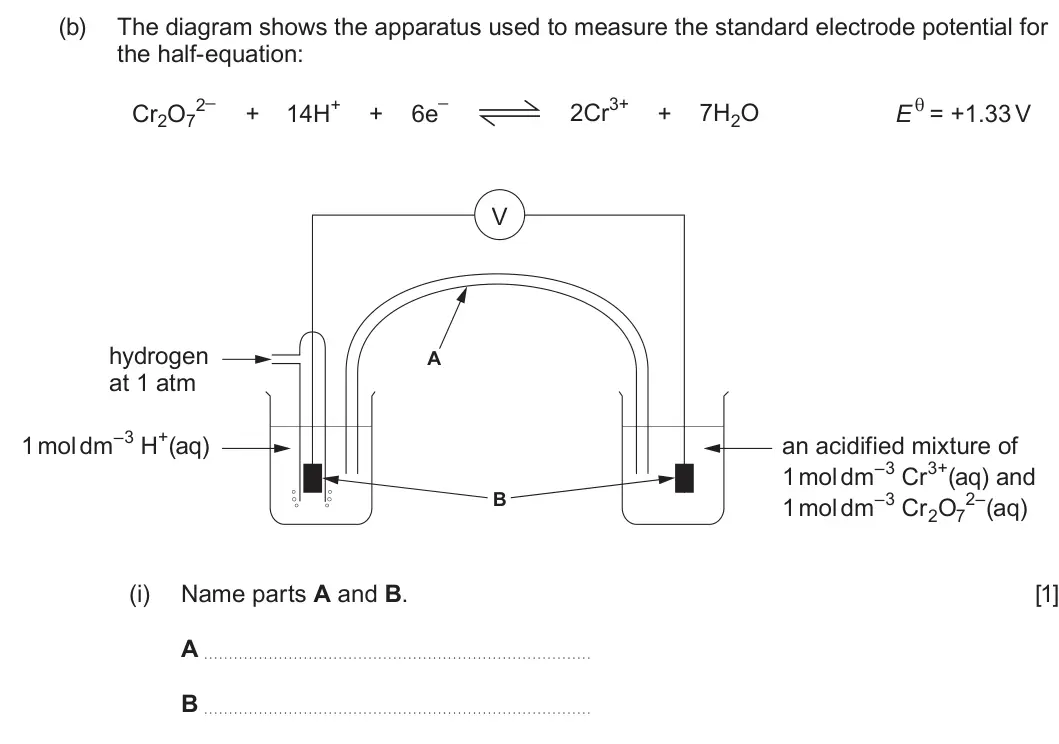
Q6(b)(ii)
The whole paper ↗
Q10(e)(i)
The whole paper ↗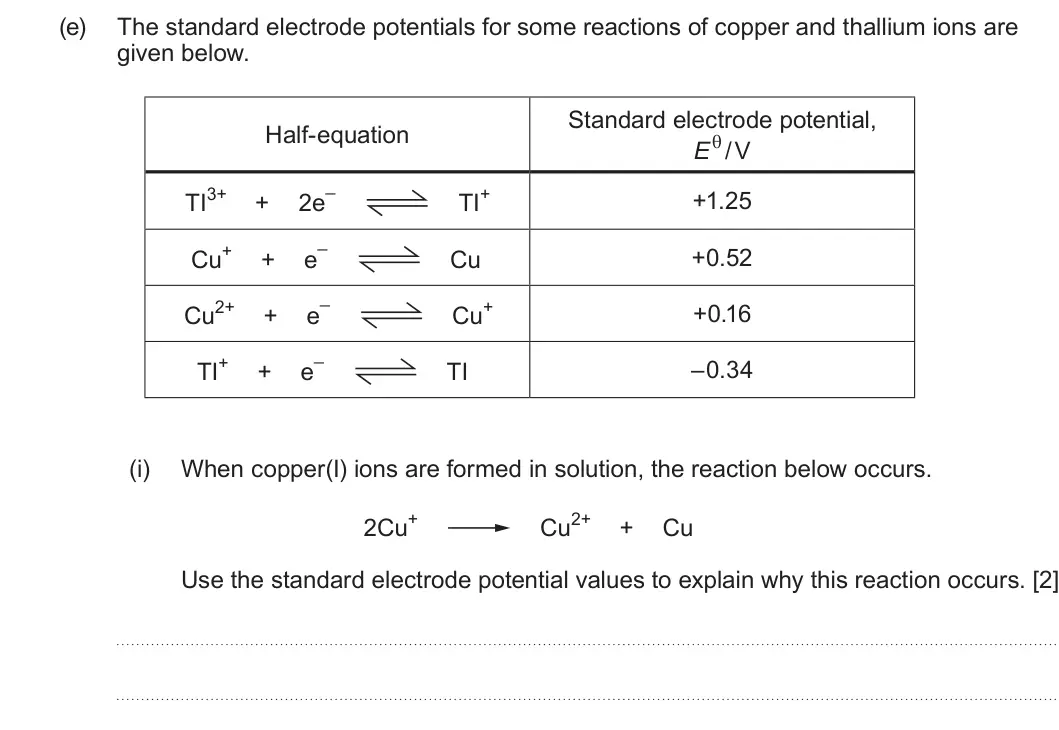
Q10(e)(ii)
The whole paper ↗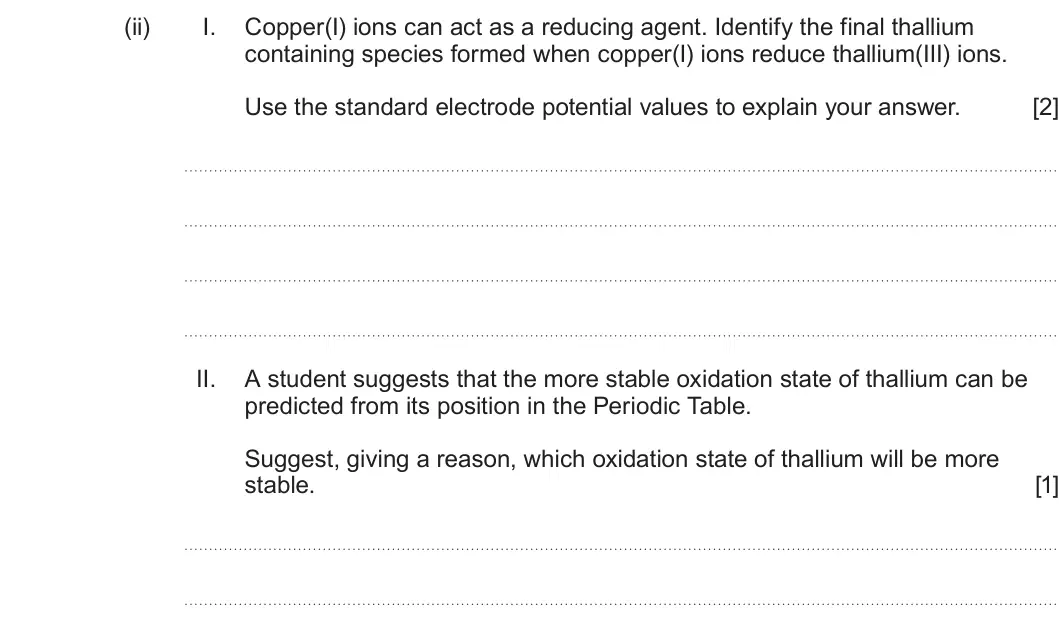
Q9(b)(i)
The whole paper ↗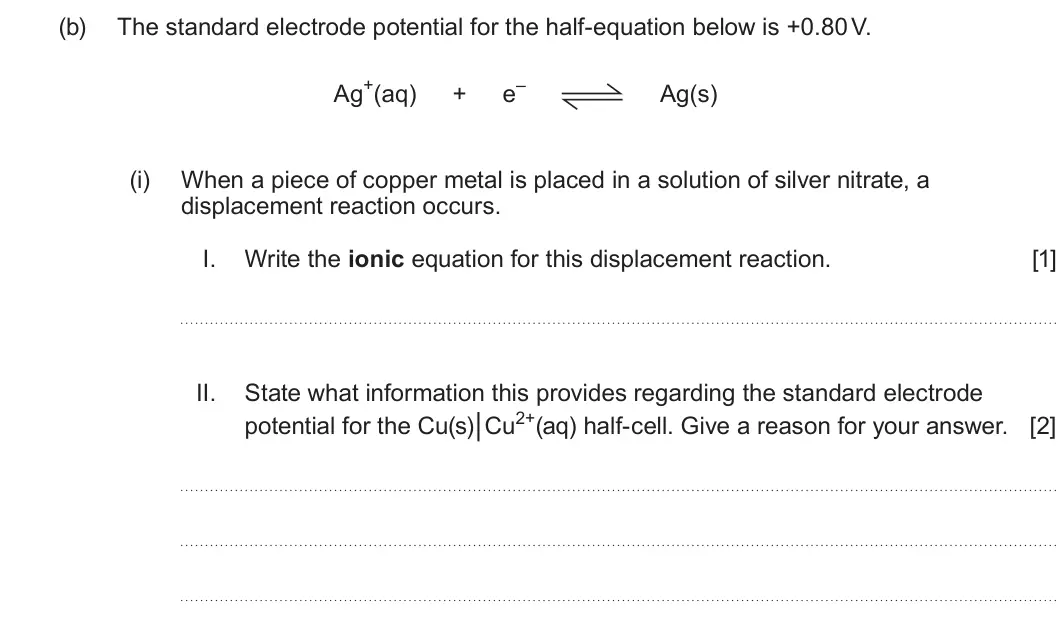
Q9(b)(ii)
The whole paper ↗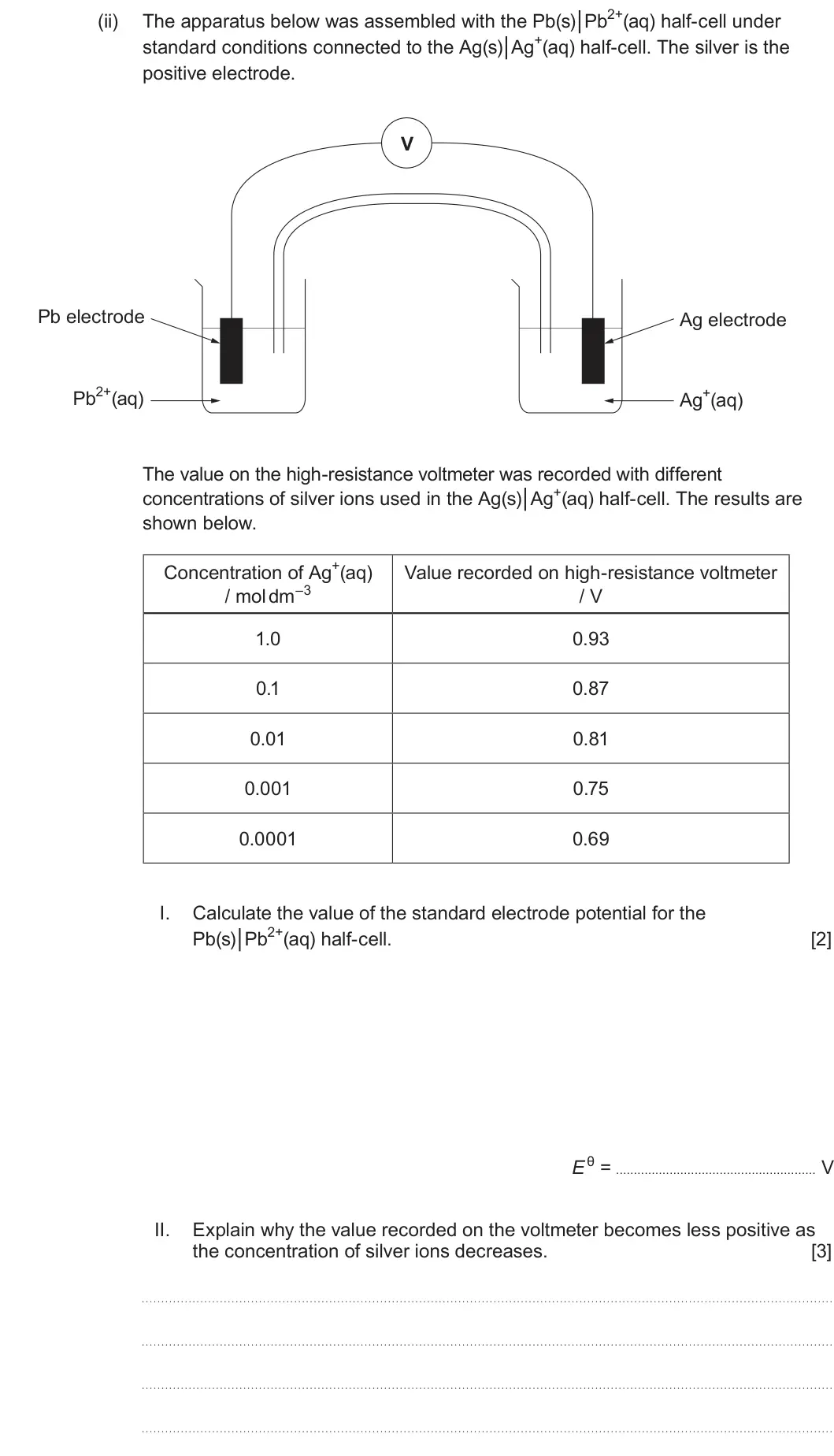
Q9(e)(iii)
The whole paper ↗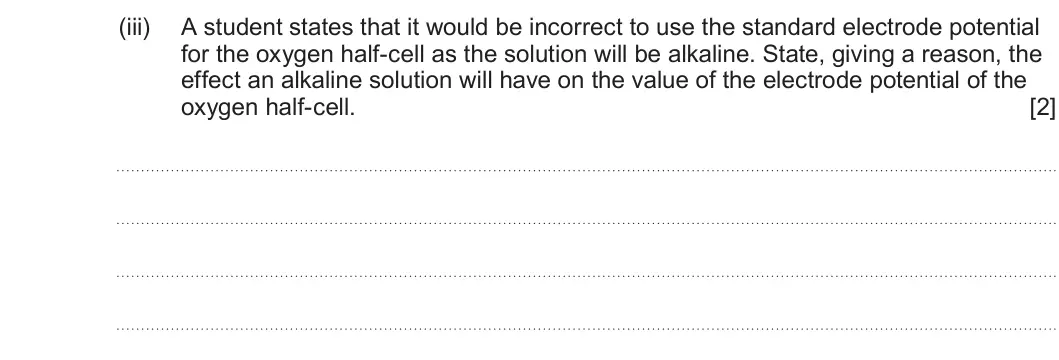

Q11(e)(i)
The whole paper ↗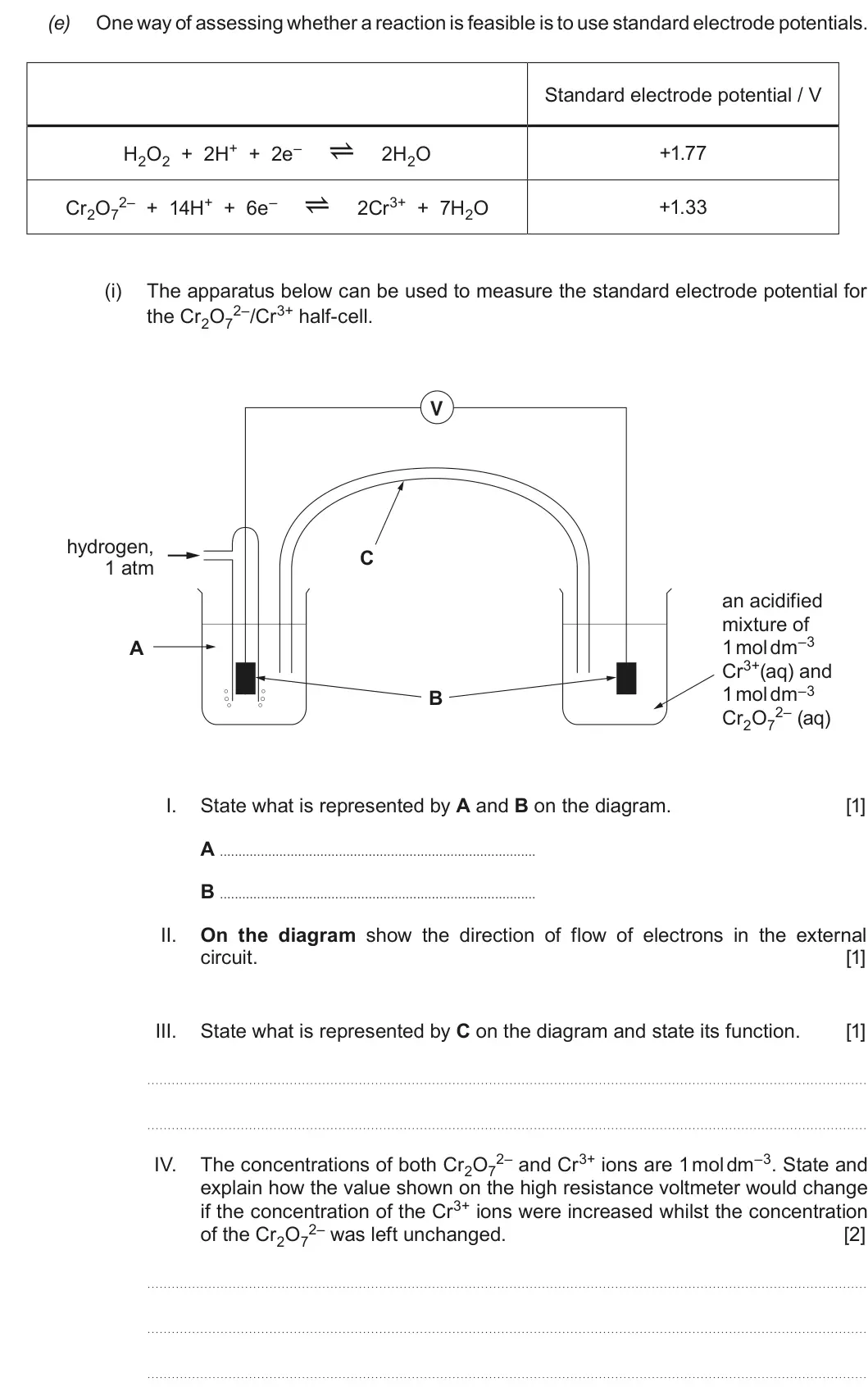
Q11(e)(ii)
The whole paper ↗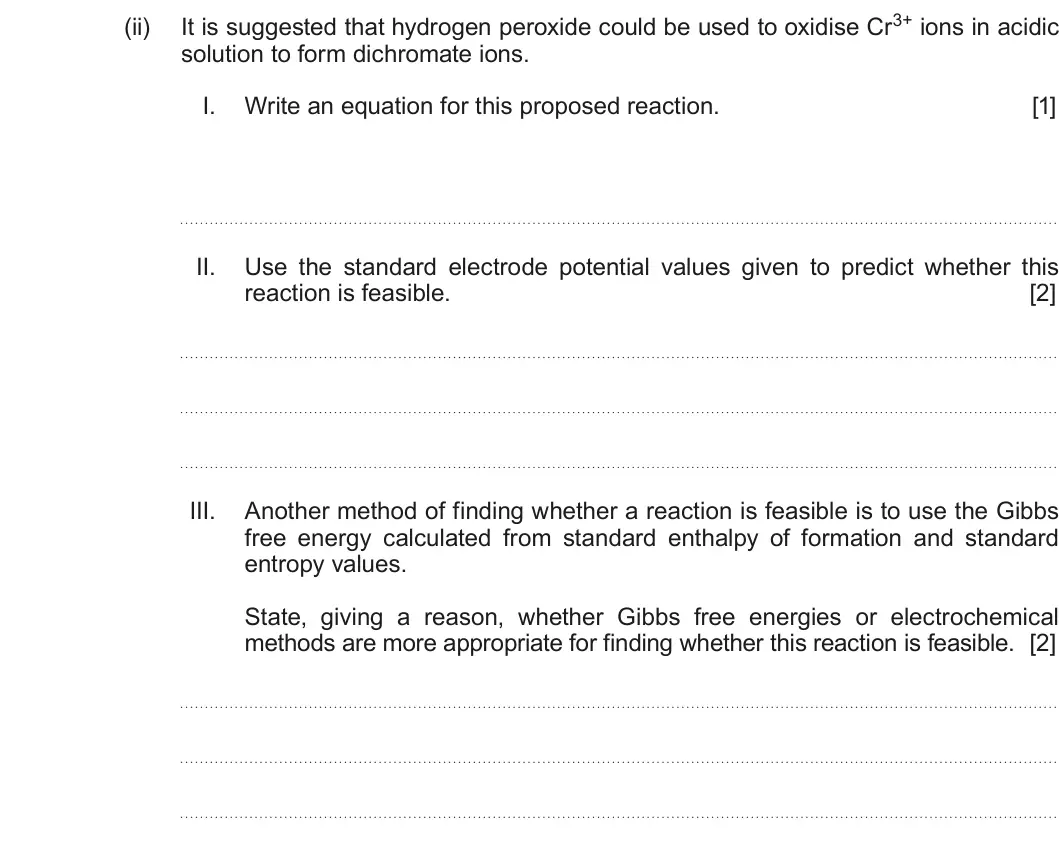
Q12(c)
The whole paper ↗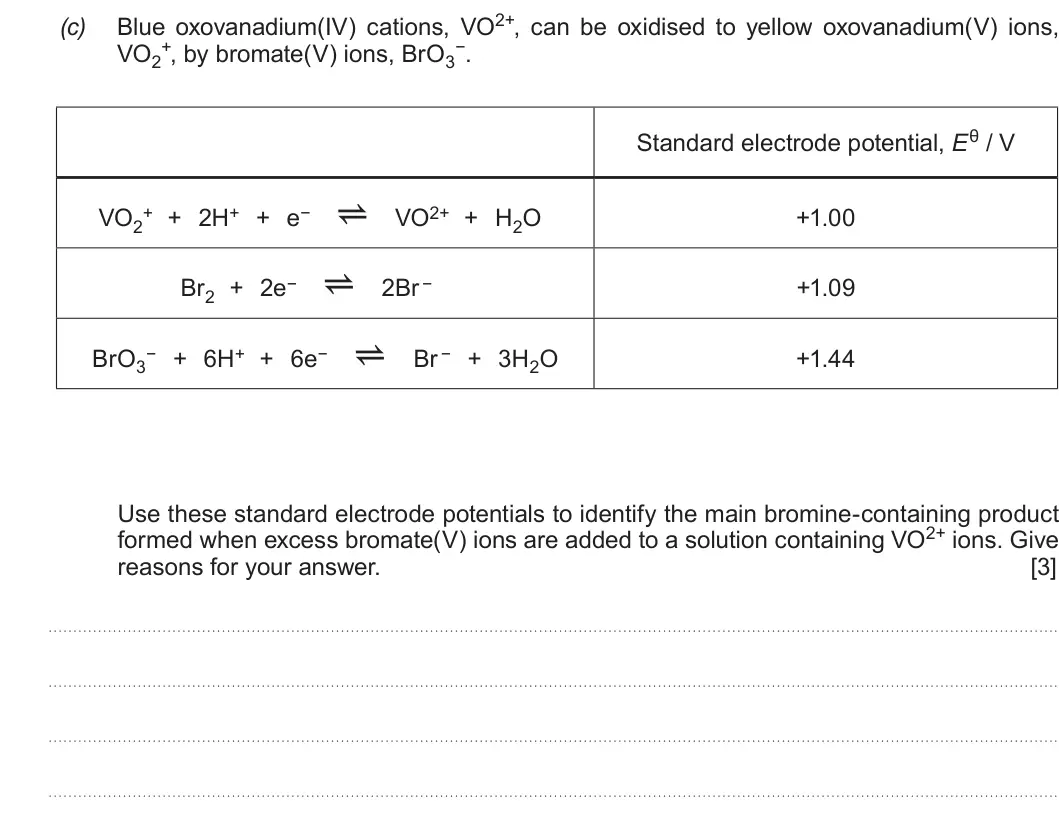
All 14 questions on Redox and standard electrode potential, as a list
- Summer 2025, Unit 3, Q6(b)(i) (1 mark): Name parts A and B. [1] A B
- Summer 2025, Unit 3, Q6(b)(ii) (1 mark): Label the diagram to show the direction of flow of electrons in the wire. [1]
- Summer 2025, Unit 3, Q10(e)(i) (2 marks): When copper(I) ions are formed in solution, the reaction below occurs. 2Cu+ Cu2+ + Cu Use the standard electrode potential values to explain why this reaction o
- Summer 2025, Unit 3, Q10(e)(ii) (3 marks): I. Copper(I) ions can act as a reducing agent. Identify the final thallium containing species formed when copper(I) ions reduce thallium(III) ions. Use the stan
- Summer 2024, Unit 3, Q4 (1 mark): One proposal to reduce the carbon dioxide emissions from public transport is to replace diesel trains with trains powered by hydrogen fuel cells. Give one other
- Summer 2024, Unit 3, Q9(b)(i) (3 marks): When a piece of copper metal is placed in a solution of silver nitrate, a displacement reaction occurs. I. Write the ionic equation for this displacement reacti
- Summer 2024, Unit 3, Q9(b)(ii) (5 marks): standard conditions connected to the Ag(s)│Ag+(aq) half-cell. The silver is the positive electrode. V Pb electrode Ag electrode Pb2+(aq) Ag+(aq) The value on th
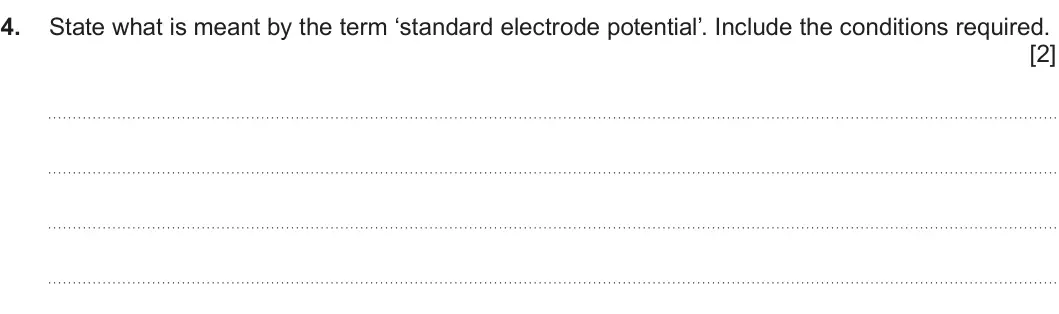
- Summer 2022, Unit 3, Q4 (2 marks): State what is meant by the term ‘standard electrode potential’. Include the conditions required. [2]
- Summer 2022, Unit 3, Q9(e)(iii) (2 marks): A student states that it would be incorrect to use the standard electrode potential for the oxygen half-cell as the solution will be alkaline. State, giving a r
- Summer 2019, Unit 3, Q4 (1 mark): The standard hydrogen electrode and hydrogen fuel cells both use the same metal as an electrode. Name the metal and explain why this metal is suitable. [1]
- Summer 2018, Unit 3, Q11(e)(i) (5 marks): The apparatus below can be used to measure the standard electrode potential for 2–/Cr3+ half-cell. the Cr2O7 V hydrogen, C 1 atm an acidified mixture of 1 mol d
- Summer 2018, Unit 3, Q11(e)(ii) (5 marks): solution to form dichromate ions. I. Write an equation for this proposed reaction. [1] II. Use the standard electrode potential values given to predict whether
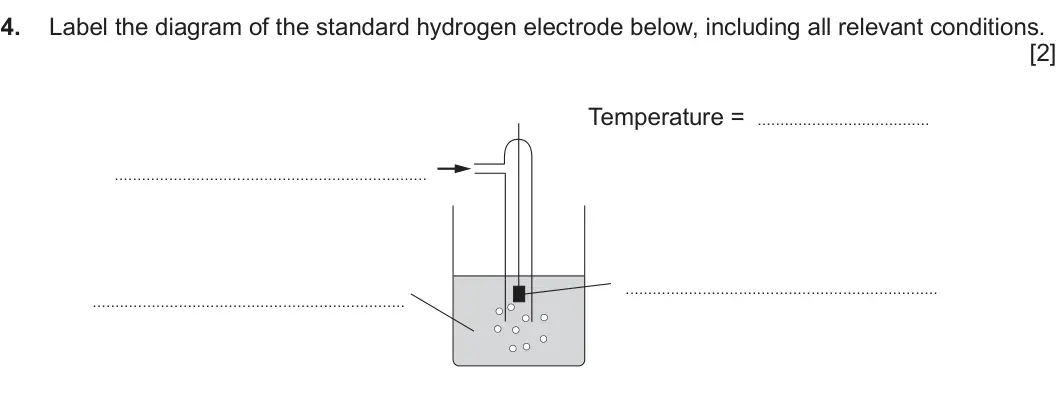
- Summer 2017, Unit 3, Q4 (2 marks): Label the diagram of the standard hydrogen electrode below, including all relevant conditions. [2] Temperature =
- Summer 2017, Unit 3, Q12(c) (3 marks): +, by bromate(V) ions, BrO3 −. VO2 Standard electrode potential, Eθ / V VO2+ + 2H+ + e− a VO2+ + H2O +1.00 Br2 + 2e− a 2Br − +1.09 BrO3− + 6H+ + 6e− a Br − + 3H
Questions, mark schemes and examiner’s reports are © WJEC CBAC Ltd, from their published past papers. Plumi isn’t affiliated with any exam board. Want whole papers? Every WJEC A-Level Chemistry paper.
Rather write your answers by hand on iPad? Plumi marks them against the same mark schemes.