 plumi
Chemistry of the d-block transition metals: WJEC A‑Level Chemistry questions
Every WJEC A-Level Chemistry exam question on 3.4 Chemistry of the d-block transition metals, 2016–2025, with its mark scheme and examiner’s report.
Find questions1,204
Calculations
Q6(a)
The whole paper ↗
Q10(d)(i)
The whole paper ↗
Q10(d)(ii)
The whole paper ↗
Q10(d)(iii)
The whole paper ↗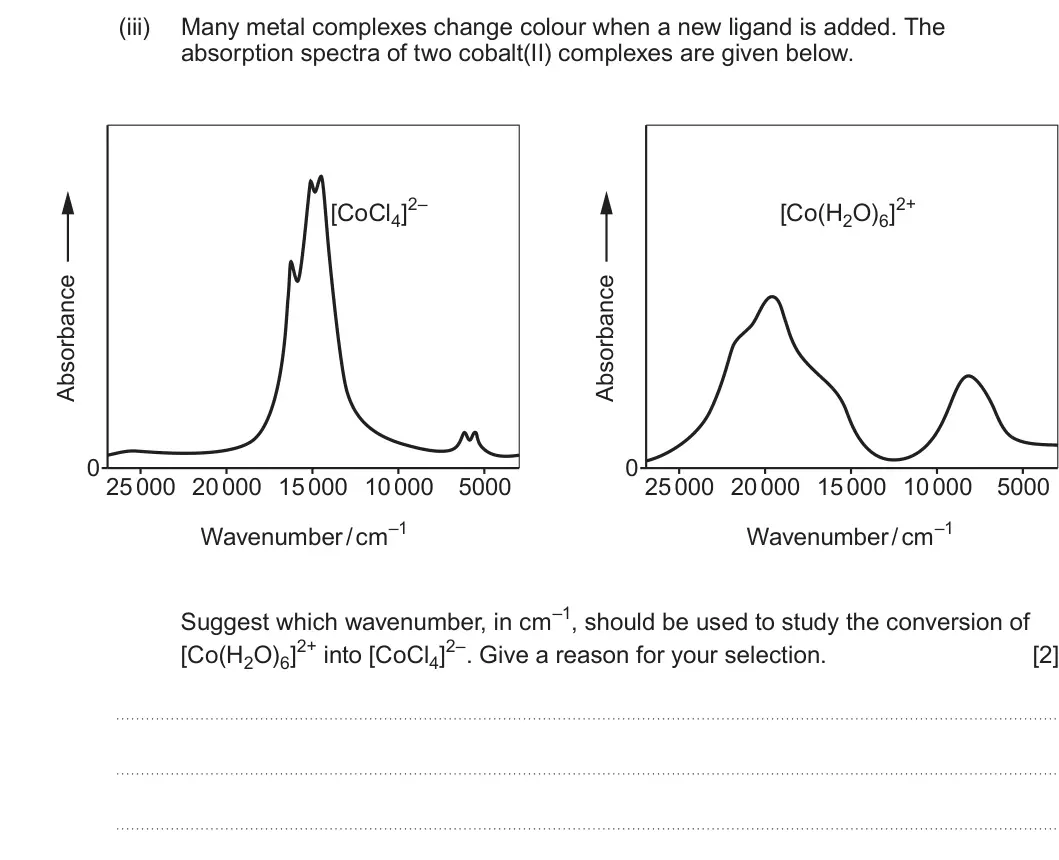
Q8(a)
The whole paper ↗
Q8(b)(i)
The whole paper ↗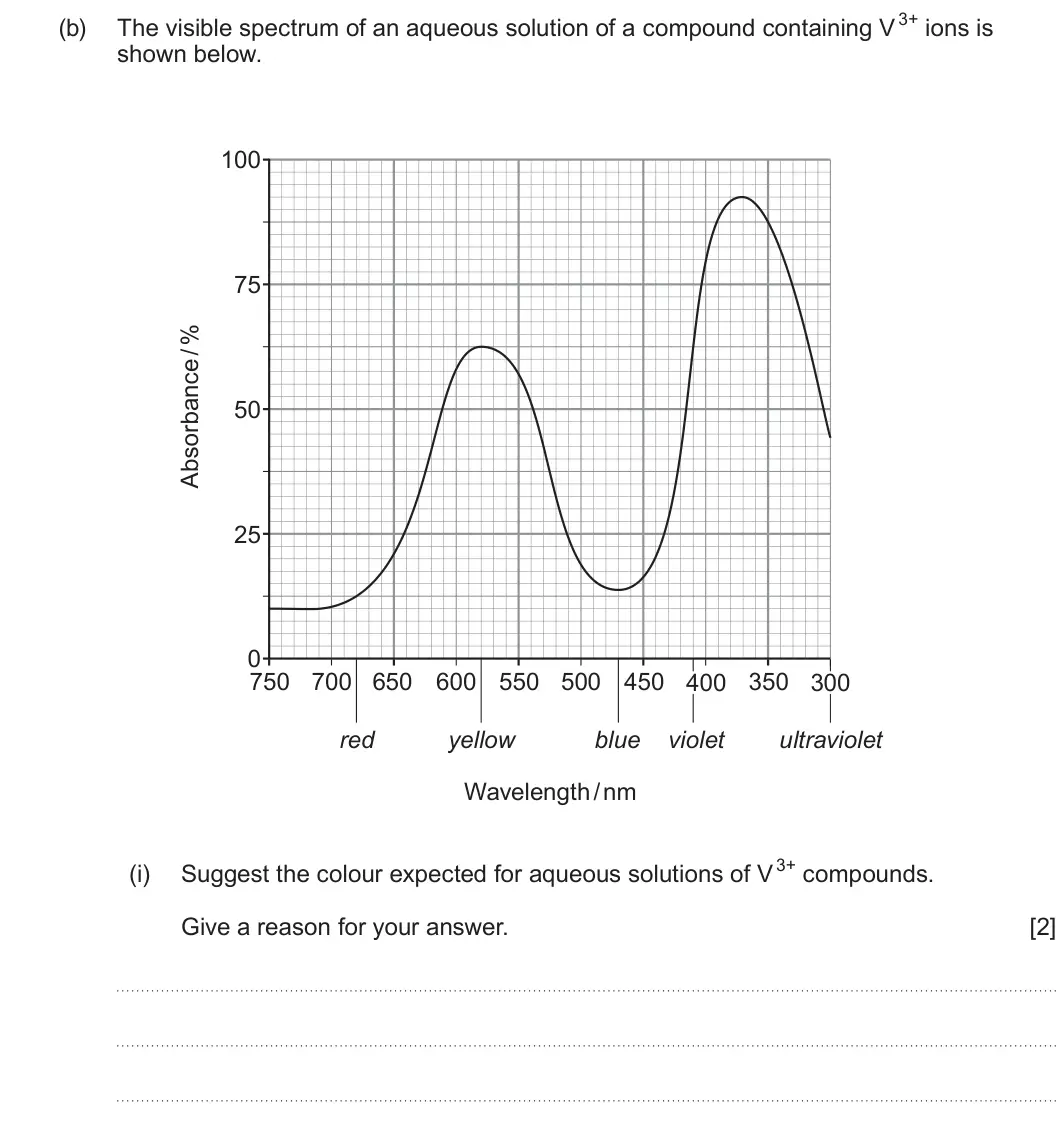
Q8(b)(ii)
The whole paper ↗
Q10(c)(i)
The whole paper ↗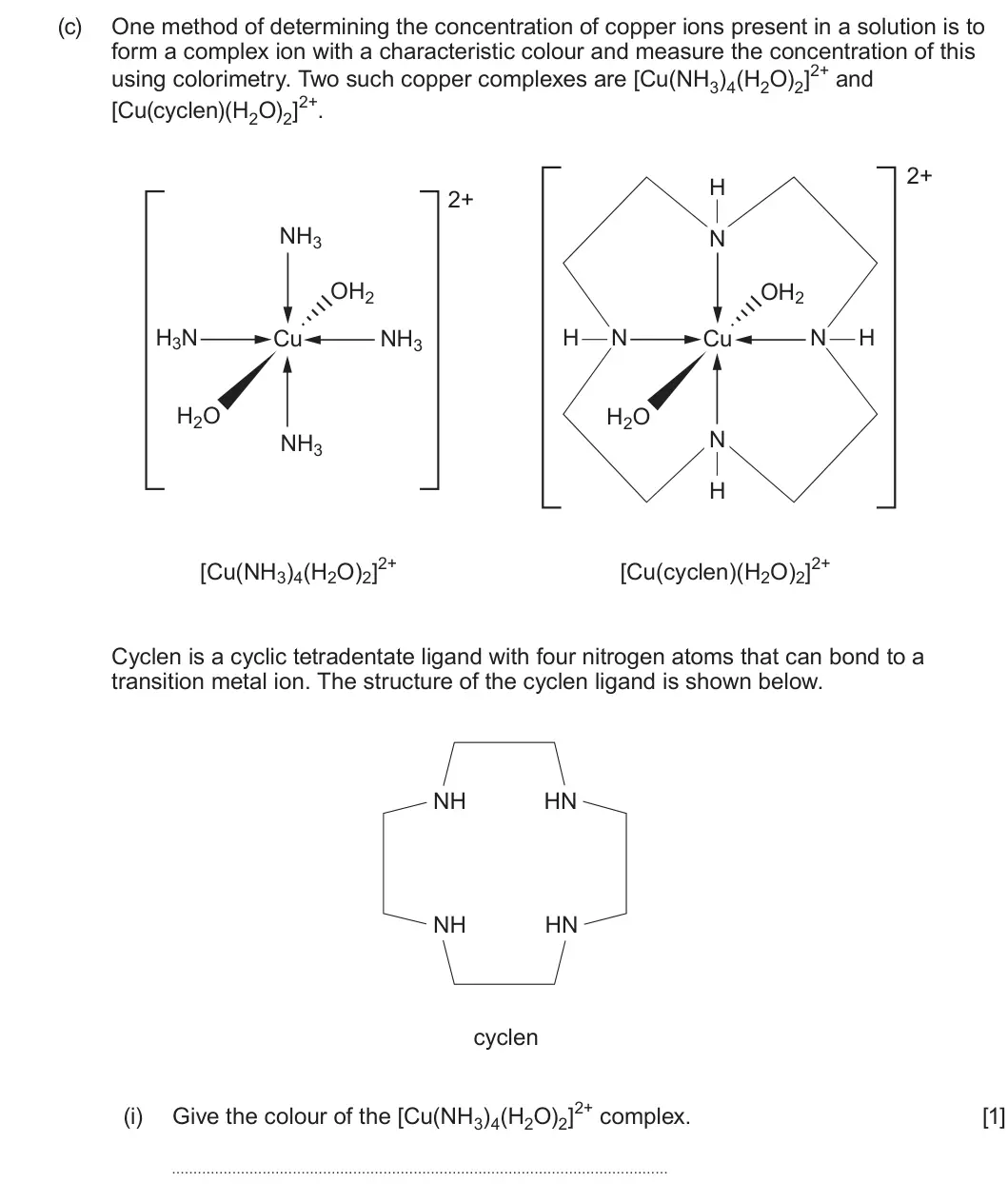
Q10(c)(ii)
The whole paper ↗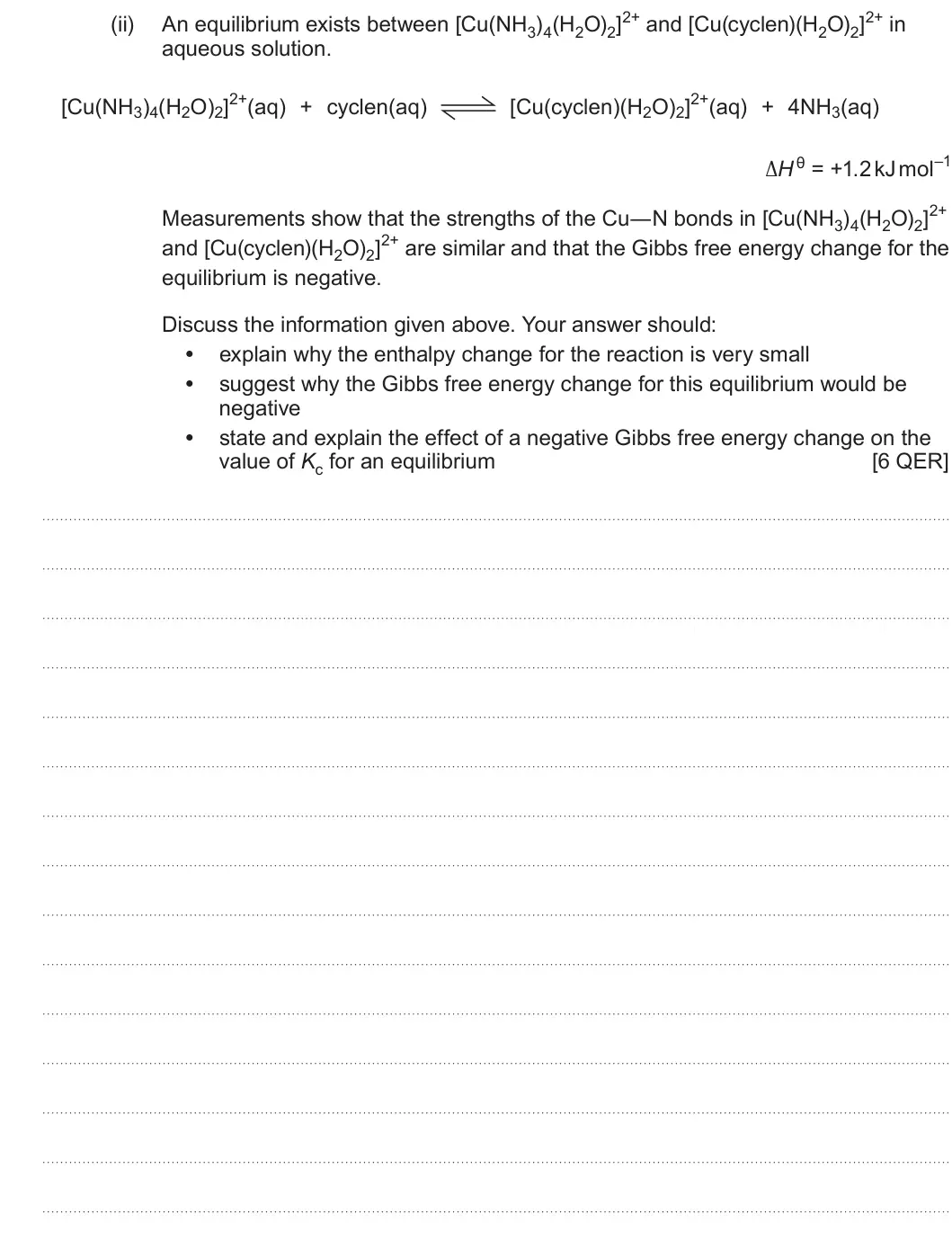

Q8(c)
The whole paper ↗
Q12(c)
The whole paper ↗

Q9(a)
The whole paper ↗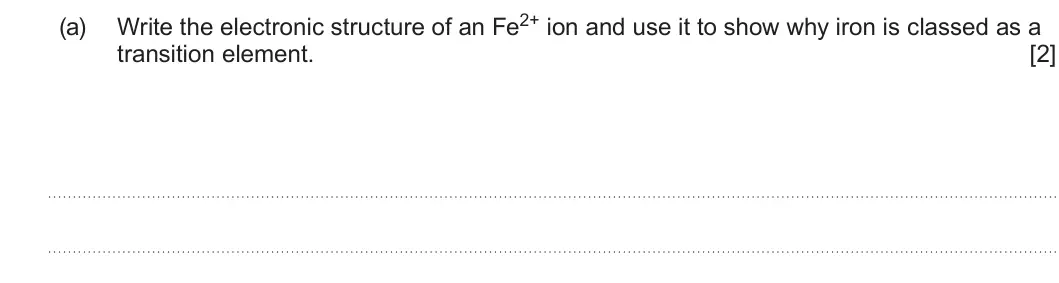
Q9(b)
The whole paper ↗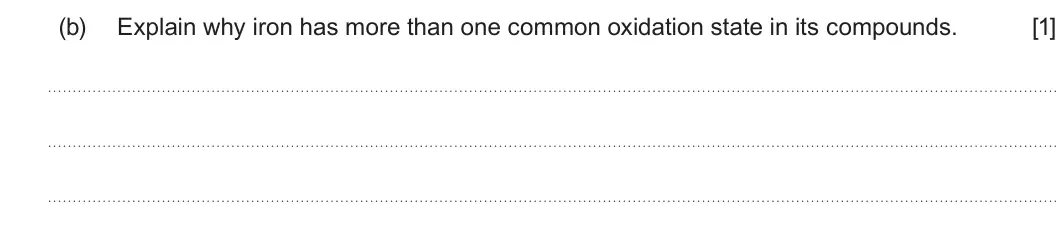
Q9(c)
The whole paper ↗
Q9(d)(i)
The whole paper ↗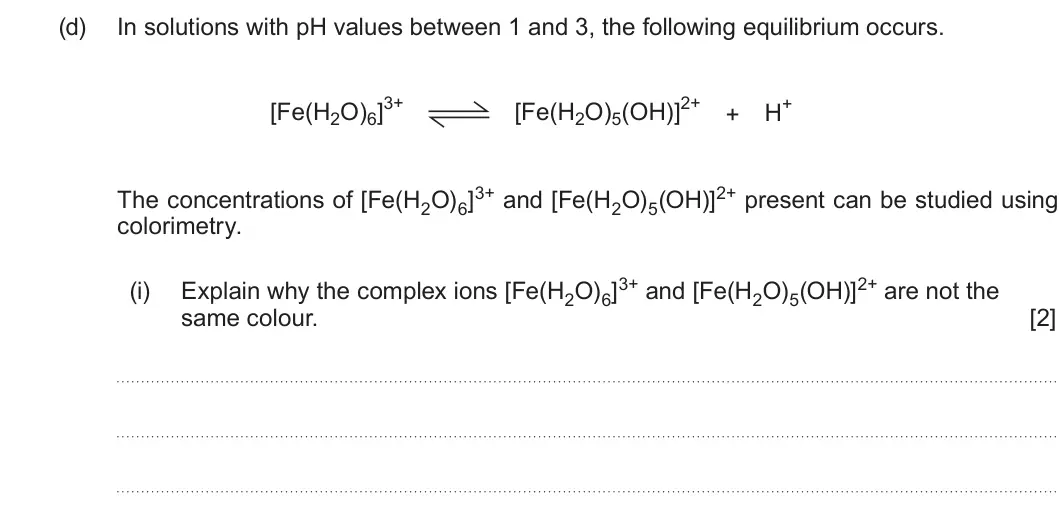
Q9(d)(ii)
The whole paper ↗
Q9(e)(i)
The whole paper ↗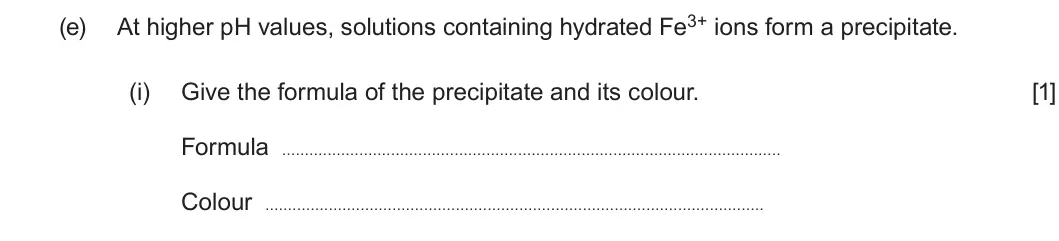

All 34 questions on Chemistry of the d-block transition metals, as a list
- Summer 2025, Unit 3, Q6(a) (1 mark): Give the observation(s) expected when aqueous sodium hydroxide is added gradually to aqueous chromium(III) chloride until the sodium hydroxide is in excess. [1]
- Summer 2025, Unit 3, Q10(d)(i) (3 marks): Explain why these solutions are pale blue. [3]
- Summer 2025, Unit 3, Q10(d)(ii) (1 mark): Copper(I) compounds are often white solids. Give a reason why these compounds are not coloured. [1]
- Summer 2025, Unit 3, Q10(d)(iii) (2 marks): Many metal complexes change colour when a new ligand is added. The absorption spectra of two cobalt(II) complexes are given below. [CoCl4]2– [Co(H2O)6]2+ 0 25 0
- Summer 2024, Unit 3, Q8(a) (1 mark): State why transition elements can form a range of oxidation states in their compounds. [1]
- Summer 2024, Unit 3, Q8(b)(i) (2 marks): Give a reason for your answer. [2]
- Summer 2024, Unit 3, Q8(b)(ii) (3 marks): In aqueous solutions, most vanadium ions form complexes with water acting as a ligand. I. Give the meaning of the term ligand. [1] II. Describe the bonding that
- Summer 2024, Unit 3, Q10(c)(i) (1 mark): [1]
- Summer 2024, Unit 3, Q10(c)(ii) (6 marks): aqueous solution. [Cu(NH3)4(H2O)2]2+(aq) [Cu(cyclen)(H2O)2]2+(aq) + cyclen(aq) + 4NH3(aq) ΔHθ = +1.2 kJ mol–1 Measurements show that the strengths of the Cu―N b
- Summer 2023, Unit 3, Q5 (1 mark): Addition of ammonia solution to aqueous copper(II) sulfate causes a pale blue precipitate to form followed by a coloured solution when excess ammonia solution i
- Summer 2023, Unit 3, Q8(c) (2 marks): Addition of aqueous sodium hydroxide to the solution of potassium dichromate causes a colour change. State the colour change and explain why this is not a redox
- Summer 2023, Unit 3, Q12(c) (3 marks): Explain the observations seen in experiment 3 Use these to name element X. [3]
- Summer 2022, Unit 3, Q2 (1 mark): Addition of excess hydrochloric acid to aqueous copper(II) sulfate causes the solution to turn green. Give the formula of the copper-containing species present.
- Summer 2022, Unit 3, Q9(a) (2 marks): transition element. [2]
- Summer 2022, Unit 3, Q9(b) (1 mark): Explain why iron has more than one common oxidation state in its compounds. [1]
- Summer 2022, Unit 3, Q9(c) (1 mark): Draw the structure of the [Fe(H2O)6]3+ ion. [1]
- Summer 2022, Unit 3, Q9(d)(i) (2 marks): same colour. [2]
- Summer 2022, Unit 3, Q9(d)(ii) (1 mark): Suggest how you would select an appropriate wavelength to find the concentration of [Fe(H2O)6]3+ in the equilibrium mixture. [1]
- Summer 2022, Unit 3, Q9(e)(i) (1 mark): Give the formula of the precipitate and its colour. [1] Formula Colour
- Summer 2019, Unit 3, Q8 (1 mark): Draw the structure of the copper-containing ion formed when concentrated hydrochloric acid is added to a solution containing [Cu(H2O)6]2+ ions. [1]
- Summer 2019, Unit 3, Q10(c)(i) (3 marks): It is an example of a homogeneous catalyst. I. State what is meant by a homogeneous catalyst. [1] Explain why transition metal complexes such as [Ir(CO)2I2]– ca
- Summer 2019, Unit 3, Q12(a)(iii) (2 marks): Give the colours of the precipitates formed when sodium hydroxide solution is added to solutions containing the following ions. [2] Mg2+(aq) Fe2+(aq) Cr3+(aq) P
- Summer 2019, Unit 3, Q12(a)(iv) (3 marks): The method given opposite is incomplete. Suggest an additional step that would allow the remaining solutions formed in step 2 to be identified. Give the expecte
- Summer 2018, Unit 3, Q2 (1 mark): Excess sodium hydroxide is added to an aqueous solution of chromium(III) chloride, CrCl3. Give the formula of the chromium-containing ion formed. [1]
- Summer 2018, Unit 3, Q9(a) (2 marks): [2]
- Summer 2018, Unit 3, Q9(b) (3 marks): [3]
- Summer 2018, Unit 3, Q9(c) (4 marks): Upon addition of hydrochloric acid the solution turned blue as [CoCl4]2– ions formed according to the equilibrium shown below. [Co(H2O)6]2+ + 4Cl– a [CoCl4]2– +
- Summer 2018, Unit 3, Q9(d)(i) (3 marks): 518 nm. Calculate the energy of this absorbance in kJ mol–1. [3] Energy = kJ mol–1
- Summer 2018, Unit 3, Q9(d)(ii) (1 mark): A colorimeter was used to study the equilibrium between the two ions. Suggest, giving a reason, an appropriate wavelength to use for the experiment. [1]
- Summer 2018, Unit 3, Q12(b) (6 marks): A student was provided with five ionic solids containing familiar cations and anions. Each solid contains a different cation. The solids were labelled A, B, C,
- Summer 2017, Unit 3, Q2 (1 mark): Give an example of a transition metal used as a catalyst. You should name the metal and identify the reaction it catalyses. [1]
- Summer 2017, Unit 3, Q12(a) (3 marks): The diagram below shows some reactions of copper(II) ions in solution. addition of solution B pale blue royal blue solution precipitate A C addition of NaOH(aq)
- Summer 2017, Unit 3, Q12(b) (1 mark): Vanadium exhibits the properties of a typical transition element, such as having variable oxidation states and forming coloured complexes. Explain why transitio
- Summer 2017, Unit 3, Q12(f) (3 marks): to colourless Ce3+. A titration using this reaction does not usually include an indicator and colorimetry is sometimes used. State why an indicator may not be u
Questions, mark schemes and examiner’s reports are © WJEC CBAC Ltd, from their published past papers. Plumi isn’t affiliated with any exam board. Want whole papers? Every WJEC A-Level Chemistry paper.
Rather write your answers by hand on iPad? Plumi marks them against the same mark schemes.