 plumi
Hydrocarbons: WJEC A‑Level Chemistry questions
Every WJEC A-Level Chemistry exam question on 2.5 Hydrocarbons, 2016–2025, with its mark scheme and examiner’s report.
Find questions1,204
Calculations
Q6(a)(i)
The whole paper ↗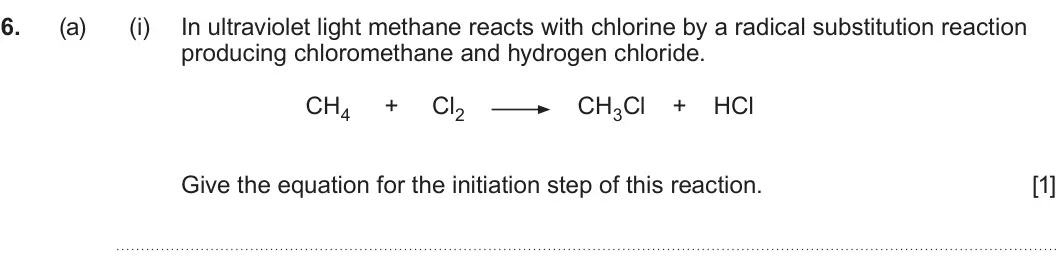
Q6(a)(ii)
The whole paper ↗
Q8(a)(i)
The whole paper ↗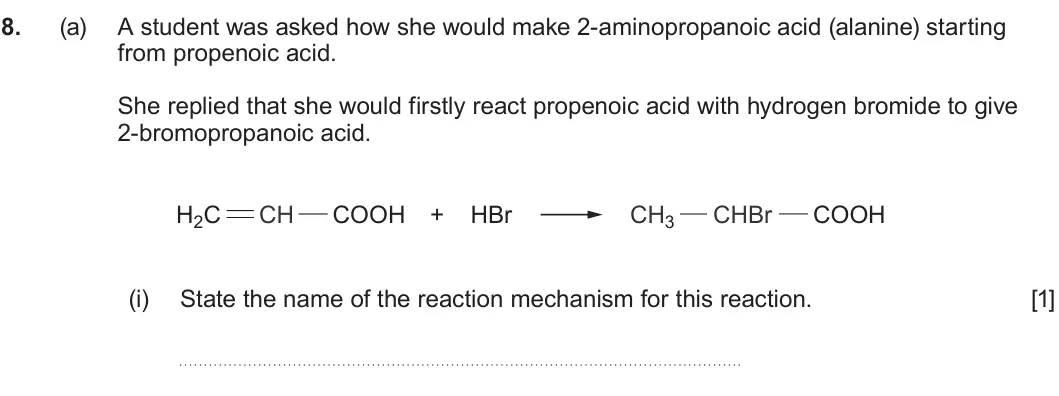
Q8(a)(ii)
The whole paper ↗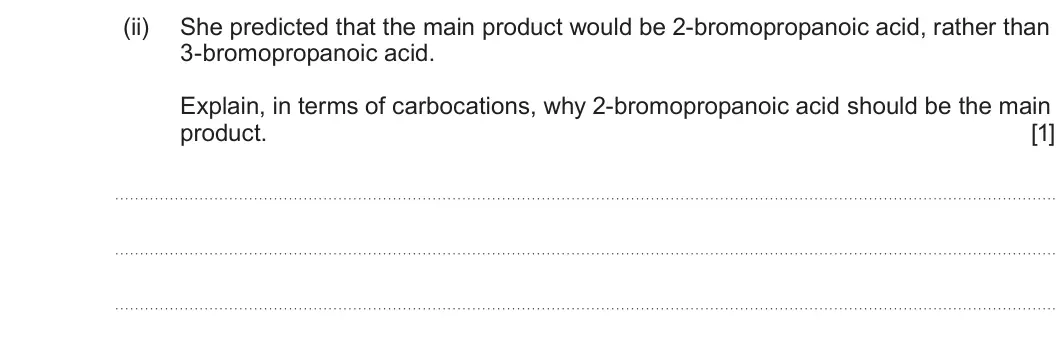
Q7(a)(i)
The whole paper ↗
Q7(a)(ii)
The whole paper ↗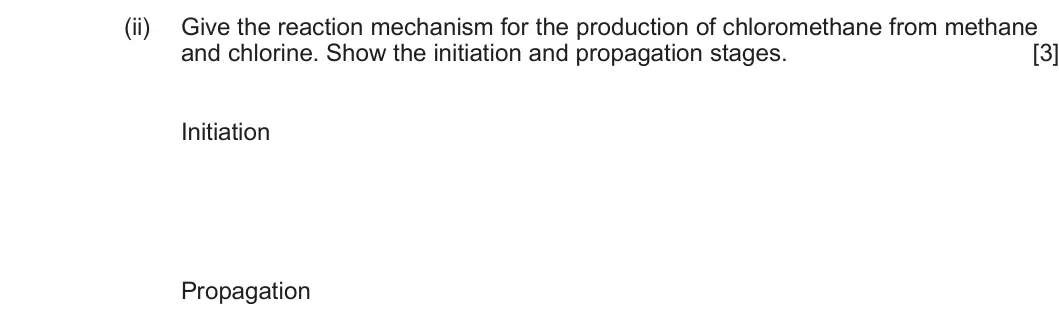
Q7(b)(i)
The whole paper ↗
Q7(b)(ii)
The whole paper ↗
Q7(c)(i)
The whole paper ↗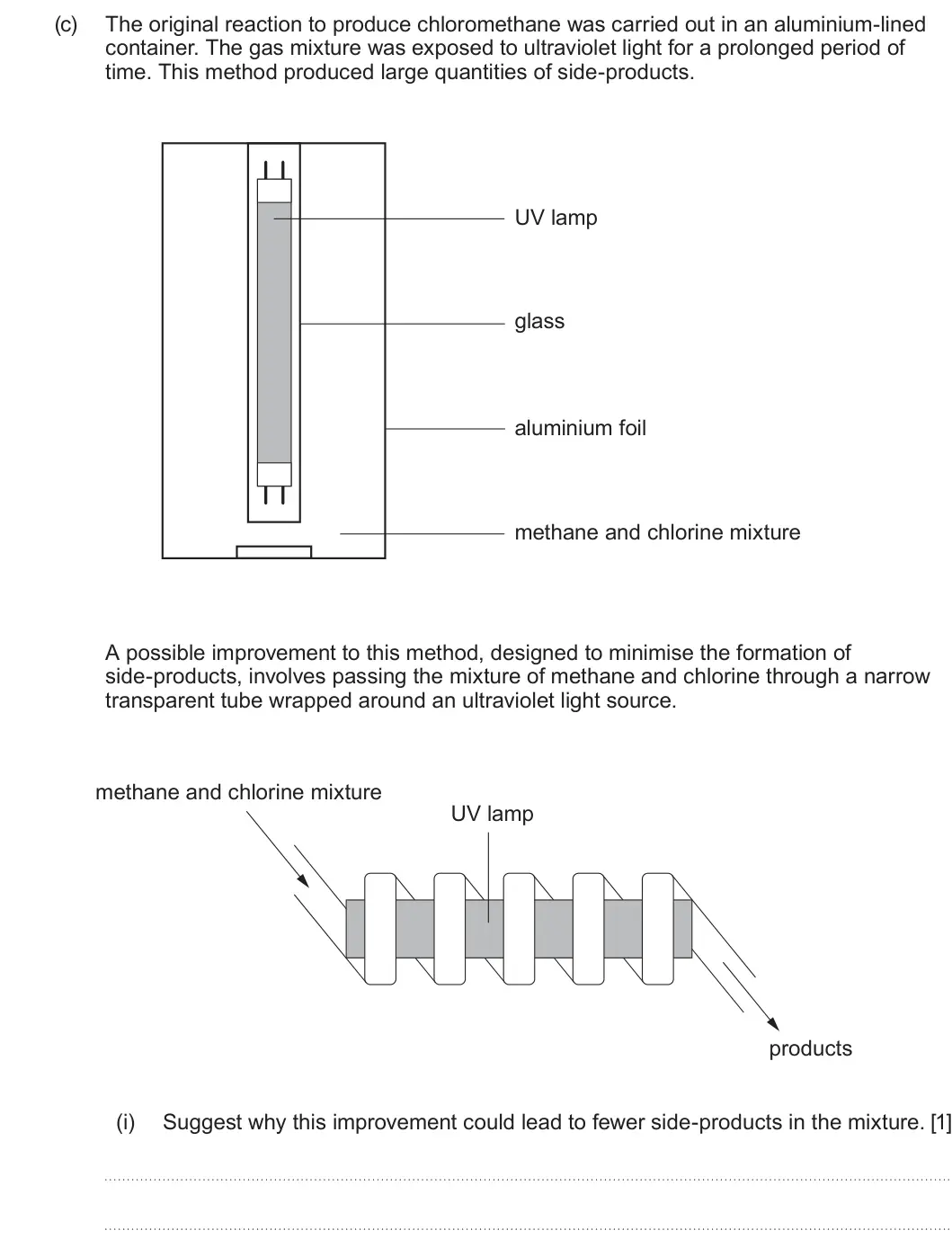
Q7(c)(ii)
The whole paper ↗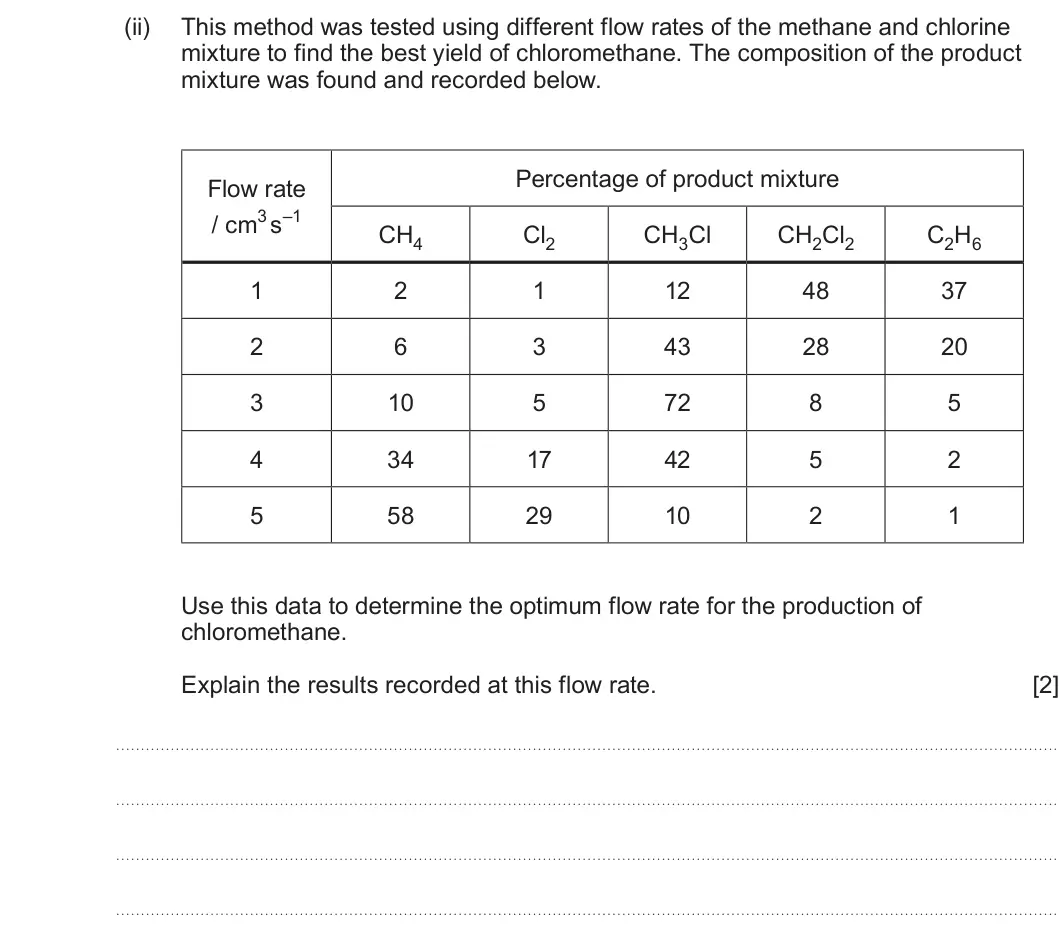
Q10(a)(iii)
The whole paper ↗
Q10(b)(ii)
The whole paper ↗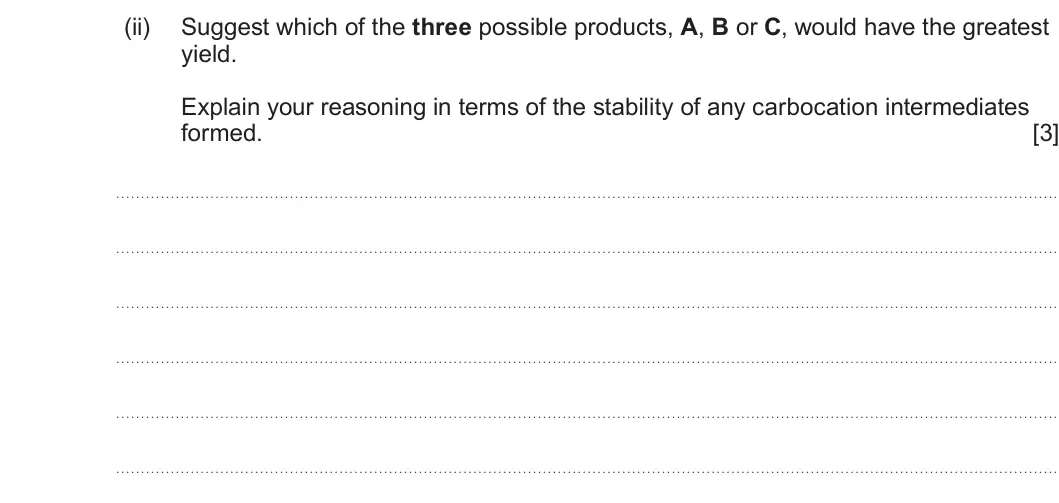

Q7(b)(v)
The whole paper ↗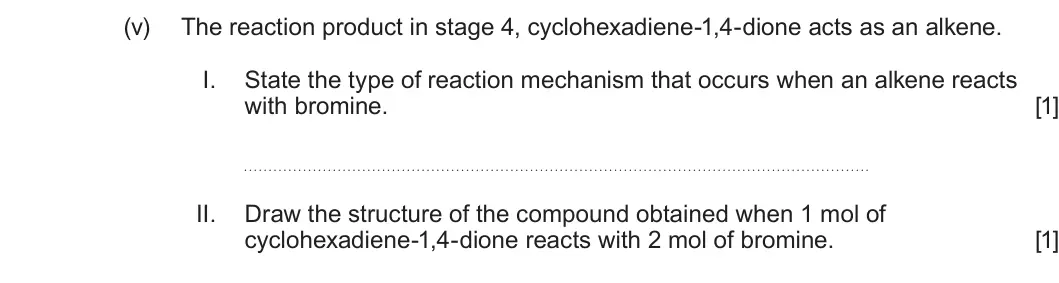
Q7(d)(iii)
The whole paper ↗
Q4(a)
The whole paper ↗
Q4(b)
The whole paper ↗


All 73 questions on Hydrocarbons, as a list
- Summer 2025, Unit 4, Q6(a)(i) (1 mark): In ultraviolet light methane reacts with chlorine by a radical substitution reaction producing chloromethane and hydrogen chloride. CH4 + Cl2 CH3Cl + HCl Give t
- Summer 2025, Unit 4, Q6(a)(ii) (1 mark): Further chlorination of methane produces CH2Cl2, CHCl3 and CCl4. Give an equation to show how 1,2-dichloroethane might be another product of this chlorination r
- Summer 2025, Unit 4, Q8(a)(i) (1 mark): State the name of the reaction mechanism for this reaction. [1]
- Summer 2025, Unit 4, Q8(a)(ii) (1 mark): She predicted that the main product would be 2-bromopropanoic acid, rather than 3-bromopropanoic acid. Explain, in terms of carbocations, why 2-bromopropanoic a
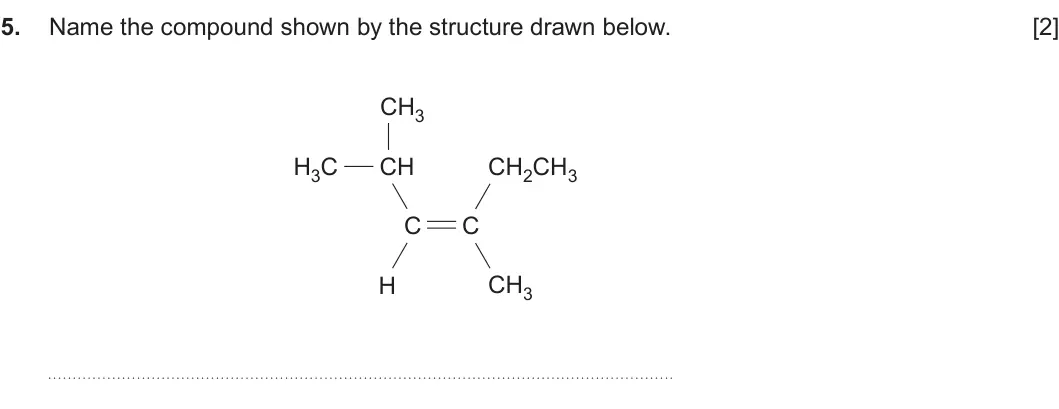
- Summer 2025, AS Unit 2, Q5 (2 marks): Name the compound shown by the structure drawn below. [2] CH3 H3C CH CH2CH3 C C H CH3
- Summer 2025, AS Unit 2, Q7(a)(i) (1 mark): Name the mechanism for this reaction. [1]
- Summer 2025, AS Unit 2, Q7(a)(ii) (3 marks): Give the reaction mechanism for the production of chloromethane from methane and chlorine. Show the initiation and propagation stages. [3] Initiation Propagatio
- Summer 2025, AS Unit 2, Q7(b)(i) (1 mark): Explain why the mixture produced in this reaction could contain ethane. [1]
- Summer 2025, AS Unit 2, Q7(b)(ii) (2 marks): Explain why the mixture produced in this reaction could contain dichloromethane. [2]
- Summer 2025, AS Unit 2, Q7(c)(i) (1 mark): Suggest why this improvement could lead to fewer side-products in the mixture. [1]
- Summer 2025, AS Unit 2, Q7(c)(ii) (2 marks): This method was tested using different flow rates of the methane and chlorine mixture to find the best yield of chloromethane. The composition of the product mi
- Summer 2025, AS Unit 2, Q10(a)(iii) (3 marks): The but-1-ene formed during this reaction is then used to form 2-bromobutane by reaction with hydrogen bromide, HBr. Draw the mechanism for this reaction. [3]
- Summer 2025, AS Unit 2, Q10(b)(ii) (3 marks): Suggest which of the three possible products, A, B or C, would have the greatest yield. Explain your reasoning in terms of the stability of any carbocation inte
- Summer 2024, Unit 4, Q4 (1 mark): Give the formula of the triphenylmethyl radical. [1]
- Summer 2024, Unit 4, Q7(b)(v) (2 marks): The reaction product in stage 4, cyclohexadiene-1,4-dione acts as an alkene. I. State the type of reaction mechanism that occurs when an alkene reacts with brom
- Summer 2024, Unit 4, Q7(d)(iii) (1 mark): Give the structure of the compound formed when compound J reacts with hydrogen bromide. [1]
- Summer 2024, AS Unit 2, Q4(a) (1 mark): State why the chloroethene monomer does not exhibit E–Z isomerism. [1]
- Summer 2024, AS Unit 2, Q4(b) (1 mark): Draw the repeating unit for PVC. [1]
- Summer 2024, AS Unit 2, Q5 (1 mark): Complete the equation to show the structure of the main product formed. [1] CH3CH CH2 + HBr
- Summer 2024, AS Unit 2, Q7 (1 mark): Name the catalyst used in the hydrogenation of unsaturated oils to make saturated fats such as margarine. [1]
- Summer 2024, AS Unit 2, Q9(a) (2 marks): Calculate the empirical formula of A. [2] Empirical formula
- Summer 2024, AS Unit 2, Q13(a)(i) (2 marks): State the type of reaction involved in each case. [2] ethane and chlorine ethene and hydrogen chloride
- Summer 2024, AS Unit 2, Q13(a)(ii) (1 mark): Suggest why the reaction between ethene and hydrogen chloride gives the better yield. [1]
- Summer 2024, AS Unit 2, Q13(a)(iii) (4 marks): Give the mechanism for the reaction between ethene and hydrogen chloride. [4]
- Summer 2023, Unit 4, Q8(d) (1 mark): Tartaric acid is formed when butenedioic acid reacts with a suitable oxidising agent. Give the equation for this reaction, representing the oxidising agent as [
- Summer 2023, Unit 4, Q12(a)(i) (1 mark): State the type of mechanism occurring during the bromination. [1]
- Summer 2023, Unit 4, Q12(a)(iii) (1 mark): The dibromoacid produced in part (ii) is then reacted with zinc under suitable conditions to give 2-methylpropenoic acid. Complete the equation, showing zinc br
- Summer 2023, AS Unit 2, Q2 (1 mark): When fuels are burned with insufficient oxygen, incomplete combustion occurs and carbon monoxide is formed instead of carbon dioxide. Write the equation for the
- Summer 2023, AS Unit 2, Q3 (1 mark): Name the reagent that is needed to change unsaturated oils into saturated fats. [1]
- Summer 2023, AS Unit 2, Q5 (2 marks): Propene reacts with hydrogen bromide. C3H6 HBr C3H7Br + Draw the structures of the two isomers formed and give the name of the major product. [2] Major product
- Summer 2023, AS Unit 2, Q7 (2 marks): Name the following E-Z isomer. [2] H CH2 CH3 C C H3C CH2 Br
- Summer 2022, Unit 4, Q2 (1 mark): Give the name of a compound of formula C4H8 that will decolourise acidified potassium manganate(VII). [1]
- Summer 2022, Unit 4, Q9(d)(ii) (1 mark): During this reaction a cumene radical is produced. State what is meant by the term ‘radical’. [1]
- Summer 2022, Unit 4, Q9(d)(iii) (1 mark): Give the formula of a radical formed during the reaction of methane with chlorine. [1]
- Summer 2022, Unit 4, Q12(b)(i) (1 mark): In the first stage of this method bromine adds across the C C double bonds present. State the type of mechanism occurring when bromine adds across these double
- Summer 2022, AS Unit 2, Q1(a)(i) (1 mark): State the expected colour change for a positive test for alkenes. [1]
- Summer 2022, AS Unit 2, Q1(a)(ii) (1 mark): Draw the structure of the product formed when propene reacts with bromine water. [1]
- Summer 2022, AS Unit 2, Q1(b) (1 mark): Identify another reagent that can be used to test for the presence of alkenes. [1]
- Summer 2022, AS Unit 2, Q2(a) (1 mark): Draw an s-orbital and a p-orbital in the space below. [1]
- Summer 2022, AS Unit 2, Q2(b) (1 mark): Name the type of bond shown in the diagram below. [1] H C C H
- Summer 2022, AS Unit 2, Q4 (1 mark): Complete the equation below to show the product of addition polymerisation. [1] W X n C C Y Z
- Summer 2022, AS Unit 2, Q7(b)(i) (2 marks): Write an equation for the complete combustion of hexane in excess oxygen. [2]
- Summer 2022, AS Unit 2, Q7(b)(iii) (1 mark): 2,2-dimethylbutane is the isomer of C6H14 which ignites most readily. Suggest a reason for this. [1]
- Summer 2019, Unit 4, Q8(a)(i) (1 mark): This reaction involves radicals. In the first stage chlorine radicals are formed. They then attack the ethanoic acid molecule producing a molecule of hydrogen c
- Summer 2019, Unit 4, Q9(a)(i) (1 mark): Explain what can be deduced about the structural formula of alkene T. [1]
- Summer 2019, Unit 4, Q9(a)(iv) (2 marks): Use your answer to part (iii) and other relevant information given in the question to give the structure of alkene T. Name alkene T. [2] Name
- Summer 2019, AS Unit 2, Q3 (2 marks): The compounds shown below have the same molecular formula. H3C H H3C CH3 C C C C H3C H H H A B State which of these compounds can exist as E-Z isomers. Explain
- Summer 2019, AS Unit 2, Q5(a) (1 mark): State the type of polymerisation involved when 2-fluorobut-2-ene, CH3CF CHCH3, — forms a polymer. [1]
- Summer 2019, AS Unit 2, Q5(b) (1 mark): Draw one repeat unit of the polymer formed when 2-fluorobut-2-ene is polymerised. [1]
- Summer 2018, Unit 4, Q8(a) (1 mark): For a number of years CFCs were used in refrigeration and in air conditioning. The use of these compounds is in decline as they damage the ozone layer. A typica
- Summer 2018, Unit 4, Q8(d)(ii) (2 marks): The addition of hydrogen bromide to 1,3,3,3-tetrafluoropropene results in two structural isomers, each of molecular formula C3H3BrF4. I. State the type of mecha
- Summer 2018, AS Unit 2, Q4 (1 mark): Complete the diagram to show the formation of the π-bond in ethene. [1] H H H H C C C C H H H H
- Summer 2018, AS Unit 2, Q6 (1 mark): Draw two repeat units for the polymer formed from the monomer pent-2-ene. [1]
- Summer 2018, AS Unit 2, Q7 (2 marks): Draw diagrams to show the structures of the E and Z isomers of 2-bromopent-2-ene. Label the isomers E and Z. [2]
- Summer 2018, AS Unit 2, Q8(b) (4 marks): State why it is necessary to use ultraviolet light when making chloroethane from ethane. Give equations to show the mechanism for the formation of chloroethane.
- Summer 2018, AS Unit 2, Q8(c) (3 marks): The student found that he had made 1.0 g of chloroethane. Calculate his percentage yield. [3] Percentage yield = %
- Summer 2018, AS Unit 2, Q8(d) (2 marks): The student was disappointed by the yield he obtained but his teacher told him that the yield was always poor due to other products being formed in this reactio
- Summer 2018, AS Unit 2, Q9(d) (1 mark): Suggest the type of reaction that occurs between ethyne and hydrogen. [1]
- Summer 2018, AS Unit 2, Q13(b)(i) (1 mark): of the unknown alkane in terms of x and y. [1] Volume carbon dioxide = cm3 Volume water vapour = cm3
- Summer 2018, AS Unit 2, Q13(b)(ii) (2 marks): [2] y =
- Summer 2017, Unit 4, Q13(a)(ii) (3 marks): Another student suggested that the compound was bromocyclobutane. Br I. Describe a chemical test that would show that the compound was either L, M or N and not
- Summer 2017, Unit 4, Q13(c)(i) (2 marks): The bromination of 4-bromomethylbenzene is a free radical process. Give the equation for this reaction and then use the equation to calculate the minimum mass o
- Summer 2017, AS Unit 2, Q4 (1 mark): A section of polymer is shown. CH3 Cl CH3 H C C C C H H H Cl Draw the structural formula of the monomer used to make this polymer. [1]
- Summer 2017, AS Unit 2, Q8(a)(i) (3 marks): Find the empirical formula of X and hence its molecular formula. Show clearly how you carried out your calculation. [3] Molecular formula
- Summer 2017, AS Unit 2, Q8(a)(ii) (2 marks): Explain what can be deduced from the fact that 11.2 g of X reacts with exactly 32.0 g of bromine. [2]
- Summer 2017, AS Unit 2, Q8(a)(iii) (1 mark): What type of reaction mechanism occurs when X reacts with bromine in the absence of light? [1]
- Summer 2017, AS Unit 2, Q8(a)(iv) (1 mark): What type of reaction mechanism occurs when X reacts with more bromine in the presence of sunlight? [1]
- Summer 2017, AS Unit 2, Q8(a)(v) (3 marks): Draw displayed formulae for each of the following. [3] Compound X The product formed when X reacts with bromine in the absence of light One possible product for
- Summer 2016, AS Unit 2, Q3 (1 mark): Draw a section of the addition polymer formed from the monomer below. CH3CH(OH)CH CHCl You should show two repeat units. [1]
- Summer 2016, AS Unit 2, Q5(a) (1 mark): State what feature of a molecule gives rise to E-Z isomerism. [1]
- Summer 2016, AS Unit 2, Q5(b) (1 mark): Does the molecule shown below show E-Z isomerism? Explain your answer. [1] CH3CH2CH C(CH3)2
- Summer 2016, AS Unit 2, Q9(a) (5 marks): Describe the bonding in propene and use this to explain its reactivity. [5]
- Summer 2016, AS Unit 2, Q9(b) (4 marks): Draw the mechanism for the reaction between propene and bromine. You should show any relevant dipoles, lone pairs of electrons and curly arrows to indicate the
Questions, mark schemes and examiner’s reports are © WJEC CBAC Ltd, from their published past papers. Plumi isn’t affiliated with any exam board. Want whole papers? Every WJEC A-Level Chemistry paper.
Rather write your answers by hand on iPad? Plumi marks them against the same mark schemes.