 plumi
Simple equilibria and acid-base reactions: WJEC A‑Level Chemistry questions
Every WJEC A-Level Chemistry exam question on 1.7 Simple equilibria and acid-base reactions, 2016–2025, with its mark scheme and examiner’s report.
Find questions1,204
Calculations
Q9(b)(ii)
The whole paper ↗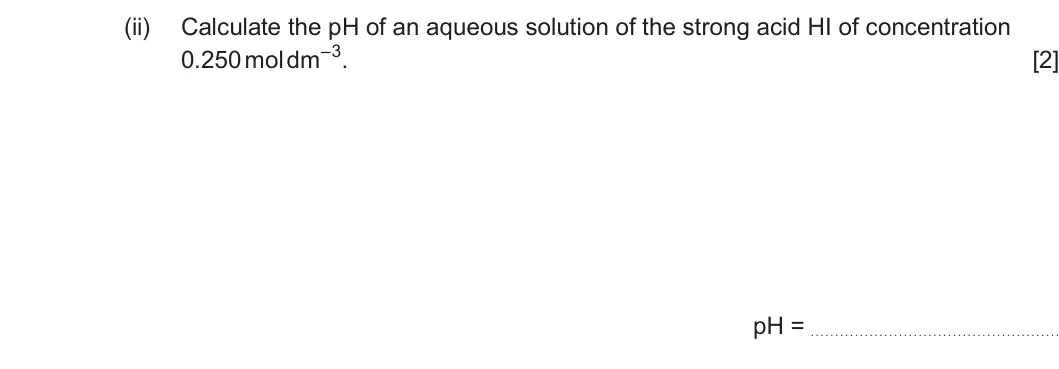
Q12(e)(i)
The whole paper ↗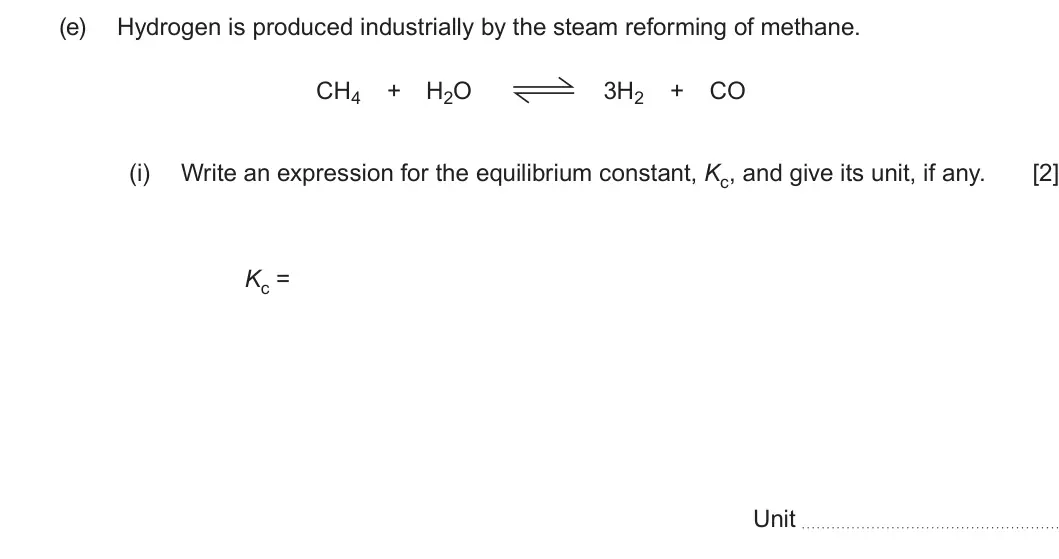
Q12(e)(ii)
The whole paper ↗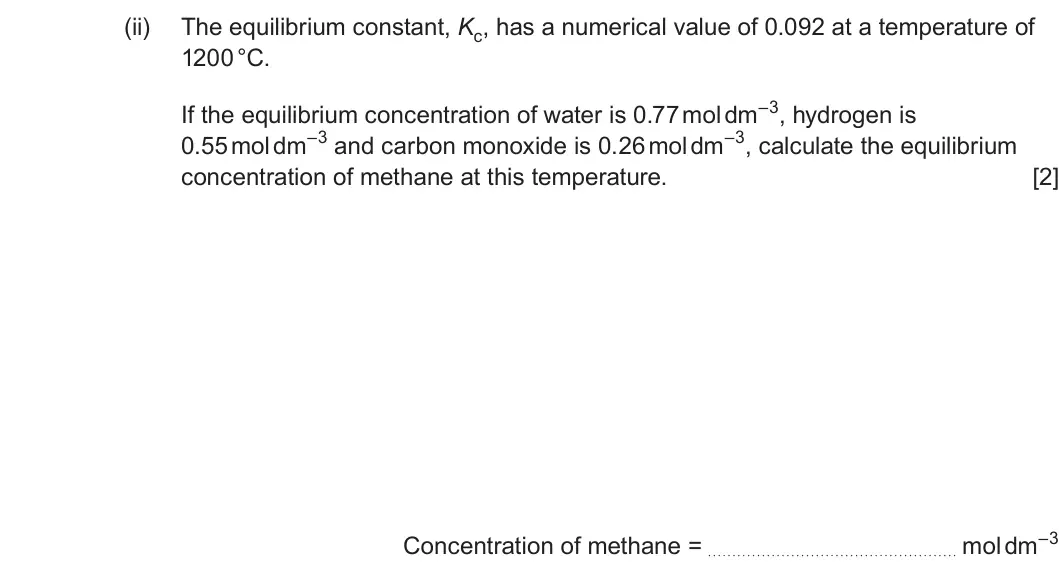
Q13(a)
The whole paper ↗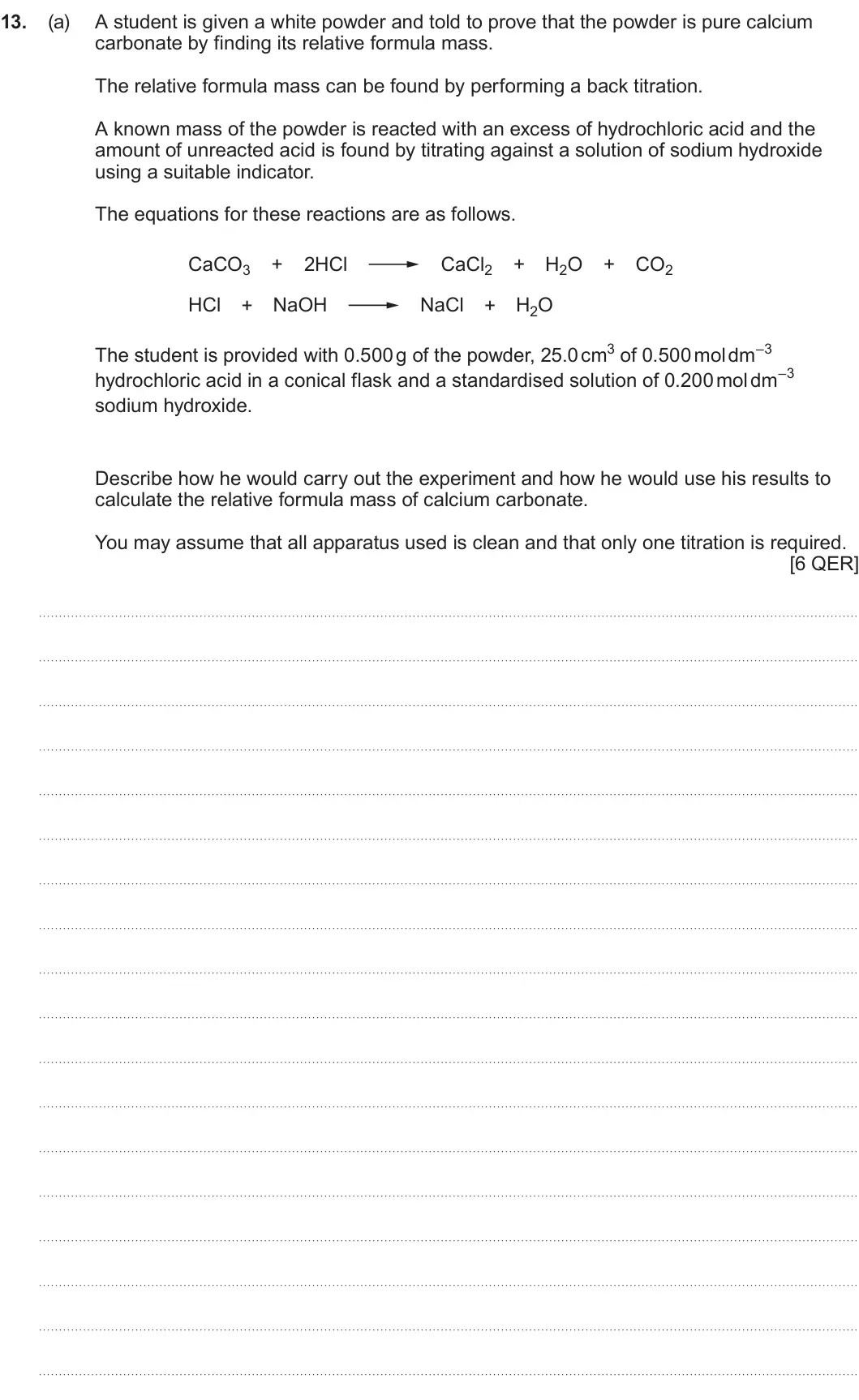
Q13(b)(i)
The whole paper ↗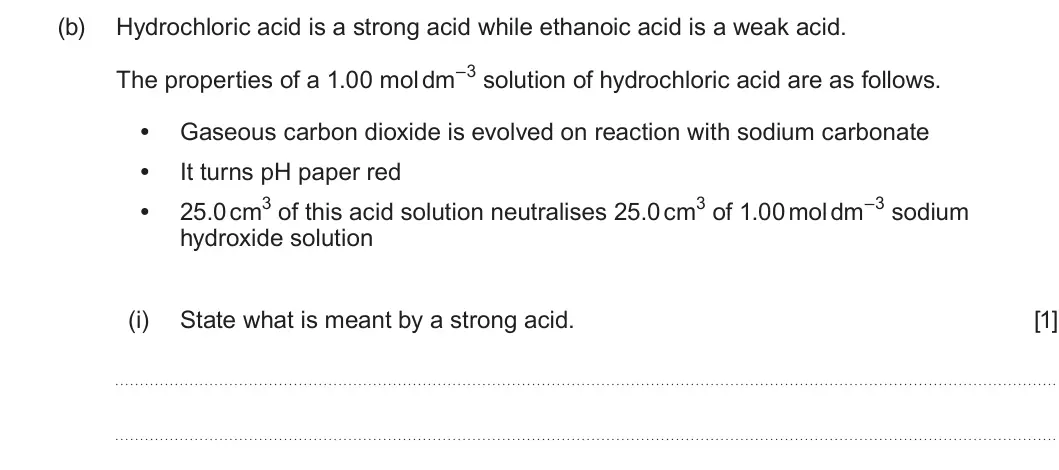
Q13(b)(ii)
The whole paper ↗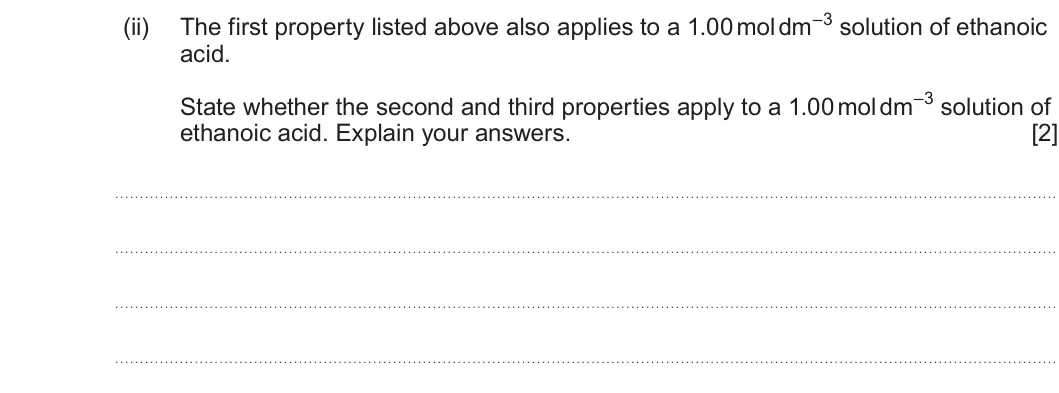
Q13(d)
The whole paper ↗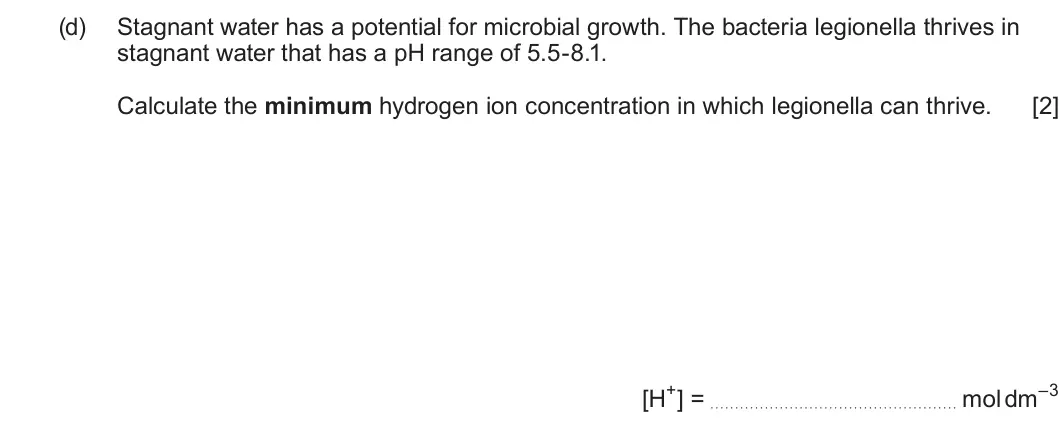
Q10(a)
The whole paper ↗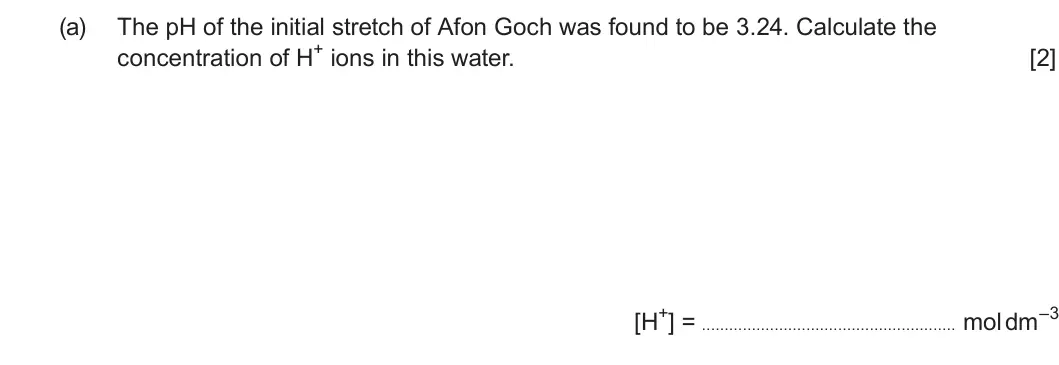
Q10(c)(i)
The whole paper ↗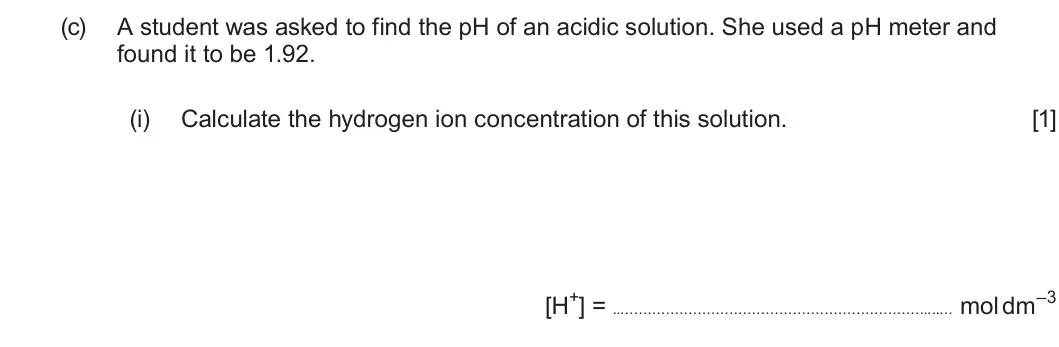
Q10(c)(ii)
The whole paper ↗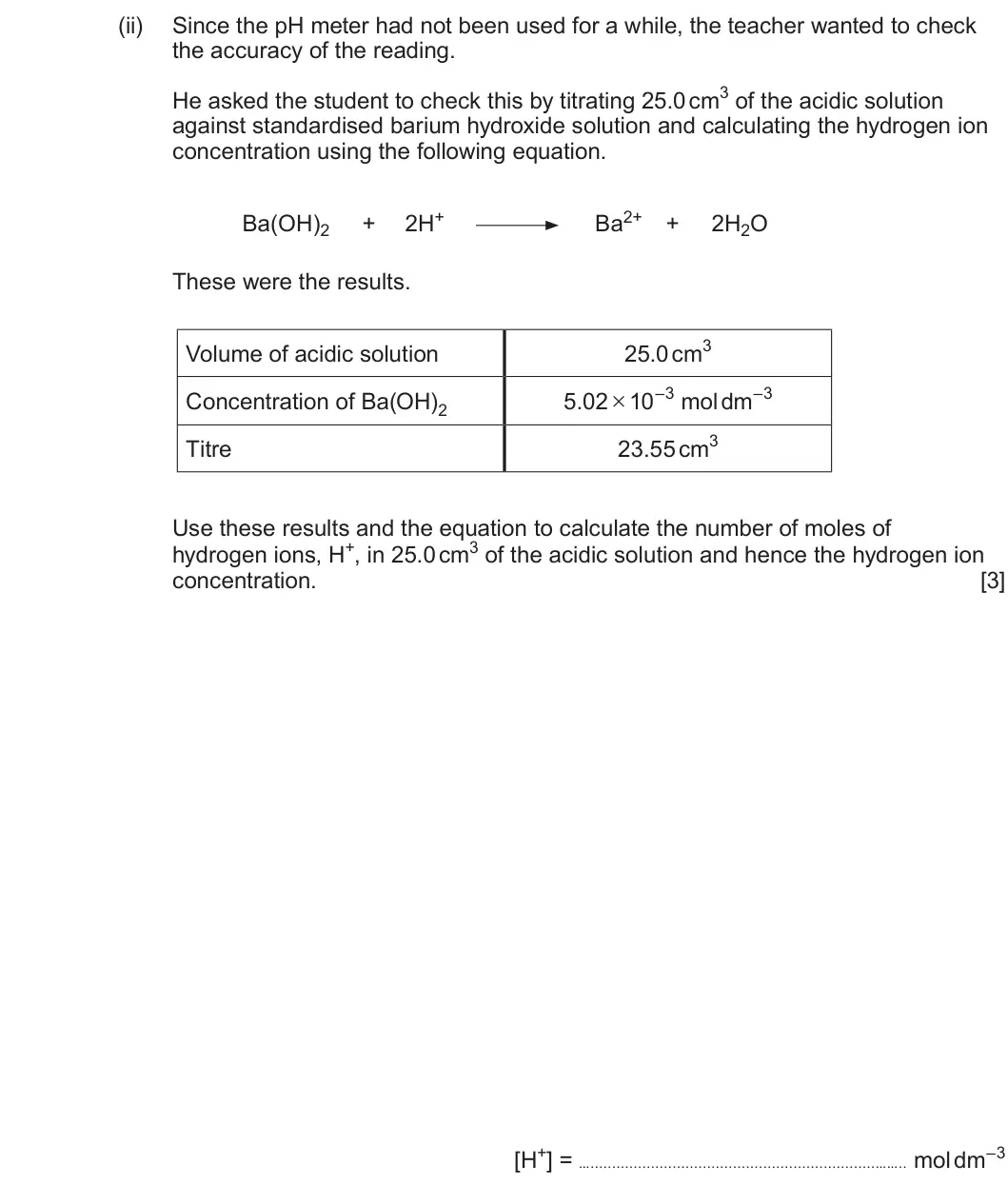
Q10(c)(iii)
The whole paper ↗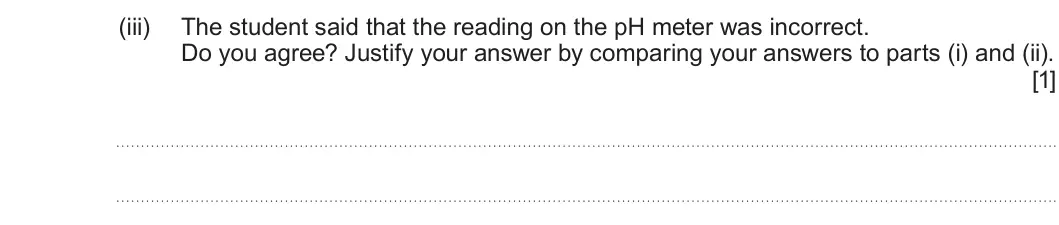
Q12(a)
The whole paper ↗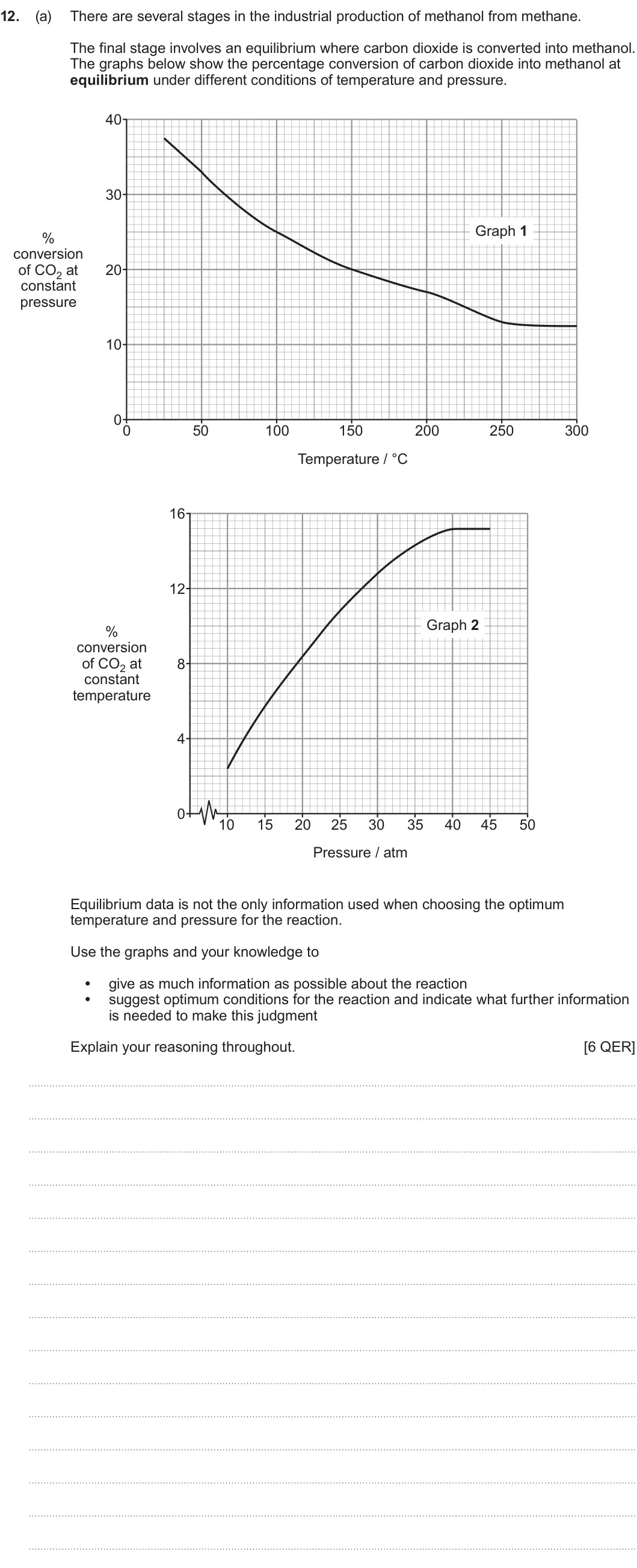
Q12(b)(i)
The whole paper ↗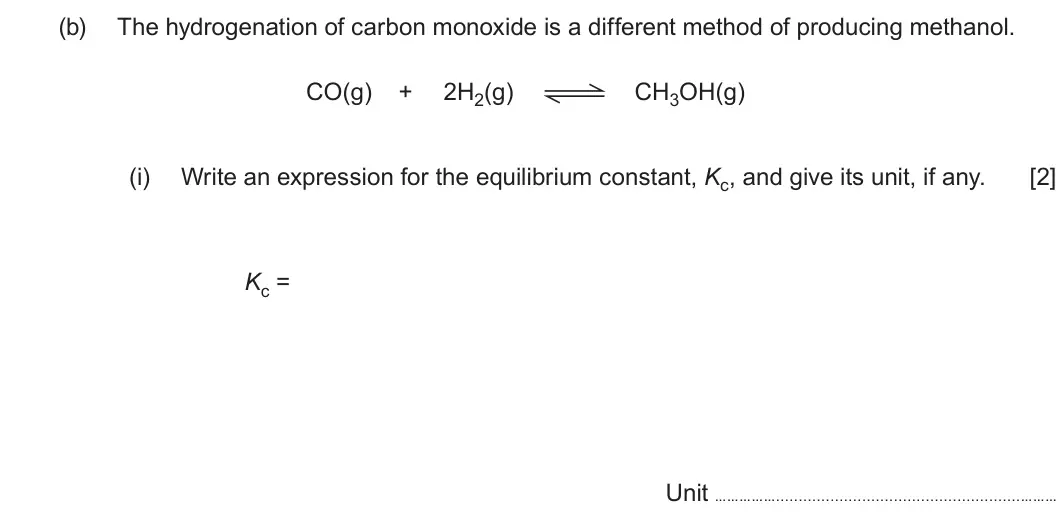
Q12(b)(ii)
The whole paper ↗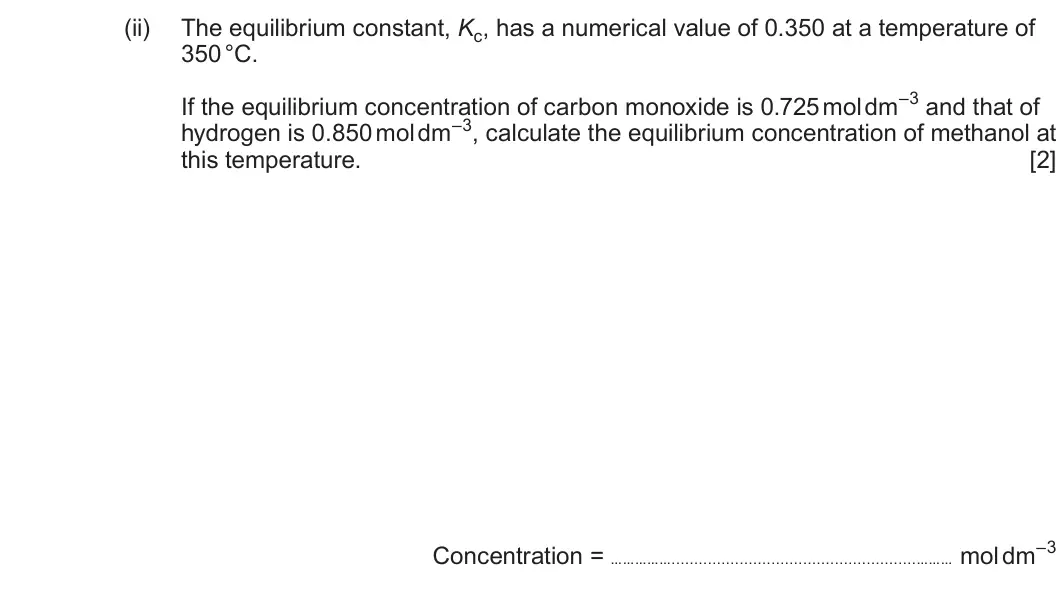
Q13(a)
The whole paper ↗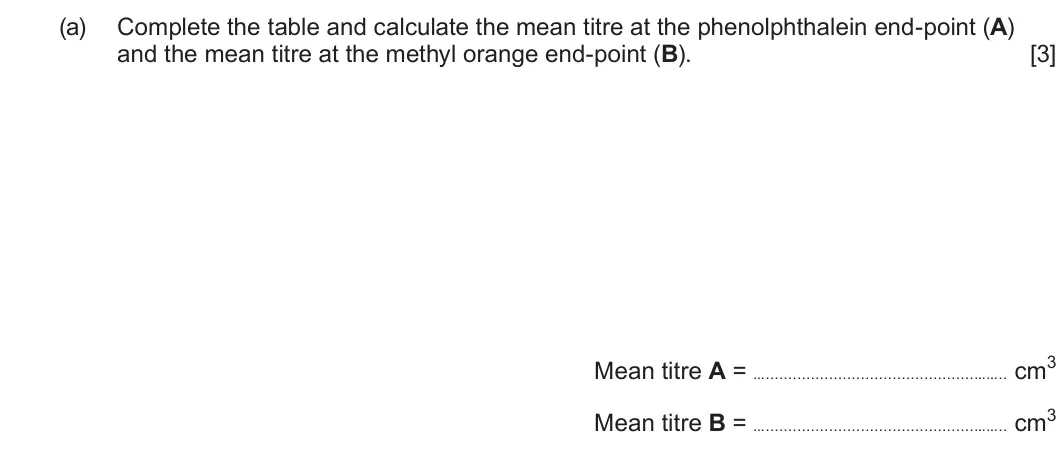
Q13(b)
The whole paper ↗
Q13(c)
The whole paper ↗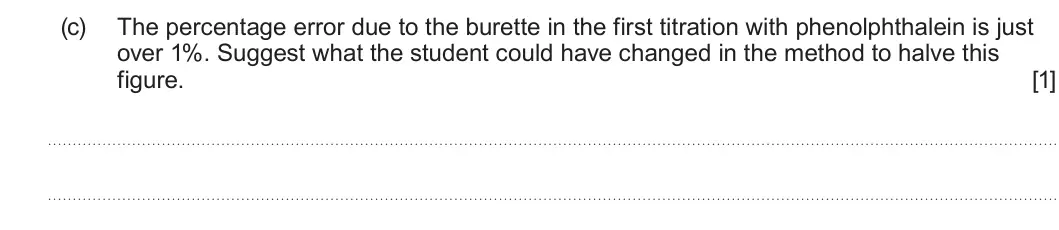
Q13(d)
The whole paper ↗
Q13(e)(i)
The whole paper ↗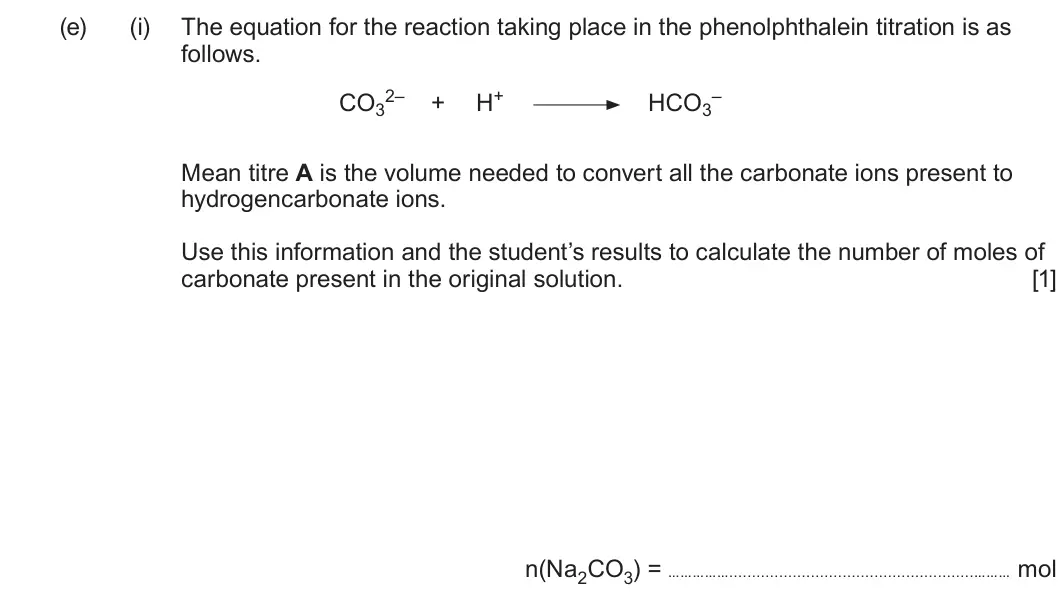
Q13(e)(ii)
The whole paper ↗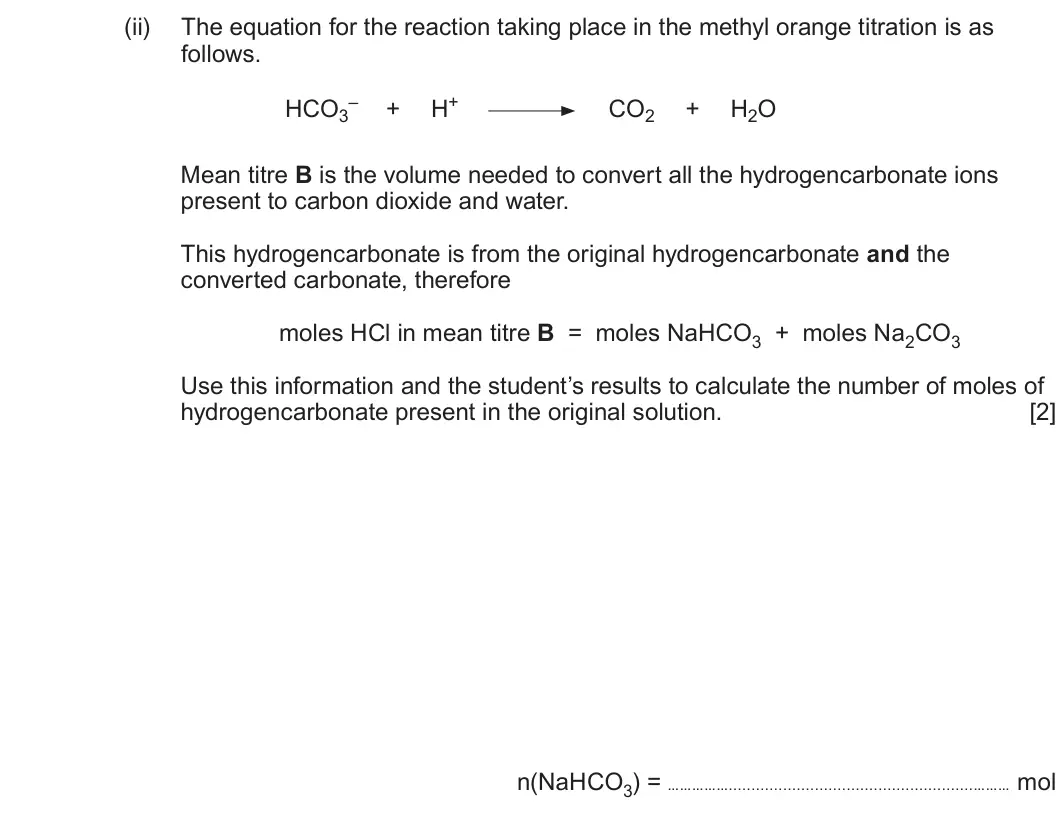
All 72 questions on Simple equilibria and acid-base reactions, as a list
- Summer 2025, Unit 3, Q9(b)(ii) (2 marks): Calculate the pH of an aqueous solution of the strong acid HI of concentration 0.250 mol dm–3. [2] pH =
- Summer 2025, AS Unit 1, Q12(e)(i) (2 marks): Write an expression for the equilibrium constant, Kc, and give its unit, if any. [2] Kc = Unit
- Summer 2025, AS Unit 1, Q12(e)(ii) (2 marks): The equilibrium constant, Kc, has a numerical value of 0.092 at a temperature of 1200 °C. If the equilibrium concentration of water is 0.77 mol dm–3, hydrogen i
- Summer 2025, AS Unit 1, Q13(a) (6 marks): A student is given a white powder and told to prove that the powder is pure calcium carbonate by finding its relative formula mass. The relative formula mass ca
- Summer 2025, AS Unit 1, Q13(b)(i) (1 mark): State what is meant by a strong acid. [1]
- Summer 2025, AS Unit 1, Q13(b)(ii) (2 marks): acid. State whether the second and third properties apply to a 1.00 mol dm–3 solution of ethanoic acid. Explain your answers. [2]
- Summer 2025, AS Unit 1, Q13(d) (2 marks): Stagnant water has a potential for microbial growth. The bacteria legionella thrives in stagnant water that has a pH range of 5.5-8.1. Calculate the minimum hyd
- Summer 2024, Unit 3, Q10(a) (2 marks): The pH of the initial stretch of Afon Goch was found to be 3.24. Calculate the concentration of H+ ions in this water. [2] [H+] = mol dm–3
- Summer 2024, AS Unit 1, Q10(c)(i) (1 mark): Calculate the hydrogen ion concentration of this solution. [1] [H+] = … …….. mol dm–3
- Summer 2024, AS Unit 1, Q10(c)(ii) (3 marks): Since the pH meter had not been used for a while, the teacher wanted to check the accuracy of the reading. He asked the student to check this by titrating 25.0
- Summer 2024, AS Unit 1, Q10(c)(iii) (1 mark): The student said that the reading on the pH meter was incorrect. Do you agree? Justify your answer by comparing your answers to parts (i) and (ii). [1]
- Summer 2024, AS Unit 1, Q12(a) (6 marks): There are several stages in the industrial production of methanol from methane. The final stage involves an equilibrium where carbon dioxide is converted into m
- Summer 2024, AS Unit 1, Q12(b)(i) (2 marks): Write an expression for the equilibrium constant, Kc, and give its unit, if any. [2] Kc = Unit
- Summer 2024, AS Unit 1, Q12(b)(ii) (2 marks): The equilibrium constant, Kc, has a numerical value of 0.350 at a temperature of 350 °C. If the equilibrium concentration of carbon monoxide is 0.725 mol dm–3 a
- Summer 2024, AS Unit 1, Q13(a) (3 marks): Complete the table and calculate the mean titre at the phenolphthalein end-point (A) and the mean titre at the methyl orange end-point (B). [3] Mean titre A = …
- Summer 2024, AS Unit 1, Q13(b) (1 mark): solution into the conical flask. [1] … ……..
- Summer 2024, AS Unit 1, Q13(c) (1 mark): The percentage error due to the burette in the first titration with phenolphthalein is just over 1%. Suggest what the student could have changed in the method t
- Summer 2024, AS Unit 1, Q13(d) (1 mark): Despite having a larger percentage error due to the burette, suggest a reason why mean titre A could be more accurate than mean titre B. [1]
- Summer 2024, AS Unit 1, Q13(e)(i) (1 mark): The equation for the reaction taking place in the phenolphthalein titration is as follows. CO32– H+ HCO3– + Mean titre A is the volume needed to convert all the
- Summer 2024, AS Unit 1, Q13(e)(ii) (2 marks): The equation for the reaction taking place in the methyl orange titration is as follows. HCO3– H+ + CO2 + H2O Mean titre B is the volume needed to convert all t
- Summer 2023, AS Unit 1, Q9(a) (1 mark): Over 180 million tonnes of ammonia are manufactured each year. The main use of ammonia is in the production of salts such as ammonium sulfate, which is used as
- Summer 2023, AS Unit 1, Q9(c)(i) (1 mark): State Le Chatelier’s principle. [1]
- Summer 2023, AS Unit 1, Q9(c)(ii) (2 marks): A student looked at curves A and B and said that the forward reaction is exothermic. Is he correct? Justify your answer by using Le Chatelier’s principle. [2]
- Summer 2023, AS Unit 1, Q9(c)(iii) (2 marks): On the graph, draw a curve that represents the reaction at 850 °C but with a catalyst added to the reaction mixture. Label this curve C. Explain the shape of th
- Summer 2023, AS Unit 1, Q9(d) (1 mark): Calculate its pH. [1] pH =
- Summer 2023, AS Unit 1, Q11(a)(i) (1 mark): Before starting the titration, the student rinses the burette with silver nitrate solution. Suggest why he does this. [1]
- Summer 2023, AS Unit 1, Q11(a)(ii) (1 mark): Suggest why the student dilutes the seawater. [1]
- Summer 2023, AS Unit 1, Q11(a)(iv) (2 marks): Describe and explain one action the student might take just before the endpoint of the titration, to ensure that the volume of silver nitrate added at the endpo
- Summer 2022, Unit 3, Q10(b) (2 marks): Calculate the concentration of the HA solution. [2] Concentration = mol dm–3
- Summer 2022, AS Unit 1, Q9(c)(i) (2 marks): the forward reaction is endothermic or exothermic. [2]
- Summer 2022, AS Unit 1, Q9(c)(ii) (2 marks): the forward reaction involves an increase or decrease in the number of moles of gas. [2]
- Summer 2022, AS Unit 1, Q11(b)(ii) (1 mark): A solution of arsenous acid has a pH of 5.11. Calculate the hydrogen ion concentration of this solution. [1] [H+] = mol dm–3
- Summer 2022, AS Unit 1, Q12(b) (1 mark): State why he adds an indicator to this solution. [1]
- Summer 2022, AS Unit 1, Q12(c) (1 mark): Suggest why he was told to carry out a rough titration first. [1]
- Summer 2022, AS Unit 1, Q12(d) (1 mark): State what you understand by the term ‘concordant titres’. [1]
- Summer 2022, AS Unit 1, Q12(e) (3 marks): Some of the student’s results are shown below: Mass of weighing bottle + carbonate / g 13.73 Mass of weighing bottle / g 12.48 Titration Rough 1 2 3 Final readi
- Summer 2022, AS Unit 1, Q12(f)(i) (2 marks): [2] number of moles =
- Summer 2019, AS Unit 1, Q11(c) (4 marks): The equation for the reaction between calcium carbonate and hydrochloric acid is as follows. CaCO3(s) + 2HCl(aq) CaCl2(aq) + H2O(l) + CO2(g) Use this and the st
- Summer 2019, AS Unit 1, Q11(d) (1 mark): Comment on the validity of the mean titre calculated. [1]
- Summer 2019, AS Unit 1, Q11(e) (2 marks): Another student follows the same procedure but filters the solution before the reaction is complete. State what effect, if any, this would have on the value of
- Summer 2019, AS Unit 1, Q13(a)(i) (1 mark): Chemical equilibria are often described as dynamic equilibria. Explain the term dynamic equilibrium. [1]
- Summer 2019, AS Unit 1, Q13(a)(ii) (2 marks): Use Le Chatelier’s principle to explain why the pale green colour disappears if sodium hydroxide solution is added. [2]
- Summer 2018, Unit 4, Q8(b)(i) (1 mark): Write a statement that links the mole ratio of HF : CH2Cl2 with the yield of difluoromethane. [1]
- Summer 2018, Unit 4, Q8(c)(i) (1 mark): Suggest, giving a reason, whether a high or low pressure should be used in stage 1 [1]
- Summer 2018, Unit 4, Q8(c)(ii) (1 mark): Suggest, giving a reason, whether a high or low temperature should be used in stage 2 [1]
- Summer 2018, AS Unit 1, Q8(e) (1 mark): Hydrazine acts as a base in a similar way to ammonia. Suggest an equation for the equilibrium formed when hydrazine dissolves in water. [1]
- Summer 2018, AS Unit 1, Q9(b)(i) (1 mark): Suggest why she did not need to measure the volume of water accurately. [1]
- Summer 2018, AS Unit 1, Q9(b)(ii) (1 mark): Suggest why she heated the flask for 5 to 10 minutes. [1]
- Summer 2018, AS Unit 1, Q9(c) (2 marks): The student used the results from three titrations to calculate a mean titre. Some of her results are shown below. Titration 1 2 3 Final reading / cm3 26.90 26.
- Summer 2018, AS Unit 1, Q9(d) (2 marks): Ascorbic acid can decompose upon exposure to air. If this reaction occurred before the titration was completed, state how it might affect the titration results.
- Summer 2018, AS Unit 1, Q9(e) (3 marks): The equation for the reaction between ascorbic acid and sodium hydroxide is given below. C6H8O6 + NaOH C6H7O6Na + H2O Mr 176 The percentage of ascorbic acid is
- Summer 2018, AS Unit 1, Q9(f)(i) (2 marks): [2] pH =
- Summer 2018, AS Unit 1, Q10(a)(i) (4 marks): A student said that the equilibrium must lie to the left because the concentrations of nitrogen and hydrogen are greater than that of ammonia. Is he correct? Ju
- Summer 2018, AS Unit 1, Q10(a)(ii) (2 marks): When the temperature is increased the equilibrium yield of NH3 decreases. The student said that the reaction is endothermic. Is he correct? Justify your answer
- Summer 2017, Unit 3, Q9(c)(i) (2 marks): Explain why the use of a catalyst is essential in industrial processes involving exothermic equilibria such as stage 1 [2]
- Summer 2017, Unit 3, Q9(c)(ii) (4 marks): A student attempted to perform stage 2 using a temperature of 450 K and a pressure of 5 atm. He obtained only a small yield. Suggest how the yield could be impr
- Summer 2017, Unit 3, Q10(e)(i) (1 mark): The pH of a dilute solution of nitric acid is measured using a pH probe and has a value of 0.3. Calculate the concentration of this solution. [1] Concentration
- Summer 2017, Unit 3, Q10(e)(ii) (2 marks): An alternative way of measuring the concentration of the solution is by titration against a standard solution of sodium hydrogencarbonate of concentration 0.500
- Summer 2017, Unit 4, Q9(d)(ii) (3 marks): The esterification of 2-aminobenzoic acid is a reversible reaction and eventually the mixture will reach equilibrium. Use the information below to suggest why t
- Summer 2017, AS Unit 1, Q7(b)(i) (1 mark): Calculate the mean titre that should be used to determine the concentration of the hydrochloric acid. [1] Mean titre = cm3
- Summer 2017, AS Unit 1, Q7(b)(ii) (1 mark): The burette used in the titrations has an uncertainty for each reading of ± 0.05 cm3. Estimate the maximum percentage error in the titre in titration 4 Show you
- Summer 2017, AS Unit 1, Q7(b)(iii) (2 marks): Apart from errors in reading the burette, suggest one reason why incorrect titres may have been obtained when carrying out the titrations. Explain the effect of
- Summer 2017, AS Unit 1, Q7(c)(i) (3 marks): the number of moles that reacted with the fertiliser. [3] n(NaOH) = mol
- Summer 2017, AS Unit 1, Q8(b) (2 marks): Sulfur dioxide can react with oxygen and water to form sulfuric acid. Although sulfuric acid is a strong acid, it does not have to be a concentrated acid. Expla
- Summer 2017, AS Unit 1, Q8(c)(i) (2 marks): A student was given an aqueous solution of an acid HX and was asked to find out if it was a strong or weak acid. 25.0 cm3 of the acid HX required 15.90 cm3 of 0
- Summer 2017, AS Unit 1, Q8(c)(ii) (2 marks): A teacher measured the pH of the aqueous solution and found it to be 2.10. She told the student that the acid in the solution must be a strong one. Is she corre
- Summer 2017, AS Unit 1, Q8(d)(i) (2 marks): State and explain what you would observe on adding water to the equilibrium mixture. [2]
- Summer 2017, AS Unit 1, Q8(d)(ii) (2 marks): State and explain what you would observe on heating the equilibrium mixture. [2]
- Summer 2016, AS Unit 1, Q7(a) (1 mark): Write the expression for the equilibrium constant in terms of concentration, Kc, for this reaction. [1]
- Summer 2016, AS Unit 1, Q7(b) (2 marks): The equilibrium constant, Kc , for this reaction has a value of 46.0 at a certain temperature. Calculate the equilibrium concentration of hydrogen at this tempe
- Summer 2016, AS Unit 1, Q10(e) (3 marks): Solid magnesium hexafluorosilicate hydrolyses rapidly when added to water. One equation for this reaction is as follows. MgSiF6(s) + 2H2O(l) Mg2+(aq) + 6F–(aq)
- Summer 2016, AS Unit 1, Q11(c) (6 marks): Ammonium sulfate can be prepared in the laboratory by neutralising aqueous sulfuric acid with ammonia solution in an acid-base titration. 2NH3(aq) + H2SO4(aq) (
Questions, mark schemes and examiner’s reports are © WJEC CBAC Ltd, from their published past papers. Plumi isn’t affiliated with any exam board. Want whole papers? Every WJEC A-Level Chemistry paper.
Rather write your answers by hand on iPad? Plumi marks them against the same mark schemes.