 plumi
The periodic table: WJEC A‑Level Chemistry questions
Every WJEC A-Level Chemistry exam question on 1.6 The periodic table, 2016–2025, with its mark scheme and examiner’s report.
Find questions1,204
Calculations
Q7(a)(iii)
The whole paper ↗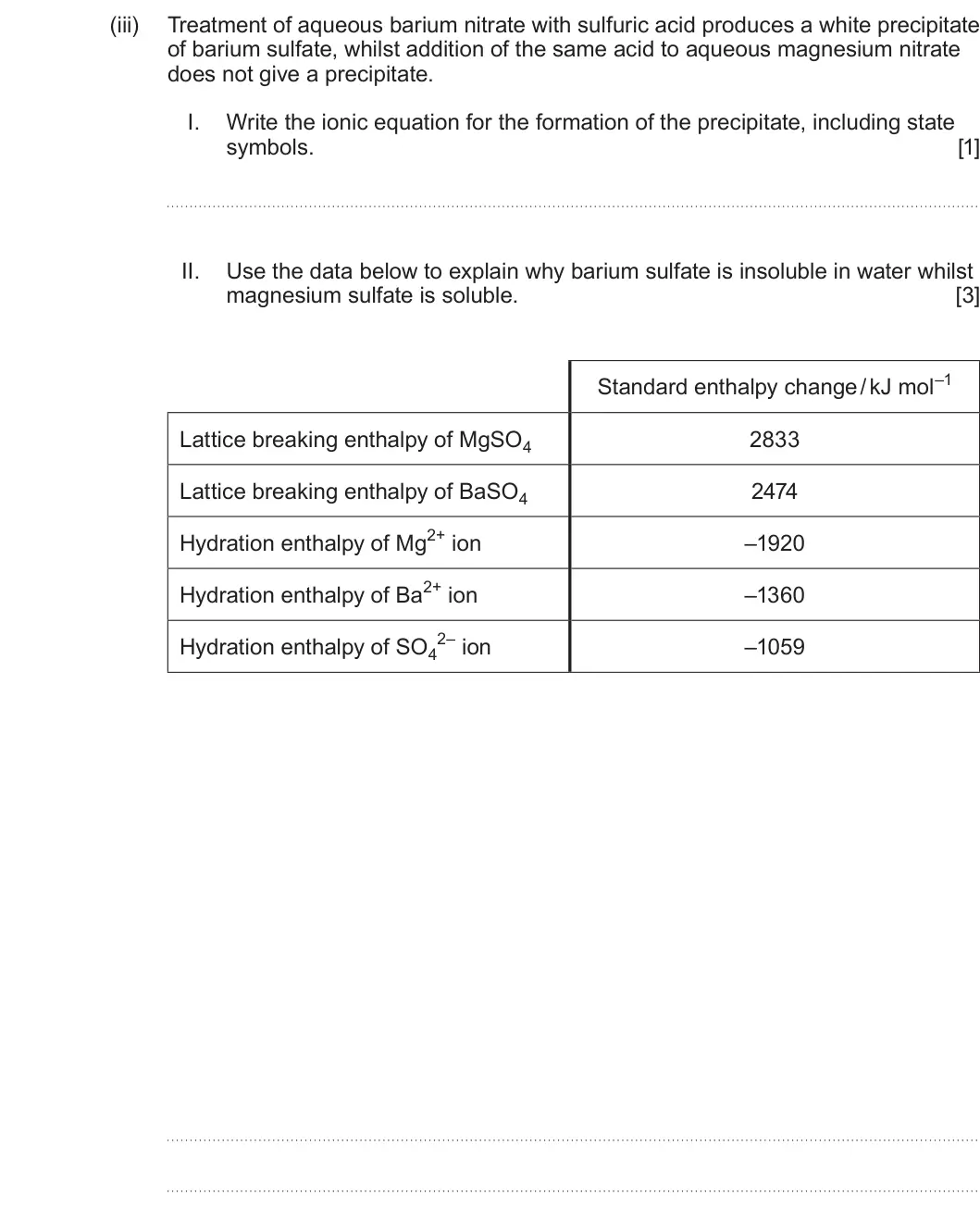
Q8(a)(i)
The whole paper ↗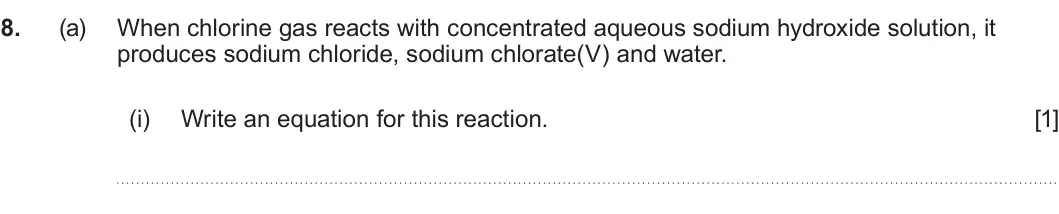
Q8(a)(ii)
The whole paper ↗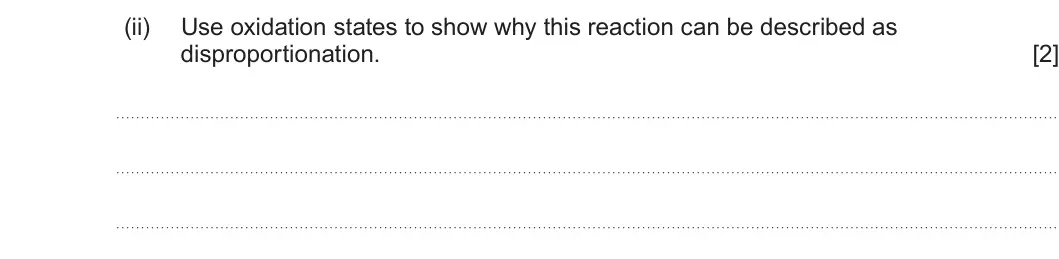

Q6(a)
The whole paper ↗
Q6(b)
The whole paper ↗
Q11(c)(i)
The whole paper ↗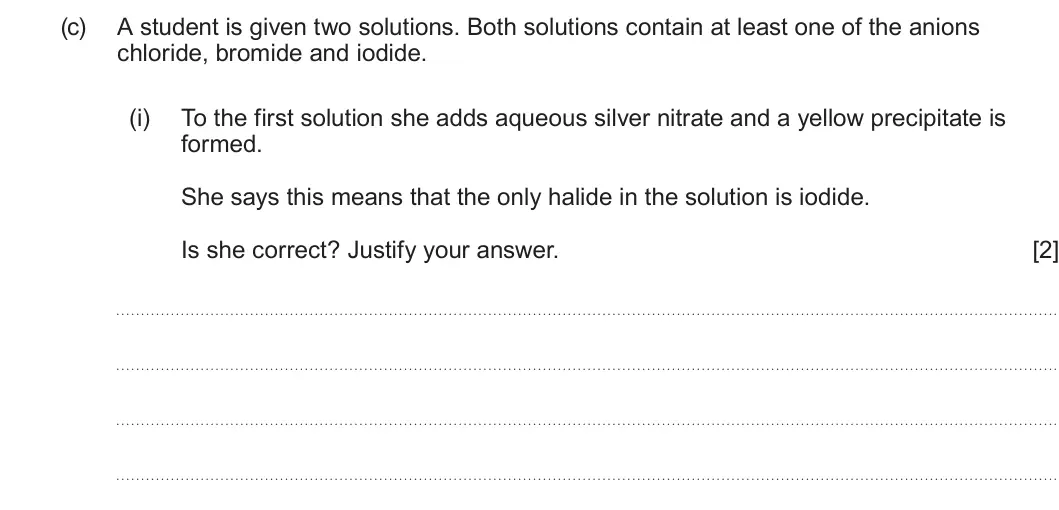
Q11(c)(ii)
The whole paper ↗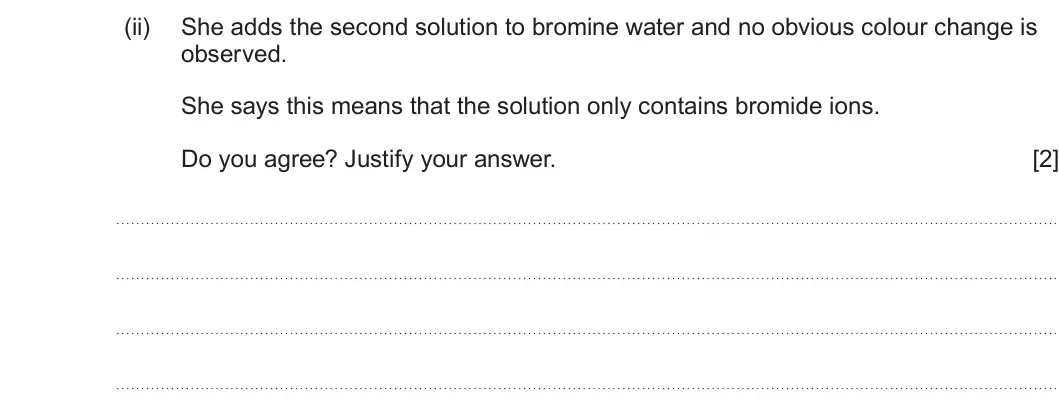
Q2(a)
The whole paper ↗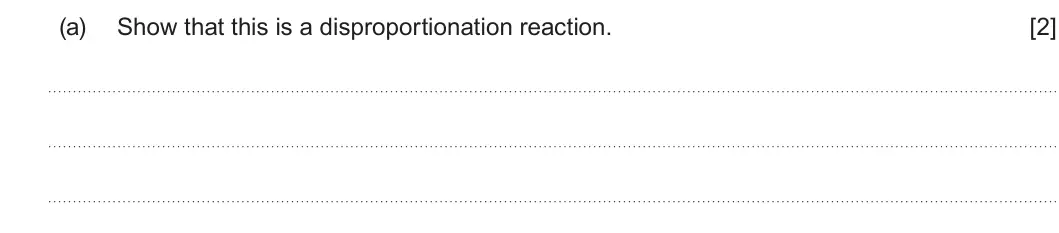
Q2(b)
The whole paper ↗
Q9(a)(i)
The whole paper ↗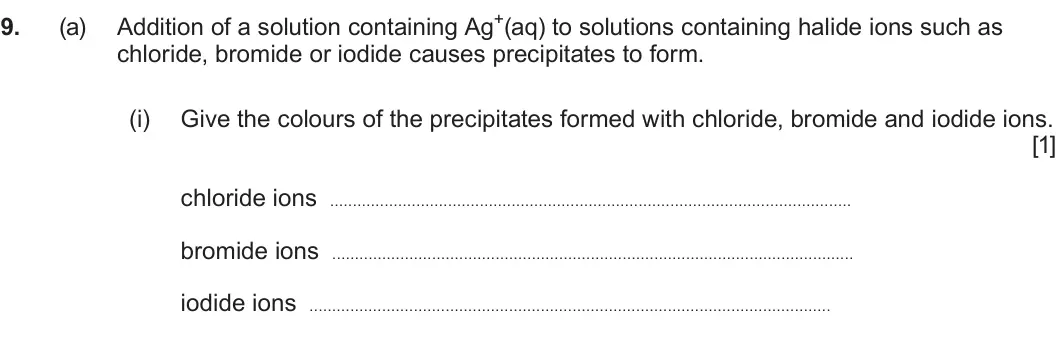



Q9(b)(i)
The whole paper ↗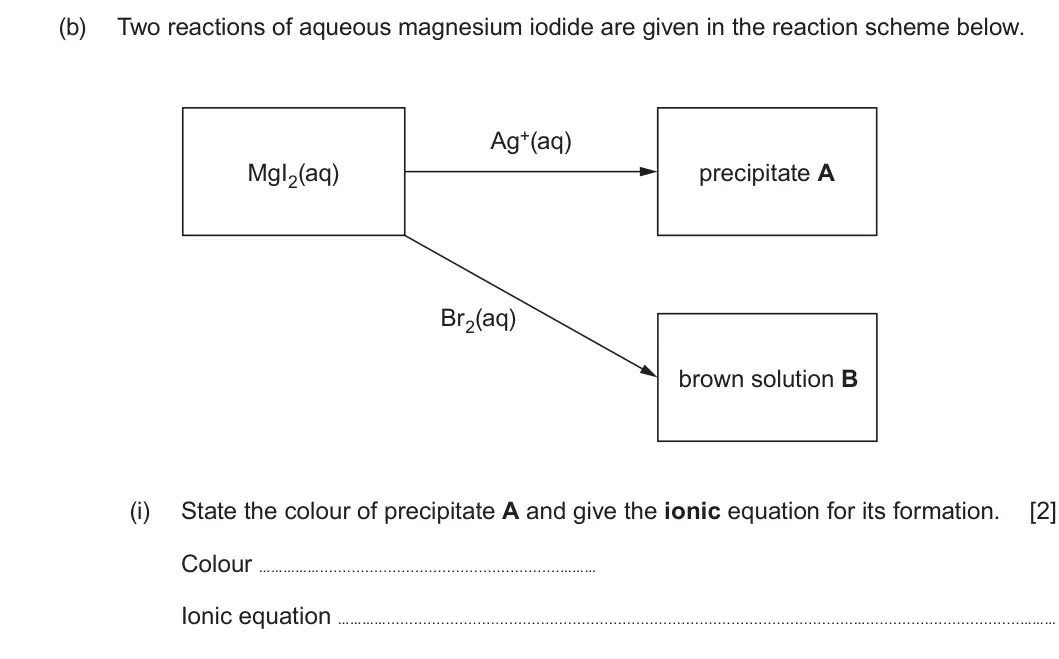
Q9(b)(ii)
The whole paper ↗
Q9(c)
The whole paper ↗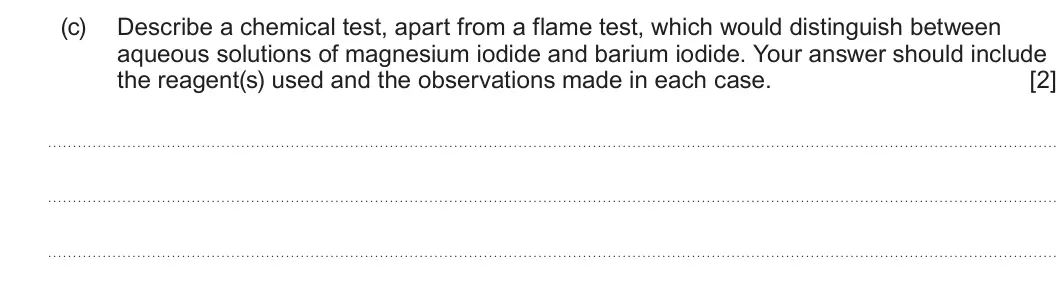
All 81 questions on The periodic table, as a list
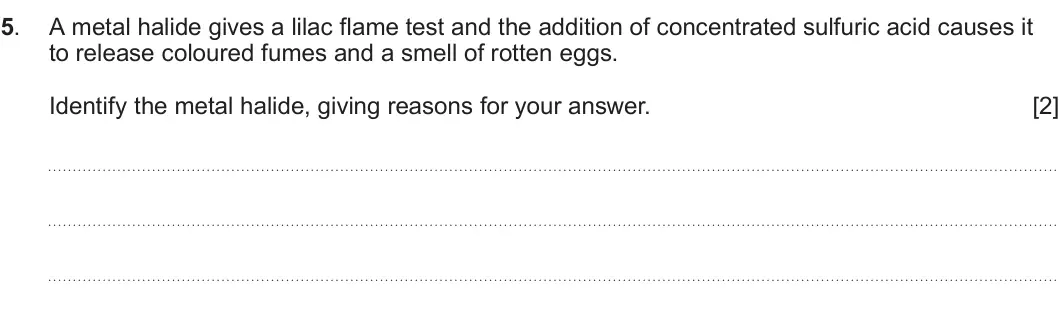
- Summer 2025, Unit 3, Q5 (2 marks): A metal halide gives a lilac flame test and the addition of concentrated sulfuric acid causes it to release coloured fumes and a smell of rotten eggs. Identify
- Summer 2025, Unit 3, Q7(a)(iii) (4 marks): Treatment of aqueous barium nitrate with sulfuric acid produces a white precipitate of barium sulfate, whilst addition of the same acid to aqueous magnesium nit
- Summer 2025, Unit 3, Q8(a)(i) (1 mark): Write an equation for this reaction. [1]
- Summer 2025, Unit 3, Q8(a)(ii) (2 marks): Use oxidation states to show why this reaction can be described as disproportionation. [2]
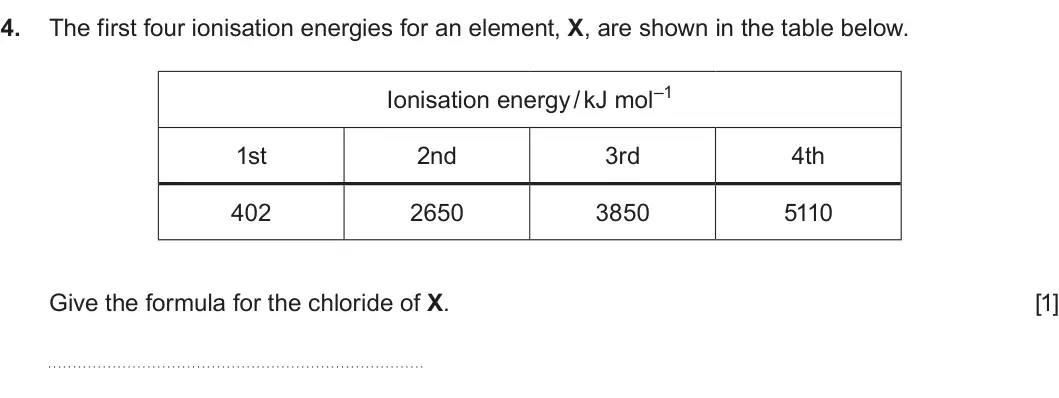
- Summer 2025, AS Unit 1, Q4 (1 mark): The first four ionisation energies for an element, X, are shown in the table below. Ionisation energy / kJ mol–1 1st 2nd 3rd 4th 402 2650 3850 5110 Give the for
- Summer 2025, AS Unit 1, Q5 (1 mark): State the total number of orbitals that are occupied in a nitrogen atom. [1]
- Summer 2025, AS Unit 1, Q6(a) (1 mark): State which element forms the sulfate that is least soluble in water. [1]
- Summer 2025, AS Unit 1, Q6(b) (1 mark): State which element forms compounds which give an apple-green flame test. [1]
- Summer 2025, AS Unit 1, Q11(c)(i) (2 marks): To the first solution she adds aqueous silver nitrate and a yellow precipitate is formed. She says this means that the only halide in the solution is iodide. Is
- Summer 2025, AS Unit 1, Q11(c)(ii) (2 marks): She adds the second solution to bromine water and no obvious colour change is observed. She says this means that the solution only contains bromide ions. Do you
- Summer 2024, Unit 3, Q2(a) (2 marks): Show that this is a disproportionation reaction. [2]
- Summer 2024, Unit 3, Q2(b) (1 mark): Give one common use for sodium chlorate(I). [1]
- Summer 2024, Unit 3, Q9(a)(i) (1 mark): Give the colours of the precipitates formed with chloride, bromide and iodide ions. [1] chloride ions bromide ions iodide ions
- Summer 2024, AS Unit 1, Q1 (1 mark): State why chlorine is used in water treatment. [1]
- Summer 2024, AS Unit 1, Q2 (1 mark): State the pattern in electronegativity across Period 3 in the Periodic Table. [1]
- Summer 2024, AS Unit 1, Q3 (1 mark): Name the element in Period 3 that has a half-filled set of p-orbitals. [1]
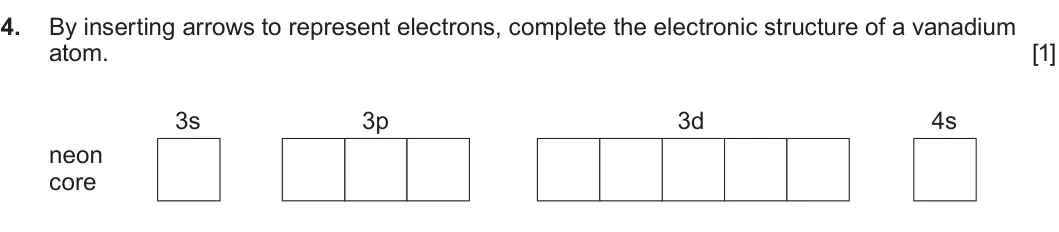
- Summer 2024, AS Unit 1, Q4 (1 mark): By inserting arrows to represent electrons, complete the electronic structure of a vanadium atom. [1] 3s 3p 3d 4s neon core
- Summer 2024, AS Unit 1, Q9(b)(i) (2 marks): State the colour of precipitate A and give the ionic equation for its formation. [2] Colour Ionic equation …
- Summer 2024, AS Unit 1, Q9(b)(ii) (2 marks): Name the product that gives solution B its brown colour and state the role of aqueous bromine in this reaction. [2]
- Summer 2024, AS Unit 1, Q9(c) (2 marks): Describe a chemical test, apart from a flame test, which would distinguish between aqueous solutions of magnesium iodide and barium iodide. Your answer should i
- Summer 2024, AS Unit 1, Q11(a)(i) (1 mark): State how the graph shows that element X is in Group 2 [1]
- Summer 2024, AS Unit 1, Q11(a)(ii) (3 marks): Element Y has an atomic number one less than X, while element Z has an atomic number one more than X. Since there is a general increase in first ionisation ener
- Summer 2024, AS Unit 1, Q11(b)(i) (1 mark): Write an equation to represent the second ionisation energy of sodium. Include state symbols. [1]
- Summer 2023, Unit 3, Q3 (2 marks): A white crystalline solid gives a red colour in a flame test and addition of concentrated sulfuric acid to the solid gives purple fumes and a smell of rotten eg
- Summer 2023, AS Unit 1, Q5 (1 mark): 40 A student said that 16 S2– and 20 Ca2+ 5 have the same electronic configuration. Do you agree? Give a reason for your answer. [1]
- Summer 2023, AS Unit 1, Q8(c)(i) (1 mark): Sketch a graph of log (ionisation energy) for the successive ionisations of aluminium. The first and last points have been plotted for you. [1] 1 2 3 4 5 6 7 8
- Summer 2023, AS Unit 1, Q8(c)(ii) (2 marks): I. Explain the general slope of the graph. [1] II. Explain the reason for any sharp changes in the graph. [1]
- Summer 2023, AS Unit 1, Q10(a)(i) (1 mark): Suggest an improvement to the method to ensure that the experiment is a fair test. [1]
- Summer 2023, AS Unit 1, Q10(a)(ii) (1 mark): Suggest why the delivery tube should be lifted out of the limewater before the flame is removed from under the boiling tube. [1]
- Summer 2023, AS Unit 1, Q10(a)(iii) (1 mark): State what conclusion she can draw about the thermal stabilities of the Group 2 carbonates from these results. [1]
- Summer 2023, AS Unit 1, Q10(a)(iv) (1 mark): The student was told that the temperature at which barium carbonate decomposes is 1360 °C. The maximum temperature of a typical Bunsen burner flame is around 80
- Summer 2023, AS Unit 1, Q10(d) (2 marks): The atomic radius of a barium atom is 0.217 nm. From the list below, choose the value for the ionic radius of a barium ion. Give a reason for your choice. [2] 0
- Summer 2022, Unit 3, Q8(c) (6 marks): Tachyhydrite is a soft, soluble mineral that has a general formula of AaBbXc.dH2O. A and B represent two different s-block metal ions, with X representing an an
- Summer 2022, AS Unit 1, Q3 (1 mark): By inserting arrows to represent electrons, show the electronic configuration of a calcium atom. [1] 1s 2s 2p 3s 3p 3d 4s
- Summer 2022, AS Unit 1, Q8(b)(i) (2 marks): State what the developer would see if cadmium ions were present when they added: I. sodium hydroxide solution. [1] II. sodium sulfate solution. [1]
- Summer 2022, AS Unit 1, Q10(a) (6 marks): Group 1 and Group 2 metals are in the s-block of the Periodic Table. Using potassium and calcium as examples, discuss the similarities and differences between G
- Summer 2022, AS Unit 1, Q10(c) (2 marks): A solution is thought to contain potassium chloride. Describe suitable tests that a student could do to confirm this. Include the expected observations. [2]
- Summer 2022, AS Unit 1, Q10(d) (2 marks): are unlikely to form. [2]
- Summer 2019, Unit 3, Q1 (1 mark): Complete the electronic structure of the Co2+ ion below. 1 [1] 1s2 2s2 2p6 3s2 3p6
- Summer 2019, Unit 3, Q9(b)(iii) (1 mark): State the colour observed in a flame test using calcium chloride. [1]
- Summer 2019, Unit 3, Q9(c) (3 marks): Calcium halides react with concentrated sulfuric acid in a similar manner to sodium halides. State the observation(s) when concentrated sulfuric acid is added t
- Summer 2019, Unit 3, Q12(a)(i) (2 marks): State which compound(s) would give effervescence and why they do so. [2]
- Summer 2019, AS Unit 1, Q2 (1 mark): In some areas, fluoride ions are added to drinking water. State one benefit of adding fluoride ions to water. [1]
- Summer 2019, AS Unit 1, Q4 (1 mark): Sodium forms only one stable ion. By inserting arrows to represent electrons, complete the electronic structure of this ion. [1] 1s 2s 2p 3s 3p
- Summer 2019, AS Unit 1, Q9(a)(i) (3 marks): Give the letter (A-G) of the element with the largest first ionisation energy. Give two reasons for your answer. [3]
- Summer 2019, AS Unit 1, Q9(a)(ii) (2 marks): Give the letter (A-G) of the element with the largest last ionisation energy. Give a reason for your answer. [2]
- Summer 2019, AS Unit 1, Q9(a)(iii) (2 marks): Give the letters (A-G) of all the elements above that are metals. [2]
- Summer 2019, AS Unit 1, Q9(a)(iv) (1 mark): Give the letters (A-G) of all the elements above that form basic oxides. [1]
- Summer 2019, AS Unit 1, Q12(a)(i) (2 marks): A student correctly identified the metal ion as calcium. Give two reasons why she came to that conclusion. [2]
- Summer 2019, AS Unit 1, Q12(a)(ii) (1 mark): Name compound B. [1]
- Summer 2019, AS Unit 1, Q12(c) (6 marks): Describe, giving brief experimental details, how you would obtain the maximum amount of magnesium carbonate from a known mass of magnesium, in a two-stage proce
- Summer 2018, Unit 3, Q1 (1 mark): Give the electronic configuration of a copper atom. [1]
- Summer 2018, Unit 3, Q3(a) (1 mark): Write the equation for the reaction of hot concentrated aqueous sodium hydroxide with chlorine. [1]
- Summer 2018, Unit 3, Q3(b) (1 mark): This is an example of a disproportionation reaction. State what is meant by the term disproportionation. [1]
- Summer 2018, Unit 3, Q8(a) (3 marks): Sodium chloride and sodium bromide both react with concentrated sulfuric acid. Describe the observations in both reactions and explain why they are different. [
- Summer 2018, Unit 3, Q12(a) (2 marks): A student was provided with five ionic solids containing familiar cations and anions. Each solid contains a different cation. The solids were labelled A, B, C,
- Summer 2018, AS Unit 1, Q2 (1 mark): The first four ionisation energies for an element are shown in the table below. Ionisation energy / kJ mol–1 1st 2nd 3rd 4th 548 1060 4120 5440 State to which g
- Summer 2018, AS Unit 1, Q3 (1 mark): By inserting arrows to represent electrons, complete the electronic structure of a chromium atom. [1] 3s 3p 3d 4s neon core
- Summer 2018, AS Unit 1, Q5(b) (1 mark): Explain why electronegativity increases across a period in the Periodic Table. [1]
- Summer 2018, AS Unit 1, Q6(a) (1 mark): Give the ionic equation for this reaction. [1]
- Summer 2018, AS Unit 1, Q6(b) (1 mark): Describe a test, apart from the use of chlorine, to show that a solution contains bromide ions. Give the reagent(s) and observation(s). [1] Reagent(s) Observati
- Summer 2018, AS Unit 1, Q7(b) (2 marks): State and explain how you would expect the first ionisation energy of nitrogen to compare with the first ionisation energy of oxygen. [2]
- Summer 2018, AS Unit 1, Q8(b)(i) (2 marks): Explain what this statement means. [2]
- Summer 2018, AS Unit 1, Q11(a)(i) (6 marks): Devise a plan that unambiguously proves which anions are present in the mixture. You should also give any observations and conclusions that enable you to identi
- Summer 2018, AS Unit 1, Q11(a)(ii) (2 marks): A student said that the cation in the mixture can only be sodium since all the possible anions form a soluble salt with sodium. Is he correct? Justify your answ
- Summer 2017, Unit 3, Q11(b)(i) (2 marks): Identify the halide present in the compound, explaining fully all observations that led to your conclusion. [2]
- Summer 2017, AS Unit 1, Q6(b)(i) (2 marks): helium [2]
- Summer 2017, AS Unit 1, Q6(b)(ii) (2 marks): lithium [2]
- Summer 2017, AS Unit 1, Q8(a)(ii) (1 mark): Give the full electronic configuration of a copper atom. [1]
- Summer 2017, AS Unit 1, Q9(a) (6 marks): A student is given five beakers labelled A, B, C, D and E. Each contains a different solution. The solutions are barium bromide, barium nitrate, calcium chlorid
- Summer 2017, AS Unit 1, Q9(b) (2 marks): Give a test which would confirm the presence of calcium ions in aqueous calcium chloride. State the result of the test. [2]
- Summer 2017, AS Unit 1, Q9(d) (2 marks): All Group 2 carbonates are insoluble and can be precipitated, dried and weighed in experiments similar to that in part (c). However, the strong heating needed t
- Summer 2016, AS Unit 1, Q1 (1 mark): Using the convention of arrows to represent electrons, complete the electronic structure of an arsenic atom, As. [1] 3d 4s 4p [Ar] argon core
- Summer 2016, AS Unit 1, Q4 (1 mark): Explain why the second molar ionisation energy of sodium is greater than its first molar ionisation energy. [1]
- Summer 2016, AS Unit 1, Q8(d)(i) (1 mark): State what would be seen during the reaction apart from gas bubbles. [1]
- Summer 2016, AS Unit 1, Q8(e) (2 marks): When barium sulfide is added to water a similar reaction occurs to that described in part (d) with gaseous hydrogen sulfide and barium hydroxide being the produ
- Summer 2016, AS Unit 1, Q8(f) (2 marks): Barium hydroxide can also be produced by adding barium oxide to water. Give the equation for this reaction and estimate the pH of the product. [2]
- Summer 2016, AS Unit 1, Q8(g) (2 marks): [2]
- Summer 2016, AS Unit 1, Q12(a)(i) (3 marks): One student decided to try electrolysis. He dissolved some of the mixture in distilled water to give a concentrated solution. He then passed electricity through
- Summer 2016, AS Unit 1, Q12(a)(ii) (3 marks): Another student decided to use a chemical test. She dissolved some of the mixture in distilled water and then added a little aqueous silver nitrate. After notin
- Summer 2016, AS Unit 1, Q12(c) (2 marks): The table shows bond energy values and absorption maxima for the hydrogen halides. Bond energy Absorption H–X maximum / nm / kJ mol–1 H–F 562 212 H–Cl 431 278 H
Questions, mark schemes and examiner’s reports are © WJEC CBAC Ltd, from their published past papers. Plumi isn’t affiliated with any exam board. Want whole papers? Every WJEC A-Level Chemistry paper.
Rather write your answers by hand on iPad? Plumi marks them against the same mark schemes.