 plumi
Chemical calculations: WJEC A‑Level Chemistry questions
Every WJEC A-Level Chemistry exam question on 1.3 Chemical calculations, 2016–2025, with its mark scheme and examiner’s report.
Find questions1,204
Calculations
Q7(d)
The whole paper ↗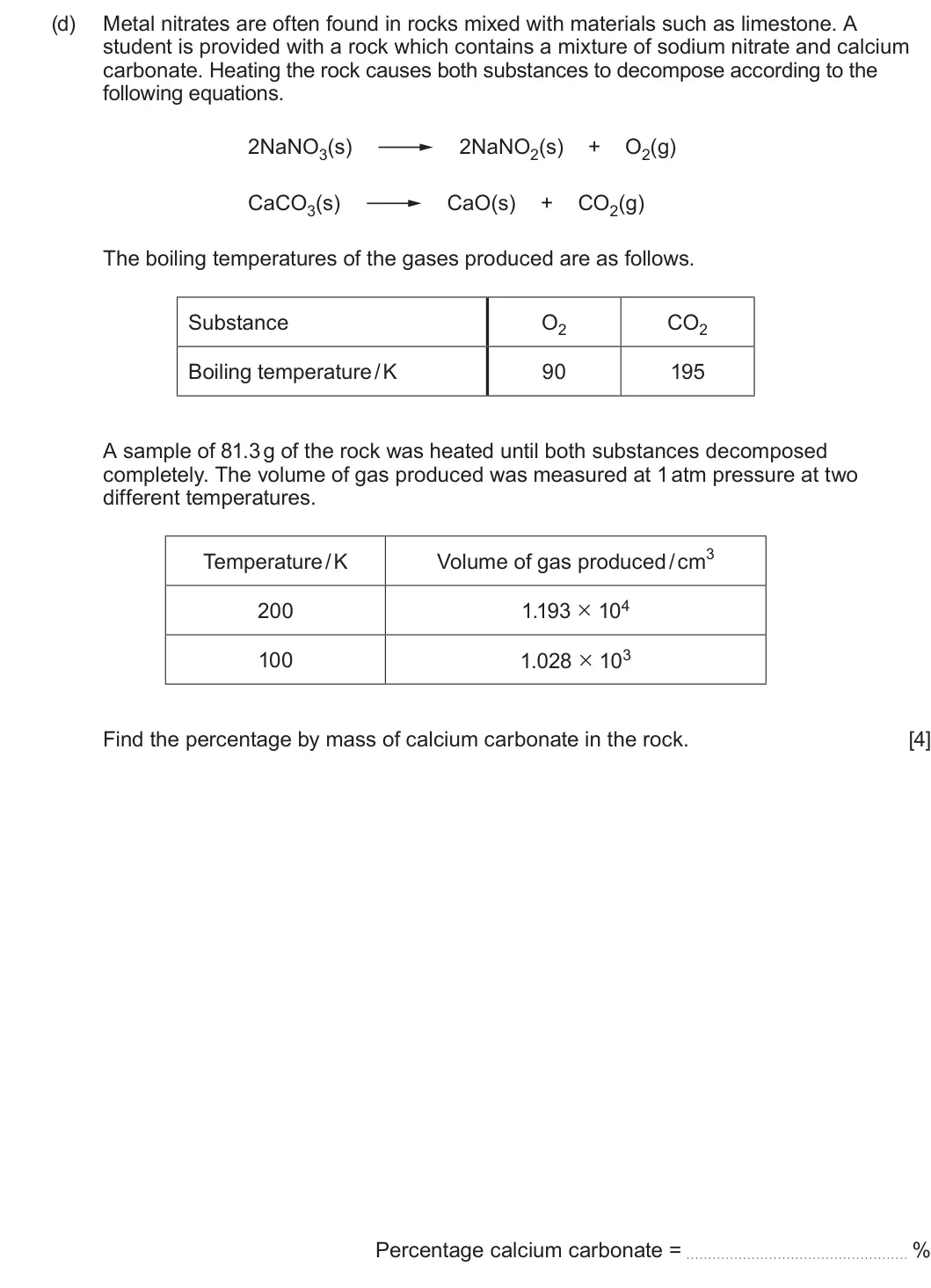
Q10(c)(ii)
The whole paper ↗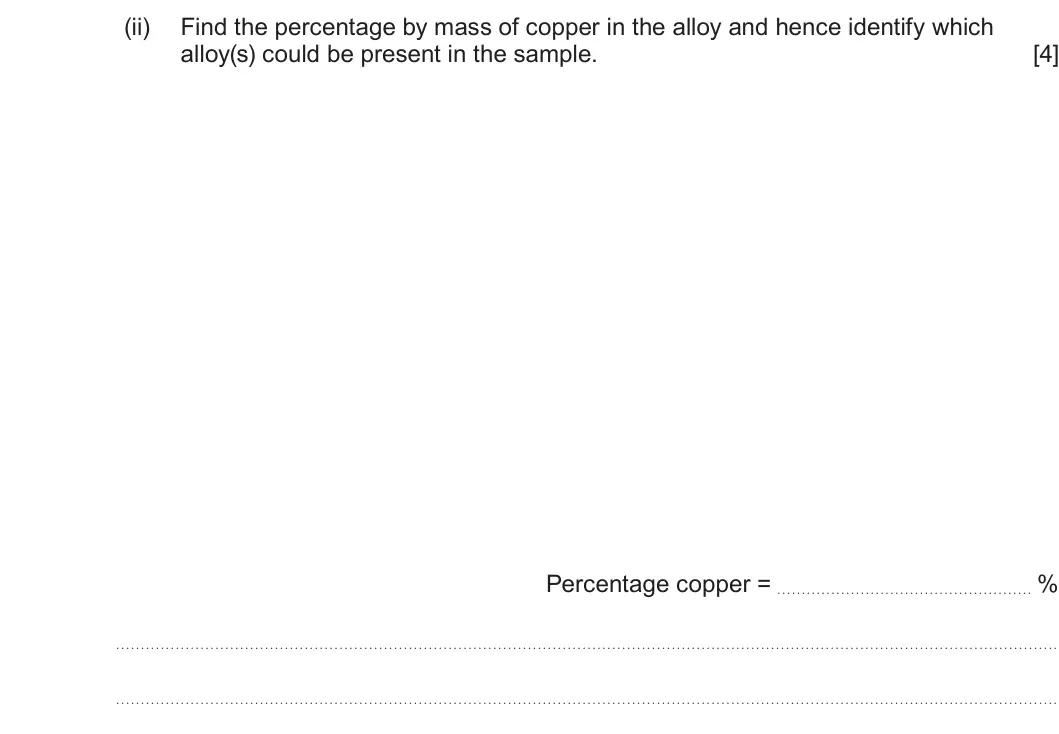
Q1(c)
The whole paper ↗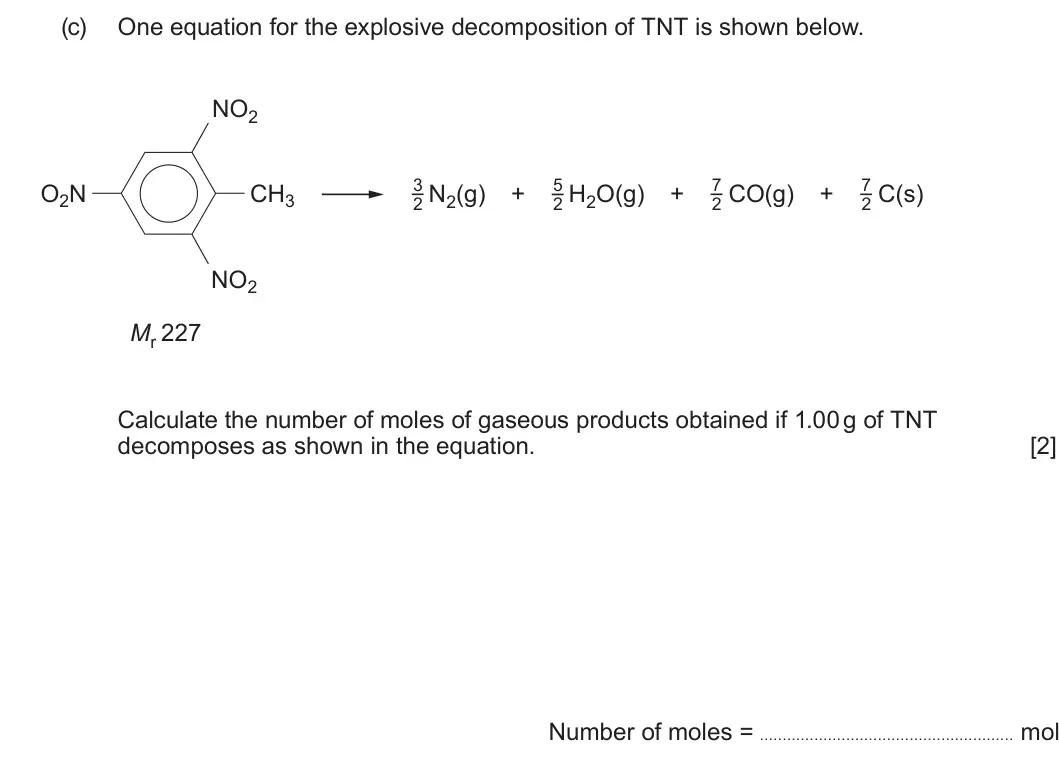
Q3(a)
The whole paper ↗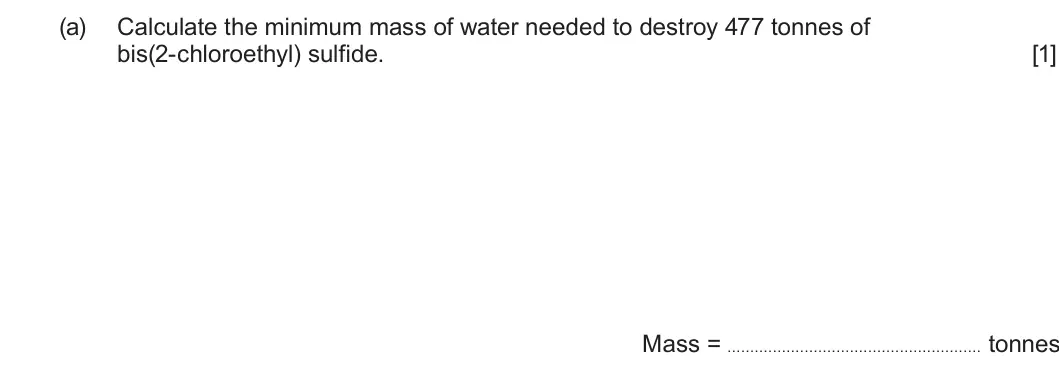
Q5(a)
The whole paper ↗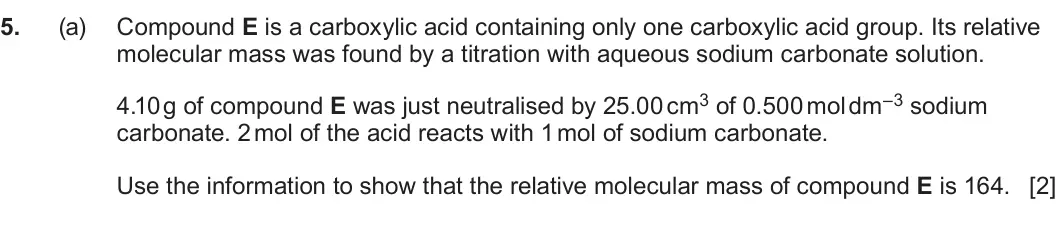
Q5(b)(iii)
The whole paper ↗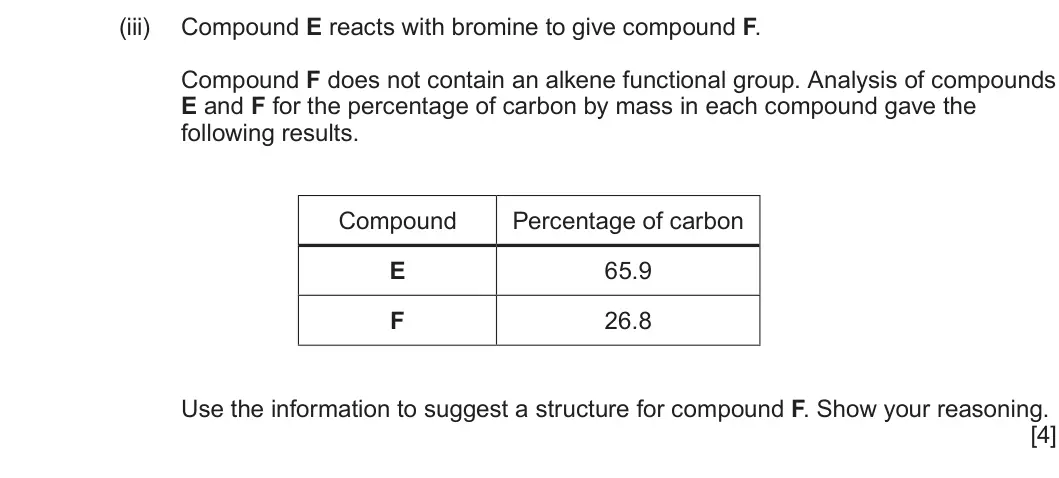
Q6(b)(i)
The whole paper ↗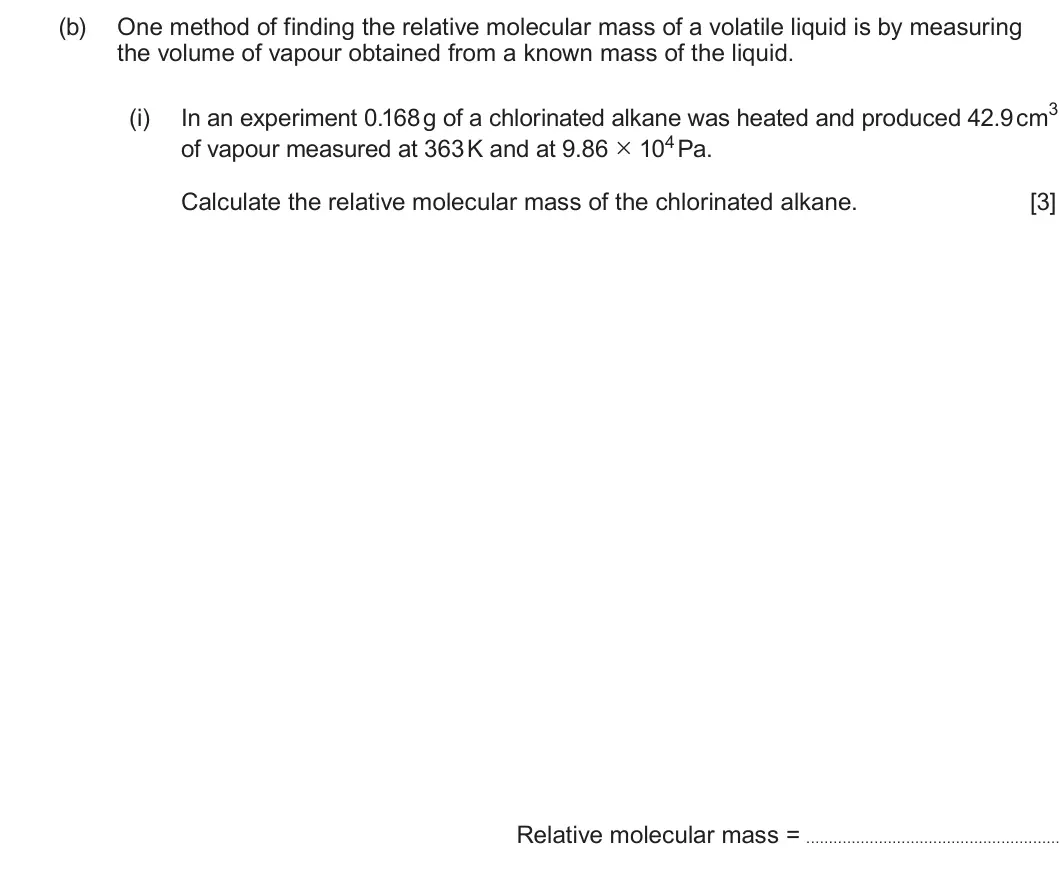
Q6(b)(ii)
The whole paper ↗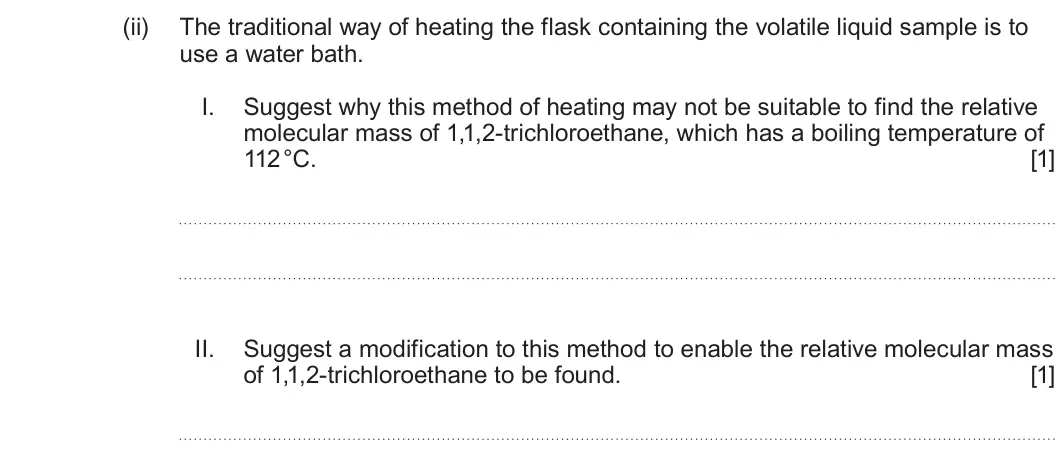
Q6(e)
The whole paper ↗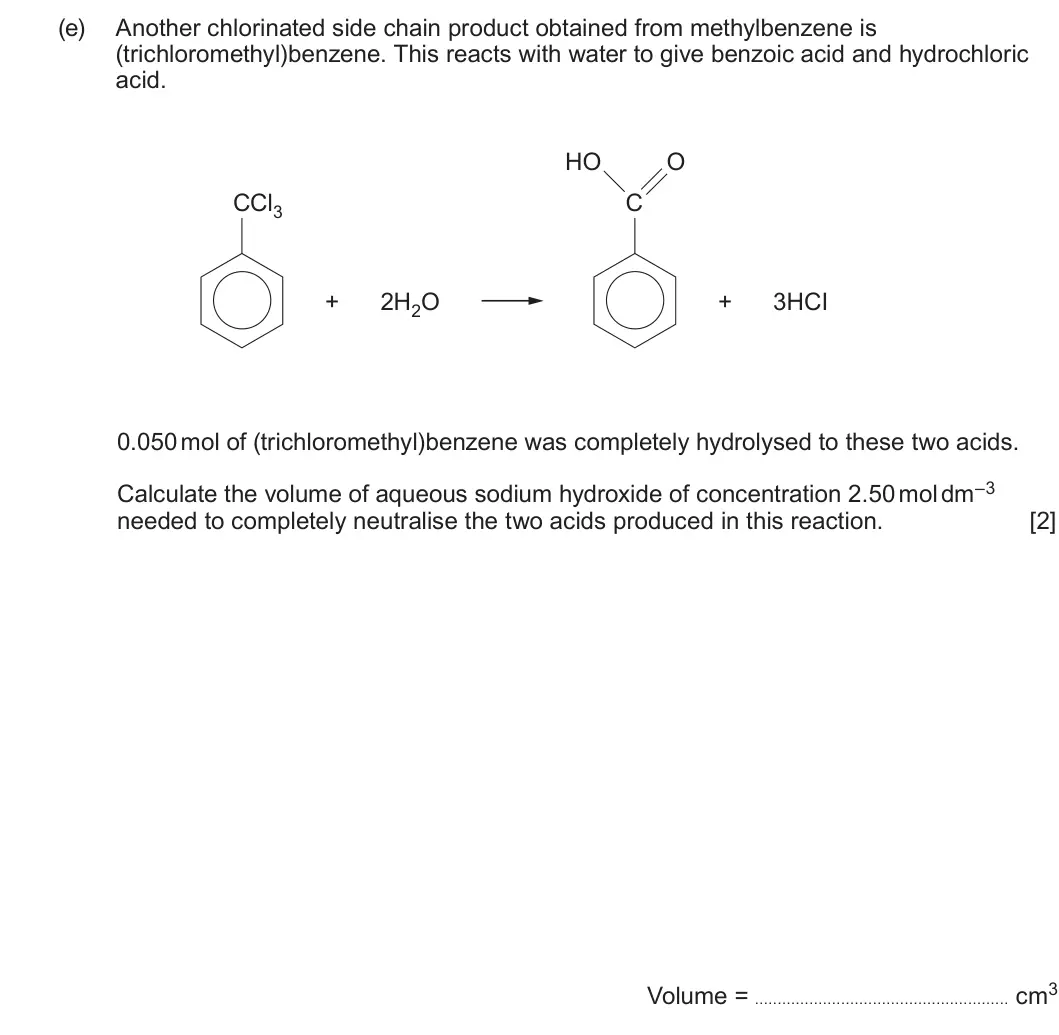
Q9(b)
The whole paper ↗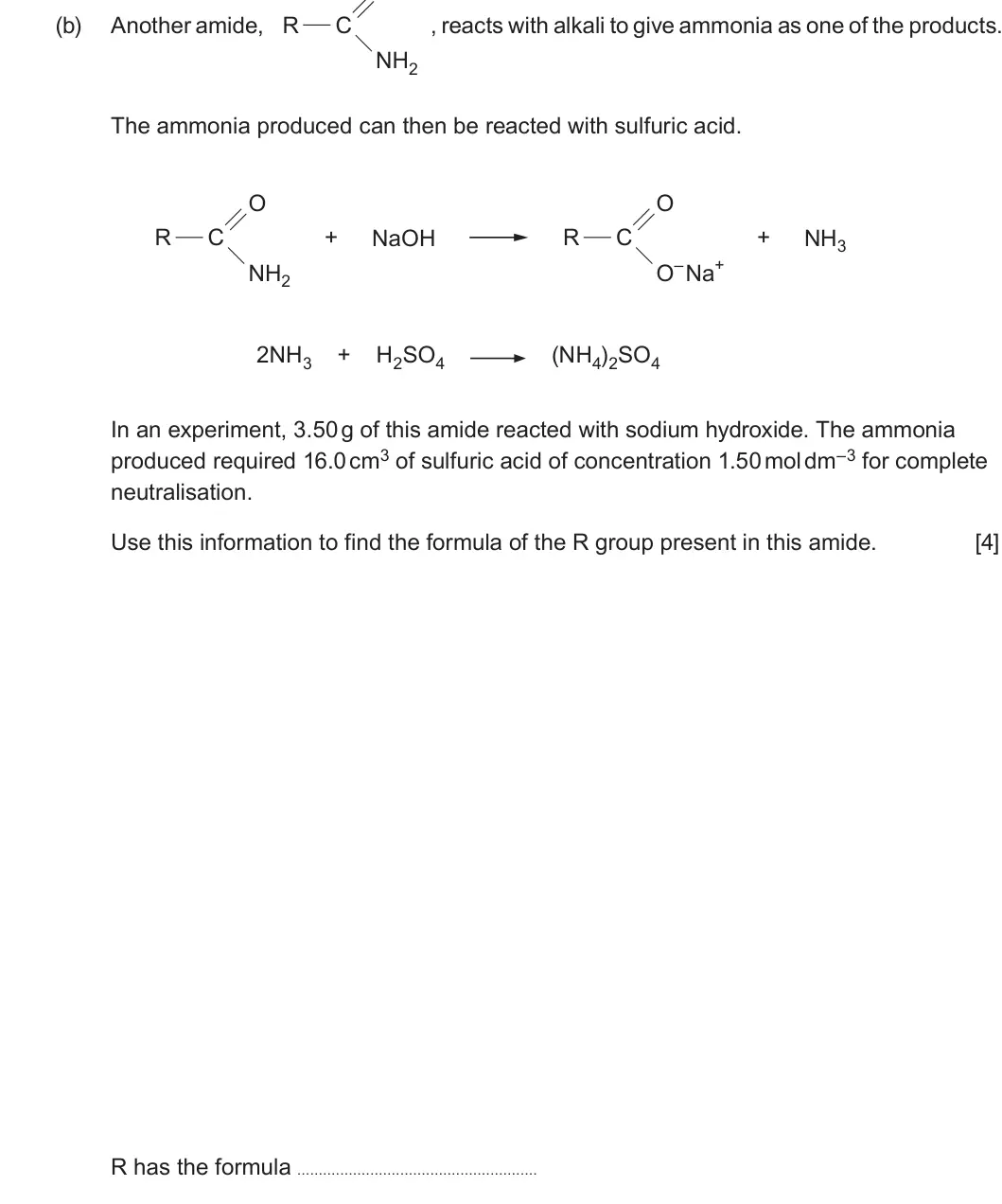
Q9(a)(i)
The whole paper ↗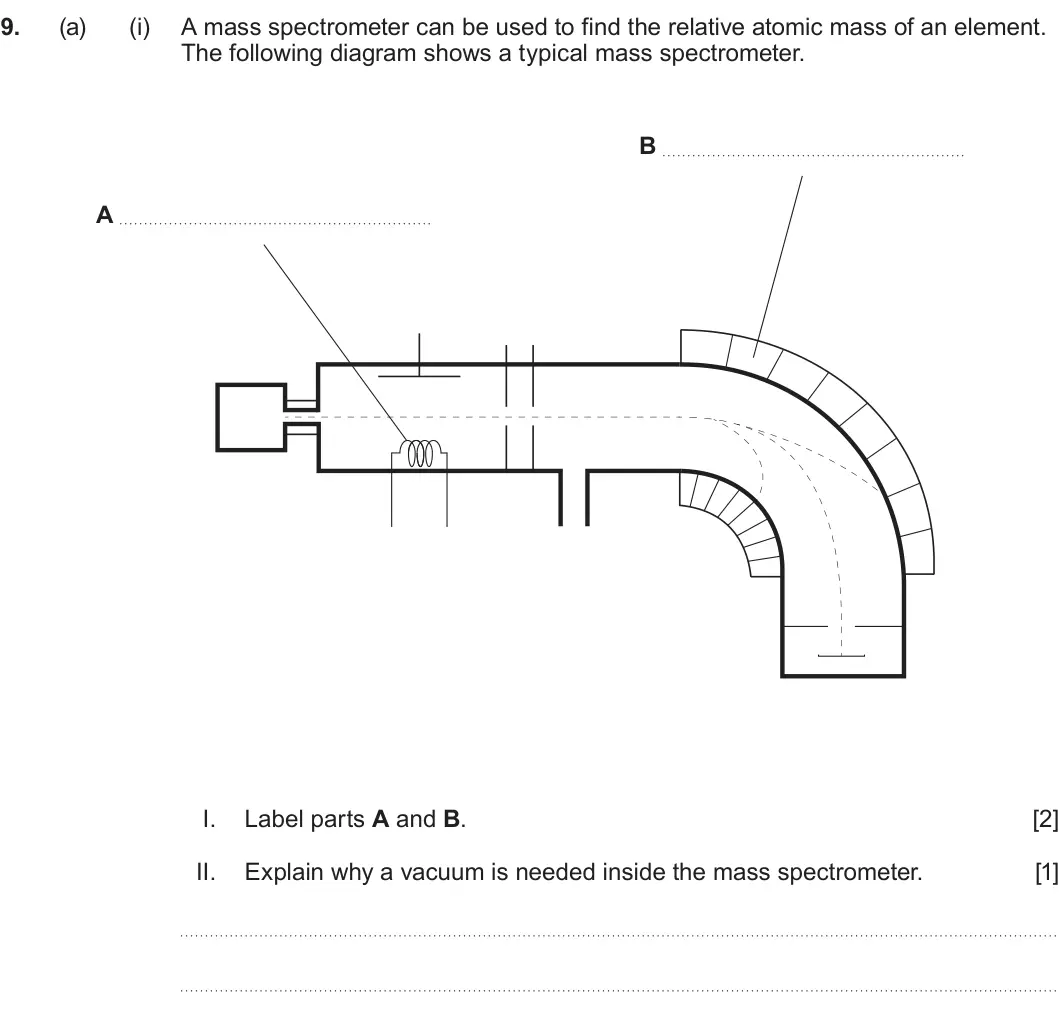
Q9(a)(ii)
The whole paper ↗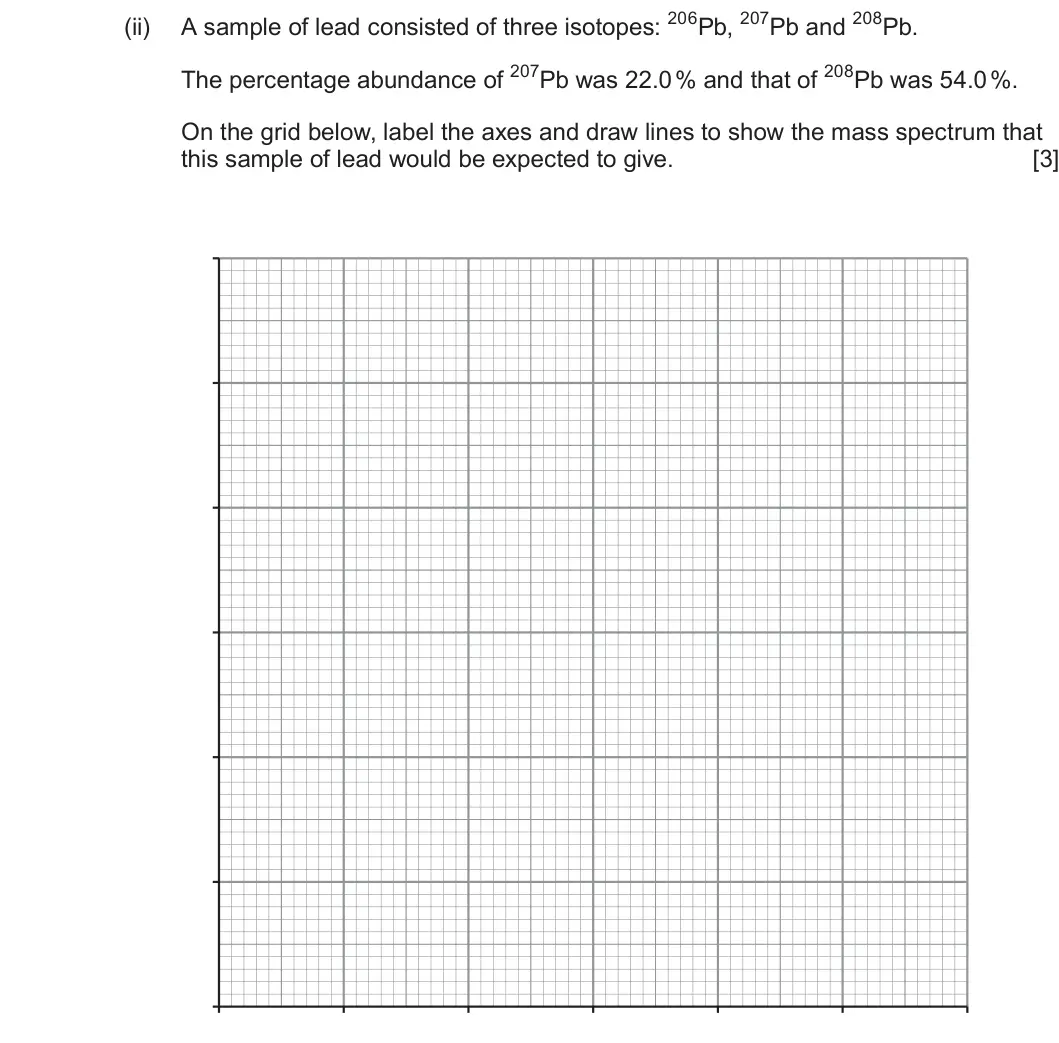
Q9(c)
The whole paper ↗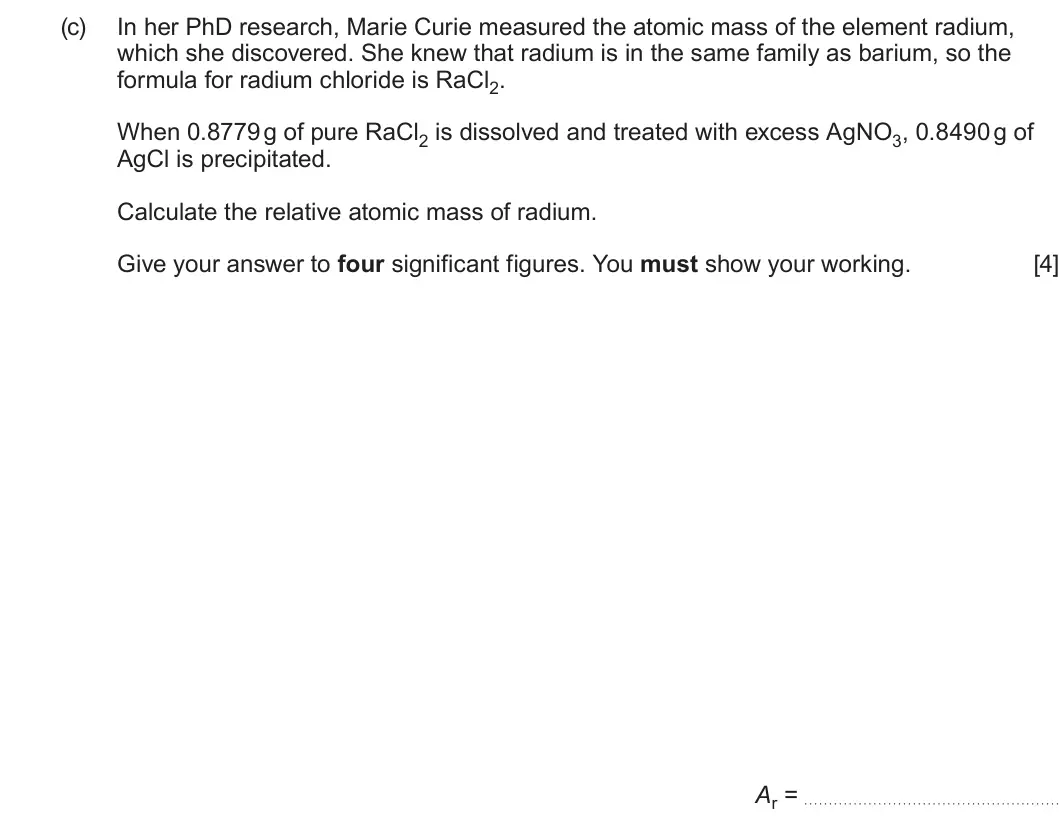
Q10(a)(i)
The whole paper ↗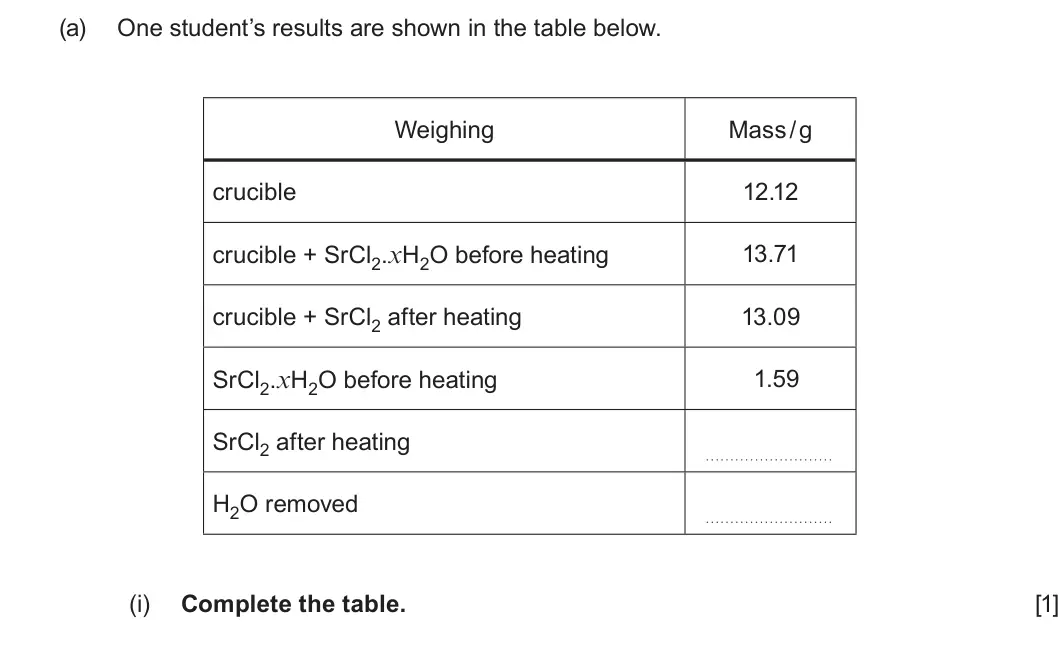
Q10(a)(ii)
The whole paper ↗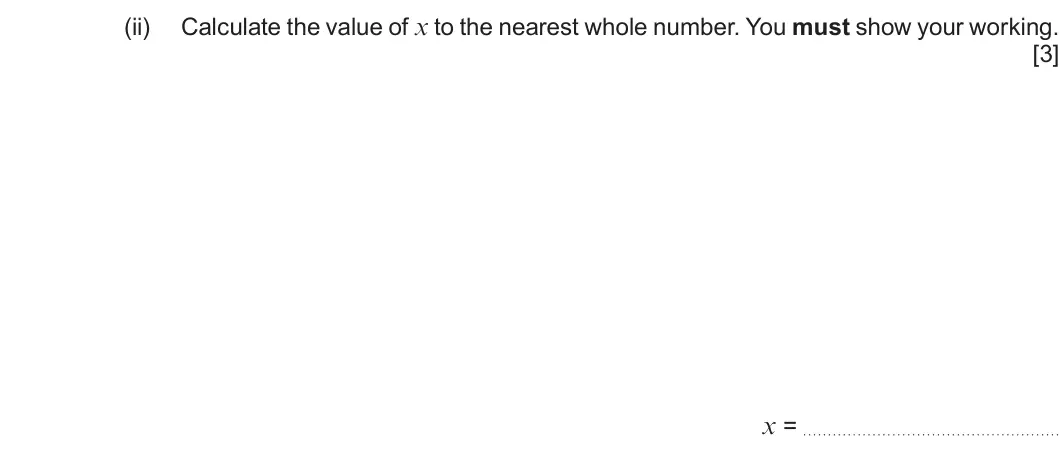
Q10(a)(iii)
The whole paper ↗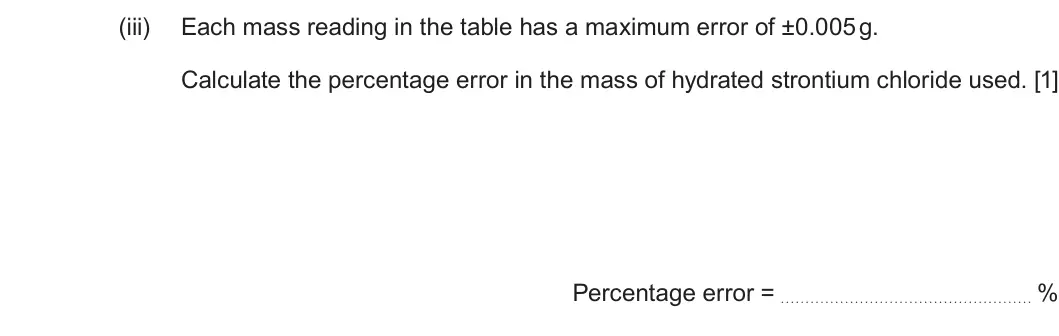
Q10(b)(i)
The whole paper ↗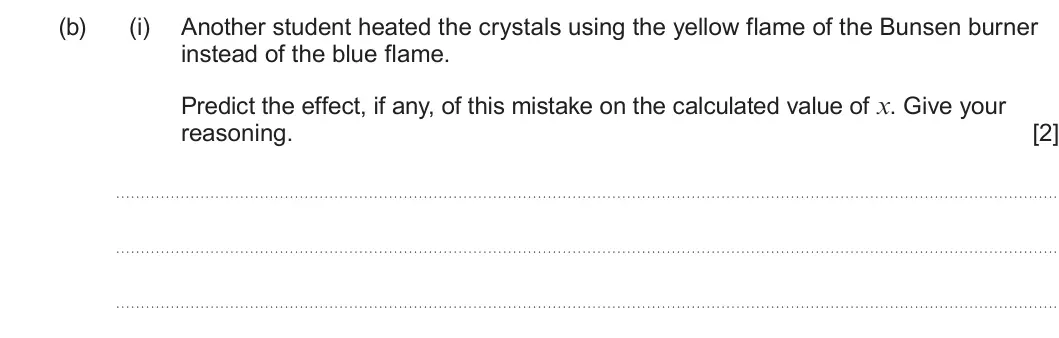
Q10(b)(ii)
The whole paper ↗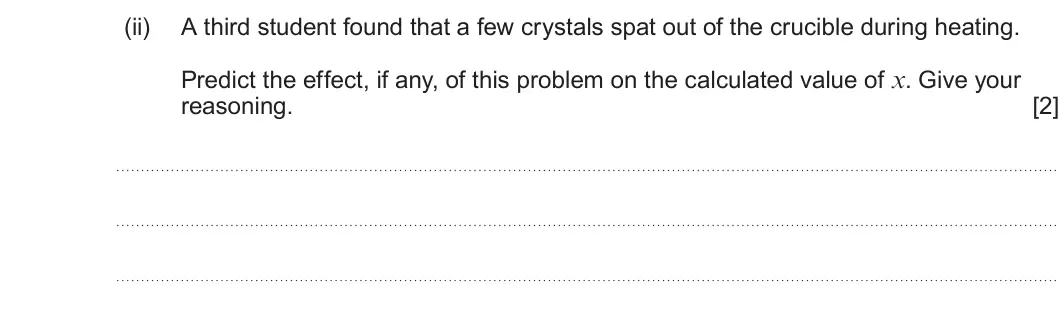
Q10(c)
The whole paper ↗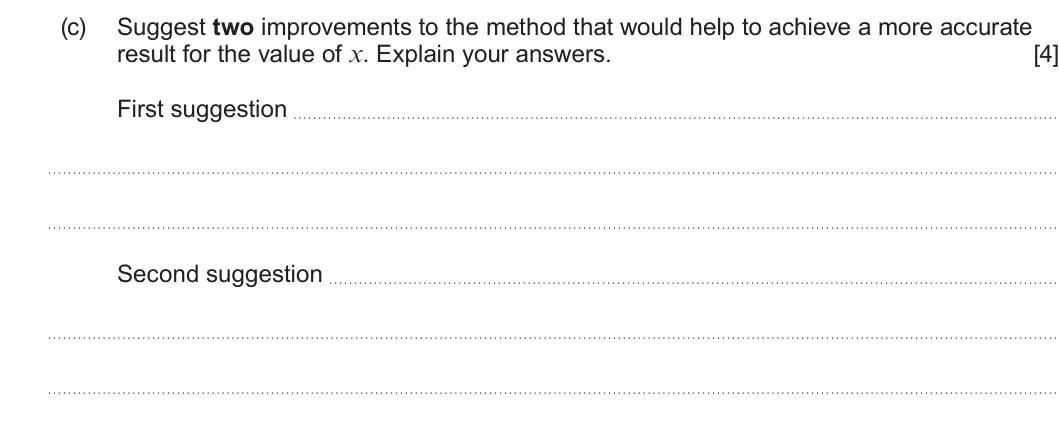
All 139 questions on Chemical calculations, as a list
- Summer 2025, Unit 3, Q7(d) (4 marks): Metal nitrates are often found in rocks mixed with materials such as limestone. A student is provided with a rock which contains a mixture of sodium nitrate and
- Summer 2025, Unit 3, Q10(c)(ii) (4 marks): Find the percentage by mass of copper in the alloy and hence identify which alloy(s) could be present in the sample. [4] Percentage copper = %
- Summer 2025, Unit 4, Q1(c) (2 marks): One equation for the explosive decomposition of TNT is shown below. NO2 3 5 7 7 O2N CH3 N2(g) + H2O(g) + CO(g) + C(s) 2 2 2 2 NO2 Mr 227 Calculate the number of
- Summer 2025, Unit 4, Q3(a) (1 mark): Calculate the minimum mass of water needed to destroy 477 tonnes of bis(2-chloroethyl) sulfide. [1] Mass = tonnes
- Summer 2025, Unit 4, Q5(a) (2 marks): Compound E is a carboxylic acid containing only one carboxylic acid group. Its relative molecular mass was found by a titration with aqueous sodium carbonate so
- Summer 2025, Unit 4, Q5(b)(iii) (4 marks): Compound E reacts with bromine to give compound F. Compound F does not contain an alkene functional group. Analysis of compounds E and F for the percentage of c
- Summer 2025, Unit 4, Q6(b)(i) (3 marks): of vapour measured at 363 K and at 9.86 × 10⁴ Pa. Calculate the relative molecular mass of the chlorinated alkane. [3] Relative molecular mass =
- Summer 2025, Unit 4, Q6(b)(ii) (2 marks): The traditional way of heating the flask containing the volatile liquid sample is to use a water bath. I. Suggest why this method of heating may not be suitable
- Summer 2025, Unit 4, Q6(e) (2 marks): Another chlorinated side chain product obtained from methylbenzene is (trichloromethyl)benzene. This reacts with water to give benzoic acid and hydrochloric aci
- Summer 2025, Unit 4, Q9(b) (4 marks): Another amide, R C , reacts with alkali to give ammonia as one of the products. NH2 The ammonia produced can then be reacted with sulfuric acid. O O R C + NaOH
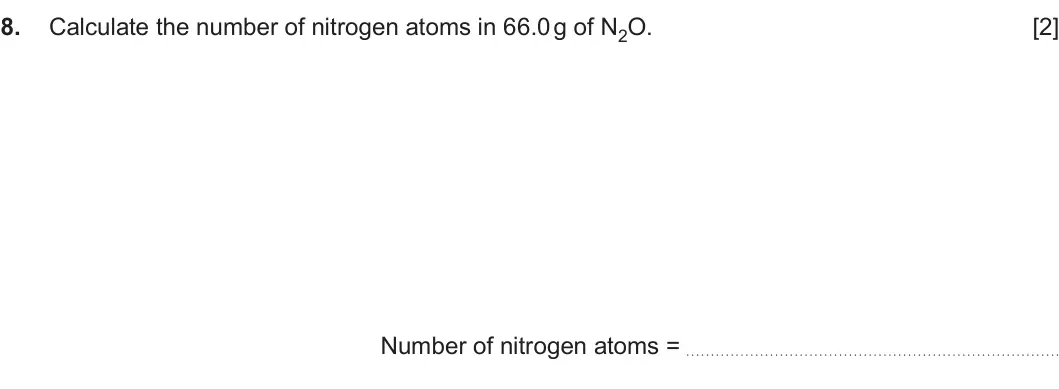
- Summer 2025, AS Unit 1, Q8 (2 marks): Calculate the number of nitrogen atoms in 66.0 g of N2O. [2] Number of nitrogen atoms =
- Summer 2025, AS Unit 1, Q9(a)(i) (3 marks): A mass spectrometer can be used to find the relative atomic mass of an element. The following diagram shows a typical mass spectrometer. B A I. Label parts A an
- Summer 2025, AS Unit 1, Q9(a)(ii) (3 marks): The percentage abundance of 207Pb was 22.0 % and that of 208Pb was 54.0 %. On the grid below, label the axes and draw lines to show the mass spectrum that this
- Summer 2025, AS Unit 1, Q9(c) (4 marks): In her PhD research, Marie Curie measured the atomic mass of the element radium, which she discovered. She knew that radium is in the same family as barium, so
- Summer 2025, AS Unit 1, Q10(a)(i) (1 mark): Complete the table. [1]
- Summer 2025, AS Unit 1, Q10(a)(ii) (3 marks): Calculate the value of x to the nearest whole number. You must show your working. [3] x =
- Summer 2025, AS Unit 1, Q10(a)(iii) (1 mark): Each mass reading in the table has a maximum error of ±0.005 g. Calculate the percentage error in the mass of hydrated strontium chloride used. [1] Percentage e
- Summer 2025, AS Unit 1, Q10(b)(i) (2 marks): Another student heated the crystals using the yellow flame of the Bunsen burner instead of the blue flame. Predict the effect, if any, of this mistake on the ca
- Summer 2025, AS Unit 1, Q10(b)(ii) (2 marks): A third student found that a few crystals spat out of the crucible during heating. Predict the effect, if any, of this problem on the calculated value of x. Giv
- Summer 2025, AS Unit 1, Q10(c) (4 marks): Suggest two improvements to the method that would help to achieve a more accurate result for the value of x. Explain your answers. [4] First suggestion Second s
- Summer 2025, AS Unit 1, Q12(c)(i) (3 marks): Calculate the molar ratio of the three named substances. [3]
- Summer 2025, AS Unit 1, Q12(d) (4 marks): 0.300 g of lithium reacts with an excess of water at 15 °C and 1 atm pressure to form lithium hydroxide and hydrogen. 2Li + 2H2O 2LiOH + H2 Calculate the volume
- Summer 2025, AS Unit 1, Q13(c) (2 marks): 100 cm3. Calculate the volume of water that should be added to this acid to dilute the sample to a concentration of 1.60 mol dm−3. [2] cm3 Volume of water added
- Summer 2024, Unit 3, Q7(e)(ii) (3 marks): A sample of lead(II) iodate(V) decomposes on heating to give a mixture of solids and a mixture of oxygen gas and iodine vapour. At a temperature of 200 °C, the
- Summer 2024, Unit 3, Q10(b)(i) (1 mark): river water. Suggest how this could be separated from test water A. [1]
- Summer 2024, Unit 3, Q10(b)(ii) (5 marks): gravimetric analysis. He adds excess aqueous sodium hydroxide, filters and then heats the precipitate in an oxygen-rich atmosphere. I. Give two reasons why the
- Summer 2024, Unit 3, Q10(b)(iv) (2 marks): The two students compared their results and decided that they are in agreement. Calculate the percentage difference between the concentrations of Fe2+ ions foun
- Summer 2024, Unit 4, Q9(b)(i) (2 marks): Calculate the minimum volume of this aqueous sulfuric acid needed to just react with all the calcium ethanedioate. [2] Minimum volume = cm3
- Summer 2024, Unit 4, Q9(b)(ii) (3 marks): After removal of insoluble calcium sulfate, the residue was washed with water. The solution was boiled until 50.0 cm3 (50.0 g) of solution remained. The solubil
- Summer 2024, Unit 4, Q9(d) (2 marks): On heating, barium ethanedioate undergoes decomposition. Use the graph to show that the equation for this reaction is (COO)2Ba(s) BaCO3(s) + CO(g) [2] Mr 225 Mr
- Summer 2024, Unit 4, Q10(a) (6 marks): Compound B contains only carbon, hydrogen and bromine. The hydrogen and bromine atoms could be at any of the positions indicated by a circle in the following st
- Summer 2024, Unit 4, Q10(b)(i) (2 marks): A 0.0700 mol sample of sucrose was used in a preparation. Calculate the minimum volume of ethanoic anhydride needed to react with all the ―OH groups present in
- Summer 2024, Unit 4, Q11(a)(ii) (2 marks): In another stage, adipamide is reacted with bromine in the presence of alkali to give butane-1,4-diamine, H2N(CH2)4NH2. Br2 / NaOH H2NOC(CH2)4CONH2 H2N(CH2)4NH2
- Summer 2024, AS Unit 1, Q7 (1 mark): Hydrated copper(II) sulfate has the formula CuSO4.5H2O. Calculate the number of moles of oxygen atoms present in 0.5 mol of hydrated copper(II) sulfate. [1] Oxy
- Summer 2024, AS Unit 1, Q8 (2 marks): A 0.717 g sample of gas occupies 1000 cm3 at 273 K and 1 atm. Calculate the relative formula 8 mass of the gas. [2] Relative formula mass = … ……..
- Summer 2024, AS Unit 1, Q10(b) (3 marks): The molecular ion region of the mass spectrum of bromine, Br2, is shown below. Relative abundance 156 157 158 159 160 161 162 163 m / z Explain the presence of
- Summer 2024, AS Unit 1, Q12(c)(i) (3 marks): Calculate the atom economy for the formation of iron in this reaction. Give your answer to an appropriate number of significant figures. [3] Atom economy = … ……
- Summer 2024, AS Unit 1, Q12(c)(ii) (4 marks): 20 tonnes of iron(III) oxide were reduced at a temperature of 1100 °C and a pressure of 1 atm. [4] Volume = m3
- Summer 2024, AS Unit 1, Q13(e)(iii) (1 mark): Na2CO3.xNaHCO3.yH2O is 1 [1]
- Summer 2024, AS Unit 1, Q13(e)(iv) (2 marks): of y. [2] y = … ……..
- Summer 2023, Unit 3, Q8(a) (2 marks): Potassium dichromate, K2Cr2O7 , is a primary standard. Calculate the concentration of a solution of potassium dichromate made from 5.00 g of potassium dichromat
- Summer 2023, Unit 3, Q10(c)(i) (2 marks): Calculate the concentration of the HF solution formed. [2] mol dm−3 concentration =
- Summer 2023, Unit 3, Q12(a) (2 marks): Find the value of e, the number of water molecules in each formula unit. [2] e =
- Summer 2023, Unit 3, Q12(b) (2 marks): Find the value of c, the number of carbonate ions in each formula unit. [2] c =
- Summer 2023, Unit 3, Q12(d) (4 marks): In experiment 4 the acid reacts with all the hydroxide and carbonate ions. H+ OH– + H2O 2H+ 2– + CO3 H2O + CO2 Calculate the value of d, the number of hydroxide
- Summer 2023, Unit 3, Q12(e) (3 marks): The compound has 56 atoms in each formula unit. Use your answers to (a), (b), (c) and (d), and the total number of atoms to find the formula of the mineral. [3]
- Summer 2023, Unit 4, Q5 (1 mark): Hexachlorocyclohexane can be used as an insecticide. CHCl CHCl ClHC ClHC CHCl CHCl Deduce the empirical formula of this compound. [1]
- Summer 2023, Unit 4, Q8(a)(i) (2 marks): 100 °C. Calculate how much sorbic acid is precipitated from its aqueous solution if 200 cm3 of a saturated solution at 100 °C is cooled to 20 °C. Give your answ
- Summer 2023, Unit 4, Q9(a)(ii) (3 marks): using a suitable indicator. Both acids were just neutralised by 75.00 cm3 of the sodium hydroxide solution. Use the results to calculate the relative molecular
- Summer 2023, Unit 4, Q10(b)(iii) (5 marks): If an excess of bromine is added to eugenol, a new compound is formed that contains the following percentages by mass of each element. C 24.9% H 2.1% O 6.6%, th
- Summer 2023, AS Unit 1, Q6 (2 marks): Copper can be extracted from copper(II) oxide using hydrogen. If the atom economy for this reaction is 78% and 4.2 g of copper is formed, calculate the total ma
- Summer 2023, AS Unit 1, Q7(c) (2 marks): Compounds containing a Group 1 metal, a Group 3 metal and hydrogen only are known as complex metal hydrides. There has been much interest in their use as hydrog
- Summer 2023, AS Unit 1, Q8(b) (4 marks): Aluminium also reacts with chlorine to form aluminium chloride. A 0.400 g sample of aluminium chloride was heated to 220 °C. The vapour produced occupied a volu
- Summer 2023, AS Unit 1, Q9(b) (3 marks): Sodium hydroxide reacts with ammonium sulfate to form ammonia, sodium sulfate and water as shown in the equation below. (NH4)2SO4 2NaOH 2NH3 Na2SO4 2H2O + + + A
- Summer 2023, AS Unit 1, Q10(b)(i) (3 marks): In an experiment 0.960 g of barium nitrate was heated strongly for 2 minutes. Calculate the maximum volume, in cm3, of gas that could be produced at a temperatu
- Summer 2023, AS Unit 1, Q10(b)(ii) (1 mark): The volume of a gas is directly proportional to its temperature at constant pressure. A student said that if the gas formed in this experiment were collected at
- Summer 2023, AS Unit 1, Q10(e) (2 marks): A sample of barium contains two isotopes. The first isotope has a relative isotopic mass of 134.9 and the second a relative isotopic mass of 137.9. The relative
- Summer 2023, AS Unit 1, Q11(a)(iii) (3 marks): Describe how the student should dilute the seawater by a factor of five. [3]
- Summer 2023, AS Unit 1, Q11(a)(vi) (4 marks): Calculate the mass of chloride ions in 1 000 cm3 of the original seawater, giving your answer to an appropriate number of significant figures. [4] Mass of chlor
- Summer 2023, AS Unit 1, Q11(b)(i) (5 marks): Describe how the student carried out the gravimetric analysis to find the mass of the barium sulfate precipitated. [5]
- Summer 2023, AS Unit 1, Q11(b)(ii) (3 marks): precipitate all of the sulfate ions in 100 cm3 of the seawater. [3] Volume = cm3
- Summer 2023, AS Unit 1, Q11(b)(iii) (1 mark): Suggest why the volume of barium nitrate needed was different to the volume of seawater used. [1]
- Summer 2022, Unit 3, Q8(c) (6 marks): Tachyhydrite is a soft, soluble mineral that has a general formula of AaBbXc.dH2O. A and B represent two different s-block metal ions, with X representing an an
- Summer 2022, Unit 3, Q11(a)(i) (1 mark): Calculate the mean volume of sodium thiosulfate solution used. [1] Mean volume = cm3
- Summer 2022, Unit 3, Q11(a)(ii) (3 marks): Find the concentration of sodium chlorate(I) in the initial bleach sample. [3] Concentration = mol dm–3
- Summer 2022, Unit 3, Q11(a)(iii) (1 mark): Bleach concentrations are often quoted on labels as % w/v, that is the mass of sodium chlorate(I) dissolved in 100 cm3 of water. Calculate the % w/v concentrati
- Summer 2022, Unit 3, Q11(a)(iv) (2 marks): The teacher tells Dewi that he has selected an inappropriate concentration of sodium thiosulfate solution. Suggest which concentration of sodium thiosulfate he
- Summer 2022, Unit 3, Q11(c)(ii) (7 marks): found by adding an excess of calcium carbonate and then measuring the amount of carbon dioxide gas released. This can be done by either: • measuring the volume
- Summer 2022, Unit 4, Q8(c)(ii) (2 marks): Poly(sodiumacrylate) is capable of absorbing several hundred times its own mass of water, whilst remaining as a solid material. In an experiment, 4.0 × 10⁻⁶ mol
- Summer 2022, Unit 4, Q9(d)(i) (2 marks): The yield of phenol (Mr 94) in this process is 86% with benzene (Mr 78) as the starting material. Calculate the mass of phenol produced from 234 kg of benzene.
- Summer 2022, Unit 4, Q11(b)(ii) (2 marks): In an experiment, 54.0 g of glucose produced 41.2 g of calcium butane-1,4-dioate. Calculate the minimum volume of sulfuric acid, of concentration 2.5 mol dm–3,
- Summer 2022, Unit 4, Q12(b)(ii) (2 marks): The overall reaction with iodine can be represented by the following equation. Br2 I2 CH CH CH CH CH CH Br Br I I In palm oil, most of the unsaturated oils are
- Summer 2022, AS Unit 1, Q4 (1 mark): Hydrazine can be manufactured from ammonia. 2NH3 + H2O2 N2H4 + 2H2O Calculate the atom economy of this reaction. [1] atom economy = %
- Summer 2022, AS Unit 1, Q7 (2 marks): Calculate the mass of calcium that contains the same number of atoms as there are molecules in 9.1 g of sulfur dioxide, SO2. [2] calcium mass = g
- Summer 2022, AS Unit 1, Q9(d) (3 marks): The Solvay process is the major industrial process for the manufacture of sodium carbonate. Two of the stages in the process are shown below: NaCl + NH3 + CO2 +
- Summer 2022, AS Unit 1, Q10(b) (3 marks): The equation for the reaction between potassium carbonate and hydrochloric acid is given below. K2CO3 + 2HCl 2KCl + H2O + CO2 A 1.40 g sample of impure potassiu
- Summer 2022, AS Unit 1, Q11(b)(i) (3 marks): solution. [3] concentration of H3AsO3 = mol dm–3
- Summer 2022, AS Unit 1, Q11(d) (4 marks): Phosphorus can form two chlorides, PCl3 and PCl5. 0.181 g of a chloride of phosphorus gave 39 cm3 of vapour at 1 atm pressure when heated to 87 °C. The sample w
- Summer 2022, AS Unit 1, Q11(e)(i) (1 mark): Identify the species responsible for peak C at m/z 101. [1]
- Summer 2022, AS Unit 1, Q11(e)(ii) (2 marks): Explain why the height ratio of peaks C:E is 9:1. [2]
- Summer 2022, AS Unit 1, Q12(a) (2 marks): Another student said that there were two errors in making the 250.0 cm3 carbonate solution. Error 1: A small amount of solid remained in the weighing bottle. Er
- Summer 2022, AS Unit 1, Q12(f)(ii) (4 marks): Calculate the relative formula mass of the carbonate and hence deduce the Group 1 metal in the carbonate. You must show your working. [4] group 1 metal =
- Summer 2019, Unit 3, Q9(b)(ii) (3 marks): In the drying process 5.20 g of hydrated calcium chloride forms 3.15 g of anhydrous calcium chloride. Calculate the value of x in the original CaCl2.xH2O. [3] x
- Summer 2019, Unit 3, Q12(b)(i) (3 marks): Find the formula of the mineral huntite. [3] Formula
- Summer 2019, Unit 3, Q12(b)(ii) (3 marks): aqueous acid used to form the solution for analysis. [3] Volume = dm3
- Summer 2019, Unit 4, Q1 (1 mark): The skeletal formula of the compound TATP is shown below. O O O O Give the molecular formula of this compound. [1]
- Summer 2019, Unit 4, Q8(a)(ii) (6 marks): I. In an experiment 89.0 g of ethanoic acid reacted with chlorine. Calculate the increase in mass that occurs if chloroethanoic acid is the only organic product
- Summer 2019, Unit 4, Q8(d) (3 marks): Aminoethanoic acid reacts with nitric(III) acid to produce nitrogen gas. CH2(NH2)COOH + HNO2 CH2(OH)COOH + N2 + H2O Calculate the maximum volume of nitrogen gas
- Summer 2019, Unit 4, Q10(b)(i) (2 marks): Calculate the mass of the azo dye needed to prepare 250 cm3 of a standard solution of concentration 0.0075 mol dm–3. [2] Mass required = g
- Summer 2019, Unit 4, Q11(a)(ii) (3 marks): In this experiment the percentage yield of dry 2-hydroxy-5-nitrobenzenecarboxylic acid (Mr 183) was 41 %. Calculate the mass produced based on the original mass
- Summer 2019, Unit 4, Q12(b)(ii) (2 marks): After use, a bottle containing decanedioyl dichloride (Mr 239.1) can become contaminated with decanedioic acid. Analysis of a 3.50 g sample of contaminated deca
- Summer 2019, AS Unit 1, Q3 (1 mark): Complete the following definition of relative atomic mass. [1] The relative atomic mass of an element is the average mass of one atom of the element relative to
- Summer 2019, AS Unit 1, Q7 (1 mark): Cooking fuel for outdoor camping contains butane, which reacts with oxygen according to the following equation. 1 C4H10(g) + 6 O2(g) 4CO2(g) + 5H2O(g) 2 If 1.00
- Summer 2019, AS Unit 1, Q8 (2 marks): 9.60 g of titanium reacts completely with 3.68 dm3 of oxygen gas at 298 K and 1 atm to form an 8 oxide. Calculate the empirical formula of this oxide. [2] Empir
- Summer 2019, AS Unit 1, Q9(b)(i) (1 mark): State how magnesium ions are formed in a mass spectrometer. [1]
- Summer 2019, AS Unit 1, Q9(b)(ii) (1 mark): State how magnesium ions are separated in a mass spectrometer. [1]
- Summer 2019, AS Unit 1, Q9(e) (1 mark): According to the label on the bottle, the concentration of magnesium ions in a sample of Welsh mineral water is 15 mg / litre. Calculate the concentration of ma
- Summer 2019, AS Unit 1, Q10(d)(i) (3 marks): aluminium were added to an excess of sulfuric acid at a temperature of 25 °C and a pressure of 1 atm. [3] Volume = cm3
- Summer 2019, AS Unit 1, Q10(d)(ii) (2 marks): Calculate the volume of hydrogen that would be produced if the same experiment were carried out at 50 °C and 1.6 atm. [2] (If you do not have an answer in part
- Summer 2019, AS Unit 1, Q11(a) (1 mark): State how the student would know that the reaction between the chalk and acid had finished. [1]
- Summer 2019, AS Unit 1, Q11(b) (4 marks): Suggest and explain two improvements to the student’s method. [4]
- Summer 2019, AS Unit 1, Q12(a)(iii) (2 marks): hydrochloric acid. Given that 1 mol of compound C reacts with 2 mol of acid, calculate the relative formula mass of compound C and hence confirm that the metal
- Summer 2019, AS Unit 1, Q12(b) (3 marks): Group 2 metals are not the only elements that form 2+ ions. A sample of an element has two isotopes, one with 70 neutrons and the other 72 neutrons. This elemen
- Summer 2019, AS Unit 1, Q13(b)(i) (4 marks): I. Calcium chloride can exist as an anhydrous salt or as a hydrated salt, CaCl2.xH2O. In an experiment to determine the extent of hydration a sample of hydrated
- Summer 2018, Unit 3, Q5 (2 marks): A 25.0 cm3 sample of a solution containing iodine is titrated against a sodium thiosulfate solution of concentration 0.0200 mol dm–3. This requires 23.25 cm3 of
- Summer 2018, Unit 3, Q10(c)(ii) (2 marks): A 5.00 cm3 sample of the solution was analysed by titration against acidified potassium manganate(VII). The sample required 27.20 cm3 of manganate(VII) solution
- Summer 2018, Unit 4, Q5 (2 marks): On detonation, the explosive RDX produces carbon monoxide, steam and nitrogen. C3H6N6O6(s) 3CO(g) + 3H2O(g) + 3N2(g) RDX Mr 222 Calculate the mass of RDX that w
- Summer 2018, Unit 4, Q8(b)(ii) (2 marks): In an experiment using 0.040 mol of CH2Cl2, the yield of CH2F2 was 89.0 %. Calculate the mass of difluoromethane produced. [2] Mass = g
- Summer 2018, AS Unit 1, Q4(b) (2 marks): Calculate the atom economy for the formation of phosphoric acid in this reaction. [2] Atom economy = %
- Summer 2018, AS Unit 1, Q7(c) (2 marks): Antimony is in Group 5 Its mass spectrum shows that it has two stable isotopes. 30 20 10 0 120 124 m/z Calculate the relative atomic mass of antimony. You must
- Summer 2018, AS Unit 1, Q8(c) (3 marks): Hydrazine is a compound of hydrogen and nitrogen only. It is a colourless, flammable liquid which was used in various rocket fuels. 0.160 g of hydrazine on vapo
- Summer 2018, AS Unit 1, Q9(a) (2 marks): A three decimal place balance was used. The mass of each vitamin C tablet was 500 mg. Calculate the maximum percentage error in the weighing of the tablet. You
- Summer 2018, AS Unit 1, Q10(b) (3 marks): Ammonia can be used as part of the nitrophosphate process to produce the fertiliser diammonium hydrogenphosphate (DAP) which has the formula (NH4)2HPO4. Ca(NO3)
- Summer 2018, AS Unit 1, Q10(c) (4 marks): of 120 °C and a pressure of 101 kPa. [4] Volume = cm3
- Summer 2017, Unit 3, Q9(a) (2 marks): One study of the liquid mixture showed that it contained 0.714 % NO2 by mass. Calculate how many moles of NO2 would be present in 25.0 g of this liquid. Give yo
- Summer 2017, Unit 3, Q11(a) (2 marks): Calculate the value of d in the formula MaAlbZc.dH2O. [2] d =
- Summer 2017, Unit 3, Q11(b)(ii) (2 marks): Calculate the value of c in the formula MaAlbZc.dH2O. [2] c =
- Summer 2017, Unit 3, Q11(d) (3 marks): The Mr of the original hydrated compound is 425.62. Use all the information above to find the formula of the hydrated compound. Explain your reasoning. [3] Form
- Summer 2017, Unit 4, Q2 (1 mark): Sotolone is one of the compounds that is responsible for the smell of raspberries. H3C O O H3C OH sotolone Give the empirical formula of this compound. [1]
- Summer 2017, Unit 4, Q9(d)(i) (1 mark): of BA. Calculate the number of moles of BA that were produced. [1] n(BA) = mol
- Summer 2017, Unit 4, Q11(a)(iii) (3 marks): In a further experiment an excess of hydrogen cyanide reacted with 17.4 g of propanone (Mr 58.06) to produce 18.6 g of 2-hydroxy-2-methylpropanenitrile (Mr 85.0
- Summer 2017, Unit 4, Q11(d)(ii) (2 marks): Use the figures to calculate the relative molecular mass of the alcohol. [2] Mr =
- Summer 2017, AS Unit 1, Q5 (2 marks): Boron has a relative atomic mass of 10.8. It has only two naturally-occurring isotopes, one of which has an abundance of 80.0 % and a mass of 11 Calculate the m
- Summer 2017, AS Unit 1, Q6(c)(i) (2 marks): formed at a temperature of 24 °C and a pressure of 1.01 × 10⁵ Pa. Calculate the volume occupied by this gas under the same pressure and at a temperature of 52 °
- Summer 2017, AS Unit 1, Q6(c)(ii) (3 marks): Assuming that hydrogen behaves as an ideal gas, calculate the amount, in moles, of hydrogen formed. [3] n = mol
- Summer 2017, AS Unit 1, Q7(a) (6 marks): A student is asked to prepare a standard solution of sodium carbonate of concentration 0.0500 mol dm−3. The first step involved in the preparation of a standard
- Summer 2017, AS Unit 1, Q7(c)(ii) (2 marks): The equation for the reaction between ammonium sulfate and sodium hydroxide is: (NH4)2SO4 + 2NaOH 2NH3 + Na2SO4 + 2H2O Use your answer to part (i) to calculate
- Summer 2017, AS Unit 1, Q8(a)(iii) (2 marks): A sample of rock contains 1.30 % by mass of chalcopyrite. Assuming this is the only source of copper in the rock, calculate the percentage by mass of copper in
- Summer 2016, AS Unit 1, Q5 (1 mark): The explosive ADN has the structural formula shown below. O2N _ + N NH4 O2N Give the empirical formula of ADN. [1]
- Summer 2016, AS Unit 1, Q6 (1 mark): Sodium carbonate, Na2CO3, is made by heating sodium hydrogencarbonate, NaHCO3. Na2CO3 2NaHCO3 + CO2 + H2O Mr 106 Mr 84 Calculate the atom economy of this reacti
- Summer 2016, AS Unit 1, Q8(b) (2 marks): The iron obtained from the blast furnace contains some sulfur as an impurity. This is removed during Basic Oxygen Steelmaking (BOS), by adding magnesium, which
- Summer 2016, AS Unit 1, Q8(d)(ii) (3 marks): A student added a small sample of magnesium sulfide of mass 0.224 g to some water in a fume cupboard. Calculate the maximum volume, in cm3, of hydrogen sulfide
- Summer 2016, AS Unit 1, Q9(a)(ii) (3 marks): After purification, the oxalic acid is produced as white crystals of a hydrate, (COOH)2. xH2O. On heating this hydrate, water is lost, leaving anhydrous oxalic
- Summer 2016, AS Unit 1, Q9(b) (2 marks): Another method of producing oxalic acid in the laboratory is to heat potassium methanoate, HCOOK. This produces potassium oxalate, which is then acidified to gi
- Summer 2016, AS Unit 1, Q9(c)(ii) (3 marks): In his experiment Gareth obtained 2.49 g of pure dry calcium oxalate (Mr 128). calcium chloride (aq) (COOK)2 (COO)2Ca + 2KCl Mr 166 Mr 128 Calculate the percent
- Summer 2016, AS Unit 1, Q10(a) (3 marks): 29Si and 30Si. The percentage of 28Si present was 92.2 % and the mass spectrum showed that the percentage of 29Si present was twice that of 30Si. Calculate the
- Summer 2016, AS Unit 1, Q10(c) (2 marks): Hydrofluoric acid, HF, is supplied as a solution that contains 50 % by mass of hydrogen fluoride. The density of this solution is 1.17 g cm–3. Calculate the con
- Summer 2016, AS Unit 1, Q10(d)(ii) (3 marks): Hexafluorosilicic acid, H2SiF6, (Mr 144) can be added to drinking water to promote good dental health. When added to water all the fluorine in the acid is avail
- Summer 2016, AS Unit 1, Q12(a)(iii) (3 marks): In a further test the concentration of the iodide ions present was found by a titration with potassium iodate(V) dissolved in a strong acid. 11.24 g of the mixt
Questions, mark schemes and examiner’s reports are © WJEC CBAC Ltd, from their published past papers. Plumi isn’t affiliated with any exam board. Want whole papers? Every WJEC A-Level Chemistry paper.
Rather write your answers by hand on iPad? Plumi marks them against the same mark schemes.