 plumi
Amines: WJEC A‑Level Chemistry questions
Every WJEC A-Level Chemistry exam question on 4.6 Amines, 2016–2025, with its mark scheme and examiner’s report.
Find questions1,204
Calculations
Q7(b)(i)
The whole paper ↗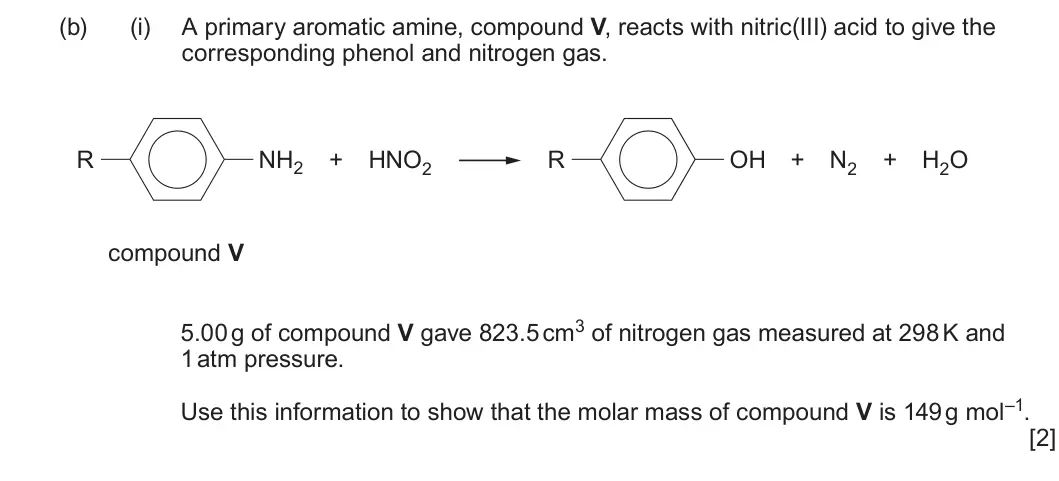
Q7(b)(iii)
The whole paper ↗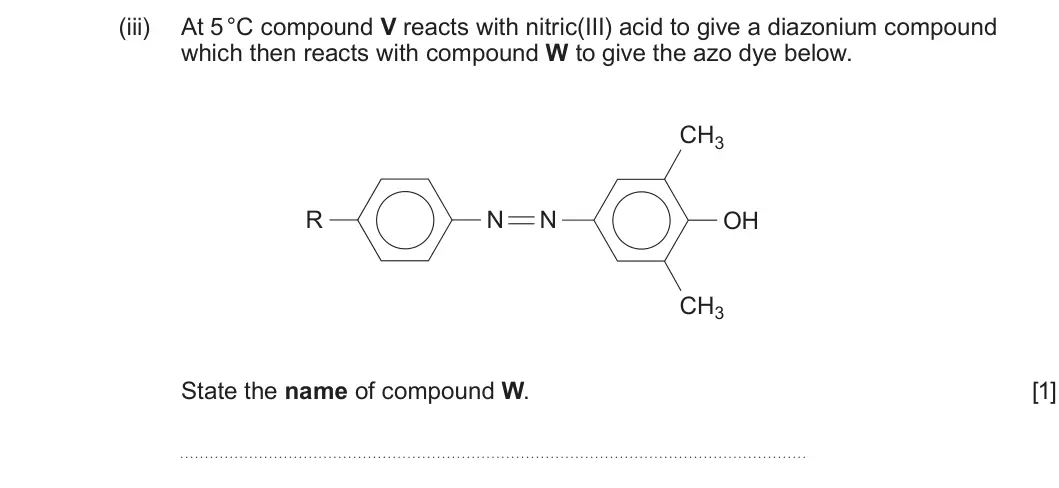
Q8(a)(iii)
The whole paper ↗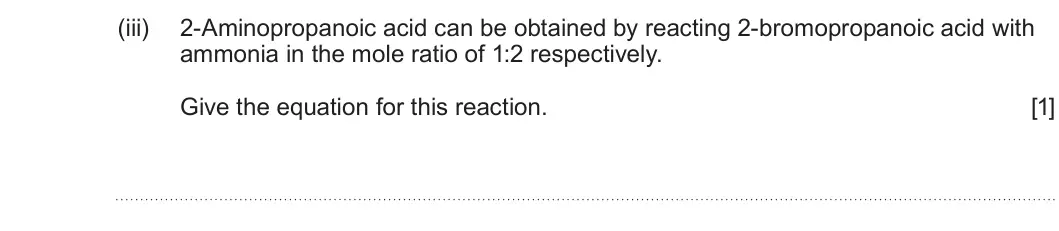
Q9(a)(vi)
The whole paper ↗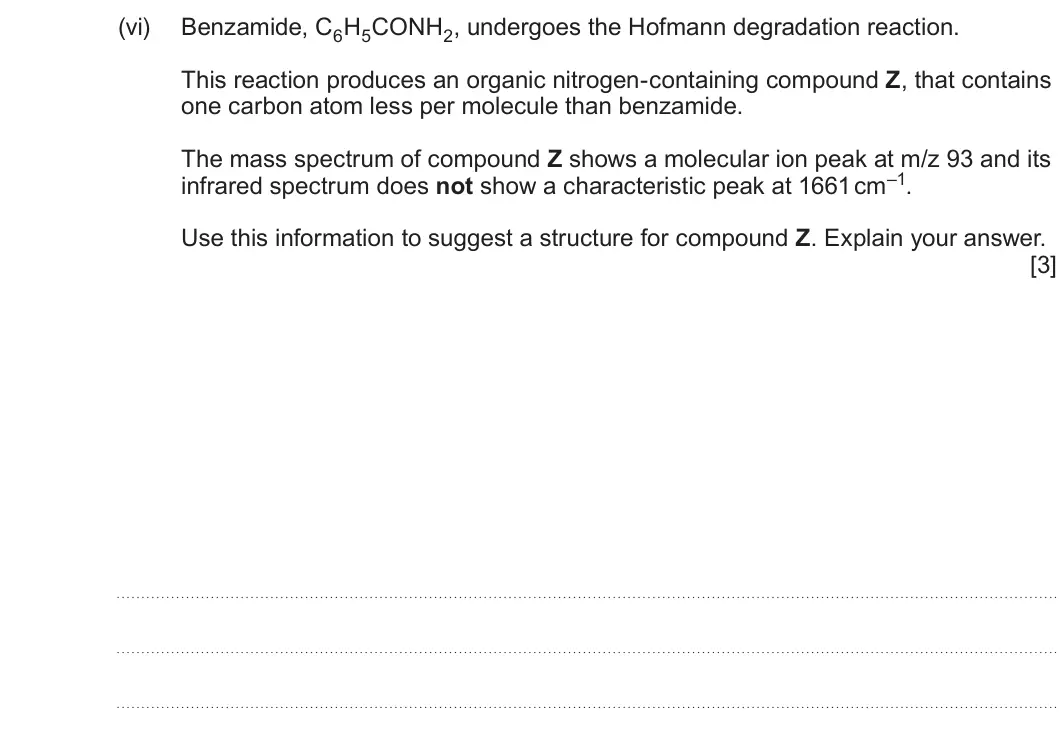
Q2(a)
The whole paper ↗
Q2(b)
The whole paper ↗
Q7(b)(i)
The whole paper ↗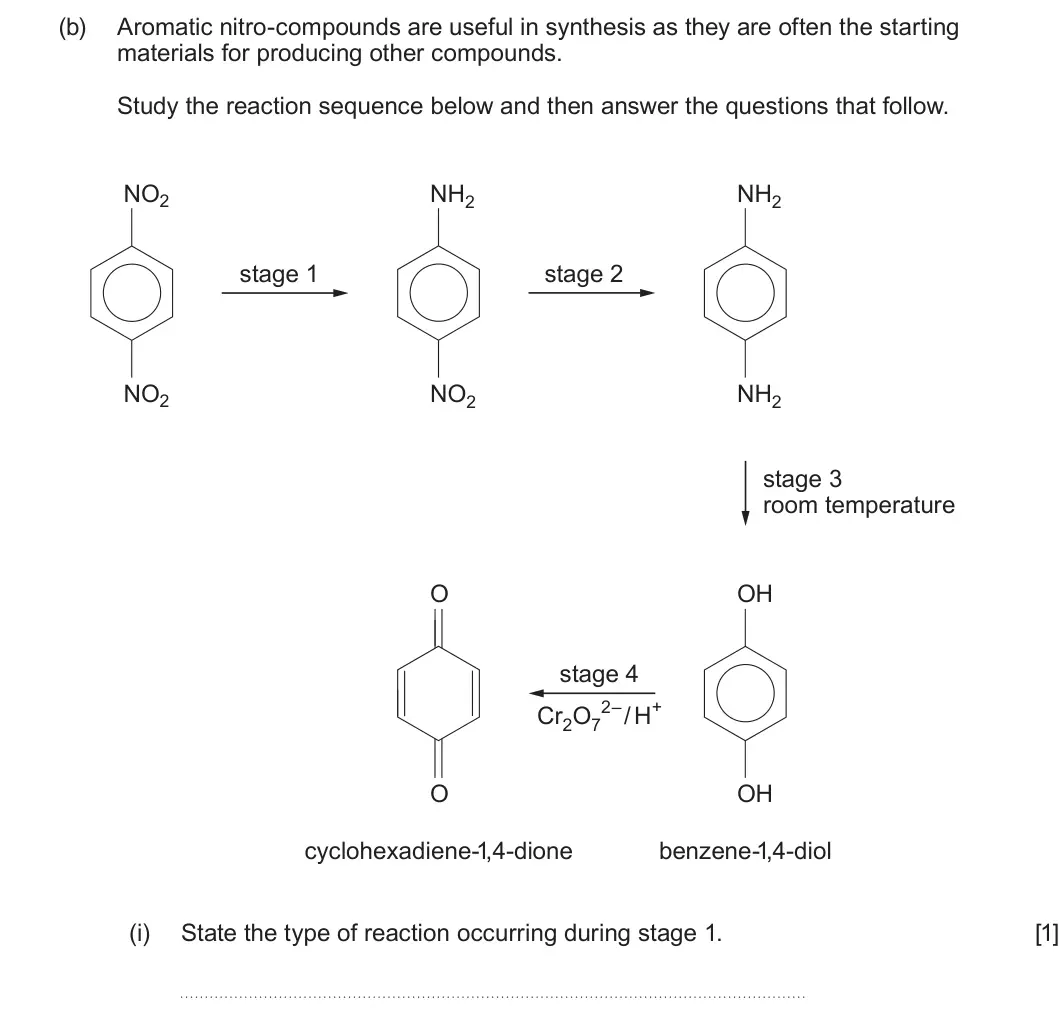
Q7(b)(ii)
The whole paper ↗
Q7(b)(iii)
The whole paper ↗
Q7(c)(i)
The whole paper ↗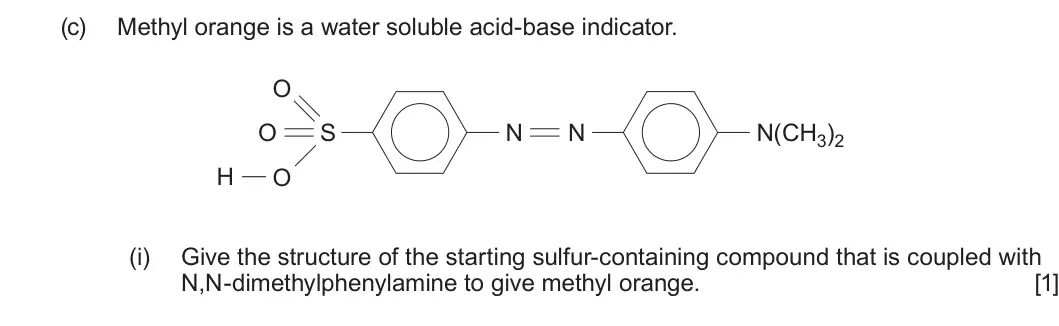
Q7(c)(ii)
The whole paper ↗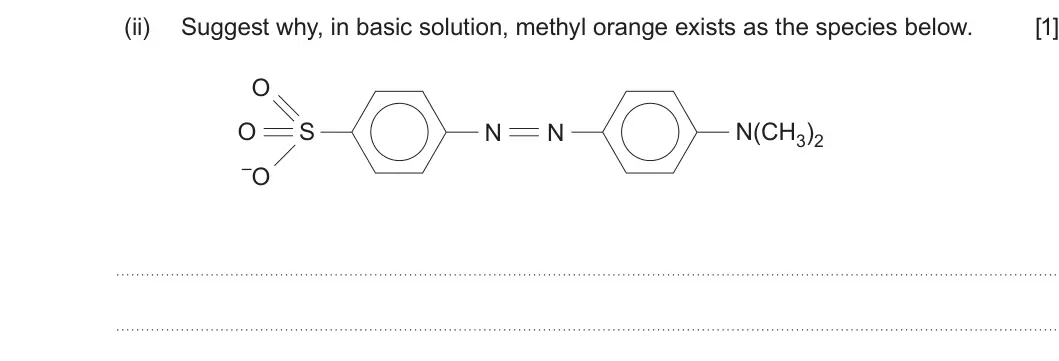
Q3(a)
The whole paper ↗
Q3(b)
The whole paper ↗
Q9(a)(ii)
The whole paper ↗
Q9(f)(iii)
The whole paper ↗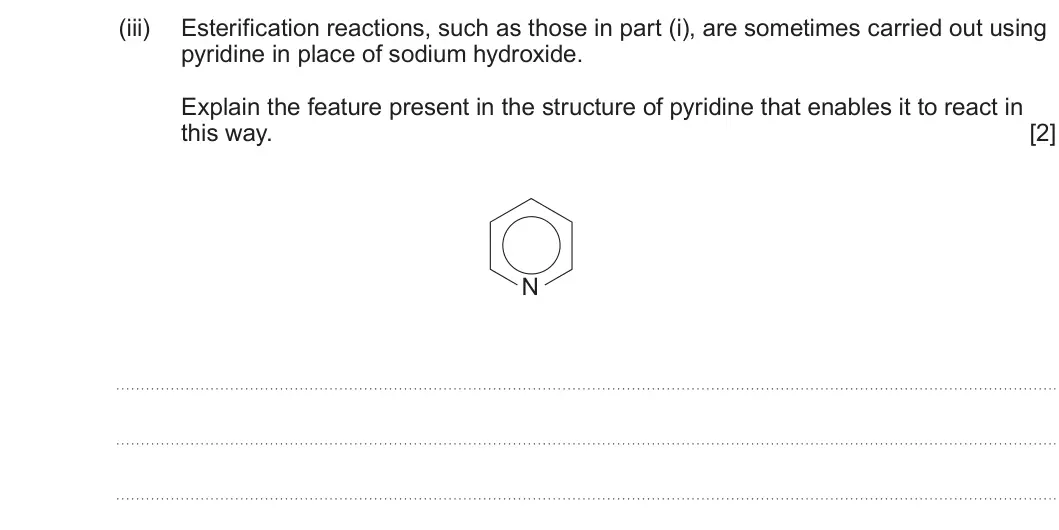
Q10(c)(ii)
The whole paper ↗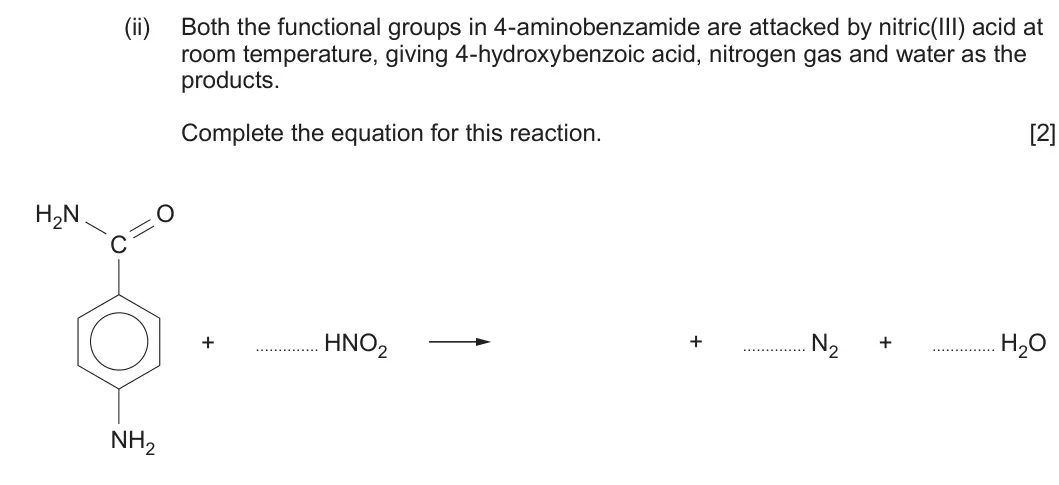
Q10(a)(i)
The whole paper ↗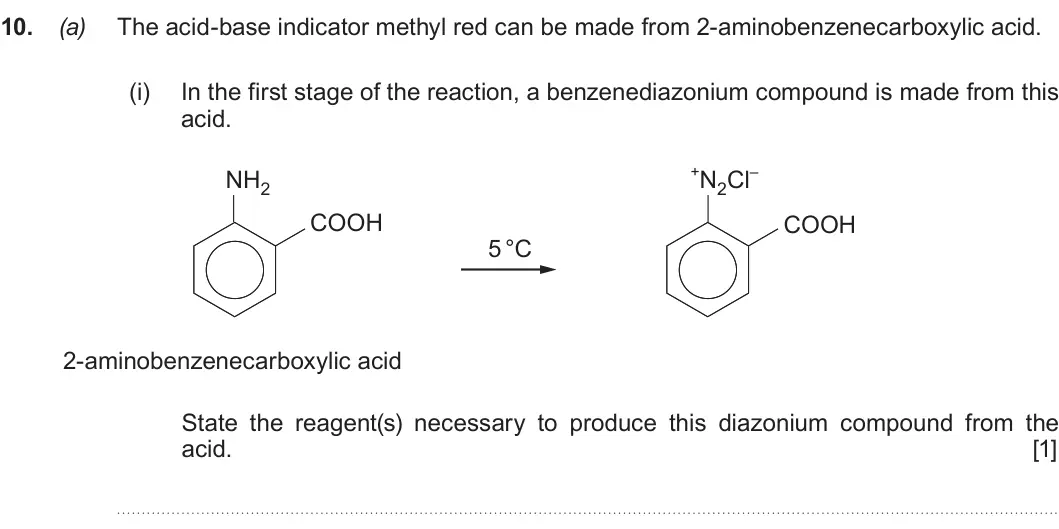
Q10(a)(ii)
The whole paper ↗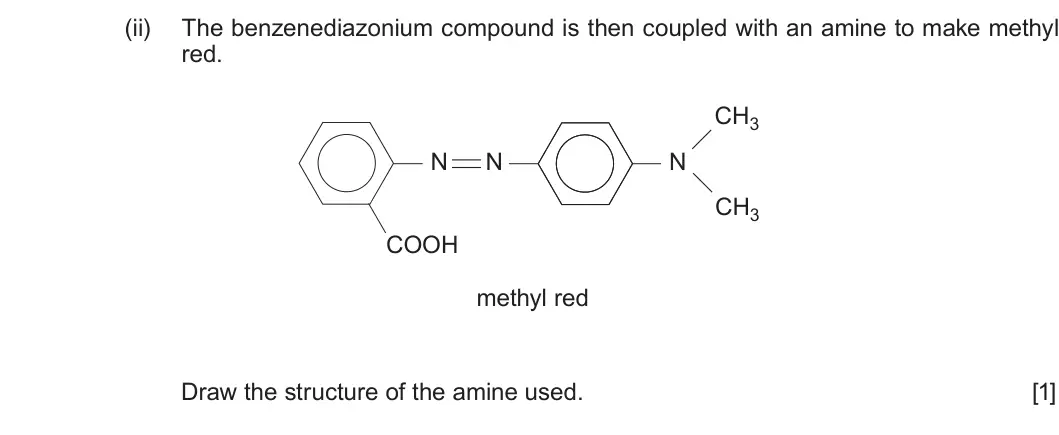
All 34 questions on Amines, as a list
- Summer 2025, Unit 4, Q7(b)(i) (2 marks): A primary aromatic amine, compound V, reacts with nitric(III) acid to give the corresponding phenol and nitrogen gas. R NH2 + HNO2 R OH + N2 + H2O compound V 5.
- Summer 2025, Unit 4, Q7(b)(iii) (1 mark): At 5 °C compound V reacts with nitric(III) acid to give a diazonium compound which then reacts with compound W to give the azo dye below. CH3 R N N OH CH3 State
- Summer 2025, Unit 4, Q8(a)(iii) (1 mark): 2-Aminopropanoic acid can be obtained by reacting 2-bromopropanoic acid with ammonia in the mole ratio of 1:2 respectively. Give the equation for this reaction.
- Summer 2025, Unit 4, Q9(a)(vi) (3 marks): Benzamide, C6H5CONH2, undergoes the Hofmann degradation reaction. This reaction produces an organic nitrogen-containing compound Z, that contains one carbon ato
- Summer 2024, Unit 4, Q2(a) (1 mark): Calculate the frequency corresponding to this wavelength. [1] Frequency = Hz
- Summer 2024, Unit 4, Q2(b) (1 mark): Explain why this dye is yellow in white light. [1]
- Summer 2024, Unit 4, Q7(b)(i) (1 mark): State the type of reaction occurring during stage 1 [1]
- Summer 2024, Unit 4, Q7(b)(ii) (1 mark): State the reagent(s) used in stage 2 [1]
- Summer 2024, Unit 4, Q7(b)(iii) (1 mark): State the reagent(s) used to produce benzene-1,4-diol in stage 3 [1]
- Summer 2024, Unit 4, Q7(c)(i) (1 mark): Give the structure of the starting sulfur-containing compound that is coupled with N,N-dimethylphenylamine to give methyl orange. [1]
- Summer 2024, Unit 4, Q7(c)(ii) (1 mark): Suggest why, in basic solution, methyl orange exists as the species below. [1] O O S N N N(CH3)2 –O
- Summer 2023, Unit 4, Q3(a) (1 mark): 1,2-Diaminoethane reacts as a base. Explain how this compound acts as a base. [1]
- Summer 2023, Unit 4, Q3(b) (1 mark): Give the structure of the organic compound formed when 1 mole of 1,2-diaminoethane reacts with 2 moles of ethanoyl chloride. [1]
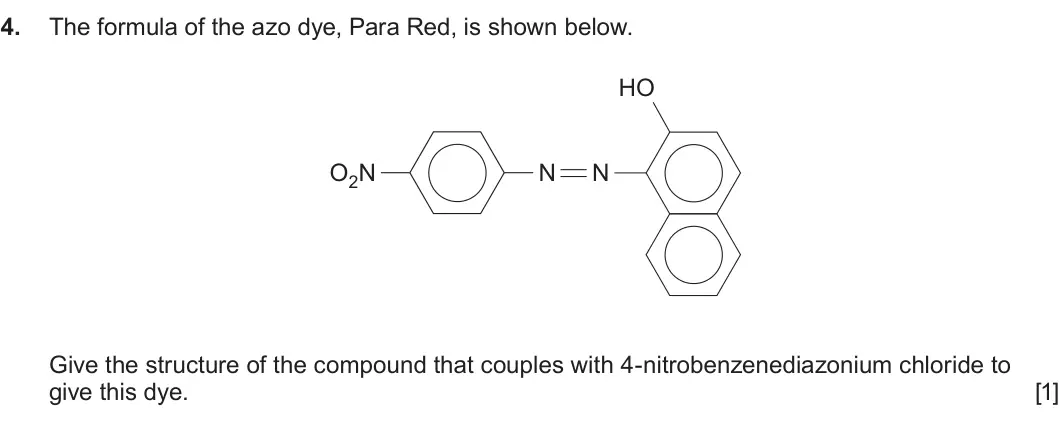
- Summer 2023, Unit 4, Q4 (1 mark): The formula of the azo dye, Para Red, is shown below. HO O2N N N Give the structure of the compound that couples with 4-nitrobenzenediazonium chloride to give t
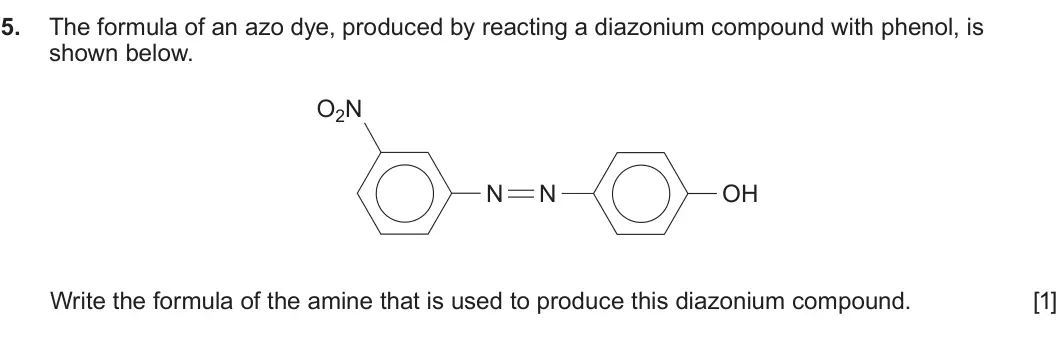
- Summer 2022, Unit 4, Q5 (1 mark): The formula of an azo dye, produced by reacting a diazonium compound with phenol, is shown below. O2N N N OH Write the formula of the amine that is used to prod
- Summer 2022, Unit 4, Q9(a)(ii) (1 mark): Suggest a reagent(s) for stage 2 [1]
- Summer 2022, Unit 4, Q9(f)(iii) (2 marks): Esterification reactions, such as those in part (i), are sometimes carried out using pyridine in place of sodium hydroxide. Explain the feature present in the s
- Summer 2022, Unit 4, Q10(c)(ii) (2 marks): Both the functional groups in 4-aminobenzamide are attacked by nitric(III) acid at room temperature, giving 4-hydroxybenzoic acid, nitrogen gas and water as the
- Summer 2019, Unit 4, Q10(a)(i) (1 mark): In the first stage of the reaction, a benzenediazonium compound is made from this acid. +N2Cl– NH2 COOH COOH 5 °C 2-aminobenzenecarboxylic acid State the reagen
- Summer 2019, Unit 4, Q10(a)(ii) (1 mark): The benzenediazonium compound is then coupled with an amine to make methyl red. CH3 N N N CH3 COOH methyl red Draw the structure of the amine used. [1]
- Summer 2019, Unit 4, Q10(a)(iii) (2 marks): The visible spectrum of this azo dye at a certain pH shows an absorption maximum at 410 nm. Calculate the frequency that corresponds to this wavelength. [2] Fre
- Summer 2019, Unit 4, Q10(b)(ii) (2 marks): Absorption (A) and concentration (c) are related by the equation A = k c where k is a constant The calibration graph shows that an absorption of 1.44 is measure
- Summer 2019, Unit 4, Q10(c)(iv) (1 mark): Some amines can be made by the reaction of a chlorine-containing compound and ammonia. For example (chloromethyl)benzene reacts with ammonia to give phenylmethy
- Summer 2018, Unit 4, Q7(b) (1 mark): State the feature of 2,4-DNPH that enables it to react as a base. [1]
- Summer 2018, Unit 4, Q10(a) (3 marks): Butylamine can be made from propan-1-ol in a three-stage process. Give the reagent used and the structural formula of the product for each stage. [3] Stage Reag
- Summer 2018, Unit 4, Q10(b)(i) (1 mark): State how nitric(III) acid is prepared for use in this reaction. [1]
- Summer 2018, Unit 4, Q10(b)(ii) (1 mark): Give the equation for the reaction of benzenediazonium chloride with phenol to produce an azo dye. [1]
- Summer 2017, Unit 4, Q8 (2 marks): State the reagents necessary to convert hexane-1,6-diamine to hexane-1,6-dioic acid in two stages. [2] A B H2N(CH2)6NH2 HO(CH2)6OH HOOC(CH2)4COOH A B
- Summer 2017, Unit 4, Q9(c)(ii) (1 mark): Explain why compound T is initially produced in this reaction. [1]
- Summer 2017, Unit 4, Q10(a)(i) (2 marks): Give the displayed formulae of the two starting compounds that react, via a diazonium compound, to give Mordant Orange 1 [2]
- Summer 2017, Unit 4, Q10(a)(ii) (1 mark): The table shows the colour seen and the colour absorbed for a solution of Mordant Orange 1 as the pH increases. Colour seen yellow orange-red Colour absorbed vi
- Summer 2017, Unit 4, Q10(a)(iii) (2 marks): The visible spectrum of the dye at pH 10.1 shows that it has a maximum absorption at 385 nm. Calculate the frequency of the radiation being absorbed at 385 nm.
- Summer 2017, Unit 4, Q10(a)(iv) (3 marks): Use your answer to (iii) to calculate the energy of the maximum absorption at 385 nm, giving your answer in kJ mol−1. [3] Energy = kJ mol−1
- Summer 2017, Unit 4, Q10(b)(i) (1 mark): 1,4-diaminobenzene can also be made from 4-nitrophenylamine. State the reagent(s) necessary for this reaction. [1]
Questions, mark schemes and examiner’s reports are © WJEC CBAC Ltd, from their published past papers. Plumi isn’t affiliated with any exam board. Want whole papers? Every WJEC A-Level Chemistry paper.
Rather write your answers by hand on iPad? Plumi marks them against the same mark schemes.