 plumi
Aldehydes and ketones: WJEC A‑Level Chemistry questions
Every WJEC A-Level Chemistry exam question on 4.4 Aldehydes and ketones, 2016–2025, with its mark scheme and examiner’s report.
Find questions1,204
Calculations
Q2(a)
The whole paper ↗
Q7(c)
The whole paper ↗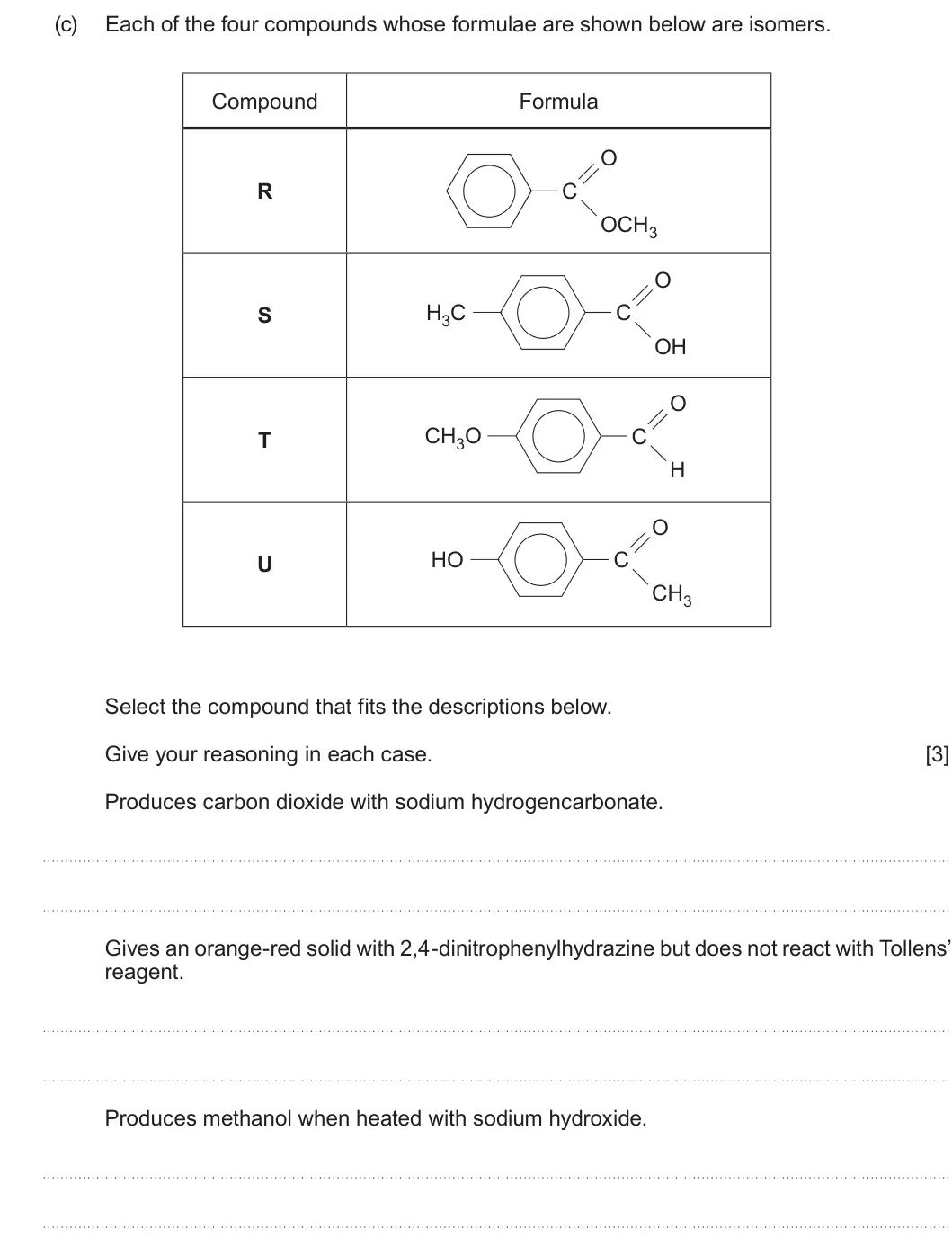
Q8(a)(iii)
The whole paper ↗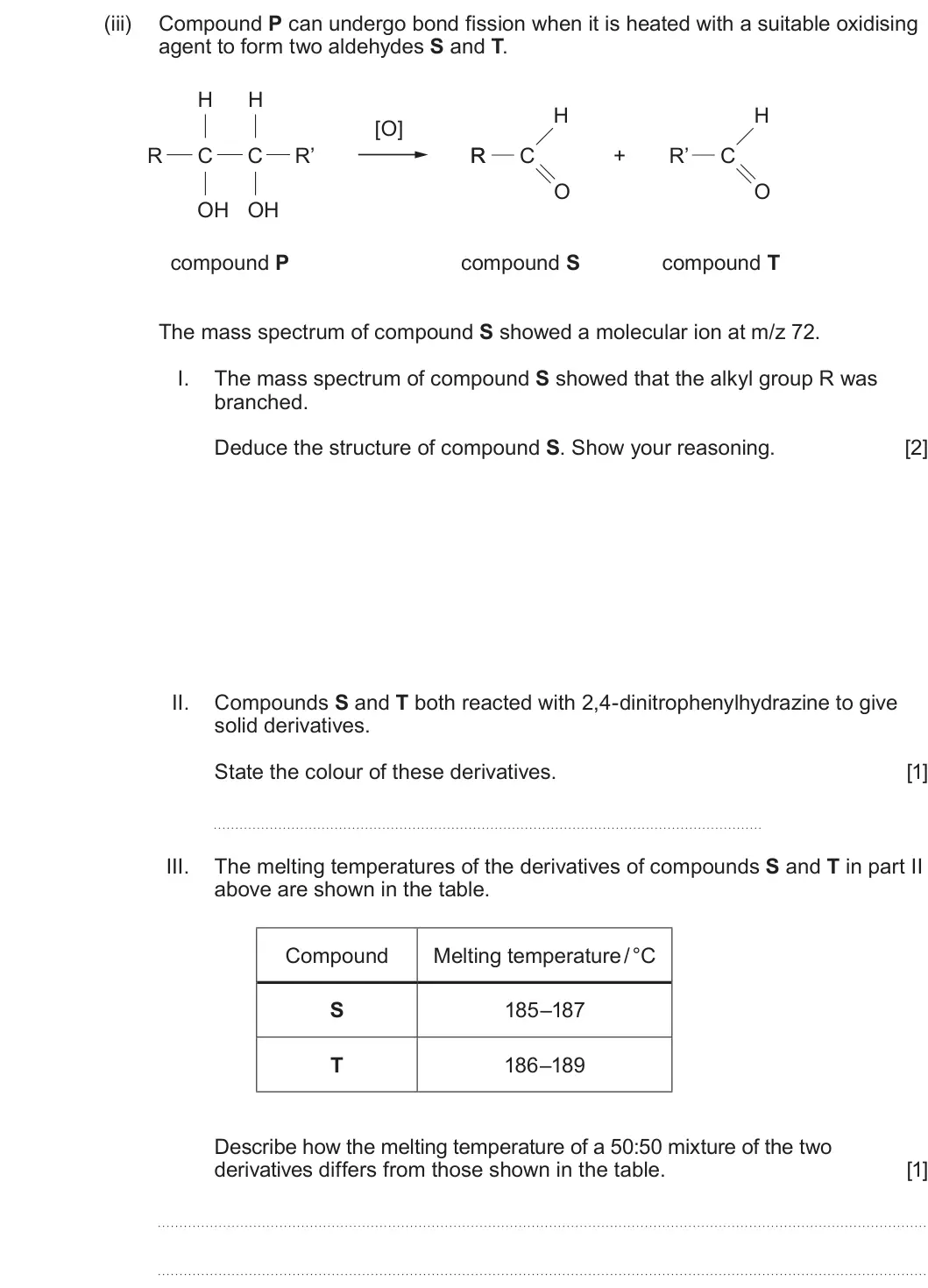
Q8(b)(ii)
The whole paper ↗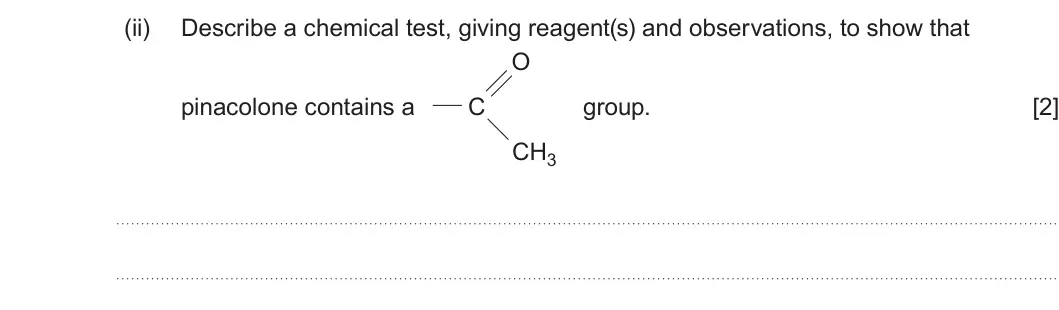
Q10(c)(i)
The whole paper ↗
Q10(c)(ii)
The whole paper ↗
Q12(b)(i)
The whole paper ↗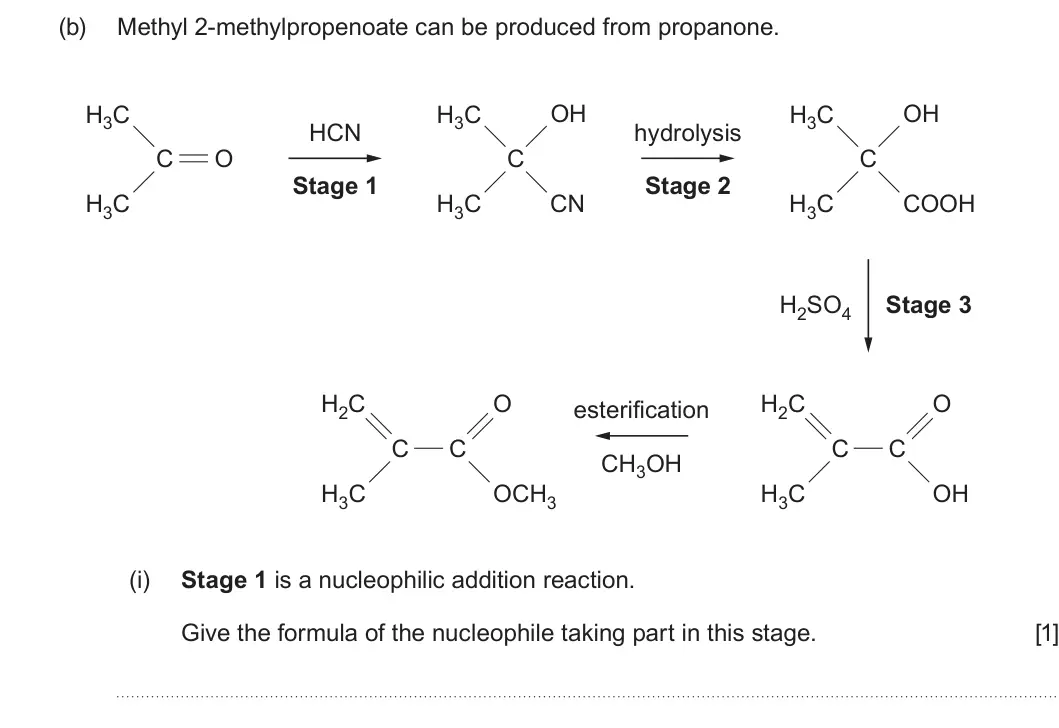
Q12(b)(ii)
The whole paper ↗
Q12(b)(iii)
The whole paper ↗
Q6(a)
The whole paper ↗
Q9(a)(ii)
The whole paper ↗
Q9(a)(iii)
The whole paper ↗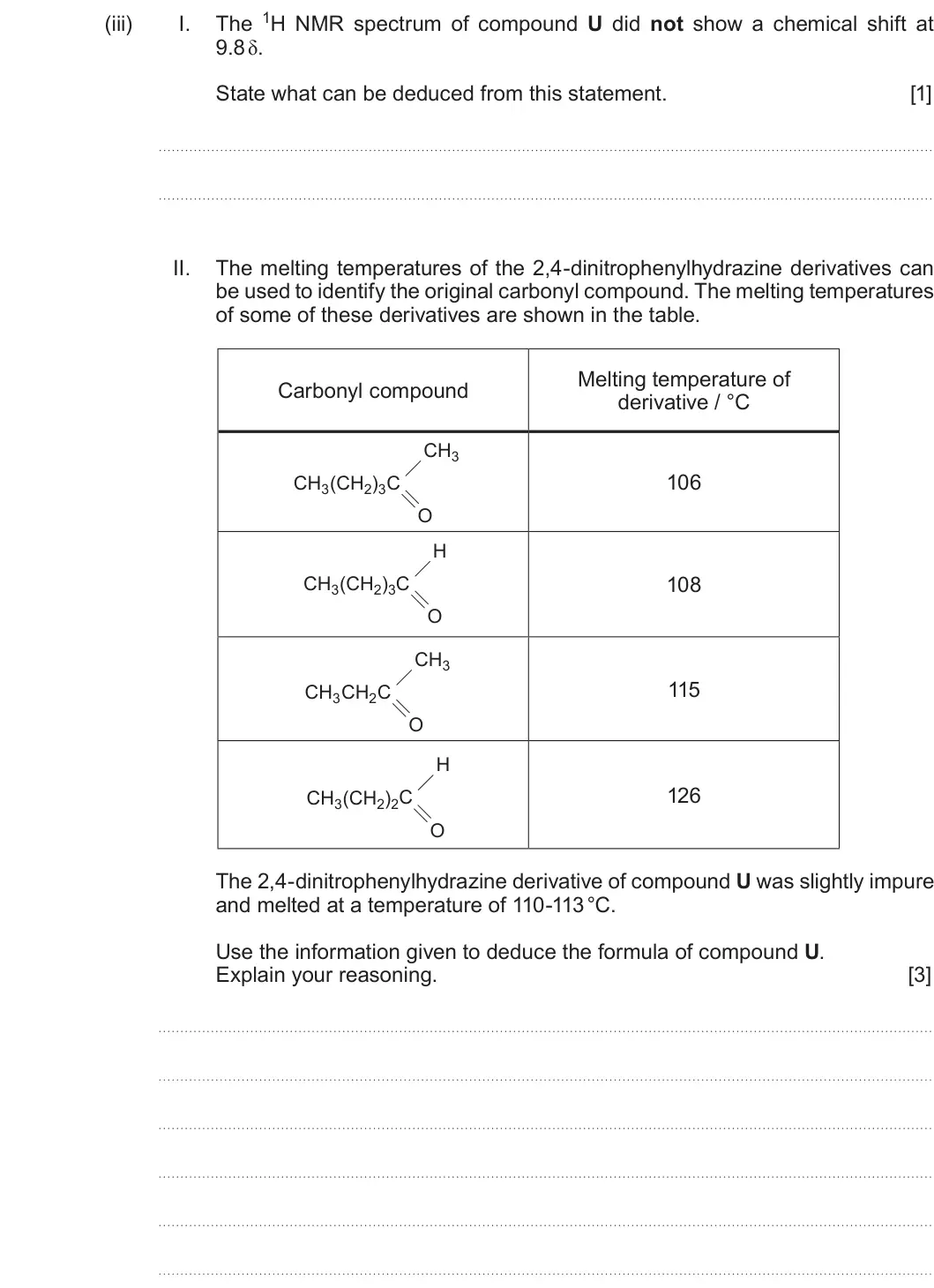
Q9(a)(iv)
The whole paper ↗
Q9(b)(iv)
The whole paper ↗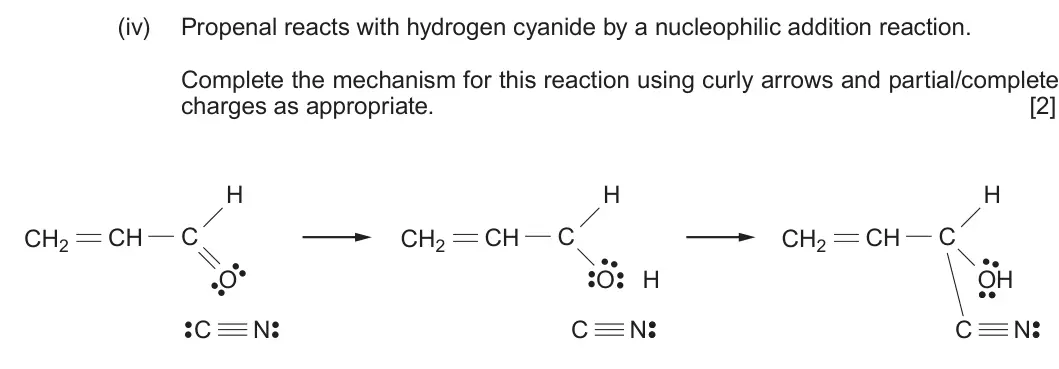
Q1(a)
The whole paper ↗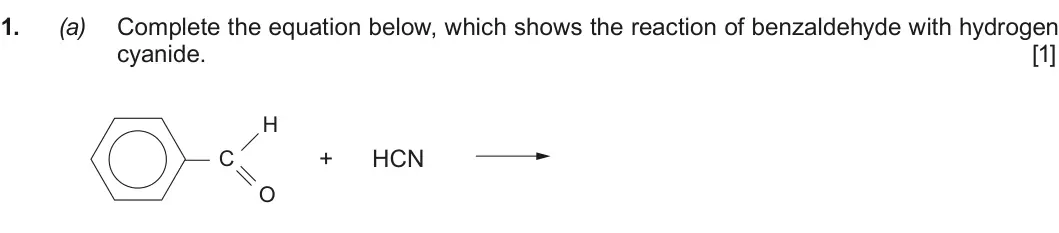
Q1(b)
The whole paper ↗
Q6(b)(i)
The whole paper ↗
Q6(b)(ii)
The whole paper ↗
All 27 questions on Aldehydes and ketones, as a list
- Summer 2025, Unit 4, Q2(a) (1 mark): State what is seen, if anything, when propan-2-ol reacts with an alkaline solution of iodine. [1]
- Summer 2025, Unit 4, Q7(c) (3 marks): Each of the four compounds whose formulae are shown below are isomers. Compound Formula O R C OCH3 O H3C C S OH O CH3O C T H O HO C U CH3 Select the compound th
- Summer 2024, Unit 4, Q8(a)(iii) (4 marks): Compound P can undergo bond fission when it is heated with a suitable oxidising agent to form two aldehydes S and T. H H H H [O] R C C R’ R R C R’ C + O O OH OH
- Summer 2024, Unit 4, Q8(b)(ii) (2 marks): Describe a chemical test, giving reagent(s) and observations, to show that O pinacolone contains a C group. [2] CH3
- Summer 2024, Unit 4, Q10(c)(i) (1 mark): State what is seen when lactose reacts with the dark blue solution of Fehling’s reagent. [1]
- Summer 2024, Unit 4, Q10(c)(ii) (1 mark): State which functional group must be present in a molecule of lactose for this result with Fehling’s reagent. [1]
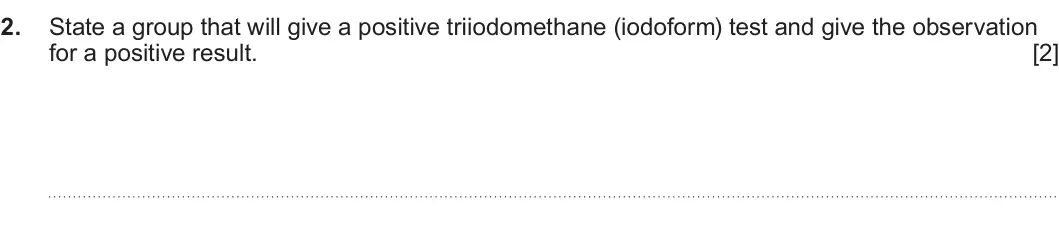
- Summer 2023, Unit 4, Q2 (2 marks): State a group that will give a positive triiodomethane (iodoform) test and give the observation for a positive result. [2]
- Summer 2023, Unit 4, Q12(b)(i) (1 mark): Stage 1 is a nucleophilic addition reaction. Give the formula of the nucleophile taking part in this stage. [1]
- Summer 2023, Unit 4, Q12(b)(ii) (1 mark): State why Stage 1 is described as an addition reaction. [1]
- Summer 2023, Unit 4, Q12(b)(iii) (1 mark): State a reagent used for hydrolysis in Stage 2 [1]
- Summer 2022, Unit 4, Q6(a) (1 mark): State the type of mechanism occurring during this reaction. [1]
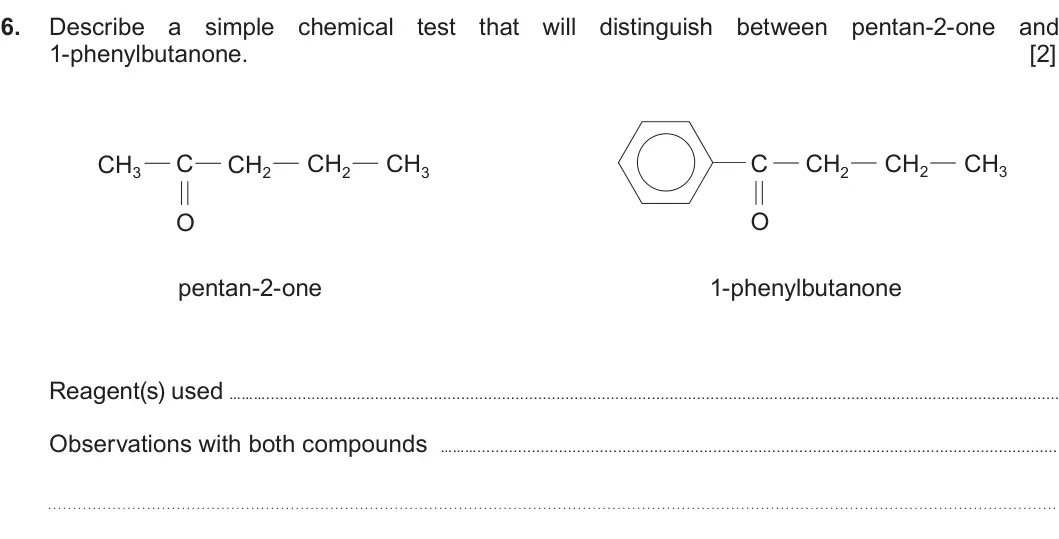
- Summer 2019, Unit 4, Q6 (2 marks): Describe a simple chemical test that will distinguish between pentan-2-one and 1-phenylbutanone. [2] CH3 C CH2 CH2 CH3 C CH2 CH2 CH3 O O pentan-2-one 1-phenylbu
- Summer 2019, Unit 4, Q9(a)(ii) (1 mark): Carbonyl compound U reacted with 2,4-dinitrophenylhydrazine to produce a solid derivative. State the colour of this solid derivative. [1]
- Summer 2019, Unit 4, Q9(a)(iii) (4 marks): I. 9.8 δ. State what can be deduced from this statement. [1] II. The melting temperatures of the 2,4-dinitrophenylhydrazine derivatives can be used to identify
- Summer 2019, Unit 4, Q9(a)(iv) (2 marks): Use your answer to part (iii) and other relevant information given in the question to give the structure of alkene T. Name alkene T. [2] Name
- Summer 2019, Unit 4, Q9(b)(iv) (2 marks): Propenal reacts with hydrogen cyanide by a nucleophilic addition reaction. Complete the mechanism for this reaction using curly arrows and partial/complete char
- Summer 2018, Unit 4, Q1(a) (1 mark): Complete the equation below, which shows the reaction of benzaldehyde with hydrogen cyanide. [1] H + HCN C O
- Summer 2018, Unit 4, Q1(b) (1 mark): Give the formula of the nucleophile that takes part in the reaction shown in part (a). [1] (b)
- Summer 2018, Unit 4, Q6(b)(i) (1 mark): Give the formula of the yellow precipitate. [1]
- Summer 2018, Unit 4, Q6(b)(ii) (2 marks): Suggest a structural formula for this isomer and identify the group that enables it to produce this yellow precipitate. [2] Structural formula Group
- Summer 2018, Unit 4, Q6(c)(i) (1 mark): State a reagent that can be used to produce octane-2,3-diol from octane-2,3-dione. [1]
- Summer 2018, Unit 4, Q6(c)(ii) (1 mark): Suggest how the rate of the reaction in part (i) could be studied. [1]
- Summer 2018, Unit 4, Q7(c)(i) (1 mark): State what is seen when 2,4-DNPH is used to identify an aldehyde or a ketone. [1]
- Summer 2018, Unit 4, Q7(c)(ii) (1 mark): Explain why 2,4-DNPH is an appropriate reagent to use in their identification. [1]
- Summer 2017, Unit 4, Q4 (1 mark): State the reagent used to produce phenylmethanol from benzaldehyde. [1]
- Summer 2017, Unit 4, Q11(a)(i) (3 marks): Draw the mechanism for this reaction. Name the type of reaction mechanism occurring. [3] Mechanism type
- Summer 2017, Unit 4, Q12(a) (6 marks): Queen bees secrete a pheromone, compound W, which is used for a number of purposes, both inside and outside the hive. Compound W • is a straight chain aliphatic
Questions, mark schemes and examiner’s reports are © WJEC CBAC Ltd, from their published past papers. Plumi isn’t affiliated with any exam board. Want whole papers? Every WJEC A-Level Chemistry paper.
Rather write your answers by hand on iPad? Plumi marks them against the same mark schemes.