 plumi
Bonding: WJEC A‑Level Chemistry questions
Every WJEC A-Level Chemistry exam question on 1.4 Bonding, 2016–2025, with its mark scheme and examiner’s report.
Find questions1,204
Calculations

Q11(a)(i)
The whole paper ↗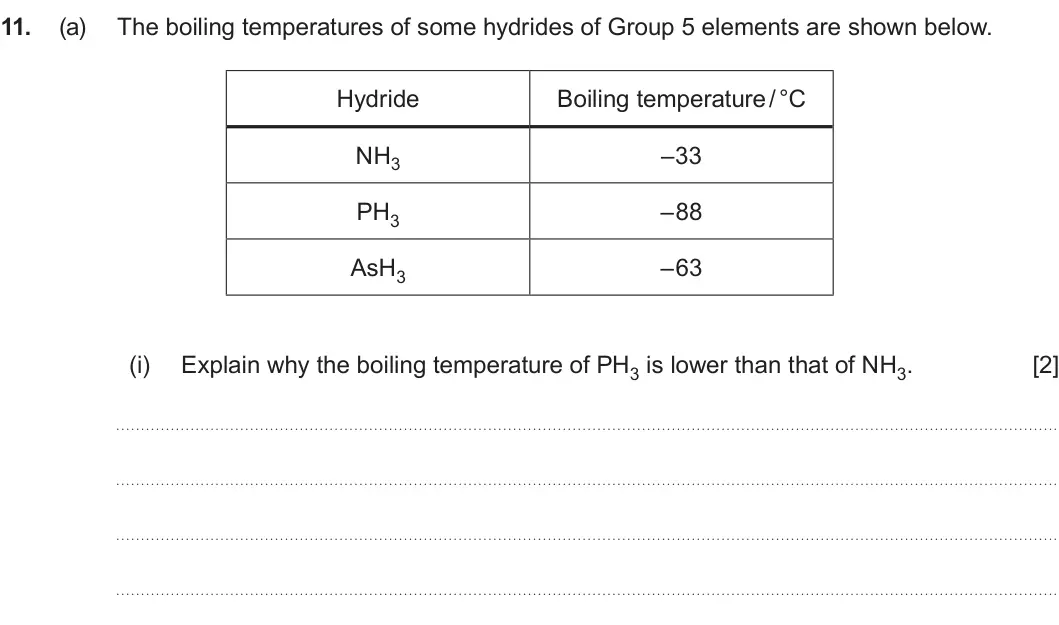
Q11(a)(ii)
The whole paper ↗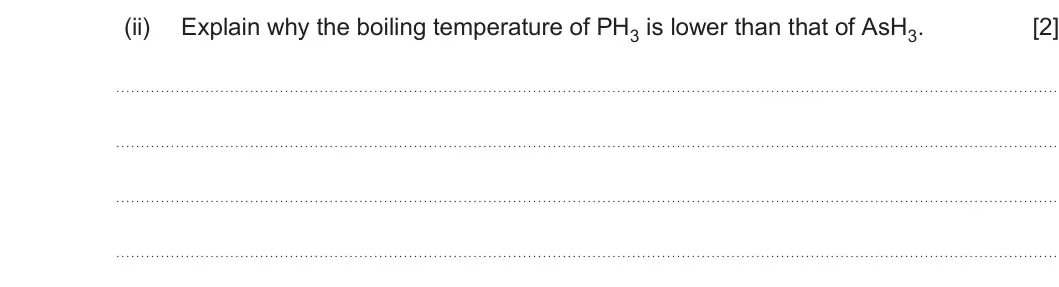
Q11(b)
The whole paper ↗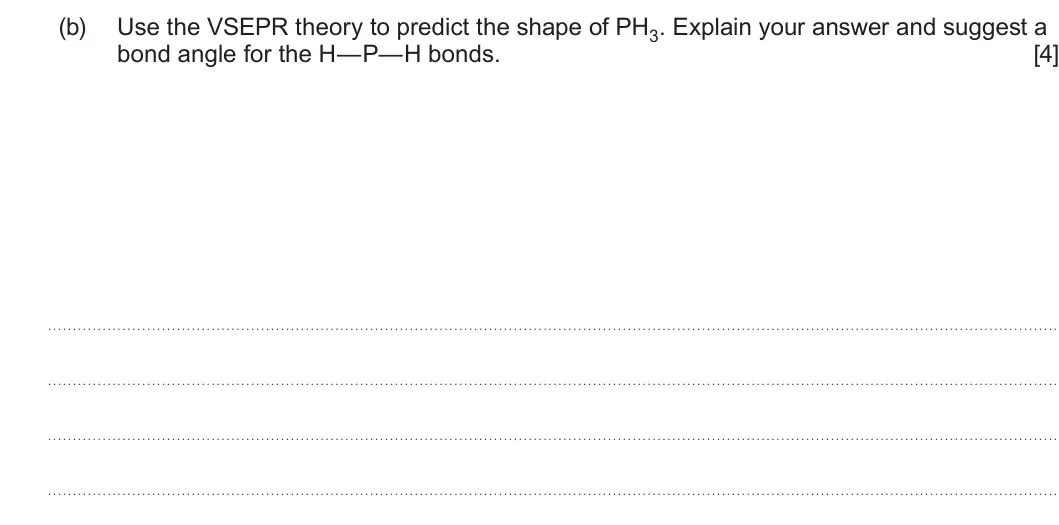
Q9(a)(ii)
The whole paper ↗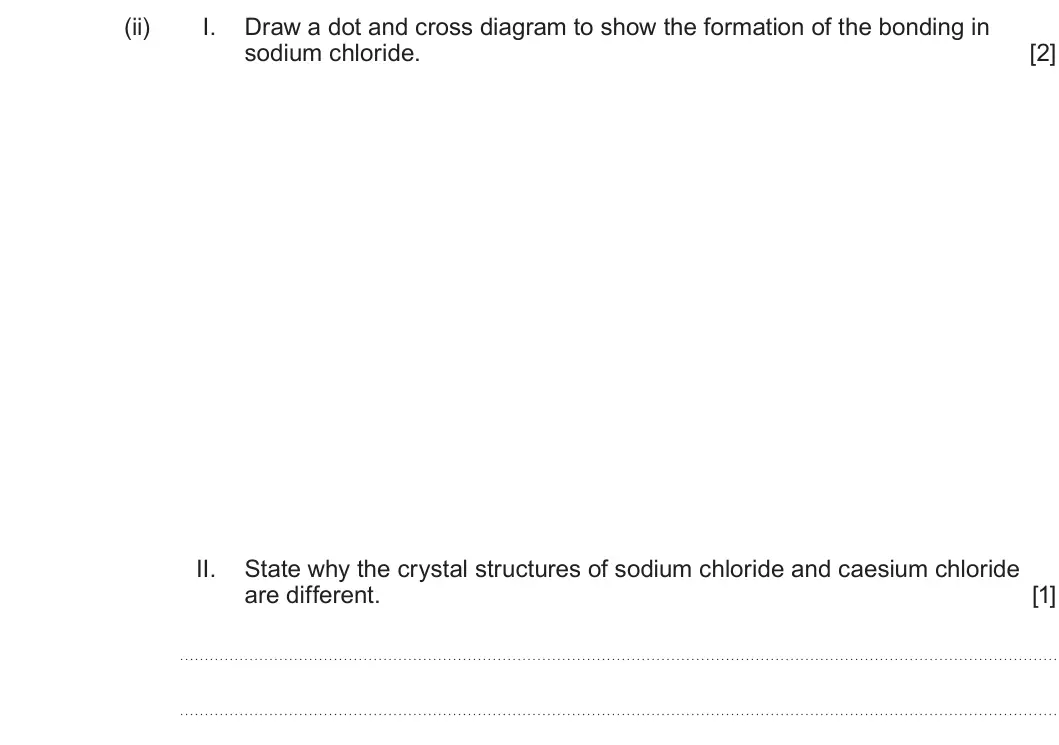
Q11(c)(i)
The whole paper ↗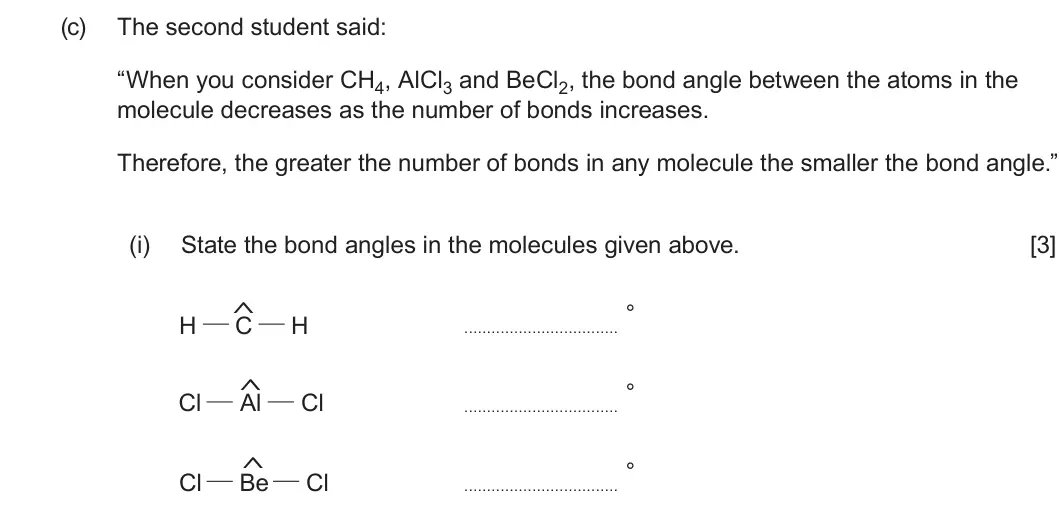
Q11(c)(ii)
The whole paper ↗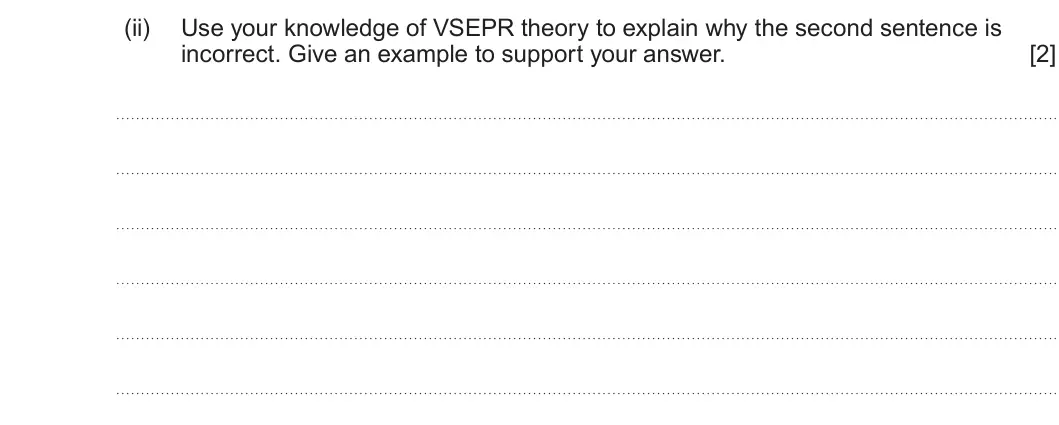
Q7(a)
The whole paper ↗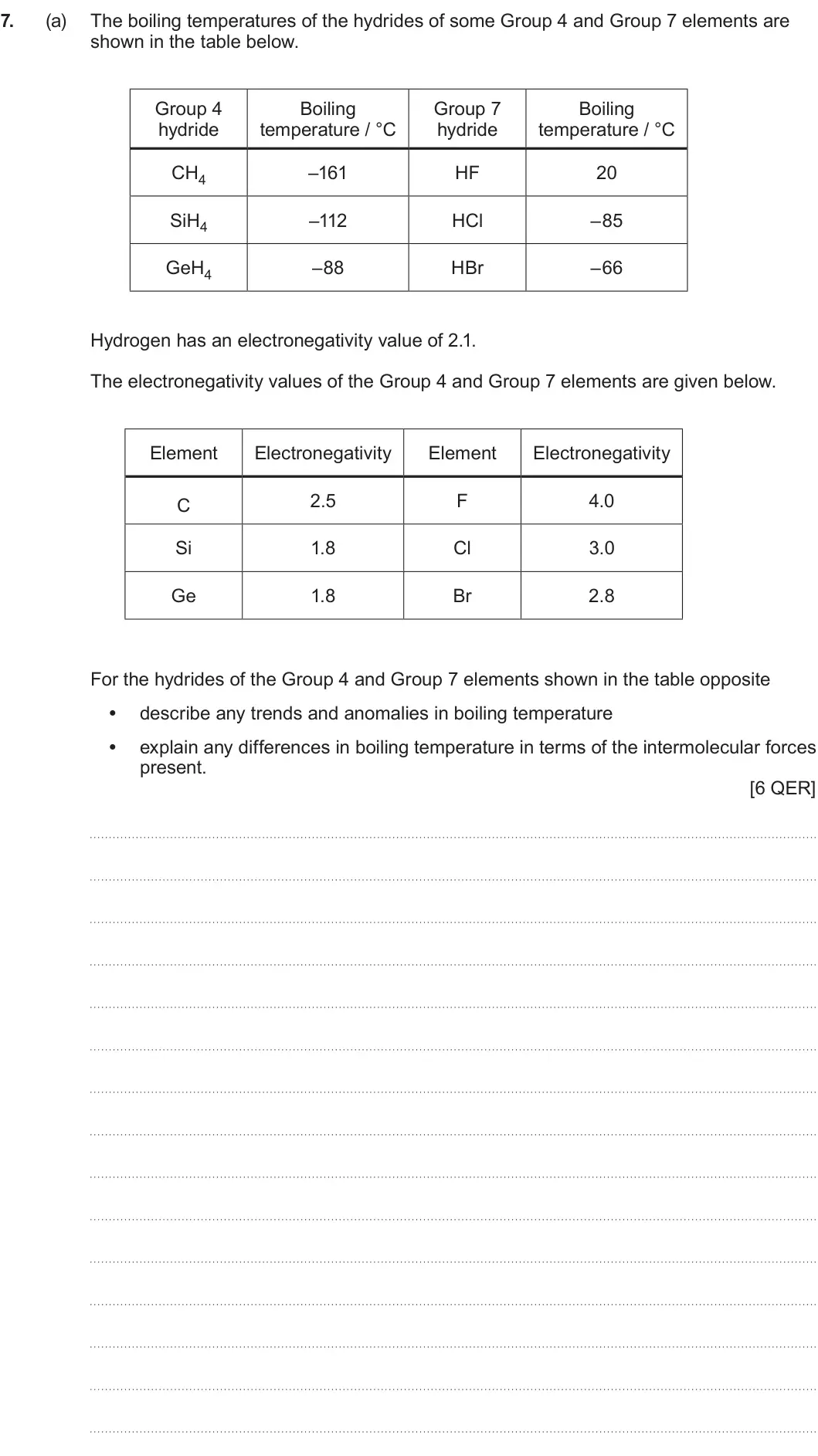
Q8(a)
The whole paper ↗
Q9(e)
The whole paper ↗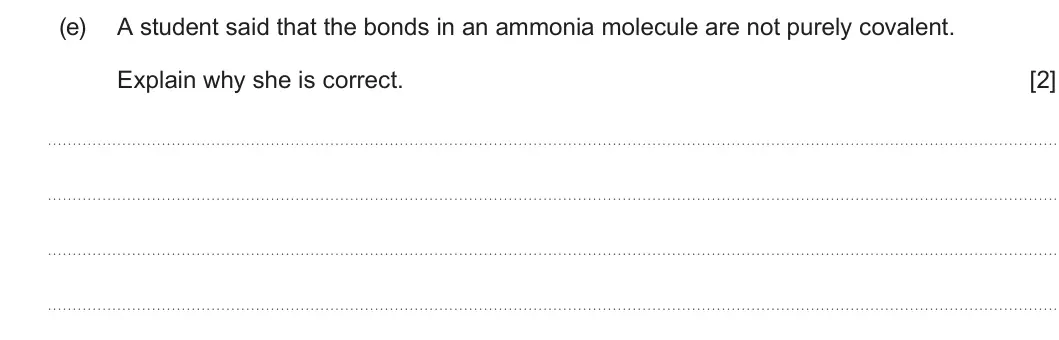


Q11(c)
The whole paper ↗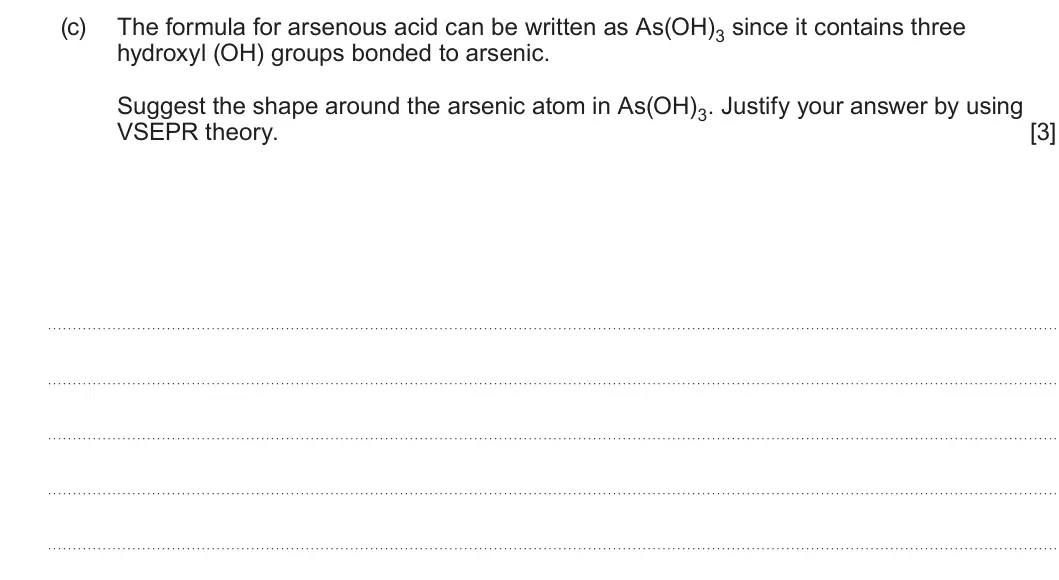

Q13(c)(i)
The whole paper ↗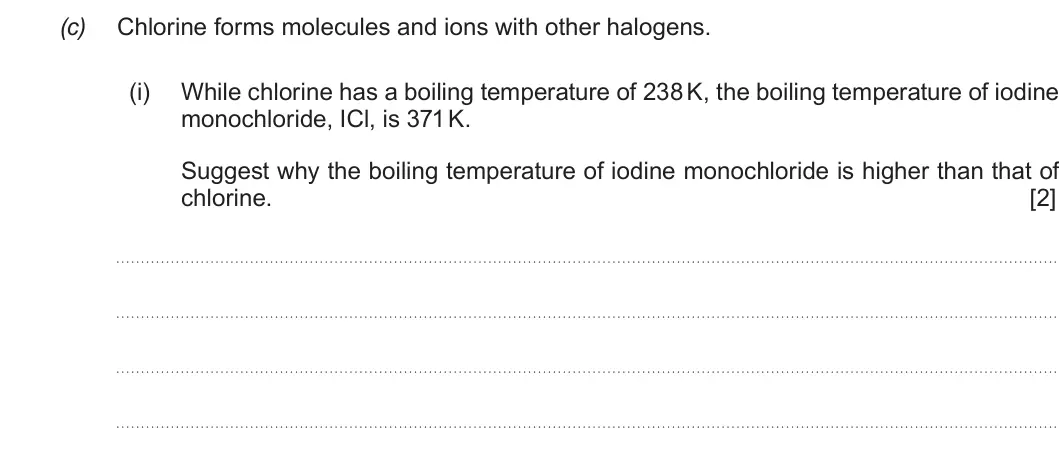
Q13(c)(ii)
The whole paper ↗
Q13(c)(iii)
The whole paper ↗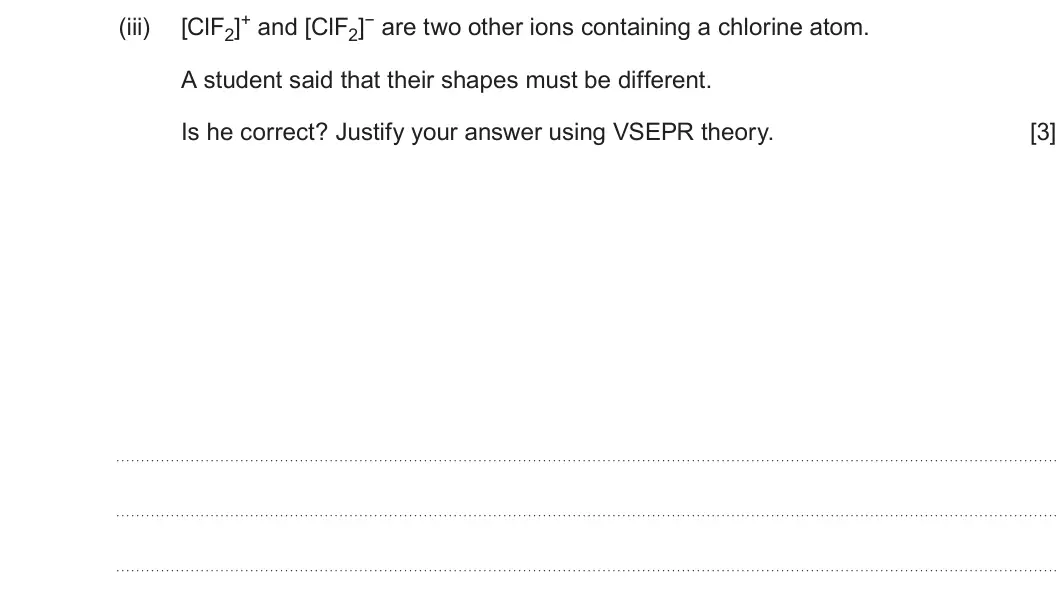
Q5(a)
The whole paper ↗
All 33 questions on Bonding, as a list
- Summer 2025, AS Unit 1, Q1 (1 mark): Using outer electrons only, draw a dot and cross diagram to show the bonding in a diatomic molecule of oxygen. [1]
- Summer 2025, AS Unit 1, Q11(a)(i) (2 marks): Explain why the boiling temperature of PH3 is lower than that of NH3. [2]
- Summer 2025, AS Unit 1, Q11(a)(ii) (2 marks): Explain why the boiling temperature of PH3 is lower than that of AsH3. [2]
- Summer 2025, AS Unit 1, Q11(b) (4 marks): Use the VSEPR theory to predict the shape of PH3. Explain your answer and suggest a bond angle for the H—P—H bonds. [4]
- Summer 2024, AS Unit 1, Q9(a)(ii) (3 marks): I. Draw a dot and cross diagram to show the formation of the bonding in sodium chloride. [2] II. State why the crystal structures of sodium chloride and caesium
- Summer 2024, AS Unit 1, Q11(c)(i) (3 marks): State the bond angles in the molecules given above. [3] $ ° H C H $ ° Cl Al Cl $ ° Cl Cl Be
- Summer 2024, AS Unit 1, Q11(c)(ii) (2 marks): Use your knowledge of VSEPR theory to explain why the second sentence is incorrect. Give an example to support your answer. [2]
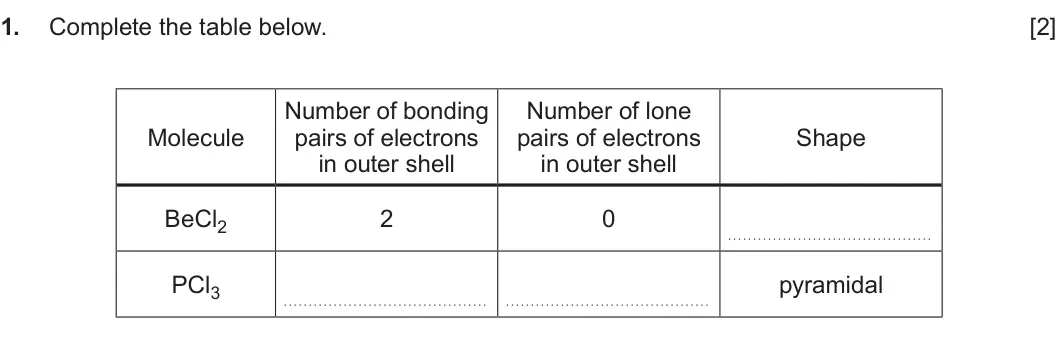
- Summer 2023, AS Unit 1, Q1 (2 marks): Complete the table below. [2] Number of bonding Number of lone Molecule pairs of electrons pairs of electrons Shape in outer shell in outer shell BeCl2 2 0 PCl3
- Summer 2023, AS Unit 1, Q7(a) (6 marks): The boiling temperatures of the hydrides of some Group 4 and Group 7 elements are shown in the table below. Group 4 Boiling Group 7 Boiling hydride temperature
- Summer 2023, AS Unit 1, Q8(a) (2 marks): Aluminium reacts with oxygen to form aluminium oxide. Using outer electrons only, draw a dot and cross diagram to show the bonding in aluminium oxide. [2]
- Summer 2023, AS Unit 1, Q9(e) (2 marks): A student said that the bonds in an ammonia molecule are not purely covalent. Explain why she is correct. [2]
- Summer 2022, AS Unit 1, Q1 (2 marks): Using outer electrons only, draw a dot and cross diagram to show the formation of the bonding in sodium oxide. [2]
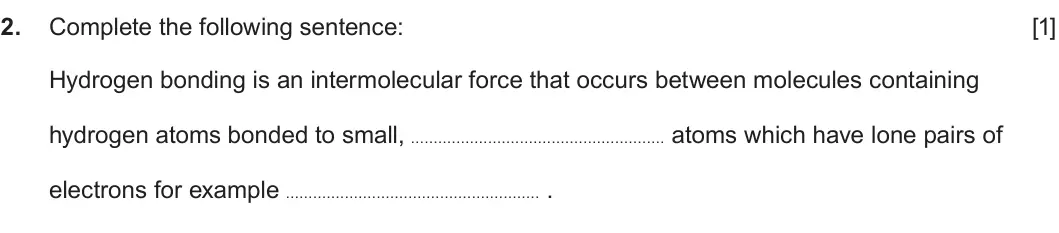
- Summer 2022, AS Unit 1, Q2 (1 mark): Complete the following sentence: [1] Hydrogen bonding is an intermolecular force that occurs between molecules containing hydrogen atoms bonded to small, atoms
- Summer 2022, AS Unit 1, Q5 (1 mark): The ammonium ion contains a ‘coordinate bond’. Explain what is meant by this term. [1]
- Summer 2022, AS Unit 1, Q11(c) (3 marks): The formula for arsenous acid can be written as As(OH)3 since it contains three hydroxyl (OH) groups bonded to arsenic. Suggest the shape around the arsenic ato
- Summer 2019, AS Unit 1, Q1 (2 marks): Using outer electrons only, draw a dot and cross diagram to show the formation of the bonding in magnesium fluoride. [2]
- Summer 2019, AS Unit 1, Q13(c)(i) (2 marks): While chlorine has a boiling temperature of 238 K, the boiling temperature of iodine monochloride, ICl, is 371 K. Suggest why the boiling temperature of iodine
- Summer 2019, AS Unit 1, Q13(c)(ii) (1 mark): [1]
- Summer 2019, AS Unit 1, Q13(c)(iii) (3 marks): A student said that their shapes must be different. Is he correct? Justify your answer using VSEPR theory. [3]
- Summer 2018, AS Unit 1, Q5(a) (1 mark): Give the meaning of the term electronegativity. [1]
- Summer 2018, AS Unit 1, Q8(d)(i) (2 marks): Draw a dot and cross diagram to show the electron arrangement in hydrazine, N2H4. Show outer electrons only. [2]
- Summer 2018, AS Unit 1, Q8(d)(ii) (1 mark): Hydrazine contains polar covalent bonds between nitrogen and hydrogen atoms. State what is meant by a polar covalent bond. [1]
- Summer 2017, Unit 4, Q10(b)(iv) (1 mark): 5-Amino-2-hydroxybenzoic acid can be used in medicine to treat a number of conditions. It is believed to work by removing free radicals. One of these radicals i
- Summer 2017, AS Unit 1, Q1 (2 marks): Using outer electrons only, draw a dot and cross diagram to show the bonding in calcium bromide. [2]
- Summer 2017, AS Unit 1, Q2 (2 marks): Identify the two elements from the following list that together produce the most ionic bond. Explain your choice. bromine magnesium oxygen sodium [2]
- Summer 2017, AS Unit 1, Q3(a) (1 mark): State how a coordinate bond differs from a covalent bond. [1]
- Summer 2017, AS Unit 1, Q3(b) (1 mark): Give one example of a species containing a coordinate bond. [1]
- Summer 2017, AS Unit 1, Q6(d) (3 marks): Hydrogen can form a range of covalent hydrides such as water, H2O, and beryllium hydride, BeH2. A student said that since the ratio of hydrogen to the other ele
- Summer 2016, AS Unit 1, Q10(b)(i) (1 mark): State the name of the shape that has this bond angle. [1]
- Summer 2016, AS Unit 1, Q10(b)(iii) (1 mark): Explain why the bonding between each atom is covalent. [1]
- Summer 2016, AS Unit 1, Q10(d)(i) (3 marks): Hydrofluoric acid will dissolve silica, SiO2, to produce hexafluorosilicic acid. 2– ion. This acid contains the SiF6 2– ion, Use the information from the table
- Summer 2016, AS Unit 1, Q11(a) (4 marks): 2-Aminoethanol is a colourless liquid. H H H N C C O H H H H 2-aminoethanol It is very soluble in water owing to its ability to hydrogen bond with water molecul
- Summer 2016, AS Unit 1, Q11(b) (3 marks): The boiling temperatures of 1,2-diaminoethane and 2-aminoethanol are shown in the table. Compound Formula Boiling temperature / °C 1,2-diaminoethane H2N–CH2–CH2
Questions, mark schemes and examiner’s reports are © WJEC CBAC Ltd, from their published past papers. Plumi isn’t affiliated with any exam board. Want whole papers? Every WJEC A-Level Chemistry paper.
Rather write your answers by hand on iPad? Plumi marks them against the same mark schemes.