 plumi
Alcohols and carboxylic acids: WJEC A‑Level Chemistry questions
Every WJEC A-Level Chemistry exam question on 2.7 Alcohols and carboxylic acids, 2016–2025, with its mark scheme and examiner’s report.
Find questions1,204
Calculations
Q2(b)
The whole paper ↗
Q9(b)(i)
The whole paper ↗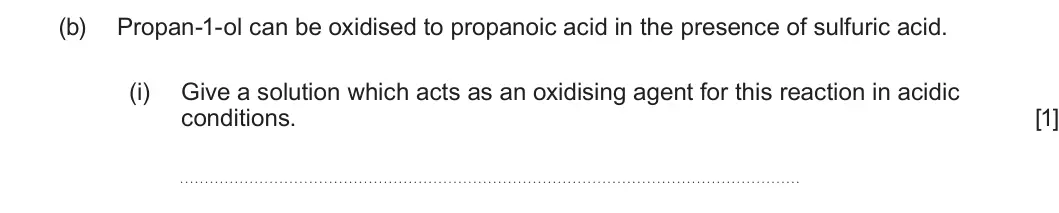
Q9(b)(ii)
The whole paper ↗
Q9(b)(iii)
The whole paper ↗
Q9(b)(iv)
The whole paper ↗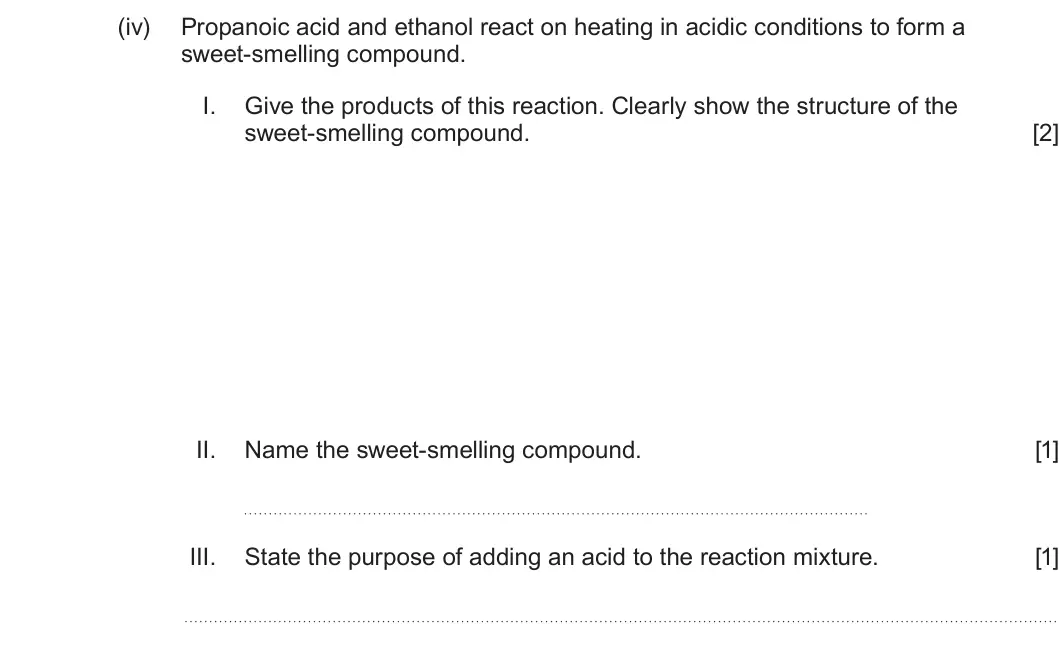
Q7(b)(iv)
The whole paper ↗

Q9(b)
The whole paper ↗
Q9(c)
The whole paper ↗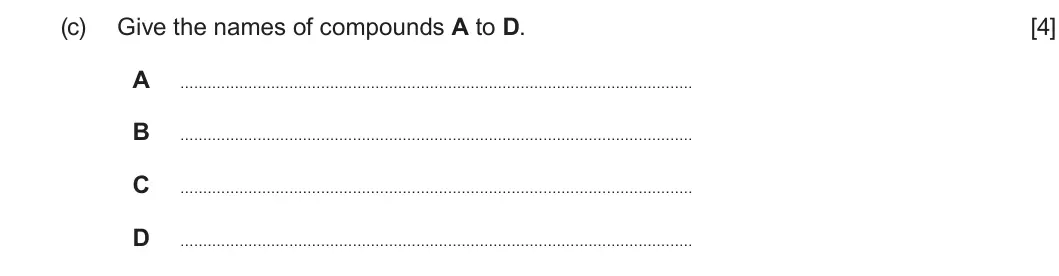
Q9(d)
The whole paper ↗
Q13(b)(i)
The whole paper ↗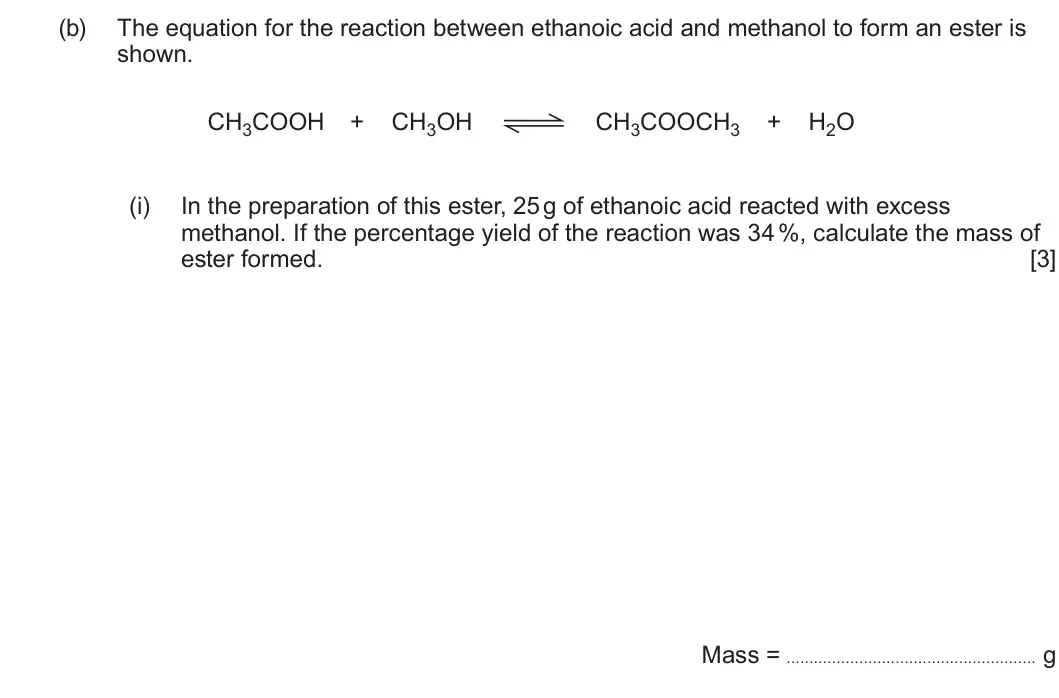
Q13(b)(ii)
The whole paper ↗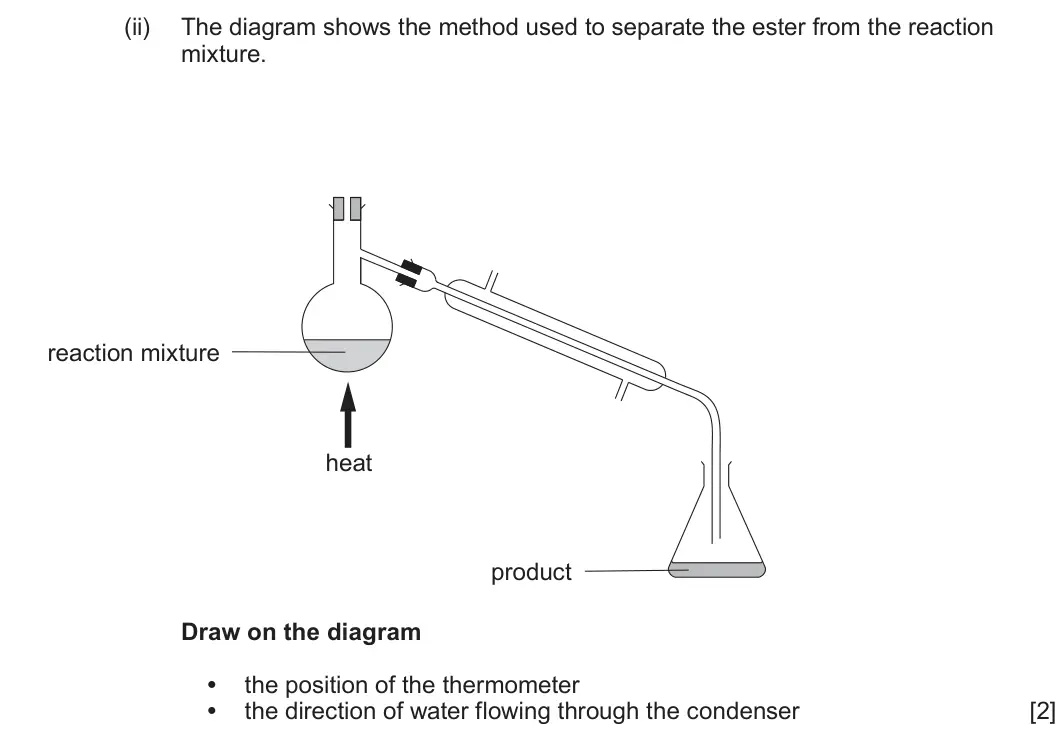
Q13(b)(iii)
The whole paper ↗
Q13(c)
The whole paper ↗
Q12(a)(ii)
The whole paper ↗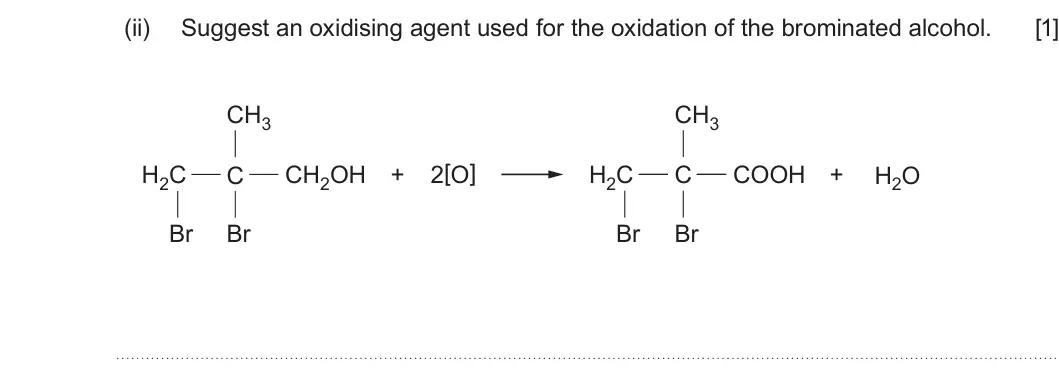
Q12(b)(iv)
The whole paper ↗
Q10(c)(i)
The whole paper ↗
Q10(c)(ii)
The whole paper ↗
Q13(b)(i)
The whole paper ↗
Q13(b)(ii)
The whole paper ↗
All 70 questions on Alcohols and carboxylic acids, as a list
- Summer 2025, Unit 4, Q2(b) (1 mark): Give the structure of the organic compound produced when propan-2-ol reacts with an acidified solution of potassium dichromate. [1]
- Summer 2025, AS Unit 2, Q9(b)(i) (1 mark): Give a solution which acts as an oxidising agent for this reaction in acidic conditions. [1]
- Summer 2025, AS Unit 2, Q9(b)(ii) (1 mark): Give the balanced equation for this reaction. [1] + [O] + H2O
- Summer 2025, AS Unit 2, Q9(b)(iii) (2 marks): The oxidation of propan-1-ol requires the presence of a strong acid. Hydrochloric acid cannot be used in this reaction as the chloride ions would be oxidised. G
- Summer 2025, AS Unit 2, Q9(b)(iv) (4 marks): Propanoic acid and ethanol react on heating in acidic conditions to form a sweet-smelling compound. I. Give the products of this reaction. Clearly show the stru
- Summer 2024, Unit 4, Q7(b)(iv) (1 mark): State the colour change undergone by the reagents in stage 4 [1]
- Summer 2024, AS Unit 2, Q6 (1 mark): Give the structure of a tertiary alcohol which contains 5 carbon atoms. [1]
- Summer 2024, AS Unit 2, Q9(b) (3 marks): Show that the relative molecular mass (Mr ) of D is 88 [3]
- Summer 2024, AS Unit 2, Q9(c) (4 marks): Give the names of compounds A to D. [4] A B C D
- Summer 2024, AS Unit 2, Q9(d) (1 mark): Name a suitable reagent for the conversion of B to D. [1]
- Summer 2024, AS Unit 2, Q13(b)(i) (3 marks): In the preparation of this ester, 25 g of ethanoic acid reacted with excess methanol. If the percentage yield of the reaction was 34 %, calculate the mass of es
- Summer 2024, AS Unit 2, Q13(b)(ii) (2 marks): The diagram shows the method used to separate the ester from the reaction mixture. reaction mixture heat product Draw on the diagram • the position of the therm
- Summer 2024, AS Unit 2, Q13(b)(iii) (2 marks): Addition of concentrated sulfuric acid increases the yield of ester. Explain this observation. [2]
- Summer 2024, AS Unit 2, Q13(c) (1 mark): Draw the structure of the ester formed when propan-2-ol reacts with methanoic acid. [1]
- Summer 2023, Unit 4, Q12(a)(ii) (1 mark): Suggest an oxidising agent used for the oxidation of the brominated alcohol. [1] CH3 CH3 2[O] H2C C CH2OH + H2C C COOH + H2O Br Br Br Br
- Summer 2023, Unit 4, Q12(b)(iv) (1 mark): State the role of sulfuric acid in Stage 3 [1]
- Summer 2023, AS Unit 2, Q10(c)(i) (2 marks): Write the equation for the reaction that occurs when solid copper(II) carbonate is added to aqueous methanoic acid to form aqueous copper(ll) methanoate, (HCOO)
- Summer 2023, AS Unit 2, Q10(c)(ii) (2 marks): State what is observed during the reaction in part (i). [2]
- Summer 2023, AS Unit 2, Q13(b)(i) (1 mark): Suggest an oxidising agent suitable to carry out this reaction. [1]
- Summer 2023, AS Unit 2, Q13(b)(ii) (2 marks): Write the equation for this reaction. Use [O] for the oxidising agent. [2]
- Summer 2023, AS Unit 2, Q13(b)(iii) (2 marks): To ensure complete oxidation the reagents are refluxed. Draw and label the apparatus as it is being used in this reaction. [2]
- Summer 2023, AS Unit 2, Q13(b)(v) (4 marks): The reaction can be used to prepare a sample of solid ethanedioic acid. This is generally hydrated as (COOH)2.xH2O where x is an integer. 2.00 g of ethane-1,2-d
- Summer 2023, AS Unit 2, Q13(b)(vi) (3 marks): I. Complete the equation for the reaction which occurs when ethanedioic acid is heated with excess methanol in acidic conditions. Clearly show the structure of
- Summer 2022, Unit 4, Q8(a)(iii) (1 mark): A sample of the cyclohexanol in KA is oxidised in the laboratory by refluxing with a suitable reagent. State a suitable oxidising agent that can be used. [1]
- Summer 2022, AS Unit 2, Q3 (2 marks): A student suspects an unlabelled organic liquid is a carboxylic acid. Name the reagent(s) that must be added to the unknown organic liquid to test for the prese
- Summer 2022, AS Unit 2, Q6(b)(iii) (1 mark): State the classification of alcohol to which butan-2-ol belongs. [1]
- Summer 2022, AS Unit 2, Q6(c)(i) (1 mark): State the role of the acidified potassium manganate(VII) in this reaction. [1]
- Summer 2022, AS Unit 2, Q6(c)(ii) (2 marks): Explain why butanone can be removed from the reaction as it is formed using distillation, leaving unreacted butan-2-ol in the reaction mixture. [2]
- Summer 2022, AS Unit 2, Q6(d)(i) (1 mark): Suggest why the overall yield of the two-step synthesis is likely to be lower than the yield of the direct hydration. [1]
- Summer 2022, AS Unit 2, Q6(d)(ii) (4 marks): Reaction of butan-2-ol with concentrated sulfuric acid results in the formation of three isomers with the formula C4H8. I. Name the type of reaction used to for
- Summer 2022, AS Unit 2, Q10(b) (2 marks): Sodium ethanoate can be made in a neutralisation reaction. Complete the following equation: [2] + CH3COONa + CO2 + H2O
- Summer 2022, AS Unit 2, Q10(c)(i) (2 marks): Name the reagents and give the expected observations. [2]
- Summer 2022, AS Unit 2, Q10(c)(ii) (3 marks): A student proposed that the apparatus below should be used to perform this oxidation reduction experiment. The teacher said that this would not work and would b
- Summer 2019, AS Unit 2, Q6 (1 mark): Complete the equation for the formation of ethanol by the fermentation of glucose. [1] C6H12O6 +
- Summer 2019, AS Unit 2, Q9(a)(i) (2 marks): Name the method being used with the condenser positioned in this way. Explain why it is necessary to use the condenser. [2]
- Summer 2019, AS Unit 2, Q9(a)(ii) (2 marks): Name the method used to separate the product from the liquid mixture. State which property of an ester allows this method of separation to be used. [2] Method P
- Summer 2019, AS Unit 2, Q9(a)(iii) (1 mark): Name the catalyst most commonly used in the preparation of an ester. [1]
- Summer 2019, AS Unit 2, Q9(a)(iv) (2 marks): Write the equation for the reaction between methanoic acid and butan-2-ol. [2] Clearly show the structure of the ester formed.
- Summer 2019, AS Unit 2, Q9(b) (5 marks): A compound is known to be one of butan-2-ol, CH3CH2CH(OH)CH3, 2-methylpropanoic acid, CH3CH(CH3)COOH, and 3-hydroxybutanoic acid, CH3CH(OH)CH2COOH. Choose two c
- Summer 2019, AS Unit 2, Q10(b)(i) (1 mark): State why this reaction is classified as disproportionation. [1]
- Summer 2019, AS Unit 2, Q10(b)(ii) (3 marks): A chemist used 9.50 g of C6H5CHO in the reaction above and made 3.39 g of C6H5CH2OH. Calculate the percentage yield that this mass of C6H5CH2OH represents. [3]
- Summer 2019, AS Unit 2, Q10(b)(iii) (1 mark): Cannizzaro’s reaction is usually carried out using aqueous sodium hydroxide, rather than with water as shown in the equation above. Write the equation for the C
- Summer 2018, Unit 4, Q6(a)(iii) (1 mark): State a reagent that can be used for Stage 3 [1]
- Summer 2018, Unit 4, Q9(b)(v) (1 mark): Compound A is made by heating 2-methylbutan-1-ol and ethanoic acid in the presence of concentrated sulfuric acid. State the name of another organic compound tha
- Summer 2018, AS Unit 2, Q1 (1 mark): Draw the structure of a secondary alcohol that contains 6 carbon atoms. [1]
- Summer 2018, AS Unit 2, Q5(a) (1 mark): Complete the equation for the fermentation of glucose. [1] C6H12O6 +
- Summer 2018, AS Unit 2, Q5(b) (1 mark): Name the substance generally used to catalyse this reaction. [1]
- Summer 2018, AS Unit 2, Q11(b)(i) (1 mark): State the type of reaction that occurs when X is warmed with acidified potassium dichromate(VI). [1]
- Summer 2018, AS Unit 2, Q11(b)(ii) (1 mark): Draw the structure of the organic product formed when X reacts with acidified potassium dichromate(VI). [1]
- Summer 2017, Unit 4, Q11(d)(iii) (1 mark): The alcohol used for this experiment gave a ketone on oxidation. Give the displayed formula of the alcohol. [1]
- Summer 2017, AS Unit 2, Q6(a) (1 mark): Complete the equation below to show clearly the missing product. [1] H O CH3C + CH3 CCH2CH3 + H2O OH OH
- Summer 2017, AS Unit 2, Q6(b) (1 mark): Name the catalyst used in the reaction in part (a). [1]
- Summer 2017, AS Unit 2, Q11(a)(i) (3 marks): A student wanted to prepare ethanol and was given the following instructions. • Mix glucose and water. • Put the mixture into a stoppered bottle. • Leave the bo
- Summer 2017, AS Unit 2, Q11(a)(ii) (2 marks): Calculate the atom economy of this process as a method of preparing ethanol. [2] Atom economy = %
- Summer 2017, AS Unit 2, Q11(a)(iii) (2 marks): Ethanol can also be made by the hydration of ethene. Describe one environmental consideration in choosing between fermentation and hydration as methods for etha
- Summer 2017, AS Unit 2, Q11(b)(i) (1 mark): Explain the meaning of primary as applied to alcohols. [1]
- Summer 2017, AS Unit 2, Q11(b)(ii) (2 marks): Give the structural formula and name of a tertiary alcohol that contains five carbon atoms. [2] Name
- Summer 2017, AS Unit 2, Q11(b)(iii) (3 marks): Describe one test that can be used to investigate whether an alcohol is secondary or tertiary. Include the reagents used and the observations for both types of
- Summer 2016, AS Unit 2, Q6 (1 mark): On warming, copper(II) oxide reacts with aqueous methanoic acid. Write the equation for this reaction. [1]
- Summer 2016, AS Unit 2, Q11(a)(i) (3 marks): Draw a labelled diagram of the apparatus you would use to carry out a reaction under reflux. [3]
- Summer 2016, AS Unit 2, Q11(a)(ii) (1 mark): Explain how the apparatus that you have drawn in part (i) results in the process of reflux. [1]
- Summer 2016, AS Unit 2, Q11(a)(iii) (1 mark): Why is it necessary to use a reflux technique in this type of reaction? [1]
- Summer 2016, AS Unit 2, Q11(a)(iv) (1 mark): State the function of the concentrated sulfuric acid in this reaction. [1]
- Summer 2016, AS Unit 2, Q11(b)(i) (1 mark): Suggest how the methyl ethanoate could be separated from the mixture formed in the reaction vessel. [1]
- Summer 2016, AS Unit 2, Q11(b)(ii) (3 marks): Calculate the percentage of theoretical yield of methyl ethanoate obtained. Show your working. [3] Percentage yield = %
- Summer 2016, AS Unit 2, Q11(b)(iii) (2 marks): Suggest one change that could be made to this preparation to improve the percentage yield of methyl ethanoate. Explain your suggestion. [2]
- Summer 2016, AS Unit 2, Q11(c)(i) (1 mark): What type of reaction is taking place when compound A is heated with concentrated sulfuric acid to form compound B? [1]
- Summer 2016, AS Unit 2, Q11(c)(iii) (1 mark): What colour change is seen when compound A reacts with the Cr2O7 solution? [1]
- Summer 2016, AS Unit 2, Q11(c)(iv) (1 mark): What type of reaction is taking place when compound A is heated with Cr2O7 to form compound C? [1]
- Summer 2016, AS Unit 2, Q11(c)(v) (1 mark): Draw a displayed formula of compound C. [1]
Questions, mark schemes and examiner’s reports are © WJEC CBAC Ltd, from their published past papers. Plumi isn’t affiliated with any exam board. Want whole papers? Every WJEC A-Level Chemistry paper.
Rather write your answers by hand on iPad? Plumi marks them against the same mark schemes.