 plumi
Chemical kinetics: WJEC A‑Level Chemistry questions
Every WJEC A-Level Chemistry exam question on 3.5 Chemical kinetics, 2016–2025, with its mark scheme and examiner’s report.
Find questions1,204
Calculations

Q8(b)(i)
The whole paper ↗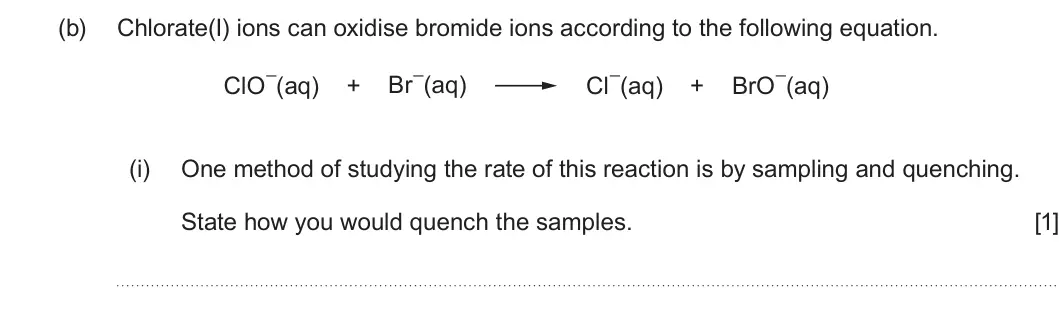
Q8(b)(ii)
The whole paper ↗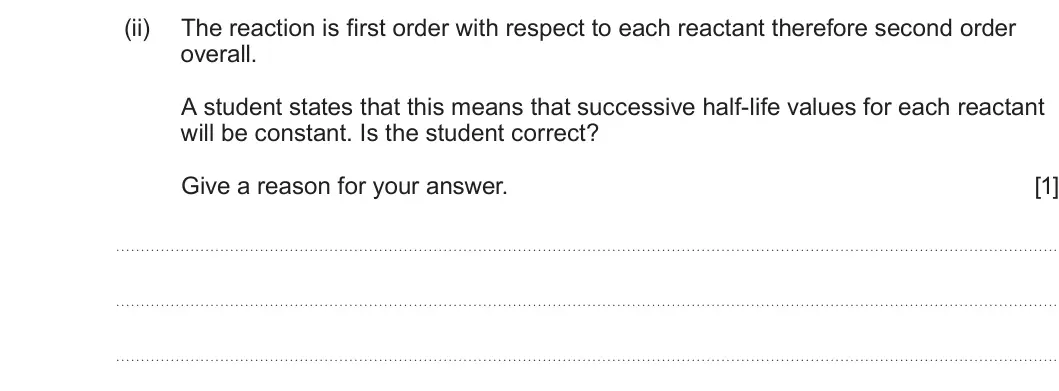
Q8(b)(iii)
The whole paper ↗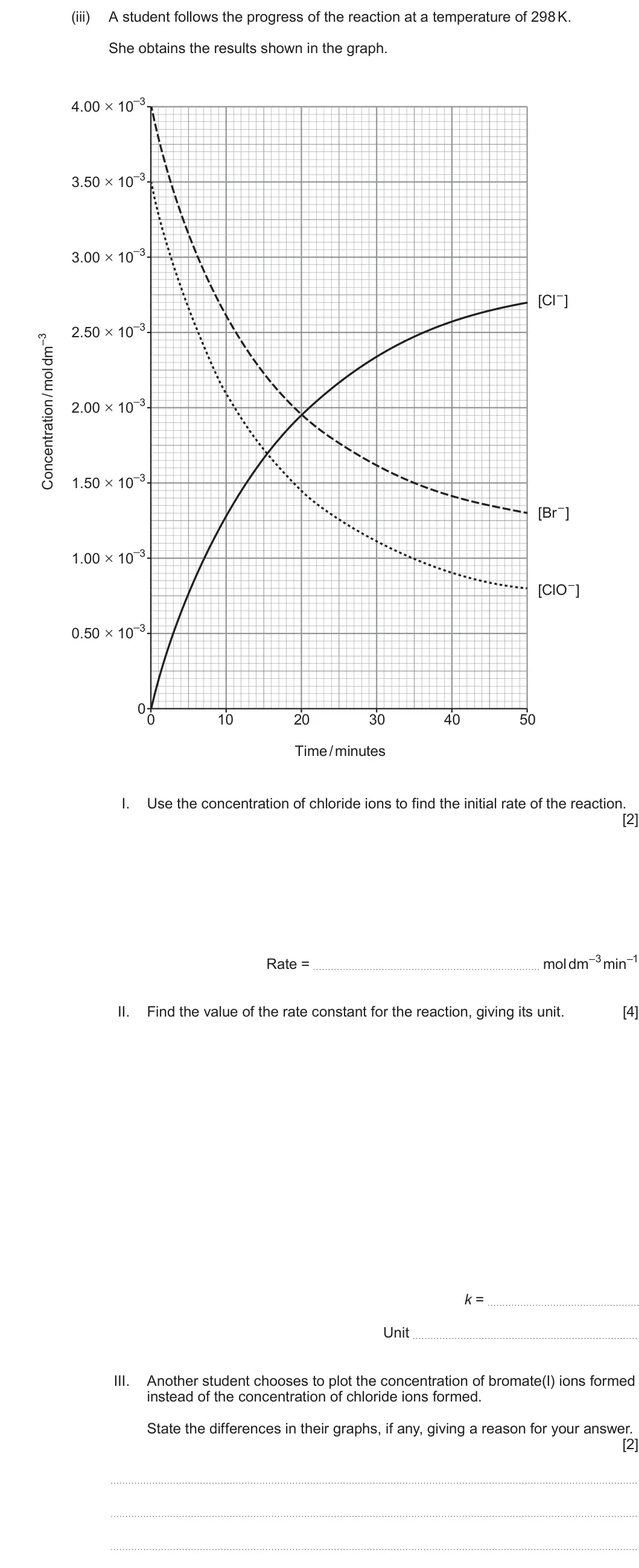
Q7(a)
The whole paper ↗
Q7(b)
The whole paper ↗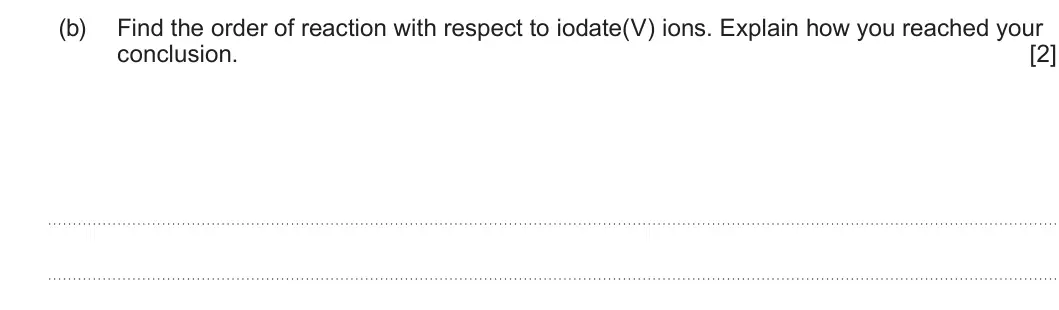
Q7(c)
The whole paper ↗
Q7(d)
The whole paper ↗
Q9(b)(i)
The whole paper ↗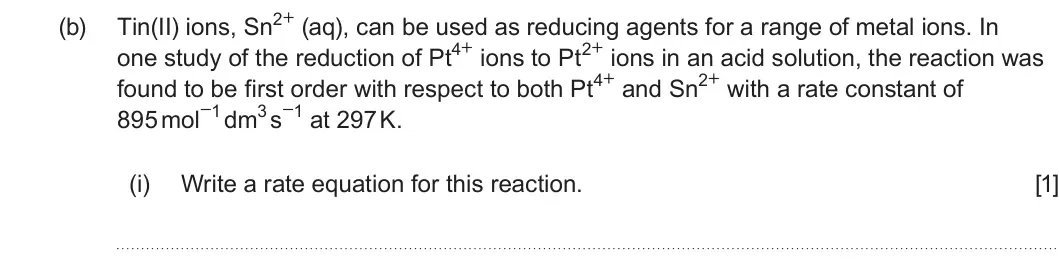
Q9(b)(ii)
The whole paper ↗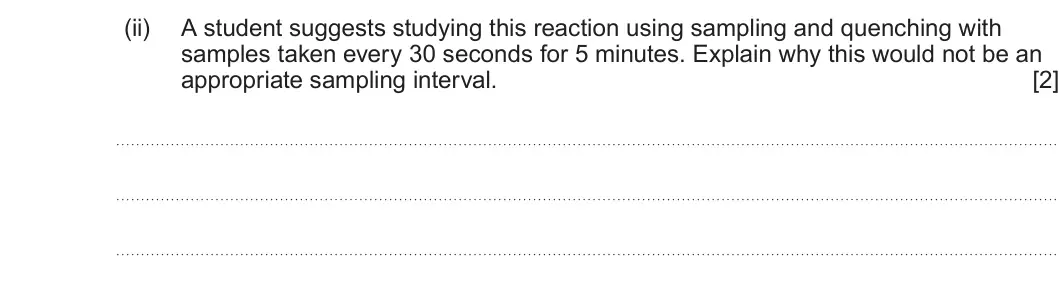
Q9(c)(i)
The whole paper ↗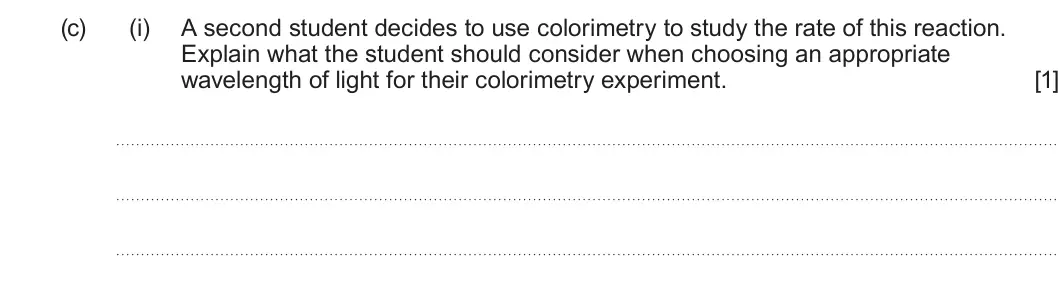
Q9(c)(ii)
The whole paper ↗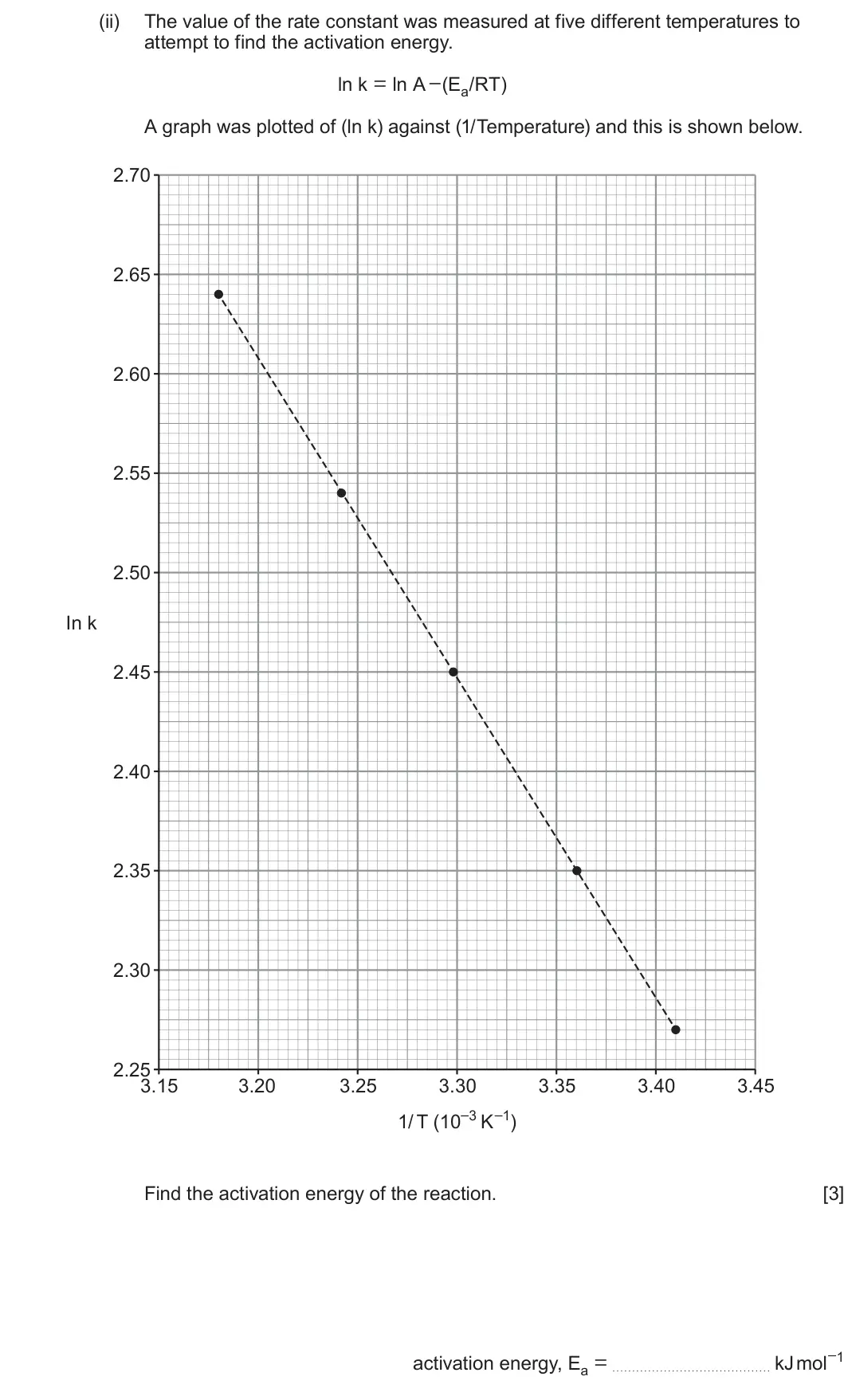
Q3(a)
The whole paper ↗
Q3(b)
The whole paper ↗
Q11(b)(i)
The whole paper ↗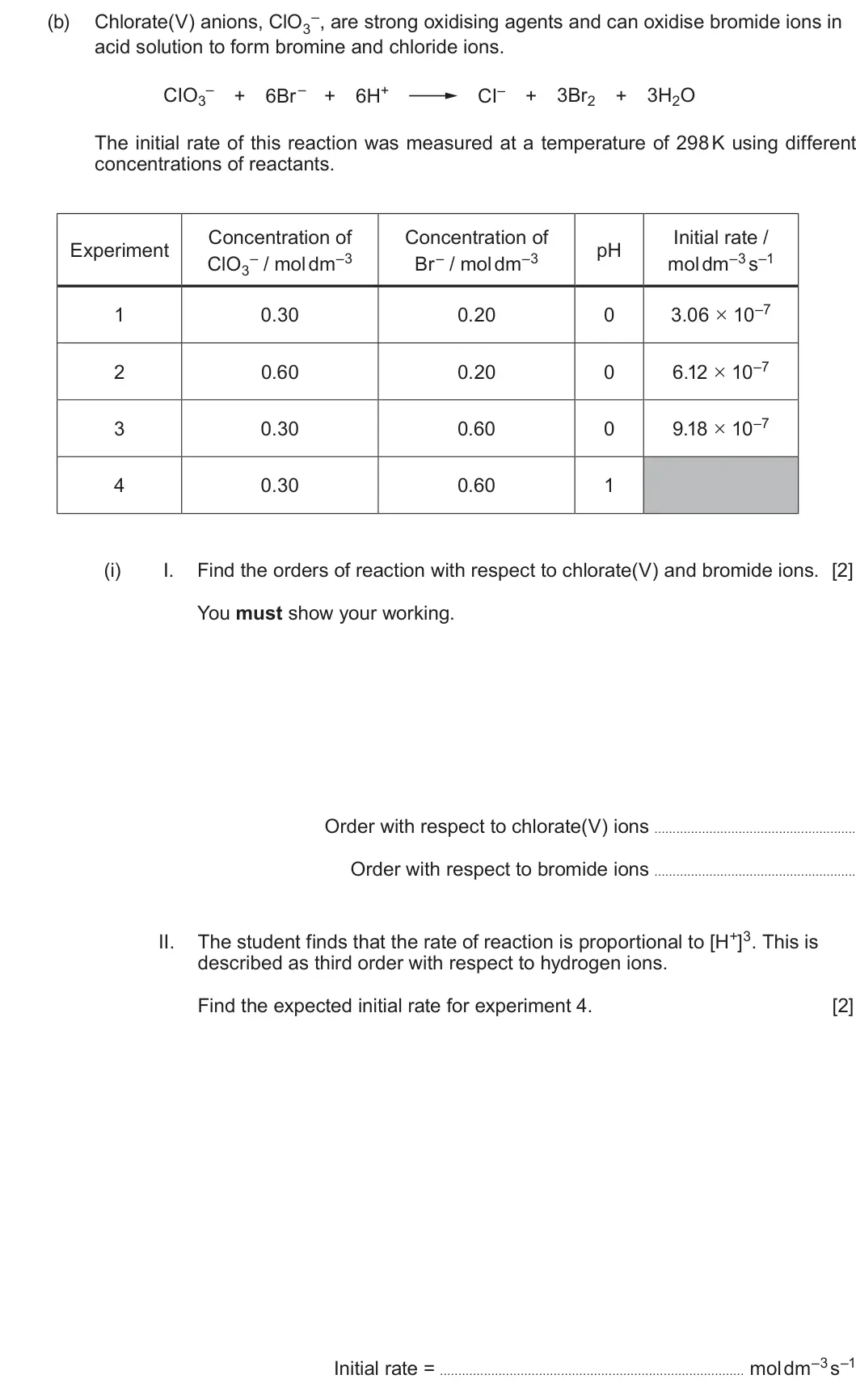
Q11(b)(ii)
The whole paper ↗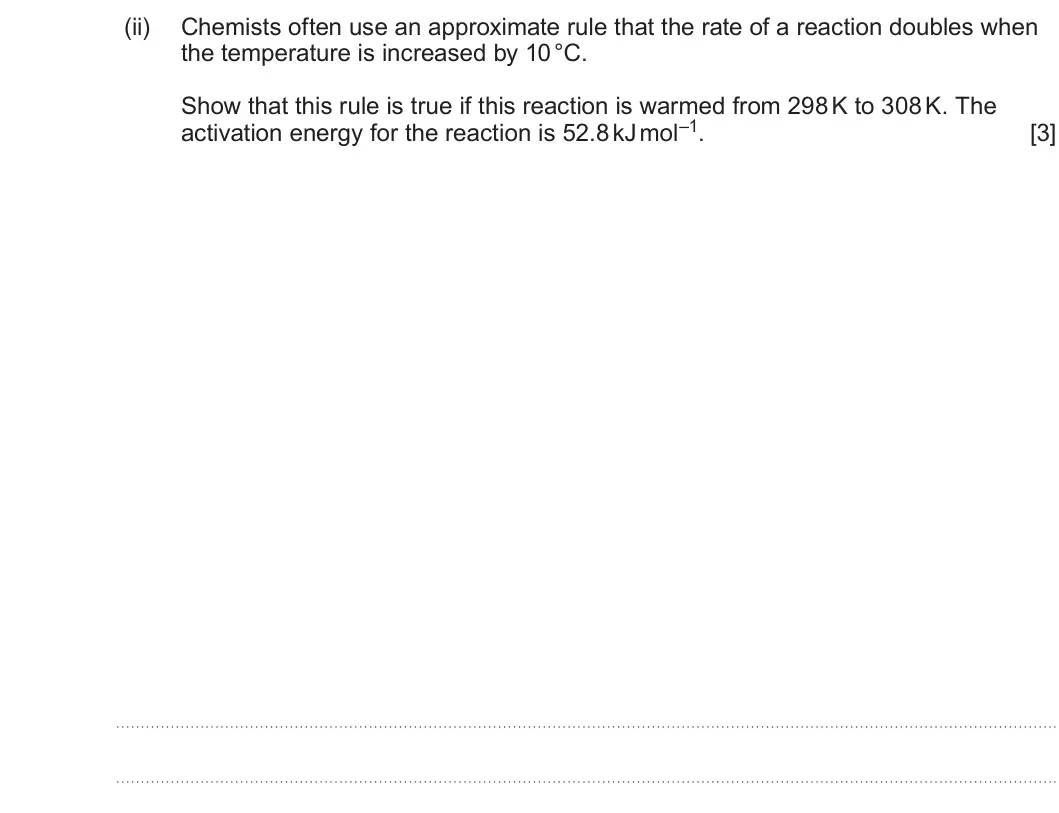
Q10(a)(i)
The whole paper ↗
Q10(a)(ii)
The whole paper ↗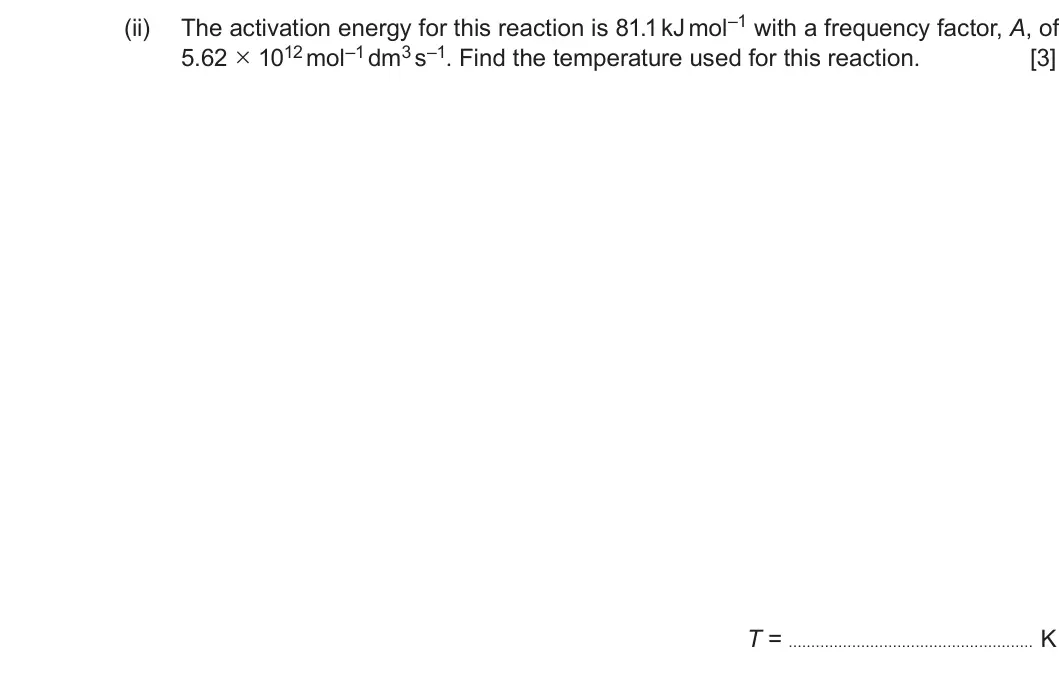
Q10(b)(i)
The whole paper ↗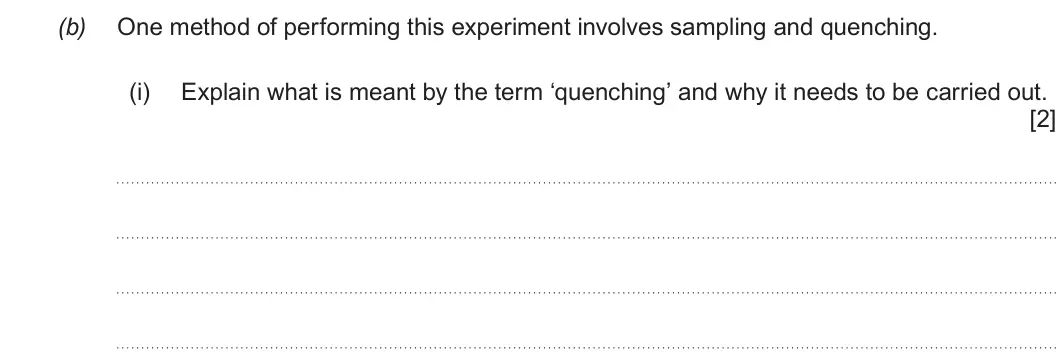
Q10(b)(i)
The whole paper ↗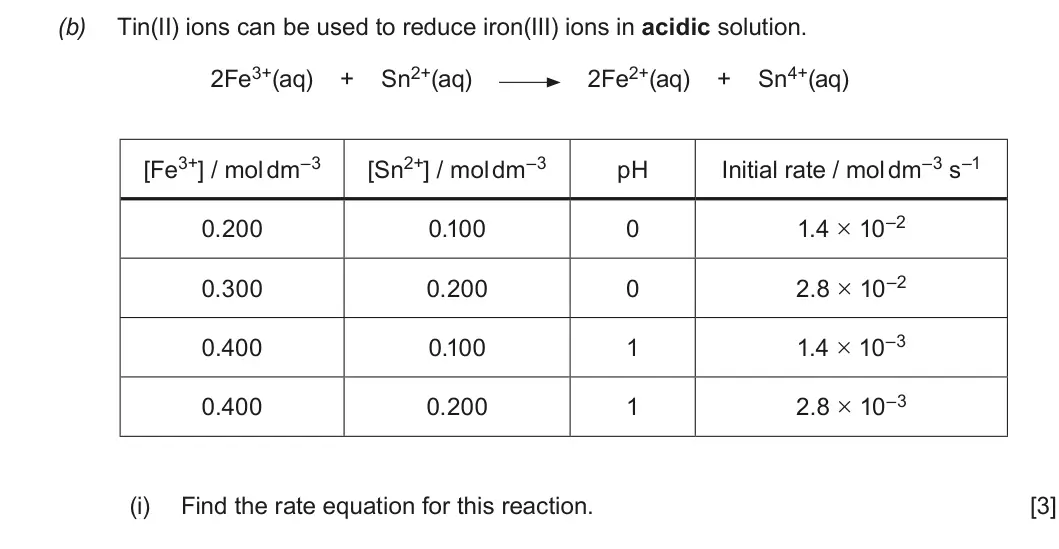
All 29 questions on Chemical kinetics, as a list
- Summer 2025, Unit 3, Q1 (1 mark): Complete the Arrhenius equation below. [1] k =
- Summer 2025, Unit 3, Q8(b)(i) (1 mark): One method of studying the rate of this reaction is by sampling and quenching. State how you would quench the samples. [1]
- Summer 2025, Unit 3, Q8(b)(ii) (1 mark): The reaction is first order with respect to each reactant therefore second order overall. A student states that this means that successive half-life values for
- Summer 2025, Unit 3, Q8(b)(iii) (8 marks): A student follows the progress of the reaction at a temperature of 298 K. She obtains the results shown in the graph. _3 4.00 × 10 _3 3.50 × 10 _3 3.00 × 10 [Cl
- Summer 2024, Unit 3, Q7(a) (1 mark): Complete the table to show the volume of deionised water that should be used in the final experiment. Give a reason for the value you have chosen. [1]
- Summer 2024, Unit 3, Q7(b) (2 marks): Find the order of reaction with respect to iodate(V) ions. Explain how you reached your conclusion. [2]
- Summer 2024, Unit 3, Q7(c) (2 marks): The reaction is fourth order overall. Suggest a rate equation for the reaction. [2]
- Summer 2024, Unit 3, Q7(d) (1 mark): Suggest a rate determining step for the reaction. [1]
- Summer 2023, Unit 3, Q9(b)(i) (1 mark): Write a rate equation for this reaction. [1]
- Summer 2023, Unit 3, Q9(b)(ii) (2 marks): A student suggests studying this reaction using sampling and quenching with samples taken every 30 seconds for 5 minutes. Explain why this would not be an appro
- Summer 2023, Unit 3, Q9(c)(i) (1 mark): A second student decides to use colorimetry to study the rate of this reaction. Explain what the student should consider when choosing an appropriate wavelength
- Summer 2023, Unit 3, Q9(c)(ii) (3 marks): The value of the rate constant was measured at five different temperatures to attempt to find the activation energy. ln k = ln A −(Ea/RT) A graph was plotted of
- Summer 2022, Unit 3, Q3(a) (1 mark): Write the rate equation for this reaction. [1]
- Summer 2022, Unit 3, Q3(b) (1 mark): Suggest a rate-determining step for this reaction. [1]
- Summer 2022, Unit 3, Q11(b)(i) (4 marks): I. Find the orders of reaction with respect to chlorate(V) and bromide ions. [2] You must show your working. Order with respect to chlorate(V) ions Order with r
- Summer 2022, Unit 3, Q11(b)(ii) (3 marks): Chemists often use an approximate rule that the rate of a reaction doubles when the temperature is increased by 10 °C. Show that this rule is true if this react
- Summer 2019, Unit 3, Q10(a)(i) (2 marks): Write the rate equation for this reaction. [2]
- Summer 2019, Unit 3, Q10(a)(ii) (3 marks): 5.62 × 10¹² mol–1 dm3 s–1. Find the temperature used for this reaction. [3] T = K
- Summer 2019, Unit 3, Q10(b)(i) (2 marks): Explain what is meant by the term ‘quenching’ and why it needs to be carried out. [2]
- Summer 2018, Unit 3, Q10(b)(i) (3 marks): Find the rate equation for this reaction. [3]
- Summer 2018, Unit 3, Q10(b)(ii) (2 marks): Calculate the value of the rate constant, k, for this reaction. [2] k =
- Summer 2018, Unit 3, Q10(b)(iii) (2 marks): A student suggests that the rate determining step for this reaction is: Fe3+ + Sn2+ Fe2+ + Sn3+ State, giving a reason, whether this is a possible rate determin
- Summer 2018, Unit 3, Q10(c)(i) (1 mark): Explain what is meant by sampling and quenching. [1]
- Summer 2018, Unit 3, Q11(b)(i) (1 mark): State the Arrhenius equation. [1]
- Summer 2018, Unit 3, Q11(b)(ii) (3 marks): Calculate the activation energy using this catalyst and hence state whether it is a more effective catalyst than MnO2. [3] Activation energy = kJ mol–1
- Summer 2017, Unit 3, Q5(a) (1 mark): Complete the table with appropriate values of mean time taken. [1]
- Summer 2017, Unit 3, Q5(b) (1 mark): Calculate the rate of reaction for these two concentrations. [1] Rate for 0.200 mol dm−3 [I−] = s−1 Rate for 0.400 mol dm−3 [I−] = s−1
- Summer 2017, Unit 3, Q12(d) (3 marks): using the same concentrations and volumes of all other reactants. The following data were collected. Rate / mol dm−3 s−1 pH 3.287 × 10⁻³ 1.0 1.308 × 10⁻³ 1.4 5.
- Summer 2017, Unit 3, Q12(e) (4 marks): The value of the rate constant, k, for this reaction at two temperatures is given below. Temperature / K Rate constant (unit not shown) 288 0.0761 300 0.2873 Th
Questions, mark schemes and examiner’s reports are © WJEC CBAC Ltd, from their published past papers. Plumi isn’t affiliated with any exam board. Want whole papers? Every WJEC A-Level Chemistry paper.
Rather write your answers by hand on iPad? Plumi marks them against the same mark schemes.