 plumi
Halogenoalkanes: WJEC A‑Level Chemistry questions
Every WJEC A-Level Chemistry exam question on 2.6 Halogenoalkanes, 2016–2025, with its mark scheme and examiner’s report.
Find questions1,204
Calculations
Q3(b)
The whole paper ↗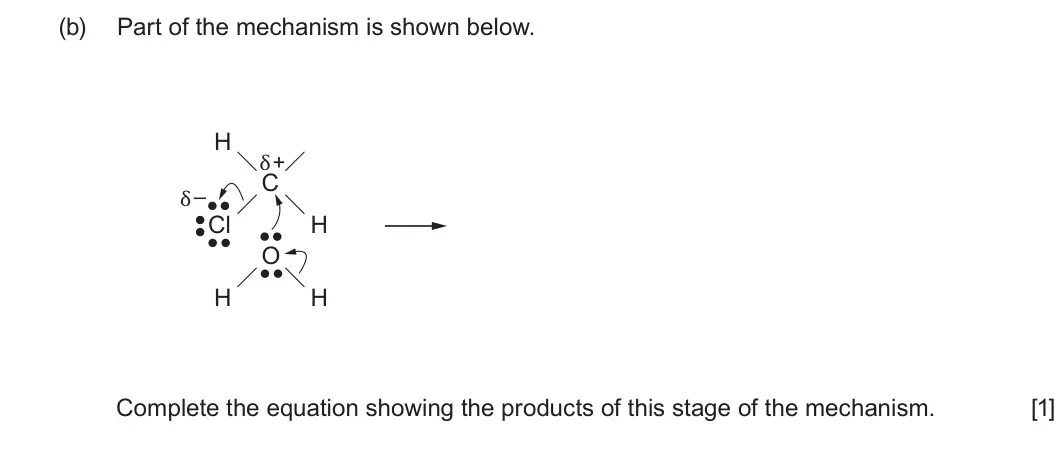
Q6(c)(i)
The whole paper ↗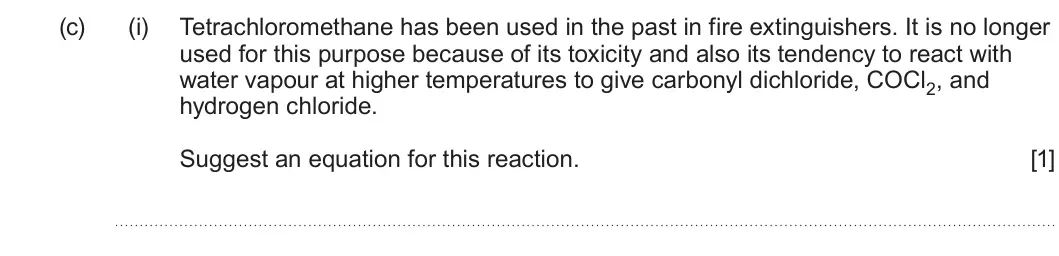
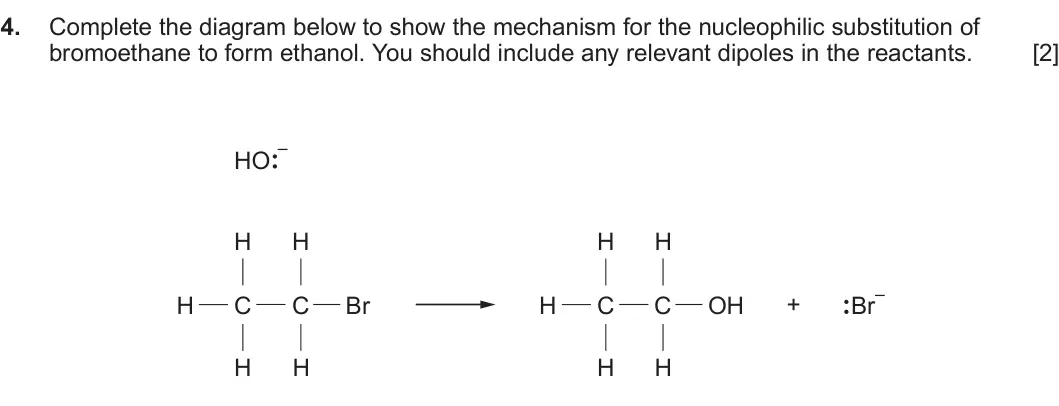
Q10(a)(i)
The whole paper ↗
Q10(a)(ii)
The whole paper ↗
Q10(b)(i)
The whole paper ↗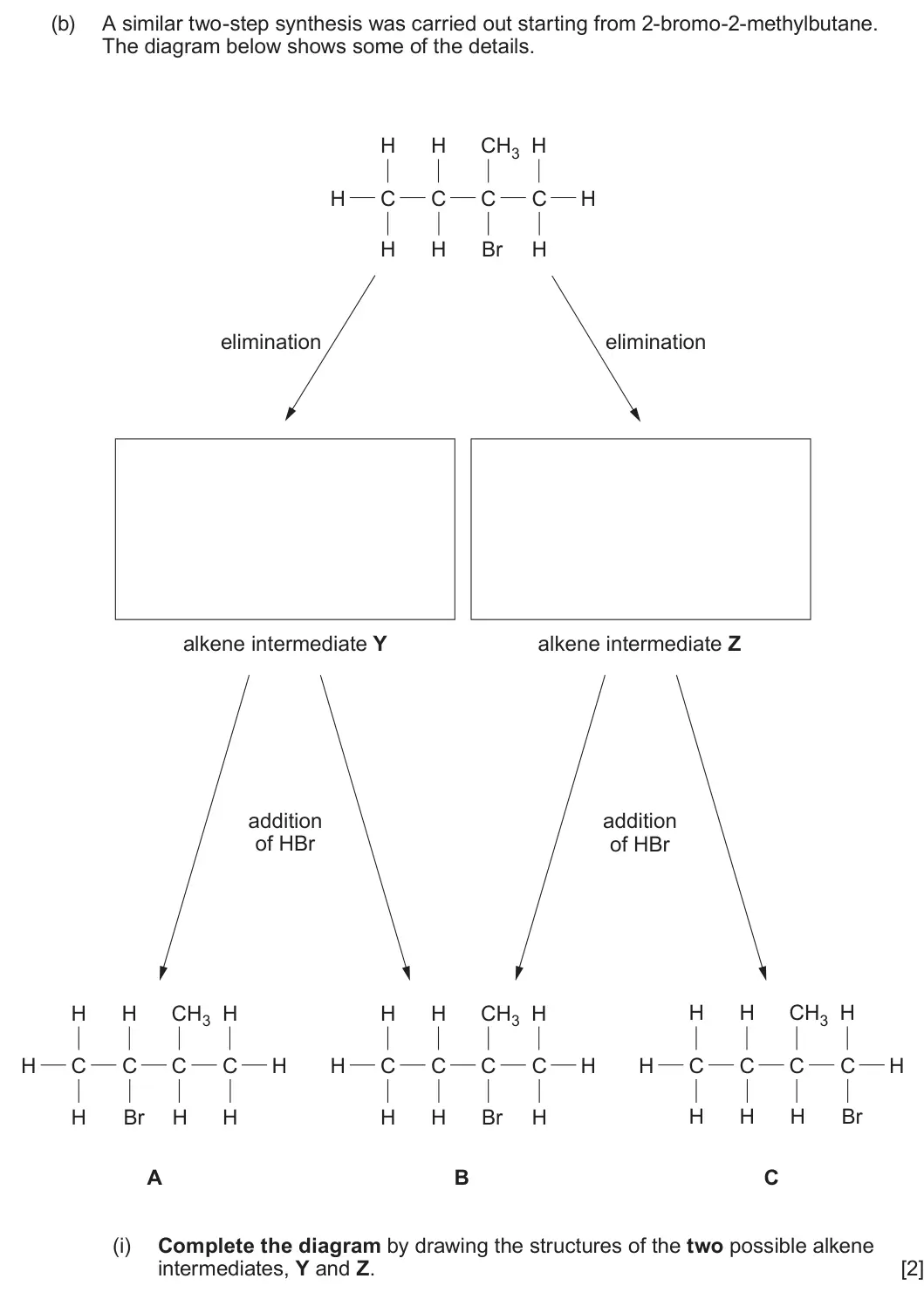
Q11(a)(i)
The whole paper ↗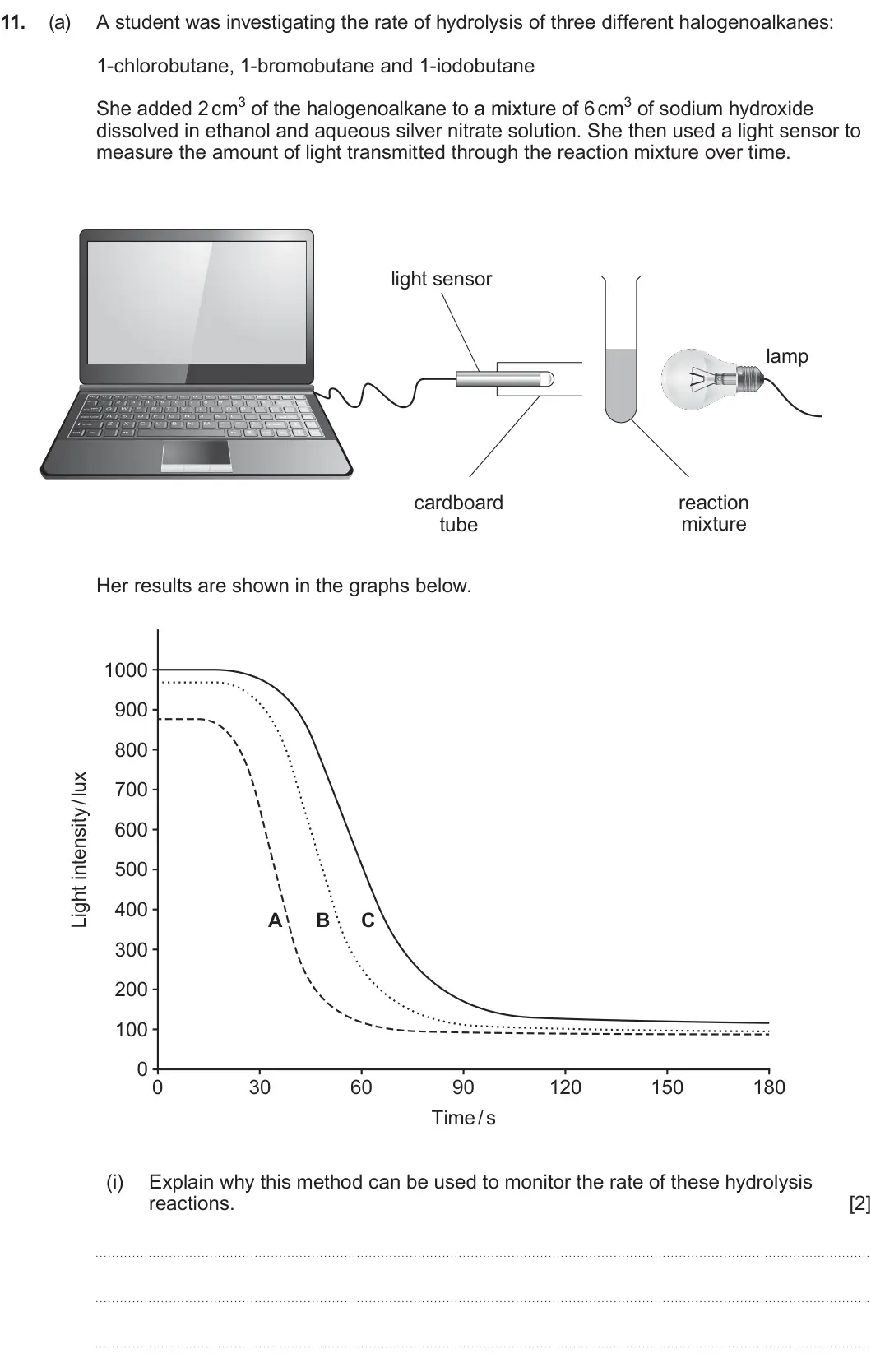
Q11(a)(ii)
The whole paper ↗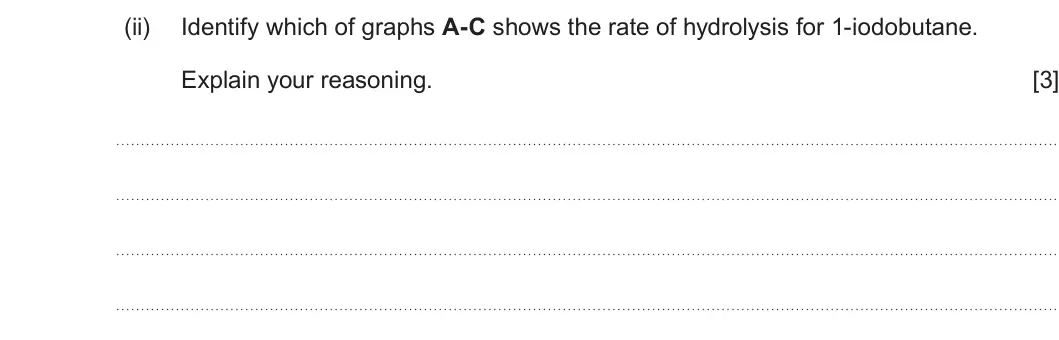
Q8(a)(i)
The whole paper ↗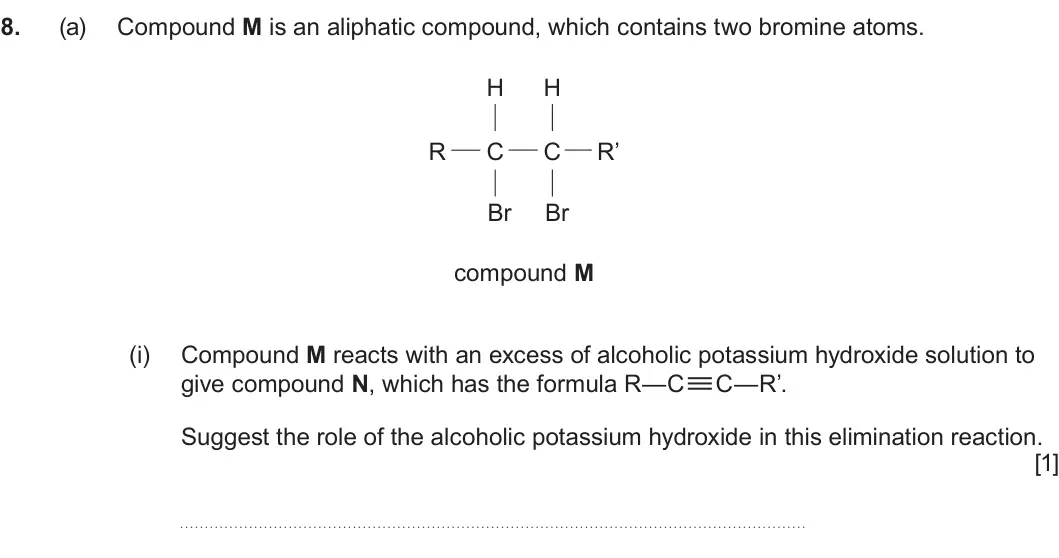
Q8(a)(ii)
The whole paper ↗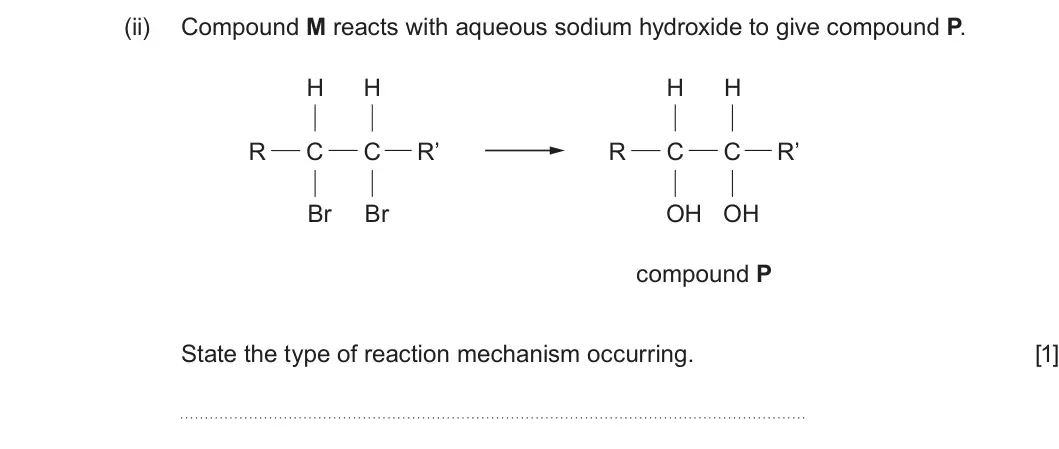
Q9(c)
The whole paper ↗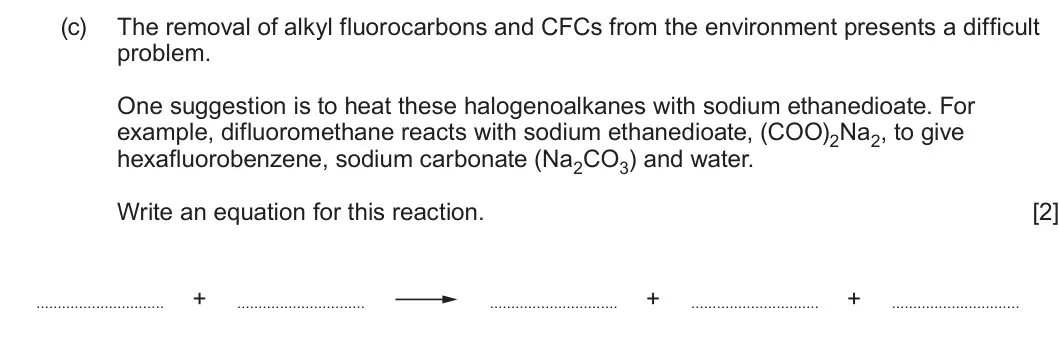
Q11(a)
The whole paper ↗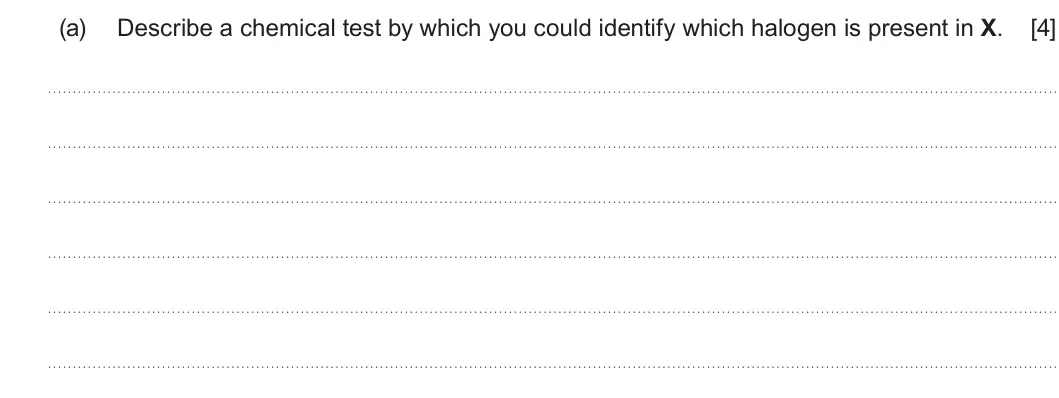
Q12(a)(i)
The whole paper ↗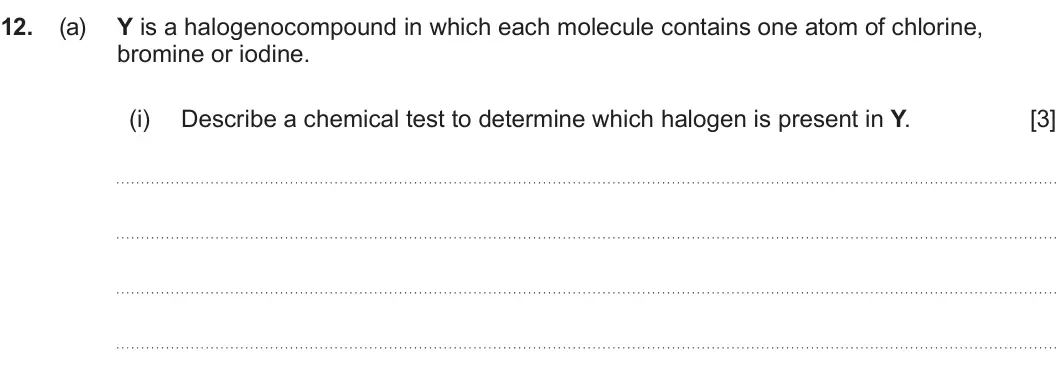
Q12(a)(ii)
The whole paper ↗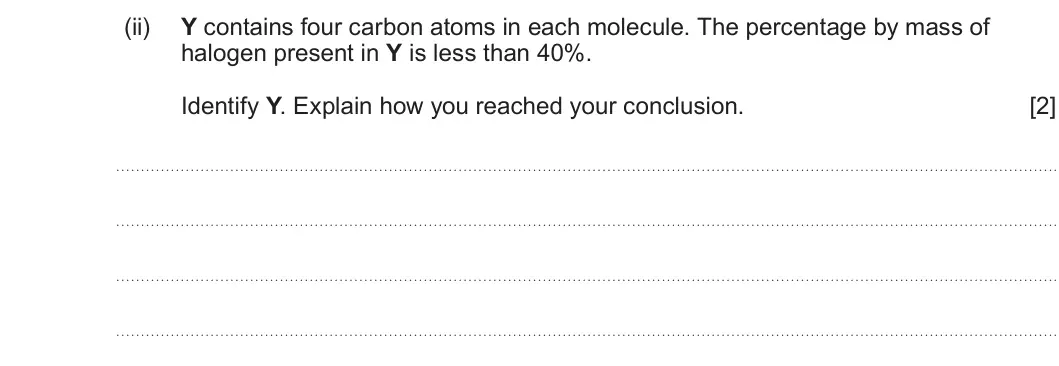
Q12(b)(i)
The whole paper ↗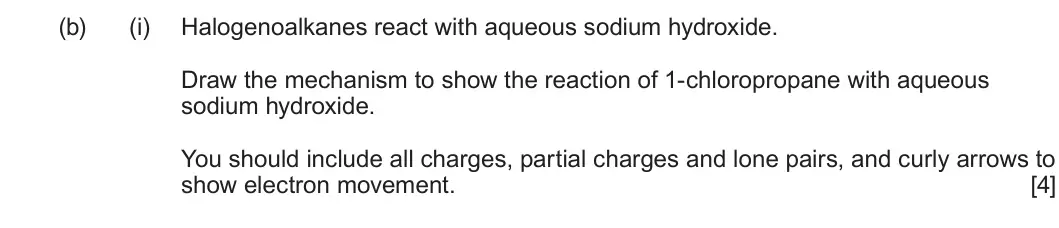
Q12(b)(ii)
The whole paper ↗
Q12(c)(i)
The whole paper ↗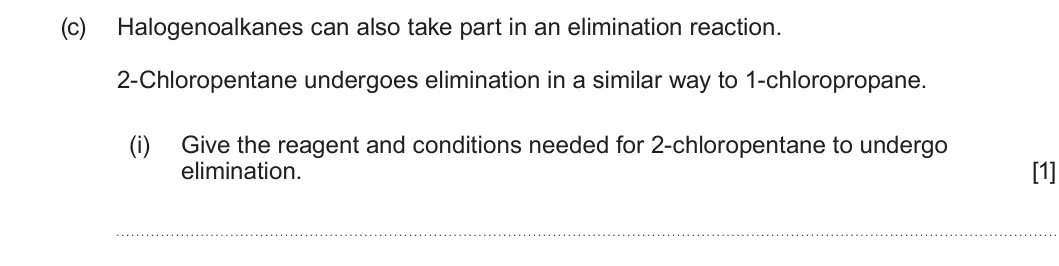
Q12(c)(ii)
The whole paper ↗
Q6(b)(i)
The whole paper ↗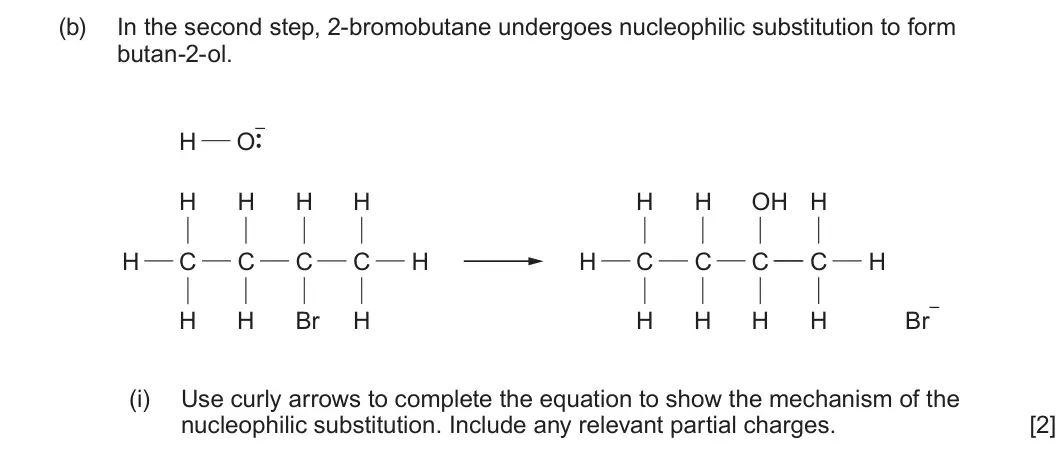
All 41 questions on Halogenoalkanes, as a list
- Summer 2025, Unit 4, Q3(b) (1 mark): Part of the mechanism is shown below. δ+ H δ– C Cl H O H H Complete the equation showing the products of this stage of the mechanism. [1]
- Summer 2025, Unit 4, Q6(c)(i) (1 mark): Tetrachloromethane has been used in the past in fire extinguishers. It is no longer used for this purpose because of its toxicity and also its tendency to react
- Summer 2025, AS Unit 2, Q4 (2 marks): Complete the diagram below to show the mechanism for the nucleophilic substitution of bromoethane to form ethanol. You should include any relevant dipoles in th
- Summer 2025, AS Unit 2, Q10(a)(i) (2 marks): Give the conditions needed for this elimination reaction. [2]
- Summer 2025, AS Unit 2, Q10(a)(ii) (1 mark): State the molecule eliminated from 1-bromobutane. [1]
- Summer 2025, AS Unit 2, Q10(b)(i) (2 marks): Complete the diagram by drawing the structures of the two possible alkene intermediates, Y and Z. [2]
- Summer 2025, AS Unit 2, Q11(a)(i) (2 marks): Explain why this method can be used to monitor the rate of these hydrolysis reactions. [2]
- Summer 2025, AS Unit 2, Q11(a)(ii) (3 marks): Identify which of graphs A-C shows the rate of hydrolysis for 1-iodobutane. Explain your reasoning. [3]
- Summer 2024, Unit 4, Q8(a)(i) (1 mark): Compound M reacts with an excess of alcoholic potassium hydroxide solution to give compound N, which has the formula R—C≡C—R’. Suggest the role of the alcoholic
- Summer 2024, Unit 4, Q8(a)(ii) (1 mark): Compound M reacts with aqueous sodium hydroxide to give compound P. H H H H R C C R’ R C C R’ Br Br OH OH compound P State the type of reaction mechanism occurr
- Summer 2024, Unit 4, Q9(c) (2 marks): The removal of alkyl fluorocarbons and CFCs from the environment presents a difficult problem. One suggestion is to heat these halogenoalkanes with sodium ethan
- Summer 2024, AS Unit 2, Q11(a) (4 marks): Describe a chemical test by which you could identify which halogen is present in X. [4]
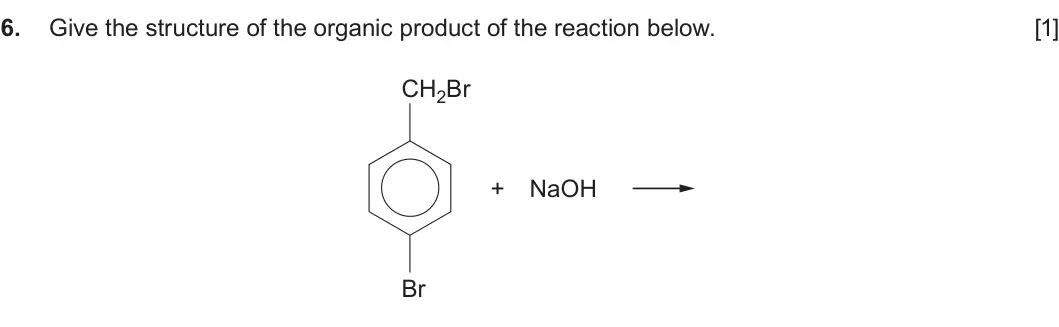
- Summer 2023, Unit 4, Q6 (1 mark): Give the structure of the organic product of the reaction below. [1] CH2Br + NaOH Br
- Summer 2023, AS Unit 2, Q12(a)(i) (3 marks): Describe a chemical test to determine which halogen is present in Y. [3]
- Summer 2023, AS Unit 2, Q12(a)(ii) (2 marks): Y contains four carbon atoms in each molecule. The percentage by mass of halogen present in Y is less than 40%. Identify Y. Explain how you reached your conclus
- Summer 2023, AS Unit 2, Q12(b)(i) (4 marks): Halogenoalkanes react with aqueous sodium hydroxide. Draw the mechanism to show the reaction of 1-chloropropane with aqueous sodium hydroxide. You should includ
- Summer 2023, AS Unit 2, Q12(b)(ii) (1 mark): Name the type of reaction shown in part (i). [1]
- Summer 2023, AS Unit 2, Q12(c)(i) (1 mark): Give the reagent and conditions needed for 2-chloropentane to undergo elimination. [1]
- Summer 2023, AS Unit 2, Q12(c)(ii) (2 marks): When 2-chloropentane undergoes elimination, two structural isomers are formed. Give the structures of these two isomers. [2]
- Summer 2022, AS Unit 2, Q6(b)(i) (2 marks): Use curly arrows to complete the equation to show the mechanism of the nucleophilic substitution. Include any relevant partial charges. [2]
- Summer 2022, AS Unit 2, Q6(b)(ii) (2 marks): Give the reagents and conditions required for this nucleophilic substitution. [2]
- Summer 2022, AS Unit 2, Q8 (10 marks): Compound A contains only carbon, hydrogen and an unknown halogen. Refluxing compound A in aqueous sodium hydroxide followed by the addition of nitric acid and a
- Summer 2019, AS Unit 2, Q4 (2 marks): Halogenoalkanes are hydrolysed by aqueous sodium hydroxide. State and explain which of 1-fluoropropane, 1-chloropropane and 1-bromopropane is hydrolysed most ra
- Summer 2018, Unit 4, Q6(a)(ii) (2 marks): State a reagent that can be used for Stage 2 and name the type of reaction mechanism taking place. [2] Reagent(s) Type of reaction mechanism
- Summer 2018, AS Unit 2, Q10(a)(i) (6 marks): Use both sets of data to explain the student’s results. Include an equation to show the hydrolysis reaction between a halogenoalkane and aqueous sodium hydroxid
- Summer 2018, AS Unit 2, Q10(a)(ii) (1 mark): Write an ionic equation, including state symbols, for a reaction that produces a silver halide precipitate. [1]
- Summer 2018, AS Unit 2, Q10(a)(iii) (2 marks): Suggest a practical method by which the student could have obtained these results. [2]
- Summer 2018, AS Unit 2, Q10(a)(iv) (1 mark): Suggest the difference that the student would have observed in his experiments if he had not added ethanol to the water before adding the halogenoalkane. [1]
- Summer 2018, AS Unit 2, Q10(b)(i) (4 marks): Outline the adverse environmental effects of the use of CFCs. You do not need to include any equations for the reactions involved. [4]
- Summer 2018, AS Unit 2, Q10(b)(ii) (2 marks): Use relevant data in part (a) to explain why hydrofluorocarbons, HFCs, have replaced CFCs in many of their uses. [2]
- Summer 2017, Unit 4, Q13(c)(ii) (1 mark): State the name of reagent F. [1]
- Summer 2017, AS Unit 2, Q5 (2 marks): Complete the statement below. [2] To test for the presence of iodine in an organic compound the compound is first heated with . This is followed by adding and t
- Summer 2017, AS Unit 2, Q10(a)(i) (4 marks): Complete the mechanism of the reaction between 2-chlorobutane and potassium cyanide. You should include relevant dipoles and curly arrows to show the movement o
- Summer 2017, AS Unit 2, Q10(a)(ii) (1 mark): Name the type of reaction mechanism shown in part (i). [1]
- Summer 2017, AS Unit 2, Q10(b)(i) (3 marks): Draw the displayed formulae of the three products. Name each product. [3]
- Summer 2017, AS Unit 2, Q10(b)(ii) (1 mark): Name the type of reaction taking place. [1]
- Summer 2017, AS Unit 2, Q10(c) (5 marks): Until recently chlorofluorocarbons, CFCs, were used in many commercial products but nowadays hydrofluorocarbons, HFCs, are preferred. Explain why HFCs are prefe
- Summer 2016, AS Unit 2, Q10(a)(i) (1 mark): Write the equation to show the hydrolysis of 3-chloro-2-methylpentane with aqueous sodium hydroxide. You should show clearly the structure of the organic reagen
- Summer 2016, AS Unit 2, Q10(a)(ii) (1 mark): State the name of the mechanism for the reaction taking place in part (i). [1]
- Summer 2016, AS Unit 2, Q10(a)(iii) (2 marks): Describe a chemical test to show that this hydrolysis reaction has occurred. Include the test and the result expected. [2]
- Summer 2016, AS Unit 2, Q10(b)(ii) (3 marks): What would be the effect on the initial rate of reaction if the halogen in the halogenoalkane were changed from chlorine to bromine? You should assume that this
Questions, mark schemes and examiner’s reports are © WJEC CBAC Ltd, from their published past papers. Plumi isn’t affiliated with any exam board. Want whole papers? Every WJEC A-Level Chemistry paper.
Rather write your answers by hand on iPad? Plumi marks them against the same mark schemes.