 plumi
Solid structures: WJEC A‑Level Chemistry questions
Every WJEC A-Level Chemistry exam question on 1.5 Solid structures, 2016–2025, with its mark scheme and examiner’s report.
Find questions1,204
Calculations

Q12(a)
The whole paper ↗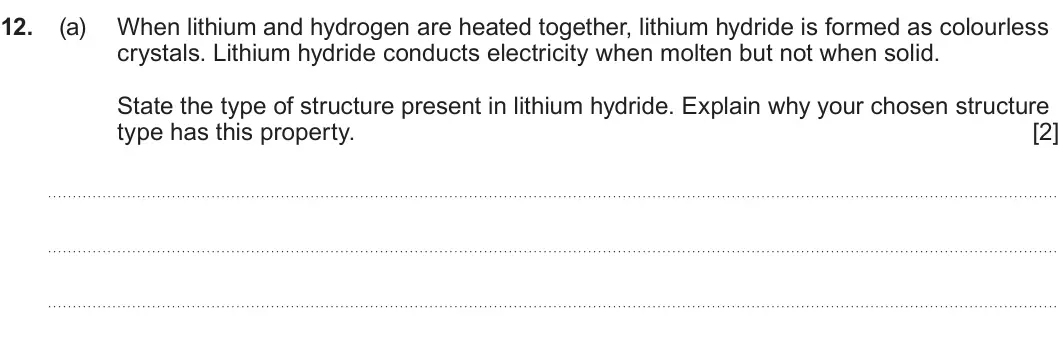
Q6(b)(ii)
The whole paper ↗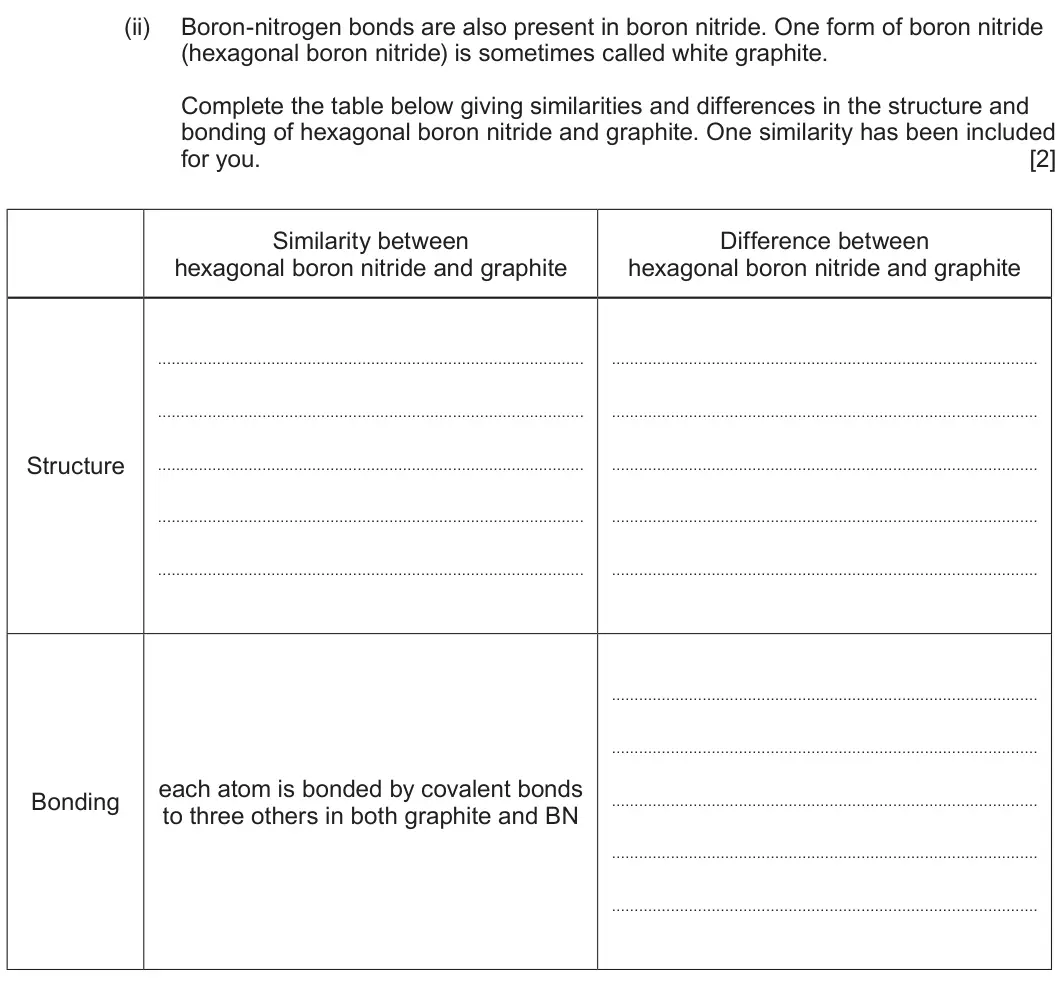
Q9(a)(i)
The whole paper ↗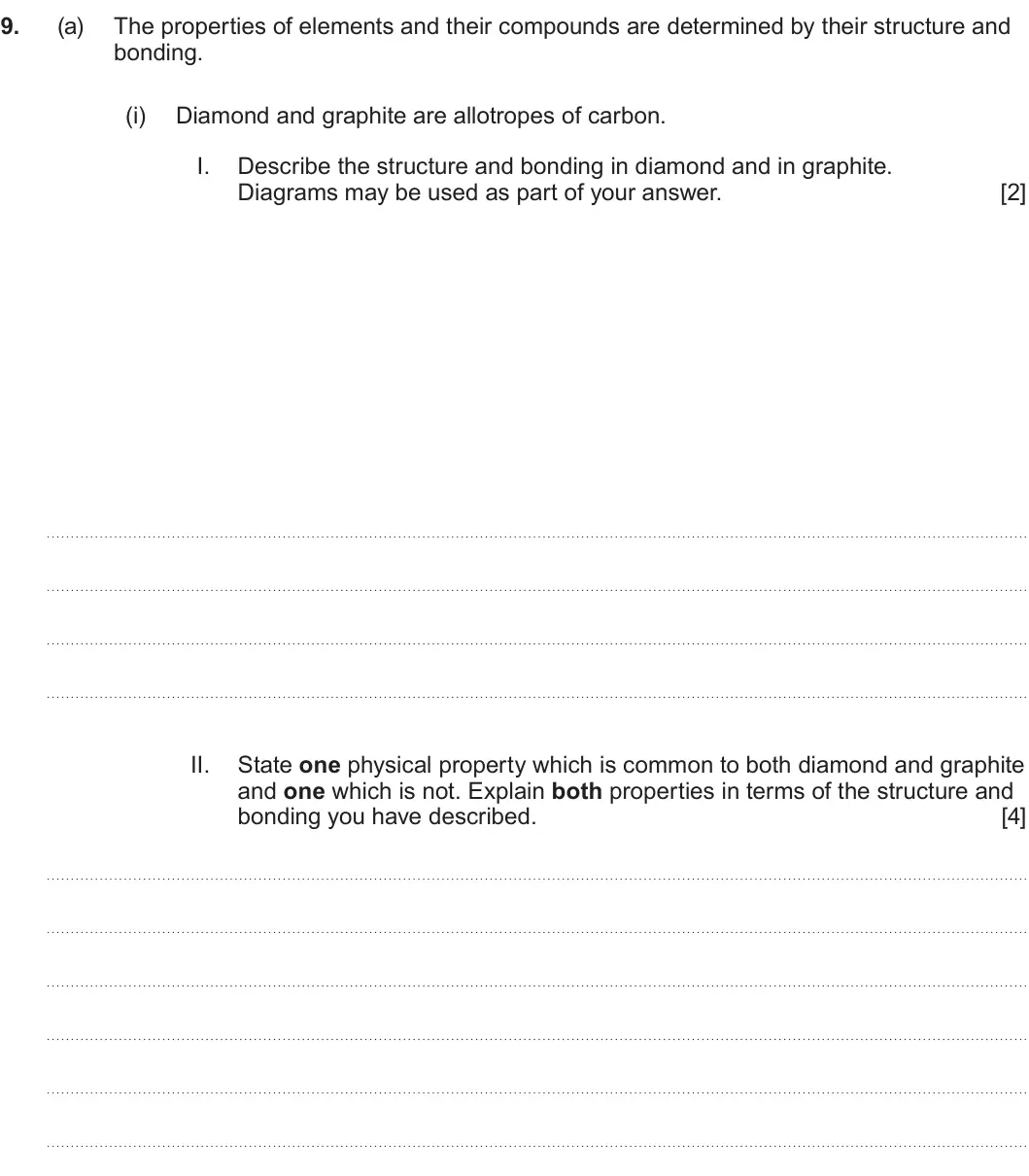
Q9(a)(ii)
The whole paper ↗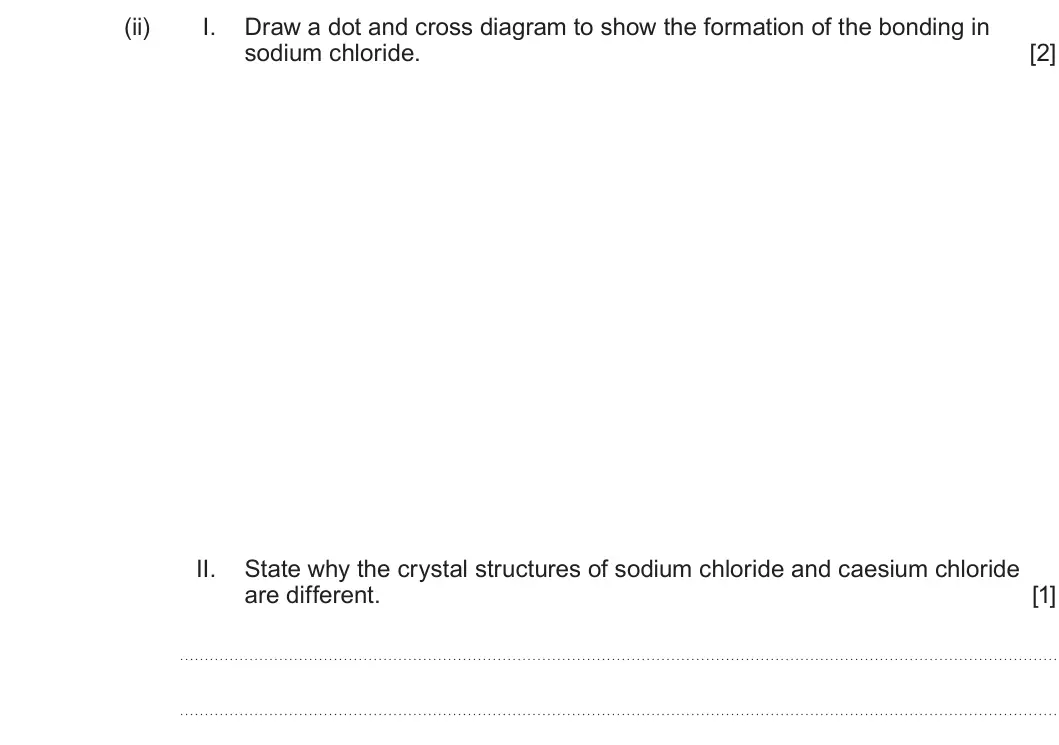

Q10(c)
The whole paper ↗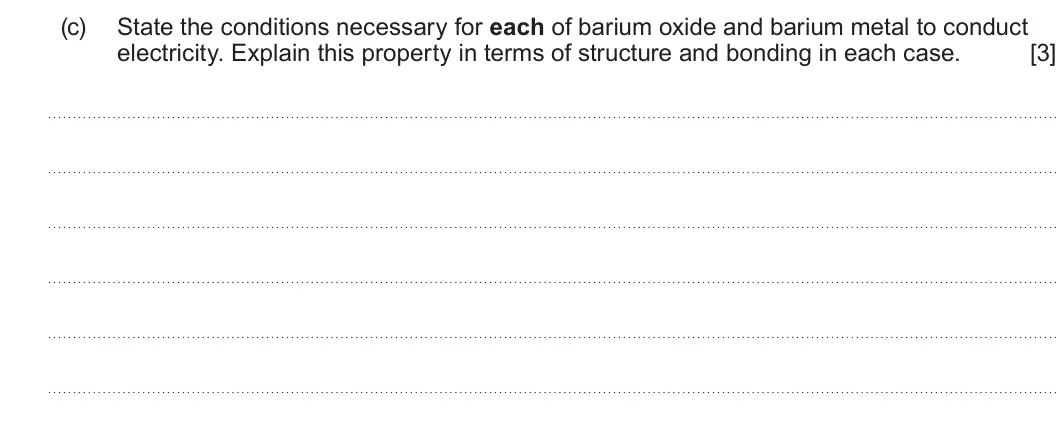
Q8(a)
The whole paper ↗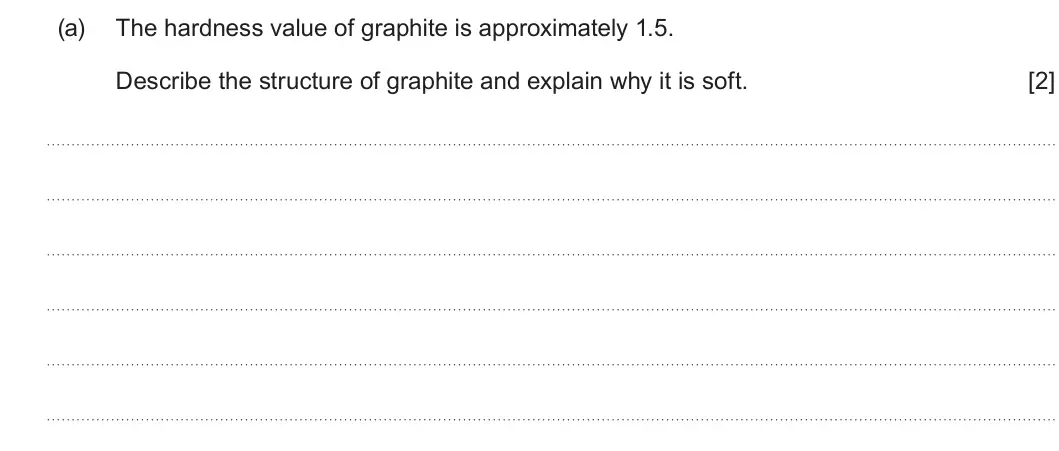
Q8(a)(i)
The whole paper ↗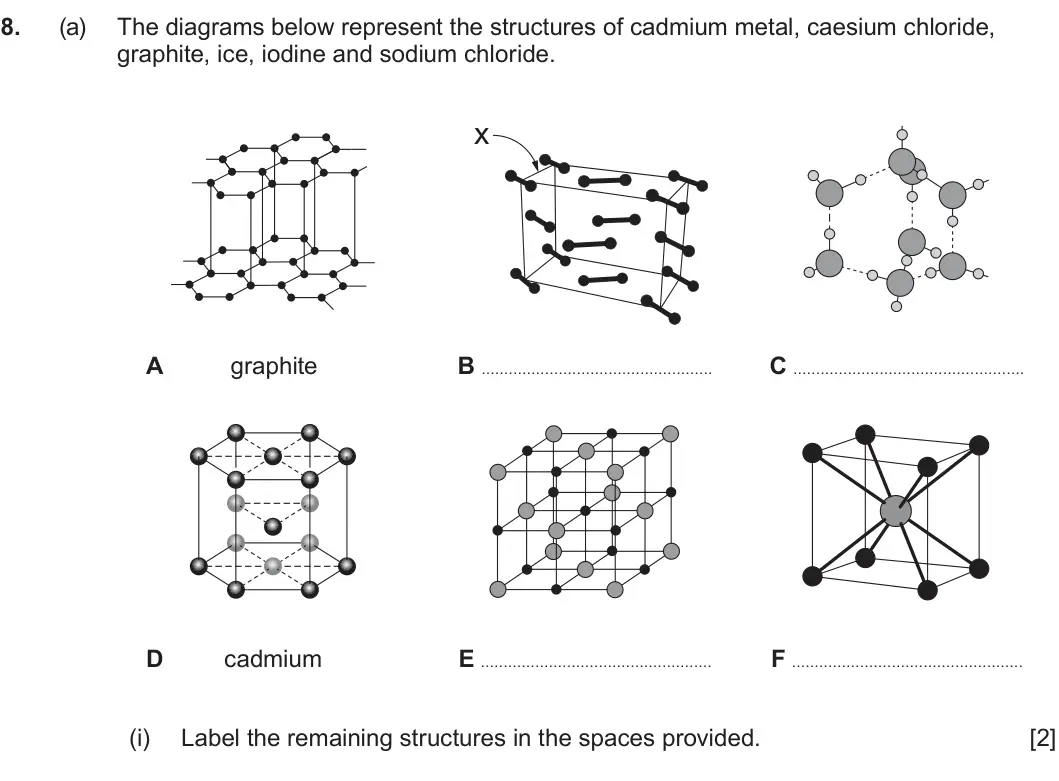
Q8(a)(ii)
The whole paper ↗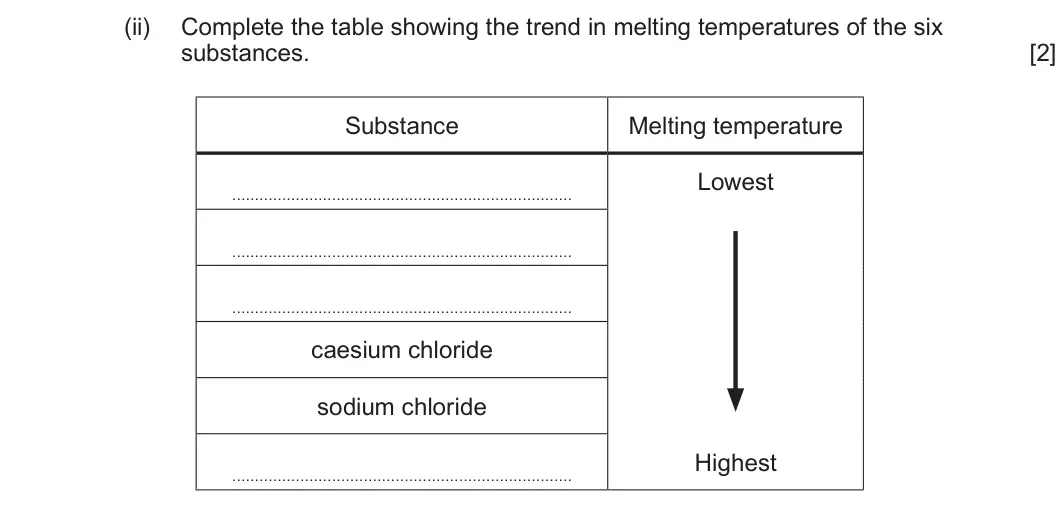
Q8(a)(iii)
The whole paper ↗
Q8(a)(iv)
The whole paper ↗
Q8(a)(v)
The whole paper ↗
Q8(a)(vi)
The whole paper ↗
Q9(d)
The whole paper ↗
Q13(b)(ii)
The whole paper ↗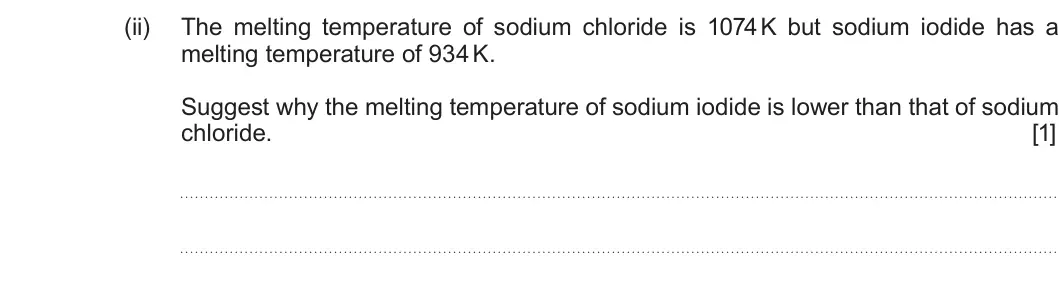

Q7(a)(i)
The whole paper ↗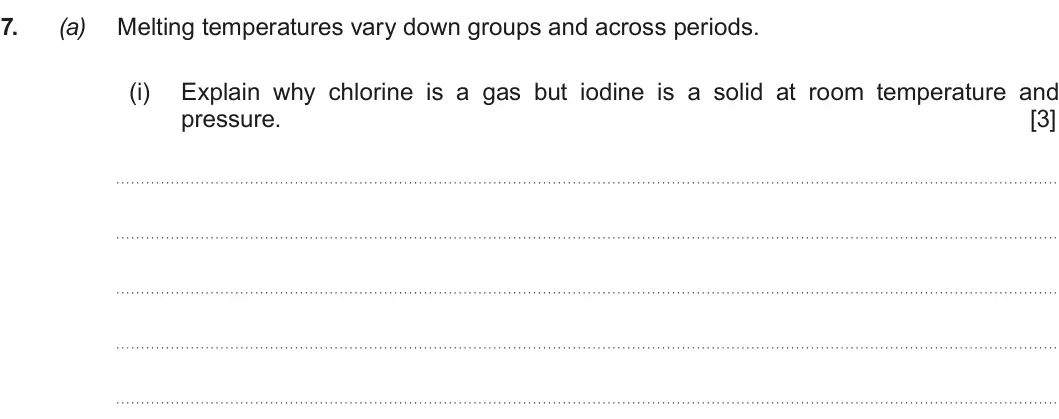
Q7(a)(ii)
The whole paper ↗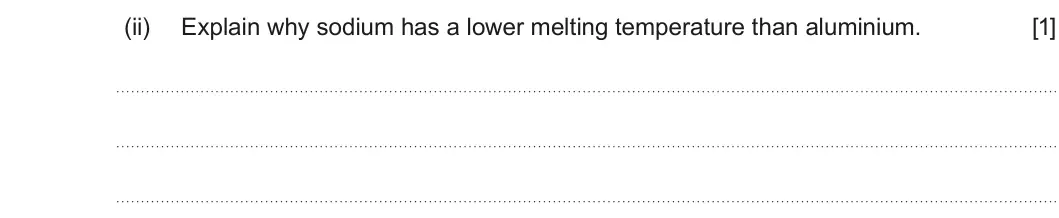
All 31 questions on Solid structures, as a list
- Summer 2025, AS Unit 1, Q2 (1 mark): State why the coordination number of Na+ in NaCl is different to that of Cs+ in CsCl. 2 [1]
- Summer 2025, AS Unit 1, Q12(a) (2 marks): When lithium and hydrogen are heated together, lithium hydride is formed as colourless crystals. Lithium hydride conducts electricity when molten but not when s
- Summer 2024, Unit 3, Q6(b)(ii) (2 marks): Boron-nitrogen bonds are also present in boron nitride. One form of boron nitride (hexagonal boron nitride) is sometimes called white graphite. Complete the tab
- Summer 2024, AS Unit 1, Q9(a)(i) (6 marks): Diamond and graphite are allotropes of carbon. I. Describe the structure and bonding in diamond and in graphite. Diagrams may be used as part of your answer. [2
- Summer 2024, AS Unit 1, Q9(a)(ii) (3 marks): I. Draw a dot and cross diagram to show the formation of the bonding in sodium chloride. [2] II. State why the crystal structures of sodium chloride and caesium
- Summer 2023, Unit 3, Q7 (1 mark): Hexagonal boron nitride is sometimes called white graphite. Give one difference between the physical properties of hexagonal boron nitride and graphite. [1]
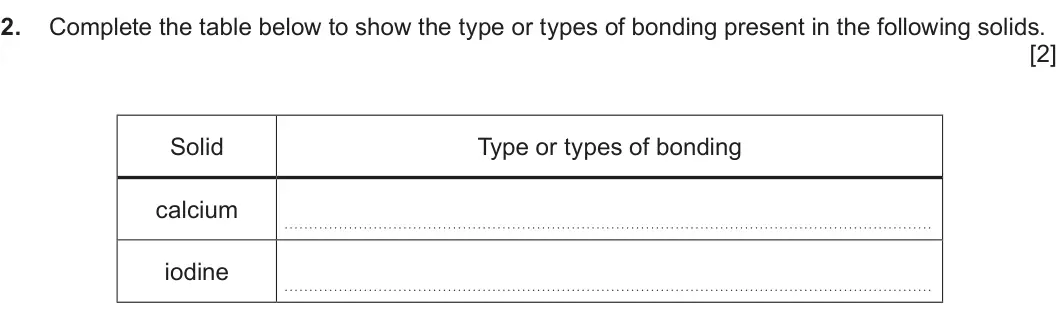
- Summer 2023, AS Unit 1, Q2 (2 marks): Complete the table below to show the type or types of bonding present in the following solids. [2] Solid Type or types of bonding calcium iodine
- Summer 2023, AS Unit 1, Q10(c) (3 marks): State the conditions necessary for each of barium oxide and barium metal to conduct electricity. Explain this property in terms of structure and bonding in each
- Summer 2022, Unit 3, Q8(a) (2 marks): The hardness value of graphite is approximately 1.5. Describe the structure of graphite and explain why it is soft. [2]
- Summer 2022, AS Unit 1, Q8(a)(i) (2 marks): Label the remaining structures in the spaces provided. [2]
- Summer 2022, AS Unit 1, Q8(a)(ii) (2 marks): Complete the table showing the trend in melting temperatures of the six substances. [2] Substance Melting temperature Lowest caesium chloride sodium chloride Hi
- Summer 2022, AS Unit 1, Q8(a)(iii) (1 mark): For structure B, name the type of bond or force represented by the letter X. [1]
- Summer 2022, AS Unit 1, Q8(a)(iv) (1 mark): Name the two substances which are good electrical conductors in the solid state. [1]
- Summer 2022, AS Unit 1, Q8(a)(v) (2 marks): Explain why graphite is suitable for use in pencils. [2]
- Summer 2022, AS Unit 1, Q8(a)(vi) (3 marks): Cadmium is a typical metal. Give a brief description of metallic bonding. [3] You may include a diagram to support your answer.
- Summer 2019, AS Unit 1, Q9(d) (3 marks): Magnesium is a typical metal. Describe the bonding in magnesium and explain why it is ductile. You may include a diagram as part of your answer. [3]
- Summer 2019, AS Unit 1, Q13(b)(ii) (1 mark): The melting temperature of sodium chloride is 1074 K but sodium iodide has a melting temperature of 934 K. Suggest why the melting temperature of sodium iodide
- Summer 2018, AS Unit 1, Q1 (1 mark): For the ionic compound caesium chloride, state the coordination number of the chloride ion. [1]
- Summer 2018, AS Unit 1, Q7(a)(i) (3 marks): Explain why chlorine is a gas but iodine is a solid at room temperature and pressure. [3]
- Summer 2018, AS Unit 1, Q7(a)(ii) (1 mark): Explain why sodium has a lower melting temperature than aluminium. [1]
- Summer 2018, AS Unit 1, Q7(a)(iii) (1 mark): Explain why silicon has a higher melting temperature than phosphorus. [1]
- Summer 2018, AS Unit 1, Q11(b)(i) (4 marks): Use the information in the table to identify each type of structure. Where a definite conclusion cannot be reached explain your reasoning. [4] QUESTION CONTINUE
- Summer 2018, AS Unit 1, Q11(b)(ii) (2 marks): For one of the materials where the type of structure could not be identified, suggest what further test(s) are needed to identify the type of structure. [2]
- Summer 2018, AS Unit 1, Q11(b)(iii) (1 mark): Suggest why it is difficult to identify a material as a metal when it is in powdered form. [1]
- Summer 2017, AS Unit 1, Q6(e)(i) (2 marks): density of ice at 0 °C. [2] Density = g cm−3
- Summer 2017, AS Unit 1, Q6(e)(ii) (1 mark): Explain why ice and water have different densities at 0 °C. [1]
- Summer 2017, AS Unit 1, Q9(e)(i) (2 marks): Ionic substances such as calcium chloride can conduct electricity under certain circumstances. [2]
- Summer 2017, AS Unit 1, Q9(e)(ii) (2 marks): Iodine is a solid which vaporises on gentle warming. [2]
- Summer 2017, AS Unit 1, Q9(e)(iii) (2 marks): A metal such as magnesium is malleable. [2]
- Summer 2016, AS Unit 1, Q8(c) (2 marks): Magnesium sulfide has the same crystal structure as sodium chloride. Use the diagram below to show the crystal structure of magnesium sulfide, clearly labelling
- Summer 2016, AS Unit 1, Q10(b)(ii) (1 mark): Explain why solid silicon is a very poor electrical conductor. [1]
Questions, mark schemes and examiner’s reports are © WJEC CBAC Ltd, from their published past papers. Plumi isn’t affiliated with any exam board. Want whole papers? Every WJEC A-Level Chemistry paper.
Rather write your answers by hand on iPad? Plumi marks them against the same mark schemes.