 plumi
Chemistry of the p-block: WJEC A‑Level Chemistry questions
Every WJEC A-Level Chemistry exam question on 3.3 Chemistry of the p-block, 2016–2025, with its mark scheme and examiner’s report.
Find questions1,204
Calculations

Q7(c)
The whole paper ↗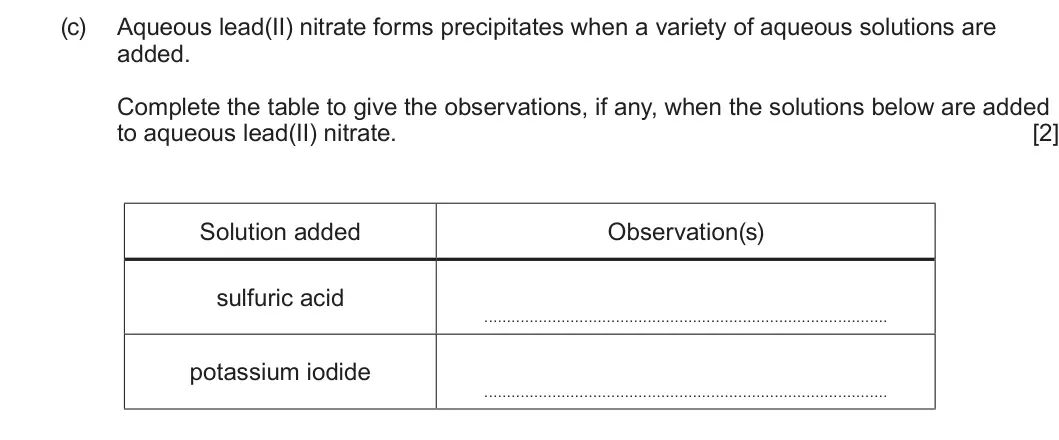
Q10(a)
The whole paper ↗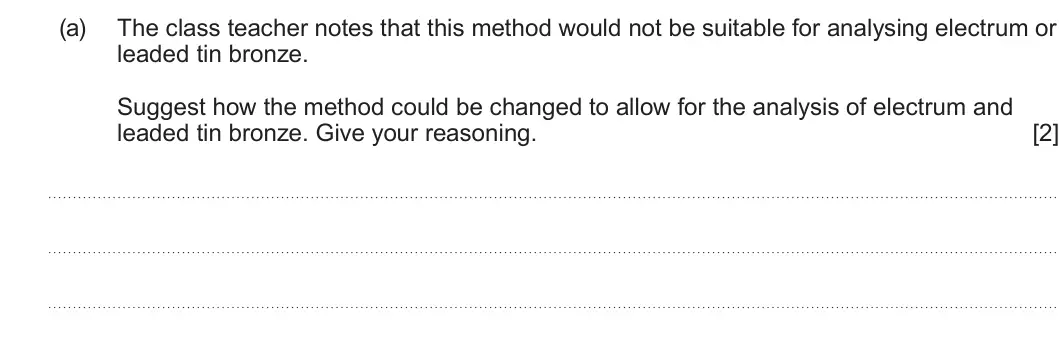
Q10(b)
The whole paper ↗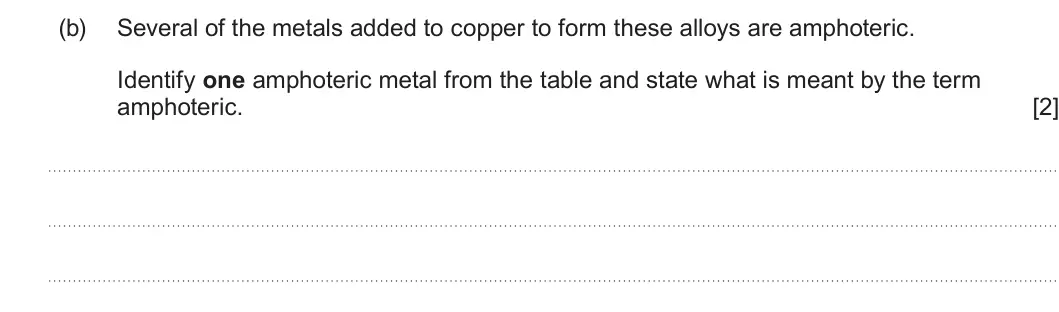
Q6(b)(i)
The whole paper ↗
Q6(c)
The whole paper ↗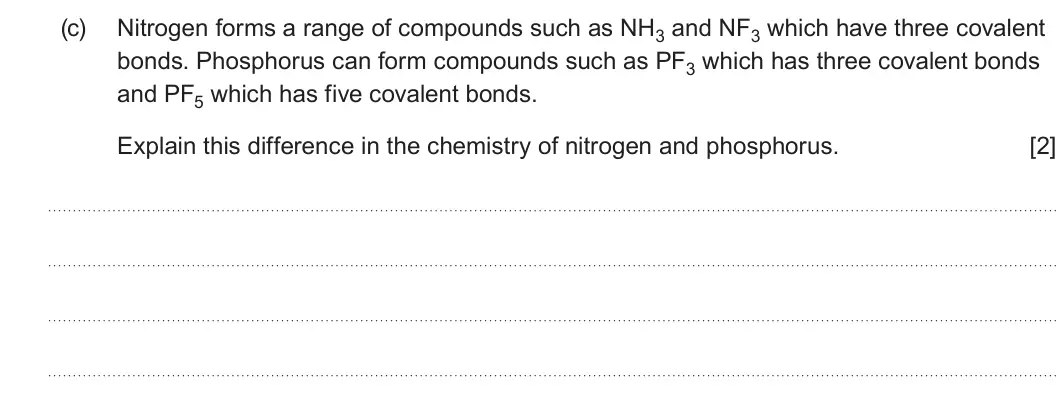
Q7(e)(i)
The whole paper ↗

Q9(a)
The whole paper ↗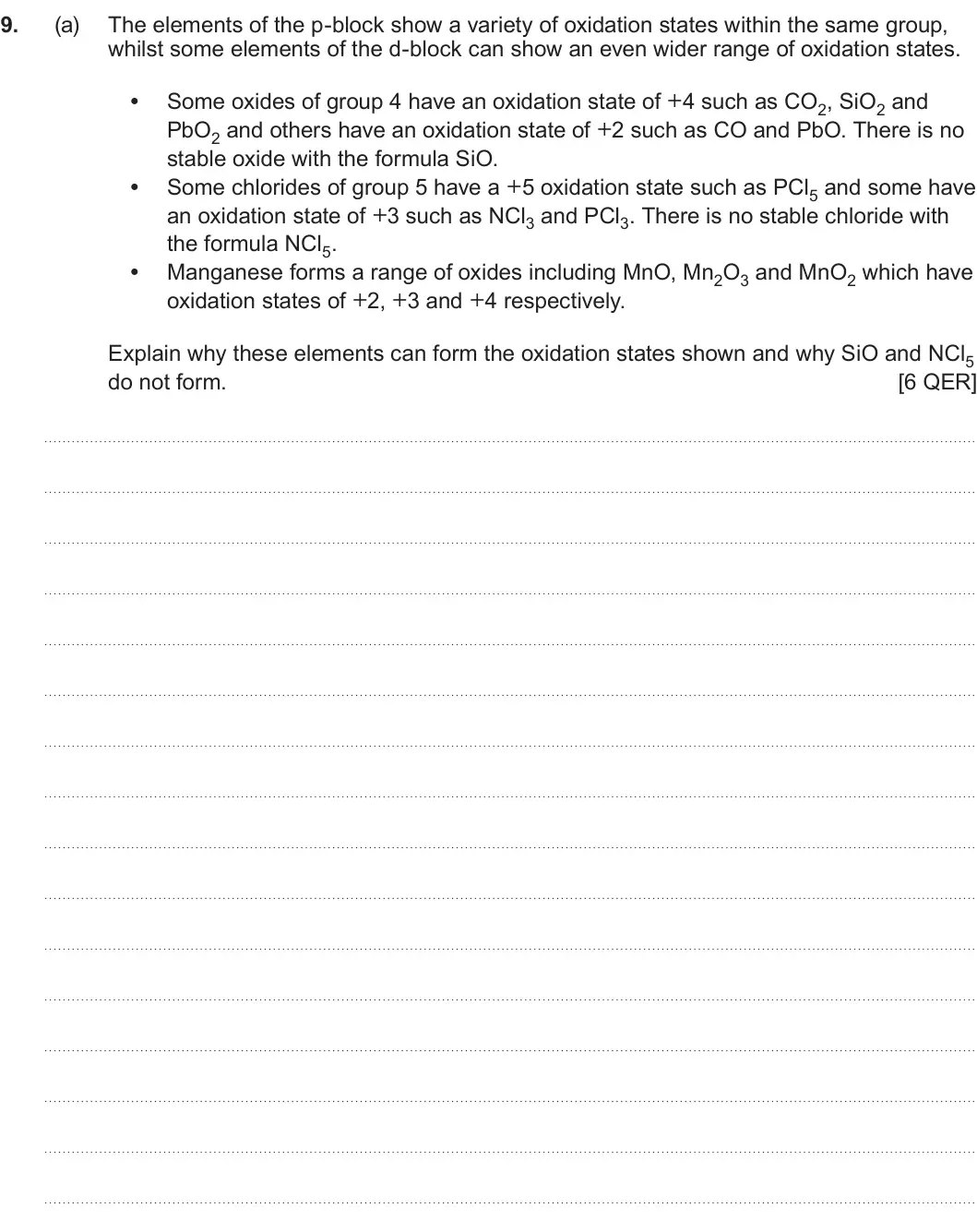
Q1(a)
The whole paper ↗
Q1(b)
The whole paper ↗
Q9(f)(i)
The whole paper ↗
Q9(f)(ii)
The whole paper ↗
Q7(a)
The whole paper ↗
Q7(b)
The whole paper ↗
All 32 questions on Chemistry of the p-block, as a list
- Summer 2025, Unit 3, Q2 (1 mark): Give a reason why SiCl4 reacts vigorously with water whilst CCl4 does not. [1]
- Summer 2025, Unit 3, Q7(c) (2 marks): Aqueous lead(II) nitrate forms precipitates when a variety of aqueous solutions are added. Complete the table to give the observations, if any, when the solutio
- Summer 2025, Unit 3, Q10(a) (2 marks): The class teacher notes that this method would not be suitable for analysing electrum or leaded tin bronze. Suggest how the method could be changed to allow for
- Summer 2025, Unit 3, Q10(b) (2 marks): Several of the metals added to copper to form these alloys are amphoteric. Identify one amphoteric metal from the table and state what is meant by the term amph
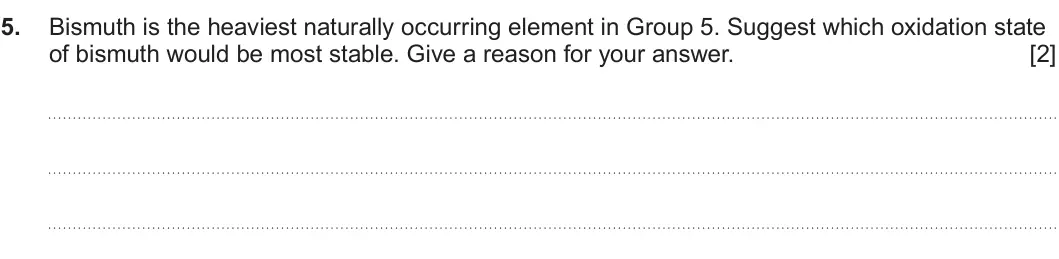
- Summer 2024, Unit 3, Q5 (2 marks): Bismuth is the heaviest naturally occurring element in Group 5 Suggest which oxidation state of bismuth would be most stable. Give a reason for your answer. [2]
- Summer 2024, Unit 3, Q6(b)(i) (1 mark): Draw a dot and cross diagram of the compound formed. [1]
- Summer 2024, Unit 3, Q6(c) (2 marks): Nitrogen forms a range of compounds such as NH3 and NF3 which have three covalent bonds. Phosphorus can form compounds such as PF3 which has three covalent bond
- Summer 2024, Unit 3, Q7(e)(i) (1 mark): Give the colour of lead(II) iodide. [1]
- Summer 2023, Unit 3, Q1 (1 mark): Addition of aqueous lead nitrate to aqueous potassium iodide causes a precipitate to form. Write an ionic equation for the formation of the precipitate, includi
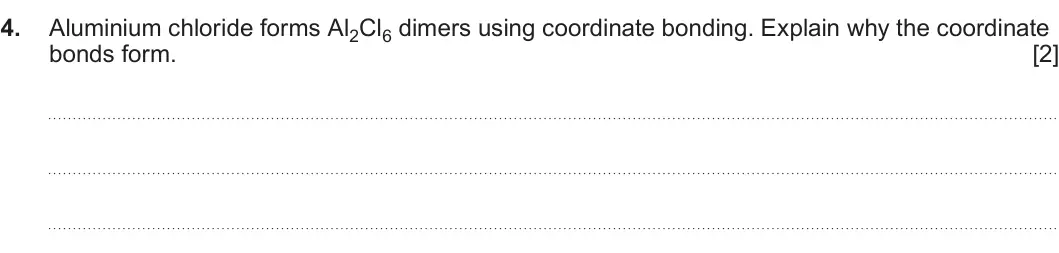
- Summer 2023, Unit 3, Q4 (2 marks): Aluminium chloride forms Al2Cl6 dimers using coordinate bonding. Explain why the coordinate bonds form. [2]
- Summer 2023, Unit 3, Q9(a) (6 marks): The elements of the p-block show a variety of oxidation states within the same group, whilst some elements of the d-block can show an even wider range of oxidat
- Summer 2022, Unit 3, Q1(a) (1 mark): Give the colour of the precipitate. [1]
- Summer 2022, Unit 3, Q1(b) (1 mark): Write an ionic equation for the reaction. [1]
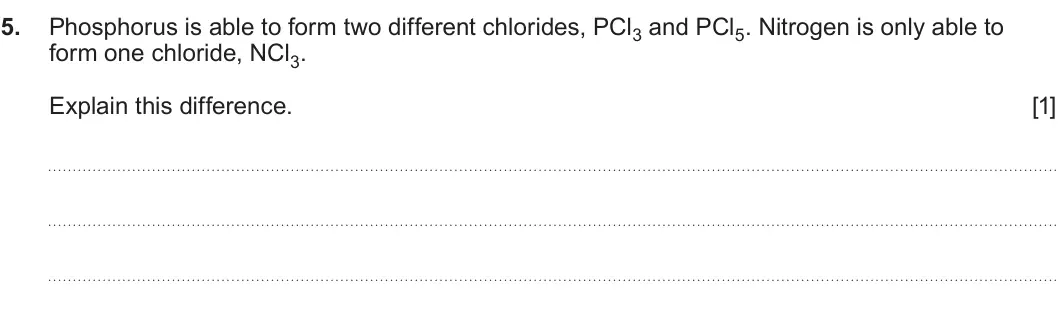
- Summer 2022, Unit 3, Q5 (1 mark): Phosphorus is able to form two different chlorides, PCl3 and PCl5. Nitrogen is only able to form one chloride, NCl3. Explain this difference. [1]
- Summer 2022, Unit 3, Q9(f)(i) (1 mark): Write an equation for this process. [1]
- Summer 2022, Unit 3, Q9(f)(ii) (1 mark): Explain why CO is a good reducing agent. [1]
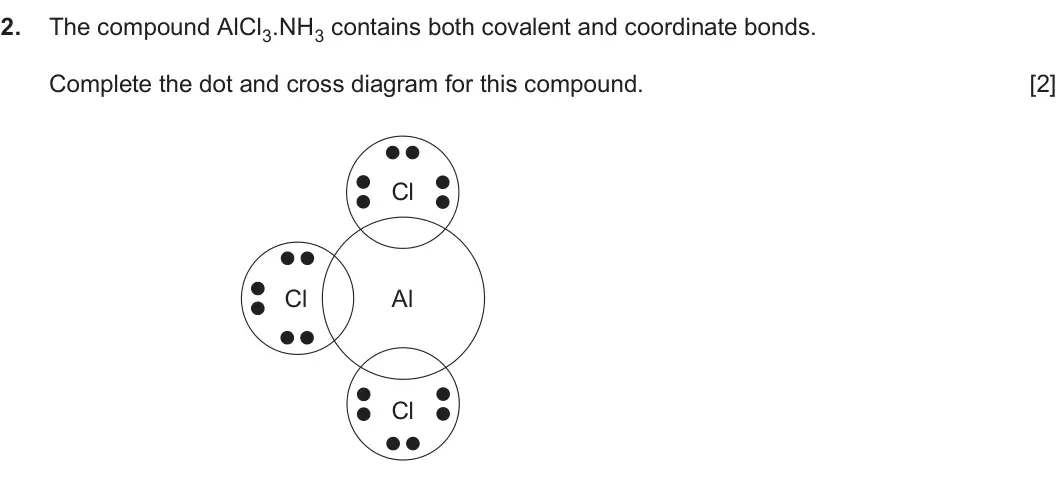
- Summer 2019, Unit 3, Q2 (2 marks): The compound AlCl3.NH3 contains both covalent and coordinate bonds. Complete the dot and cross diagram for this compound. [2] Cl Cl Al Cl
- Summer 2019, Unit 3, Q5 (1 mark): When CCl4 is added to water two separate layers are formed and there is no reaction, whilst SiCl4 reacts violently with water. Give the reason for this differen
- Summer 2019, Unit 3, Q7(a) (1 mark): Write an equation for this reaction. [1]
- Summer 2019, Unit 3, Q7(b) (1 mark): Give a reason why carbon monoxide acts as a reducing agent while the equivalent oxide of lead does not. [1]
- Summer 2019, Unit 3, Q10(b)(iii) (1 mark): A student suggests using gravimetric analysis to measure the amount of iodide ions produced in the reaction by addition of Pb2+(aq) ions to form a precipitate.
- Summer 2019, Unit 3, Q12(a)(ii) (2 marks): The student plans to use dilute hydrochloric acid in step 1 His teacher tells him that this is not the correct acid to use. Explain why hydrochloric acid should
- Summer 2018, Unit 3, Q4 (1 mark): Give the observation(s) expected when water is added to SiCl4. [1]
- Summer 2018, Unit 3, Q10(a)(i) (1 mark): Tin and carbon are both more stable in oxidation state +4 whilst lead is more stable as +2. Explain the difference in the stabilities of these oxidation states.
- Summer 2018, Unit 3, Q10(a)(ii) (1 mark): Lead(IV) oxide can act as an oxidising agent when it reacts with concentrated hydrochloric acid. Write an equation for this reaction. [1]
- Summer 2018, Unit 3, Q12(b) (6 marks): A student was provided with five ionic solids containing familiar cations and anions. Each solid contains a different cation. The solids were labelled A, B, C,
- Summer 2017, Unit 3, Q1(a) (1 mark): Give the colour of the precipitate. [1]
- Summer 2017, Unit 3, Q1(b) (1 mark): Write an ionic equation for the reaction that occurs, including state symbols. [1]
- Summer 2017, Unit 3, Q8(a)(i) (2 marks): Explain why nitrogen can only form a chloride with eight outer shell electrons, but phosphorus can form a chloride with a different number of outer shell electr
- Summer 2017, Unit 3, Q8(a)(ii) (2 marks): Explain why aluminium forms compounds that are electron deficient. Show how one of these compounds can act to gain a full outer shell. [2] You should give the d
- Summer 2017, Unit 3, Q8(b) (6 marks): Below is some information about the oxides of two Group 4 elements. There are two common oxides of carbon. Carbon dioxide is an acidic oxide Carbon and carbon m
- Summer 2017, Unit 3, Q11(c) (1 mark): State what the observations with sodium hydroxide indicate about the acidity/basicity of the aluminium ions. [1]
Questions, mark schemes and examiner’s reports are © WJEC CBAC Ltd, from their published past papers. Plumi isn’t affiliated with any exam board. Want whole papers? Every WJEC A-Level Chemistry paper.
Rather write your answers by hand on iPad? Plumi marks them against the same mark schemes.