Skip to content

WJEC A‑Level Biology questions by topic

Every question from every WJEC A-Level Biology paper, 2016–2025, part by part. Filter by topic, paper or year, open the mark scheme under any question, and download a set as a PDF.

Find questions1,223
Topics Pick as many as you like. Open one to choose its sub-topics.

Year 1 · AS

Year 2 · A‑Level only

Calculations

1,223 questions

  1. Q1(a)

    Summer 2025 · Unit 3

    2 marks
    The whole paper ↗
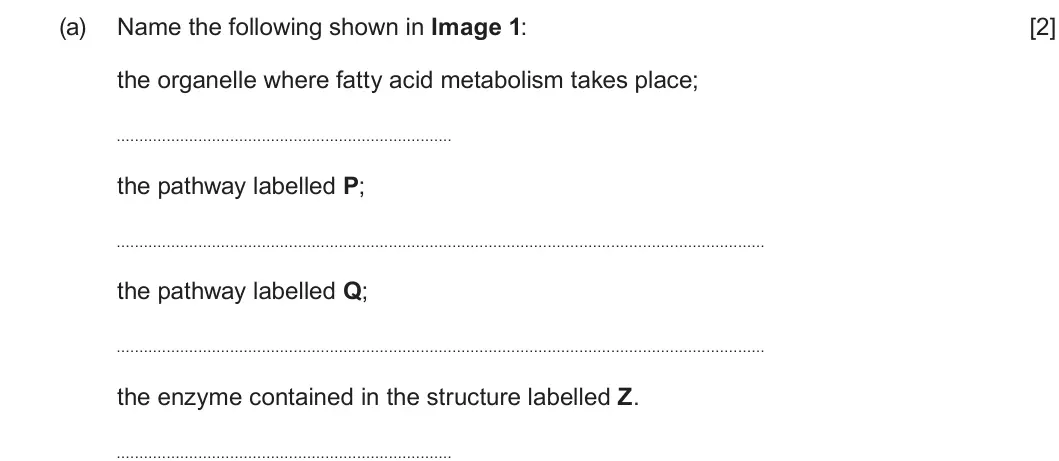
    Summer 2025 Unit 3, question 1(a): Name the following shown in Image 1: [2] the organelle where fatty acid metabolism takes place; the pathway labelled P; the pathway labelled Q; the enzyme conta
  2. Q1(b)

    Summer 2025 · Unit 3

    1 mark
    The whole paper ↗
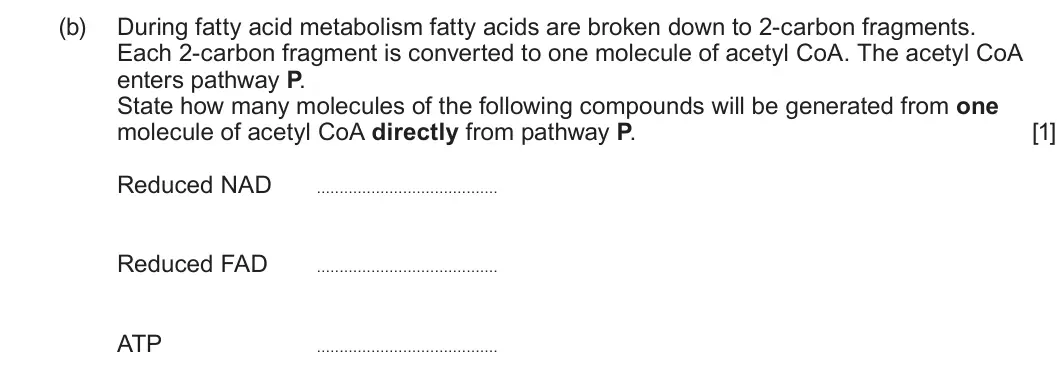
    Summer 2025 Unit 3, question 1(b): During fatty acid metabolism fatty acids are broken down to 2-carbon fragments. Each 2-carbon fragment is converted to one molecule of acetyl CoA. The acetyl Co
  3. Q1(c)(i)

    Summer 2025 · Unit 3

    4 marks
    The whole paper ↗
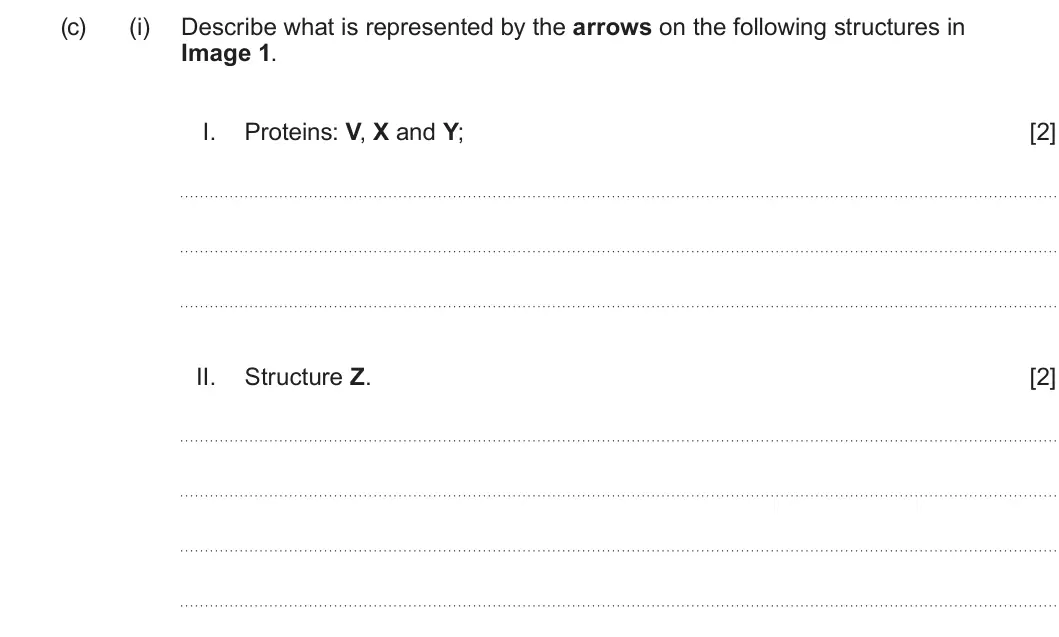
    Summer 2025 Unit 3, question 1(c)(i): Describe what is represented by the arrows on the following structures in Image 1 I. Proteins: V, X and Y; [2] II. Structure Z. [2]
  4. Q1(c)(ii)

    Summer 2025 · Unit 3

    1 mark
    The whole paper ↗
    Summer 2025 Unit 3, question 1(c)(ii): Water is formed as part of pathway Q. State the role of oxygen in this pathway. [1]
  5. Q2(a)(i)

    Summer 2025 · Unit 3

    2 marks
    The whole paper ↗
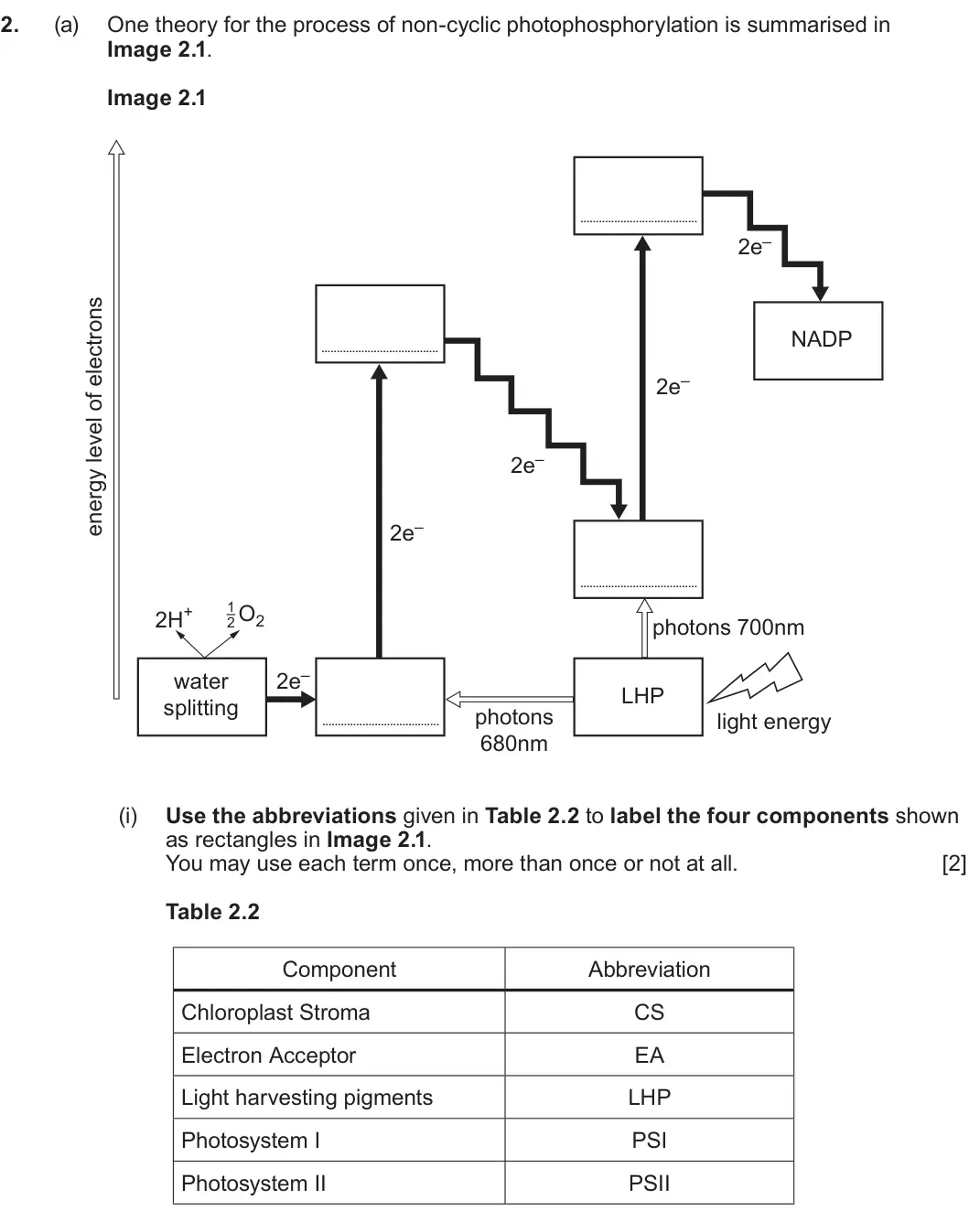
    Summer 2025 Unit 3, question 2(a)(i): Use the abbreviations given in Table 2.2 to label the four components shown as rectangles in Image 2.1. You may use each term once, more than once or not at all
  6. Q2(a)(ii)

    Summer 2025 · Unit 3

    2 marks
    The whole paper ↗
    Summer 2025 Unit 3, question 2(a)(ii): For each pair of electrons passing through the process two molecules of ATP are produced. Draw and label an arrow on Image 2.1 to show where and how ATP is prod
  7. Q2(a)(iii)

    Summer 2025 · Unit 3

    1 mark
    The whole paper ↗
    Summer 2025 Unit 3, question 2(a)(iii): State the biological term for the process labelled water splitting in Image 2.1. [1]
  8. Q2(a)(iv)

    Summer 2025 · Unit 3

    2 marks
    The whole paper ↗
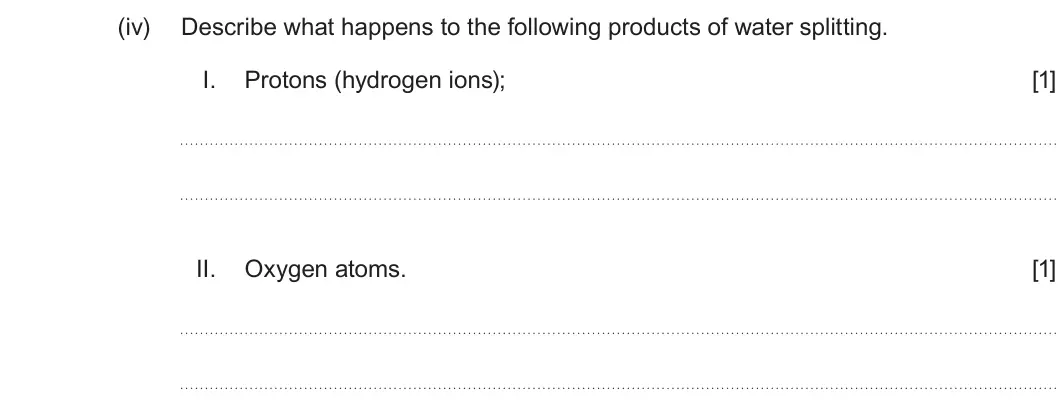
    Summer 2025 Unit 3, question 2(a)(iv): Describe what happens to the following products of water splitting. I. Protons (hydrogen ions); [1] II. Oxygen atoms. [1]
  9. Q2(a)(v)

    Summer 2025 · Unit 3

    1 mark
    The whole paper ↗
    Summer 2025 Unit 3, question 2(a)(v): Describe how the energy from the photons shown in Image 2.1 would be used in photophosphorylation. [1]
  10. Q2(b)

    Summer 2025 · Unit 3

    4 marks
    The whole paper ↗
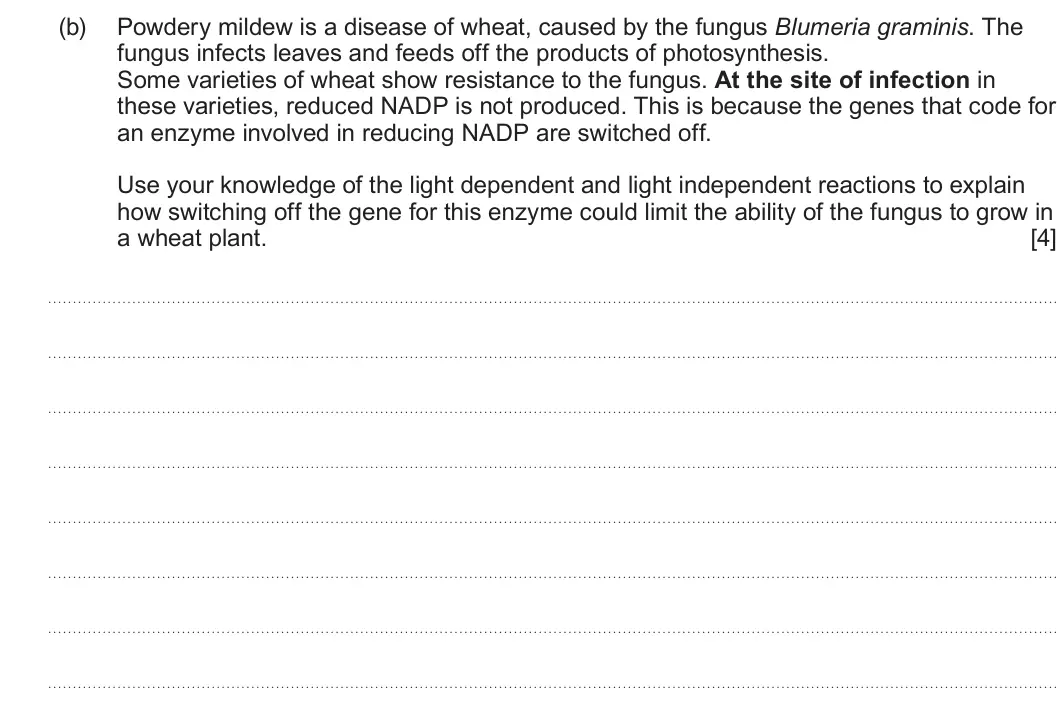
    Summer 2025 Unit 3, question 2(b): Powdery mildew is a disease of wheat, caused by the fungus Blumeria graminis. The fungus infects leaves and feeds off the products of photosynthesis. Some varie
  11. Q3(a)(i)

    Summer 2025 · Unit 3

    1 mark
    The whole paper ↗
    Summer 2025 Unit 3, question 3(a)(i): Identify the plane of the section shown in Image 3.1B. [1]
  12. Q3(a)(ii)

    Summer 2025 · Unit 3

    1 mark
    The whole paper ↗
    Summer 2025 Unit 3, question 3(a)(ii): Name the two blood vessels labelled in Image 3.1B. [1]
  13. Q3(a)(iii)

    Summer 2025 · Unit 3

    1 mark
    The whole paper ↗
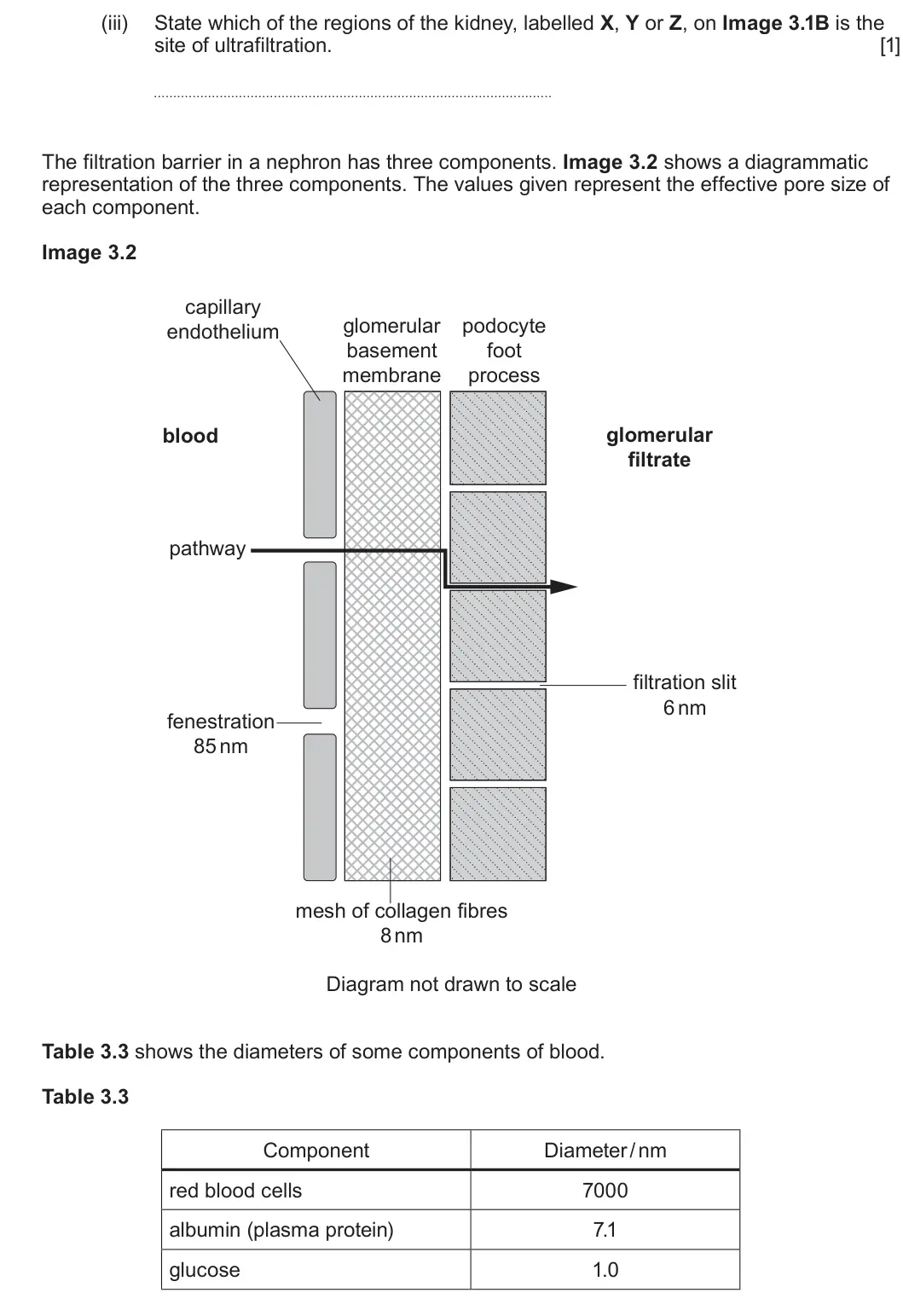
    Summer 2025 Unit 3, question 3(a)(iii): State which of the regions of the kidney, labelled X, Y or Z, on Image 3.1B is the site of ultrafiltration. [1] The filtration barrier in a nephron has three co
  14. Q3(b)

    Summer 2025 · Unit 3

    2 marks
    The whole paper ↗
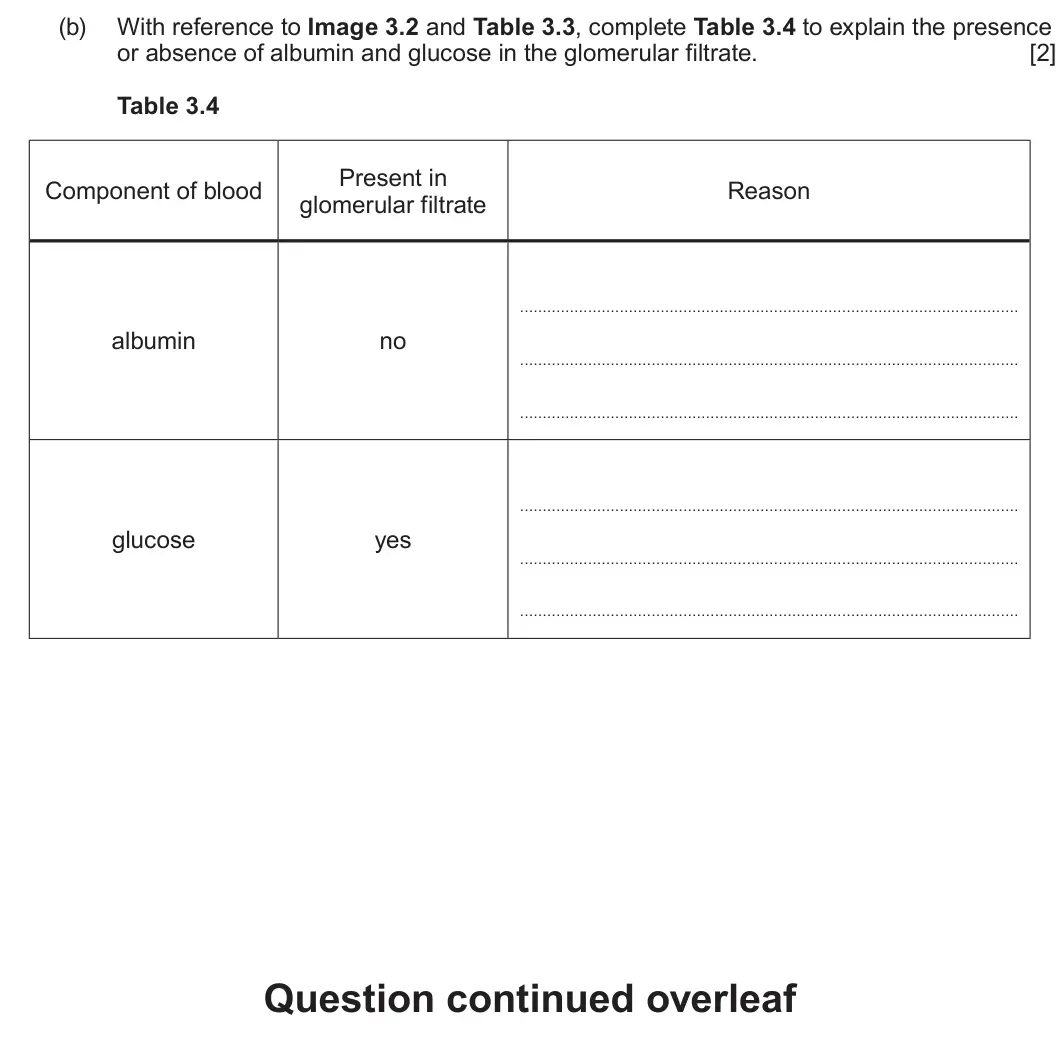
    Summer 2025 Unit 3, question 3(b): With reference to Image 3.2 and Table 3.3, complete Table 3.4 to explain the presence or absence of albumin and glucose in the glomerular filtrate. [2] Table 3.
  15. Q3(c)(i)

    Summer 2025 · Unit 3

    3 marks
    The whole paper ↗
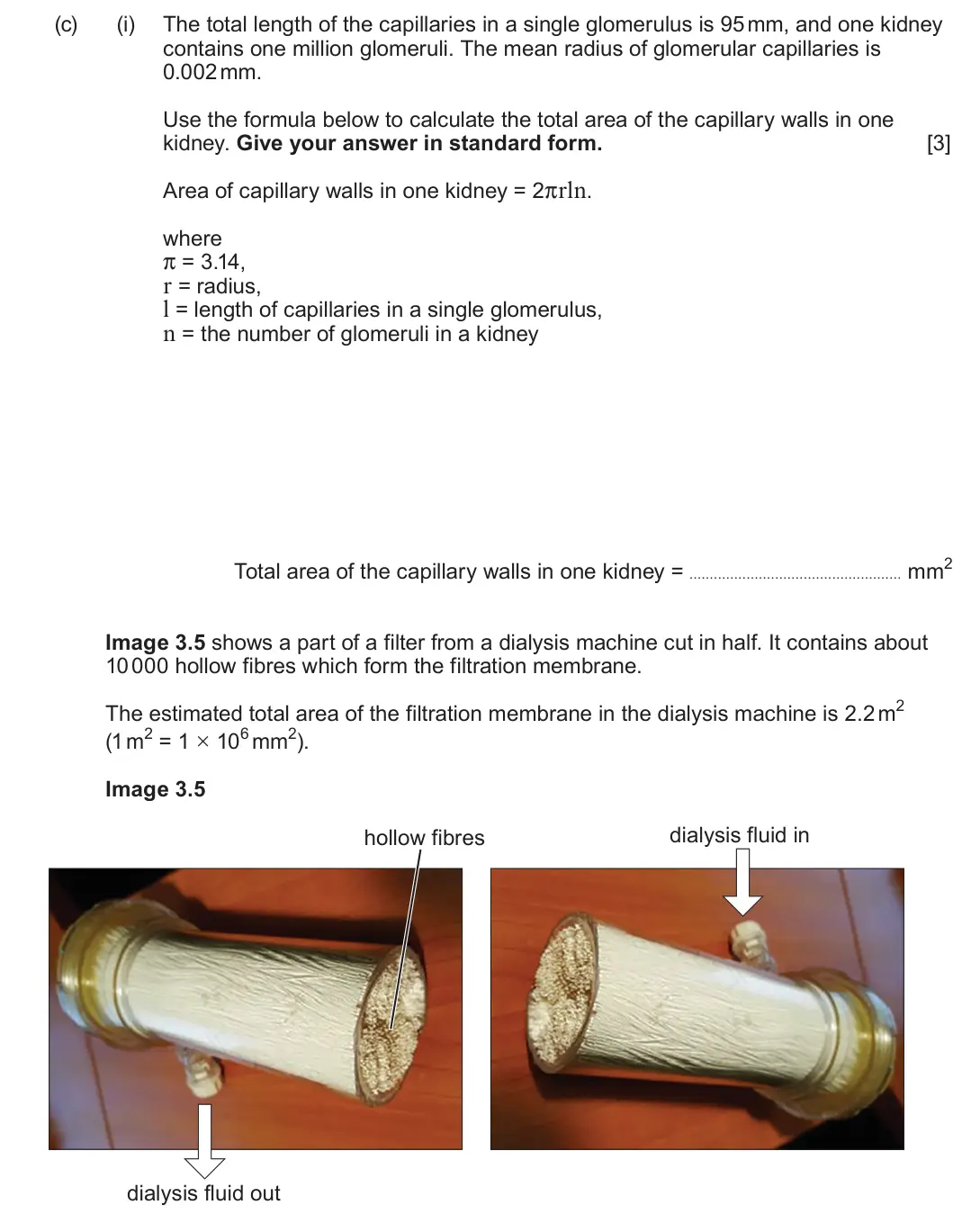
    Summer 2025 Unit 3, question 3(c)(i): The total length of the capillaries in a single glomerulus is 95 mm, and one kidney contains one million glomeruli. The mean radius of glomerular capillaries is
  16. Q3(c)(ii)

    Summer 2025 · Unit 3

    1 mark
    The whole paper ↗
    Summer 2025 Unit 3, question 3(c)(ii): Give one reason why the estimate of the area for the dialysis filter is likely to be more accurate than the calculated area for the capillary walls of the kidne
  17. Q3(c)(iii)

    Summer 2025 · Unit 3

    1 mark
    The whole paper ↗
    Summer 2025 Unit 3, question 3(c)(iii): Explain why having a large surface area is important in ultrafiltration. [1]
  18. Q3(d)(i)

    Summer 2025 · Unit 3

    1 mark
    The whole paper ↗
    Summer 2025 Unit 3, question 3(d)(i): Suggest how the filtration rate would be affected in Alport syndrome. Explain your answer. [1]
  19. Q3(d)(ii)

    Summer 2025 · Unit 3

    2 marks
    The whole paper ↗
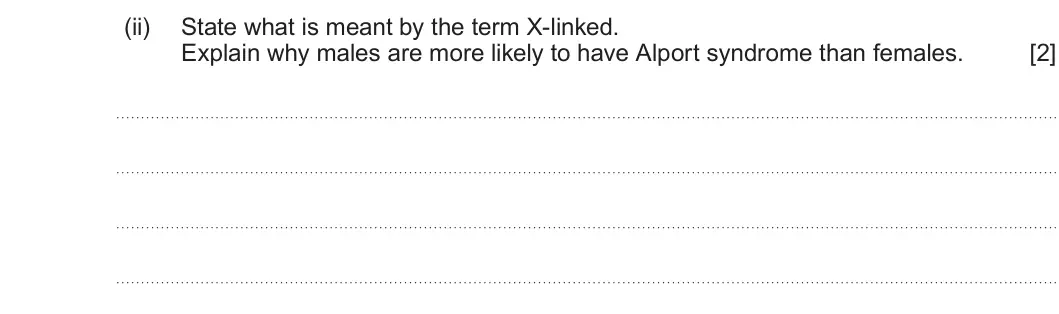
    Summer 2025 Unit 3, question 3(d)(ii): State what is meant by the term X-linked. Explain why males are more likely to have Alport syndrome than females. [2]
  20. Q4(a)

    Summer 2025 · Unit 3

    2 marks
    The whole paper ↗
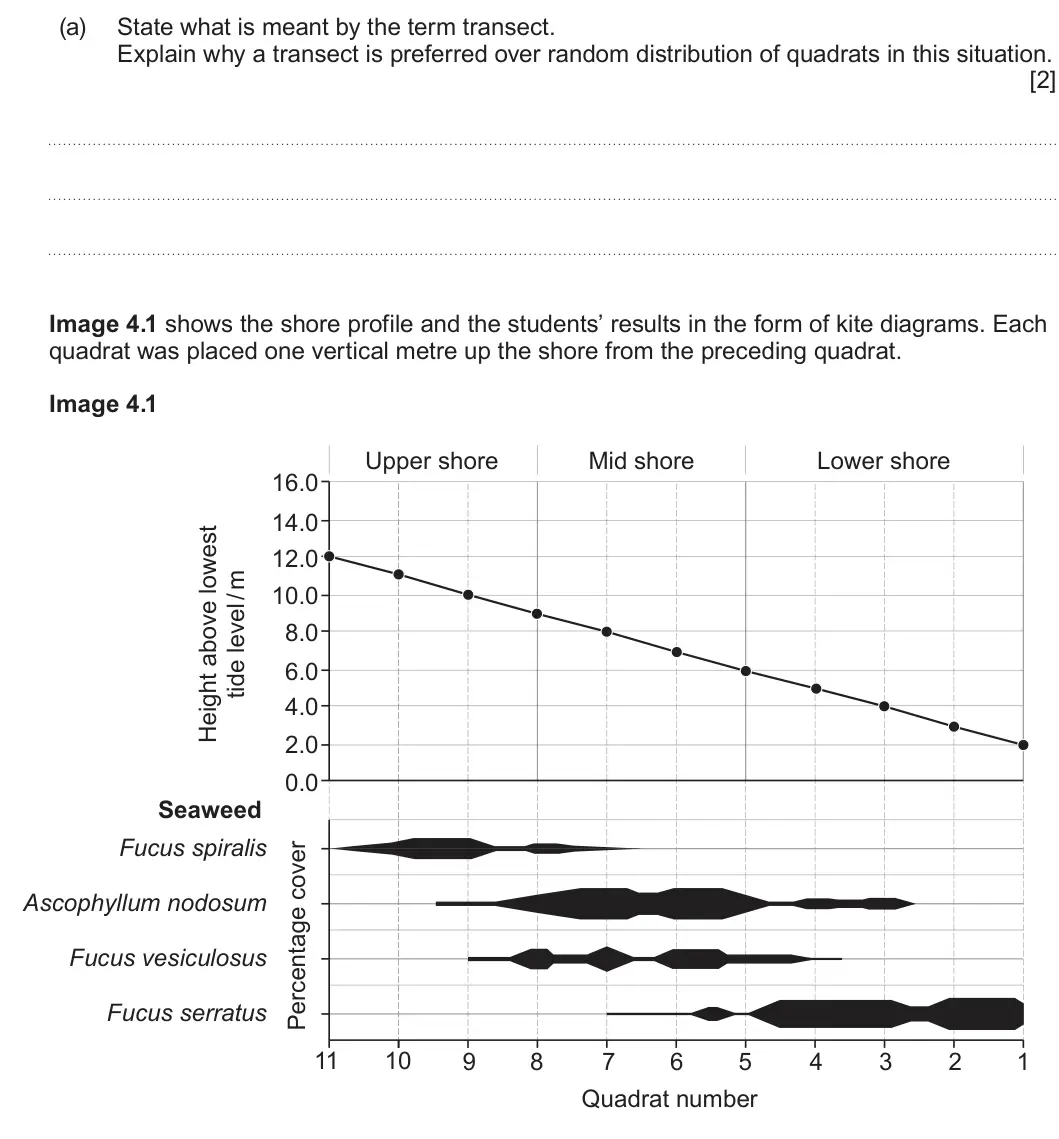
    Summer 2025 Unit 3, question 4(a): State what is meant by the term transect. Explain why a transect is preferred over random distribution of quadrats in this situation. [2] Image 4.1 shows the sh

Questions, mark schemes and examiner’s reports are © WJEC CBAC Ltd, from their published past papers. Plumi isn’t affiliated with any exam board. Want whole papers? Every WJEC A-Level Biology paper.

Rather write your answers by hand on iPad? Plumi marks them against the same mark schemes.