 plumi
The nervous system: WJEC A‑Level Biology questions
Every WJEC A-Level Biology exam question on 3.8 The nervous system, 2016–2025, with its mark scheme and examiner’s report.
Find questions1,223
Calculations
Q5(a)(i)
The whole paper ↗
Q5(a)(ii)
The whole paper ↗
Q5(a)(iii)
The whole paper ↗
Q5(b)(i)
The whole paper ↗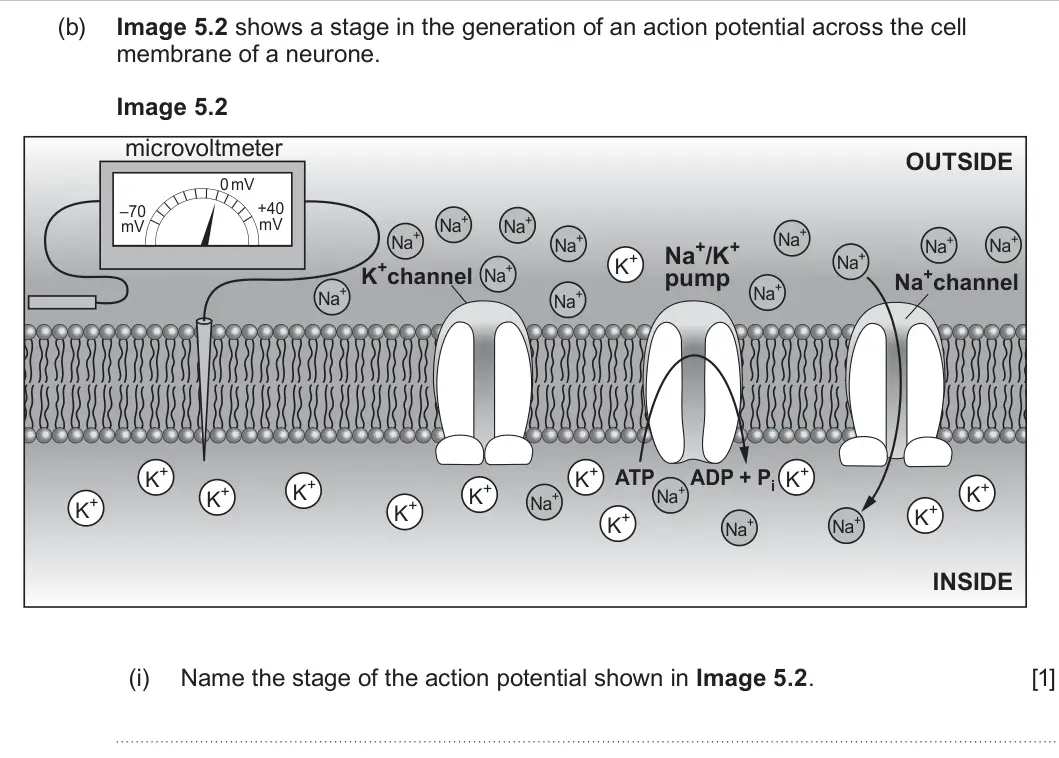
Q5(b)(ii)
The whole paper ↗
Q5(b)(iii)
The whole paper ↗
Q5(b)(iv)
The whole paper ↗
Q5(c)
The whole paper ↗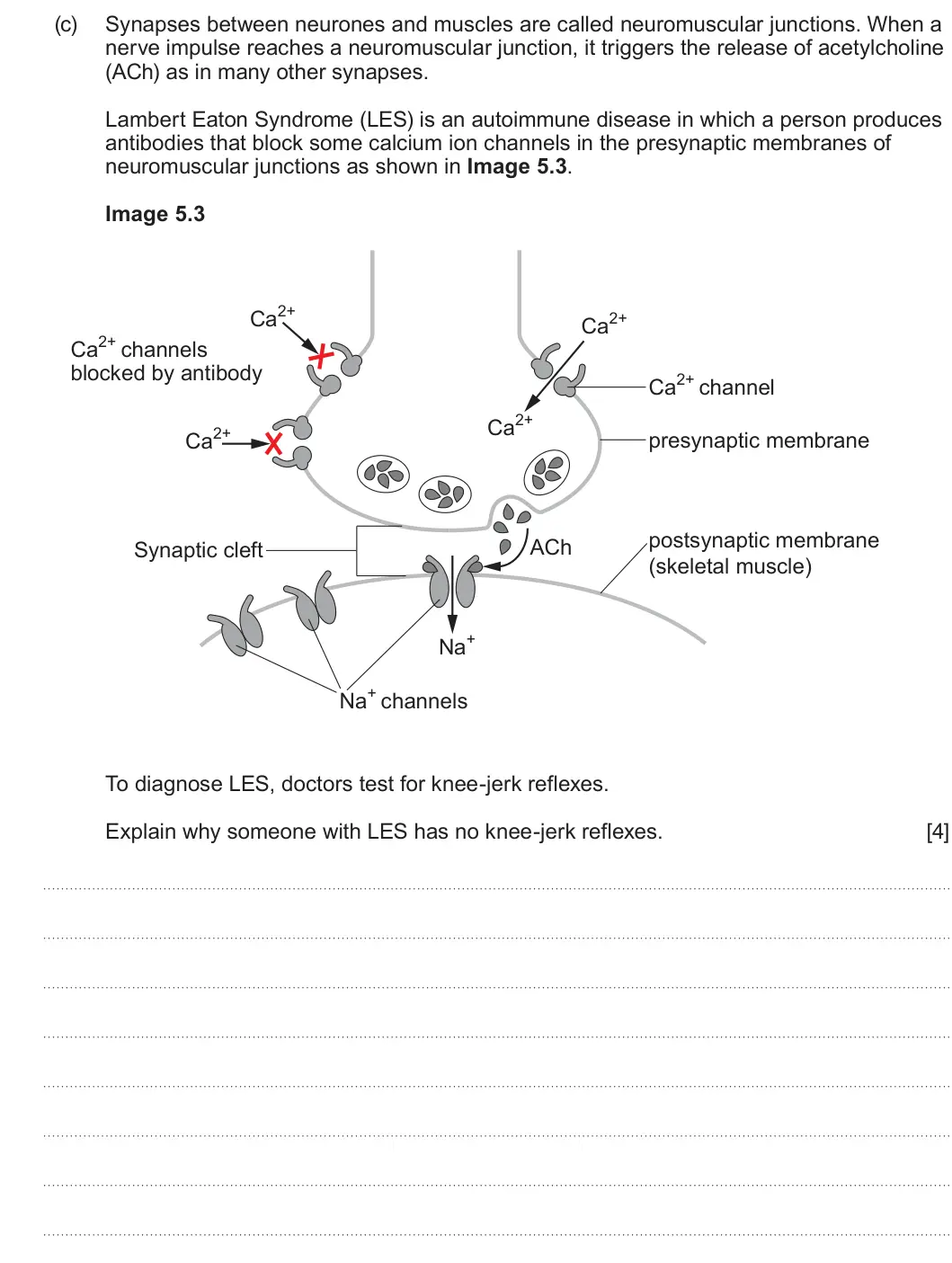
Q4(a)
The whole paper ↗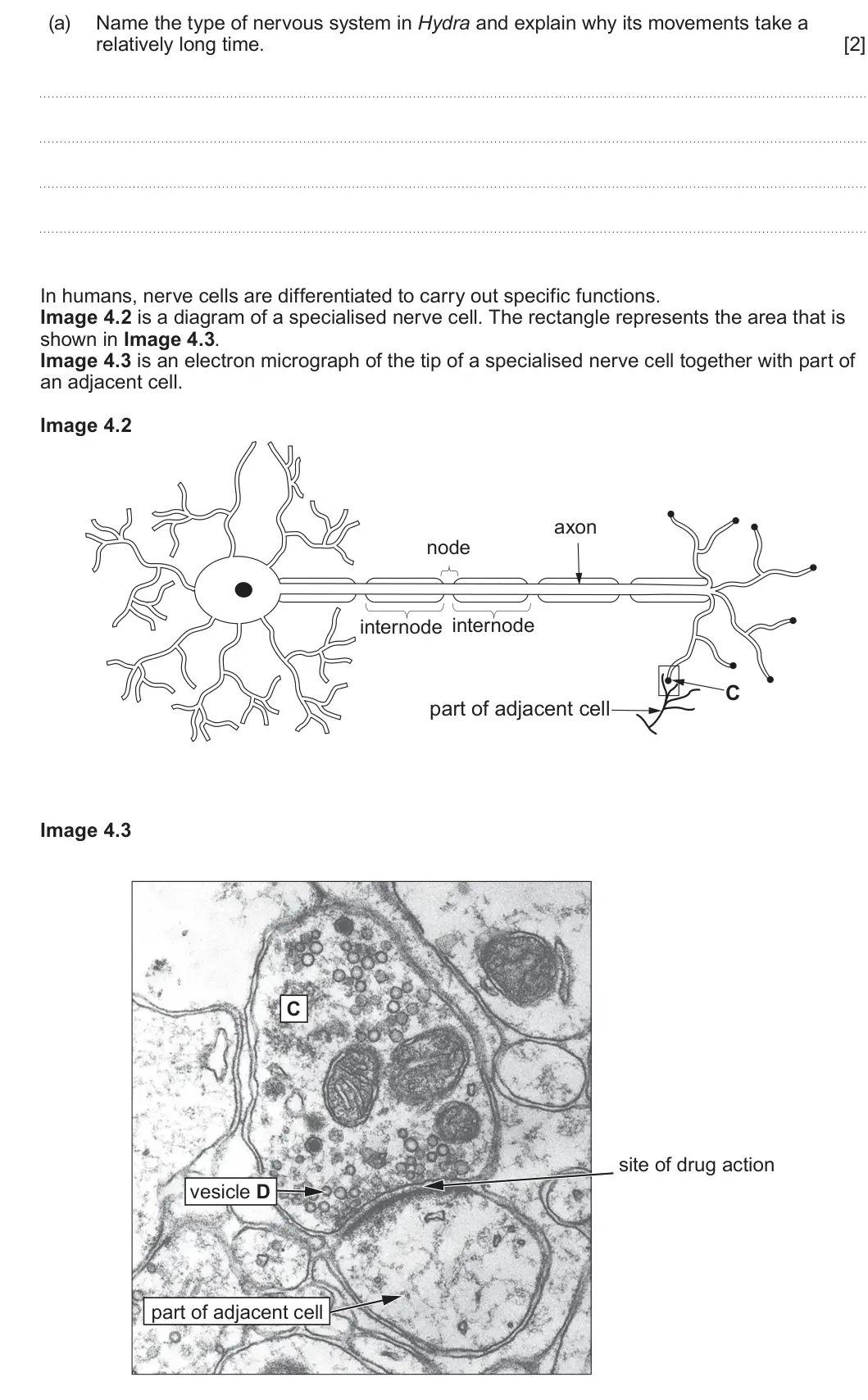
Q4(b)(i)
The whole paper ↗
Q4(b)(ii)
The whole paper ↗
Q4(b)(iii)
The whole paper ↗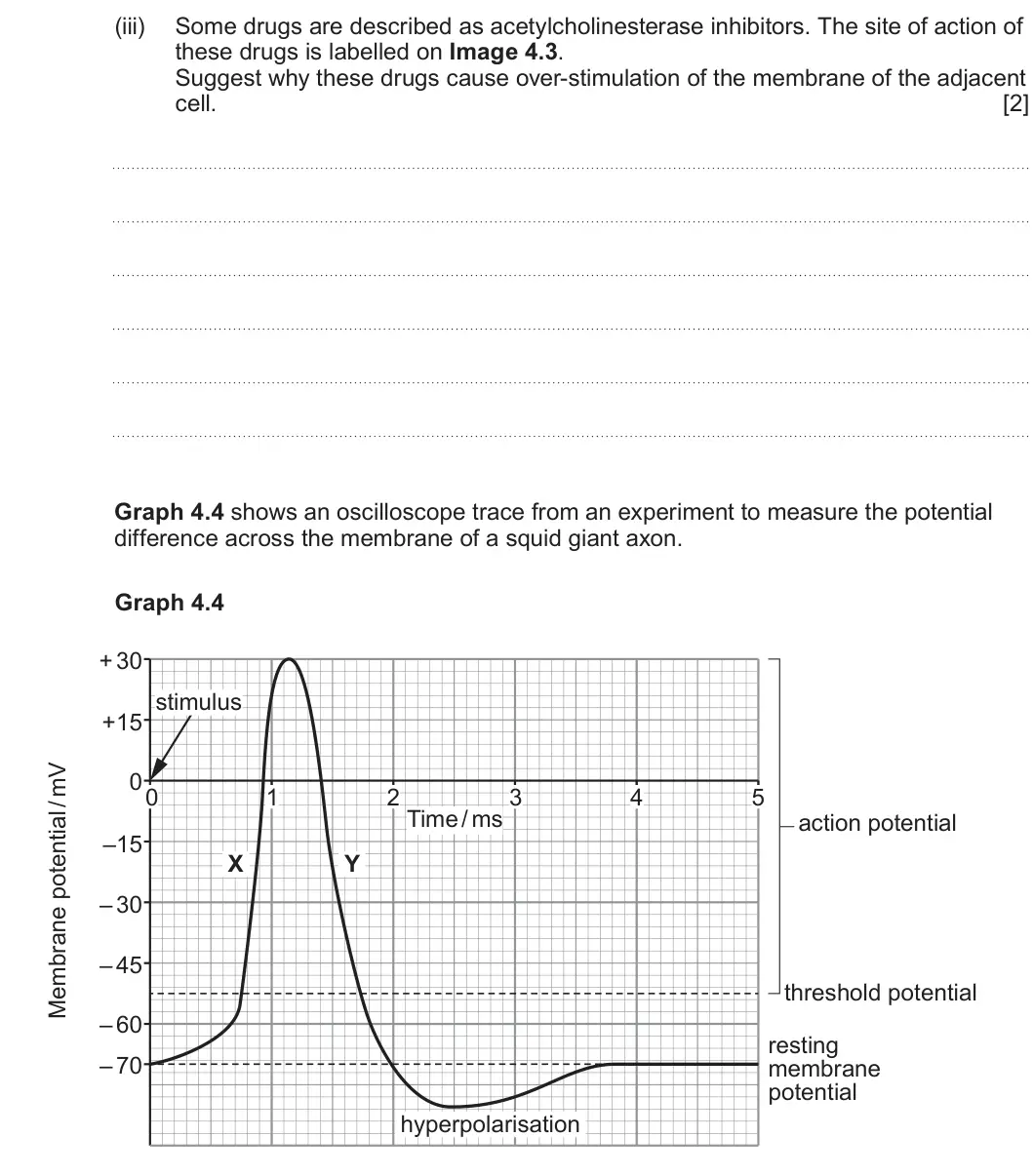
Q4(c)(i)
The whole paper ↗
Q4(c)(ii)
The whole paper ↗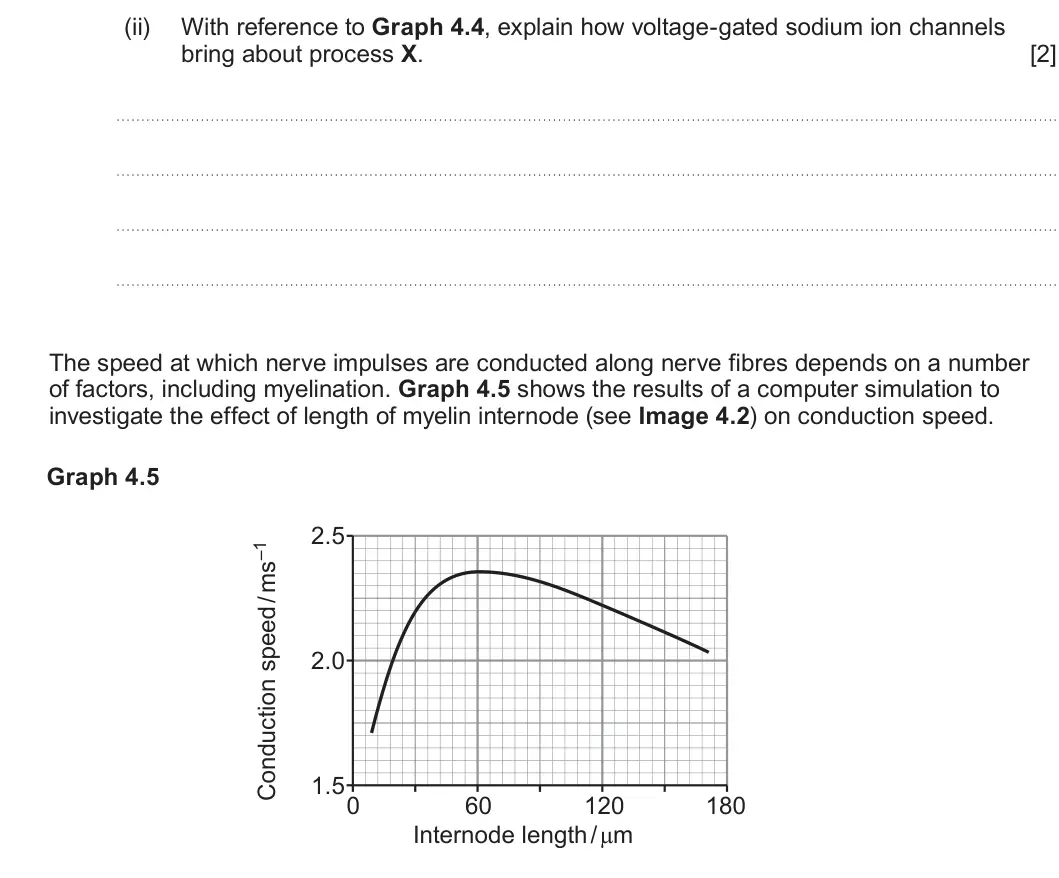
Q4(d)
The whole paper ↗
Q4(c)
The whole paper ↗
Q1(a)(i)
The whole paper ↗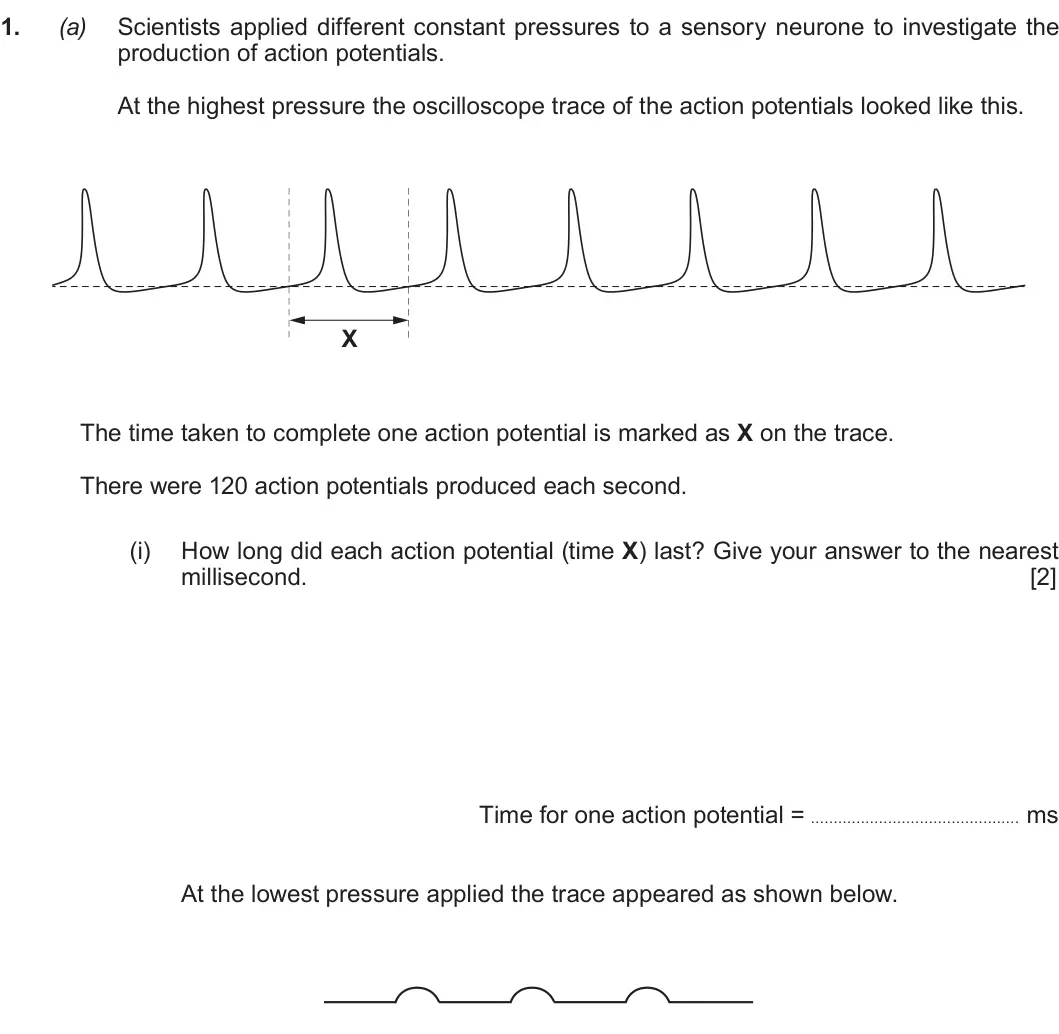
Q1(a)(ii)
The whole paper ↗
Q1(b)(i)
The whole paper ↗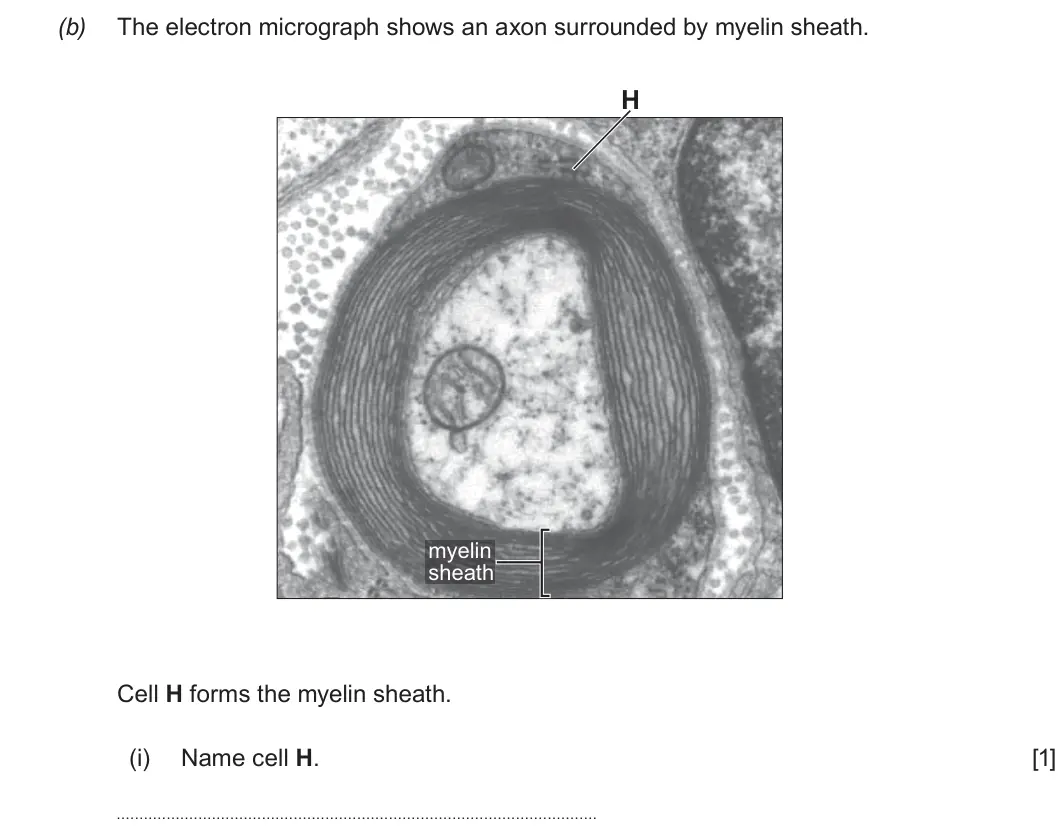
All 61 questions on The nervous system, as a list
- Summer 2025, Unit 3, Q5(a)(i) (1 mark): Use Image 5.1 to name the effector and the part of the Central Nervous System (CNS) involved in this reflex. [1] Effector Part of CNS
- Summer 2025, Unit 3, Q5(a)(ii) (1 mark): Name the types of neurones labelled A and B. [1] A B
- Summer 2025, Unit 3, Q5(a)(iii) (2 marks): Explain, in terms of the structures visible in Image 5.1, why this reflex is rapid and automatic. [2]
- Summer 2025, Unit 3, Q5(b)(i) (1 mark): Name the stage of the action potential shown in Image 5.2. [1]
- Summer 2025, Unit 3, Q5(b)(ii) (1 mark): Describe how you would expect the needle on the microvoltmeter to move as this stage progresses. [1]
- Summer 2025, Unit 3, Q5(b)(iii) (2 marks): Explain the roles of potassium ion channels and sodium ion channels in the generation of an action potential. [2]
- Summer 2025, Unit 3, Q5(b)(iv) (2 marks): Explain the role of the sodium-potassium ion pump in returning the cell membrane of the neurone to its resting potential. [2]
- Summer 2025, Unit 3, Q5(c) (4 marks): Synapses between neurones and muscles are called neuromuscular junctions. When a nerve impulse reaches a neuromuscular junction, it triggers the release of acet
- Summer 2024, Unit 3, Q4(a) (2 marks): Name the type of nervous system in Hydra and explain why its movements take a relatively long time. [2] In humans, nerve cells are differentiated to carry out s
- Summer 2024, Unit 3, Q4(b)(i) (1 mark): Name the structure labelled C in Images 4.2 and 4.3. [1]
- Summer 2024, Unit 3, Q4(b)(ii) (1 mark): Name the type of vesicle labelled D in Image 4.3 and describe its function. [1]
- Summer 2024, Unit 3, Q4(b)(iii) (2 marks): Some drugs are described as acetylcholinesterase inhibitors. The site of action of these drugs is labelled on Image 4.3. Suggest why these drugs cause over-stim
- Summer 2024, Unit 3, Q4(c)(i) (1 mark): Name the processes represented by letters X and Y in Graph 4.4. [1] X Y
- Summer 2024, Unit 3, Q4(c)(ii) (2 marks): With reference to Graph 4.4, explain how voltage-gated sodium ion channels bring about process X. [2] The speed at which nerve impulses are conducted along nerv
- Summer 2024, Unit 3, Q4(d) (4 marks): Describe the relationship between internode length and conduction speed and use your knowledge of nerve impulse transmission to explain the results. [4]
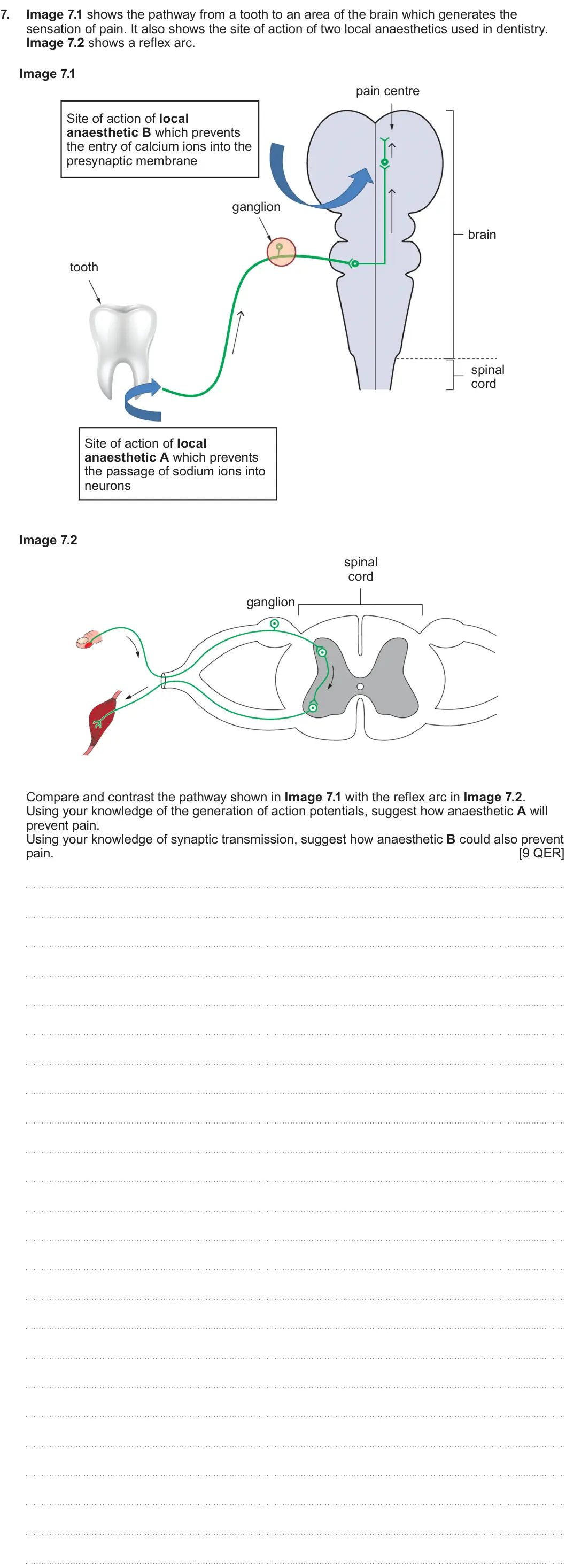
- Summer 2023, Unit 3, Q7 (9 marks): Image 7.1 shows the pathway from a tooth to an area of the brain which generates the sensation of pain. It also shows the site of action of two local anaestheti
- Summer 2022, Unit 3, Q4(c) (5 marks): Using all the relevant information from both Images 4.1 and 4.2 describe how the hormone molecules are released from the end of the neurosecretory cell. [5] Hae
- Summer 2019, Unit 3, Q1(a)(i) (2 marks): How long did each action potential (time X) last? Give your answer to the nearest millisecond. [2] Time for one action potential = ms At the lowest pressure app
- Summer 2019, Unit 3, Q1(a)(ii) (2 marks): Explain why the trace appeared this way for the lowest pressure. [2]
- Summer 2019, Unit 3, Q1(b)(i) (1 mark): Name cell H. [1]
- Summer 2019, Unit 3, Q1(b)(ii) (1 mark): Name the main class of biological molecule found in myelin. [1] The neurone appears like this when drawn as a side section. Nodes of Ranvier A B Cell H Drawing
- Summer 2019, Unit 3, Q1(b)(iii) (3 marks): Calculate the time it would take an action potential to travel from point A to point B on an actual neurone. Give your answer in standard form in seconds. [3] T
- Summer 2019, Unit 3, Q1(c)(i) (4 marks): Suggest what would happen to the rate of oxygen consumption for the demyelinated neurone. Explain your answer. [4]
- Summer 2019, Unit 3, Q1(c)(ii) (2 marks): Suggest two symptoms which could occur in someone who has demyelinated neurones. [2]
- Summer 2018, Unit 3, Q1(a)(i) (3 marks): Draw and label the position of a sensory neurone and a motor neurone and label the cell bodies. [3]
- Summer 2018, Unit 3, Q1(a)(ii) (1 mark): When a person touches a hot object with their finger they will move away from the heat. State the advantage to humans of having this type of response to an exte
- Summer 2018, Unit 3, Q1(b)(i) (1 mark): State the name given to this type of nervous system. [1]
- Summer 2018, Unit 3, Q1(b)(ii) (2 marks): Explain why the non-myelinated neurones of Cnidarians result in slower nerve impulses than in mammals. [2]
- Summer 2018, Unit 4, Q7(b)(vii) (4 marks): Calcium is needed for the contraction of muscles. Explain how a lack of calcium could cause poor muscle contraction in patients. [4]
- Summer 2018, Unit 4, Q7(c)(i) (1 mark): State the order of lever which is shown in the diagram above. [1]
- Summer 2018, Unit 4, Q7(c)(ii) (2 marks): Calculate the force effort required to lift the 4 kg hand weight in a patient with TS where elbow to hand distance of 34 cm and elbow to biceps is 4 cm. Show yo
- Summer 2018, Unit 4, Q8(a)(i) (3 marks): State the name and function of the lobes labelled A and B on the diagram above. [3] Name Function A B
- Summer 2018, Unit 4, Q8(a)(ii) (2 marks): The brain can be studied in several ways. Outline the differences in the information provided by electroencephalography (EEG) and computerised tomography (CT).
- Summer 2018, Unit 4, Q8(b)(i) (4 marks): Suggest why children who are not exposed to language during the critical period are likely to never develop speech. [4]
- Summer 2018, Unit 4, Q8(b)(ii) (1 mark): Suggest how the fMRI images and graph would differ for a feral child. [1]
- Summer 2018, Unit 4, Q8(b)(iii) (1 mark): State one factor which could be involved in causing this effect in feral children or those exposed to psychological trauma at an early age. [1]
- Summer 2018, Unit 4, Q8(c)(i) (1 mark): Which area of the brain is involved in learning? [1]
- Summer 2018, Unit 4, Q8(c)(ii) (4 marks): Use the information provided to conclude the learning patterns exhibited by each group of rats. Explain your conclusions. [4] Group 1 Group 2 Group 3
- Summer 2018, Unit 4, Q8(c)(iii) (2 marks): Calculate the percentage change in the number of errors for group 2 between day 10 and day 13 [2] Percentage change = %
- Summer 2018, Unit 4, Q8(c)(iv) (2 marks): State two factors which should have been controlled in this investigation. [2]
- Summer 2017, Unit 3, Q2(a) (2 marks): Describe the function of sodium ion channels in a neurone membrane in response to a stimulus. [2]
- Summer 2017, Unit 3, Q2(b) (4 marks): Explain how lidocaine acts as a local anaesthetic. [4] The maximum allowable dose of lidocaine for a patient is 7 mg per kg of tissue (mg kg–1).
- Summer 2017, Unit 3, Q2(c) (2 marks): Use the equation below to calculate the maximum dose volume for a 60 kg patient if the concentration of lidocaine is 2%. [2] maximum dose maximum allowable mass
- Summer 2017, Unit 3, Q2(d) (3 marks): The marine cone shell, Conus magus, releases a chemical which blocks calcium ion channels on the pre-synaptic membrane of a synapse. This has a potential use as
- Summer 2017, Unit 4, Q8(a)(ii) (2 marks): Explain how the interaction between actin and myosin results in the contraction of muscle. Reference to the roles of troponin and tropomyosin are not required.
- Summer 2017, Unit 4, Q8(b)(i) (1 mark): To determine the length of sarcomeres at different resting positions, myofibrils were viewed using a high-powered microscope. The muscle proteins were stained u
- Summer 2017, Unit 4, Q8(b)(ii) (3 marks): Use the graph to calculate the length of the actin fibre. [3] actin length =
- Summer 2017, Unit 4, Q8(b)(iii) (2 marks): Physiologists conducting these experiments used tissue from the same organism. Suggest two other factors that would need to be controlled when carrying out the
- Summer 2017, Unit 4, Q8(b)(iv) (2 marks): Suggest an explanation as to why no tension is generated at C on the graph. [2]
- Summer 2017, Unit 4, Q8(c)(i) (1 mark): Explain why skeletal muscles are arranged in antagonistic muscle pairs. [1] Scientists studied patients with osteoarthritis and a control group without the cond
- Summer 2017, Unit 4, Q8(c)(ii) (2 marks): With reference to the role of the quadriceps in movement of the lower leg, explain the differences between the osteoarthritis and control groups. [2] Body mass
- Summer 2017, Unit 4, Q8(c)(iii) (5 marks): Explain the effect of a higher BMI on the results in the table and suggest why increased physical activity would reduce the impact and progression of osteoarthr
- Summer 2017, Unit 4, Q9(a) (1 mark): Identify A, B and C on the diagram above. [1] A B C
- Summer 2017, Unit 4, Q9(b)(i) (2 marks): Explain why a PET scan would be suitable for investigating activity levels within the brain whereas an MRI scan would not. [2]
- Summer 2017, Unit 4, Q9(b)(ii) (5 marks): With reference to the image of the PET scan and your knowledge of brain regions involved in language, suggest and explain how the PET scan of a deaf person, act
- Summer 2017, Unit 4, Q9(b)(iii) (2 marks): Suggest two medical details that would be needed when interpreting PET scans from patients with hearing problems. [2]
- Summer 2017, Unit 4, Q9(b)(iv) (3 marks): Explain why PET scans of adults with total hearing loss have revealed activation of regions of the cortex related to hearing. [3]
- Summer 2017, Unit 4, Q9(c)(i) (1 mark): State one advantage to male sticklebacks of defending their territory. [1] The table below shows the results of the investigation. Mean number Model colour of b
- Summer 2017, Unit 4, Q9(c)(ii) (3 marks): State what is meant by a sign stimulus and based on this information, identify what it would be for the stickleback. Explain your answer. [3] Mean number 2 ∑(x
- Summer 2017, Unit 4, Q9(c)(iii) (2 marks): Complete the table above by calculating the standard deviation for the silver belly stickleback using the formula below: [2] √ 2 Standard Deviation = ∑(x – x )
- Summer 2017, Unit 4, Q9(c)(iv) (1 mark): The standard deviation for both models was high. Explain how this could affect your confidence in the conclusion. [1]
Questions, mark schemes and examiner’s reports are © WJEC CBAC Ltd, from their published past papers. Plumi isn’t affiliated with any exam board. Want whole papers? Every WJEC A-Level Biology paper.
Rather write your answers by hand on iPad? Plumi marks them against the same mark schemes.