Skip to content

Edexcel A‑Level Chemistry questions by topic

Every question from every Edexcel A-Level Chemistry paper, 2016–2025, part by part. Filter by topic, paper or year, open the mark scheme under any question, and download a set as a PDF.

Find questions2,028
Topics Pick as many as you like. Open one to choose its sub-topics.

Year 1 · AS

Year 2 · A‑Level only

Calculations

2,028 questions

  1. Q1(a)

    June 2025 · Paper 1

    2 marks
    The whole paper ↗
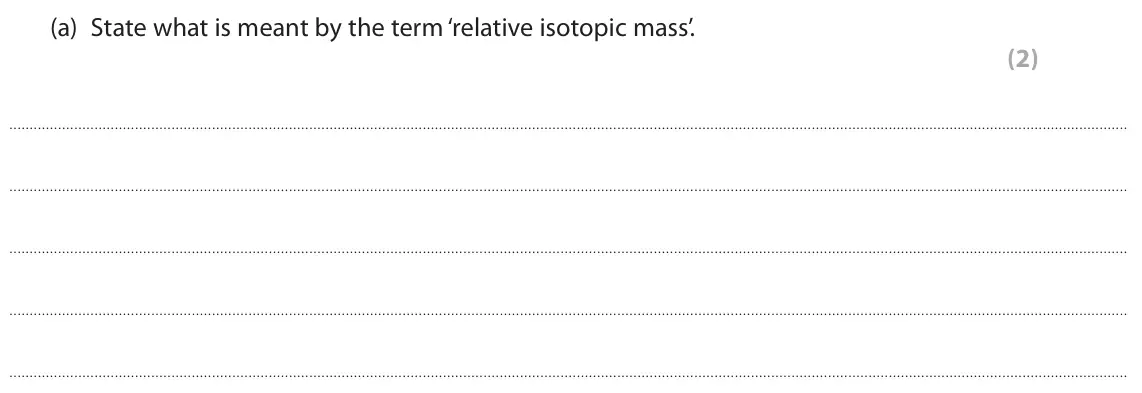
    June 2025 Paper 1, question 1(a): State what is meant by the term ‘relative isotopic mass’. (2)
  2. Q1(b)

    June 2025 · Paper 1

    2 marks
    The whole paper ↗
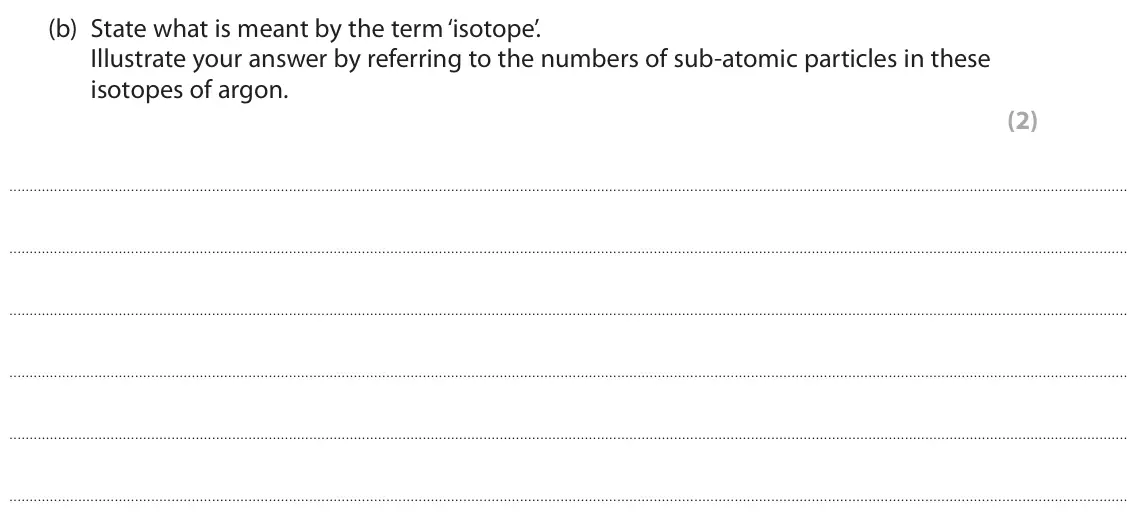
    June 2025 Paper 1, question 1(b): State what is meant by the term ‘isotope’. Illustrate your answer by referring to the numbers of sub‑atomic particles in these isotopes of argon. (2)
  3. Q1(c)

    June 2025 · Paper 1

    2 marks
    The whole paper ↗
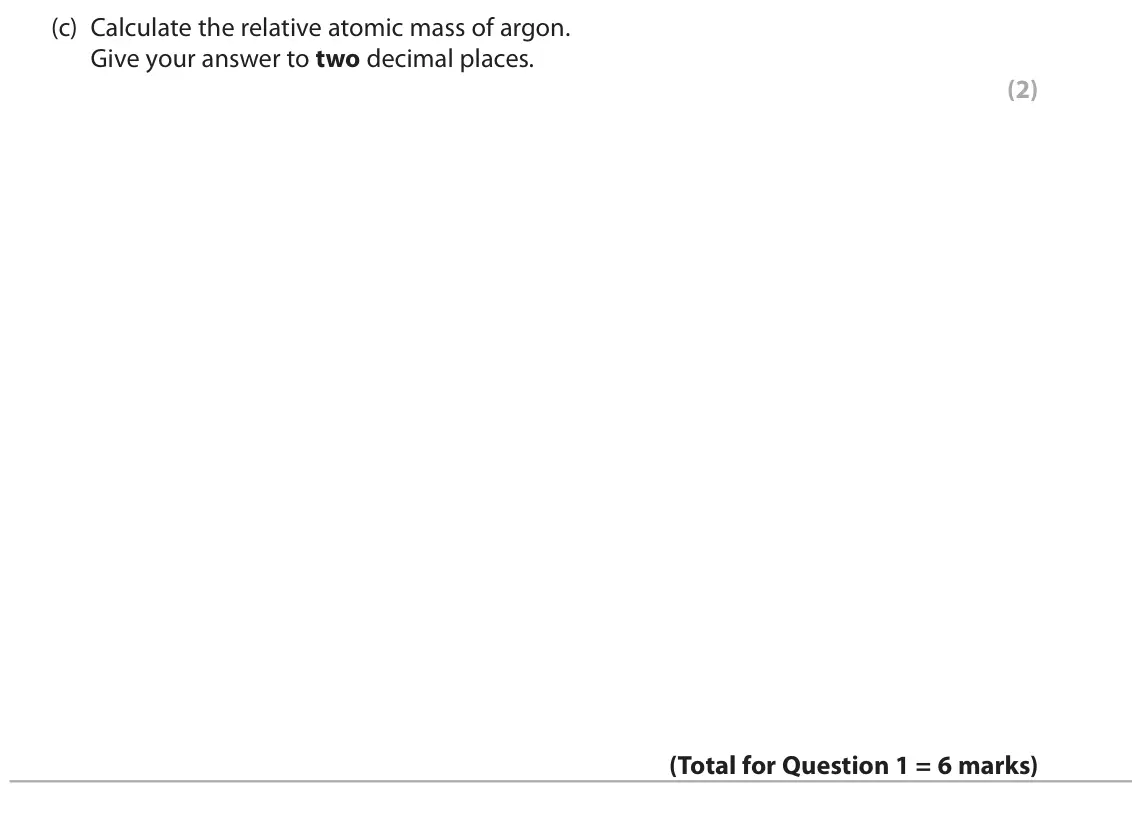
    June 2025 Paper 1, question 1(c): Calculate the relative atomic mass of argon. Give your answer to two decimal places. (2)
  4. Q2(a)

    June 2025 · Paper 1

    3 marks
    The whole paper ↗
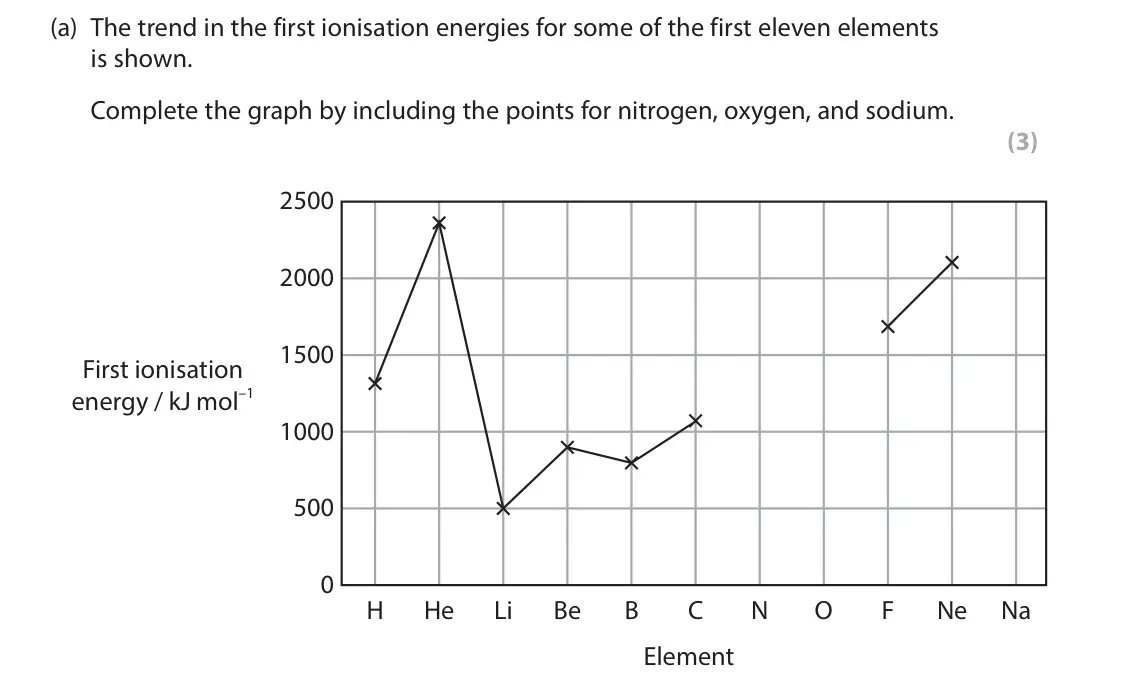
    June 2025 Paper 1, question 2(a): The trend in the first ionisation energies for some of the first eleven elements is shown. Complete the graph by including the points for nitrogen, oxygen, and
  5. Q2(b)

    June 2025 · Paper 1

    4 marks
    The whole paper ↗
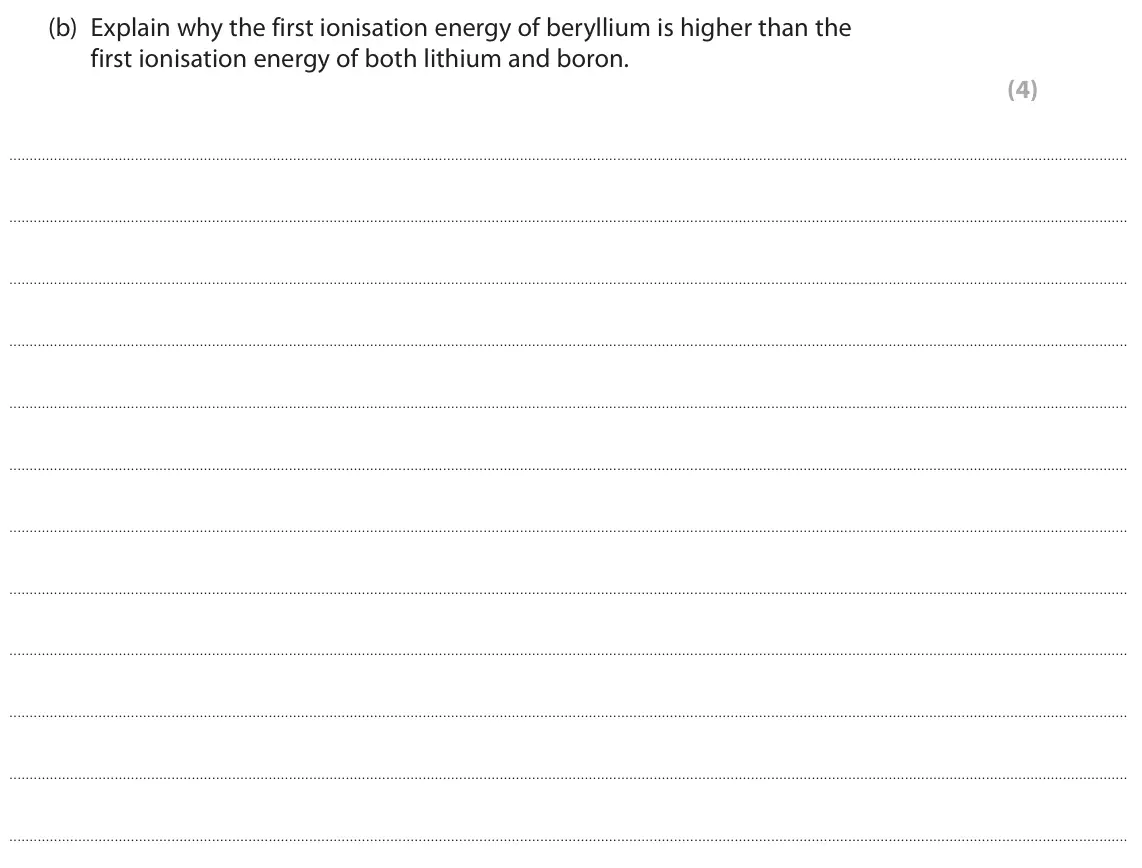
    June 2025 Paper 1, question 2(b): Explain why the first ionisation energy of beryllium is higher than the first ionisation energy of both lithium and boron. (4)
  6. Q2(c)

    June 2025 · Paper 1

    1 mark
    The whole paper ↗
    June 2025 Paper 1, question 2(c): Write the equation for the second ionisation energy of beryllium. Include state symbols. (1)
  7. Q2(d)

    June 2025 · Paper 1

    1 mark
    The whole paper ↗
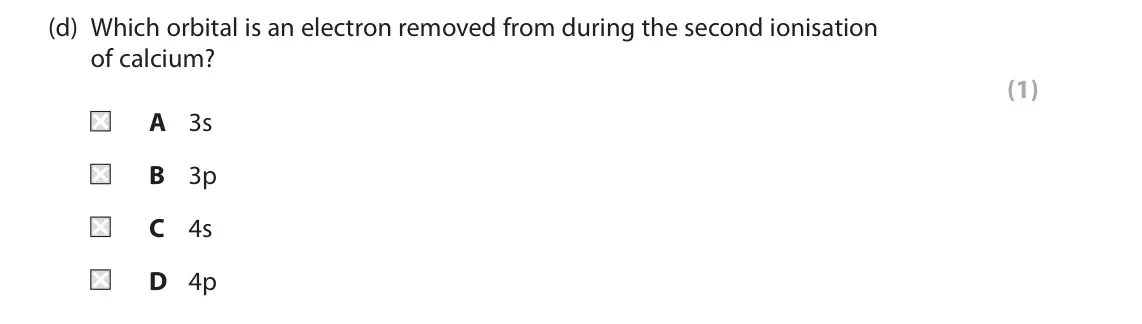
    June 2025 Paper 1, question 2(d): Which orbital is an electron removed from during the second ionisation of calcium? (1) A 3s B 3p C 4s D 4p
  8. Q2(e)

    June 2025 · Paper 1

    1 mark
    The whole paper ↗
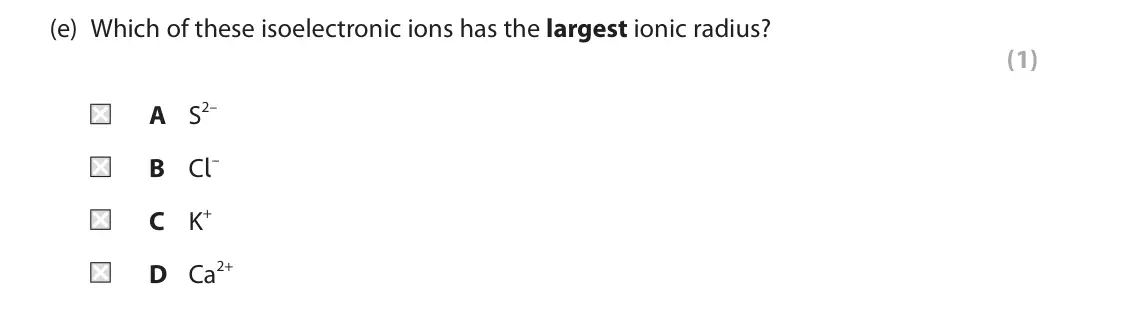
    June 2025 Paper 1, question 2(e): Which of these isoelectronic ions has the largest ionic radius? (1) A S2– B Cl– C K+ D Ca2+
  9. Q2(f)

    June 2025 · Paper 1

    6 marks
    The whole paper ↗
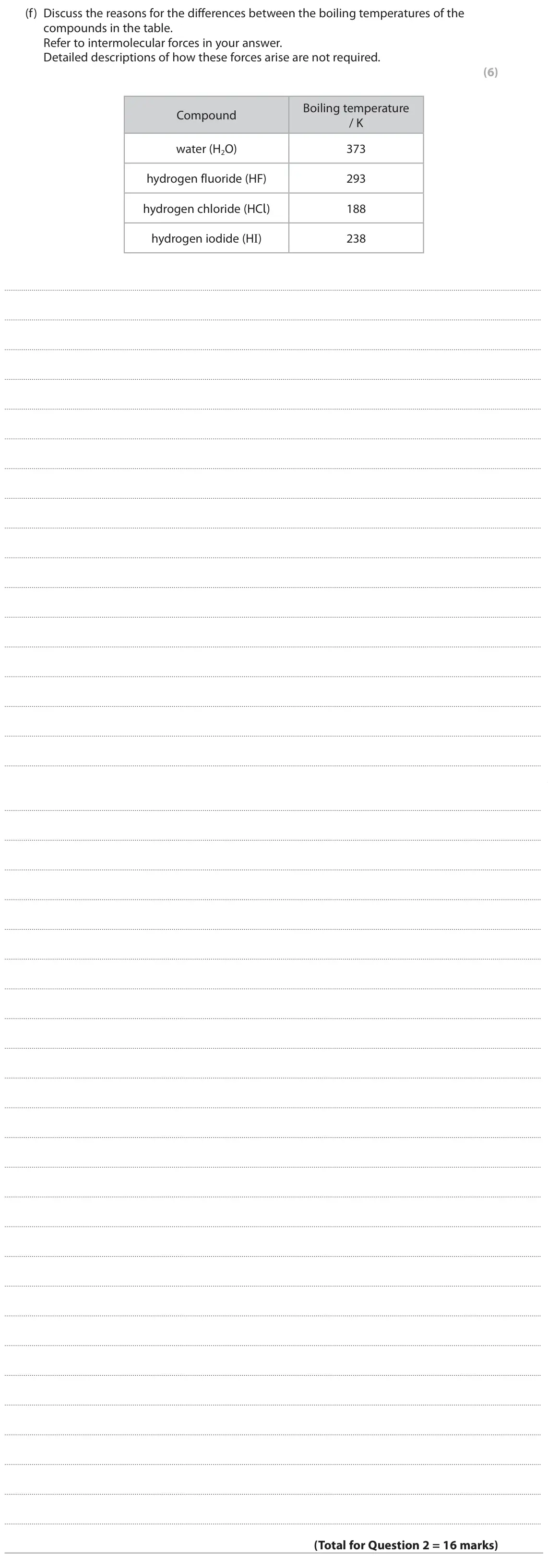
    June 2025 Paper 1, question 2(f): Discuss the reasons for the differences between the boiling temperatures of the compounds in the table. Refer to intermolecular forces in your answer. Detailed
  10. Q3(a)

    June 2025 · Paper 1

    1 mark
    The whole paper ↗
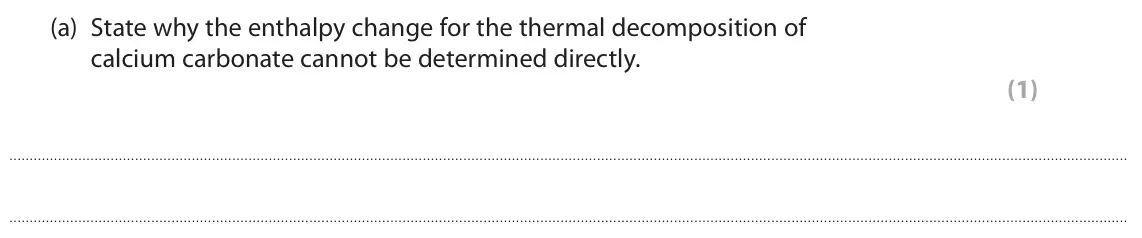
    June 2025 Paper 1, question 3(a): State why the enthalpy change for the thermal decomposition of calcium carbonate cannot be determined directly. (1)
  11. Q3(b)(i)

    June 2025 · Paper 1

    1 mark
    The whole paper ↗
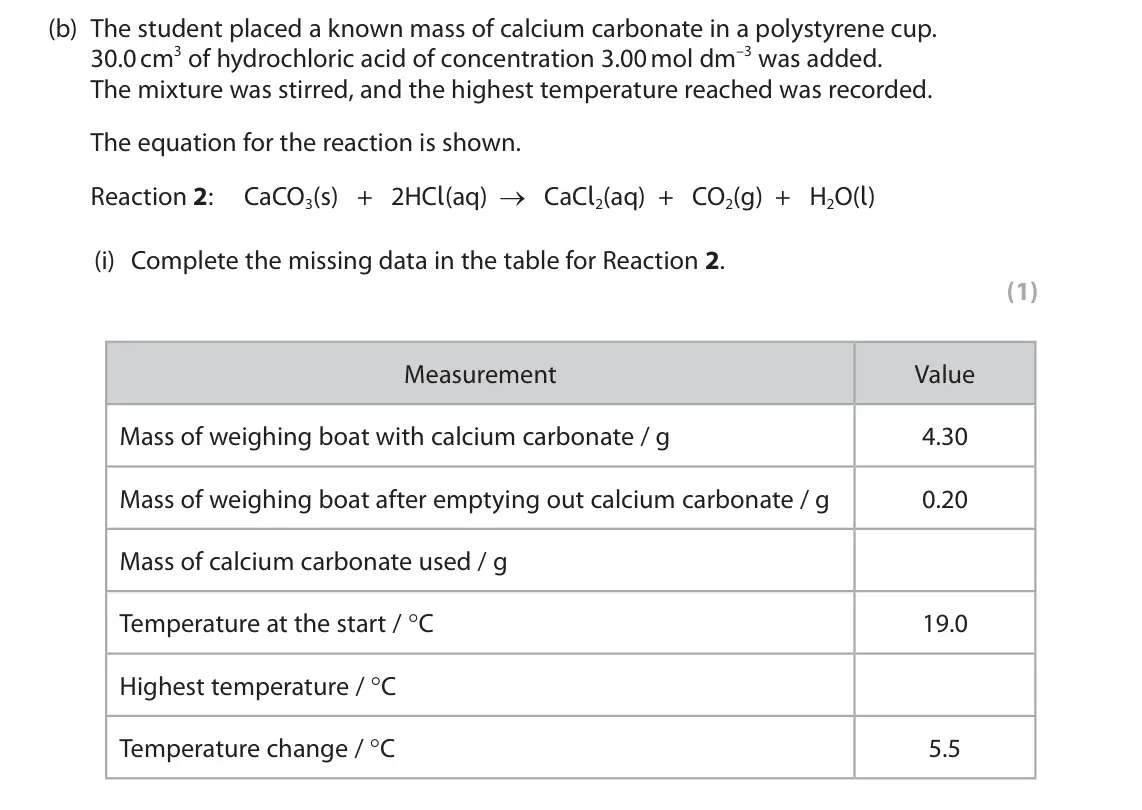
    June 2025 Paper 1, question 3(b)(i): Complete the missing data in the table for Reaction 2. (1) Measurement Value Mass of weighing boat with calcium carbonate / g 4.30 Mass of weighing boat after e
  12. Q3(b)(ii)

    June 2025 · Paper 1

    2 marks
    The whole paper ↗
    June 2025 Paper 1, question 3(b)(ii): 0.041 mol of CaCO3(s) was used in the experiment. Show, by calculation, that the hydrochloric acid is in excess for Reaction 2. (2)
  13. Q3(b)(iii)

    June 2025 · Paper 1

    3 marks
    The whole paper ↗
    June 2025 Paper 1, question 3(b)(iii): Calculate the enthalpy change, ΔrH2 , for Reaction 2 in kJ mol–1. Include a sign in your answer. [Assume the specific heat capacity of the solution = 4.18 J g–1
  14. Q3(b)(iv)

    June 2025 · Paper 1

    2 marks
    The whole paper ↗
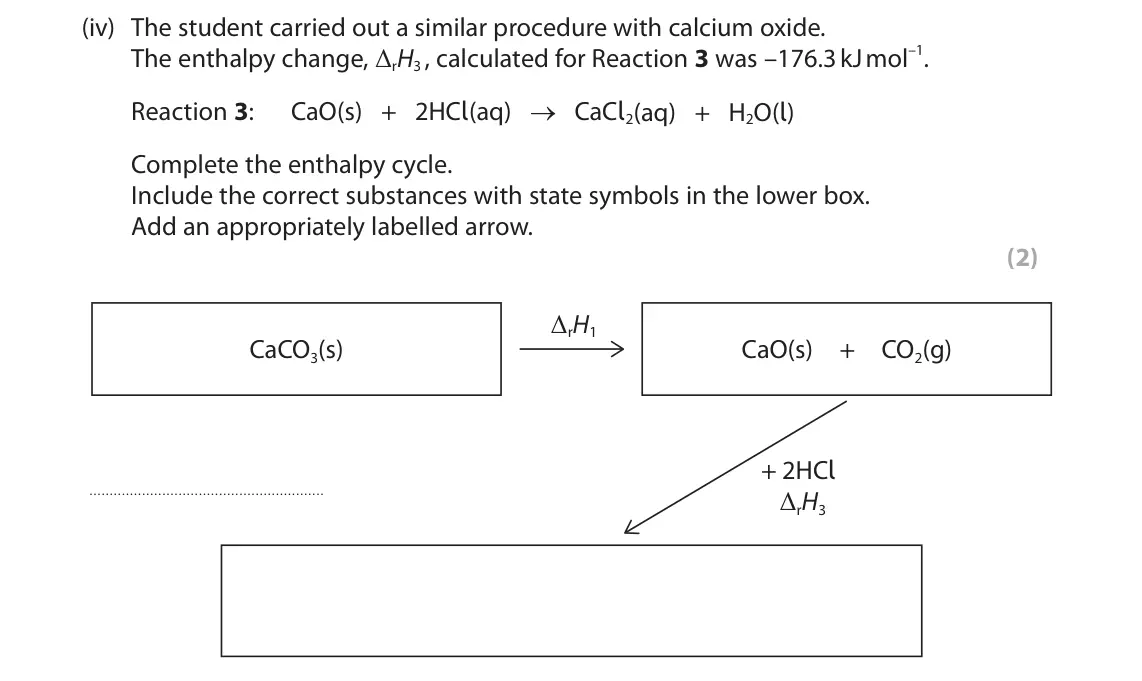
    June 2025 Paper 1, question 3(b)(iv): The student carried out a similar procedure with calcium oxide. The enthalpy change, ΔrH3 , calculated for Reaction 3 was –176.3 kJ mol–1. Reaction 3: CaO(s) +
  15. Q3(b)(v)

    June 2025 · Paper 1

    1 mark
    The whole paper ↗
    June 2025 Paper 1, question 3(b)(v): Calculate a value for the enthalpy change ΔrH1 for the thermal decomposition of calcium carbonate by using your cycle. (1)
  16. Q3(c)(i)

    June 2025 · Paper 1

    3 marks
    The whole paper ↗
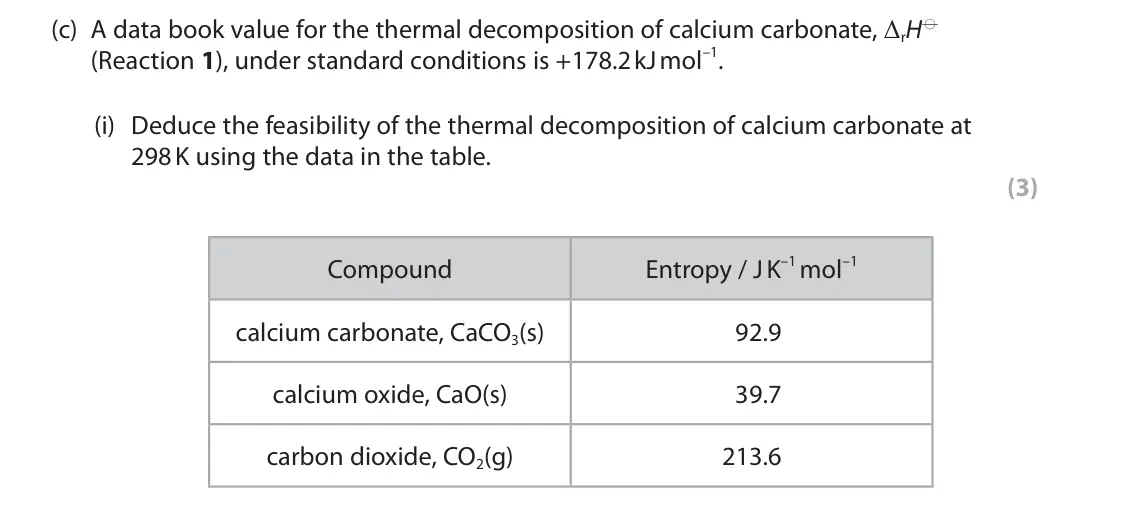
    June 2025 Paper 1, question 3(c)(i): Deduce the feasibility of the thermal decomposition of calcium carbonate at 298 K using the data in the table. (3) Entropy / J K–1 mol–1 Compound calcium carbon
  17. Q3(c)(ii)

    June 2025 · Paper 1

    2 marks
    The whole paper ↗
    June 2025 Paper 1, question 3(c)(ii): Calculate the minimum temperature, in °C, at which thermal decomposition would occur. Give your answer to 3 significant figures. (2)
  18. Q3(d)

    June 2025 · Paper 1

    3 marks
    The whole paper ↗
    June 2025 Paper 1, question 3(d): Explain why magnesium carbonate undergoes thermal decomposition at a lower temperature than calcium carbonate. (3)
  19. Q4(a)

    June 2025 · Paper 1

    5 marks
    The whole paper ↗
    June 2025 Paper 1, question 4(a): Calculate the value of Kp at this temperature. Include the expression for Kp and units as appropriate. (5)
  20. Q4(b)(i)

    June 2025 · Paper 1

    2 marks
    The whole paper ↗
    June 2025 Paper 1, question 4(b)(i): It is proposed to increase the pressure in the reactor to 70.0 atm. Explain the effect this change would have on the yield of ethanol by referring to the equili

Questions, mark schemes and examiner’s reports are © Pearson Edexcel, from their published past papers. Plumi isn’t affiliated with any exam board. Want whole papers? Every Edexcel A-Level Chemistry paper.

Rather write your answers by hand on iPad? Plumi marks them against the same mark schemes.