 plumi
Alkanes: Edexcel A‑Level Chemistry questions
Every Edexcel A-Level Chemistry exam question on 6B Alkanes, 2016–2025, with its mark scheme and examiner’s report.
Find questions2,028
Calculations
Q4(a)(i)
The whole paper ↗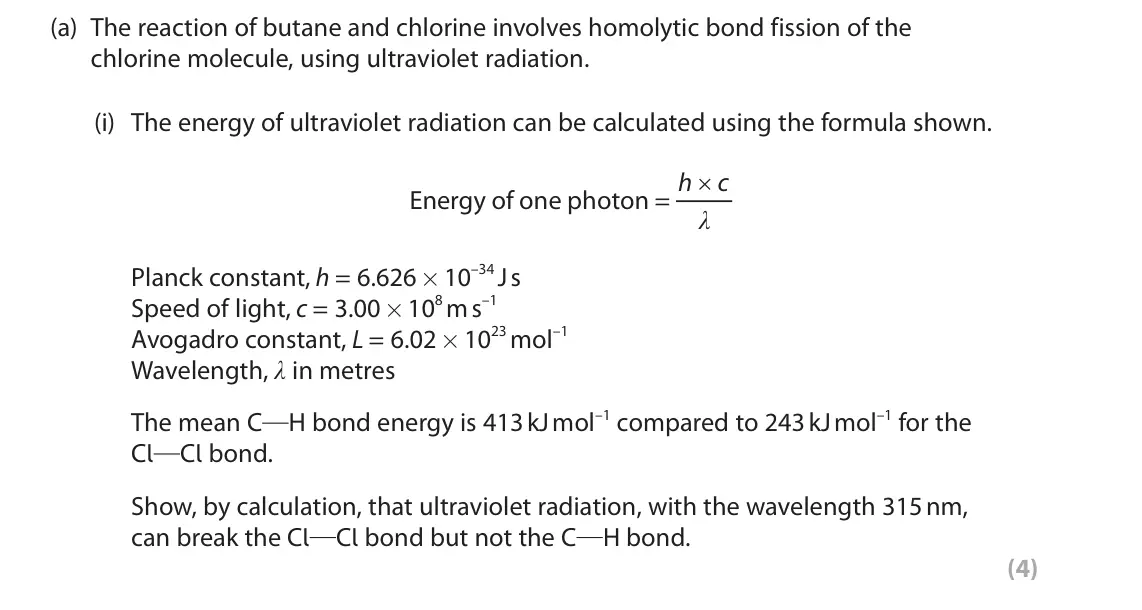
Q4(a)(ii)
The whole paper ↗
Q4(a)(iii)
The whole paper ↗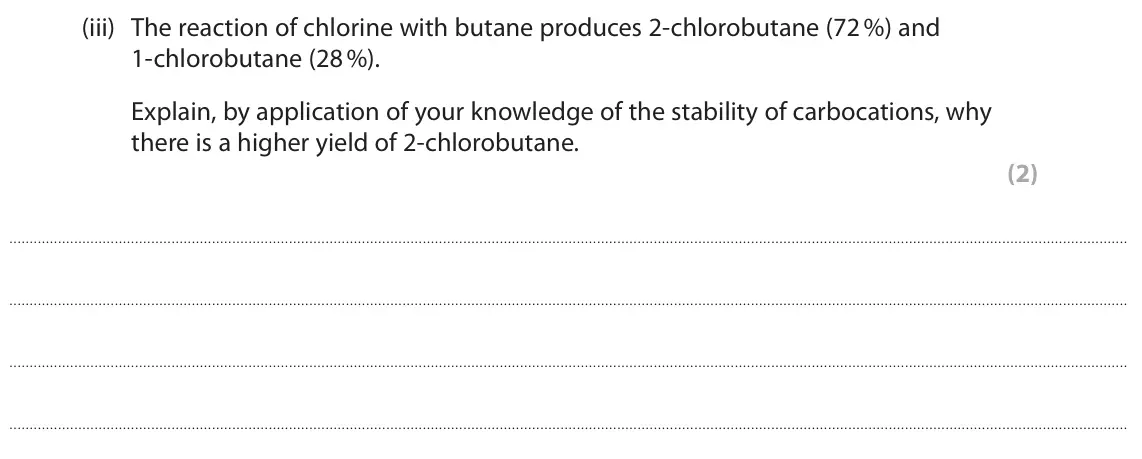
Q8(b)(iii)
The whole paper ↗
Q5(a)
The whole paper ↗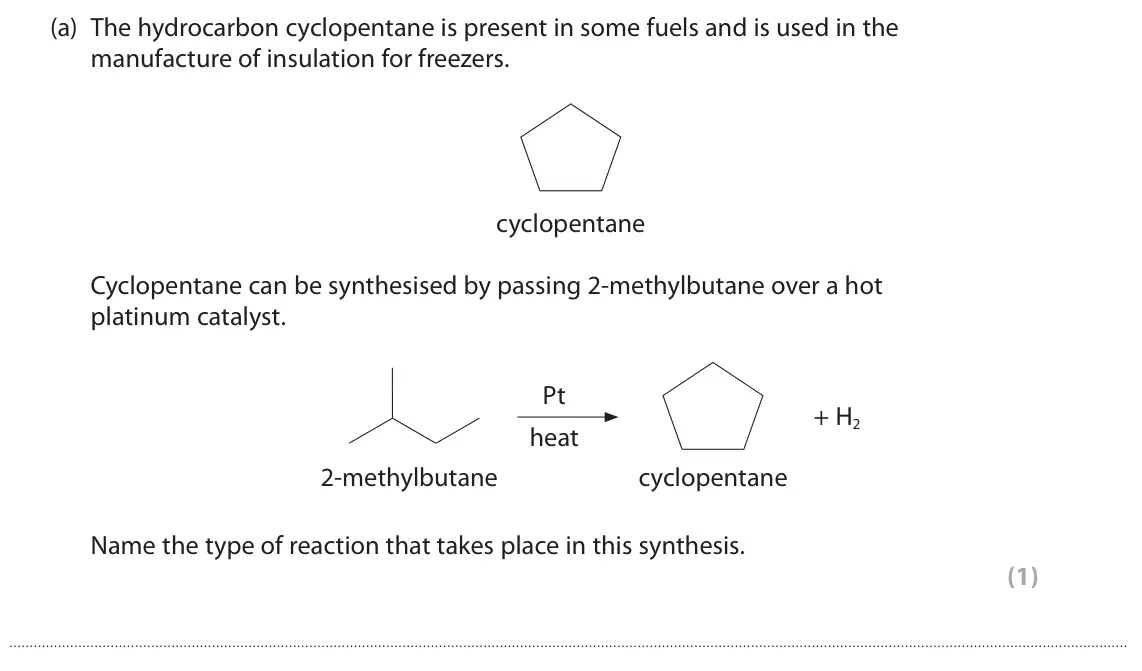
Q5(b)
The whole paper ↗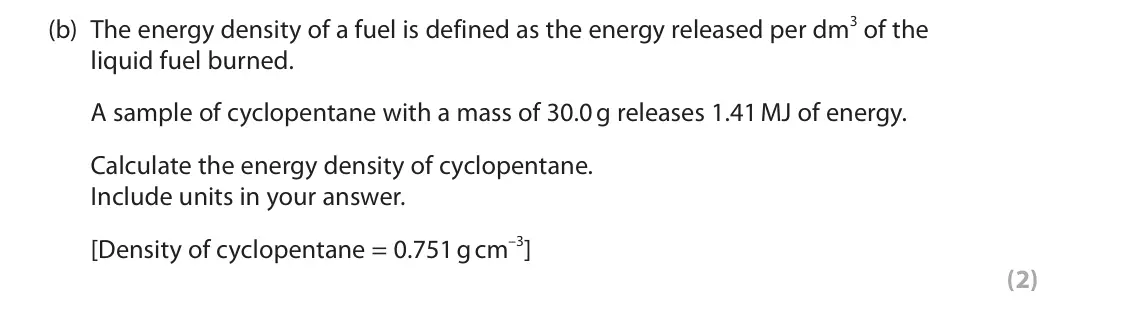
Q5(c)(i)
The whole paper ↗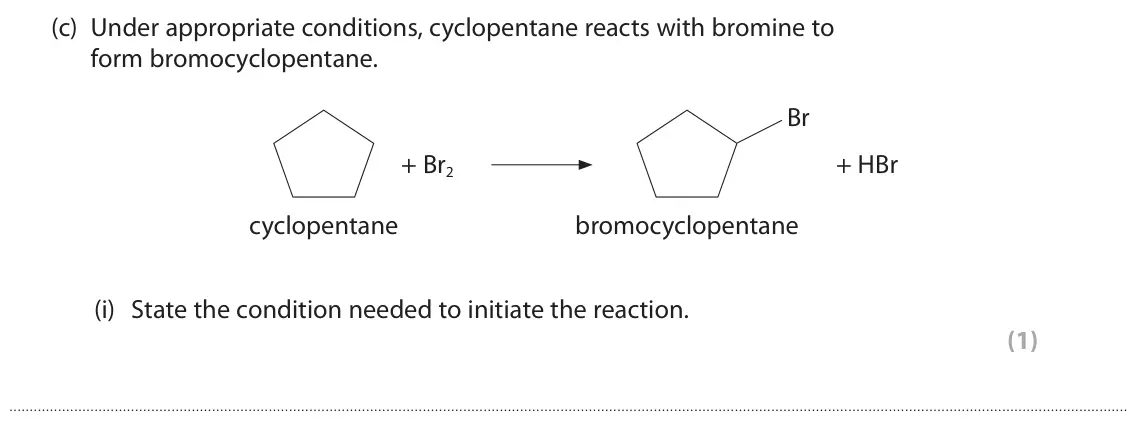
Q5(c)(ii)
The whole paper ↗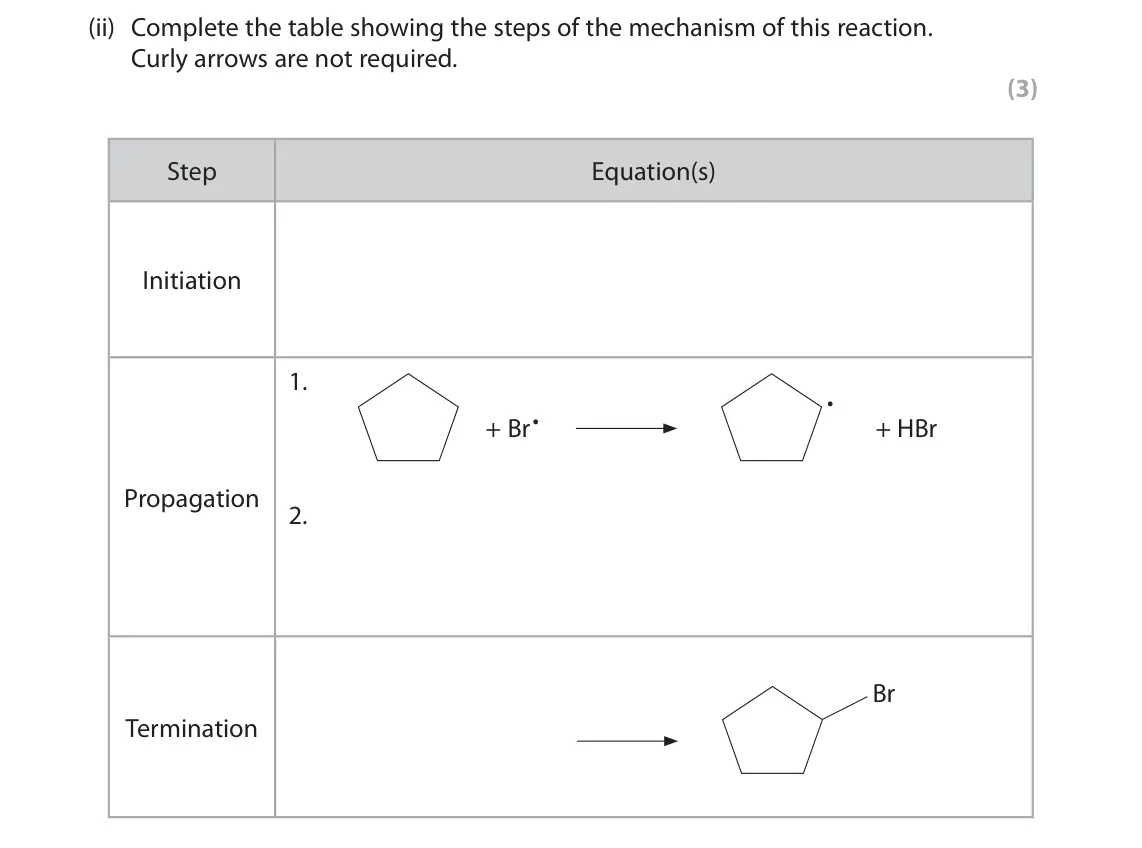
Q5(c)(iii)
The whole paper ↗
Q1(c)
The whole paper ↗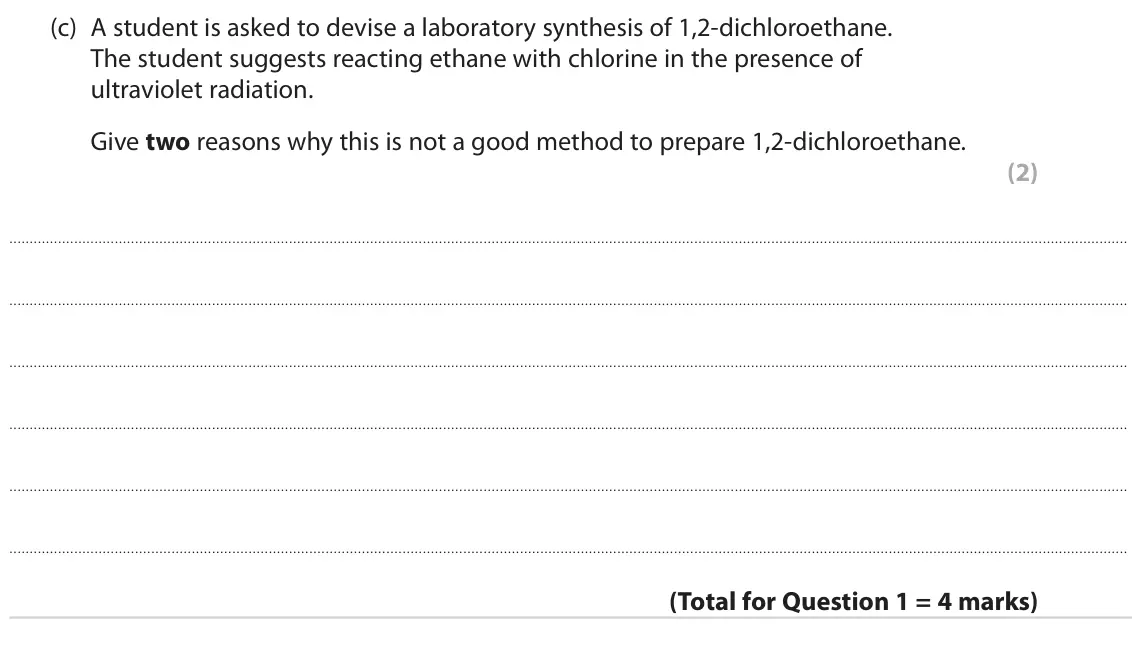
Q2(a)
The whole paper ↗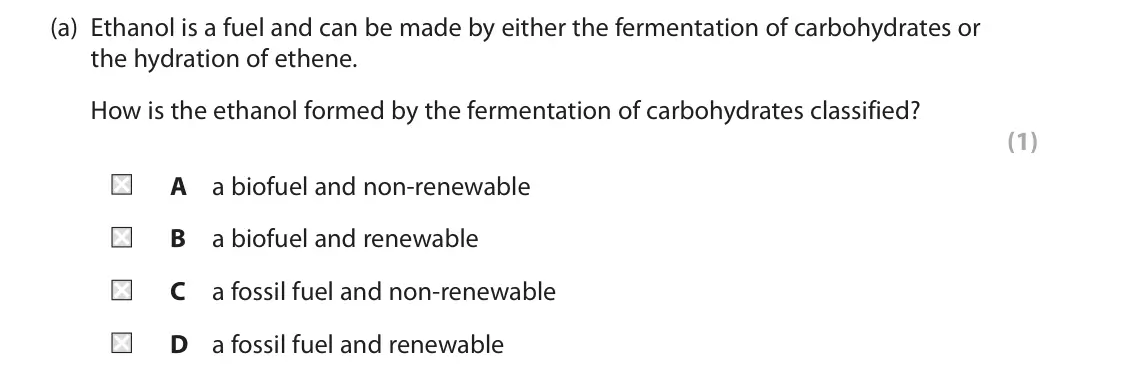
Q1(a)
The whole paper ↗
Q1(b)
The whole paper ↗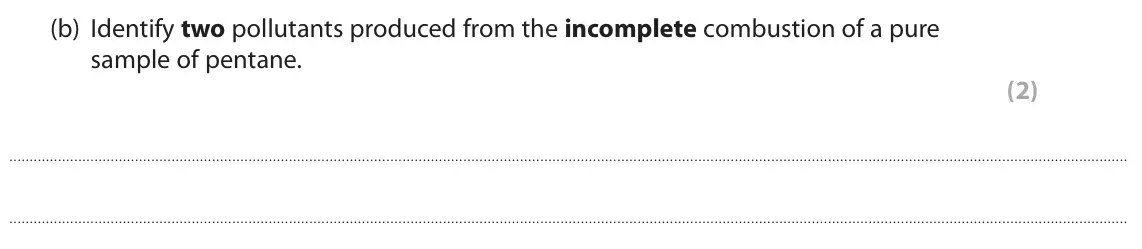
Q1(c)
The whole paper ↗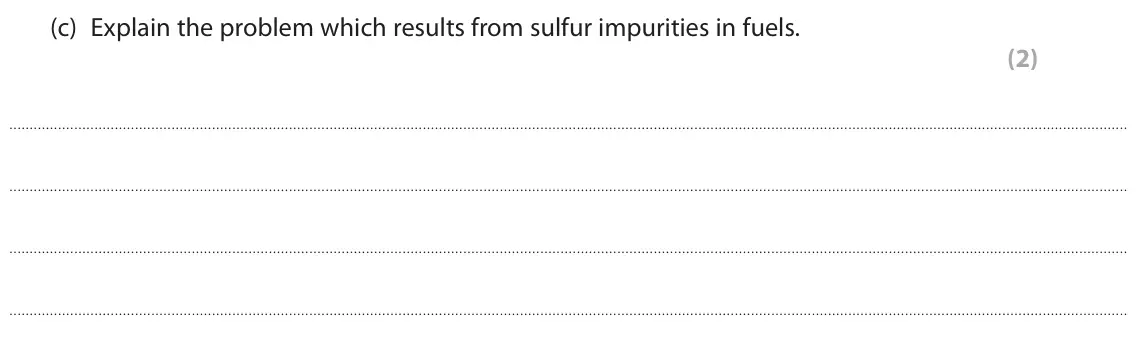
Q1(d)
The whole paper ↗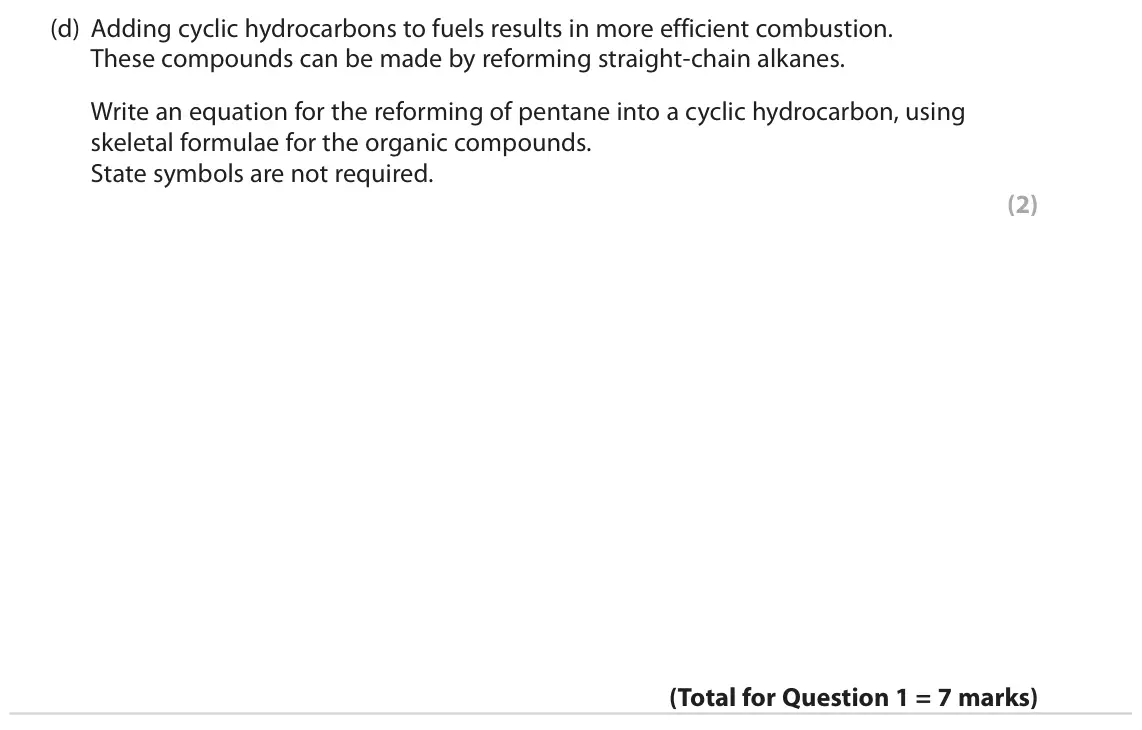
Q2(b)(i)
The whole paper ↗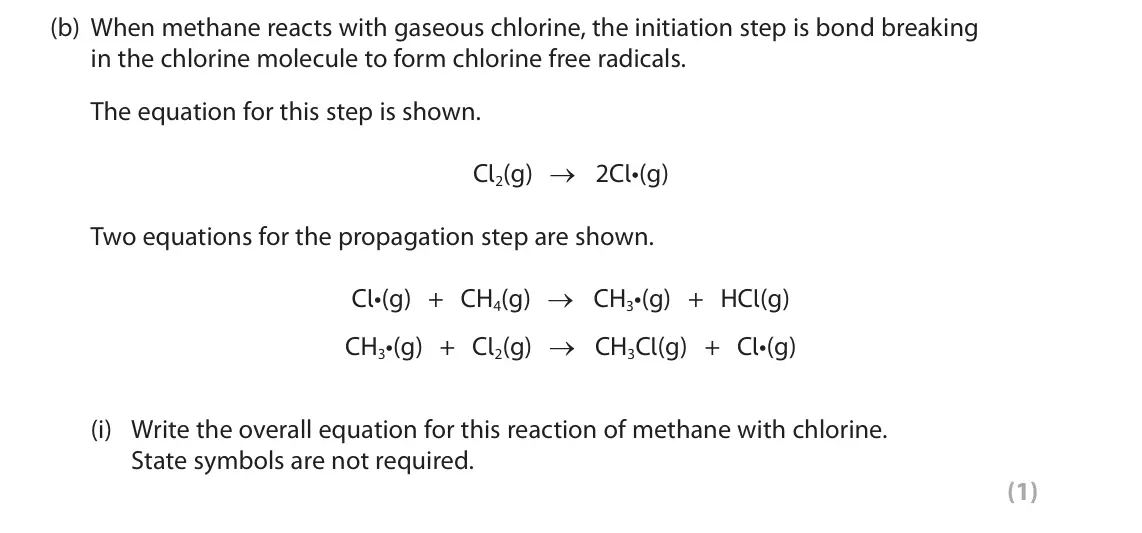
Q2(b)(iii)
The whole paper ↗
Q2(c)(ii)
The whole paper ↗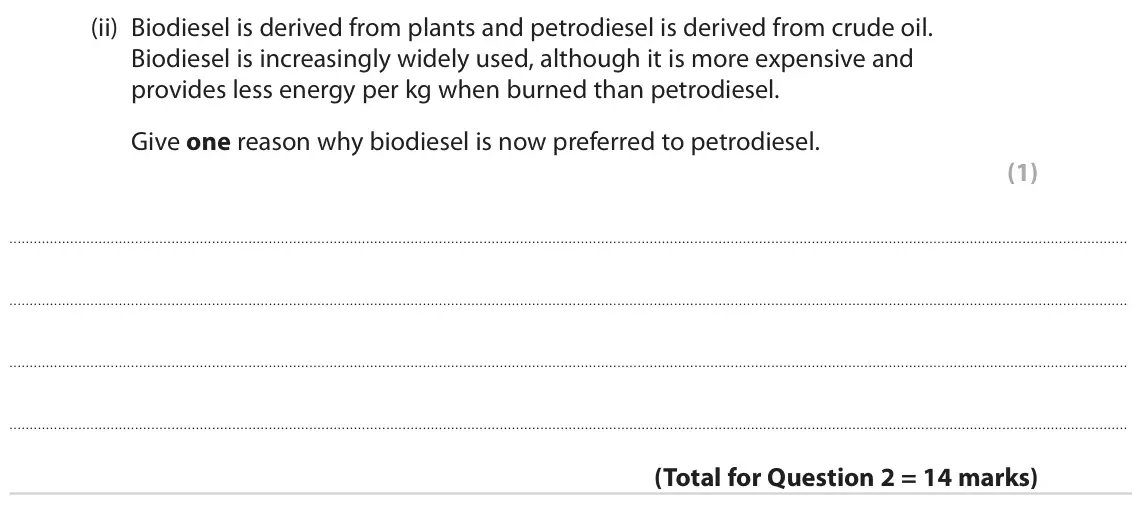
Q3(b)(i)
The whole paper ↗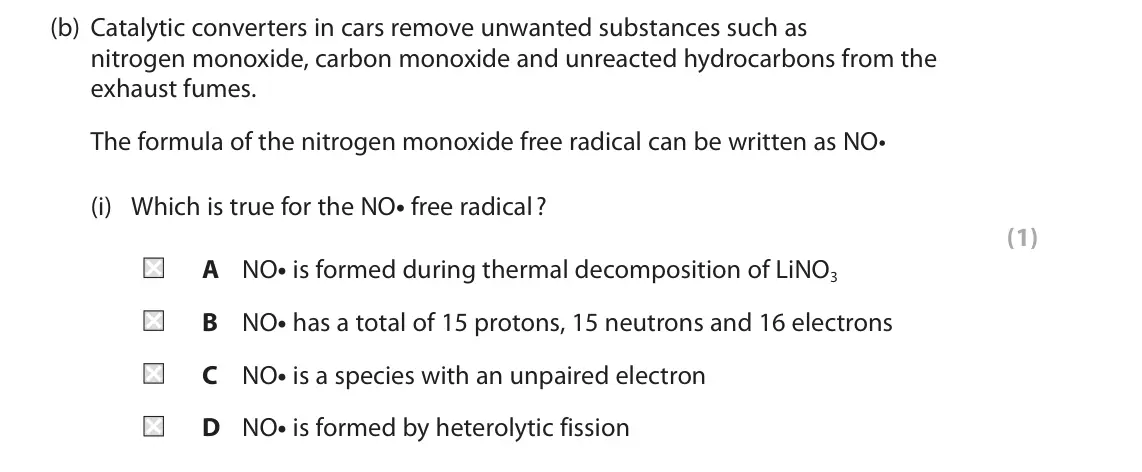
Q3(b)(ii)
The whole paper ↗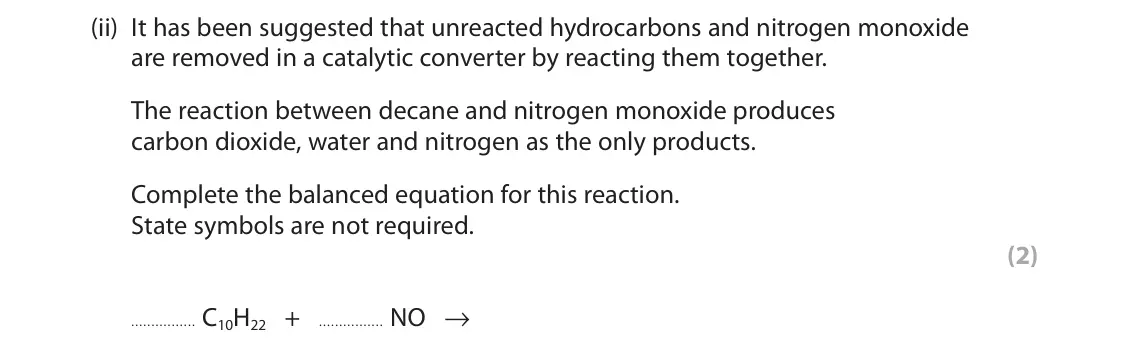
All 47 questions on Alkanes, as a list
- June 2025, Paper 2, Q4(a)(i) (4 marks): The energy of ultraviolet radiation can be calculated using the formula shown. h c Energy of one photon = λ Planck constant, h = 6.626 × 10⁻³⁴ J s Speed of ligh
- June 2025, Paper 2, Q4(a)(ii) (2 marks): In the reaction of chlorine with butane, the propagation stage produces two different butyl radicals. Write the structural formulae of these two radicals. (2)
- June 2025, Paper 2, Q4(a)(iii) (2 marks): The reaction of chlorine with butane produces 2‑chlorobutane (72 %) and 1‑chlorobutane (28 %). Explain, by application of your knowledge of the stability of car
- June 2025, AS Paper 2, Q8(b)(iii) (3 marks): Identify three of the major pollutants and the products they form having passed over the heterogeneous catalyst. (3)
- June 2024, Paper 2, Q5(a) (1 mark): The hydrocarbon cyclopentane is present in some fuels and is used in the manufacture of insulation for freezers. cyclopentane Cyclopentane can be synthesised by
- June 2024, Paper 2, Q5(b) (2 marks): The energy density of a fuel is defined as the energy released per dm3 of the liquid fuel burned. A sample of cyclopentane with a mass of 30.0 g releases 1.41 M
- June 2024, Paper 2, Q5(c)(i) (1 mark): State the condition needed to initiate the reaction. (1)
- June 2024, Paper 2, Q5(c)(ii) (3 marks): Complete the table showing the steps of the mechanism of this reaction. Curly arrows are not required. (3) Step Equation(s) Initiation 1. . + Br. + HBr Propagat
- June 2024, Paper 2, Q5(c)(iii) (1 mark): Draw the structure of the organic product of an alternative termination step. (1)
- June 2023, Paper 2, Q1(c) (2 marks): A student is asked to devise a laboratory synthesis of 1,2‑dichloroethane. The student suggests reacting ethane with chlorine in the presence of ultraviolet rad
- June 2023, Paper 2, Q2(a) (1 mark): Ethanol is a fuel and can be made by either the fermentation of carbohydrates or the hydration of ethene. How is the ethanol formed by the fermentation of carbo
- June 2023, Paper 3, Q1(a) (1 mark): Complete the equation for the complete combustion of hexane. State symbols are not required. (1) C6H14 + O2 → CO2 + H2O
- June 2023, Paper 3, Q1(b) (2 marks): Identify two pollutants produced from the incomplete combustion of a pure sample of pentane. (2)
- June 2023, Paper 3, Q1(c) (2 marks): Explain the problem which results from sulfur impurities in fuels. (2)
- June 2023, Paper 3, Q1(d) (2 marks): Adding cyclic hydrocarbons to fuels results in more efficient combustion. These compounds can be made by reforming straight‑chain alkanes. Write an equation for
- June 2023, AS Paper 2, Q2(b)(i) (1 mark): Write the overall equation for this reaction of methane with chlorine. State symbols are not required. (1)
- June 2023, AS Paper 2, Q2(b)(iii) (1 mark): Write an equation for a termination step for this reaction. State symbols are not required. (1)
- June 2023, AS Paper 2, Q2(c)(ii) (1 mark): Biodiesel is derived from plants and petrodiesel is derived from crude oil. Biodiesel is increasingly widely used, although it is more expensive and provides le
- June 2022, AS Paper 2, Q3(b)(i) (1 mark): Which is true for the NO• free radical ? (1) A NO• is formed during thermal decomposition of LiNO3 B NO• has a total of 15 protons, 15 neutrons and 16 electrons
- June 2022, AS Paper 2, Q3(b)(ii) (2 marks): It has been suggested that unreacted hydrocarbons and nitrogen monoxide are removed in a catalytic converter by reacting them together. The reaction between dec
- June 2022, AS Paper 2, Q3(b)(iii) (1 mark): Give a possible reason why this reaction might not proceed according to the equation in (b)(ii). (1)
- June 2022, AS Paper 2, Q5(b)(i) (1 mark): Give the reagent and condition required to convert ethane into chloroethane. (1) Reagent Condition
- June 2022, AS Paper 2, Q5(b)(ii) (1 mark): What is the mechanism and type of reaction by which ethane is converted into chloroethane? (1) A electrophilic addition B free radical addition C free radical s
- June 2022, AS Paper 2, Q5(b)(iii) (3 marks): Further reactions of chloroethane result in the formation of small amounts of the isomers 1,1‑dichloroethane and 1,2‑dichloroethane. Write equations to show the
- November 2021, Paper 2, Q5(c)(i) (1 mark): What is the name of the process used to separate different hydrocarbons from crude oil? (1) A cracking B reforming C fractional distillation D heating under ref
- November 2021, AS Paper 2, Q5(a) (2 marks): One type of power station uses the combustion of methane gas to generate power. Write an equation for the incomplete combustion of methane gas to form carbon mo
- November 2021, AS Paper 2, Q5(b)(i) (2 marks): Explain how oxides of sulfur and nitrogen can be formed from the combustion of fossil fuels. (2)
- November 2021, AS Paper 2, Q5(b)(ii) (2 marks): Some power stations use a process of flue gas desulfurisation (FGD) to remove sulfur oxides from the gaseous combustion products. One such process, known as wet
- October 2020, AS Paper 2, Q1(c)(i) (1 mark): Write the equation for the formation of trifluoromethane by the reaction of difluoromethane with fluorine. State symbols are not required. (1)
- October 2020, AS Paper 2, Q1(c)(ii) (3 marks): The mechanism for this reaction is similar to that of the reaction between chlorine and methane. Give the equations for the following steps in the mechanism for
- June 2019, Paper 2, Q2(b) (1 mark): What is the name of the process that could be used to produce propane, C.Ha, from decane, CoH22? (1) • A substitution • B reforming • C fractional distillation
- June 2019, Paper 2, Q2(c)(i) (1 mark): The first step of the reaction involves (1) A heterolytic bond fission to form free radicals B heterolytic bond fission to form ions C homolytic bond fission to
- June 2019, Paper 2, Q2(c)(iii) (1 mark): A source from the internet gave the percentage yield for this reaction as 31.0%. The best explanation for the low percentage yield of 1-bromopropane in this rea
- June 2019, AS Paper 2, Q1(a)(i) (1 mark): Identify, by name or structural formula, the unbranched alkane with six carbon atoms found in kerosene. (1)
- June 2019, AS Paper 2, Q1(b) (3 marks): During cracking, carbon to carbon bonds are broken. Explain the two major reasons for cracking hydrocarbons. (3)
- June 2019, AS Paper 2, Q1(c) (1 mark): Which of the following changes to the proportions of organic molecules within a fraction results from the reforming process? (1) Proportion of branched chain Pr
- June 2018, Paper 2, Q1(a) (1 mark): The reaction of ethane and chlorine in UV radiation produces chloroethane. C2H6 + Cl2 → C2H5Cl + HCl This reaction is classified as (1) A addition B elimination
- June 2018, Paper 2, Q1(b) (1 mark): The black smoke produced from the incomplete combustion of alkane fuels is (1) A carbon particulates B oxides of nitrogen C oxides of sulfur D unburnt hydrocarb
- June 2018, Paper 2, Q1(c) (1 mark): A reaction of hexane is shown below. + H2 This is best described as (1) A elimination B hydrogenation C isomerisation D reforming
- June 2017, Paper 2, Q1(a) (1 mark): What is the reaction mechanism when ethane and chlorine react in UV light? (1) A electrophilic addition B electrophilic substitution C free radical addition D f
- June 2017, Paper 2, Q1(c)(i) (2 marks): Explain why different alkanes in crude oil can be separated by fractional distillation. (2)
- June 2017, Paper 2, Q1(c)(ii) (1 mark): Complete the equation for the cracking of octane to produce ethene and only one other organic compound. State symbols are not required. (1) C8H18 r +
- June 2017, Paper 2, Q1(c)(iii) (1 mark): Write the equation for the reforming of hexane into cyclohexane, using displayed formulae for the organic compounds. State symbols are not required. (1)
- June 2016, AS Paper 2, Q1(c) (2 marks): Write the equation for reforming heptane into cycloheptane, showing the skeletal formulae of the organic molecules. (2)
- June 2016, AS Paper 2, Q1(d)(i) (1 mark): In the initiation step, chlorine molecules are converted into radicals. Cl2 o 2Cl∙ Identify the type of bond broken and the type of bond fission occurring in th
- June 2016, AS Paper 2, Q1(d)(ii) (2 marks): Write the propagation steps to show the formation of C2H5Cl. (2)
- June 2016, AS Paper 2, Q1(d)(iii) (1 mark): State how some butane, C4H10, is formed in the reaction. (1)
Questions, mark schemes and examiner’s reports are © Pearson Edexcel, from their published past papers. Plumi isn’t affiliated with any exam board. Want whole papers? Every Edexcel A-Level Chemistry paper.
Rather write your answers by hand on iPad? Plumi marks them against the same mark schemes.