 plumi
Alkenes: Edexcel A‑Level Chemistry questions
Every Edexcel A-Level Chemistry exam question on 6C Alkenes, 2016–2025, with its mark scheme and examiner’s report.
Find questions2,028
Calculations
Q8(b)
The whole paper ↗
Q8(c)
The whole paper ↗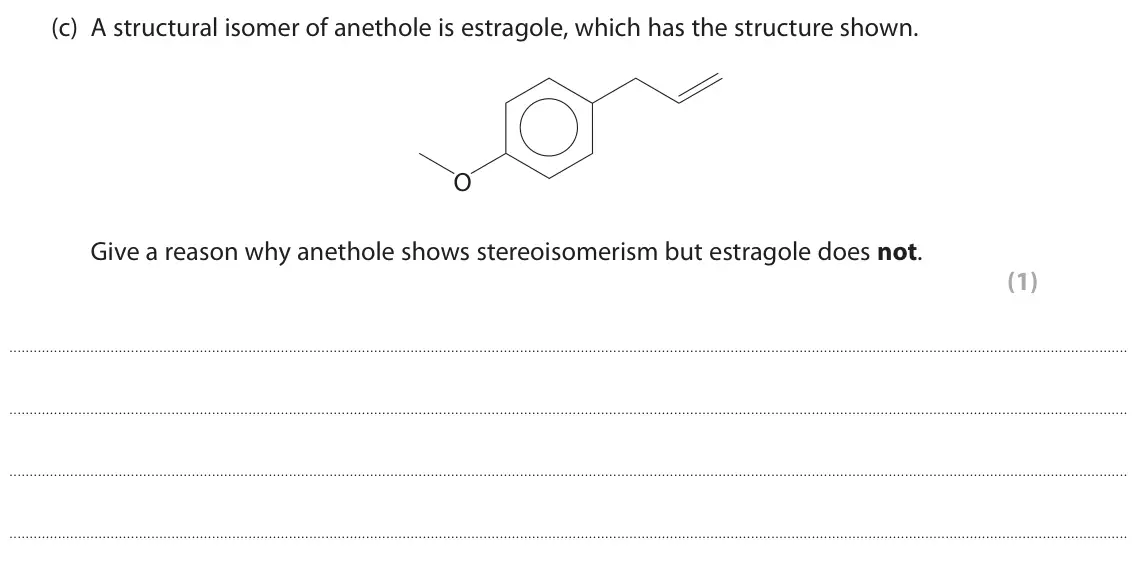
Q8(d)
The whole paper ↗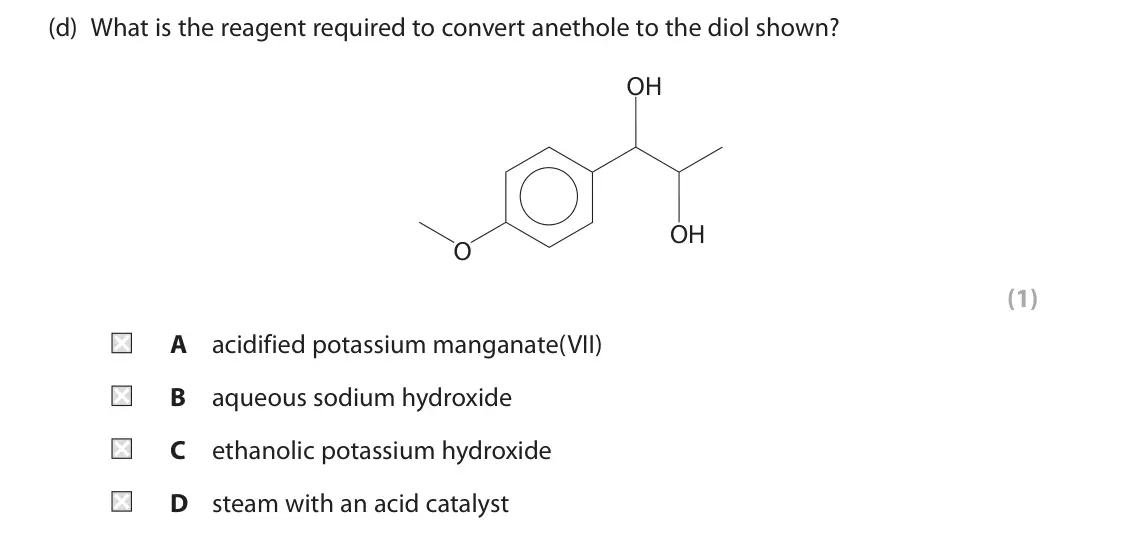
Q2(a)(i)
The whole paper ↗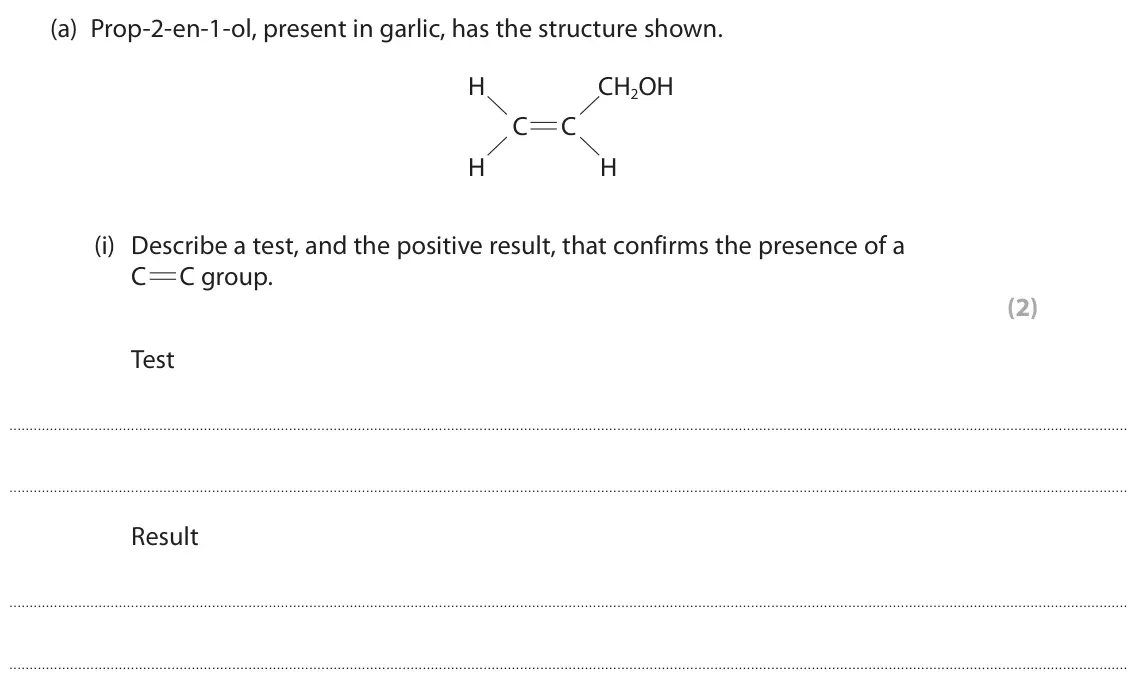
Q2(a)(ii)
The whole paper ↗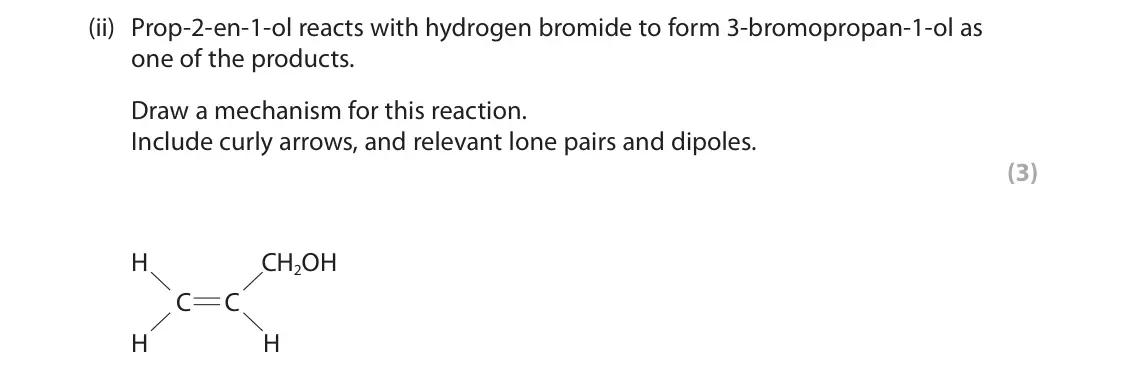
Q2(b)
The whole paper ↗
Q2(c)
The whole paper ↗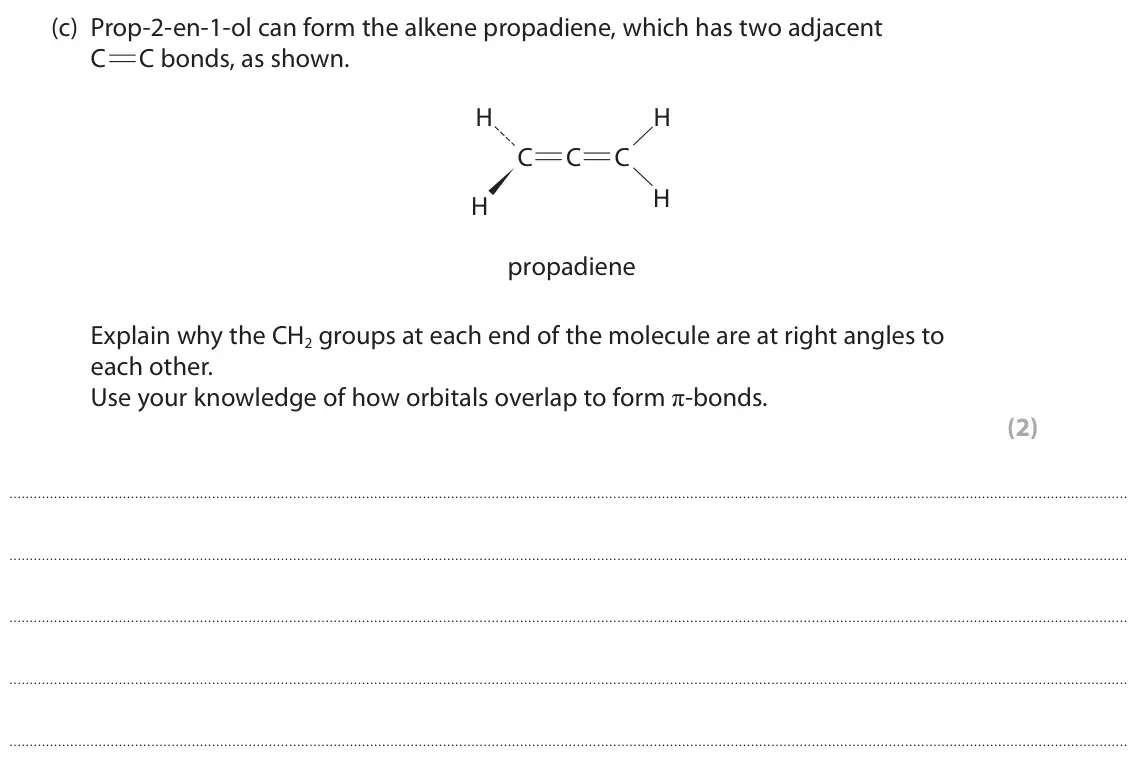
Q2(d)(i)
The whole paper ↗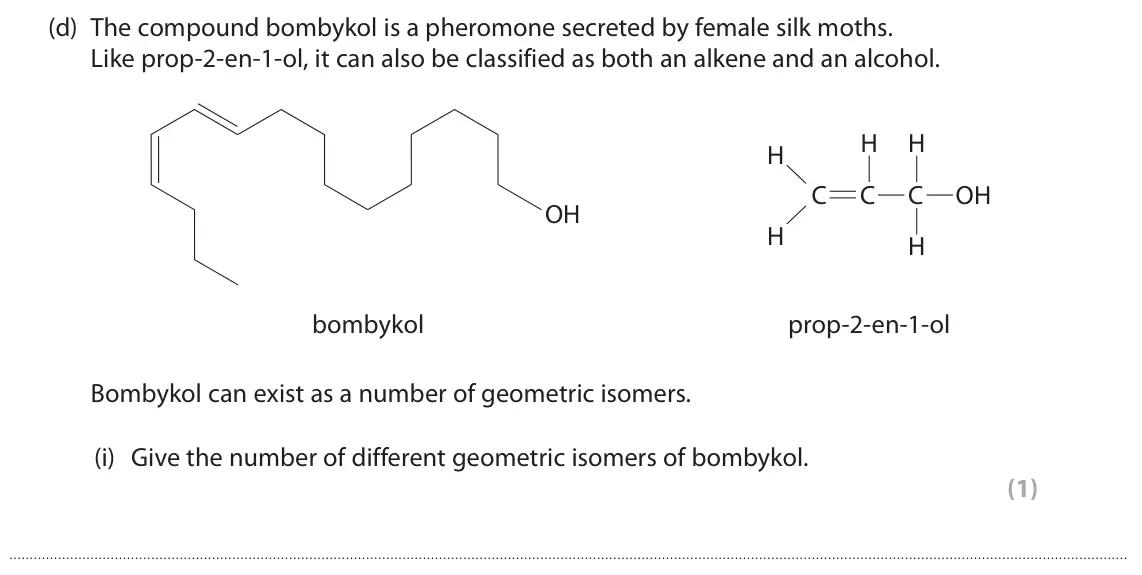
Q2(d)(ii)
The whole paper ↗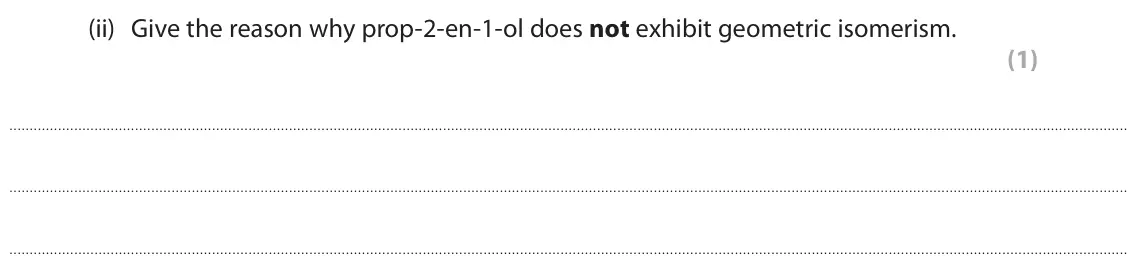
Q1(b)
The whole paper ↗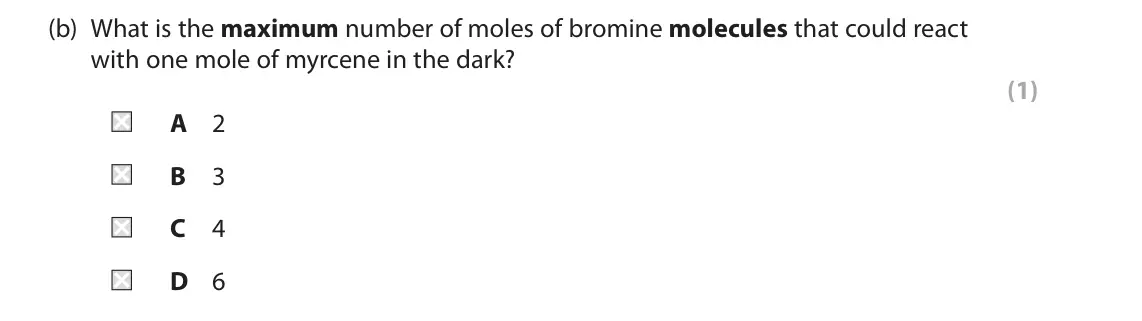
Q1(d)
The whole paper ↗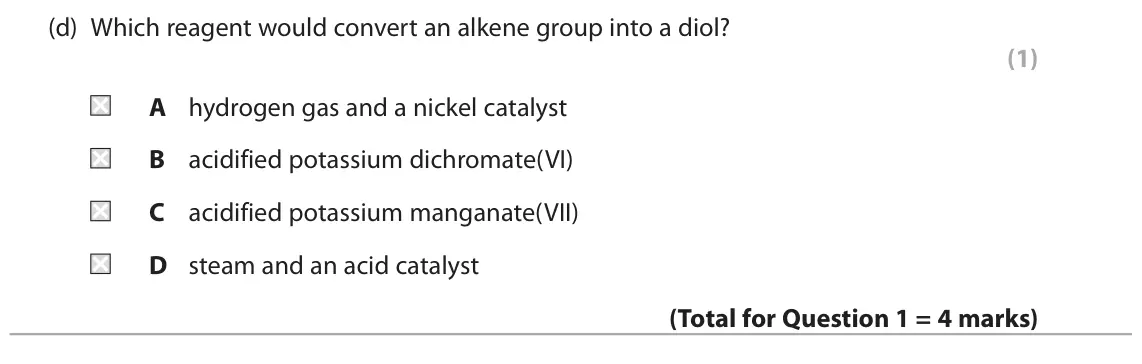
Q7(c)(i)
The whole paper ↗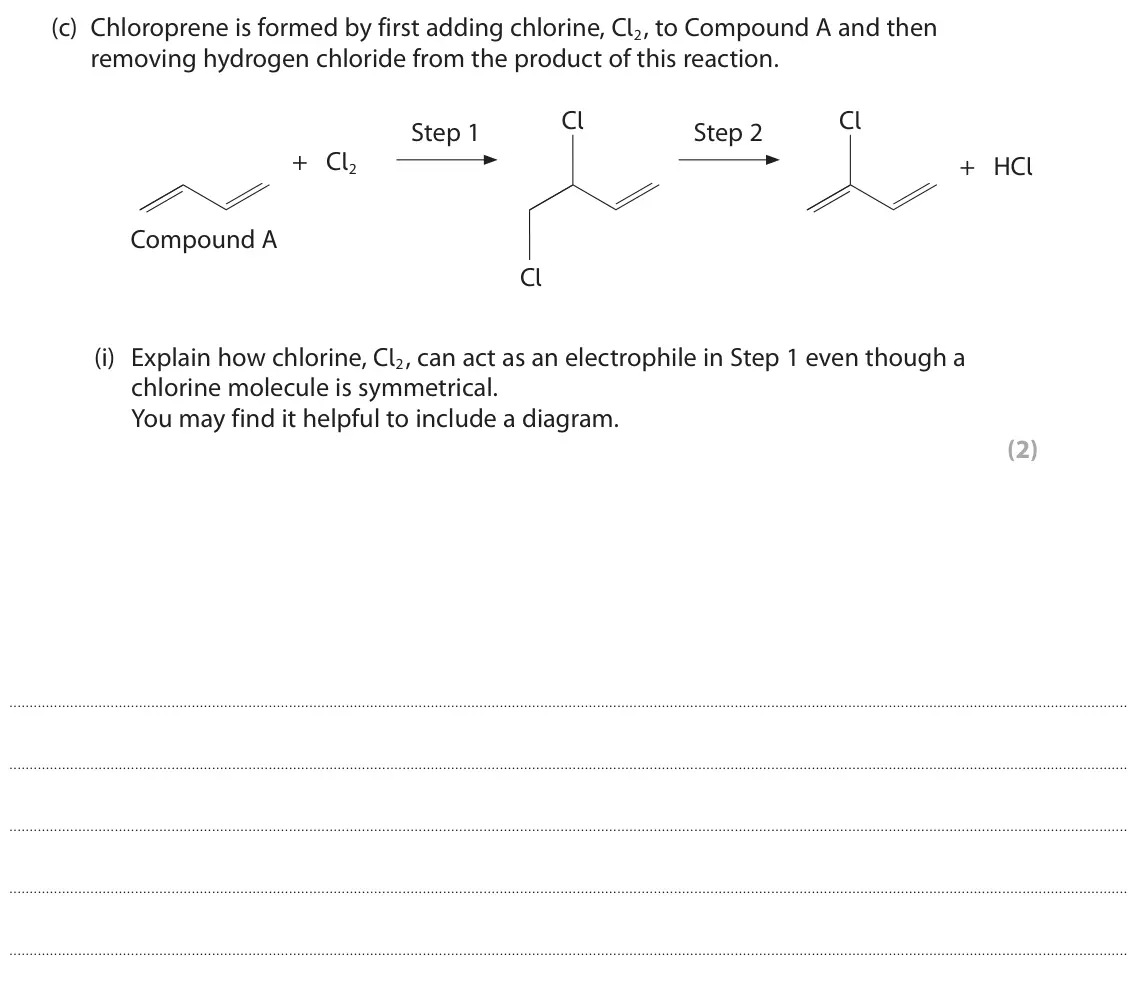
Q7(c)(ii)
The whole paper ↗
Q7(c)(iii)
The whole paper ↗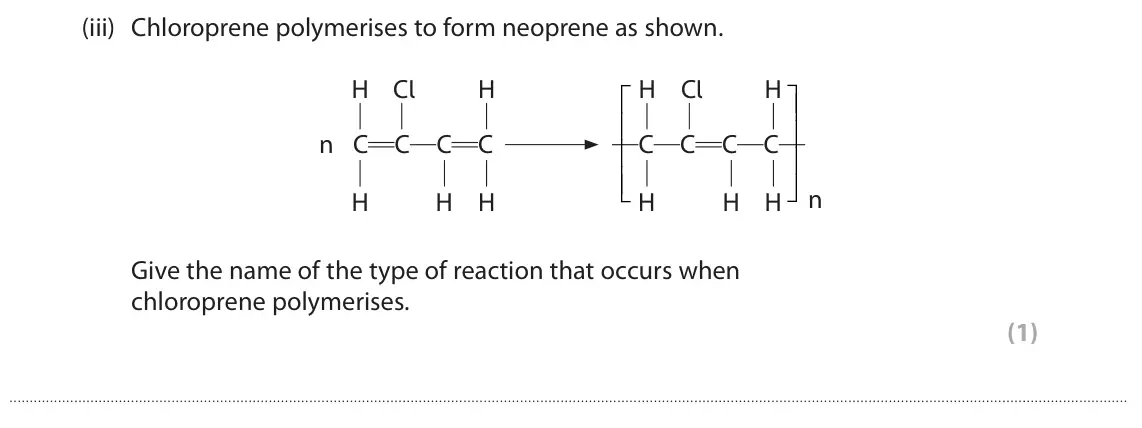
Q7(a)
The whole paper ↗
Q3(b)(i)
The whole paper ↗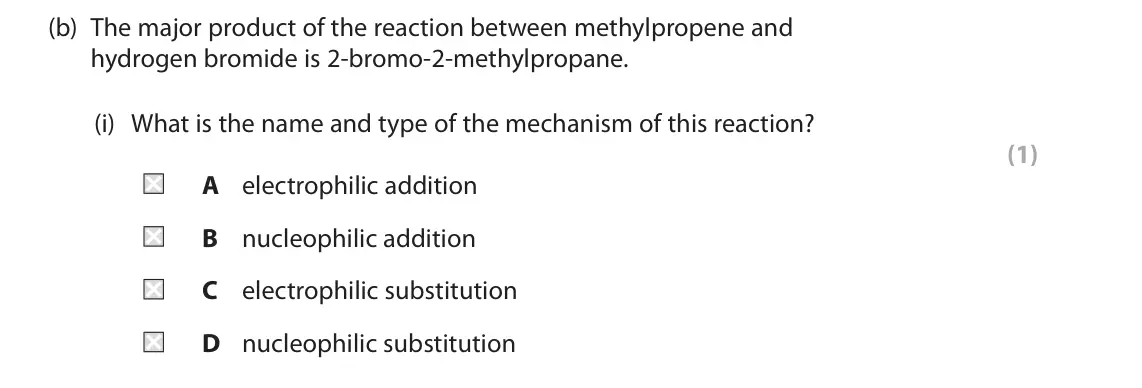
Q3(b)(ii)
The whole paper ↗
Q3(b)(iii)
The whole paper ↗
All 83 questions on Alkenes, as a list
- June 2025, Paper 2, Q8(b) (1 mark): Draw the stereoisomer of anethole. (1)
- June 2025, Paper 2, Q8(c) (1 mark): A structural isomer of anethole is estragole, which has the structure shown. O Give a reason why anethole shows stereoisomerism but estragole does not. (1)
- June 2025, Paper 2, Q8(d) (1 mark): What is the reagent required to convert anethole to the diol shown? OH OH O (1) A acidified potassium manganate(VII) B aqueous sodium hydroxide C ethanolic pota
- June 2025, Paper 3, Q2(a)(i) (2 marks): Describe a test, and the positive result, that confirms the presence of a C C group. (2) Test Result
- June 2025, Paper 3, Q2(a)(ii) (3 marks): Prop-2-en-1-ol reacts with hydrogen bromide to form 3-bromopropan-1-ol as one of the products. Draw a mechanism for this reaction. Include curly arrows, and rel
- June 2025, Paper 3, Q2(b) (2 marks): Prop-2-en-1-ol can polymerise to form an addition polymer. Write a balanced equation for this polymerisation. (2)
- June 2025, Paper 3, Q2(c) (2 marks): Prop-2-en-1-ol can form the alkene propadiene, which has two adjacent C C bonds, as shown. H H C C C H H propadiene Explain why the CH2 groups at each end of th
- June 2025, Paper 3, Q2(d)(i) (1 mark): Give the number of different geometric isomers of bombykol. (1)
- June 2025, Paper 3, Q2(d)(ii) (1 mark): Give the reason why prop-2-en-1-ol does not exhibit geometric isomerism. (1)
- June 2025, AS Paper 2, Q1(b) (1 mark): What is the maximum number of moles of bromine molecules that could react with one mole of myrcene in the dark? (1) A 2 B 3 C 4 D 6
- June 2025, AS Paper 2, Q1(d) (1 mark): Which reagent would convert an alkene group into a diol? (1) A hydrogen gas and a nickel catalyst B acidified potassium dichromate(VI) C acidified potassium man
- June 2024, Paper 2, Q4 (6 marks): * 4 Discuss the role society, and chemists in particular, can play in order to contribute to a more sustainable use of polymers. Your answer should consider • t
- June 2024, Paper 2, Q7(c)(i) (2 marks): Explain how chlorine, Cl2, can act as an electrophile in Step 1 even though a chlorine molecule is symmetrical. You may find it helpful to include a diagram. (2
- June 2024, Paper 2, Q7(c)(ii) (3 marks): Draw the mechanism for Step 1. Include curly arrows, and any relevant lone pairs and dipoles. (3)
- June 2024, Paper 2, Q7(c)(iii) (1 mark): Chloroprene polymerises to form neoprene as shown. H Cl H H Cl H n C C C C C C C C n H H H H H H Give the name of the type of reaction that occurs when chloropr
- June 2024, Paper 3, Q5 (6 marks): * 5 Compare and contrast the reactions of bromine with benzene and of bromine with cyclohexene. Consider the types of reaction that occur, the products that for
- June 2024, Paper 3, Q7(a) (4 marks): Draw the mechanism for Step 1. Include curly arrows, and relevant lone pairs and dipoles. (4)
- June 2024, AS Paper 2, Q3(b)(i) (1 mark): What is the name and type of the mechanism of this reaction? (1) A electrophilic addition B nucleophilic addition C electrophilic substitution D nucleophilic su
- June 2024, AS Paper 2, Q3(b)(ii) (4 marks): Draw the mechanism for the formation of 2‑bromo‑2‑methylpropane. Include curly arrows, and any relevant charges, dipoles and lone pairs. (4)
- June 2024, AS Paper 2, Q3(b)(iii) (3 marks): A minor organic product is also formed in this reaction. Justify why this minor product is formed in smaller amounts. Include the structure of the minor organic
- June 2024, AS Paper 2, Q3(b)(iv) (1 mark): State what a curly arrow represents in your diagram of the mechanism in (b)(ii). (1)
- June 2023, Paper 2, Q4(b)(i) (1 mark): An electrophile is a substance that (1) A accepts a pair of electrons B accepts an unpaired electron C donates a pair of electrons D donates an unpaired electro
- June 2023, Paper 2, Q8(b) (3 marks): Propene reacts with bromine to form 1,2‑dibromopropane as the only product. Draw the mechanism for the reaction between propene and bromine. Include curly arrow
- June 2023, Paper 2, Q8(c)(i) (2 marks): Explain, by reference to your mechanism in (b), why no 1,2‑dichloropropane forms. (2)
- June 2023, Paper 2, Q8(c)(ii) (2 marks): Explain why far more 1‑bromo‑2‑chloropropane forms than 2‑bromo‑1‑chloropropane. (2)
- June 2023, Paper 2, Q8(d) (6 marks): Discuss the different types of stereoisomerism that occur in organic compounds. Use only molecules A and B as examples. CHCl C(CH3)Br CH3CH(OH)COOH A B Include
- June 2023, Paper 3, Q3(d)(v) (1 mark): Describe a test, with the positive result, which would confirm the presence of an alkene in the test tube. (1)
- June 2023, AS Paper 2, Q3(c) (3 marks): Draw a diagram of an ethene molecule showing the shape of all the bonding electron clouds. Include labels for all the bond types within the molecule. (3)
- June 2023, AS Paper 2, Q3(d)(i) (1 mark): Draw the fully displayed formula of isomer B. (1)
- June 2023, AS Paper 2, Q3(d)(ii) (1 mark): Draw the structural formula of product C, which is formed by the reaction of but‑1‑ene with potassium manganate(VII) in acid conditions. (1)
- June 2023, AS Paper 2, Q3(e) (1 mark): The industrial manufacture of margarine involves the addition of hydrogen to an alkene. Which catalyst is used for this process? (1) A iron B nickel C phosphori
- June 2023, AS Paper 2, Q3(f) (1 mark): Polymers can be produced by the addition polymerisation of alkenes. Poly(propene) can be made from propene. Draw the structure of poly(propene), showing two rep
- June 2023, AS Paper 2, Q3(g)(i) (4 marks): Complete the mechanism of the reaction of propene with hydrogen bromide to form 2‑bromopropane. Include curly arrows and any relevant lone pairs and dipoles. (4
- June 2023, AS Paper 2, Q3(g)(ii) (1 mark): What is the type and mechanism for the reaction of hydrogen bromide with propene? (1) A electrophilic addition B electrophilic substitution C nucleophilic addit
- June 2023, AS Paper 2, Q3(h)(i) (1 mark): Describe how the toxic gas hydrogen chloride produced during the incineration of poly(chloroethene) could be removed. (1)
- June 2023, AS Paper 2, Q3(h)(ii) (1 mark): Give a reason why some polymers cannot be recycled. (1)
- June 2022, Paper 2, Q1(a) (1 mark): An addition polymer is formed from 2‑methylpent‑2‑ene. What is the repeat unit for poly(2‑methylpent‑2‑ene)? (1) A B C D
- June 2022, Paper 2, Q1(b) (1 mark): Which is not a use of waste poly(alkenes)? (1) A feedstock for cracking B generation of biodegradable materials C incineration to release energy D make new mate
- June 2022, Paper 2, Q1(d) (1 mark): Which approach used by chemists would not contribute to a more sustainable use of materials over the life cycle of a polymer? (1) A make more efficient use of e
- June 2022, Paper 2, Q3(a)(i) (3 marks): Complete the mechanism for the production of a dihalogenoalkane from 2‑methylbut‑1‑ene and chlorine. Include curly arrows and any relevant lone pairs. (3) Cl Cl
- June 2022, Paper 3, Q7(a)(iii) (2 marks): Complete the equation for the formation of the polymer from methyl methacrylate. (2) O O
- June 2022, AS Paper 2, Q2(a) (2 marks): Some plastic products can be cleaned and used again. Give two other uses of waste plastic. (2)
- June 2022, AS Paper 2, Q2(b) (1 mark): The V on the symbol with the number 3 stands for vinyl or vinyl chloride. The V is sometimes replaced by PVC, standing for polyvinyl chloride. State the link be
- June 2022, AS Paper 2, Q2(c) (1 mark): LDPE stands for low density poly(ethene). Which of the diagrams shows exactly three repeat units of poly(ethene)? (1) H H A C C H H n H H H B C C C H H H H H H
- June 2022, AS Paper 2, Q5(a)(i) (1 mark): Identify, by name or formula, the reagent for this conversion. (1)
- June 2022, AS Paper 2, Q5(a)(ii) (4 marks): Draw the mechanism for the conversion of ethene into chloroethane. Include curly arrows, and any relevant lone pairs and dipoles. (4)
- November 2021, Paper 2, Q3 (1 mark): What is the systematic name for tiglic acid? O OH tiglic acid A E-2-methylbut-2-enoic acid B Z-2-methylbut-2-enoic acid C E-3-methylbut-2-enoic acid D Z-3-methy
- November 2021, Paper 2, Q4(a) (3 marks): Draw the skeletal formulae of three branched chain alkenes with the molecular formula C5H10 . (3)
- November 2021, Paper 2, Q4(c) (4 marks): Pent-2-ene reacts with hydrogen bromide, HBr, to form two bromoalkanes. Complete the diagram to show the mechanism for the formation of 2-bromopentane in this r
- November 2021, Paper 2, Q7(a) (6 marks): Compare and contrast how each of these monomers forms a polymer. OH HO C O 4-hydroxycyclohexanecarboxylic acid cyclohexene Include equations, showing the format
- November 2021, Paper 2, Q7(b) (3 marks): Give three ways in which waste polymers can be utilised to improve their sustainability. (3)
- November 2021, AS Paper 2, Q6(d)(ii) (1 mark): Draw the displayed formula for the repeat unit of a polymer that is made by the polymerisation of 2‑methylpropene, (CH3)2C CH2 . (1)
- November 2021, AS Paper 2, Q6(d)(iii) (4 marks): Draw a mechanism for the addition of hydrogen bromide, HBr, to 2‑methylpropene to form 2‑bromo‑2‑methylpropane. Include curly arrows, and any relevant dipoles a
- October 2020, Paper 2, Q2(c) (3 marks): Two reactions of ethene are shown. H H C C H H Reaction 1 Reaction 2 HBr H H Product H C C OH H H Complete the table. (3) Reaction Reagent and condition Product
- October 2020, Paper 2, Q2(d)(i) (1 mark): Draw the structure of the polymer formed when but-1-ene polymerises. Include two repeat units. (1)
- October 2020, Paper 2, Q5(c) (1 mark): How many σ bonds and π bonds are there in one molecule of cyclohexene? . (1) σ bonds π bonds A 5 2 B 6 1 C 15 2 D 16 1
- October 2020, Paper 2, Q5(e) (4 marks): Propene reacts with iodine monochloride, ICl, by an electrophilic addition mechanism. Draw the mechanism for the reaction between propene and iodine monochlorid
- October 2020, Paper 2, Q7(a)(ii) (2 marks): Give a suitable reagent and condition for Step 1. (2)
- October 2020, AS Paper 2, Q5(b)(ii) (3 marks): Draw the mechanism for the addition of iodine monochloride to propene. You should include all curly arrows and relevant lone pairs and dipoles. (3)
- October 2020, AS Paper 2, Q5(c)(iii) (1 mark): Give a reason why the reaction of iodine monochloride is significantly faster than the reaction of iodine. (1)
- June 2019, Paper 2, Q4(c)(i) (4 marks): Draw the mechanism for the reaction between methyl cinnamate and bromine, Brz. Include curly arrows, and relevant lone pairs and dipoles. (4)
- June 2019, AS Paper 2, Q2(b)(i) (1 mark): Give the reagent required for this reaction. (1)
- June 2019, AS Paper 2, Q2(b)(ii) (1 mark): What is the type and mechanism of the reaction in (b)(i)? (1) A electrophilic addition B nucleophilic addition C electrophilic substitution D nucleophilic subst
- June 2019, AS Paper 2, Q5(b) (2 marks): Describe a chemical test on the gas in the syringe to identify its functional group. Include the expected result. (2)
- June 2018, Paper 2, Q7(b) (1 mark): Which reagent could produce a diol from phenylethene? (1) A acidified potassium dichromate(VI) B acidified potassium manganate(VII) C aqueous sodium hydroxide D
- June 2018, Paper 2, Q7(c) (1 mark): Draw a section of the polymer, polystyrene, showing two repeat units. (1)
- June 2018, Paper 2, Q7(d) (2 marks): Give one advantage and one disadvantage of the disposal of polystyrene by incineration. (2)
- June 2018, Paper 3, Q6(f)(i) (2 marks): Draw the structures of these stereoisomers. (2) E-isomer Z-isomer
- June 2018, Paper 3, Q6(f)(ii) (2 marks): State why HOOCCH CHCOOH has E/Z isomers. (2)
- June 2018, AS Paper 2, Q5(a)(i) (1 mark): This reaction is best described as (1) A electrophilic substitution B electrophilic addition C nucleophilic substitution D nucleophilic addition
- June 2018, AS Paper 2, Q5(a)(iii) (4 marks): Draw the mechanism for the reaction of propene with hydrogen chloride to produce 2-chloropropane. Include curly arrows, and any relevant dipoles and lone pairs.
- June 2018, AS Paper 2, Q5(b)(i) (1 mark): Draw a displayed formula of two repeat units of poly(chloroethene). (1)
- June 2018, AS Paper 2, Q5(b)(ii) (2 marks): Some polymers are disposed of by incineration. Ignoring any economic considerations, explain why incineration is not a suitable method for the disposal of poly(
- June 2018, AS Paper 2, Q5(b)(iii) (1 mark): Chloroethene has a boiling temperature of 260 K and is known to be carcinogenic. Use these facts to state one precaution that chemists should take when using th
- June 2018, AS Paper 2, Q6(a)(i) (2 marks): Identify reagent B and state suitable conditions for this reaction. (2)
- June 2018, AS Paper 2, Q6(a)(ii) (1 mark): This reaction is best described as (1) A hydrolysis B oxidation C reduction D substitution
- June 2018, AS Paper 2, Q6(a)(iii) (1 mark): Name one other commercially important product that can be manufactured by this type of reaction with the alkene group. (1)
- June 2017, Paper 2, Q6(a) (2 marks): But-1-ene and cyclohexene both form addition polymers. Draw a section of each polymer, showing two repeat units. (2) CH2 CHCH2CH3 r r
- June 2017, AS Paper 2, Q4(d) (4 marks): Give one chemical test that you could use to confirm the presence of each of the two functional groups suggested in part (c). Predict a result for each test. (4
- June 2017, AS Paper 2, Q4(f) (4 marks): 2-methylbuta-1,3-diene can react with hydrogen bromide. When 2-methylbuta-1,3-diene reacts with excess hydrogen bromide, several isomeric products are possible.
- June 2016, AS Paper 2, Q2(a) (1 mark): What is the name of the compound shown? H CH3 C C Cl Br (1) A cis-2-bromo-1-chloroprop-1-ene B E-2-bromo-1-chloroprop-1-ene C trans-2-bromo-1-chloroprop-1-ene D
- June 2016, AS Paper 2, Q2(b)(i) (1 mark): What is the classification of the mechanism for the reaction between ethene and bromine? (1) A electrophilic addition B electrophilic substitution C nucleophili
- June 2016, AS Paper 2, Q2(b)(ii) (1 mark): Which of the following shows the formation of the intermediate in the mechanism for the reaction between ethene and bromine? (1) A H H H H C C H C C– + Br– H H
Questions, mark schemes and examiner’s reports are © Pearson Edexcel, from their published past papers. Plumi isn’t affiliated with any exam board. Want whole papers? Every Edexcel A-Level Chemistry paper.
Rather write your answers by hand on iPad? Plumi marks them against the same mark schemes.