 plumi
Nuclear magnetic resonance (NMR): Edexcel A‑Level Chemistry questions
Every Edexcel A-Level Chemistry exam question on 19B Nuclear magnetic resonance (NMR), 2016–2025, with its mark scheme and examiner’s report.
Find questions2,028
Calculations
Q8(g)
The whole paper ↗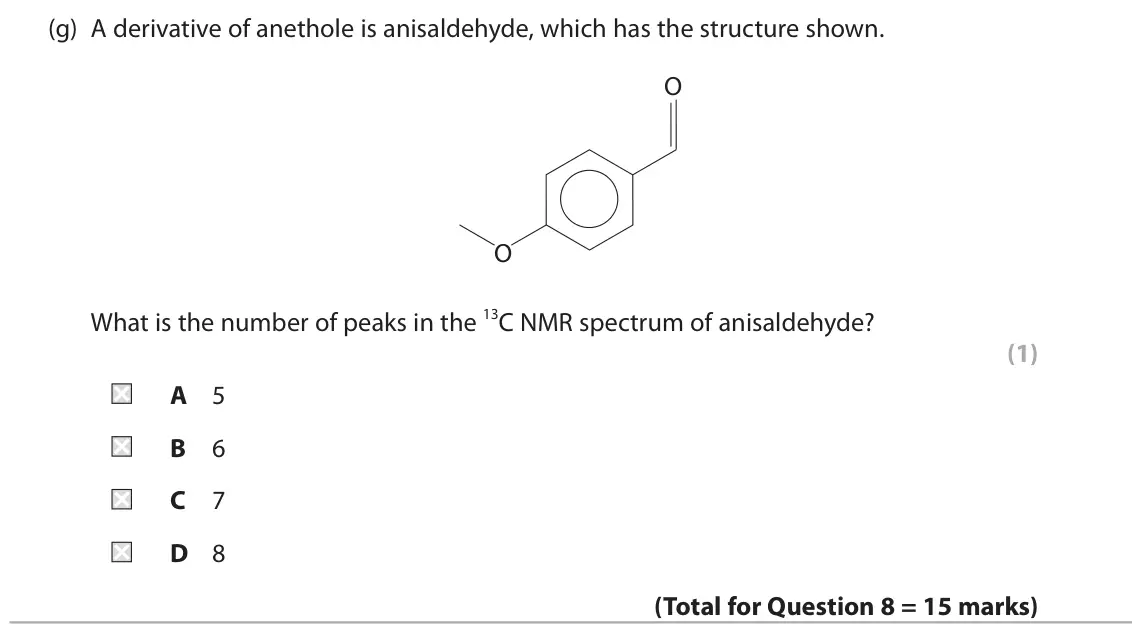
Q6(b)
The whole paper ↗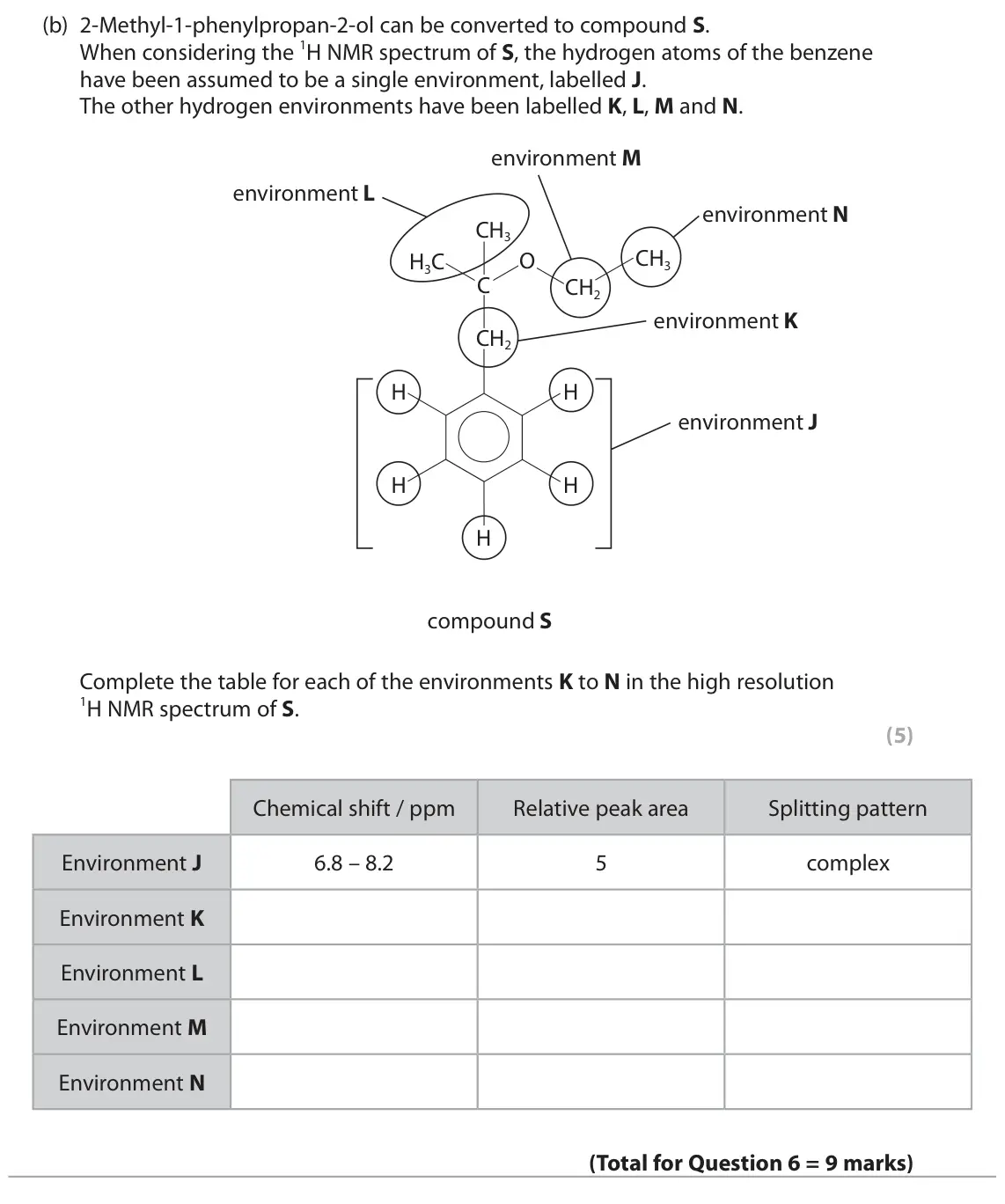
Q6(a)
The whole paper ↗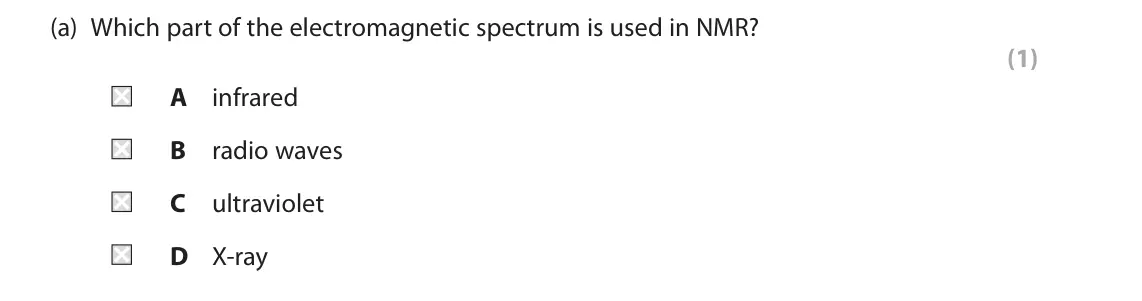
Q6(b)
The whole paper ↗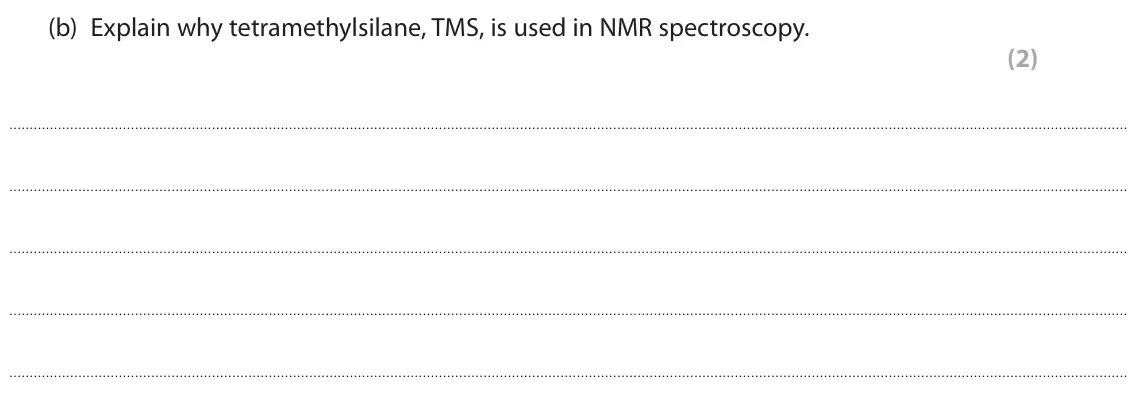
Q6(c)(ii)
The whole paper ↗
Q6(d)
The whole paper ↗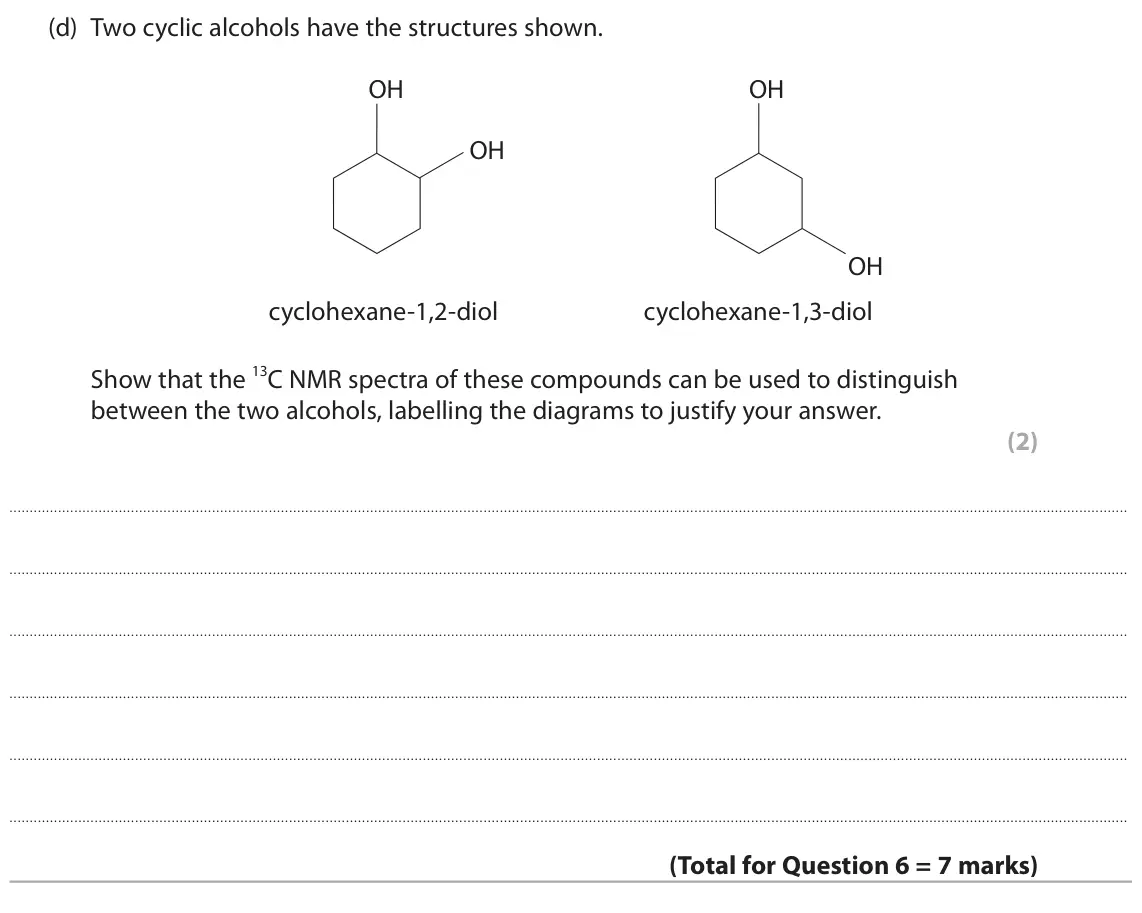
Q6(b)(i)
The whole paper ↗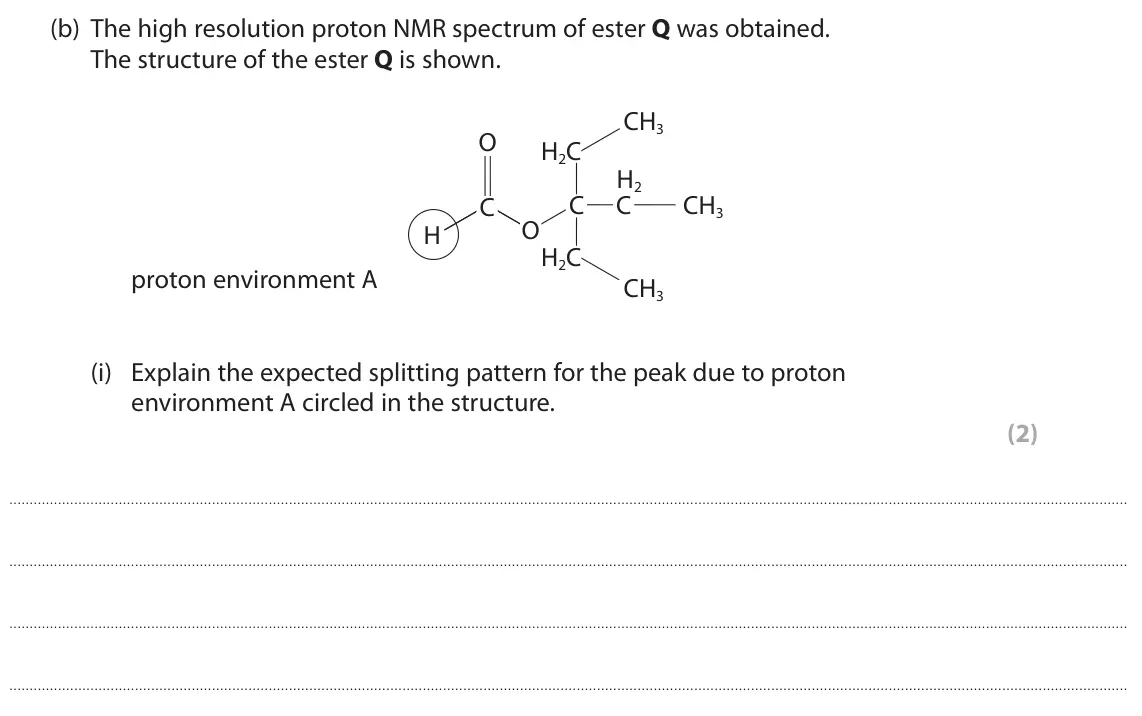
Q6(b)(ii)
The whole paper ↗
Q6(b)(iii)
The whole paper ↗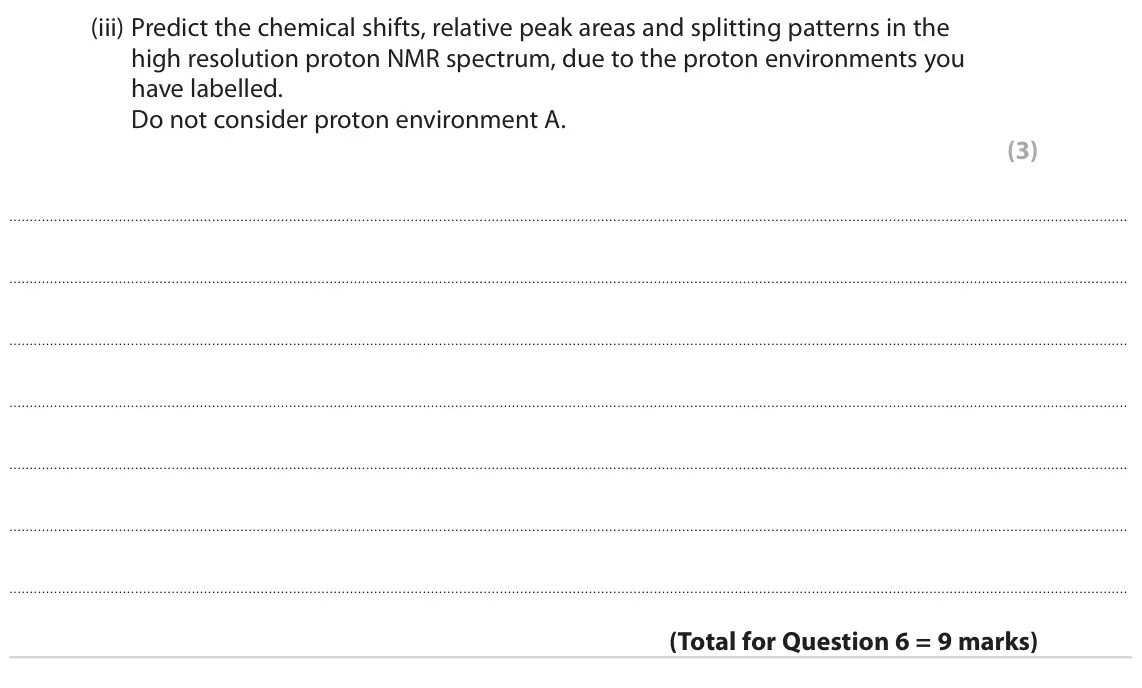
Q2(d)(ii)
The whole paper ↗
Q7(c)(iii)
The whole paper ↗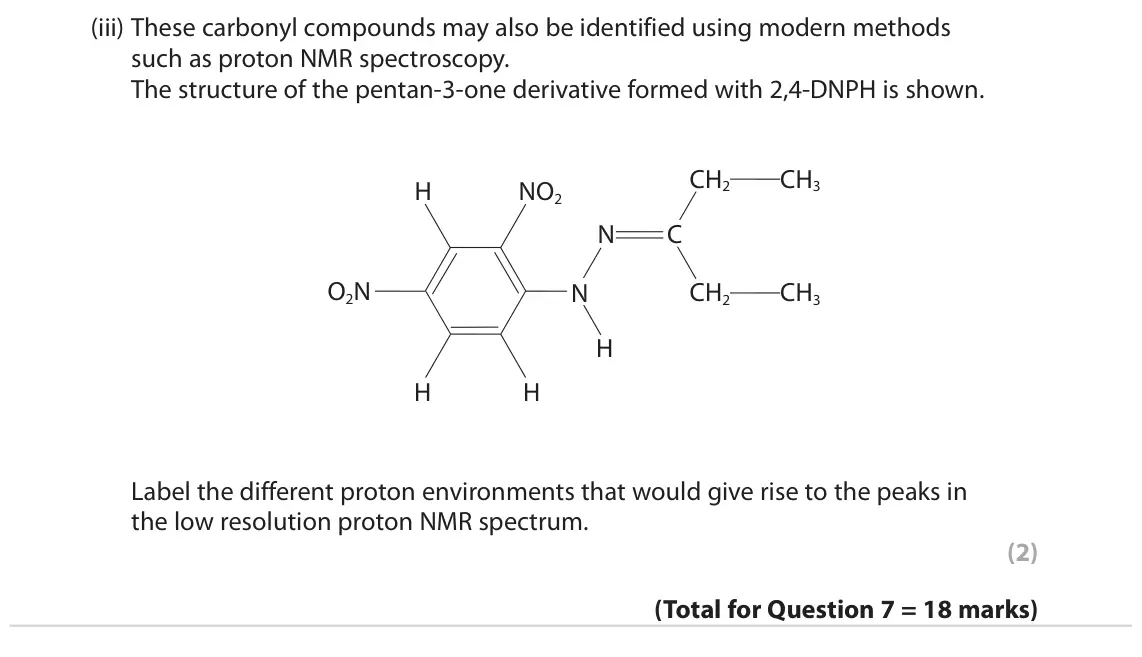
Q8(a)
The whole paper ↗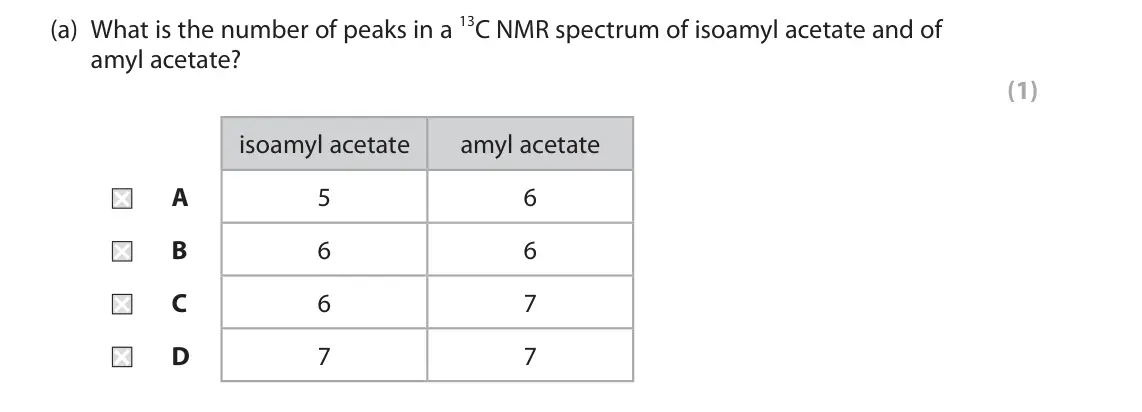
Q6(b)
The whole paper ↗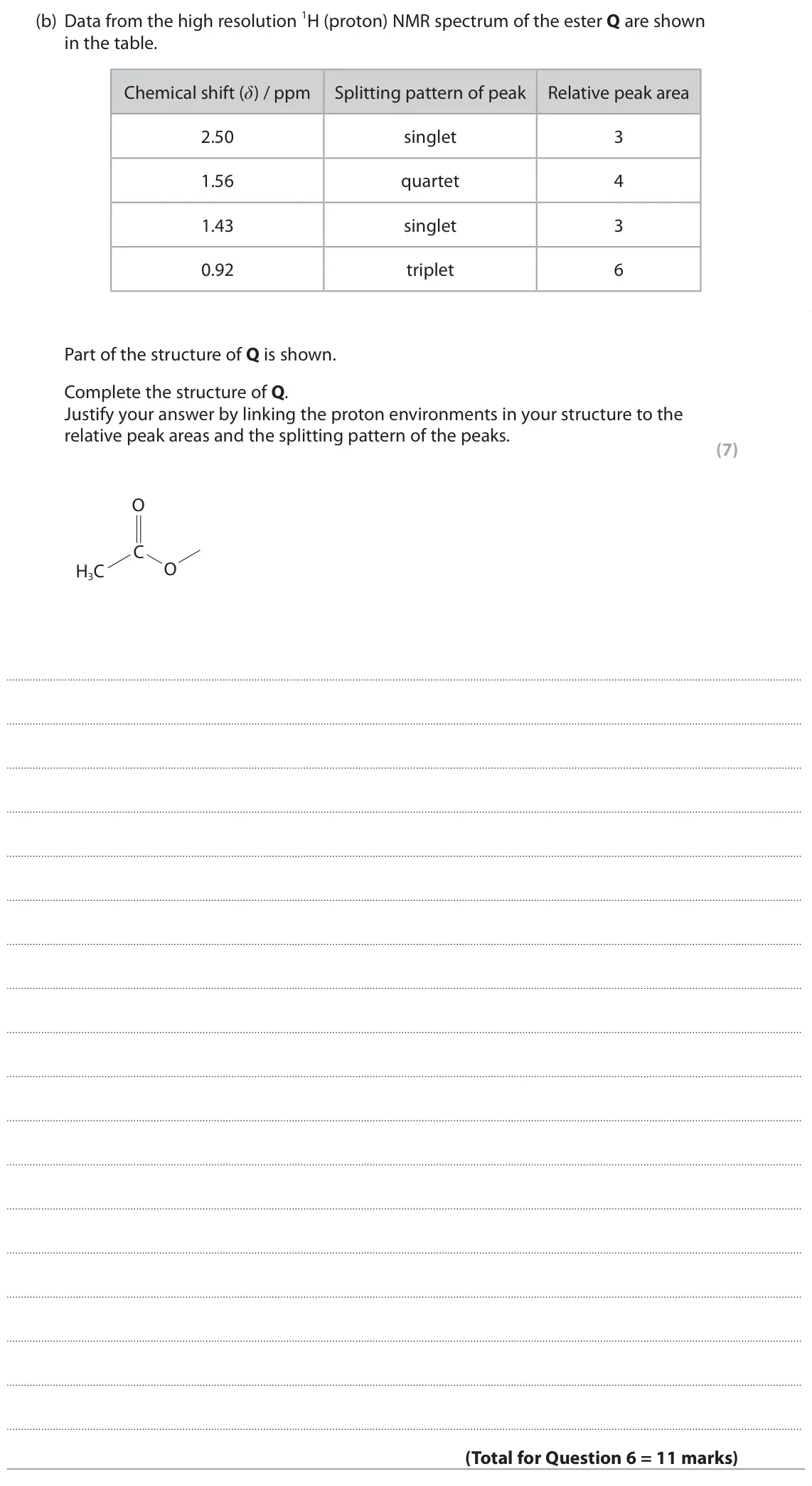
Q9(a)
The whole paper ↗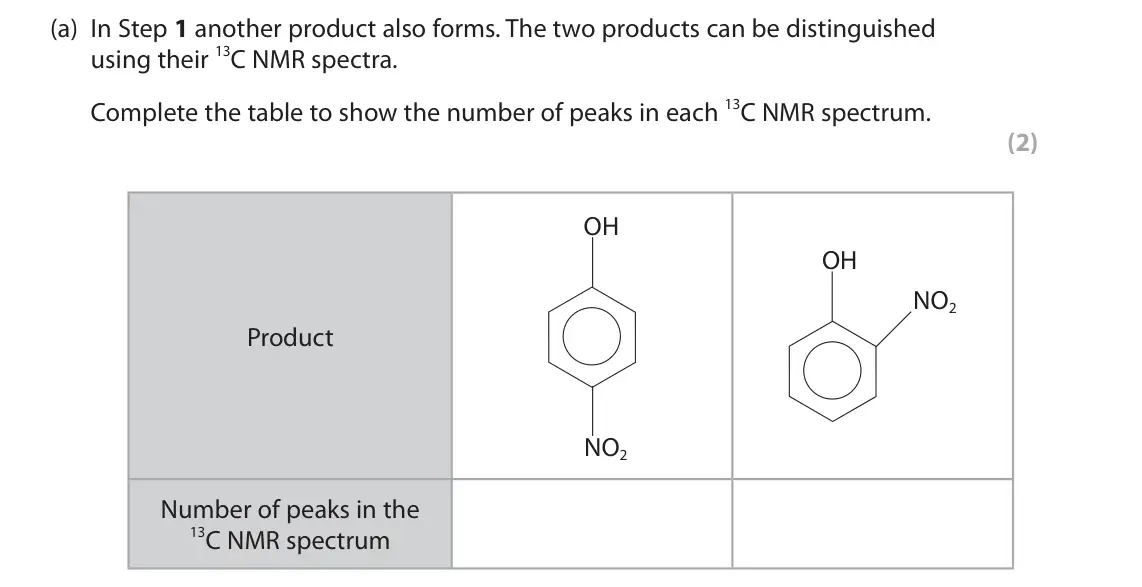
Q8(c)
The whole paper ↗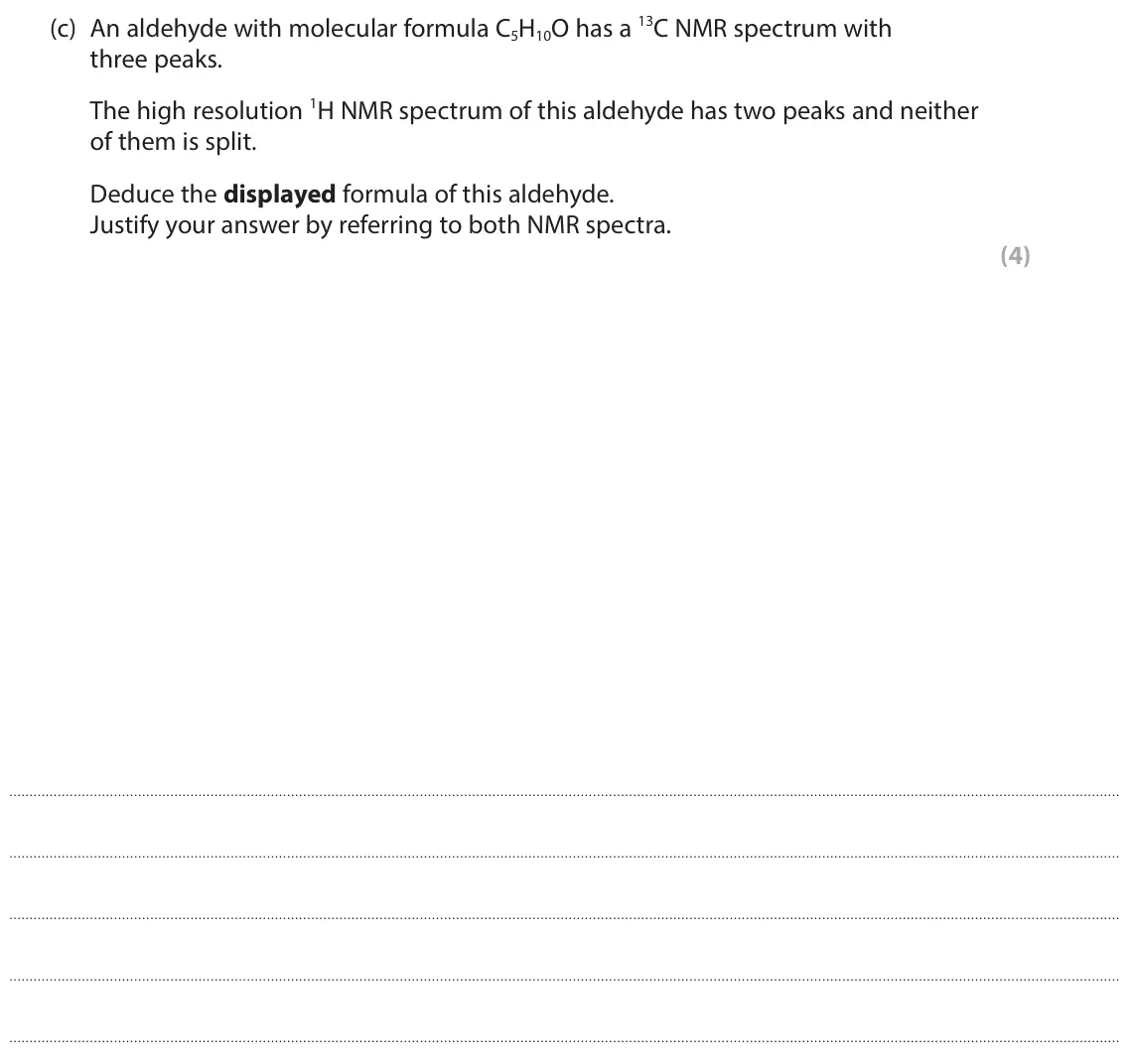
Q8(b)
The whole paper ↗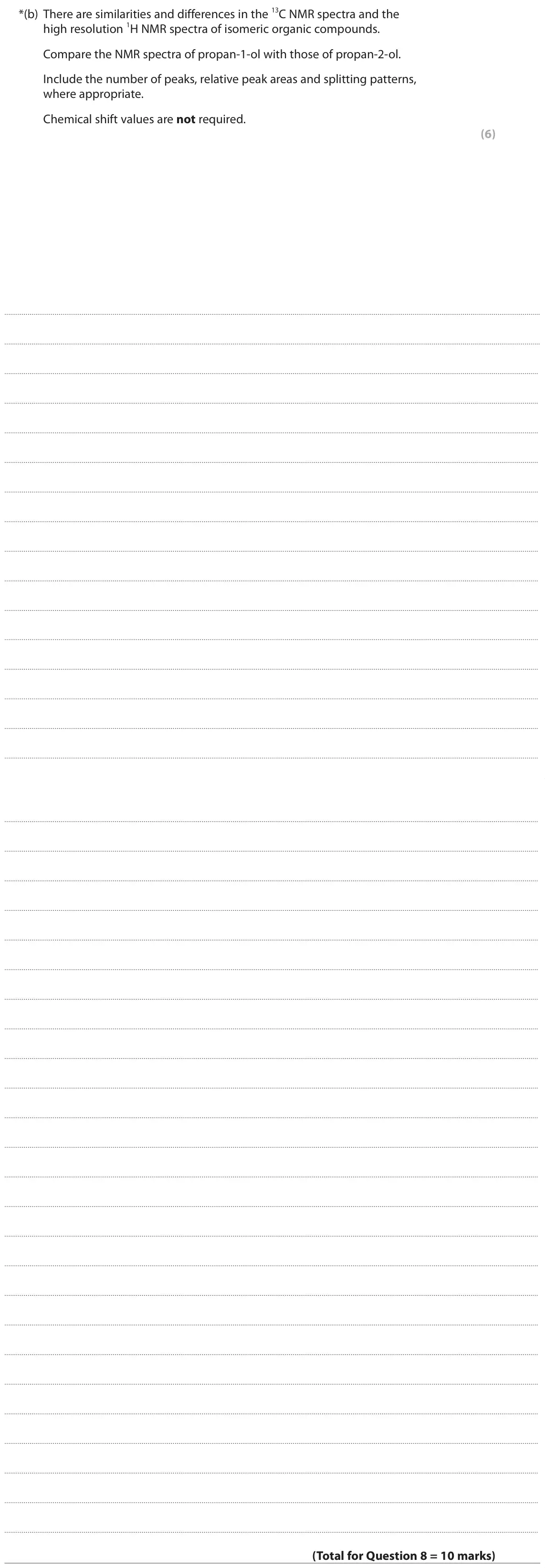
Q6(c)(ii)
The whole paper ↗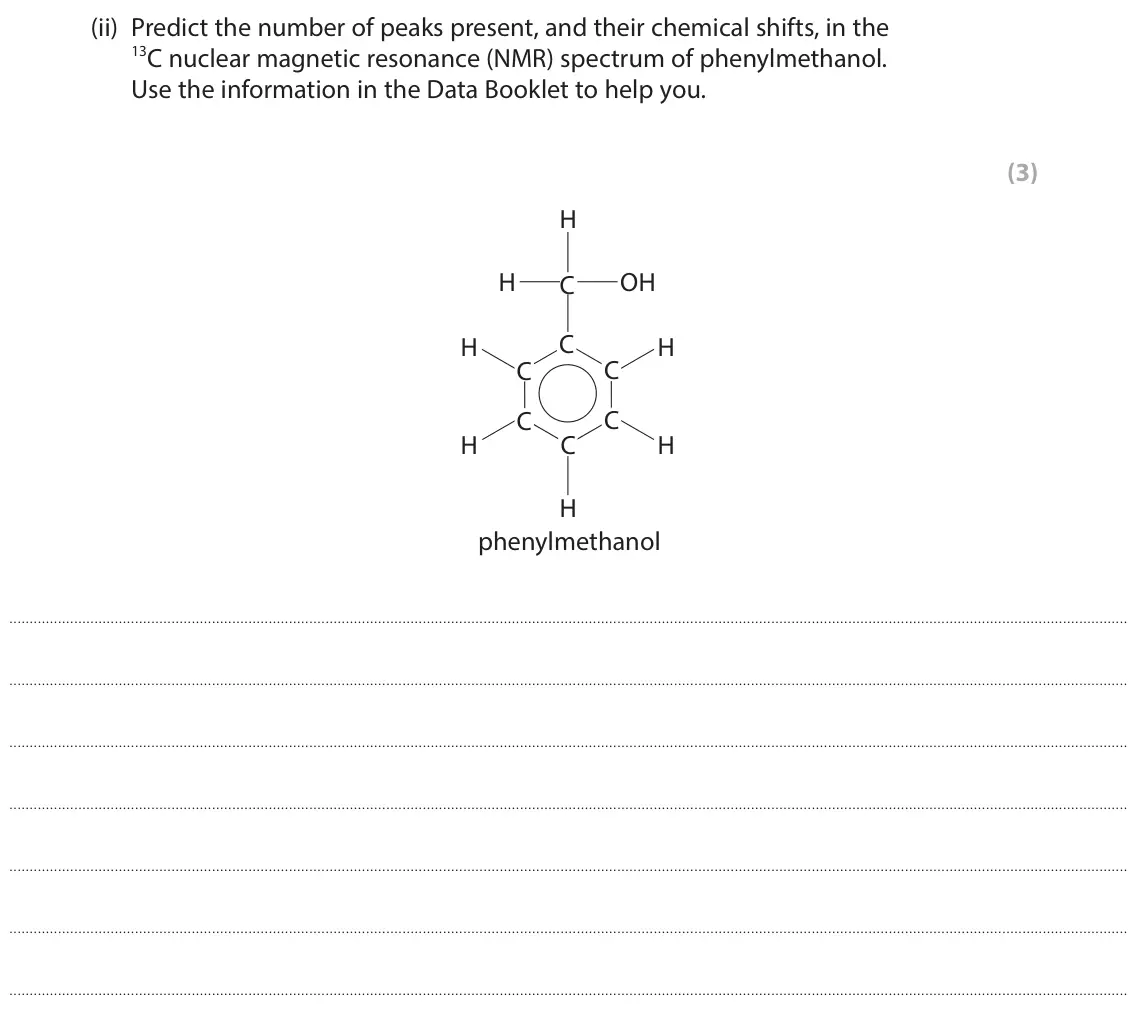
Q4(b)(i)
The whole paper ↗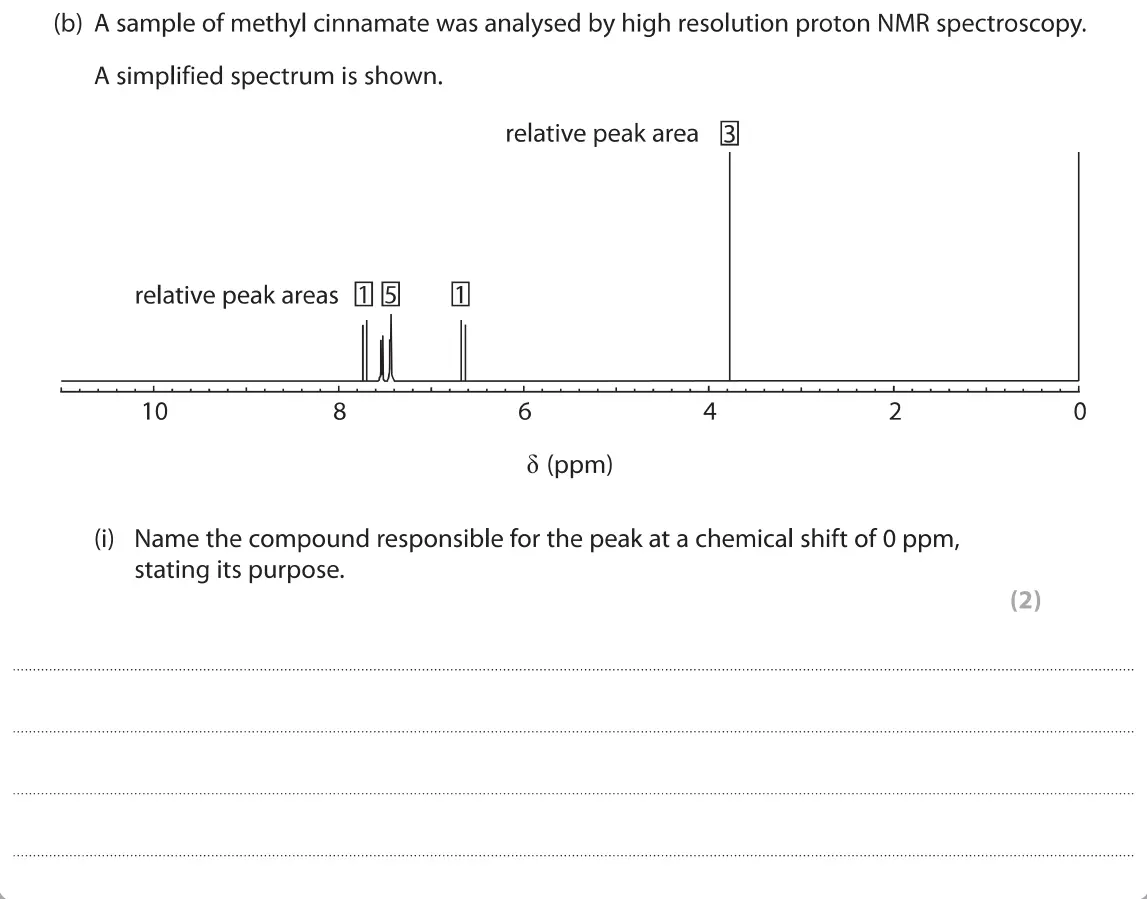
Q4(b)(ii)
The whole paper ↗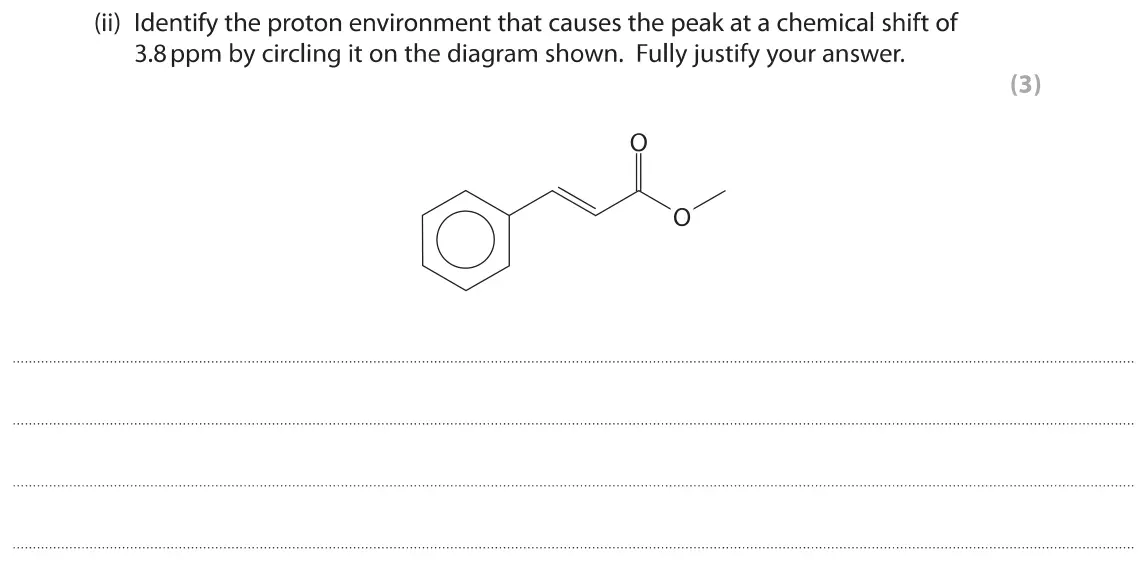
Q10(c)(iii)
The whole paper ↗
All 28 questions on Nuclear magnetic resonance (NMR), as a list
- June 2025, Paper 2, Q8(g) (1 mark): A derivative of anethole is anisaldehyde, which has the structure shown. O O What is the number of peaks in the 13C NMR spectrum of anisaldehyde? (1) A 5 B 6 C
- June 2025, Paper 3, Q6(b) (5 marks): 2-Methyl-1-phenylpropan-2-ol can be converted to compound S. When considering the 1H NMR spectrum of S, the hydrogen atoms of the benzene have been assumed to b
- June 2024, Paper 2, Q6(a) (1 mark): Which part of the electromagnetic spectrum is used in NMR? (1) A infrared B radio waves C ultraviolet D X‑ray
- June 2024, Paper 2, Q6(b) (2 marks): Explain why tetramethylsilane, TMS, is used in NMR spectroscopy. (2)
- June 2024, Paper 2, Q6(c)(ii) (1 mark): Deduce the structure of Q. (1)
- June 2024, Paper 2, Q6(d) (2 marks): Two cyclic alcohols have the structures shown. OH OH OH OH cyclohexane-1,2-diol cyclohexane-1,3-diol Show that the 13C NMR spectra of these compounds can be use
- June 2024, Paper 3, Q6(b)(i) (2 marks): Explain the expected splitting pattern for the peak due to proton environment A circled in the structure. (2)
- June 2024, Paper 3, Q6(b)(ii) (1 mark): Label the structure to indicate the remaining equivalent proton environments in ester Q. (1)
- June 2024, Paper 3, Q6(b)(iii) (3 marks): Predict the chemical shifts, relative peak areas and splitting patterns in the high resolution proton NMR spectrum, due to the proton environments you have labe
- June 2023, Paper 2, Q2(d)(ii) (1 mark): State the number of peaks in the 13C NMR spectrum of propan‑2‑ol. (1)
- June 2023, Paper 2, Q7(c)(iii) (2 marks): These carbonyl compounds may also be identified using modern methods such as proton NMR spectroscopy. The structure of the pentan‑3‑one derivative formed with 2
- June 2022, Paper 2, Q8(a) (1 mark): What is the number of peaks in a 13C NMR spectrum of isoamyl acetate and of amyl acetate? (1) isoamyl acetate amyl acetate A 5 6 B 6 6 C 6 7 D 7 7
- June 2022, Paper 3, Q6(b) (7 marks): Data from the high resolution 1H (proton) NMR spectrum of the ester Q are shown in the table. Chemical shift (δ) / ppm Splitting pattern of peak Relative peak a
- November 2021, Paper 2, Q9(a) (2 marks): In Step 1 another product also forms. The two products can be distinguished using their 13C NMR spectra. Complete the table to show the number of peaks in each
- November 2021, Paper 3, Q8(c) (4 marks): An aldehyde with molecular formula C5H10O has a 13C NMR spectrum with three peaks. The high resolution 1H NMR spectrum of this aldehyde has two peaks and neithe
- October 2020, Paper 2, Q8(b) (6 marks): There are similarities and differences in the 13C NMR spectra and the high resolution 1H NMR spectra of isomeric organic compounds. Compare the NMR spectra of p
- October 2020, Paper 3, Q6(c)(ii) (3 marks): Predict the number of peaks present, and their chemical shifts, in the 13C nuclear magnetic resonance (NMR) spectrum of phenylmethanol. Use the information in t
- June 2019, Paper 2, Q4(b)(i) (2 marks): Name the compound responsible for the peak at a chemical shift of 0 ppm, stating its purpose. (2)
- June 2019, Paper 2, Q4(b)(ii) (3 marks): Identify the proton environment that causes the peak at a chemical shift of 3.8 ppm by circling it on the diagram shown. Fully justify your answer. (3)
- June 2019, Paper 3, Q10(c)(iii) (3 marks): The 13C NMR spectrum of compound D has four peaks. Identify the structure of D. Justify your answer by labelling the different carbon environments in all the st
- June 2018, Paper 3, Q4(a)(i) (1 mark): Give the structural formula of TMS. (1)
- June 2018, Paper 3, Q4(a)(ii) (2 marks): TMS is an inert and non-toxic compound. State two other reasons why TMS is suitable for use as a standard when recording NMR spectra. (2)
- June 2018, Paper 3, Q4(b)(i) (2 marks): Draw the structural formulae of the two esters with formula C6H12O2 that each have only two peaks, both singlets, in their high resolution proton NMR spectra. T
- June 2018, Paper 3, Q4(b)(ii) (5 marks): The high resolution proton NMR spectrum of another isomer of C6H12O2 is shown. 5 4 3 2 1 0 δ / ppm The ratios of the number of protons for the five sets peaks i
- June 2018, Paper 3, Q4(c)(i) (2 marks): There are three other isomers of C6H12O2 which are carboxylic acids with five peaks in their carbon-13 NMR spectra. Draw the structural formula of two of these
- June 2018, Paper 3, Q4(c)(ii) (1 mark): Draw the skeletal formula of a cyclic diol isomer of C6H12O2 that has only two peaks in its carbon-13 NMR spectrum. (1)
- June 2017, Paper 2, Q7(b) (1 mark): What is the number of peaks in a C-13 NMR spectrum of Antifebrin? (1) A 5 B 6 C 7 D 8
- June 2017, Paper 2, Q8(b)(iii) (6 marks): Compare and contrast the high resolution proton NMR spectra of phenylethanone and phenylethanal. You should use the Data Booklet. O C O CH3 C CH2 H Phenylethano
Questions, mark schemes and examiner’s reports are © Pearson Edexcel, from their published past papers. Plumi isn’t affiliated with any exam board. Want whole papers? Every Edexcel A-Level Chemistry paper.
Rather write your answers by hand on iPad? Plumi marks them against the same mark schemes.