 plumi
Entropy: Edexcel A‑Level Chemistry questions
Every Edexcel A-Level Chemistry exam question on 13B Entropy, 2016–2025, with its mark scheme and examiner’s report.
Find questions2,028
Calculations
Q3(c)(i)
The whole paper ↗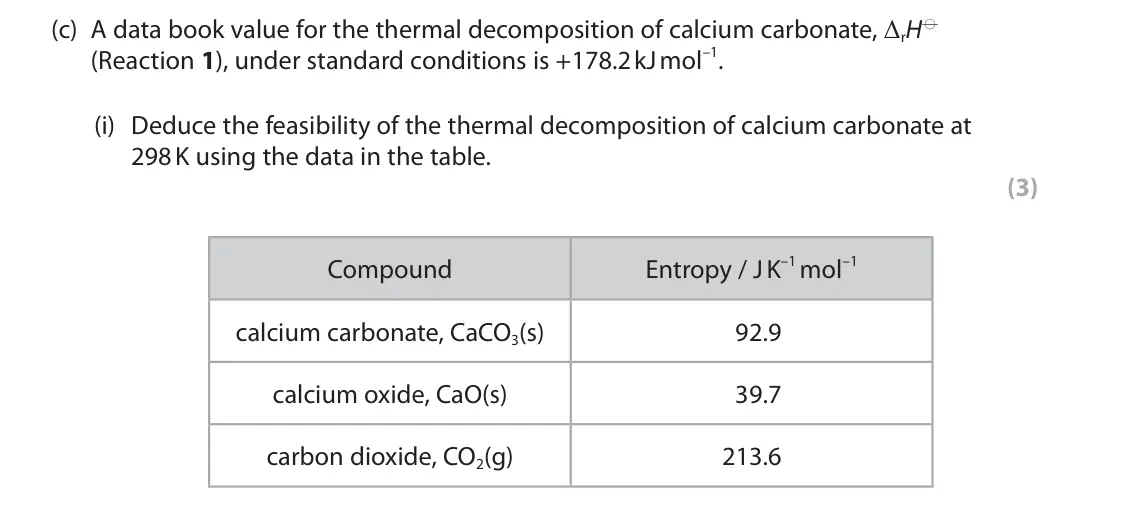
Q3(c)(ii)
The whole paper ↗
Q9(a)
The whole paper ↗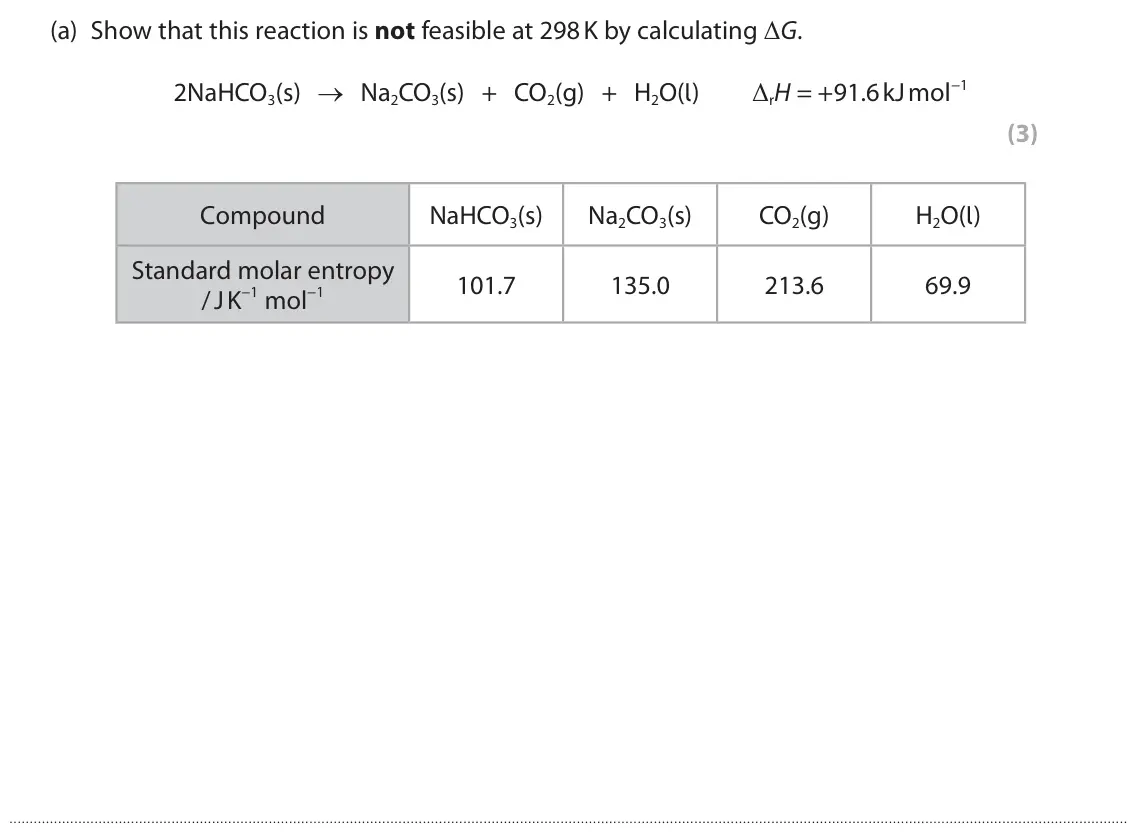
Q9(b)
The whole paper ↗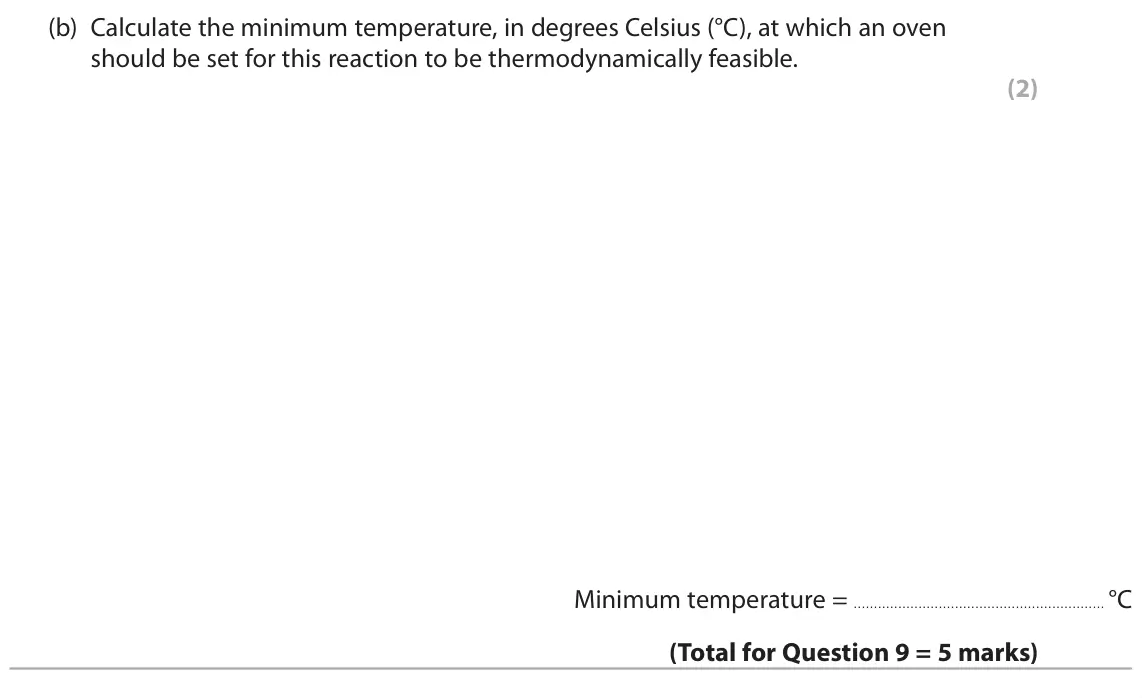
Q4(a)(i)
The whole paper ↗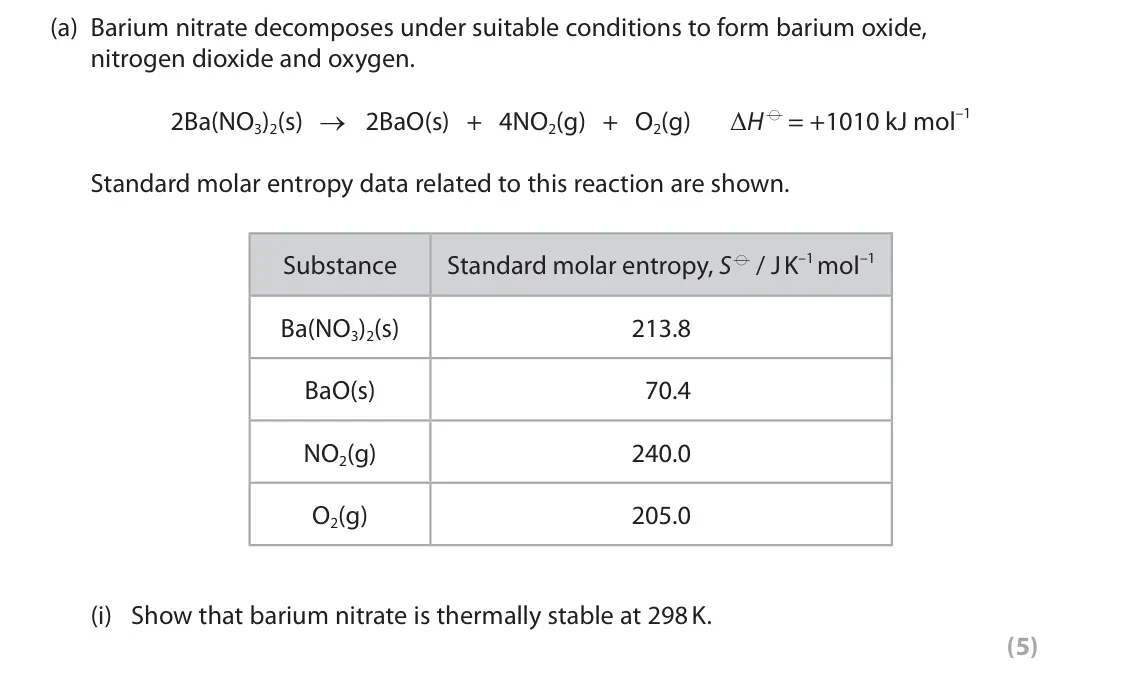
Q4(a)(ii)
The whole paper ↗
Q5(a)(i)
The whole paper ↗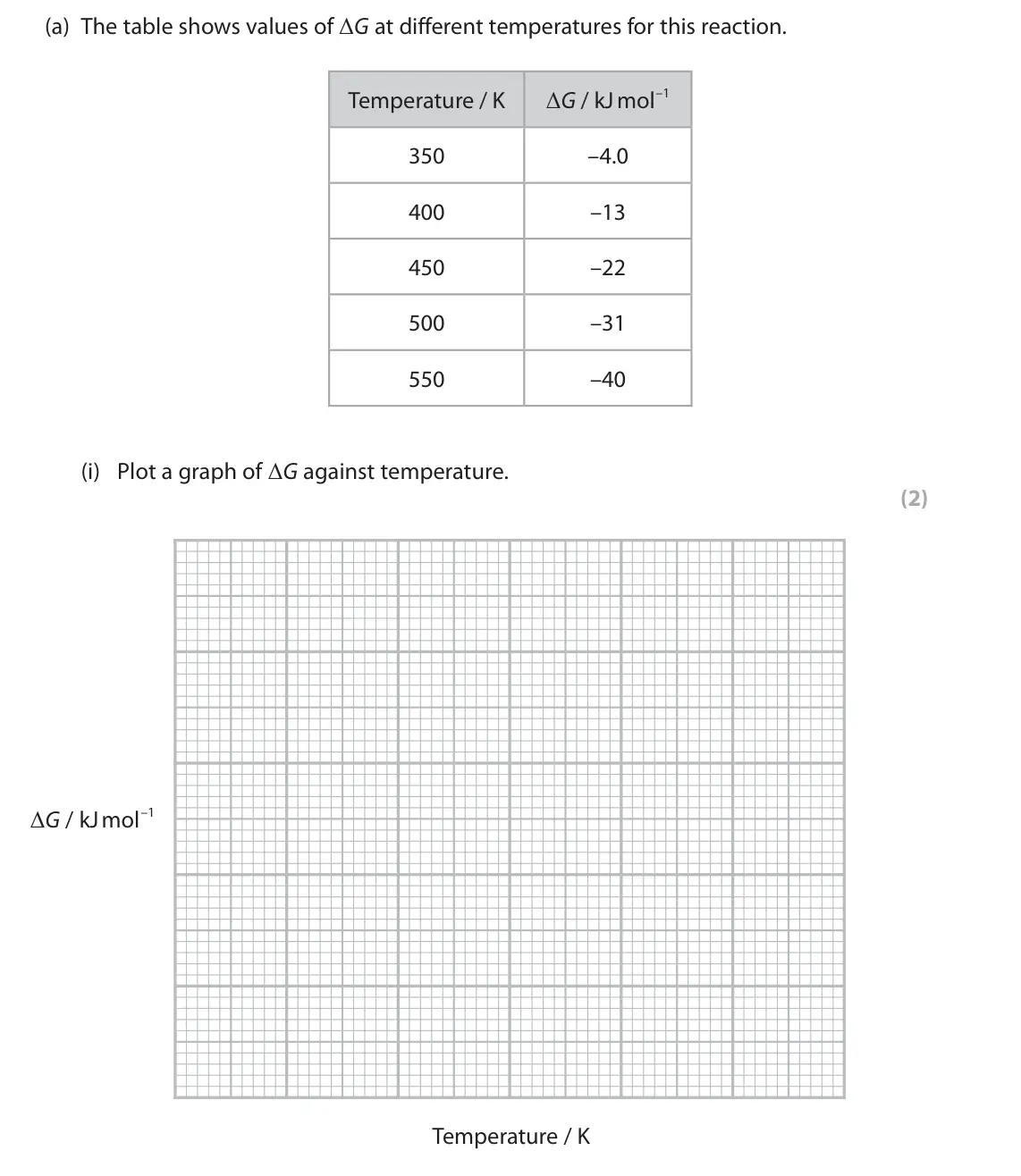
Q5(a)(ii)
The whole paper ↗
Q5(a)(iii)
The whole paper ↗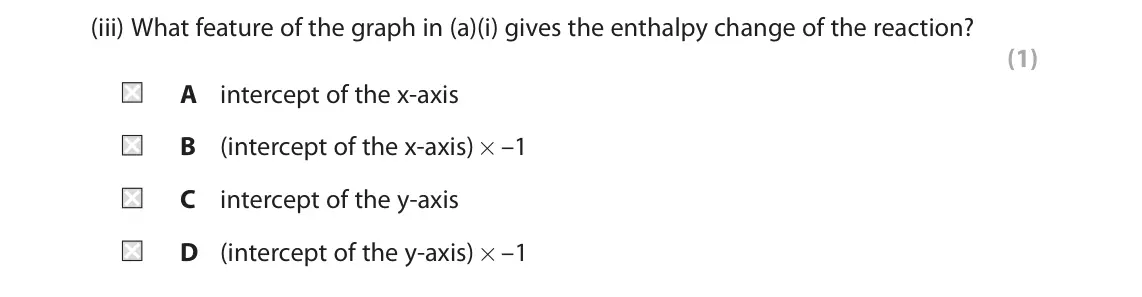
Q10(b)(i)
The whole paper ↗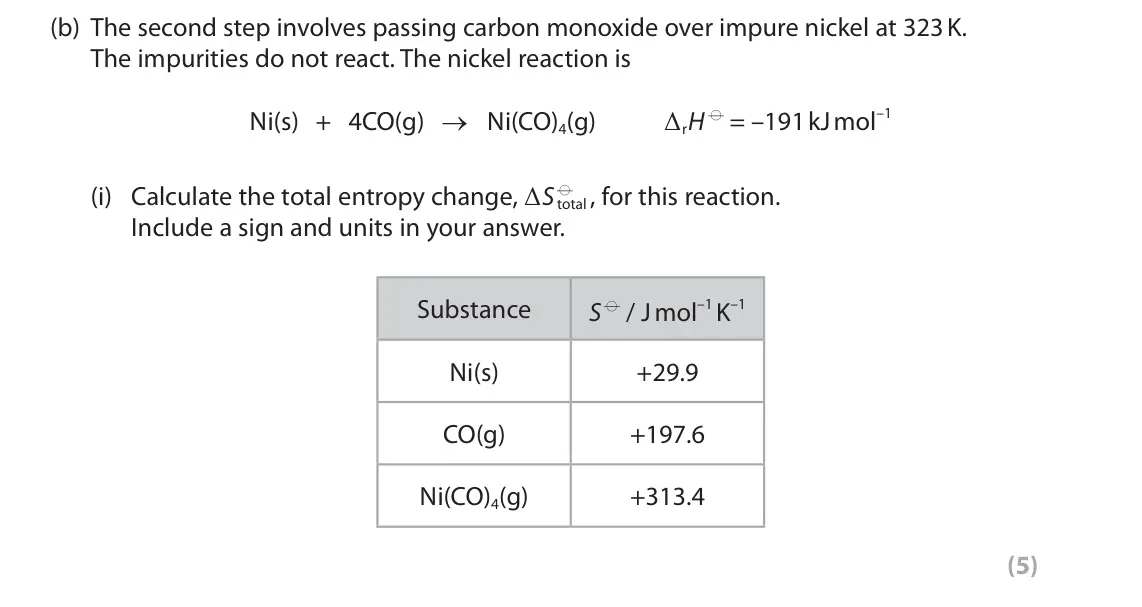
Q10(b)(ii)
The whole paper ↗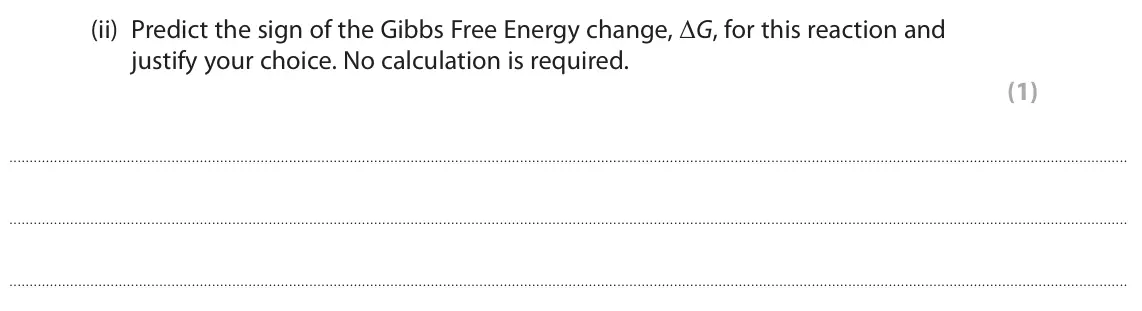
Q10(c)
The whole paper ↗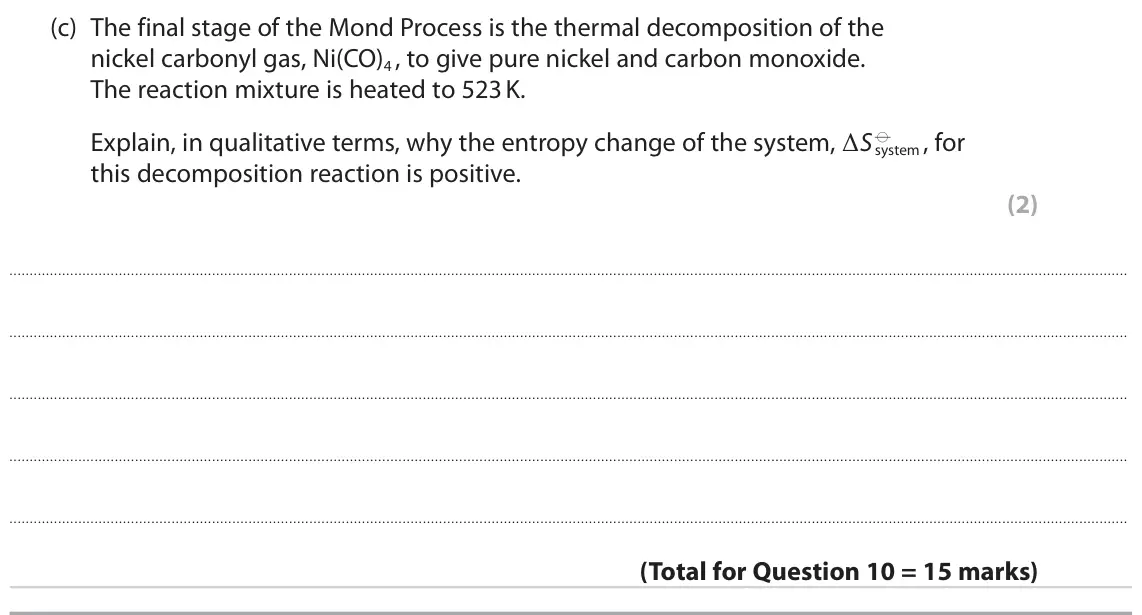
Q4(a)(i)
The whole paper ↗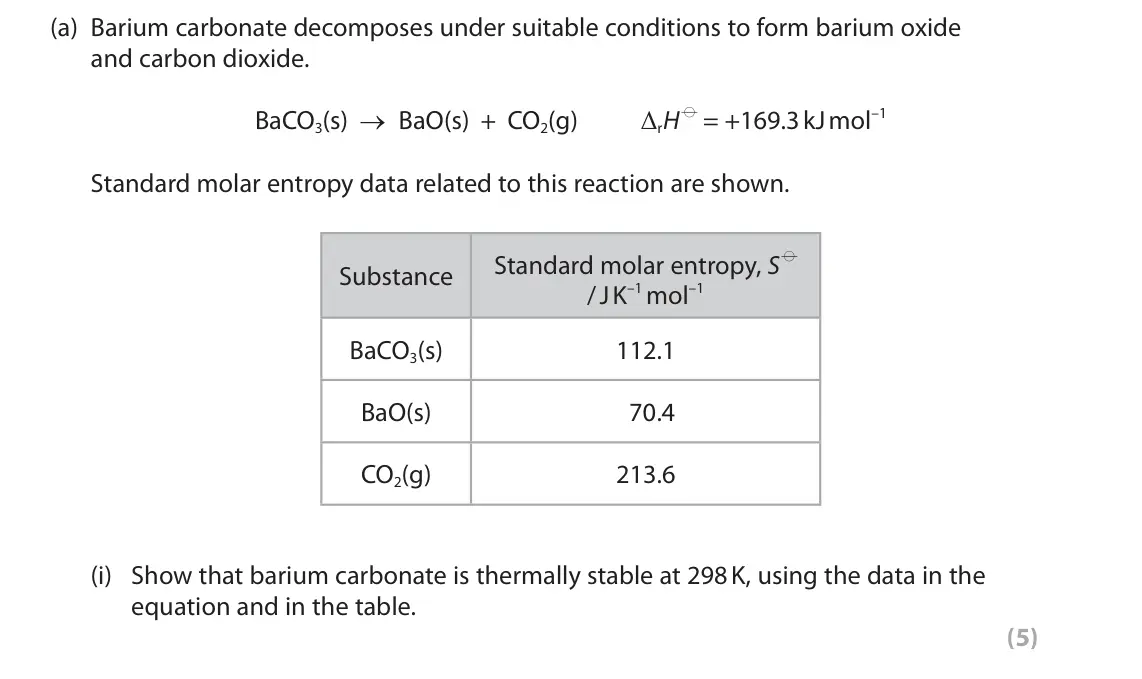
Q4(a)(ii)
The whole paper ↗
Q6(a)(i)
The whole paper ↗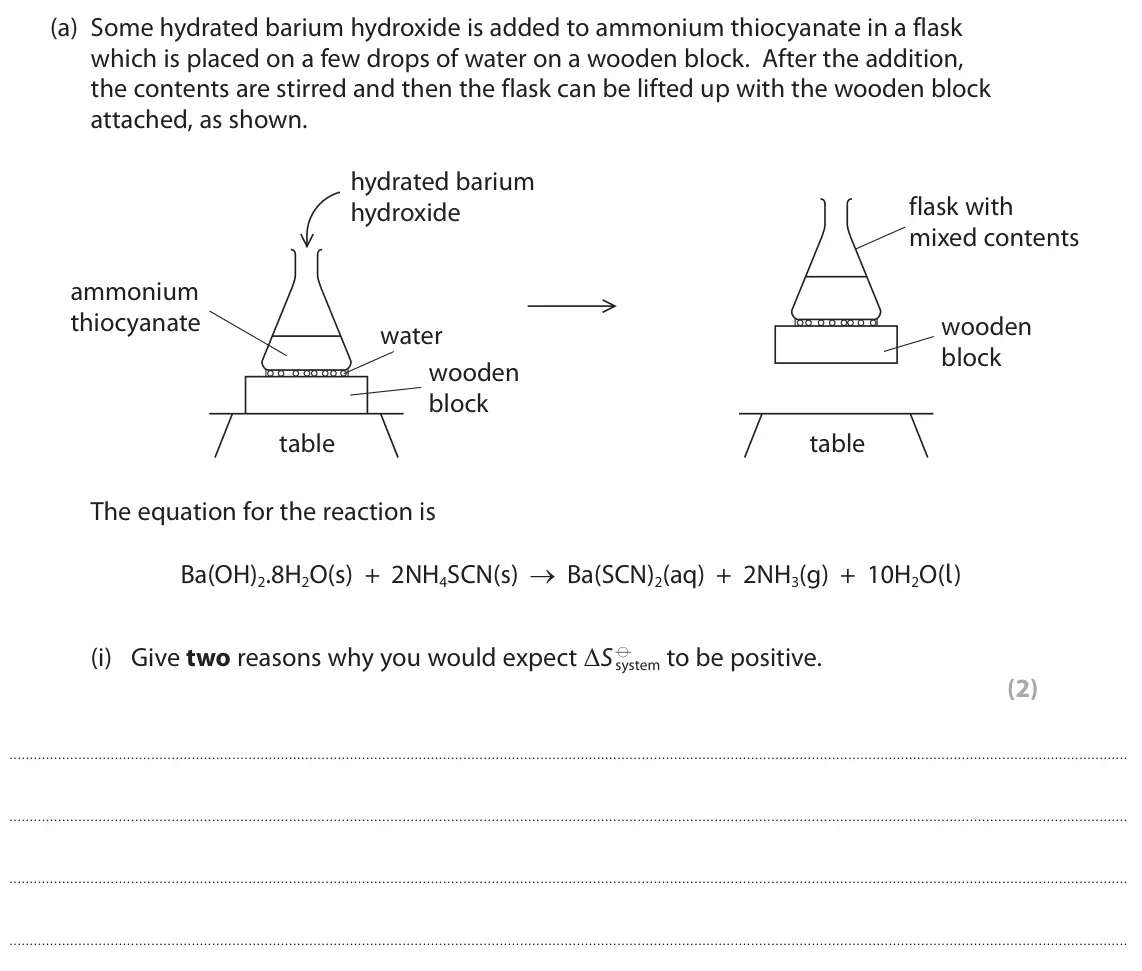
Q6(a)(ii)
The whole paper ↗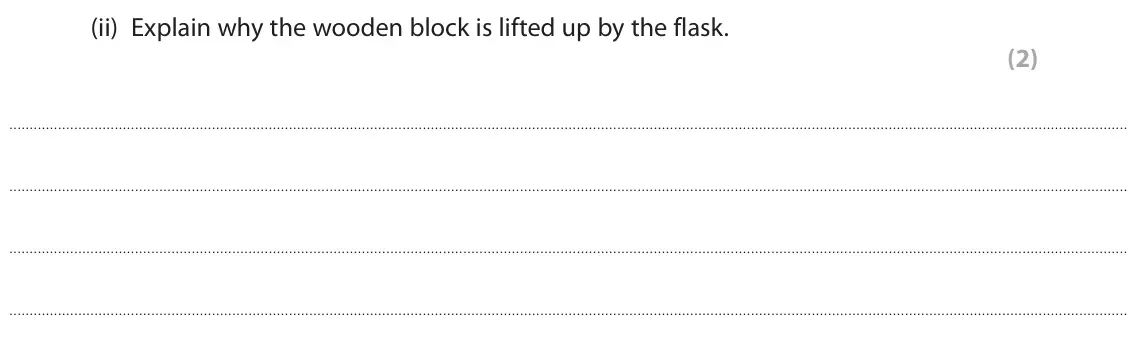
Q6(b)
The whole paper ↗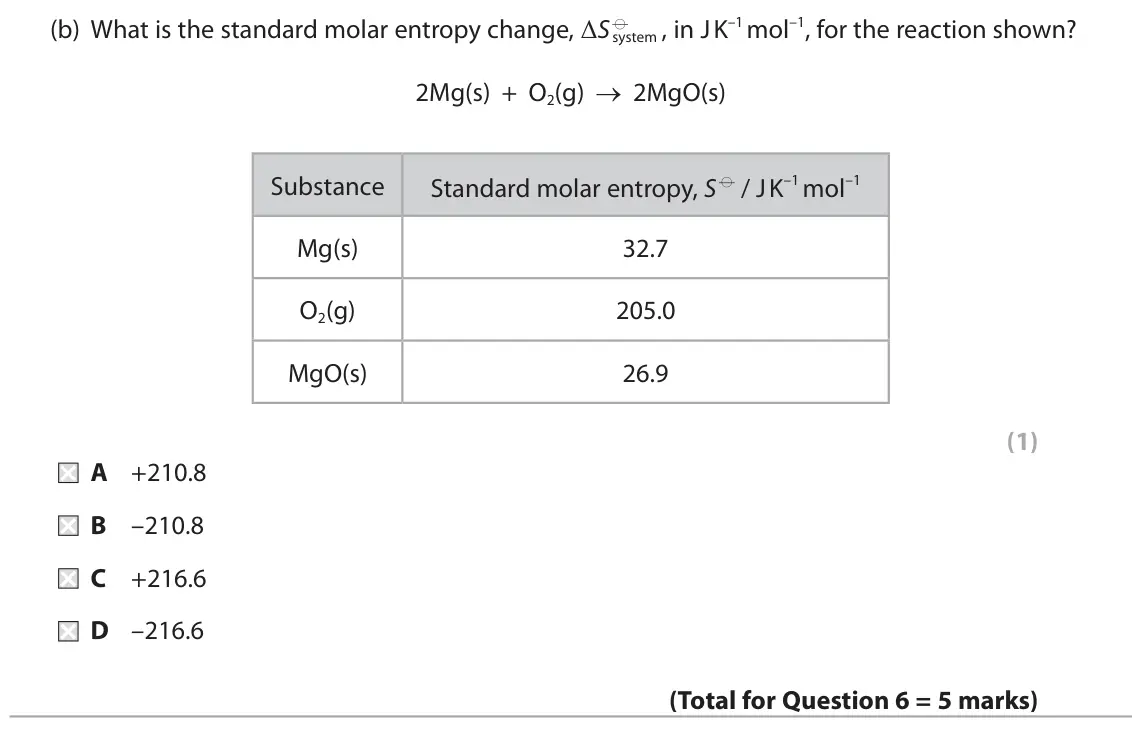
Q3(c)
The whole paper ↗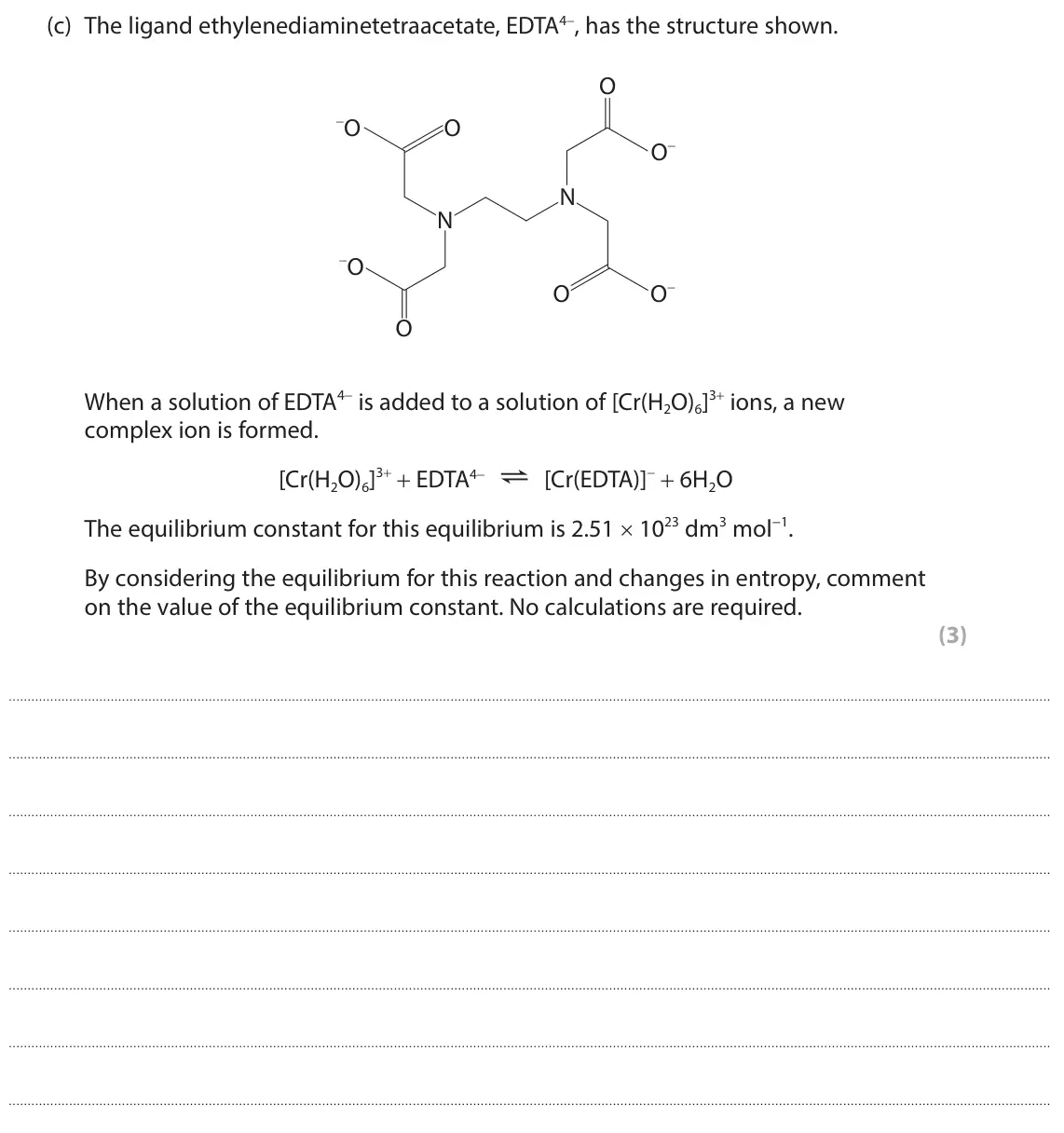
Q6(a)(iii)
The whole paper ↗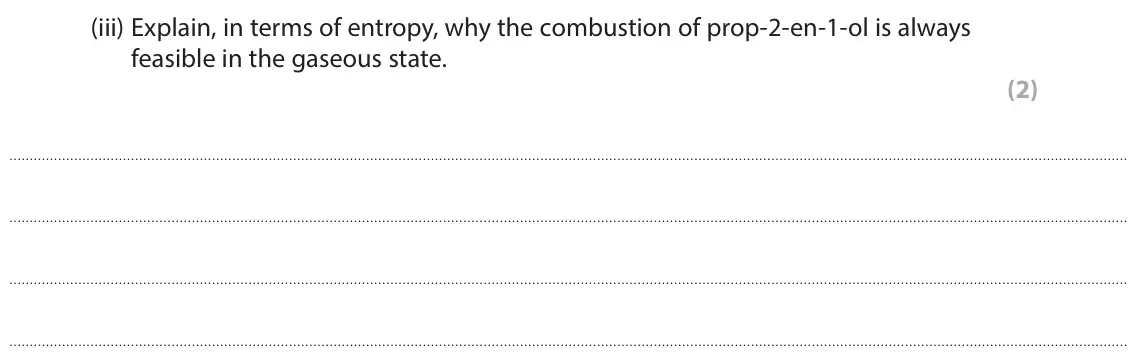
All 30 questions on Entropy, as a list
- June 2025, Paper 1, Q3(c)(i) (3 marks): Deduce the feasibility of the thermal decomposition of calcium carbonate at 298 K using the data in the table. (3) Entropy / J K–1 mol–1 Compound calcium carbon
- June 2025, Paper 1, Q3(c)(ii) (2 marks): Calculate the minimum temperature, in °C, at which thermal decomposition would occur. Give your answer to 3 significant figures. (2)
- June 2024, Paper 1, Q9(a) (3 marks): Show that this reaction is not feasible at 298 K by calculating ΔG. 2NaHCO3(s) → Na2CO3(s) + CO2(g) + H2O(l) ΔrH = +91.6 kJ mol−1 (3) Compound NaHCO3(s) Na2CO3(
- June 2024, Paper 1, Q9(b) (2 marks): Calculate the minimum temperature, in degrees Celsius (°C), at which an oven should be set for this reaction to be thermodynamically feasible. (2) Minimum tempe
- June 2024, Paper 3, Q4(a)(i) (5 marks): Show that barium nitrate is thermally stable at 298 K. (5)
- June 2024, Paper 3, Q4(a)(ii) (3 marks): Calculate the minimum temperature, in °C, at which it is thermodynamically feasible for barium nitrate to decompose. Give your answer to an appropriate number o
- June 2023, Paper 1, Q5(a)(i) (2 marks): Plot a graph of ΔG against temperature. (2) ΔG / kJ mol–1 Temperature / K
- June 2023, Paper 1, Q5(a)(ii) (3 marks): Calculate the entropy change of the system, ΔSsystem , in J K–1 mol–1, using your straight line from the graph in (a)(i) and the equation shown. ΔG = –TΔSsystem
- June 2023, Paper 1, Q5(a)(iii) (1 mark): What feature of the graph in (a)(i) gives the enthalpy change of the reaction? (1) A intercept of the x‑axis B (intercept of the x‑axis) × –1 C intercept of the
- June 2023, Paper 3, Q10(b)(i) (5 marks): Calculate the total entropy change, ΔS d total , for this reaction. Include a sign and units in your answer. Substance S d / J mol–1 K–1 Ni(s) +29.9 CO(g) +197.
- June 2023, Paper 3, Q10(b)(ii) (1 mark): Predict the sign of the Gibbs Free Energy change, ΔG, for this reaction and justify your choice. No calculation is required. (1)
- June 2023, Paper 3, Q10(c) (2 marks): The final stage of the Mond Process is the thermal decomposition of the nickel carbonyl gas, Ni(CO)4 , to give pure nickel and carbon monoxide. The reaction mix
- June 2022, Paper 3, Q4(a)(i) (5 marks): Show that barium carbonate is thermally stable at 298 K, using the data in the equation and in the table. (5)
- June 2022, Paper 3, Q4(a)(ii) (3 marks): Calculate the lowest temperature, in °C, at which it is thermodynamically feasible for barium carbonate to decompose. Give your answer to three significant figu
- November 2021, Paper 1, Q6(a)(i) (2 marks): Give two reasons why you would expect ΔS d system to be positive. (2)
- November 2021, Paper 1, Q6(a)(ii) (2 marks): Explain why the wooden block is lifted up by the flask. (2)
- November 2021, Paper 1, Q6(b) (1 mark): What is the standard molar entropy change, ΔS d system , in J K–1 mol–1, for the reaction shown? 2Mg(s) + O2(g) → 2MgO(s) Substance Standard molar entropy, S d
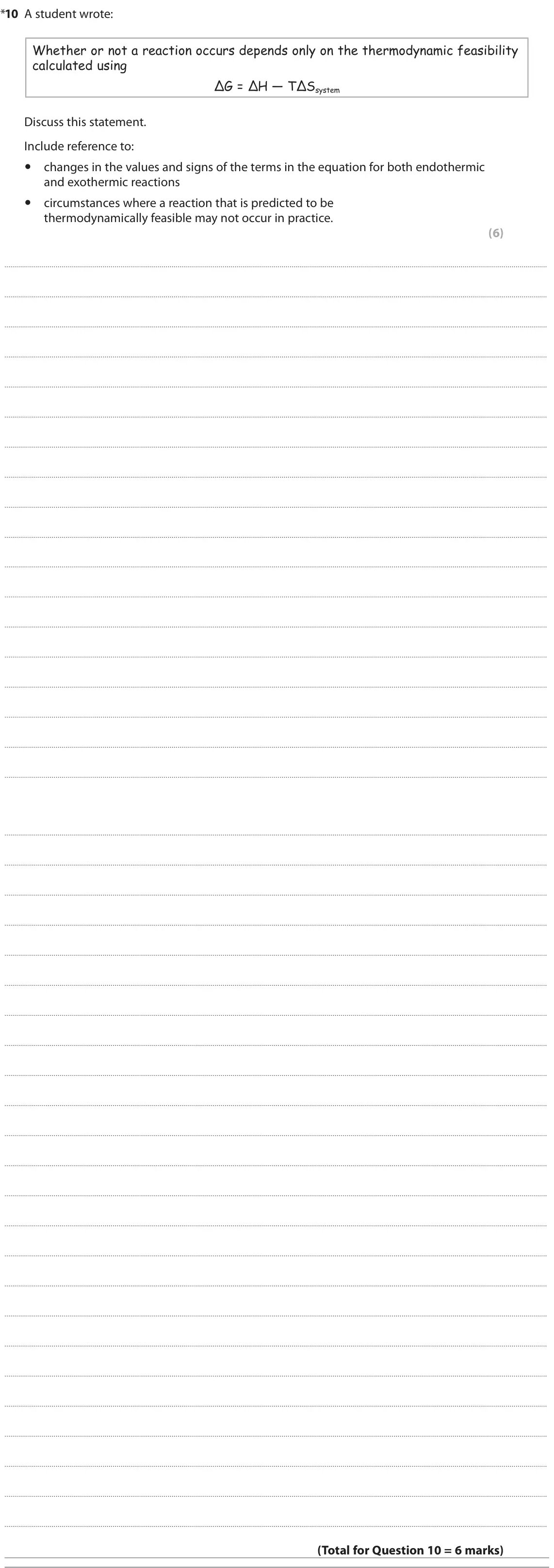
- November 2021, Paper 1, Q10 (6 marks): * A student wrote: Whether or not a reaction occurs depends only on the thermodynamic feasibility calculated using ∆G = ∆H — T∆Ssystem Discuss this statement. I
- October 2020, Paper 1, Q3(c) (3 marks): The ligand ethylenediaminetetraacetate, EDTA4−, has the structure shown. O −O O O− N N −O O− O O When a solution of EDTA4− is added to a solution of [Cr(H2O)6]3
- October 2020, Paper 1, Q6(a)(iii) (2 marks): Explain, in terms of entropy, why the combustion of prop-2-en-1-ol is always feasible in the gaseous state. (2)
- October 2020, Paper 1, Q6(b) (5 marks): Chemists are researching a process to make ethanol and ethene directly from carbon dioxide and water. 4CO2(g) + 5H2O(l) → CH3CH2OH(l) + C2H4(g) + 6O2(g) ∆HO= +2
- October 2020, Paper 3, Q10(a)(iii) (6 marks): Calculate the standard molar entropy of ethyl ethanoate using your knowledge of Gibbs free energy, ∆G, and the data in the table. Include sign and units in your
- June 2019, Paper 1, Q8(b)(i) (2 marks): Deduce the feasibility of this reaction at 298 K by calculating the free energy change, ¨G. (2)
- June 2019, Paper 1, Q8(b)(ii) (1 mark): Calculate the temperature at which ¨G = 0. (1)
- June 2018, Paper 1, Q9(a) (2 marks): Complete the table by giving the sign of the entropy change of the system, ∆Ssystem , for each reaction. (2) Sign of ∆Ssystem Reaction CO2(s) → CO2(g) NaCl(s) +
- June 2018, Paper 1, Q9(b) (8 marks): Calculate the total entropy change, ∆Stotal, for the thermal decomposition of calcium carbonate at 298 K. CaCO3(s) → CaO(s) + CO2(g) [Data: ∆rH = +178 kJ mol−1
- June 2017, Paper 1, Q4(c)(ii) (2 marks): Explain, in terms of entropy, why this reaction is feasible. (2)
- June 2017, Paper 1, Q5(c) (1 mark): Which reaction has a negative value for ¨Ssystem? (1) A 2Cu(s) + O2(g) r 2CuO(s) B 2H2O2(l) r 2H2O(l) + O2(g) C MgCO3(s) + H2SO4(aq) r MgSO4(aq) + H2O(l) + CO2(
- June 2017, Paper 1, Q5(d) (1 mark): What is the expression for ¨Stotal? (1) A ¨Ssurroundings + ¨H– T B ¨Ssurroundings – ¨H– T C ¨Ssystem + ¨H– T D ¨Ssystem – ¨H– T
- June 2017, Paper 1, Q5(e) (3 marks): Calcium carbonate decomposes on heating. CaCO3(s) r CaO(s) + CO2(g) ¨rH = +178 kJ mol–1 ¨Ssystem = +165 J mol–1 K–1 Show, by calculating the value for the free
Questions, mark schemes and examiner’s reports are © Pearson Edexcel, from their published past papers. Plumi isn’t affiliated with any exam board. Want whole papers? Every Edexcel A-Level Chemistry paper.
Rather write your answers by hand on iPad? Plumi marks them against the same mark schemes.