 plumi
Principles of transition metal chemistry: Edexcel A‑Level Chemistry questions
Every Edexcel A-Level Chemistry exam question on 15A Principles of transition metal chemistry, 2016–2025, with its mark scheme and examiner’s report.
Find questions2,028
Calculations
Q6(a)(i)
The whole paper ↗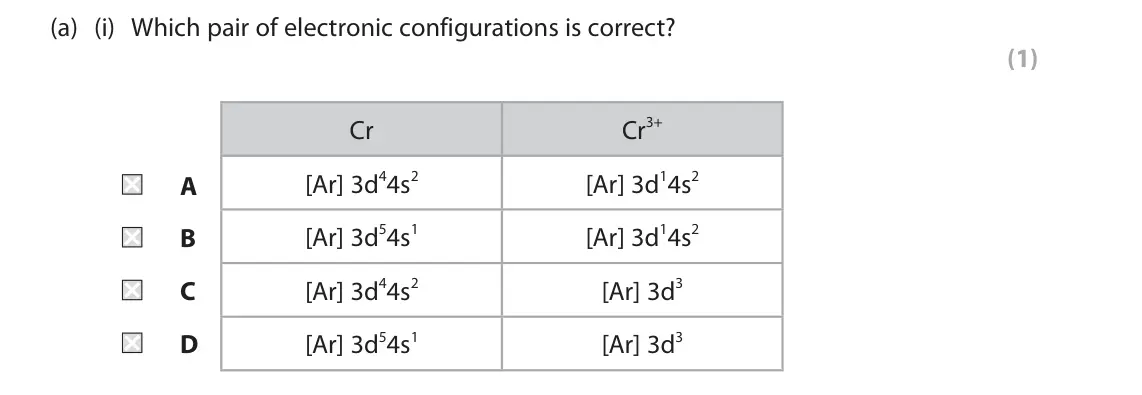
Q6(a)(ii)
The whole paper ↗
Q6(b)(i)
The whole paper ↗
Q6(b)(ii)
The whole paper ↗
Q6(e)(i)
The whole paper ↗
Q6(e)(ii)
The whole paper ↗
Q5(a)(iii)
The whole paper ↗
Q5(b)(ii)
The whole paper ↗
Q7(c)(i)
The whole paper ↗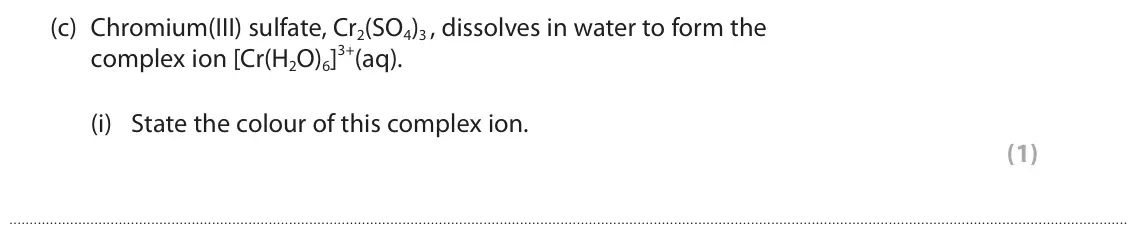
Q7(c)(i)
The whole paper ↗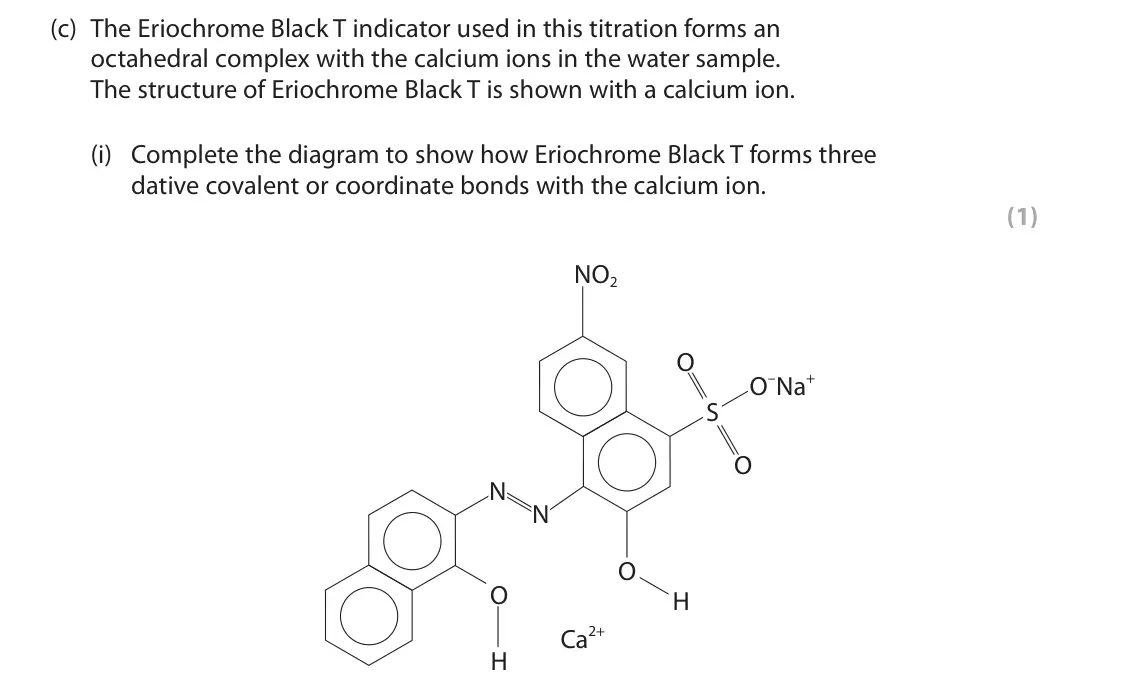
Q7(c)(ii)
The whole paper ↗
Q10(a)
The whole paper ↗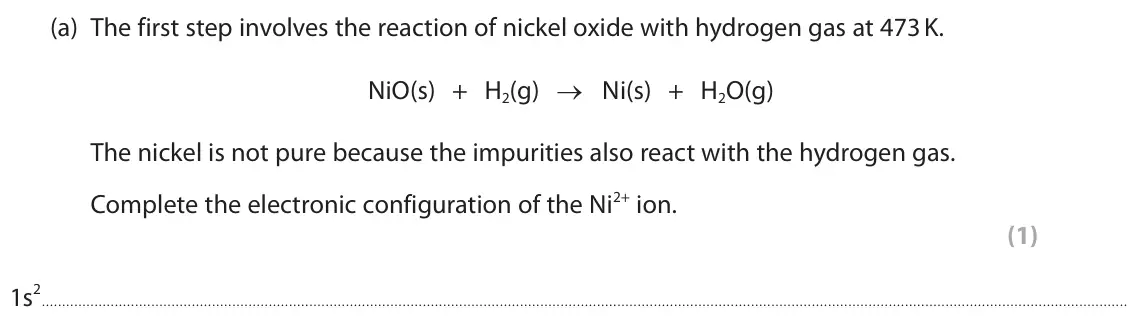
Q7(a)
The whole paper ↗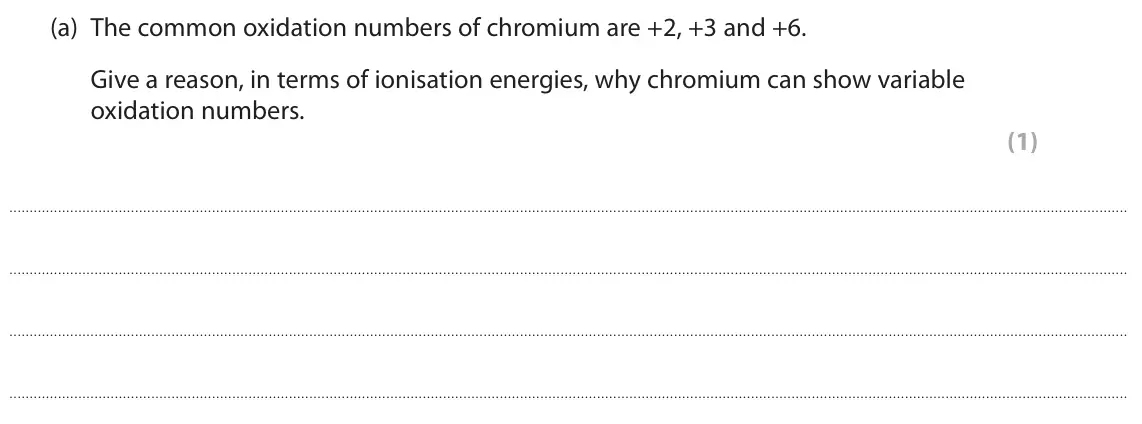
Q7(c)(iv)
The whole paper ↗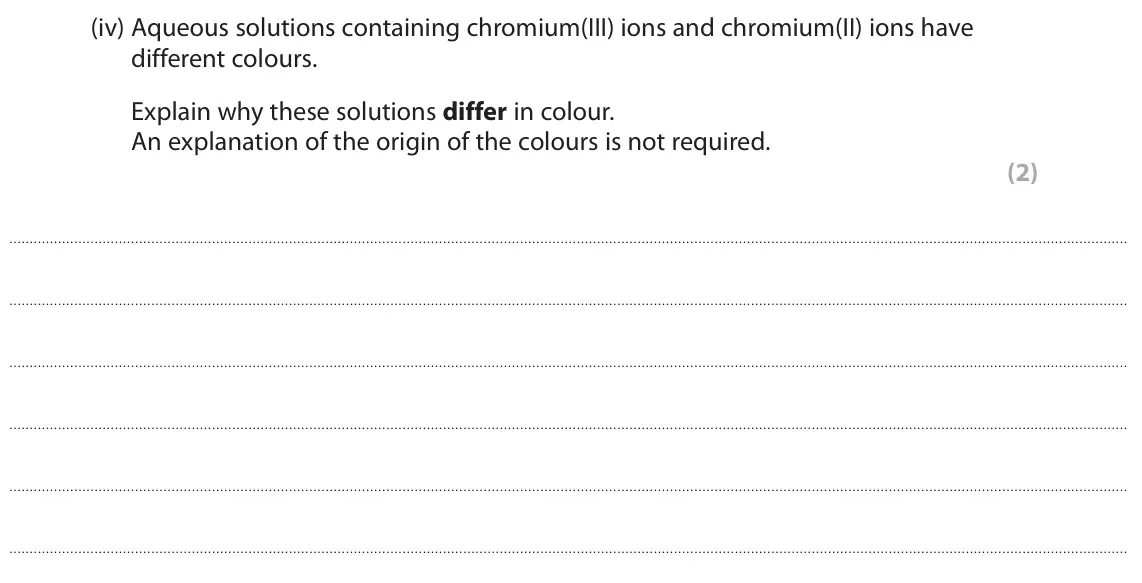
Q2(a)(i)
The whole paper ↗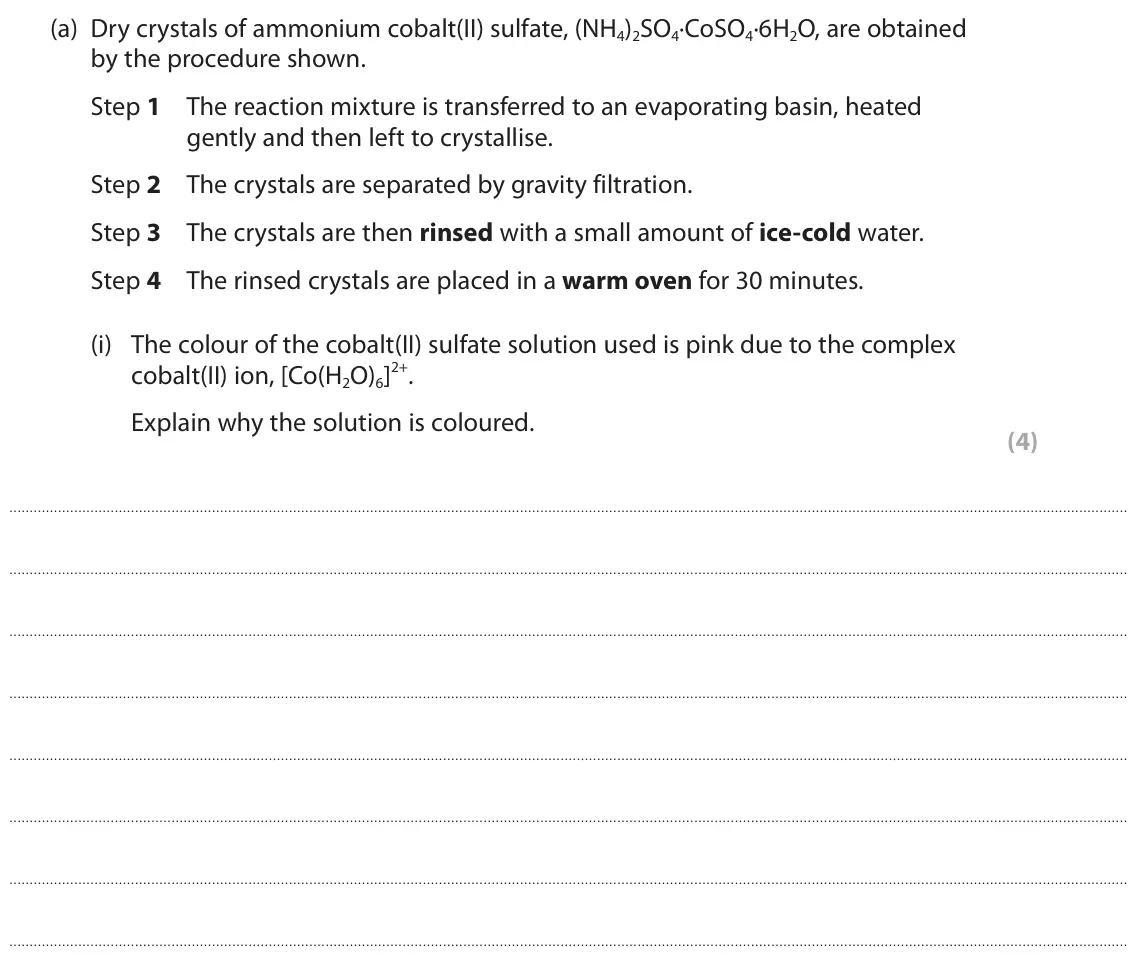
Q8(a)(i)
The whole paper ↗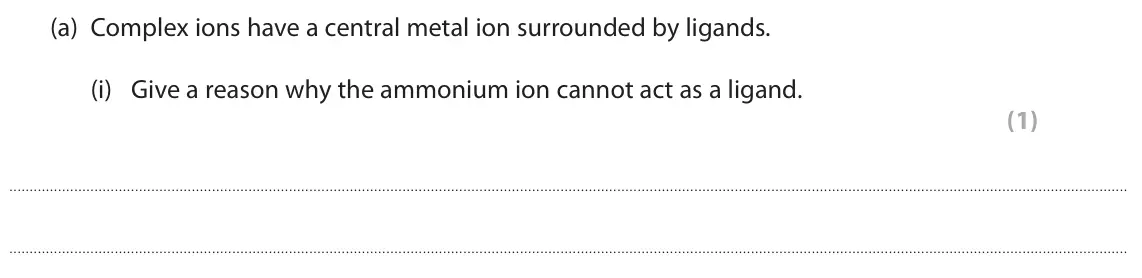
Q8(a)(ii)
The whole paper ↗
Q8(b)
The whole paper ↗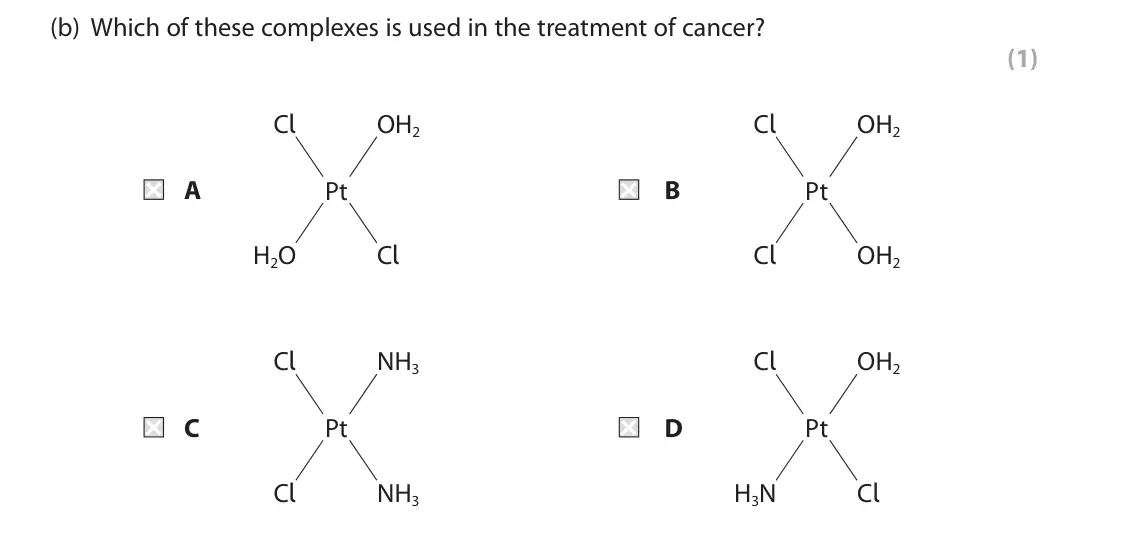
Q8(c)
The whole paper ↗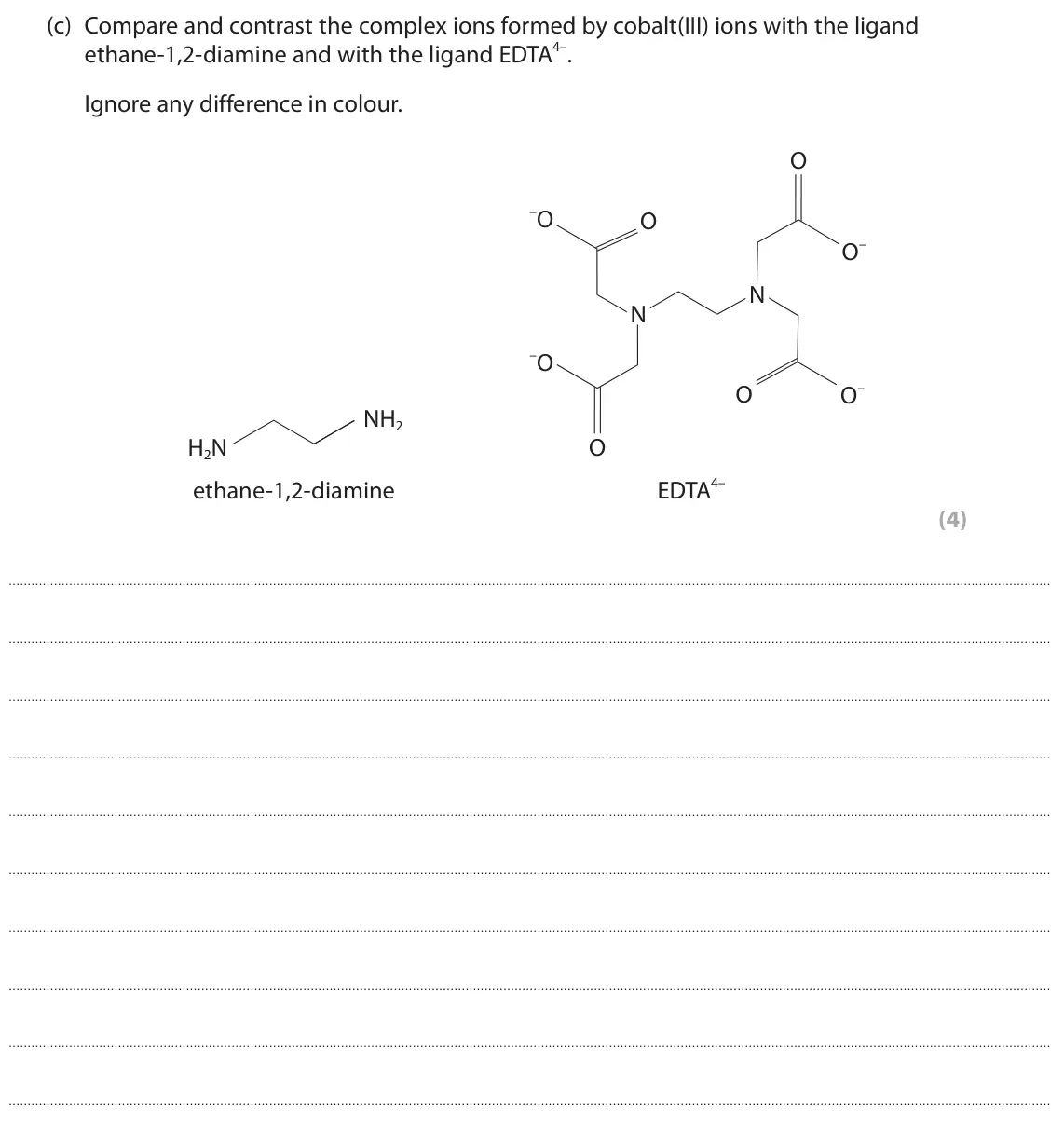
All 42 questions on Principles of transition metal chemistry, as a list
- June 2025, Paper 1, Q6(a)(i) (1 mark): Which pair of electronic configurations is correct? (1) Cr3+ Cr [Ar] 3d44s2 [Ar] 3d14s2 A [Ar] 3d54s1 [Ar] 3d14s2 B [Ar] 3d44s2 [Ar] 3d3 C D [Ar] 3d54s1 [Ar] 3d
- June 2025, Paper 1, Q6(a)(ii) (1 mark): State why chromium is classified as a transition metal. (1)
- June 2025, Paper 1, Q6(b)(i) (2 marks): Draw the structure of the complex ion, [Cr(H2O)6]3+(aq), showing clearly its 3‑dimensional shape, and the bonds between the chromium ion and the water ligands.
- June 2025, Paper 1, Q6(b)(ii) (1 mark): Name the shape of the [Cr(H2O)6]3+(aq) complex ion. (1)
- June 2025, Paper 1, Q6(e)(i) (4 marks): Explain why aqueous solutions of [Cr(H2O)6]3+ are coloured. (4)
- June 2025, Paper 1, Q6(e)(ii) (1 mark): Give the reason why the solutions of [Cr(H2O)6]3+ and [CrCl4]– are different colours. (1)
- June 2025, Paper 3, Q5(a)(iii) (3 marks): Draw the three-dimensional shape of the complex ion, Q, using your answer to (a)(ii) to help deduce the formula and overall charge. (3)
- June 2025, Paper 3, Q5(b)(ii) (3 marks): Explain, in terms of equilibria and entropy, which of the three complex ions is the most stable. (3)
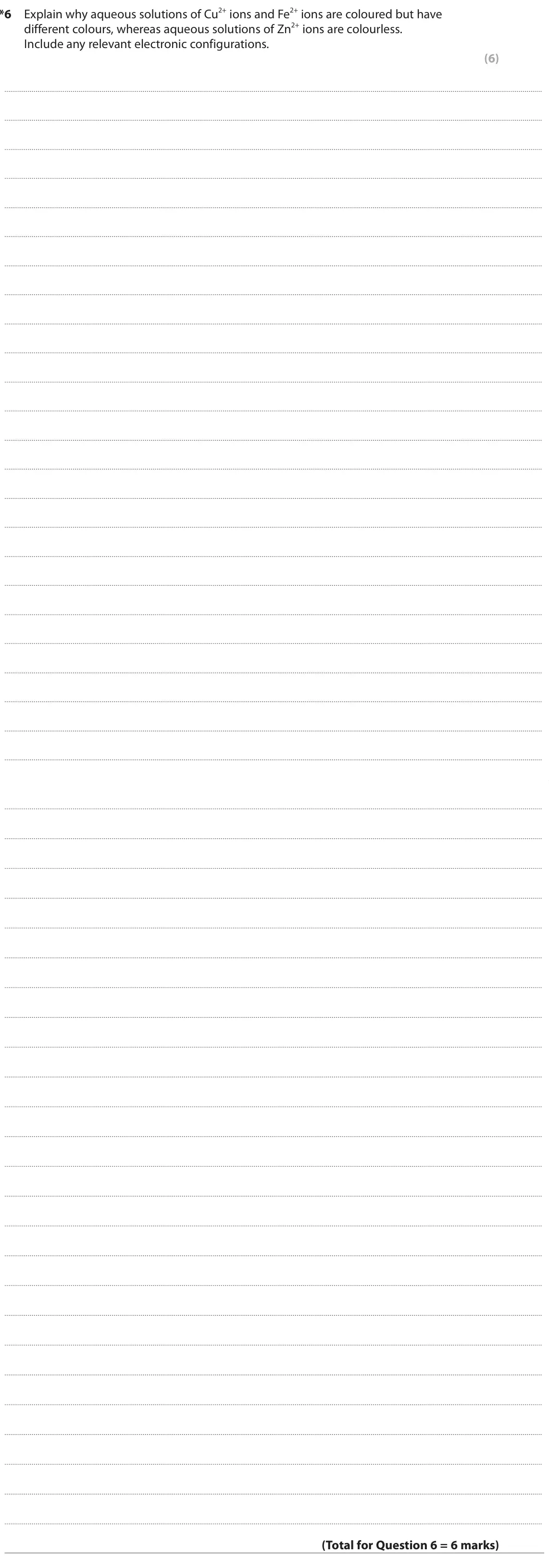
- June 2024, Paper 1, Q6 (6 marks): *6 Explain why aqueous solutions of Cu2+ ions and Fe2+ ions are coloured but have different colours, whereas aqueous solutions of Zn2+ ions are colourless. Incl
- June 2023, Paper 1, Q7(c)(i) (1 mark): State the colour of this complex ion. (1)
- June 2023, Paper 3, Q7(c)(i) (1 mark): Complete the diagram to show how Eriochrome Black T forms three dative covalent or coordinate bonds with the calcium ion. (1) NO2 O O–Na+ S O N N O O H Ca2+ H
- June 2023, Paper 3, Q7(c)(ii) (1 mark): State the number of water molecules needed to complete this complex. (1)
- June 2023, Paper 3, Q10(a) (1 mark): The first step involves the reaction of nickel oxide with hydrogen gas at 473 K. NiO(s) + H2(g) → Ni(s) + H2O(g) The nickel is not pure because the impurities a
- June 2022, Paper 1, Q7(a) (1 mark): The common oxidation numbers of chromium are +2, +3 and +6. Give a reason, in terms of ionisation energies, why chromium can show variable oxidation numbers. (1
- June 2022, Paper 1, Q7(c)(iv) (2 marks): Aqueous solutions containing chromium(III) ions and chromium(II) ions have different colours. Explain why these solutions differ in colour. An explanation of th
- June 2022, Paper 3, Q2(a)(i) (4 marks): The colour of the cobalt(II) sulfate solution used is pink due to the complex cobalt(II) ion, [Co(H2O)6]2+. Explain why the solution is coloured. (4)
- November 2021, Paper 1, Q8(a)(i) (1 mark): Give a reason why the ammonium ion cannot act as a ligand. (1)
- November 2021, Paper 1, Q8(a)(ii) (4 marks): Explain why the complex ions [Co(NH3)6]2+ and [Co(H2O)6]2+ are coloured and have different colours. (4)
- November 2021, Paper 1, Q8(b) (1 mark): Which of these complexes is used in the treatment of cancer? (1) Cl Cl OH2 OH2 A B Pt Pt H2O Cl Cl OH2 Cl NH3 Cl OH2 C D Pt Pt Cl NH3 H3N Cl
- November 2021, Paper 1, Q8(c) (4 marks): Compare and contrast the complex ions formed by cobalt(III) ions with the ligand ethane‑1,2‑diamine and with the ligand EDTA4–. Ignore any difference in colour.
- November 2021, Paper 1, Q8(d) (2 marks): Hydrated chromium(III) chloride, CrCl3.6H2O, dissolves in water to form a number of different complex ions containing both chloride and water ligands. The gener
- October 2020, Paper 1, Q1(e) (4 marks): A student stated that ‘the elements scandium and zinc are d-block elements but are not transition metals’. Discuss this statement, using appropriate electronic
- October 2020, Paper 1, Q3(b)(i) (1 mark): Give the shape of this complex ion. (1)
- October 2020, Paper 1, Q3(b)(ii) (3 marks): Explain why the chromium complex ion is coloured. (3)
- October 2020, Paper 1, Q3(c) (3 marks): The ligand ethylenediaminetetraacetate, EDTA4−, has the structure shown. O −O O O− N N −O O− O O When a solution of EDTA4− is added to a solution of [Cr(H2O)6]3
- October 2020, Paper 3, Q7 (6 marks): *7 “Cobalt(II) ions combine with substances in solution to form complex ions with different coordination numbers.” Discuss this statement by referring to two co
- June 2019, Paper 1, Q7 (6 marks): *7 Colour is often used in chemistry to identify substances. Compare and contrast the origin of the colour of a copper(II) complex with the origin of the colour
- June 2019, Paper 3, Q6(a)(i) (1 mark): State the coordination number of Cr3+ in this complex ion. (1)
- June 2019, Paper 3, Q6(a)(ii) (1 mark): State the overall charge on this complex ion. (1)
- June 2019, Paper 3, Q6(b) (3 marks): The complex ions of transition metals have different colours in aqueous solution. Two factors that affect the colour of the solution are the oxidation number of
- June 2019, Paper 3, Q9(a)(ii) (2 marks): A hot aqueous solution of glycine is added to a hot solution of copper(II) ethanoate. When the mixture is cooled, crystals of copper(II) glycinate are formed. W
- June 2019, Paper 3, Q9(b) (2 marks): Haemoglobin is an iron(II) complex. It carries oxygen around the body. Part of the structure of haemoglobin is shown. O2 N N Fe2+ N N globin The four nitrogen a
- June 2018, Paper 1, Q4(a) (1 mark): Which of these ions has the electronic configuration [Ar]3d5? (1) A Cr3+ B Fe2+ C Mn2+ D Mn3+
- June 2018, Paper 1, Q4(b) (1 mark): In which of these complex ions does the transition metal have the oxidation number +3? (1) A [Ag(CN)2]− B [CuCl4]2− C [Fe(CN)6]3− D [Ni(EDTA)]2−
- June 2018, Paper 1, Q4(c) (1 mark): Which type or types of bonding exist within the complex ion [Cr(H2O)6]3+? (1) A dative covalent only B dative covalent and covalent only C dative covalent and i
- June 2018, Paper 1, Q4(d) (1 mark): Which best explains why [Cu(NH3)2]+ ions are colourless? (1) A all complex ions having a metal ion with a +1 charge are colourless B no electronic transitions c
- June 2018, Paper 1, Q4(e) (2 marks): Glycinate ions are bidentate ligands and can be represented by the structure O H2N CH2 C O− Complete the diagram below to show the structure of the [Cu(NH2CH2CO
- June 2017, Paper 1, Q4(a) (1 mark): Which of these is the electronic configuration of an iron(II) ion, Fe2+? (1) 3d 4s np np np A [Ar] np n n n n B [Ar] np np np C [Ar] n n n n np D [Ar]
- June 2017, Paper 1, Q4(b) (2 marks): Iron(II) ions, [Fe(H2O)6]2+, form a pale green solution but zinc ions, [Zn(H2O)6]2+, form a colourless solution. Explain why zinc ions are colourless. (2)
- June 2017, Paper 1, Q4(c)(i) (2 marks): Draw a structure of the [Fe(C2O4)2(H2O)2]2– ion, showing all of the bonds. (2)
- June 2017, Paper 1, Q4(c)(ii) (2 marks): Explain, in terms of entropy, why this reaction is feasible. (2)
- June 2017, Paper 3, Q7(a) (6 marks): Many of the d-block elements are also classified as transition metals. Explain why two of the d-block elements within Period 4 (scandium to zinc) are not classi
Questions, mark schemes and examiner’s reports are © Pearson Edexcel, from their published past papers. Plumi isn’t affiliated with any exam board. Want whole papers? Every Edexcel A-Level Chemistry paper.
Rather write your answers by hand on iPad? Plumi marks them against the same mark schemes.