 plumi
Lattice energy: Edexcel A‑Level Chemistry questions
Every Edexcel A-Level Chemistry exam question on 13A Lattice energy, 2016–2025, with its mark scheme and examiner’s report.
Find questions2,028
Calculations
Q7(a)
The whole paper ↗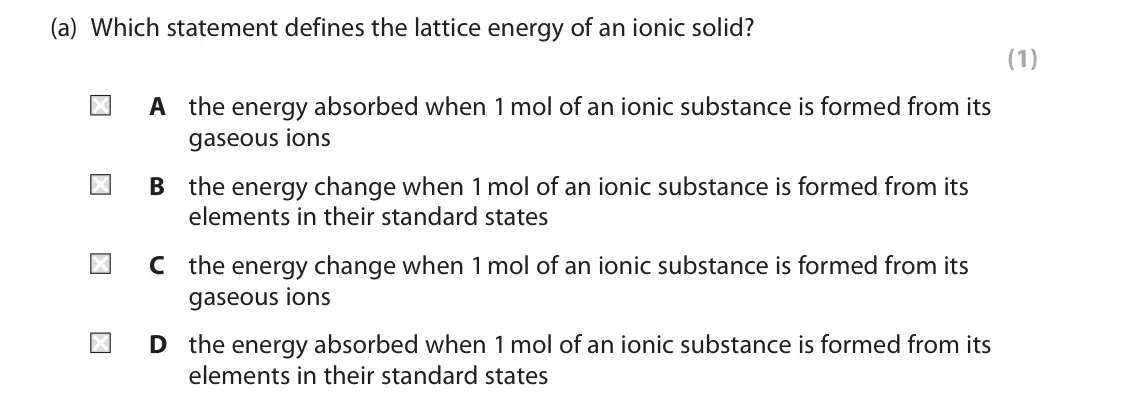
Q7(b)
The whole paper ↗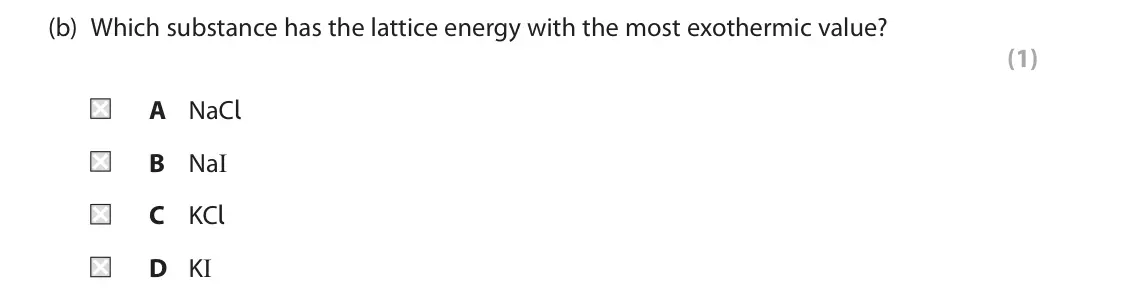
Q7(c)
The whole paper ↗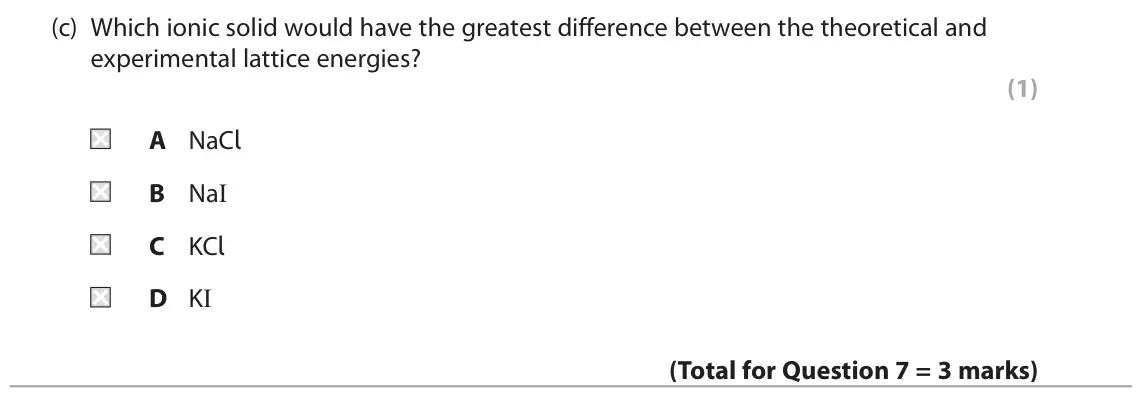
Q2(a)
The whole paper ↗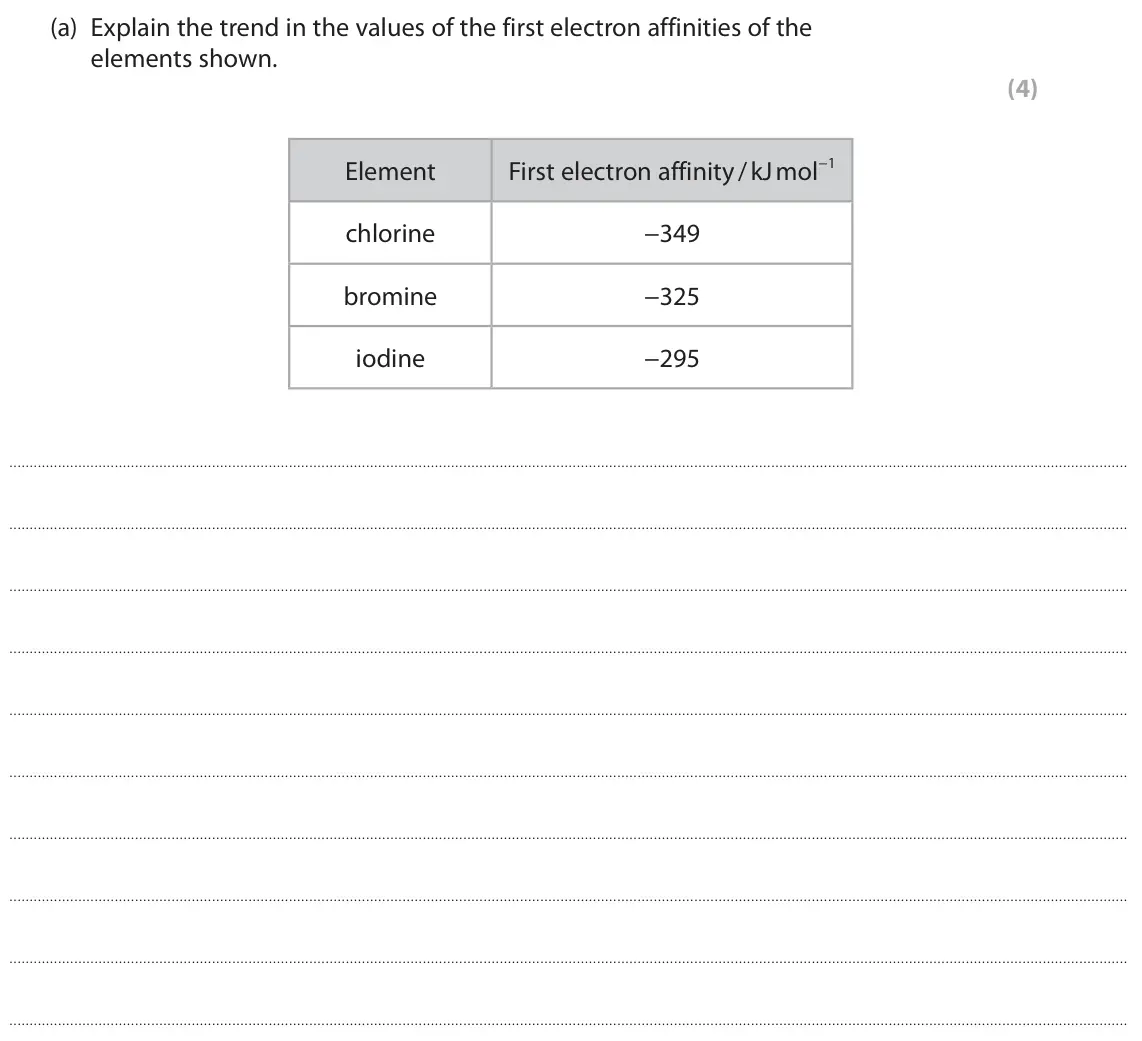
Q8(b)
The whole paper ↗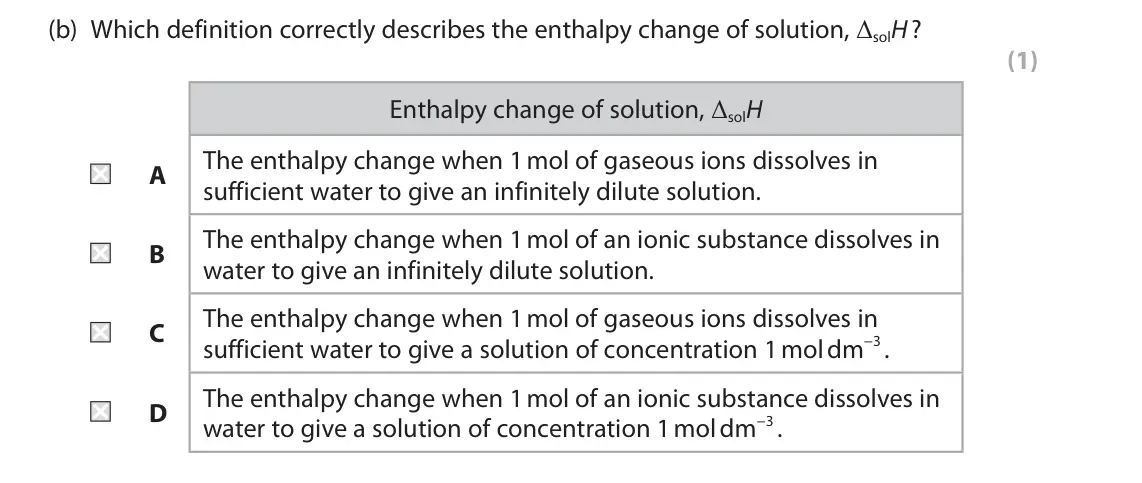
Q8(c)(i)
The whole paper ↗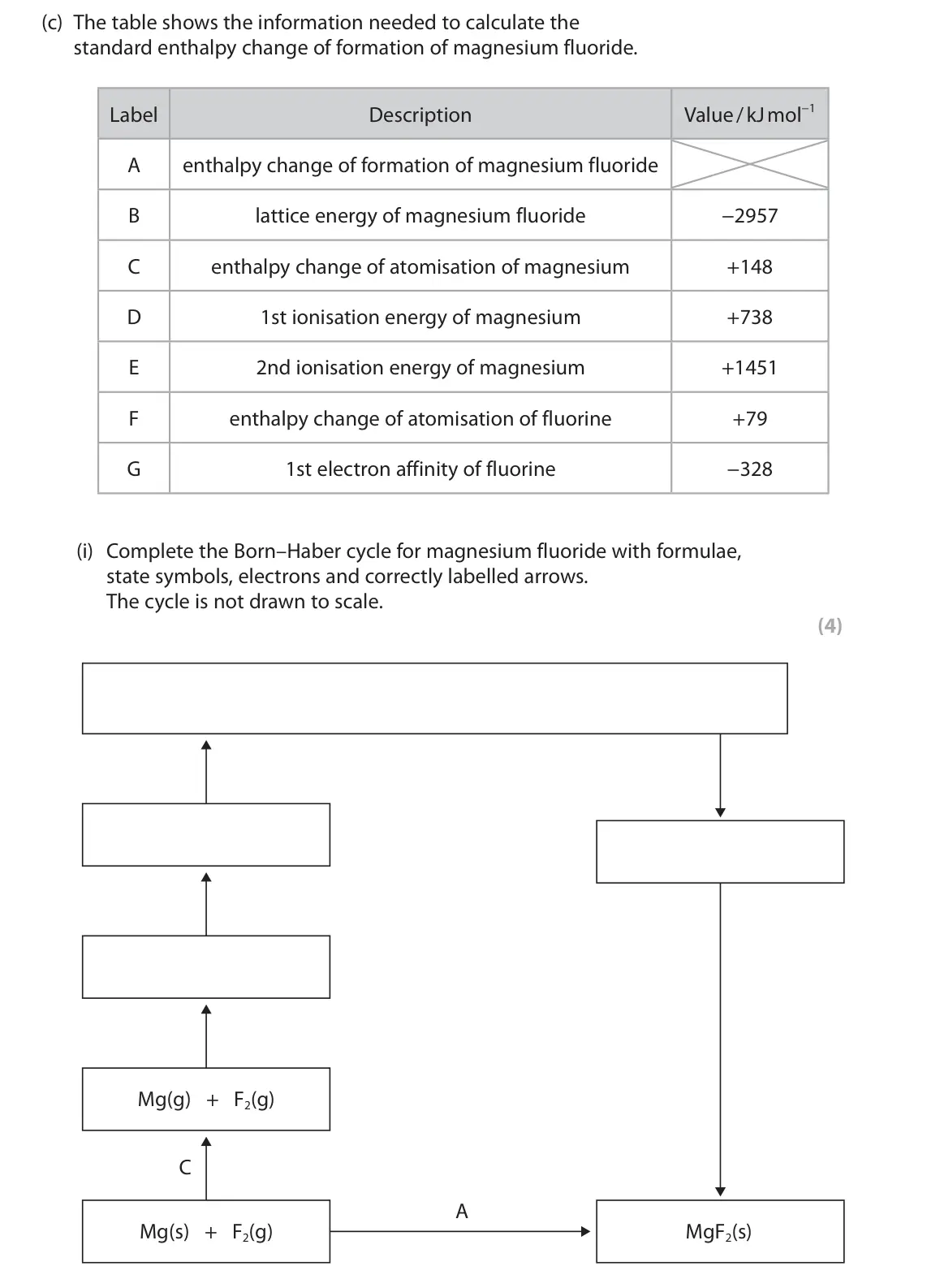
Q8(c)(ii)
The whole paper ↗
Q8(c)(iii)
The whole paper ↗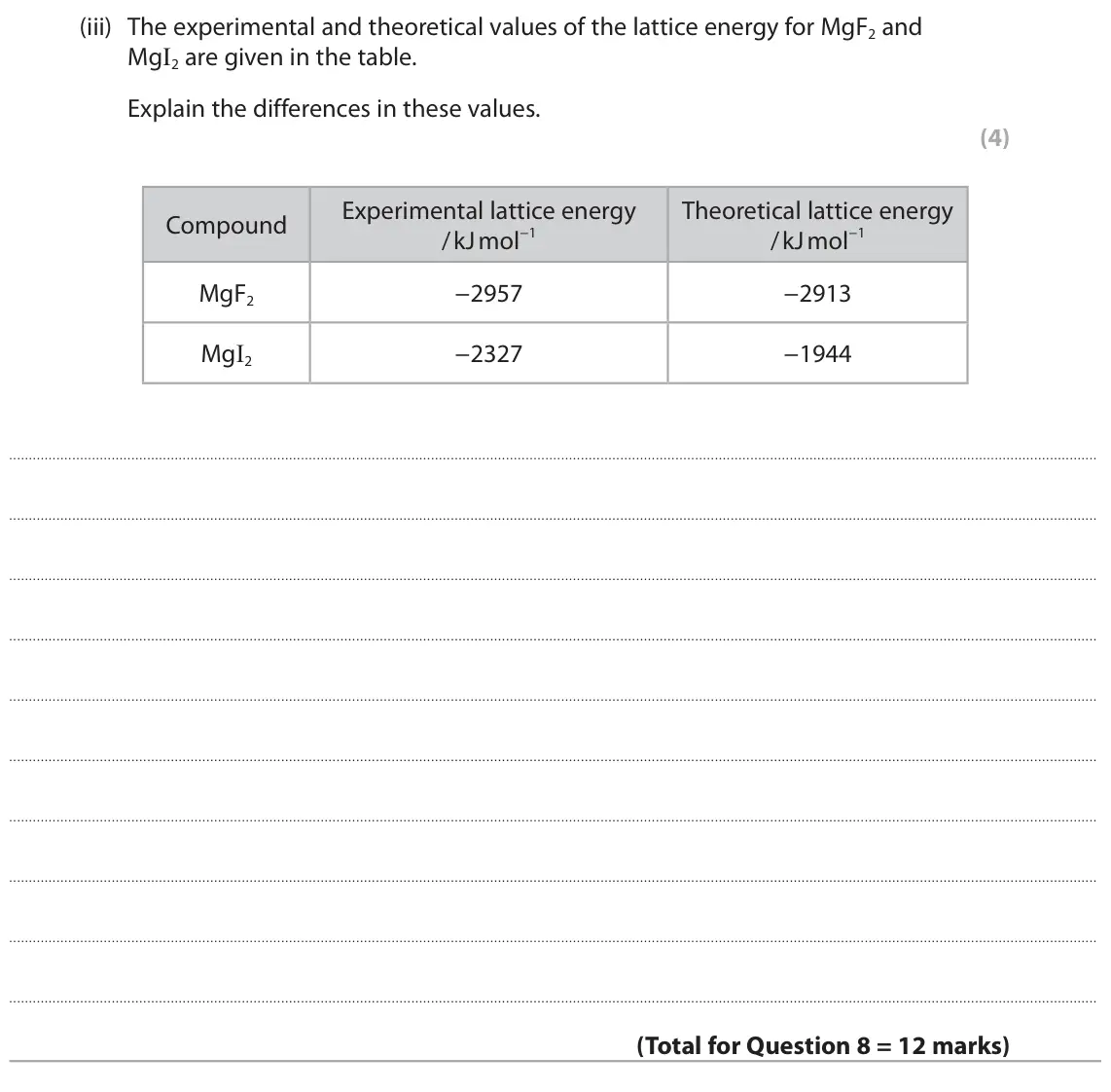
Q9(a)(i)
The whole paper ↗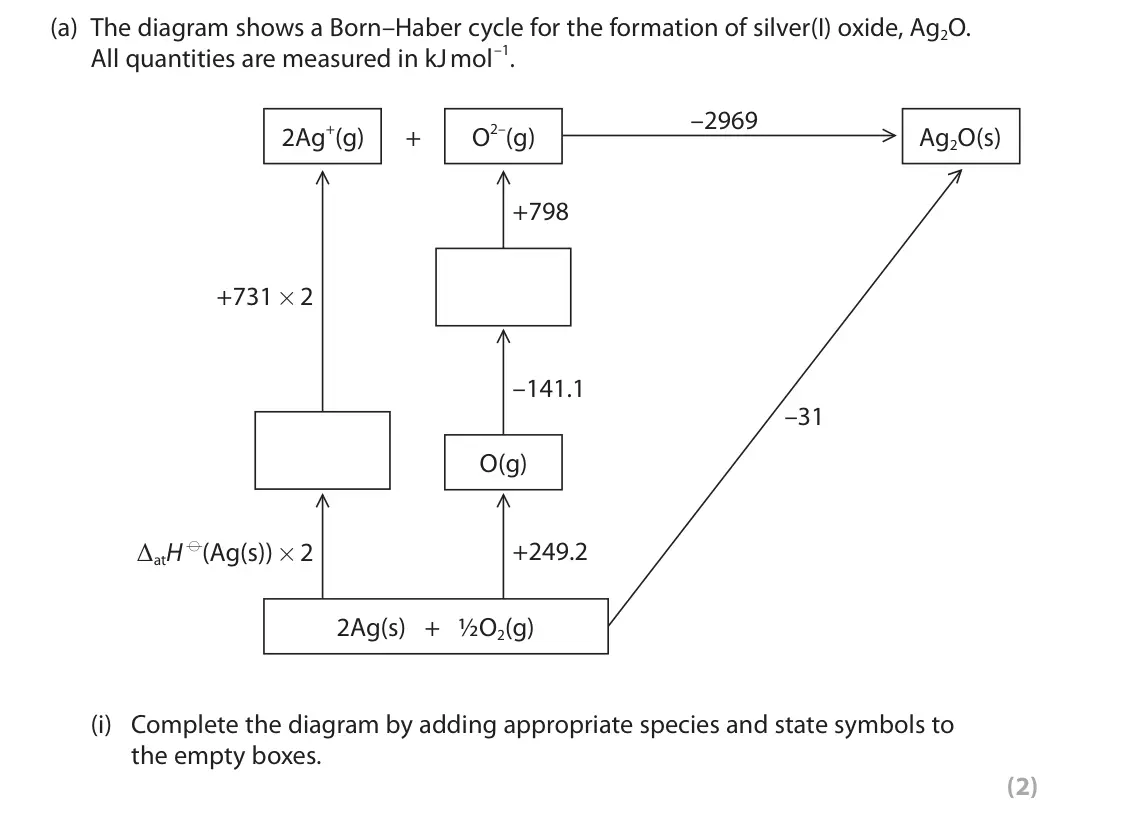
Q9(a)(ii)
The whole paper ↗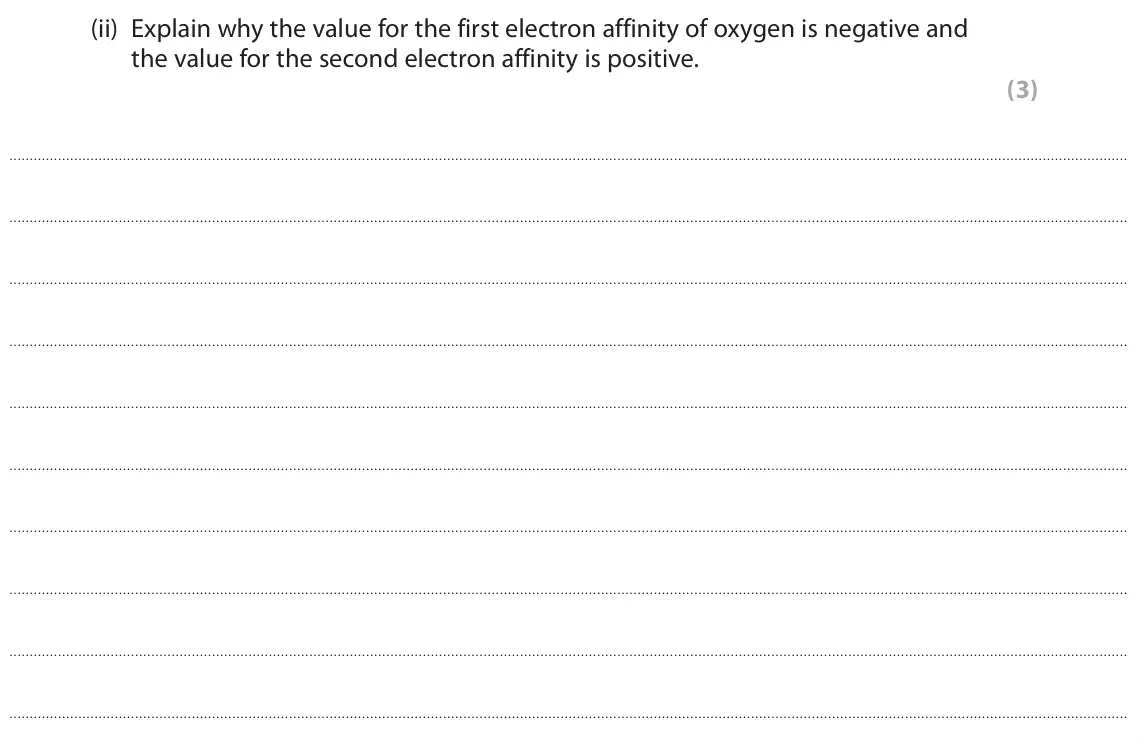
Q9(a)(iii)
The whole paper ↗
Q9(b)(i)
The whole paper ↗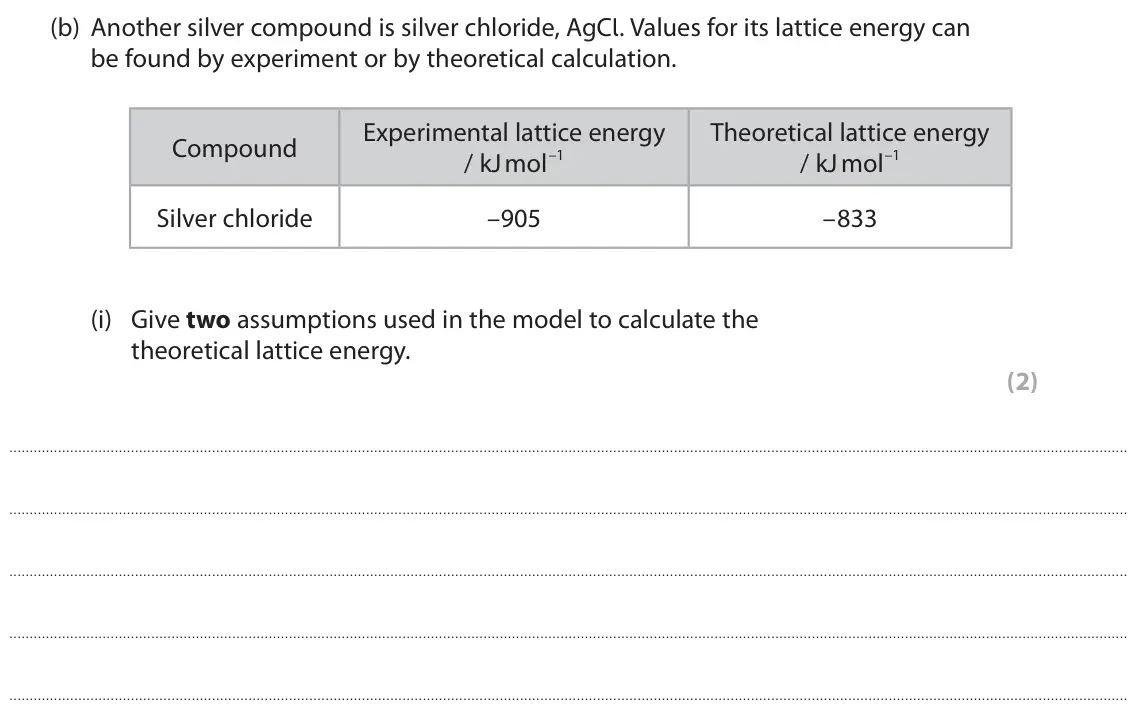
Q9(b)(ii)
The whole paper ↗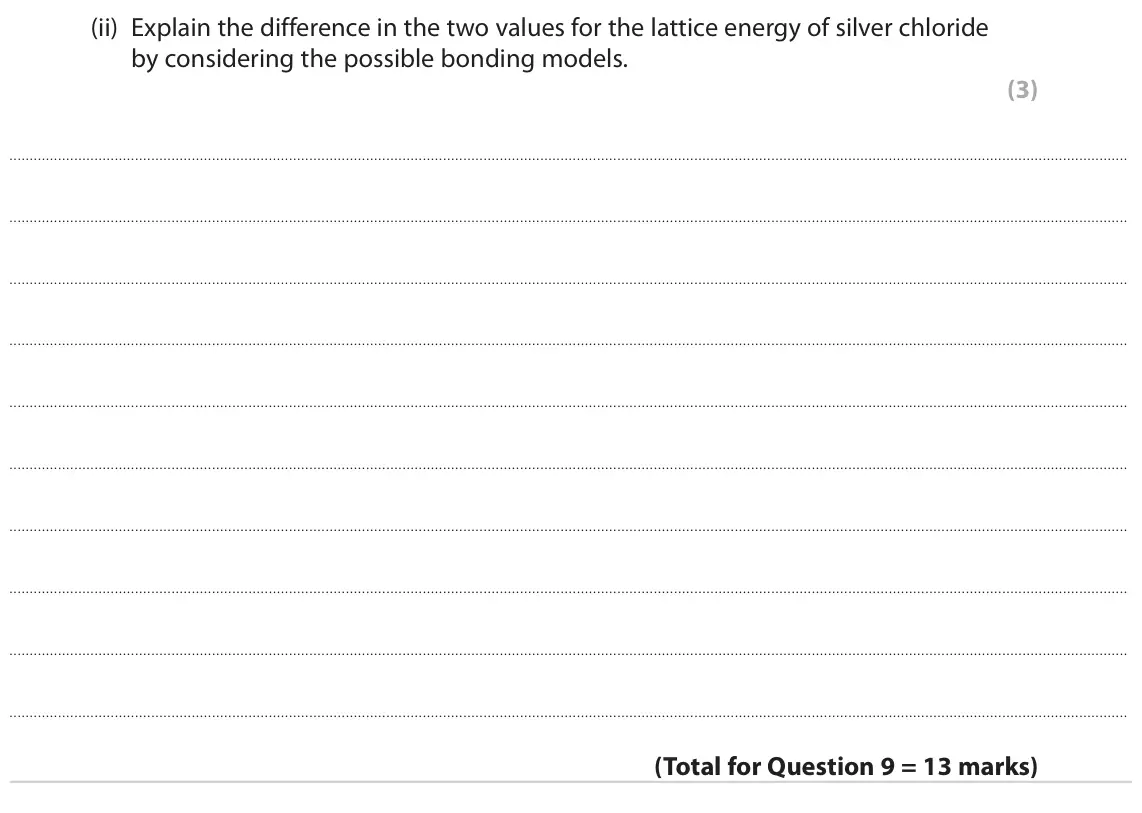
Q4(c)
The whole paper ↗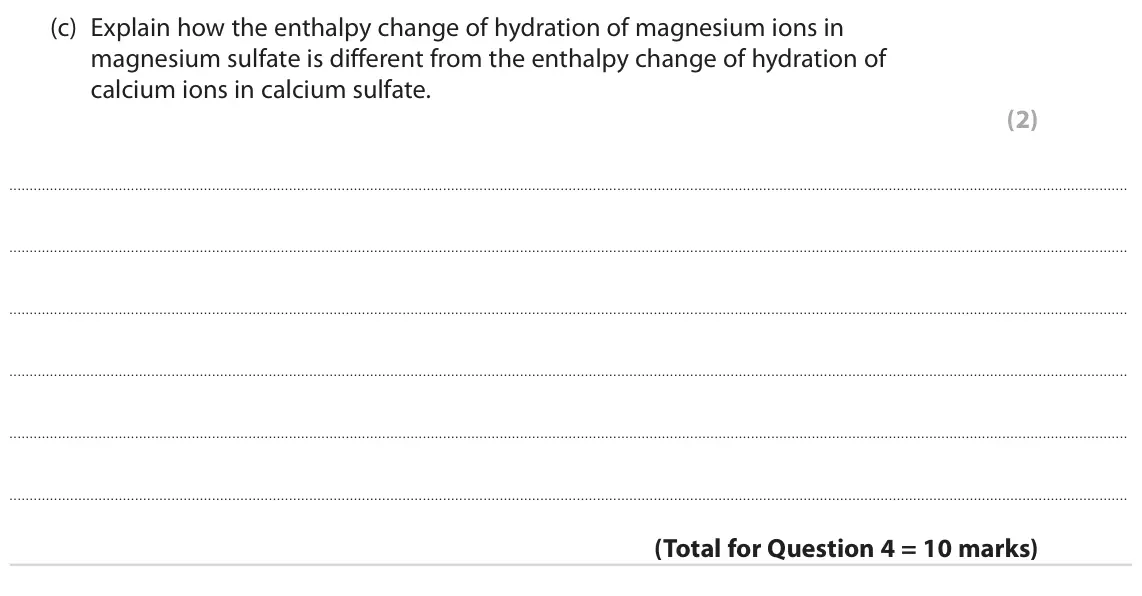
Q5(c)(i)
The whole paper ↗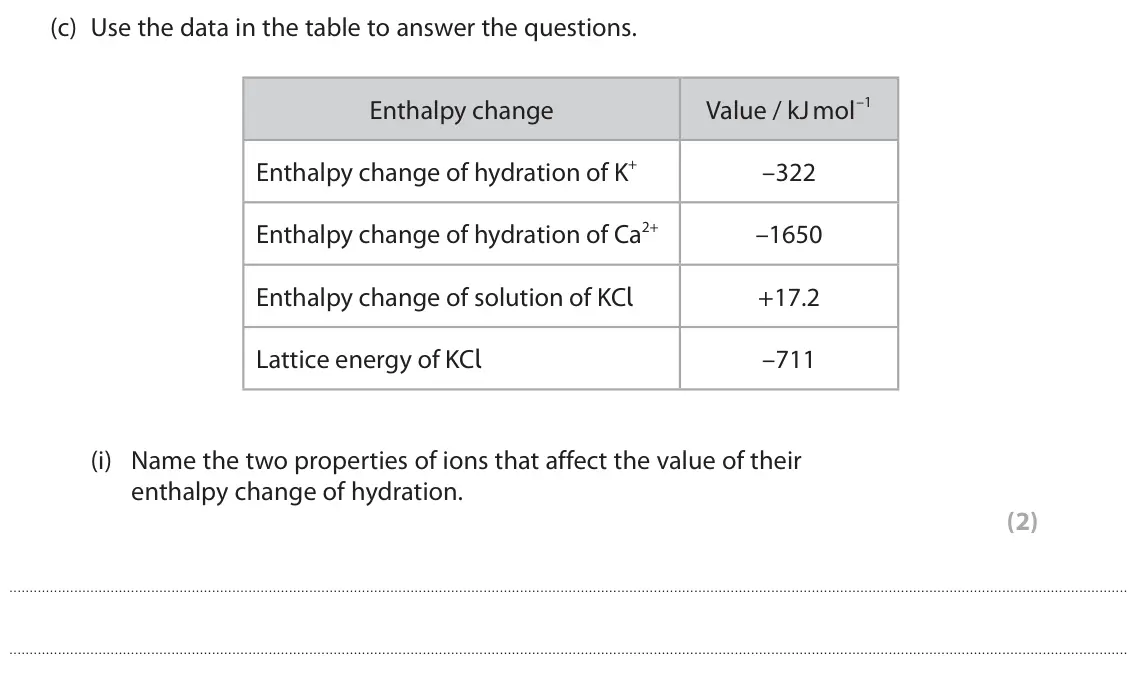
Q5(c)(ii)
The whole paper ↗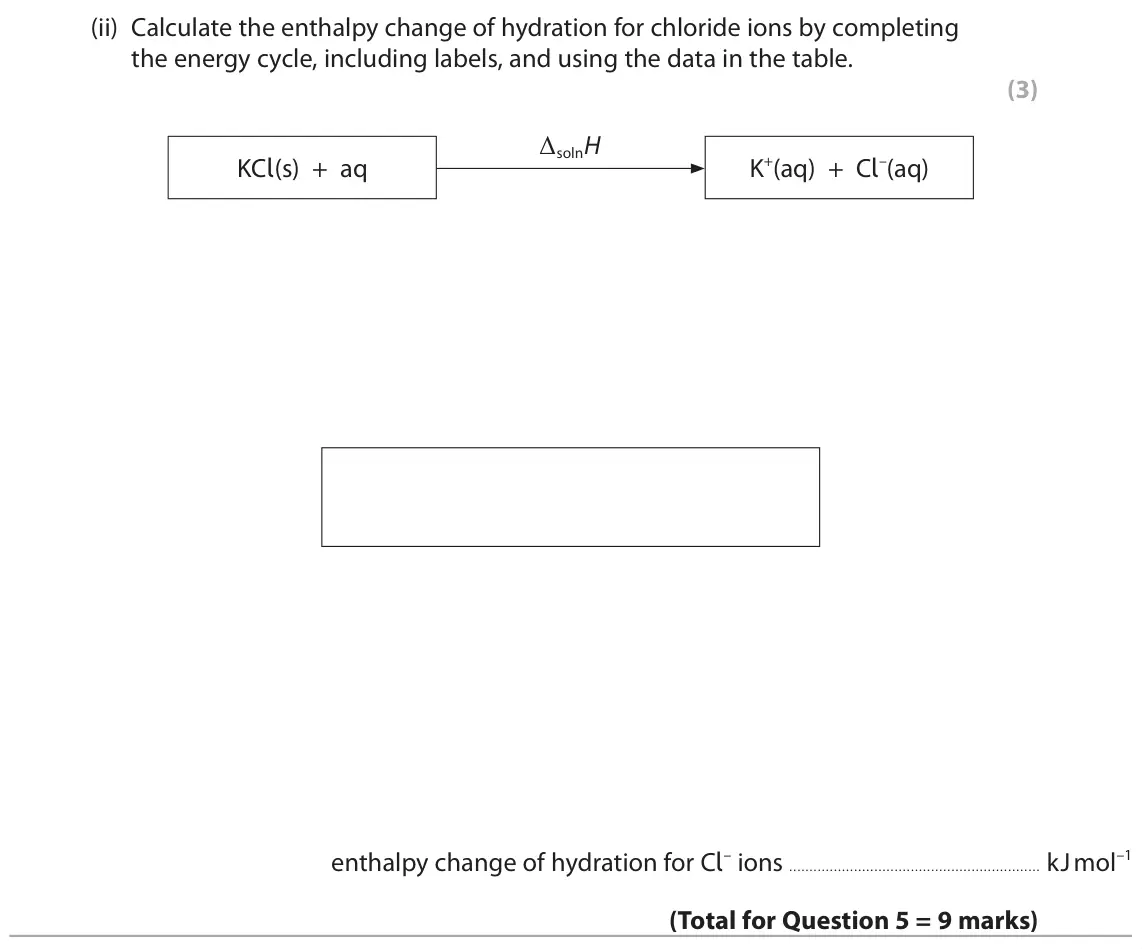
Q9(a)(i)
The whole paper ↗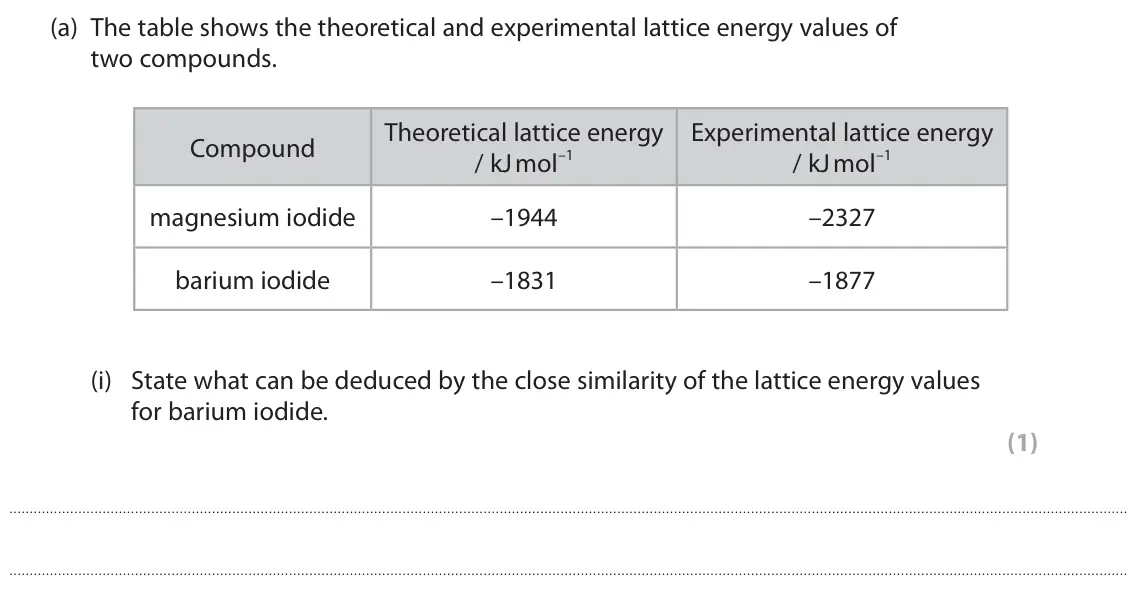
Q9(a)(ii)
The whole paper ↗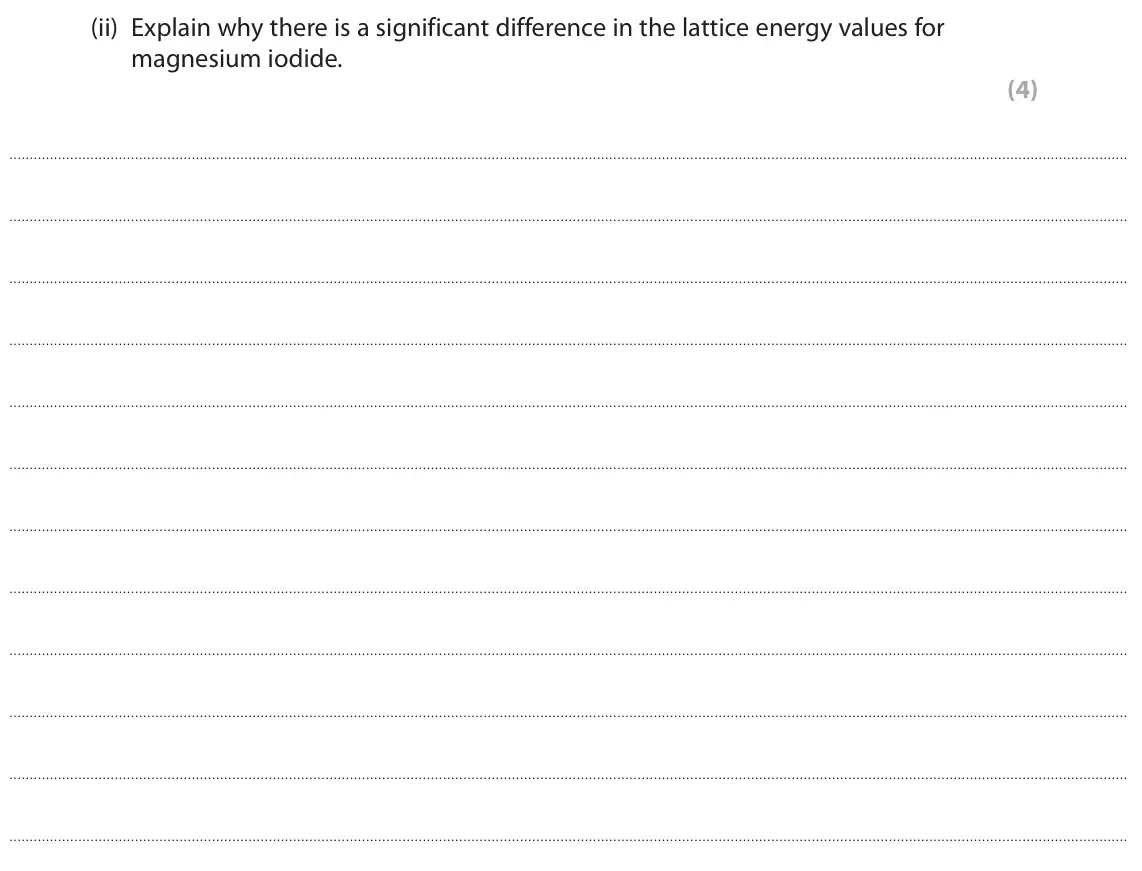
Q9(b)(i)
The whole paper ↗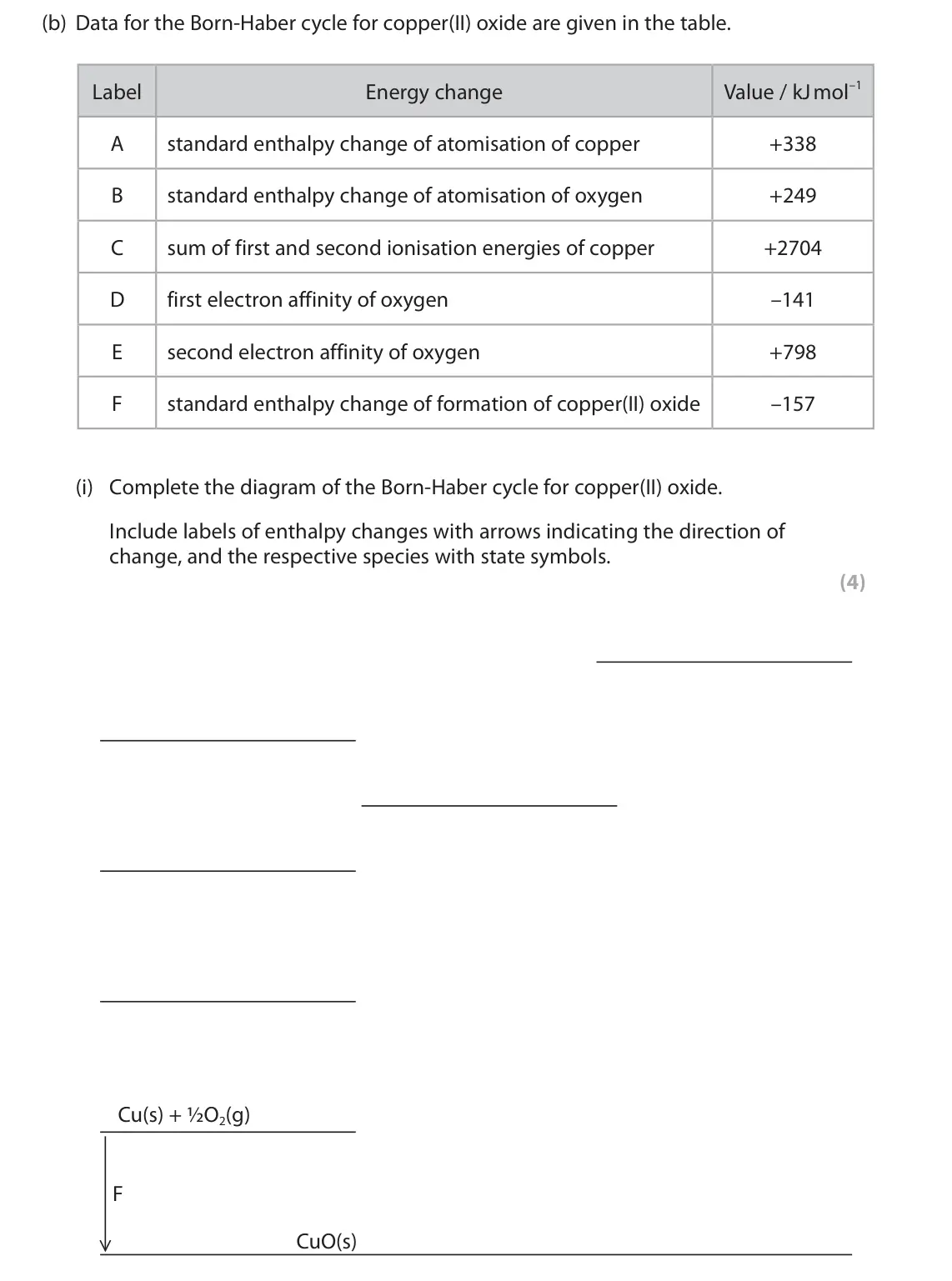
Q9(b)(ii)
The whole paper ↗
All 31 questions on Lattice energy, as a list
- June 2025, Paper 1, Q7(a) (1 mark): Which statement defines the lattice energy of an ionic solid? (1) A the energy absorbed when 1 mol of an ionic substance is formed from its gaseous ions B the e
- June 2025, Paper 1, Q7(b) (1 mark): Which substance has the lattice energy with the most exothermic value? (1) A NaCl B NaI C KCl D KI
- June 2025, Paper 1, Q7(c) (1 mark): Which ionic solid would have the greatest difference between the theoretical and experimental lattice energies? (1) A NaCl B NaI C KCl D KI
- June 2024, Paper 1, Q2(a) (4 marks): Explain the trend in the values of the first electron affinities of the elements shown. (4) First electron affinity / kJ mol−1 Element chlorine −349 bromine −32
- June 2024, Paper 1, Q8(b) (1 mark): Which definition correctly describes the enthalpy change of solution, ΔsolH ? (1) Enthalpy change of solution, ΔsolH The enthalpy change when 1 mol of gaseous i
- June 2024, Paper 1, Q8(c)(i) (4 marks): Complete the Born–Haber cycle for magnesium fluoride with formulae, state symbols, electrons and correctly labelled arrows. The cycle is not drawn to scale. (4)
- June 2024, Paper 1, Q8(c)(ii) (1 mark): Calculate the value of ΔfH [MgF2(s)]. (1)
- June 2024, Paper 1, Q8(c)(iii) (4 marks): The experimental and theoretical values of the lattice energy for MgF2 and MgI2 are given in the table. Explain the differences in these values. (4) Experimenta
- June 2023, Paper 1, Q9(a)(i) (2 marks): Complete the diagram by adding appropriate species and state symbols to the empty boxes. (2)
- June 2023, Paper 1, Q9(a)(ii) (3 marks): Explain why the value for the first electron affinity of oxygen is negative and the value for the second electron affinity is positive. (3)
- June 2023, Paper 1, Q9(a)(iii) (3 marks): Calculate a value for the standard enthalpy change of atomisation of silver, ΔatH d, using the Born–Haber cycle. (3)
- June 2023, Paper 1, Q9(b)(i) (2 marks): Give two assumptions used in the model to calculate the theoretical lattice energy. (2)
- June 2023, Paper 1, Q9(b)(ii) (3 marks): Explain the difference in the two values for the lattice energy of silver chloride by considering the possible bonding models. (3)
- June 2023, Paper 3, Q4(c) (2 marks): Explain how the enthalpy change of hydration of magnesium ions in magnesium sulfate is different from the enthalpy change of hydration of calcium ions in calciu
- June 2022, Paper 1, Q5(c)(i) (2 marks): Name the two properties of ions that affect the value of their enthalpy change of hydration. (2)
- June 2022, Paper 1, Q5(c)(ii) (3 marks): Calculate the enthalpy change of hydration for chloride ions by completing the energy cycle, including labels, and using the data in the table. (3) ΔsolnH KCl(s
- November 2021, Paper 1, Q9(a)(i) (1 mark): State what can be deduced by the close similarity of the lattice energy values for barium iodide. (1)
- November 2021, Paper 1, Q9(a)(ii) (4 marks): Explain why there is a significant difference in the lattice energy values for magnesium iodide. (4)
- November 2021, Paper 1, Q9(b)(i) (4 marks): Complete the diagram of the Born‑Haber cycle for copper(II) oxide. Include labels of enthalpy changes with arrows indicating the direction of change, and the re
- November 2021, Paper 1, Q9(b)(ii) (1 mark): Calculate the lattice energy of copper(II) oxide. (1)
- November 2021, Paper 1, Q9(c) (2 marks): A different energy cycle can be used to calculate lattice energy. Ca2+(g) + 2Br–(g) CaBr2(s) Ca2+(aq) + 2Br–(aq) Value / kJ mol–1 Enthalpy change enthalpy chang
- November 2021, Paper 3, Q1(c) (2 marks): Write the equation for the first electron affinity of chlorine. Include state symbols. (2)
- October 2020, Paper 1, Q4(b) (1 mark): What is the value, in kJ mol−1, for the standard enthalpy change of solution of magnesium chloride? Mg2+(g) + 2Cl−(g) MgCl2(s) Mg2+(aq) + 2Cl−(aq) = −2526 kJ mo
- June 2019, Paper 1, Q8(a)(i) (2 marks): Identify and correct the two errors in this Born-Haber cycle. (2)
- June 2019, Paper 1, Q8(a)(ii) (1 mark): Calculate the first electron affinity, in kJ mol–1, of hydrogen, using the values given in the cycle. (1)
- June 2019, Paper 1, Q8(d) (1 mark): Lattice energies provide an indication of ionic bond strength. Which are the lattice energies of the hydrides NaH, KH and MgH2? (1) Lattice energy / kJ mol–1 So
- June 2018, Paper 1, Q6(b)(iii) (2 marks): Calculate the enthalpy change of solution of magnesium hydroxide, using the following data. Energy or enthalpy change Value / kJ mol−1 Lattice energy of Mg(OH)2
- June 2018, Paper 1, Q8(b) (1 mark): The diagram, which is not drawn to scale, shows the Born-Haber cycle for lithium fluoride. The energy changes are given in kJ mol−1. Li+(g) + F(g) + e− +79 Y Li
- June 2018, Paper 1, Q8(c) (6 marks): The table shows the theoretical and experimental lattice energy values of two compounds. Theoretical lattice energy Experimental lattice energy Compound / kJ mo
- June 2017, Paper 1, Q6(b)(i) (3 marks): Complete the Born-Haber cycle for magnesium bromide with formulae, electrons and labelled arrows. The cycle is not drawn to scale. (3) Mg(g) + Br2(l) ¨atH [Mg(s
- June 2017, Paper 1, Q6(b)(ii) (2 marks): Calculate the first electron affinity of bromine, in kJ mol–1. (2)
Questions, mark schemes and examiner’s reports are © Pearson Edexcel, from their published past papers. Plumi isn’t affiliated with any exam board. Want whole papers? Every Edexcel A-Level Chemistry paper.
Rather write your answers by hand on iPad? Plumi marks them against the same mark schemes.