 plumi
Acid-base equilibria: Edexcel A‑Level Chemistry questions
Every Edexcel A-Level Chemistry exam question on 12 Acid-base equilibria, 2016–2025, with its mark scheme and examiner’s report.
Find questions2,028
Calculations
Q5(a)
The whole paper ↗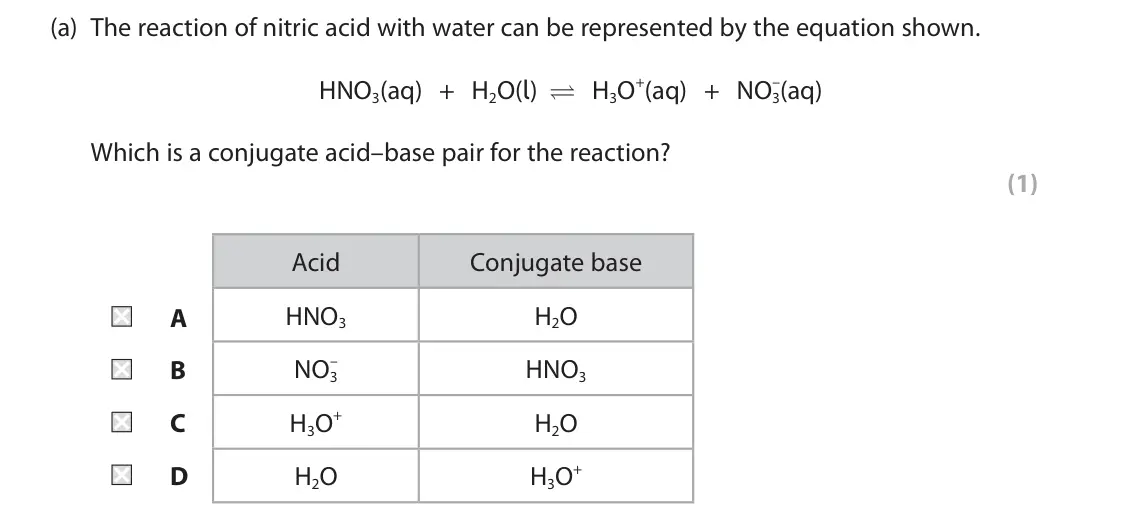
Q5(b)
The whole paper ↗
Q5(c)
The whole paper ↗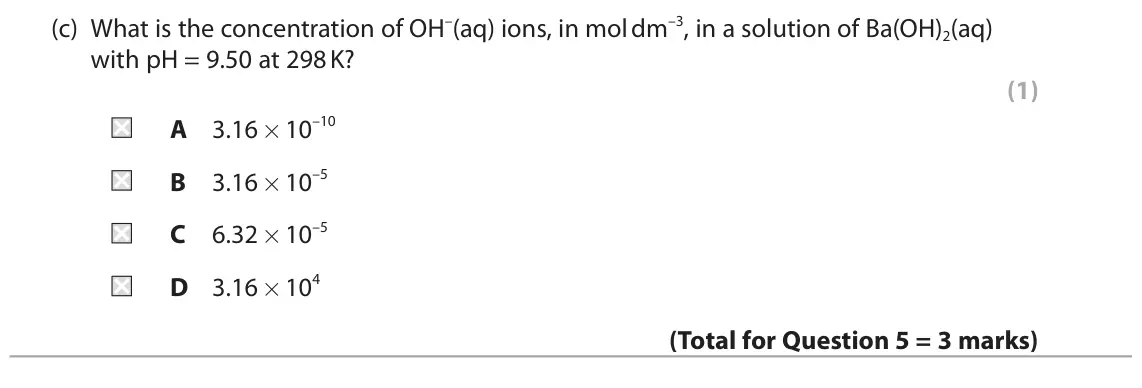
Q8(a)
The whole paper ↗
Q8(b)(i)
The whole paper ↗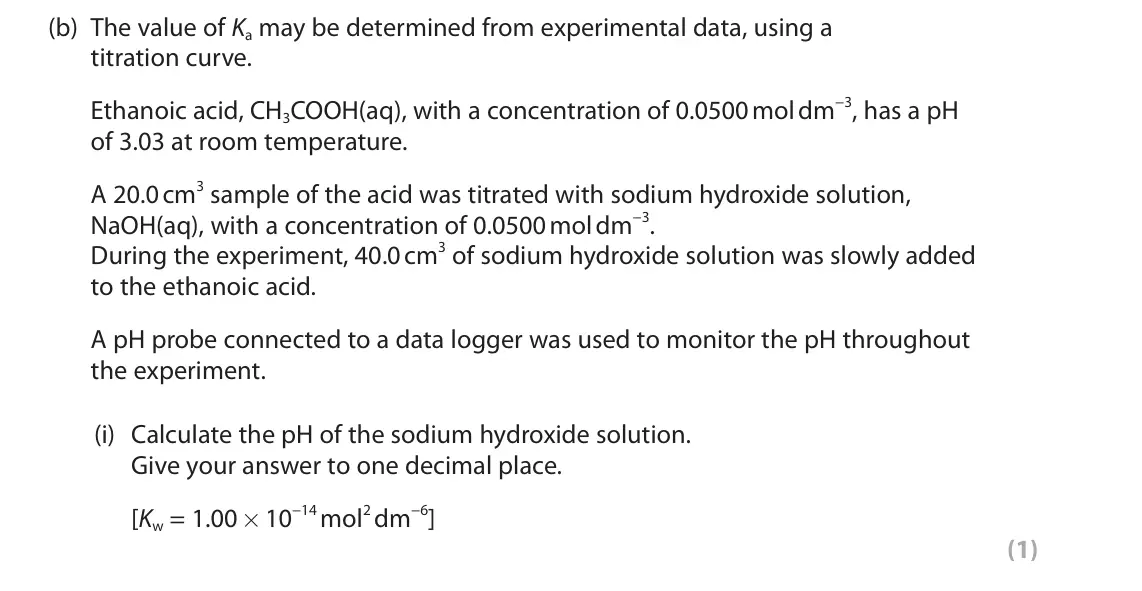
Q8(b)(ii)
The whole paper ↗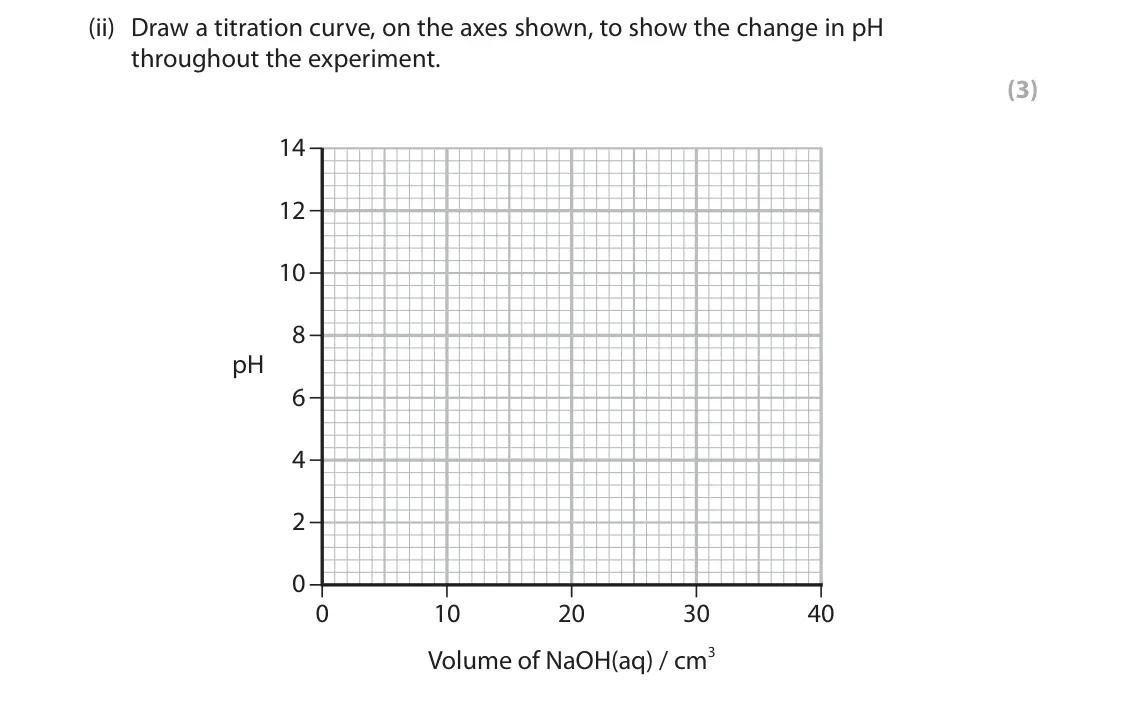
Q8(b)(iii)
The whole paper ↗
Q8(b)(iv)
The whole paper ↗
Q8(c)
The whole paper ↗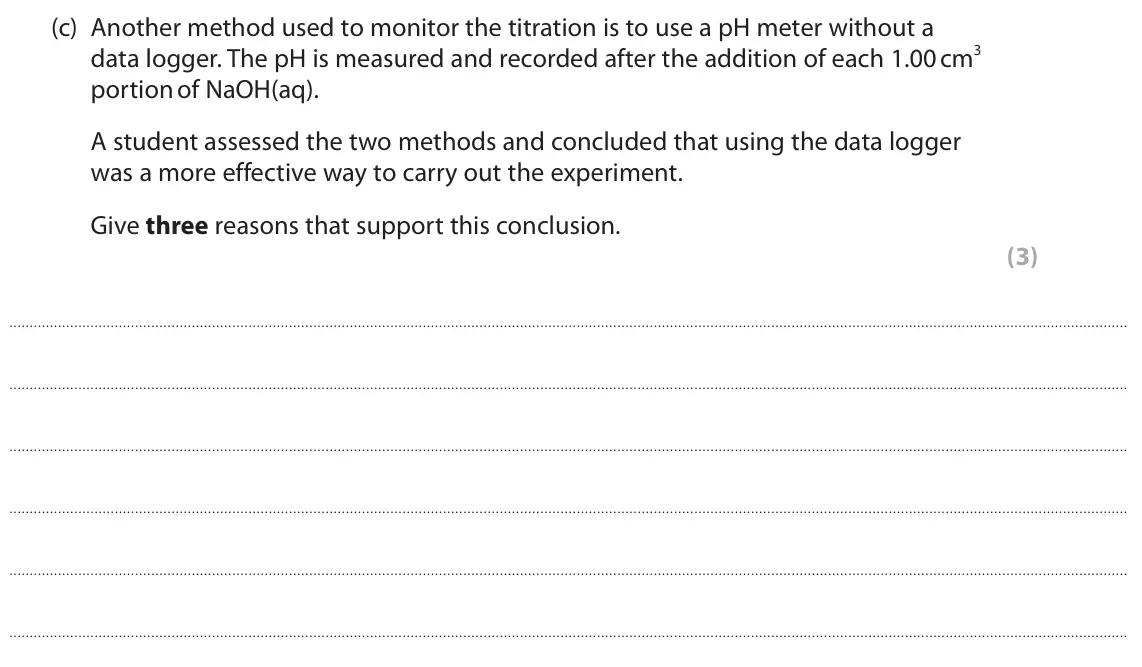
Q8(d)(i)
The whole paper ↗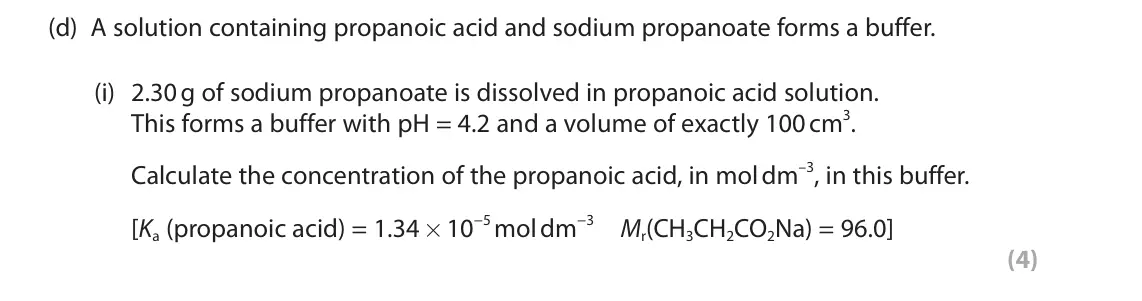
Q8(d)(ii)
The whole paper ↗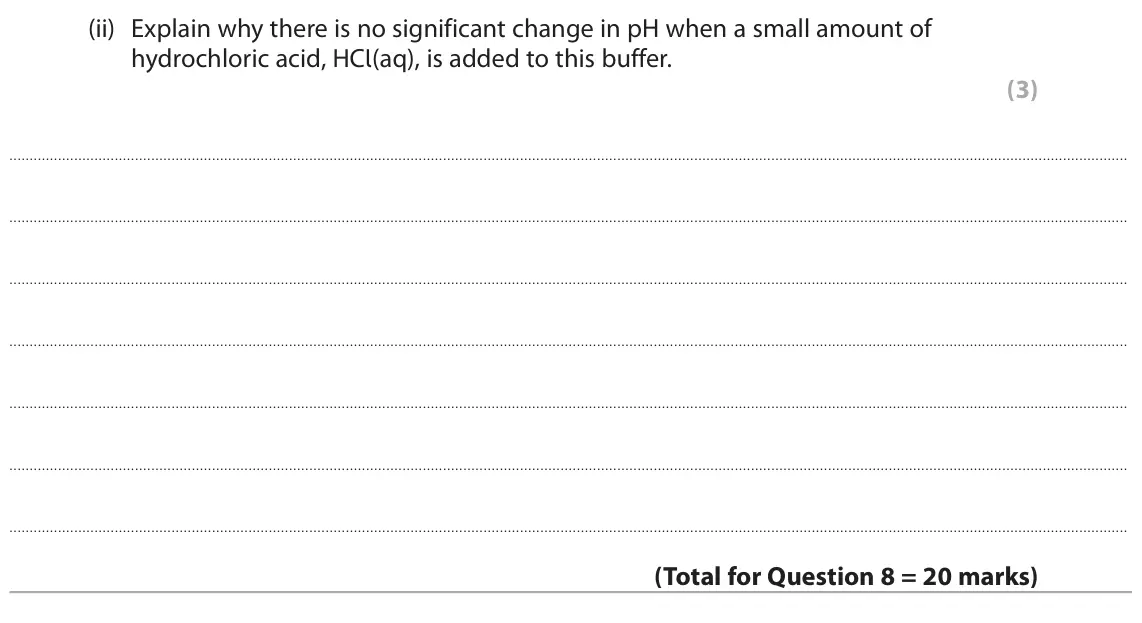
Q4(a)
The whole paper ↗
Q4(b)
The whole paper ↗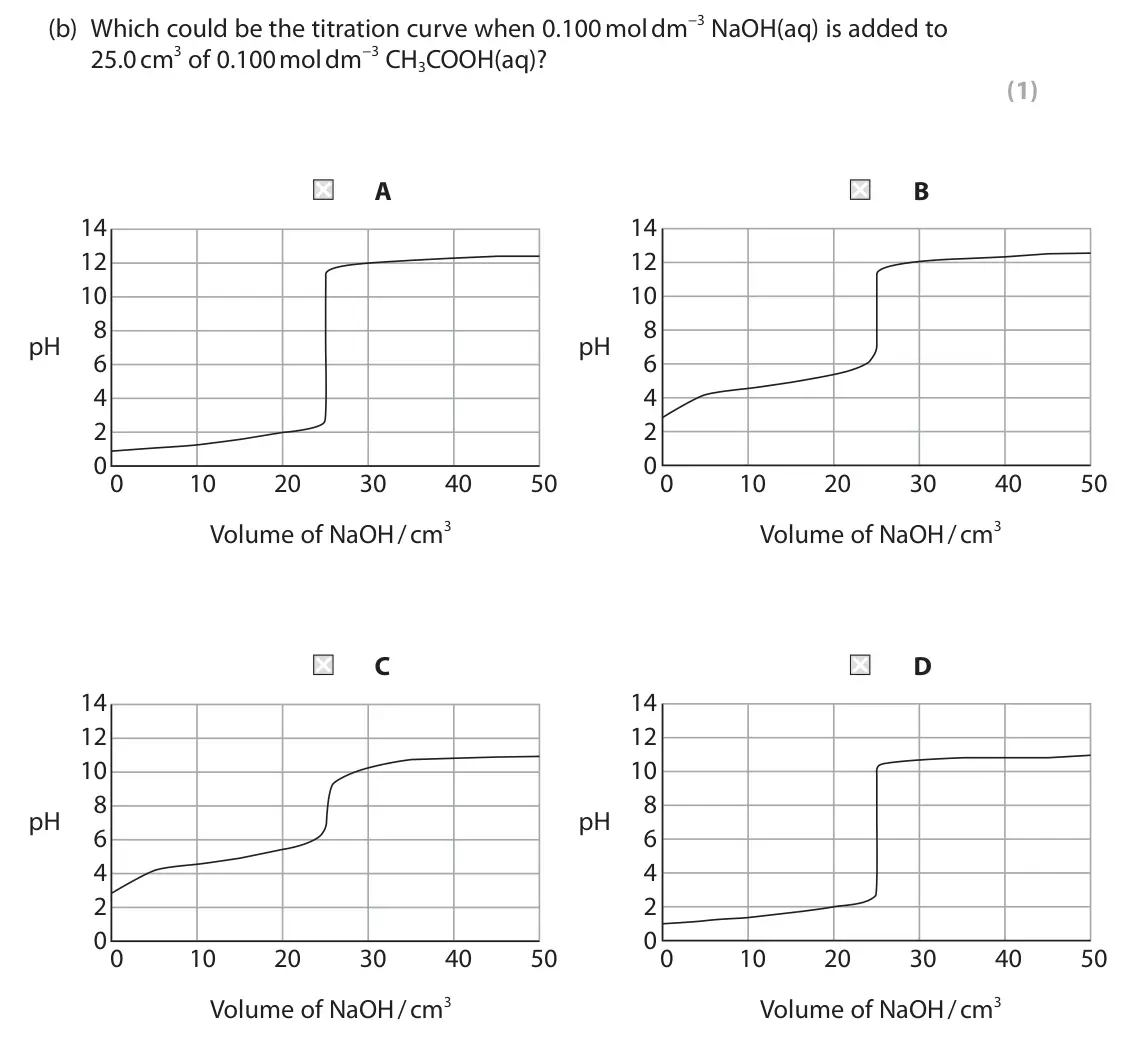
Q4(c)
The whole paper ↗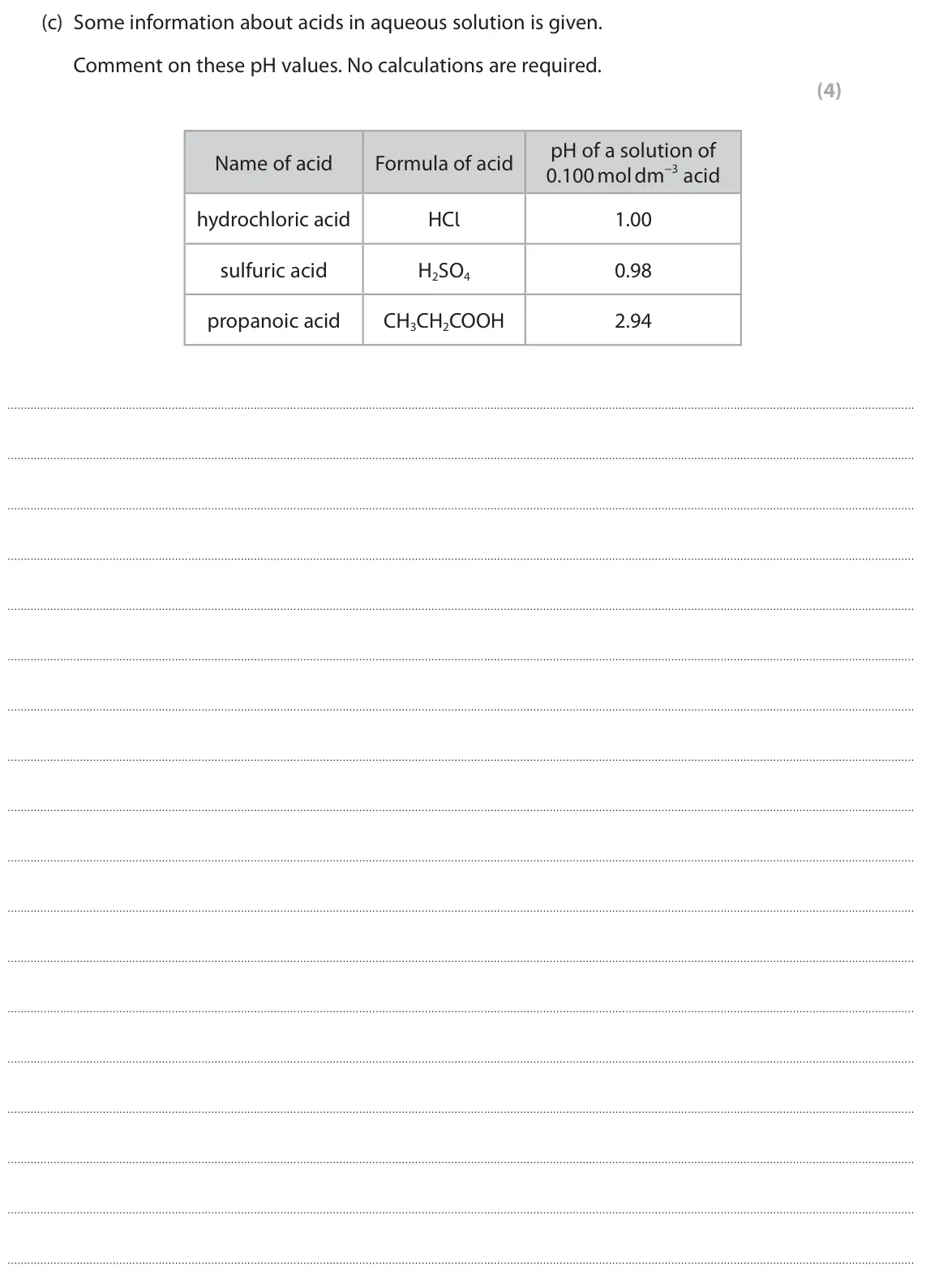
Q4(d)(i)
The whole paper ↗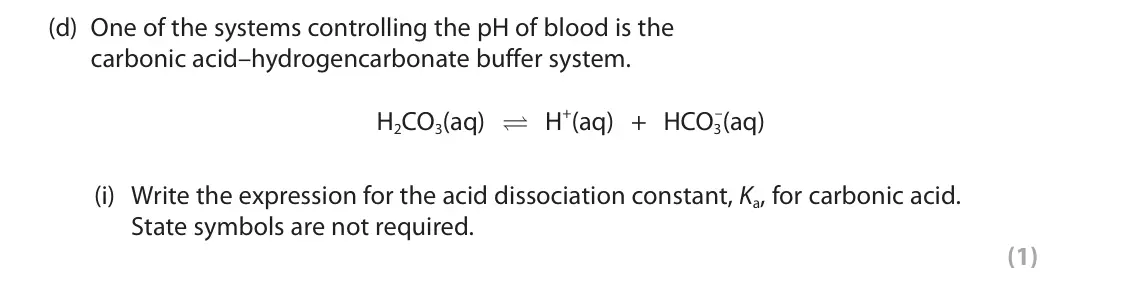
Q4(d)(ii)
The whole paper ↗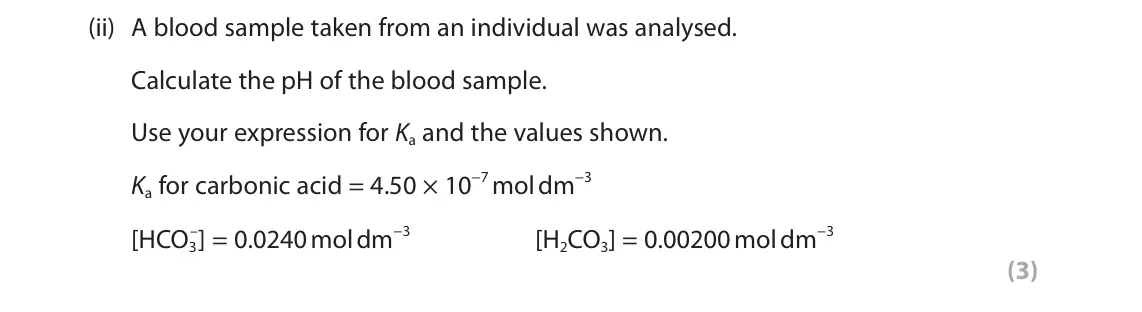
Q4(e)(i)
The whole paper ↗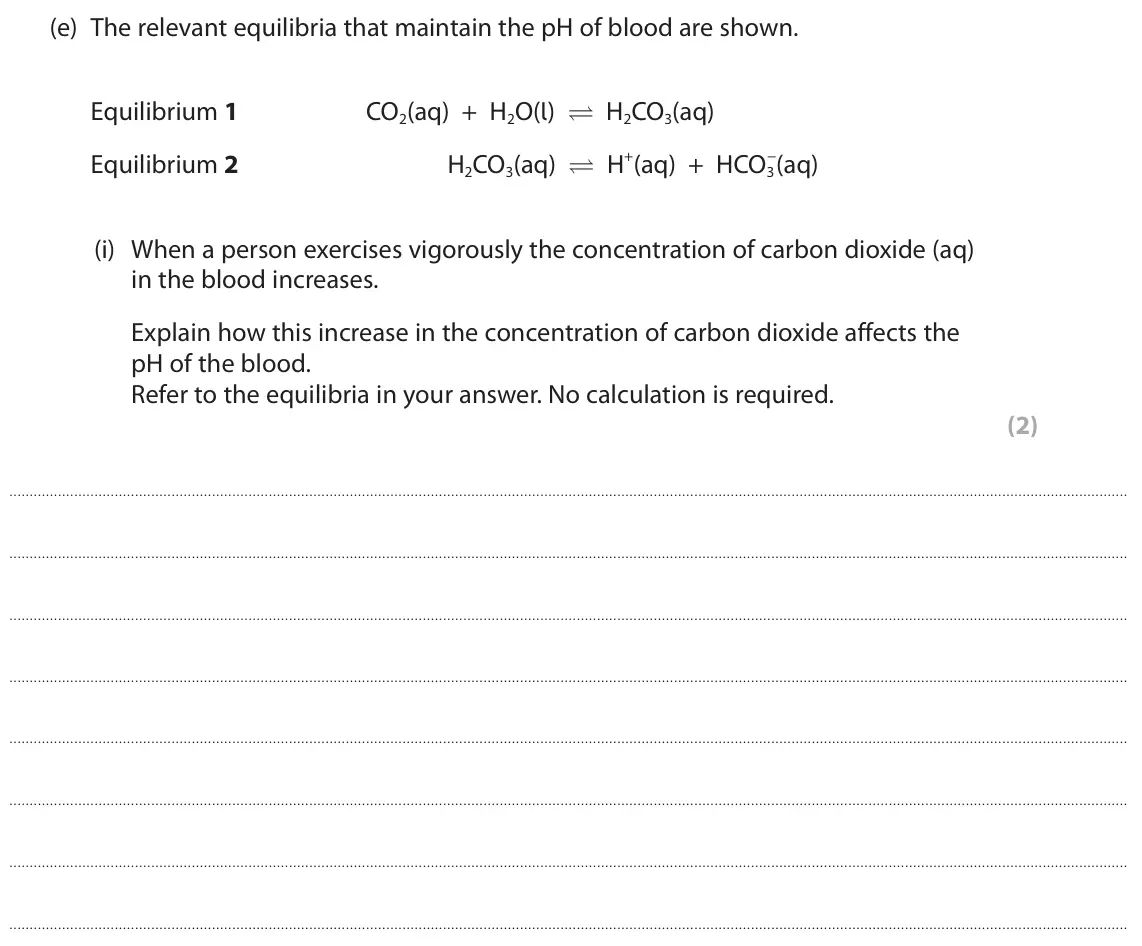
Q4(e)(ii)
The whole paper ↗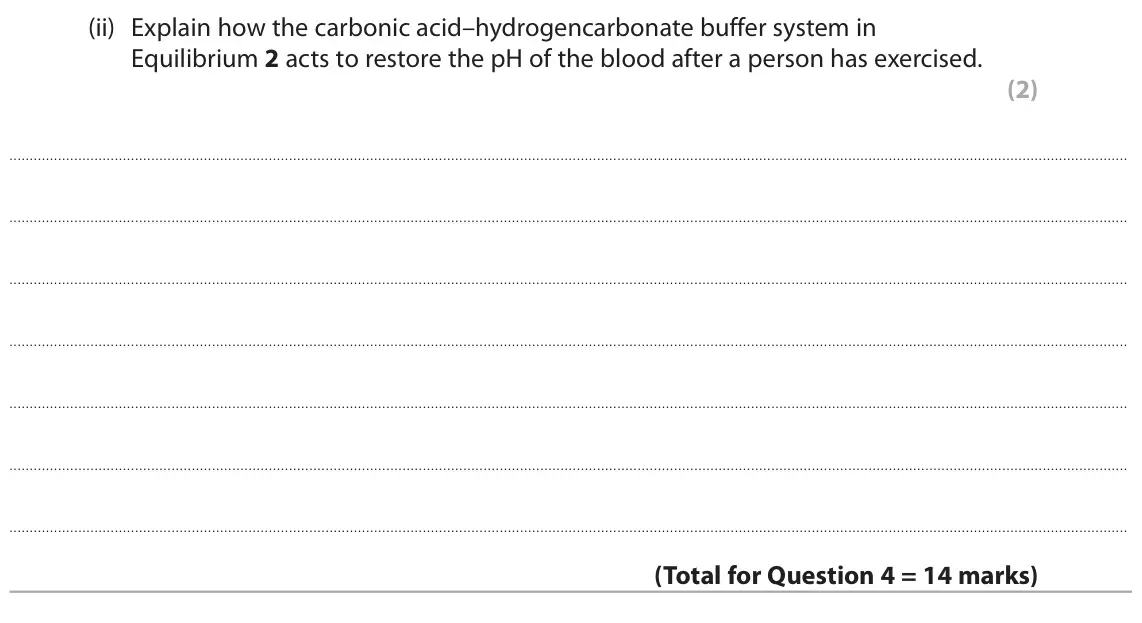
Q8(a)(i)
The whole paper ↗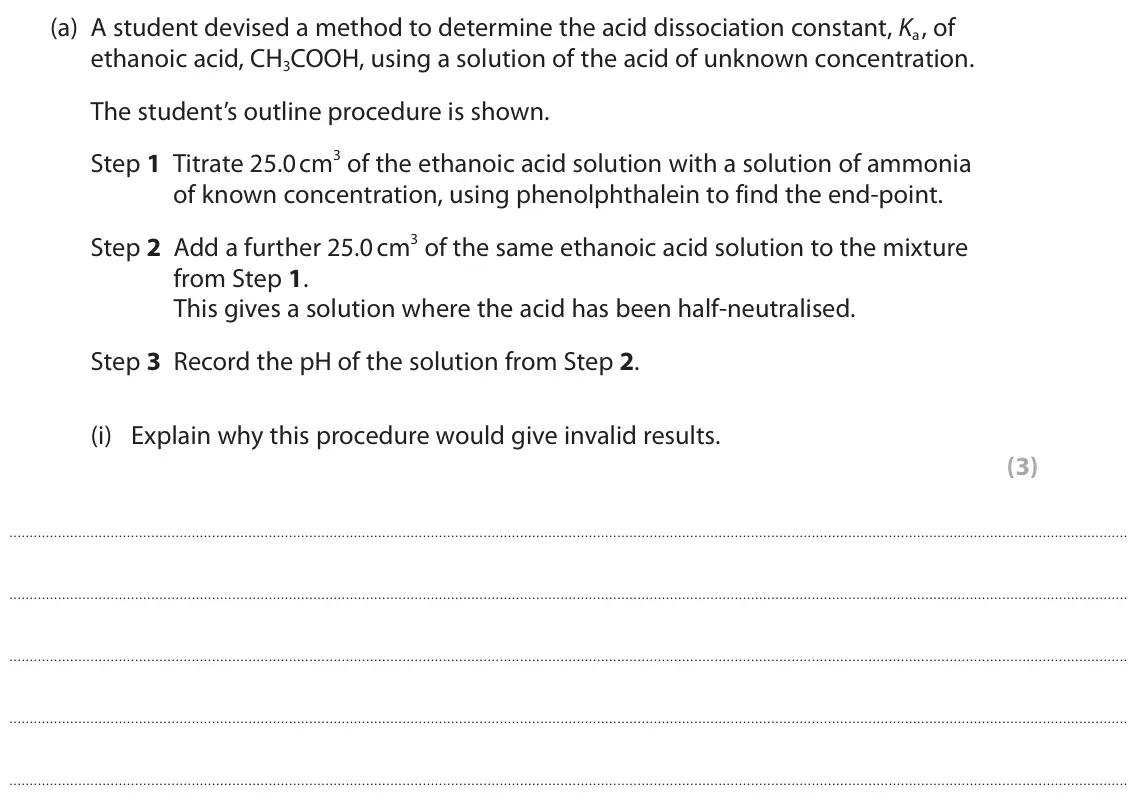
Q8(a)(ii)
The whole paper ↗
All 85 questions on Acid-base equilibria, as a list
- June 2025, Paper 1, Q5(a) (1 mark): The reaction of nitric acid with water can be represented by the equation shown. HNO3(aq) + H2O(l) H3O+(aq) + NO3 –(aq) Which is a conjugate acid–base pair fo
- June 2025, Paper 1, Q5(b) (1 mark): State the expression that defines the pH of a solution. (1)
- June 2025, Paper 1, Q5(c) (1 mark): What is the concentration of OH–(aq) ions, in mol dm–3, in a solution of Ba(OH)2(aq) with pH = 9.50 at 298 K? (1) A 3.16 × 10⁻¹⁰ B 3.16 × 10⁻⁵ C 6.32 × 10⁻⁵ D 3
- June 2025, Paper 3, Q8(a) (2 marks): An aqueous solution of a weak acid, HA(aq), with a concentration of 0.0712 mol dm−3, has a pH = 3.25 at room temperature. Calculate the value of Ka for the weak
- June 2025, Paper 3, Q8(b)(i) (1 mark): Calculate the pH of the sodium hydroxide solution. Give your answer to one decimal place. [Kw = 1.00 × 10⁻¹⁴ mol2 dm−6] (1)
- June 2025, Paper 3, Q8(b)(ii) (3 marks): Draw a titration curve, on the axes shown, to show the change in pH throughout the experiment. (3) 14 12 10 8 pH 6 4 2 0 0 10 20 30 40 Volume of NaOH(aq) / cm3
- June 2025, Paper 3, Q8(b)(iii) (1 mark): Give an estimate of the pH value at the half-equivalence point. Show your working on the titration curve. (1)
- June 2025, Paper 3, Q8(b)(iv) (3 marks): Calculate a value for Ka of ethanoic acid using your answer to (b)(iii). You must show your working. (3)
- June 2025, Paper 3, Q8(c) (3 marks): Another method used to monitor the titration is to use a pH meter without a data logger. The pH is measured and recorded after the addition of each 1.00 cm3 por
- June 2025, Paper 3, Q8(d)(i) (4 marks): 2.30 g of sodium propanoate is dissolved in propanoic acid solution. This forms a buffer with pH = 4.2 and a volume of exactly 100 cm3. Calculate the concentrat
- June 2025, Paper 3, Q8(d)(ii) (3 marks): Explain why there is no significant change in pH when a small amount of hydrochloric acid, HCl(aq), is added to this buffer. (3)
- June 2024, Paper 1, Q4(a) (1 mark): State what is meant by a Brønsted−Lowry acid. (1)
- June 2024, Paper 1, Q4(b) (1 mark): Which could be the titration curve when 0.100 mol dm−3 NaOH(aq) is added to 25.0 cm3 of 0.100 mol dm−3 CH3COOH(aq)? (1) A B 14 14 12 12 10 10 8 8 pH pH 6 6 4 4
- June 2024, Paper 1, Q4(c) (4 marks): Some information about acids in aqueous solution is given. Comment on these pH values. No calculations are required. (4) pH of a solution of Name of acid Formul
- June 2024, Paper 1, Q4(d)(i) (1 mark): Write the expression for the acid dissociation constant, Ka, for carbonic acid. State symbols are not required. (1)
- June 2024, Paper 1, Q4(d)(ii) (3 marks): A blood sample taken from an individual was analysed. Calculate the pH of the blood sample. Use your expression for Ka and the values shown. Ka for carbonic aci
- June 2024, Paper 1, Q4(e)(i) (2 marks): When a person exercises vigorously the concentration of carbon dioxide (aq) in the blood increases. Explain how this increase in the concentration of carbon dio
- June 2024, Paper 1, Q4(e)(ii) (2 marks): Explain how the carbonic acid–hydrogencarbonate buffer system in Equilibrium 2 acts to restore the pH of the blood after a person has exercised. (2)
- June 2024, Paper 3, Q8(a)(i) (3 marks): Explain why this procedure would give invalid results. (3)
- June 2024, Paper 3, Q8(a)(ii) (1 mark): State how Step 1 should be amended to give valid results. (1)
- June 2024, Paper 3, Q8(a)(iii) (3 marks): Show that when the solution has been half-neutralised, the acid dissociation constant is given by the expression Ka = 10–pH (3)
- June 2024, Paper 3, Q8(b) (5 marks): Calculate the mass of sodium ethanoate needed to be dissolved in 250 cm3 of 0.520 mol dm–3 ethanoic acid to form a buffer solution with pH = 4.48 [Ka for ethano
- June 2024, Paper 3, Q8(c) (5 marks): A student mixes 50.0 cm3 of 0.900 mol dm–3 NaOH(aq) with 20.0 cm3 of 0.400 mol dm–3 H2SO4(aq). Calculate the pH of the resultant solution. [Ionic product of wat
- June 2023, Paper 1, Q6(a) (1 mark): Which of these answers identifies the types of species present when benzoic acid is mixed with nitric acid? [Ka of benzoic acid = 6.3 × 10⁻⁵ mol dm–3; Ka of nit
- June 2023, Paper 1, Q6(c)(i) (1 mark): Write the expression for the acid dissociation constant, Ka , of benzoic acid. (1)
- June 2023, Paper 1, Q6(c)(ii) (4 marks): Calculate the mass of benzoic acid needed to prepare 250 cm3 of a solution with a pH = 3.51 (4)
- June 2023, Paper 1, Q6(d)(i) (1 mark): Which of these could be used to show the end‑point of a titration of benzoic acid with sodium hydroxide solution? (1) A bromothymol blue B litmus C methyl orang
- June 2023, Paper 1, Q6(d)(iii) (2 marks): The standard enthalpy change of neutralisation of the weak acid HCN by sodium hydroxide is –11.7 kJ mol–1 while that of the strong acid HCl is –57.9 kJ mol–1. E
- June 2023, Paper 3, Q7(b)(ii) (4 marks): The pH 10 buffer can be made by adding solid ammonium chloride to an aqueous solution of ammonia of concentration 18.1 mol dm–3. The relevant equation is NH4 +
- June 2023, Paper 3, Q7(b)(iii) (1 mark): State a necessary laboratory precaution, other than wearing a laboratory coat, gloves and goggles, that must be taken when using concentrated ammonia. (1)
- June 2022, Paper 1, Q6(a) (1 mark): State what is meant by a Brønsted‑Lowry base. (1)
- June 2022, Paper 1, Q6(c) (1 mark): Calculate the concentration of hydrogen ions, in mol dm pH of 9.43 (1)
- June 2022, Paper 1, Q6(d) (1 mark): The pH of two salt solutions, J and K, are solution J pH = 5 solution K pH = 9 The solutions are equimolar. Which acids and bases could form the salts in soluti
- June 2022, Paper 1, Q6(e)(i) (3 marks): Determine the value of Kw at 45 °C by plotting a suitable graph. You must show your working on the graph. (3) Kw at 45 °C =
- June 2022, Paper 1, Q6(e)(ii) (3 marks): The ionic product of water at 30 °C is 1.47 × 10⁻¹⁴ mol2 dm–6. Calculate the pH of water at this temperature. (3)
- June 2022, Paper 1, Q6(f)(i) (2 marks): Deduce a suitable indicator to identify the first equivalence point. Justify your answer using values from the Data Booklet. (2)
- June 2022, Paper 1, Q6(f)(ii) (1 mark): Write the equation for the reaction taking place at the second equivalence point. State symbols are not required. (1)
- June 2022, Paper 1, Q6(f)(iii) (3 marks): Explain how the solution at point X on the graph can act as a buffer solution. (3)
- June 2022, Paper 3, Q8(a) (5 marks): Devise an experiment to determine the acid dissociation constant, Ka , for a solution of ethanoic acid, CH3COOH, of unknown concentration. Assume you have acces
- June 2022, Paper 3, Q8(b) (3 marks): 500 cm3 of a buffer solution of pH = 4.70 is required. Calculate the volume of 0.800 mol dm–3 sodium ethanoate solution and of 0.800 mol dm–3 ethanoic acid need
- June 2022, Paper 3, Q8(c) (6 marks): Calculate the pH of the solution formed when 51.2 cm3 of 0.927 mol dm–3 NaOH(aq) is mixed with 40.4 cm3 of 0.370 mol dm–3 H2SO4(aq). [Ionic product of water Kw
- June 2022, Paper 3, Q9(a)(i) (1 mark): Give a reason why methyl orange would not be a suitable indicator to use in this titration. (1)
- November 2021, Paper 1, Q7(a) (1 mark): Ethanoic acid, CH3COOH, is a monobasic acid. CH3COOH + H2O CH3COO– + H3O+ Give a reason why only the proton from the carboxylic acid group, and not from the m
- November 2021, Paper 1, Q7(b) (1 mark): The reaction of ammonia with water can be represented by NH3 + H2O NH4 + + OH– Which is the acid‑conjugate base pair? (1) Acid Conjugate base A OH– NH3 B + NH
- November 2021, Paper 1, Q7(c) (2 marks): A commercial nitric acid solution, HNO3(aq), has a concentration of 15.9 mol dm–3. A 15.0 cm3 sample was made up to 100 cm3 by adding deionised water. Calculate
- November 2021, Paper 1, Q7(d)(i) (3 marks): Calculate the pH of a 0.100 mol dm–3 solution of propanoic acid at 298 K. Give your answer to an appropriate number of significant figures. [Ka = 1.35 × 10⁻⁵ mo
- November 2021, Paper 1, Q7(d)(ii) (2 marks): State two assumptions that you made in the calculation in d(i). (2)
- November 2021, Paper 1, Q7(e)(i) (4 marks): Calculate the pH of this buffer solution at 298 K. (4)
- November 2021, Paper 1, Q7(e)(ii) (2 marks): Explain why the pH of the buffer solution hardly changes when a few drops of sodium hydroxide solution are added to it. Include an equation or equations in your
- October 2020, Paper 1, Q2(a) (1 mark): What is the order of decreasing pH for 0.100 mol dm−3 solutions of these three acids? (1) A CH3COOH > CH2ClCOOH > HCl B HCl > CH3COOH > CH2ClCOOH C CH2ClCOOH >
- October 2020, Paper 1, Q2(b) (3 marks): A solution of methanoic acid, HCOOH, has a concentration of 0.240 mol dm−3 and a pH of 2.20. Calculate the value of pKa for methanoic acid. (3)
- October 2020, Paper 1, Q2(c) (1 mark): Which of these mixtures would form a buffer solution with a pH below 7? (1) A NaOH(aq) and excess HCl(aq) B NaOH(aq) and excess CH3COOH(aq) C excess NaOH(aq) an
- October 2020, Paper 1, Q2(d) (1 mark): Bromothymol blue, methyl orange and phenolphthalein are indicators used in titrations. Which, if any, of these indicators could be used for a titration of ammon
- October 2020, Paper 3, Q3(c)(i) (4 marks): Assess the suitability of methyl red as an indicator for this titration. Make use of the Data Booklet in answering this question. (4)
- October 2020, Paper 3, Q3(c)(ii) (1 mark): Complete the table, with a tick (✓) or a cross (✗), to show whether or not the indicator would be suitable for use in this titration. (1) Indicator pH range Tic
- June 2019, Paper 1, Q3(b)(ii) (2 marks): Explain why the data book value for the standard enthalpy change of neutralisation of ethanoic acid with sodium hydroxide is –55.2 kJ mol–1 but the value for hy
- June 2019, Paper 1, Q6(d)(i) (2 marks): Calculate the pH of water at 310 K. Give your answer to two decimal places. (2)
- June 2019, Paper 1, Q6(d)(ii) (2 marks): Predict, with a reason, whether water is acidic, alkaline or neutral at 310 K. (2)
- June 2019, Paper 1, Q6(d)(iii) (1 mark): Predict, with a reason, the sign of the enthalpy change for the ionisation of water. (1)
- June 2019, Paper 1, Q9(a) (1 mark): A buffer solution always (1) A keeps the pH less than 7. B contains equimolar amounts of acid and its conjugate base. C keeps the pH constant if small quantitie
- June 2019, Paper 1, Q9(b) (5 marks): A buffer solution with a pH of 3.90 is required. Calculate the mass, in grams, of sodium ethanoate that should be added to 50.0 cm3 of an ethanoic acid solution
- June 2019, Paper 1, Q9(c) (3 marks): One of the systems controlling the pH of blood is the carbonic acid-hydrogencarbonate buffer system. ` H+ + HCO3 – H2CO3 _ Explain how this buffer system helps
- June 2019, Paper 1, Q9(d)(i) (4 marks): Draw a titration curve for the addition of 100 cm3 of sodium hydroxide solution of concentration 0.100 mol dm–3 to 40.0 cm3 of propanoic acid solution of concen
- June 2019, Paper 1, Q9(d)(ii) (2 marks): Describe, without calculation, how you would use your curve to determine the value of Ka for propanoic acid. (2)
- June 2019, Paper 3, Q1(a) (1 mark): State what is meant by a Brønsted-Lowry acid. (1)
- June 2019, Paper 3, Q1(b) (1 mark): Identify the acid-base conjugate pairs in this reaction. (1) CH3COOH + HCOOH o CH3COOH2 + + HCOO–
- June 2019, Paper 3, Q1(c) (1 mark): Write the expression that defines the pH of a solution. (1)
- June 2019, Paper 3, Q1(d) (1 mark): Calculate the concentration of hydrogen ions, in mol dm–3, in a solution with a pH of 2.76 (1)
- June 2019, Paper 3, Q1(e) (2 marks): Explain why the pH of a 1 × 10⁻⁸ mol dm–3 solution of nitric acid, HNO3 , is not 8. [Ionic product of water, Kw = 1.00 × 10⁻¹⁴ mol2 dm–6] (2)
- June 2018, Paper 1, Q7(d)(i) (3 marks): Calculate the pH of a 0.0500 mol dm−3 solution of boric acid from the pKa value for the first dissociation. (3)
- June 2018, Paper 1, Q7(d)(ii) (2 marks): State any assumptions you made in your calculation in (d)(i). (2)
- June 2018, Paper 1, Q7(e) (1 mark): Boric acid can undergo further dissociation. Which is the conjugate acid of the HBO3 2− ion? (1) A BO3 3− B H2BO3 − C H3BO3 D H3O+
- June 2018, Paper 3, Q7(a) (5 marks): A weak acid, HX, has a Ka value of 5.25 × 10⁻⁵ mol dm−3. A solution was formed by mixing 10.5 cm3 of 0.800 mol dm−3 dilute sodium hydroxide with 25.0 cm3 of 0.9
- June 2018, Paper 3, Q7(b)(i) (4 marks): Propanoic acid, CH3CH2COOH, is a weak acid. On the grid below, sketch the change in pH during the addition of 50.0 cm3 of 0.100 mol dm−3 sodium hydroxide soluti
- June 2018, Paper 3, Q7(b)(ii) (2 marks): Explain how you would use the graph in (b)(i) to obtain the value of the acid dissociation constant, Ka , for propanoic acid. You are not expected to calculate
- June 2017, Paper 1, Q7(b) (6 marks): The table shows the enthalpy changes of reaction when 1 mol of different acids are neutralised by sodium hydroxide solution, at 298 K. Enthalpy change of reacti
- June 2017, Paper 1, Q8(a) (1 mark): A solution of glycolic acid of concentration 0.1 mol dm–3 has a pH of 2.4 What is the approximate pH of the resulting solution after it has been diluted by a fa
- June 2017, Paper 1, Q8(b) (3 marks): Another solution of glycolic acid has a pH of 2.0 Calculate the concentration of this solution. (3)
- June 2017, Paper 1, Q8(c)(i) (3 marks): Use the information given in your Data Booklet to select a suitable indicator for this titration, including the colour change you would expect to see. Justify y
- June 2017, Paper 1, Q8(c)(ii) (1 mark): What is the concentration of this glycolic acid in mol dm–3? (1) A 0.080 B 0.100 C 0.125 D 0.250
- June 2017, Paper 1, Q8(c)(iii) (1 mark): The pH of the solution containing just sodium glycolate and water is (1) A 2.8 B 6.0 C 8.3 D 11.0
- June 2017, Paper 1, Q8(d)(i) (2 marks): Give a possible explanation as to why the value of Ka for glycolic acid is approximately ten times larger than that of ethanoic acid. (2)
- June 2017, Paper 1, Q8(d)(ii) (1 mark): Complete the equation to show the conjugate acid-base pairs that would be produced when pure samples of glycolic acid and ethanoic acid are mixed. (1) CH2OHCOOH
- June 2017, Paper 1, Q9(a) (2 marks): A buffer solution is formed from disodium hydrogenphosphate, containing HPO4 – ions. and sodium dihydrogenphosphate, containing H2PO4 2– and H2PO4 – ions to sho
- June 2017, Paper 1, Q9(b) (5 marks): Another buffer solution was formed by mixing 20.0 cm3 of sodium hydroxide solution of concentration 0.100 mol dm–3 with 25.0 cm3 of ethanoic acid of concentrati
Questions, mark schemes and examiner’s reports are © Pearson Edexcel, from their published past papers. Plumi isn’t affiliated with any exam board. Want whole papers? Every Edexcel A-Level Chemistry paper.
Rather write your answers by hand on iPad? Plumi marks them against the same mark schemes.