 plumi
Energetics I: Edexcel A‑Level Chemistry questions
Every Edexcel A-Level Chemistry exam question on 8 Energetics I, 2016–2025, with its mark scheme and examiner’s report.
Find questions2,028
Calculations
Q3(a)
The whole paper ↗
Q3(b)(i)
The whole paper ↗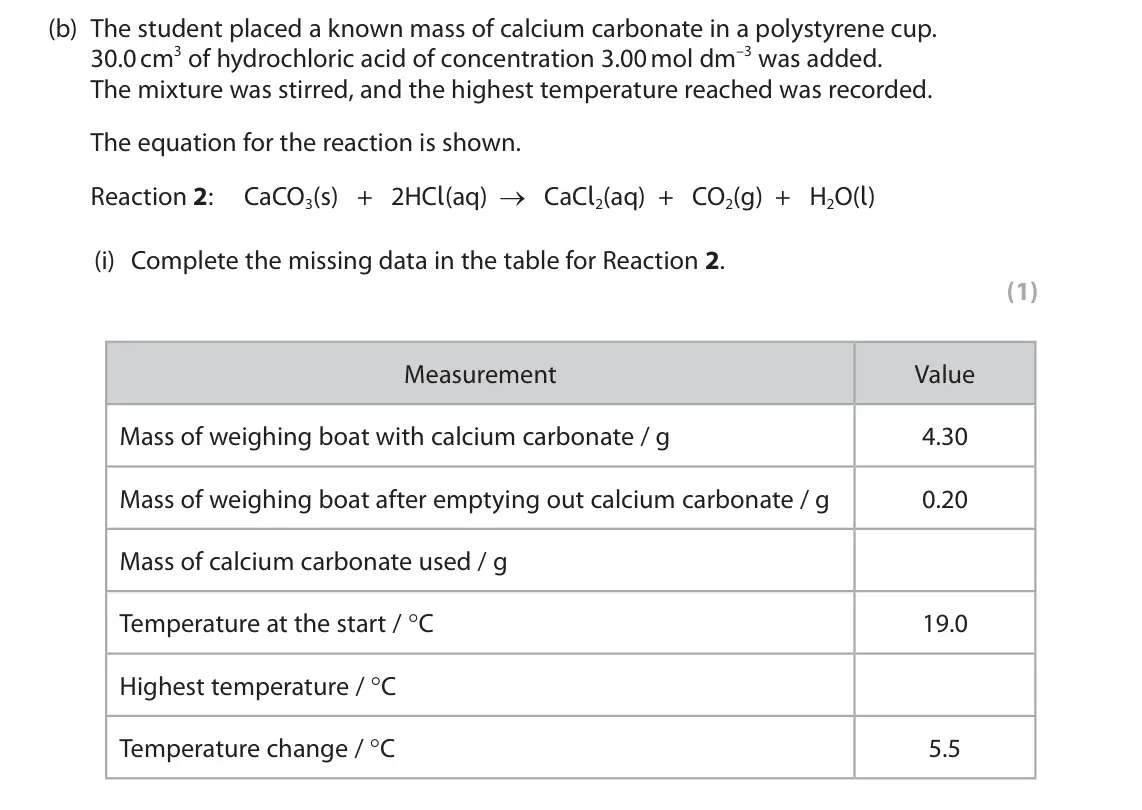
Q3(b)(iii)
The whole paper ↗
Q3(b)(iv)
The whole paper ↗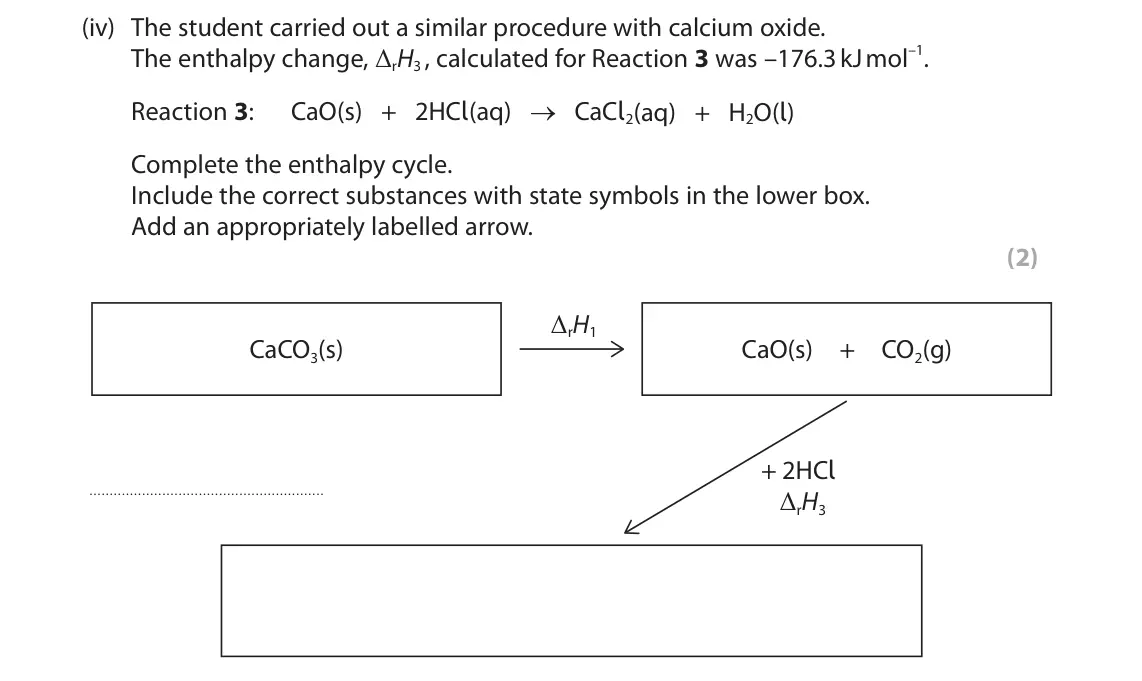
Q3(b)(v)
The whole paper ↗
Q3(a)
The whole paper ↗
Q3(b)
The whole paper ↗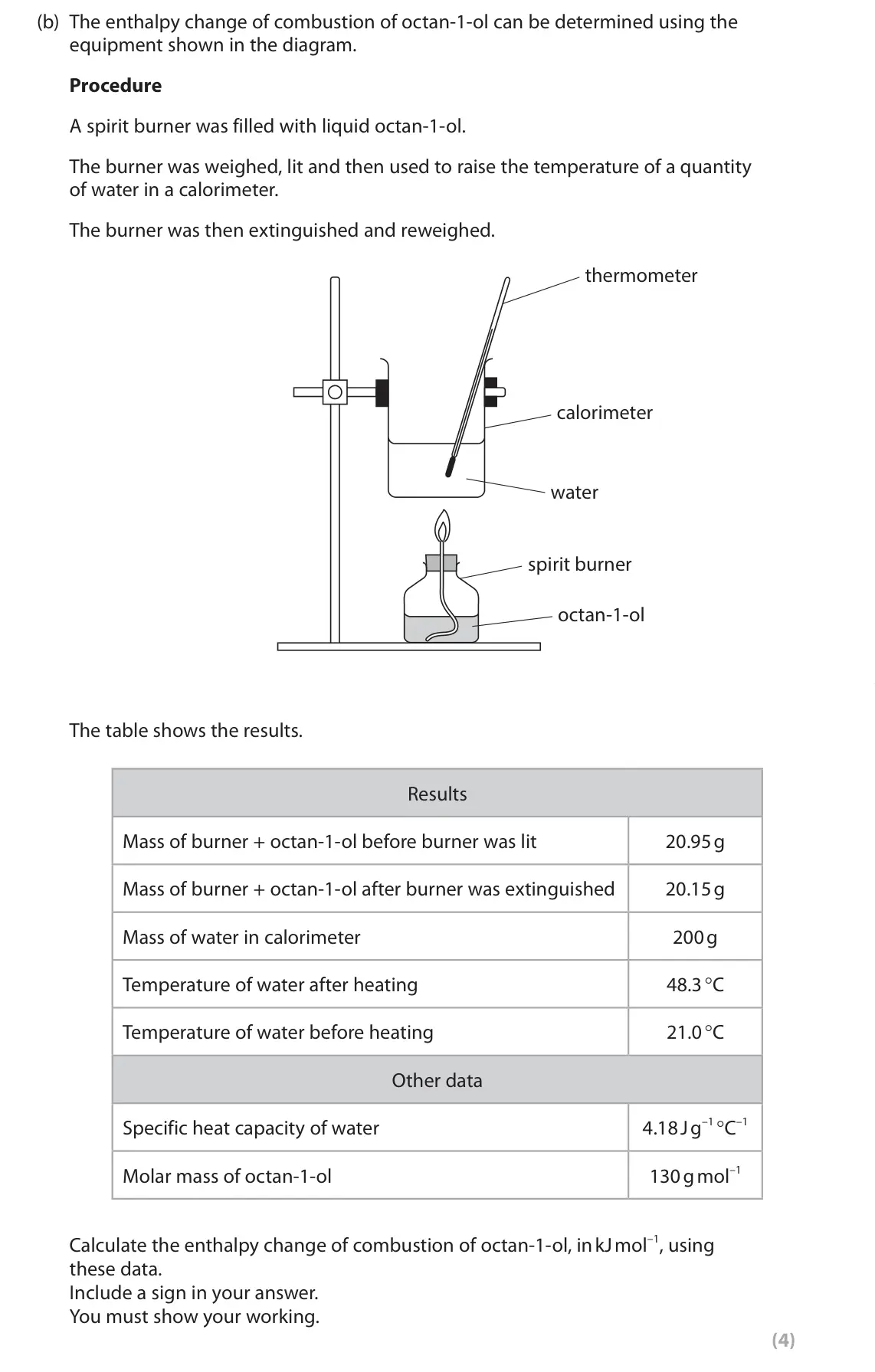
Q3(c)
The whole paper ↗
Q3(d)
The whole paper ↗
Q4(b)
The whole paper ↗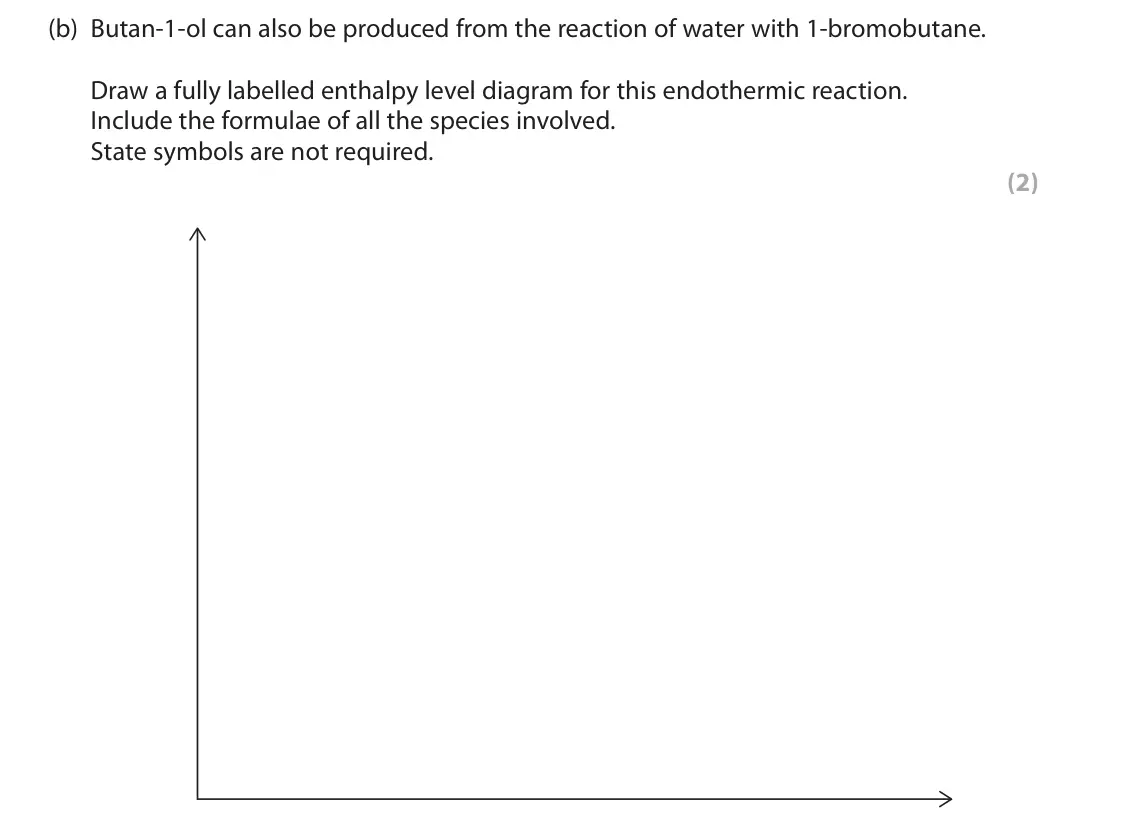
Q9(a)(i)
The whole paper ↗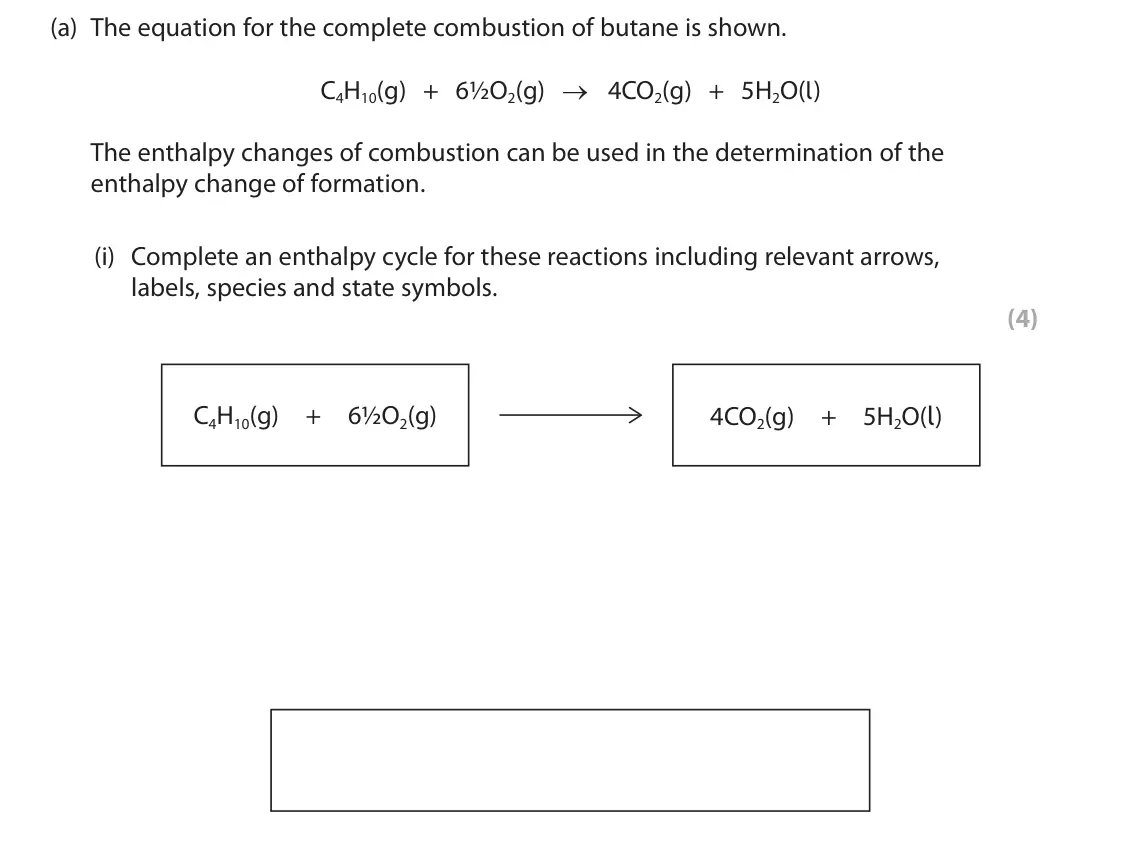
Q9(a)(ii)
The whole paper ↗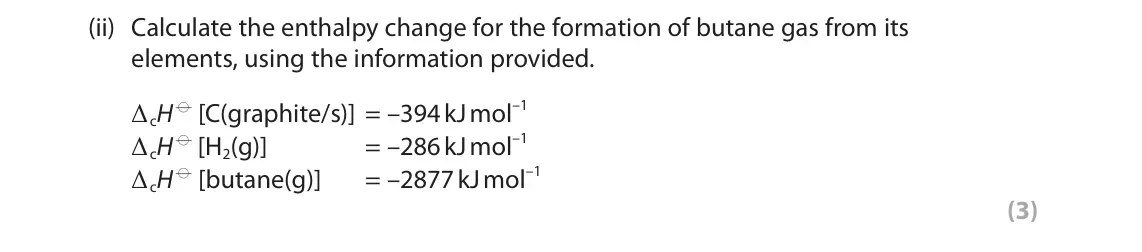
Q9(b)
The whole paper ↗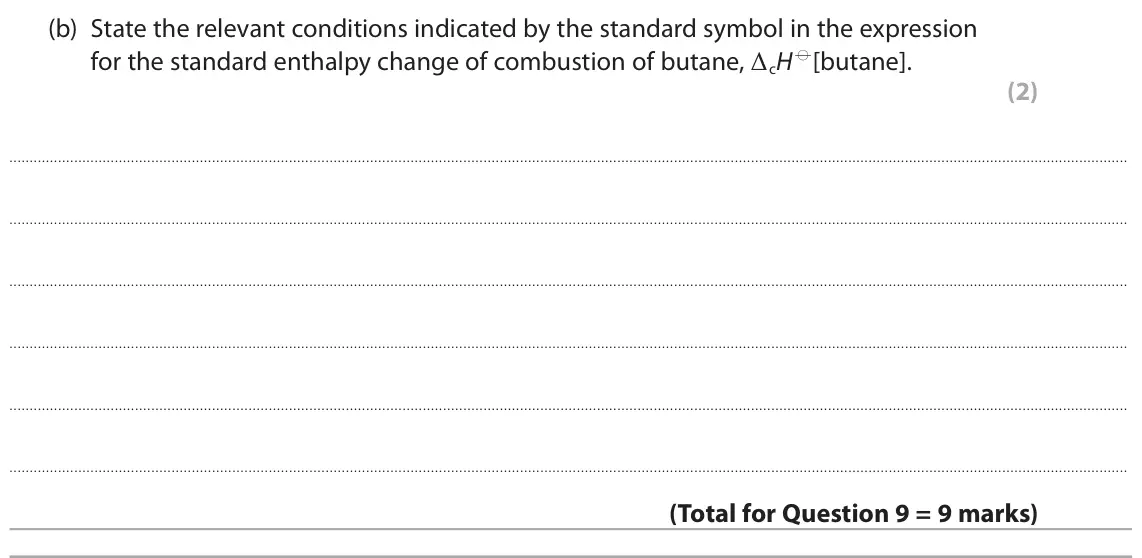
Q5(a)
The whole paper ↗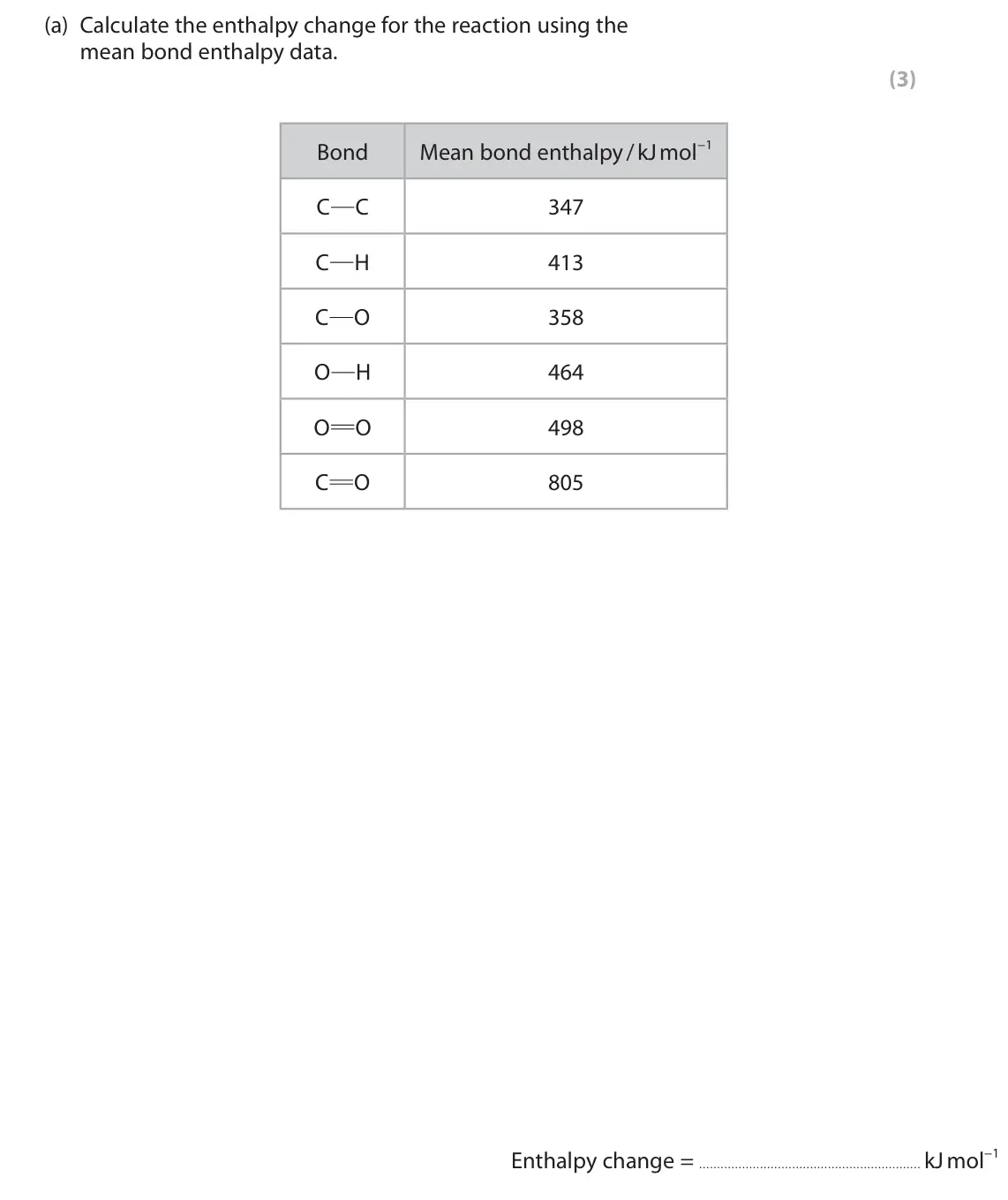
Q5(b)(i)
The whole paper ↗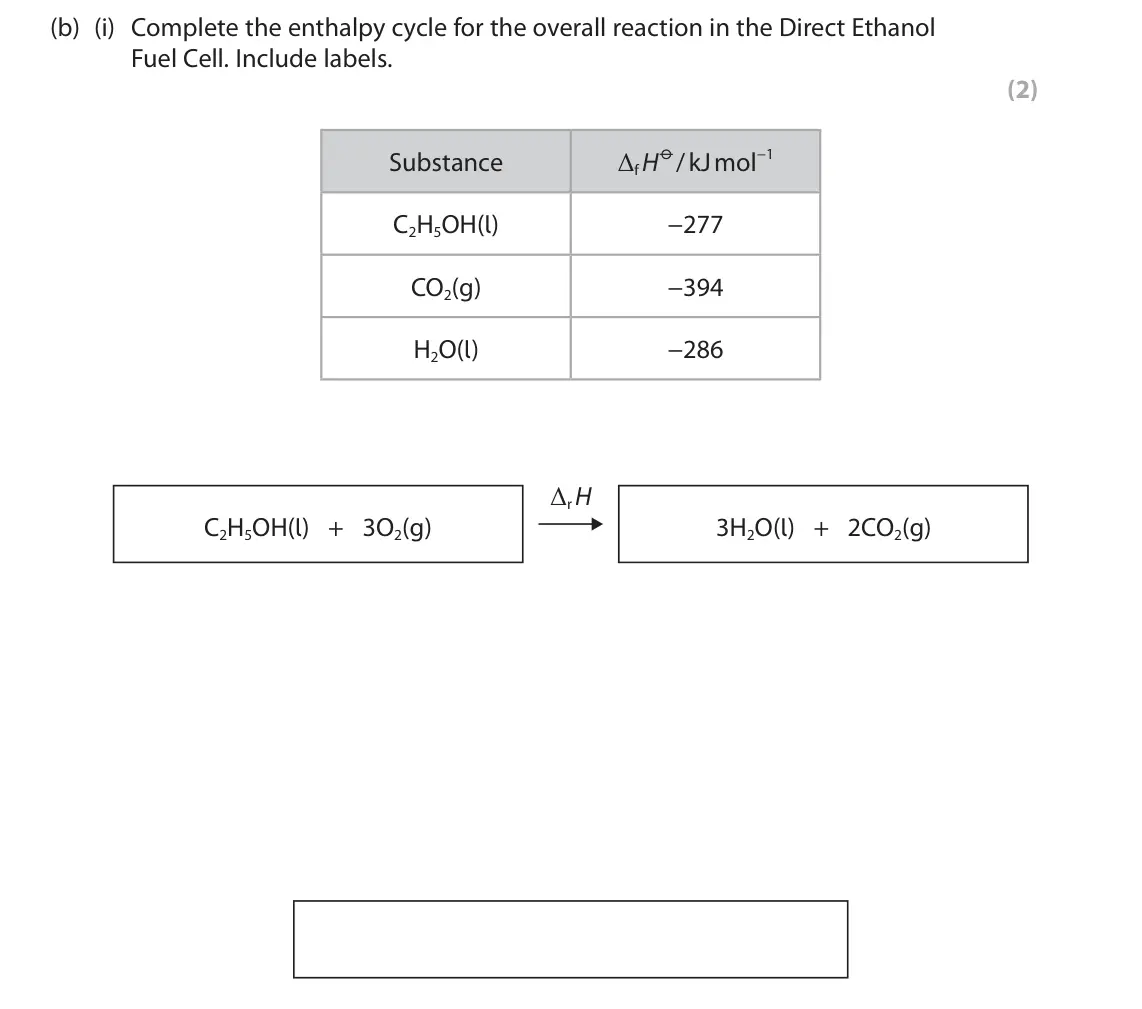
Q5(b)(ii)
The whole paper ↗
Q5(c)
The whole paper ↗
Q4(a)(i)
The whole paper ↗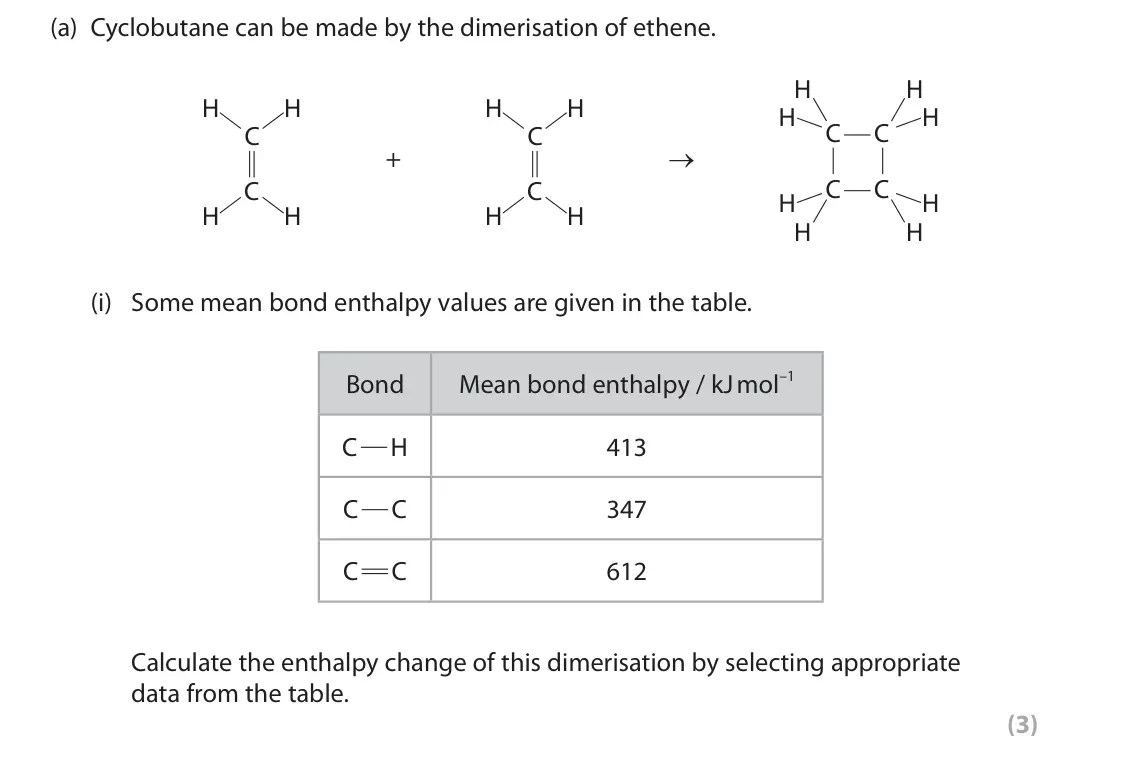
Q4(a)(ii)
The whole paper ↗
Q4(b)(i)
The whole paper ↗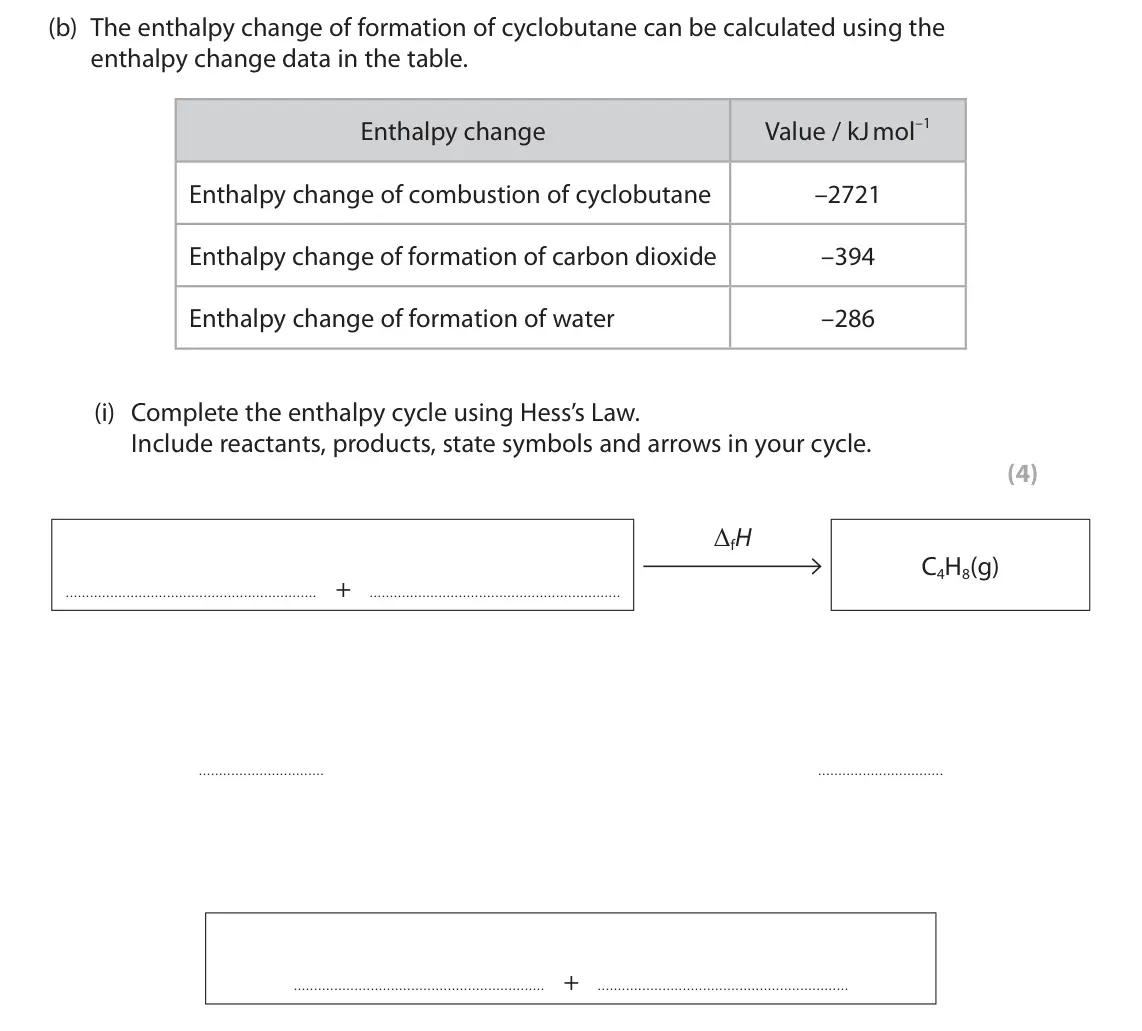
All 110 questions on Energetics I, as a list
- June 2025, Paper 1, Q3(a) (1 mark): State why the enthalpy change for the thermal decomposition of calcium carbonate cannot be determined directly. (1)
- June 2025, Paper 1, Q3(b)(i) (1 mark): Complete the missing data in the table for Reaction 2. (1) Measurement Value Mass of weighing boat with calcium carbonate / g 4.30 Mass of weighing boat after e
- June 2025, Paper 1, Q3(b)(iii) (3 marks): Calculate the enthalpy change, ΔrH2 , for Reaction 2 in kJ mol–1. Include a sign in your answer. [Assume the specific heat capacity of the solution = 4.18 J g–1
- June 2025, Paper 1, Q3(b)(iv) (2 marks): The student carried out a similar procedure with calcium oxide. The enthalpy change, ΔrH3 , calculated for Reaction 3 was –176.3 kJ mol–1. Reaction 3: CaO(s) +
- June 2025, Paper 1, Q3(b)(v) (1 mark): Calculate a value for the enthalpy change ΔrH1 for the thermal decomposition of calcium carbonate by using your cycle. (1)
- June 2025, AS Paper 2, Q3(a) (1 mark): Predict the enthalpy change of combustion of hexan‑1‑ol, C6H13OH. (1) kJ mol–1
- June 2025, AS Paper 2, Q3(b) (4 marks): The enthalpy change of combustion of octan‑1‑ol can be determined using the equipment shown in the diagram. Procedure A spirit burner was filled with liquid oct
- June 2025, AS Paper 2, Q3(c) (2 marks): In the experiment, the calorimeter is not insulated. Explain the difference between the enthalpy change of combustion of octan‑1‑ol determined in this experimen
- June 2025, AS Paper 2, Q3(d) (2 marks): A student carried out this experiment leaving the thermometer at the bottom of the calorimeter and not stirring. Explain the effect this would have on the calcu
- June 2025, AS Paper 2, Q4(b) (2 marks): Butan-1-ol can also be produced from the reaction of water with 1-bromobutane. Draw a fully labelled enthalpy level diagram for this endothermic reaction. Inclu
- June 2025, AS Paper 2, Q9(a)(i) (4 marks): Complete an enthalpy cycle for these reactions including relevant arrows, labels, species and state symbols. (4) C4H10(g) + 6½O2(g) 4CO2(g) + 5H2O(l)
- June 2025, AS Paper 2, Q9(a)(ii) (3 marks): Calculate the enthalpy change for the formation of butane gas from its elements, using the information provided. ΔcH d [C(graphite/s)] = –394 kJ mol–1 ΔcH d [H2
- June 2025, AS Paper 2, Q9(b) (2 marks): State the relevant conditions indicated by the standard symbol in the expression for the standard enthalpy change of combustion of butane, ΔcH d [butane]. (2)
- June 2024, Paper 1, Q5(a) (3 marks): Calculate the enthalpy change for the reaction using the mean bond enthalpy data. (3) Bond Mean bond enthalpy / kJ mol−1 C C 347 C H 413 C O 358 O H 464 O O 498
- June 2024, Paper 1, Q5(b)(i) (2 marks): Complete the enthalpy cycle for the overall reaction in the Direct Ethanol Fuel Cell. Include labels. (2) ΔfH / kJ mol−1 Substance C2H5OH(l) −277 CO2(g) −394 H2
- June 2024, Paper 1, Q5(b)(ii) (1 mark): Calculate a value for the enthalpy change of the Direct Ethanol Fuel Cell reaction, using your cycle. (1) Enthalpy change = kJ mol−1
- June 2024, Paper 1, Q5(c) (2 marks): Give two reasons for the difference between your calculated values in (a) and (b). (2)
- June 2024, AS Paper 2, Q4(a)(i) (3 marks): Some mean bond enthalpy values are given in the table. Mean bond enthalpy / kJ mol–1 Bond C H 413 C C 347 C C 612 Calculate the enthalpy change of this dimerisa
- June 2024, AS Paper 2, Q4(a)(ii) (2 marks): A different value for the enthalpy change of the reaction can be calculated using bond enthalpies instead of mean bond enthalpies. This value is more accurate.
- June 2024, AS Paper 2, Q4(b)(i) (4 marks): Complete the enthalpy cycle using Hess’s Law. Include reactants, products, state symbols and arrows in your cycle. (4) ΔfH C4H8(g) + +
- June 2024, AS Paper 2, Q4(b)(ii) (2 marks): Calculate the enthalpy change of formation of cyclobutane. (2)
- June 2024, AS Paper 2, Q8(a)(i) (2 marks): Write the equation to represent the enthalpy change of combustion of methanol. Include state symbols. (2)
- June 2024, AS Paper 2, Q8(a)(ii) (4 marks): Calculate the expected final temperature of the water in the student’s experiment, assuming no experimental errors. (4)
- June 2024, AS Paper 2, Q8(a)(iii) (1 mark): Calculate the percentage error in the experimental temperature rise compared to the theoretical temperature rise from your calculation. (1)
- June 2024, AS Paper 2, Q8(b) (2 marks): Instead of waiting in a queue for a balance which recorded the mass of the spirit burner to 2 decimal places, the student used a balance which recorded the mass
- June 2023, Paper 1, Q6(d)(ii) (3 marks): Another weak acid found in cranberries is quinic acid, C6H7(OH)4COOH. It is neutralised by sodium hydroxide solution in a similar way to benzoic acid. A 25.0 cm
- June 2023, Paper 3, Q4(a) (6 marks): Devise an experimental procedure to determine the enthalpy change of solution for hydrated magnesium sulfate. MgSO4·7H2O(s) + aq → MgSO4(aq) Details of the meth
- June 2023, Paper 3, Q4(b) (2 marks): The enthalpy changes of solution for anhydrous and hydrated magnesium sulfate were found by experiment to be MgSO4(s) + aq → MgSO4(aq) ΔrH = –63.2 kJ mol–1 ΔrH
- June 2023, AS Paper 2, Q5(a)(i) (3 marks): Calculate the enthalpy change, in kJ g–1, when 1.00 g of alcohol Q is burned. Include a sign in your final answer. (3)
- June 2023, AS Paper 2, Q5(a)(ii) (2 marks): At the end of the experiment there was a black deposit of carbon on the bottom of the beaker. Explain the effect of formation of the carbon deposit on your answ
- June 2023, AS Paper 2, Q5(b) (2 marks): Give one theoretical and one practical reason why this procedure is insufficient to identify the alcohol. (2) Theoretical reason Practical reason
- June 2023, AS Paper 2, Q7(b) (2 marks): The equation for the complete combustion of butan‑1‑ol is shown. CH3CH2CH2CH2OH(l) + 6O2(g) → 4CO2(g) + 5H2O(l) ΔcH d = –2675.6 kJ mol–1 Draw a labelled enthalp
- June 2023, AS Paper 2, Q8(a) (2 marks): State the two conditions denoted by the standard symbol d for this reaction. (2)
- June 2023, AS Paper 2, Q8(b)(i) (2 marks): Draw a Hess’s Law cycle that would enable you to use the data provided to calculate the enthalpy change of formation of gaseous water, ΔrH. (2) H2(g) + ½O2(g) →
- June 2023, AS Paper 2, Q8(b)(ii) (3 marks): Calculate the enthalpy change for the reaction shown. H2(g) + ½O2(g) → H2O(g) (3)
- June 2022, Paper 1, Q5(a) (1 mark): Magnesium carbonate reacts with dilute hydrochloric acid at room temperature. MgCO3(s) + 2HCl(aq) → MgCl2(aq) + CO2(g) + H2O(l) When the reaction is carried out
- June 2022, Paper 1, Q5(b) (3 marks): State what is meant by the standard enthalpy change of formation of aluminium oxide, Al2O3(s). Include standard conditions. (3)
- June 2022, AS Paper 2, Q3(a)(i) (3 marks): Calculate the enthalpy change of combustion of decane, using the mean bond enthalpy values in the table. (3) Mean bond enthalpy Bond / kJ mol−1 C C 347 C H 413
- June 2022, AS Paper 2, Q3(a)(ii) (2 marks): A data book value for the enthalpy change of combustion of decane is −6 778 kJ mol−1 . Give two reasons for the difference between your answer to (a)(i) and thi
- June 2022, AS Paper 2, Q4(a)(i) (2 marks): Plot the results using the axes provided. Include two straight lines of best fit, extrapolated until they meet. (2) 27 26 25 24 23 22 21 20 0 10 20 30 40 50 60
- June 2022, AS Paper 2, Q4(a)(ii) (1 mark): Determine the maximum temperature rise from your graph. (1)
- June 2022, AS Paper 2, Q4(a)(iv) (3 marks): The reaction that occurs is NH3(aq) + CH3COOH(aq) → NH4 +(aq) + CH3COO−(aq) Calculate the enthalpy change per mole for this reaction. Include a sign and units i
- June 2022, AS Paper 2, Q4(b)(i) (1 mark): The temperature of the reaction mixture initially increased because the reaction is (1) A endothermic so energy is absorbed by the water B endothermic so energy
- June 2022, AS Paper 2, Q4(b)(ii) (1 mark): Give the main reason why, after the end‑point was reached, the temperature of the solution decreased. (1)
- June 2022, AS Paper 2, Q7(b)(i) (2 marks): Complete the Hess cycle to enable you to calculate the enthalpy change of formation, ∆fH298 , of NOCl. Include state symbols. (2) 2NO(g) + Cl2(g) 2NOCl(g)
- June 2022, AS Paper 2, Q7(b)(ii) (2 marks): Calculate the enthalpy change of formation, ∆fH298 , of NOCl given the data 2NO(g) + Cl2(g) 2NOCl(g) ∆rH298 = −75.6 kJ mol−1 enthalpy change of formation of N
- November 2021, Paper 1, Q5(a)(i) (3 marks): Chlorine and phosphorus (P4) can react to form phosphorus(V) chloride. The structure of a molecule of phosphorus is P P P P Some mean bond enthalpy values are s
- November 2021, Paper 1, Q5(a)(ii) (1 mark): Give a reason why bond enthalpy values are always positive. (1)
- November 2021, Paper 3, Q7(a)(i) (1 mark): Complete the table. (1)
- November 2021, Paper 3, Q7(a)(iii) (3 marks): Calculate the enthalpy change for the reaction between sodium hydrogencarbonate and hydrochloric acid, using the results of the experiment. Include a sign and u
- November 2021, Paper 3, Q7(b)(i) (2 marks): Complete the Hess cycle with appropriate formulae and labelled arrows. (2) ∆rH 2NaHCO3(s) Na2CO3(s) + H2O(l) + CO2(g)
- November 2021, Paper 3, Q7(b)(ii) (3 marks): Calculate the enthalpy change for the decomposition of sodium hydrogencarbonate. Include a sign and units in your answer. ∆rH 2NaHCO3(s) Na2CO3(s) + H2O(l) + CO
- November 2021, Paper 3, Q7(c)(i) (1 mark): Calculate the percentage error in this student’s value. (1)
- November 2021, Paper 3, Q7(c)(ii) (1 mark): Calculate the percentage uncertainties in measuring 50 cm3 of hydrochloric acid using a burette and using a measuring cylinder. (1) Apparatus Uncertainty Percen
- November 2021, Paper 3, Q7(c)(iii) (1 mark): Give a reason why using a burette rather than a measuring cylinder will not improve the accuracy of the experiment. (1)
- November 2021, Paper 3, Q7(c)(iv) (5 marks): Describe changes to the method and how the data is used that would improve the accuracy of the determination of the temperature change in Experiment 2. Your des
- November 2021, AS Paper 2, Q2(a)(i) (3 marks): Complete the Hess’s Law cycle to include the enthalpy change of formation of both phosphorus chlorides. Include the labels of the missing enthalpy changes. ΔvH
- November 2021, AS Paper 2, Q2(a)(ii) (2 marks): Calculate the enthalpy change for the thermal decomposition of PCl5(g) to PCl3(g) and Cl2(g), using the data given in the table. Include a sign and units in you
- November 2021, AS Paper 2, Q4(b) (1 mark): Which two terms could be used to describe this reaction? (1) Enthalpy change Type of process A endothermic hydration B exothermic hydration C exothermic dehydra
- November 2021, AS Paper 2, Q4(c)(ii) (4 marks): Calculate the enthalpy change, in kJ mol–1, for this reaction. Include a sign in your answer and give your answer to an appropriate number of significant figure
- November 2021, AS Paper 2, Q4(c)(iii) (2 marks): Deduce which measurement has the greatest uncertainty in this experiment. Justify your answer by calculating the percentage uncertainty of this piece of apparat
- November 2021, AS Paper 2, Q9(a)(i) (3 marks): Calculate the enthalpy change for the forward reaction shown in the equation, selecting from the bond enthalpies in the table. Include a sign in your answer. (3
- November 2021, AS Paper 2, Q9(a)(ii) (2 marks): A data book gives the standard enthalpy change of formation of ammonia as –46.1 kJ mol–1. Give two reasons for the difference between this value and the value t
- October 2020, Paper 1, Q6(a)(i) (2 marks): When researching the bond enthalpy data, the student claimed that it was not necessary to find the value for the C=C bond as they could use the value for a C–C
- October 2020, Paper 1, Q6(a)(ii) (3 marks): Calculate a value for the enthalpy of combustion of prop-2-en-1-ol using the data shown. C3H6O(g) + 4O2(g) → 3CO2(g) + 3H2O(g) C=C C=O O=O Bond C−C C−O O−H C−H
- October 2020, Paper 3, Q4(b) (3 marks): The reaction of hydrated copper(II) sulfate with water is shown. CuSO4.5H2O(s) + aq → CuSO4(aq) ∆H1 = +18.2 kJ mol−1 Calculate the temperature change that would
- October 2020, Paper 3, Q4(c)(i) (3 marks): Draw to scale, on the graph paper, a labelled enthalpy level diagram which shows the enthalpy changes for the reactions of water with hydrated copper(II) sulfat
- October 2020, Paper 3, Q4(c)(ii) (1 mark): Use your enthalpy level diagram in (c)(i) to determine the enthalpy change, ∆rH, for the reaction CuSO4(s) + 5H2O(l) → CuSO4.5H2O(s) You must show your working
- October 2020, Paper 3, Q4(d) (1 mark): State why the enthalpy change for the reaction of one mole of anhydrous copper(II) sulfate with five moles of water to form hydrated copper(II) sulfate, CuSO4.5
- October 2020, AS Paper 1, Q3(c) (2 marks): Hydrazine has been used as a rocket fuel. It is a powerful reducing agent and will react very exothermically with oxidising agents such as hydrogen peroxide. Th
- October 2020, AS Paper 2, Q4(a) (4 marks): Use the data to calculate a value for the enthalpy change of combustion of one mole of methanol. Give your answer to an appropriate number of significant figure
- October 2020, AS Paper 2, Q4(c) (3 marks): Calculate a value for the standard enthalpy change of combustion of gaseous methanol using the enthalpy change for Step 2 and the standard enthalpy change of co
- October 2020, AS Paper 2, Q5(a) (2 marks): Iodine monochloride gas can be produced by the reaction between iodine vapour and chlorine gas. The reaction is exothermic. I2(g) + Cl2(g) → 2ICl(g) ΔrH = −30 k
- June 2019, Paper 1, Q3(a)(i) (1 mark): Which piece of equipment has the smallest measurement uncertainty for the measurement of 50.0 cm3 of sodium hydroxide solution? (1) Equipment Measurement uncert
- June 2019, Paper 1, Q3(a)(ii) (3 marks): 50.0 cm3 of propanoic acid solution, of concentration 1.00 mol dm–3, was added and thoroughly mixed with the sodium hydroxide solution in the polystyrene cup. T
- June 2019, Paper 1, Q3(b)(i) (1 mark): Which graph shows the correct way that the maximum temperature rise should be determined? (1) A B 45 45 40 40 35 35 ¨T 30 30 ¨T 25 25 20 20 15 15 0 0 0 60 120 1
- June 2019, AS Paper 2, Q3(a)(i) (2 marks): State what is meant by the term ‘standard enthalpy change of combustion’. (2)
- June 2019, AS Paper 2, Q3(a)(ii) (2 marks): Write the equation, including state symbols, for the reaction that occurs when the standard enthalpy change of combustion of octane, C8H18(l), is measured. (2)
- June 2019, AS Paper 2, Q3(a)(iii) (2 marks): The standard enthalpy change of combustion of octane is –5 470 kJ mol–1. Complete the reaction profile diagram for the combustion of octane. 9, Include labels s
- June 2019, AS Paper 2, Q3(b) (4 marks): Enthalpy changes of reactions which cannot be measured directly can be calculated using standard enthalpy changes of combustion. The table shows some of these v
- June 2019, AS Paper 2, Q3(c)(i) (1 mark): the mean bond enthalpy of a C−−H bond. (1)
- June 2019, AS Paper 2, Q3(c)(ii) (2 marks): the mean bond enthalpy of a C−−C bond. (2)
- June 2018, Paper 1, Q3(a) (1 mark): Give a reason why excess sodium hydroxide was used. (1)
- June 2018, Paper 1, Q3(b) (4 marks): Calculate the enthalpy change of neutralisation for the reaction between nitric acid and sodium hydroxide solution, using the results of the experiment. Give yo
- June 2018, AS Paper 2, Q3(b)(i) (3 marks): Use this equation, and the enthalpy changes of formation of nitrogen(II) oxide and water, to calculate the enthalpy change of formation of ammonia in kJ mol−1.
- June 2018, AS Paper 2, Q8(c)(i) (4 marks): Using the bond enthalpies shown in the table, calculate a value for the enthalpy change, in kJ mol−1, for the complete combustion of 2-methylpropan-2-ol. (4) Bo
- June 2018, AS Paper 2, Q8(c)(ii) (2 marks): 2-methylpropan-2-ol burns in air with a smoky flame. Explain how burning with a smoky flame affects the value of the experimentally determined enthalpy change o
- June 2018, AS Paper 2, Q8(c)(iii) (1 mark): A Data Book value for the enthalpy change of combustion of 2-methylpropan-2-ol is −2643.8 kJ mol−1. Give the main reason for the difference between this value a
- June 2017, Paper 1, Q5(a) (1 mark): Which is the equation for the standard enthalpy change of formation, ¨fH , of aluminium oxide? (1) A 4Al(s) + 3 O2(g) r 2Al2O3(s) B 4Al(s) + 6 O(g) r 2Al2O3(s)
- June 2017, Paper 1, Q5(b) (3 marks): Propan-1-ol is dehydrated to form propene. H H H H H C C ¨rH = +42 kJ mol−1 + H2O H C C C O H H C H H H H H H The relevant mean bond enthalpies are given in the
- June 2017, Paper 1, Q7(a) (3 marks): The enthalpy change when hydrochloric acid reacts with aqueous ammonia is –53.4 kJ mol–1. HCl(aq) + NH3(aq) r NH4Cl(aq) Calculate the temperature change you wou
- June 2017, Paper 1, Q7(b) (6 marks): The table shows the enthalpy changes of reaction when 1 mol of different acids are neutralised by sodium hydroxide solution, at 298 K. Enthalpy change of reacti
- June 2017, Paper 3, Q4(a) (2 marks): Complete Table 1, giving the values to an appropriate number of decimal places.
- June 2017, Paper 3, Q4(b) (2 marks): Write the equation that represents the reaction that occurs when the standard en
- June 2017, Paper 3, Q4(c) (4 marks): Use Student 1’s result to calculate the enthalpy change of combustion of methano
- June 2017, Paper 3, Q4(d)(i) (1 mark): Student 1 compared the experimental value for the enthalpy change of combustion
- June 2017, Paper 3, Q4(d)(ii) (3 marks): Compare and contrast the use of a 250 cm3 measuring cylinder to measure out the
- June 2017, Paper 3, Q4(d)(iii) (3 marks): Student 1 calculated the uncertainties in the remaining measurements. However,
- June 2017, Paper 3, Q4(e) (2 marks): Student 1 decided to repeat the experiment. Student 1 used the copper calorimete
- June 2017, Paper 3, Q4(f) (2 marks): Student 2 followed the original instructions provided, but extinguished the flam
- June 2017, Paper 3, Q4(g) (2 marks): Another student, Student 3, used the results from Student 1’s first experiment t
- June 2017, AS Paper 2, Q3(b)(i) (3 marks): Use these results to calculate the enthalpy change of combustion of hydrocarbon A in kJ mol–1. Give your answer to an appropriate number of significant figures
- June 2017, AS Paper 2, Q3(b)(ii) (1 mark): The beaker used in this experiment was made of copper rather than glass. Give a reason for this. (1)
- June 2016, AS Paper 2, Q4(b) (2 marks): Write the equation to represent the standard enthalpy change of formation of ethanol. Include state symbols. (2)
- June 2016, AS Paper 2, Q4(c)(i) (3 marks): The table shows some mean bond enthalpy data. Bond C C C H C O O H O O C O Mean bond enthalpy 347 413 358 464 498 805 / kJ mol−1 Calculate the enthalpy change,
- June 2016, AS Paper 2, Q4(c)(ii) (2 marks): Complete the reaction profile diagram for the combustion of ethanol and fully label the diagram. (2) enthalpy C2H5OH(l) + 3O2(g) reaction pathway
- June 2016, AS Paper 2, Q4(c)(iii) (1 mark): A data book value for the standard enthalpy change of combustion of ethanol is −1367.3 kJ mol−1. Give the main reason why the value you calculated in (b)(i) is
- June 2016, AS Paper 2, Q6(a) (4 marks): In the first experiment, the student determines the enthalpy change of solution for anhydrous sodium carbonate. 50.0g of distilled water is placed in a polystyr
- June 2016, AS Paper 2, Q6(b) (2 marks): In the second experiment, the student determines the enthalpy change of solution for hydrated sodium carbonate. Na2CO3.10H2O(s) + aq o Na2CO3(aq) ¨H = + 53.7kJ
- June 2016, AS Paper 2, Q6(c) (2 marks): Hydrated sodium carbonate slowly loses some water of crystallisation when left in air. Explain how the enthalpy change in the second experiment would compare wi
Questions, mark schemes and examiner’s reports are © Pearson Edexcel, from their published past papers. Plumi isn’t affiliated with any exam board. Want whole papers? Every Edexcel A-Level Chemistry paper.
Rather write your answers by hand on iPad? Plumi marks them against the same mark schemes.