 plumi
The elements of Groups 1 and 2: Edexcel A‑Level Chemistry questions
Every Edexcel A-Level Chemistry exam question on 4A The elements of Groups 1 and 2, 2016–2025, with its mark scheme and examiner’s report.
Find questions2,028
Calculations
Q3(d)
The whole paper ↗
Q4(b)(i)
The whole paper ↗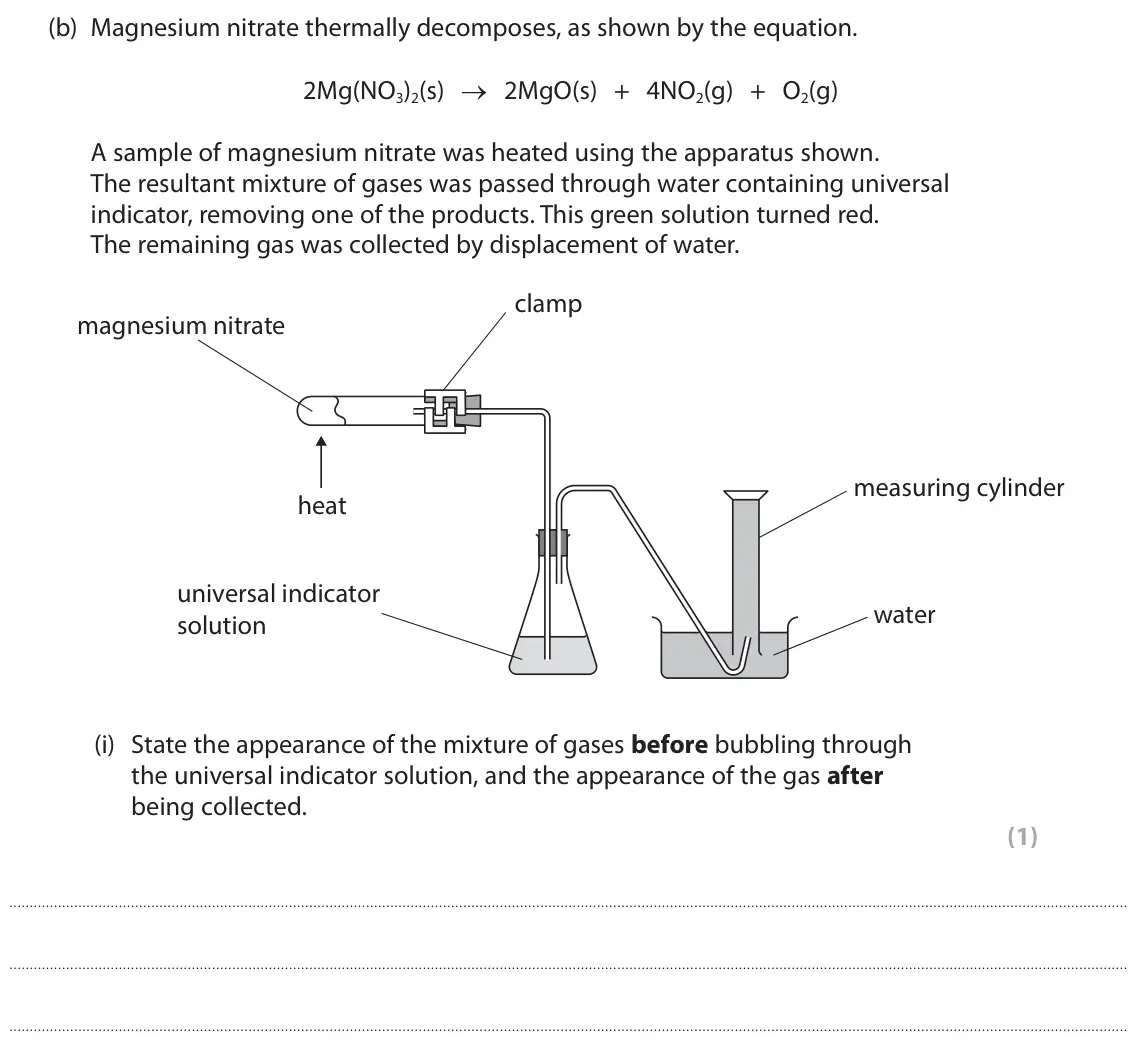
Q4(b)(ii)
The whole paper ↗
Q3(a)(i)
The whole paper ↗
Q3(a)(ii)
The whole paper ↗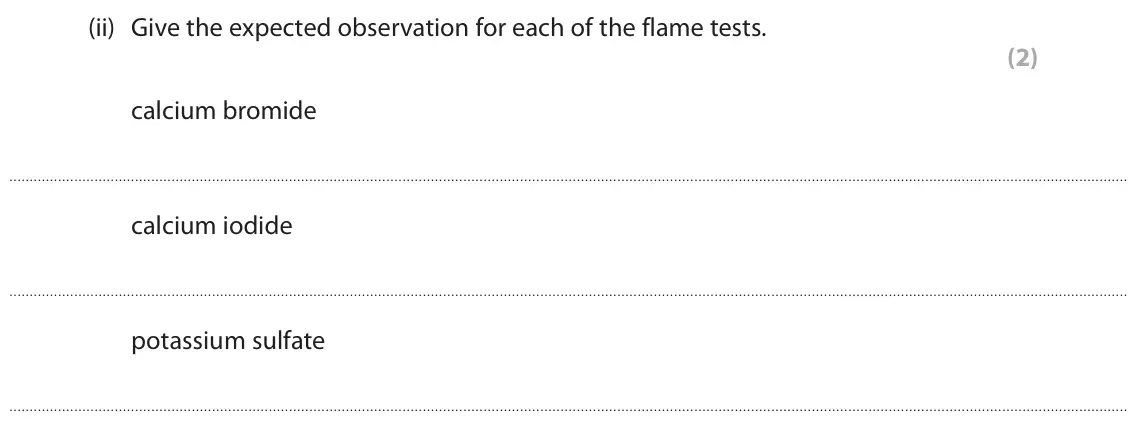
Q3(e)(i)
The whole paper ↗
Q4(b)
The whole paper ↗
Q7(b)(i)
The whole paper ↗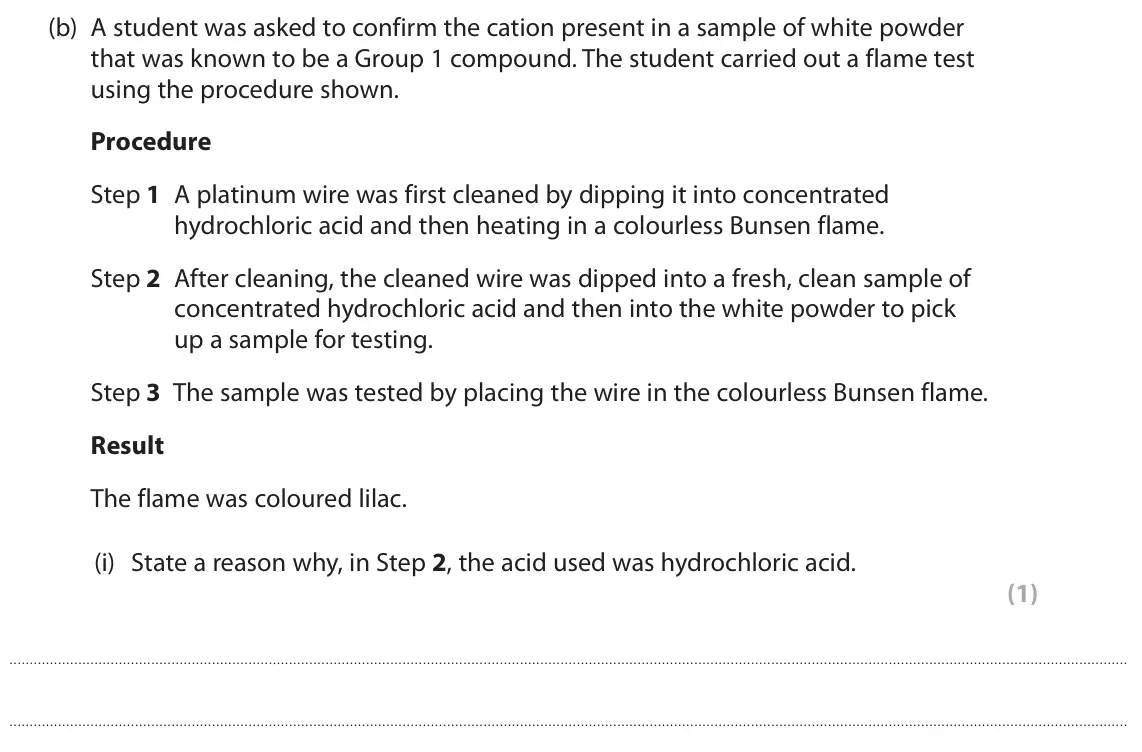
Q7(b)(ii)
The whole paper ↗
Q7(c)(i)
The whole paper ↗
Q7(c)(ii)
The whole paper ↗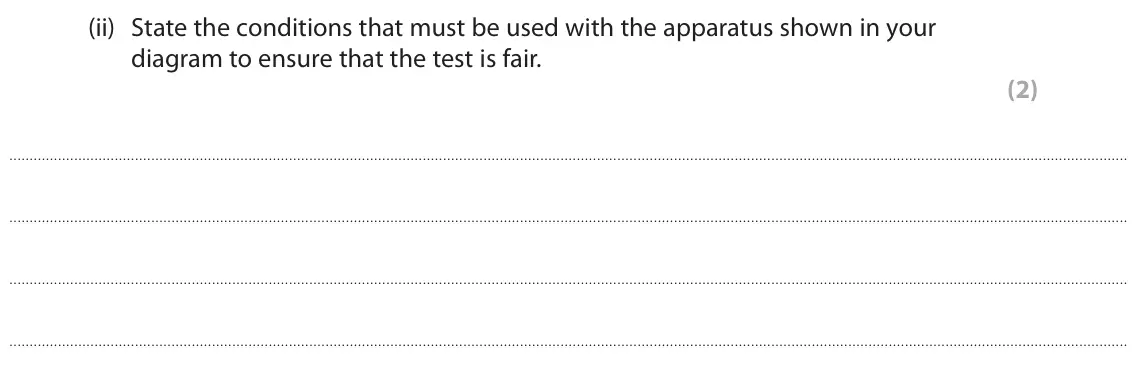
Q7(c)(iii)
The whole paper ↗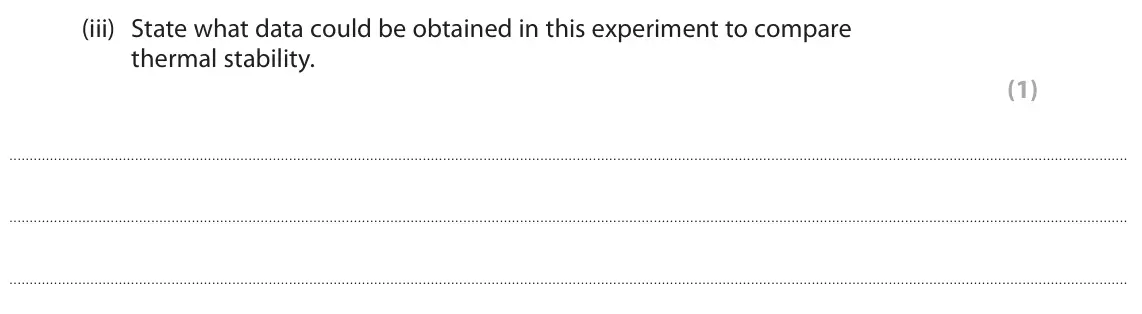
Q7(c)(iv)
The whole paper ↗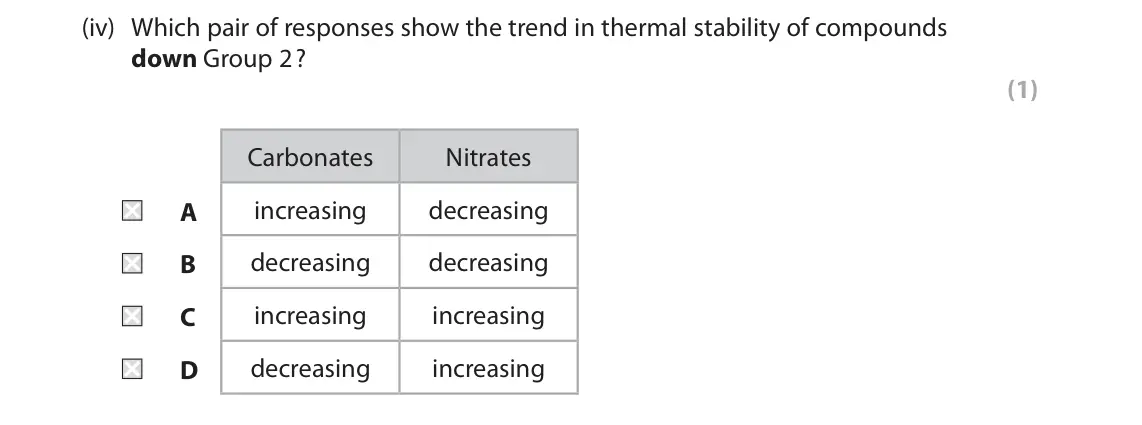
Q2(a)(i)
The whole paper ↗
Q2(a)(ii)
The whole paper ↗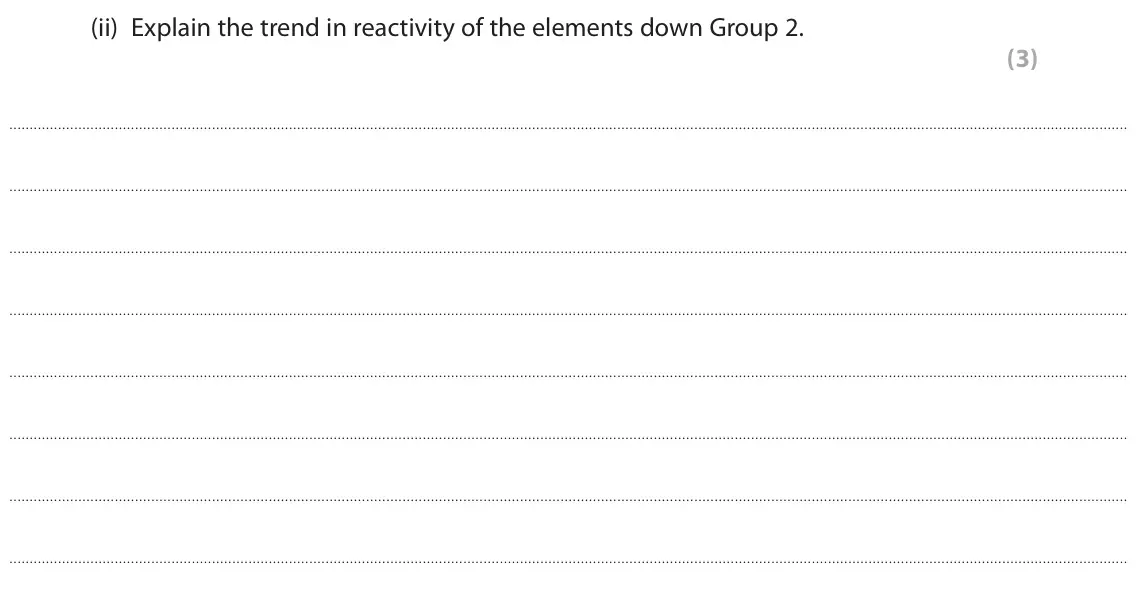
Q2(b)(i)
The whole paper ↗
Q2(b)(ii)
The whole paper ↗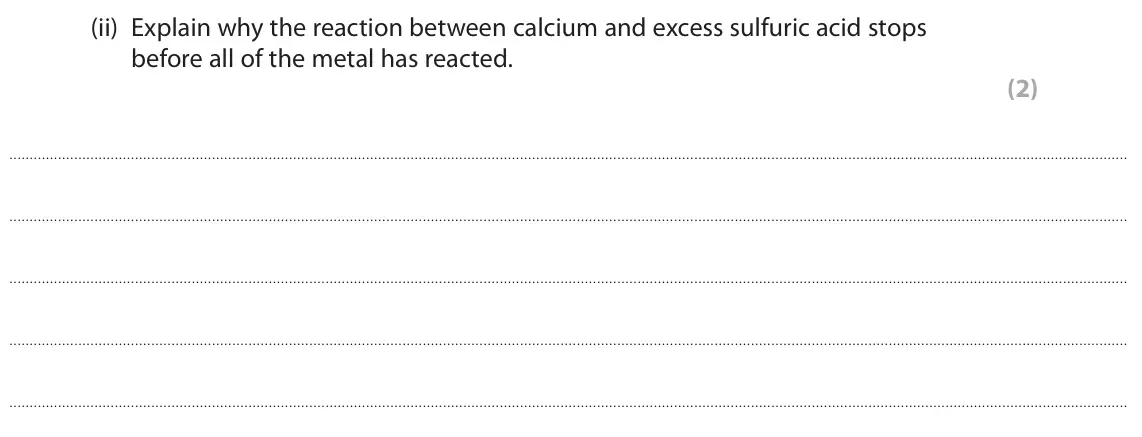
Q2(c)(ii)
The whole paper ↗
Q2(b)
The whole paper ↗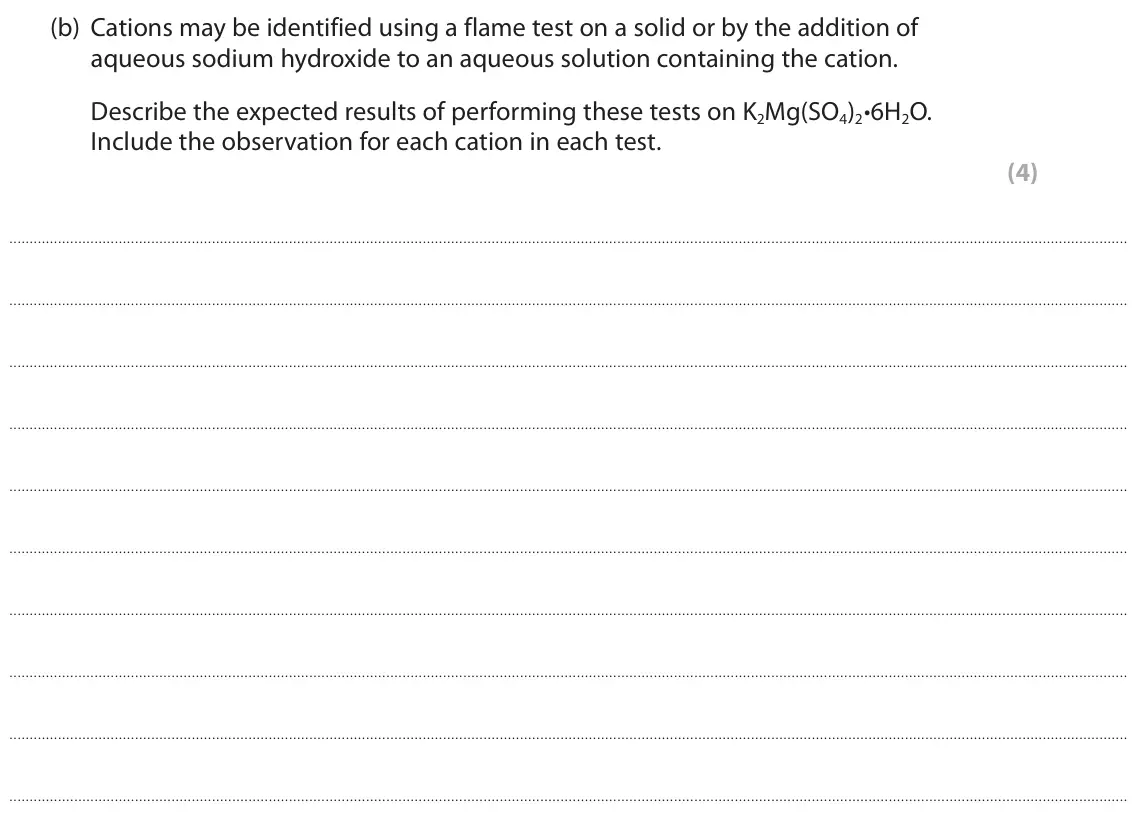
Q9(b)(ii)
The whole paper ↗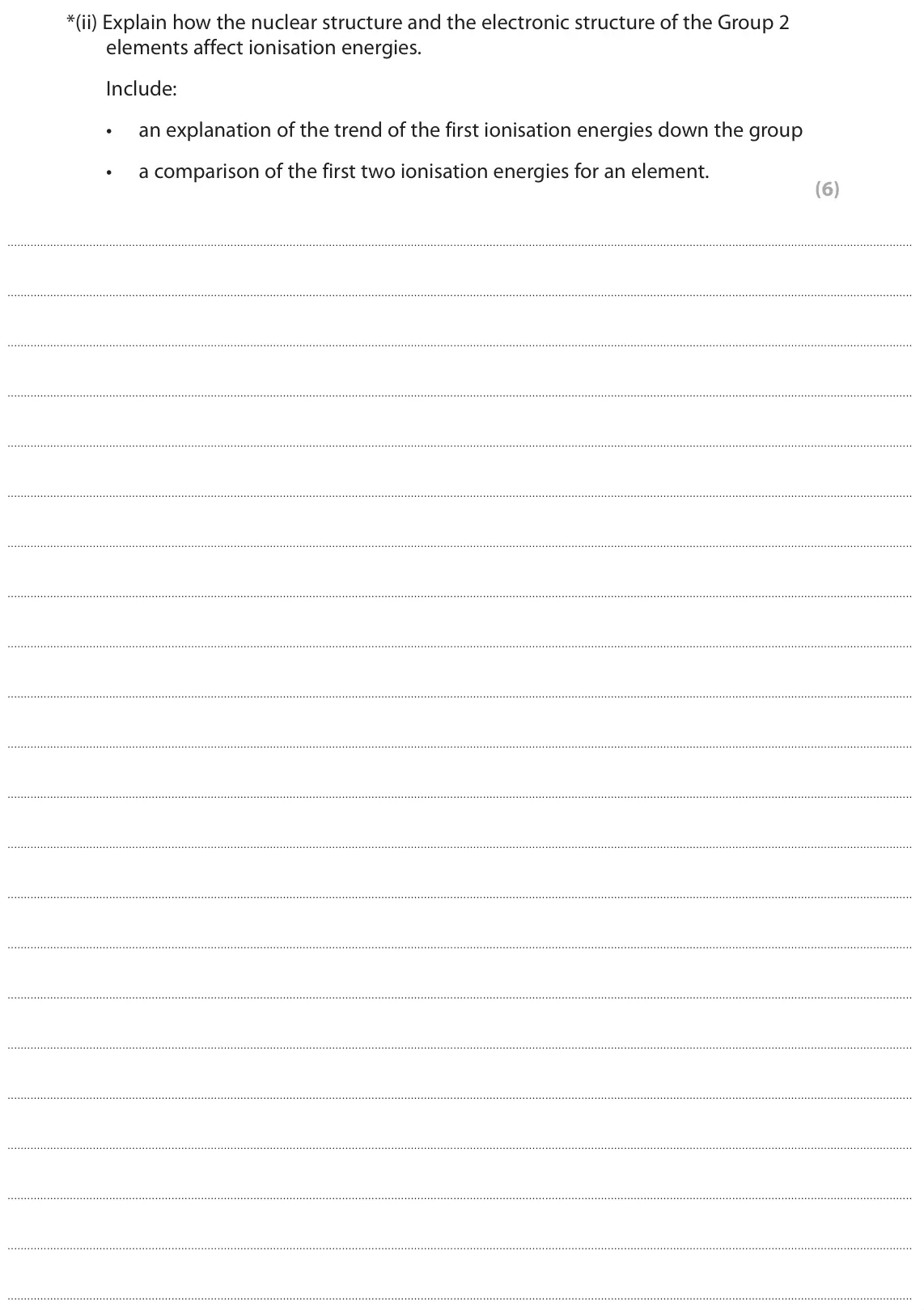
All 80 questions on The elements of Groups 1 and 2, as a list
- June 2025, Paper 1, Q3(d) (3 marks): Explain why magnesium carbonate undergoes thermal decomposition at a lower temperature than calcium carbonate. (3)
- June 2025, AS Paper 1, Q4(b)(i) (1 mark): State the appearance of the mixture of gases before bubbling through the universal indicator solution, and the appearance of the gas after being collected. (1)
- June 2025, AS Paper 1, Q4(b)(ii) (2 marks): Explain the change in appearance of the mixture of gases, and of the universal indicator solution. (2)
- June 2024, Paper 1, Q3(a)(i) (3 marks): Describe how to carry out a flame test on these samples. (3)
- June 2024, Paper 1, Q3(a)(ii) (2 marks): Give the expected observation for each of the flame tests. (2) calcium bromide calcium iodide potassium sulfate
- June 2024, Paper 3, Q3(e)(i) (2 marks): Explain what causes the flame colour in such a test. (2)
- June 2024, Paper 3, Q4(b) (3 marks): Explain why calcium nitrate is less thermally stable than barium nitrate. (3)
- June 2024, AS Paper 1, Q7(b)(i) (1 mark): State a reason why, in Step 2, the acid used was hydrochloric acid. (1)
- June 2024, AS Paper 1, Q7(b)(ii) (1 mark): Identify the cation present in this sample of white powder. (1)
- June 2024, AS Paper 1, Q7(c)(i) (2 marks): Draw a labelled diagram of apparatus that would enable you to compare the thermal stability of Group 2 carbonates. (2)
- June 2024, AS Paper 1, Q7(c)(ii) (2 marks): State the conditions that must be used with the apparatus shown in your diagram to ensure that the test is fair. (2)
- June 2024, AS Paper 1, Q7(c)(iii) (1 mark): State what data could be obtained in this experiment to compare thermal stability. (1)
- June 2024, AS Paper 1, Q7(c)(iv) (1 mark): Which pair of responses show the trend in thermal stability of compounds down Group 2 ? (1) Carbonates Nitrates increasing decreasing A decreasing decreasing B
- June 2023, Paper 3, Q2(a)(i) (1 mark): Write the equation for the reaction between magnesium and oxygen. Include state symbols. (1)
- June 2023, Paper 3, Q2(a)(ii) (3 marks): Explain the trend in reactivity of the elements down Group 2. (3)
- June 2023, Paper 3, Q2(b)(i) (1 mark): State the trend in solubility of the Group 2 sulfates. (1)
- June 2023, Paper 3, Q2(b)(ii) (2 marks): Explain why the reaction between calcium and excess sulfuric acid stops before all of the metal has reacted. (2)
- June 2023, Paper 3, Q2(c)(ii) (1 mark): Write the equation for this decomposition. State symbols are not required. (1)
- June 2023, AS Paper 1, Q2(b) (4 marks): Cations may be identified using a flame test on a solid or by the addition of aqueous sodium hydroxide to an aqueous solution containing the cation. Describe th
- June 2023, AS Paper 1, Q9(b)(ii) (6 marks): Explain how the nuclear structure and the electronic structure of the Group 2 elements affect ionisation energies. Include: • an explanation of the trend of the
- June 2023, AS Paper 1, Q9(b)(iii) (2 marks): The value of the sum of the first and second ionisation energies changes on descending Group 2. Explain how this changing value might contribute to the relative
- June 2022, Paper 1, Q2(a) (2 marks): Magnesium powder is added to a beaker of water containing a few drops of Universal Indicator. The apparatus is set up as shown and allowed to stand for a few da
- June 2022, Paper 1, Q2(b) (3 marks): Explain how the trend in the reactivity of the Group 2 elements is determined by their electronic configurations. (3)
- June 2022, Paper 1, Q6(b) (2 marks): Write the ionic equation for the reaction between magnesium oxide and an acid. State symbols are required. (2)
- June 2022, Paper 3, Q4(b) (3 marks): Explain whether magnesium carbonate is more or less thermally stable than barium carbonate. (3)
- June 2022, AS Paper 1, Q3(a) (3 marks): A student wrote the following answer to a question about the processes that can give rise to a flame colour during a flame test of an inorganic compound. “When
- June 2022, AS Paper 1, Q3(b) (1 mark): Which compound does not give a red colour in a flame test? (1) A calcium chloride B lithium carbonate C sodium iodide D strontium bromide
- June 2022, AS Paper 1, Q3(c) (1 mark): A wire is used for a flame test. Which material would be most suitable for a flame test wire? (1) A copper B iron C magnesium D platinum
- June 2022, AS Paper 1, Q7(b) (1 mark): Which pair of statements describes the trends down Group 2? (1) Solubility of Solubility of sulfates hydroxides A increases increases B decreases increases C de
- June 2022, AS Paper 1, Q7(c)(ii) (1 mark): Write an equation for the thermal decomposition of lithium nitrate. State symbols are not required. (1)
- June 2022, AS Paper 1, Q7(d) (3 marks): A textbook states, ‘The thermal stability of Group 1 carbonates is generally higher than the thermal stability of Group 2 carbonates in the same period’. Explai
- November 2021, Paper 1, Q2(a) (1 mark): Which of the following should be used for a flame test on barium carbonate? (1) A iron wire and water B iron wire and concentrated hydrochloric acid C nichrome
- November 2021, Paper 1, Q2(b) (1 mark): What colour do barium ions give in a flame test? (1) A green B lilac C red D yellow
- November 2021, Paper 1, Q2(c) (1 mark): A flame test was carried out on a mixture of barium chloride and magnesium chloride. How does the presence of magnesium ions affect the appearance of the flame
- November 2021, AS Paper 1, Q3(b) (1 mark): Give a possible reason why samples of sodium amide are stored in oil. (1)
- November 2021, AS Paper 1, Q7(c)(i) (1 mark): Which of the following is a reason for dipping the flame test wire in concentrated hydrochloric acid during a flame test procedure? (1) A it dissolves metal ion
- November 2021, AS Paper 1, Q7(c)(ii) (1 mark): The flame colour given by these three solids in the flame test are shades of (1) A green B lilac C red D yellow
- November 2021, AS Paper 1, Q7(c)(iii) (1 mark): What is the best explanation for why metal ions produce different flame colours? (1) Different wavelengths of light energy are A required to promote electrons t
- November 2021, AS Paper 1, Q7(d) (6 marks): Devise a procedure to identify the nitrates of lithium, rubidium and strontium using the effect of heat on the three solids and any precipitation reactions of t
- October 2020, Paper 1, Q4(a) (1 mark): Which of these compounds is the most soluble in water? (1) A barium sulfate B calcium sulfate C magnesium sulfate D strontium sulfate
- October 2020, Paper 1, Q5(a)(i) (2 marks): State two observations you would see when hydrated magnesium nitrate is heated. (2)
- October 2020, Paper 1, Q5(a)(ii) (3 marks): Explain the trend in thermal stability of Group 2 nitrates. (3)
- October 2020, Paper 3, Q2(c) (3 marks): Explain, with reference to electron transitions, the formation of the colour in a flame test. (3)
- October 2020, AS Paper 1, Q6(c)(i) (3 marks): Describe how you would carry out a flame test on a sample of powdered malachite. (3)
- October 2020, AS Paper 1, Q6(c)(ii) (4 marks): When the atoms of some elements are heated, they produce a characteristic flame colour. For example, the copper in malachite gives a blue-green colour. Explain
- October 2020, AS Paper 1, Q8(a) (2 marks): Complete the equations for the thermal decomposition of sodium nitrate, NaNO3 , and for the thermal decomposition of calcium nitrate, Ca(NO3)2 . State symbols a
- October 2020, AS Paper 1, Q8(b) (3 marks): The thermal stability of Group 1 nitrates increases down the group. The decomposition temperatures of some Group 1 nitrates are shown. Decomposition temperature
- October 2020, AS Paper 1, Q8(c)(i) (1 mark): Write an equation, including state symbols, for the thermal decomposition of calcium carbonate. (1)
- June 2019, Paper 1, Q4(a)(i) (1 mark): The glowing splint is used as a test for one of the gases given off in this experiment. Identify this gas and the positive result of the test. (1)
- June 2019, Paper 1, Q4(a)(ii) (1 mark): Give the name and appearance of the other gas given off in this experiment when a Group 2 nitrate is heated. (1)
- June 2019, Paper 1, Q4(a)(iii) (1 mark): Write the equation for the decomposition if the Group 1 compound, sodium nitrate, was used in this experiment. State symbols are not required. (1)
- June 2019, Paper 1, Q4(a)(iv) (2 marks): Describe the apparatus that would be used to compare the decomposition of metal carbonates. Include how the rate of decomposition would be compared. (2)
- June 2019, Paper 1, Q4(b) (3 marks): Explain why magnesium carbonate decomposes much more readily on heating than barium carbonate. (3)
- June 2019, Paper 1, Q7 (6 marks): *7 Colour is often used in chemistry to identify substances. Compare and contrast the origin of the colour of a copper(II) complex with the origin of the colour
- June 2019, AS Paper 1, Q4(a) (1 mark): Which of the following describes the trends in thermal stability of the Group 2 carbonates and nitrates going down the group? (1) Thermal stability Carbonates N
- June 2019, AS Paper 1, Q4(b) (4 marks): Describe, with the aid of a labelled diagram, how you would compare the thermal stability of two different Group 2 nitrates using simple laboratory equipment. Y
- June 2019, AS Paper 1, Q4(c) (1 mark): Which of the following describes the trends in the solubility in water of the Group 2 hydroxides and sulfates going down the group? (1) Solubility in water Hydr
- June 2019, AS Paper 1, Q6(a)(i) (3 marks): Describe how a flame test is carried out. (3)
- June 2019, AS Paper 1, Q6(a)(ii) (4 marks): Explain the origin of flame test colours. (4)
- June 2019, AS Paper 1, Q6(a)(iii) (1 mark): Give a reason why the magnesium ion does not produce a flame colour. (1)
- June 2019, AS Paper 1, Q6(a)(iv) (1 mark): Give a reason why the lack of a flame colour is not a positive test for the magnesium ion. (1)
- June 2018, Paper 1, Q6(a) (1 mark): Which of these metal hydroxides is the most soluble in water? (1) A barium hydroxide B calcium hydroxide C magnesium hydroxide D potassium hydroxide
- June 2018, Paper 2, Q4(c) (3 marks): The third reaction in the airbag is between the metal oxides and silicon dioxide. State the type of reaction taking place and justify why this reaction is neces
- June 2018, Paper 3, Q3(e)(i) (1 mark): This question is about the identification of a Group 2 carbonate. A chemistry teacher found a bottle containing lumps of a white solid. The original label was m
- June 2018, AS Paper 1, Q4(b) (1 mark): Test 2 A flame test on a sample of solid MN.xH2O gave no change in the flame colour. Give a possible identity of the cation, M. (1)
- June 2018, AS Paper 1, Q5(c)(i) (2 marks): Explain why the student was surprised and decided to carry out a flame test. (2)
- June 2018, AS Paper 1, Q5(c)(ii) (1 mark): The flame test colour was crimson red. Identify J. (1) A barium B calcium C lithium D strontium
- June 2017, Paper 1, Q2(b) (3 marks): Calcium nitrate decomposes in a similar way to magnesium nitrate, but requires a higher temperature for decomposition. Explain this observation in terms of the
- June 2017, Paper 3, Q6(f) (2 marks): A student carried out an investigation to determine the value of x in hydrated magnesium nitrate(III), Mg(NO2)2•xH2O, using three different methods. Method 1 •
- June 2017, AS Paper 1, Q1(a)(i) (2 marks): Some metal ions give characteristic colours in a flame test. Describe how to carry out a flame test on an unknown solid. (2)
- June 2017, AS Paper 1, Q1(a)(ii) (1 mark): Which of the following ions does not give a red flame? (1) A barium B calcium C lithium D strontium
- June 2017, AS Paper 1, Q1(a)(iii) (1 mark): Some anions can also be identified by heating in a Bunsen burner flame. A compound heated in a test tube in a Bunsen burner flame gave off a brown gas and cause
- June 2017, AS Paper 1, Q2(b) (1 mark): Liquid water is a good solvent for many, but not all, ionic compounds. Which is least soluble in water? (1) A barium hydroxide B calcium hydroxide C magnesium h
- June 2016, AS Paper 1, Q4(a) (1 mark): Solutions can be sprayed into a flame to produce a flame colour identical to that seen in the more conventional method with a solid on a nichrome wire. Which so
- June 2016, AS Paper 1, Q4(b) (1 mark): Which of the following diagrams best illustrates the electronic transitions that take place during a flame test? (1) Excited State Excited State Energy Released
- June 2016, AS Paper 1, Q7(a) (6 marks): A student suggested that the difference in the rates of reaction of strontium and barium with water is due to the difference in the sum of their first and secon
- June 2016, AS Paper 1, Q7(c) (4 marks): Explain why magnesium nitrate, Mg(NO3)2 decomposes more readily on heating than potassium nitrate, KNO3. (4)
- June 2016, AS Paper 1, Q7(d)(i) (2 marks): Draw a diagram of the apparatus that could be used to compare the ease of thermal decomposition of lithium carbonate, Li2CO3, and magnesium carbonate, MgCO3. (2
- June 2016, AS Paper 1, Q7(d)(ii) (1 mark): State one way in which you would ensure a fair test. (1)
- June 2016, AS Paper 1, Q7(d)(iii) (1 mark): State how data obtained in this experiment could be used to make a comparison. (1)
Questions, mark schemes and examiner’s reports are © Pearson Edexcel, from their published past papers. Plumi isn’t affiliated with any exam board. Want whole papers? Every Edexcel A-Level Chemistry paper.
Rather write your answers by hand on iPad? Plumi marks them against the same mark schemes.