Skip to content

AQA GCSE Chemistry questions by topic

Every question from every AQA GCSE Chemistry paper, 2018–2025, part by part. Filter by topic, paper or year, open the mark scheme under any question, and download a set as a PDF.

Find questions1,744
Topics Pick as many as you like. Open one to choose its sub-topics.

By area

Calculations

1,744 questions

  1. Q01.1

    June 2025 · Paper 1 Higher

    1 mark
    The whole paper ↗
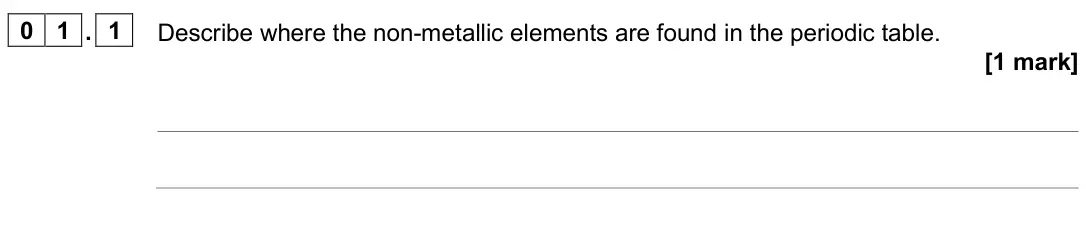
    June 2025 Paper 1 Higher, question 01.1: Describe where the non-metallic elements are found in the periodic table. [1 mark]
  2. Q01.2

    June 2025 · Paper 1 Higher

    1 mark
    The whole paper ↗
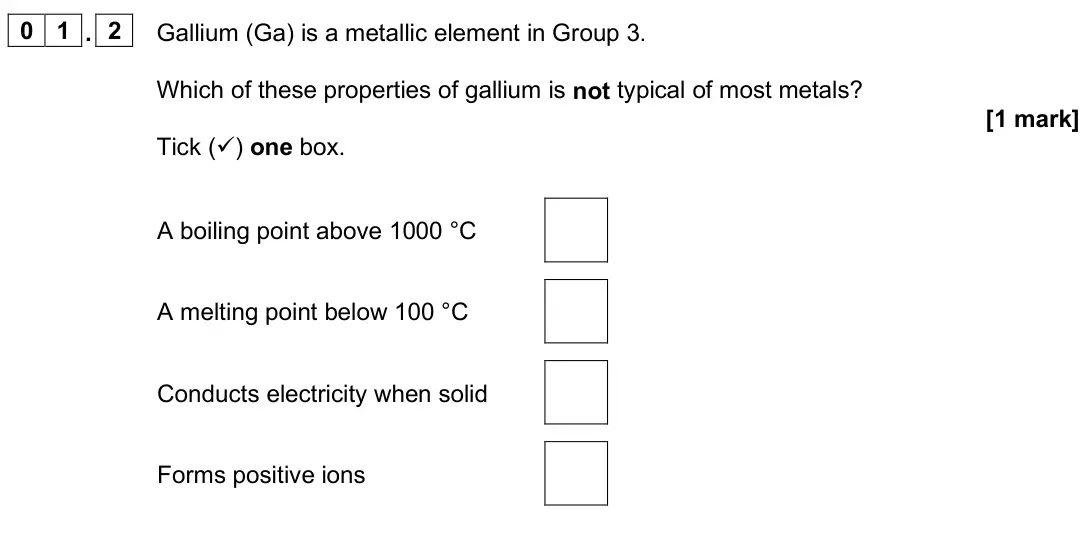
    June 2025 Paper 1 Higher, question 01.2: Gallium (Ga) is a metallic element in Group 3. Which of these properties of gallium is not typical of most metals? [1 mark] Tick () one box. A boiling point ab
  3. Q01.3

    June 2025 · Paper 1 Higher

    1 mark
    The whole paper ↗
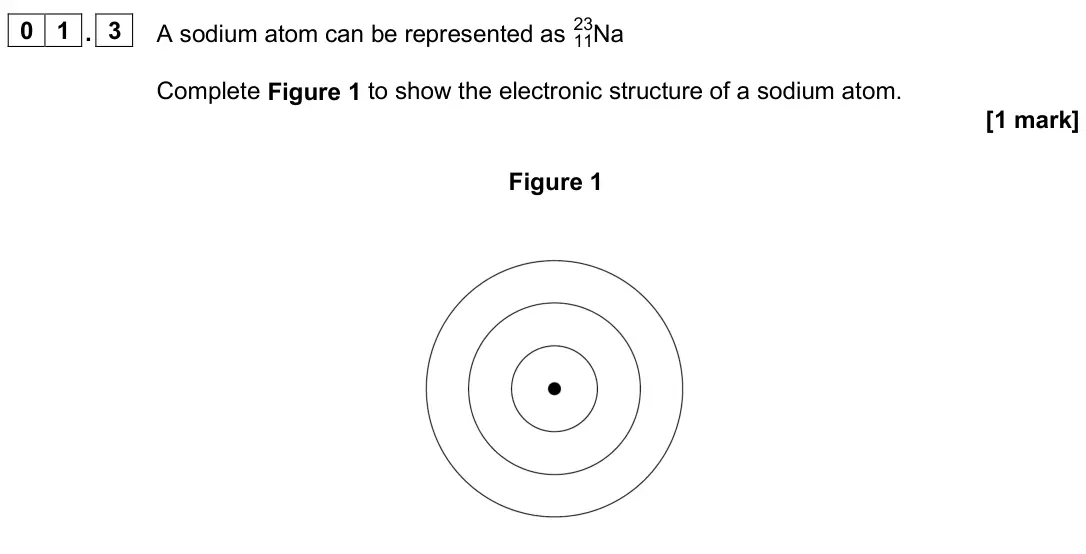
    June 2025 Paper 1 Higher, question 01.3: A sodium atom can be represented as Na 11 23 Complete Figure 1 to show the electronic structure of a sodium atom. [1 mark] Figure 1
  4. Q01.4

    June 2025 · Paper 1 Higher

    1 mark
    The whole paper ↗
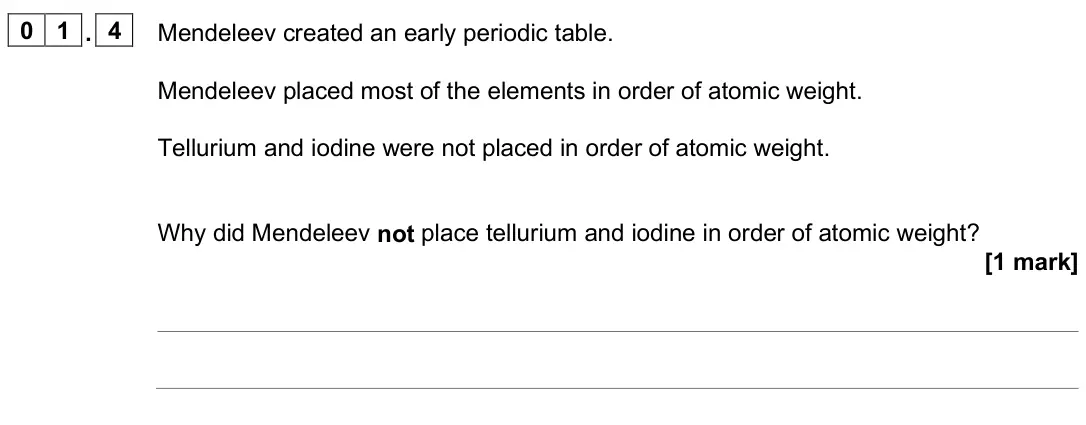
    June 2025 Paper 1 Higher, question 01.4: Mendeleev created an early periodic table. Mendeleev placed most of the elements in order of atomic weight. Tellurium and iodine were not placed in order of ato
  5. Q01.5

    June 2025 · Paper 1 Higher

    2 marks
    The whole paper ↗
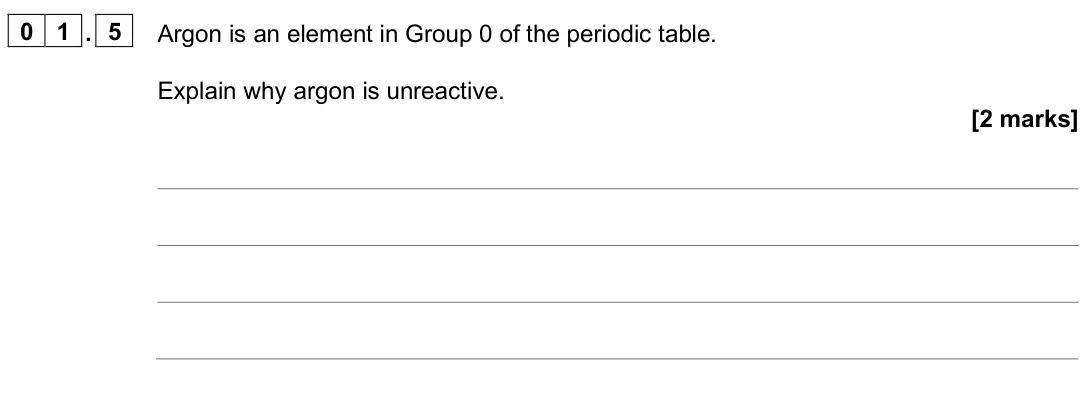
    June 2025 Paper 1 Higher, question 01.5: Argon is an element in Group 0 of the periodic table. Explain why argon is unreactive. [2 marks]
  6. Q01.6

    June 2025 · Paper 1 Higher

    2 marks
    The whole paper ↗
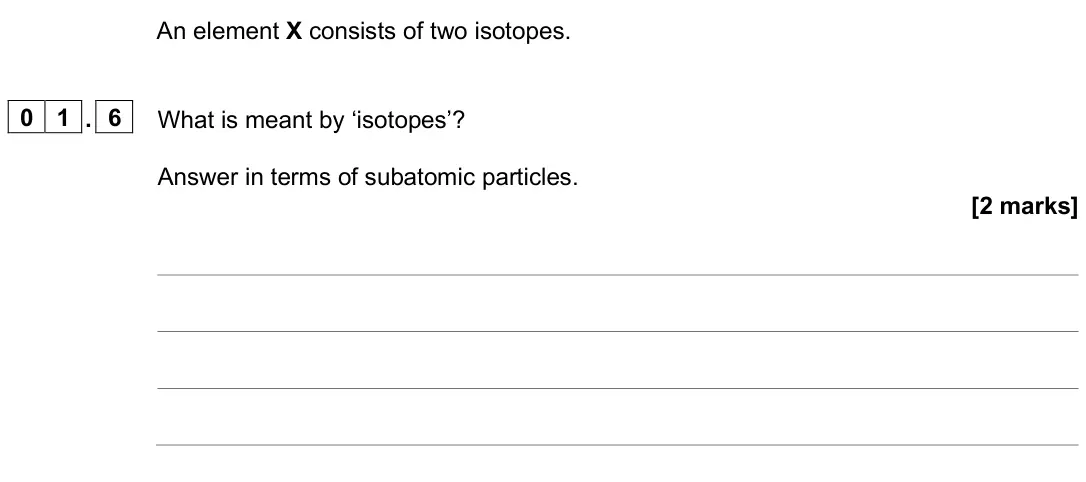
    June 2025 Paper 1 Higher, question 01.6: What is meant by ‘isotopes’? Answer in terms of subatomic particles. [2 marks]
  7. Q01.7

    June 2025 · Paper 1 Higher

    1 mark
    The whole paper ↗
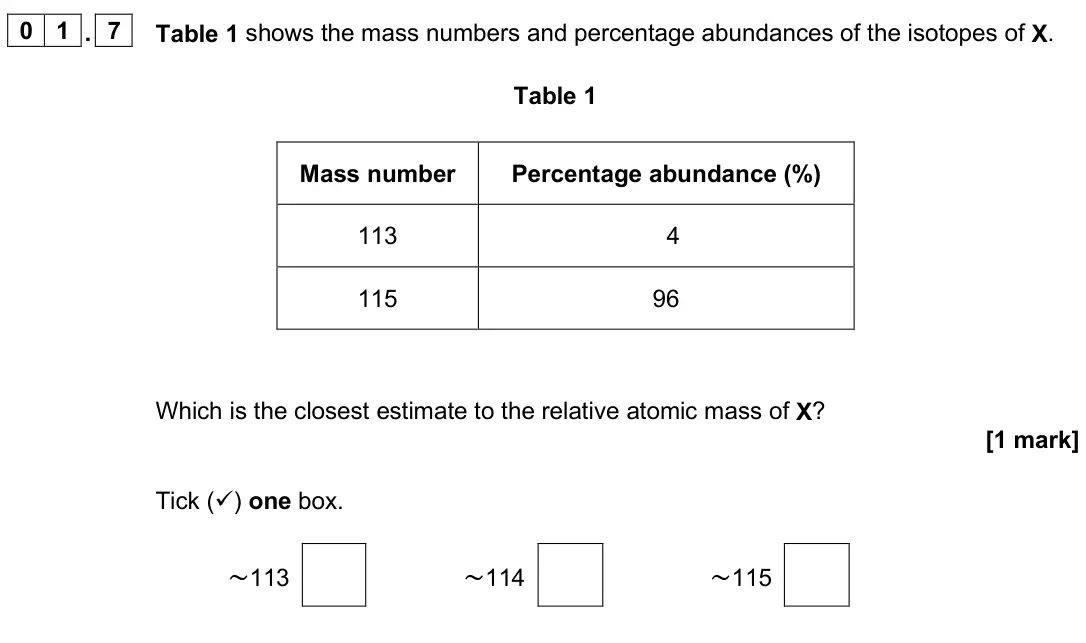
    June 2025 Paper 1 Higher, question 01.7: Table 1 shows the mass numbers and percentage abundances of the isotopes of X. Table 1 Mass number Percentage abundance (%) 113 4 115 96 Which is the closest es
  8. Q02.1

    June 2025 · Paper 1 Higher

    1 mark
    The whole paper ↗
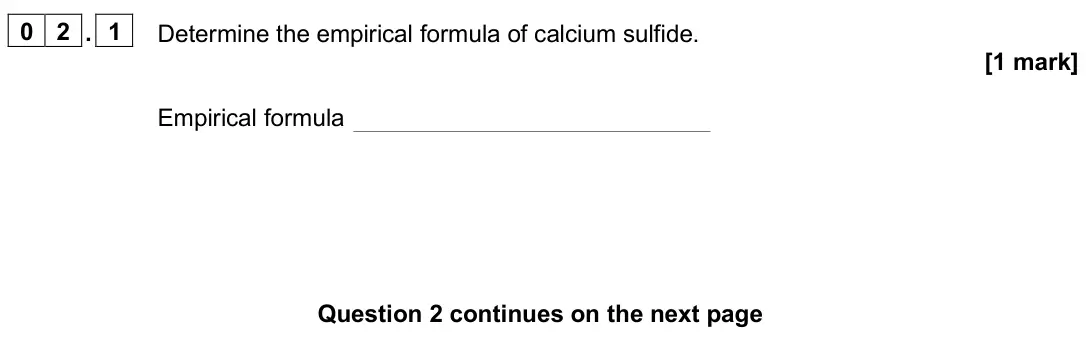
    June 2025 Paper 1 Higher, question 02.1: Determine the empirical formula of calcium sulfide. [1 mark] Empirical formula
  9. Q02.2

    June 2025 · Paper 1 Higher

    4 marks
    The whole paper ↗
    June 2025 Paper 1 Higher, question 02.2: Calcium is in Group 2 of the periodic table. Sulfur is in Group 6 of the periodic table. Describe what happens when a calcium atom reacts with a sulfur atom. An
  10. Q02.3

    June 2025 · Paper 1 Higher

    4 marks
    The whole paper ↗
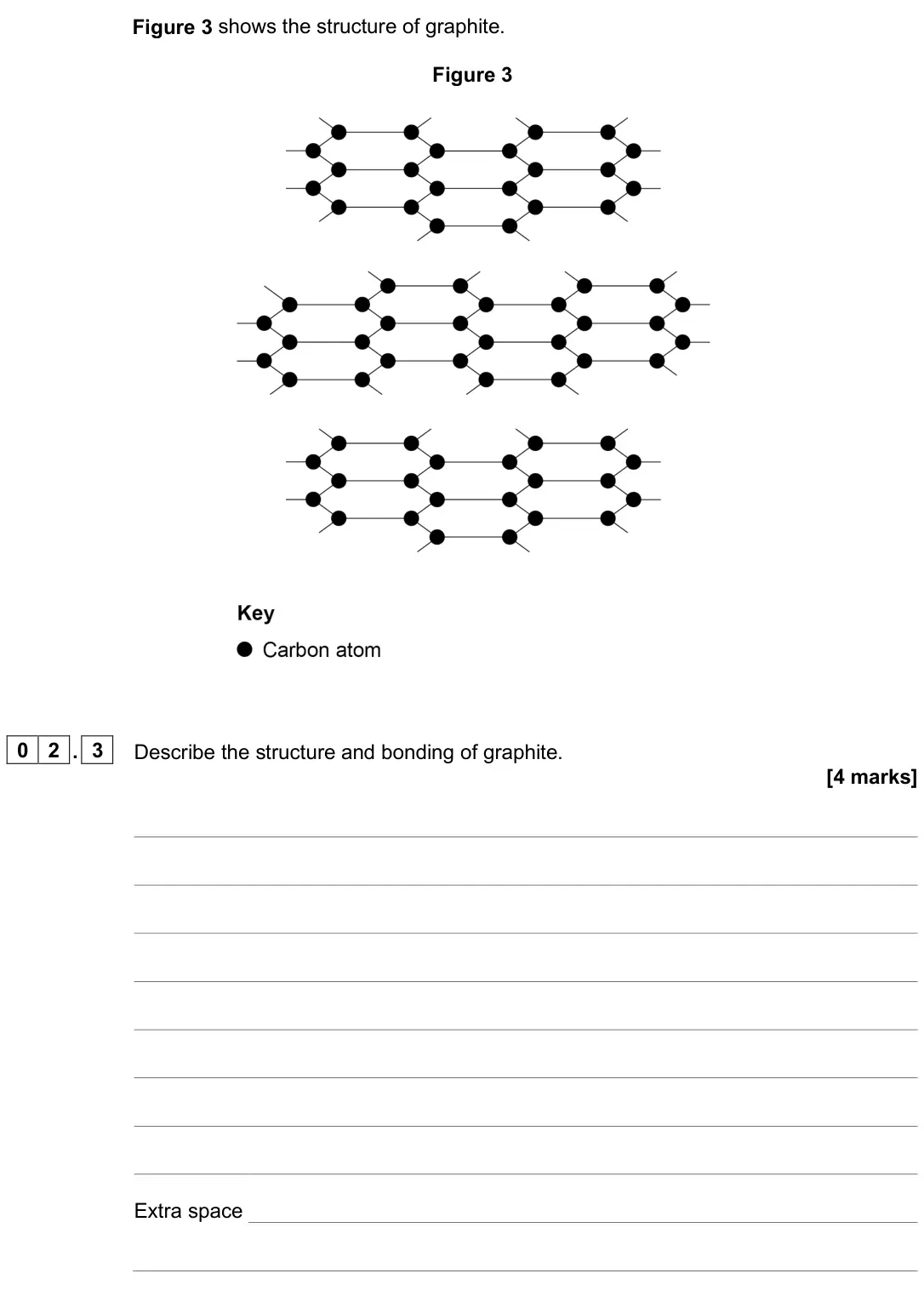
    June 2025 Paper 1 Higher, question 02.3: Describe the structure and bonding of graphite. [4 marks]
  11. Q02.4

    June 2025 · Paper 1 Higher

    1 mark
    The whole paper ↗
    June 2025 Paper 1 Higher, question 02.4: Substances that consist of small molecules do not conduct electricity. Give one reason why. [1 mark]
  12. Q02.5

    June 2025 · Paper 1 Higher

    1 mark
    The whole paper ↗
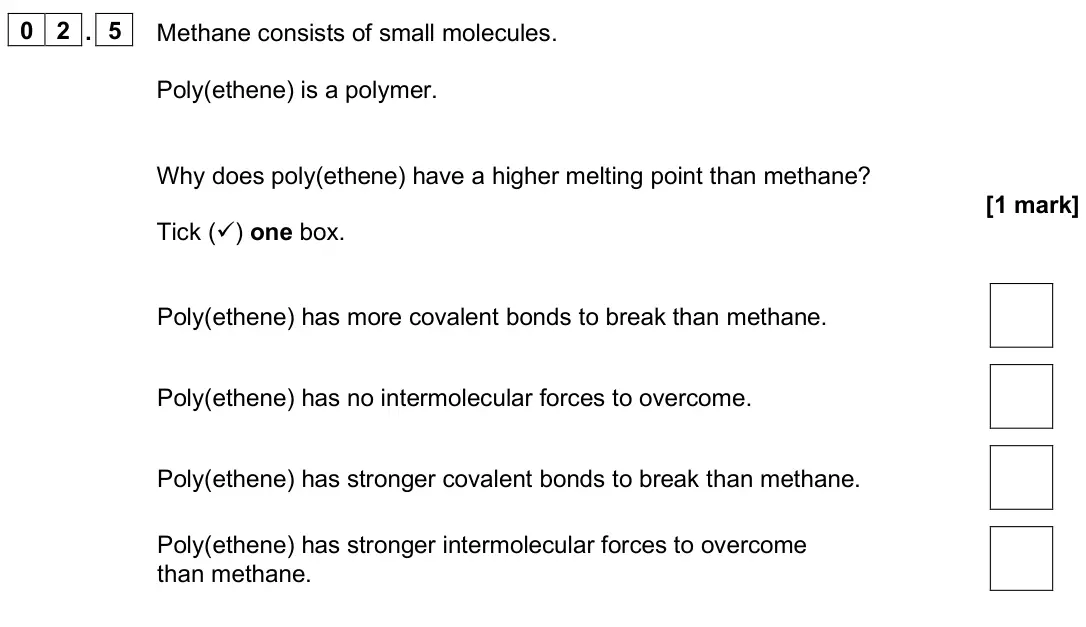
    June 2025 Paper 1 Higher, question 02.5: Methane consists of small molecules. Poly(ethene) is a polymer. Why does poly(ethene) have a higher melting point than methane? [1 mark] Tick () one box. Poly(
  13. Q03.1

    June 2025 · Paper 1 Higher

    2 marks
    The whole paper ↗
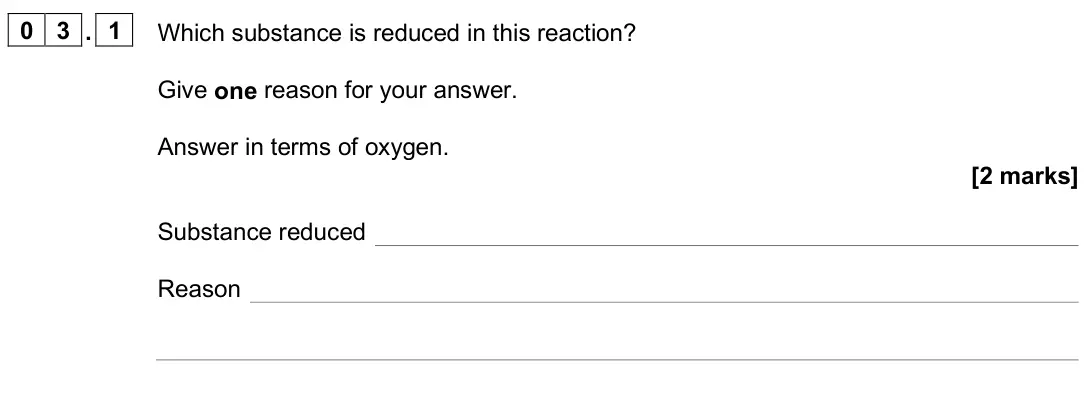
    June 2025 Paper 1 Higher, question 03.1: Which substance is reduced in this reaction? Give one reason for your answer. Answer in terms of oxygen. [2 marks] Substance reduced Reason
  14. Q03.2

    June 2025 · Paper 1 Higher

    1 mark
    The whole paper ↗
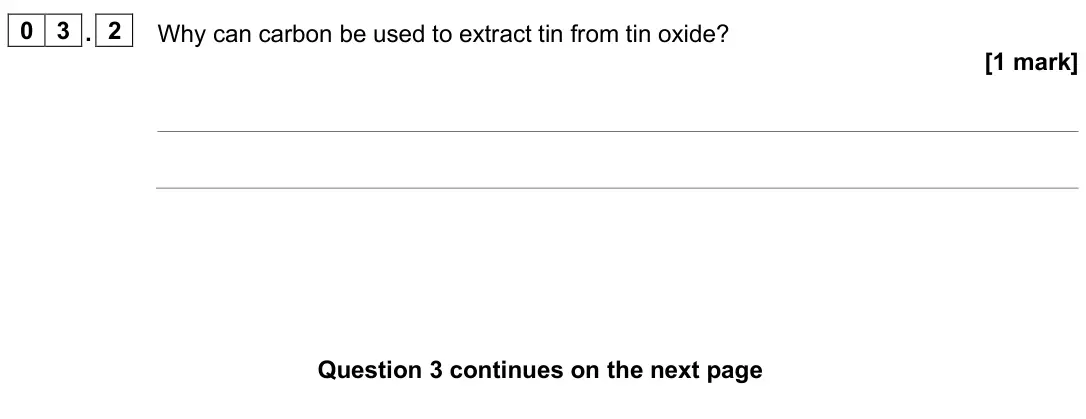
    June 2025 Paper 1 Higher, question 03.2: Why can carbon be used to extract tin from tin oxide? [1 mark]
  15. Q03.3

    June 2025 · Paper 1 Higher

    3 marks
    The whole paper ↗
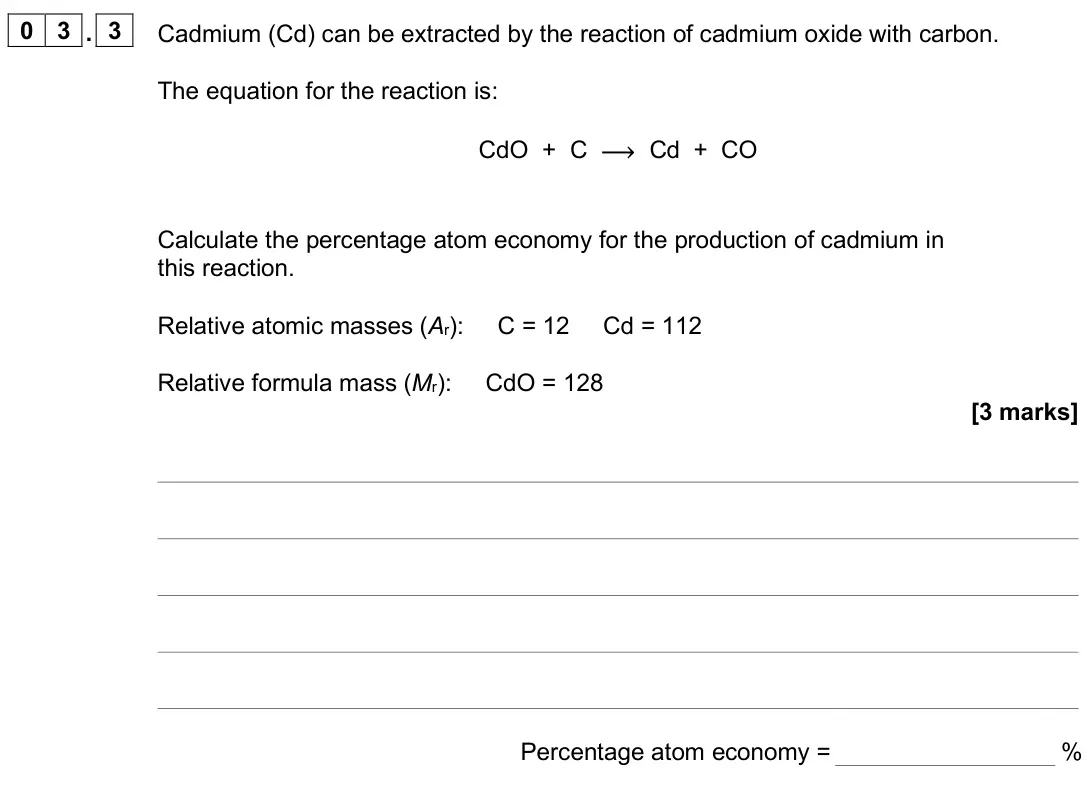
    June 2025 Paper 1 Higher, question 03.3: Cadmium (Cd) can be extracted by the reaction of cadmium oxide with carbon. The equation for the reaction is: CdO + C ⟶ Cd + CO Calculate the percentage atom ec
  16. Q03.4

    June 2025 · Paper 1 Higher

    2 marks
    The whole paper ↗
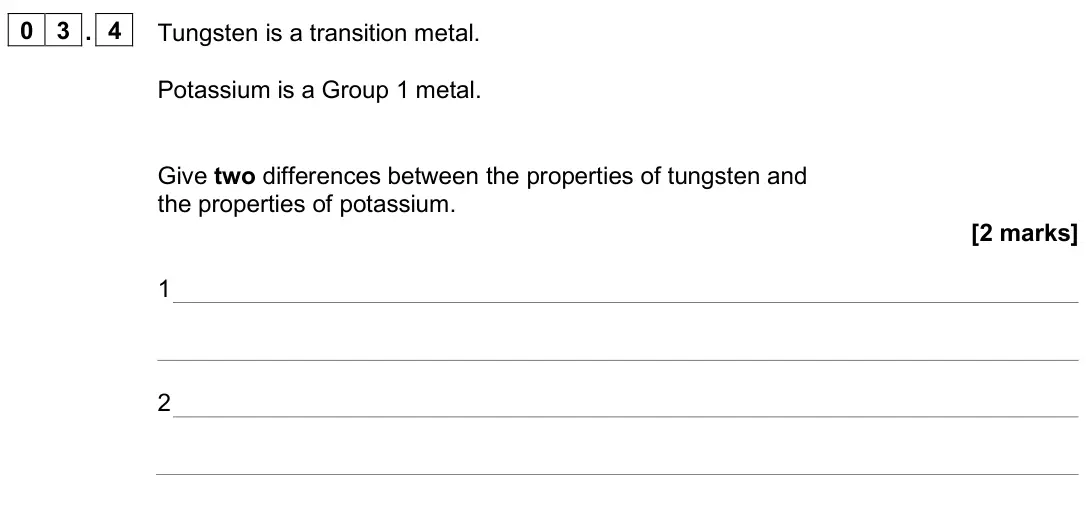
    June 2025 Paper 1 Higher, question 03.4: Tungsten is a transition metal. Potassium is a Group 1 metal. Give two differences between the properties of tungsten and the properties of potassium. [2 marks]
  17. Q03.5

    June 2025 · Paper 1 Higher

    2 marks
    The whole paper ↗
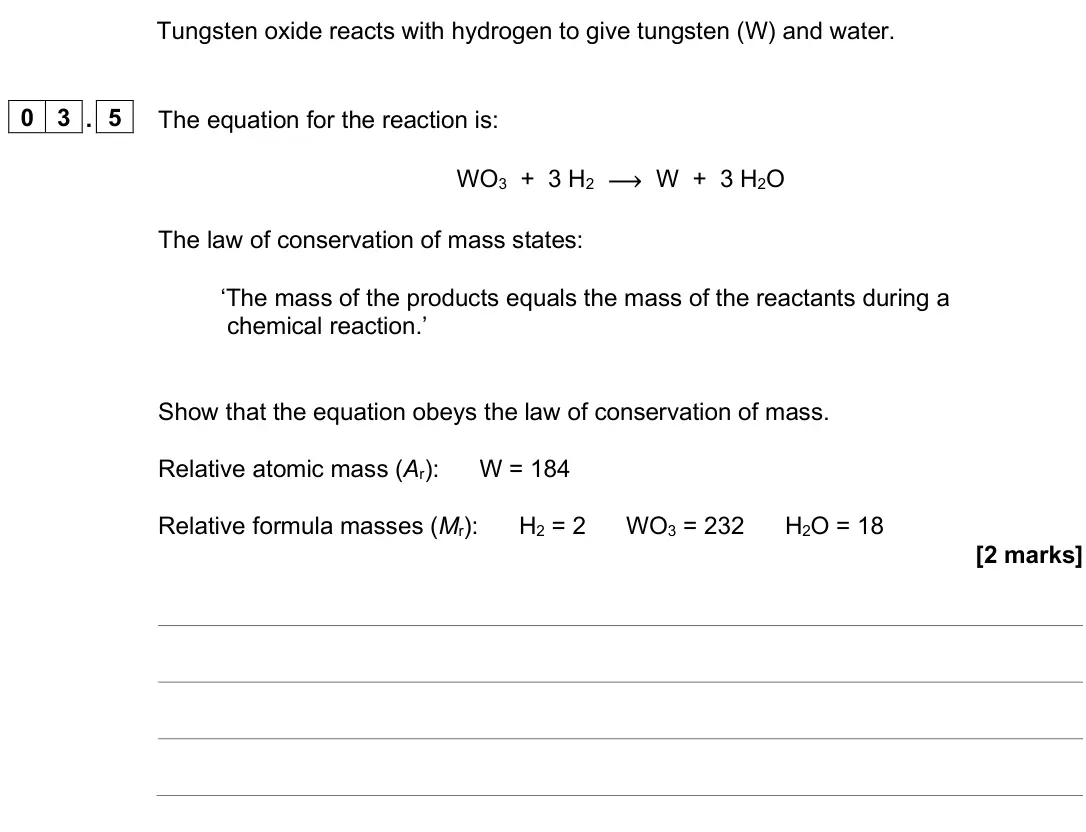
    June 2025 Paper 1 Higher, question 03.5: The equation for the reaction is: WO3 + 3 H2 ⟶ W + 3 H2O The law of conservation of mass states: ‘The mass of the products equals the mass of the reactants duri
  18. Q03.6

    June 2025 · Paper 1 Higher

    1 mark
    The whole paper ↗
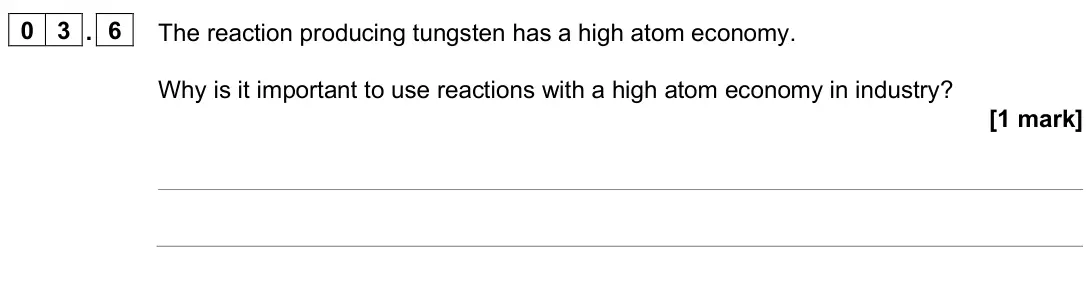
    June 2025 Paper 1 Higher, question 03.6: The reaction producing tungsten has a high atom economy. Why is it important to use reactions with a high atom economy in industry? [1 mark]
  19. Q04.1

    June 2025 · Paper 1 Higher

    1 mark
    The whole paper ↗
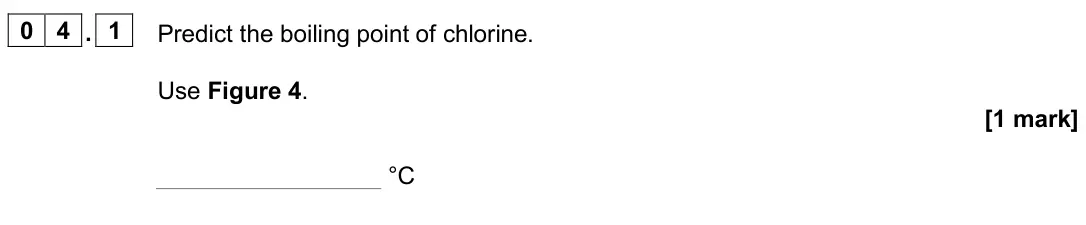
    June 2025 Paper 1 Higher, question 04.1: Predict the boiling point of chlorine. Use Figure 4. [1 mark] °C
  20. Q04.2

    June 2025 · Paper 1 Higher

    1 mark
    The whole paper ↗
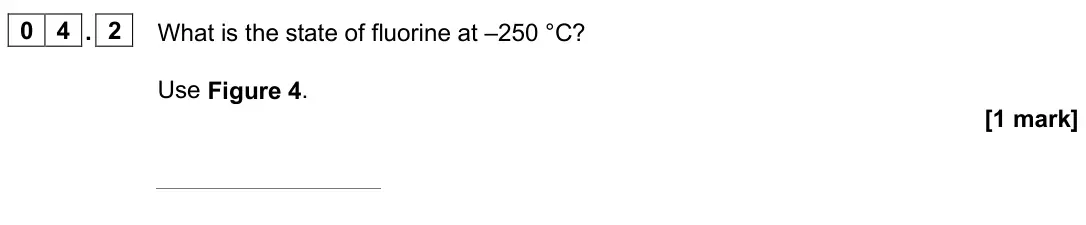
    June 2025 Paper 1 Higher, question 04.2: What is the state of fluorine at –250 °C? Use Figure 4. [1 mark]

Questions, mark schemes and examiner’s reports are © AQA, from their published past papers. Plumi isn’t affiliated with any exam board. Want whole papers? Every AQA GCSE Chemistry paper.

Rather write your answers by hand on iPad? Plumi marks them against the same mark schemes.