 plumi
Using the Earth's resources and obtaining potable water: AQA GCSE Chemistry questions
Every AQA GCSE Chemistry exam question on 4.10.1 Using the Earth's resources and obtaining potable water, 2018–2025, with its mark scheme and examiner’s report.
Find questions1,744
Calculations
Q01.1
The whole paper ↗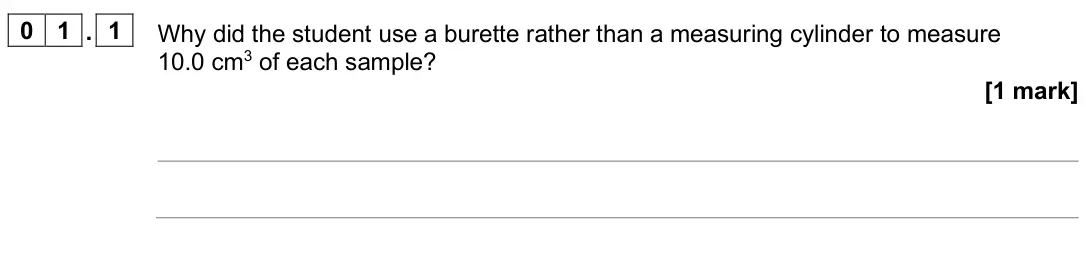
Q01.2
The whole paper ↗
Q01.3
The whole paper ↗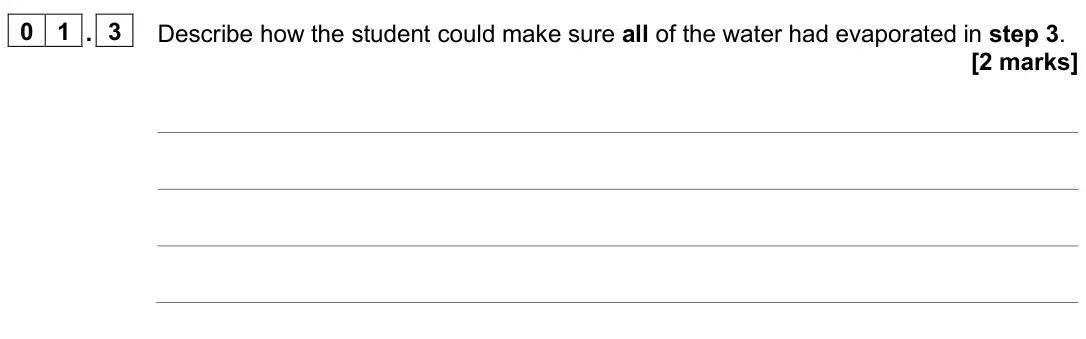
Q01.4
The whole paper ↗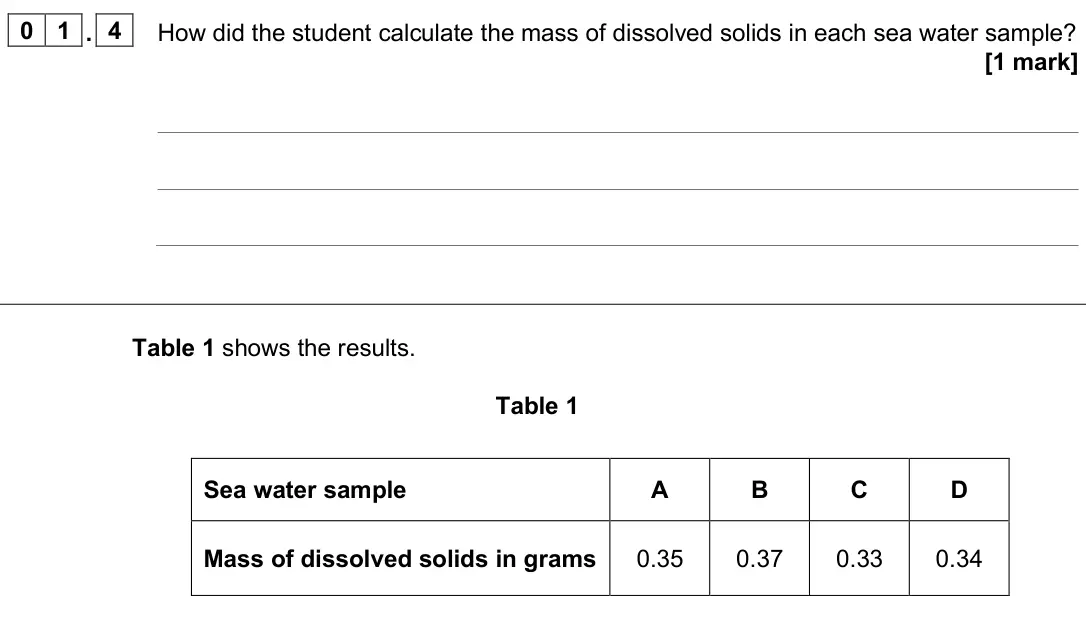
Q01.5
The whole paper ↗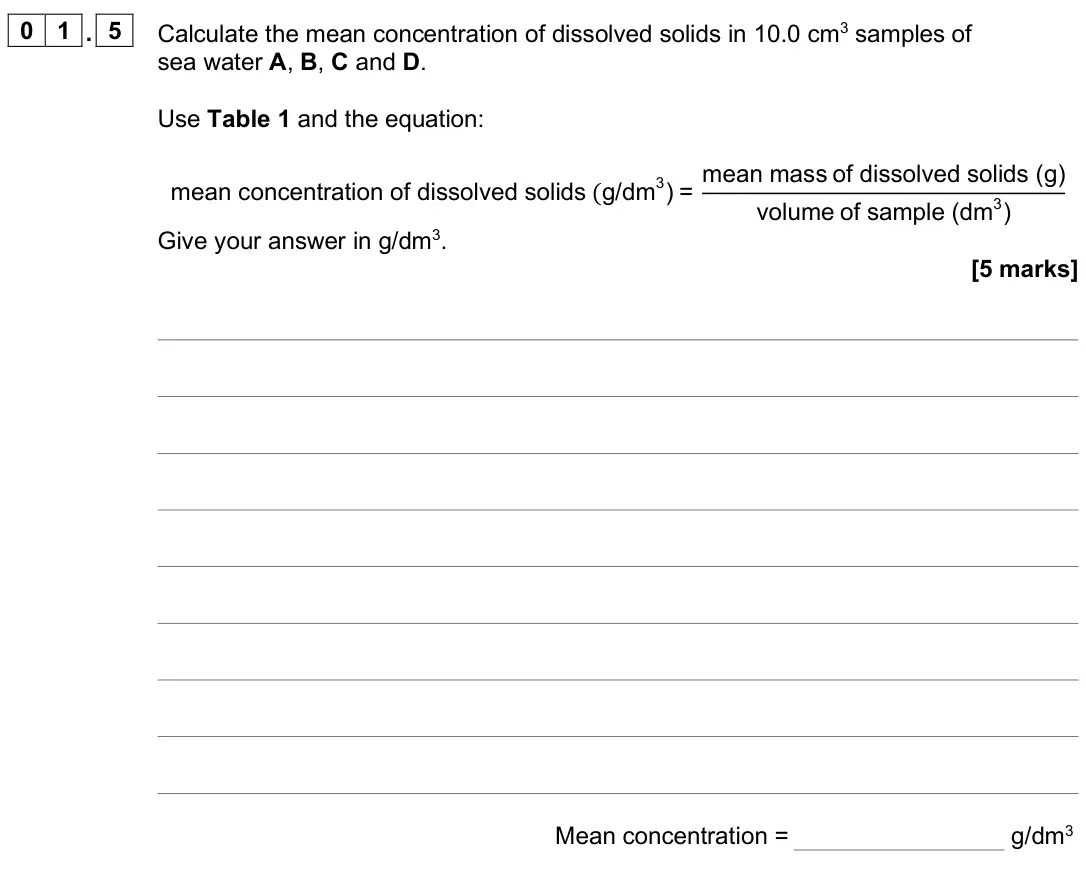
Q01.6
The whole paper ↗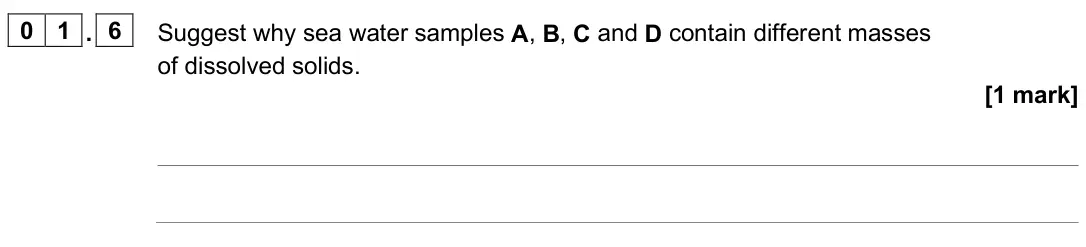
Q03.1
The whole paper ↗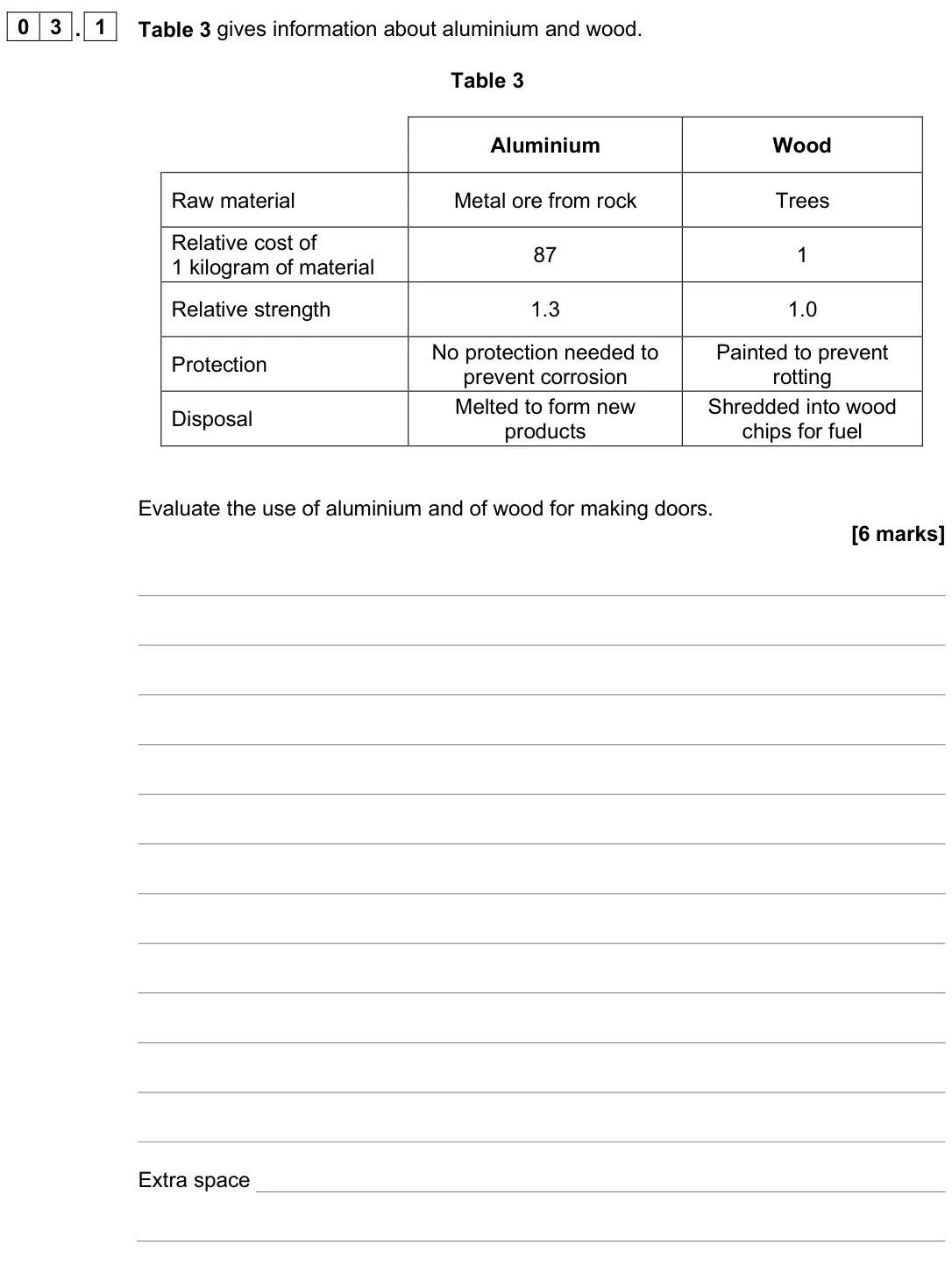
Q09.6
The whole paper ↗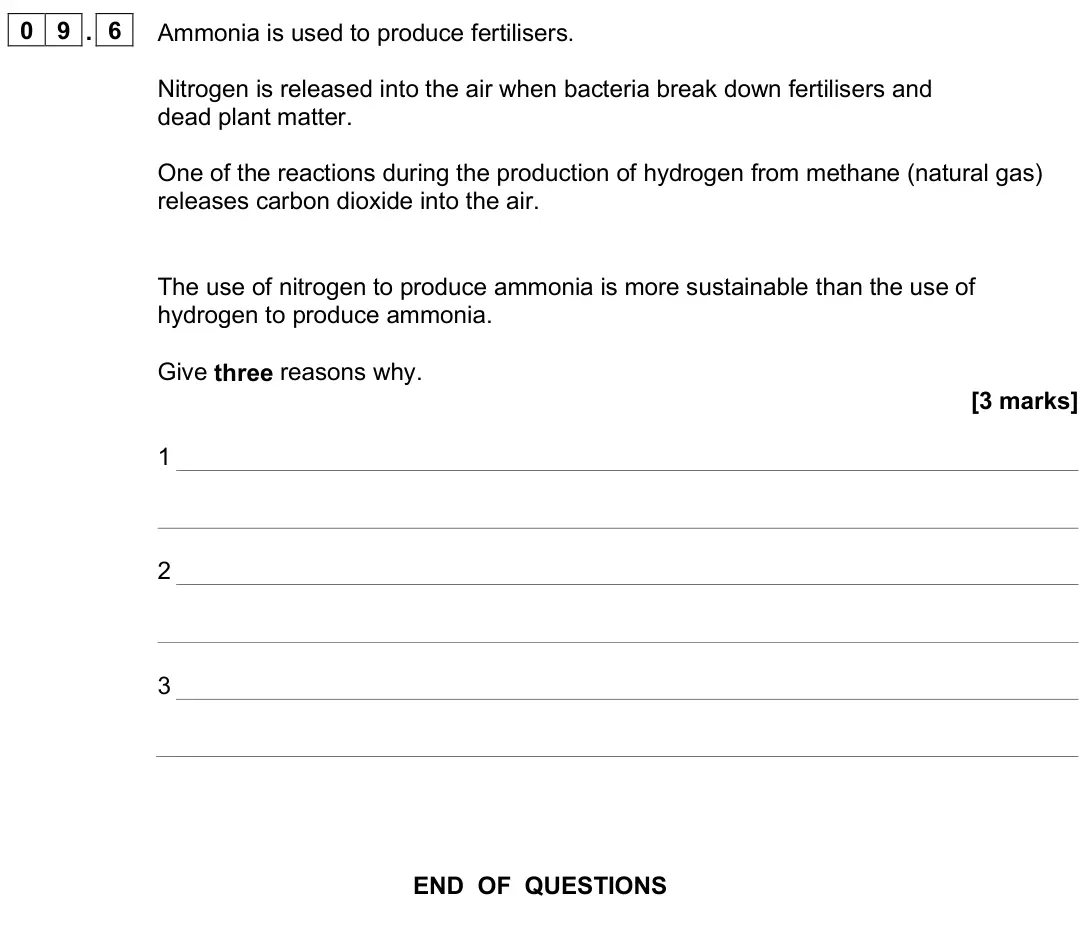
Q08.1
The whole paper ↗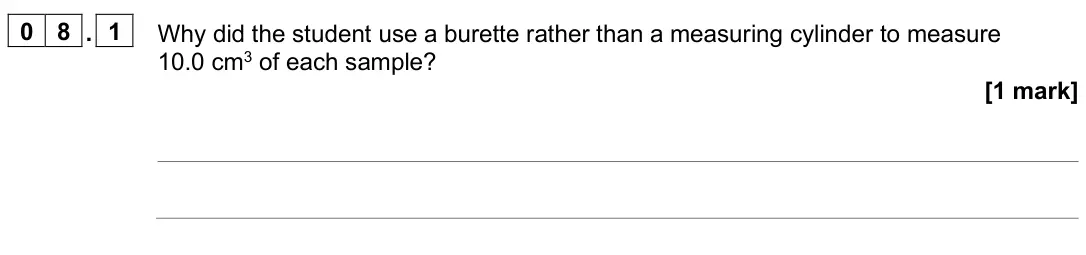
Q08.2
The whole paper ↗
Q08.3
The whole paper ↗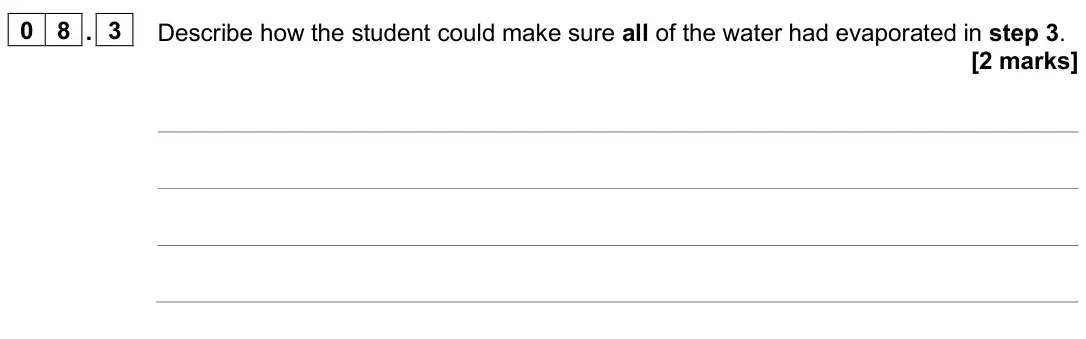
Q08.4
The whole paper ↗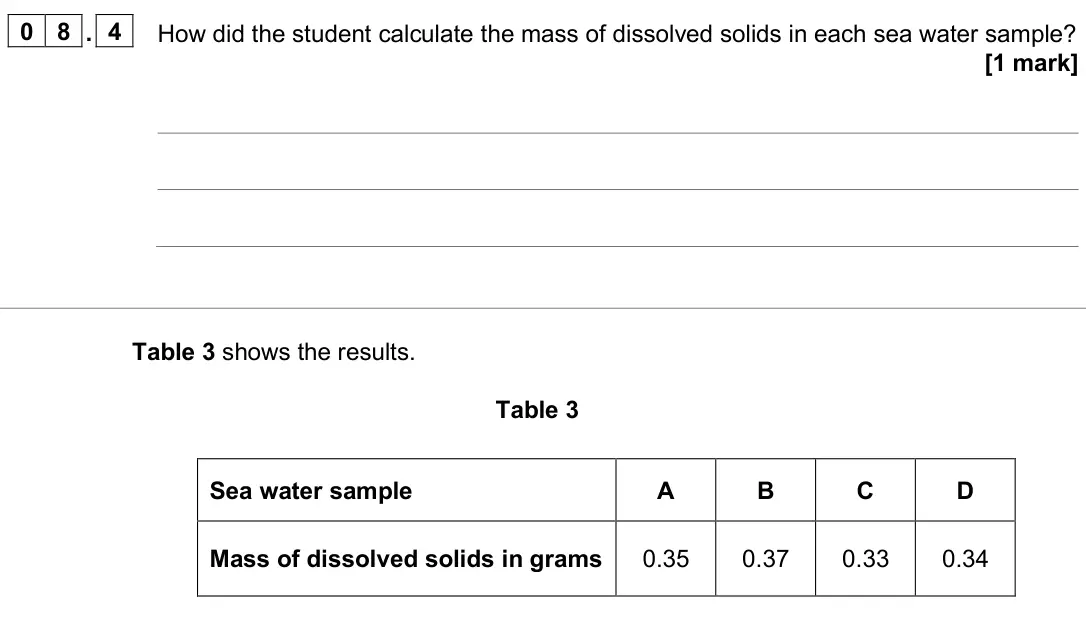
Q08.5
The whole paper ↗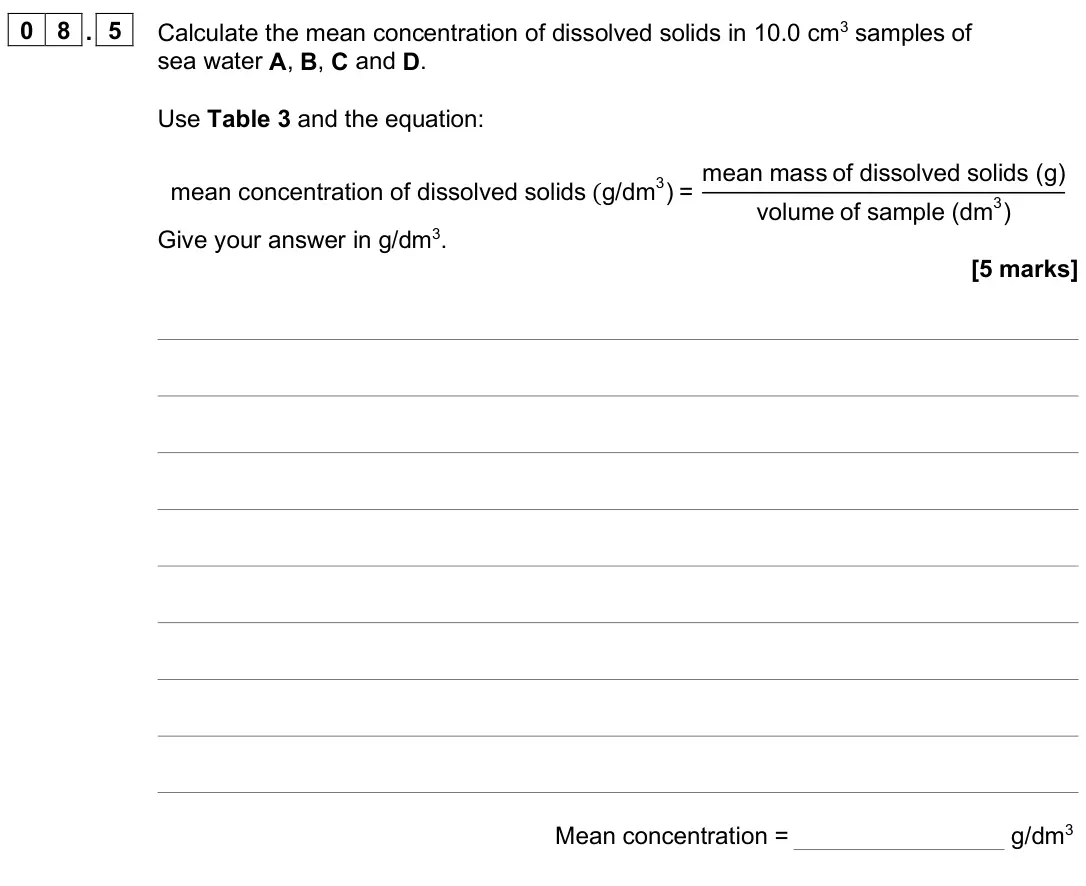
Q08.6
The whole paper ↗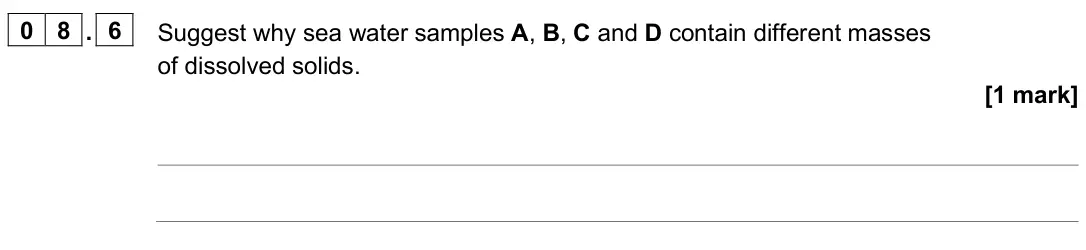
Q10.1
The whole paper ↗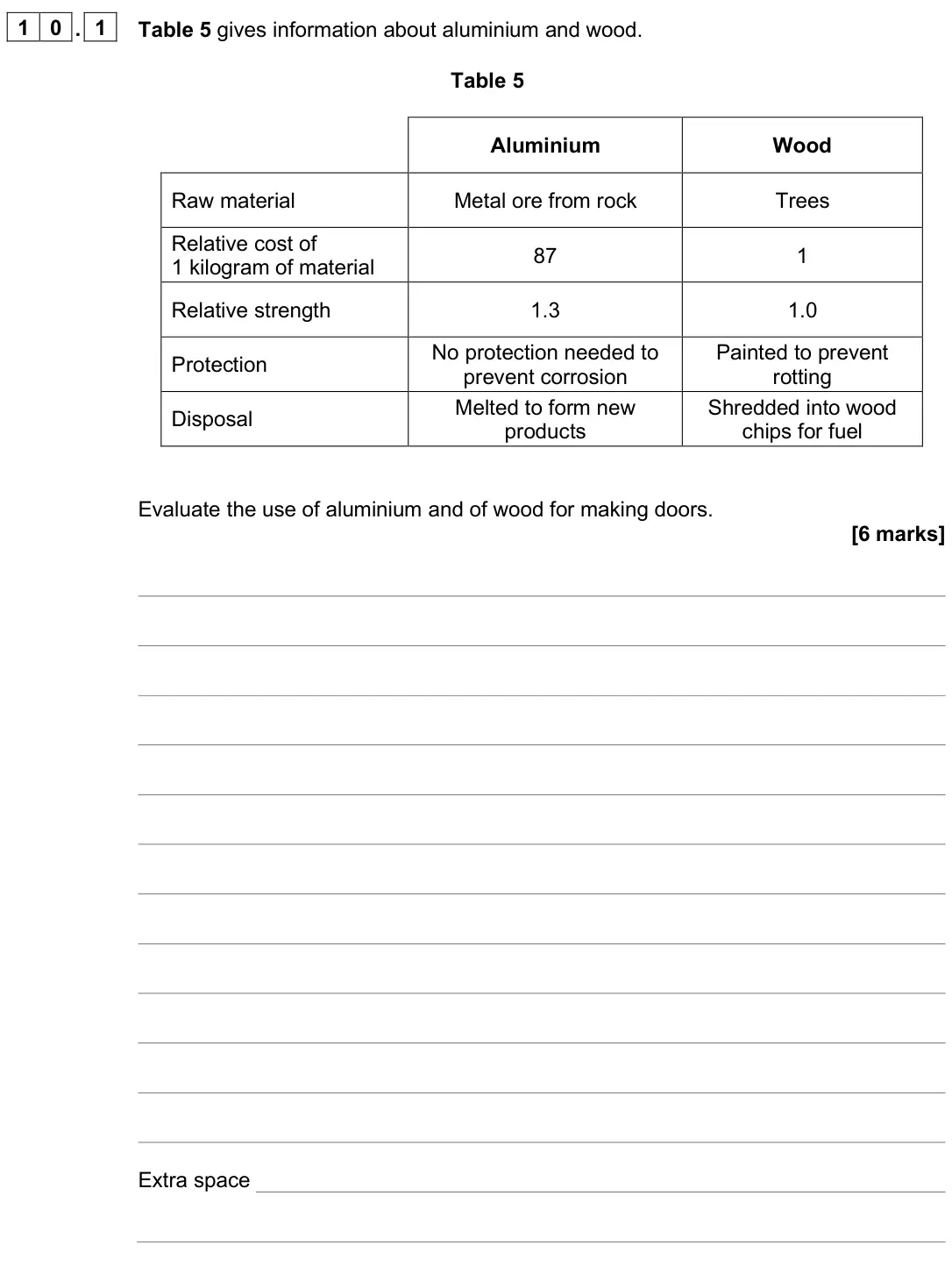
Q01.3
The whole paper ↗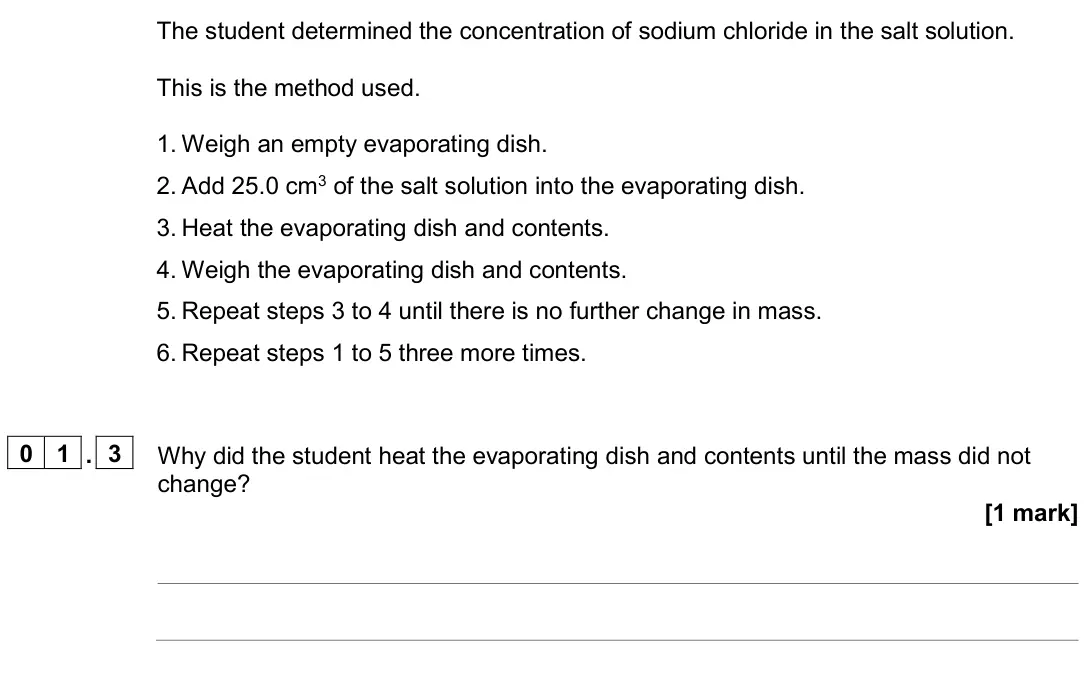
Q01.4
The whole paper ↗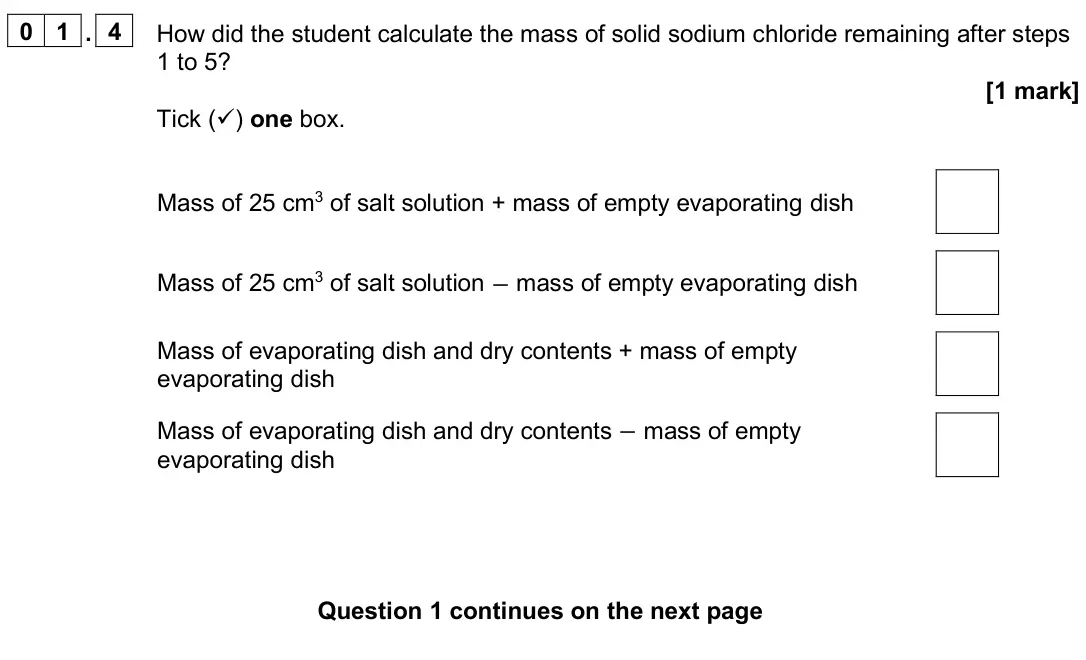
Q03.3
The whole paper ↗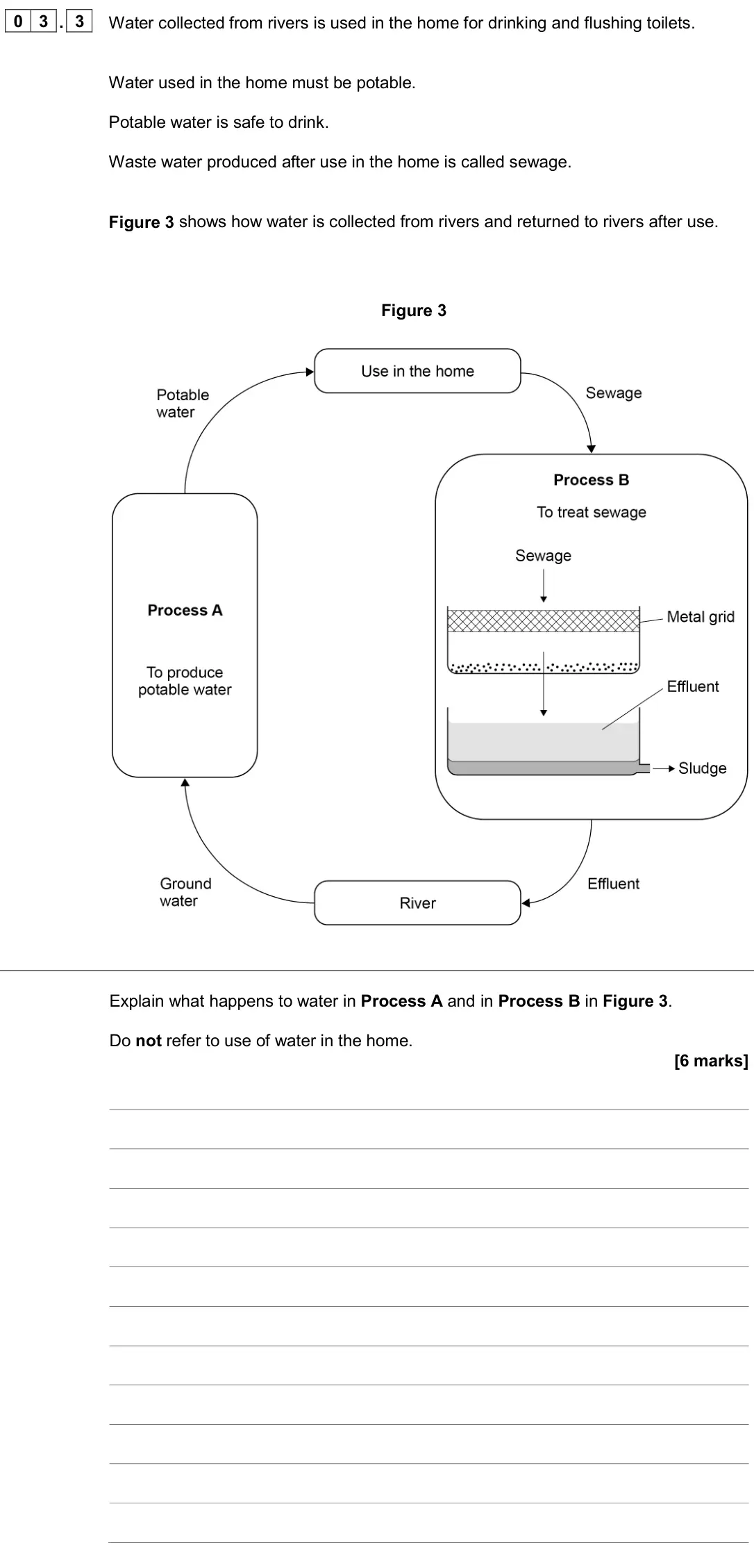
Q06.7
The whole paper ↗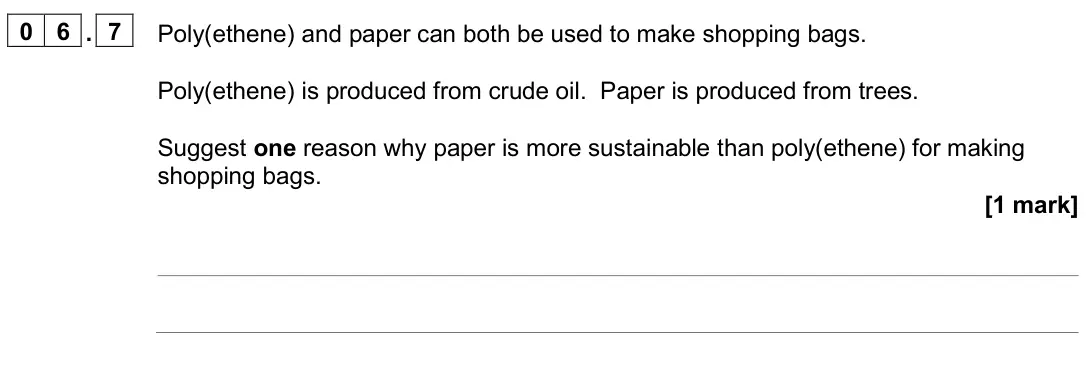
Q08.3
The whole paper ↗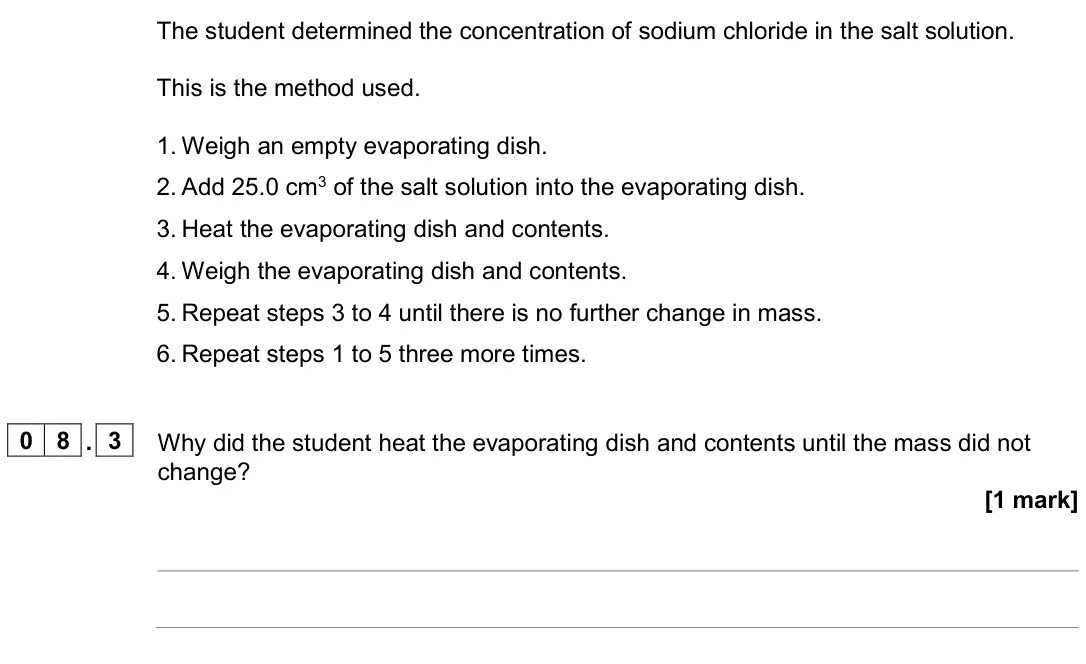
All 79 questions on Using the Earth's resources and obtaining potable water, as a list
- June 2025, Paper 2 Higher, Q01.1 (1 mark): Why did the student use a burette rather than a measuring cylinder to measure 10.0 cm3 of each sample? [1 mark]
- June 2025, Paper 2 Higher, Q01.2 (1 mark): What was the dependent variable in this investigation? [1 mark]
- June 2025, Paper 2 Higher, Q01.3 (2 marks): Describe how the student could make sure all of the water had evaporated in step 3. [2 marks]
- June 2025, Paper 2 Higher, Q01.4 (1 mark): How did the student calculate the mass of dissolved solids in each sea water sample? [1 mark] Table 1 shows the results. Table 1 Sea water sample A B C D Mass o
- June 2025, Paper 2 Higher, Q01.5 (5 marks): Calculate the mean concentration of dissolved solids in 10.0 cm3 samples of sea water A, B, C and D. Use Table 1 and the equation: mean concentration of dissolv
- June 2025, Paper 2 Higher, Q01.6 (1 mark): Suggest why sea water samples A, B, C and D contain different masses of dissolved solids. [1 mark]
- June 2025, Paper 2 Higher, Q03.1 (6 marks): Table 3 gives information about aluminium and wood. Table 3 Aluminium Wood Raw material Metal ore from rock Trees Relative cost of 1 kilogram of material 87 1 R
- June 2025, Paper 2 Higher, Q09.6 (3 marks): Ammonia is used to produce fertilisers. Nitrogen is released into the air when bacteria break down fertilisers and dead plant matter. One of the reactions durin
- June 2025, Paper 2 Foundation, Q08.1 (1 mark): Why did the student use a burette rather than a measuring cylinder to measure 10.0 cm3 of each sample? [1 mark]
- June 2025, Paper 2 Foundation, Q08.2 (1 mark): What was the dependent variable in this investigation? [1 mark]
- June 2025, Paper 2 Foundation, Q08.3 (2 marks): Describe how the student could make sure all of the water had evaporated in step 3. [2 marks]
- June 2025, Paper 2 Foundation, Q08.4 (1 mark): How did the student calculate the mass of dissolved solids in each sea water sample? [1 mark] Table 3 shows the results. Table 3 Sea water sample A B C D Mass o
- June 2025, Paper 2 Foundation, Q08.5 (5 marks): Calculate the mean concentration of dissolved solids in 10.0 cm3 samples of sea water A, B, C and D. Use Table 3 and the equation: mean concentration of dissolv
- June 2025, Paper 2 Foundation, Q08.6 (1 mark): Suggest why sea water samples A, B, C and D contain different masses of dissolved solids. [1 mark]
- June 2025, Paper 2 Foundation, Q10.1 (6 marks): Table 5 gives information about aluminium and wood. Table 5 Aluminium Wood Raw material Metal ore from rock Trees Relative cost of 1 kilogram of material 87 1 R
- June 2024, Paper 2 Higher, Q01.3 (1 mark): Why did the student heat the evaporating dish and contents until the mass did not change? [1 mark]
- June 2024, Paper 2 Higher, Q01.4 (1 mark): How did the student calculate the mass of solid sodium chloride remaining after steps 1 to 5? [1 mark] Tick () one box. Mass of 25 cm3 of salt solution + mass
- June 2024, Paper 2 Higher, Q03.3 (6 marks): Water collected from rivers is used in the home for drinking and flushing toilets. Water used in the home must be potable. Potable water is safe to drink. Waste
- June 2024, Paper 2 Foundation, Q06.7 (1 mark): Poly(ethene) and paper can both be used to make shopping bags. Poly(ethene) is produced from crude oil. Paper is produced from trees. Suggest one reason why pap
- June 2024, Paper 2 Foundation, Q08.3 (1 mark): Why did the student heat the evaporating dish and contents until the mass did not change? [1 mark]
- June 2024, Paper 2 Foundation, Q08.4 (1 mark): How did the student calculate the mass of solid sodium chloride remaining after steps 1 to 5? [1 mark] Tick () one box. Mass of 25 cm3 of salt solution + mass
- June 2024, Paper 2 Foundation, Q10.3 (6 marks): Water collected from rivers is used in the home for drinking and flushing toilets. Water used in the home must be potable. Potable water is safe to drink. Waste
- June 2023, Paper 2 Higher, Q05.2 (3 marks): Calculate the percentage by mass of copper in CuFeS2 Relative atomic masses (Ar): S = 32 Fe = 56 Cu = 63.5 [3 marks] Percentage by mass = %
- June 2023, Paper 2 Higher, Q05.4 (2 marks): Copper can be extracted from low-grade ores by bioleaching. Describe what is meant by bioleaching. [2 marks]
- June 2023, Paper 2 Higher, Q10.1 (4 marks): A scientist analysed the percentages of nitrogen, phosphorus and potassium in a soil. The percentages of nitrogen and of potassium in the soil were lower than t
- June 2022, Paper 2 Higher, Q01.4 (2 marks): Suggest two reasons why recycling scrap copper is more sustainable than extracting copper from copper ores. [2 marks] 1 2
- June 2022, Paper 2 Higher, Q03.1 (6 marks): Milk bottles can be made from glass or from a polymer. Table 2 shows information about milk bottles of equal volume. Table 2 Glass Polymer Raw materials Limesto
- June 2022, Paper 2 Higher, Q03.2 (3 marks): Milk is also sold in cardboard cartons. A carton is made using 40 cm3 of cardboard. The density of the cardboard is 0.40 g/cm3. Calculate the mass of the carton
- June 2022, Paper 2 Higher, Q05.1 (4 marks): Sewage is waste water. Sewage contains organic matter. Describe how sewage is treated to remove organic matter. [4 marks]
- June 2022, Paper 2 Higher, Q05.2 (1 mark): Sea water is desalinated during Process 1. Which pair of concentrations could represent X in Table 5? [1 mark] Tick () one box. Na+ : 0.003 mol/dm3 Cl− : 0.003
- June 2022, Paper 2 Higher, Q05.3 (2 marks): Explain why the concentrations of sodium ions and of chloride ions in the ground water in Table 5 are unchanged by Process 1. [2 marks]
- June 2022, Paper 2 Higher, Q05.4 (2 marks): Explain why the ground water in Table 5 requires Process 2 before the water is safe to drink. [2 marks]
- June 2022, Paper 2 Higher, Q05.5 (1 mark): After treatment the ground water in Table 5 is sold by a company as pure water. The ground water in Table 5 is not chemically pure because the water contains so
- June 2022, Paper 2 Foundation, Q01.1 (2 marks): Complete the sentences. Choose answers from the box. [2 marks] 0 4 7 10 25 100 Pure water has a boiling point of °C. Pure water has a pH of .
- June 2022, Paper 2 Foundation, Q01.2 (1 mark): What could the student use to measure the pH of pure water? [1 mark]
- June 2022, Paper 2 Foundation, Q01.3 (2 marks): Which two pieces of equipment were needed in this investigation? [2 marks] Tick () two boxes. Balance Measuring cylinder Ruler Thermometer Timer
- June 2022, Paper 2 Foundation, Q01.4 (2 marks): Table 1 shows the results. Table 1 Sea water sample Mass of solid that remained in grams 1 1.73 2 1.70 3 1.75 4 1.78 Calculate the mean mass of solid that remai
- June 2022, Paper 2 Foundation, Q01.5 (2 marks): A 50 cm3 sample of sea water from a different source contained 1.50 g of dissolved solids. Calculate the mass of dissolved solids in 1000 cm3 of this sea water.
- June 2022, Paper 2 Foundation, Q08.4 (2 marks): Suggest two reasons why recycling scrap copper is more sustainable than extracting copper from copper ores. [2 marks] 1 2
- June 2022, Paper 2 Foundation, Q10.1 (6 marks): Milk bottles can be made from glass or from a polymer. Table 10 shows information about milk bottles of equal volume. Table 10 Glass Polymer Raw materials Limes
- June 2022, Paper 2 Foundation, Q10.2 (3 marks): Milk is also sold in cardboard cartons. A carton is made using 40 cm3 of cardboard. The density of the cardboard is 0.40 g/cm3. Calculate the mass of the carton
- November 2021, Paper 2 Higher, Q01.3 (1 mark): Suggest one reason why using solar energy is a more sustainable way of generating electricity than burning oil. [1 mark]
- November 2021, Paper 2 Higher, Q01.4 (2 marks): Solar energy may not be able to replace the generation of electricity from fossil fuels completely. Suggest two reasons why. [2 marks] 1 2
- November 2021, Paper 2 Higher, Q08.3 (3 marks): Suggest three reasons why recycling scrap copper is a more sustainable way of obtaining copper than processing copper ores. [3 marks] 1 2 3
- November 2021, Paper 2 Higher, Q08.4 (4 marks): Describe how copper is extracted from low-grade ores by phytomining. [4 marks]
- November 2021, Paper 2 Higher, Q08.5 (2 marks): Phytomining has not been widely used to extract copper. Suggest two reasons why. [2 marks] 1 2
- November 2021, Paper 2 Foundation, Q02.1 (2 marks): What equipment should the student use to measure: • the mass of the evaporating dish • the volume of sea water? [2 marks] Mass of evaporating dish Volume of sea
- November 2021, Paper 2 Foundation, Q02.2 (3 marks): Table 2 shows the student’s results. Table 2 Mass in g Evaporating dish 30.44 Evaporating dish and salt 30.49 The student used 50 cm3 of sea water. Calculate th
- November 2021, Paper 2 Foundation, Q02.3 (2 marks): The salt must be completely dry. Which two extra steps are needed to show that the salt is completely dry? [2 marks] Tick () two boxes. Filter the sea water ag
- November 2021, Paper 2 Foundation, Q02.4 (2 marks): Students Y and Z boil the same volume of sea water for the same period of time. Explain why student Y collects a smaller volume of water than student Z. [2 mark
- November 2021, Paper 2 Foundation, Q02.5 (1 mark): Water obtained by distillation does not need to be sterilised and is safe to drink. Suggest why. [1 mark]
- November 2021, Paper 2 Foundation, Q02.6 (2 marks): How is fresh water sterilised? [2 marks] Tick () two boxes. Using ammonia Using chlorine Using chromatography Using filtration Using ozone
- November 2021, Paper 2 Foundation, Q02.7 (1 mark): A student tests the pH of fresh water using universal indicator solution. When added to the fresh water, the colour of the universal indicator solution is green
- November 2021, Paper 2 Foundation, Q03.6 (2 marks): Wood can be used instead of polymers to make window frames. • Polymers are unreactive. • Polymers are produced from crude oil. • Wood breaks down in wet conditi
- November 2021, Paper 2 Foundation, Q07.6 (4 marks): Two processes for producing ethanol are: • fermentation • hydration (reacting ethene with steam). Table 5 shows information about the processes. Table 5 Feature
- November 2021, Paper 2 Foundation, Q08.3 (1 mark): Suggest one reason why using solar energy is a more sustainable way of generating electricity than burning oil. [1 mark]
- November 2021, Paper 2 Foundation, Q08.4 (2 marks): Solar energy may not be able to replace the generation of electricity from fossil fuels completely. Suggest two reasons why. [2 marks] 1 2
- November 2020, Paper 2 Higher, Q02.1 (4 marks): In the UK, potable (drinking) water is produced from different sources of fresh water. Explain how potable water is produced from fresh water. [4 marks]
- November 2020, Paper 2 Higher, Q02.2 (1 mark): A different country has: • very little rainfall • a long coastline • plentiful energy supplies. Suggest one process this country could use to obtain most of its
- November 2020, Paper 2 Higher, Q02.3 (2 marks): Waste water is not fit to drink. Treatment of waste water produces two substances: • liquid effluent • solid sewage sludge. Draw one line from each substance to
- November 2020, Paper 2 Higher, Q02.4 (3 marks): Calculate the percentage of processed solid sewage sludge that was burned in 2010. Give your answer to 3 significant figures. Use Table 1. [3 marks] Percentage
- November 2020, Paper 2 Higher, Q02.5 (1 mark): Suggest one reason why the total mass of processed solid sewage sludge increased between 1992 and 2010. [1 mark]
- November 2020, Paper 2 Higher, Q02.6 (2 marks): Between 1992 and 2010 the proportion of processed solid sewage sludge used as fertiliser increased. Suggest two reasons why. [2 marks] 1 2
- November 2020, Paper 2 Higher, Q05.2 (4 marks): Evaluate the use of these materials for making food plates. You should use features of life cycle assessments (LCAs). Use Table 2. [4 marks]
- November 2020, Paper 2 Foundation, Q09.1 (4 marks): In the UK, potable (drinking) water is produced from different sources of fresh water. Explain how potable water is produced from fresh water. [4 marks]
- November 2020, Paper 2 Foundation, Q09.2 (1 mark): A different country has: • very little rainfall • a long coastline • plentiful energy supplies. Suggest one process this country could use to obtain most of its
- November 2020, Paper 2 Foundation, Q09.3 (2 marks): Waste water is not fit to drink. Treatment of waste water produces two substances: • liquid effluent • solid sewage sludge. Draw one line from each substance to
- November 2020, Paper 2 Foundation, Q09.4 (3 marks): Calculate the percentage of processed solid sewage sludge that was burned in 2010. Give your answer to 3 significant figures. Use Table 6. [3 marks] Percentage
- November 2020, Paper 2 Foundation, Q09.5 (1 mark): Suggest one reason why the total mass of processed solid sewage sludge increased between 1992 and 2010. [1 mark]
- November 2020, Paper 2 Foundation, Q09.6 (2 marks): Between 1992 and 2010 the proportion of processed solid sewage sludge used as fertiliser increased. Suggest two reasons why. [2 marks] 1 2
- June 2018, Paper 2 Higher, Q06.3 (2 marks): Carpets are made from: • poly(propene) • wool • a mixture of poly(propene) and wool. Poly(propene) wears out more slowly than wool. A mixture of poly(propene) a
- Specimen, Paper 2 Higher, Q02.1 (2 marks): What are the two main steps used to treat water from lakes? Give a reason for each step. [2 marks] Step 1 Reason Step 2 Reason
- Specimen, Paper 2 Higher, Q02.2 (3 marks): Explain why it is more difficult to produce drinking water from waste water than from water in lakes. [3 marks] 6
- Specimen, Paper 2 Higher, Q02.3 (3 marks): Some countries make drinking water from sea water. Complete Figure 1 to show how you can distil salt solution to produce and collect pure water. Label the follo
- Specimen, Paper 2 Higher, Q02.5 (1 mark): Why is producing drinking water from sea water expensive? [1 mark] 8
- Specimen, Paper 2 Foundation, Q10.1 (2 marks): What are the two main steps used to treat water from lakes? Give a reason for each step. [2 mark Step 1 Reason Step 2 Reason
- Specimen, Paper 2 Foundation, Q10.2 (3 marks): Explain why it is more difficult to produce drinking water from waste water than fro water in lakes. [3 mark 9
- Specimen, Paper 2 Foundation, Q10.3 (3 marks): Some countries make drinking water from sea water. Complete Figure 11 to show how you can distil salt solution to produce and collect pure water. Label the foll
- Specimen, Paper 2 Foundation, Q10.5: Why is producing drinking water from sea water expensive? [1 mar 3
Questions, mark schemes and examiner’s reports are © AQA, from their published past papers. Plumi isn’t affiliated with any exam board. Want whole papers? Every AQA GCSE Chemistry paper.
Rather write your answers by hand on iPad? Plumi marks them against the same mark schemes.