 plumi
Electrolysis: AQA GCSE Chemistry questions
Every AQA GCSE Chemistry exam question on 4.4.3 Electrolysis, 2018–2025, with its mark scheme and examiner’s report.
Find questions1,744
Calculations
Q06.2
The whole paper ↗
Q06.3
The whole paper ↗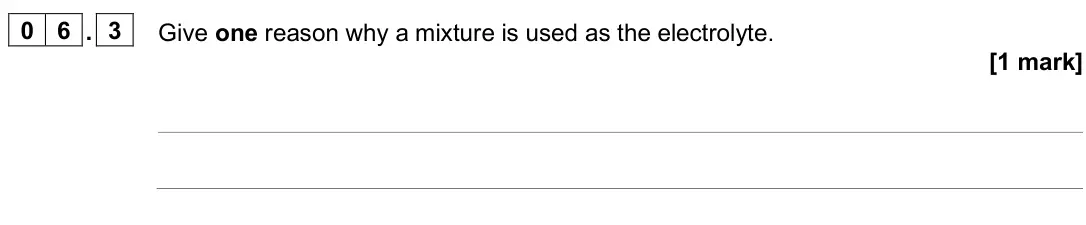
Q06.5
The whole paper ↗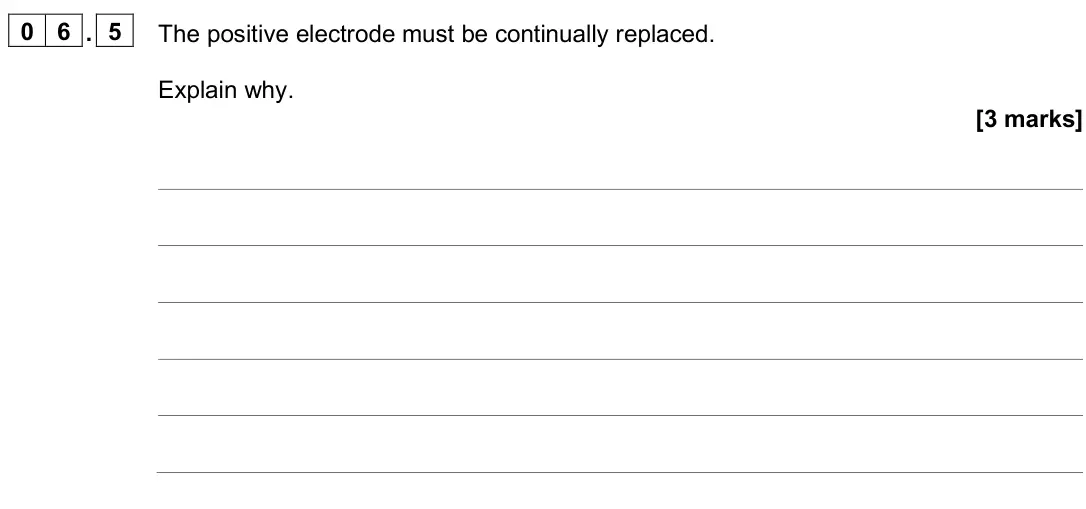
Q03.1
The whole paper ↗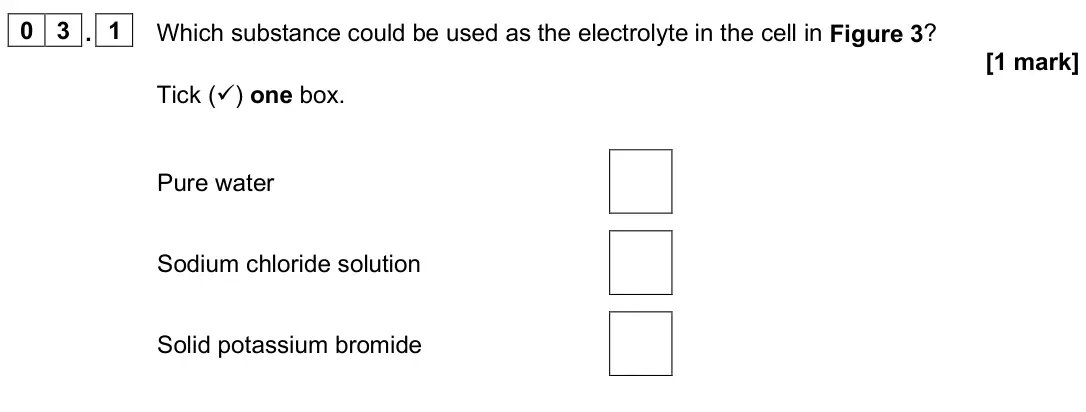
Q05.1
The whole paper ↗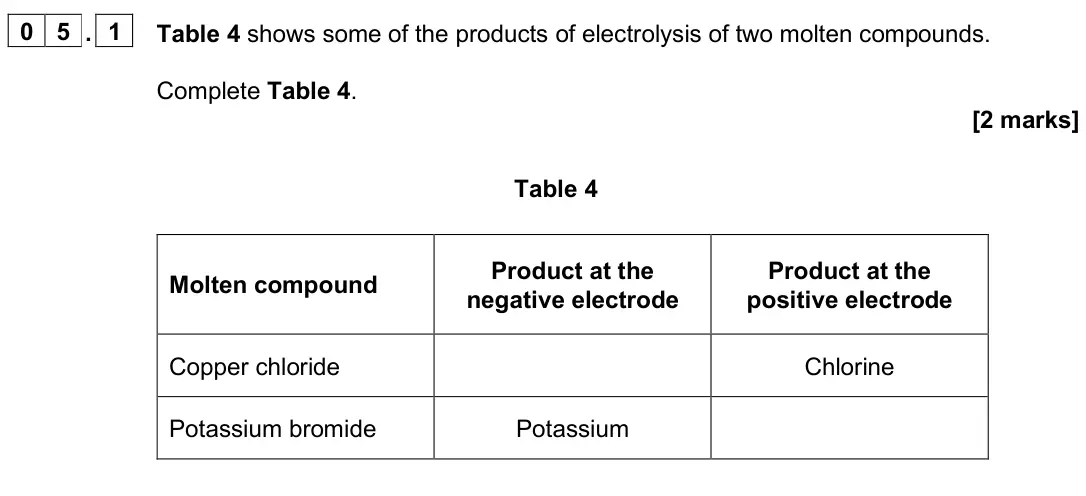
Q05.3
The whole paper ↗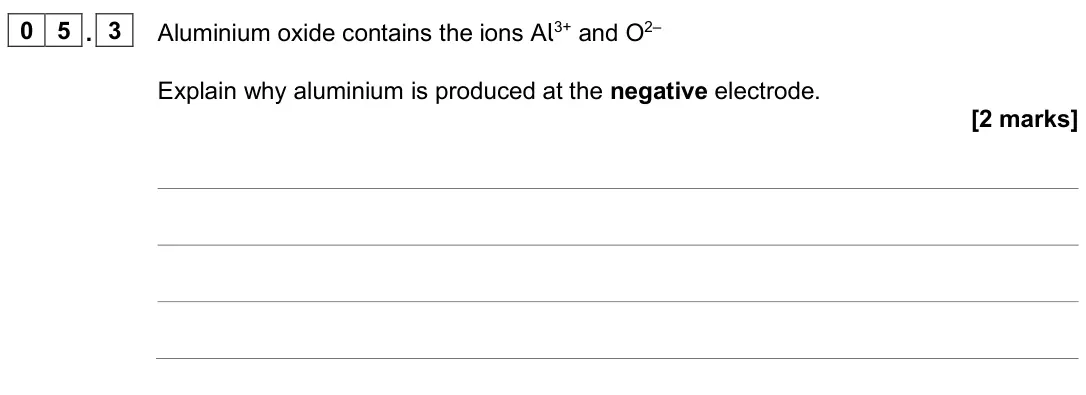
Q05.4
The whole paper ↗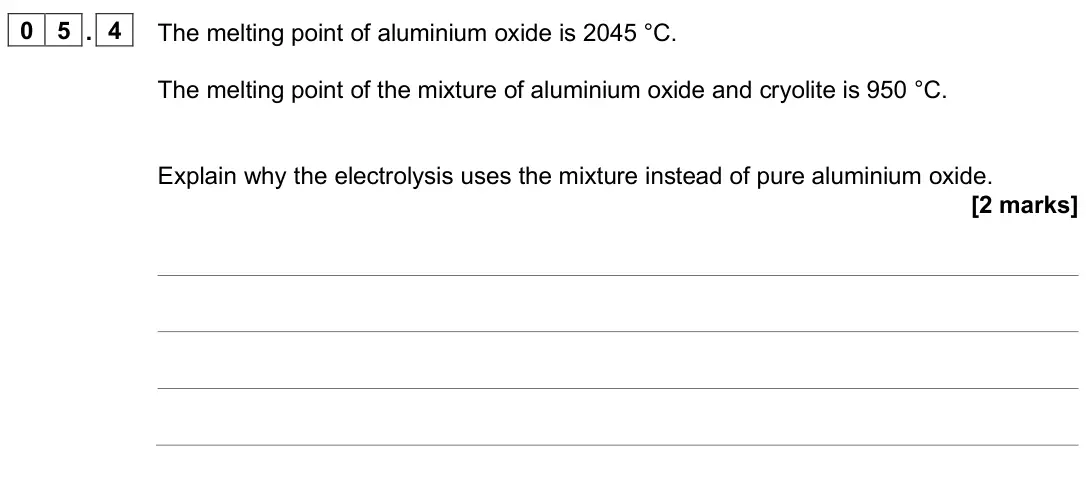
Q05.5
The whole paper ↗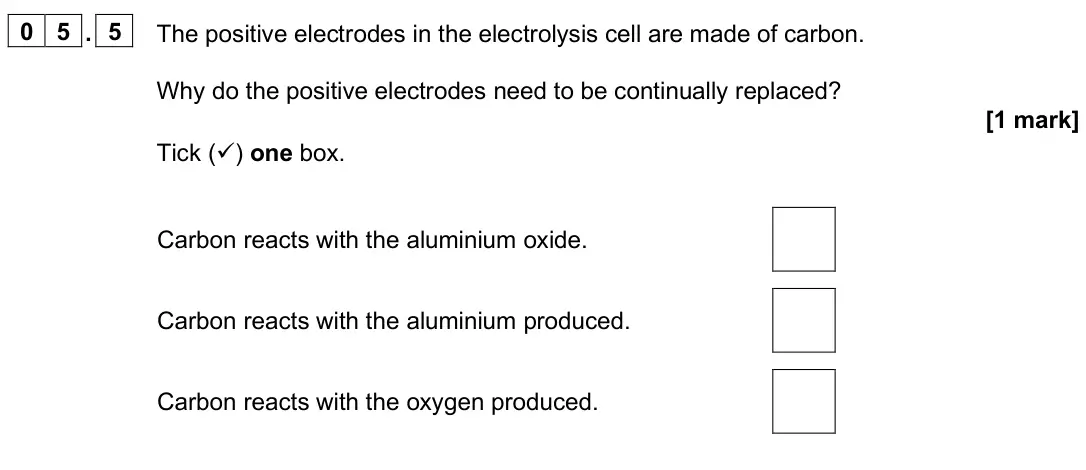
Q05.6
The whole paper ↗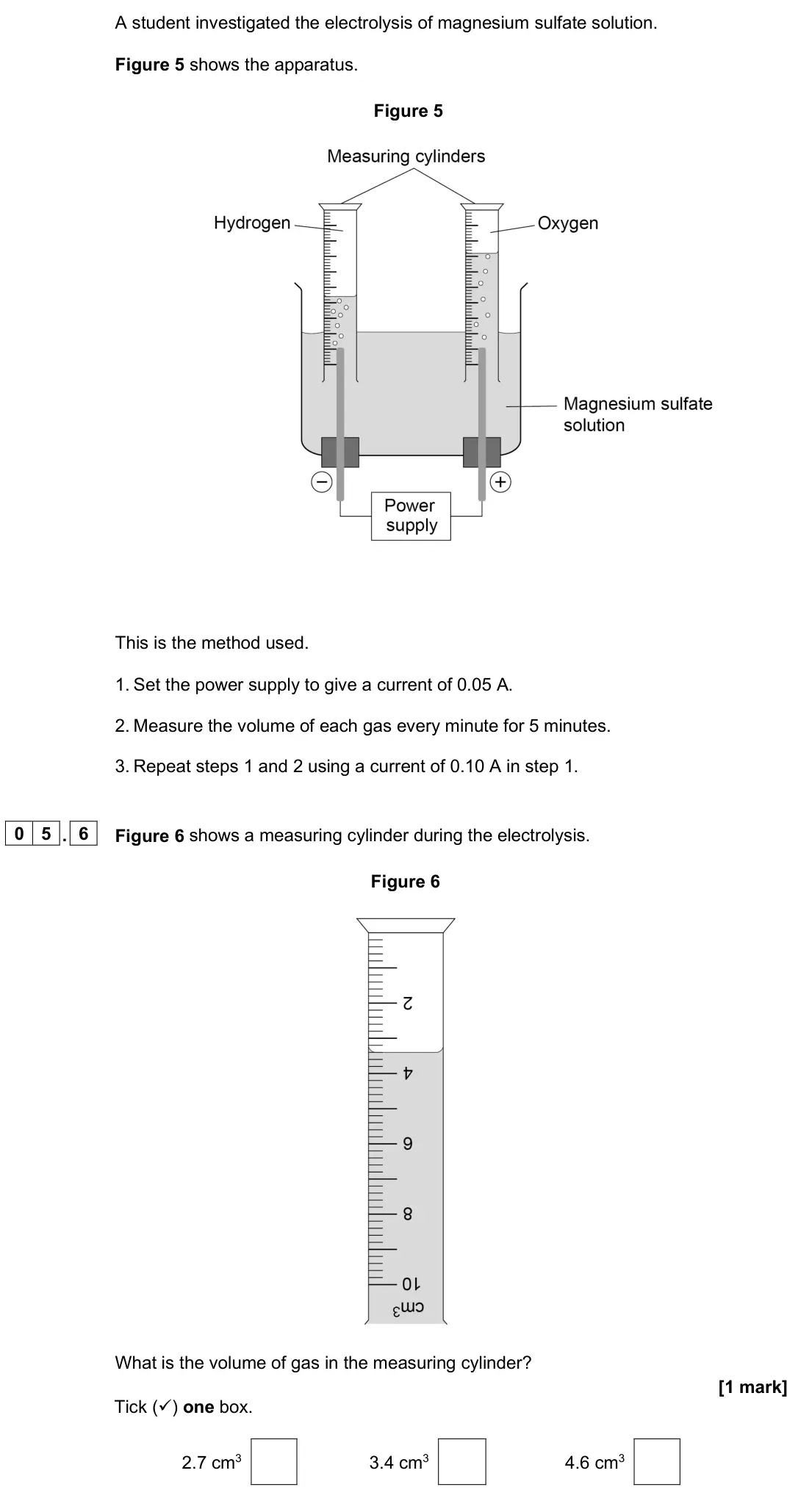
Q05.7
The whole paper ↗
Q05.8
The whole paper ↗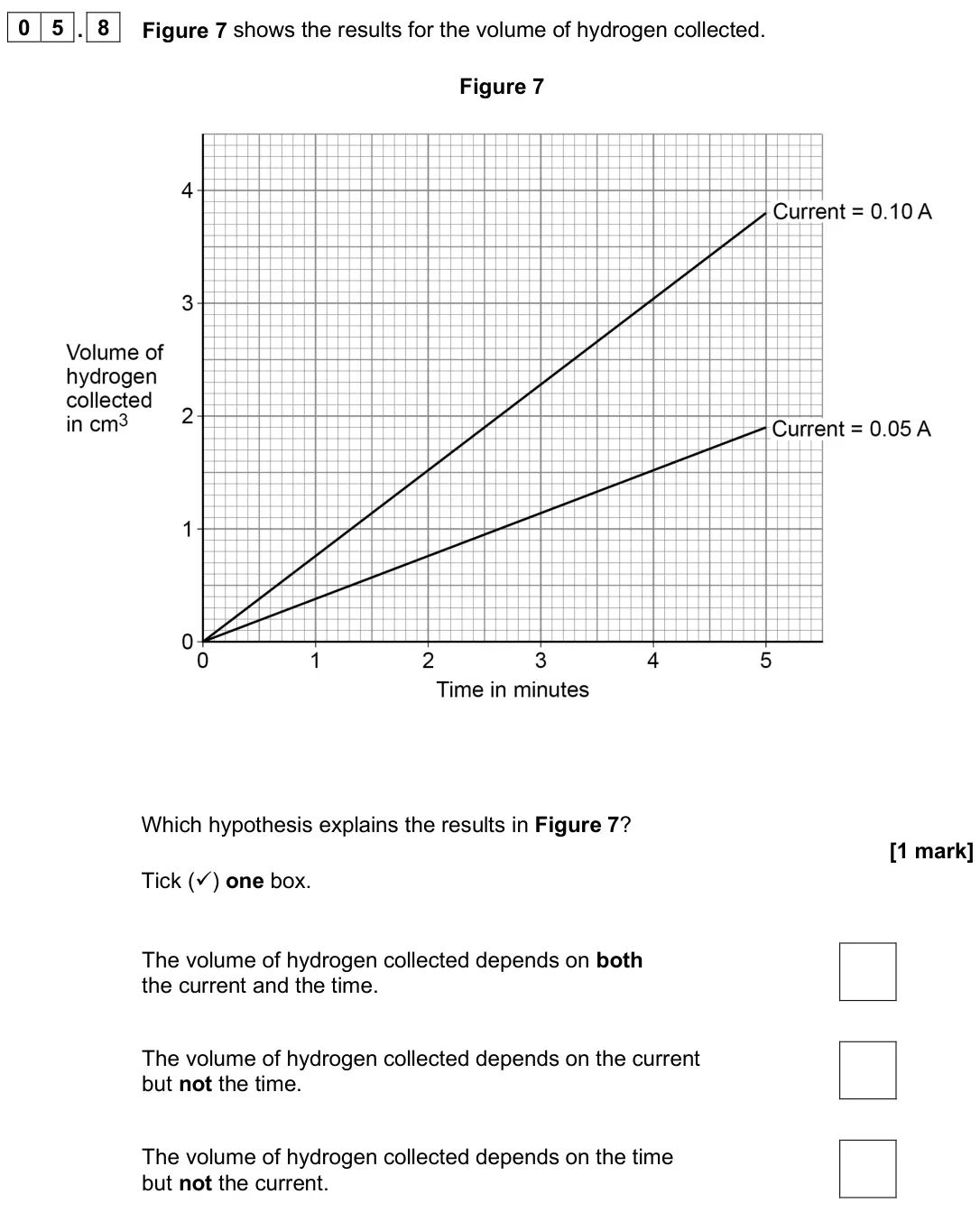
Q05.9
The whole paper ↗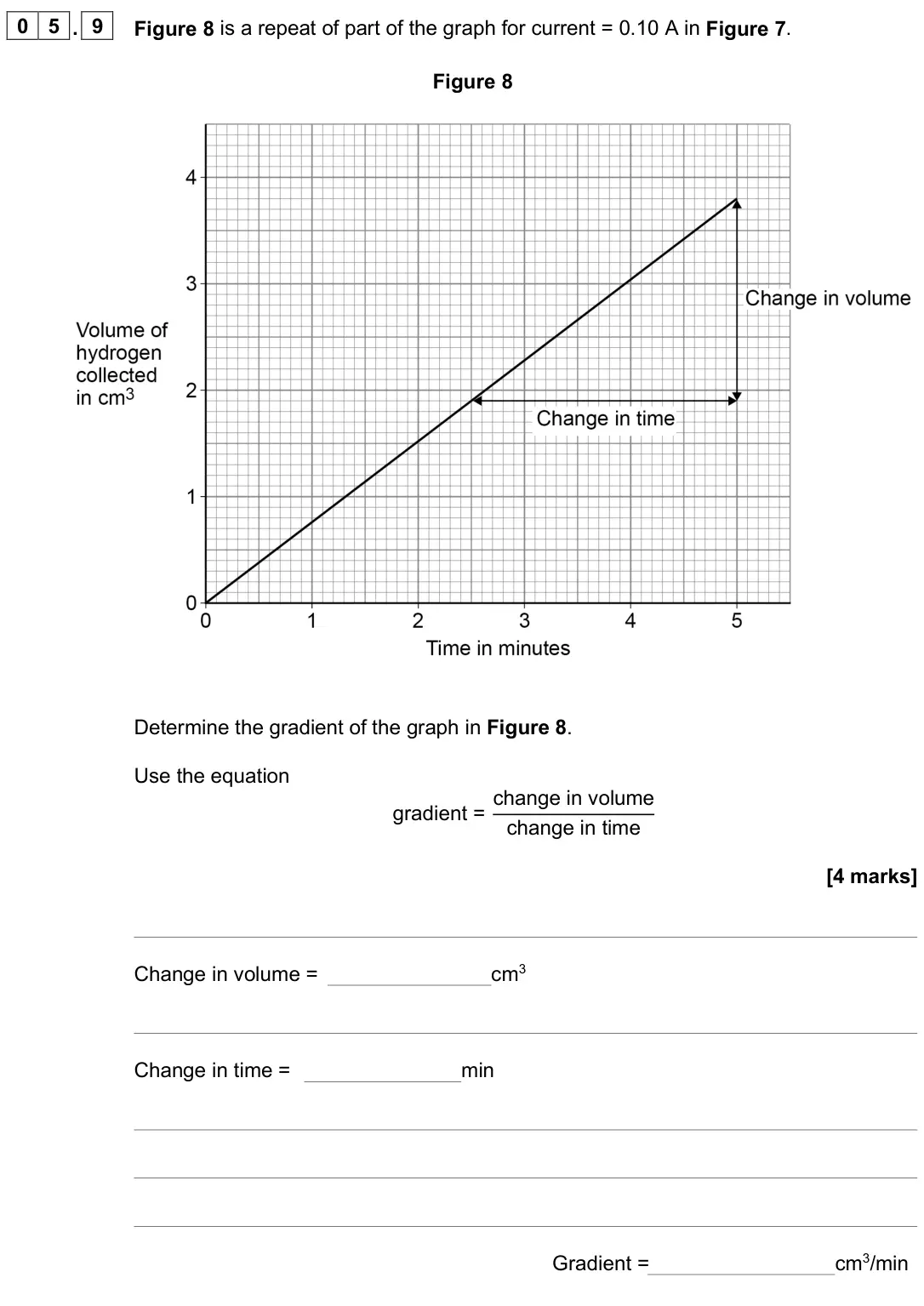
Q05.2
The whole paper ↗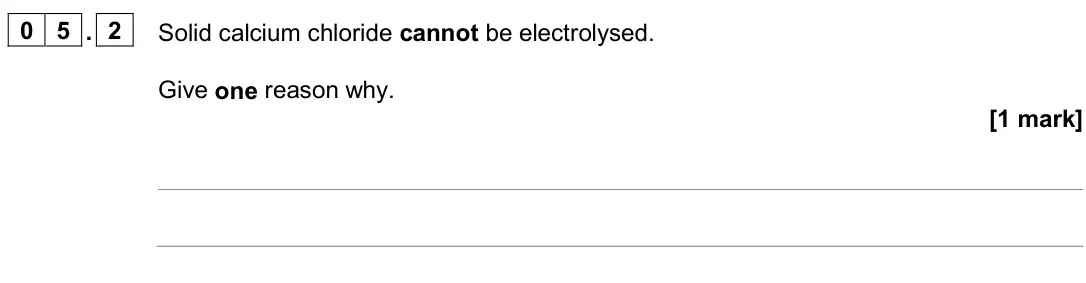
Q05.3
The whole paper ↗
Q05.5
The whole paper ↗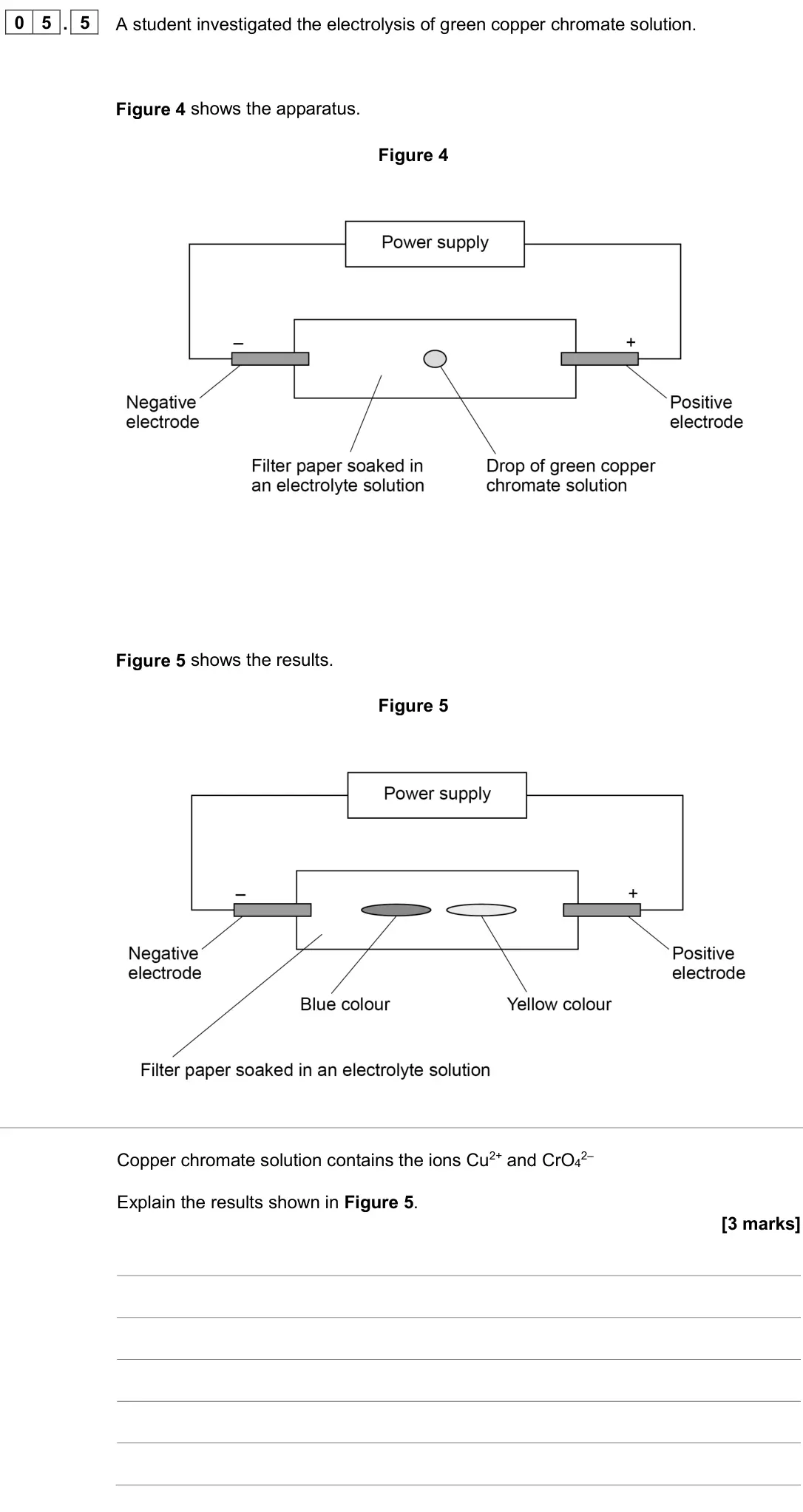
Q06.1
The whole paper ↗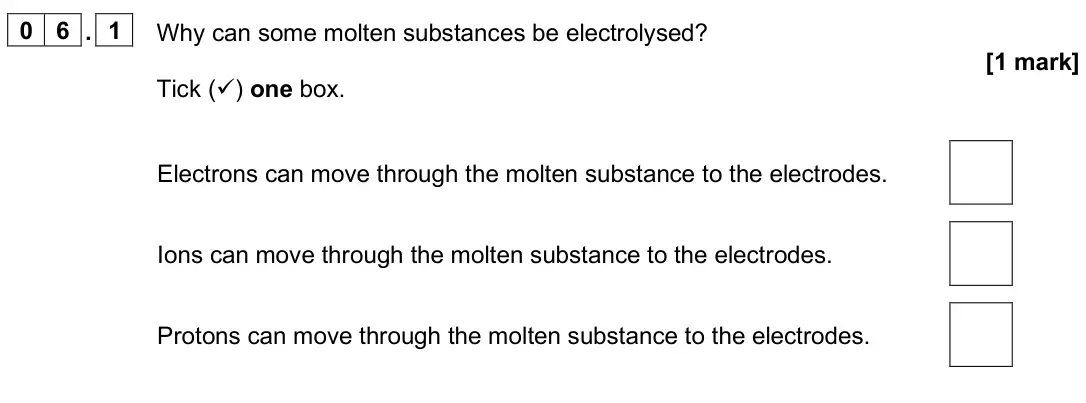
Q06.2
The whole paper ↗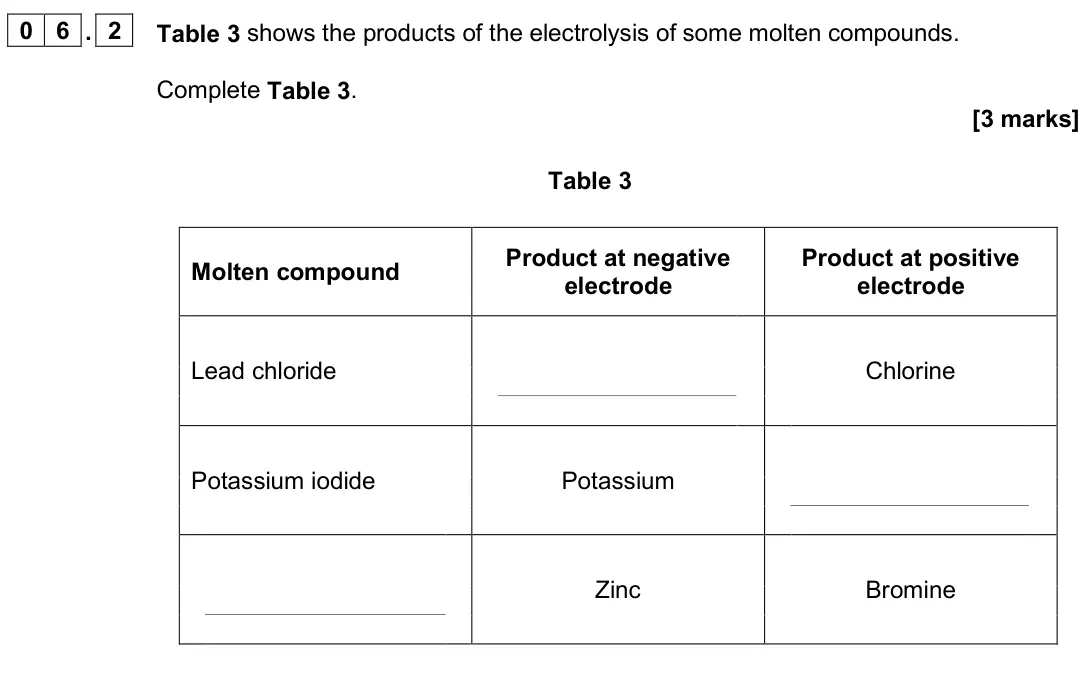
Q06.5
The whole paper ↗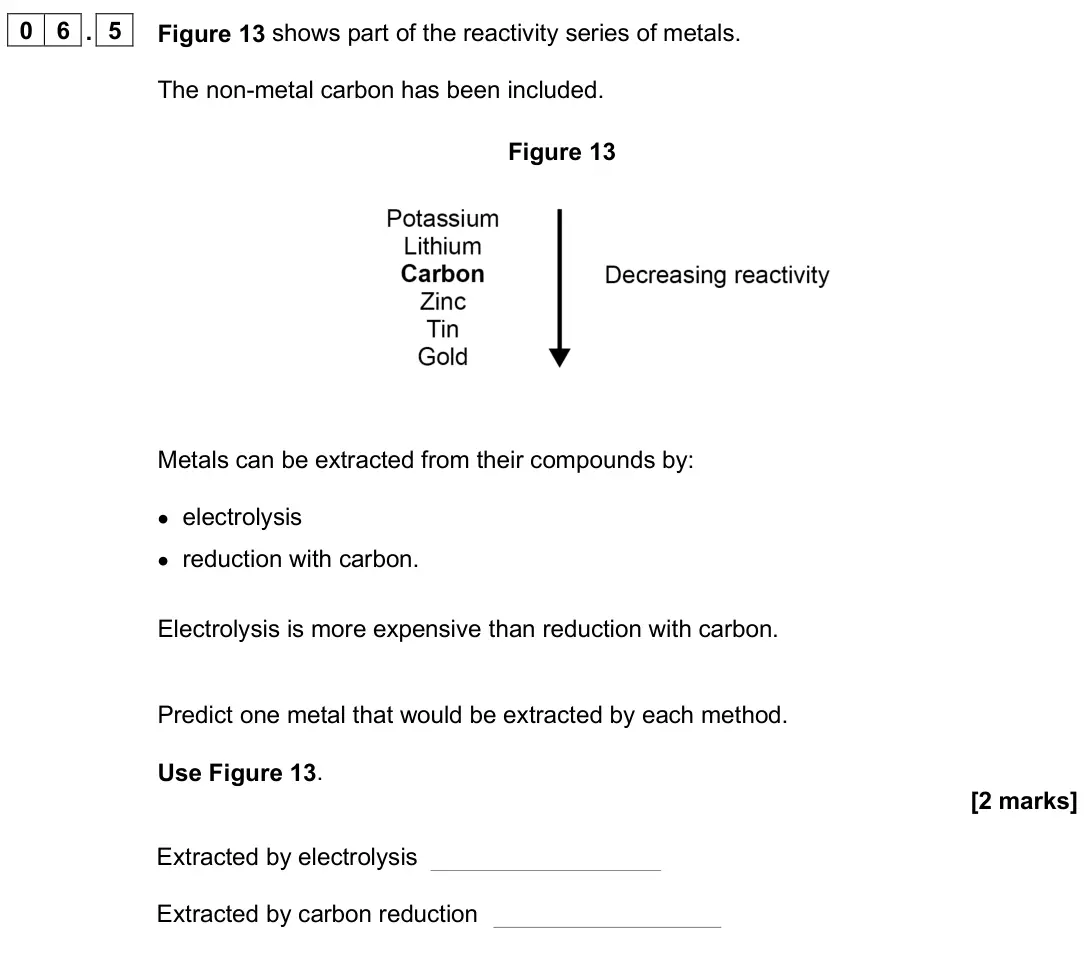
All 83 questions on Electrolysis, as a list
- June 2025, Paper 1 Higher, Q06.2 (1 mark): Name the substance added to aluminium oxide to form the mixture. [1 mark]
- June 2025, Paper 1 Higher, Q06.3 (1 mark): Give one reason why a mixture is used as the electrolyte. [1 mark]
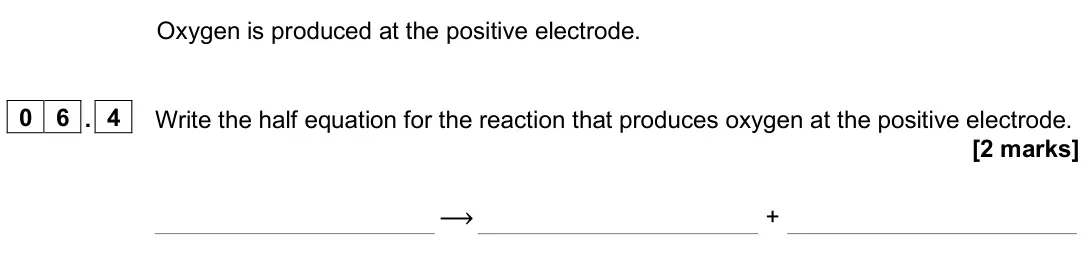
- June 2025, Paper 1 Higher, Q06.4 (2 marks): Write the half equation for the reaction that produces oxygen at the positive electrode. [2 marks] ⟶ +
- June 2025, Paper 1 Higher, Q06.5 (3 marks): The positive electrode must be continually replaced. Explain why. [3 marks]
- June 2025, Paper 1 Foundation, Q03.1 (1 mark): Which substance could be used as the electrolyte in the cell in Figure 3? [1 mark] Tick () one box. Pure water Sodium chloride solution Solid potassium bromide
- June 2025, Paper 1 Foundation, Q05.1 (2 marks): Table 4 shows some of the products of electrolysis of two molten compounds. Complete Table 4. [2 marks] Table 4 Molten compound Product at the negative electrod
- June 2025, Paper 1 Foundation, Q05.3 (2 marks): Aluminium oxide contains the ions Al3+ and O2– Explain why aluminium is produced at the negative electrode. [2 marks]
- June 2025, Paper 1 Foundation, Q05.4 (2 marks): The melting point of aluminium oxide is 2045 °C. The melting point of the mixture of aluminium oxide and cryolite is 950 °C. Explain why the electrolysis uses t
- June 2025, Paper 1 Foundation, Q05.5 (1 mark): The positive electrodes in the electrolysis cell are made of carbon. Why do the positive electrodes need to be continually replaced? [1 mark] Tick () one box.
- June 2025, Paper 1 Foundation, Q05.6 (1 mark): Figure 6 shows a measuring cylinder during the electrolysis. Figure 6 What is the volume of gas in the measuring cylinder? [1 mark] Tick () one box. 2.7 cm3 3.
- June 2025, Paper 1 Foundation, Q05.7 (1 mark): Hydrogen is produced instead of magnesium at the negative electrode. Why is hydrogen produced at the negative electrode? [1 mark] Tick () one box. Hydrogen is
- June 2025, Paper 1 Foundation, Q05.8 (1 mark): Figure 7 shows the results for the volume of hydrogen collected. Figure 7 Which hypothesis explains the results in Figure 7? [1 mark] Tick () one box. The volu
- June 2025, Paper 1 Foundation, Q05.9 (4 marks): Figure 8 is a repeat of part of the graph for current = 0.10 A in Figure 7. Figure 8 Determine the gradient of the graph in Figure 8. Use the equation gradient
- June 2024, Paper 1 Higher, Q05.2 (1 mark): Solid calcium chloride cannot be electrolysed. Give one reason why. [1 mark]
- June 2024, Paper 1 Higher, Q05.3 (1 mark): Name the product formed at the negative electrode when aqueous calcium chloride solution is electrolysed. [1 mark]
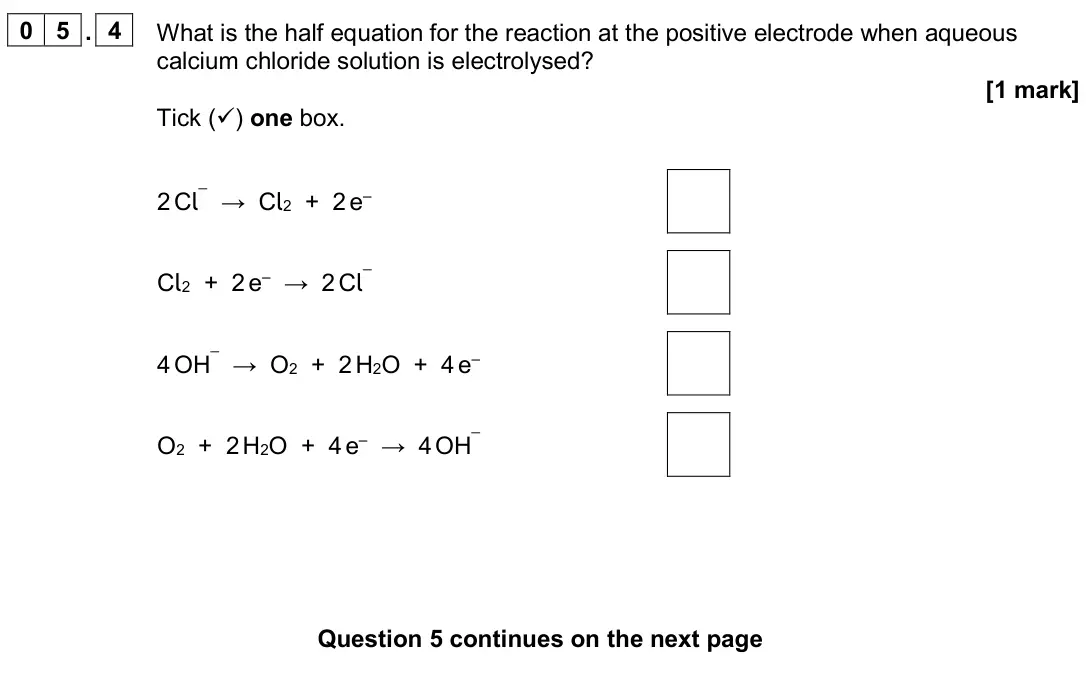
- June 2024, Paper 1 Higher, Q05.4 (1 mark): What is the half equation for the reaction at the positive electrode when aqueous calcium chloride solution is electrolysed? [1 mark] Tick () one box. 2 Cl¯ →
- June 2024, Paper 1 Higher, Q05.5 (3 marks): A student investigated the electrolysis of green copper chromate solution. Figure 4 shows the apparatus. Figure 4 Figure 5 shows the results. Figure 5 Copper ch
- June 2024, Paper 1 Foundation, Q06.1 (1 mark): Why can some molten substances be electrolysed? [1 mark] Tick () one box. Electrons can move through the molten substance to the electrodes. Ions can move thro
- June 2024, Paper 1 Foundation, Q06.2 (3 marks): Table 3 shows the products of the electrolysis of some molten compounds. Complete Table 3. [3 marks] Table 3 Molten compound Product at negative electrode Produ
- June 2024, Paper 1 Foundation, Q06.5 (2 marks): Figure 13 shows part of the reactivity series of metals. The non-metal carbon has been included. Figure 13 Metals can be extracted from their compounds by: • el
- June 2024, Paper 1 Foundation, Q07.2 (1 mark): Which is a suitable electrolyte for a chemical cell? [1 mark] Tick () one box. Pure water Solid lead bromide Sodium chloride solution
- June 2023, Paper 1 Higher, Q07.1 (1 mark): Complete the half equation for the reaction occurring at the negative electrode. [1 mark] Al3+ + e− → Al
- June 2023, Paper 1 Higher, Q07.2 (1 mark): Cryolite contains Na+ ions as well as Al3+ ions. Suggest one reason why sodium is not a product of the electrolysis. [1 mark] A student investigated the electro
- June 2023, Paper 1 Higher, Q07.3 (4 marks): Explain how oxygen was produced from water during the electrolysis of this aqueous solution. [4 marks]
- June 2023, Paper 1 Higher, Q07.4 (2 marks): The student compared the volumes of the two gases collected. How can the student change the apparatus in Figure 7 to compare the volumes of the two gases produc
- June 2023, Paper 1 Higher, Q09.5 (3 marks): The nitrate ion has the formula NO3 – Which of the four metals could be aluminium? Explain your answer. Use Table 6. [3 marks] Metal Explanation
- June 2023, Paper 1 Foundation, Q07.2 (1 mark): Give one reason why molten sodium chloride conducts electricity. Refer to ions in your answer. [1 mark]
- June 2023, Paper 1 Foundation, Q07.3 (2 marks): Table 3 shows products of the electrolysis of two molten ionic compounds. Complete Table 3. [2 marks] Table 3 Molten compound Product at the negative electrode
- June 2023, Paper 1 Foundation, Q07.4 (1 mark): Aluminium is extracted by electrolysis. The electrolyte is a molten mixture of aluminium oxide and cryolite. Why is a mixture used instead of pure aluminium oxi
- June 2023, Paper 1 Foundation, Q07.5 (1 mark): What is the source of the hydrogen and the oxygen produced during the electrolysis of aqueous sodium sulfate solution? [1 mark] Tick () one box. Air Sulfate io
- June 2023, Paper 1 Foundation, Q07.6 (1 mark): Why is hydrogen produced instead of sodium in the electrolysis of aqueous sodium sulfate solution? [1 mark] Tick () one box. Hydrogen is less reactive than sod
- June 2023, Paper 1 Foundation, Q07.7 (1 mark): Figure 9 shows the relationship between the volume of hydrogen and the volume of oxygen produced during the electrolysis. Figure 9 Give one conclusion that can
- June 2022, Paper 1 Higher, Q06.1 (1 mark): Which is the correct half equation for the production of sodium? [1 mark] Tick () one box. Na + e− → Na+ Na → Na+ + e− Na+ + e− → Na Na+ → Na + e−
- June 2022, Paper 1 Higher, Q06.2 (1 mark): Suggest one reason why the products of the electrolysis must be kept apart. [1 mark]
- June 2022, Paper 1 Higher, Q06.3 (1 mark): Which type of particle passes through the mesh in the electrolysis of molten sodium chloride? [1 mark] Tick () one box. Atom Electron Ion Molecule
- June 2022, Paper 1 Higher, Q06.4 (2 marks): Which two ions are present in aqueous sodium chloride solution in addition to sodium ions and chloride ions? [2 marks] 1 2
- June 2022, Paper 1 Higher, Q06.5 (1 mark): Name the alkaline solution produced. [1 mark]
- June 2022, Paper 1 Higher, Q06.6 (3 marks): Explain how the alkaline solution is produced. You should refer to the processes at the electrodes. [3 marks]
- June 2022, Paper 1 Higher, Q07.2 (2 marks): Aluminium also reduces silicon dioxide. Carbon is used rather than aluminium to reduce silicon dioxide because carbon is cheaper than aluminium. Carbon can be o
- June 2022, Paper 1 Foundation, Q08.1 (1 mark): Sodium sulfate solution contains: • hydrogen ions • hydroxide ions • sodium ions • sulfate ions. Oxygen is produced at the positive electrode. Which ions are di
- June 2022, Paper 1 Foundation, Q08.2 (1 mark): Figure 14 shows one of the measuring cylinders during the electrolysis. Figure 14 What is the volume of gas in the measuring cylinder? [1 mark] Volume of gas =
- June 2022, Paper 1 Foundation, Q08.3 (1 mark): Ionic compounds can be electrolysed when molten or dissolved in water. Why can ionic compounds not be electrolysed when solid? You should answer in terms of ion
- June 2022, Paper 1 Foundation, Q08.4 (2 marks): Table 7 shows the products of electrolysis of two molten compounds. Table 7 Molten compound Product at negative electrode Product at positive electrode Potassiu
- June 2022, Paper 1 Foundation, Q08.5 (1 mark): The electrolysis of molten sodium chloride is used to extract sodium metal. Why is sodium metal extracted by electrolysis instead of by reduction with carbon? [
- November 2021, Paper 1 Higher, Q07.1 (2 marks): Electrolysis and chemical cells both involve chemical reactions and electricity. Explain the difference between the processes in electrolysis and in a chemical
- November 2021, Paper 1 Higher, Q07.2 (2 marks): A teacher demonstrates the electrolysis of molten lead bromide. Bromine is produced at the positive electrode. Complete the half equation for the production of
- November 2021, Paper 1 Higher, Q07.3 (3 marks): Two aqueous salt solutions are electrolysed using inert electrodes. Complete Table 4 to show the product at each electrode. [3 marks] Table 4 Salt solution Prod
- November 2021, Paper 1 Higher, Q07.4 (4 marks): Some of the copper produced did not stick to the negative electrode but fell to the bottom of the beaker. Suggest how the students could find the total mass of
- November 2021, Paper 1 Higher, Q07.5 (1 mark): How do the results in Figure 5 support the conclusion that the total mass of copper produced is directly proportional to the time? [1 mark]
- November 2021, Paper 1 Higher, Q07.6 (1 mark): How do the results in Figure 5 support the conclusion that the total mass of copper produced is directly proportional to the current? Use data from Figure 5 in
- November 2021, Paper 1 Higher, Q07.7 (1 mark): Copper nitrate solution is blue. Suggest why the blue colour of the copper nitrate solution fades during the electrolysis. [1 mark]
- November 2021, Paper 1 Foundation, Q07.2 (4 marks): Draw a graph on Figure 12. You should: • use a suitable scale for the x-axis • plot the data from Table 5 • draw a line of best fit. [4 marks] Figure 12
- November 2021, Paper 1 Foundation, Q07.3 (1 mark): Determine the mass of silver that would be produced after 12 minutes. Use Figure 12. [1 mark] Mass of silver = g
- November 2021, Paper 1 Foundation, Q07.4 (2 marks): A student investigated the electrolysis of two aqueous salt solutions. Hydrogen is produced at the negative electrode when the metal in the salt solution is mor
- November 2021, Paper 1 Foundation, Q07.5 (1 mark): A teacher demonstrates the electrolysis of molten lead bromide. The products at the electrodes are lead and bromine. Why should the teacher do the demonstration
- November 2021, Paper 1 Foundation, Q07.6 (3 marks): Two other molten compounds are electrolysed. Complete Table 7 to show the molten compounds and the products. [3 marks] Table 7 Molten compound electrolysed Prod
- November 2020, Paper 1 Higher, Q04.1 (2 marks): Explain why the colour changed at the positive electrode. [2 marks]
- November 2020, Paper 1 Higher, Q04.2 (1 mark): The gas produced at the positive electrode was oxygen. The oxygen was produced from hydroxide ions. Name the substance in the solution that provides the hydroxi
- November 2020, Paper 1 Higher, Q04.3 (3 marks): Describe how the solid forms at the negative electrode. [3 marks]
- November 2020, Paper 1 Higher, Q04.4 (2 marks): The student repeated the investigation using potassium iodide solution instead of copper chromate solution. Name the product at each electrode when potassium io
- November 2020, Paper 1 Foundation, Q04.1 (2 marks): What observation would be made at each electrode if the hypothesis is correct? [2 marks] Observation if metal produced at the negative electrode Observation if
- November 2020, Paper 1 Foundation, Q04.2 (2 marks): Which salt solution in Table 3 does not match the student’s hypothesis? Give one reason why. [2 marks] Salt solution Reason
- November 2020, Paper 1 Foundation, Q04.3 (2 marks): Give two reasons why graphite is used for the electrodes. [2 marks] 1 2
- November 2020, Paper 1 Foundation, Q04.4 (2 marks): What happens to the purple coloured ions? Give one reason for your answer. [2 marks] Tick () one box. The ions do not move. The ions move towards the negative
- November 2020, Paper 1 Foundation, Q05.4 (2 marks): The waste material from the bauxite is stored in lakes of mud. The lakes of mud are held in place by dams. Figure 6 shows one of these lakes. Figure 6 Suggest t
- November 2020, Paper 1 Foundation, Q05.6 (1 mark): What is the reason for adding cryolite to the aluminium oxide? [1 mark] Tick () one box. To increase the amount of aluminium extracted To lower the melting poi
- November 2020, Paper 1 Foundation, Q05.7 (2 marks): Complete the sentences. Choose answers from the box. [2 marks] aluminium carbon fluorine oxygen sodium When the molten aluminium oxide and cryolite mixture is e
- November 2020, Paper 1 Foundation, Q05.8 (3 marks): A sample of bauxite contains 25% aluminium. Calculate the maximum mass of aluminium that can be extracted from 300 000 kg of the sample of bauxite. Give your an
- June 2019, Paper 1 Higher, Q07.1 (2 marks): Explain why a mixture is used as the electrolyte instead of using only aluminium oxide. [2 marks]
- June 2019, Paper 1 Higher, Q07.2 (1 mark): What happens at the negative electrode during the production of aluminium? [1 mark] Tick () one box. Aluminium atoms gain electrons. Aluminium atoms lose elect
- June 2019, Paper 1 Higher, Q07.3 (2 marks): Oxygen is produced at the positive electrode. Complete the balanced half-equation for the process at the positive electrode. [2 marks] → O2 +
- June 2019, Paper 1 Higher, Q07.4 (3 marks): Explain why the positive electrode must be continually replaced. [3 marks]
- June 2019, Paper 1 Higher, Q07.6 (2 marks): Explain why sodium chloride solution cannot be used as the electrolyte to produce sodium metal. [2 marks]
- June 2019, Paper 1 Foundation, Q06.5 (2 marks): Extracting metals by electrolysis is a very expensive process. Explain why aluminium is extracted using electrolysis and not by reduction with carbon. [2 marks]
- June 2018, Paper 1 Higher, Q06.1 (2 marks): Explain why electrolysis would not take place in the apparatus shown in Figure 6. [2 marks]
- June 2018, Paper 1 Higher, Q06.3 (2 marks): The student made an error in selecting the apparatus for this investigation. How should the apparatus be changed? Give one reason for your answer. [2 marks]
- June 2018, Paper 1 Higher, Q06.4 (3 marks): Describe the trends shown in the results. Use values from Figure 8. [3 marks]
- June 2018, Paper 1 Higher, Q06.5 (1 mark): The number of moles of each gas produced at the electrodes is the same. No gas escapes from the apparatus. Suggest one reason for the difference in volume of ea
- June 2018, Paper 1 Foundation, Q04.1 (1 mark): Figure 5 shows the volume of hydrogen gas collected in the measuring cylinder after 8 minutes. Figure 5 What is the volume of hydrogen gas collected? [1 mark] V
- June 2018, Paper 1 Foundation, Q04.2 (1 mark): Which of the lines on Figure 6 show that the volume of gas collected is directly proportional to the time? [1 mark] Tick one box. Both lines Chlorine line only
- June 2018, Paper 1 Foundation, Q04.3 (1 mark): Which of the lines on Figure 6 show a positive correlation between the volume of gas collected and time? [1 mark] Tick one box. Both lines Chlorine line only Hy
- June 2018, Paper 1 Foundation, Q04.5 (4 marks): The teacher demonstrates the electrolysis of: • molten zinc chloride • potassium bromide solution. Complete Table 3 to predict the products. Choose answers from
- Specimen, Paper 1 Higher, Q01.6: What are the products of electrolysing potassium iodide solution? [1 mar Tick one box. Product at cathode Product at anode hydrogen iodine hydrogen oxygen potas
Questions, mark schemes and examiner’s reports are © AQA, from their published past papers. Plumi isn’t affiliated with any exam board. Want whole papers? Every AQA GCSE Chemistry paper.
Rather write your answers by hand on iPad? Plumi marks them against the same mark schemes.