 plumi
Reactions of acids: AQA GCSE Chemistry questions
Every AQA GCSE Chemistry exam question on 4.4.2 Reactions of acids, 2018–2025, with its mark scheme and examiner’s report.
Find questions1,744
Calculations
Q08.1
The whole paper ↗
Q08.2
The whole paper ↗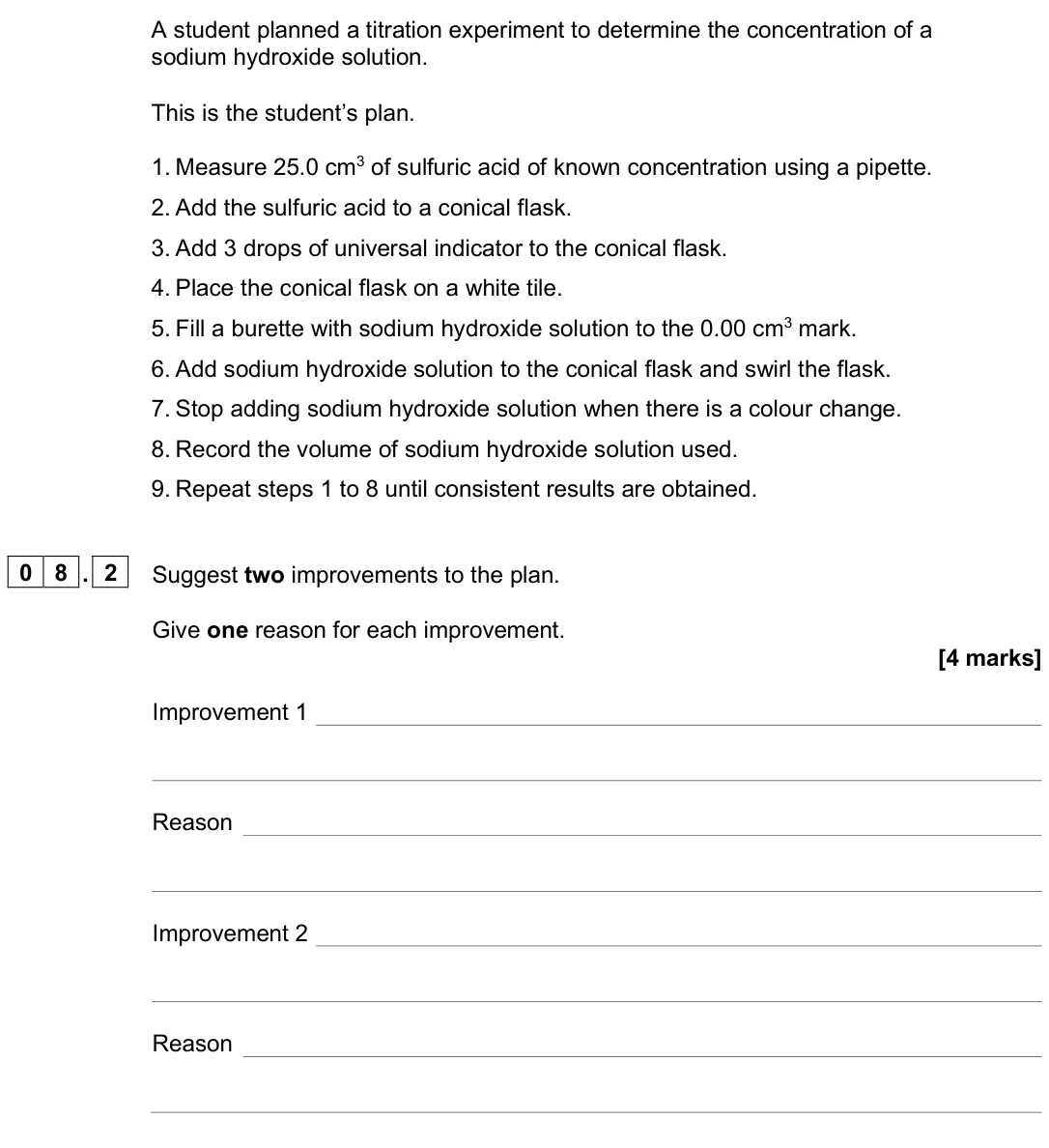
Q08.3
The whole paper ↗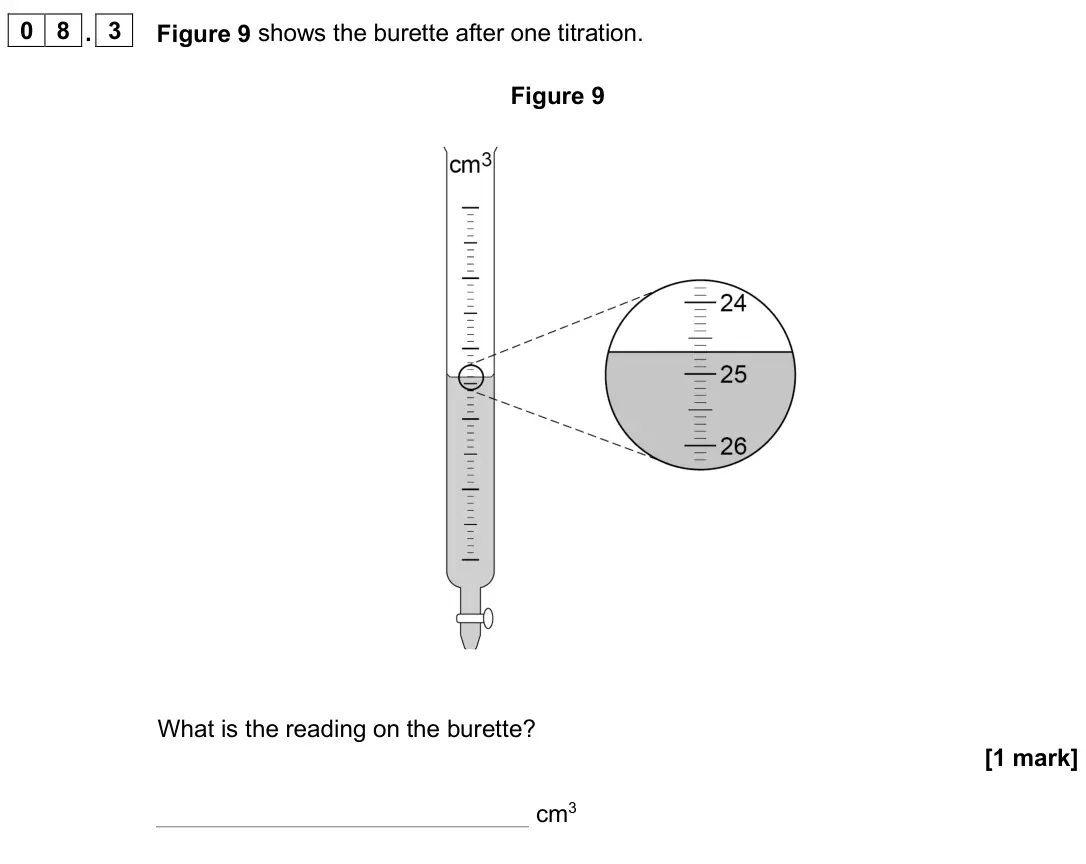
Q08.4
The whole paper ↗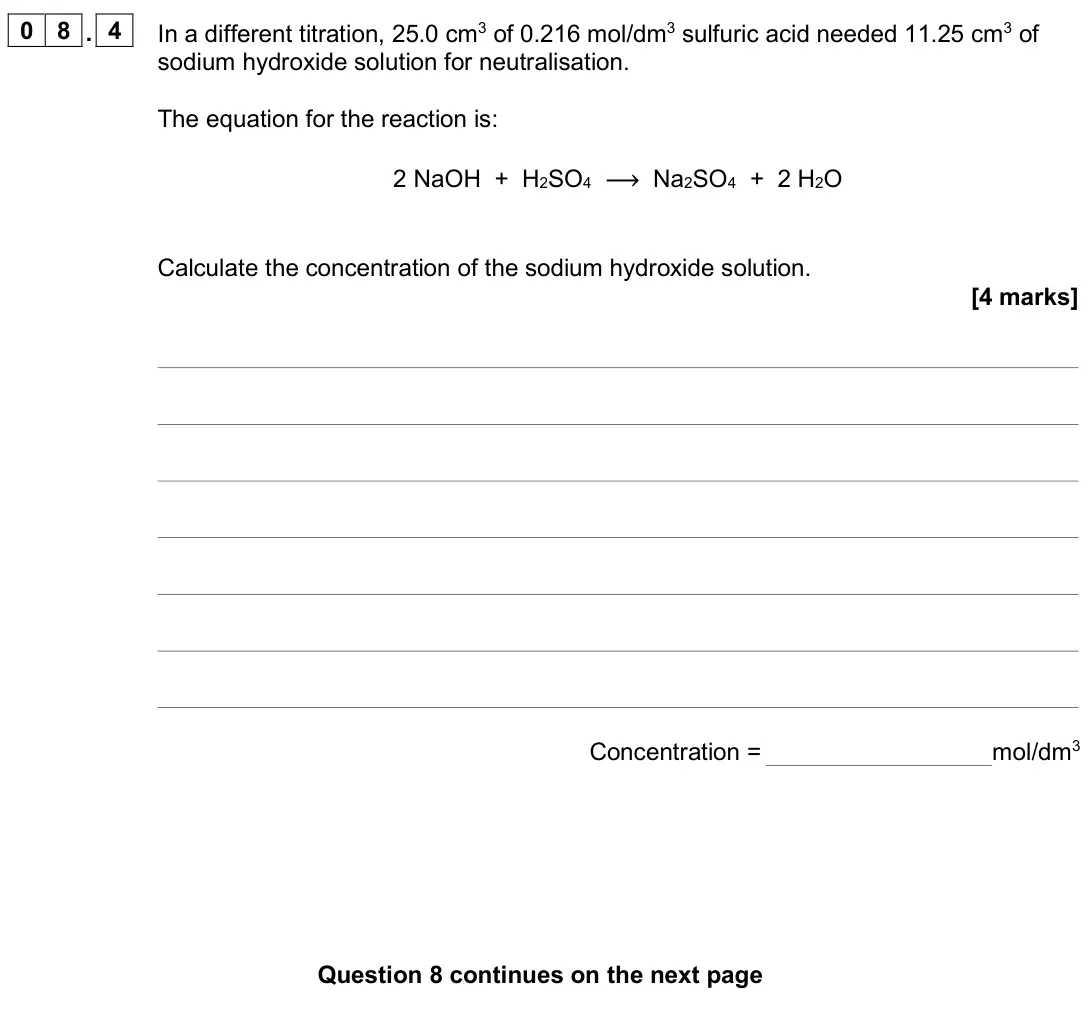
Q08.5
The whole paper ↗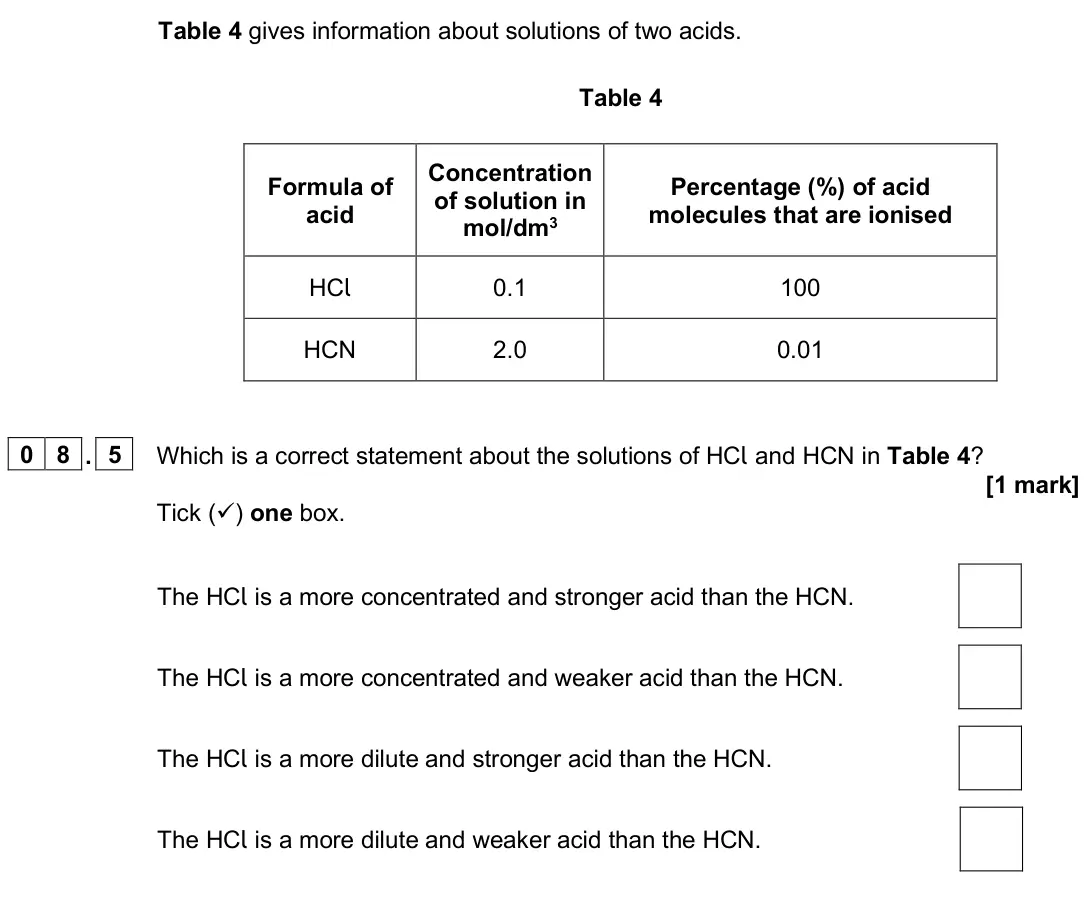
Q08.6
The whole paper ↗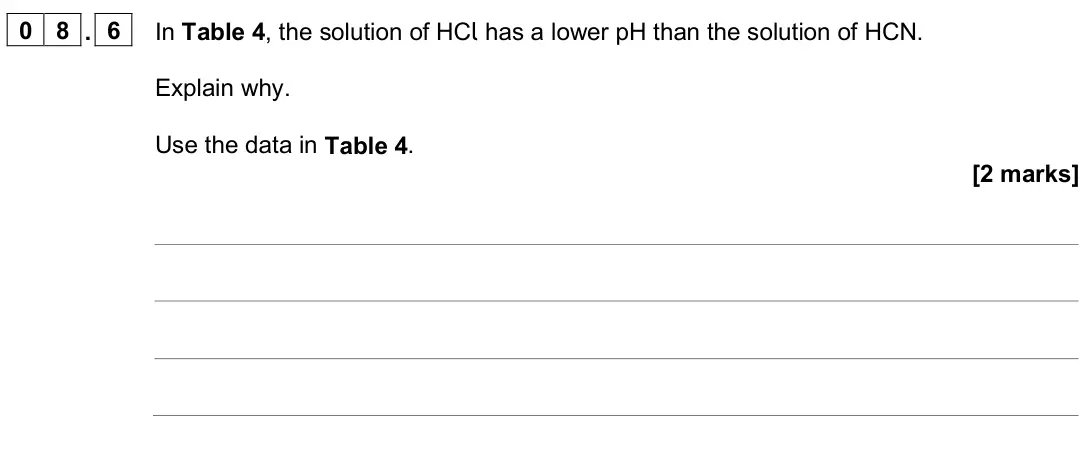
Q09.1
The whole paper ↗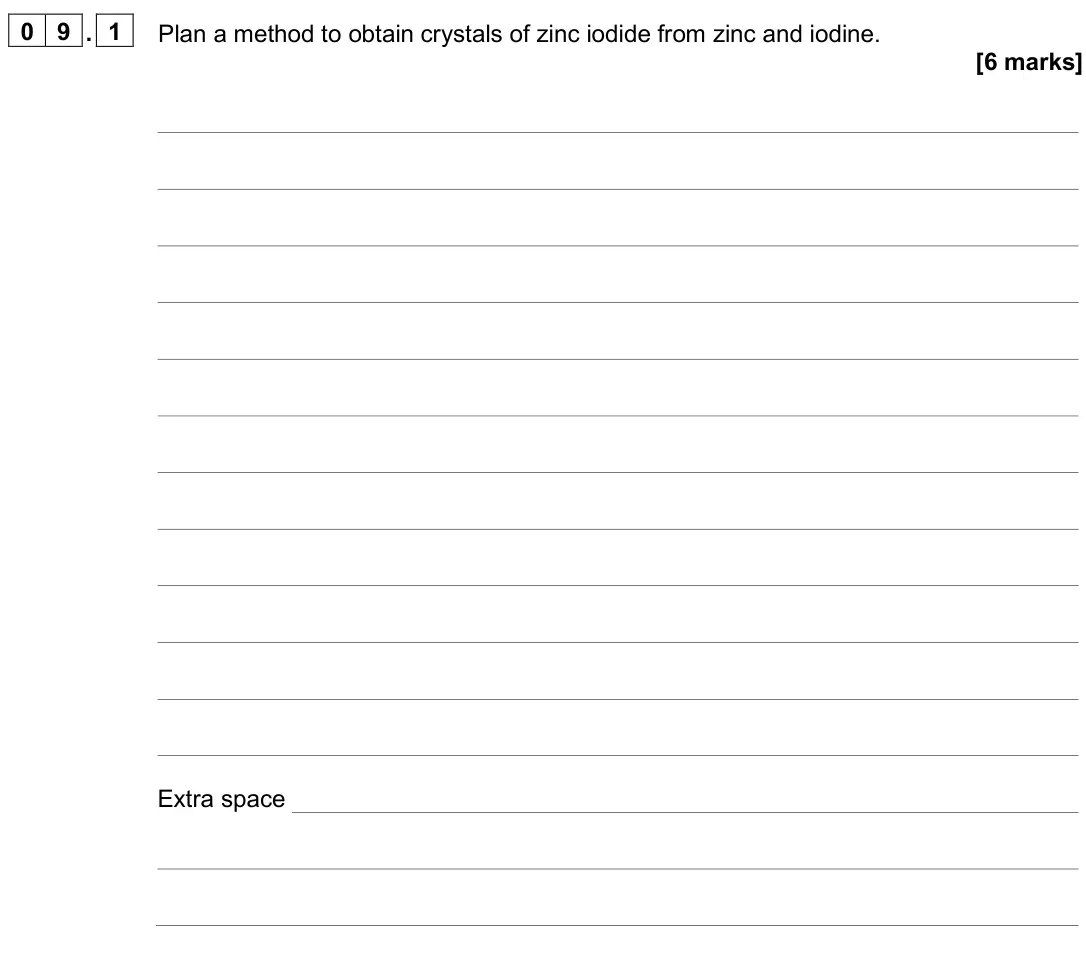
Q02.1
The whole paper ↗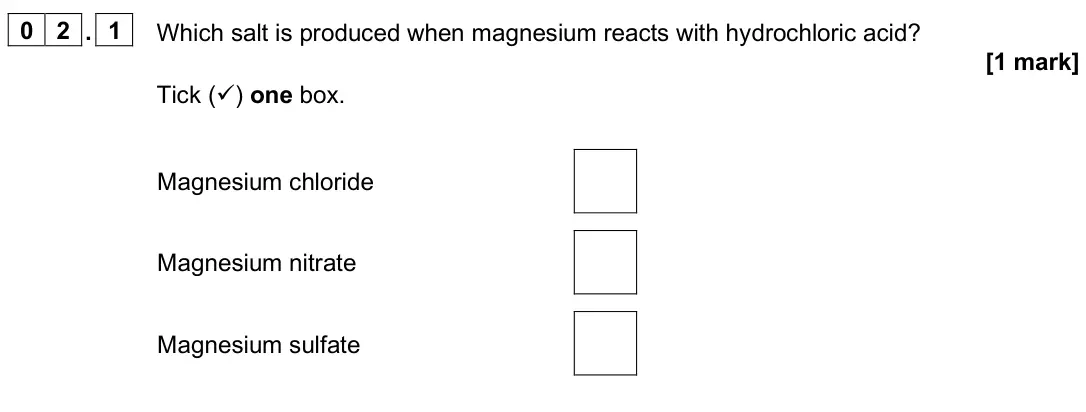
Q02.2
The whole paper ↗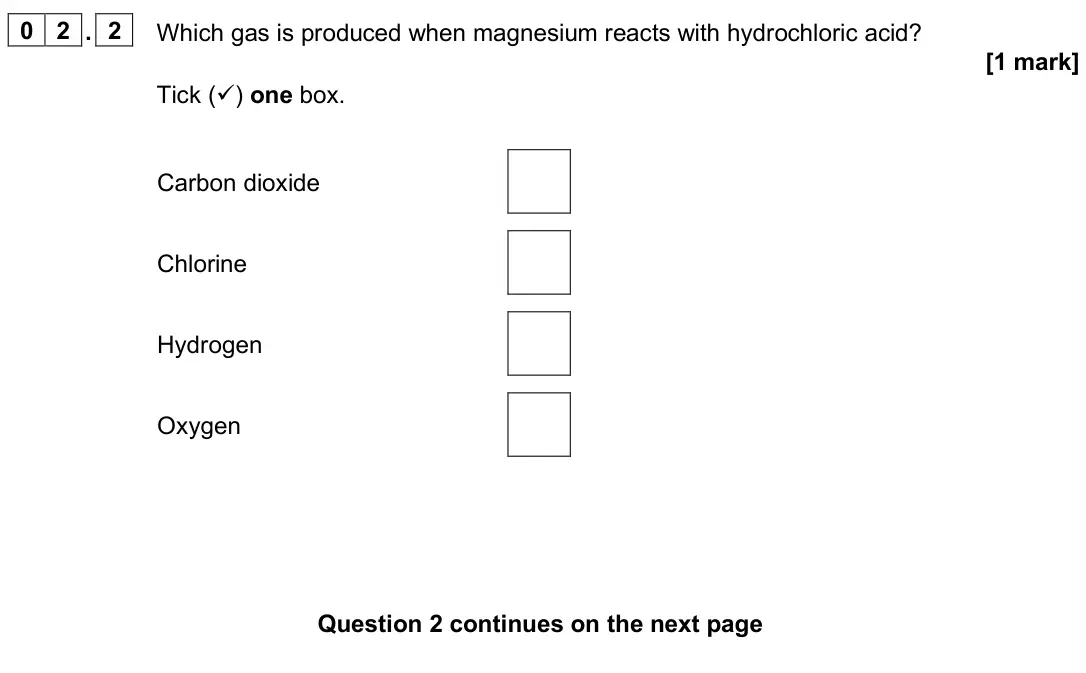
Q04.1
The whole paper ↗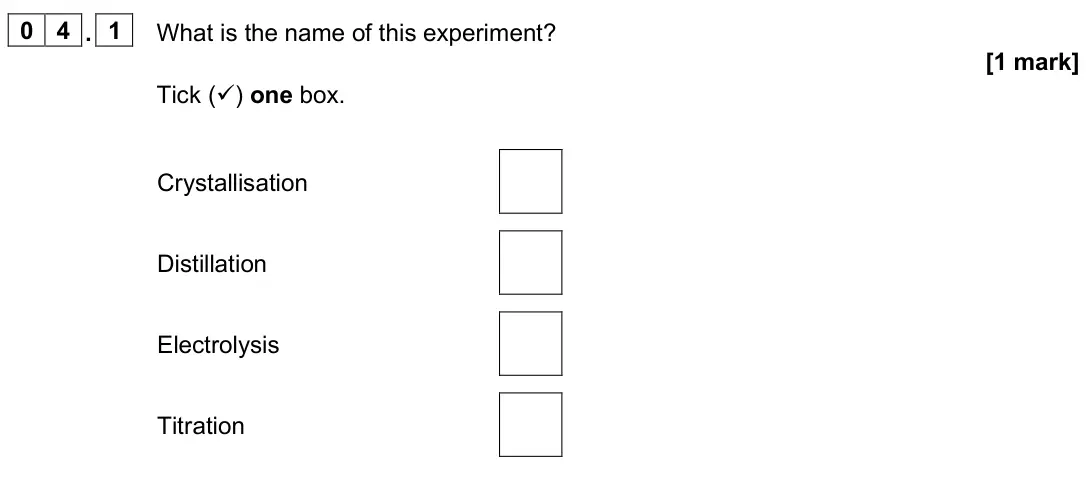
Q04.2
The whole paper ↗
Q04.3
The whole paper ↗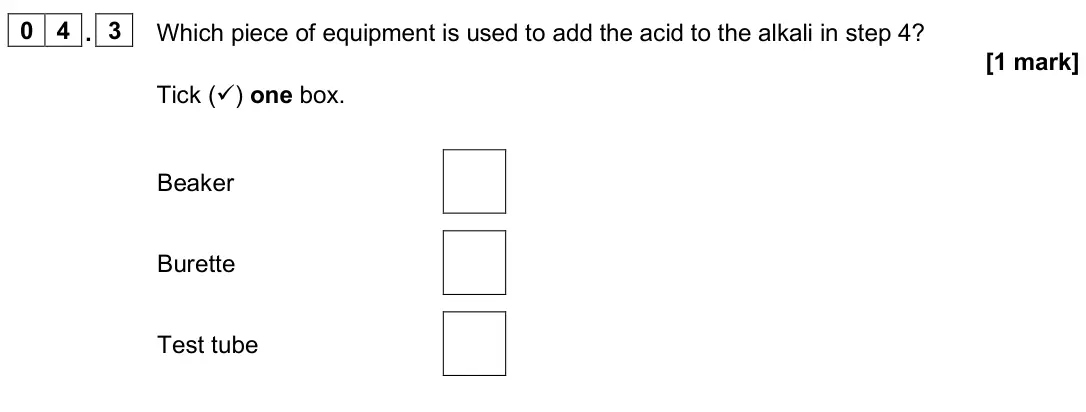
Q04.4
The whole paper ↗
Q04.5
The whole paper ↗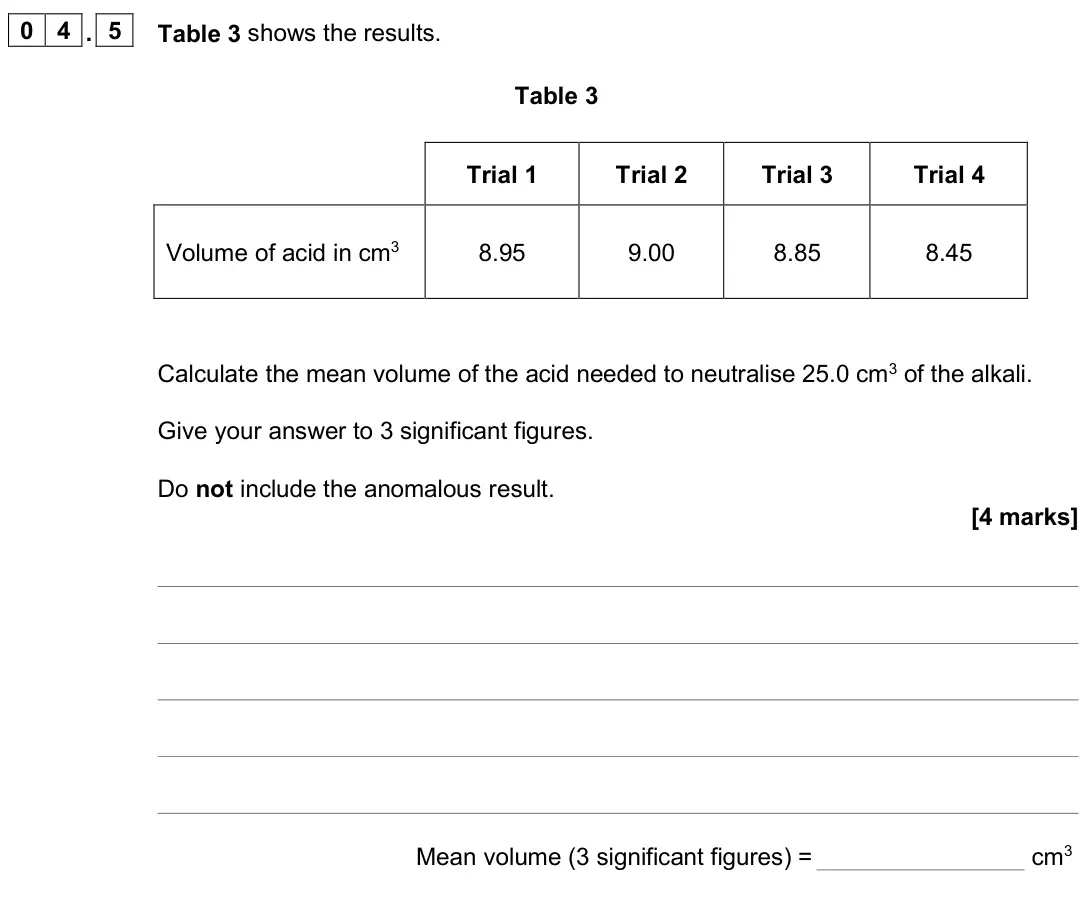
Q04.6
The whole paper ↗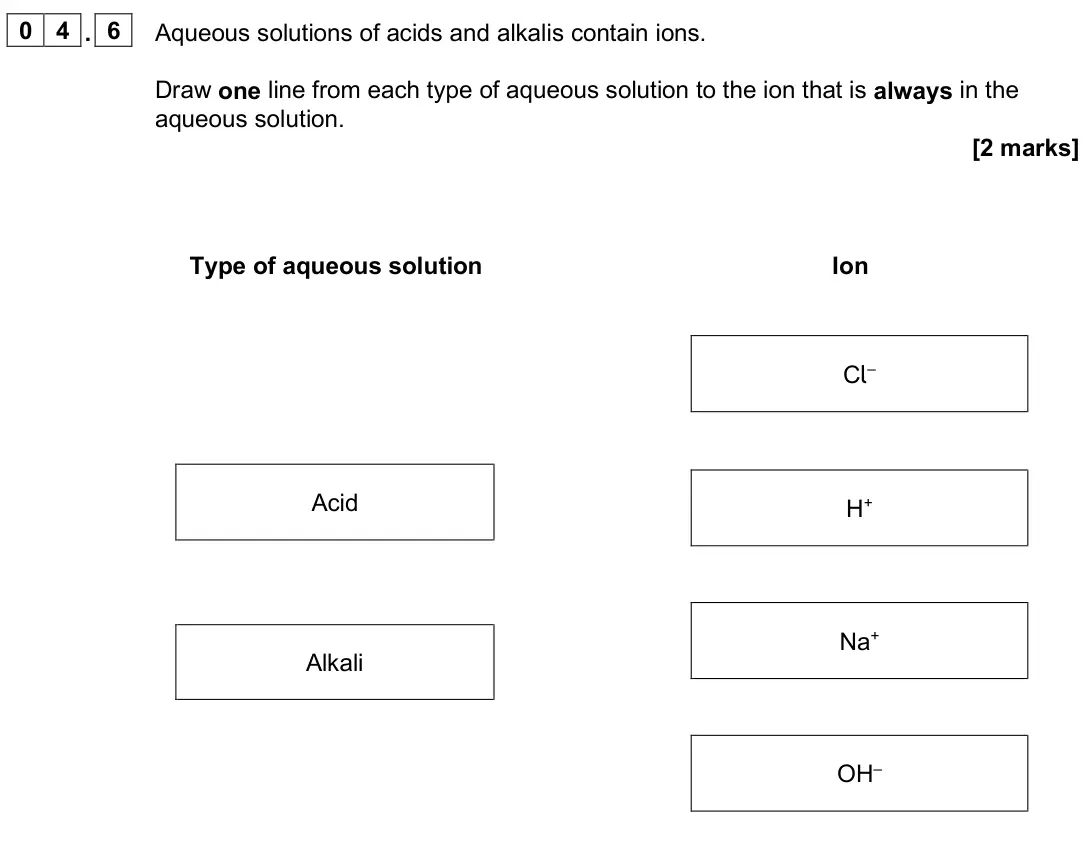
Q07.2
The whole paper ↗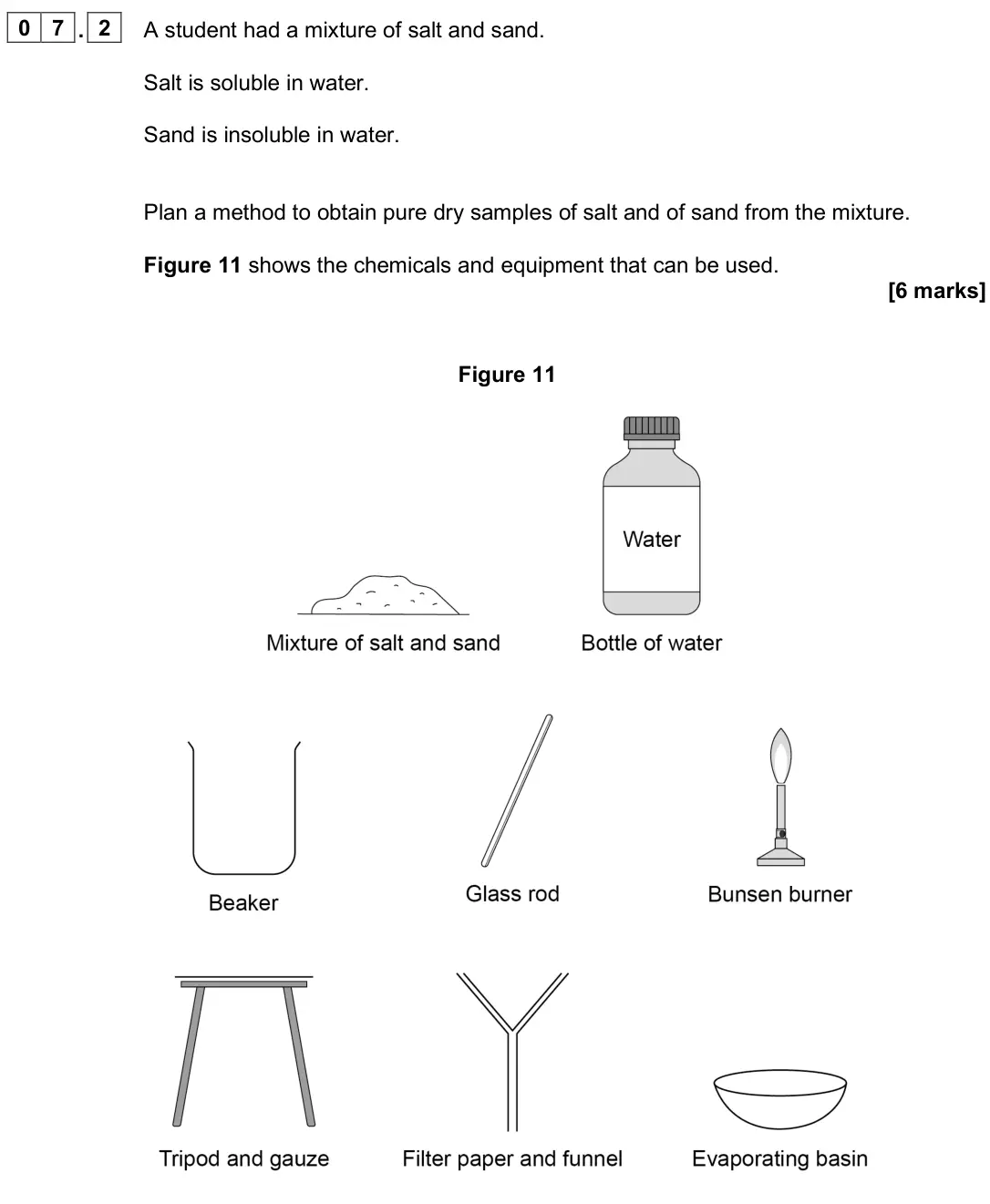
Q06.6
The whole paper ↗
Q01.1
The whole paper ↗
Q01.2
The whole paper ↗
Q01.3
The whole paper ↗
All 156 questions on Reactions of acids, as a list
- June 2025, Paper 1 Higher, Q08.1 (1 mark): What is the formula of the ion that all alkalis contain when in solution? [1 mark]
- June 2025, Paper 1 Higher, Q08.2 (4 marks): Suggest two improvements to the plan. Give one reason for each improvement. [4 marks] Improvement 1 Reason Improvement 2 Reason
- June 2025, Paper 1 Higher, Q08.3 (1 mark): Figure 9 shows the burette after one titration. Figure 9 What is the reading on the burette? [1 mark] cm3
- June 2025, Paper 1 Higher, Q08.4 (4 marks): In a different titration, 25.0 cm3 of 0.216 mol/dm3 sulfuric acid needed 11.25 cm3 of sodium hydroxide solution for neutralisation. The equation for the reactio
- June 2025, Paper 1 Higher, Q08.5 (1 mark): Which is a correct statement about the solutions of HCl and HCN in Table 4? [1 mark] Tick () one box. The HCl is a more concentrated and stronger acid than the
- June 2025, Paper 1 Higher, Q08.6 (2 marks): In Table 4, the solution of HCl has a lower pH than the solution of HCN. Explain why. Use the data in Table 4. [2 marks]
- June 2025, Paper 1 Higher, Q09.1 (6 marks): Plan a method to obtain crystals of zinc iodide from zinc and iodine. [6 marks]
- June 2025, Paper 1 Foundation, Q02.1 (1 mark): Which salt is produced when magnesium reacts with hydrochloric acid? [1 mark] Tick () one box. Magnesium chloride Magnesium nitrate Magnesium sulfate
- June 2025, Paper 1 Foundation, Q02.2 (1 mark): Which gas is produced when magnesium reacts with hydrochloric acid? [1 mark] Tick () one box. Carbon dioxide Chlorine Hydrogen Oxygen
- June 2025, Paper 1 Foundation, Q04.1 (1 mark): What is the name of this experiment? [1 mark] Tick () one box. Crystallisation Distillation Electrolysis Titration
- June 2025, Paper 1 Foundation, Q04.2 (1 mark): Substance X is used in step 2 of the method. What type of substance is X? [1 mark]
- June 2025, Paper 1 Foundation, Q04.3 (1 mark): Which piece of equipment is used to add the acid to the alkali in step 4? [1 mark] Tick () one box. Beaker Burette Test tube
- June 2025, Paper 1 Foundation, Q04.4 (1 mark): Suggest one improvement to step 4 of the method. [1 mark]
- June 2025, Paper 1 Foundation, Q04.5 (4 marks): Table 3 shows the results. Table 3 Trial 1 Trial 2 Trial 3 Trial 4 Volume of acid in cm3 8.95 9.00 8.85 8.45 Calculate the mean volume of the acid needed to neu
- June 2025, Paper 1 Foundation, Q04.6 (2 marks): Aqueous solutions of acids and alkalis contain ions. Draw one line from each type of aqueous solution to the ion that is always in the aqueous solution. [2 mark
- June 2025, Paper 1 Foundation, Q07.2 (6 marks): A student had a mixture of salt and sand. Salt is soluble in water. Sand is insoluble in water. Plan a method to obtain pure dry samples of salt and of sand fro
- June 2025, Paper 2 Higher, Q06.6 (4 marks): The student repeated the test on solution C using 1.0 mol/dm3 ethanoic acid instead of 1.0 mol/dm3 nitric acid. Bubbles of gas were produced more slowly using e
- June 2024, Paper 1 Higher, Q01.1 (2 marks): Complete the word equation for the reaction. [2 marks] copper carbonate + sulfuric acid → + + carbon dioxide
- June 2024, Paper 1 Higher, Q01.2 (1 mark): Give one observation the student could make during Step 4 which shows that the copper carbonate is in excess. [1 mark]
- June 2024, Paper 1 Higher, Q01.3 (1 mark): Give one reason for filtering the mixture in Step 5. [1 mark]
- June 2024, Paper 1 Higher, Q01.4 (1 mark): Name the equipment that can be used to warm the filtrate gently in Step 6. [1 mark]
- June 2024, Paper 1 Higher, Q01.6 (2 marks): Some salts can be produced by reacting sulfuric acid with a metal. Neither copper nor sodium is used to produce a salt with sulfuric acid. Give one reason why e
- June 2024, Paper 1 Higher, Q02.3 (2 marks): Potassium hydroxide solution is produced when potassium reacts with water. What is the colour of universal indicator when added to potassium hydroxide solution?
- June 2024, Paper 1 Higher, Q07.4 (1 mark): What is the ratio of the numbers of ions in Fe3O4? [1 mark] Tick () one box. 2 Fe2+ : 1 Fe3+ : 4 O2– 1 Fe2+ : 2 Fe3+ : 4 O2– 3 Fe2+ : 4 O2– 3 Fe3+ : 4 O2–
- June 2024, Paper 1 Higher, Q09.1 (2 marks): What is meant by ‘a weak acid’? [2 marks]
- June 2024, Paper 1 Higher, Q09.2 (2 marks): Explain what happens to the pH of an acid as the acid is diluted with water. [2 marks]
- June 2024, Paper 1 Higher, Q09.3 (3 marks): A student does a titration to find the volume of acid needed to neutralise an alkali. The student fills a burette with the acid. Give three more steps the stude
- June 2024, Paper 1 Higher, Q09.4 (2 marks): The student titrated a solution containing 0.0045 moles of sodium hydroxide with 0.15 mol/dm3 hydrochloric acid. The equation for the reaction is: NaOH + HCl →
- June 2024, Paper 1 Foundation, Q02.1 (3 marks): Name the pieces of equipment labelled A, B and C in Figure 4. Choose answers from the box. [3 marks] beaker burette conical flask measuring cylinder pipette tes
- June 2024, Paper 1 Foundation, Q02.2 (1 mark): Name a suitable indicator for use in Step 2 of the titration. [1 mark]
- June 2024, Paper 1 Foundation, Q02.3 (1 mark): Give one observation that shows the alkali is neutralised. [1 mark]
- June 2024, Paper 1 Foundation, Q02.4 (2 marks): Give two ways to make sure that the volume of acid added is accurate. [2 marks] 1 2
- June 2024, Paper 1 Foundation, Q02.5 (1 mark): Figure 5 shows the reading on equipment C at the end of Step 2. Figure 5 What is the reading on equipment C in Figure 5? [1 mark] Tick () one box. 16.4 cm3 16.
- June 2024, Paper 1 Foundation, Q02.6 (1 mark): A student did a different titration. Table 1 shows the results. Table 1 Trial 1 Trial 2 Trial 3 Volume of acid added in cm3 25.3 23.7 23.6 Which two results sho
- June 2024, Paper 1 Foundation, Q02.7 (1 mark): A salt is produced when an acid neutralises an alkali. Barium chloride is a salt containing the ions Ba2+ and Cl¯ What is the formula of barium chloride? [1 mar
- June 2024, Paper 1 Foundation, Q08.1 (2 marks): Complete the word equation for the reaction. [2 marks] copper carbonate + sulfuric acid → + + carbon dioxide
- June 2024, Paper 1 Foundation, Q08.2 (1 mark): Give one observation the student could make during Step 4 which shows that the copper carbonate is in excess. [1 mark]
- June 2024, Paper 1 Foundation, Q08.3 (1 mark): Give one reason for filtering the mixture in Step 5. [1 mark]
- June 2024, Paper 1 Foundation, Q08.4 (1 mark): Name the equipment that can be used to warm the filtrate gently in Step 6. [1 mark]
- June 2024, Paper 1 Foundation, Q08.6 (2 marks): Some salts can be produced by reacting sulfuric acid with a metal. Neither copper nor sodium is used to produce a salt with sulfuric acid. Give one reason why e
- June 2024, Paper 1 Foundation, Q09.3 (2 marks): Potassium hydroxide solution is produced when potassium reacts with water. What is the colour of universal indicator when added to potassium hydroxide solution?
- June 2023, Paper 1 Higher, Q03.1 (6 marks): Plan a method to make pure, dry crystals of zinc chloride from zinc carbonate and a dilute acid. [6 marks]
- June 2023, Paper 1 Higher, Q03.2 (2 marks): Name two other substances that can each be reacted with a dilute acid to make zinc chloride. Do not refer to zinc carbonate in your answer. [2 marks] 1 2
- June 2023, Paper 1 Higher, Q05.1 (1 mark): Ethanoic acid is a weak acid. What is meant by ‘weak acid’? Answer in terms of ionisation. [1 mark]
- June 2023, Paper 1 Higher, Q05.3 (2 marks): The concentration of an acid can be determined by titration. An indicator is added to an alkali in a flask. Name an indicator that can be used in this titration
- June 2023, Paper 1 Higher, Q05.4 (1 mark): Sodium carbonate dissolves in water to produce an alkaline solution. Give the formula of the ion that makes a solution alkaline. [1 mark]
- June 2023, Paper 1 Higher, Q05.6 (1 mark): A solution of hydrochloric acid with pH 4.5 has a concentration of H+ ions of 3.16 × 10⁻⁵ mol/dm3. What is the concentration of H+ ions in a solution of hydroch
- June 2023, Paper 1 Foundation, Q02.1 (2 marks): Acids and alkalis are substances that produce ions in aqueous solution. Draw one line from each substance to the ion always produced by that substance in aqueou
- June 2023, Paper 1 Foundation, Q02.2 (1 mark): What type of aqueous solution has a pH of 11? [1 mark] Tick () one box. Acidic Alkaline Neutral
- June 2023, Paper 1 Foundation, Q02.3 (1 mark): Which piece of equipment should be used to measure 25.0 cm3 of the sodium hydroxide solution in step 1? [1 mark] Tick () one box. Beaker Pipette Ruler
- June 2023, Paper 1 Foundation, Q02.4 (1 mark): Which piece of equipment should be used to add the hydrochloric acid drop by drop in step 4? [1 mark] Tick () one box. Balance Burette Measuring cylinder Table
- June 2023, Paper 1 Foundation, Q02.5 (1 mark): Which is the anomalous result in Table 1? [1 mark] Trial 1 Trial 2 Trial 3 Trial 4
- June 2023, Paper 1 Foundation, Q02.6 (1 mark): Suggest one reason for the anomalous result in Table 1. [1 mark]
- June 2023, Paper 1 Foundation, Q11.1 (6 marks): Plan a method to make pure, dry crystals of zinc chloride from zinc carbonate and a dilute acid. [6 marks]
- June 2023, Paper 1 Foundation, Q11.2 (2 marks): Name two other substances that can each be reacted with a dilute acid to make zinc chloride. Do not refer to zinc carbonate in your answer. [2 marks] 1 2
- June 2022, Paper 1 Higher, Q04.1 (1 mark): The student adds zinc oxide to hydrochloric acid until the zinc oxide is in excess. Give one observation that the student could make to show that the zinc oxide
- June 2022, Paper 1 Higher, Q04.2 (1 mark): Why is excess zinc oxide used rather than excess hydrochloric acid? [1 mark]
- June 2022, Paper 1 Higher, Q04.3 (1 mark): Name one other compound that the student could add to hydrochloric acid to produce zinc chloride. [1 mark]
- June 2022, Paper 1 Higher, Q04.4 (2 marks): Describe how the student should obtain crystals of zinc chloride from a solution of zinc chloride. [2 marks]
- June 2022, Paper 1 Higher, Q08.1 (4 marks): Explain why the pH of an acid depends on: • the strength of the acid • the concentration of the acid. [4 marks]
- June 2022, Paper 1 Higher, Q08.2 (2 marks): A student titrated 25.00 cm3 of hydrochloric acid with 0.100 mol/dm3 barium hydroxide solution. Table 2 shows the results. Table 2 Titration number 1 2 3 4 5 Vo
- June 2022, Paper 1 Higher, Q08.3 (4 marks): 25.00 cm3 of the hydrochloric acid reacted with 23.50 cm3 of the 0.100 mol/dm3 barium hydroxide solution. The equation for the reaction is: 2 HCl(aq) + Ba(OH)2(
- June 2022, Paper 1 Higher, Q08.4 (3 marks): Explain why the electrical conductivity of the mixture was zero when the sulfuric acid had just been neutralised. Use the equation for the reaction. Refer to io
- June 2022, Paper 1 Higher, Q08.5 (1 mark): The student then added a further 10 cm3 of barium hydroxide solution. The electrical conductivity of the mixture increased. Give one reason why. [1 mark]
- June 2022, Paper 1 Foundation, Q02.7 (2 marks): Describe how to obtain sodium chloride crystals from sodium chloride solution by crystallisation. [2 marks]
- June 2022, Paper 1 Foundation, Q03.3 (2 marks): A metal oxide reacts with an acid to produce zinc sulfate and water. Name the metal oxide and the acid used in this reaction. [2 marks] Name of metal oxide Name
- June 2022, Paper 1 Foundation, Q03.4 (2 marks): Universal indicator is used to measure the pH of a solution. Draw one line from each pH to the colour of universal indicator in a solution with that pH. [2 mark
- June 2022, Paper 1 Foundation, Q03.5 (1 mark): What is the type of reaction when an acid reacts with an alkali? [1 mark] Tick () one box. Combustion Decomposition Neutralisation
- June 2022, Paper 1 Foundation, Q03.6 (1 mark): Figure 5 shows a piece of equipment used to measure the volume of the acid in the titration. Figure 5 What is the name of this piece of equipment? [1 mark] Tick
- June 2022, Paper 1 Foundation, Q05.1 (1 mark): Which gas is produced when magnesium reacts with hydrochloric acid? [1 mark] Tick () one box. Carbon dioxide Chlorine Hydrogen Oxygen
- June 2022, Paper 1 Foundation, Q05.2 (1 mark): What was the independent variable in the investigation? [1 mark]
- June 2022, Paper 1 Foundation, Q05.3 (1 mark): Give one control variable in the investigation. [1 mark] Table 5 shows the results for one length of magnesium ribbon. Table 5 Trial 1 Trial 2 Trial 3 Trial 4 V
- June 2022, Paper 1 Foundation, Q05.4 (1 mark): Which trial in Table 5 gave an anomalous result? [1 mark] Trial
- June 2022, Paper 1 Foundation, Q05.5 (1 mark): Suggest one reason for the anomalous result in Table 5. [1 mark]
- June 2022, Paper 1 Foundation, Q05.6 (3 marks): Table 6 shows the mean volume of gas produced for each length of magnesium ribbon. Table 6 Length of magnesium ribbon in mm 10 20 30 40 50 60 Mean volume of gas
- June 2022, Paper 1 Foundation, Q05.7 (1 mark): Complete the sentence. [1 mark] As the length of the magnesium ribbon increases, the mean volume of gas produced .
- June 2022, Paper 1 Foundation, Q06.6 (1 mark): Which ion is produced by carbonic acid in aqueous solution? [1 mark] Tick () one box. H+ OH− O2−
- November 2021, Paper 1 Higher, Q05.1 (1 mark): Name the salt produced by the neutralisation of hydrochloric acid with potassium hydroxide. [1 mark]
- November 2021, Paper 1 Higher, Q05.2 (1 mark): Write an ionic equation for the neutralisation of hydrochloric acid with potassium hydroxide. [1 mark] + →
- November 2021, Paper 1 Higher, Q05.3 (1 mark): Soluble salts can be produced by reacting dilute hydrochloric acid with an insoluble solid. Copper, copper carbonate and copper oxide are insoluble solids. Whic
- November 2021, Paper 1 Higher, Q05.4 (3 marks): Give one reason for: • step 2 • step 5 • step 6. [3 marks] Step 2 Step 5 Step 6
- November 2021, Paper 1 Higher, Q05.5 (1 mark): How should the filtrate be evaporated gently in step 7? [1 mark]
- November 2021, Paper 1 Higher, Q09.1 (1 mark): A solution is made by dissolving 1 g of hydrogen chloride in 1 dm3 of water. Which is the correct description of this solution? [1 mark] Tick () one box. A con
- November 2021, Paper 1 Higher, Q09.2 (1 mark): Which solution would have the lowest pH? [1 mark] Tick () one box. 0.1 mol/dm3 ethanoic acid solution 0.1 mol/dm3 hydrogen chloride solution 1.0 mol/dm3 ethano
- November 2021, Paper 1 Higher, Q09.3 (2 marks): Suggest two improvements to the method that would increase the accuracy of the result. [2 marks] 1 2
- November 2021, Paper 1 Higher, Q09.5 (3 marks): The student found that 25.0 cm3 of the sodium hydroxide solution was neutralised by 15.00 cm3 of the 0.0480 mol/dm3 ethanedioic acid solution. The equation for
- November 2021, Paper 1 Foundation, Q05.1 (1 mark): Which ion do acids produce in aqueous solution? [1 mark] Tick () one box. H+ OH– O2–
- November 2021, Paper 1 Foundation, Q05.2 (1 mark): Acids react with alkalis. What is the name of this type of reaction? [1 mark] Tick () one box. Decomposition Electrolysis Neutralisation Redox
- November 2021, Paper 1 Foundation, Q05.3 (1 mark): Balance the equation for the reaction between sulfuric acid and potassium hydroxide. [1 mark] H2SO4 + ____ KOH → K2SO4 + ____ H2O
- November 2021, Paper 1 Foundation, Q05.4 (1 mark): Universal indicator turns purple in potassium hydroxide solution. What is the pH of the solution? [1 mark] Tick () one box. 1 4 7 14
- November 2021, Paper 1 Foundation, Q05.5 (1 mark): The 25 cm3 of potassium hydroxide solution is measured with the measuring cylinder. Which piece of equipment could the student use to measure the 25 cm3 of pota
- November 2021, Paper 1 Foundation, Q05.6 (5 marks): Describe how the student would use the equipment in Figure 7 to complete the titration. [5 marks]
- November 2021, Paper 1 Foundation, Q06.1 (1 mark): Figure 9 shows the gas syringe during the experiment. Figure 9 What is the reading on the gas syringe? [1 mark] cm3
- November 2021, Paper 1 Foundation, Q06.2 (4 marks): The student plotted the results on a graph. Figure 10 shows the student’s graph. Figure 10 Determine the gradient of the line of best fit. You should: • calcula
- November 2021, Paper 1 Foundation, Q06.3 (1 mark): Copper chloride was produced in the reaction. Which acid reacts with copper carbonate to produce copper chloride? [1 mark] Tick () one box. Hydrochloric acid N
- November 2021, Paper 1 Foundation, Q06.4 (1 mark): The reaction between copper carbonate and the acid produced a gas. What was the gas? [1 mark] Tick () one box. Carbon dioxide Chlorine Hydrogen Oxygen
- November 2021, Paper 1 Foundation, Q06.5 (1 mark): Why was the solution heated gently in step 3? [1 mark] Tick () one box. To evaporate acid To evaporate copper carbonate To evaporate water
- November 2021, Paper 1 Foundation, Q06.6 (1 mark): How should the solution be heated gently in step 3? [1 mark]
- November 2021, Paper 2 Foundation, Q02.7 (1 mark): A student tests the pH of fresh water using universal indicator solution. When added to the fresh water, the colour of the universal indicator solution is green
- November 2020, Paper 1 Higher, Q09.5 (3 marks): Describe how the student would complete the titration. [3 marks]
- November 2020, Paper 1 Higher, Q09.6 (2 marks): Give two reasons why a burette is used for the citric acid solution. [2 marks] 1 2
- November 2020, Paper 1 Higher, Q09.7 (3 marks): 13.3 cm3 of 0.0500 mol/dm3 citric acid solution was needed to neutralise 25.0 cm3 of sodium hydroxide solution. The equation for the reaction is: 3 NaOH + C6H8O
- November 2020, Paper 1 Foundation, Q07.1 (1 mark): Which acid should the student use to produce zinc nitrate? [1 mark] Tick () one box. Hydrochloric acid Nitric acid Sulfuric acid
- November 2020, Paper 1 Foundation, Q07.2 (1 mark): Which is a base the student could use to produce zinc nitrate? [1 mark] Tick () one box. Zinc chloride Zinc oxide Zinc sulfate
- November 2020, Paper 1 Foundation, Q07.4 (3 marks): Describe how the pH of the mixture changes as sodium hydroxide solution is added to hydrochloric acid. Use data from Figure 10 in your answer. [3 marks]
- November 2020, Paper 1 Foundation, Q07.5 (1 mark): What volume of sodium hydroxide solution is needed to neutralise 25.0 cm3 of hydrochloric acid? Use Figure 10. [1 mark] Volume = cm3
- November 2020, Paper 1 Foundation, Q07.6 (1 mark): Figure 11 shows the colour of universal indicator at different pH values. Figure 11 The student could have used universal indicator instead of a pH probe. Deter
- November 2020, Paper 1 Foundation, Q07.7 (2 marks): The student used a pipette to measure 25.0 cm3 of hydrochloric acid. Figure 12 shows a pipette. Figure 12 The pipette is labelled 25.0 ± 0.06 cm3 Calculate the
- November 2020, Paper 1 Foundation, Q07.8 (1 mark): Give one advantage of using a pipette rather than using a measuring cylinder to measure the volume of hydrochloric acid. [1 mark]
- June 2019, Paper 1 Higher, Q02.1 (1 mark): Which ion do all acids produce in aqueous solution? [1 mark] Tick () one box. H+ H– O2– OH–
- June 2019, Paper 1 Higher, Q02.2 (2 marks): Calcium hydroxide solution reacts with an acid to form calcium chloride. Complete the word equation for the reaction. [2 marks] calcium hydroxide + acid → calci
- June 2019, Paper 1 Higher, Q02.3 (1 mark): and 02.4 0 2 . 3 Name apparatus A. [1 mark]
- June 2019, Paper 1 Higher, Q02.4 (1 mark): What is the reading on apparatus A? [1 mark] cm3
- June 2019, Paper 1 Higher, Q02.5 (6 marks): The higher the concentration of a sample of dilute sulfuric acid, the greater the volume of sodium hydroxide needed to neutralise the acid. The student tested t
- June 2019, Paper 1 Foundation, Q09.1 (1 mark): Which ion do all acids produce in aqueous solution? [1 mark] Tick () one box. H+ H– O2– OH–
- June 2019, Paper 1 Foundation, Q09.2 (2 marks): Calcium hydroxide solution reacts with an acid to form calcium chloride. Complete the word equation for the reaction. [2 marks] calcium hydroxide + acid → calci
- June 2019, Paper 1 Foundation, Q09.3 (1 mark): and 09.4 0 9 . 3 Name apparatus A. [1 mark]
- June 2019, Paper 1 Foundation, Q09.4 (1 mark): What is the reading on apparatus A? [1 mark] cm3
- June 2019, Paper 1 Foundation, Q09.5 (6 marks): The higher the concentration of a sample of dilute sulfuric acid, the greater the volume of sodium hydroxide needed to neutralise the acid. The student tested t
- June 2018, Paper 1 Higher, Q01.1 (1 mark): Give one other type of substance that can react with an acid to form a soluble salt. [1 mark]
- June 2018, Paper 1 Higher, Q01.2 (1 mark): Calcium nitrate contains the ions Ca2+ and NO3 – Give the formula of calcium nitrate. [1 mark]
- June 2018, Paper 1 Higher, Q01.3 (6 marks): Describe a method to make pure, dry crystals of magnesium sulfate from a metal oxide and a dilute acid. [6 marks]
- June 2018, Paper 1 Higher, Q09.1 (2 marks): Dilute hydrochloric acid is a strong acid. Explain why an acid can be described as both strong and dilute. [2 marks]
- June 2018, Paper 1 Higher, Q09.2 (1 mark): A 1.0 × 10⁻³ mol/dm3 solution of hydrochloric acid has a pH of 3.0 What is the pH of a 1.0 × 10⁻⁵ mol/dm3 solution of hydrochloric acid? [1 mark] pH =
- June 2018, Paper 1 Higher, Q09.4 (2 marks): Explain why the student should use a pipette to measure the dilute sulfuric acid and a burette to measure the sodium hydroxide solution. [2 marks]
- June 2018, Paper 1 Foundation, Q07.3 (1 mark): The teacher dissolves the product of the reaction in water and adds universal indicator. The universal indicator turns purple. What is the pH value of the solut
- June 2018, Paper 1 Foundation, Q07.5 (1 mark): All alkalis contain the same ion. What is the formula of this ion? [1 mark] Tick one box. H+ Na+ OH– O2–
- June 2018, Paper 1 Foundation, Q08.1 (1 mark): Give one other type of substance that can react with an acid to form a soluble salt. [1 mark]
- June 2018, Paper 1 Foundation, Q08.2 (1 mark): Calcium nitrate contains the ions Ca2+ and NO3 – Give the formula of calcium nitrate. [1 mark]
- June 2018, Paper 1 Foundation, Q08.3 (6 marks): Describe a method to make pure, dry crystals of magnesium sulfate from a metal oxide and a dilute acid. [6 marks]
- Specimen, Paper 1 Higher, Q04.1: Suggest one improvement to step 2 to make sure all the salt is dissolved in the water. [1 ma
- Specimen, Paper 1 Higher, Q04.2: The salty water in step 4 still contained very small grains of sand. Suggest one improvement to step 4 to remove all the sand. [1 ma
- Specimen, Paper 1 Higher, Q04.3: Suggest one safety precaution the students should take in step 5. [1 ma 3
- Specimen, Paper 1 Higher, Q05.1 (4 marks): Describe how a sample of copper chloride crystals could be made from copper carbonate and dilute hydrochloric acid. [4 marks 5
- Specimen, Paper 1 Higher, Q07.1: The student set up the apparatus as shown in Figure 5. Figure 5 Identify the error in the way the student set up the apparatus. Describe what would happen if th
- Specimen, Paper 1 Higher, Q07.2 (1 mark): The result for 0.29 g of sodium carbonate is anomalous. Suggest what may have happened to cause this anomalous result. [1 mark]
- Specimen, Paper 1 Higher, Q07.3 (1 mark): Why does the volume of carbon dioxide collected stop increasing at 95.0 cm3? [1 mark
- Specimen, Paper 1 Higher, Q07.4: What further work could the student do to be more certain about the minimum mass of sodium carbonate needed to produce 95.0 cm3 of carbon dioxide? [1 ma
- Specimen, Paper 1 Higher, Q07.6 (2 marks): Suggest one improvement that could be made to the apparatus used that would give more accurate results. Give a reason for your answer. [2 mark 5
- Specimen, Paper 1 Higher, Q07.7 (2 marks): One student said that the results of the experiment were wrong because the first few bubbles of gas collected were air. A second student said this would make no
- Specimen, Paper 1 Higher, Q08.1 (2 marks): Sulfuric acid is a strong acid. What is meant by a strong acid? [2 mark
- Specimen, Paper 1 Higher, Q08.2 (2 marks): Write the ionic equation for this neutralisation reaction. Include state symbols. [2 mark
- Specimen, Paper 1 Higher, Q08.3 (4 marks): Describe how the student would complete the titration. You should name a suitable indicator and give the colour change that would be seen. [4 marks 8
- Specimen, Paper 1 Higher, Q08.4 (2 marks): Concordant results are within 0.10 cm3 of each other. Use the student’s concordant results to work out the mean volume of 0.100 mol/dm sulfuric acid added. [2 m
- Specimen, Paper 1 Foundation, Q03.1 (1 mark): Figure 4 shows the measuring cylinder. Figure 4 What volume of gas has been collected? [1 mark] Volume = cm3
- Specimen, Paper 1 Foundation, Q03.2 (4 marks): Table 2 shows the students’ results. Table 2 Mass of lithium carbonate in g Volume of gas in cm3 0.0 0 0.1 22 0.2 44 0.3 50 0.4 88 0.5 96 0.6 96 0.7 96 3 On Fig
- Specimen, Paper 1 Foundation, Q03.3 (2 marks): What are two possible reasons for the anomalous result? [2 marks] Tick two boxes. Too much lithium carbonate was added. The bung was not pushed in firmly enough
- Specimen, Paper 1 Foundation, Q03.4 (2 marks): Describe the pattern the graph shows up to 0.4 g of lithium carbonate added. [2 marks] Lithium carbonate decomposes when heated. The equation shows the decompos
- Specimen, Paper 1 Foundation, Q05.4 (1 mark): 0 5 Figure 8 shows magnesium burning in air. Figure 8 1 4 7 9 5 . 4 A sample of the product from the reaction in Figure 8 was added to water and shaken. Univers
- Specimen, Paper 1 Foundation, Q06.1 (2 marks): Complete the state symbols in the equation. [2 marks] CuCO3 (…..) + H2SO4 (aq) → CuSO4 (aq) + H2O (…..) + CO2 (g)
- Specimen, Paper 1 Foundation, Q06.2 (1 mark): Why did the balance reading decrease during the reaction? [1 mark] Tick one box. The copper carbonate broke down. A salt was produced in the reaction. A gas was
- Specimen, Paper 1 Foundation, Q06.3 (6 marks): 0 6 A student investigated the reaction of copper carbonate with dilute sulfuric acid. The student used the apparatus shown in Figure 9. Figure 9 [6 marks] 6 .
- Specimen, Paper 1 Foundation, Q10.1 (1 mark): Suggest one improvement to step 2 to make sure all the salt is dissolved in the water.
- Specimen, Paper 1 Foundation, Q10.2 (1 mark): The salty water in step 4 still contained very small grains of sand. Suggest one improvement to step 4 to remove all the sand.
- Specimen, Paper 1 Foundation, Q10.3 (1 mark): Suggest one safety precaution the students should take in step 5. 38
- Specimen, Paper 2 Higher, Q09.1 (2 marks): Complete and balance the equation for the reaction between marble chips and hydrochloric acid. [2 mark + → CaCl2 + +
Questions, mark schemes and examiner’s reports are © AQA, from their published past papers. Plumi isn’t affiliated with any exam board. Want whole papers? Every AQA GCSE Chemistry paper.
Rather write your answers by hand on iPad? Plumi marks them against the same mark schemes.