 plumi
Using concentrations of solutions in mol/dm3: AQA GCSE Chemistry questions
Every AQA GCSE Chemistry exam question on 4.3.4 Using concentrations of solutions in mol/dm3, 2018–2025, with its mark scheme and examiner’s report.
Find questions1,744
Calculations
Q06.2
The whole paper ↗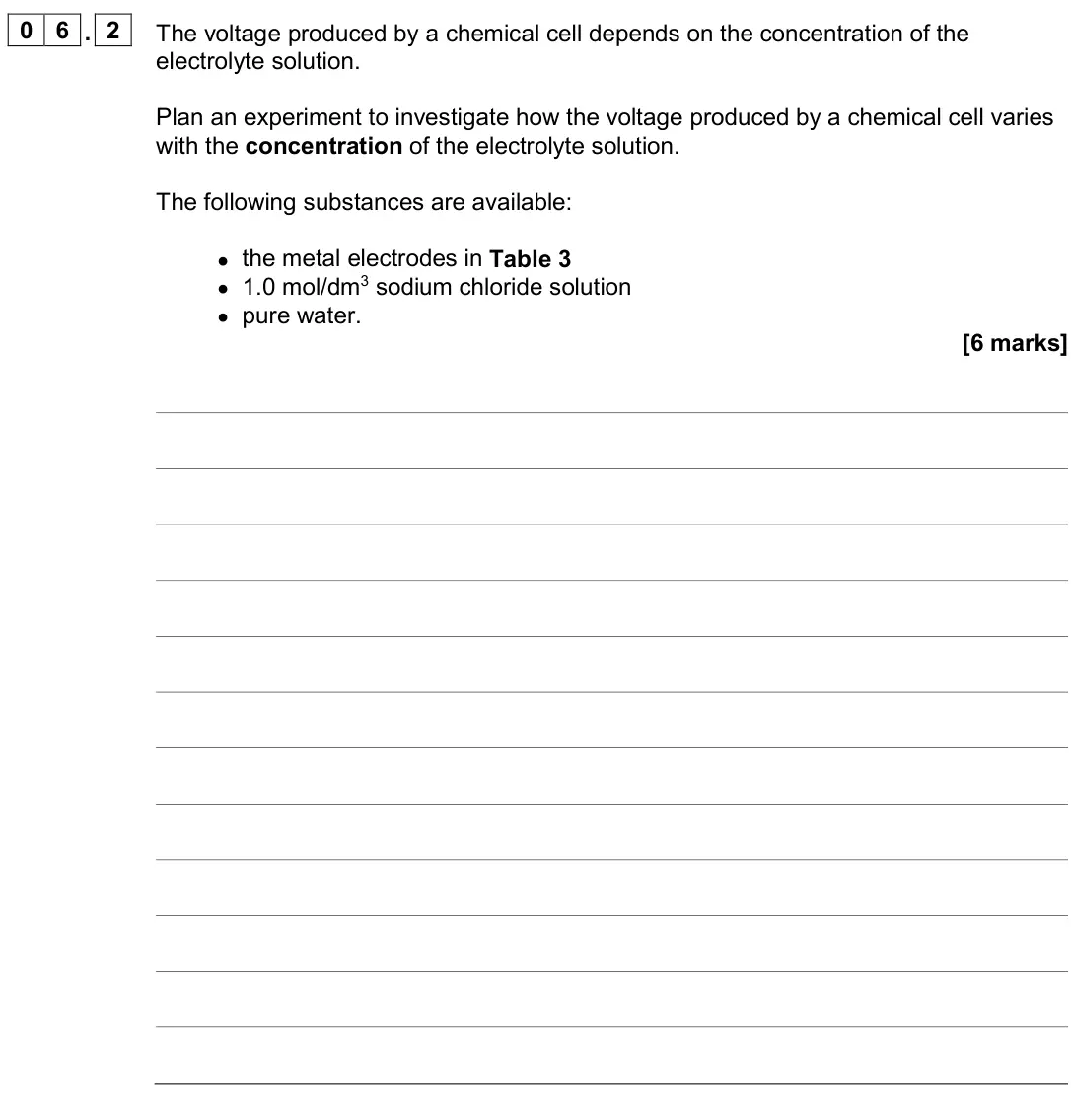
Q09.4
The whole paper ↗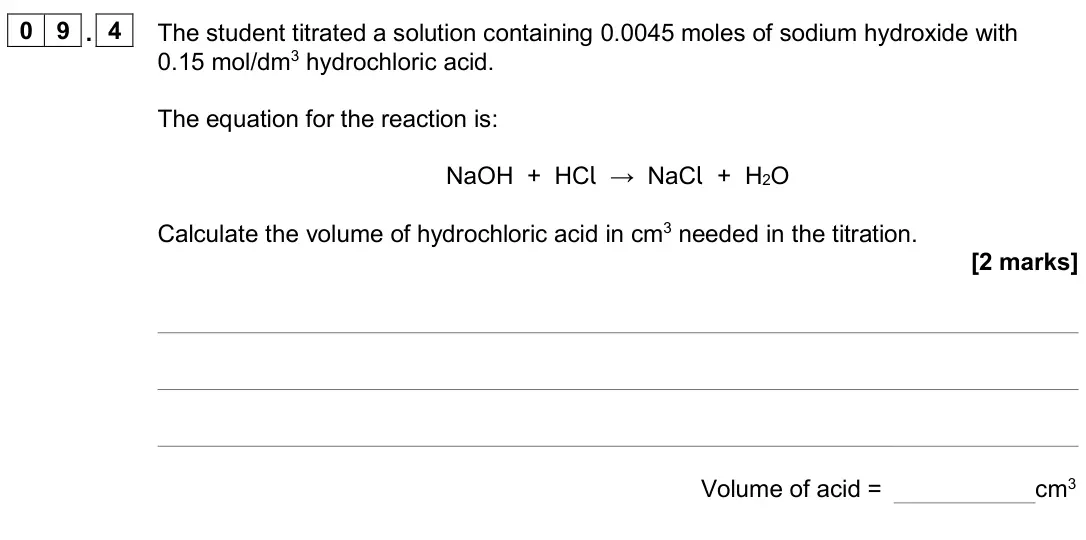
Q09.4
The whole paper ↗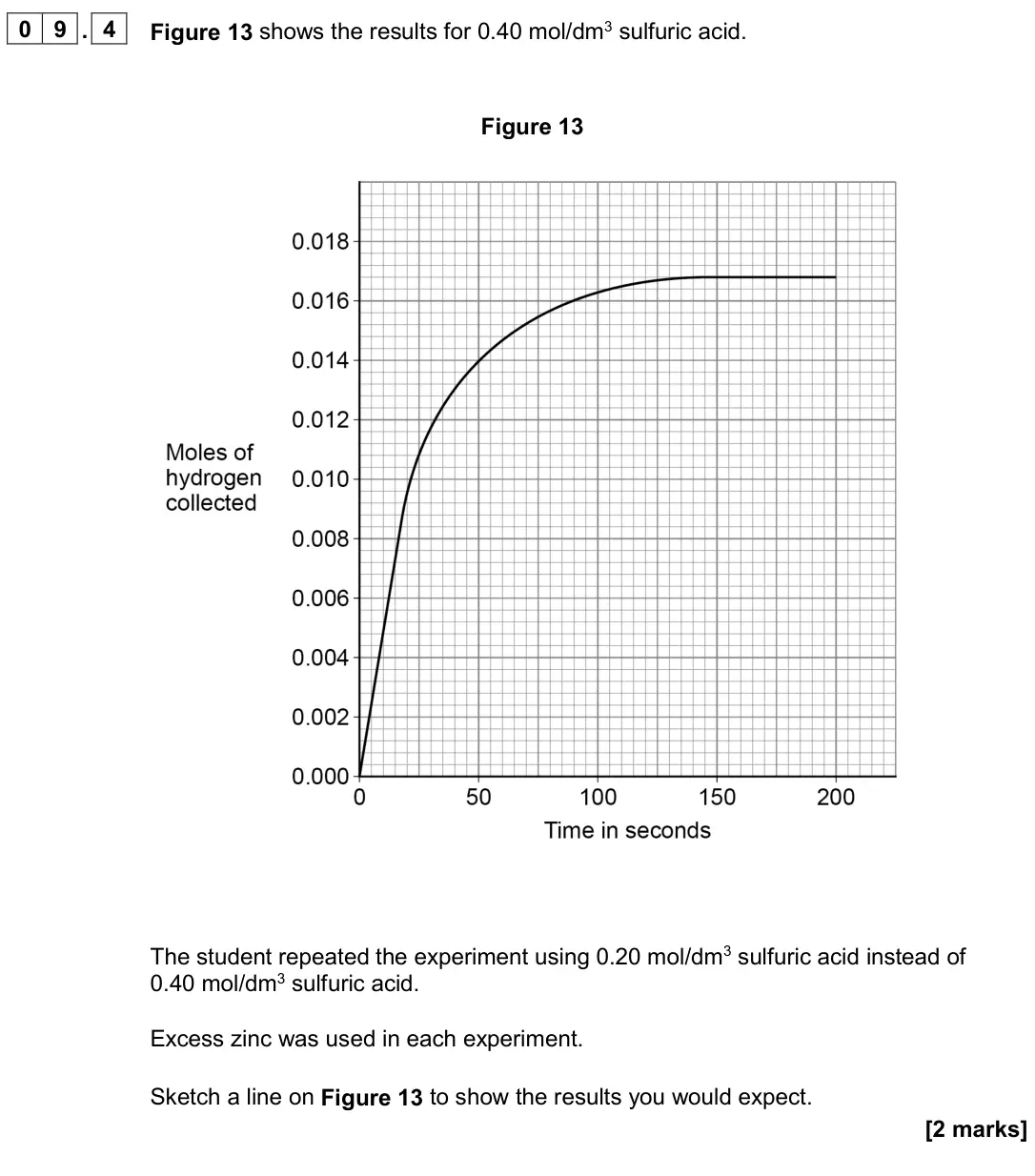
Q05.5
The whole paper ↗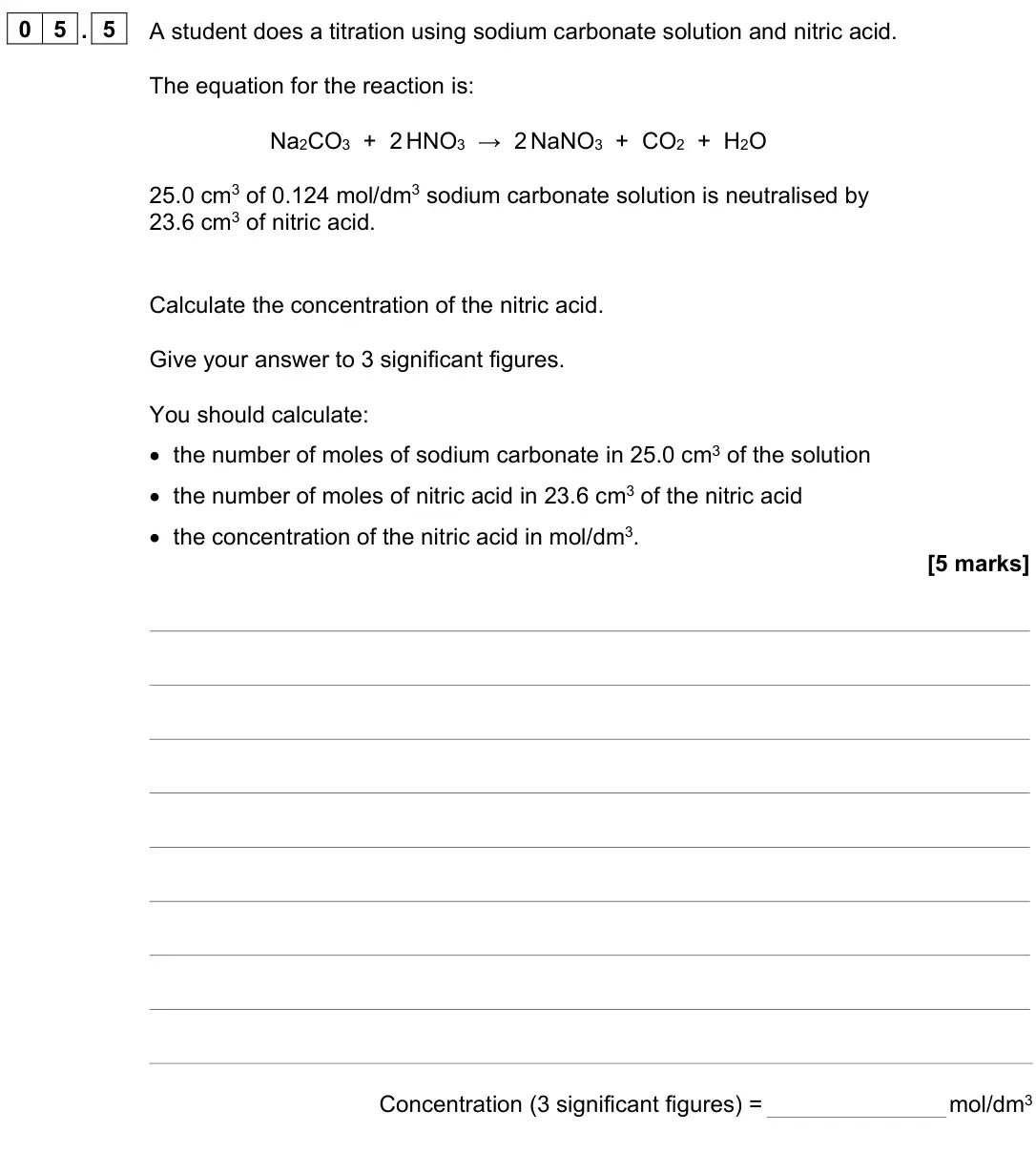
Q07.4
The whole paper ↗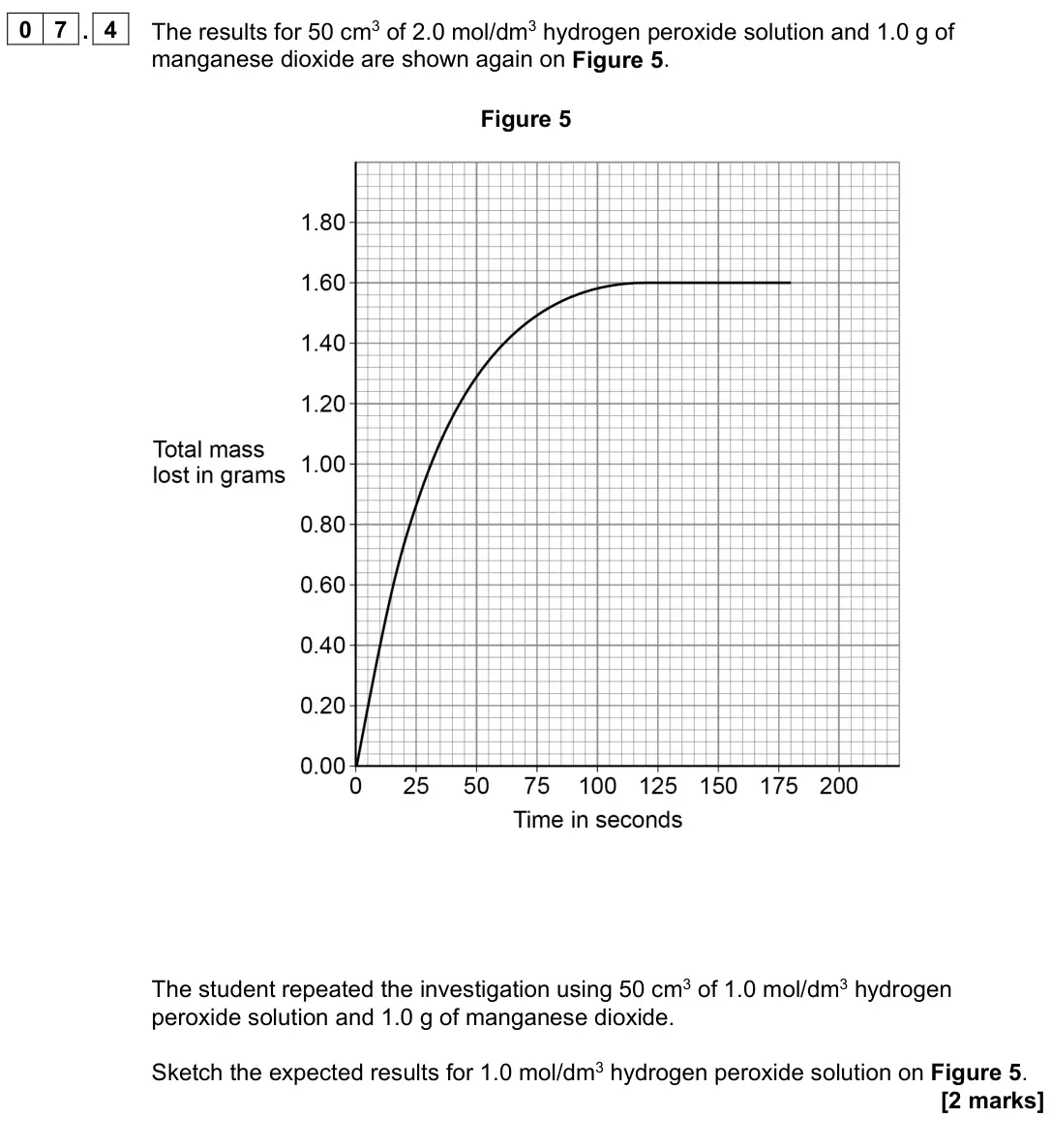
Q08.3
The whole paper ↗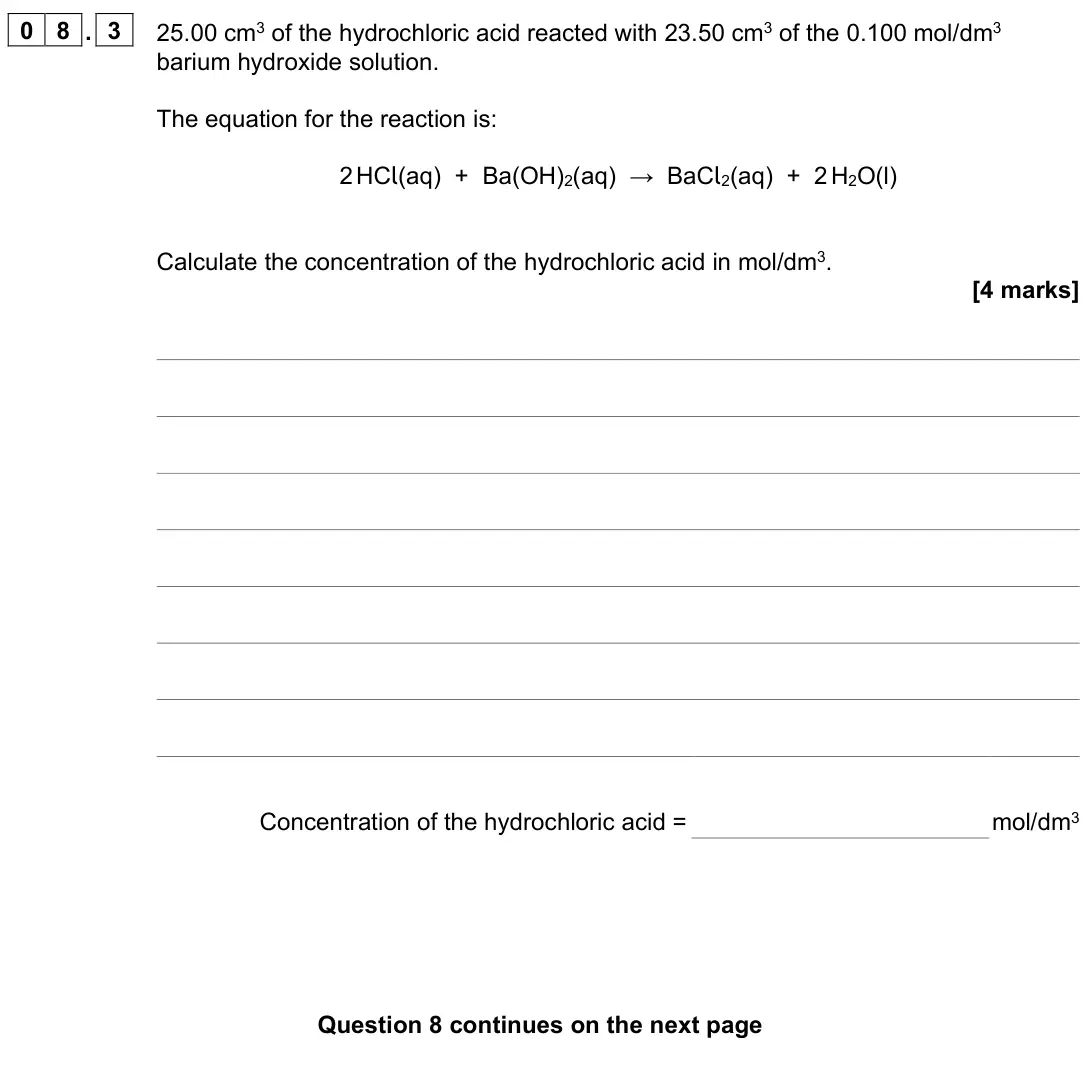
Q09.4
The whole paper ↗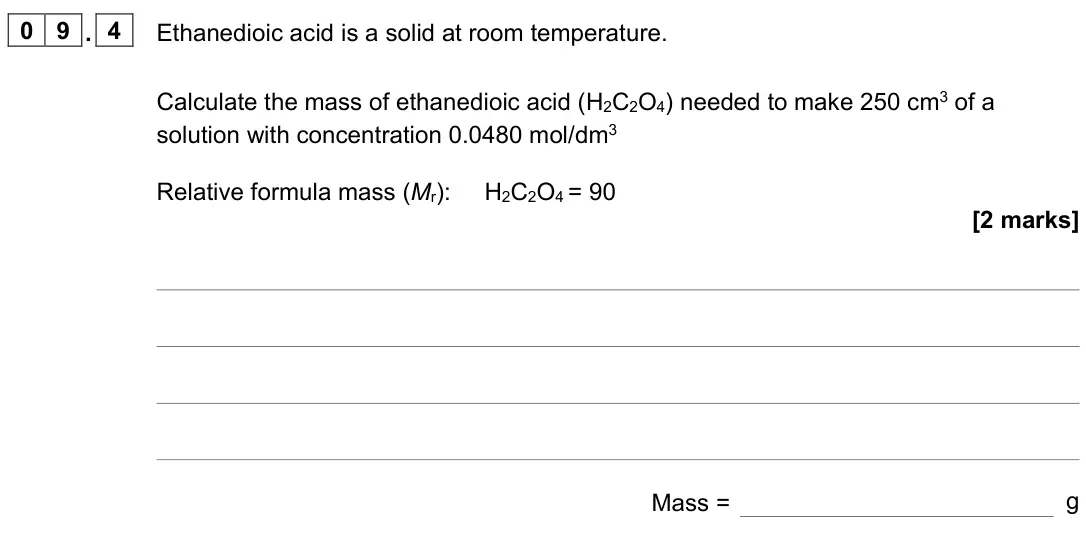
Q09.5
The whole paper ↗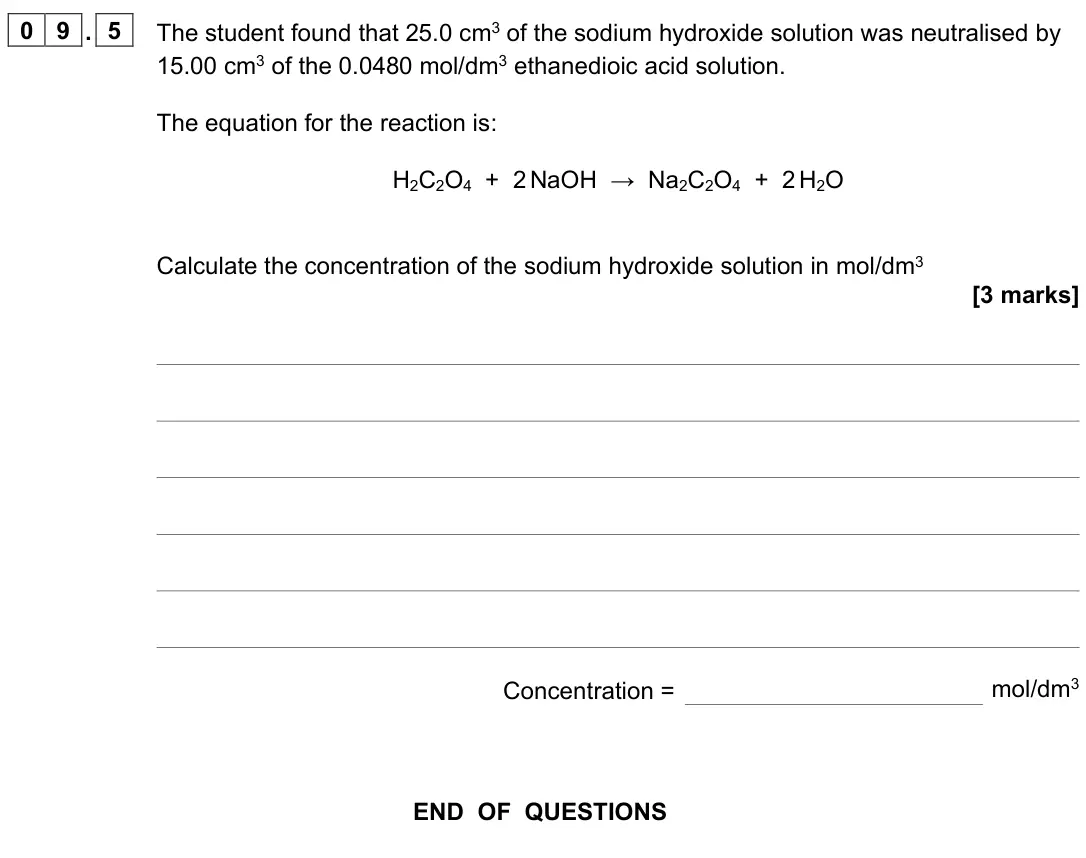
Q09.4
The whole paper ↗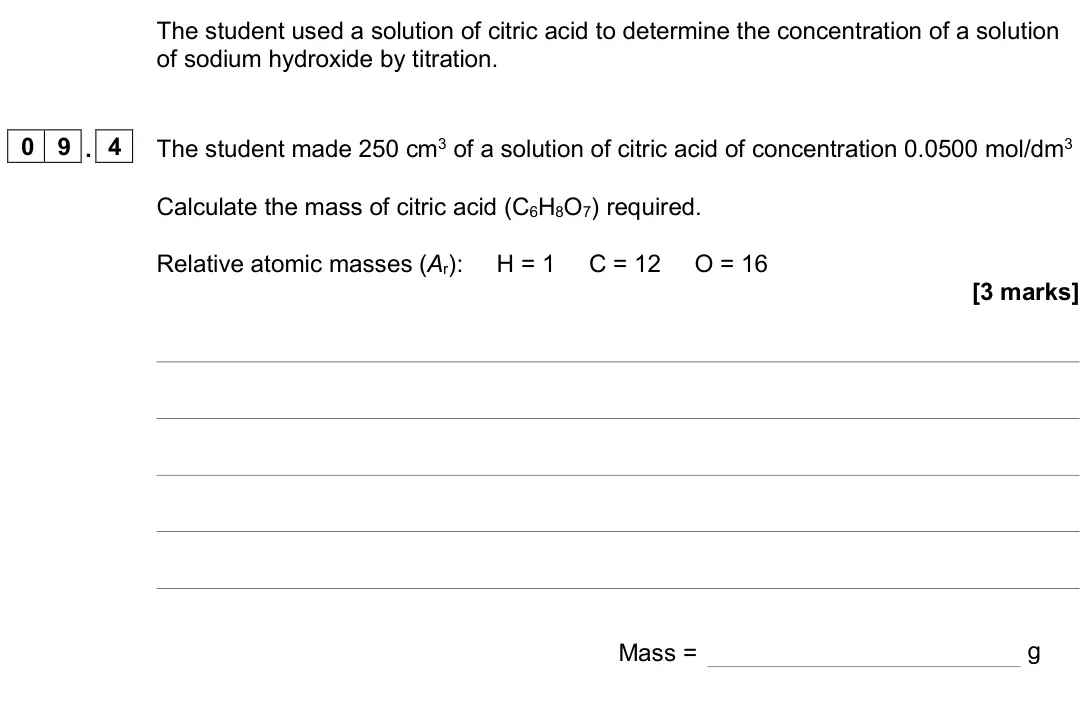
Q09.7
The whole paper ↗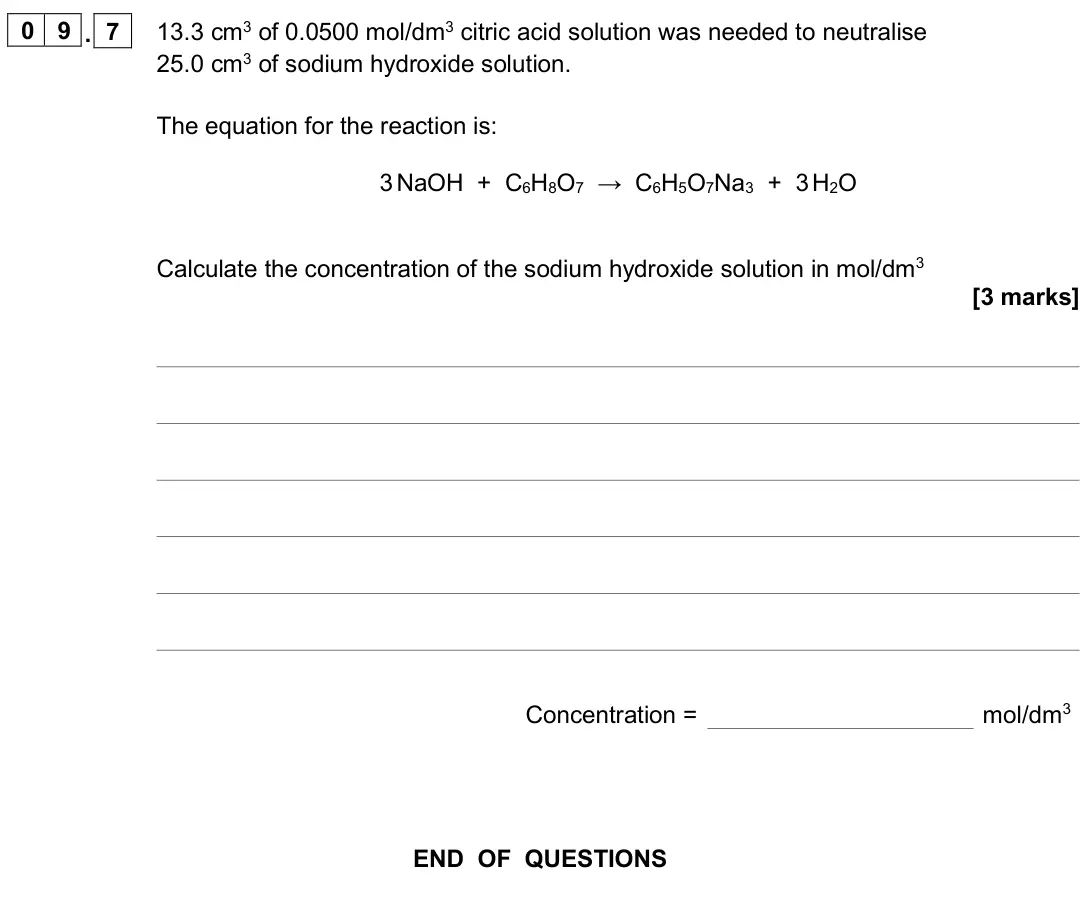
Q09.5
The whole paper ↗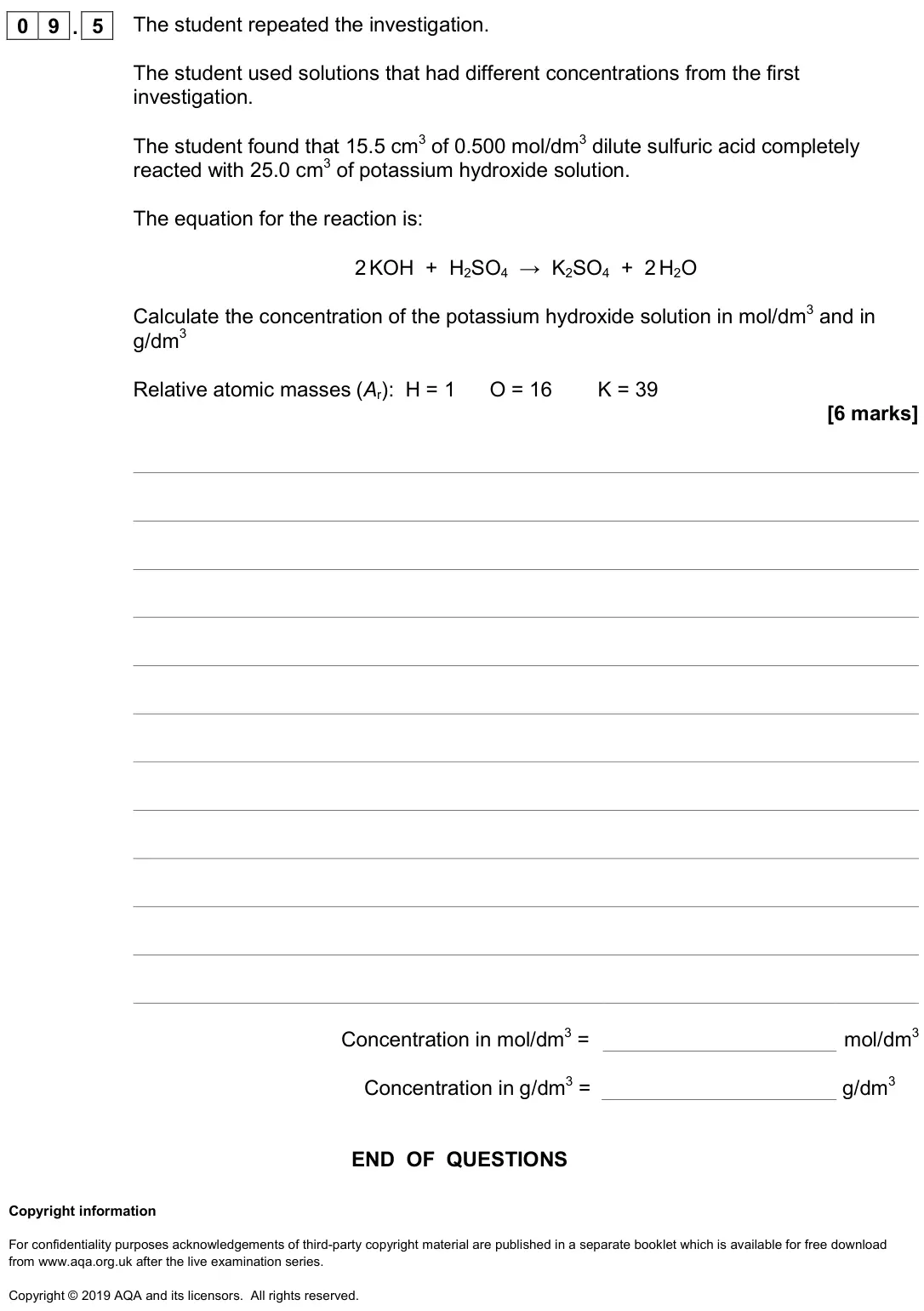
Q09.1
The whole paper ↗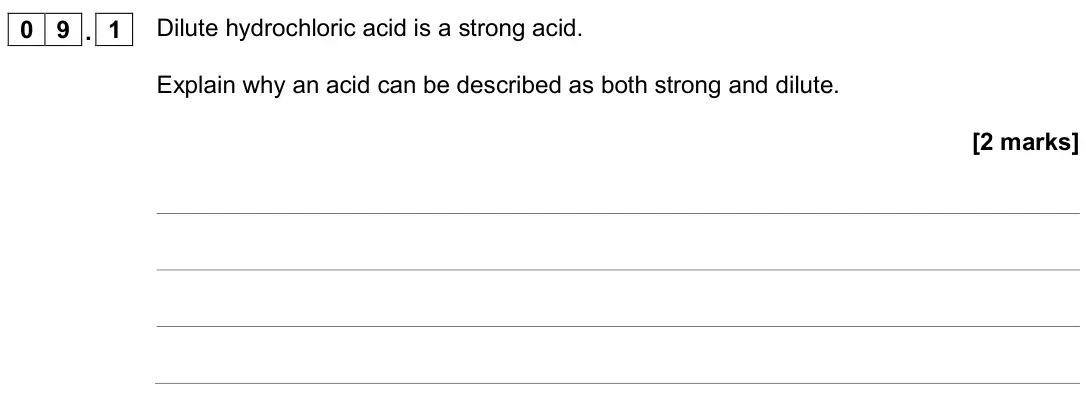
Q09.3
The whole paper ↗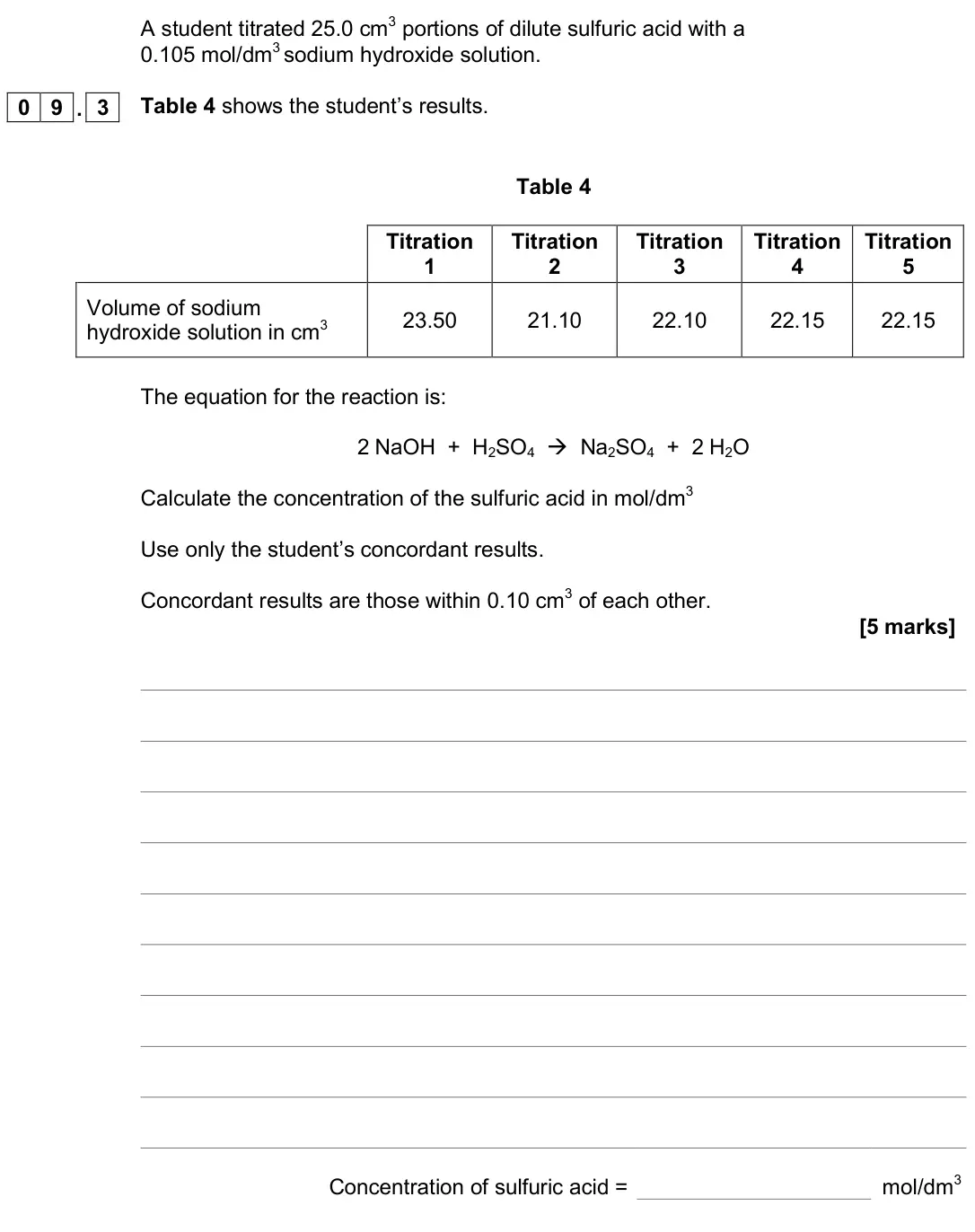
Q09.5
The whole paper ↗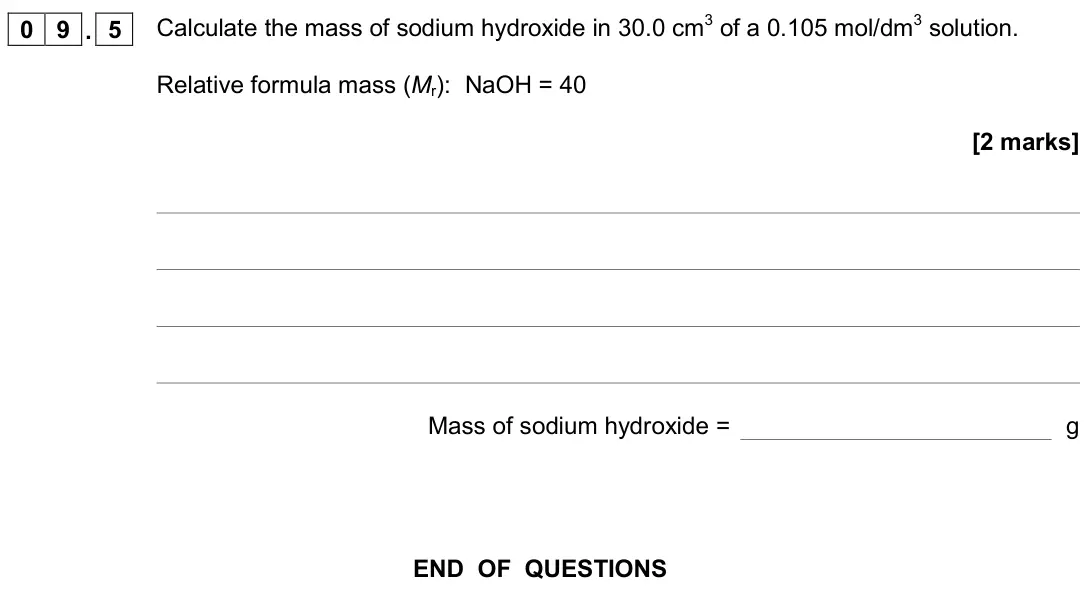
Q08.3
The whole paper ↗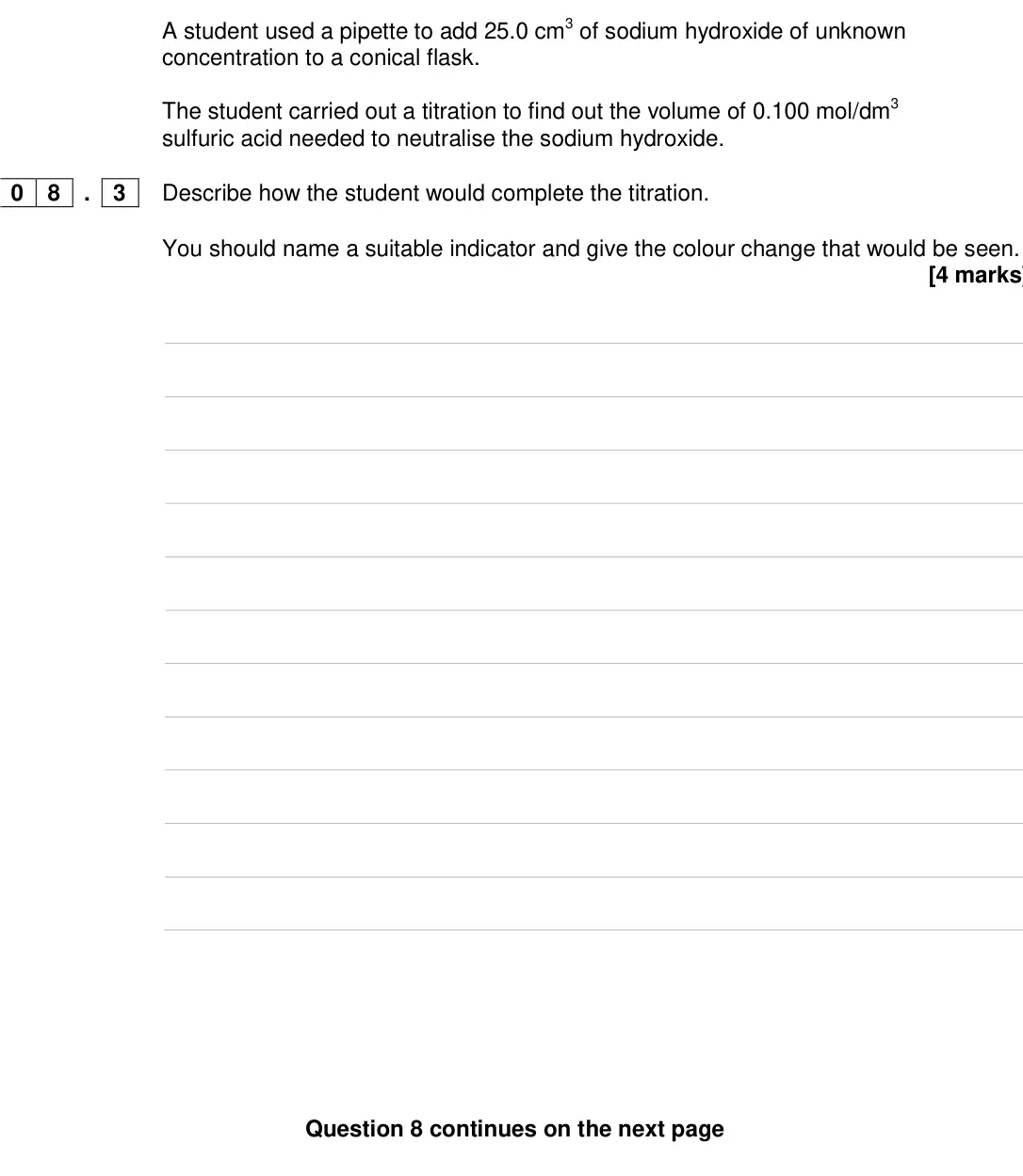
Q08.5
The whole paper ↗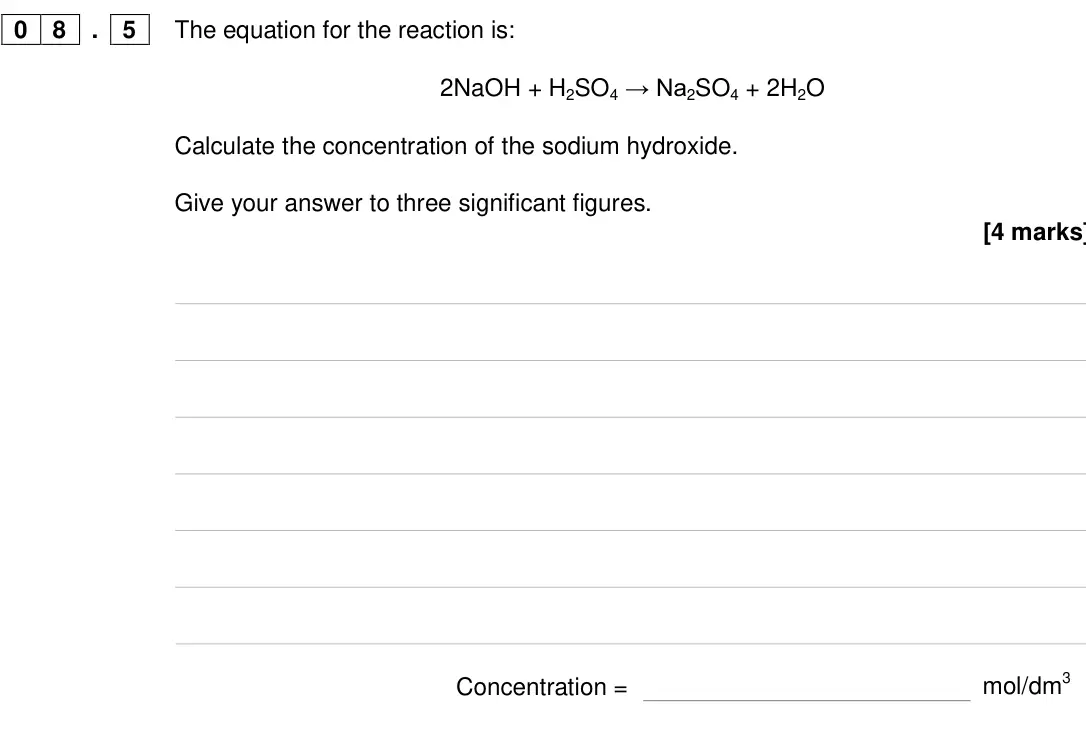
All 17 questions on Using concentrations of solutions in mol/dm3, as a list
- June 2024, Paper 1 Higher, Q06.2 (6 marks): The voltage produced by a chemical cell depends on the concentration of the electrolyte solution. Plan an experiment to investigate how the voltage produced by
- June 2024, Paper 1 Higher, Q09.4 (2 marks): The student titrated a solution containing 0.0045 moles of sodium hydroxide with 0.15 mol/dm3 hydrochloric acid. The equation for the reaction is: NaOH + HCl →
- June 2024, Paper 2 Higher, Q09.4 (2 marks): Figure 13 shows the results for 0.40 mol/dm3 sulfuric acid. Figure 13 The student repeated the experiment using 0.20 mol/dm3 sulfuric acid instead of 0.40 mol/d
- June 2023, Paper 1 Higher, Q05.5 (5 marks): A student does a titration using sodium carbonate solution and nitric acid. The equation for the reaction is: Na2CO3 + 2 HNO3 → 2 NaNO3 + CO2 + H2O 25.0 cm3 of
- June 2023, Paper 2 Higher, Q07.4 (2 marks): The results for 50 cm3 of 2.0 mol/dm3 hydrogen peroxide solution and 1.0 g of manganese dioxide are shown again on Figure 5. Figure 5 The student repeated the i
- June 2022, Paper 1 Higher, Q08.3 (4 marks): 25.00 cm3 of the hydrochloric acid reacted with 23.50 cm3 of the 0.100 mol/dm3 barium hydroxide solution. The equation for the reaction is: 2 HCl(aq) + Ba(OH)2(
- November 2021, Paper 1 Higher, Q09.4 (2 marks): Ethanedioic acid is a solid at room temperature. Calculate the mass of ethanedioic acid (H2C2O4) needed to make 250 cm3 of a solution with concentration 0.0480
- November 2021, Paper 1 Higher, Q09.5 (3 marks): The student found that 25.0 cm3 of the sodium hydroxide solution was neutralised by 15.00 cm3 of the 0.0480 mol/dm3 ethanedioic acid solution. The equation for
- November 2020, Paper 1 Higher, Q09.4 (3 marks): The student made 250 cm3 of a solution of citric acid of concentration 0.0500 mol/dm3 Calculate the mass of citric acid (C6H8O7) required. Relative atomic masse
- November 2020, Paper 1 Higher, Q09.7 (3 marks): 13.3 cm3 of 0.0500 mol/dm3 citric acid solution was needed to neutralise 25.0 cm3 of sodium hydroxide solution. The equation for the reaction is: 3 NaOH + C6H8O
- June 2019, Paper 1 Higher, Q09.5 (6 marks): The student repeated the investigation. The student used solutions that had different concentrations from the first investigation. The student found that 15.5 c
- June 2018, Paper 1 Higher, Q09.1 (2 marks): Dilute hydrochloric acid is a strong acid. Explain why an acid can be described as both strong and dilute. [2 marks]
- June 2018, Paper 1 Higher, Q09.3 (5 marks): Table 4 shows the student’s results. Table 4 Titration 1 Titration 2 Titration 3 Titration 4 Titration 5 Volume of sodium hydroxide solution in cm3 23.50 21.10
- June 2018, Paper 1 Higher, Q09.5 (2 marks): Calculate the mass of sodium hydroxide in 30.0 cm3 of a 0.105 mol/dm3 solution. Relative formula mass (Mr): NaOH = 40 [2 marks] Mass of sodium hydroxide = g
- Specimen, Paper 1 Higher, Q08.3 (4 marks): Describe how the student would complete the titration. You should name a suitable indicator and give the colour change that would be seen. [4 marks 8
- Specimen, Paper 1 Higher, Q08.5 (4 marks): The equation for the reaction is: 2NaOH + H2SO4 → Na2SO4 + 2H2O Calculate the concentration of the sodium hydroxide. Give your answer to three significant figur
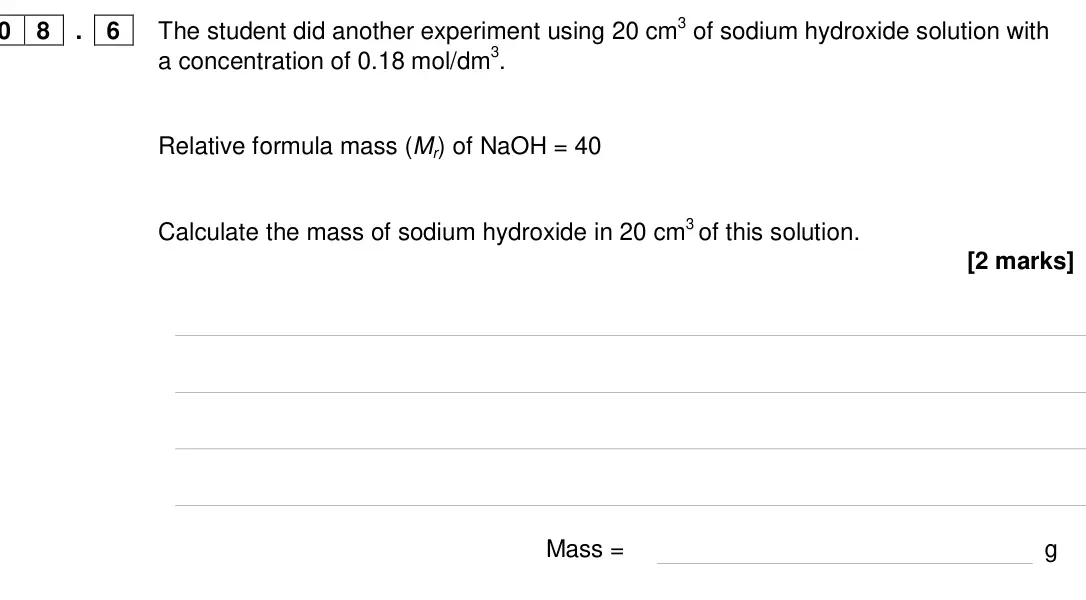
- Specimen, Paper 1 Higher, Q08.6 (2 marks): The student did another experiment using 20 cm3 of sodium hydroxide solution with a concentration of 0.18 mol/dm3. Relative formula mass (Mr) of NaOH = 40 Calcu
Questions, mark schemes and examiner’s reports are © AQA, from their published past papers. Plumi isn’t affiliated with any exam board. Want whole papers? Every AQA GCSE Chemistry paper.
Rather write your answers by hand on iPad? Plumi marks them against the same mark schemes.