 plumi
The periodic table: AQA GCSE Chemistry questions
Every AQA GCSE Chemistry exam question on 4.1.2 The periodic table, 2018–2025, with its mark scheme and examiner’s report.
Find questions1,744
Calculations
Q01.1
The whole paper ↗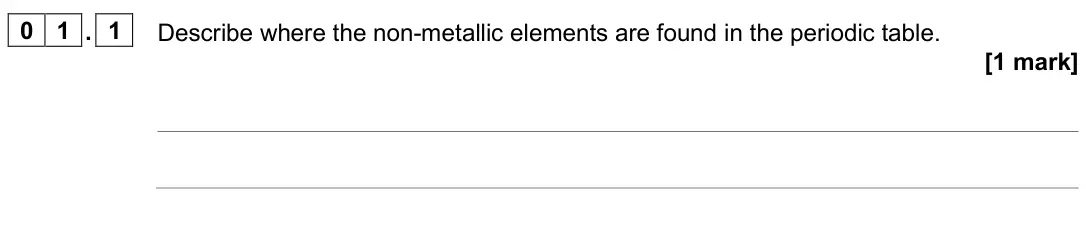
Q01.2
The whole paper ↗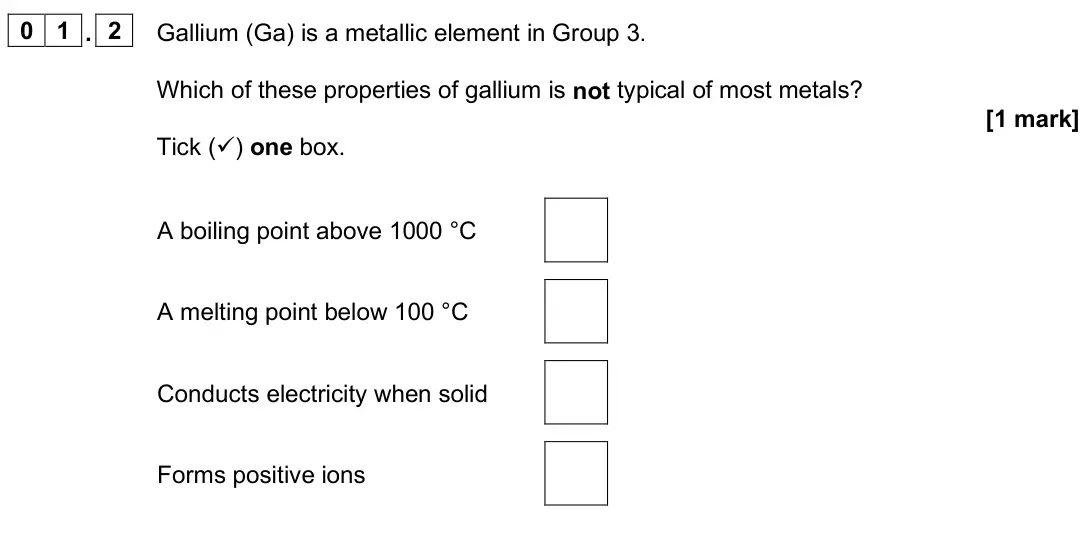
Q01.4
The whole paper ↗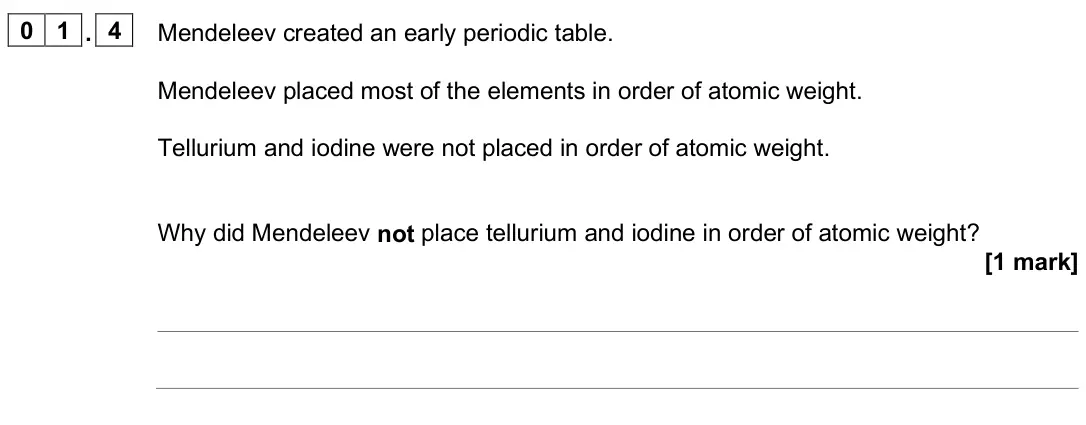
Q01.5
The whole paper ↗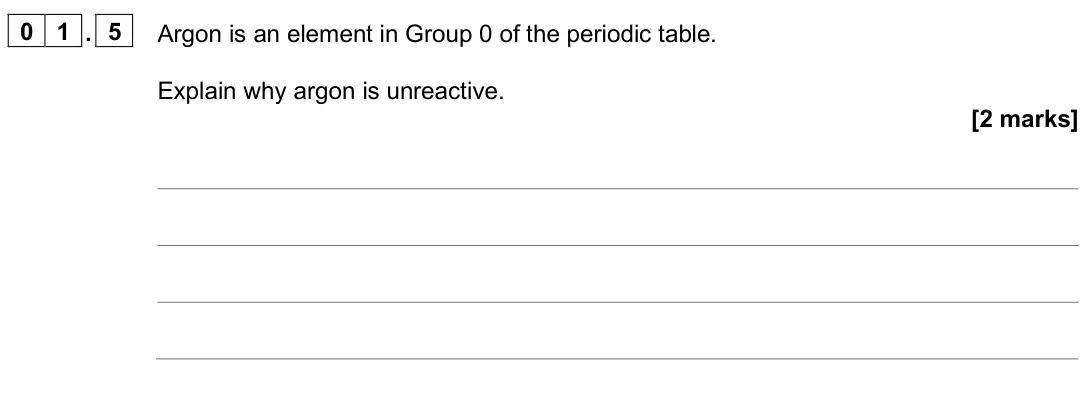
Q03.4
The whole paper ↗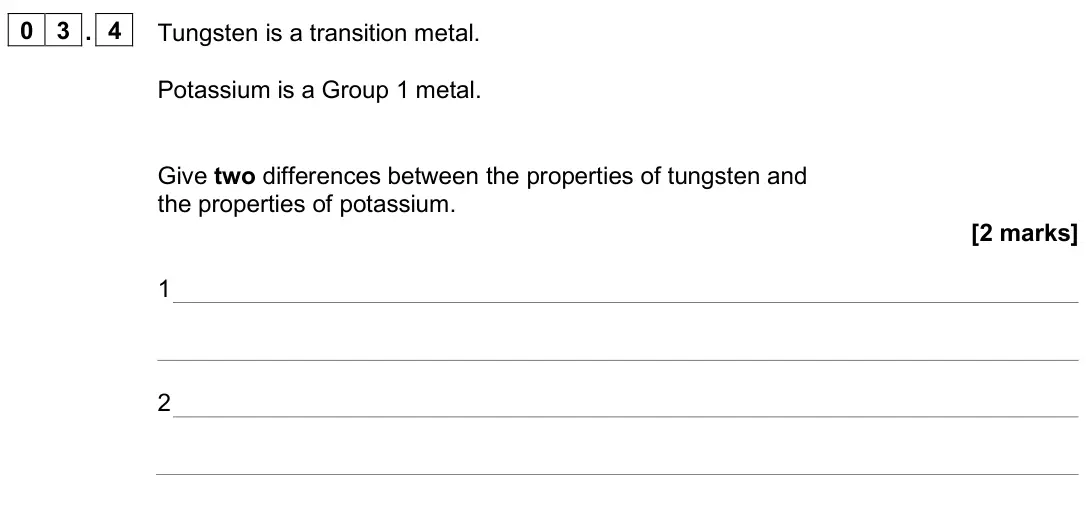
Q04.1
The whole paper ↗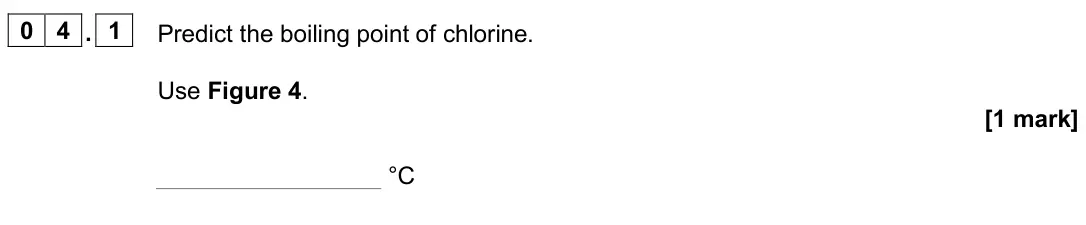
Q04.2
The whole paper ↗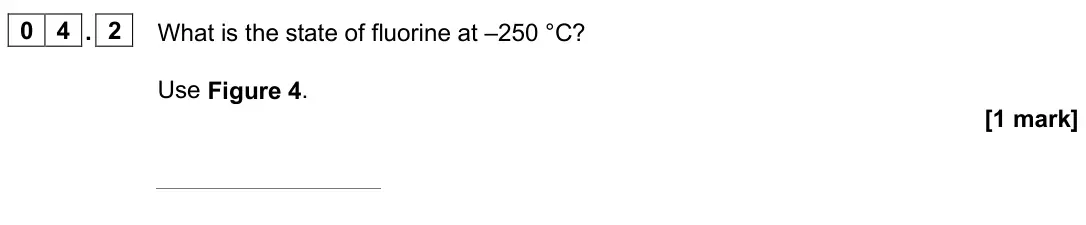
Q04.4
The whole paper ↗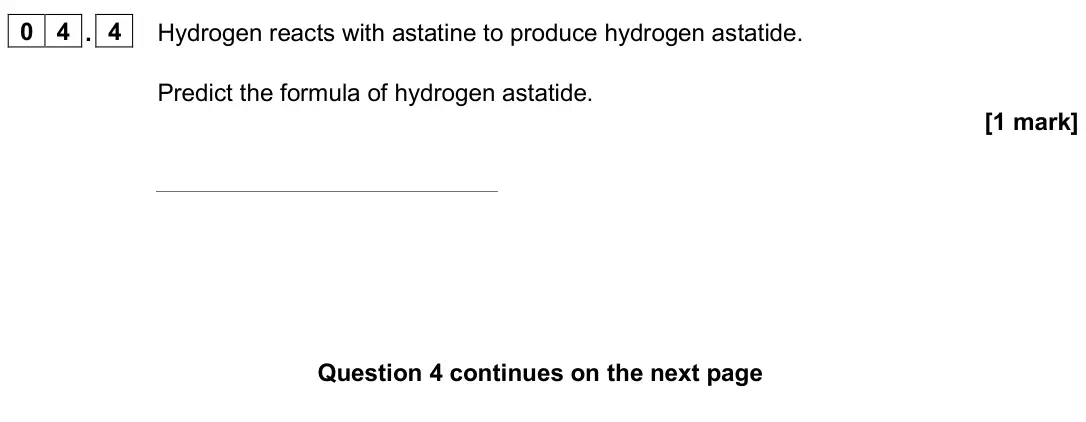
Q04.5
The whole paper ↗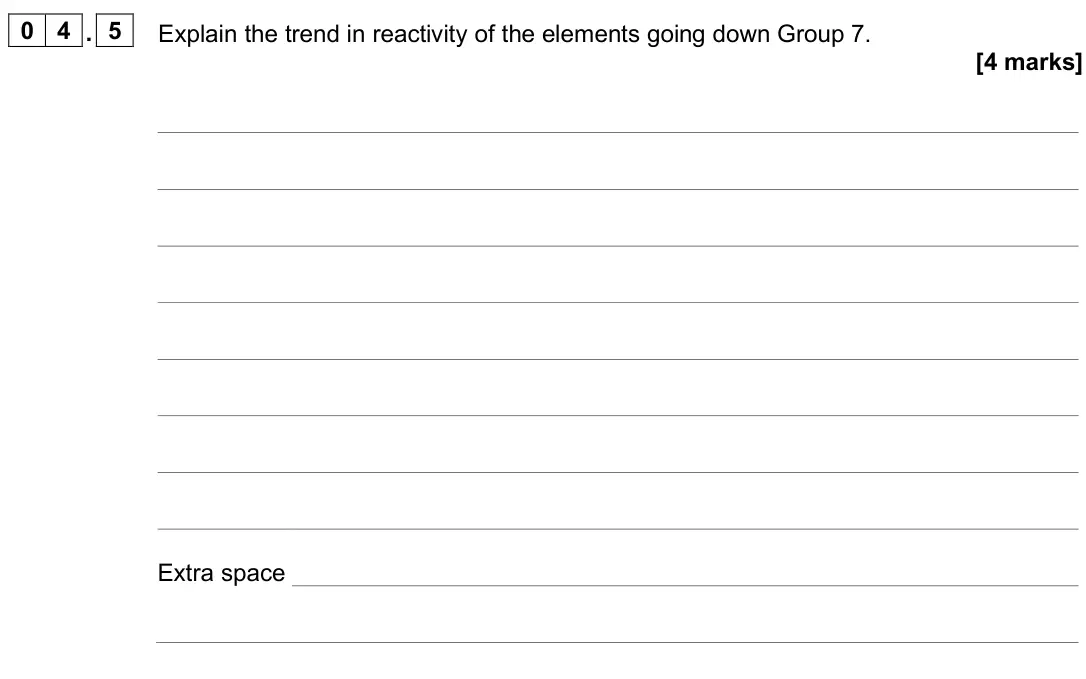
Q04.6
The whole paper ↗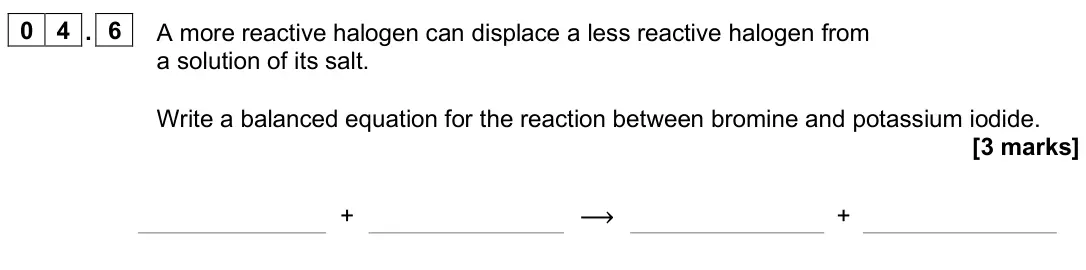
Q08.1
The whole paper ↗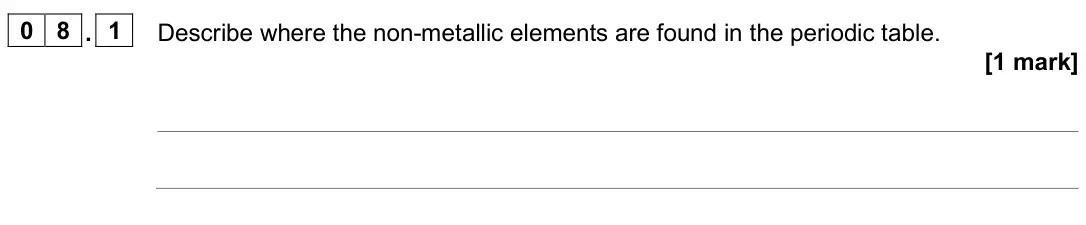
Q08.2
The whole paper ↗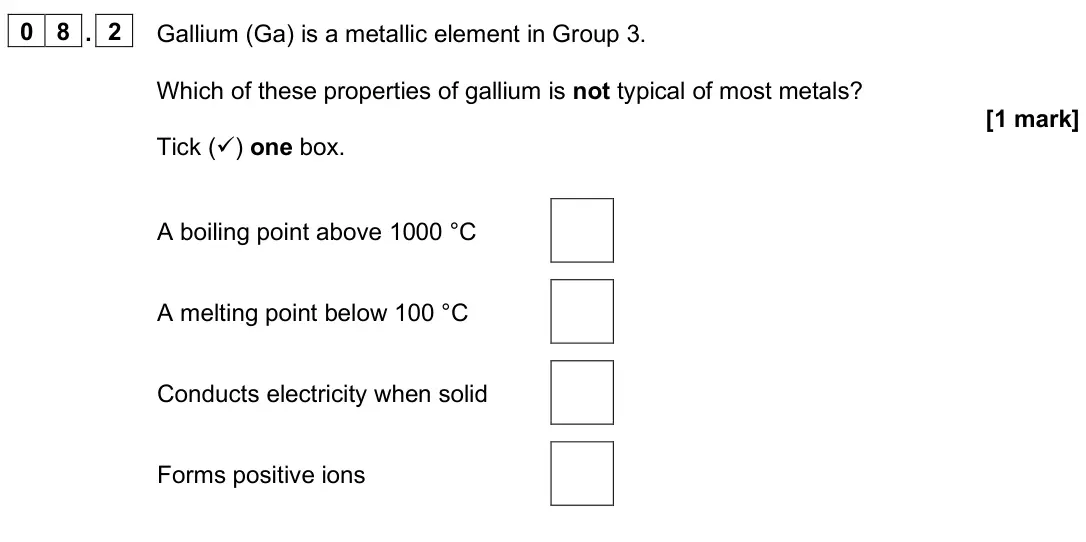
Q08.4
The whole paper ↗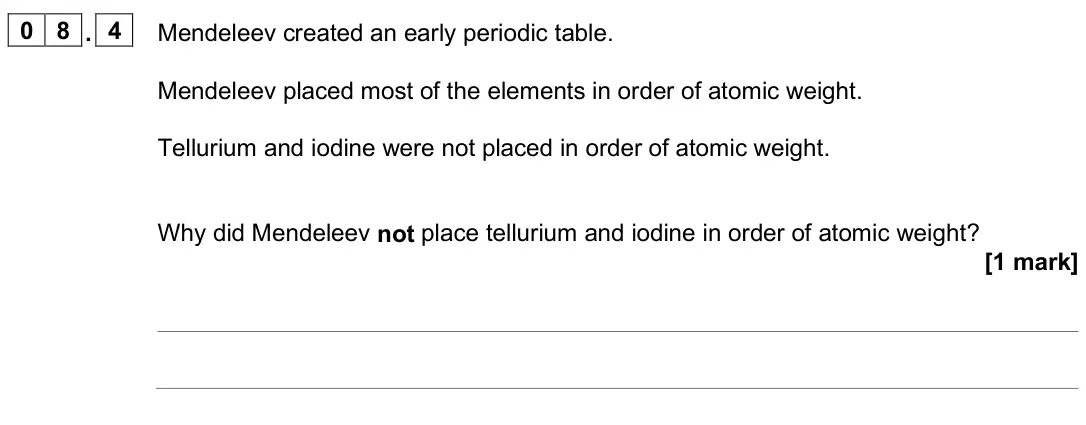
Q08.5
The whole paper ↗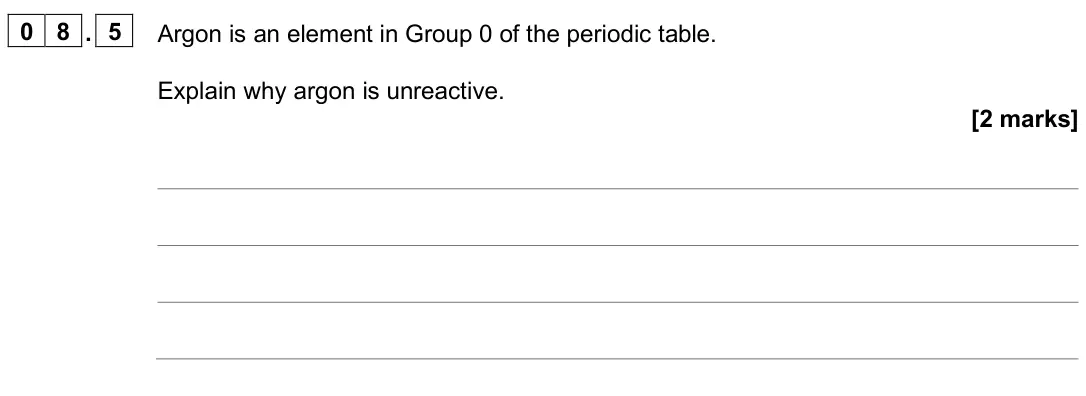
Q10.4
The whole paper ↗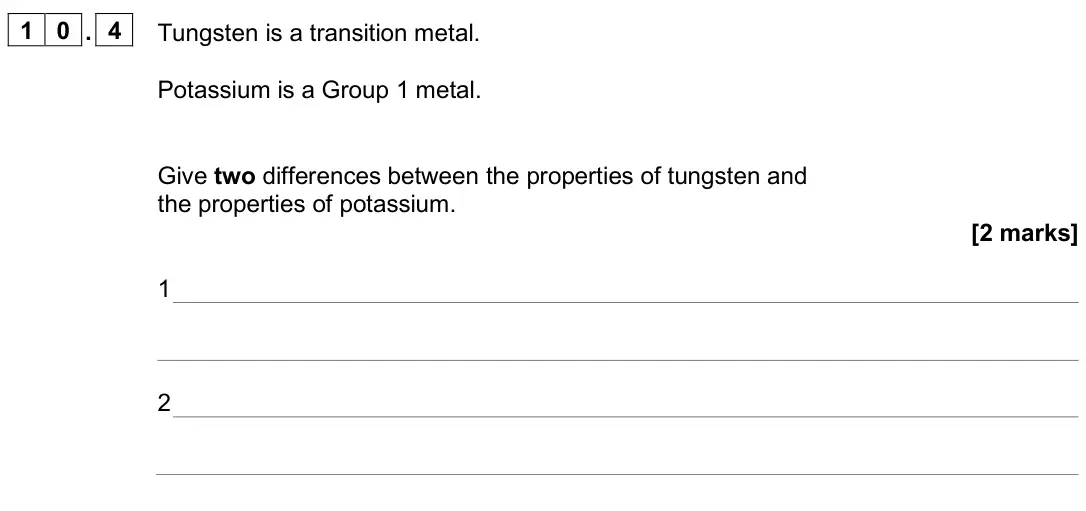
Q02.1
The whole paper ↗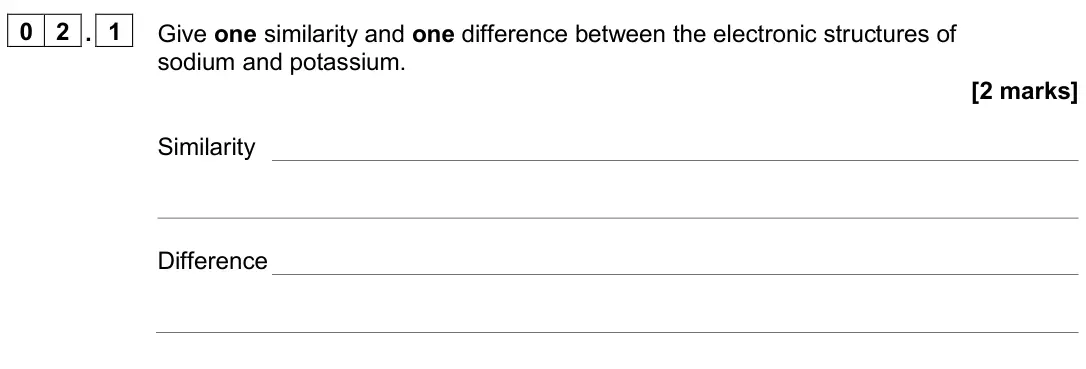
Q02.2
The whole paper ↗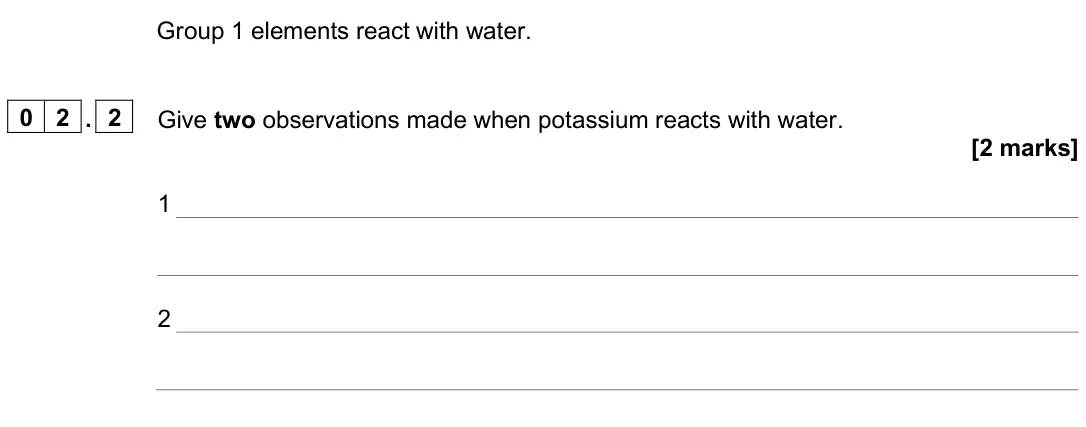
Q02.3
The whole paper ↗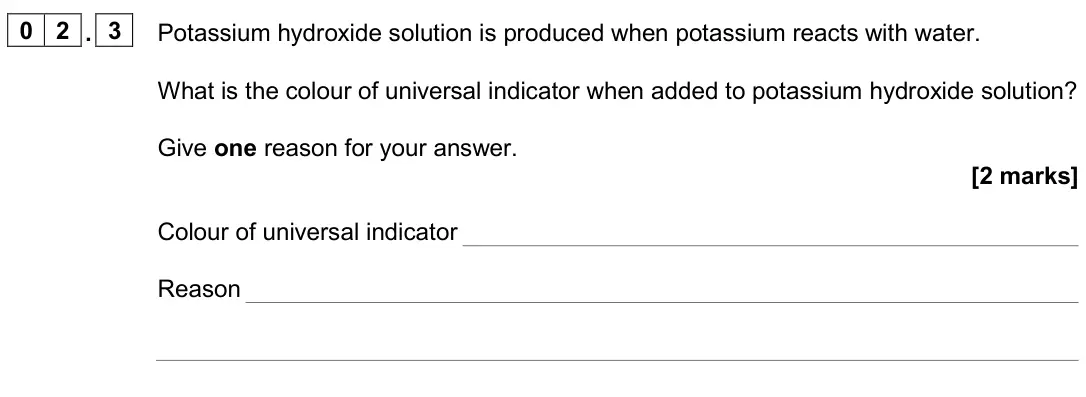
Q02.4
The whole paper ↗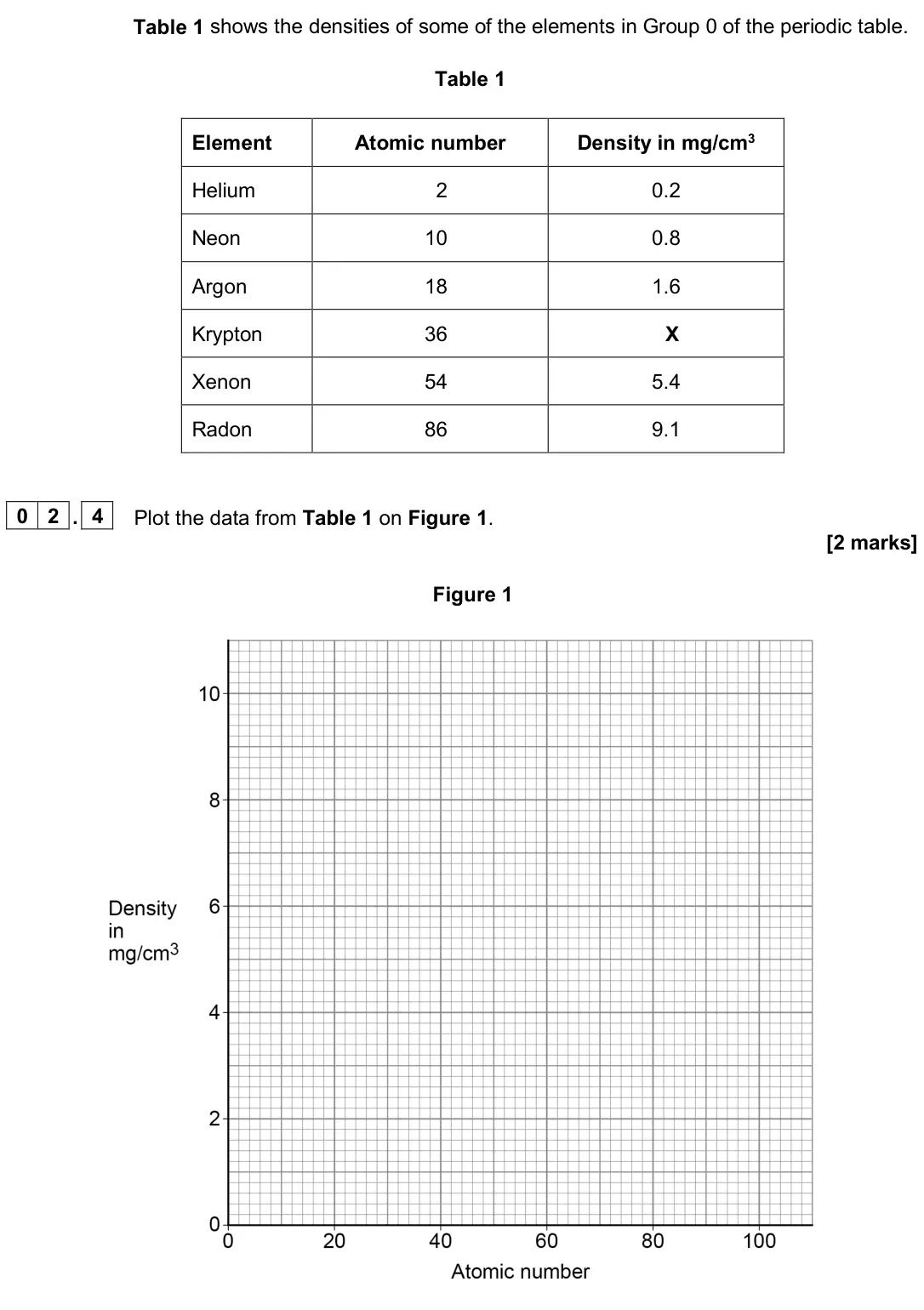
All 123 questions on The periodic table, as a list
- June 2025, Paper 1 Higher, Q01.1 (1 mark): Describe where the non-metallic elements are found in the periodic table. [1 mark]
- June 2025, Paper 1 Higher, Q01.2 (1 mark): Gallium (Ga) is a metallic element in Group 3. Which of these properties of gallium is not typical of most metals? [1 mark] Tick () one box. A boiling point ab
- June 2025, Paper 1 Higher, Q01.4 (1 mark): Mendeleev created an early periodic table. Mendeleev placed most of the elements in order of atomic weight. Tellurium and iodine were not placed in order of ato
- June 2025, Paper 1 Higher, Q01.5 (2 marks): Argon is an element in Group 0 of the periodic table. Explain why argon is unreactive. [2 marks]
- June 2025, Paper 1 Higher, Q03.4 (2 marks): Tungsten is a transition metal. Potassium is a Group 1 metal. Give two differences between the properties of tungsten and the properties of potassium. [2 marks]
- June 2025, Paper 1 Higher, Q04.1 (1 mark): Predict the boiling point of chlorine. Use Figure 4. [1 mark] °C
- June 2025, Paper 1 Higher, Q04.2 (1 mark): What is the state of fluorine at –250 °C? Use Figure 4. [1 mark]
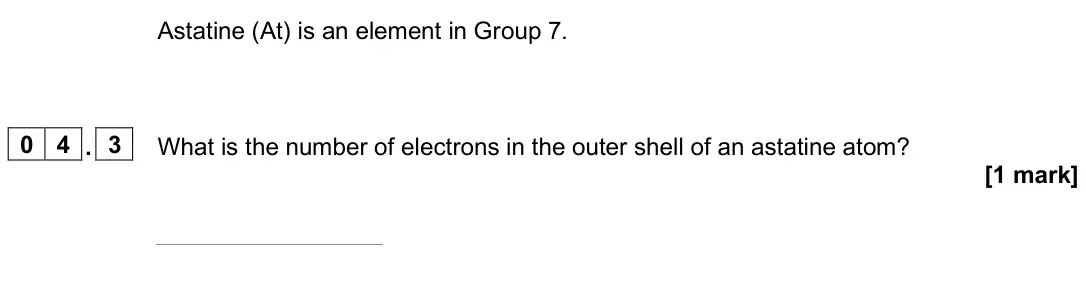
- June 2025, Paper 1 Higher, Q04.3 (1 mark): What is the number of electrons in the outer shell of an astatine atom? [1 mark]
- June 2025, Paper 1 Higher, Q04.4 (1 mark): Hydrogen reacts with astatine to produce hydrogen astatide. Predict the formula of hydrogen astatide. [1 mark]
- June 2025, Paper 1 Higher, Q04.5 (4 marks): Explain the trend in reactivity of the elements going down Group 7. [4 marks]
- June 2025, Paper 1 Higher, Q04.6 (3 marks): A more reactive halogen can displace a less reactive halogen from a solution of its salt. Write a balanced equation for the reaction between bromine and potassi
- June 2025, Paper 1 Foundation, Q08.1 (1 mark): Describe where the non-metallic elements are found in the periodic table. [1 mark]
- June 2025, Paper 1 Foundation, Q08.2 (1 mark): Gallium (Ga) is a metallic element in Group 3. Which of these properties of gallium is not typical of most metals? [1 mark] Tick () one box. A boiling point ab
- June 2025, Paper 1 Foundation, Q08.4 (1 mark): Mendeleev created an early periodic table. Mendeleev placed most of the elements in order of atomic weight. Tellurium and iodine were not placed in order of ato
- June 2025, Paper 1 Foundation, Q08.5 (2 marks): Argon is an element in Group 0 of the periodic table. Explain why argon is unreactive. [2 marks]
- June 2025, Paper 1 Foundation, Q10.4 (2 marks): Tungsten is a transition metal. Potassium is a Group 1 metal. Give two differences between the properties of tungsten and the properties of potassium. [2 marks]
- June 2024, Paper 1 Higher, Q02.1 (2 marks): Give one similarity and one difference between the electronic structures of sodium and potassium. [2 marks] Similarity Difference
- June 2024, Paper 1 Higher, Q02.2 (2 marks): Give two observations made when potassium reacts with water. [2 marks] 1 2
- June 2024, Paper 1 Higher, Q02.3 (2 marks): Potassium hydroxide solution is produced when potassium reacts with water. What is the colour of universal indicator when added to potassium hydroxide solution?
- June 2024, Paper 1 Higher, Q02.4 (2 marks): Plot the data from Table 1 on Figure 1. [2 marks] Figure 1
- June 2024, Paper 1 Higher, Q02.5 (1 mark): Estimate the density (X) of krypton. Use Figure 1 and Table 1. [1 mark] Density = mg/cm3
- June 2024, Paper 1 Higher, Q02.6 (1 mark): The elements in Group 7 are called the halogens. A more reactive halogen can displace a less reactive halogen from a solution of its salt. Which combination of
- June 2024, Paper 1 Higher, Q02.7 (1 mark): Which of the following describes the trends going down Group 7? [1 mark] Tick () one box. Relative molecular mass decreases and boiling point decreases. Relati
- June 2024, Paper 1 Higher, Q09.5 (3 marks): A calcium atom is larger than a magnesium atom. Explain why calcium reacts more vigorously than magnesium with hydrochloric acid of the same concentration. [3 m
- June 2024, Paper 1 Foundation, Q01.3 (1 mark): Elements are metals or non-metals. Figure 2 shows an outline of the periodic table. The periodic table is divided into sections. Figure 2 Where are metals found
- June 2024, Paper 1 Foundation, Q01.4 (2 marks): Which two of the following are typical properties of a transition metal? [2 marks] Tick () two boxes. Can be bent and shaped Good conductor of electricity Low
- June 2024, Paper 1 Foundation, Q01.5 (2 marks): Potassium and chlorine react to produce potassium chloride. An atom of potassium loses an electron to form a potassium ion. An atom of chlorine gains an electro
- June 2024, Paper 1 Foundation, Q09.1 (2 marks): Give one similarity and one difference between the electronic structures of sodium and potassium. [2 marks] Similarity Difference
- June 2024, Paper 1 Foundation, Q09.2 (2 marks): Give two observations made when potassium reacts with water. [2 marks] 1 2
- June 2024, Paper 1 Foundation, Q09.3 (2 marks): Potassium hydroxide solution is produced when potassium reacts with water. What is the colour of universal indicator when added to potassium hydroxide solution?
- June 2024, Paper 1 Foundation, Q09.4 (2 marks): Plot the data from Table 4 on Figure 15. [2 marks] Figure 15
- June 2024, Paper 1 Foundation, Q09.5 (1 mark): Estimate the density (X) of krypton. Use Figure 15 and Table 4. [1 mark] Density = mg/cm3
- June 2024, Paper 1 Foundation, Q09.6 (1 mark): The elements in Group 7 are called the halogens. A more reactive halogen can displace a less reactive halogen from a solution of its salt. Which combination of
- June 2024, Paper 1 Foundation, Q09.7 (1 mark): Which of the following describes the trends going down Group 7? [1 mark] Tick () one box. Relative molecular mass decreases and boiling point decreases. Relati
- June 2023, Paper 1 Higher, Q01.3 (2 marks): Predict the number of outer shell electrons in an atom of tennessine. Give one reason for your answer. Use the periodic table. [2 marks] Number of outer shell e
- June 2023, Paper 1 Higher, Q01.4 (1 mark): Tennessine was first identified by a small group of scientists in 2010. Suggest one reason why tennessine was not accepted as a new element by other scientists
- June 2023, Paper 1 Higher, Q05.7 (1 mark): Which element has atoms that have the same electronic structure as the chloride ion? Use the periodic table. [1 mark]
- June 2023, Paper 1 Higher, Q08.1 (2 marks): Argon has the atomic number 18 Explain why argon does not form compounds. Answer in terms of electrons. [2 marks]
- June 2023, Paper 1 Higher, Q08.2 (1 mark): Phosphorus (P) is the element below nitrogen in the periodic table. Predict the formula of the compound formed between phosphorus and hydrogen. [1 mark] Formula
- June 2023, Paper 1 Higher, Q08.3 (2 marks): Tellurium is the element with atomic number 52 Predict whether tellurium reacts with metals. Explain your answer. Answer in terms of the position of tellurium i
- June 2023, Paper 1 Higher, Q08.4 (2 marks): Suggest two observations that could be made when barium reacts with hydrochloric acid. [2 marks] 1 2
- June 2023, Paper 1 Foundation, Q06.2 (2 marks): Figure 7 shows a piece of sodium being added to water. Figure 7 Give two observations that could be seen when sodium is added to water. [2 marks] 1 2
- June 2023, Paper 1 Foundation, Q09.3 (2 marks): Predict the number of outer shell electrons in an atom of tennessine. Give one reason for your answer. Use the periodic table. [2 marks] Number of outer shell e
- June 2023, Paper 1 Foundation, Q09.4 (1 mark): Tennessine was first identified by a small group of scientists in 2010. Suggest one reason why tennessine was not accepted as a new element by other scientists
- June 2022, Paper 1 Higher, Q01.1 (1 mark): Element Q is a dull solid with a melting point of 44 °C. Element Q does not conduct electricity. Which section of the periodic table in Figure 1 is most likely
- June 2022, Paper 1 Higher, Q05.1 (1 mark): Rubidium and potassium are added to water. Predict one observation you would see that shows that rubidium is more reactive than potassium. [1 mark]
- June 2022, Paper 1 Higher, Q05.2 (3 marks): Explain why rubidium is more reactive than potassium. [3 marks]
- June 2022, Paper 1 Higher, Q05.3 (3 marks): Complete the equation for the reaction of rubidium with water. You should balance the equation. [3 marks] Rb + H2O → +
- June 2022, Paper 1 Higher, Q05.4 (1 mark): Which is a correct statement about the noble gases? [1 mark] Tick () one box. The noble gases all have atoms with eight electrons in the outer shell. The noble
- June 2022, Paper 1 Foundation, Q04.1 (1 mark): The scientist left gaps in the periodic table in Figure 6. Each gap is represented by a question mark (?). Give one reason why the scientist left gaps in this p
- June 2022, Paper 1 Foundation, Q04.2 (1 mark): Which scientist published the periodic table in Figure 6? [1 mark] Tick () one box. Bohr Chadwick Mendeleev
- June 2022, Paper 1 Foundation, Q04.3 (1 mark): The modern periodic table is different from the periodic table in Figure 6. One extra group of elements has been added. What is the name of the extra group of e
- June 2022, Paper 1 Foundation, Q04.4 (1 mark): Why do the elements in Group 1 of the modern periodic table have similar chemical properties? [1 mark] Tick () one box. The elements all form negative ions. Th
- June 2022, Paper 1 Foundation, Q04.5 (1 mark): Table 3 shows the melting points of the first five elements going down Group 1. Table 3 Element Melting point in °C Lithium 181 Sodium 98 Potassium X Rubidium 3
- June 2022, Paper 1 Foundation, Q04.6 (1 mark): Give one observation you would see when a small piece of potassium is added to water. [1 mark]
- June 2022, Paper 1 Foundation, Q04.7 (2 marks): Table 4 shows information about the first five elements going down Group 7. Table 4 Element State at 150 °C Symbol Formula of the compound with hydrogen Fluorin
- June 2022, Paper 1 Foundation, Q04.8 (1 mark): The elements in Group 7 consist of molecules. What is the formula of a molecule of bromine? [1 mark] Tick () one box. Br Br2 Br2 2Br
- June 2022, Paper 1 Foundation, Q09.1 (1 mark): Element Q is a dull solid with a melting point of 44 °C. Element Q does not conduct electricity. Which section of the periodic table in Figure 15 is most likely
- November 2021, Paper 1 Higher, Q02.5 (2 marks): Gallium was discovered six years after Mendeleev published his periodic table. Give two reasons why the discovery of gallium helped Mendeleev’s periodic table t
- November 2021, Paper 1 Higher, Q04.1 (2 marks): Give two observations you could make when a small piece of potassium is added to water. [2 marks] 1 2
- November 2021, Paper 1 Higher, Q04.2 (2 marks): Complete the equation for the reaction of potassium with water. You should balance the equation. [2 marks] K + H2O → +
- November 2021, Paper 1 Higher, Q04.3 (4 marks): Explain why the reactivity of elements changes going down Group 1. [4 marks]
- November 2021, Paper 1 Foundation, Q01.1 (1 mark): Substance A contains only one type of atom. Substance A does not conduct electricity. Which type of substance is A? [1 mark] Tick () one box. Compound Metallic
- November 2021, Paper 1 Foundation, Q01.3 (1 mark): What is the name of the elements in Group 0 of the periodic table? [1 mark] Tick () one box. Alkali metals Halogens Noble gases Transition metals
- November 2021, Paper 1 Foundation, Q01.4 (1 mark): Which statement about the elements in Group 0 is correct? [1 mark] Tick () one box. All elements in the group are very reactive. All elements in the group form
- November 2021, Paper 1 Foundation, Q01.5 (1 mark): Neon is in Group 0. What type of particles are in a sample of neon? [1 mark] Tick () one box. Atoms Ions Molecules
- November 2021, Paper 1 Foundation, Q03.2 (1 mark): Why do Group 1 elements have similar chemical properties? [1 mark] Tick () one box. They have the same number of electron shells. They have the same number of
- November 2021, Paper 1 Foundation, Q03.4 (2 marks): Give two observations you could make when sodium reacts with water. Write your answers in Table 3. [2 marks]
- November 2021, Paper 1 Foundation, Q03.5 (1 mark): How does the reactivity of the elements change going down Group 1? [1 mark]
- November 2021, Paper 1 Foundation, Q03.6 (2 marks): Give two ways in which the observations in Table 3 show the change in reactivity going down Group 1. [2 marks] 1 2
- November 2021, Paper 1 Foundation, Q03.7 (1 mark): Which gas is produced when Group 1 elements react with water? [1 mark] Tick () one box. Carbon dioxide Hydrogen Nitrogen Oxygen
- November 2021, Paper 1 Foundation, Q09.5 (2 marks): Gallium was discovered six years after Mendeleev published his periodic table. Give two reasons why the discovery of gallium helped Mendeleev’s periodic table t
- November 2020, Paper 1 Higher, Q05.3 (2 marks): Mendeleev published his periodic table in 1869. Mendeleev arranged the elements in order of atomic weight. Mendeleev then reversed the order of some pairs of el
- November 2020, Paper 1 Higher, Q05.4 (1 mark): Give the correct reason why Mendeleev reversed the order of some pairs of elements. [1 mark]
- November 2020, Paper 1 Higher, Q08.2 (4 marks): Explain the trend in boiling points of the halogens shown in Table 5. [4 marks]
- November 2020, Paper 1 Higher, Q08.4 (1 mark): Give one reason why this experiment should be done in a fume cupboard. [1 mark]
- November 2020, Paper 1 Higher, Q08.5 (3 marks): Explain why the reactivity of the halogens decreases going down the group. [3 marks]
- November 2020, Paper 1 Higher, Q08.6 (6 marks): A teacher investigated the reaction of iron with chlorine using the apparatus in Figure 5. The word equation for the reaction is: iron + chlorine → iron chlorid
- November 2020, Paper 1 Foundation, Q01.1 (1 mark): What is the state of bromine at 100 °C? Use Table 1. [1 mark] Tick () one box. Gas Liquid Solid
- November 2020, Paper 1 Foundation, Q01.2 (1 mark): What temperature does chlorine gas condense at to form a liquid? Use Table 1. [1 mark] Temperature = °C
- November 2020, Paper 1 Foundation, Q01.3 (2 marks): Complete the sentences. [2 marks] Going down Group 7 the melting points . This is because the size of the molecules increases so the intermolecular forces .
- November 2020, Paper 1 Foundation, Q01.4 (1 mark): Why did the teacher do the investigation in a fume cupboard? [1 mark] Tick () one box. Chlorine gas is coloured. Chlorine gas is flammable. Chlorine gas is tox
- November 2020, Paper 1 Foundation, Q01.5 (2 marks): The word equation for the reaction is: iron + chlorine → iron chloride Iron chloride is a solid. The teacher weighed the glass tube and contents: • before the r
- November 2020, Paper 1 Foundation, Q01.6 (1 mark): Fluorine is above chlorine in Group 7. Predict what you would observe when fluorine gas reacts with iron. Use Table 2. [1 mark]
- November 2020, Paper 1 Foundation, Q01.7 (1 mark): Balance the equation for the reaction between iron and bromine. [1 mark] 2 Fe + _____ Br2 → 2 FeBr3
- June 2019, Paper 1 Higher, Q01.1 (1 mark): The atomic weight of tellurium (Te) is 128 and that of iodine (I) is 127 Why did Mendeleev reverse the order of these two elements? [1 mark]
- June 2019, Paper 1 Higher, Q01.2 (3 marks): Mendeleev left spaces marked with an asterisk * He left these spaces because he thought missing elements belonged there. Why did Mendeleev’s periodic table beco
- June 2019, Paper 1 Higher, Q01.4 (1 mark): Complete the sentence. [1 mark] In the modern periodic table, the elements are arranged in order of .
- June 2019, Paper 1 Higher, Q01.5 (2 marks): Astatine (At) is below iodine in Group 7. Predict: • the formula of an astatine molecule • the state of astatine at room temperature. [2 marks] Formula of astat
- June 2019, Paper 1 Higher, Q01.6 (2 marks): Sodium is in Group 1 of the modern periodic table. Describe what you would see when sodium reacts with chlorine. [2 marks]
- June 2019, Paper 1 Foundation, Q01.3 (1 mark): Which group of the periodic table contains element Z? Use Figure 1. [1 mark] Group
- June 2019, Paper 1 Foundation, Q08.1 (1 mark): The atomic weight of tellurium (Te) is 128 and that of iodine (I) is 127 Why did Mendeleev reverse the order of these two elements? [1 mark]
- June 2019, Paper 1 Foundation, Q08.2 (3 marks): Mendeleev left spaces marked with an asterisk * He left these spaces because he thought missing elements belonged there. Why did Mendeleev’s periodic table beco
- June 2019, Paper 1 Foundation, Q08.4 (1 mark): Complete the sentence. [1 mark] In the modern periodic table, the elements are arranged in order of .
- June 2019, Paper 1 Foundation, Q08.5 (2 marks): Astatine (At) is below iodine in Group 7. Predict: • the formula of an astatine molecule • the state of astatine at room temperature. [2 marks] Formula of astat
- June 2019, Paper 1 Foundation, Q08.6 (2 marks): Sodium is in Group 1 of the modern periodic table. Describe what you would see when sodium reacts with chlorine. [2 marks]
- June 2018, Paper 1 Higher, Q02.3 (2 marks): Iron is a transition metal. Sodium is a Group 1 metal. Give two differences between the properties of iron and sodium. [2 marks] 1 2
- June 2018, Paper 1 Higher, Q07.1 (1 mark): Name the products formed when chlorine solution reacts with potassium iodide solution. [1 mark]
- June 2018, Paper 1 Higher, Q07.2 (3 marks): Explain why chlorine is more reactive than iodine. [3 marks]
- June 2018, Paper 1 Higher, Q07.3 (3 marks): Chlorine reacts with hydrogen to form hydrogen chloride. Explain why hydrogen chloride is a gas at room temperature. Answer in terms of structure and bonding. [
- June 2018, Paper 1 Higher, Q08.1 (1 mark): Suggest one hazard associated with Stage 1. [1 mark]
- June 2018, Paper 1 Higher, Q08.2 (1 mark): Water must be kept away from the reaction in Stage 2. Give one reason why it would be hazardous if water came into contact with sodium. [1 mark]
- June 2018, Paper 1 Higher, Q08.3 (2 marks): Suggest why the reaction in Stage 2 is carried out in an atmosphere of argon and not in air. [2 marks]
- June 2018, Paper 1 Higher, Q08.4 (3 marks): Titanium chloride is a liquid at room temperature. Explain why you would not expect titanium chloride to be a liquid at room temperature. [3 marks]
- June 2018, Paper 1 Foundation, Q02.1 (1 mark): Bromine is in Group 7. Give the number of electrons in the outer shell of a bromine atom. [1 mark]
- June 2018, Paper 1 Foundation, Q02.2 (1 mark): Bromine reacts with hydrogen. The gas hydrogen bromide is produced. What is the structure of hydrogen bromide? [1 mark] Tick one box. Giant covalent Ionic latti
- June 2018, Paper 1 Foundation, Q02.3 (1 mark): What is the formula for fluorine gas? [1 mark] Tick one box. F F2 F2 2F
- June 2018, Paper 1 Foundation, Q02.4 (3 marks): Explain how the reactivity of the halogens changes going down Group 7. Use the results in Table 1. [3 marks]
- June 2018, Paper 1 Foundation, Q07.1 (1 mark): Complete the word equation for the reaction. [1 mark] sodium + oxygen
- June 2018, Paper 1 Foundation, Q07.7 (2 marks): The melting points of the elements in Group 1 show a trend. Table 6 shows the atomic numbers and melting points of the Group 1 elements. Table 6 Element Atomic
- June 2018, Paper 1 Foundation, Q07.8 (1 mark): Predict the melting point, X, of rubidium, atomic number 37 Use Figure 11. [1 mark] Melting point = ºC
- June 2018, Paper 1 Foundation, Q09.3 (2 marks): Iron is a transition metal. Sodium is a Group 1 metal. Give two differences between the properties of iron and sodium. [2 marks] 1 2
- Specimen, Paper 1 Higher, Q01.2: Predict the boiling point of bromine. [1 mar 3
- Specimen, Paper 1 Higher, Q01.3 (1 mark): Look at Table 1. What is the colour of the final solution in this reaction? [1 mark] Tick one box. Brown Orange Pale green Colourless
- Specimen, Paper 1 Higher, Q01.4 (1 mark): What is the ionic equation for the reaction of chlorine with potassium iodide? [1 mark] Tick one box. Cl2 + 2K → 2KCl 2I− + Cl2 → I2 + 2Cl− I− + Cl → I + Cl− I−
- Specimen, Paper 1 Higher, Q02.2 (1 mark): Why is aluminium positioned in Group 3 of the periodic table? 6
- Specimen, Paper 1 Higher, Q02.3 (6 marks): In the periodic table, the transition elements and Group 1 elements are metals. Some of the properties of two transition elements and two Group 1 elements are s
- Specimen, Paper 1 Foundation, Q07.1: to 07.5. Each element can be used once, more than once or not at all. Use the periodic table to help you. 0 7 . 1 Which element is hydrogen? [1 mar Tick one box
- Specimen, Paper 1 Foundation, Q07.2: Which element is a halogen? [1 mar Tick one box. A B C D E 9
- Specimen, Paper 1 Foundation, Q07.3 (1 mark): Which element is a metal in the same group of the periodic table as element A? [1 mark] Tick one box. B C D E
- Specimen, Paper 1 Foundation, Q07.4 (1 mark): Which element exists as single atoms? [1 mark] Tick one box. A B C D E
- Specimen, Paper 1 Foundation, Q08.2 (1 mark): Why is aluminium positioned in Group 3 of the periodic table? 3
- Specimen, Paper 1 Foundation, Q08.3 (6 marks): In the periodic table, the transition elements and Group 1 elements are metals. Some of the properties of two transition elements and two Group 1 elements are s
Questions, mark schemes and examiner’s reports are © AQA, from their published past papers. Plumi isn’t affiliated with any exam board. Want whole papers? Every AQA GCSE Chemistry paper.
Rather write your answers by hand on iPad? Plumi marks them against the same mark schemes.