 plumi
Use of amount of substance in relation to masses of pure substances: AQA GCSE Chemistry questions
Every AQA GCSE Chemistry exam question on 4.3.2 Use of amount of substance in relation to masses of pure substances, 2018–2025, with its mark scheme and examiner’s report.
Find questions1,744
Calculations
Q08.4
The whole paper ↗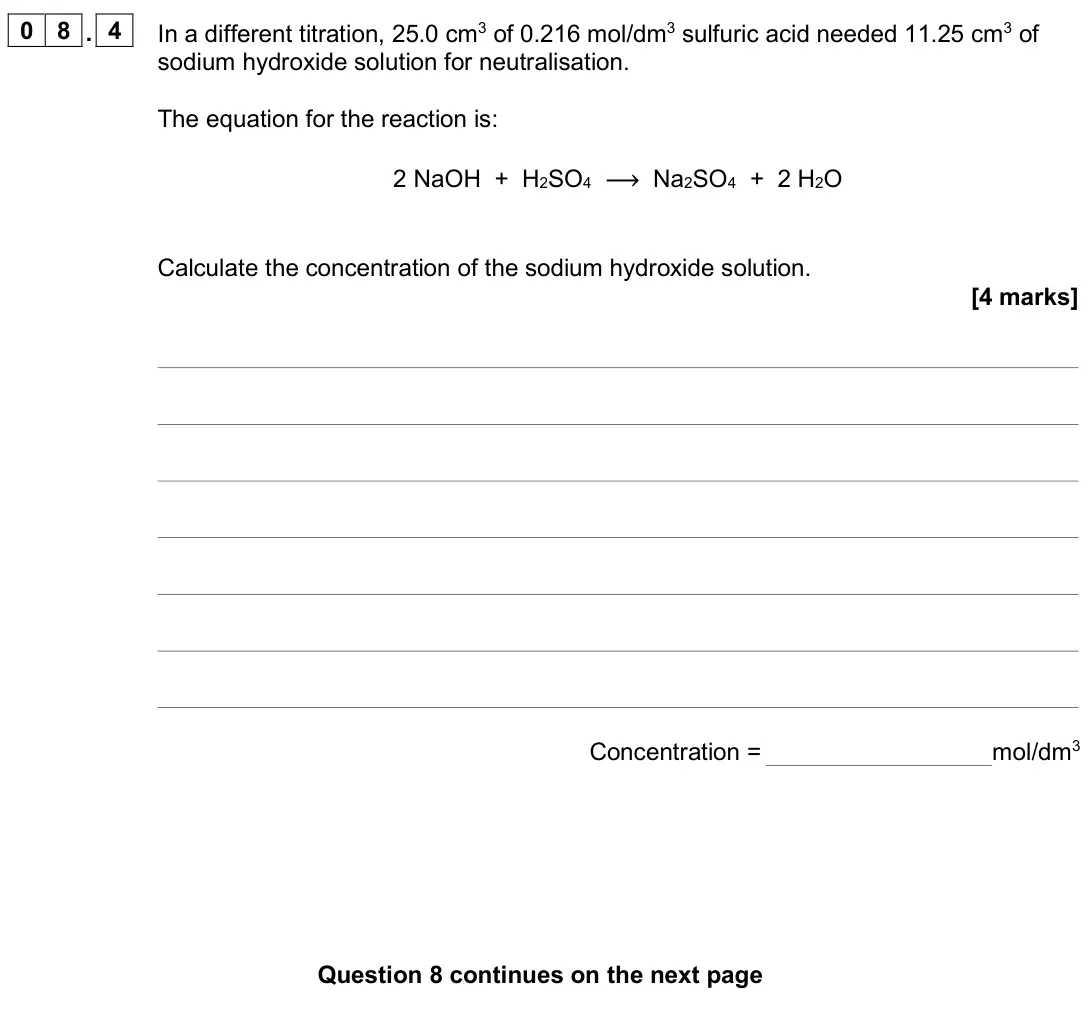
Q08.6
The whole paper ↗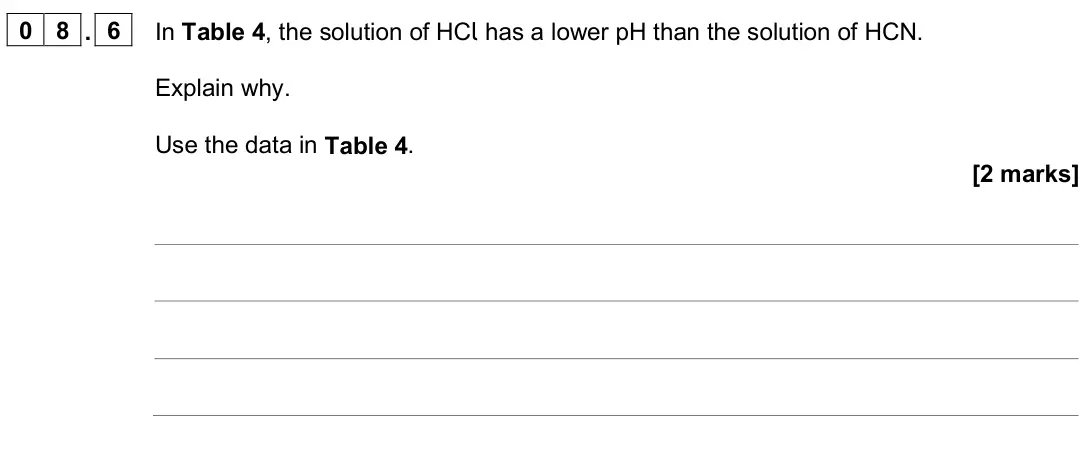
Q09.2
The whole paper ↗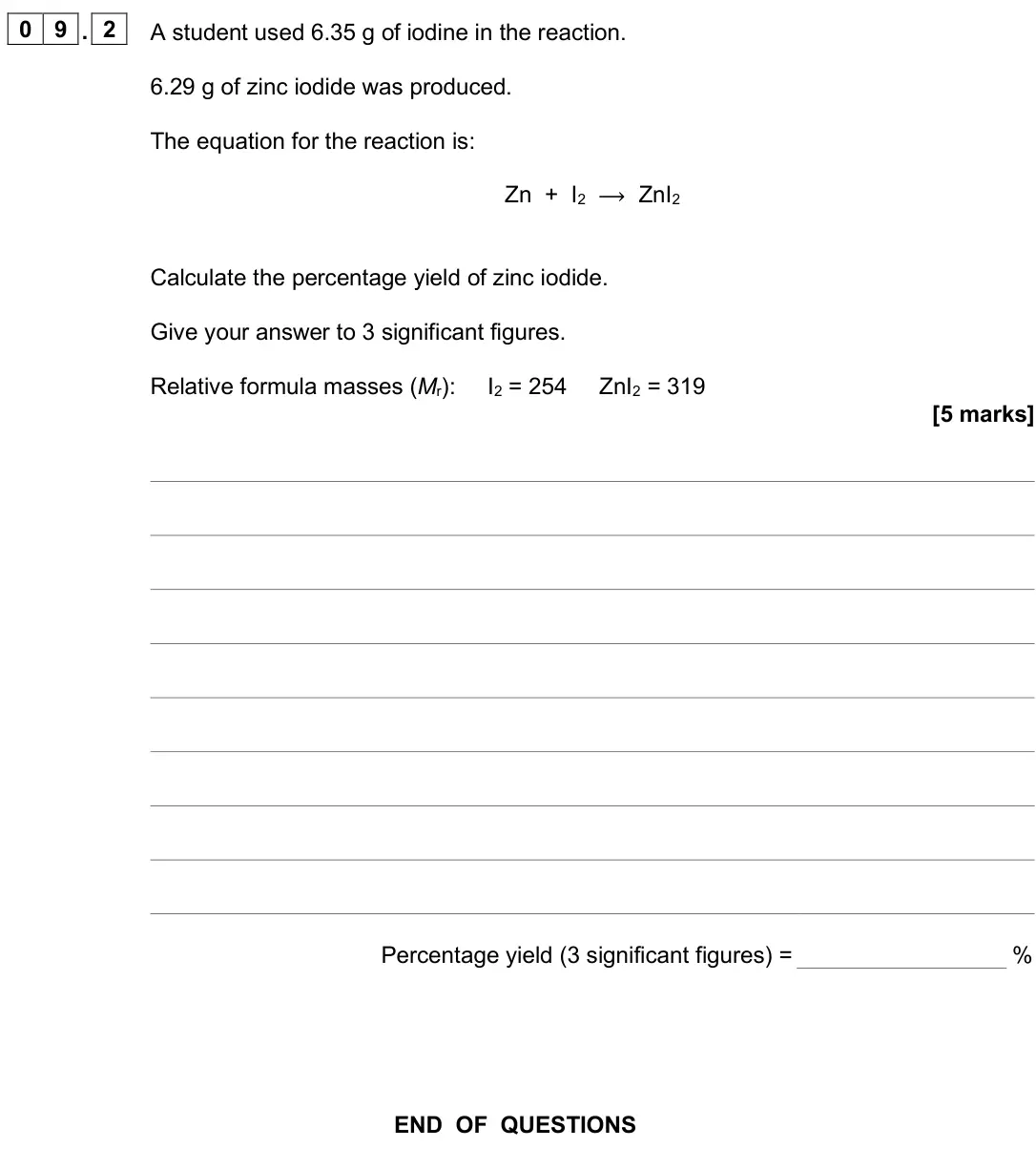
Q01.5
The whole paper ↗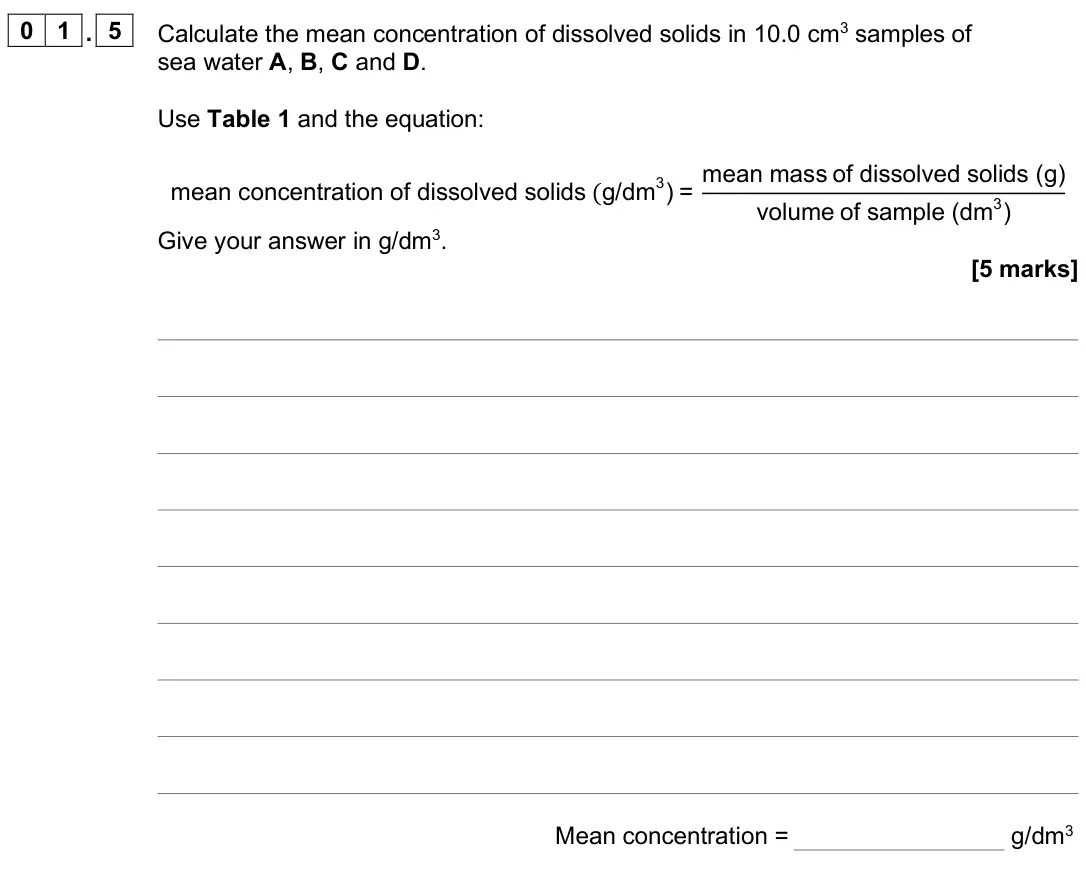
Q08.5
The whole paper ↗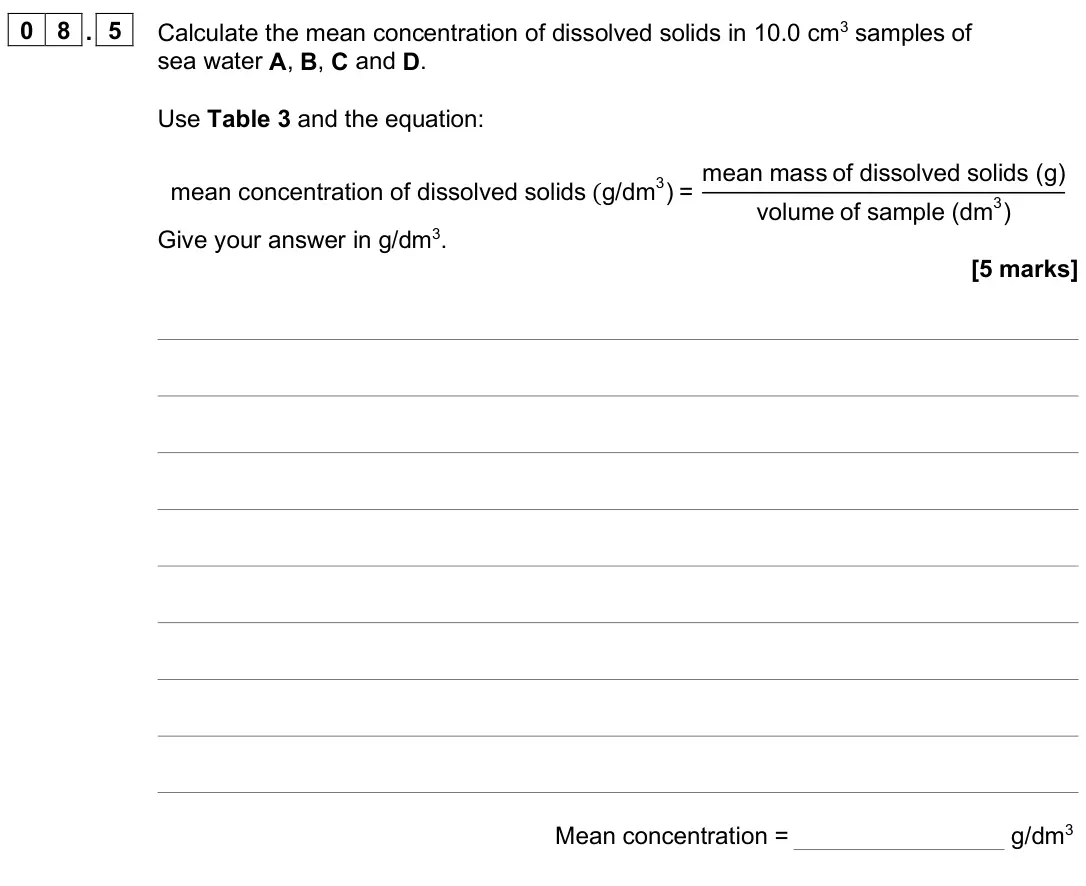
Q07.3
The whole paper ↗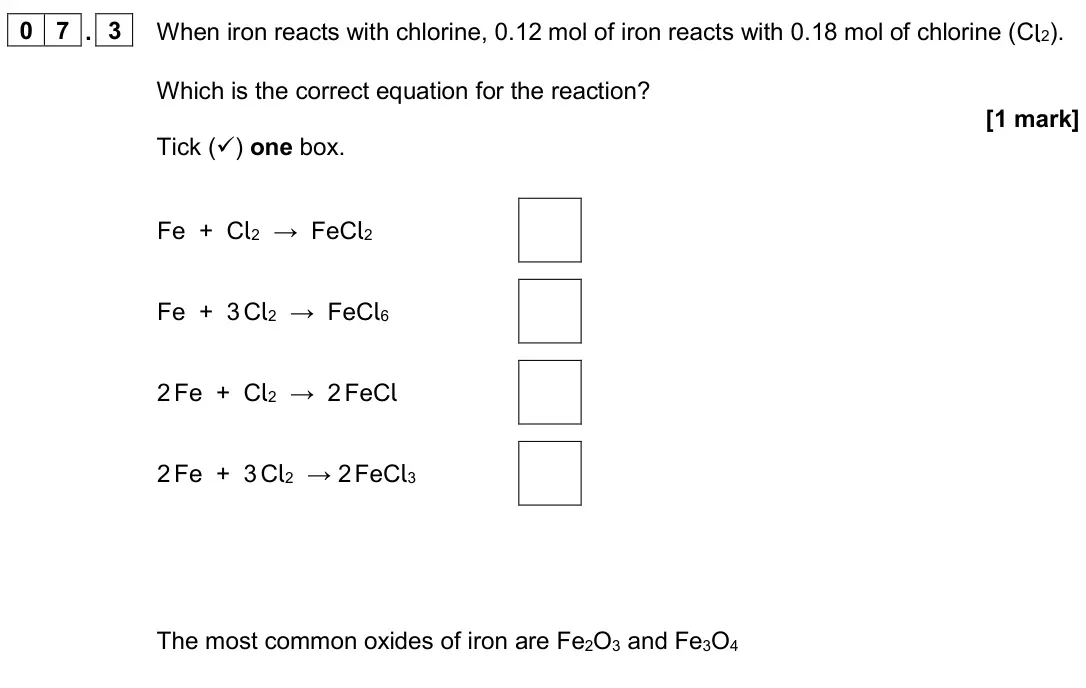
Q07.6
The whole paper ↗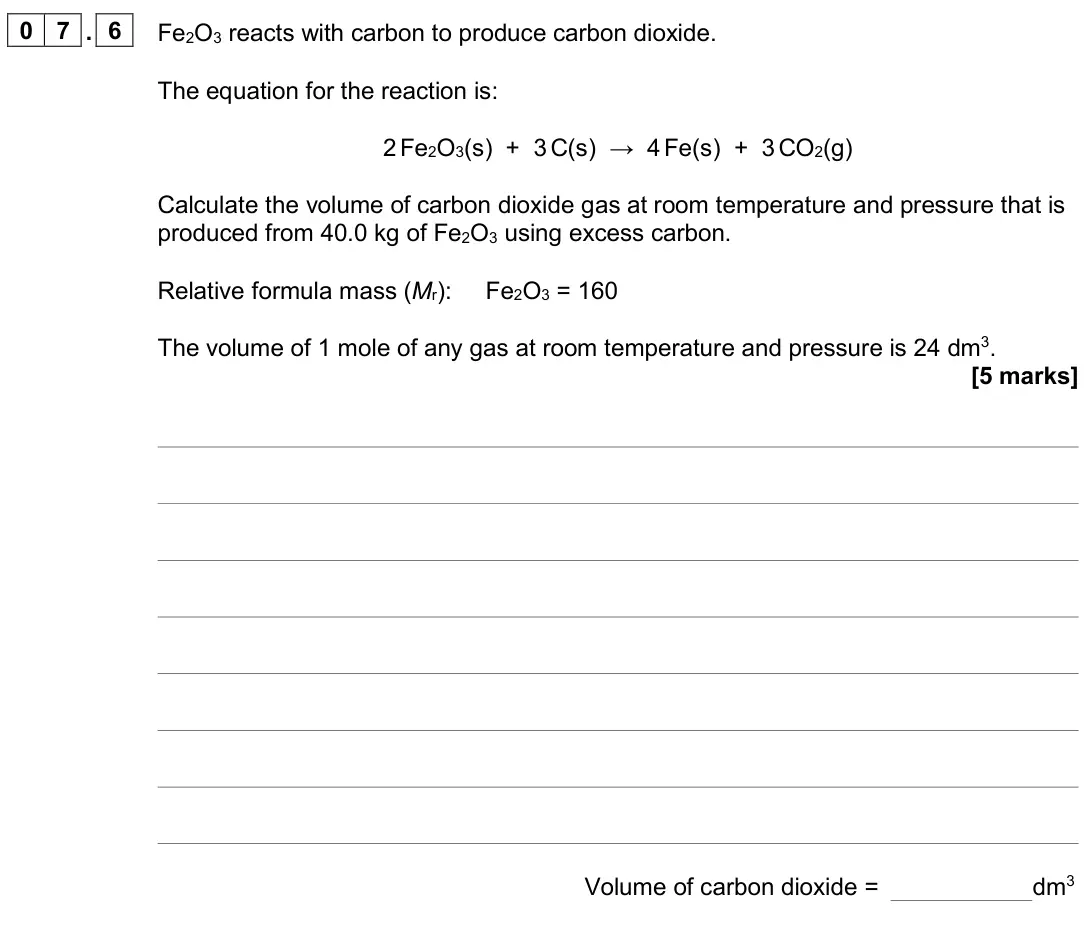
Q03.6
The whole paper ↗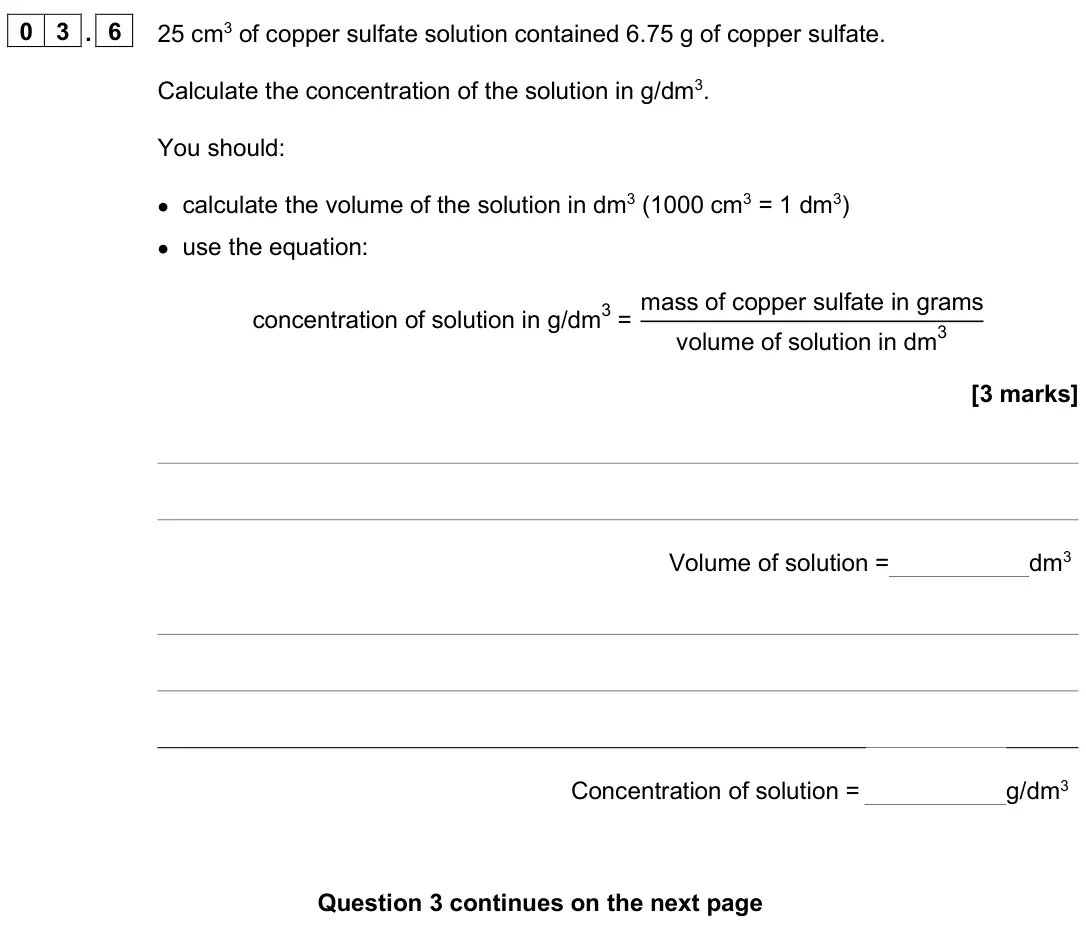
Q01.5
The whole paper ↗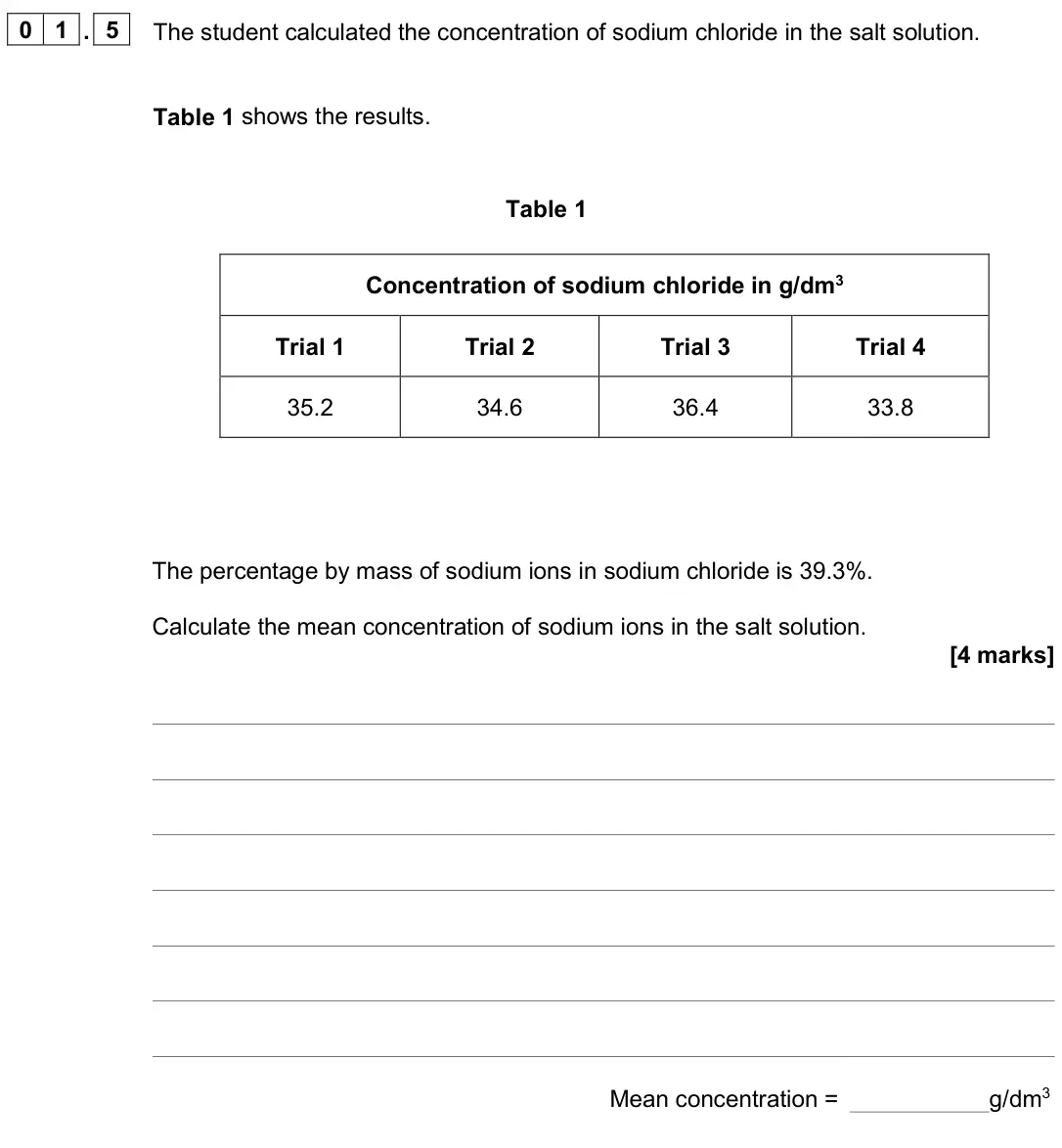
Q09.4
The whole paper ↗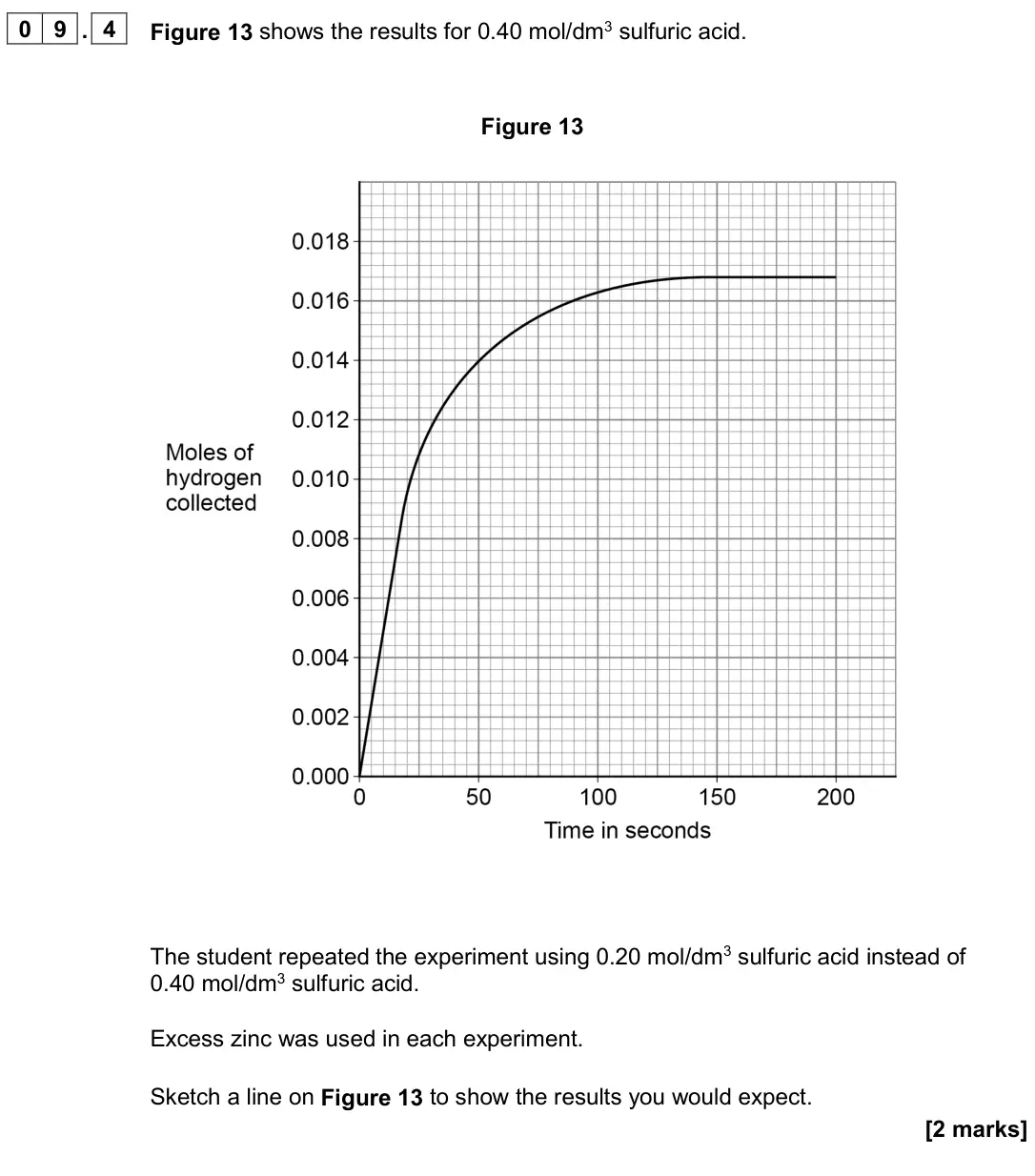
Q08.5
The whole paper ↗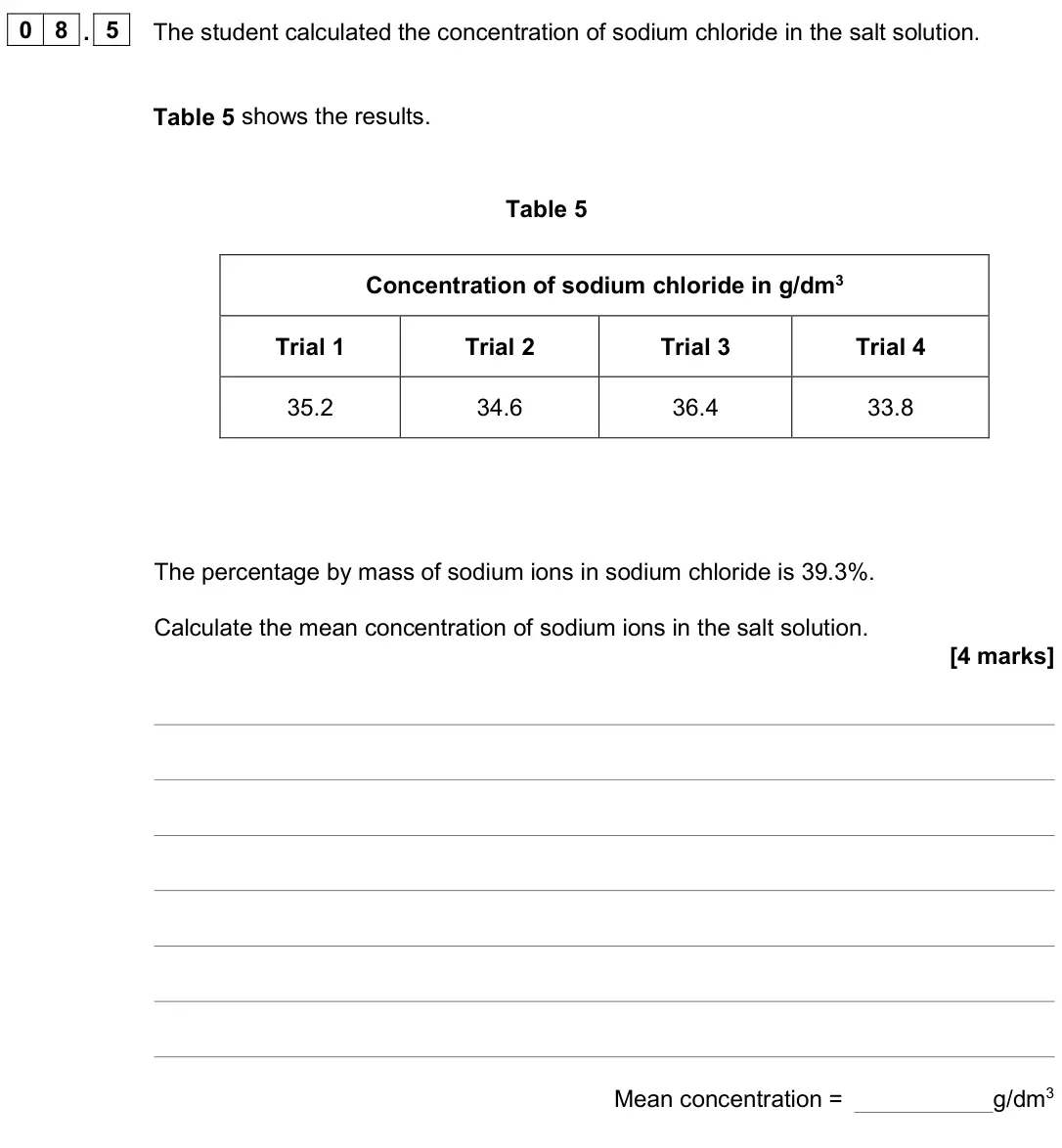
Q05.2
The whole paper ↗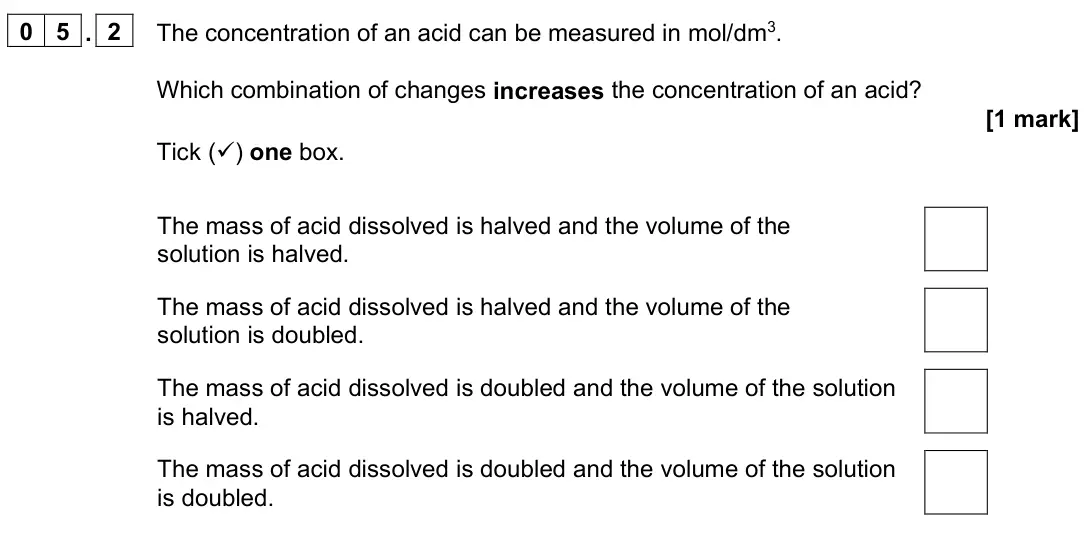
Q10.2
The whole paper ↗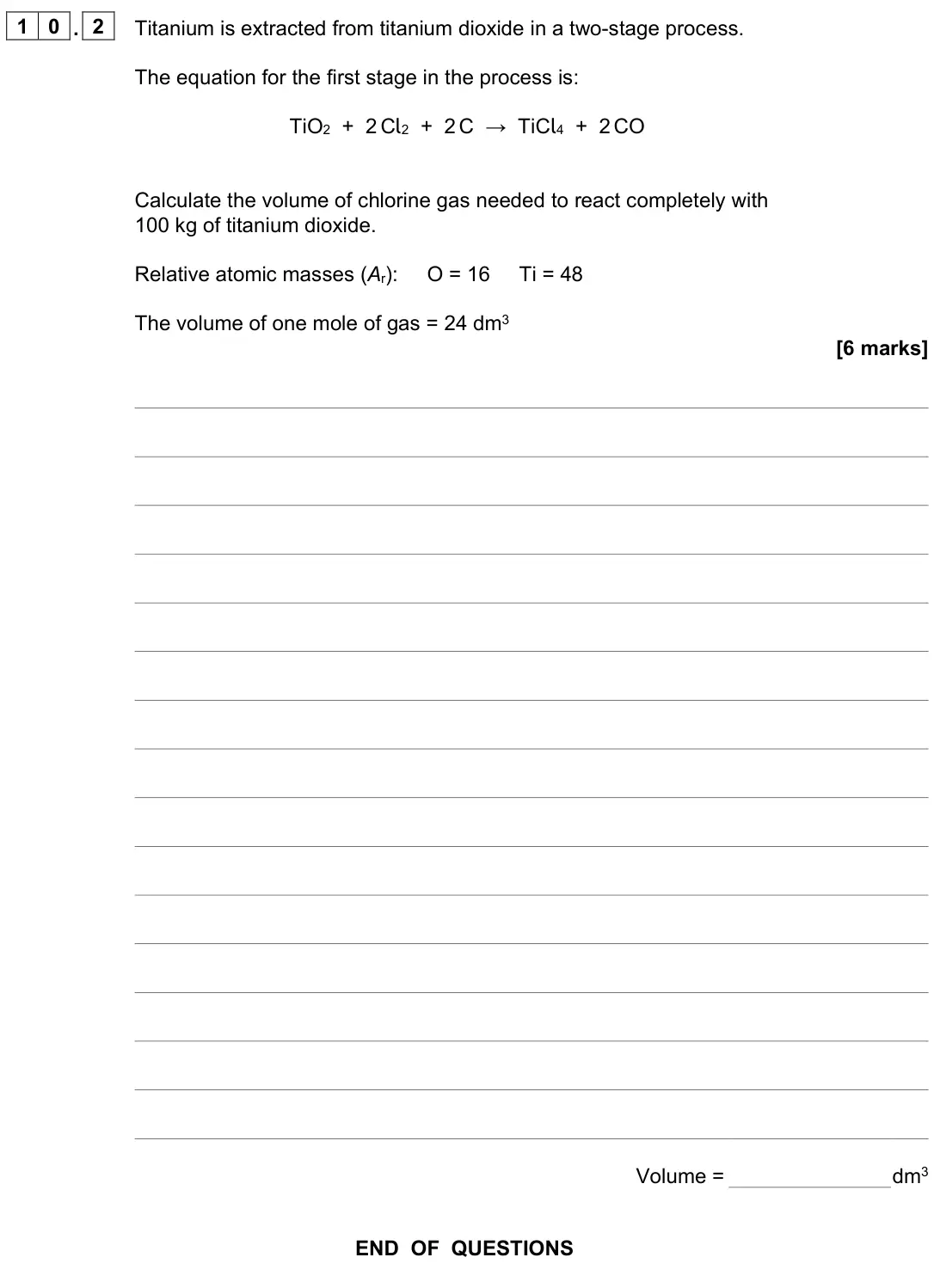
Q02.7
The whole paper ↗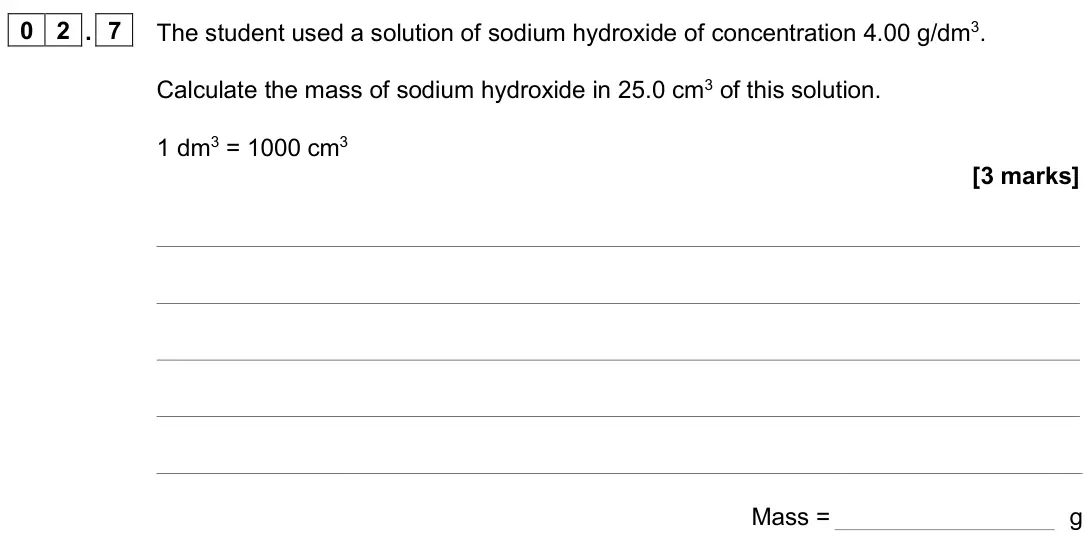
Q03.5
The whole paper ↗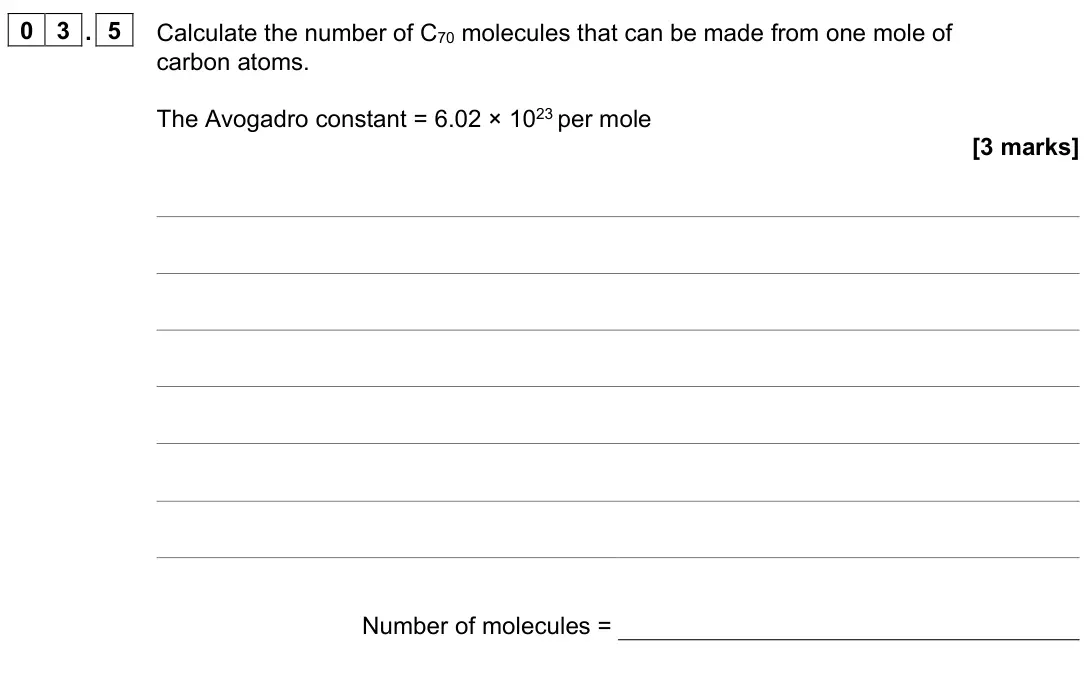
Q07.4
The whole paper ↗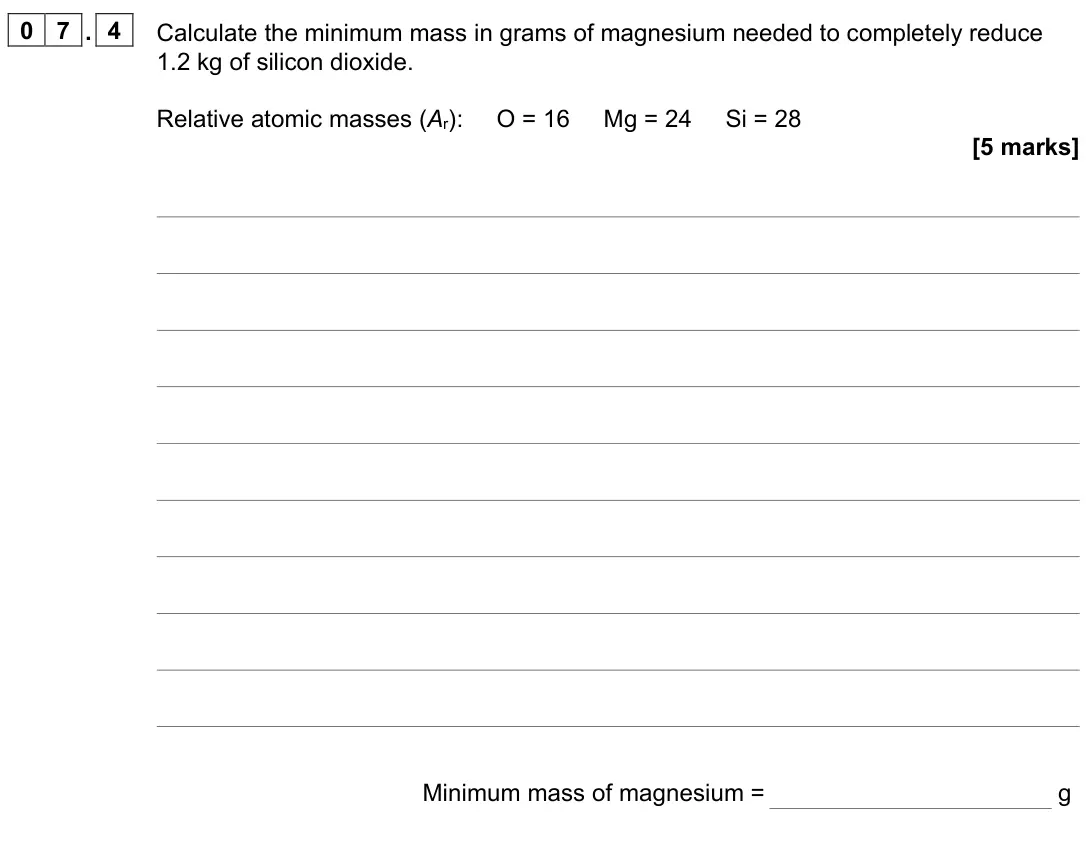
Q08.1
The whole paper ↗
Q08.4
The whole paper ↗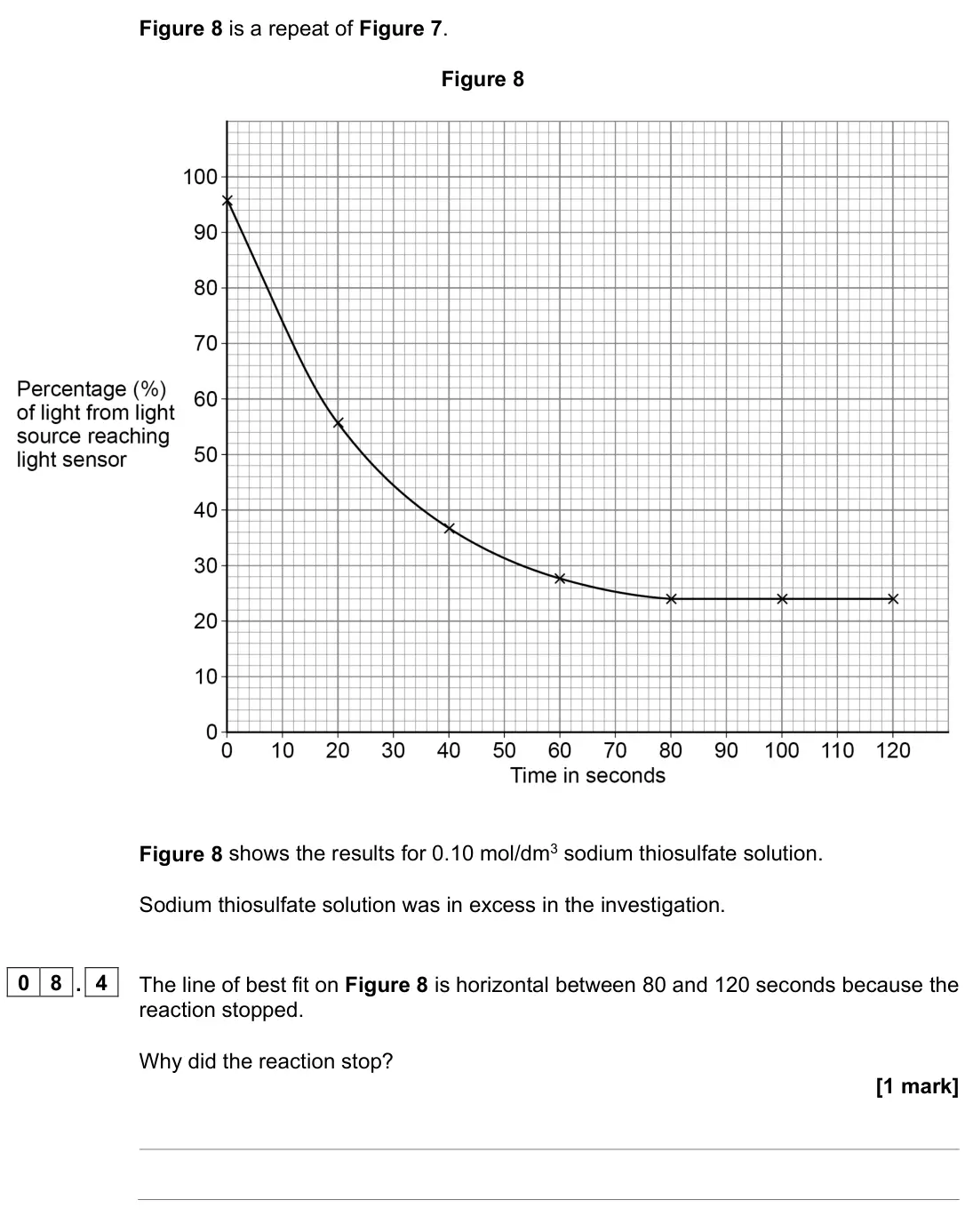
Q05.6
The whole paper ↗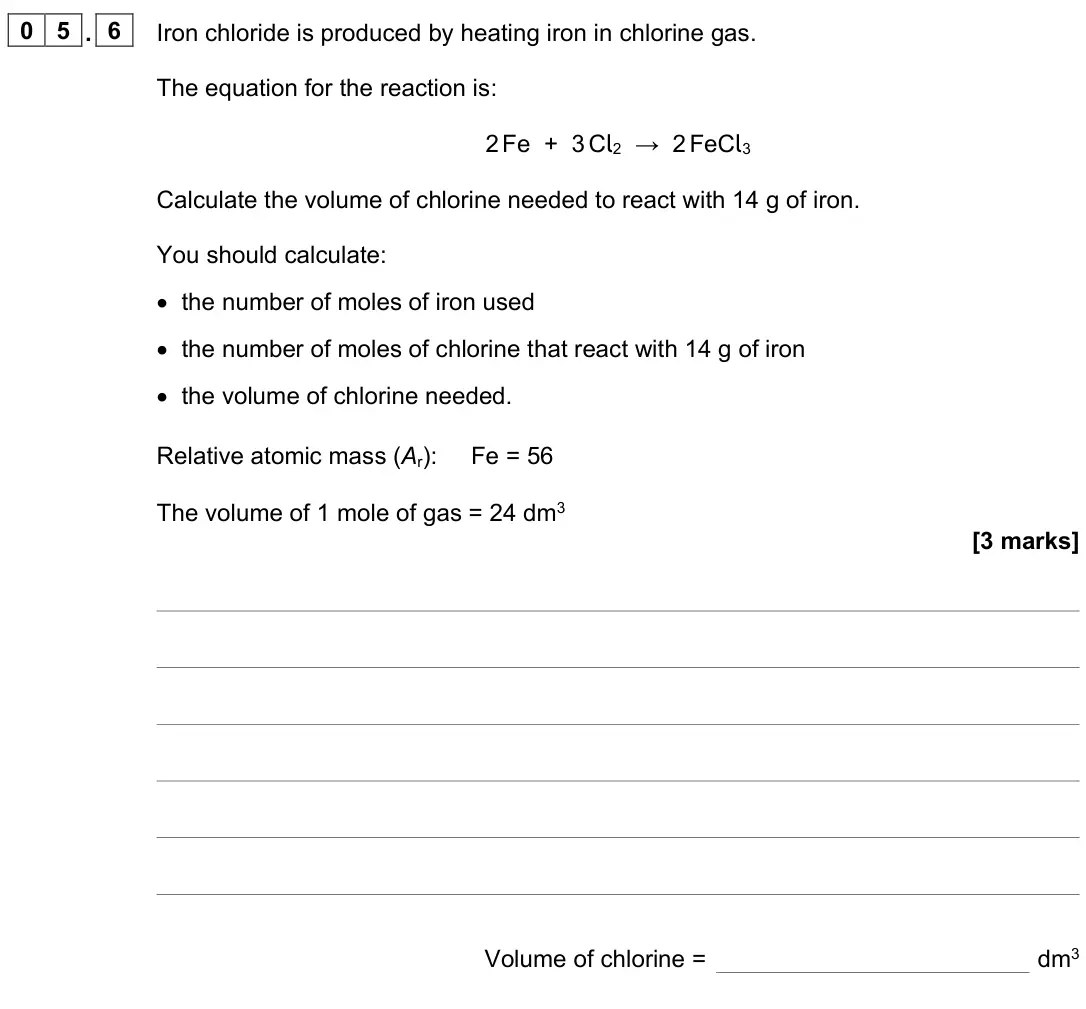
All 39 questions on Use of amount of substance in relation to masses of pure substances, as a list
- June 2025, Paper 1 Higher, Q08.4 (4 marks): In a different titration, 25.0 cm3 of 0.216 mol/dm3 sulfuric acid needed 11.25 cm3 of sodium hydroxide solution for neutralisation. The equation for the reactio
- June 2025, Paper 1 Higher, Q08.6 (2 marks): In Table 4, the solution of HCl has a lower pH than the solution of HCN. Explain why. Use the data in Table 4. [2 marks]
- June 2025, Paper 1 Higher, Q09.2 (5 marks): A student used 6.35 g of iodine in the reaction. 6.29 g of zinc iodide was produced. The equation for the reaction is: Zn + I2 ⟶ ZnI2 Calculate the percentage y
- June 2025, Paper 2 Higher, Q01.5 (5 marks): Calculate the mean concentration of dissolved solids in 10.0 cm3 samples of sea water A, B, C and D. Use Table 1 and the equation: mean concentration of dissolv
- June 2025, Paper 2 Foundation, Q08.5 (5 marks): Calculate the mean concentration of dissolved solids in 10.0 cm3 samples of sea water A, B, C and D. Use Table 3 and the equation: mean concentration of dissolv
- June 2024, Paper 1 Higher, Q07.3 (1 mark): When iron reacts with chlorine, 0.12 mol of iron reacts with 0.18 mol of chlorine (Cl2). Which is the correct equation for the reaction? [1 mark] Tick () one b
- June 2024, Paper 1 Higher, Q07.6 (5 marks): Fe2O3 reacts with carbon to produce carbon dioxide. The equation for the reaction is: 2 Fe2O3(s) + 3 C(s) → 4 Fe(s) + 3 CO2(g) Calculate the volume of carbon di
- June 2024, Paper 1 Foundation, Q03.6 (3 marks): 25 cm3 of copper sulfate solution contained 6.75 g of copper sulfate. Calculate the concentration of the solution in g/dm3. You should: • calculate the volume o
- June 2024, Paper 2 Higher, Q01.5 (4 marks): The student calculated the concentration of sodium chloride in the salt solution. Table 1 shows the results. Table 1 Concentration of sodium chloride in g/dm3 T
- June 2024, Paper 2 Higher, Q09.4 (2 marks): Figure 13 shows the results for 0.40 mol/dm3 sulfuric acid. Figure 13 The student repeated the experiment using 0.20 mol/dm3 sulfuric acid instead of 0.40 mol/d
- June 2024, Paper 2 Foundation, Q08.5 (4 marks): The student calculated the concentration of sodium chloride in the salt solution. Table 5 shows the results. Table 5 Concentration of sodium chloride in g/dm3 T
- June 2023, Paper 1 Higher, Q05.2 (1 mark): The concentration of an acid can be measured in mol/dm3. Which combination of changes increases the concentration of an acid? [1 mark] Tick () one box. The mas
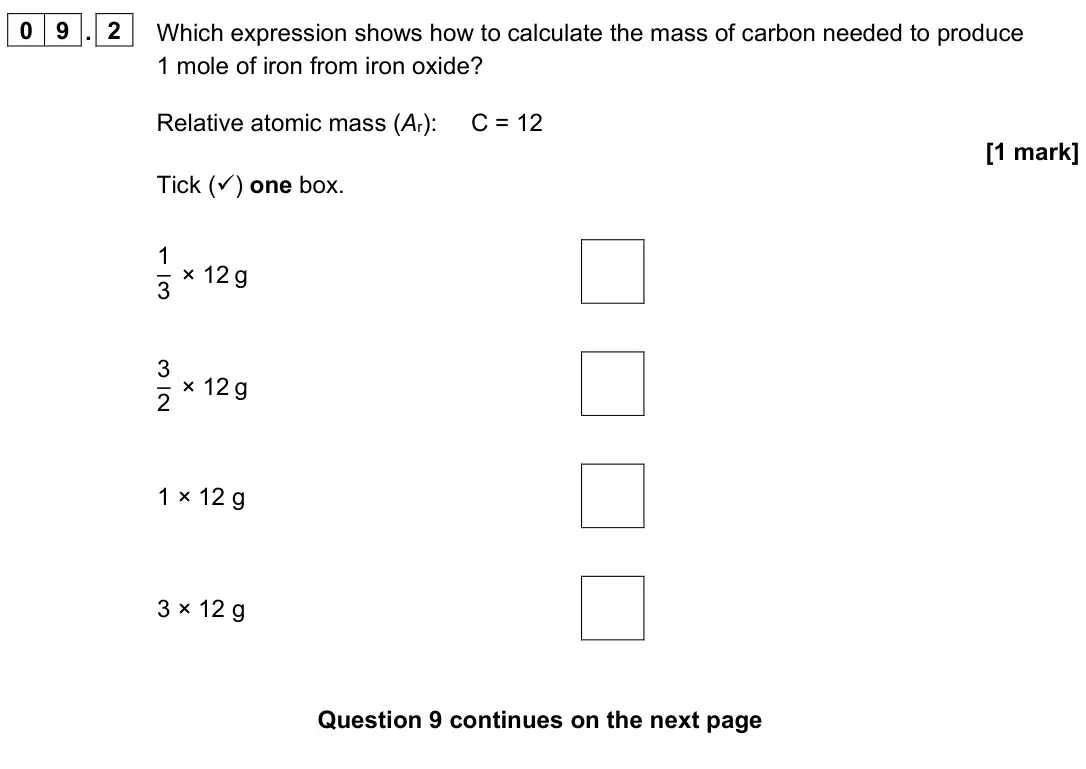
- June 2023, Paper 1 Higher, Q09.2 (1 mark): Which expression shows how to calculate the mass of carbon needed to produce 1 mole of iron from iron oxide? Relative atomic mass (Ar): C = 12 [1 mark] Tick ()
- June 2023, Paper 1 Higher, Q10.2 (6 marks): Titanium is extracted from titanium dioxide in a two-stage process. The equation for the first stage in the process is: TiO2 + 2 Cl2 + 2 C → TiCl4 + 2 CO Calcul
- June 2023, Paper 1 Foundation, Q02.7 (3 marks): The student used a solution of sodium hydroxide of concentration 4.00 g/dm3. Calculate the mass of sodium hydroxide in 25.0 cm3 of this solution. 1 dm3 = 1000 c
- June 2022, Paper 1 Higher, Q03.5 (3 marks): Calculate the number of C70 molecules that can be made from one mole of carbon atoms. The Avogadro constant = 6.02 × 10²³ per mole [3 marks] Number of molecules
- June 2022, Paper 1 Higher, Q07.4 (5 marks): Calculate the minimum mass in grams of magnesium needed to completely reduce 1.2 kg of silicon dioxide. Relative atomic masses (Ar): O = 16 Mg = 24 Si = 28 [5 m
- June 2022, Paper 1 Higher, Q08.1 (4 marks): Explain why the pH of an acid depends on: • the strength of the acid • the concentration of the acid. [4 marks]
- June 2022, Paper 2 Higher, Q08.4 (1 mark): The line of best fit on Figure 8 is horizontal between 80 and 120 seconds because the reaction stopped. Why did the reaction stop? [1 mark]
- November 2021, Paper 1 Higher, Q05.6 (3 marks): Iron chloride is produced by heating iron in chlorine gas. The equation for the reaction is: 2 Fe + 3 Cl2 → 2 FeCl3 Calculate the volume of chlorine needed to r
- November 2021, Paper 1 Higher, Q07.8 (3 marks): Determine the number of atoms of copper produced when copper nitrate solution is electrolysed for 20 minutes at a current of 0.6 A Give your answer to 3 signifi
- November 2021, Paper 1 Higher, Q09.1 (1 mark): A solution is made by dissolving 1 g of hydrogen chloride in 1 dm3 of water. Which is the correct description of this solution? [1 mark] Tick () one box. A con
- November 2021, Paper 1 Higher, Q09.4 (2 marks): Ethanedioic acid is a solid at room temperature. Calculate the mass of ethanedioic acid (H2C2O4) needed to make 250 cm3 of a solution with concentration 0.0480
- November 2021, Paper 2 Foundation, Q06.4 (4 marks): A solution of potash alum has a concentration of 258 g/dm3 Calculate the mass of potash alum needed to make 800 cm3 of a solution of potash alum with a concentr
- November 2020, Paper 1 Higher, Q06.2 (4 marks): A mixture contains 1.00 kg of aluminium and 3.00 kg of iron oxide. The equation for the reaction is: 2 Al + Fe2O3 → 2 Fe + Al2O3 Show that aluminium is the limi
- November 2020, Paper 1 Higher, Q07.6 (4 marks): The energy needed for a car powered by a hydrogen fuel cell to travel 100 km is 58 megajoules (MJ). The energy released when 1 mole of hydrogen gas reacts with
- June 2019, Paper 1 Higher, Q07.5 (4 marks): The overall equation for the electrolysis of aluminium oxide is: 2 Al2O3 → 4 Al + 3 O2 Calculate the mass of oxygen produced when 2000 kg of aluminium oxide is
- June 2019, Paper 1 Higher, Q08.1 (1 mark): Suggest one reason why step 8 is needed. [1 mark]
- June 2019, Paper 1 Higher, Q08.2 (2 marks): Explain why the excess hydrogen must be burned off. [2 marks] Figure 10 is repeated here. Figure 10
- June 2019, Paper 1 Higher, Q08.3 (2 marks): Determine the mass of copper and the mass of water produced in this experiment. Use Table 5. [2 marks] Mass of copper = g Mass of water = g
- June 2019, Paper 1 Higher, Q08.4 (3 marks): The teacher repeated the experiment with a different sample of the oxide of copper. The teacher found that the oxide of copper produced 2.54 g of copper and 0.7
- June 2018, Paper 1 Higher, Q08.7 (4 marks): In Stage 2, 40 kg of titanium chloride was added to 20 kg of sodium. The equation for the reaction is: TiCl4 + 4 Na Ti + 4 NaCl Relative atomic masses (Ar): N
- June 2018, Paper 1 Foundation, Q07.6 (2 marks): A solution of NaOH had a concentration of 40 g/dm3 What mass of NaOH would there be in 250 cm3 of the solution? [2 marks] Mass = g
- June 2018, Paper 2 Higher, Q09.2 (1 mark): How many moles of carbon monoxide react completely with 4.0 × 10³ moles of hydrogen? [1 mark] Tick one box. 1.0 × 10³ moles 2.0 × 10³ moles 4.0 × 10³ moles 8.0
- Specimen, Paper 1 Higher, Q05.2 (4 marks): A student wanted to make 11.0 g of copper chloride. The equation for the reaction is: CuCO3 + 2HCl → CuCl2 + H2O + CO2 Relative atomic masses, Ar: H = 1; C = 12
- Specimen, Paper 1 Higher, Q07.3 (1 mark): Why does the volume of carbon dioxide collected stop increasing at 95.0 cm3? [1 mark
- Specimen, Paper 1 Higher, Q07.4: What further work could the student do to be more certain about the minimum mass of sodium carbonate needed to produce 95.0 cm3 of carbon dioxide? [1 ma
- Specimen, Paper 1 Higher, Q07.6 (2 marks): Suggest one improvement that could be made to the apparatus used that would give more accurate results. Give a reason for your answer. [2 mark 5
- Specimen, Paper 1 Higher, Q07.7 (2 marks): One student said that the results of the experiment were wrong because the first few bubbles of gas collected were air. A second student said this would make no
Questions, mark schemes and examiner’s reports are © AQA, from their published past papers. Plumi isn’t affiliated with any exam board. Want whole papers? Every AQA GCSE Chemistry paper.
Rather write your answers by hand on iPad? Plumi marks them against the same mark schemes.