 plumi
Yield and atom economy of chemical reactions: AQA GCSE Chemistry questions
Every AQA GCSE Chemistry exam question on 4.3.3 Yield and atom economy of chemical reactions, 2018–2025, with its mark scheme and examiner’s report.
Find questions1,744
Calculations
Q03.3
The whole paper ↗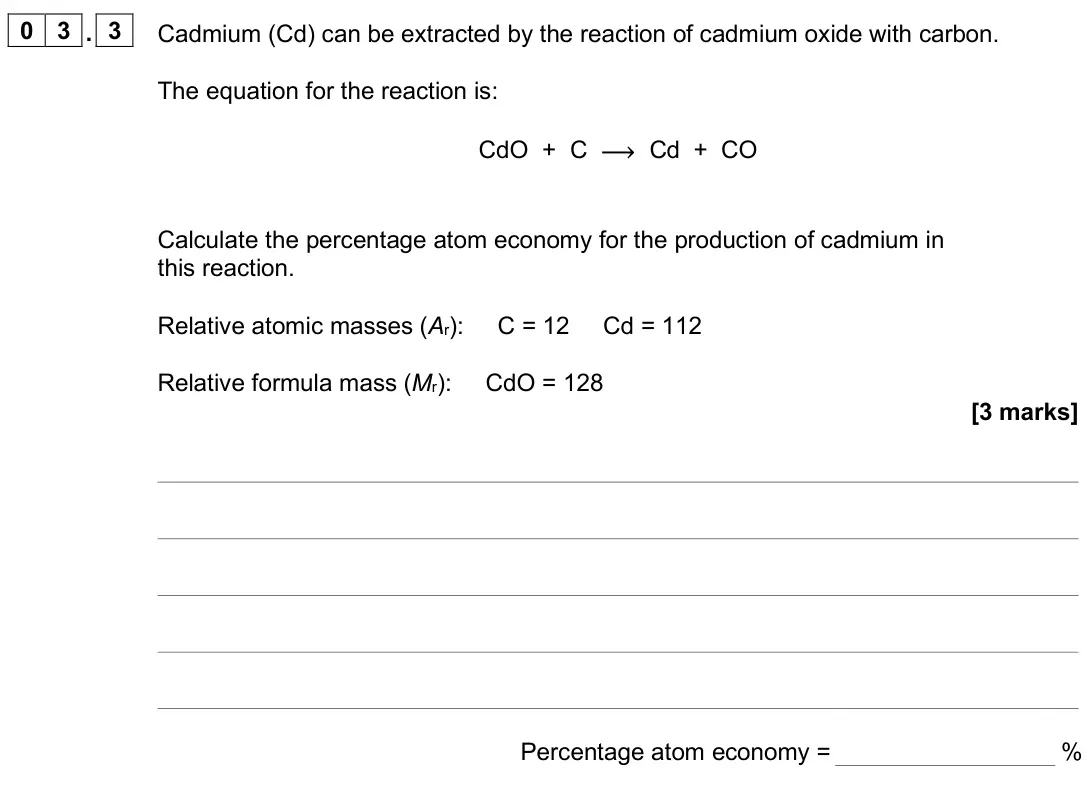
Q03.6
The whole paper ↗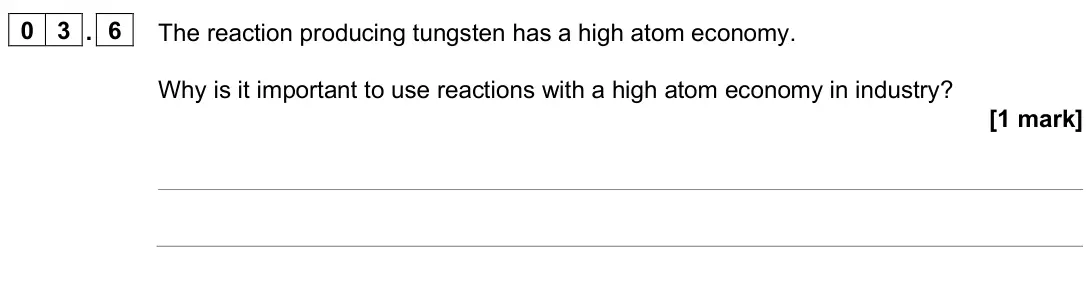
Q07.3
The whole paper ↗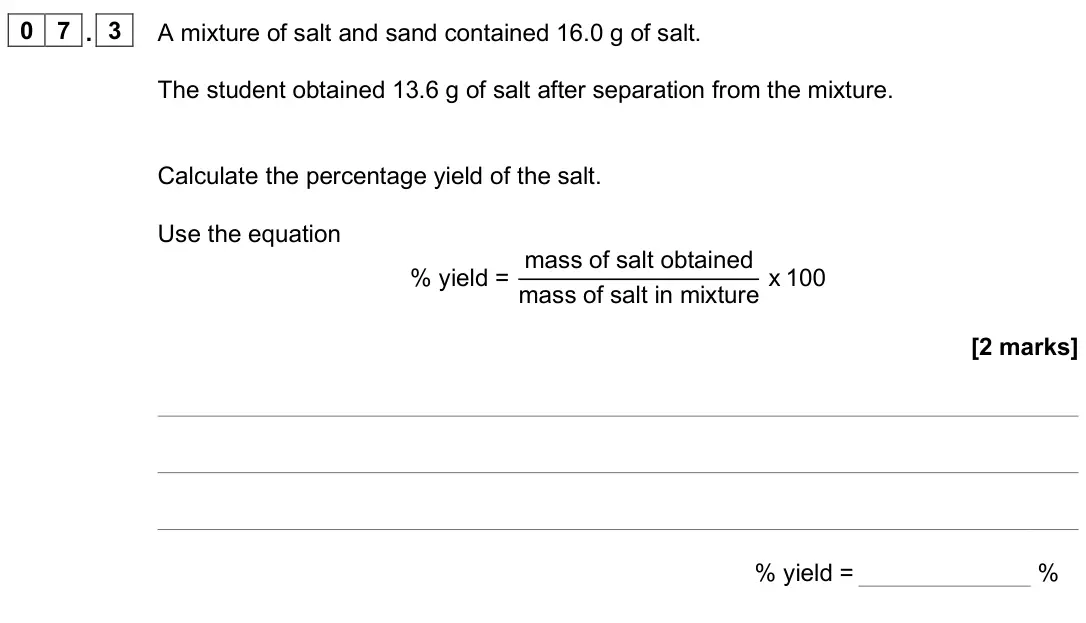
Q10.3
The whole paper ↗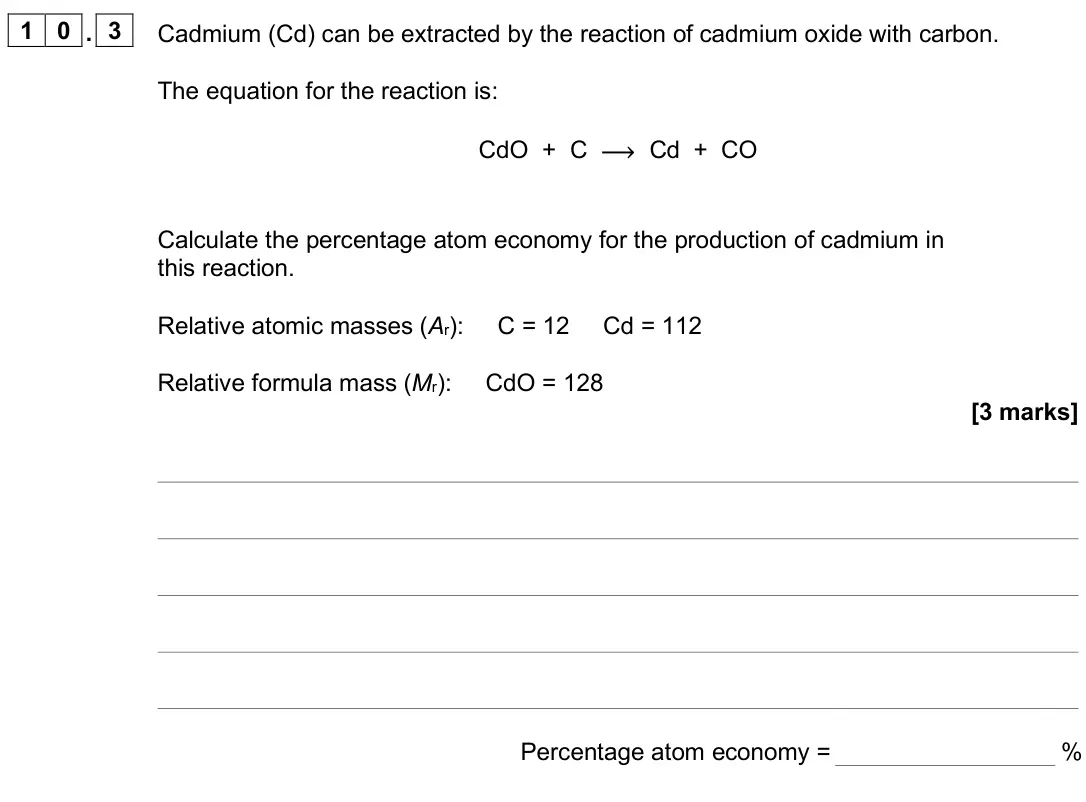
Q10.6
The whole paper ↗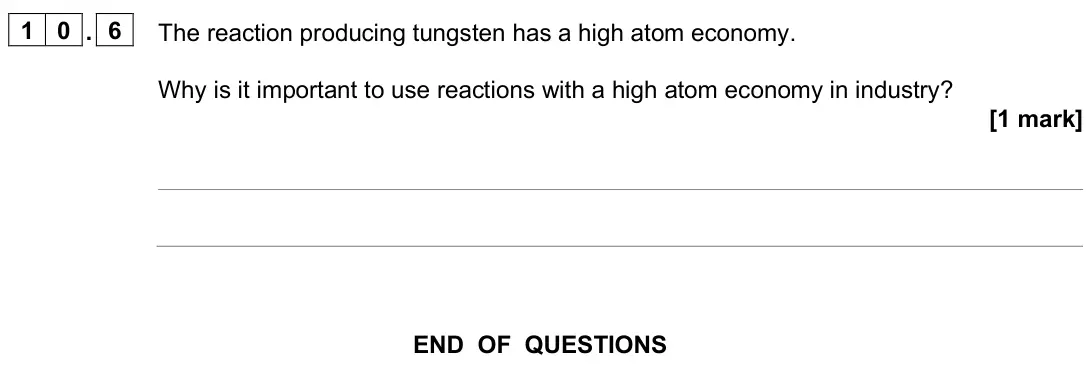
Q01.5
The whole paper ↗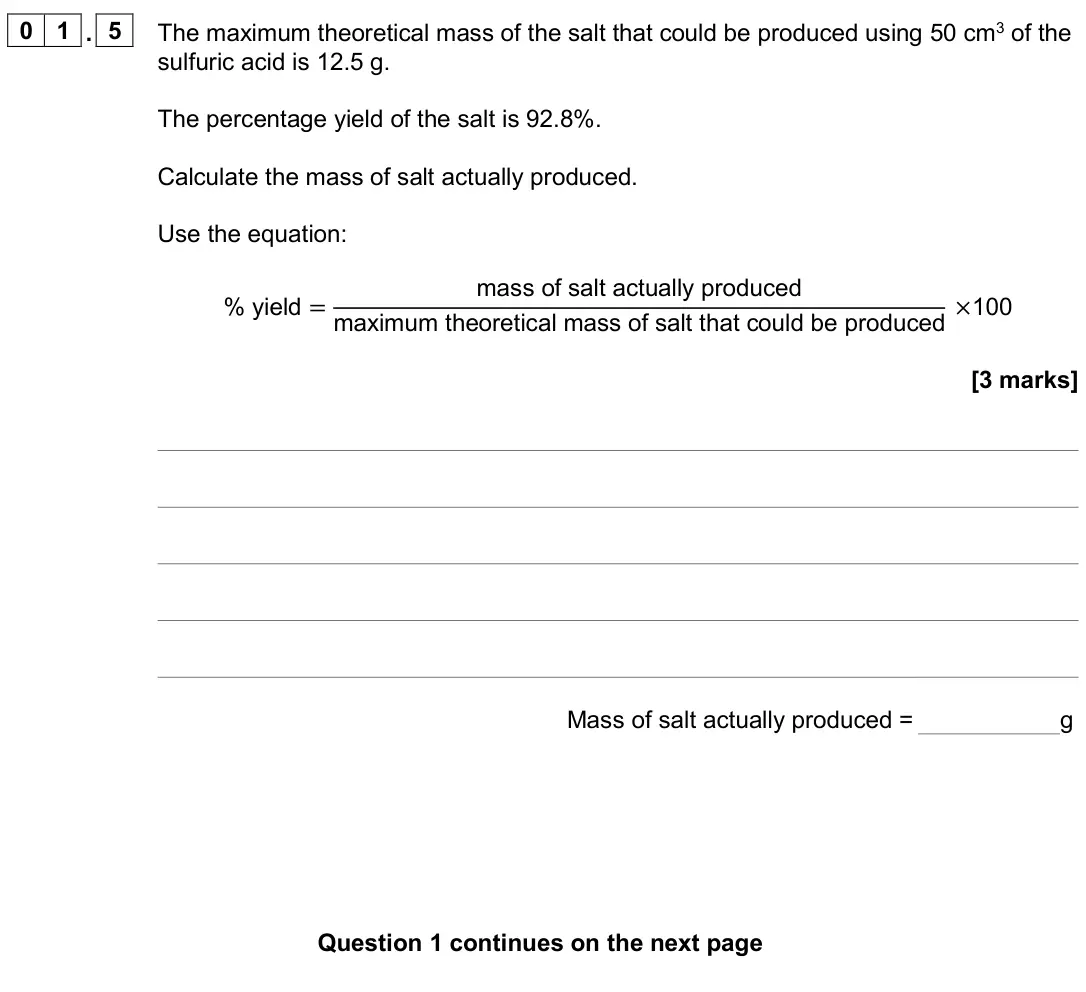
Q08.5
The whole paper ↗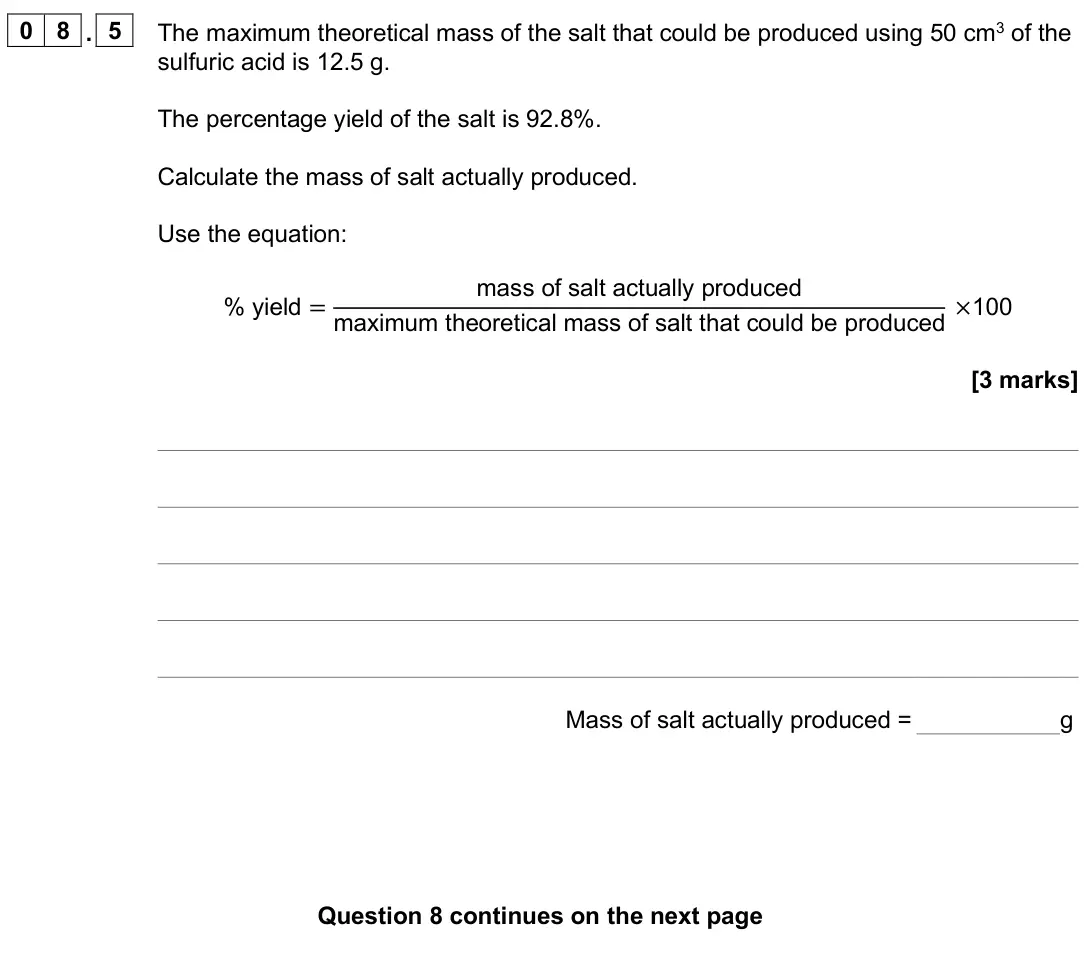
Q09.6
The whole paper ↗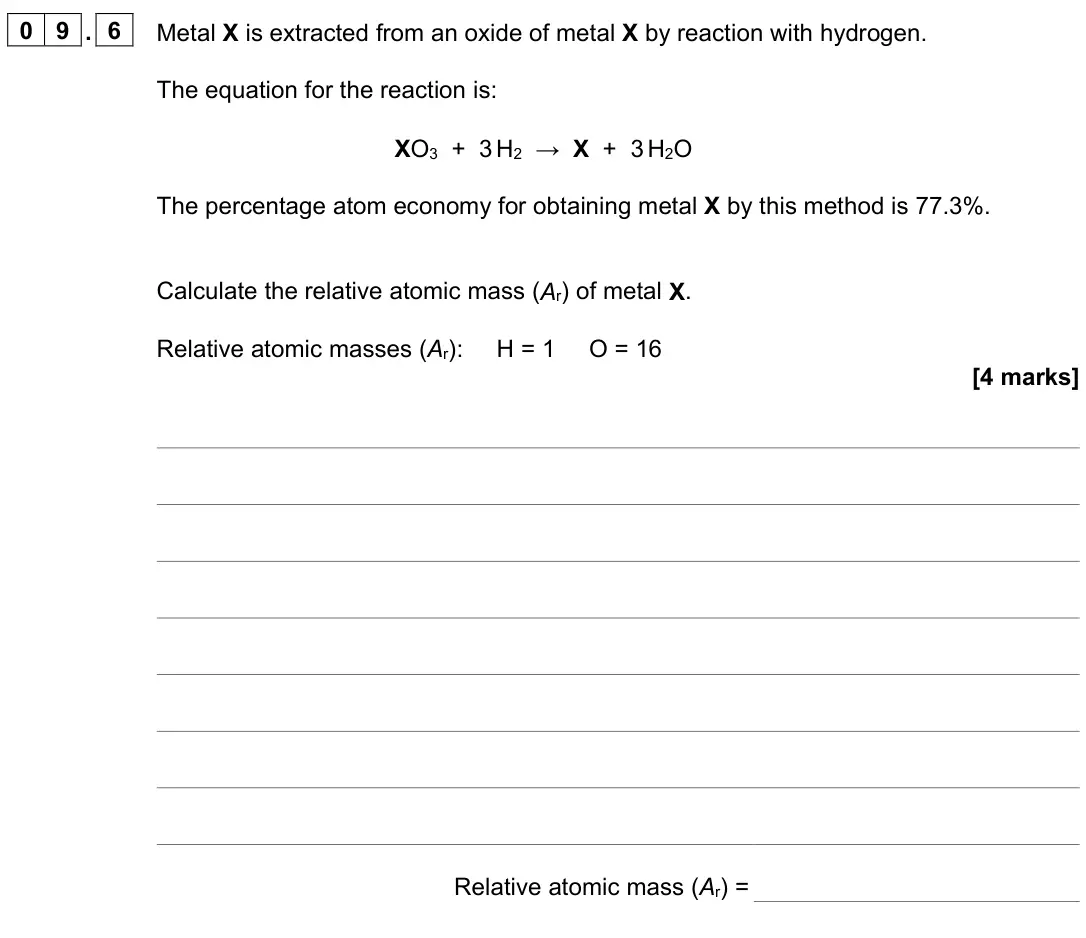
Q08.4
The whole paper ↗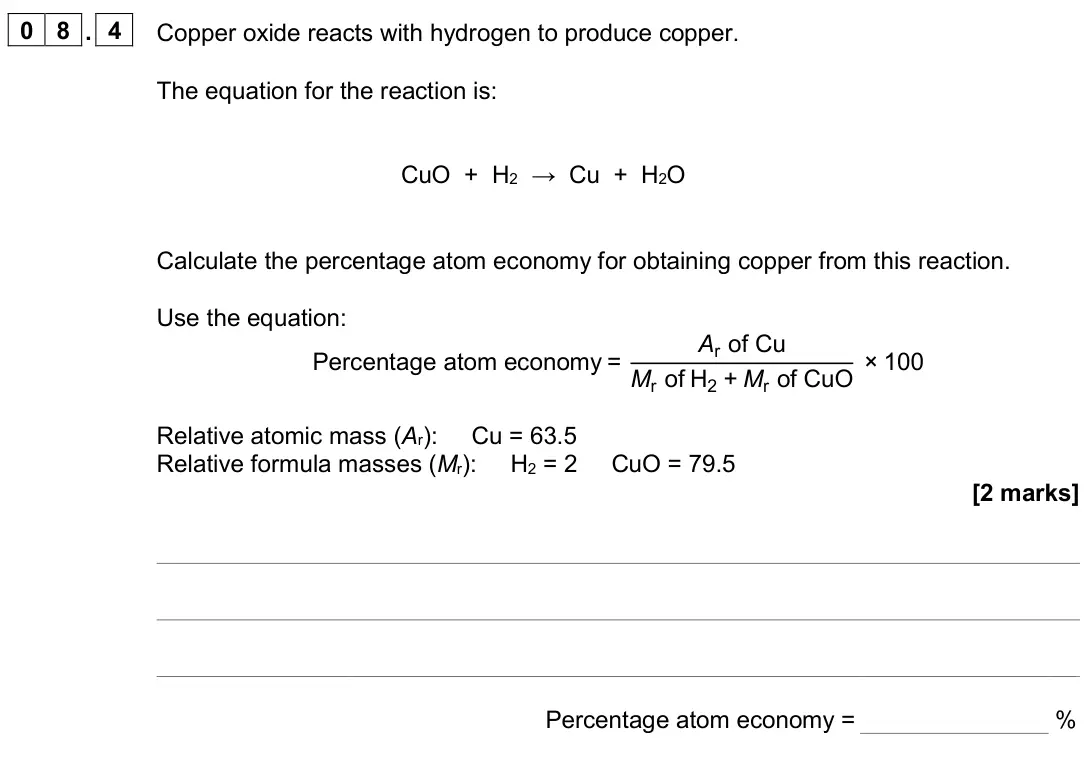
Q08.7
The whole paper ↗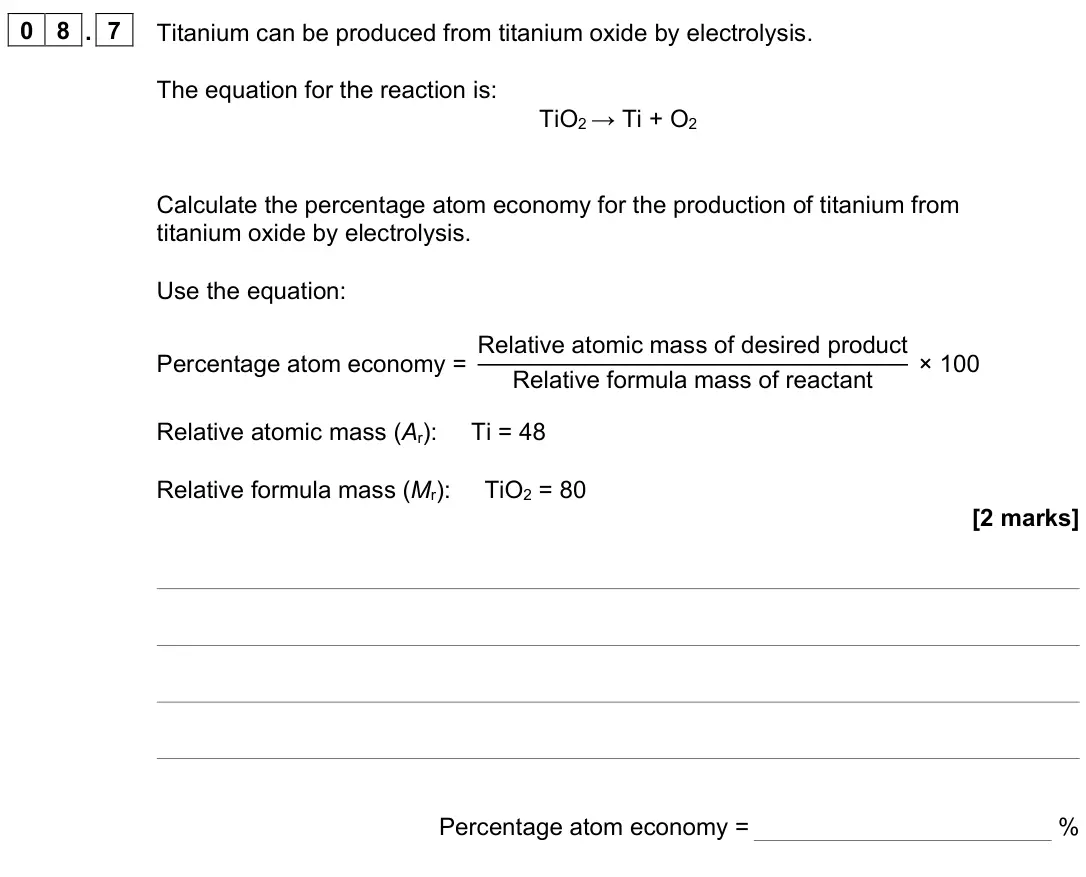
Q07.2
The whole paper ↗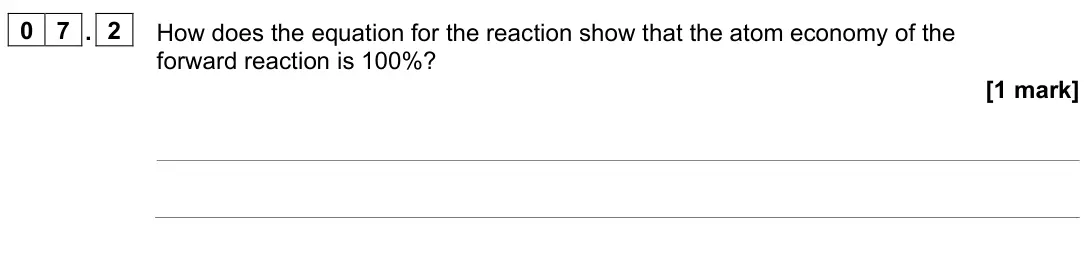
Q05.3
The whole paper ↗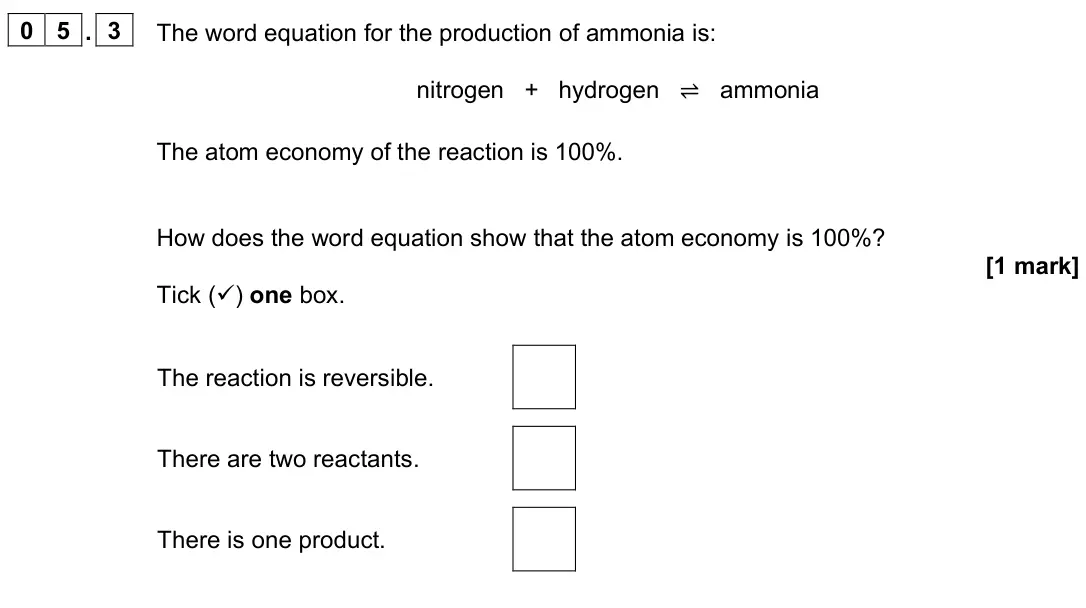
Q03.3
The whole paper ↗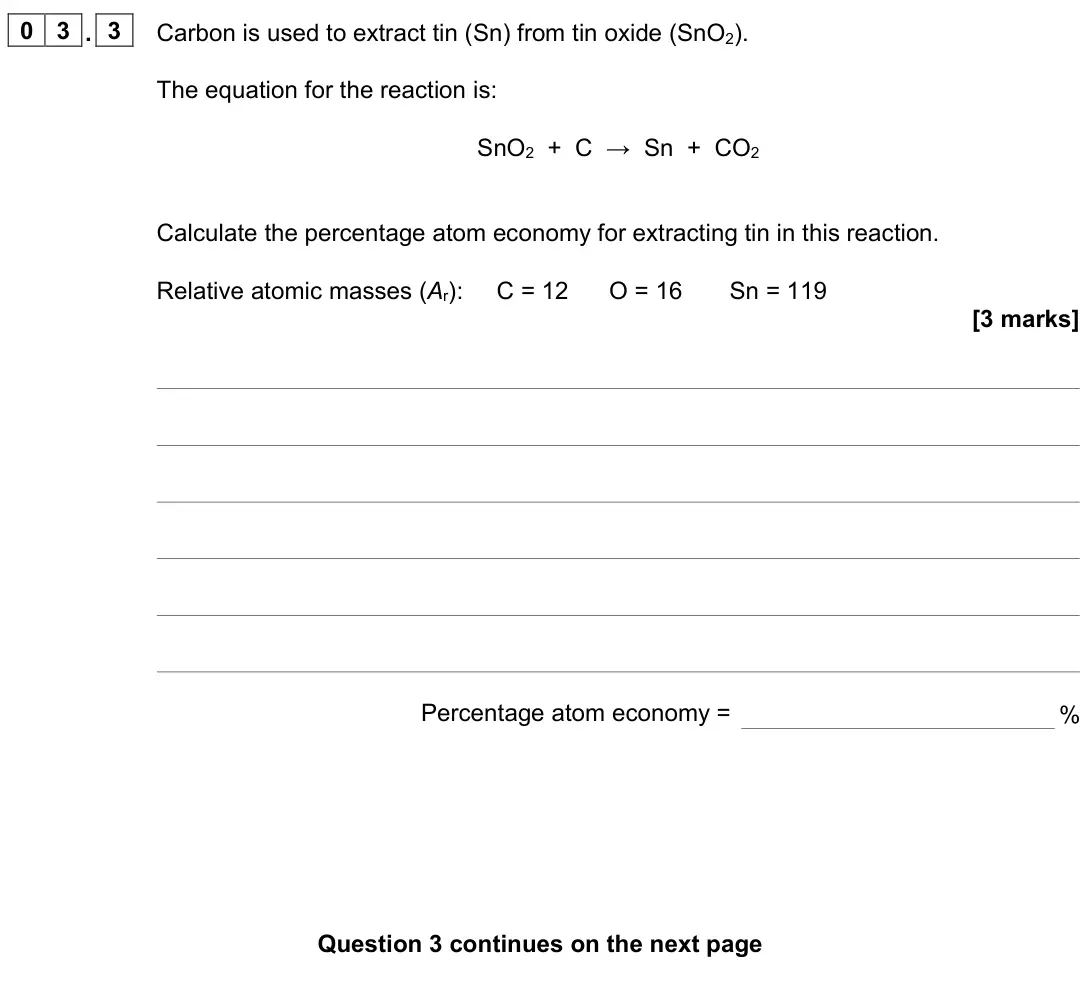
Q10.3
The whole paper ↗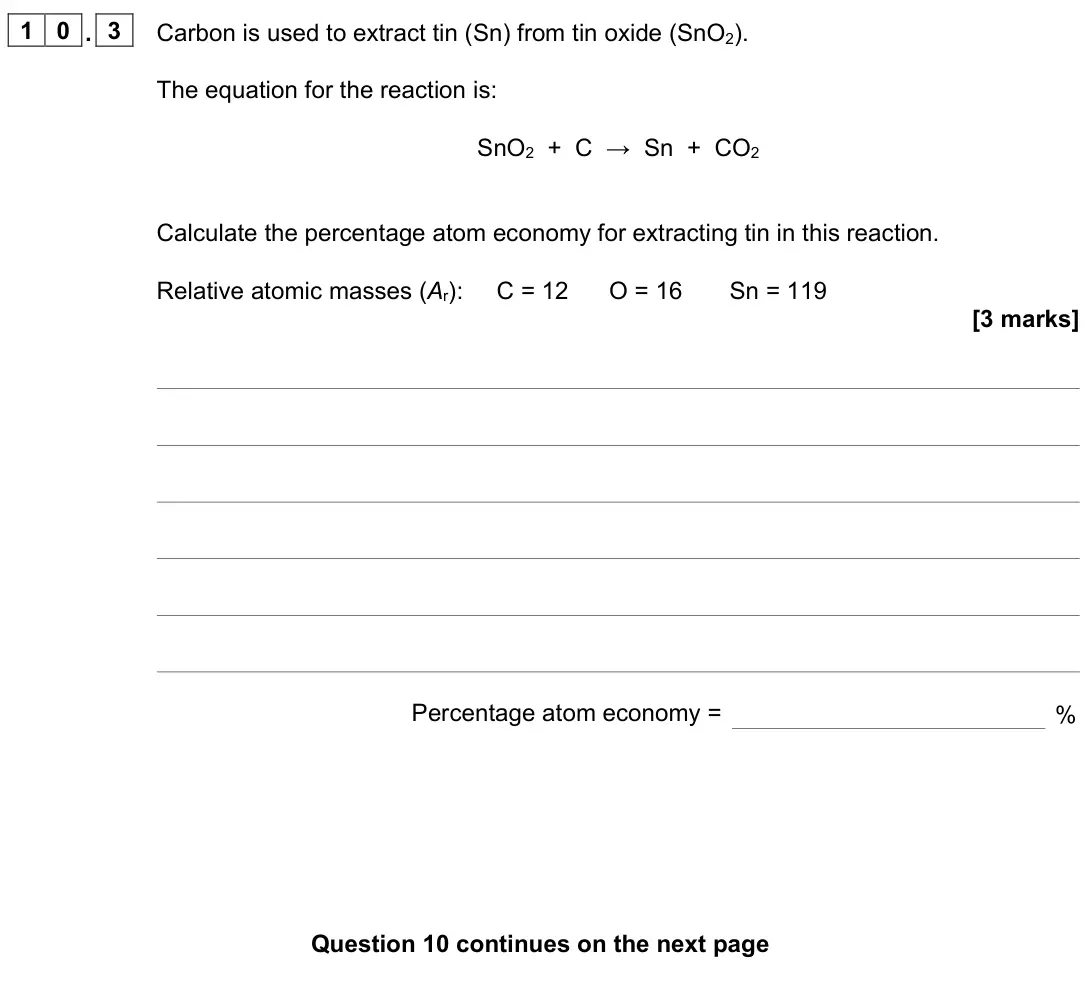
Q07.3
The whole paper ↗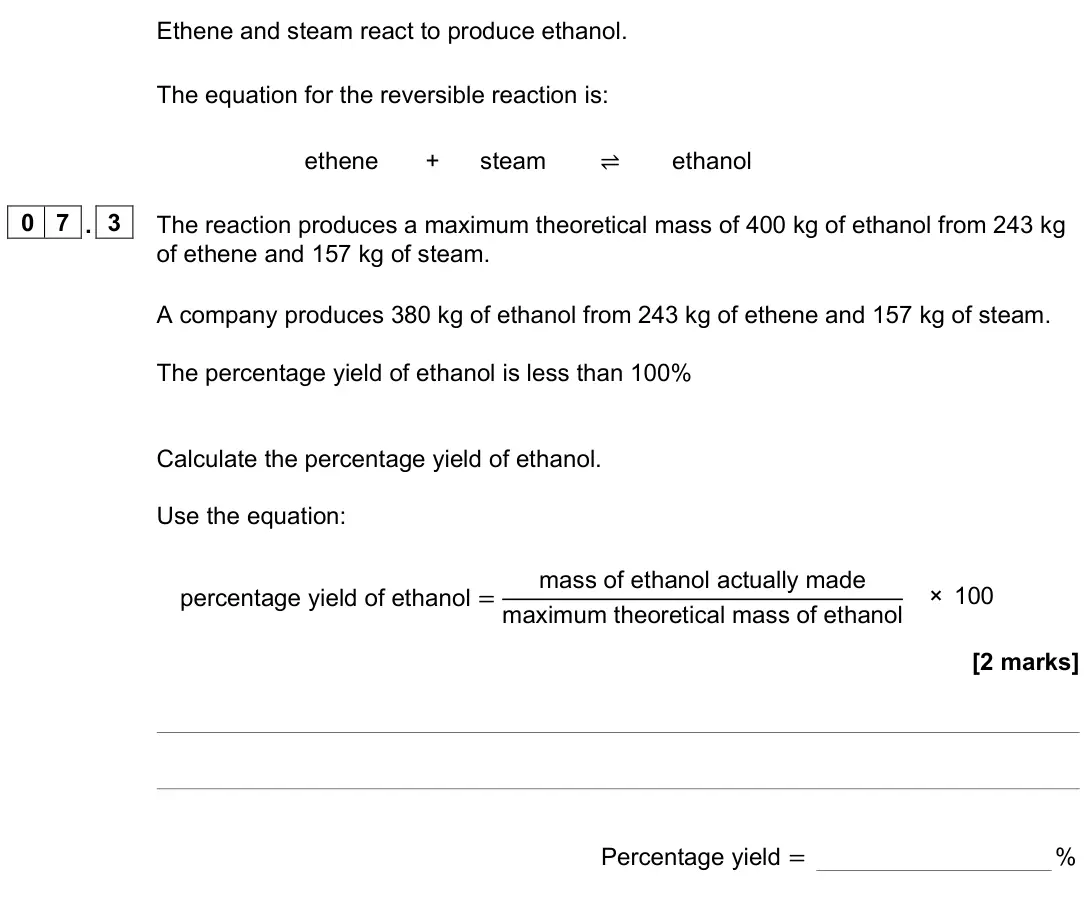
Q07.4
The whole paper ↗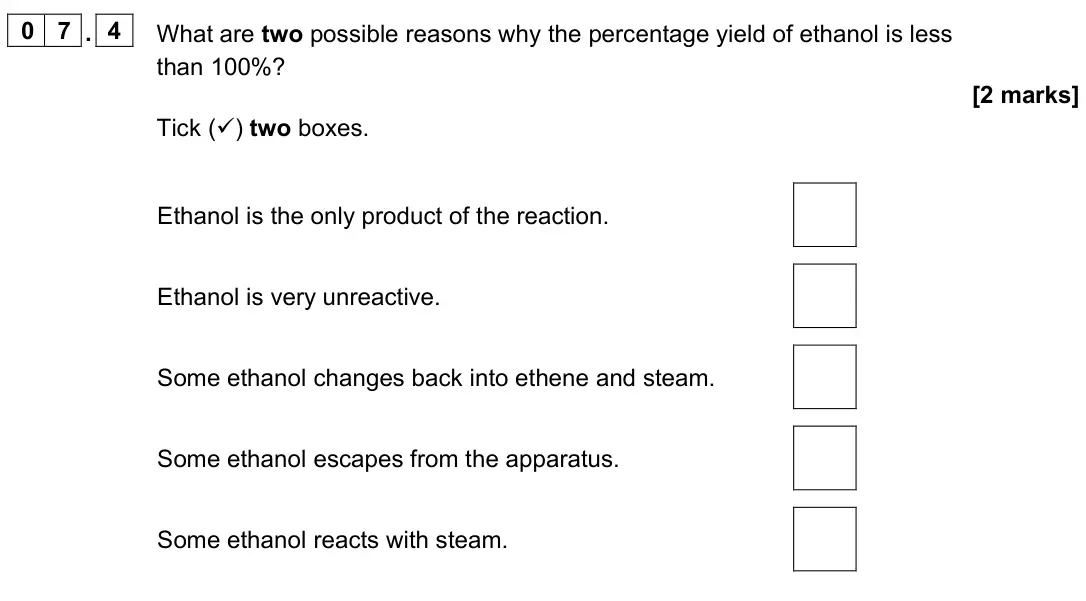
Q03.5
The whole paper ↗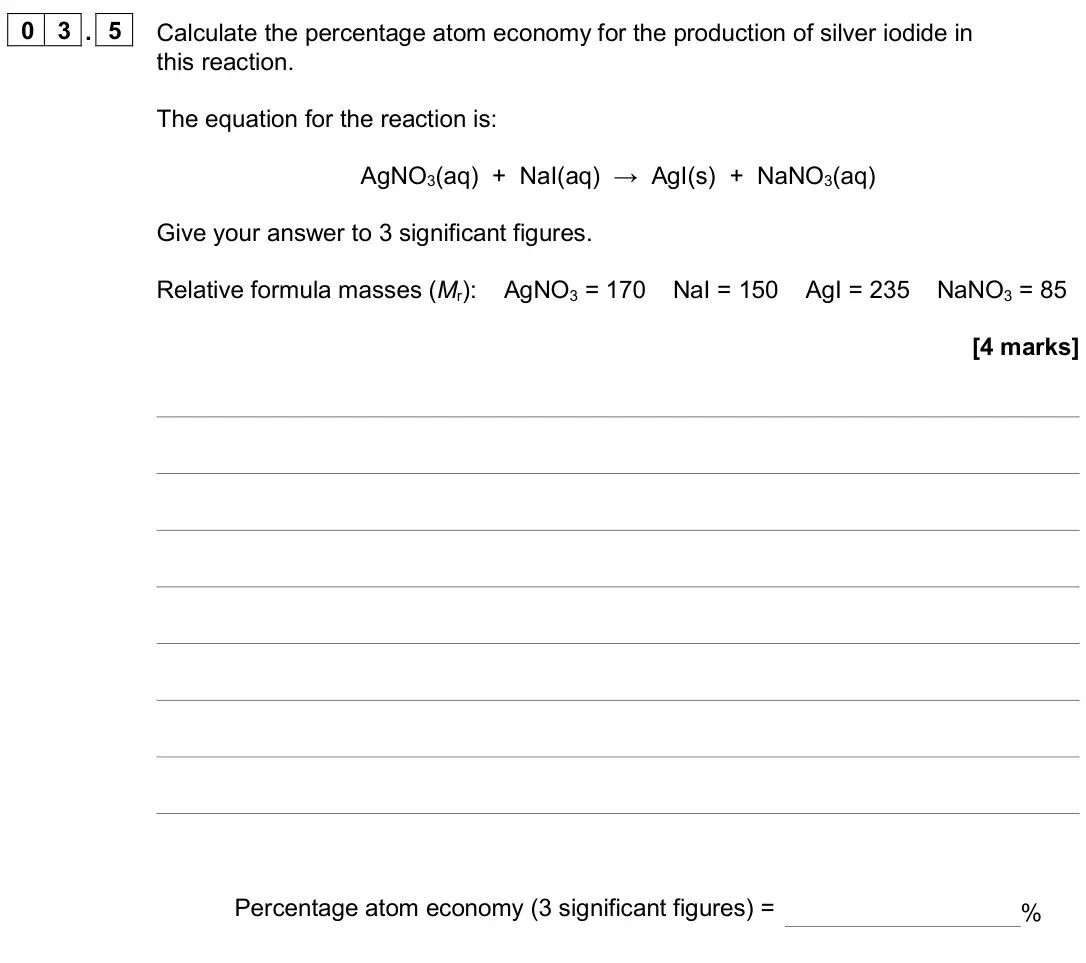
Q03.6
The whole paper ↗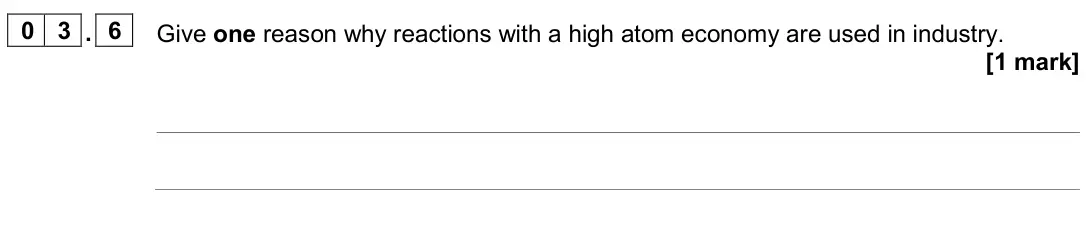
Q10.5
The whole paper ↗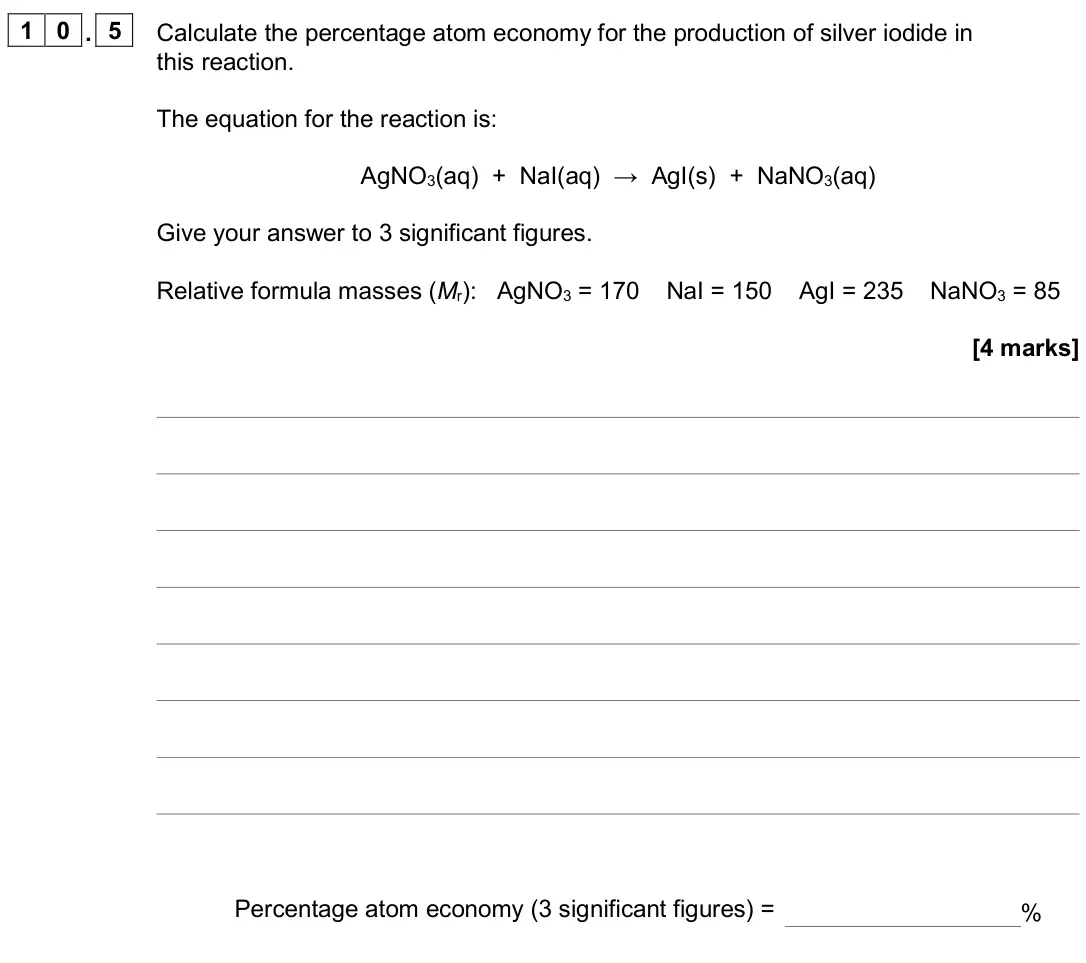
Q10.6
The whole paper ↗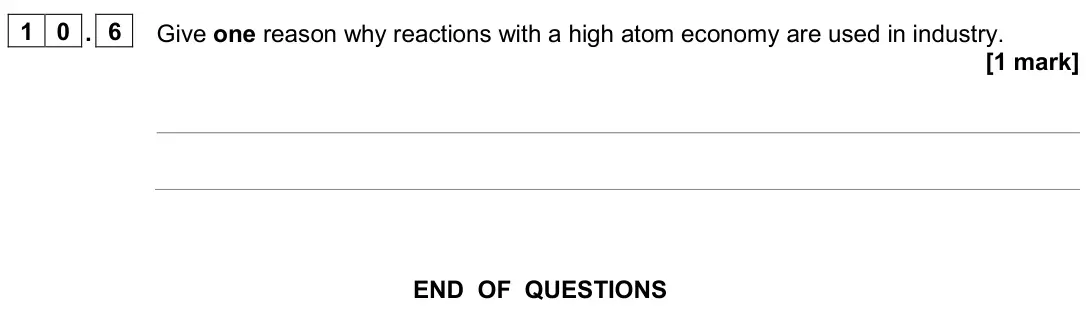
All 32 questions on Yield and atom economy of chemical reactions, as a list
- June 2025, Paper 1 Higher, Q03.3 (3 marks): Cadmium (Cd) can be extracted by the reaction of cadmium oxide with carbon. The equation for the reaction is: CdO + C ⟶ Cd + CO Calculate the percentage atom ec
- June 2025, Paper 1 Higher, Q03.6 (1 mark): The reaction producing tungsten has a high atom economy. Why is it important to use reactions with a high atom economy in industry? [1 mark]
- June 2025, Paper 1 Foundation, Q07.3 (2 marks): A mixture of salt and sand contained 16.0 g of salt. The student obtained 13.6 g of salt after separation from the mixture. Calculate the percentage yield of th
- June 2025, Paper 1 Foundation, Q10.3 (3 marks): Cadmium (Cd) can be extracted by the reaction of cadmium oxide with carbon. The equation for the reaction is: CdO + C ⟶ Cd + CO Calculate the percentage atom ec
- June 2025, Paper 1 Foundation, Q10.6 (1 mark): The reaction producing tungsten has a high atom economy. Why is it important to use reactions with a high atom economy in industry? [1 mark]
- June 2024, Paper 1 Higher, Q01.5 (3 marks): The maximum theoretical mass of the salt that could be produced using 50 cm3 of the sulfuric acid is 12.5 g. The percentage yield of the salt is 92.8%. Calculat
- June 2024, Paper 1 Foundation, Q08.5 (3 marks): The maximum theoretical mass of the salt that could be produced using 50 cm3 of the sulfuric acid is 12.5 g. The percentage yield of the salt is 92.8%. Calculat
- June 2023, Paper 1 Higher, Q09.6 (4 marks): Metal X is extracted from an oxide of metal X by reaction with hydrogen. The equation for the reaction is: XO3 + 3 H2 → X + 3 H2O The percentage atom economy fo
- June 2023, Paper 1 Foundation, Q08.4 (2 marks): Copper oxide reacts with hydrogen to produce copper. The equation for the reaction is: CuO + H2 → Cu + H2O Calculate the percentage atom economy for obtaining c
- June 2022, Paper 1 Foundation, Q08.7 (2 marks): Titanium can be produced from titanium oxide by electrolysis. The equation for the reaction is: TiO2 → Ti + O2 Calculate the percentage atom economy for the pro
- June 2022, Paper 2 Higher, Q07.2 (1 mark): How does the equation for the reaction show that the atom economy of the forward reaction is 100%? [1 mark]
- June 2022, Paper 2 Foundation, Q05.3 (1 mark): The word equation for the production of ammonia is: nitrogen + hydrogen ⇌ ammonia The atom economy of the reaction is 100%. How does the word equation show that
- November 2021, Paper 1 Higher, Q03.3 (3 marks): Carbon is used to extract tin (Sn) from tin oxide (SnO2). The equation for the reaction is: SnO2 + C → Sn + CO2 Calculate the percentage atom economy for extrac
- November 2021, Paper 1 Foundation, Q10.3 (3 marks): Carbon is used to extract tin (Sn) from tin oxide (SnO2). The equation for the reaction is: SnO2 + C → Sn + CO2 Calculate the percentage atom economy for extrac
- November 2021, Paper 2 Foundation, Q07.3 (2 marks): The reaction produces a maximum theoretical mass of 400 kg of ethanol from 243 kg of ethene and 157 kg of steam. A company produces 380 kg of ethanol from 243 k
- November 2021, Paper 2 Foundation, Q07.4 (2 marks): What are two possible reasons why the percentage yield of ethanol is less than 100%? [2 marks] Tick () two boxes. Ethanol is the only product of the reaction.
- November 2020, Paper 1 Higher, Q03.5 (4 marks): Calculate the percentage atom economy for the production of silver iodide in this reaction. The equation for the reaction is: AgNO3(aq) + NaI(aq) → AgI(s) + NaN
- November 2020, Paper 1 Higher, Q03.6 (1 mark): Give one reason why reactions with a high atom economy are used in industry. [1 mark]
- November 2020, Paper 1 Foundation, Q10.5 (4 marks): Calculate the percentage atom economy for the production of silver iodide in this reaction. The equation for the reaction is: AgNO3(aq) + NaI(aq) → AgI(s) + NaN
- November 2020, Paper 1 Foundation, Q10.6 (1 mark): Give one reason why reactions with a high atom economy are used in industry. [1 mark]
- June 2019, Paper 1 Foundation, Q06.1 (2 marks): Tungsten is a metal. The symbol of tungsten is W Tungsten is produced from tungsten oxide by reaction with hydrogen. The equation for the reaction is: WO3 + 3 H
- June 2019, Paper 1 Foundation, Q06.4 (3 marks): 60.0 kg of aluminium oxide produces a maximum of 31.8 kg of aluminium. In an extraction process only 28.4 kg of aluminium is produced from 60.0 kg of aluminium
- June 2018, Paper 1 Higher, Q02.5 (3 marks): An equation for the reaction is: NiO + C Ni + CO Calculate the percentage atom economy for the reaction to produce nickel. Relative atomic masses (Ar): C = 12
- June 2018, Paper 1 Higher, Q08.8 (2 marks): For a Stage 2 reaction the percentage yield was 92.3% The theoretical maximum mass of titanium produced in this batch was 13.5 kg. Calculate the actual mass of
- June 2018, Paper 1 Foundation, Q02.6 (2 marks): The company calculates that 500 g of titanium dioxide should produce 1.2 kg of titanium chloride. However, the company finds that 500 g of titanium dioxide only
- June 2018, Paper 1 Foundation, Q09.5 (3 marks): An equation for the reaction is: NiO + C Ni + CO Calculate the percentage atom economy for the reaction to produce nickel. Relative atomic masses (Ar): C = 12
- Specimen, Paper 1 Higher, Q05.3 (2 marks): The percentage yield of copper chloride was 79.1 %. Calculate the mass of copper chloride the student actually produced. [2 marks] Actual mass of copper chlorid
- Specimen, Paper 1 Higher, Q05.4 (3 marks): Look at the equations for the two reactions: Reaction 1 CuCO3(s) + 2HCl(aq) → CuCl2(aq) + H2O(l) + CO2(g) Reaction 2 CuO(s) + 2HCl(aq) → CuCl2(aq) + H2O(l) Reac
- Specimen, Paper 1 Higher, Q05.5 (1 mark): The atom economy for Reaction 1 is 68.45 %. Compare the atom economies of the two reactions for making copper chloride. Give a reason for the difference. [1 mar
- Specimen, Paper 1 Foundation, Q06.4 (3 marks): The percentage atom economy for a reaction is calculated using:
- Specimen, Paper 1 Foundation, Q06.5 (1 mark): Give one reason why is it important for the percentage atom economy of a reaction to be as high as possible. 8
- Specimen, Paper 2 Foundation, Q07.4 (2 marks): Use Figure 8 to determine the difference in percentage yield of ammonia at 150 atmospheres pressure and 250 atmospheres pressure. [2 marks] Difference in percen
Questions, mark schemes and examiner’s reports are © AQA, from their published past papers. Plumi isn’t affiliated with any exam board. Want whole papers? Every AQA GCSE Chemistry paper.
Rather write your answers by hand on iPad? Plumi marks them against the same mark schemes.