 plumi
Synthetic and naturally occurring polymers: AQA GCSE Chemistry questions
Every AQA GCSE Chemistry exam question on 4.7.3 Synthetic and naturally occurring polymers, 2018–2025, with its mark scheme and examiner’s report.
Find questions1,744
Calculations
Q07.1
The whole paper ↗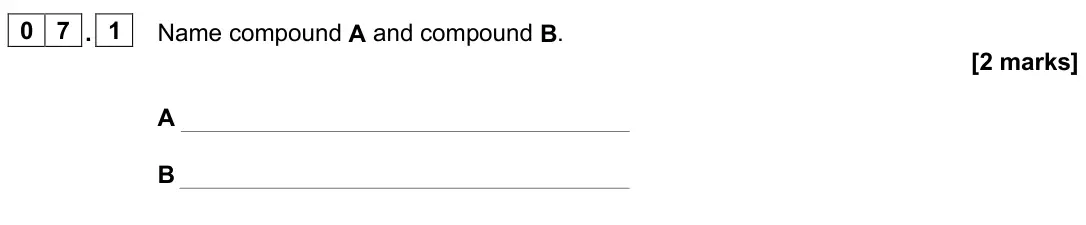
Q07.2
The whole paper ↗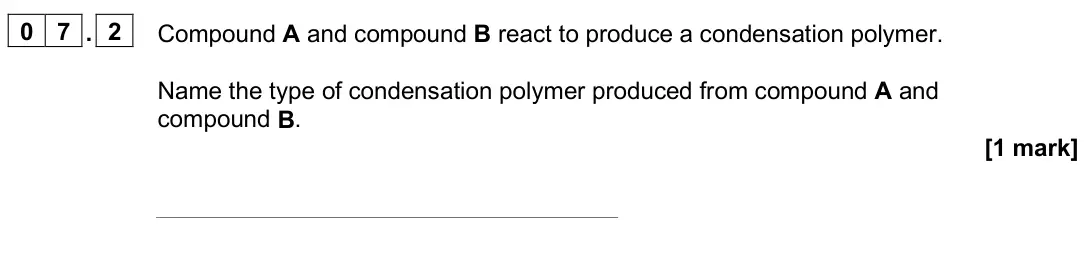
Q07.3
The whole paper ↗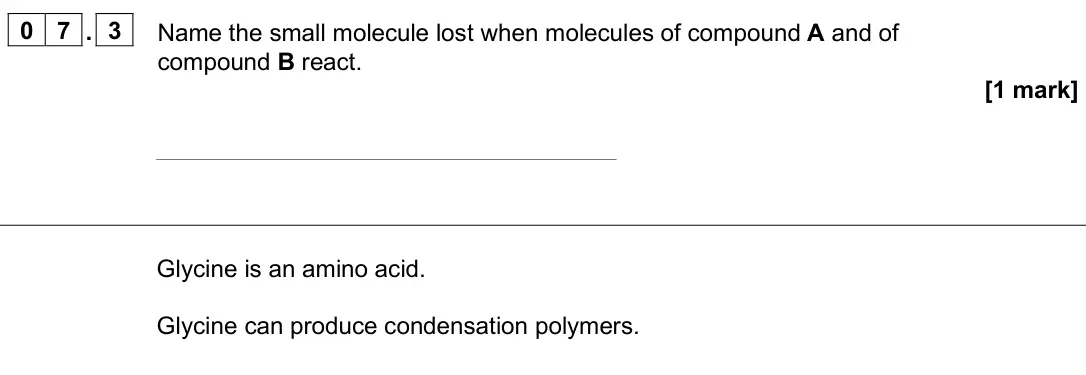
Q07.4
The whole paper ↗
Q07.5
The whole paper ↗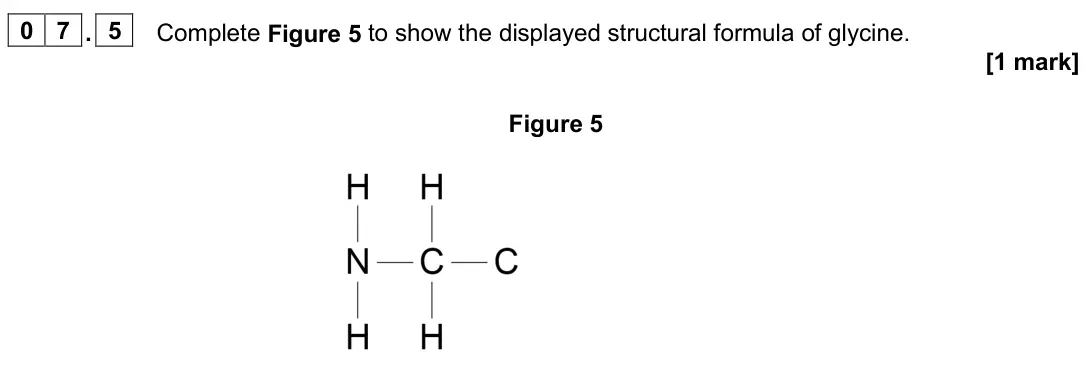
Q07.6
The whole paper ↗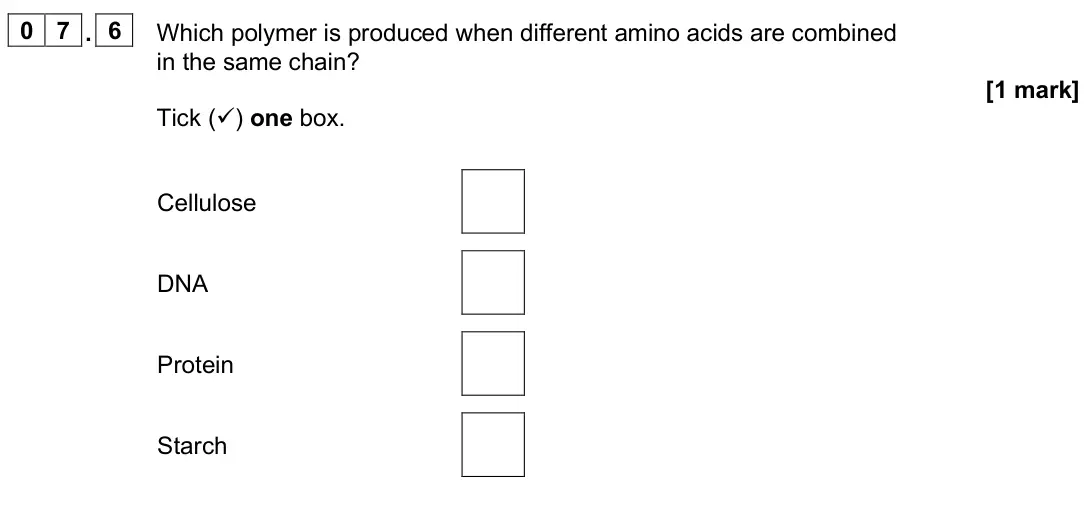
Q07.7
The whole paper ↗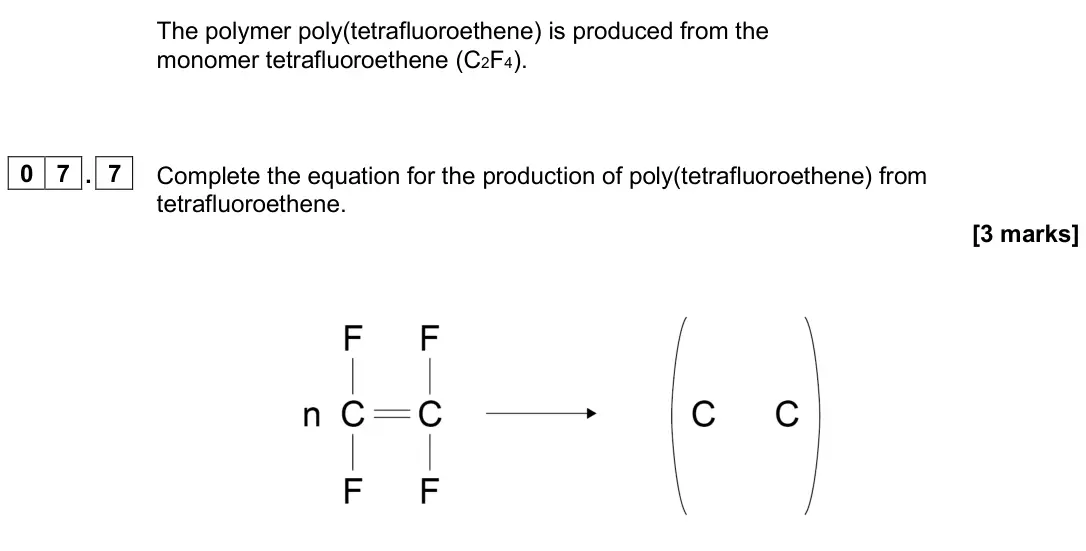
Q08.3
The whole paper ↗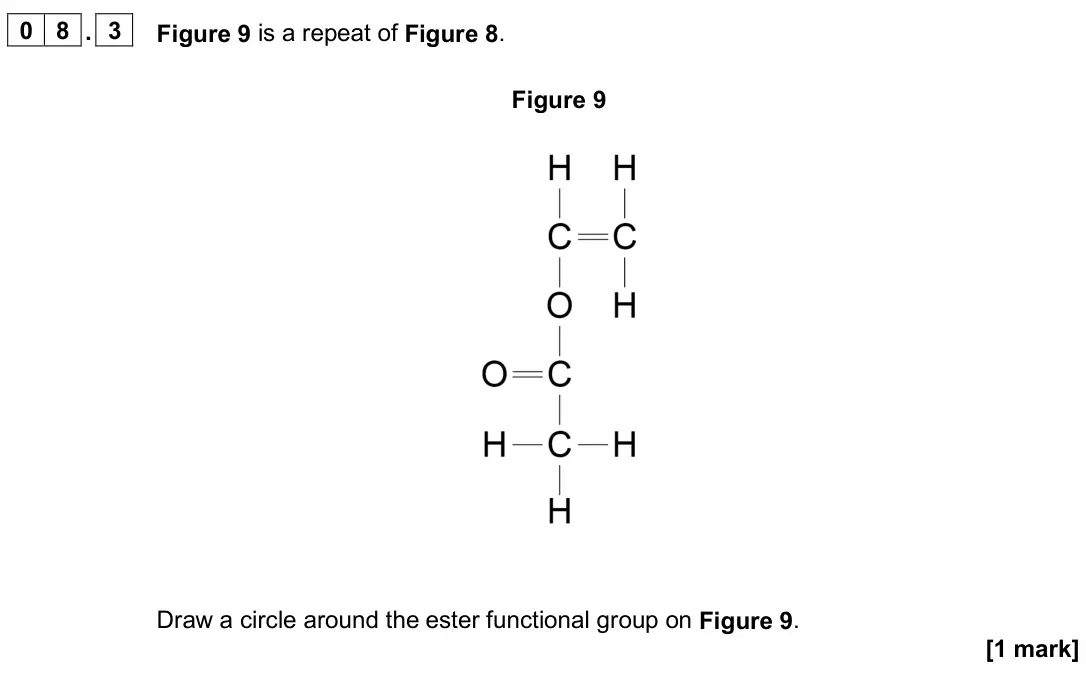
Q08.5
The whole paper ↗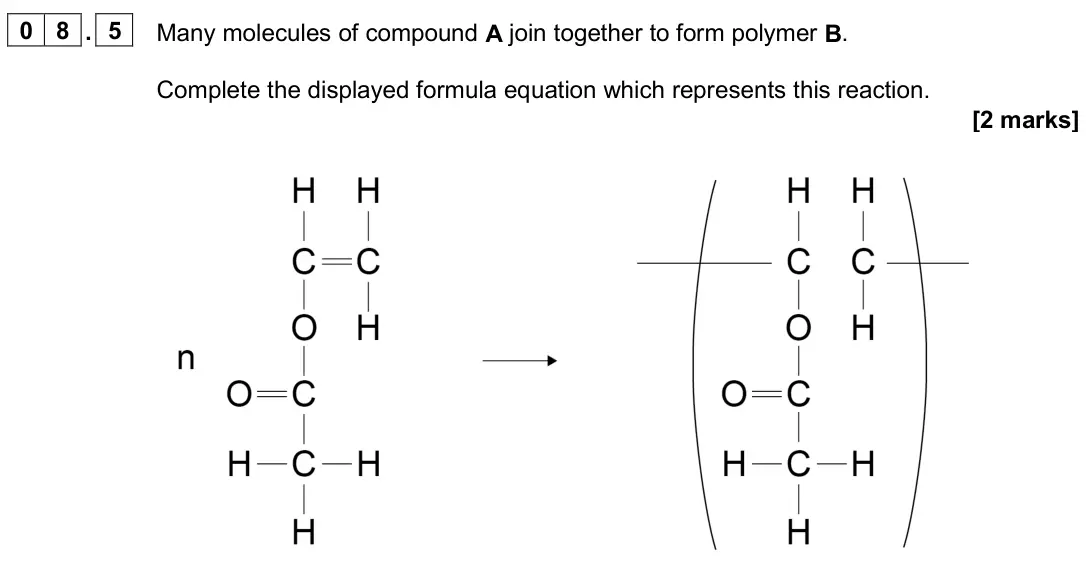
Q08.6
The whole paper ↗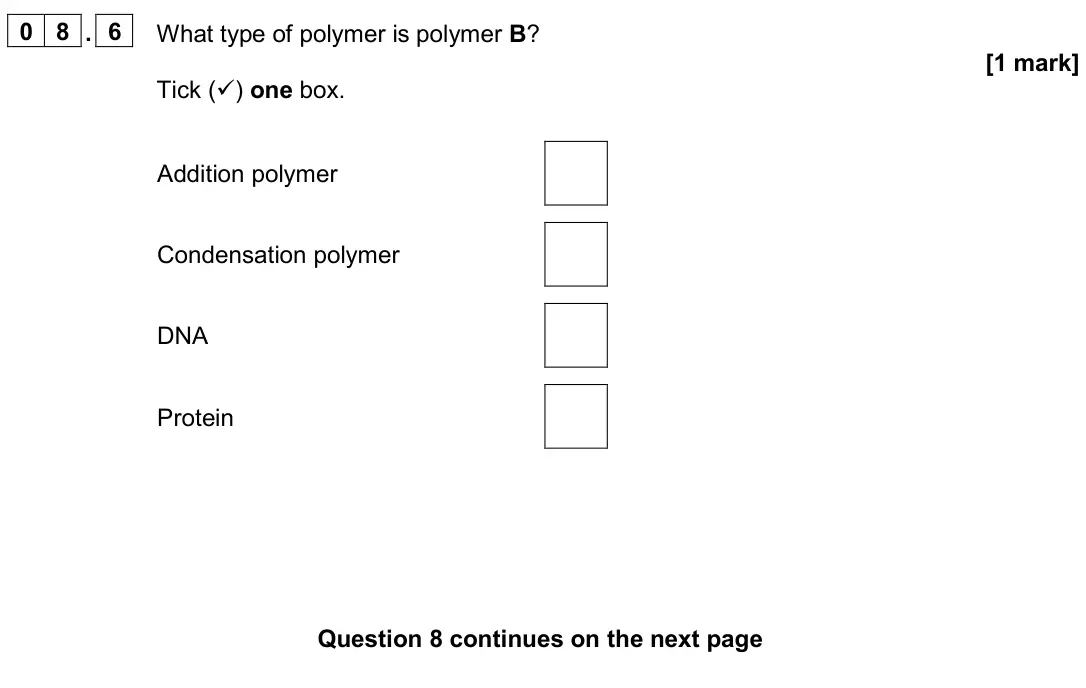
Q04.5
The whole paper ↗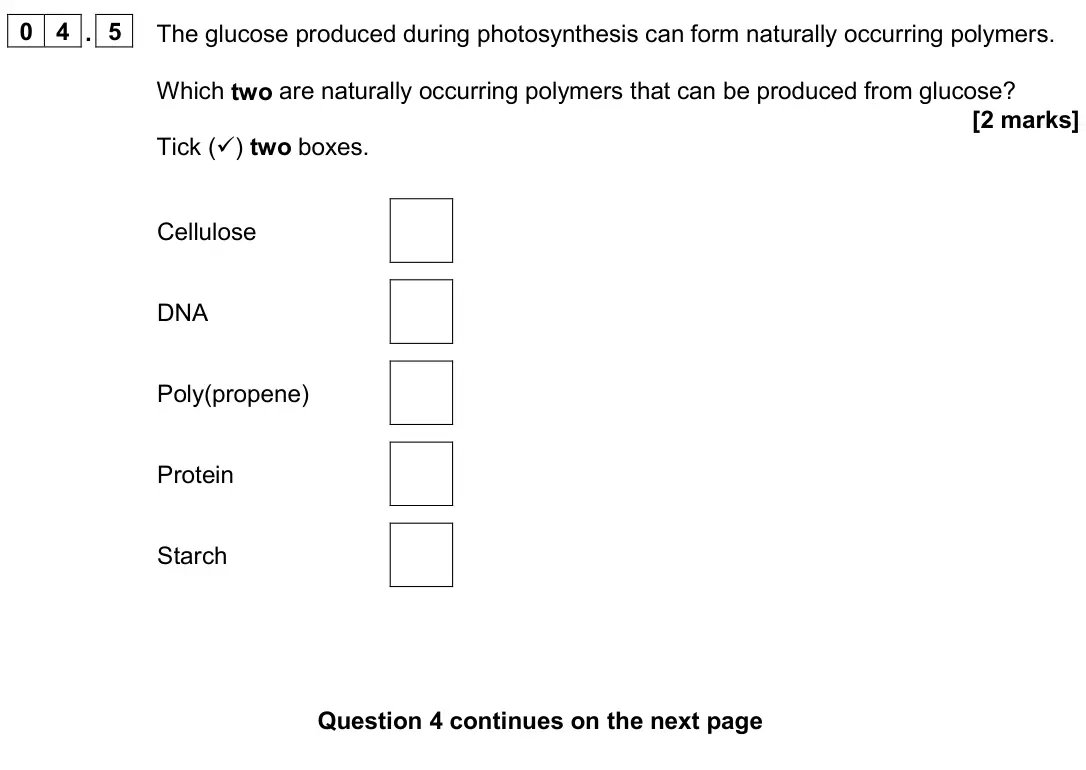
Q04.6
The whole paper ↗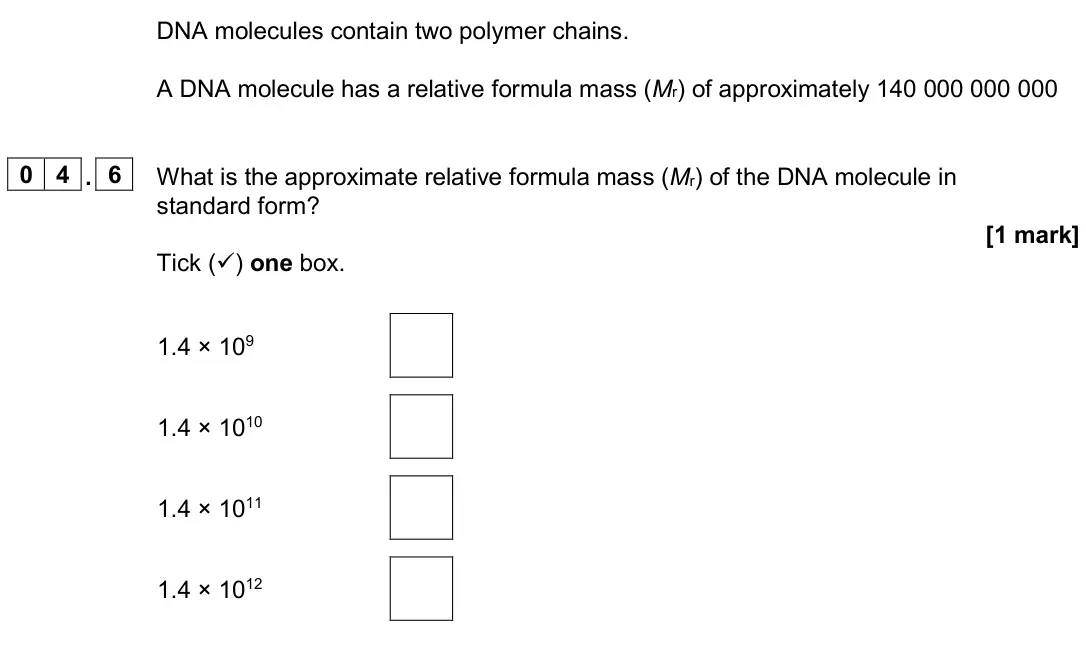
Q04.8
The whole paper ↗
Q06.4
The whole paper ↗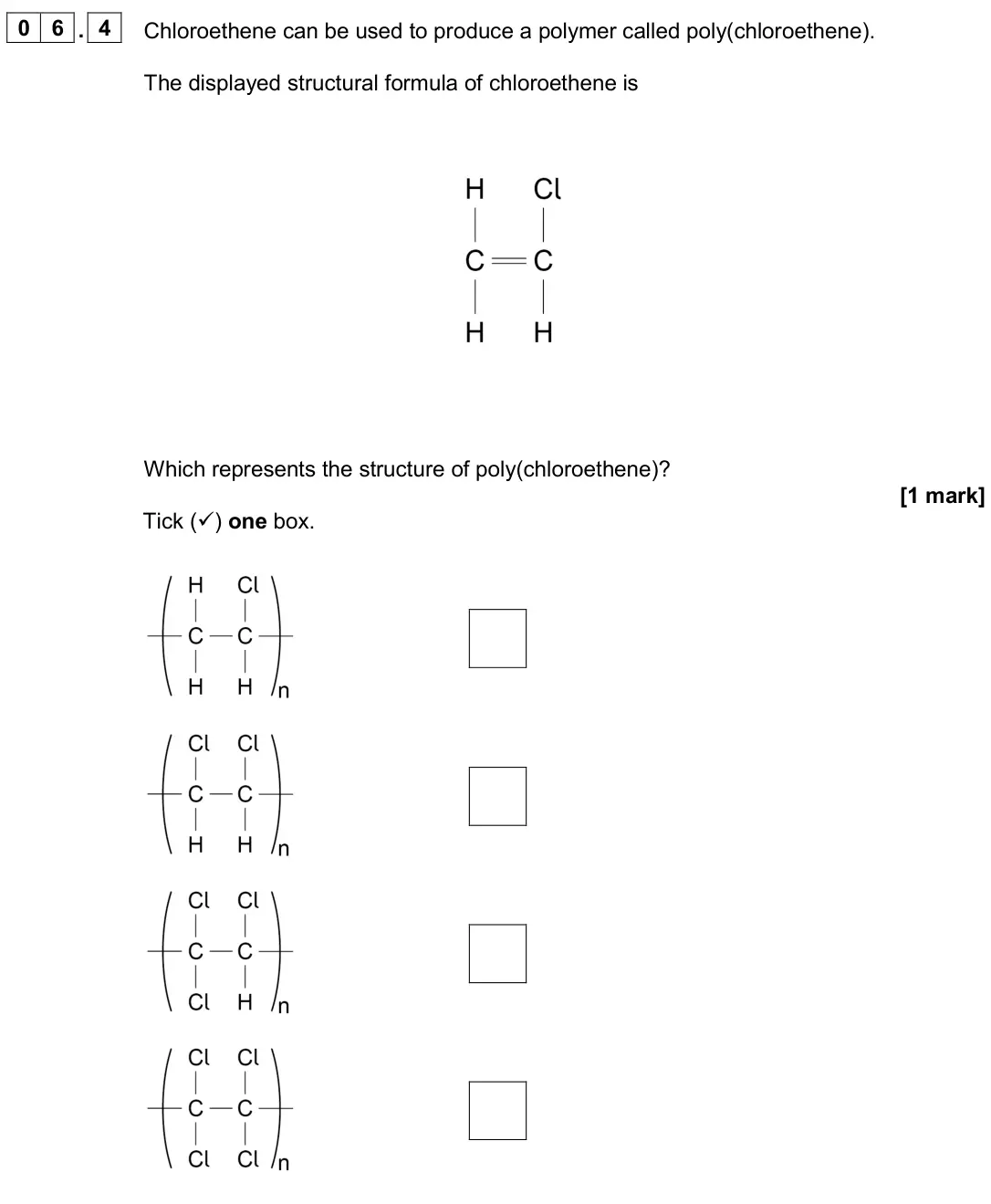
Q06.5
The whole paper ↗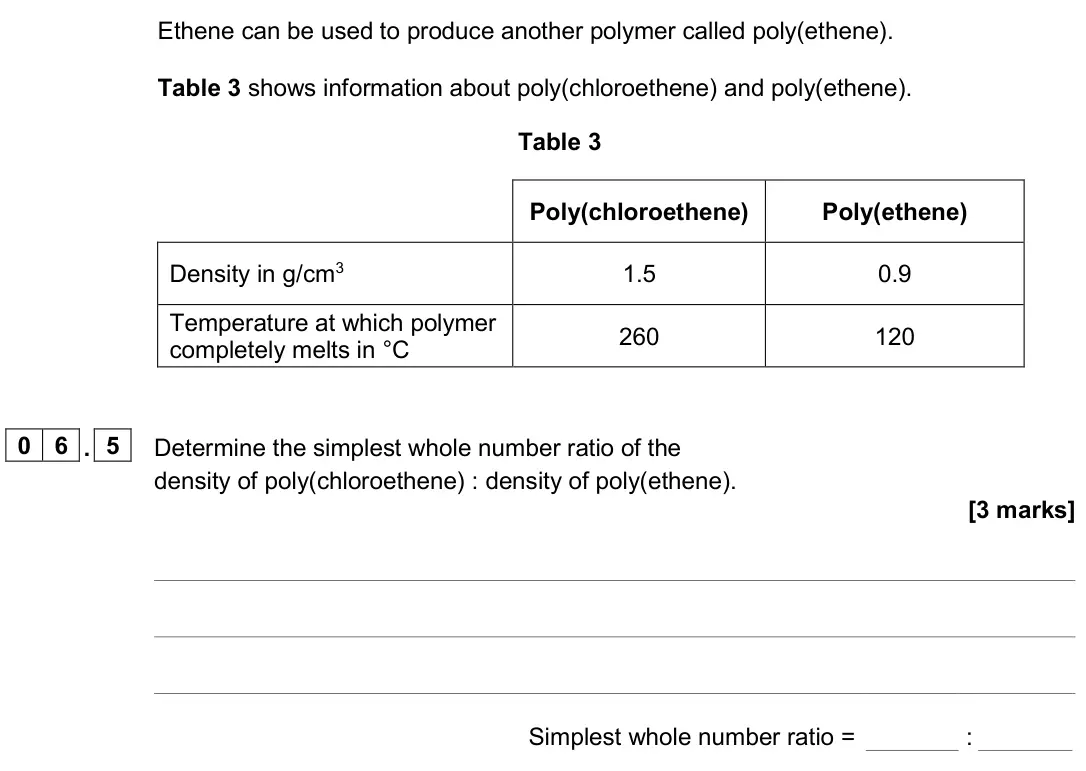
Q06.6
The whole paper ↗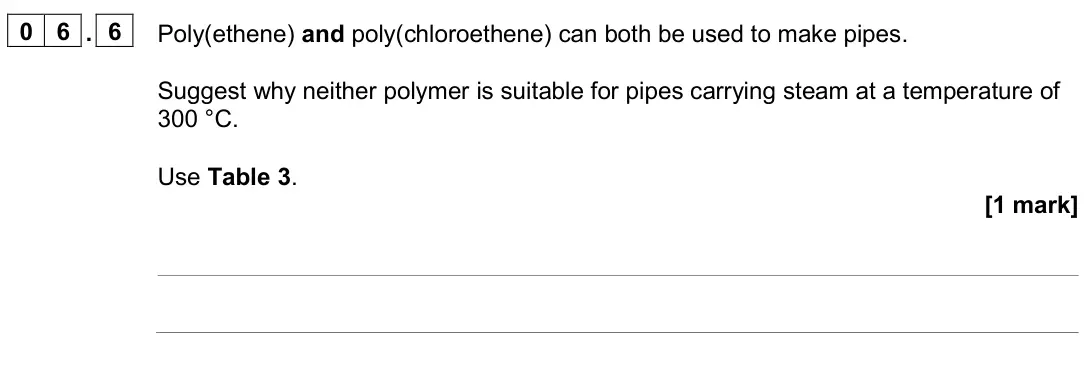
Q08.1
The whole paper ↗
Q08.2
The whole paper ↗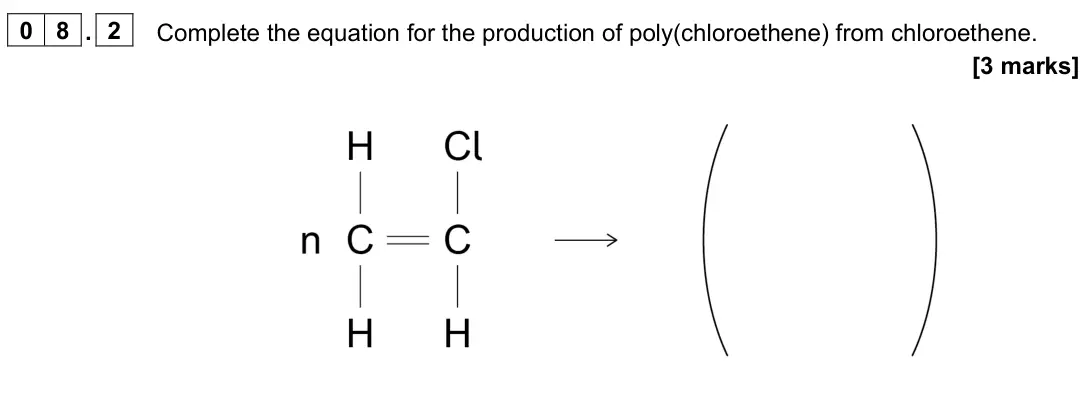
All 51 questions on Synthetic and naturally occurring polymers, as a list
- June 2025, Paper 2 Higher, Q07.1 (2 marks): Name compound A and compound B. [2 marks] A B
- June 2025, Paper 2 Higher, Q07.2 (1 mark): Compound A and compound B react to produce a condensation polymer. Name the type of condensation polymer produced from compound A and compound B. [1 mark]
- June 2025, Paper 2 Higher, Q07.3 (1 mark): Name the small molecule lost when molecules of compound A and of compound B react. [1 mark] Glycine is an amino acid. Glycine can produce condensation polymers.
- June 2025, Paper 2 Higher, Q07.4 (1 mark): Name the type of condensation polymer produced when glycine polymerises. [1 mark]
- June 2025, Paper 2 Higher, Q07.5 (1 mark): Complete Figure 5 to show the displayed structural formula of glycine. [1 mark] Figure 5
- June 2025, Paper 2 Higher, Q07.6 (1 mark): Which polymer is produced when different amino acids are combined in the same chain? [1 mark] Tick () one box. Cellulose DNA Protein Starch
- June 2025, Paper 2 Higher, Q07.7 (3 marks): Complete the equation for the production of poly(tetrafluoroethene) from tetrafluoroethene. [3 marks]
- June 2024, Paper 2 Higher, Q08.3 (1 mark): Figure 9 is a repeat of Figure 8. Figure 9 Draw a circle around the ester functional group on Figure 9. [1 mark]
- June 2024, Paper 2 Higher, Q08.5 (2 marks): Many molecules of compound A join together to form polymer B. Complete the displayed formula equation which represents this reaction. [2 marks]
- June 2024, Paper 2 Higher, Q08.6 (1 mark): What type of polymer is polymer B? [1 mark] Tick () one box. Addition polymer Condensation polymer DNA Protein
- June 2024, Paper 2 Foundation, Q04.5 (2 marks): The glucose produced during photosynthesis can form naturally occurring polymers. Which two are naturally occurring polymers that can be produced from glucose?
- June 2024, Paper 2 Foundation, Q04.6 (1 mark): What is the approximate relative formula mass (Mr) of the DNA molecule in standard form? [1 mark] Tick () one box. 1.4 × 10⁹ 1.4 × 10¹⁰ 1.4 × 10¹¹ 1.4 × 10¹²
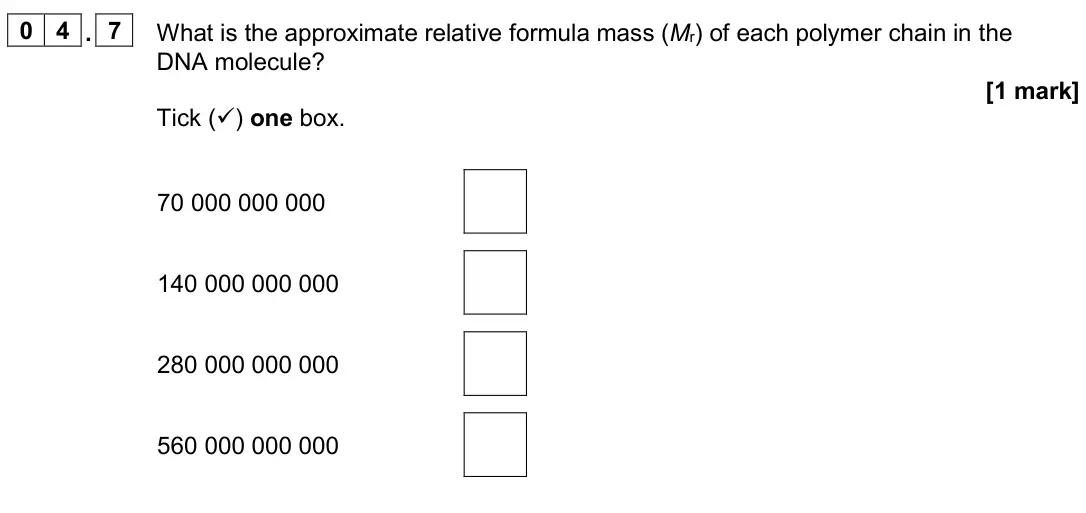
- June 2024, Paper 2 Foundation, Q04.7 (1 mark): What is the approximate relative formula mass (Mr) of each polymer chain in the DNA molecule? [1 mark] Tick () one box. 70 000 000 000 140 000 000 000 280 000
- June 2024, Paper 2 Foundation, Q04.8 (1 mark): Complete the sentence. [1 mark] The shape of a DNA molecule is a double .
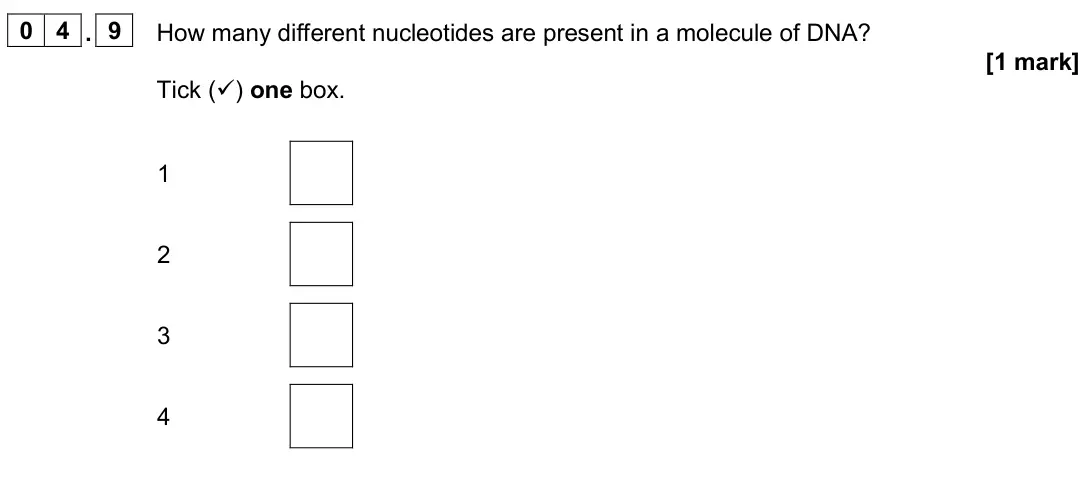
- June 2024, Paper 2 Foundation, Q04.9 (1 mark): How many different nucleotides are present in a molecule of DNA? [1 mark] Tick () one box. 1 2 3 4
- June 2024, Paper 2 Foundation, Q06.4 (1 mark): Chloroethene can be used to produce a polymer called poly(chloroethene). The displayed structural formula of chloroethene is Which represents the structure of p
- June 2024, Paper 2 Foundation, Q06.5 (3 marks): Determine the simplest whole number ratio of the density of poly(chloroethene) : density of poly(ethene). [3 marks] Simplest whole number ratio = :
- June 2024, Paper 2 Foundation, Q06.6 (1 mark): Poly(ethene) and poly(chloroethene) can both be used to make pipes. Suggest why neither polymer is suitable for pipes carrying steam at a temperature of 300 °C.
- June 2023, Paper 2 Higher, Q08.1 (1 mark): Draw a circle around the functional group on the displayed structural formula that allows chloroethene to produce an addition polymer. [1 mark]
- June 2023, Paper 2 Higher, Q08.2 (3 marks): Complete the equation for the production of poly(chloroethene) from chloroethene. [3 marks]
- June 2023, Paper 2 Higher, Q08.4 (1 mark): The amino acid beta-alanine has the formula H2NCH2CH2COOH Beta-alanine polymerises to produce a polypeptide and a small molecule. Name the small molecule produc
- June 2023, Paper 2 Higher, Q08.5 (2 marks): An amino acid can be represented as: The relative formula mass (Mr) of this amino acid is 75 Calculate the relative formula mass of the section of this amino ac
- June 2023, Paper 2 Higher, Q08.6 (1 mark): Draw a circle around the repeating unit in the polymer in Figure 6. [1 mark]
- June 2023, Paper 2 Higher, Q08.7 (1 mark): Suggest the identity of this polymer. [1 mark]
- June 2023, Paper 2 Higher, Q08.8 (1 mark): Give the general name for the four different monomers which make up the structure shown in Figure 7. [1 mark]
- June 2023, Paper 2 Higher, Q08.9 (1 mark): Name the shape of the structure shown in Figure 7. [1 mark]
- June 2023, Paper 2 Foundation, Q02.1 (2 marks): Suggest two reasons why a Bunsen burner should not be used to heat a liquid in a poly(propene) beaker. Use Table 1. [2 marks] 1 2
- June 2023, Paper 2 Foundation, Q02.2 (1 mark): Poly(propene) beakers are more expensive than borosilicate glass beakers. Suggest one reason why using poly(propene) beakers instead of borosilicate glass beake
- June 2023, Paper 2 Foundation, Q02.5 (1 mark): Which structure is the repeating unit of poly(propene)? [1 mark] Tick () one box.
- June 2023, Paper 2 Foundation, Q02.6 (3 marks): Poly(propene) is produced in three stages: • Stage 1: separating large alkane molecules from crude oil • Stage 2: producing propene molecules from large alkane
- June 2023, Paper 2 Foundation, Q02.7 (2 marks): A molecule of hexene contains a double carbon–carbon bond. Many hexene molecules join together to form poly(hexene). Which two words describe a hexene molecule
- June 2022, Paper 2 Higher, Q01.1 (2 marks): The addition polymer poly(butene) has the displayed structural formula: Poly(butene) is produced from the monomer butene. Complete Figure 2 to show the displaye
- June 2022, Paper 2 Foundation, Q08.1 (2 marks): The addition polymer poly(butene) has the displayed structural formula: Poly(butene) is produced from the monomer butene. Complete Figure 10 to show the display
- November 2021, Paper 2 Higher, Q04.1 (2 marks): Poly(ethene) is produced from ethene. Figure 3 shows part of the displayed structural formula equation for the reaction. Complete Figure 3. [2 marks] Figure 3
- November 2021, Paper 2 Higher, Q04.5 (1 mark): Draw a circle on Figure 5 around an alcohol functional group. [1 mark]
- November 2021, Paper 2 Higher, Q04.6 (1 mark): Complete Table 2 to show the formula of the small molecule produced when: • monomer A reacts with monomer B • monomer A reacts with monomer C. [1 mark] Table 2
- November 2021, Paper 2 Foundation, Q03.4 (1 mark): Figure 3 shows the displayed structural formula of poly(chloroethene). Figure 3 Which monomer is used to make poly(chloroethene)? [1 mark] Tick () one box.
- November 2021, Paper 2 Foundation, Q07.2 (1 mark): Poly(propene) is a polymer. What is the name of the monomer used to produce poly(propene)? [1 mark] Tick () one box. Propane Propanoic acid Propanol Propene
- November 2020, Paper 2 Higher, Q07.6 (1 mark): Hexanedioic acid and ethanediol join together to produce a polyester. Ethanoic acid and ethanol join together in the same way to produce an ester. Which is the
- November 2020, Paper 2 Higher, Q09.2 (2 marks): Glucose is produced when algae photosynthesise. Name two naturally occurring polymers produced from glucose. [2 marks] and
- November 2020, Paper 2 Higher, Q09.3 (1 mark): How many functional groups are there in the molecule in Figure 6? [1 mark] Tick () one box. 1 2 3 4
- November 2020, Paper 2 Higher, Q09.4 (1 mark): Glycine reacts by condensation polymerisation to produce a polypeptide and one other substance. Name the other substance produced. [1 mark]
- November 2020, Paper 2 Higher, Q09.5 (2 marks): Scientists think that algae may have used gases in Earth’s early atmosphere. Algae need an element to produce the molecule in Figure 6 which is not present in w
- November 2020, Paper 2 Higher, Q09.6 (3 marks): The development and function of algae are controlled by a naturally occurring polymer. Figure 7 represents the shape and structure of this polymer. Figure 7 Des
- November 2020, Paper 2 Foundation, Q06.3 (2 marks): Complete the sentences. [2 marks] The name for very large molecules such as poly(propene) is . The name of the alkene used to produce poly(propene) is .
- November 2020, Paper 2 Foundation, Q06.5 (1 mark): What type of bond joins the atoms in a molecule of poly(propene)? [1 mark] Tick () one box. Covalent Ionic Metallic
- June 2018, Paper 2 Higher, Q06.1 (1 mark): Polyesters are produced when monomers join together and lose a small molecule. Name the small molecule lost. [1 mark]
- June 2018, Paper 2 Higher, Q06.2 (3 marks): Poly(propene) is produced from propene. Complete the structure of poly(propene) in the equation. [3 marks]
- June 2018, Paper 2 Higher, Q06.4 (4 marks): Evaluate the suitability of poly(propene) and polyester for firefighter uniforms. [4 marks]
- Specimen, Paper 2 Higher, Q06.1 (2 marks): Draw the bonds to complete the displayed formulae of ethene and poly(ethene) in the equation. [2 marks]
- Specimen, Paper 2 Higher, Q06.2 (4 marks): Polyesters are made by a different method of polymerisation. The equation for the reaction to produce a polyester can be represented as: Compare the polymerisat
Questions, mark schemes and examiner’s reports are © AQA, from their published past papers. Plumi isn’t affiliated with any exam board. Want whole papers? Every AQA GCSE Chemistry paper.
Rather write your answers by hand on iPad? Plumi marks them against the same mark schemes.