 plumi
Exothermic and endothermic reactions: AQA GCSE Chemistry questions
Every AQA GCSE Chemistry exam question on 4.5.1 Exothermic and endothermic reactions, 2018–2025, with its mark scheme and examiner’s report.
Find questions1,744
Calculations
Q07.4
The whole paper ↗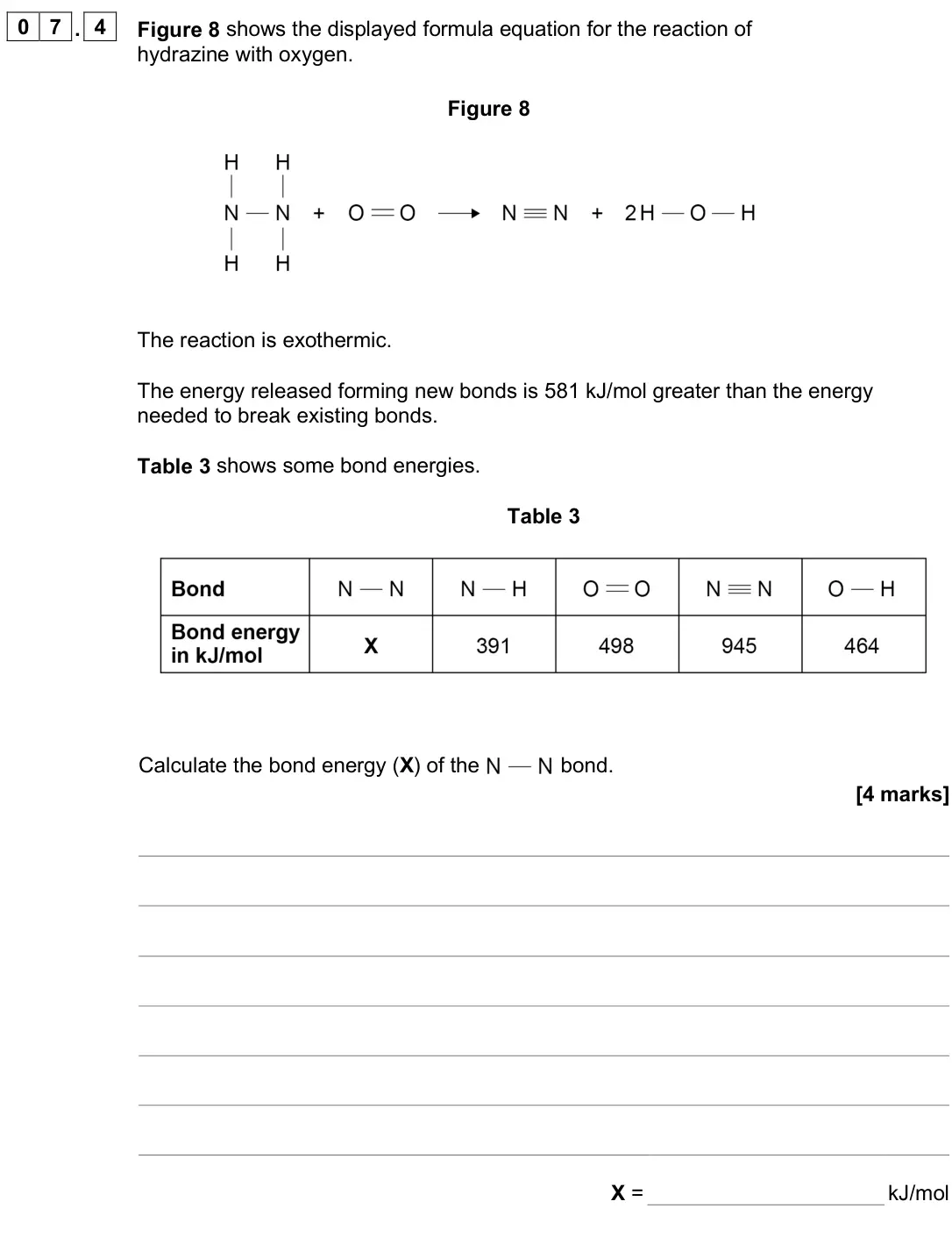
Q02.3
The whole paper ↗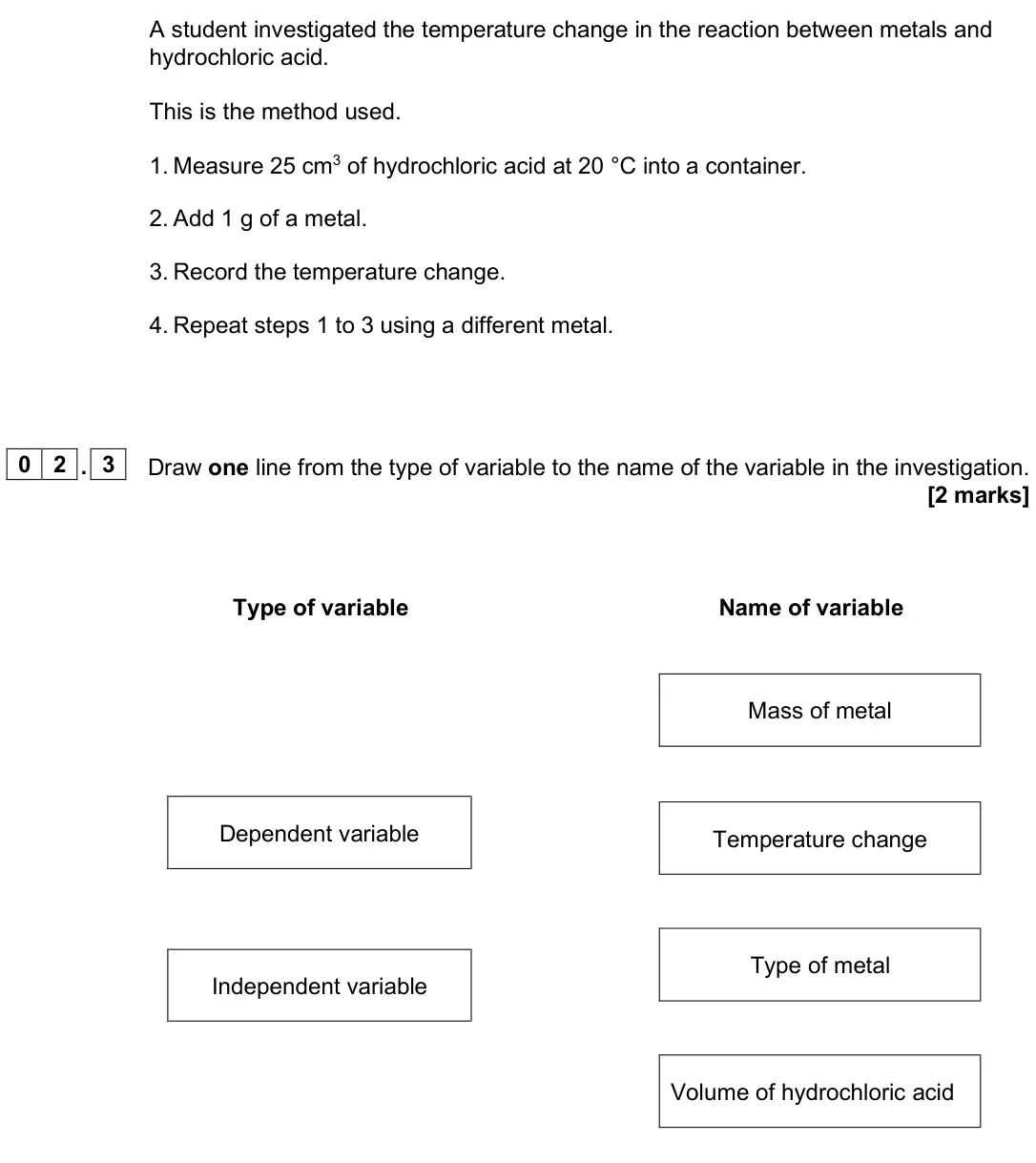
Q02.4
The whole paper ↗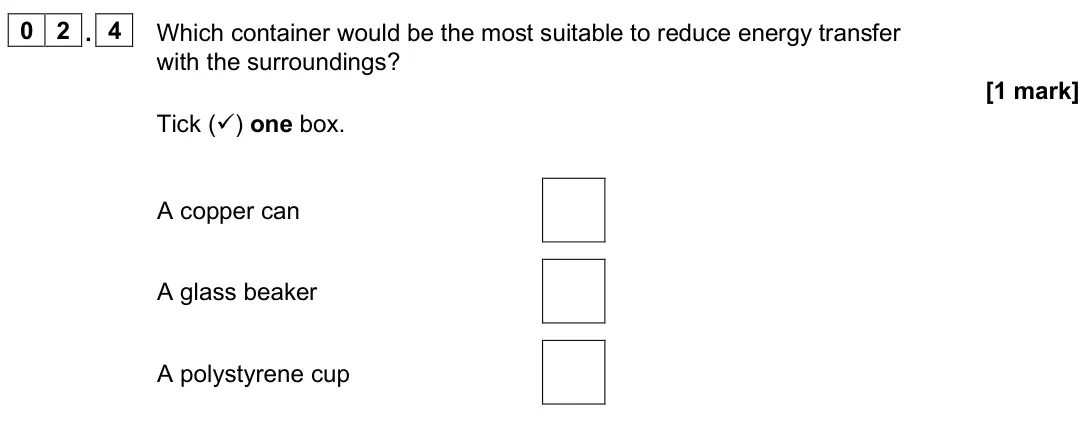
Q02.5
The whole paper ↗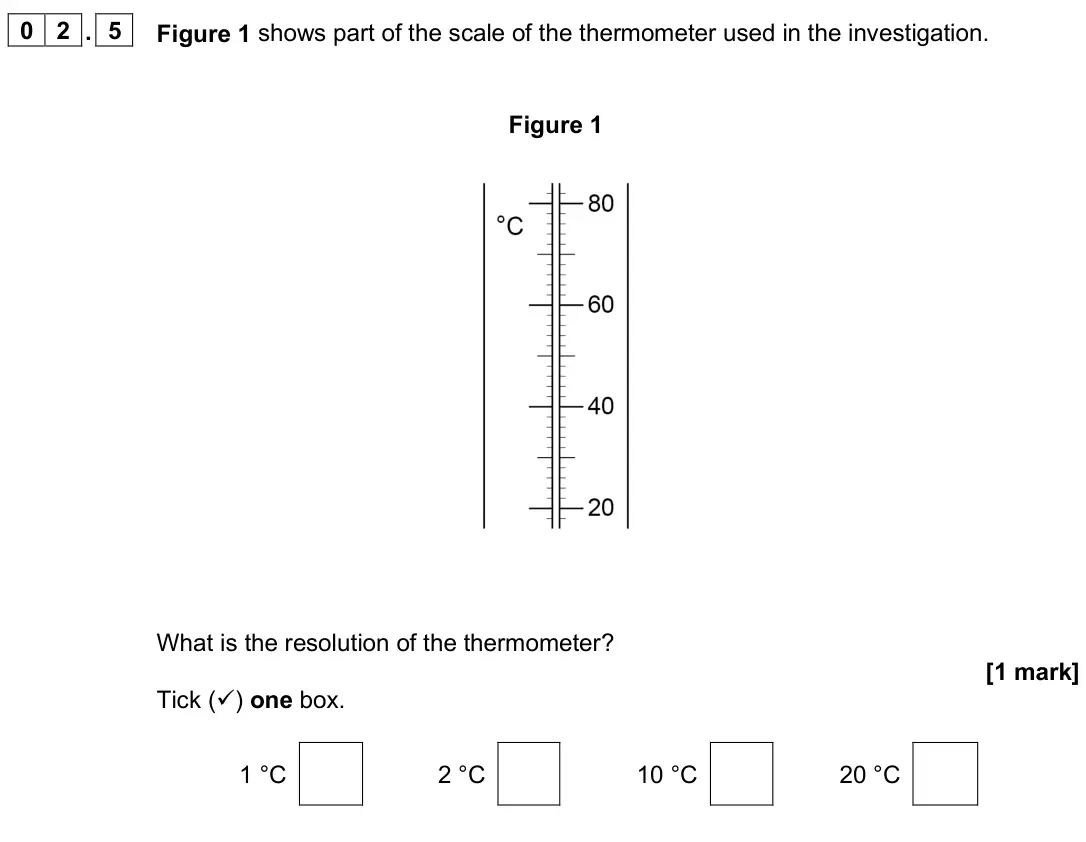
Q02.6
The whole paper ↗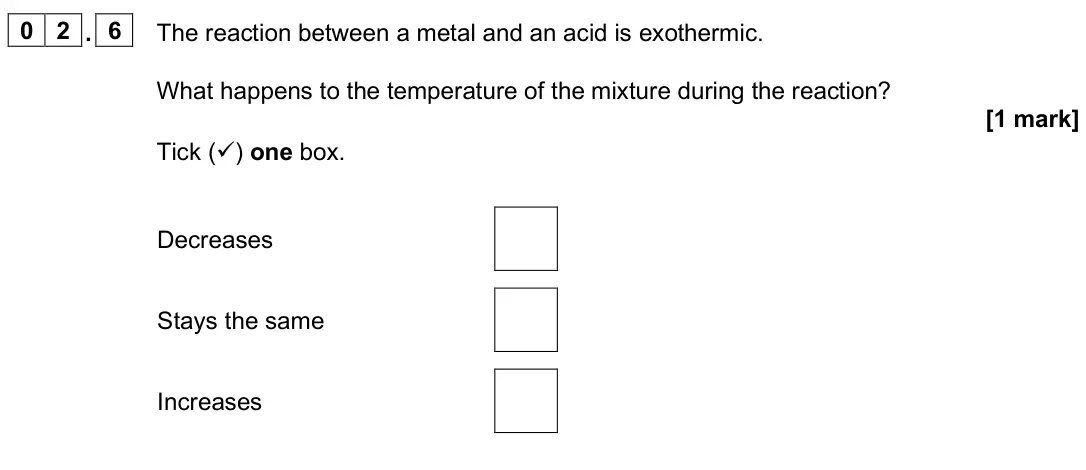
Q02.7
The whole paper ↗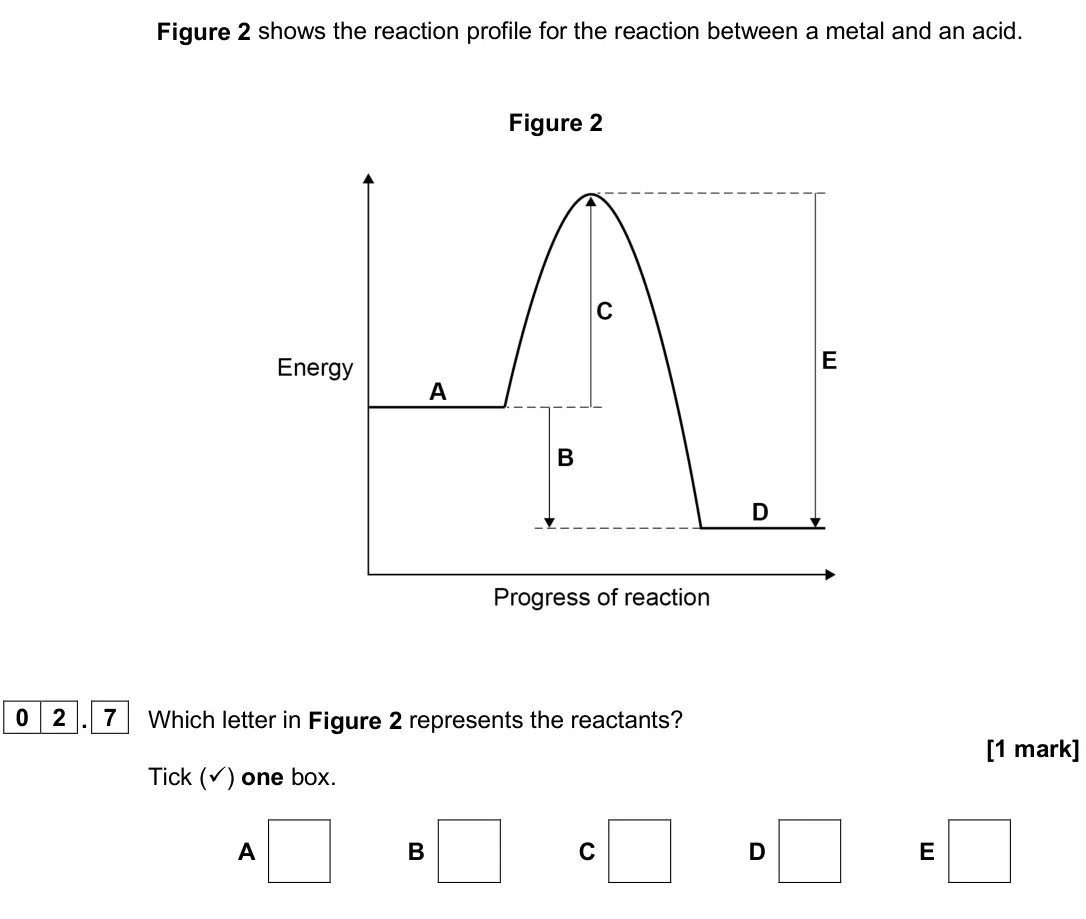
Q02.8
The whole paper ↗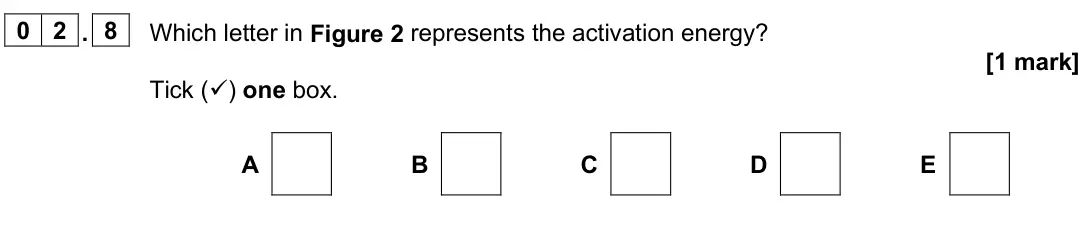
Q02.9
The whole paper ↗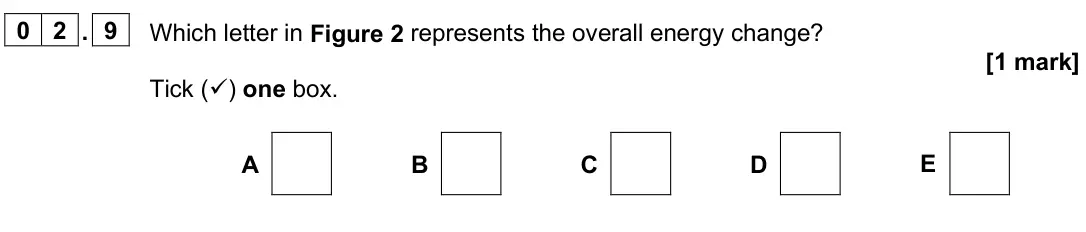
Q03.3
The whole paper ↗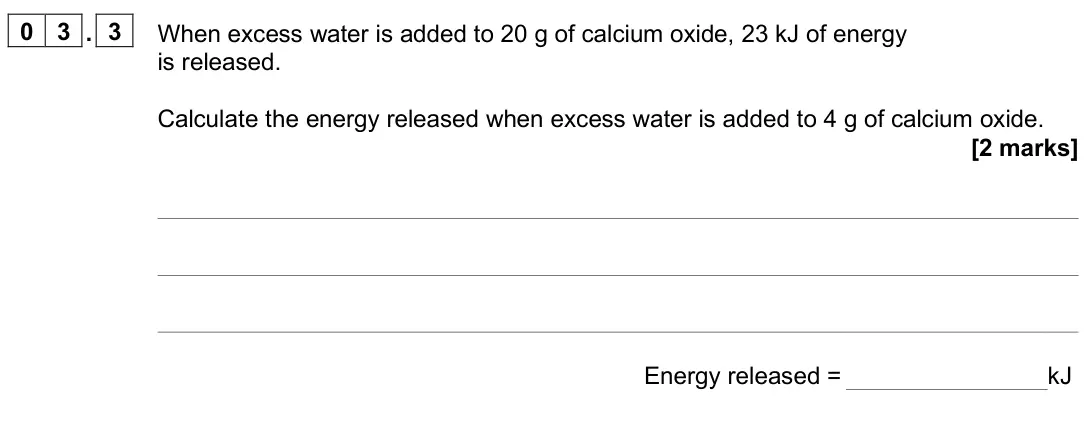
Q04.1
The whole paper ↗
Q04.2
The whole paper ↗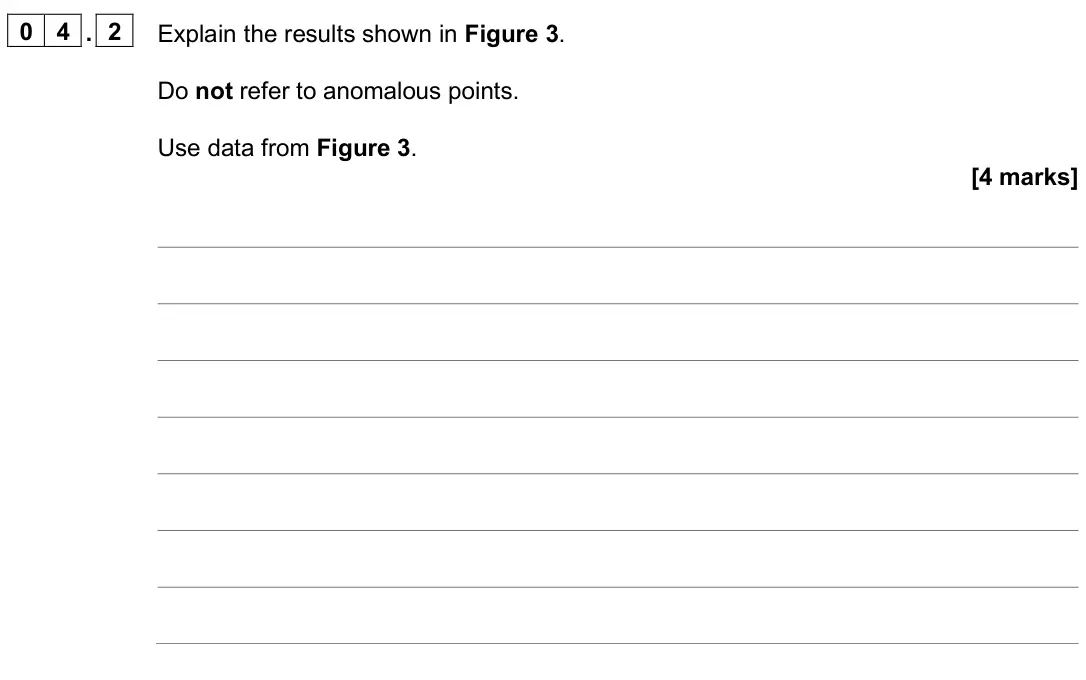
Q04.3
The whole paper ↗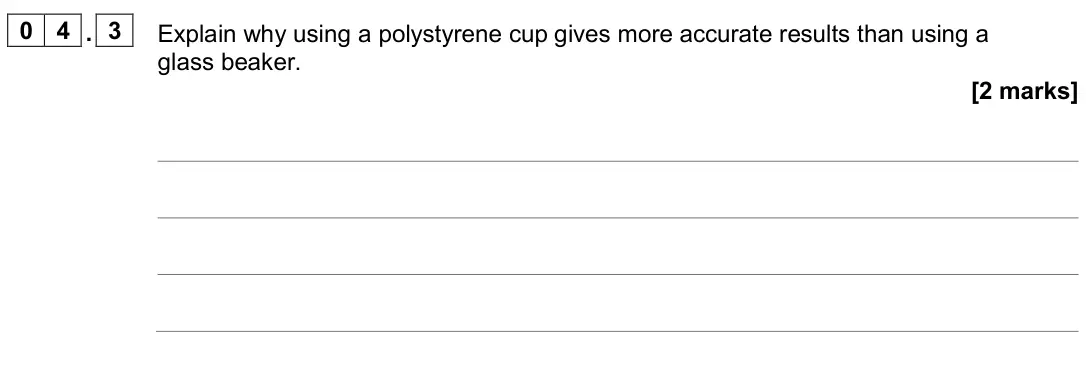
Q04.6
The whole paper ↗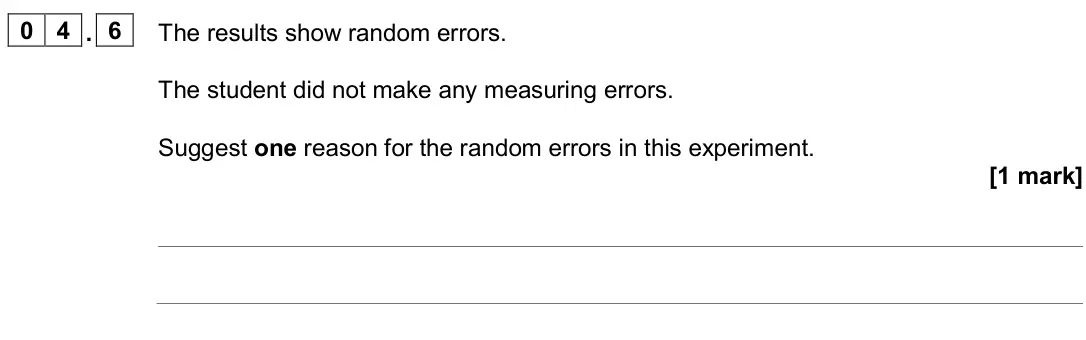
Q08.2
The whole paper ↗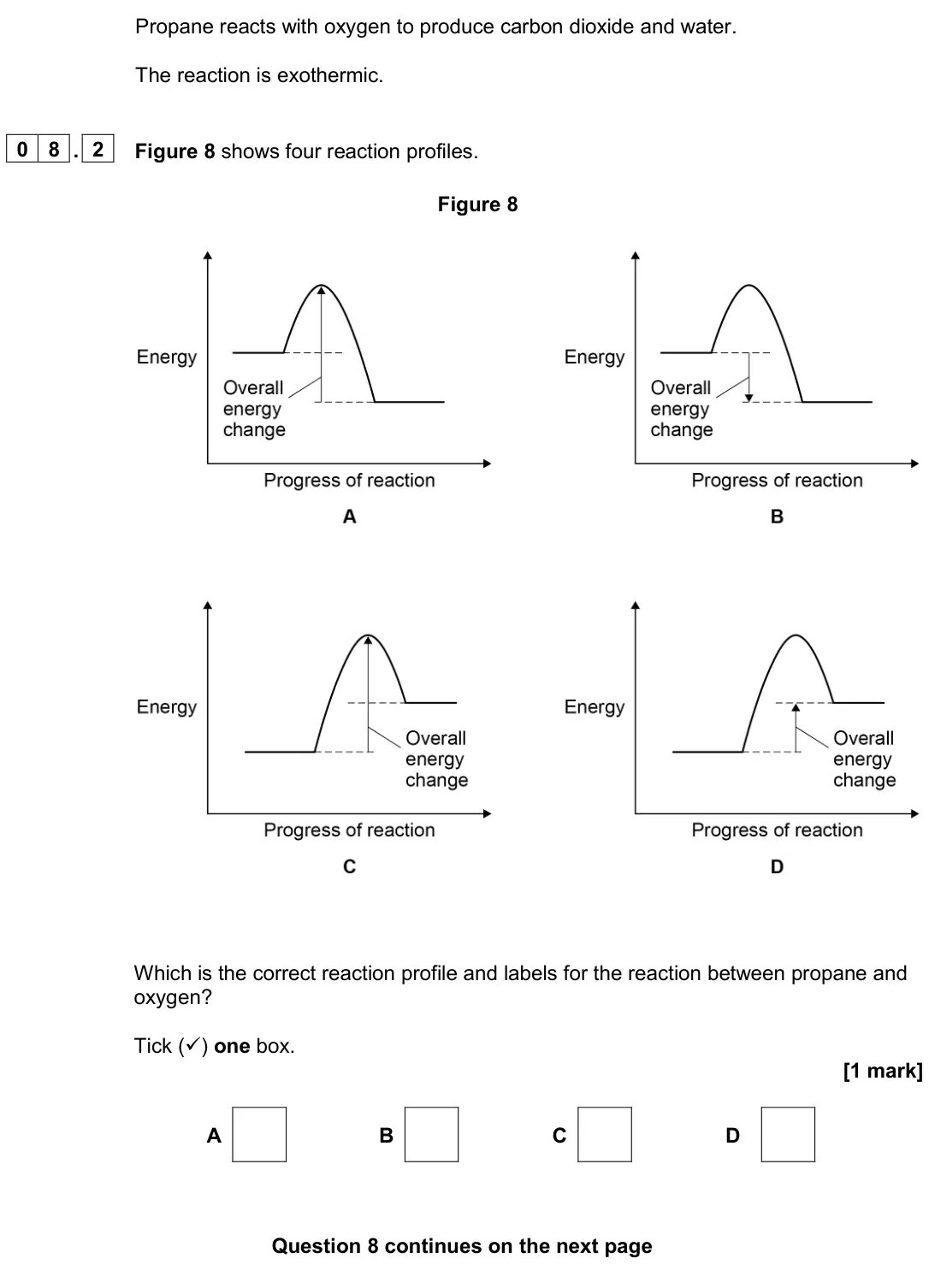
Q08.3
The whole paper ↗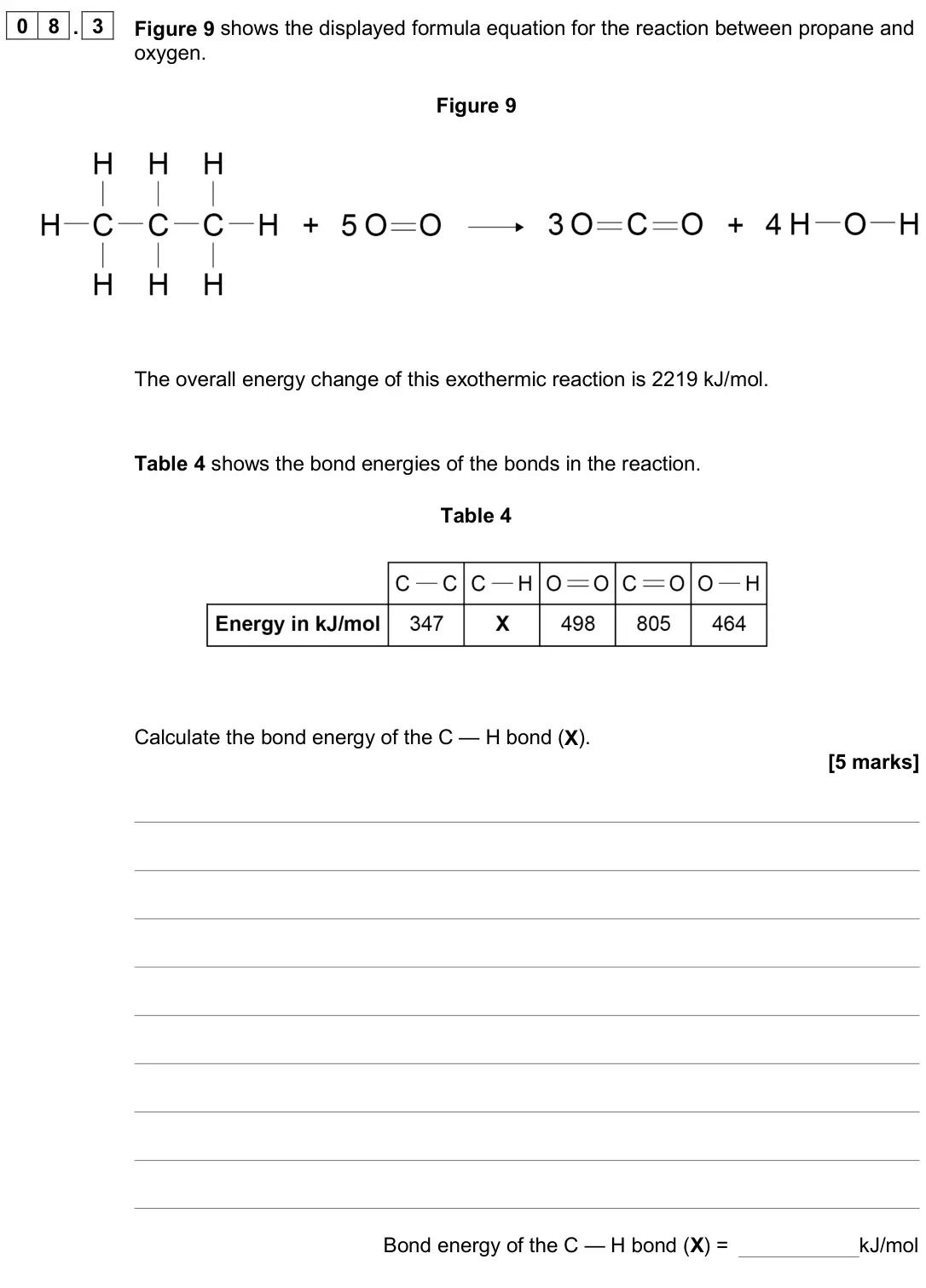
Q03.3
The whole paper ↗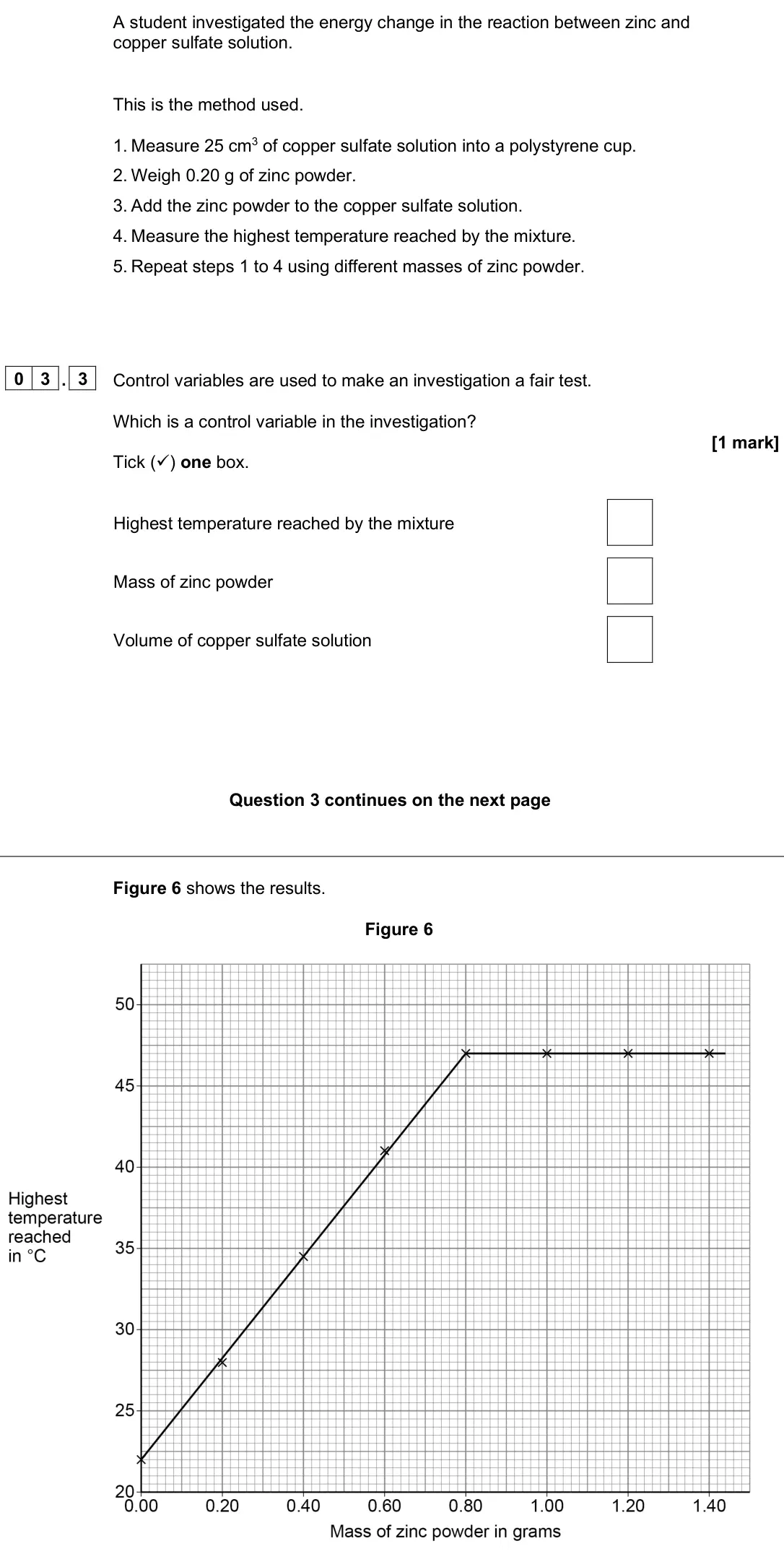
Q03.4
The whole paper ↗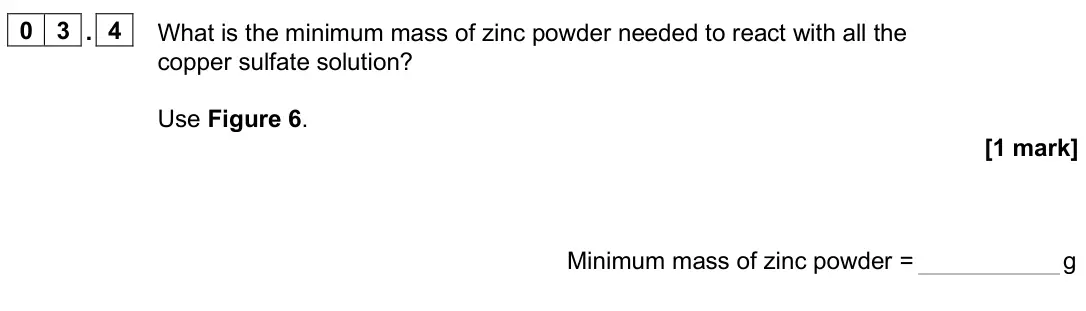
Q03.5
The whole paper ↗
Q03.7
The whole paper ↗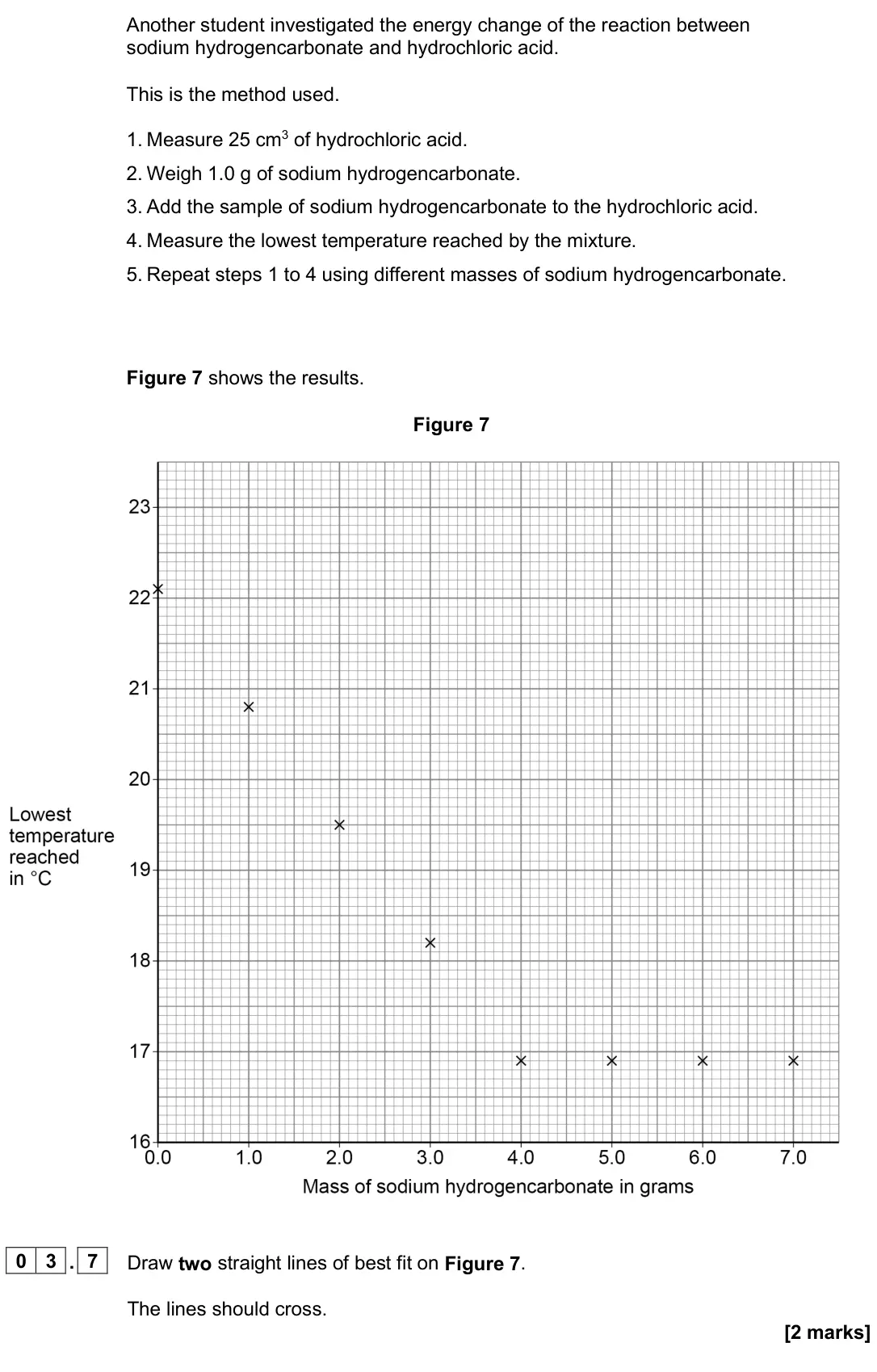
Q03.8
The whole paper ↗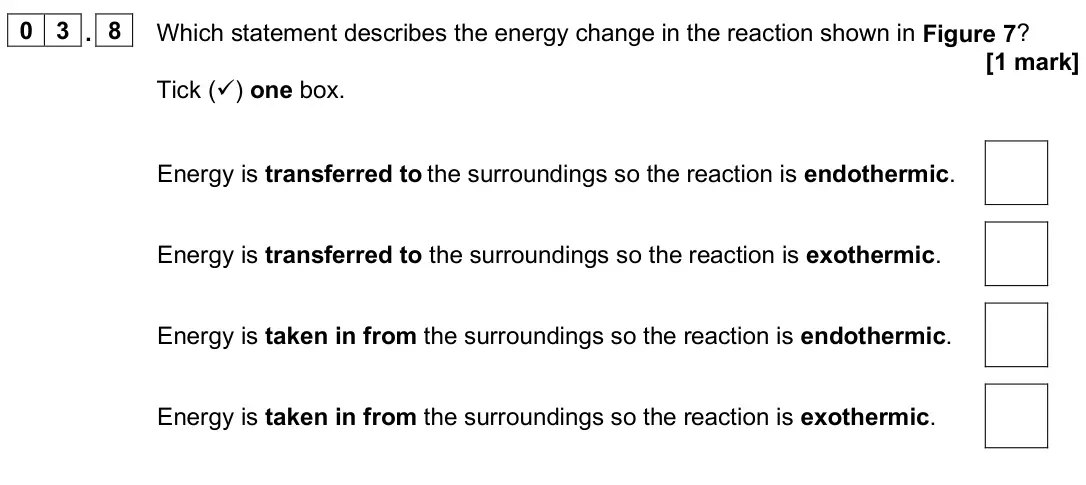
All 101 questions on Exothermic and endothermic reactions, as a list
- June 2025, Paper 1 Higher, Q07.4 (4 marks): Figure 8 shows the displayed formula equation for the reaction of hydrazine with oxygen. Figure 8 The reaction is exothermic. The energy released forming new bo
- June 2025, Paper 1 Foundation, Q02.3 (2 marks): Draw one line from the type of variable to the name of the variable in the investigation. [2 marks] Type of variable Name of variable Dependent variable Indepen
- June 2025, Paper 1 Foundation, Q02.4 (1 mark): Which container would be the most suitable to reduce energy transfer with the surroundings? [1 mark] Tick () one box. A copper can A glass beaker A polystyrene
- June 2025, Paper 1 Foundation, Q02.5 (1 mark): Figure 1 shows part of the scale of the thermometer used in the investigation. Figure 1 What is the resolution of the thermometer? [1 mark] Tick () one box. 1
- June 2025, Paper 1 Foundation, Q02.6 (1 mark): The reaction between a metal and an acid is exothermic. What happens to the temperature of the mixture during the reaction? [1 mark] Tick () one box. Decreases
- June 2025, Paper 1 Foundation, Q02.7 (1 mark): Which letter in Figure 2 represents the reactants? [1 mark] Tick () one box. A B C D E
- June 2025, Paper 1 Foundation, Q02.8 (1 mark): Which letter in Figure 2 represents the activation energy? [1 mark] Tick () one box. A B C D E
- June 2025, Paper 1 Foundation, Q02.9 (1 mark): Which letter in Figure 2 represents the overall energy change? [1 mark] Tick () one box. A B C D E
- June 2025, Paper 2 Foundation, Q03.3 (2 marks): When excess water is added to 20 g of calcium oxide, 23 kJ of energy is released. Calculate the energy released when excess water is added to 4 g of calcium oxi
- June 2024, Paper 1 Higher, Q04.1 (2 marks): Draw two lines of best fit on Figure 3. The lines should cross. [2 marks]
- June 2024, Paper 1 Higher, Q04.2 (4 marks): Explain the results shown in Figure 3. Do not refer to anomalous points. Use data from Figure 3. [4 marks]
- June 2024, Paper 1 Higher, Q04.3 (2 marks): Explain why using a polystyrene cup gives more accurate results than using a glass beaker. [2 marks]
- June 2024, Paper 1 Higher, Q04.6 (1 mark): The results show random errors. The student did not make any measuring errors. Suggest one reason for the random errors in this experiment. [1 mark]
- June 2024, Paper 1 Higher, Q08.2 (1 mark): Figure 8 shows four reaction profiles. Figure 8 Which is the correct reaction profile and labels for the reaction between propane and oxygen? Tick () one box.
- June 2024, Paper 1 Higher, Q08.3 (5 marks): Figure 9 shows the displayed formula equation for the reaction between propane and oxygen. Figure 9 The overall energy change of this exothermic reaction is 221
- June 2024, Paper 1 Foundation, Q03.3 (1 mark): Control variables are used to make an investigation a fair test. Which is a control variable in the investigation? [1 mark] Tick () one box. Highest temperatur
- June 2024, Paper 1 Foundation, Q03.4 (1 mark): What is the minimum mass of zinc powder needed to react with all the copper sulfate solution? Use Figure 6. [1 mark] Minimum mass of zinc powder = g
- June 2024, Paper 1 Foundation, Q03.5 (2 marks): What is the maximum temperature change in the reaction between zinc powder and 25 cm3 of copper sulfate solution? Use Figure 6. [2 marks] Maximum temperature ch
- June 2024, Paper 1 Foundation, Q03.7 (2 marks): Draw two straight lines of best fit on Figure 7. The lines should cross. [2 marks]
- June 2024, Paper 1 Foundation, Q03.8 (1 mark): Which statement describes the energy change in the reaction shown in Figure 7? [1 mark] Tick () one box. Energy is transferred to the surroundings so the react
- June 2023, Paper 1 Higher, Q02.1 (2 marks): Give the independent variable and the dependent variable in the investigation. [2 marks] Independent variable Dependent variable Table 2 shows the results. Tabl
- June 2023, Paper 1 Higher, Q02.2 (3 marks): Plot the data from Table 2 on Figure 2. Draw a line of best fit. [3 marks] Figure 2
- June 2023, Paper 1 Higher, Q02.3 (2 marks): Determine the initial temperature of the water. You should extend your line of best fit on Figure 2. [2 marks] Initial temperature of the water = °C
- June 2023, Paper 1 Higher, Q02.4 (1 mark): How do the results show that dissolving ammonium nitrate in water is endothermic? [1 mark] The student repeated the experiment three more times. Table 3 shows t
- June 2023, Paper 1 Higher, Q02.5 (2 marks): The student recorded the mean lowest temperature of the solution for 8.0 g of ammonium nitrate as 16.5 ± 0.3 ºC. Explain why the student included ± 0.3 ºC after
- June 2023, Paper 1 Higher, Q02.6 (1 mark): What type of error is shown by the results in Table 3? [1 mark] Tick () one box. Random error Systematic error Zero error
- June 2023, Paper 1 Higher, Q04.1 (1 mark): Which expression shows how to calculate the overall energy change for the reaction in Figure 3? Use Table 4. [1 mark] Tick () one box. 436 + 346 + 432 kJ/mol 4
- June 2023, Paper 1 Higher, Q04.2 (2 marks): Explain why this reaction releases energy to the surroundings. [2 marks]
- June 2023, Paper 1 Higher, Q04.3 (3 marks): Figure 4 shows part of a reaction profile for the reaction between hydrogen and chlorine. Complete the reaction profile in Figure 4. You should: • label the act
- June 2023, Paper 1 Foundation, Q10.1 (2 marks): Give the independent variable and the dependent variable in the investigation. [2 marks] Independent variable Dependent variable Table 6 shows the results. Tabl
- June 2023, Paper 1 Foundation, Q10.2 (3 marks): Plot the data from Table 6 on Figure 11. Draw a line of best fit. [3 marks] Figure 11
- June 2023, Paper 1 Foundation, Q10.3 (2 marks): Determine the initial temperature of the water. You should extend your line of best fit on Figure 11. [2 marks] Initial temperature of the water = °C
- June 2023, Paper 1 Foundation, Q10.4 (1 mark): How do the results show that dissolving ammonium nitrate in water is endothermic? [1 mark] The student repeated the experiment three more times. Table 7 shows t
- June 2023, Paper 1 Foundation, Q10.5 (2 marks): The student recorded the mean lowest temperature of the solution for 8.0 g of ammonium nitrate as 16.5 ± 0.3 ºC. Explain why the student included ± 0.3 ºC after
- June 2023, Paper 1 Foundation, Q10.6 (1 mark): What type of error is shown by the results in Table 7? [1 mark] Tick () one box. Random error Systematic error Zero error
- June 2022, Paper 1 Higher, Q02.1 (6 marks): Plan a method to investigate the effect of changing the mass of sodium carbonate powder on the highest temperature reached. [6 marks]
- June 2022, Paper 1 Higher, Q02.2 (5 marks): Determine the gradient of the line of best fit in Figure 3. Use the equation: Gradient = Change in highest temperature Change in mass Give the unit. [5 marks] G
- June 2022, Paper 1 Higher, Q02.3 (2 marks): The initial temperature of the reaction mixture is where the line of best fit would meet the y-axis. Determine the initial temperature of the reaction mixture.
- June 2022, Paper 1 Higher, Q02.4 (1 mark): Another student repeated the investigation but added sodium carbonate until the sodium carbonate was in excess. Which sketch graph shows the results obtained wh
- June 2022, Paper 1 Higher, Q02.5 (2 marks): What do labels X and Y represent on Figure 4? [2 marks] X Y
- June 2022, Paper 1 Higher, Q02.6 (1 mark): How does the reaction profile show that the reaction is exothermic? Use Figure 4. [1 mark]
- June 2022, Paper 1 Foundation, Q10.1 (6 marks): Plan a method to investigate the effect of changing the mass of sodium carbonate powder on the highest temperature reached. [6 marks]
- June 2022, Paper 1 Foundation, Q10.2 (5 marks): Determine the gradient of the line of best fit in Figure 17. Use the equation: Gradient = Change in highest temperature Change in mass Give the unit. [5 marks]
- June 2022, Paper 1 Foundation, Q10.3 (2 marks): The initial temperature of the reaction mixture is where the line of best fit would meet the y-axis. Determine the initial temperature of the reaction mixture.
- June 2022, Paper 1 Foundation, Q10.4 (1 mark): Another student repeated the investigation but added sodium carbonate until the sodium carbonate was in excess. Which sketch graph shows the results obtained wh
- June 2022, Paper 1 Foundation, Q10.5 (2 marks): What do labels X and Y represent on Figure 18? [2 marks] X Y
- June 2022, Paper 1 Foundation, Q10.6 (1 mark): How does the reaction profile show that the reaction is exothermic? Use Figure 18. [1 mark]
- November 2021, Paper 1 Higher, Q06.3 (4 marks): A student wants to compare the reactivity of an unknown metal, Q, with that of zinc. Both metals are more reactive than silver. The student is provided with: •
- November 2021, Paper 1 Higher, Q08.3 (3 marks): Figure 6 shows part of the reaction profile for the reaction. The reaction is exothermic. Complete Figure 6. You should: • complete the profile line • label the
- November 2021, Paper 1 Higher, Q08.4 (5 marks): Figure 7 shows the displayed formula equation for the reaction of hydrogen sulfide with oxygen. Figure 7 Table 5 shows some of the bond energies. Table 5 Bond E
- November 2021, Paper 1 Foundation, Q04.1 (2 marks): Calculate the mean temperature increase X for magnesium in Table 4. Do not include the anomalous result in your calculation. [2 marks] X = °C
- November 2021, Paper 1 Foundation, Q04.4 (1 mark): What type of variable is the volume of hydrochloric acid in this investigation? [1 mark] Tick () one box. Control Dependent Independent
- November 2021, Paper 1 Foundation, Q04.5 (1 mark): Suggest one way of improving step 3 in the method to give results which are more repeatable. [1 mark]
- November 2021, Paper 1 Foundation, Q04.6 (3 marks): Figure 6 shows a reaction profile for the reaction of magnesium with hydrochloric acid. Figure 6 What do labels A, B and C represent on Figure 6? Choose answers
- November 2020, Paper 1 Higher, Q02.3 (4 marks): A student is given three metals, X, Y and Z to identify. The metals are magnesium, iron and copper. Plan an investigation to identify the three metals by compar
- November 2020, Paper 1 Higher, Q06.1 (1 mark): The displacement reaction between aluminium and iron oxide has a high activation energy. What is meant by ‘activation energy’? [1 mark]
- November 2020, Paper 1 Higher, Q07.1 (2 marks): A student drew a reaction profile for the reaction between hydrogen and oxygen. Figure 3 shows the student’s reaction profile. Figure 3 The student made two err
- November 2020, Paper 1 Higher, Q09.1 (1 mark): Figure 6 shows an anomalous point when 0.60 g of citric acid was added. This was caused by the student making an error. The student correctly: • measured the ma
- November 2020, Paper 1 Higher, Q09.2 (3 marks): Explain the shape of the graph in terms of the energy transfers taking place. You should use data from Figure 6 in your answer. [3 marks]
- November 2020, Paper 1 Higher, Q09.3 (3 marks): A second student repeated the investigation using a metal container instead of the polystyrene cup. The container and the cup were the same size and shape. Sket
- November 2020, Paper 1 Foundation, Q03.2 (4 marks): Figure 3 shows a reaction profile for the reaction between hydrogen and oxygen. Figure 3 What do the labels W, X, Y and Z represent? Choose answers from the box
- November 2020, Paper 1 Foundation, Q06.4 (1 mark): How do the results in Table 4 show that the reaction is endothermic? [1 mark]
- November 2020, Paper 1 Foundation, Q06.5 (4 marks): Three of the student’s results are plotted on Figure 9. A line of best fit for these points is drawn. Complete Figure 9. You should: • plot the data from Table
- November 2020, Paper 1 Foundation, Q06.6 (2 marks): Determine the overall temperature change for the reaction. Use Figure 9. [2 marks] Overall temperature change = °C
- November 2020, Paper 1 Foundation, Q06.7 (1 mark): What is the dependent variable in this investigation? [1 mark] Tick () one box. Mass of citric acid Temperature of solution Volume of solution
- November 2020, Paper 1 Foundation, Q09.3 (4 marks): A student is given three metals, X, Y and Z to identify. The metals are magnesium, iron and copper. Plan an investigation to identify the three metals by compar
- June 2019, Paper 1 Higher, Q05.5 (3 marks): Calculate the overall energy change for the reaction. Use Figure 7 and Table 3. [3 marks] Overall energy change = kJ
- June 2019, Paper 1 Higher, Q05.6 (2 marks): Explain why the reaction between ammonia and oxygen is exothermic. Use values from your calculation in Question 05.5 [2 marks]
- June 2019, Paper 1 Higher, Q05.7 (2 marks): Figure 8 shows the reaction profile for the reaction between ammonia and oxygen. Complete Figure 8 by labelling the: • activation energy • overall energy change
- June 2019, Paper 1 Higher, Q09.1 (2 marks): Suggest why the student used a polystyrene cup rather than a glass beaker for the reaction. [2 marks]
- June 2019, Paper 1 Higher, Q09.2 (4 marks): Complete Figure 11: • plot the data from Table 6 • draw a line of best fit through these points • extend the lines of best fit until they cross. [4 marks]
- June 2019, Paper 1 Higher, Q09.3 (1 mark): Determine the volume of dilute sulfuric acid needed to react completely with 25.0 cm3 of the potassium hydroxide solution. Use Figure 11. [1 mark] Volume of dil
- June 2019, Paper 1 Higher, Q09.4 (1 mark): Determine the overall temperature change when the reaction is complete. Use Figure 11. [1 mark] Overall temperature change = °C
- June 2019, Paper 1 Foundation, Q02.4 (1 mark): and 02.5 0 2 . 4 Which label shows the activation energy? [1 mark] Tick () one box. A B C D
- June 2019, Paper 1 Foundation, Q02.5 (1 mark): Which label shows the energy of hydrogen peroxide? [1 mark] Tick () one box. A B C D
- June 2019, Paper 1 Foundation, Q02.6 (1 mark): The decomposition of hydrogen peroxide gives out energy to the surroundings. What type of reaction is this? [1 mark] Tick () one box. Displacement Endothermic
- June 2019, Paper 1 Foundation, Q07.1 (1 mark): Ammonium nitrate dissolves in water. The change is endothermic. Which piece of equipment uses this change? [1 mark] Tick () one box. Hand warmer Self-heating c
- June 2019, Paper 1 Foundation, Q07.2 (1 mark): Figure 9 shows part of the scales of four thermometers, A, B, C and D. Figure 9 The student wanted to measure the temperature to a resolution of 0.1 °C Which th
- June 2019, Paper 1 Foundation, Q07.3 (1 mark): Energy is lost to the surroundings during the reaction. What type of error does this cause in the results? [1 mark] Tick () one box. Human error Random error S
- June 2019, Paper 1 Foundation, Q07.4 (1 mark): The student used a glass beaker for the reaction. Name a container the student could use instead of the glass beaker to improve the accuracy of the results. [1
- June 2019, Paper 1 Foundation, Q07.5 (4 marks): Table 3 shows the student’s results. Table 3 Volume of dilute sulfuric acid added in cm3 Temperature in °C 5 21.2 10 22.0 15 22.8 20 23.6 25 24.4 30 25.2 Plot t
- June 2019, Paper 1 Foundation, Q07.6 (1 mark): The intercept on the y-axis of Figure 10 shows the starting temperature of the potassium hydroxide solution. Give the starting temperature of the potassium hydr
- June 2019, Paper 1 Foundation, Q07.7 (2 marks): Another student repeated the investigation and obtained an anomalous result. This result was lower than expected. What could have caused the anomalous result? [
- June 2018, Paper 1 Higher, Q05.1 (2 marks): Plot the data from Table 2 on Figure 4 as a bar chart. [2 marks] Figure 4
- June 2018, Paper 1 Higher, Q05.2 (1 mark): The student concluded that the reactions between the metals and copper sulfate solution are endothermic. Give one reason why this conclusion is not correct. [1
- June 2018, Paper 1 Higher, Q05.3 (4 marks): The temperature change depends on the reactivity of the metal. The student’s results are used to place copper, iron, magnesium and zinc in order of their reacti
- June 2018, Paper 1 Higher, Q05.4 (3 marks): Draw a fully labelled reaction profile for the reaction between zinc and copper sulfate solution on Figure 5. [3 marks] Figure 5
- June 2018, Paper 1 Higher, Q07.4 (4 marks): Bromine reacts with methane in sunlight. Figure 9 shows the displayed formulae for the reaction of bromine with methane. Figure 9 Table 3 shows the bond energie
- June 2018, Paper 1 Foundation, Q06.1 (2 marks): Draw one line from each type of variable to the name of the variable in the investigation. [2 marks] Type of variable Name of variable in the investigation Depe
- June 2018, Paper 1 Foundation, Q06.2 (1 mark): The student used a polystyrene cup and not a glass beaker. Why did this make the investigation more accurate? [1 mark] Tick one box. Glass is breakable Glass is
- June 2018, Paper 1 Foundation, Q06.3 (2 marks): Complete Figure 9. Use data from Table 5. [2 marks] Figure 9
- June 2018, Paper 1 Foundation, Q06.4 (1 mark): The student concluded that the reactions between the metals and copper sulfate solution are endothermic. Give one reason why this conclusion is not correct. [1
- June 2018, Paper 1 Foundation, Q06.5 (1 mark): The temperature increase depends on the reactivity of the metal. Write the metals magnesium, nickel and zinc in order of reactivity. Use Table 5. [1 mark] Most
- June 2018, Paper 1 Foundation, Q06.6 (3 marks): Y is an unknown metal. Describe a method to find the position of Y in the reactivity series in Question 06.5 [3 marks]
- June 2018, Paper 1 Foundation, Q06.7 (1 mark): Which letter represents the products of the reaction? [1 mark] Tick one box. A B C D E
- June 2018, Paper 1 Foundation, Q06.8 (1 mark): Which letter represents the activation energy? [1 mark] Tick one box. A B C D E
- Specimen, Paper 1 Higher, Q09.1 (3 marks): Complete the reaction profile in Figure 6. Draw labelled arrows to show: • The energy given out (∆H) • The activation energy. [3 mark Figure 6 3
- Specimen, Paper 1 Higher, Q09.3 (3 marks): Use the information in Table 6 and Figure 7 to calculate the bond energy for the Br−Br bond. [3 marks] Bond energy kJ/mole 3
- Specimen, Paper 1 Higher, Q09.4 (6 marks): Figure 8 shows the reaction between ethene and chlorine and is similar to the reaction between ethene and bromine. Figure 8 “The more energy levels (shells) of
- Specimen, Paper 1 Foundation, Q05.1 (1 mark): Look at Figure 8. How can you tell that a chemical reaction is taking place?
- Specimen, Paper 1 Foundation, Q05.3 (1 mark): 0 5 Figure 8 shows magnesium burning in air. Figure 8 The reaction is reversible The reaction has a high activation energy The reaction is exothermic Magnesium
Questions, mark schemes and examiner’s reports are © AQA, from their published past papers. Plumi isn’t affiliated with any exam board. Want whole papers? Every AQA GCSE Chemistry paper.
Rather write your answers by hand on iPad? Plumi marks them against the same mark schemes.